
Judge, 1926-05-29 · page 15 of 36
Judge — May 29, 1926 — page 15: what you’re looking at
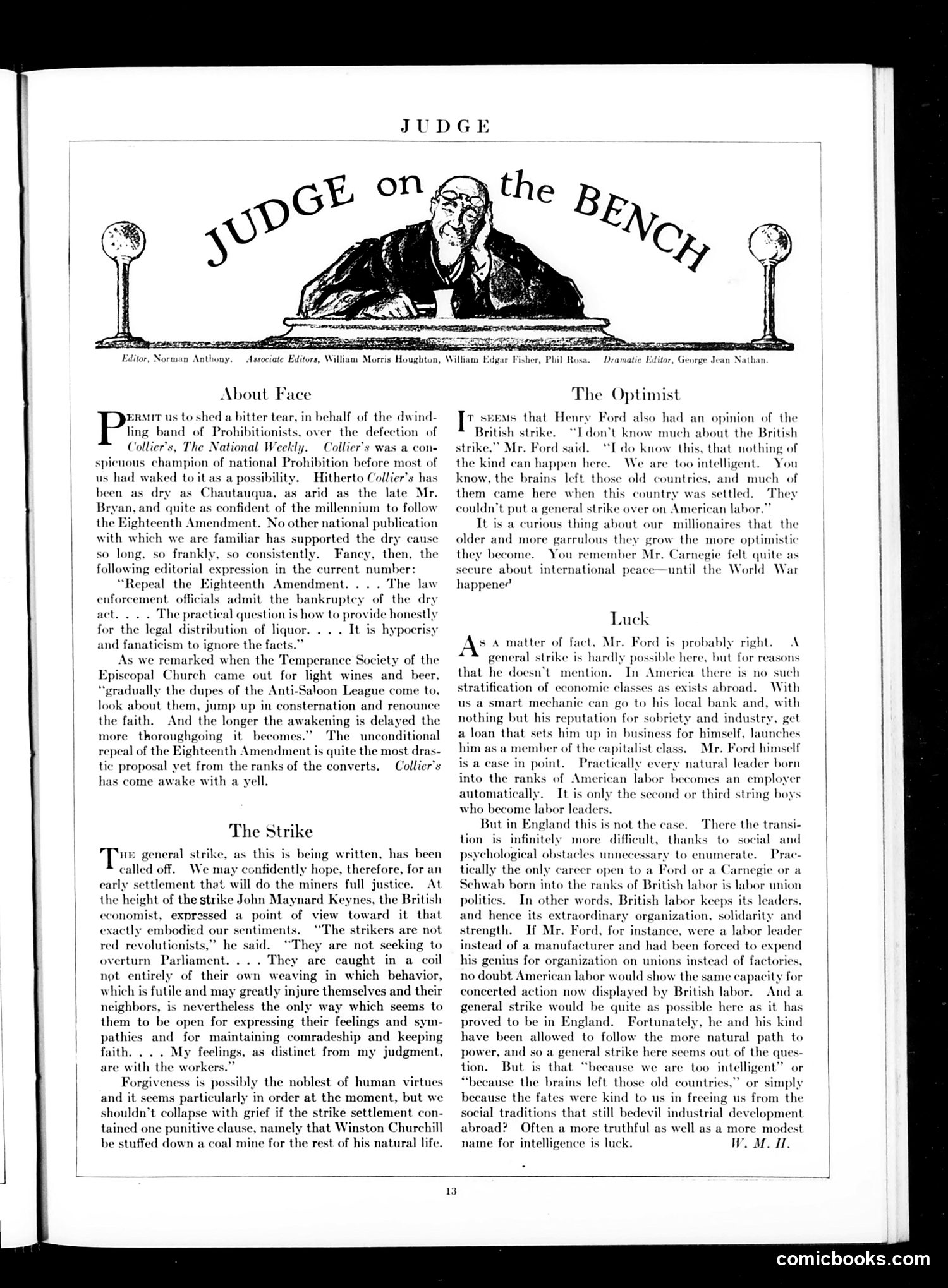
What you’re looking at
This page contains three editorial essays, not cartoons. The masthead shows a judge at a bench, illustrating the publication's satirical voice on current events. The pieces address: 1. **"About Face"**: Mocks *Collier's* magazine's reversal on Prohibition. Judge celebrates that even die-hard dry advocates now admit alcohol prohibition has failed and call for repeal—a dramatic shift Judge finds amusing. 2. **"The Strike"**: References a British general strike (likely 1926). Judge supports the miners' grievances but expresses relief at settlement. It sarcastically suggests punishing Winston Churchill (then a political figure opposing labor) by sending him down a coal mine. 3. **"The Optimist"**: Quotes Henry Ford dismissing British labor unrest, claiming America's "intelligent" immigrants prevent such trouble. Judge gently disputes this, noting America lacks rigid class divisions that breed European labor militancy—suggesting Ford's confidence, while possibly correct, rests on faulty reasoning rather than superiority.
📄 Transcribed text from this page (OCR, searchable)
Machine-transcribed from the original scan — historical spelling and the odd misread are preserved.
JUDGE Editor, Norman Anth About Face ERMIT us to shed a bitter tear, in behalf of the dwind- Pins band of Prohibitionists, over the defection of Collier's, The National Weekly. Collier's was a cons spicuous champion of national Prohibition before most of us had waked to it as a possibility. Hitherto Collier's has been as dry as Chautauqua, as arid as the late Mr. Bryan, and quite as confident of the millennium to follow the Eighteenth Amendment. No other national publication with which we are familiar has supported the dry cause so long, so frankly, so consistently. Fancy, then, the following editorial expression in the current number: “Repeal the Eighteenth Amendment. . .. The law enforcement officials admit the bankruptcy of the dry act. . . . The practical question is how to provide honestly for the legal distribution of liquor. and fanaticism to ignore the facts.” As we remarked when the Temperance Society of the Episcopal Church came out for light wines and beer, “gradually the dupes of the Anti-Saloon League come to, look about them, jump up in consternation and renounce the faith. And the longer the awakening is delayed the more thoroughgoing it becomes. The unconditional repeal of the Eighteenth Amendment is quite the most dras- tie proposal yet from the ranks of the converts, Collier's has come awake with a yell. . «It is hypocrisy The Strike ue general strike, as this is being written, has been called off. We may confidently hope, therefore, for an early settlement that will do the miners full justice. At the height of the strike John Maynard Keynes, the British economist, expressed a point of view toward it that exactly embodied our sentiments. “The strikers are not red revolutionists,” he said. “They are not seeking to overturn ament. ... They are caught in a coil not entirely of their own weaving in which behavior, which is futile and may greatly injure themselves and their neighbors, is nevertheless the only way which seems to them to be open for expressing their feelings and sym- pathies and for maintaining comradeship and keeping faith... . My feelings, as distinct from my judgment, are with the workers.” Forgiveness is possibly the noblest of human virtues and it seems particularly in order at the moment, but we shouldn't collapse with grief if the strike settlement con- tained one punitive clause, namely that Winston Churchill be stuffed down a coal mine for the rest of his natural life. Associate Editors, William Morris Houghton, William Edgar Fisher, Phil Rosa. Dramatic Editor, George Jean Nathan The Optimist I sEEMS that Henry Ford also had an opinion of the British strike. “Idon’t know much about the British strike,” Mr. Ford said. “Ido know this, that nothing of the kind can happen here. We are too intelligent. You know, the brains left those old countries, and much of them came here when this country was settled. They couldn’t put a general strike over on American labor.” It is a curious thing about our millionaires that the older and more garrulous they grow the more optimistic they become. You remember Mr. Carnegie felt quite as secure about international peace—until the World War happene? Luck As A matter of fact, Mr. Ford is probably right. A . general strike is that he doesn’t ly possible here, but for reasons mention. In America there is no such stratification of economic classes as exists abroad. With us a smart mechanie can go to his local bank and, with nothing but his reputation for sobriety and industry, get a loan that sets him up in business for himself, launches him asa member of the capitalist class. Mr. Ford himself is a case in point. Practically every natural leader born into the ranks of American labor becomes an employer automatically. It is only the second or third string boys who become labor leaders. But in England this is not the case. ‘There the transi- tion is infinitely thanks to psychological obstacles unnecessary to enumerate, tically the only career open to a Ford or a Carnegie or a Schwab born into the ranks of British labor is labor union polities. In other words, British labor keeps its and hence its extraordinary organization, solidarity and strength. If Mr. Ford, for instance, were a labor leader instead of a manufacturer and had been forced to expend his genius for organization on unions instead of factories, no doubt American labor would show the same capacity for concerted action now displayed by British labor. And a general strike would be quite as possible here as it has proved to be in England. Fortunately, he and his kind have been allowed to follow the more natural path to power, and so a gencral strike here seems out of the ques- tion. But is that “because we are too intelligent” or “because the brains left those old countries,” or simply because the fates were kind to us in freeing us from the social traditions that still bedevil industrial development abroad? Often a more truthful as well as a more modest W. Mf. HL. social and Prac- more difficult, aders, name for intelligence is luck. comicbooks.com