
Judge, 1926-05-29 · page 20 of 36
Judge — May 29, 1926 — page 20: what you’re looking at
What you’re looking at
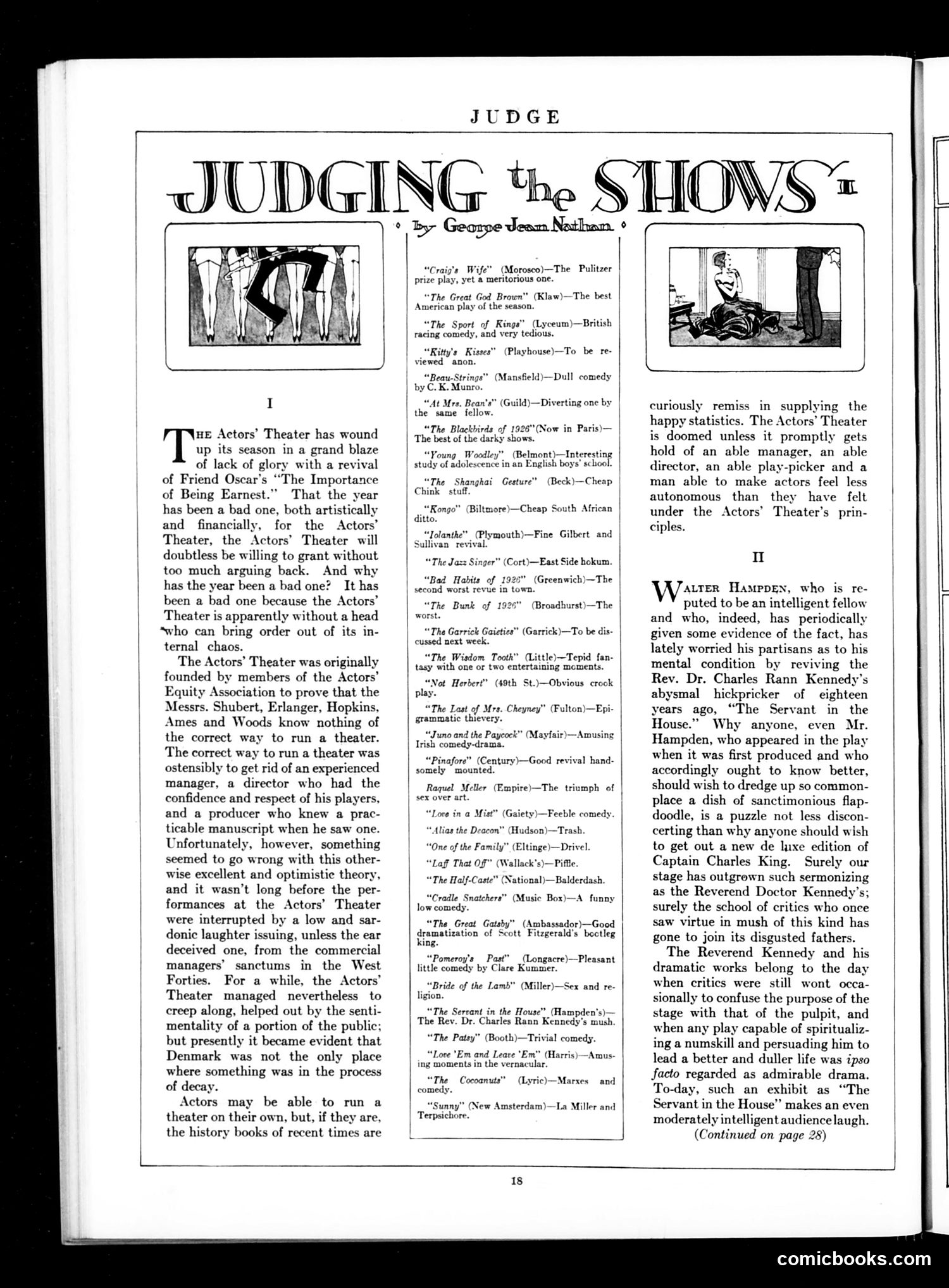
This page is primarily a theater review column by George Jean Nathan, a prominent drama critic. The two small photographs show theatrical scenes, but the main content is Nathan's critical assessment of the Actors' Theater's failed season. **The satire:** Nathan mocks the Actors' Theater—founded by members of Actors' Equity to prove established theater producers (Shubert, Erlanger, Hopkins, et al.) didn't know how to run theaters—for ironically failing precisely because it lacked experienced management. The theater attempted to operate without a professional manager, director, or experienced producer, replacing them with actors. Nathan sardonically notes this "otherwise excellent and optimistic theory" collapsed, and the commercial producers in the "West Forties" were apparently amused by the failure. The second section reviews current Broadway productions with Nathan's characteristically caustic one-liners, dismissing many as "trash," "hokum," and "balderdash." This demonstrates his acerbic critical style typical of Judge magazine's theater commentary.
📄 Transcribed text from this page (OCR, searchable)
Machine-transcribed from the original scan — historical spelling and the odd misread are preserved.
JUDGE JUDGING ‘be SHOWS ™ r I NueE Actors’ Theater has wound up its season in a grand blaze of lack of glory with a revival of Friend Oscar's “The Importance of Being Earnest.” That the year has been a bad one, both artistically and financially, for the Actors’ Theater, the Actors’ Theater will doubtless be willing to grant without too much arguing back. And why has the year been a bad one? It has been a bad one because the Actors’ Theater is apparently without a head “who can bring order out of its in- ternal chaos. The Actors’ Theater was originally founded by members of the Actors’ Equity Association to prove that the Messrs. Shubert, Erlanger, Hopkins, Ames and Woods know nothing of the correct way to run a theater. The correct way to run a theater was ostensibly to get rid of an experienced manager, a director who had the confidence and respect of his players, and a producer who knew a prac- ticable manuscript when he saw one. Unfortunately, however, something seemed to go wrong with this other- wise excellent and optimistie theory, and it wasn’t long before the per- formances at the Actors’ Theater were interrupted by a low and sar- donic laughter issuing, unless the ear deceived one, from the commercial managers’ sanctums in the West Forties. For a while, the Actors’ Theater managed nevertheless to creep along, helped out by the senti- mentality of a portion of the public; but presently it became evident that Denmark was not the only place where something was in the process of decay. Actors may be able to run a theater on their own, but, if they are, the history books of recent times are “Craig's Wife” (Morosco)—The Pulitzer prize play, yet meritorious one. “The Great God Brown" (Klaw)—The best American play of the season. “The Sport of Kings” (Lyceum)—British racing comedy, and very tedious. “Kitty's Kisses” (Playhouse)—To be re- viewed anon. “Beau-Strings” (Mansfield)—Dull comedy by C.K. Munro. “At Mra. Bean's” (Guild)—Diverting one by the same fellow. “The Blackbirds of 1926"(Now in Paris)— | ‘The best of the darky shows. “Young Woodley” (Belmont)—Interesting study of adolescence in an English boys’ school. | “The Shanghai Gesture” (Beck)—Cheap Chink stuff. ditto. “Jolanthe” (Plymouth)—Fine Gilbert and Sullivan revival. “The Jazz Singer” (Cort)—East Side hokum. “Bad Habits of 1926" (Greenwich)—The second worst revue in town. “The Bunk of 1926” (Broadhurst)—The | worst. “The Garrick Gaieties” (Garrick)—To be dis- cussed next week. “The Wisdom Tooth” (Little)—Tepid fan- tasy with one or two entertaining moments. Vot Herbert” (49th St.)—Obvious crook pl “The Last of Mrs. Cheyney” (Fulton)—Epi- grammatic thievery. “Juno and the Paycock” (Mayfair)—Amusing Irish comedy-drama. “Pinafore” (Century)—Good revival hand- somely mounted. Raquel Meller (Empire)—The triumph of | sex over art. “Lore in a Mist” (Gaiety)—Feeble comedy. | “Alias the Deacon" (Hudson)—Trash. “One of the Family” (Eltinge)—Drivel. “Laff That OF” (Wallack’s)—Piffle “The Half-Caste” (National)—Balderdash “Cradle Snatchers” (Music Box)—A funny low comedy. “The Great Gatsby” (Ambassador)—Good dramatization of Scott Fitzgerald's bectleg ing. “Pomeroy’s Past” (Longacre)—Pleasant little comedy by Clare Kummer. “Bride of the Lamb” (Miller)—Sex and re- ligion. “The Sercant in the House” (Hampden's)— The Rev. Dr. Charles Rann Kennedy's mush. “The Patsy” (Booth)—Trivial comedy. “Lore ‘Em and Leare ‘Em" (Harris) —Amus- ing moments in the vernacular. “The Cocoanuts” (Lyric)—Marxes and comedy. “Sunny” (New Amsterdam)—La Miller and | Terpsichore. “Kongo” (Biltmore)—Cheap South African | e curiously remiss in supplying the happy statistics. The Actors’ Theater is doomed unless it promptly gets hold of an able manager, an able director, an able play-picker and a man able to make actors feel less autonomous than they have felt under the Actors’ Theater’s prin- ciples. Il ALTER HamppeN, who is re- puted to be an intelligent fellow and who, indeed, has _ periodically given some evidence of the fact, has lately worried his partisans as to his mental condition by reviving the Rev. Dr. Charles Rann Kennedy's abysmal hickpricker of eighteen years ago, “The Servant in the House.” Why anyone, even Mr. Hampden, who appeared in the play when it was first produced and who accordingly ought to know better, should wish to dredge up so common- place a dish of sanctimonious flap- doodle, is a puzzle not less discon- certing than why anyone should wish to get out a new de luxe edition of Captain Charles King. Surely our stage has outgrown such sermonizing as the Reverend Doctor Kennedy’s; surely the school of critics who once saw virtue in mush of this kind has gone to join its disgusted fathers. The Reverend Kennedy and his dramatic works belong to the day when critics were still wont occa- sionally to confuse the purpose of the stage with that of the pulpit, and when any play capable of spiritualiz- ing a numskill and persuading him to lead a better and duller life was ipso facto regarded as admirable drama. To-day, such an exhibit as “The Servant in the House” makes an even moderately intelligent audience laugh. (Continued on page 28) comicbooks.com