
Judge, 1926-05-29 · page 16 of 36
Judge — May 29, 1926 — page 16: what you’re looking at
What you’re looking at
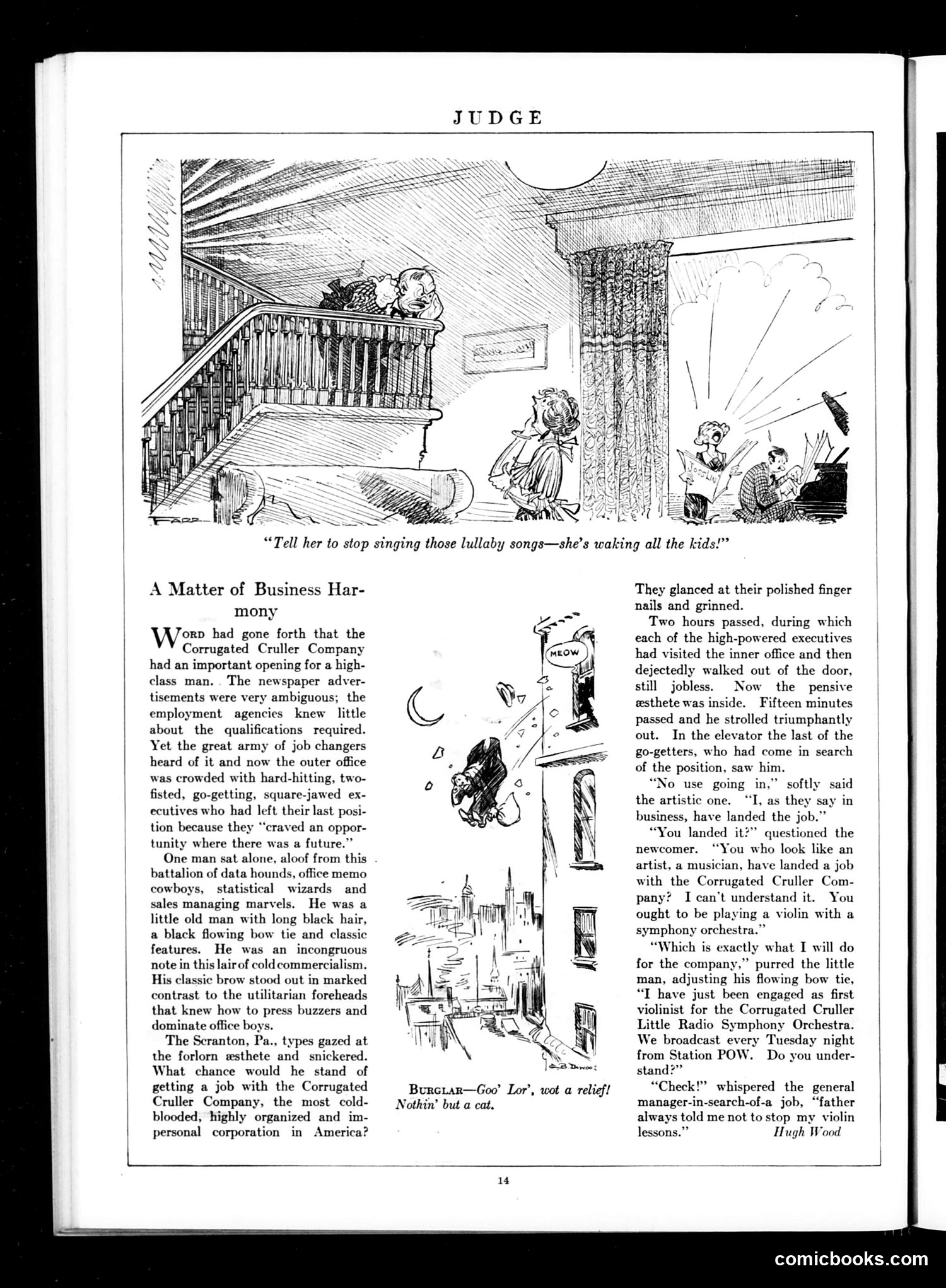
This Judge cartoon satirizes early 20th-century corporate culture and hiring practices. An artistic man with classical features—appearing as a musician or aesthete—sits alone while aggressive, ambitious "go-getter" businessmen crowd the waiting room for a position at the Corrugated Cruller Company (a fictional firm representing soulless corporate America). The joke: all the hard-nosed executives are rejected, but the artistic musician gets hired—not despite his impracticality, but *because* of it. He's hired as a violinist for the company's radio symphony orchestra, a broadcasting venture. The satire mocks how rigid corporate hierarchies miss obvious fits while pursuing stereotypical "business types," and how even supposedly cold, impersonal corporations needed culture and entertainment to seem modern and sophisticated. The "aesthetic one" triumphs precisely by being the opposite of the ruthless businessman archetype—a pointed commentary on what 1920s-30s executives actually valued.
📄 Transcribed text from this page (OCR, searchable)
Machine-transcribed from the original scan — historical spelling and the odd misread are preserved.
JUDGE “Tell her to stop singing those lullaby songs—she’s waking all the kids!” A Matter of Business Har- mony Wee had gone forth that the Corrugated Cruller Company had an important opening for a high- class man... The newspaper adver- tisements were very ambiguous; the employment agencies knew little about the qualifications required. Yet the great army of job changers heard of it and now the outer office was crowded with hard-hitting, two- fisted, go-getting, square-jawed ex- ecutives who had left their last posi- tion because they “craved an oppor- tunity where there was a future.” One man sat alone, aloof from this battalion of data hounds, office memo cowboys, statistical wizards and sales managing marvels. He was a little old man with long black hair, a black flowing bow tie and classic features. He was an incongruous note in this lairof coldcommercialism. His classic brow stood out in marked contrast to the utilitarian foreheads that knew how to press buzzers and dominate office boys. The Scranton, Pa., types gazed at the forlorn westhete and snickered. What chance would he stand of getting a job with the Corrugated Cruller Company, the most cold- blooded, highly organized and im- personal corporation in America? BurcLar—Goo’ Lor’, wot a relief! Nothin’ but a cat. They glanced at their polished finger nails and grinned. Two hours passed, during which each of the high-powered executives had visited the inner office and then dejectedly walked out of the door, still jobless. Now the pensive esthete was inside. Fifteen minutes passed and he strolled triumphantly out. In the elevator the last of the go-getters, who had come in search of the position, saw him. “No use going in,” softly said the artistic one. “I, as they say in business, have landed the job.” “You landed it?” questioned the newcomer. “You who look like an artist, a musician, have landed a job with the Corrugated Cruller Com- pany? I can’t understand it. You ought to be playing a violin with a symphony orchestra.” “Which is exactly what I will do for the company,” purred the little man, adjusting his flowing bow tie, “I have just been engaged as first violinist for the Corrugated Cruller Little Radio Symphony Orchestra. We broadcast every Tuesday night from Station POW. Do you under- stand?” “Check!” whispered the general manager-in-search-of-a job, “father always told me not to stop my violin lessons.” Hugh Wood comicbooks.com