
A complete issue · 36 pages · 1926
Judge — April 24, 1926
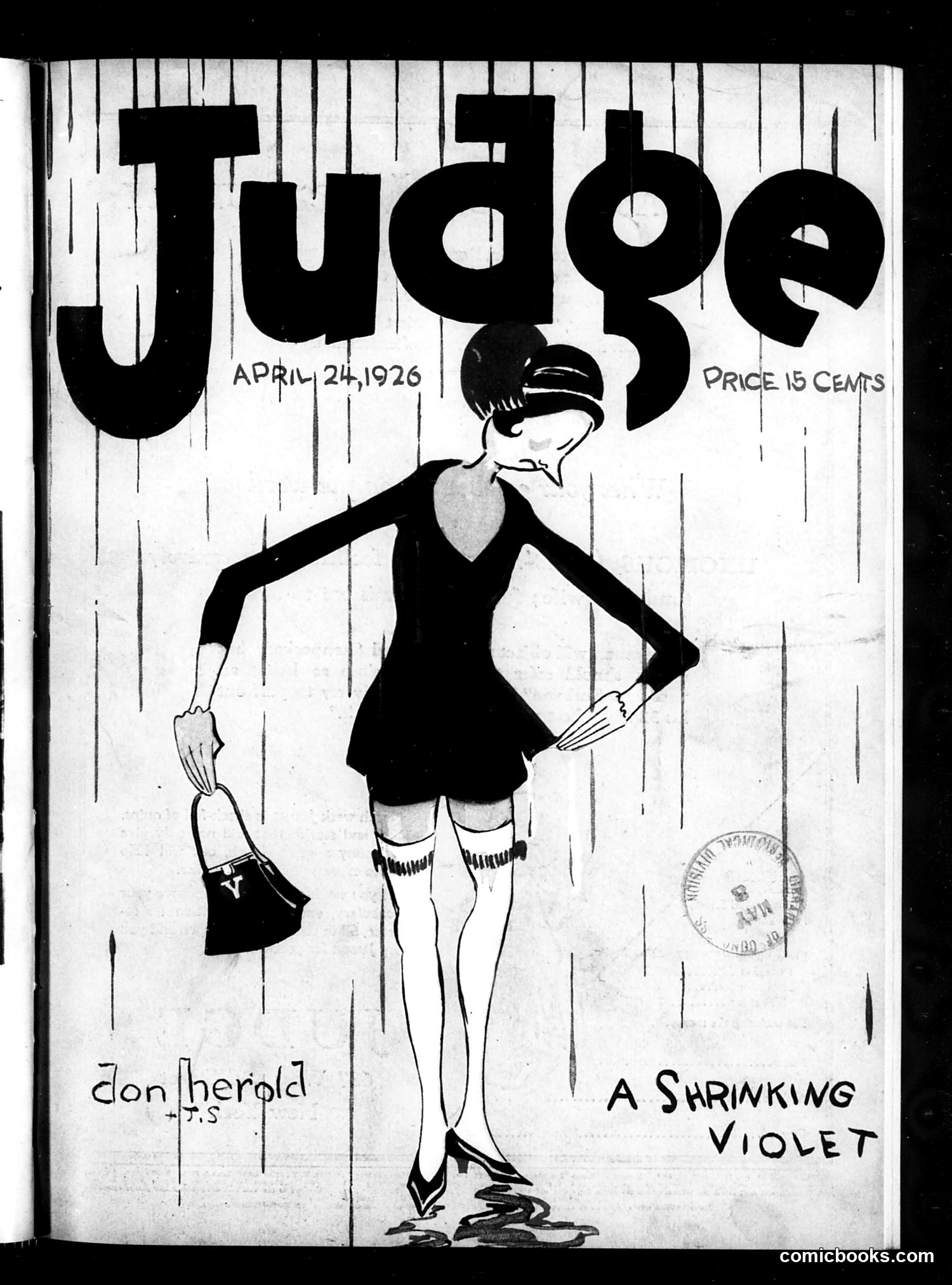
This is a cover illustration by Don Herold titled "A Shrinking Violet." The cartoon depicts a fashionable young woman in 1920s attire—short dress, cloche hat, and heeled shoes—standing in the rain while holding a handbag. The title puns on the phrase "shrinking violet" (meaning a shy, modest person), as the woman's dress appears to be literally shrinking or becoming smaller, likely due to water exposure. This satirizes the fashion and social contradictions of 1920s "flapper" culture: women adopting bold, revealing styles while society still expected feminine modesty. The joke suggests that even these supposedly liberated women's clothing couldn't withstand practical reality—hence the "shrinking" reference. It's social commentary on the gap between progressive fashion and conservative expectations.
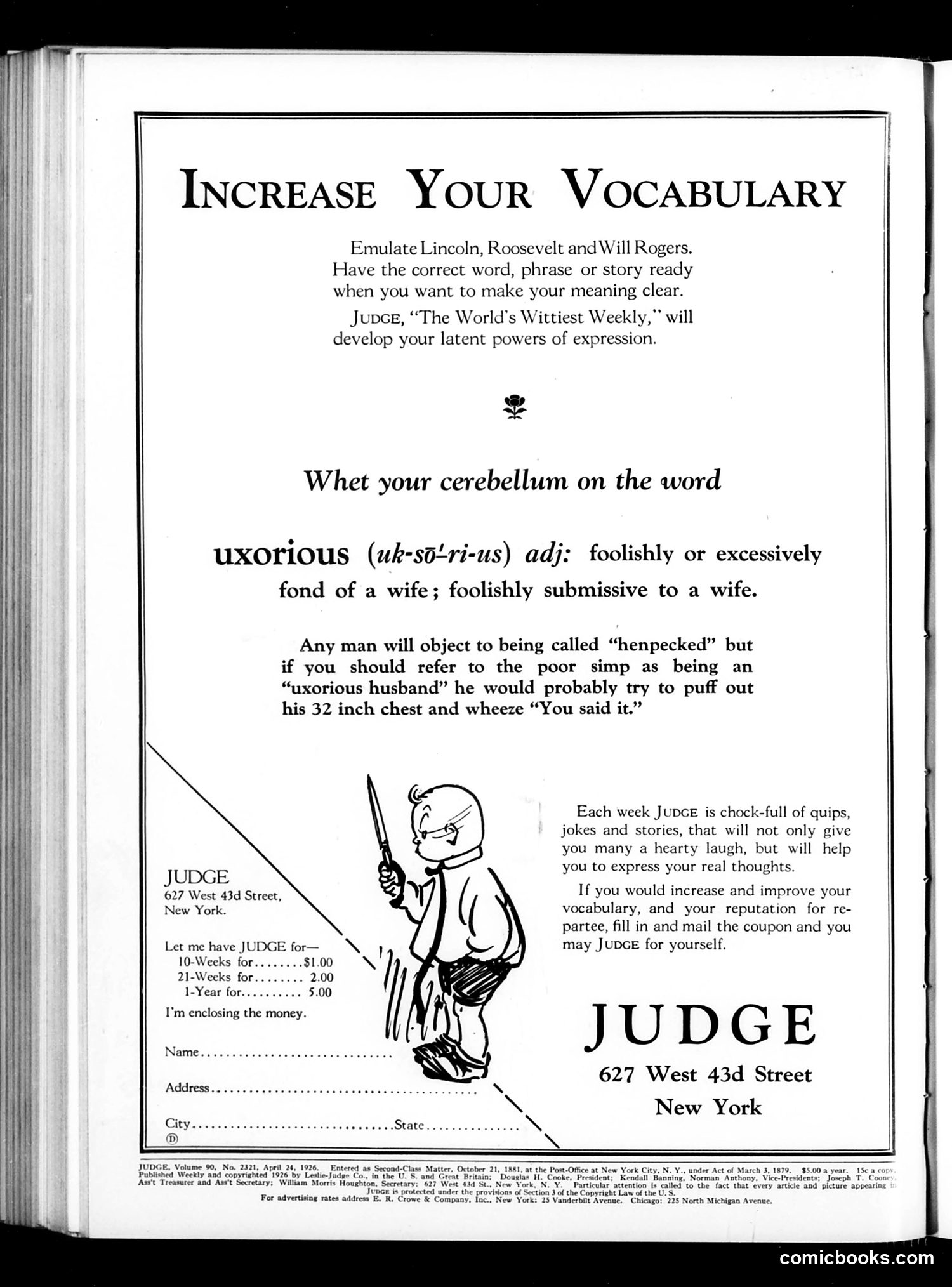
This page is primarily **advertising content** for Judge magazine's vocabulary-building feature. The main element is a definition lesson on the word "uxorious" (excessively fond of one's wife). The accompanying cartoon depicts a man wielding a sword in an exaggerated, aggressive pose. The humor relies on a gender stereotype: the advertisement suggests that a man called "uxorious" (submissive to his wife) would defensively boast about his masculinity—puffing out his chest—rather than accept the label. This reflects early-20th-century attitudes about male dominance and marital hierarchy. The satire targets men who appear weak or overly accommodating to wives, presenting this as worthy of ridicule. The cartoon mocks both uxorious husbands and their hypersensitive reactions to being so labeled.
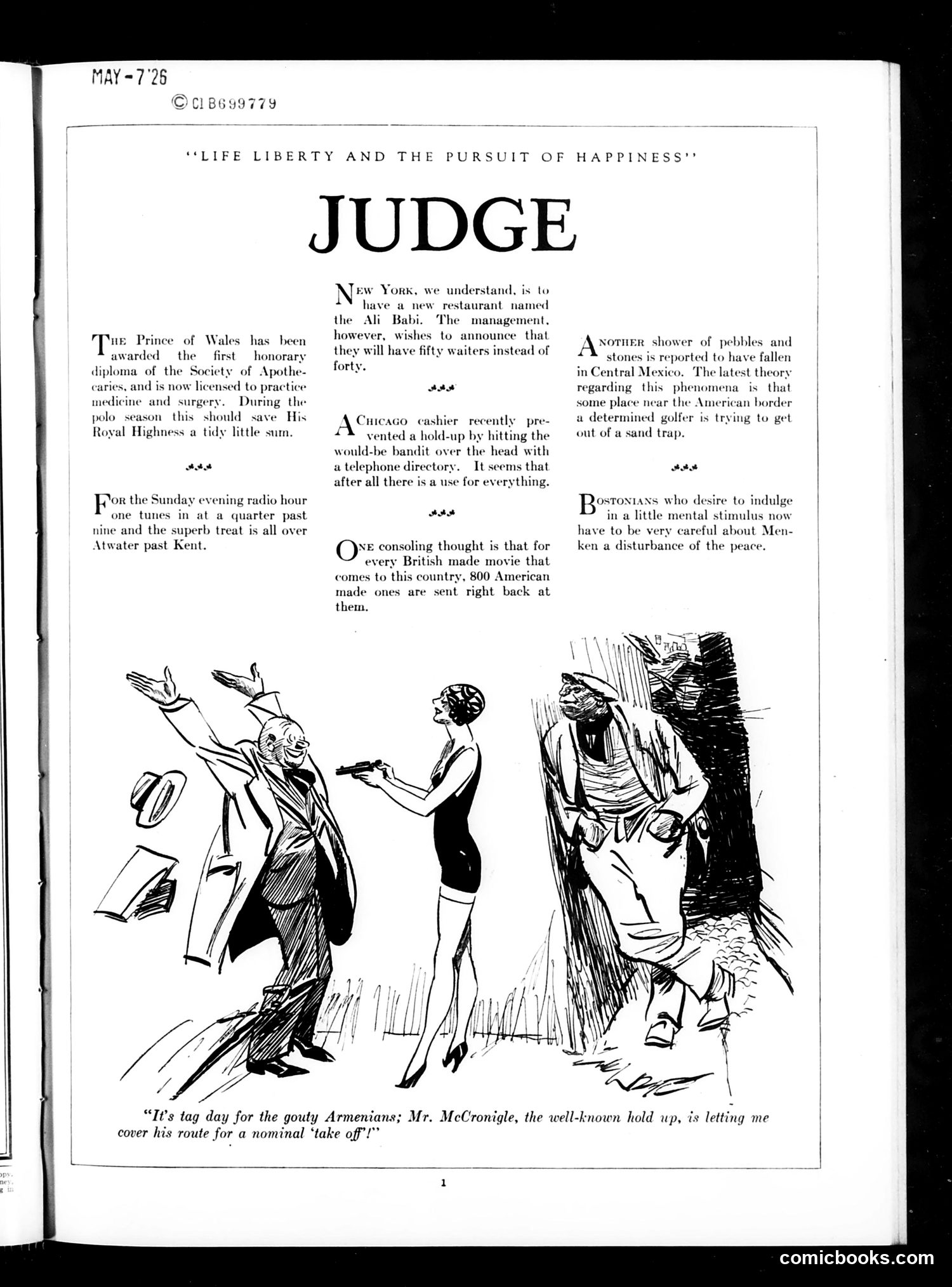
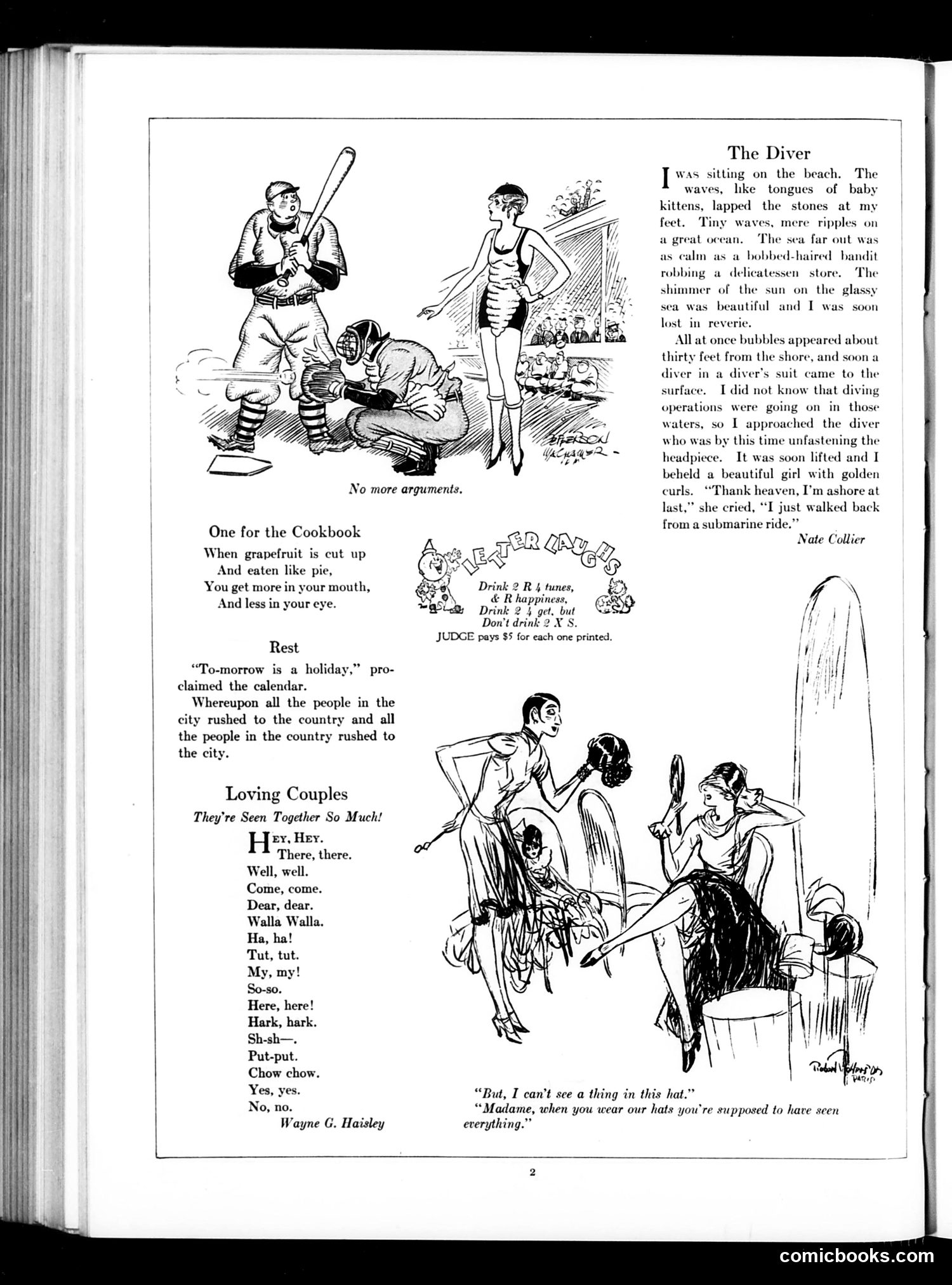
This page contains multiple brief humorous pieces typical of early Judge magazine: **"The Diver"** (Nate Collier): A short story about encountering a female diver surfacing from underwater operations. The humor relies on the unexpected appearance and the diver's excited exclamation about escaping a submarine ride—playing on early-20th-century novelty of submarine tourism. **"One for the Cookbook"**: A brief rhyme about eating pie and its digestive effects—simple bathroom humor. **"Rest"**: A one-liner about holiday crowds. **"Loving Couples"** (Wayne G. Haisley): Dialect humor listing affectionate exclamations couples make, rendered phonetically in exaggerated speech patterns. **Bottom cartoon**: Shows people at a beach; the caption jokes about hat-wearing revealing one's social pretensions—satirizing class consciousness about fashion accessories. These represent Judge's typical mix of light social satire and domestic humor.
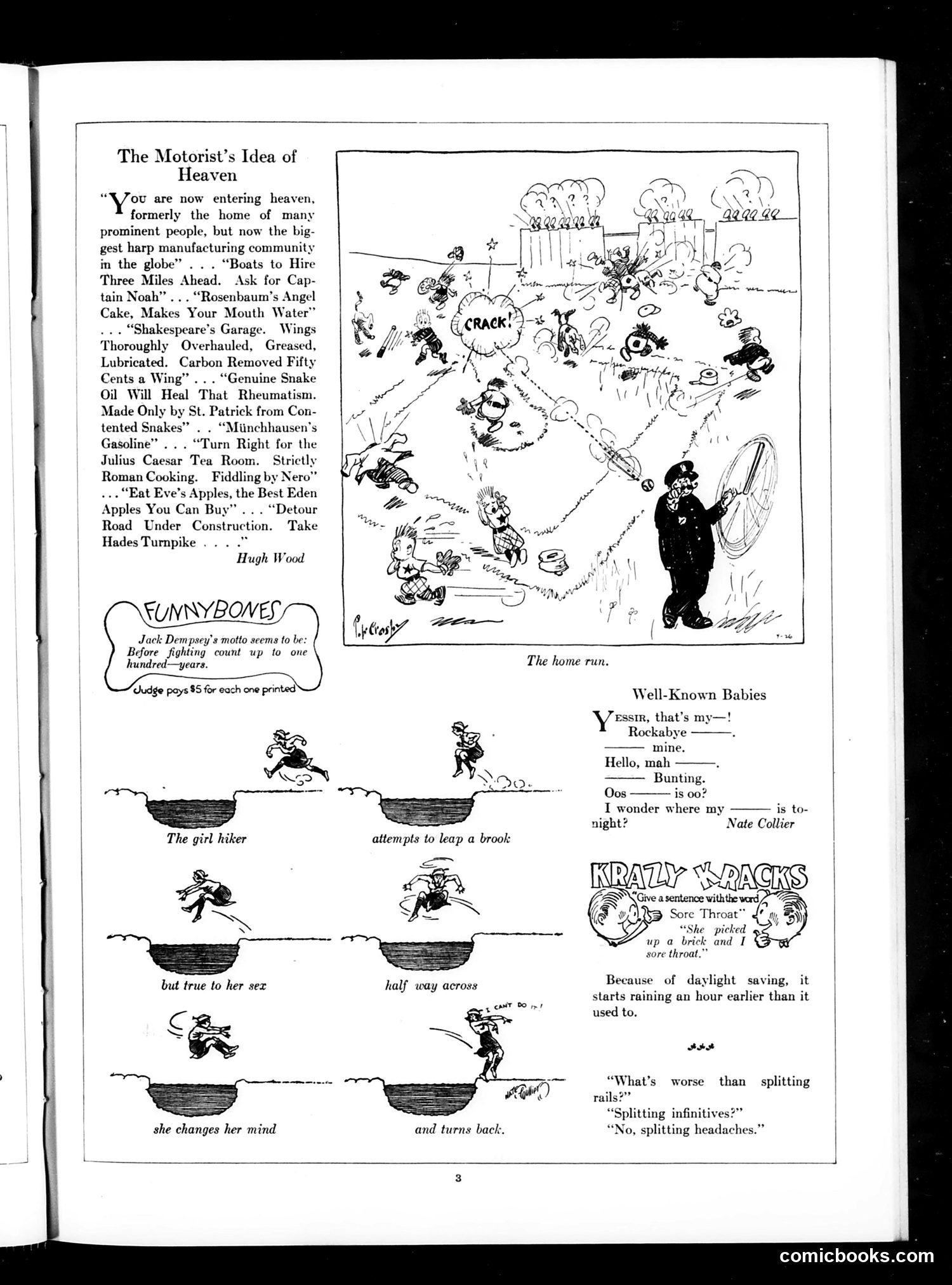
This page contains three distinct humor sections from an early 20th-century American satirical magazine: **"The Motorist's Idea of Heaven"** is a cartoon mocking automobile enthusiasts' fantasies. It depicts a chaotic automotive paradise where cars crash and break down, referencing contemporary brand names ("Rosenbaum's Angel Cake," "Shakespeare's Garage") and satirizing the era's fascination with motoring culture and brand advertising. **"The Girl Hiker"** series uses sequential panels to humorously chronicle a woman's unsuccessful attempts to leap a brook, progressing from determination to reversal of direction—a visual gag about physical comedy and gender stereotypes. **"Krazy Wracks"** and **"Well-Known Babies"** are brief joke sections playing on wordplay and contemporary references (likely celebrities or public figures recognizable to 1920s readers). The overall page reflects Judge's satirical approach to modern consumer culture and urban life.
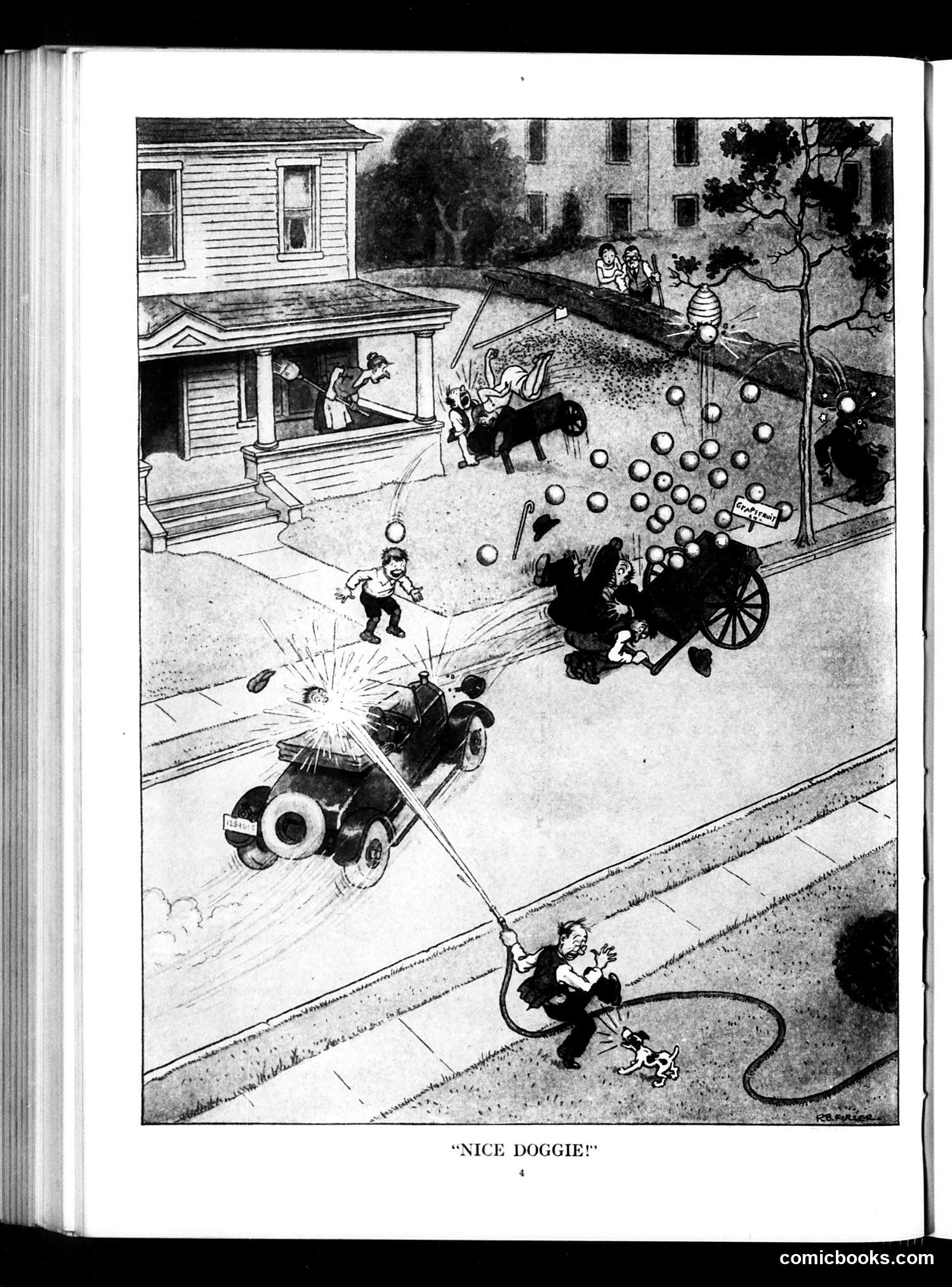
This appears to be an early 20th-century satirical illustration depicting a chaotic street scene. The caption "Nice Doggie!" suggests ironic commentary on danger presented as harmless. The image shows a small dog on a leash causing mayhem: an automobile has crashed violently (depicted with impact lines), a cart has overturned, and various people scatter in panic. The dog's owner appears unconcerned, possibly addressing the chaos as though the dog were merely being playful. The satire likely critiques either: (1) the dangers of early automobiles and traffic hazards, presented through the absurdist lens of a small dog as the culprit, or (2) underestimating seemingly minor threats. The humor derives from the disconnect between the calm "nice doggie" characterization and the actual devastation occurring around it—a commentary on willful blindness to real dangers.
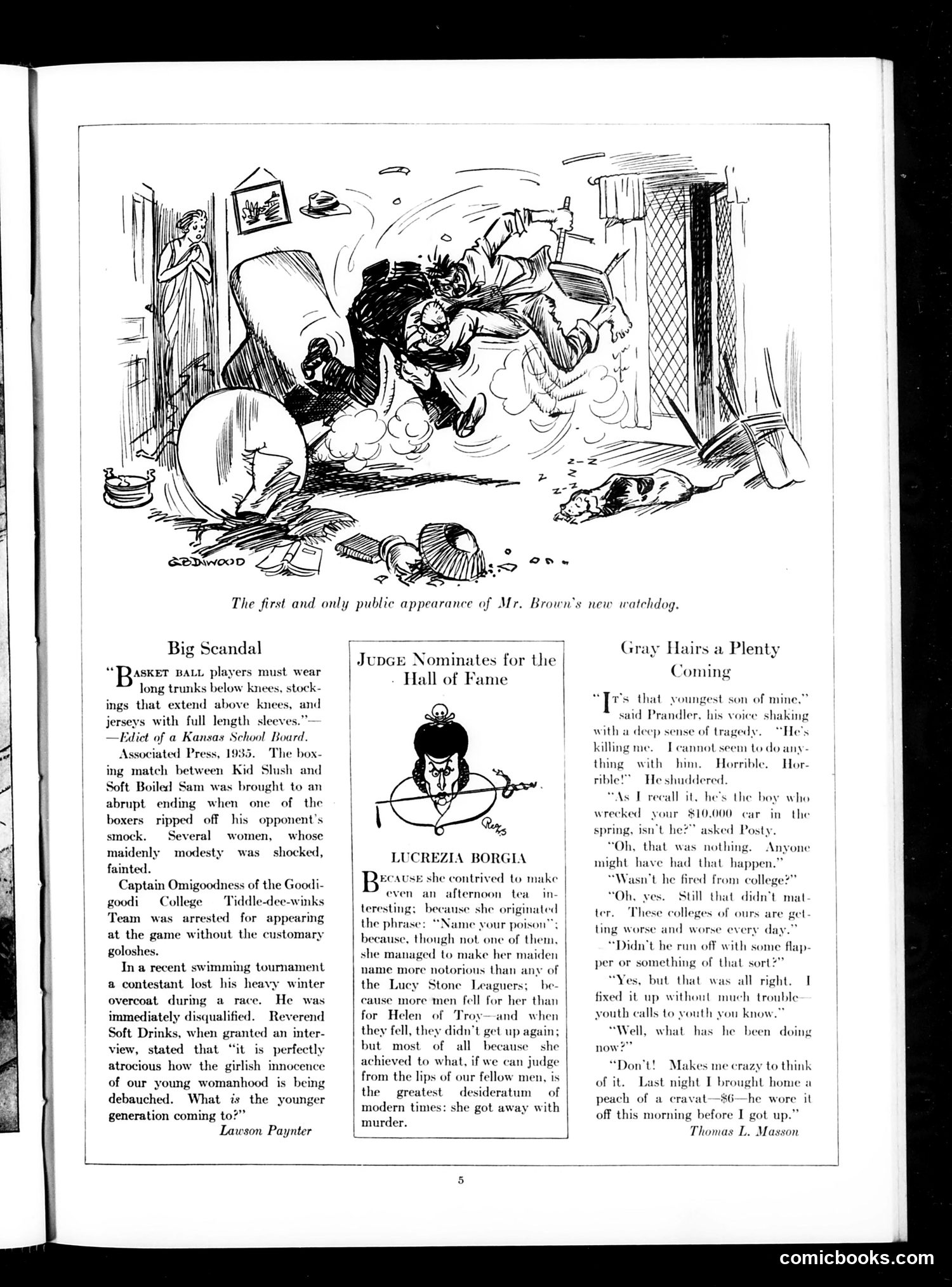
The main cartoon depicts "Mr. Brown's new watchdog"—a chaotic scene showing a dog wreaking havoc indoors, destroying furniture and causing general mayhem. This appears to be satirical commentary on an actual incident or public figure, though the specific reference is unclear without additional context. Below are three separate gossip/scandal columns: 1. **"Big Scandal"** mocks overly strict dress codes for schoolchildren and athletes, satirizing institutional prudishness. 2. **"Judge Nominates for the Hall of Fame"** features Lucrecia Borgia, using historical infamy as ironic praise for someone's notoriety. 3. **"Gray Hairs a Plenty"** presents a dialogue about a troublesome youth, likely satirizing generational decline or parental despair. The page combines visual humor with satirical social commentary typical of Judge magazine's style.
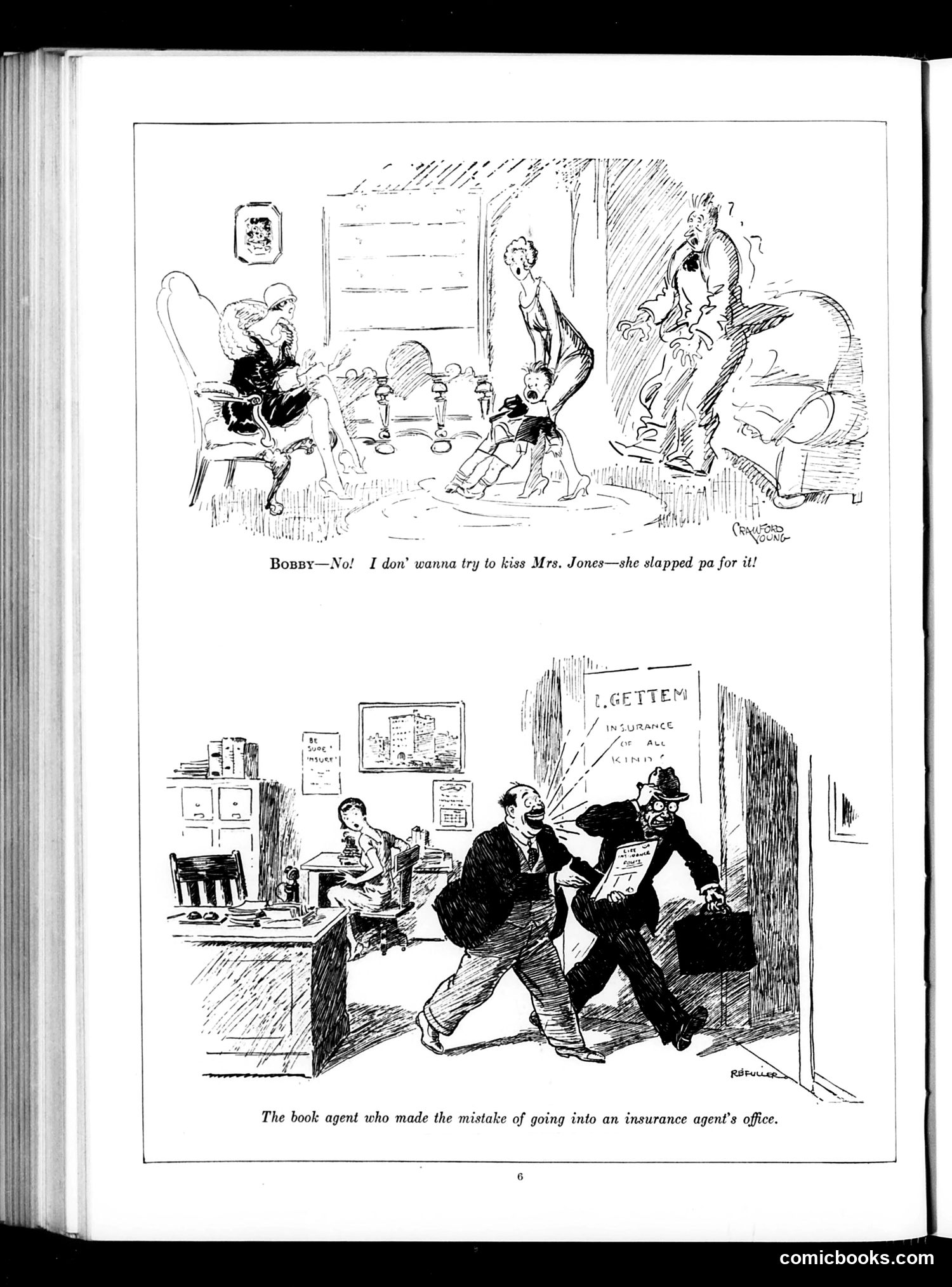
**Top cartoon:** A child (Bossy) refuses to kiss Mrs. Jones, recounting that she slapped his father for attempting it—humor derives from the child's innocent misunderstanding of adult social boundaries and his father's embarrassment. **Bottom cartoon:** A book agent mistakenly enters an insurance agent's office, where the insurance agent physically attacks him. The satire mocks the common annoyance of door-to-door book salesmen in this era, while also suggesting insurance agents were equally aggressive in their sales tactics. The humor lies in the ironic collision of two pushy sales professions, with the book agent receiving the violent treatment readers might fantasize about inflicting on unwanted solicitors. Both cartoons rely on slapstick and everyday social friction for humor.
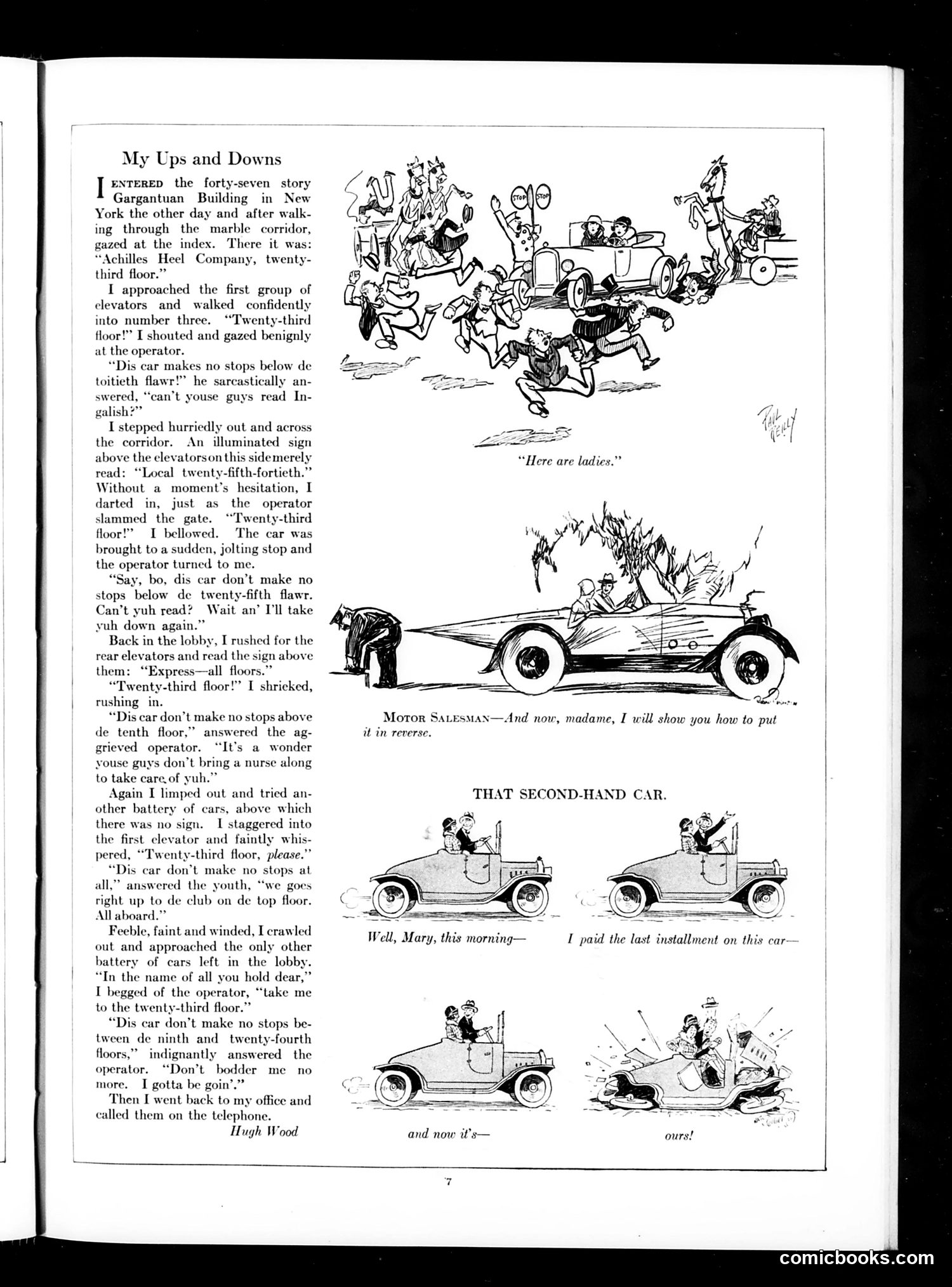
This page contains two satirical pieces from *Judge* magazine mocking early 20th-century urban inconveniences. **"My Ups and Downs"** ridicules the frustration of navigating a massive office building's elevator system. The narrator repeatedly enters wrong elevators—each with contradictory or absent signage—and encounters rude, dialect-speaking operators who refuse to help. The joke satirizes both poor building design and the gatekeepers' unhelpfulness. The punchline: he gives up and just phones instead. **"That Second-Hand Car"** and **"Motor Salesman"** mock the unreliability of used automobiles. The four-panel sequence shows a couple celebrating their final payment on a secondhand car, only to have it immediately fall apart ("and now it's—ours!"). The salesman's quip about putting it "in reverse" suggests the car spontaneously reverses or breaks down. Both pieces humorously capture common consumer frustrations—navigating bureaucratic systems and being duped by salesmen—that resonate across eras.
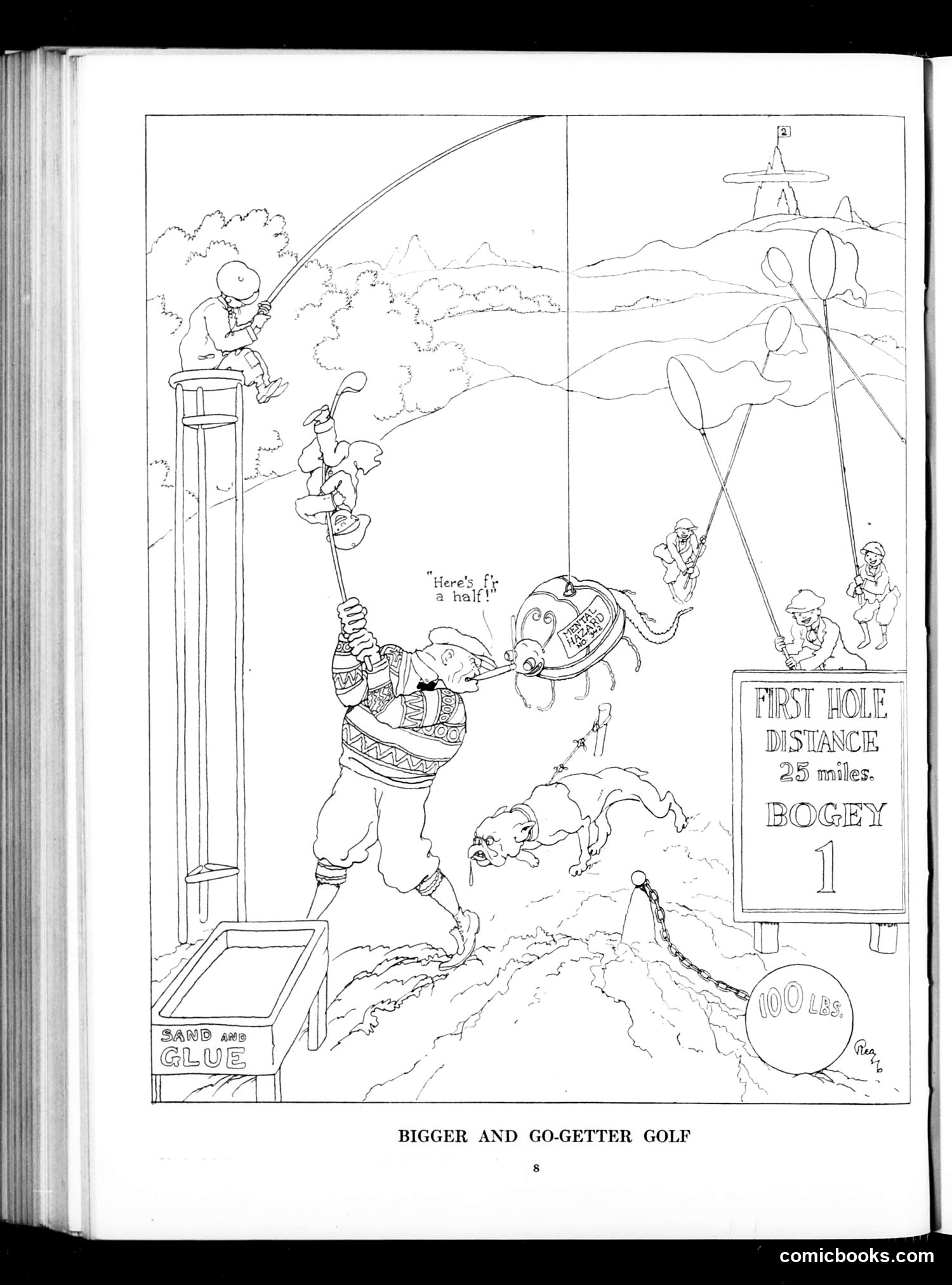
This is a humorous cartoon satirizing early 20th-century golf culture and the "bigger and better" competitive ethos of the era. The illustration depicts absurdly exaggerated golf equipment and techniques: - A golfer stands on an impossibly tall tee structure using outsized implements - The golf ball weighs "100 lbs" (marked on the image) - Multiple figures operate mechanical contraptions to hit the ball 25 miles for the "first hole" - A UFO-like device hovers overhead, suggesting fantastical technology The joke mocks the era's obsession with size, power, and technological advancement applied to golf. The phrase "Here's ft a half!" suggests competitive one-upmanship. The title "Bigger and Go-Getter Golf" parodies contemporary business jargon ("go-getter") by applying it absurdly to leisure. It's commentary on American excess and competitive materialism disguised as sports humor.
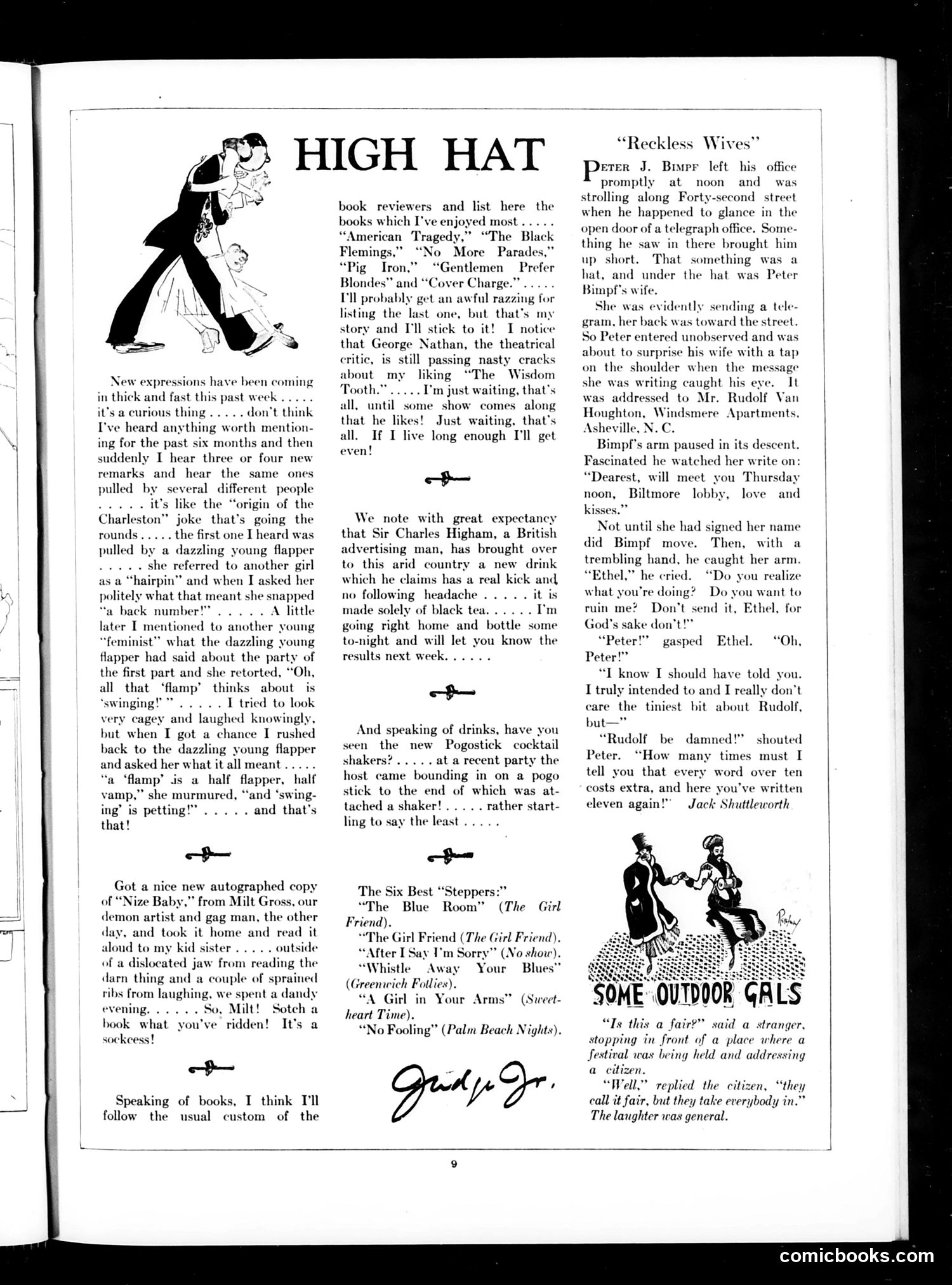
This page from Judge magazine (circa mid-1920s) contains two distinct satirical pieces: **"High Hat" Column** (left): A gossipy society commentary on 1920s slang and fashion. The author mocks new flapper terminology ("hairpin" = outdated girl; "flamp" = half-flapper/half-vamp; "swinging" = petting). This reflects contemporary anxiety about rapid social change, particularly young women's increasingly liberated behavior. The column ridicules both the slang itself and people who pretend to understand it. **"Reckless Wives" Story** (right): A dramatic narrative about infidelity. Peter Bimpf discovers his wife sending a telegram to another man arranging a secret meeting. The satire critiques 1920s "modern" women who, despite newfound independence, were stereotyped as morally loose or unfaithful—playing on conservative fears about changing gender roles. The juxtaposition satirizes both youth culture's frivolousness and anxieties about women's independence undermining traditional marriage.
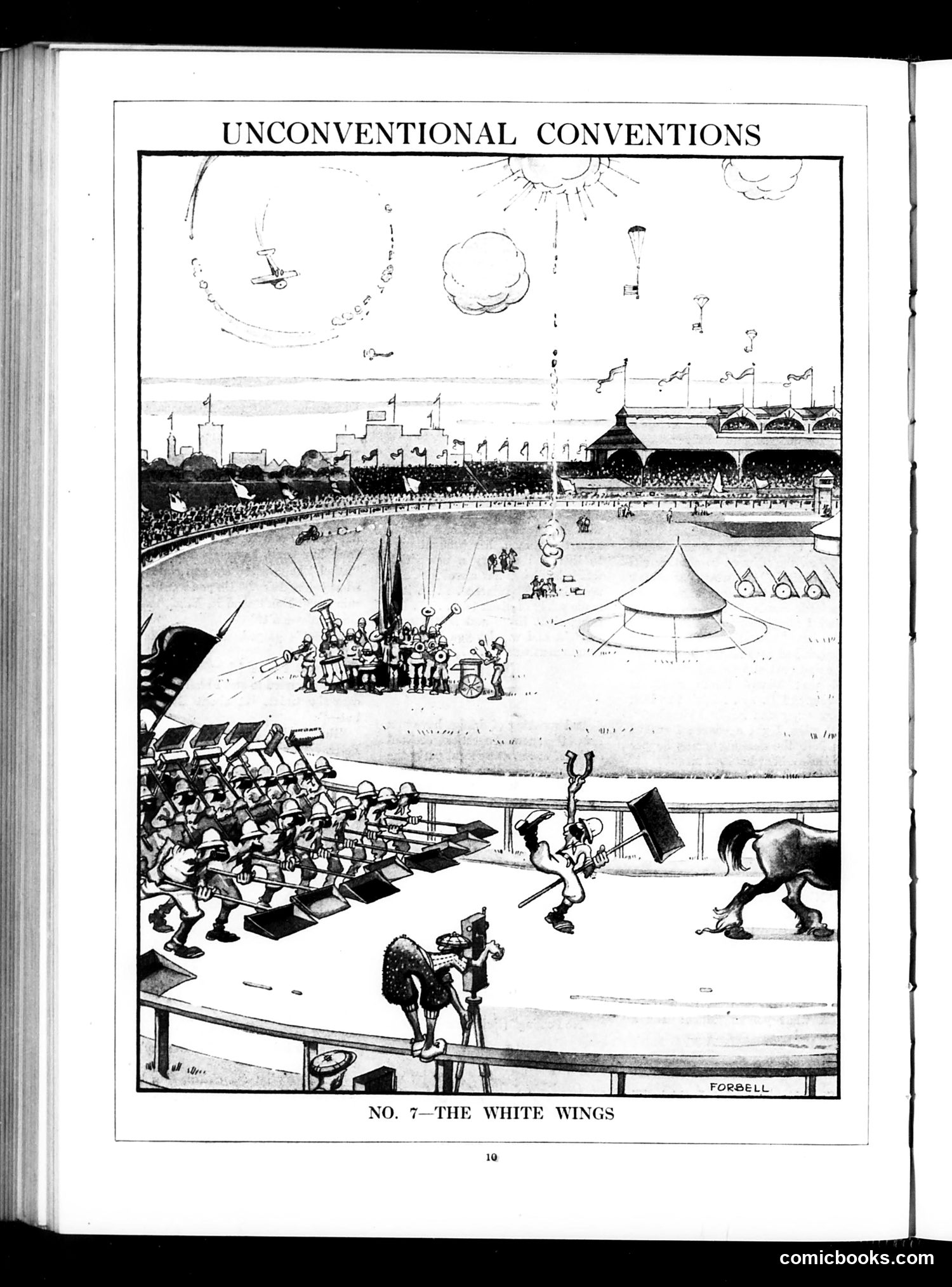
This cartoon satirizes the "White Wings," a street-cleaning organization or service (likely New York City's sanitation workers). The illustration depicts an elaborate, absurdist "convention" for these humble street sweepers, complete with: - Military-style formations of uniformed workers with brooms - Formal parade grounds with spectators and grandstands - Mock-ceremonial tents and displays - Cavalry and regimented troops treating garbage collection like a military operation The satire mocks the pretentiousness of giving street cleaners such grandiose, formal treatment—inflating mundane sanitation work into something resembling a grand civic or military spectacle. It's commentary on either municipal bureaucracy, labor organization, or the absurdity of treating working-class jobs with excessive pomp and ceremony.
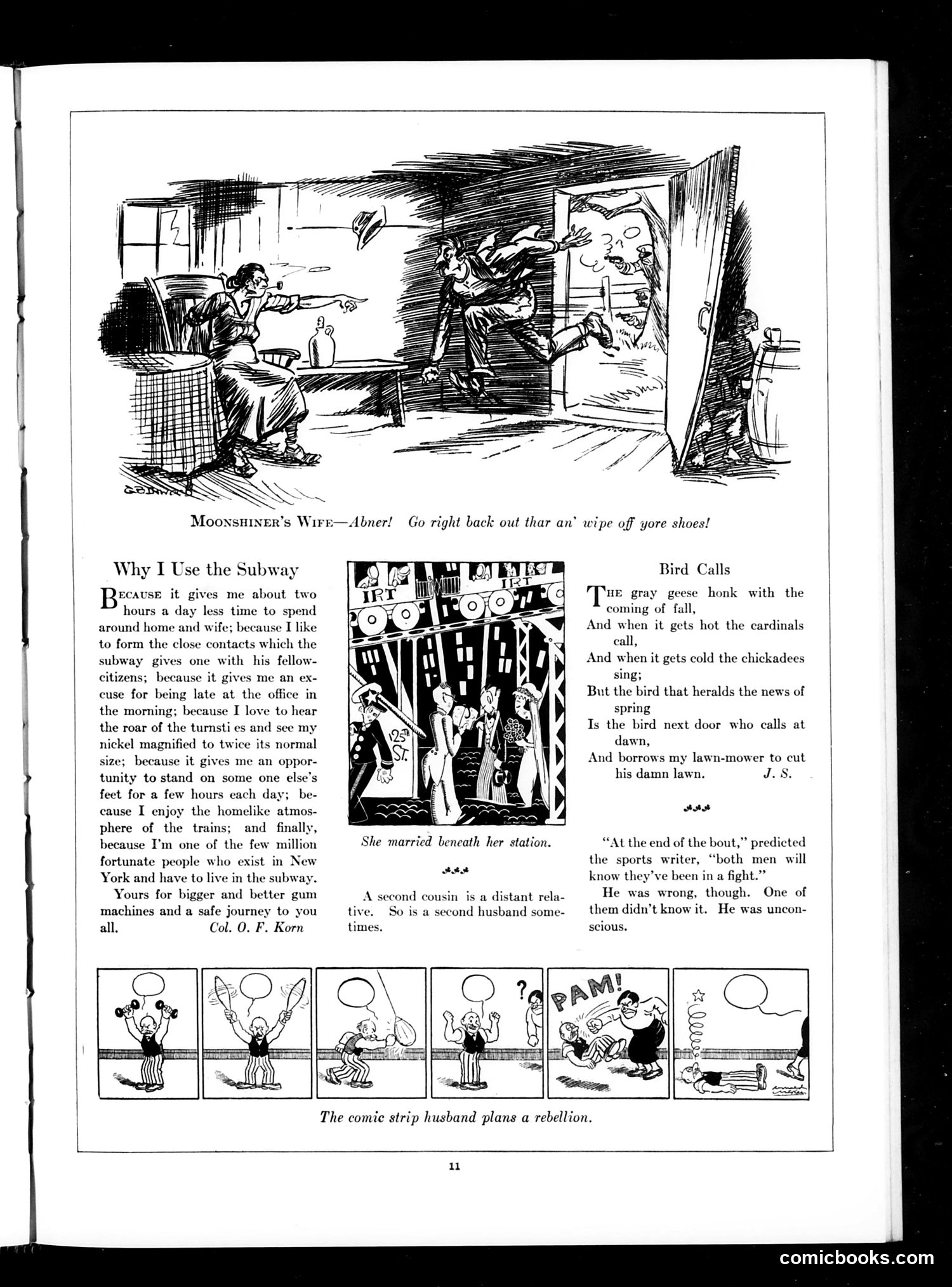
**Top Cartoon ("Moonshiner's Wife"):** A rural domestic scene where a woman orders her husband to clean his muddy shoes before entering. The humor relies on dialect humor and the contrast between backwoods domesticity and urban concerns—typical of early 20th-century magazines that stereotyped rural Americans. **"Why I Use the Subway":** A satirical essay by Col. O.F. Korn listing humorous "reasons" for using NYC subways—overcrowding, lateness excuses, standing on strangers' feet—that are actually complaints disguised as benefits. It mocks both the subway system's poor conditions and commuters who rationalize using it anyway. **"Bird Calls":** A poem by J.S. listing bird sounds, ending with a joke about an annoying neighbor who borrows the narrator's lawnmower at dawn. **Bottom Comic Strip:** Wordless panels showing a husband's failed "rebellion"—likely depicting domestic conflict played for laughs, reflecting period humor about marital tension and male resistance to domestic authority. The page captures Judge magazine's blend of urban satire, regional stereotyping, and domestic comedy typical of 1920s-30s American humor.
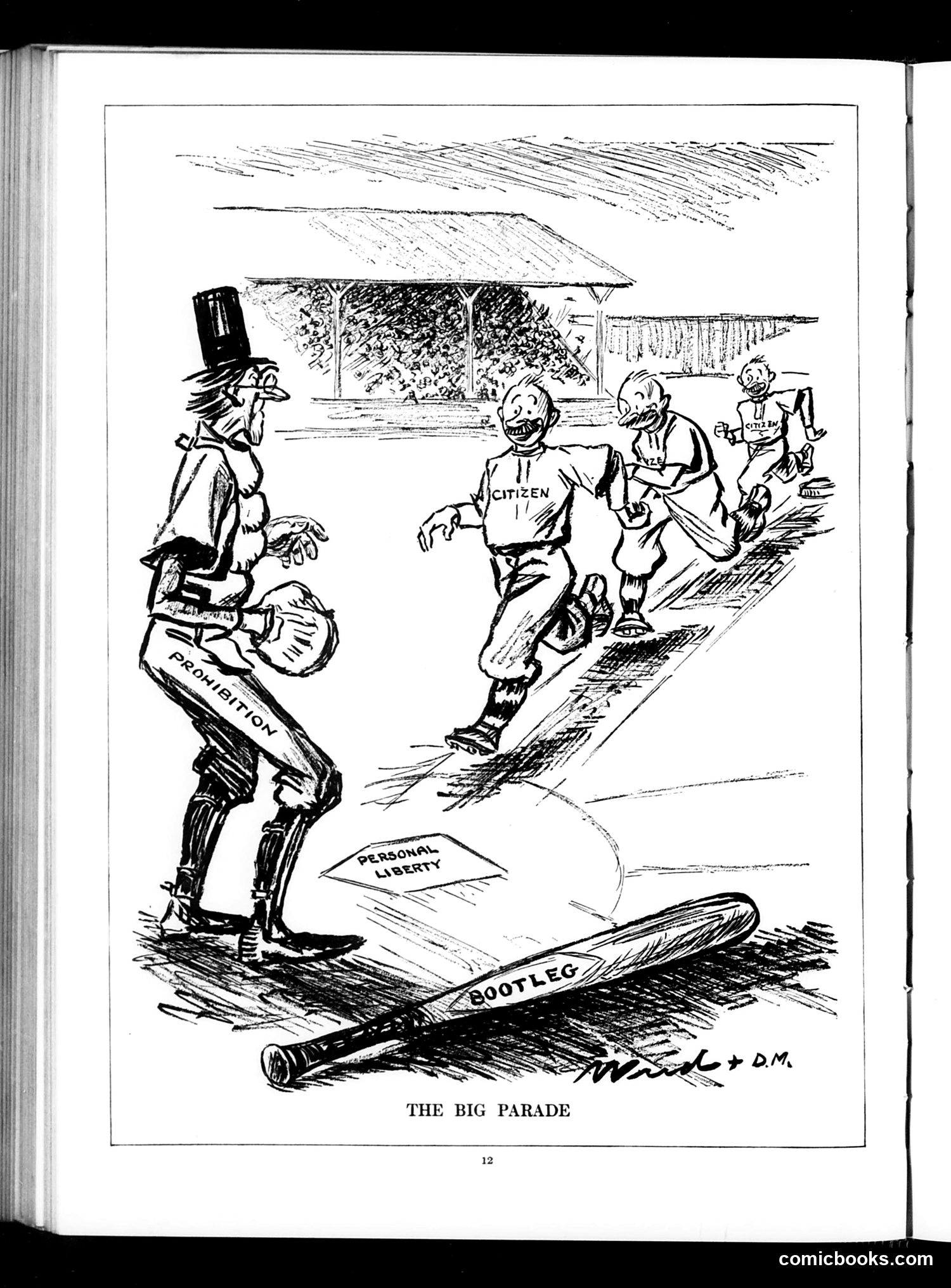
This political cartoon satirizes Prohibition enforcement. On the left stands a figure labeled "PROHIBITION" wearing a top hat, wielding a club labeled "BOOTLEG." He attempts to block ordinary citizens—one marked "CITIZEN"—from accessing "PERSONAL LIBERTY," depicted as a diamond shape on the ground. The cartoon criticizes how Prohibition agents and laws were seen as trampling citizens' freedoms while chasing bootleggers (illegal alcohol producers/sellers). The "big parade" likely refers to the public spectacle of Prohibition enforcement, while the club represents aggressive tactics. The satire suggests that anti-alcohol campaigns were authoritarian overreach, infringing on fundamental liberties in the name of prohibition.
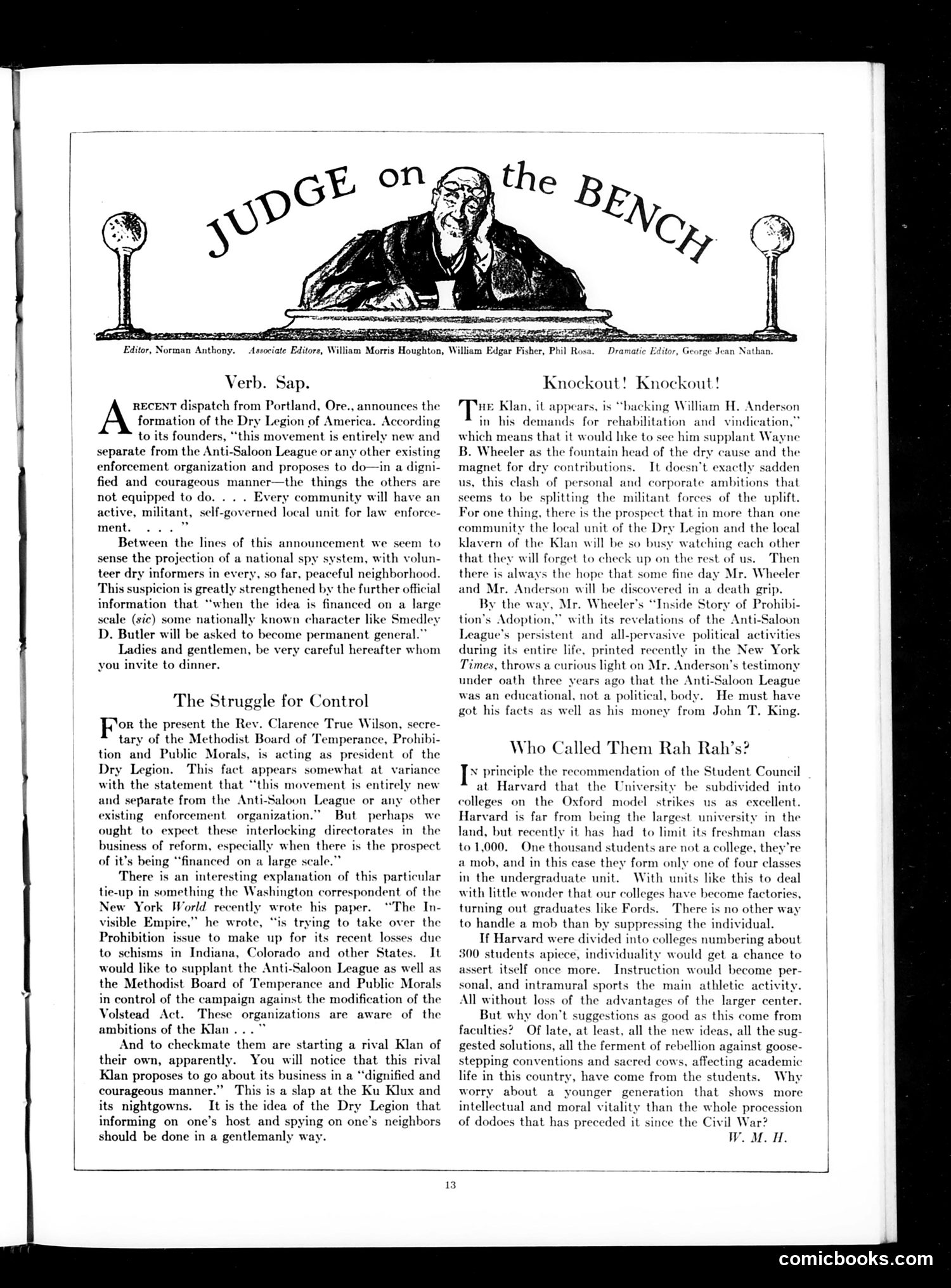
This page satirizes competing Prohibition enforcement organizations during the 1920s Volstead Act era. The "Dry Legion of America," a new temperance group, claims independence but is allegedly backed by the Ku Klux Klan—here called the "Invisible Empire"—seeking to dominate the Prohibition movement. Judge mocks the proposed organization's promise of "dignified" enforcement while actually describing a nationwide spy network of informers reporting on neighbors and dinner guests. The satire escalates when noting that military figure Smedley Butler might lead it, and that competing leaders (William H. Anderson and W.B. Wheeler) represent dueling personal ambitions. The cartoon's bitter humor: rival Prohibition groups—the Klan, Anti-Saloon League, and Methodist Board—will be too busy fighting each other to actually spy on ordinary citizens. Judge suggests hypocrisy and power struggles underlie claims of moral reform.
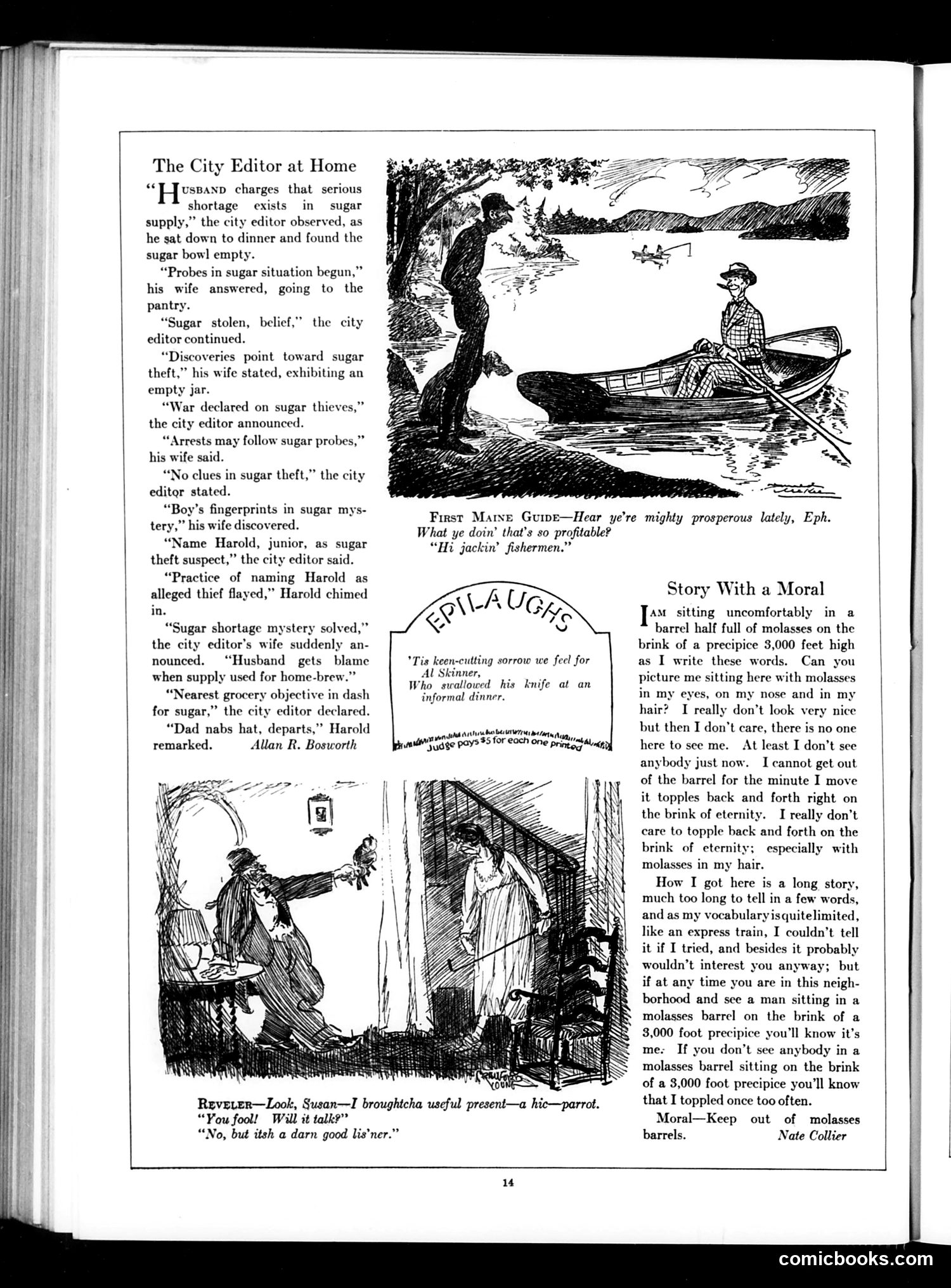
This page satirizes newspaper sensationalism and Prohibition-era concerns through multiple pieces: **"The City Editor at Home"** mocks how newspapers dramatically overstate mundane domestic events using inflated headlines. A missing sugar bowl becomes "War declared on sugar thieves" and "Arrests may follow." The joke culminates when the wife reveals the real culprit: her husband using sugar for home-brew (illegal alcohol production during Prohibition). This satirizes both yellow journalism and the hypocrisy of "respectable" citizens violating Prohibition laws. The smaller cartoons add comedic variety: a fisherman's claim to "hi-jack" fishermen, a parrot that listens but doesn't talk, and a moral tale about a man stuck in a molasses barrel on a precipice—apparently a recurring consequence of his foolishness. Together, these pieces ridicule media sensationalism, domestic hypocrisy regarding Prohibition, and poor judgment—typical Judge magazine targets of satirical humor.
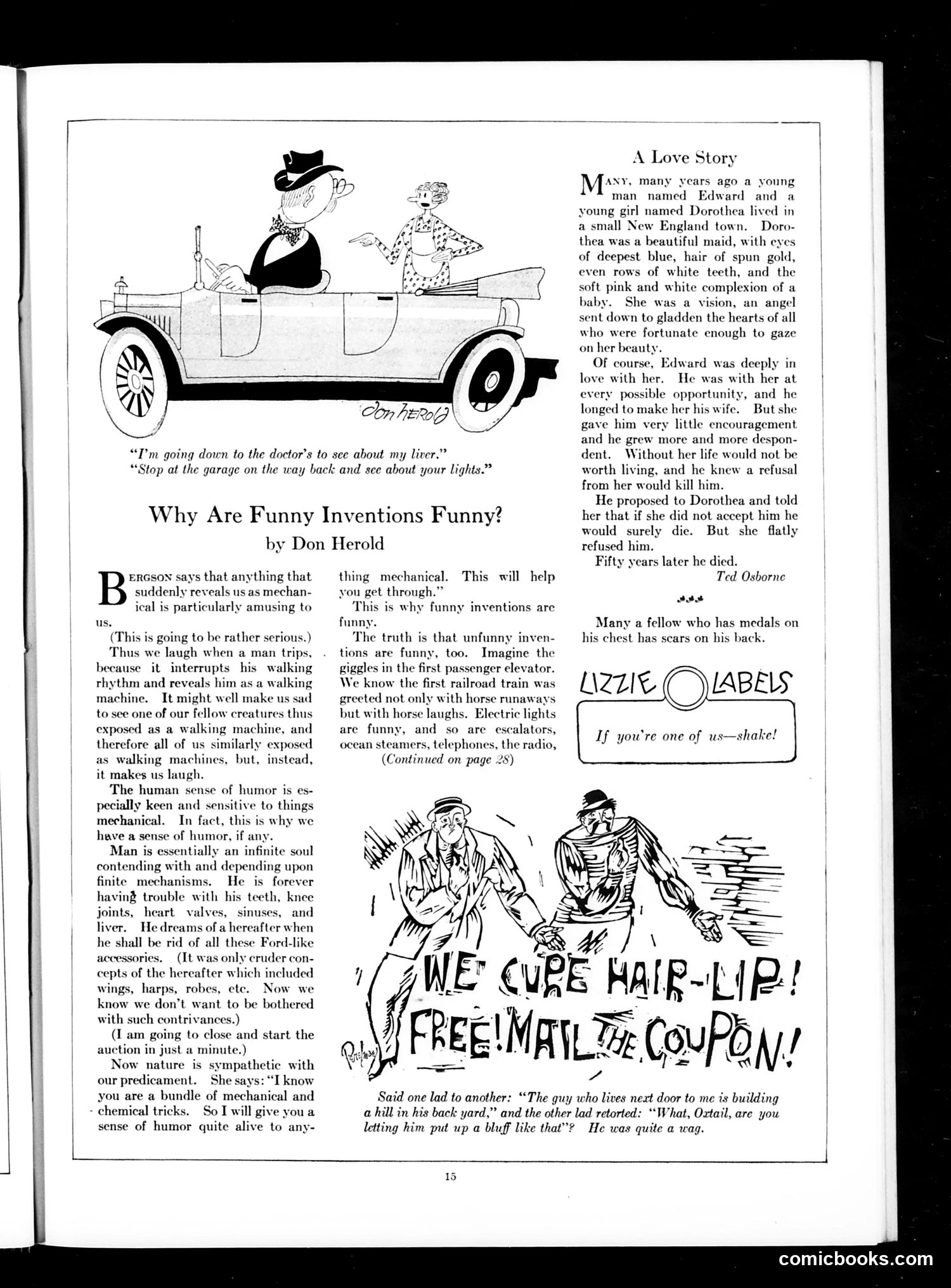
This page contains three distinct pieces of humor typical of early 20th-century American satire: **Top cartoon**: Shows a man telling his companion he's visiting the doctor about his liver while driving an early automobile. The joke plays on the new technology—the companion suggests he also get the car's headlights checked. This reflects the era's fascination with automobiles as novelty machines prone to mechanical failure. **"Why Are Funny Inventions Funny?"** by Don Herold is a philosophical essay arguing that humans find humor in things that expose our mechanical nature. Herold cites examples like tripping (revealing we're walking machines) and new inventions like elevators and trains, which amused early users precisely because they mechanized human experience. **"A Love Story"** is ironic melodrama: Edward desperately loves Dorothea and threatens to die if she refuses him. She refuses anyway—and he dies fifty years later, making his threat absurdly literal but delayed, undercutting romantic tragedy with anticlimactic timing. **Bottom cartoon**: Two men excitedly advertise a "hair-lip cure" mail coupon. The crude satire mocks patent medicine scams common in that era.
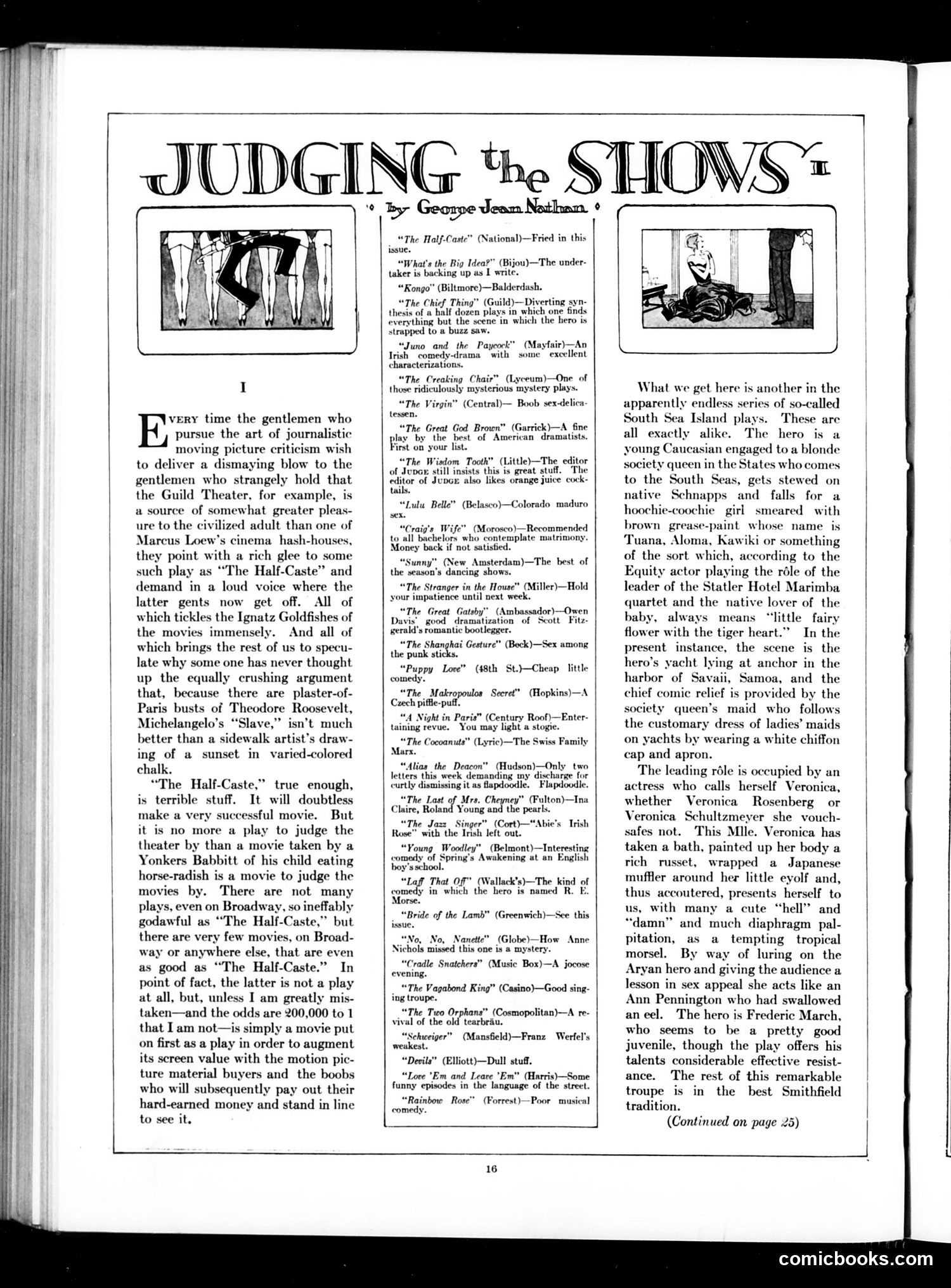
This is a theater criticism column by George Jean Nathan reviewing Broadway plays. The satirical point attacks the false equivalence critics make between poor theatrical productions and cinema. Nathan argues that theater critics unfairly dismiss live theater by pointing to terrible plays like "The Half-Caste" as evidence of theater's inferiority to movies. He counters this is illogical—one shouldn't judge an entire medium by its worst examples. His analogy: a plaster bust of Roosevelt isn't inferior to Michelangelo's "Slave" simply because both are sculptures. Importantly, Nathan reveals "The Half-Caste" is actually a movie disguised as a stage play to boost its film credentials—exposing the cynical commercialism blurring these mediums. The right column continues reviewing current Broadway shows with acerbic one-liners ("Balderdash," "sex-delicatessen," etc.), maintaining Judge's irreverent tone toward entertainment industry pretension. This defends theatrical culture against emerging cinema's commercial dominance in 1920s America.
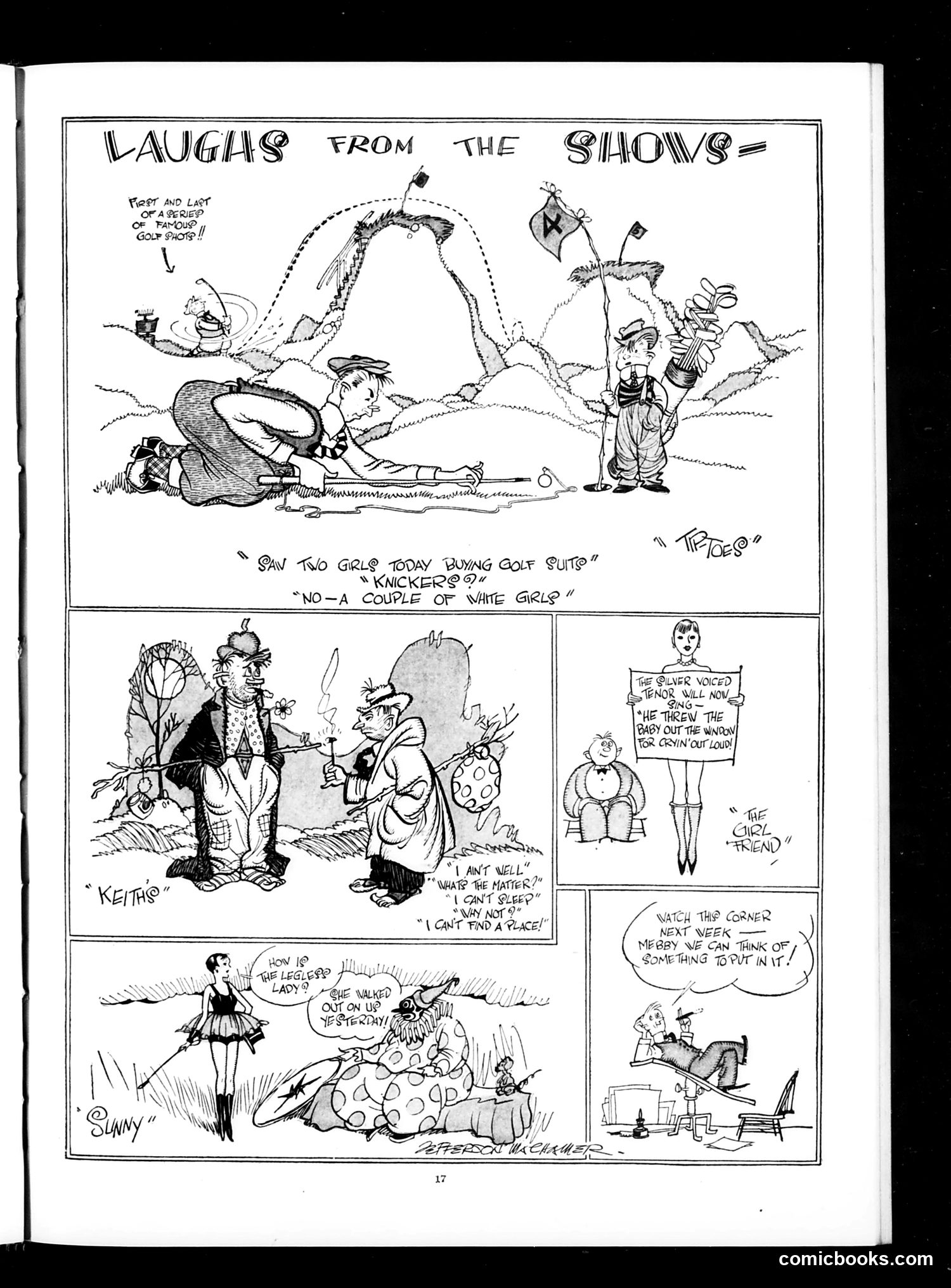
This page collects theatrical humor sketches from Judge magazine, satirizing early 20th-century social conventions. **Top panel**: Two men observe women golfing in knickerbockers (loose knee-length pants), then note they're actually "a couple of white girls"—the joke being that women wearing practical athletic wear was scandalous enough to seem gender-ambiguous to observers accustomed to full skirts. **Middle panels**: Social humor about popular entertainment and courtship rituals. "Keith" references Keith's vaudeville circuit; "The Choir Friend" shows a woman singing operatic lyrics while appearing less refined than her sheet music suggests. "Sunny" depicts flirtation between a man and woman. **Bottom panel**: Suggests planning entertainment for next week's publication. The overall satire targets changing social mores—women's athletic wear, vaudeville culture, and shifting gender norms—through gentle mockery typical of Judge's approach to contemporary society.
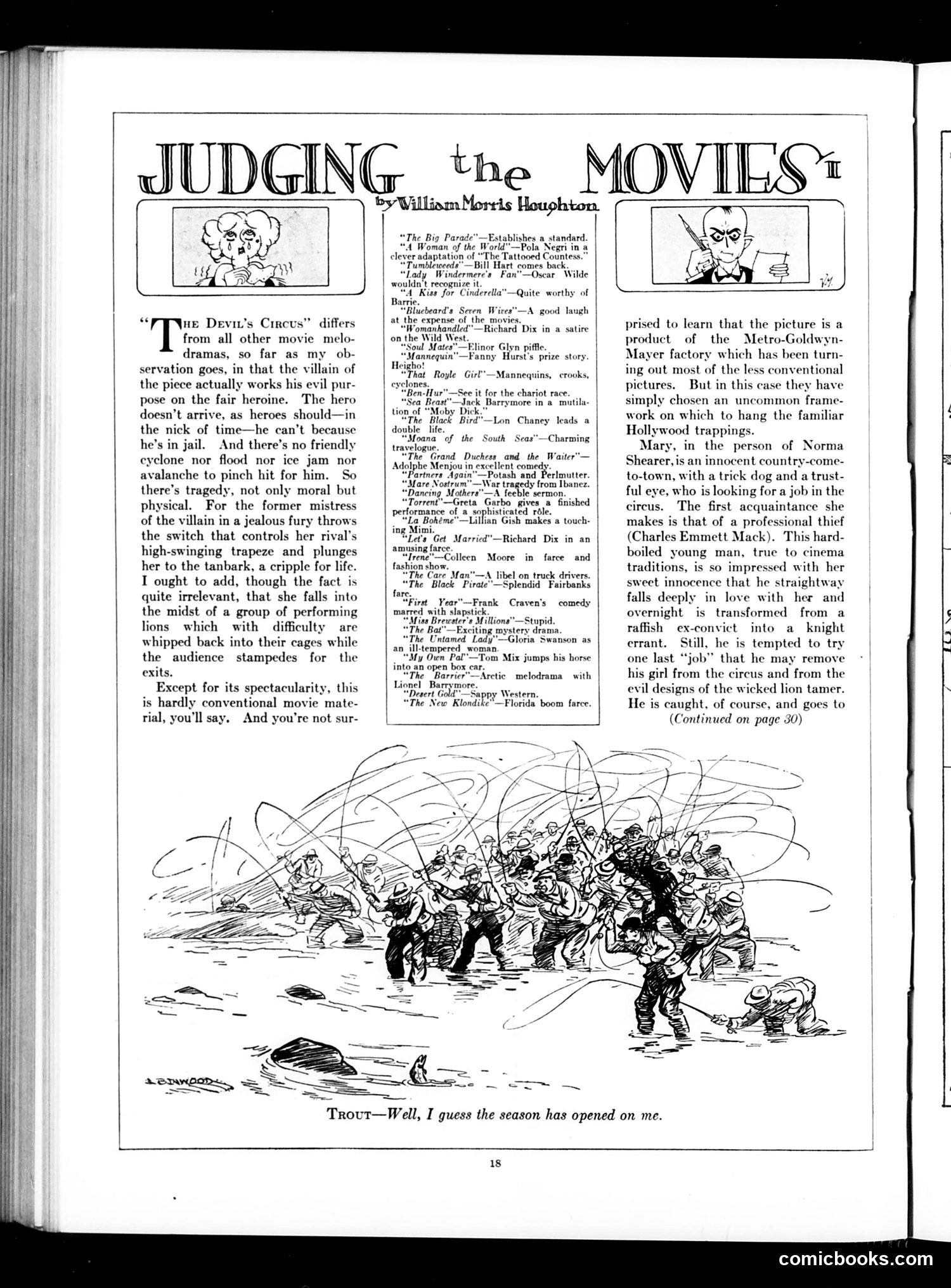
This page features William Morris Houghton's film review column critiquing 1920s movies. The main article discusses "The Devil's Circus," praising its unusual realism: unlike typical melodramas, the hero doesn't arrive to save the day, and the heroine actually suffers permanent injury (becoming crippled), creating genuine tragedy rather than convenient rescue. The cartoon below depicts a fishing scene where a trout recognizes the seasonal opening of fishing season—a visual pun on being vulnerable to harm. It parallels the article's theme: characters who cannot escape danger through conventional plot devices. The right column lists brief reviews of contemporary films (Greta Garbo, Lillian Gish, Lon Chaney productions). The content reflects 1920s cinema's transition toward more sophisticated storytelling, with Houghton sardonically noting when films abandon clichéd conventions, which was apparently noteworthy for the era.
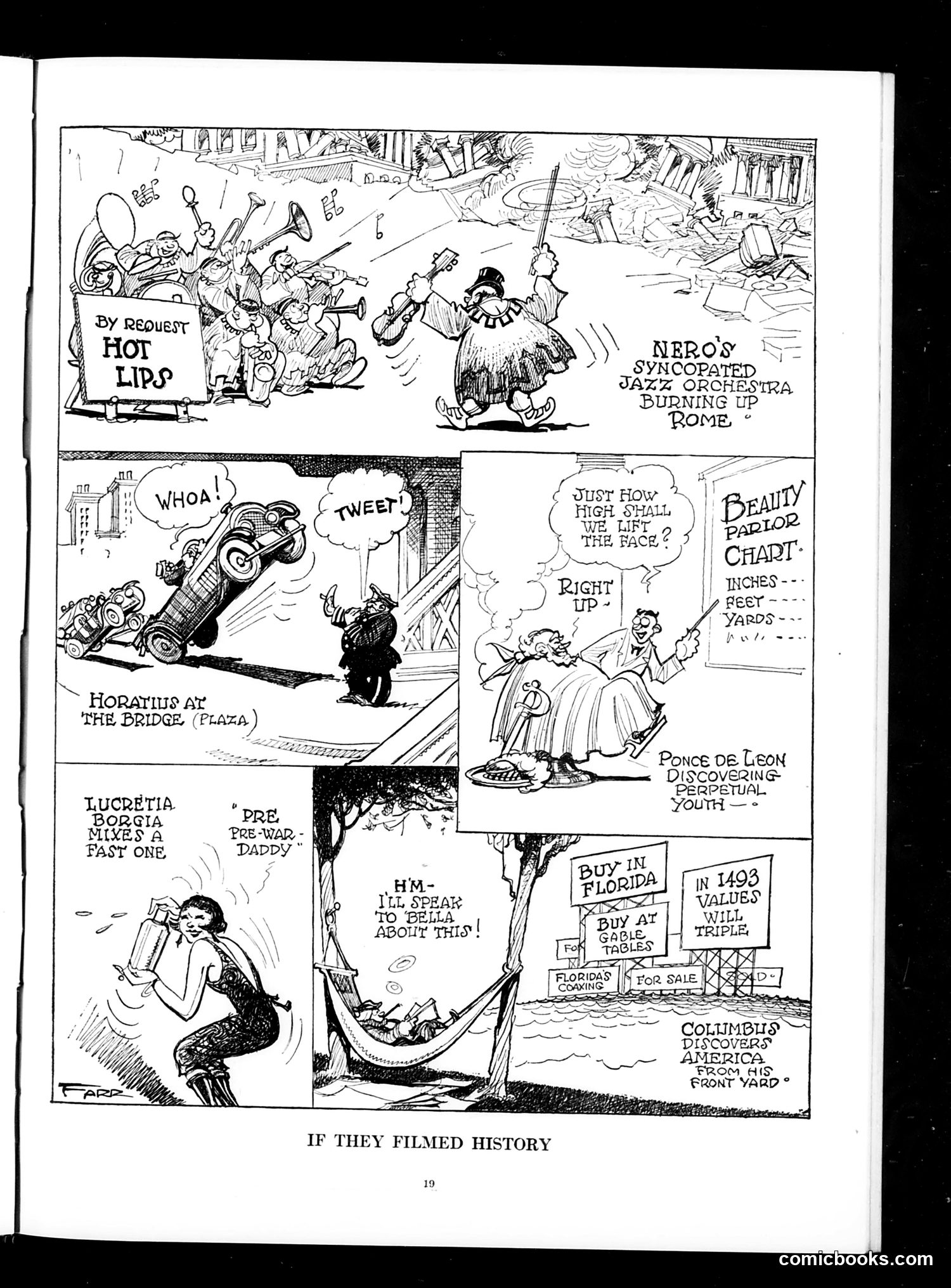
This page satirizes how early 20th-century popular culture trivializes or distorts historical events through modern entertainment. Each panel reimagines famous historical moments as contemporary scenarios: - **Nero's orchestra**: Ancient Rome's burning depicted as a jazz band performance ("syncopated jazz orchestra") - **Horatius at the Bridge**: A car crash replacing classical heroism - **Ponce de León**: A beauty pageant contestant instead of explorer seeking fountain of youth - **Lucretia Borgia**: Reduced to gossip ("I'll speak to Bella about this") - **Columbus**: Discovering America portrayed as finding real estate ("Buy in Florida") The satire suggests that modern media (particularly cinema) sensationalizes, romanticizes, or commercializes history, stripping it of genuine significance. The humor relies on absurdist contrasts between dignified historical events and frivolous contemporary concerns—flappers, automobiles, beauty standards, and real estate schemes replace actual historical import.
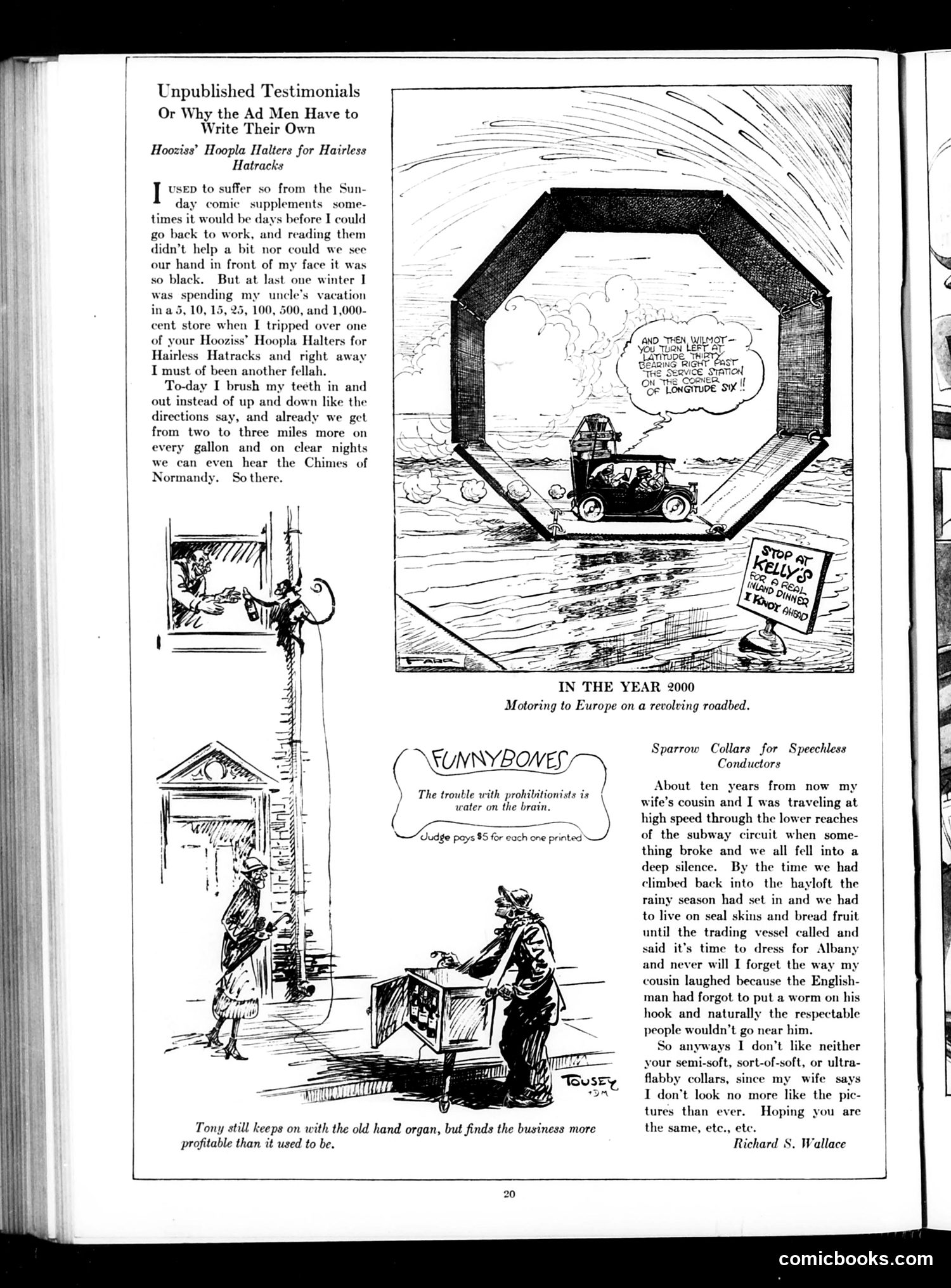
This page satirizes fake testimonials used in advertising. The "Unpublished Testimonials" header signals the joke: these are obviously fabricated endorsements that no real company would publish because they're absurd. The first testimonial mocks patent medicine ads by praising "Hooziss' Hoopla Halters for Hairless Hatracks" (nonsense product names) with illogical benefits—brushing teeth differently allegedly improves gas mileage. The "Funny Bones" section jokes that prohibitionists have "water on the brain" (are foolish)—a reference to 1920s Prohibition debates. The futuristic cartoon shows motoring to Europe via "revolving roadbed" in 2000—absurdist speculative fiction. The final testimonial about "Sparrow Collars" is deliberately incoherent, mixing unrelated anecdotes (subway accidents, trading vessels, fishing) that prove nothing about the product. The satire targets advertising's use of fabricated customer testimonials to sell products. By presenting transparently fake endorsements with surreal logic, Judge ridicules the entire testimonial advertising format as inherently dishonest.
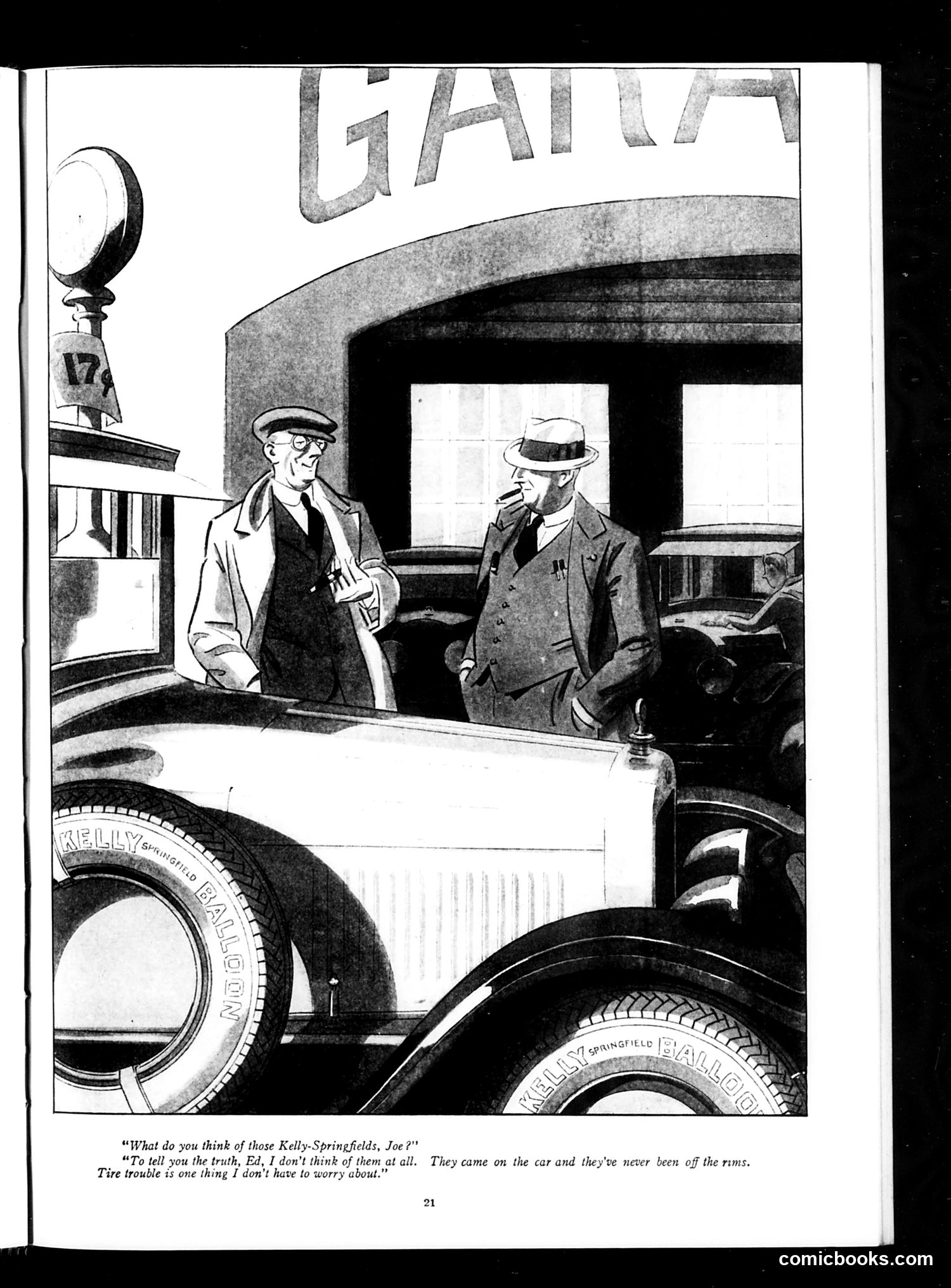
This is a **Kelly-Springfield tire advertisement** disguised as a comic dialogue. Two men discuss tires outside what appears to be a car dealership (marked "UTICA"). The satire works by having "Joe" praise Kelly-Springfields not through enthusiastic endorsement, but by claiming he literally never thinks about them—they've performed so reliably they've never needed removal from the wheel rims. This is a backhanded compliment format common in vintage advertising: the product is so dependable it becomes invisible to the user. The joke targets competing tire brands' reputation for requiring frequent maintenance and replacement. By having a satisfied customer emphasize *forgetfulness* rather than active satisfaction, the ad suggests Kelly-Springfields eliminate the tire anxiety that plagued early automobile owners.
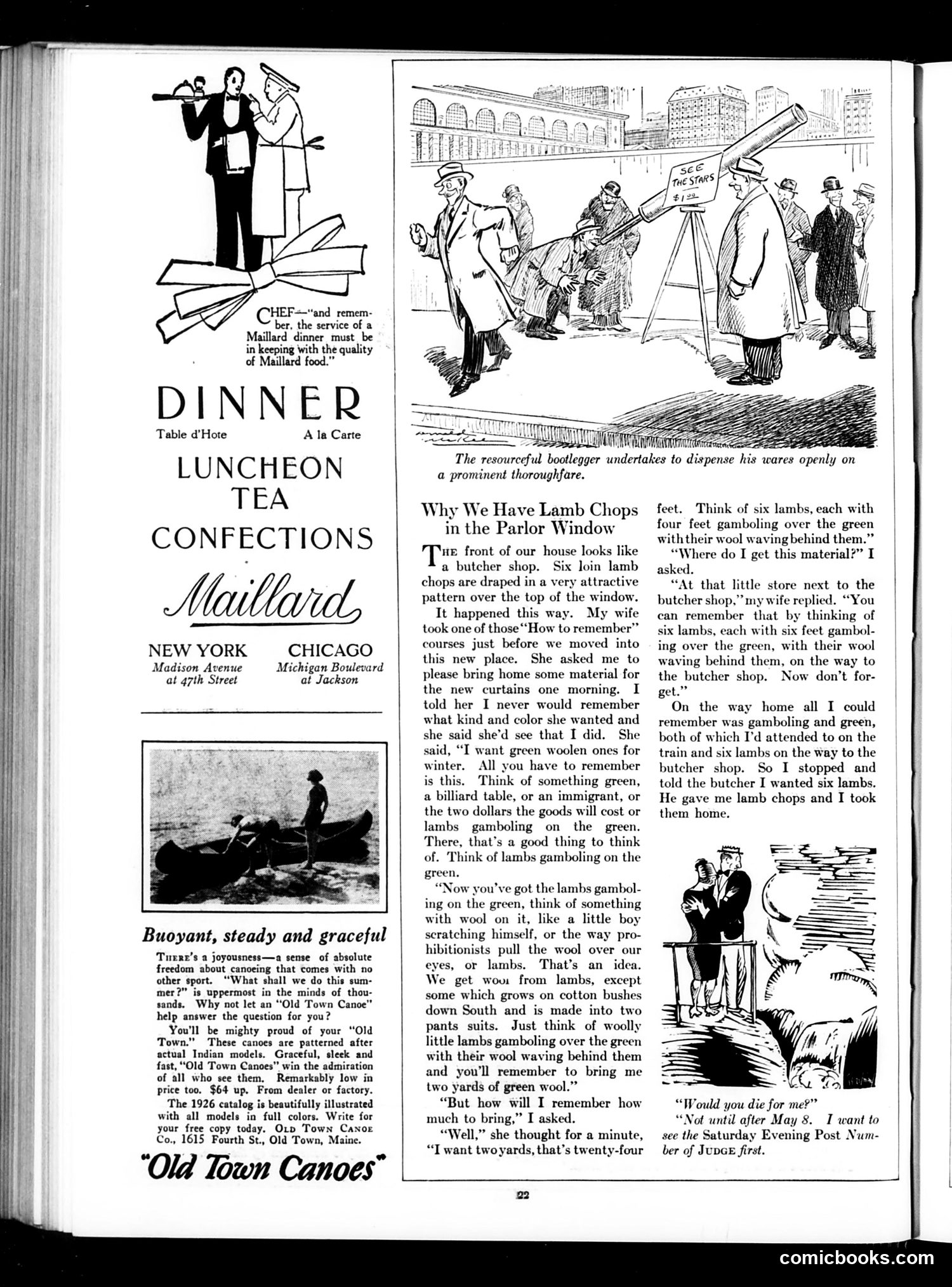
This page contains **primarily advertisements and a humorous short story**, not political satire. **Left side:** Ads for Maillard (upscale chocolates/confections) and Old Town Canoes. **Main content (right):** A satirical short story titled "Why We Have Lamb Chops in the Parlor Window." The humor involves a wife who takes a memory-training course and tries to help her husband remember to buy green wool curtains by having him visualize "lambs gamboling on the green." The mnemonic device backfires: he only remembers "lambs" and "green," so he stops at a butcher shop and purchases lamb chops instead—which he then displays in the parlor window, making the house look like a meat shop. The joke plays on the absurdity of over-complicated memory techniques and misunderstanding. **Bottom cartoon:** A small romantic exchange where a woman asks "Would you die for me?" The man replies he'll wait until after May 8 to see the Saturday Evening Post issue of *Judge* first—a meta-joke about the magazine's appeal. This is light domestic humor typical of 1920s popular magazines.
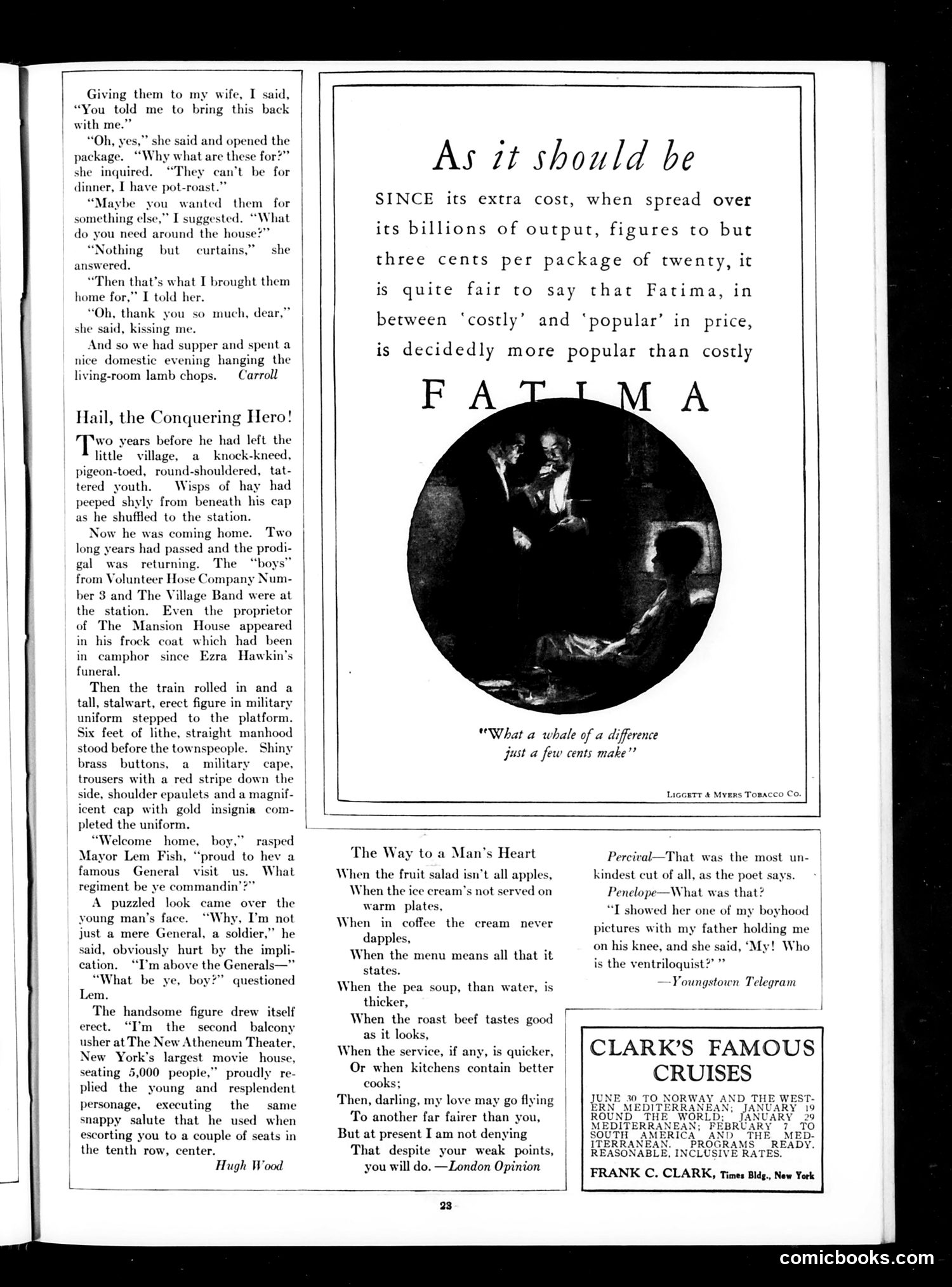
This **Judge magazine page** contains three distinct satirical pieces: **1. "Hail, the Conquering Hero!"** (left column): A soldier returns from military service in full dress uniform with medals and insignia. The townspeople assume he's a decorated General. The punchline: he's actually a **second balcony usher at a New York movie theater**—his formal uniform and salute are merely from seating patrons. The satire mocks small-town naïveté and the inflated dignity some working-class jobs could inspire, particularly in the early 20th century. **2. Fatima Cigarette Advertisement** (center): An elegantly designed product ad arguing that despite costing only 3 cents more per package, Fatima cigarettes offer quality between "costly" and "popular" brands—a fair value proposition. **3. "The Way to a Man's Heart"** and **Percival/Penelope joke** (right): Light romantic humor about relationships and aging, typical of Judge's comedic filler content. The page primarily demonstrates Judge's mix of social satire and advertising typical of early 20th-century American magazines.
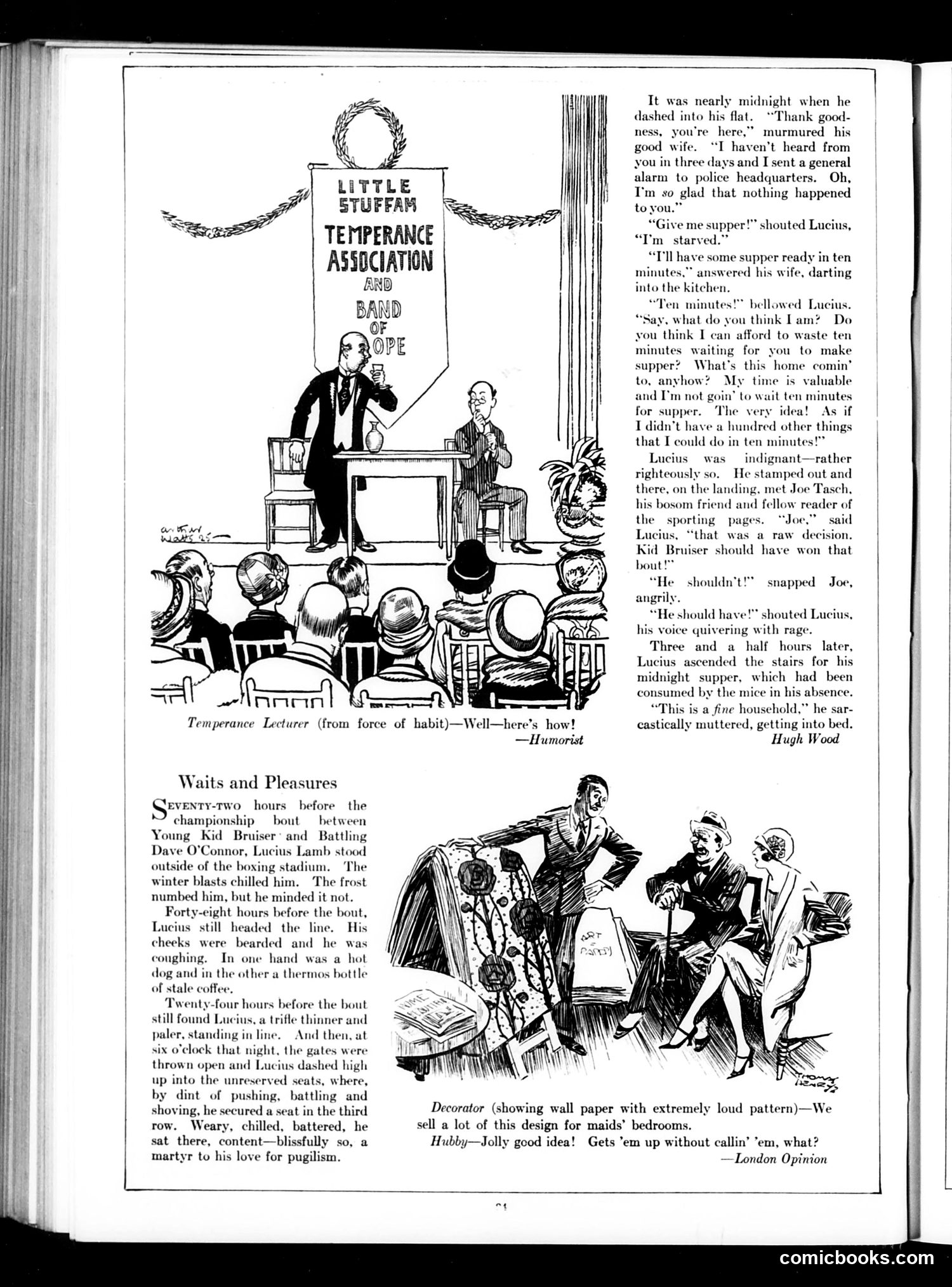
This page contains two satirical pieces lampooning male behavior and priorities in early 20th-century America. **"Temperance Lecturer"** (top cartoon): A man speaking at a temperance association meeting—ironically, while holding a drink. The joke: despite publicly advocating abstinence, he privately indulges, exposing the hypocrisy of temperance movement crusaders who didn't practice what they preached. **"Waits and Pleasures"** (main story): Lucius Lamb exemplifies misplaced priorities. He camps outside a boxing stadium for 72 hours in brutal cold to see a fight, but refuses to wait ten minutes for his wife's supper, then argues with a friend about the bout instead of eating. He loses his midnight meal to mice. The satire mocks working-class men who obsess over sports while neglecting home and family obligations—their "love for pugilism" trumping domestic responsibility. The decorative cartoon jokes about loud wallpaper designs marketed to servants' rooms.
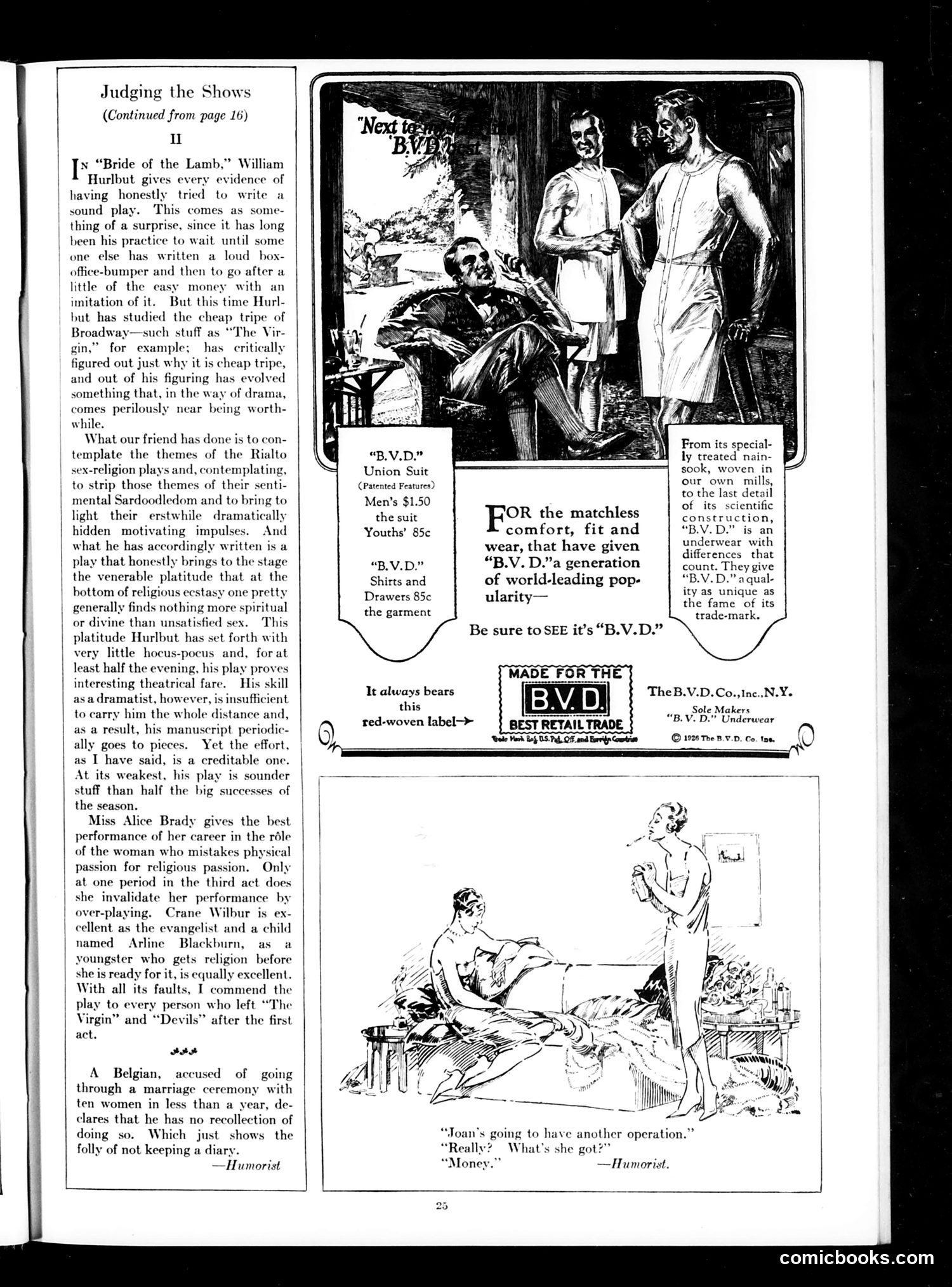
This Judge magazine page contains theater criticism and advertising, not political satire. **The Main Content:** William Hurlbut's play "Bride of the Lamb" is reviewed. The critic praises Hurlbut for honestly attempting serious drama rather than cynically imitating Broadway hits. The play apparently explores how religious ecstasy masks sexual desire—stripping sentimentality from the "sex-religion plays" popular on the Rialto (Broadway theater district). Performances by Alice Brady and Crane Wilbur are commended. **The Humor Section:** A brief joke about a Belgian man who married ten women in one year claims not to remember—the punchline advises keeping a diary. **The Advertisement:** B.V.D. brand union suits and underwear occupy significant space, emphasizing their patented construction and quality. The page reflects 1920s theater criticism conventions and consumer advertising, with no detectable political commentary or caricature.
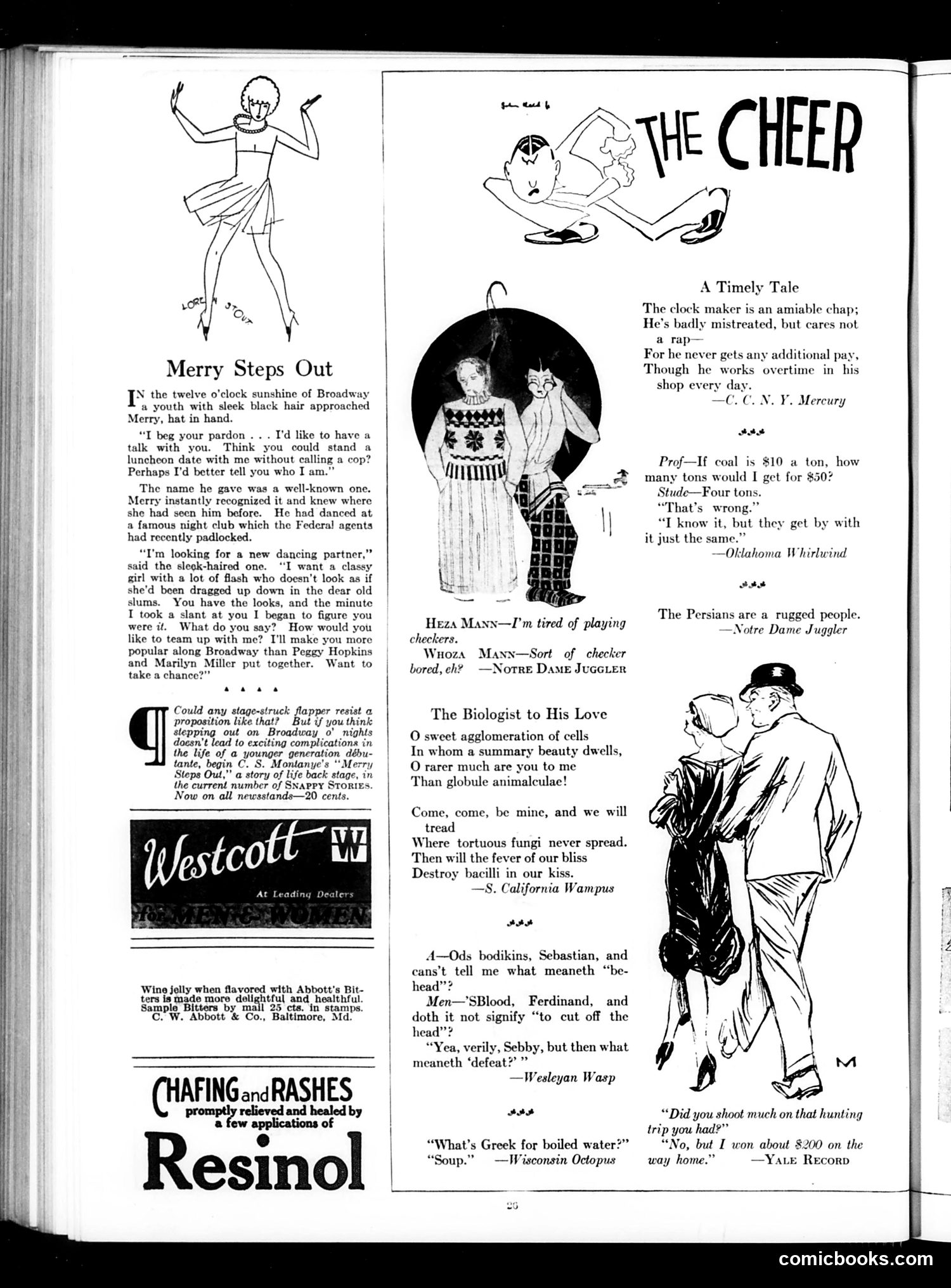
This page presents a serialized story about a young woman named Merry approached by a well-dressed man on Broadway who offers her a lucrative dancing partnership. The crucial context: he's identified as someone who "danced at a famous night club which the Federal agents had recently padlocked"—indicating he's connected to illegal speakeasies during Prohibition. The satire targets "flappers" (modern young women of the 1920s) and warns against the temptations of fast Broadway life and morally questionable associations. The accompanying text asks whether such a stage-struck girl could resist this proposition, implying the danger lies in organized crime connections masquerading as show-business opportunity. The remaining content consists of jokes, poetry parodies, and product advertisements typical of Judge magazine—including a humorous poem comparing romantic love to biological cells, and student humor about coal prices and hunting trips.
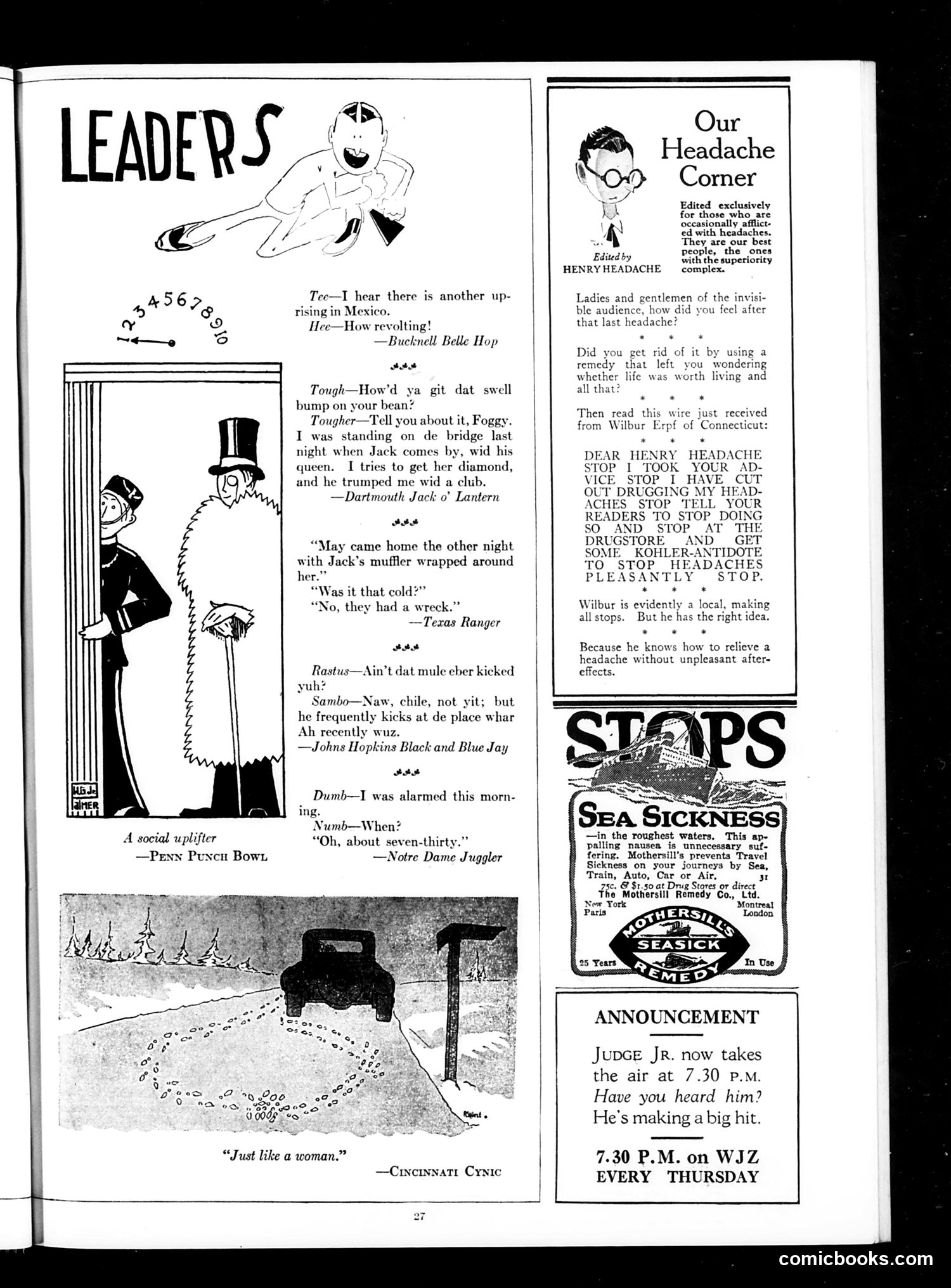
This page contains a "Leaders" section—a collection of short humorous anecdotes and jokes sourced from college newspapers and regional publications. The humor relies on wordplay and situational comedy typical of 1920s-era collegiate wit. Notable jokes include card game double-entendre ("trumped me wid a club"), a car-crash innuendo joke, and ethnic dialect humor featuring Black characters (common but now-offensive stereotyping of the era). The page's main cartoon shows a well-dressed man confronting a woman in furs—captioned "A social uplifter"—likely satirizing wealthy men posing as philanthropists while pursuing romantic/sexual encounters. The right column advertises Mothersill's seasickness remedy and announces "Judge Jr." radio programming on WJZ at 7:30 PM Thursdays, indicating Judge magazine's multimedia expansion into broadcasting during radio's early commercial boom.
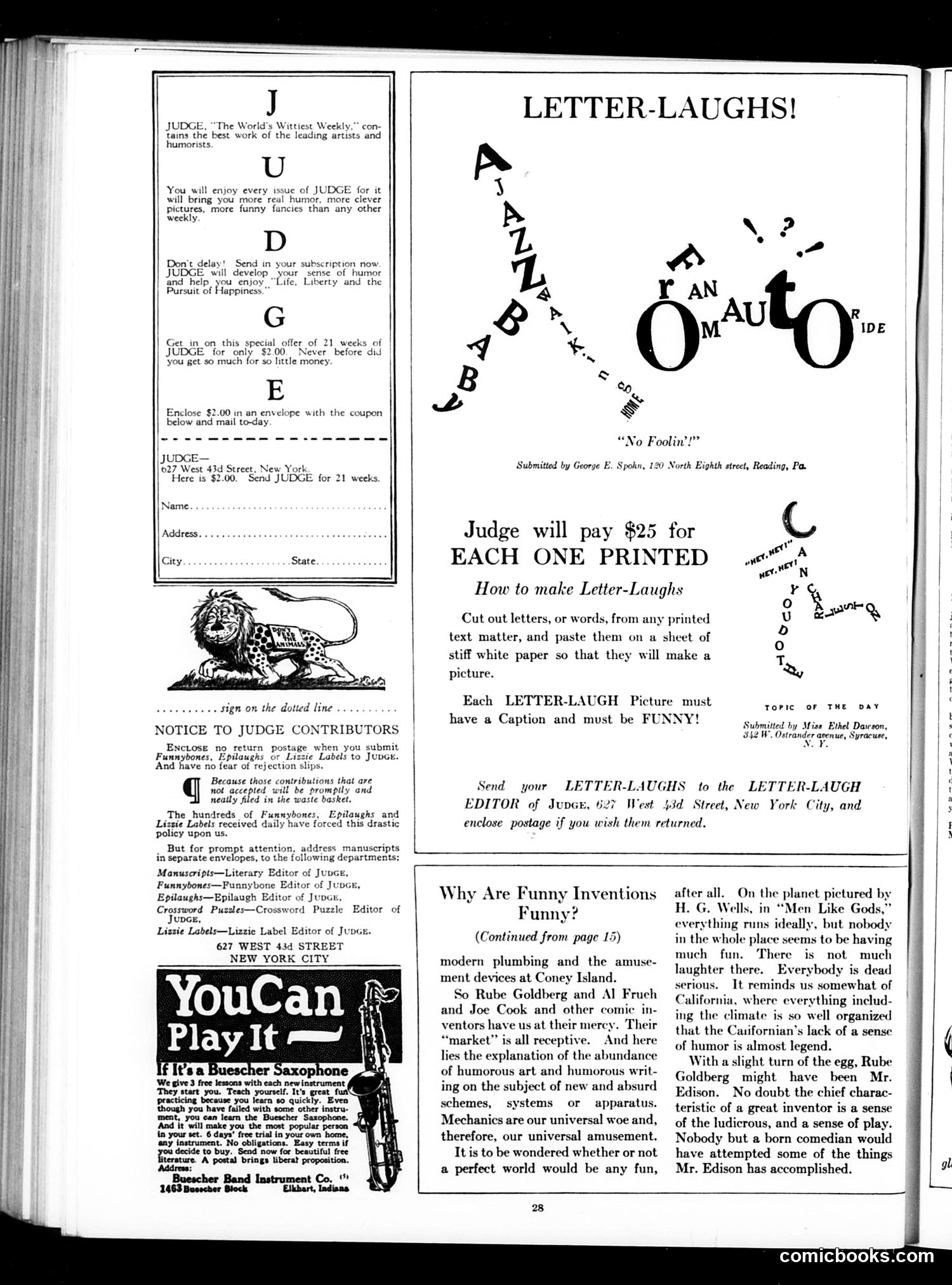
This page showcases **Judge magazine's promotional material and reader-submission contests**. The left side advertises Judge's $2 subscription offer, presenting it as America's premier humor magazine with superior cartoons and jokes compared to competitors. The right side features "Letter-Laughs"—a contest where Judge paid $25 for submitted visual puns created by cutting letters from printed text and arranging them into pictorial jokes. Examples shown include "An Auto Ride" and "Canopy," where letter arrangement creates the image itself. The bottom article discusses why "funny inventions" appeal to audiences, referencing cartoonist **Rube Goldberg** and others who satirized modern mechanical contraptions. It notes that humor about technology resonates because machinery represents "universal woe" in modern life. This reflects early 20th-century American humor: combining wordplay, reader participation, and satire about technological progress—core elements of Judge's appeal to educated, middle-class readers.
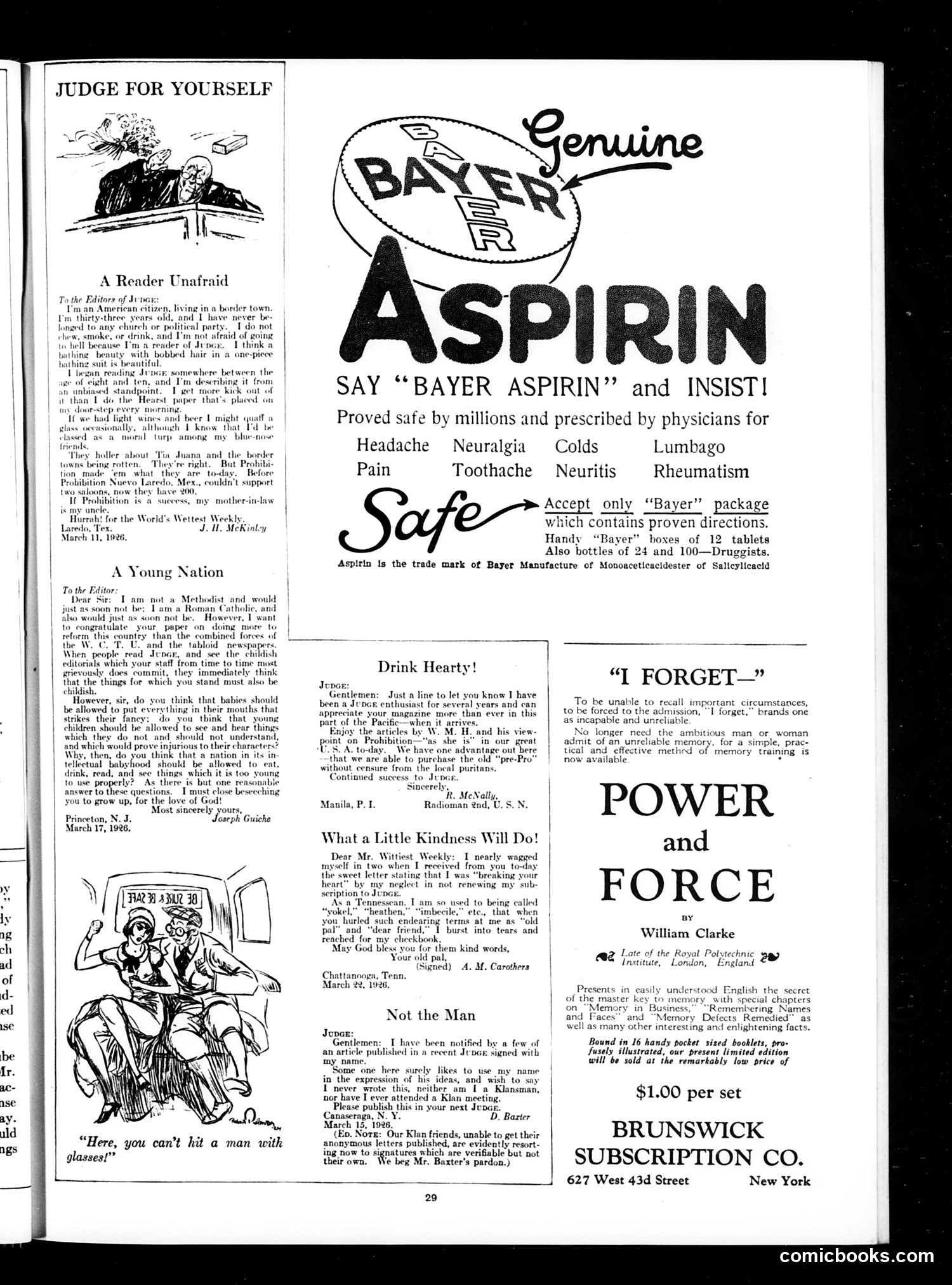
This page contains reader letters and advertisements typical of Judge, a satirical weekly. The "Judge For Yourself" section features letters to the editor addressing contemporary concerns: **Key content:** A reader defends Judge's irreverent content against Prohibition-era critics, arguing censorship of adults mirrors restricting children from harmful materials. Another writer protests his name being used in a KKK-related letter—the editor sarcastically notes the Klan is now forging signatures since they can't get their own letters published, a jab at the Klan's secretive practices. **The cartoons** show mundane domestic humor unrelated to the political content—a couple arguing, someone in a car. **Advertisements** dominate the page: Bayer Aspirin (emphasizing it's "genuine" and "safe"), memory-training books, and subscription services. The Bayer ad is notably prominent, reflecting early-20th-century pharmaceutical marketing directly to consumers. The overall page reflects 1920s anxieties about censorship, organized religion (Klan criticism), and consumer culture.
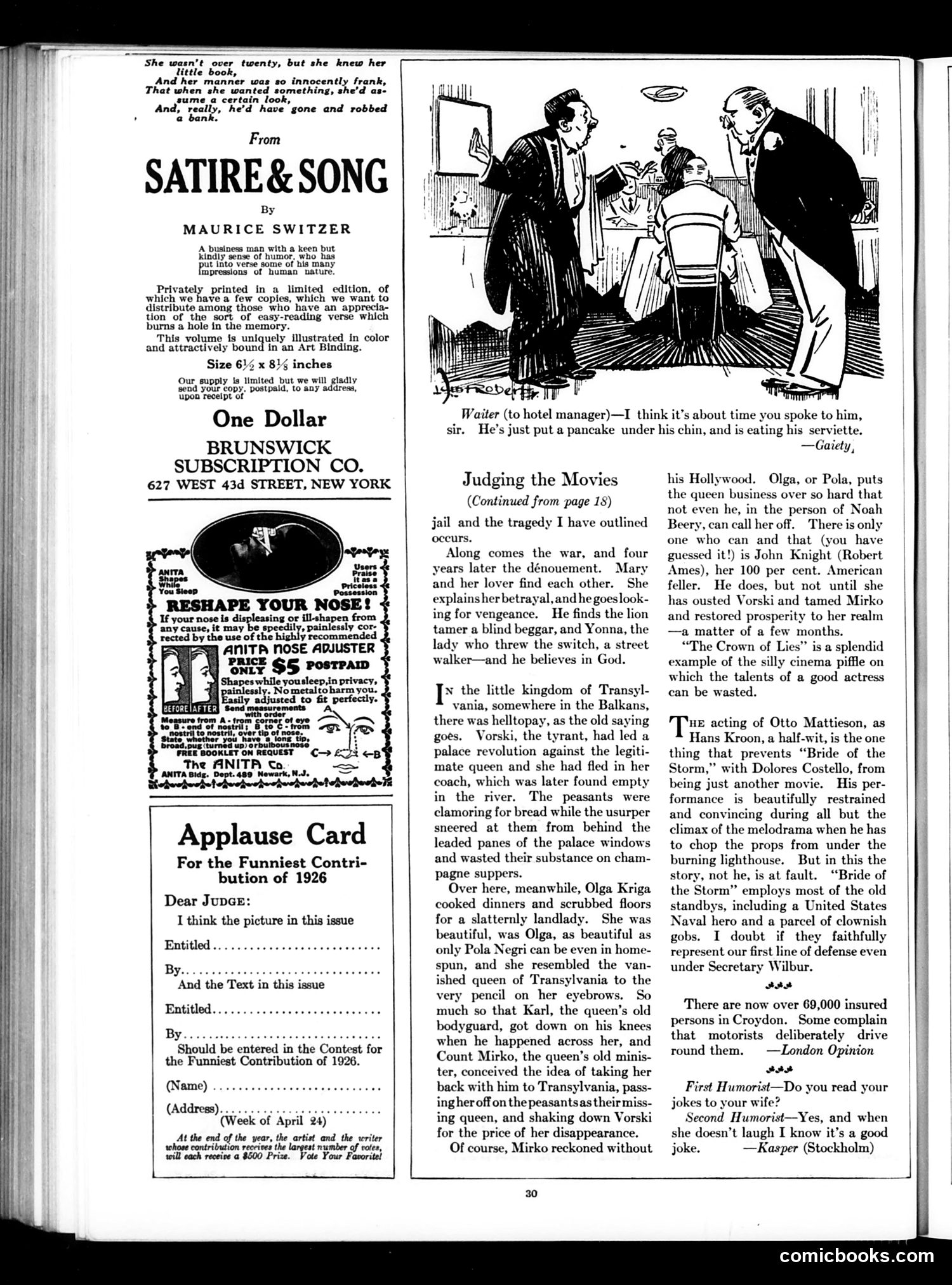
This page mixes advertising with entertainment content typical of 1926 Judge magazine. **The Main Cartoon** (top right) depicts a hotel waiter reporting to management about a disruptive guest who has placed a pancake under his chin and is eating his napkin—absurdist humor about eccentric behavior. **Movie Review Section** discusses film plots, notably mentioning actress **Pola Negri** in what appears to be a Transylvanian-themed picture. The review mocks melodramatic plot devices: a peasant girl resembling a deposed queen, palace intrigue, and American intervention. **Advertisements** include the **Anita Nose Adjuster**—a device claiming to reshape noses—reflecting period obsessions with physical "improvement" and the pseudoscience of appearance-based self-help. **"Satire & Song"** promotes a book by Maurice Switzer featuring light verse about human nature. The **Applause Card** invites readers to vote on the funniest contribution for a prize, engaging the audience as judges of humor—reflecting Judge's participatory culture. Overall: typical 1920s satirical magazine mixing social mockery, product promotion, and reader involvement.
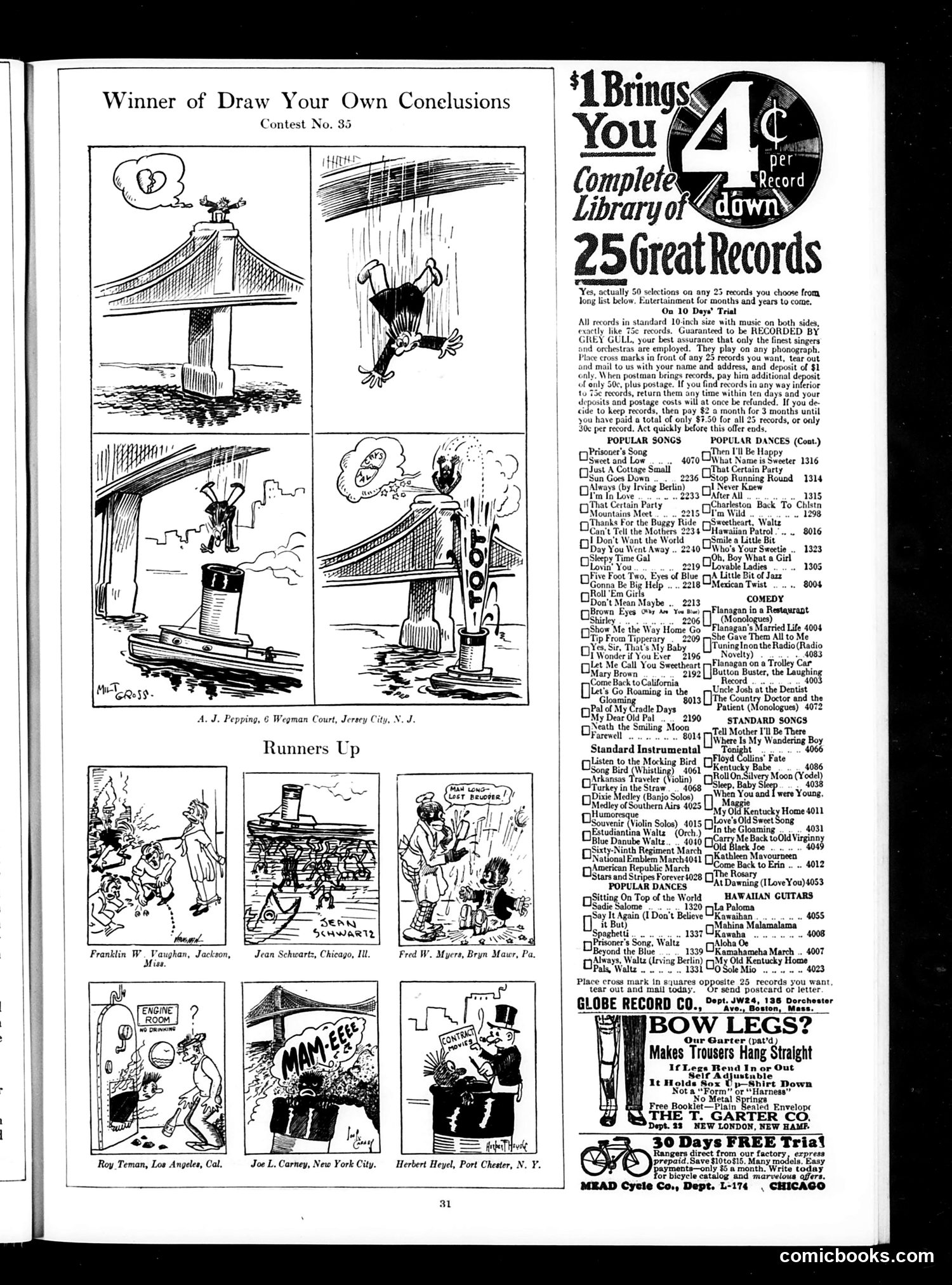
This page combines two elements: a "Draw Your Own Conclusions" contest and a record company advertisement. The **contest winner** (top left) shows four cartoon panels depicting someone being comically ejected from a bridge—likely satirizing the popular pastime of bridge construction and public fascination with engineering marvels like the Brooklyn Bridge. The humor relies on visual slapstick rather than political commentary. The **runners-up** cartoons below depict various humorous domestic and social scenarios typical of 1920s-era Judge humor—domestic mishaps, romantic entanglements, and absurdist situations. The page is predominantly **commercial advertising** for Globe Record Company's mail-order record service, offering 25 records for $1 down plus installment payments. The "Bow Legs" garter advertisement appears at bottom. This is primarily a magazine filler page combining contest results with paid advertising rather than substantive political satire.
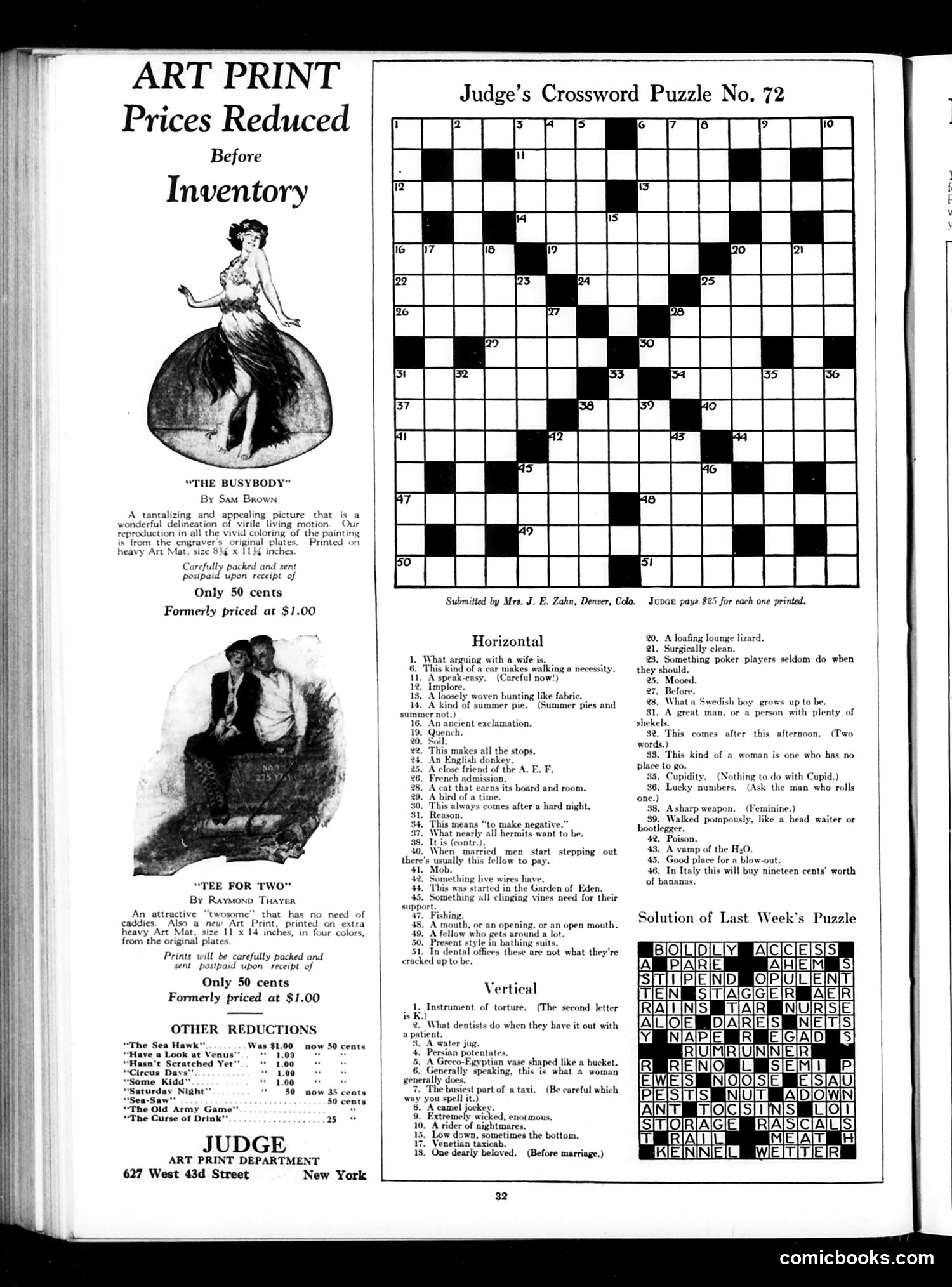
This page is primarily **advertising and a crossword puzzle** rather than political satire. The left side features **art print advertisements** for Judge's department, offering reproductions of paintings at reduced prices before inventory. "The Busybody" by Sam Brown and "Tee for Two" by Raymond Thayer are promoted at 50 cents (down from $1.00). The right side contains **"Judge's Crossword Puzzle No. 72,"** a standard word puzzle with horizontal and vertical clues. The clues are lighthearted wordplay typical of 1920s humor, referencing domestic life, romance, and contemporary slang (references to "the A.E.F.," wives, "hermits," "bootleggers," "bathing suits"). Below the puzzle is the **solution to the previous week's crossword**. The page demonstrates how Judge—primarily a satirical magazine—also functioned as a **commercial entertainment product**, blending advertising, puzzles, and general interest content alongside its political and social commentary found elsewhere in the publication.
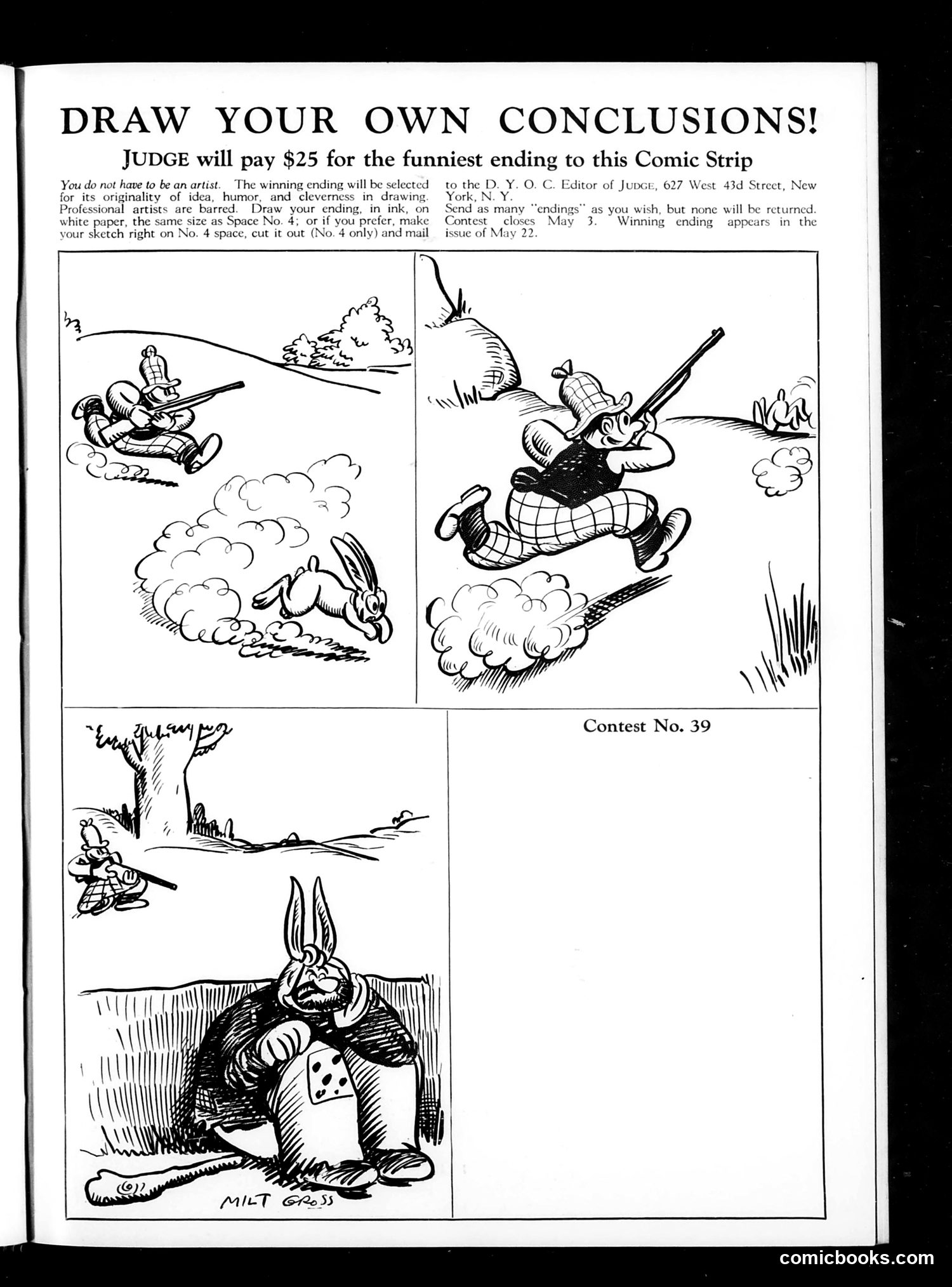
This page from *Judge* magazine presents "Contest No. 39," a reader participation contest. The magazine published an incomplete comic strip featuring a character (appears to be a soldier or military figure with a rifle) and a rabbit in various scenes, then invited readers to submit humorous endings. The contest offered $25 for the funniest conclusion, emphasizing that artistic skill wasn't required—originality, humor, and cleverness in drawing mattered most. Entries were to be submitted to *Judge*'s New York offices, with the winning ending published in the May 23 issue. This type of participatory contest was common in early-to-mid 20th century magazines, engaging readers while generating content and reader loyalty. The comic strip's absurdist humor—a soldier chasing a rabbit with explosions—is typical of *Judge*'s satirical style, though the specific satirical target remains unclear from this page alone.
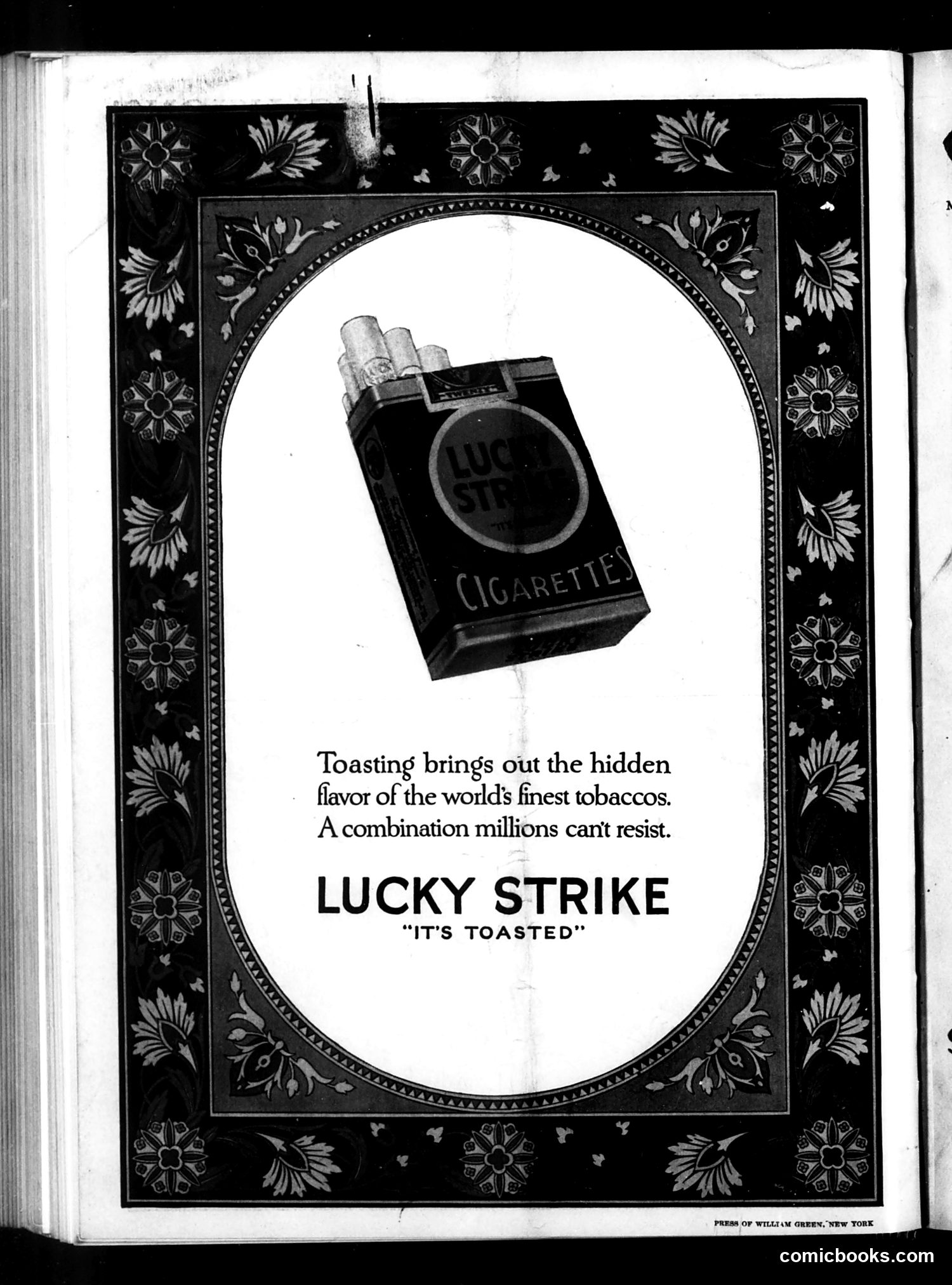
This page is primarily a **cigarette advertisement**, not political satire. It promotes Lucky Strike cigarettes with their famous "It's Toasted" slogan, claiming that toasting brings out hidden flavors in tobacco. The ad features a pack of Lucky Strike cigarettes displayed in an ornate oval frame with decorative floral borders—a common design convention for premium product advertising of the era. The text promises the toasting process creates "a combination millions can't resist." This represents straightforward **commercial advertising from the early-to-mid 20th century**, before tobacco health warnings were required. Judge magazine, while primarily satirical, carried such advertisements to fund publication. There is no satirical commentary or political message visible on this page—it's simply a period tobacco ad using decorative design to convey product prestige.