
Judge, 1926-04-24 · page 15 of 36
Judge — April 24, 1926 — page 15: what you’re looking at
What you’re looking at
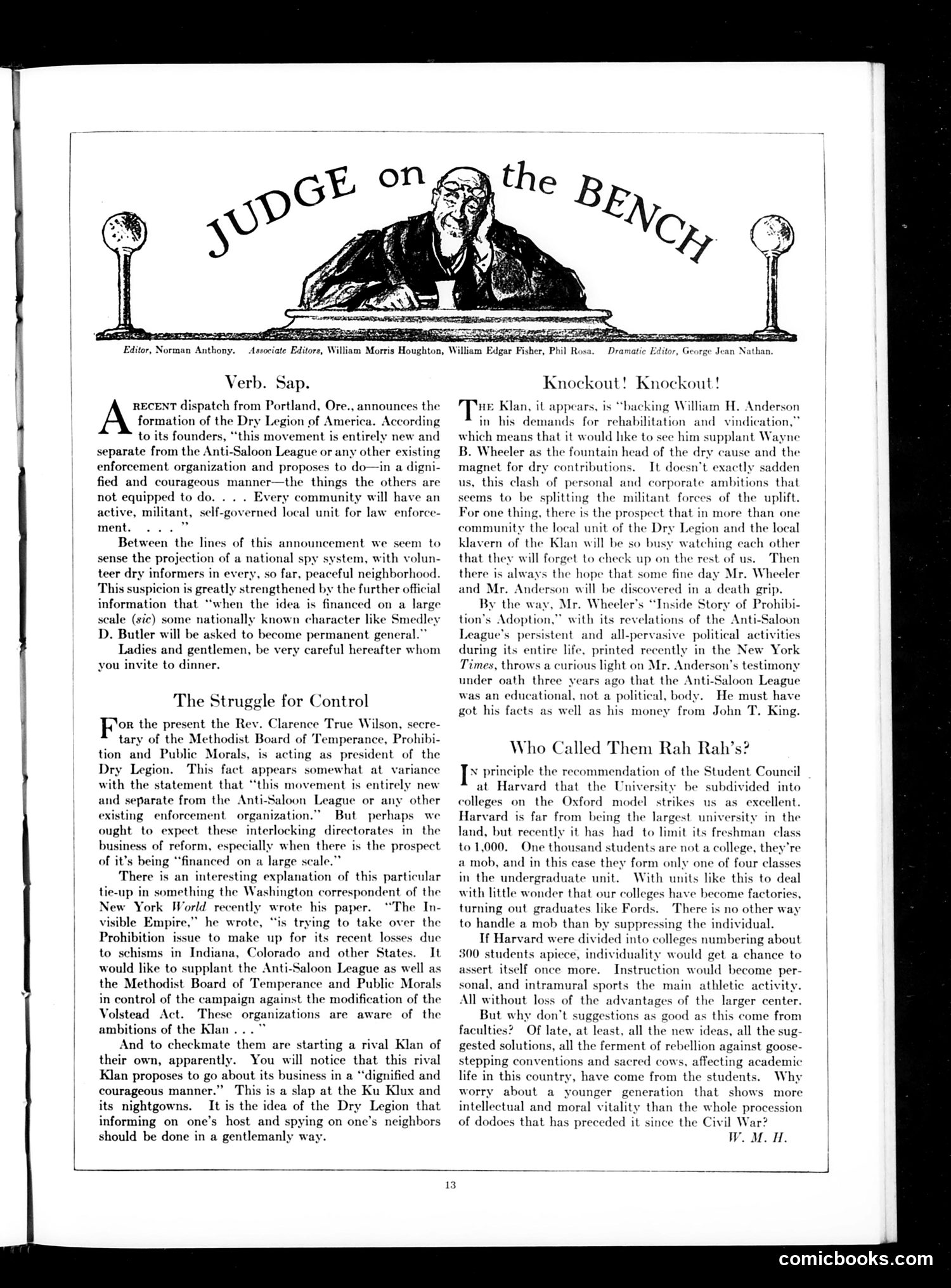
This page satirizes competing Prohibition enforcement organizations during the 1920s Volstead Act era. The "Dry Legion of America," a new temperance group, claims independence but is allegedly backed by the Ku Klux Klan—here called the "Invisible Empire"—seeking to dominate the Prohibition movement. Judge mocks the proposed organization's promise of "dignified" enforcement while actually describing a nationwide spy network of informers reporting on neighbors and dinner guests. The satire escalates when noting that military figure Smedley Butler might lead it, and that competing leaders (William H. Anderson and W.B. Wheeler) represent dueling personal ambitions. The cartoon's bitter humor: rival Prohibition groups—the Klan, Anti-Saloon League, and Methodist Board—will be too busy fighting each other to actually spy on ordinary citizens. Judge suggests hypocrisy and power struggles underlie claims of moral reform.
📄 Transcribed text from this page (OCR, searchable)
Machine-transcribed from the original scan — historical spelling and the odd misread are preserved.
Verb. Sap. A RECENT dispatch from Portland, Ore., announces the formation of the Dry Legion of America. According to its founders, “this movement is entirely new and separate from the Anti-Saloon League or any other existing enforcement organization and proposes to do—in a digni- fied and courageous manner—the things the others are not equipped to do... . Every community will have an active, militant, self-governed local unit for law enforce- ment. is Between the lines of this announcement we seem to sense the projection of a national spy system, with volun- teer dry informers in every, so far, peaceful neighborhood. This suspicion is greatly strengthened by the further official information that “when the idea is financed on a large scale (sic) some nationally known character like Smedley D. Butler will be asked to become permanent general Ladies and gentlemen, be very careful hereafter whom you invite to dinner. The Struggle for Control Fro the present the Rev. Clarence True Wilson, secre- tary of the Methodist Board of Temperance, Prohibi- tion and Public Morals, is acting as president of the Dry Legion. This fact appears somewhat at variance with the statement that “this movement is entire and separate from the Anti-Saloon League or any other existing enforcement organization.” But perhaps we ought to expect these interlocking directorates in the business of reform, especially when there is the prospect of it’s being ‘financed on a large scale.” There is an interesting explanation of this particular tie-up in something the Washington correspondent of the New York World recently wrote his paper. “The In- visible Empire," he wrote, “is trying to take over the Prohibition issue to make up for its recent losses due to schisms in Indiana, Colorado and other States. It would like to supplant the Anti-Saloon League as well as the Methodist Board of Temperance and Public Morals in control of the campaign against the modification of the Volstead Act. These organizations are of the ambitions of the Klan . . And to checkmate them are their own, apparently. You Klan proposes to go about its business in a “dignified and courageous manner.” This is a slap at the Ku Klux and its nightgowns. It is the idea of the Dry Legion that informing on one’s host and spying on one’s neighbors should be done in a gentlemanly way. new tarting a rival Klan of Il notice that this rival Dramatic Edito Knockout! Knockout! Tr Klan, it appears, is “backing William H. Anderson 1 his demands for rehabilitation and vindication which means that it would like to see him supplant W B. Wheeler as the fountain head of the dry cause and the magnet for dry contributions. It doesn’t exactly sadden us, this clash of personal and corporate ambitions that seems to be splitting the militant forces of the uplift. For one thing, there is the prospect that in more than one community the local unit of the Dry Legion and the local klavern of the Klan will be so busy watching each other that they will forget to check up on the rest of us. Then there is always the hope that some fine day Mr. Wheeler and Mr. Anderson will be discovered in a death grip. By the way, Mr. Wheeler's “Inside Story of Prohibi- tion’s Adoption,” with its re ions of the Anti- League’s persistent and all-pervasive political acti during its entire life, printed recently in the New York Times, throws a curious light on Mr. Anderson’s testimony under oath three years ago that the Anti-Saloon League was an educational, not a political, body. He must have got his facts as well as his money from John T. King. Who Called Them Rah Rah’s? I principle the recommendation of the Student Council at Harvard that the University be subdivided into colleges on the Oxford model strikes us as excellent. Harvard is far from being the largest university in the land, but recently it has had to limit its freshman class to 1,000. One thousand students are not a college, they’re a mob, and in this case they form only one of four elas in the undergraduate unit. With units like this to deal with little wonder that our colleges have become factories, turning out graduates like Fords. There is no other way to handle a mob than by suppressing the individual. If Harvard were divided into colleges numbering about 300 students apiece, individuality would get a chance to assert itself once more. Instruction would become per- sonal, and intramural sports the main athletic activity. All without loss of the advantages of the larger center. But why don’t suggestions as good as this come from faculties? Of late, at least, all the new ideas, all the sug- gested solutions, all the ferment of rebellion against goose- stepping conventions and sacred cows, affecting academic life in this country, have come from the students. Why worry about a younger generation that shows more intellectual and moral vitality than the whole procession of dodoes that has preceded it since the Civil War? W. MoH, comicbooks.com