
Judge, 1926-04-24 · page 18 of 36
Judge — April 24, 1926 — page 18: what you’re looking at
What you’re looking at
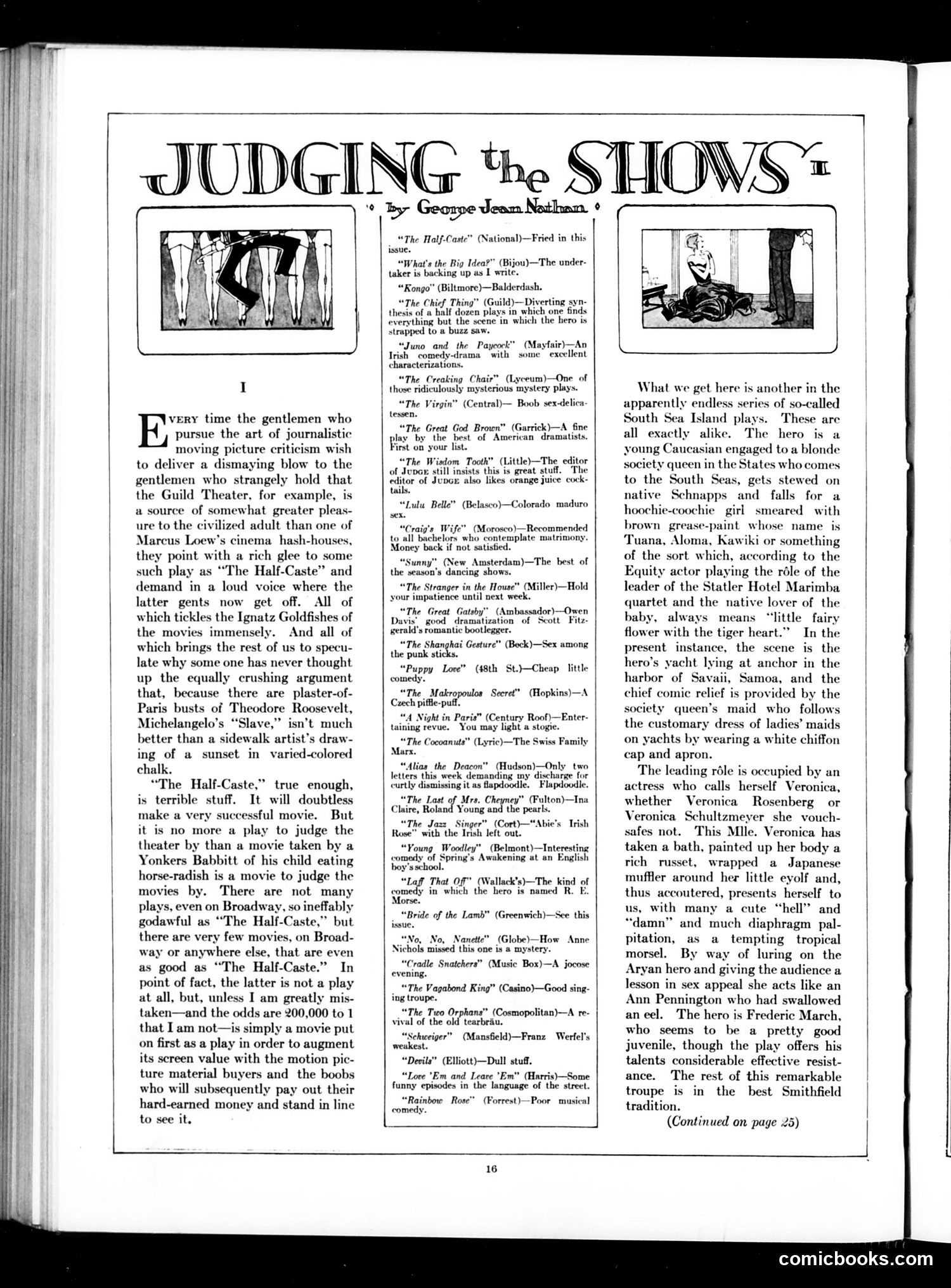
This is a theater criticism column by George Jean Nathan reviewing Broadway plays. The satirical point attacks the false equivalence critics make between poor theatrical productions and cinema. Nathan argues that theater critics unfairly dismiss live theater by pointing to terrible plays like "The Half-Caste" as evidence of theater's inferiority to movies. He counters this is illogical—one shouldn't judge an entire medium by its worst examples. His analogy: a plaster bust of Roosevelt isn't inferior to Michelangelo's "Slave" simply because both are sculptures. Importantly, Nathan reveals "The Half-Caste" is actually a movie disguised as a stage play to boost its film credentials—exposing the cynical commercialism blurring these mediums. The right column continues reviewing current Broadway shows with acerbic one-liners ("Balderdash," "sex-delicatessen," etc.), maintaining Judge's irreverent tone toward entertainment industry pretension. This defends theatrical culture against emerging cinema's commercial dominance in 1920s America.
📄 Transcribed text from this page (OCR, searchable)
Machine-transcribed from the original scan — historical spelling and the odd misread are preserved.
UDGING ‘be e SHOWS* very time the gentlemen who E pursue the art of journalistic moving picture criticism wish to deliver a dismaying blow to the gentlemen who strangely hold that the Guild Theater, for example, is a source of somewhat greater pleas- ure to the civilized adult than one of Marcus Loew’s cinema hash-houses, they point with a rich glee to some such play as ‘The Half-Caste” and demand in a loud voice where the latter gents now get off. All of which tickles the Ignatz Goldfishes of the movies immensely. And all of which brings the rest of us to specu- late why some one has never thought up the equally crushing argument that, because there are plaster-of- Paris busts of Theodore Roosevelt, Michelangelo's “Slave,” isn’t much better than a sidewalk artist's draw- ing of a sunset in varied-colored chalk. “The Half-Caste,” true enough, is terrible stuff. It will doubtless make a very successful movie. But it is no more a play to judge the theater by than a movie taken by a Yonkers Babbitt of his child eating horse-radish is a movie to judge the movies by. There are not many plays, even on Broadway, so ineffably godawful as “The Half-Caste,” but there are very few movies, on Broad- way or anywhere else, that are even as good as “The Half-Caste.” In point of fact, the latter is not a play at all, but, unless I am greatly mis- taken—and the odds are 200,000 to 1 that I am not—is simply a movie put on first as a play in order to augment its screen value with the motion pic- ture material buyers and the boobs who will subsequently pay out their hard-earned money and stand in line to see it. “The Half-Caste” (National)—Fried in this issue. Vhat's the Big Idea?” (Bijou)—The under- taker is backing up as I write. “Kongo” (Biltmore)—Balderdash. “The Chief Thing” (Guild)—Diverting syn- thesis of a half dozen plays in which one finds everything but the scene in which the hero is strapped to a buzz saw. (Mayfair)—An “Juno and the Paycock”” excellent Irish comedy-drama with som characterizations. “The Creaking Chair” (Lyceum)—One of those ridiculously mysterious mystery plays. “The Virgin” (Central)— Boob sex-delica- tessen. The Great God Brown” (Garrick)—A fine by the best of American dramatists. on your list. “The Wisdom Tooth” (Little)—The editor of Jupar: still insists this is great stuff. The See ie rea tates foes come tails, “Lulu Belle” (Belasco)—Colorado maduro sex. ‘raig's Wife” (Morosco)—Recommended to all bachelors who contemplate matrimony. Money back if not satisfied. “Sunny” (New. Amsterdam)—The best of the season's dancing shows. The Stranger in the House” (Miller)—Hold your impatience until next week. “The Great Gatsby’ (Ambassador)—Owen Davis’ good dramatization of Scott Fitz- gerald’s romantic bootlegger. “The Shanghai Gesture” (Bock)—Sex among the punk sti “Puppy Love” comedy. “The Makropoulos Secret” (Hopkins)—A Ceech pitle-pufl. “A Night in Paria” (Century Roof)—Enter- taining revue, You may light a stogi “The Cocoanuts” (Lyric)—The Swiss Family Marx. Alias the Deacon (Hudson)—Oi tters this week demanding my di tly detaining tas dapleodie, Flapdoodic The Last of Mrs. Cheyney” (Fulton)—Ina Claire, Roland Young and the pearls. je Jazz Singer” (Cort)—“Abie’s Trish Rose” with the Irish left out. “Young Woodley” comedy of boy's schoo! (48th St.)—Cheap little (Belmont)—Interesting is's Awakening at an English That Off” (Wallack’s)—The kind of in which the hero is named R. “Bride of the Lamb” (Greenwich)—Sce this issue. “No, No, Nanette” (Globe)—How Anne Nichols missed this one is a mystery. ‘Cradle Snatchers” (Music Box)—A jocose evening. “The Vagabond King” (Casino)—Good sing- ing troupe. “The Tico Orphans” (Cosmopolitan)—A re- of the old tearbriu. *hweiger” (Mansfield)—Franz Werfel's weakest. “Devils” (Elliott)—Dull stuff. “Love 'Em and Leare "Em" (Harris)—Some funny episodes in the language of the street. “Rainbow Rose” comedy. (Forrest)—Poor musical What we get here is another in the apparently endless series of so-called South Sea sland plays. These are alike. The hero is a an engaged to a blonde society queen in the States who comes to the South Seas, gets stewed on native Schnapps and falls for a hoochie-coochie girl smeared with brown grease-paint whose name is Tuana, Aloma, Kawiki or something of the sort which, according to the Equity actor playing the réle of the leader of the Statler Hotel Marimba quartet and the native lover of the baby, always means “little fairy flower with the tiger heart.” In the present instance, the scene is the hero’s yacht lying at anchor in the harbor of Savaii, Samoa, and the chief comic relief is provided by the society queen’s maid who follows the customary dress of ladies’ maids on yachts by wearing a white chiffon cap and apron. The leading réle is occupied by actress who calls herself Veronica, whether Veronica Rosenberg or Veronica Schultzmeyer she vouch- safes not. This Mlle. Veronica has taken a bath, painted up her body a rich russet, wrapped a Japanese muffler around her little eyolf and, thus accoutered, presents herself to us, with many a cute “hell” and “damn” and much diaphragm pal- pitation, as a tempting tropical morsel. By way of luring on the Aryan hero and giving the audience a lesson in sex appeal she acts like an Ann Pennington who had swallowed aneel. The hero is Frederic March, who seems to be a pretty good juvenile, though the play offers his talents considerable effective resi: ance. The rest of this remarkable troupe is in the best Smithfield tradition. (Continued on page 25) comicbooks.com