
A complete issue · 36 pages · 1926
Judge — February 27, 1926
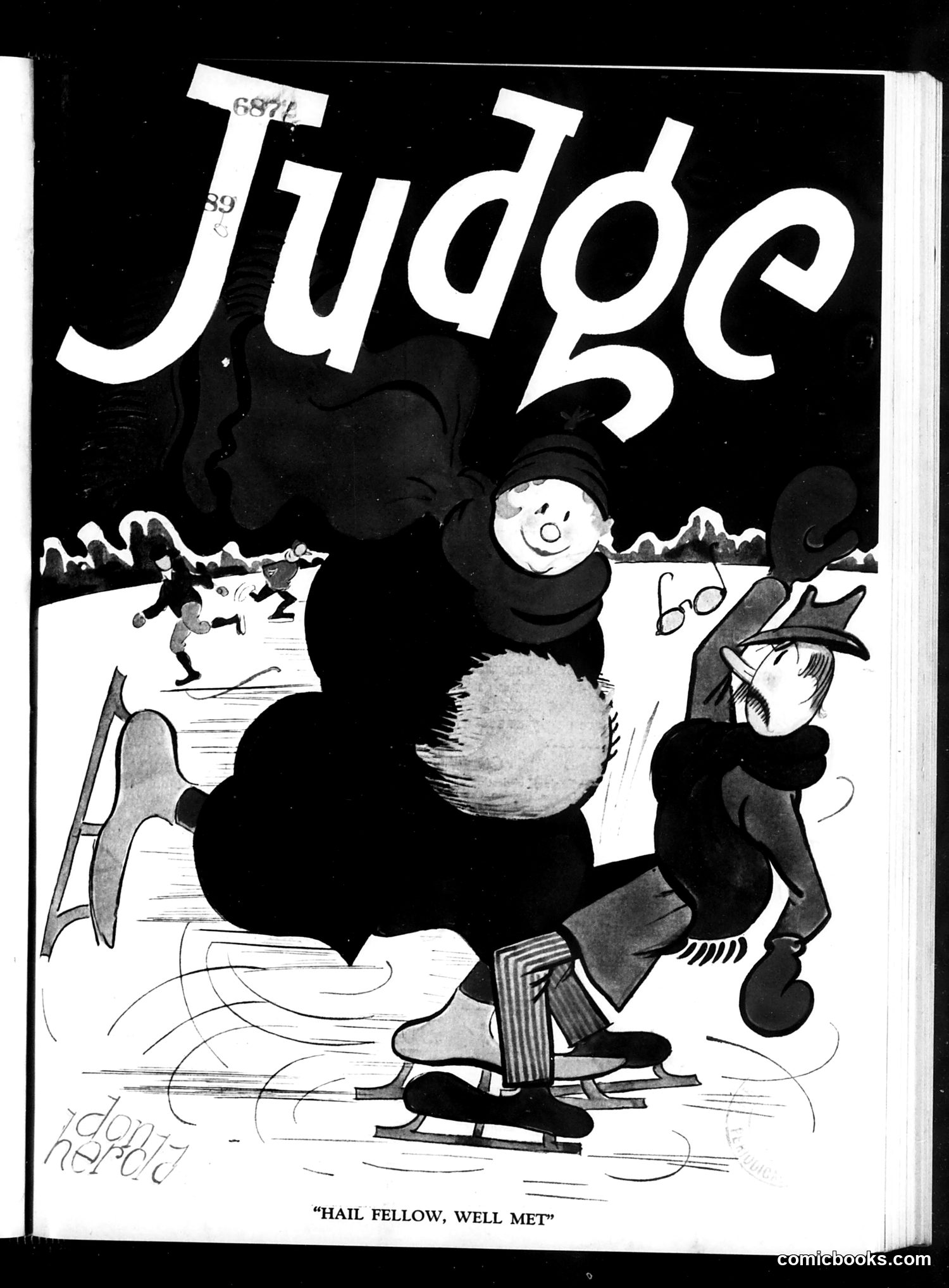
This appears to be a cover or illustration from *Judge* magazine featuring a jovial, rotund figure juggling a large snowball while ice-skating. The caption reads "HAIL FELLOW, WELL MET" — a phrase meaning a friendly, convivial greeting. The cartoon likely celebrates winter sports and seasonal festivities, showing a cheerful character engaged in snow-based play. The figure's exaggerated proportions and happy demeanor suggest this is a lighthearted, humorous take on winter entertainment rather than sharp political satire. Without additional context about the specific publication date or current events referenced, the exact satirical target remains unclear. The image appears primarily designed for entertainment and seasonal humor rather than pointed social commentary.
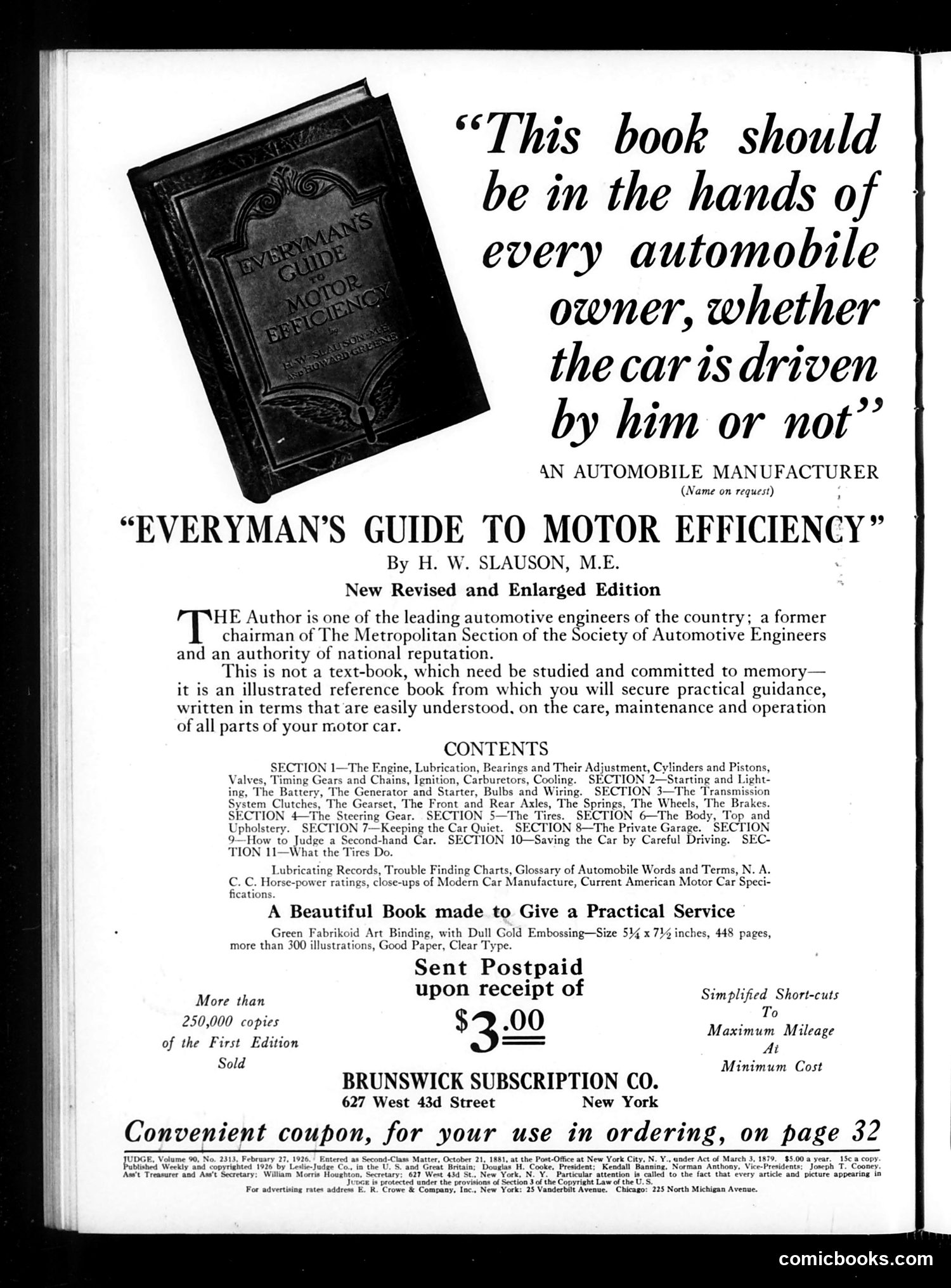
This page is primarily an **advertisement**, not a political cartoon. It promotes "Everyman's Guide to Motor Efficiency" by H.W. Slauson, a practical manual for automobile owners and maintenance. The advertisement includes a testimonial quote from an unnamed automobile manufacturer endorsing the book's value to all car owners. The pitch emphasizes the book's practical utility—it's "not a text-book" but rather an illustrated reference guide covering engine maintenance, repair, and operation written in accessible language. The publication details (Brunswick Subscription Co., New York, priced at $3.00) and sales figures (250,000 copies of first edition sold) suggest this was a popular instructional work during the automobile's early widespread adoption era. No political or satirical content is present on this page.
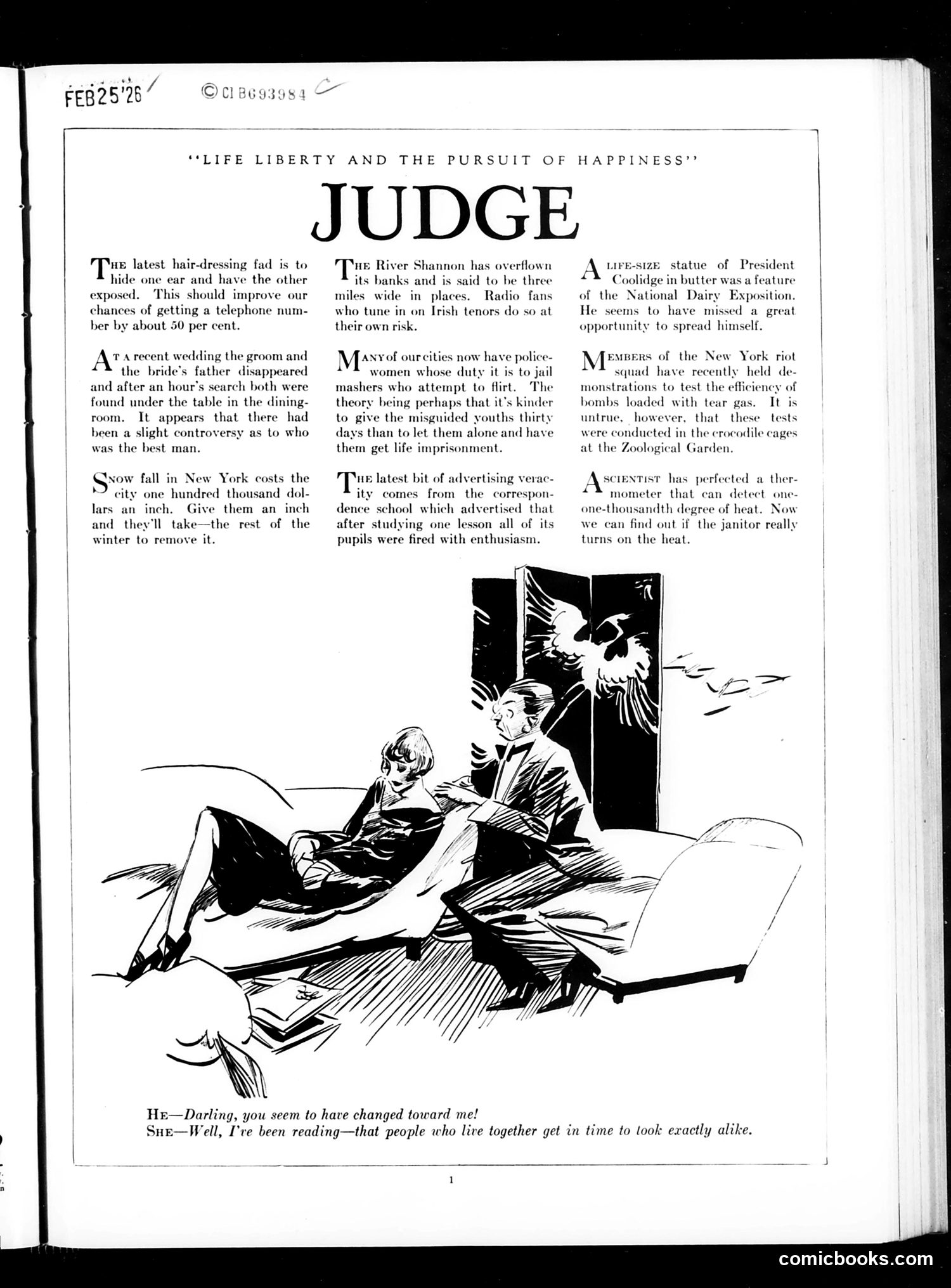
This page from *Judge* magazine (dated FEB 25, '25) contains satirical commentary and a humorous cartoon rather than political caricature. The main cartoon depicts a couple on a sofa with a bird flying away through a window. The caption reads: "He—Darling, you seem to have changed toward me! / She—Well, I've been reading—that people who live together get in time to look exactly alike." The joke satirizes marriage anxiety: the husband notices his wife's emotional distance and suspects infidelity, but she's merely been reading that cohabiting couples develop similar appearances. The humor relies on subverting his dramatic assumption with a mundane, absurd explanation. The surrounding text contains brief humorous observations about contemporary life—hair-styling fads, snow removal costs, police-women, and thermometers—typical of *Judge*'s lighthearted social satire of the 1920s.
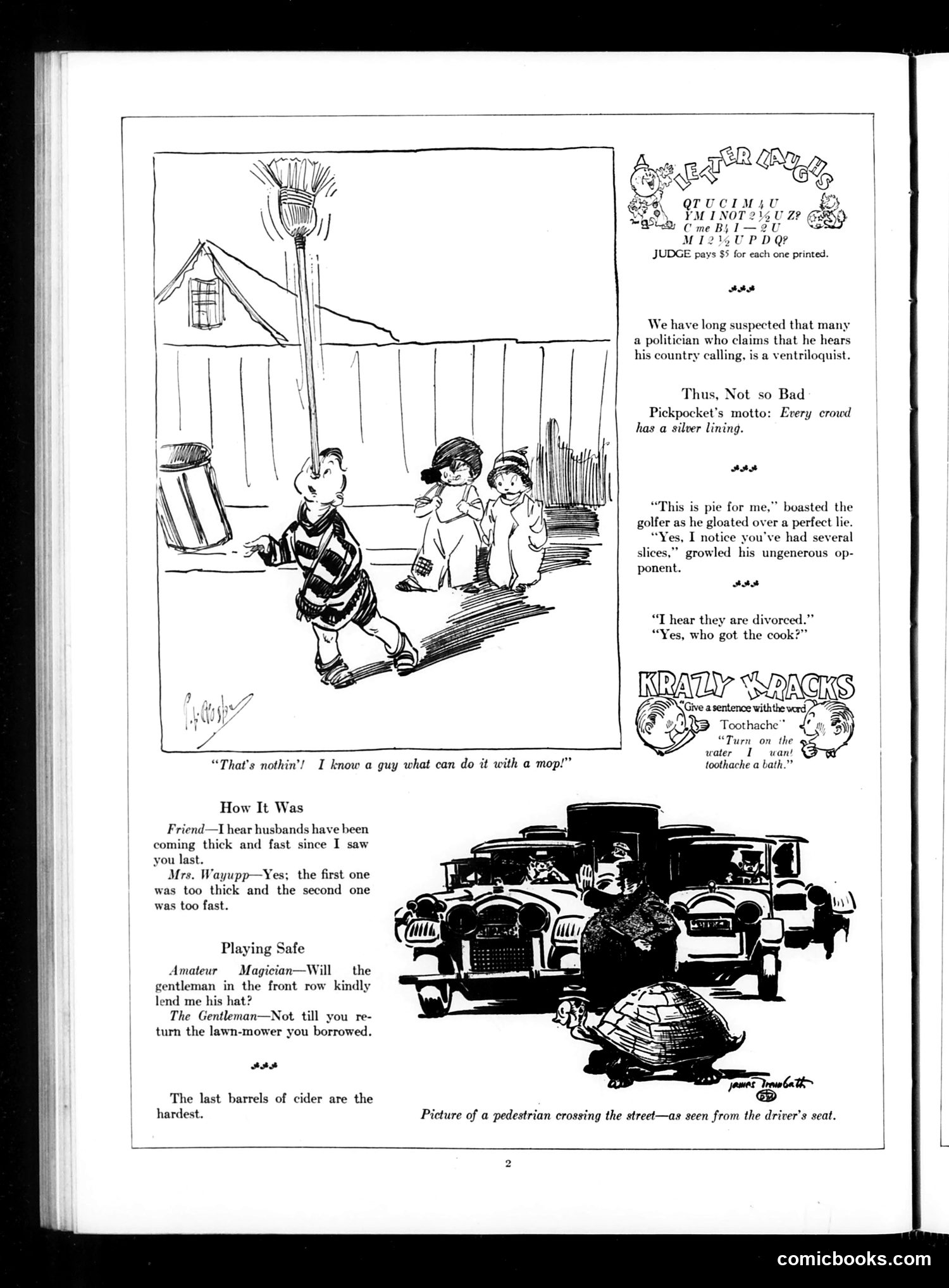
The main cartoon depicts a man with a mop, with the caption "That's nothin'! I know a guy what can do it with a mop!" This appears to be a working-class humor joke about comparative skill levels. The surrounding text includes brief humorous anecdotes ("How It Was," "Playing Safe") typical of Judge's format, plus a "Krazy Kracks" wordplay puzzle. The bottom illustration shows a turtle crossing a street amid automobiles—captioned as "Picture of a pedestrian crossing the street—as seen from the driver's seat." This is traffic-safety humor, mocking pedestrians' slowness relative to increasingly common motor vehicles. Overall, this page represents Judge's mix of blue-collar humor, domestic comedy, and contemporary social commentary about early 20th-century American life, particularly the novelty of automobile culture.
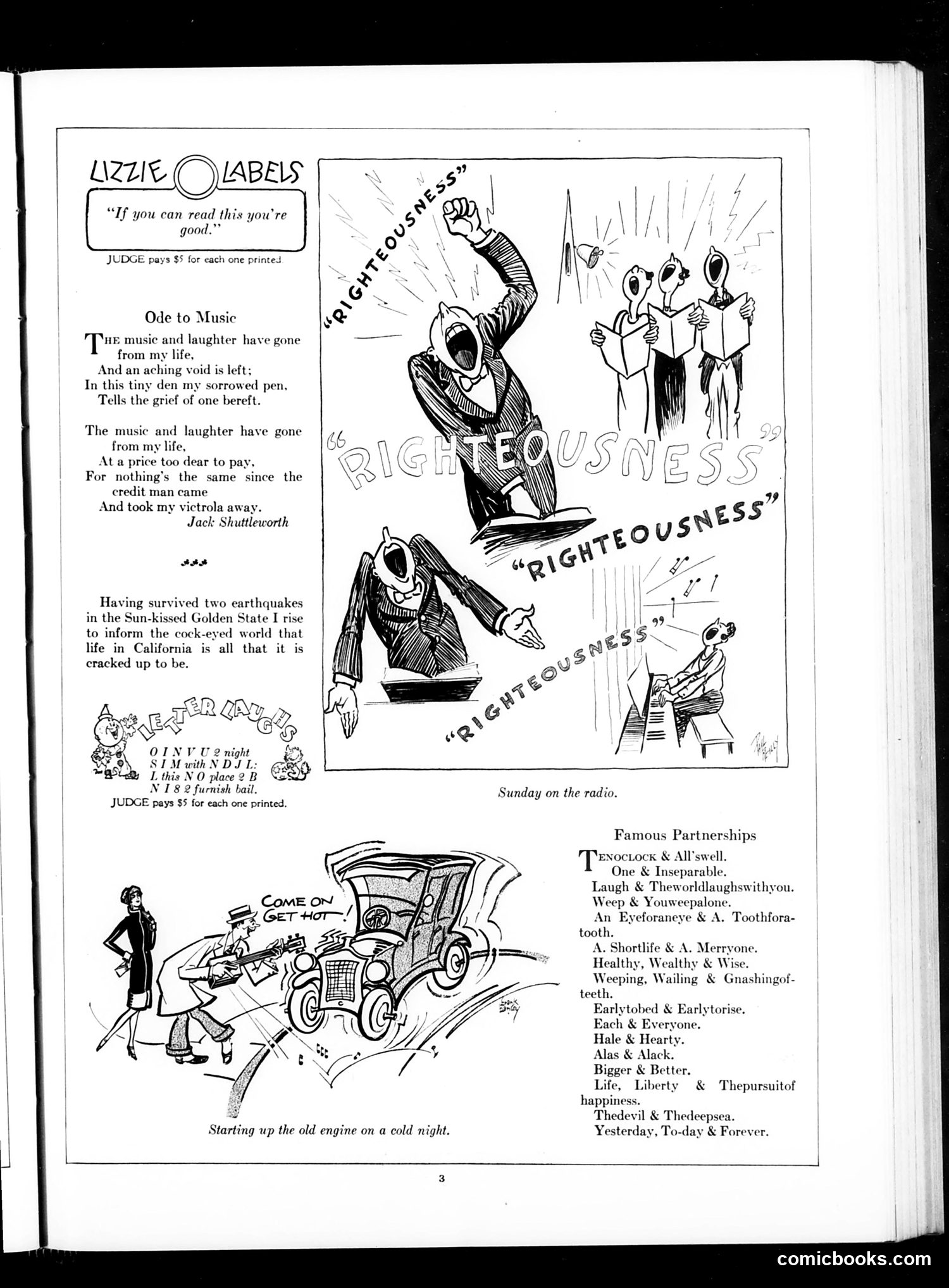
The central cartoon satirizes excessive "righteousness"—depicting figures preaching morality while appearing hypocritical or self-righteous. The raised fist and broadcast setting suggest commentary on radio preachers or moral crusaders of the era. The "Ode to Music" laments lost joy in American life, attributing decline to financial hardship ("price too dear to pay") and the loss of the "credit man"—likely referencing economic instability, possibly related to the Great Depression. The bottom cartoon humorously depicts difficulty starting an old engine in winter—a relatable domestic complaint of the period. The "Famous Partnerships" section is primarily wordplay on famous pairs (literary, cultural), serving as filler content rather than satire. Overall, the page blends social commentary on hypocrisy with everyday humor typical of Judge's satirical approach.
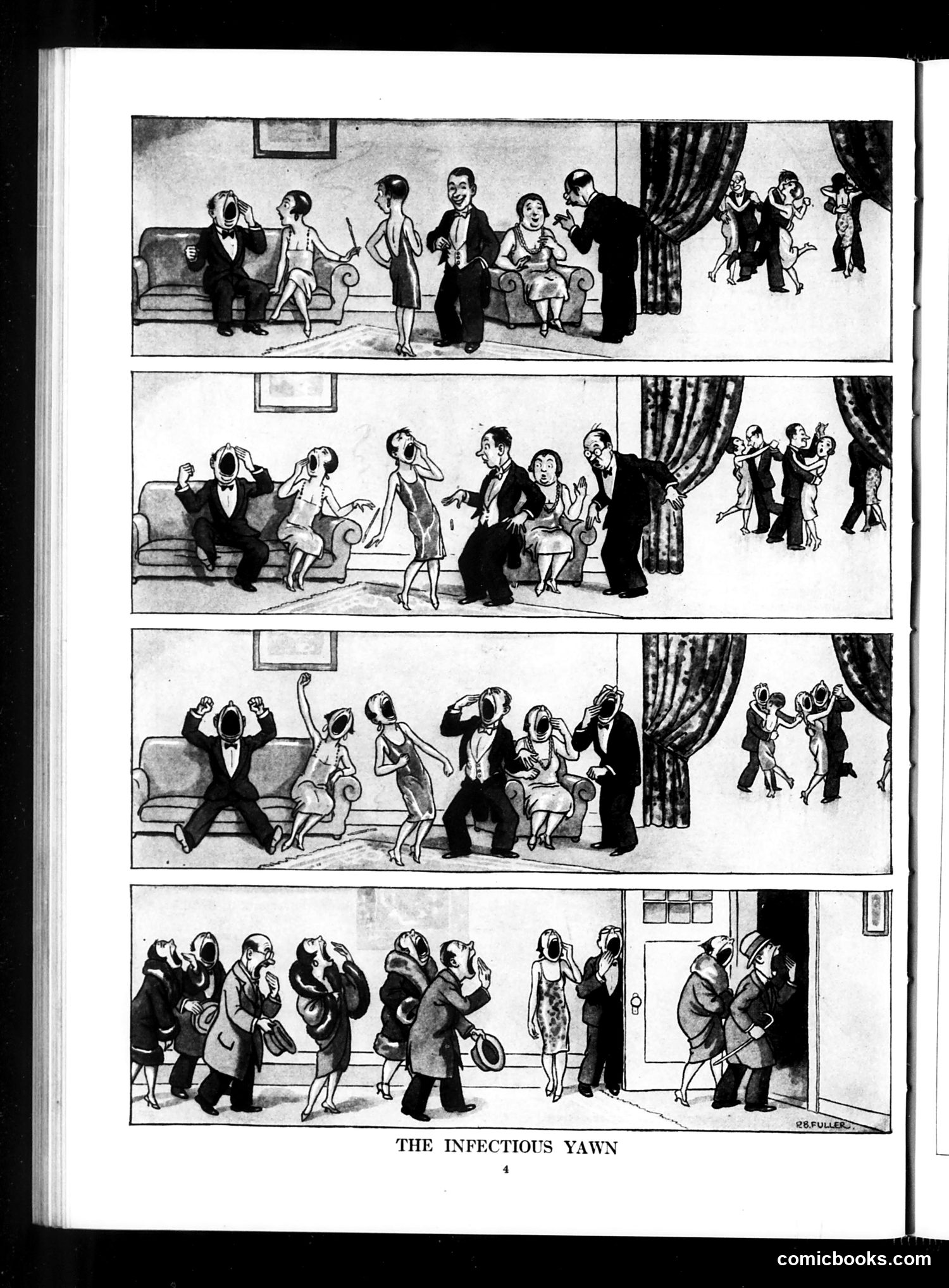
This four-panel comic illustrates the contagious nature of yawning through a social gathering. The sequence shows: **Panel 1:** A man yawns at a formal party; guests remain composed. **Panel 2:** More guests begin yawning as the behavior spreads. **Panel 3:** The yawning intensifies, affecting nearly everyone present. **Panel 4:** The "infection" spreads beyond the room—guests departing and people outside catch the yawn. The cartoon satirizes how social behaviors and moods spread through groups, using yawning as a humorous metaphor. The title "The Infectious Yawn" plays on contemporary concerns about contagion and disease (common satirical subjects in Judge magazine). It's a lighthearted commentary on crowd psychology and social conformity—how one person's action triggers imitation in others, regardless of context or propriety.
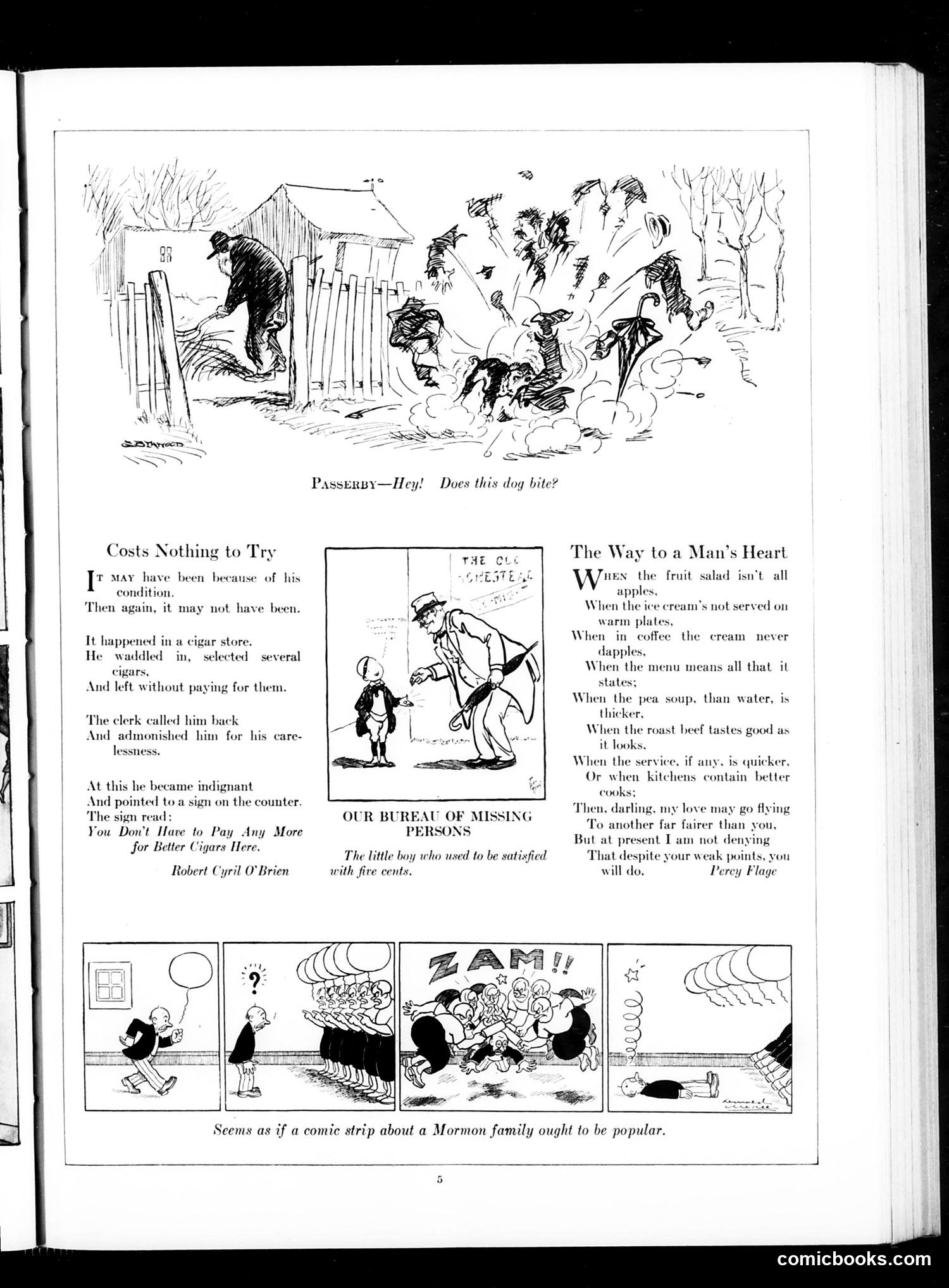
This page contains three distinct pieces of humor: 1. **"Passerby—Hey! Does this dog bite?"** (top): A slapstick cartoon showing a man being attacked by dogs while asking about their temperament. 2. **"Costs Nothing to Try"** (left): A poem about a man who complained about cigars in a store, was mocked by the clerk, and demanded better merchandise—satirizing customer entitlement. 3. **"The Way to a Man's Heart"** (right): A humorous poem by Percy Flage listing domestic failures (imperfect fruit salads, warm ice cream, thin soup) that nonetheless won't drive a man away, poking fun at female domestic anxiety. 4. **Bottom comic strip** labeled "Scenes as if a comic strip about a Mormon family ought to be popular"—anti-Mormon satire mocking the LDS faith through crude stereotyping. The page reflects early 20th-century American attitudes toward consumerism, domesticity, and religious minorities.
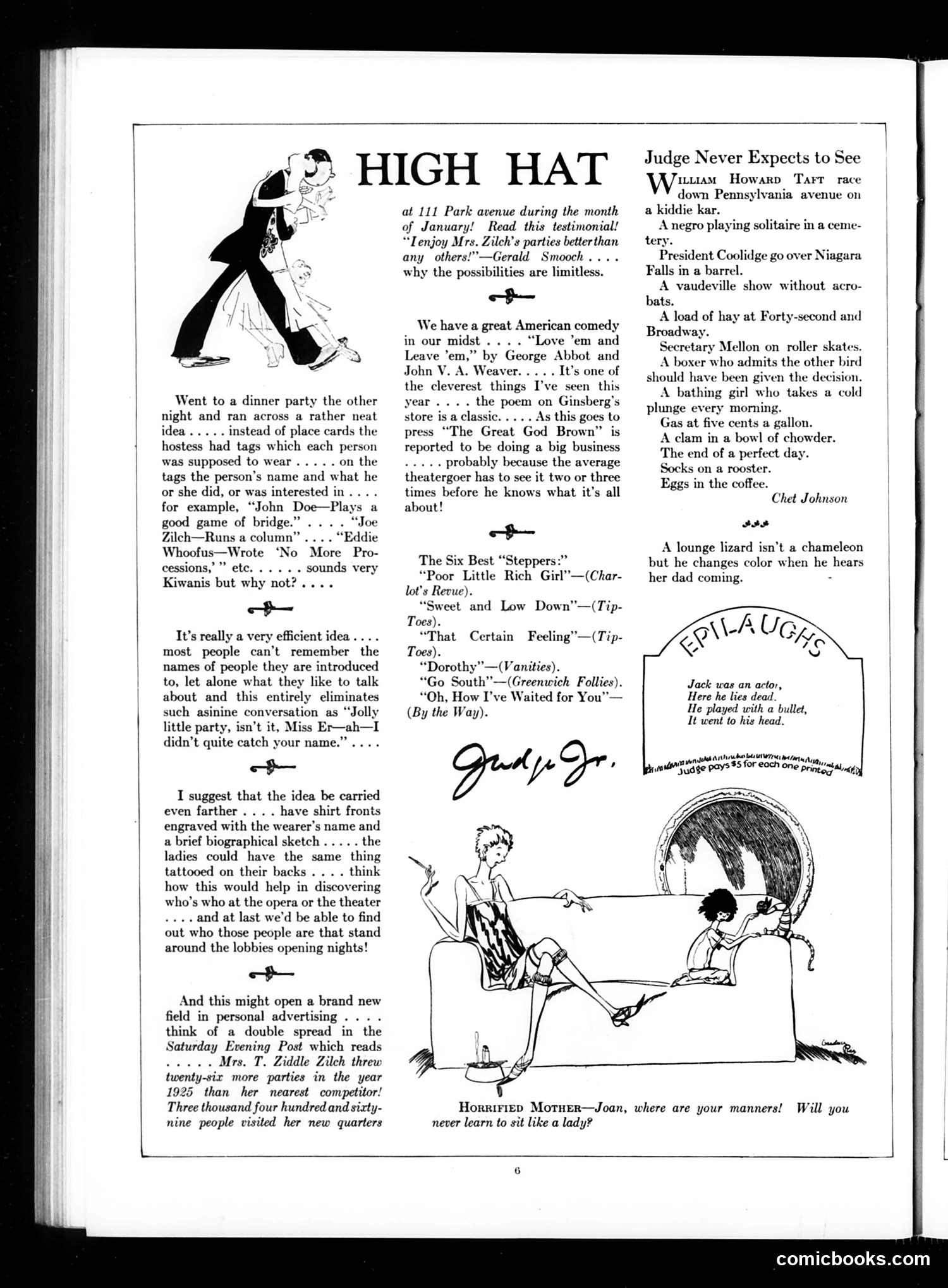
This is a satirical column about modern social etiquette and entertainment, typical of 1920s Judge magazine content. **Main Column ("High Hat"):** The author proposes that dinner party hosts provide name tags identifying guests and their occupations/interests—a practical solution to forgotten introductions. He sarcastically suggests expanding this to engraved shirt fronts and tattooed backs, then jokes about advertising potential: imagine bragging in the *Saturday Evening Post* that Mrs. Zilch threw more parties than competitors. **Theater References:** Brief reviews mention contemporary Broadway hits: "Love 'em and Leave 'em," "The Great God Brown" (by Eugene O'Neill—noted as requiring multiple viewings), and "poor little Rich Girl" and other musical numbers from 1925-26 revues. **Side Column:** Lists absurdities "Judge Never Expects to See"—humorous impossibilities like Secretary Mellon on roller skates, bathing girls taking cold plunges, or eggs in coffee. These mock contemporary figures and behaviors. **Cartoons:** Illustrate party scenarios with the era's typical Art Deco flapper aesthetic. The overall tone reflects Jazz Age sophistication with gentle mockery of upper-class social pretension.
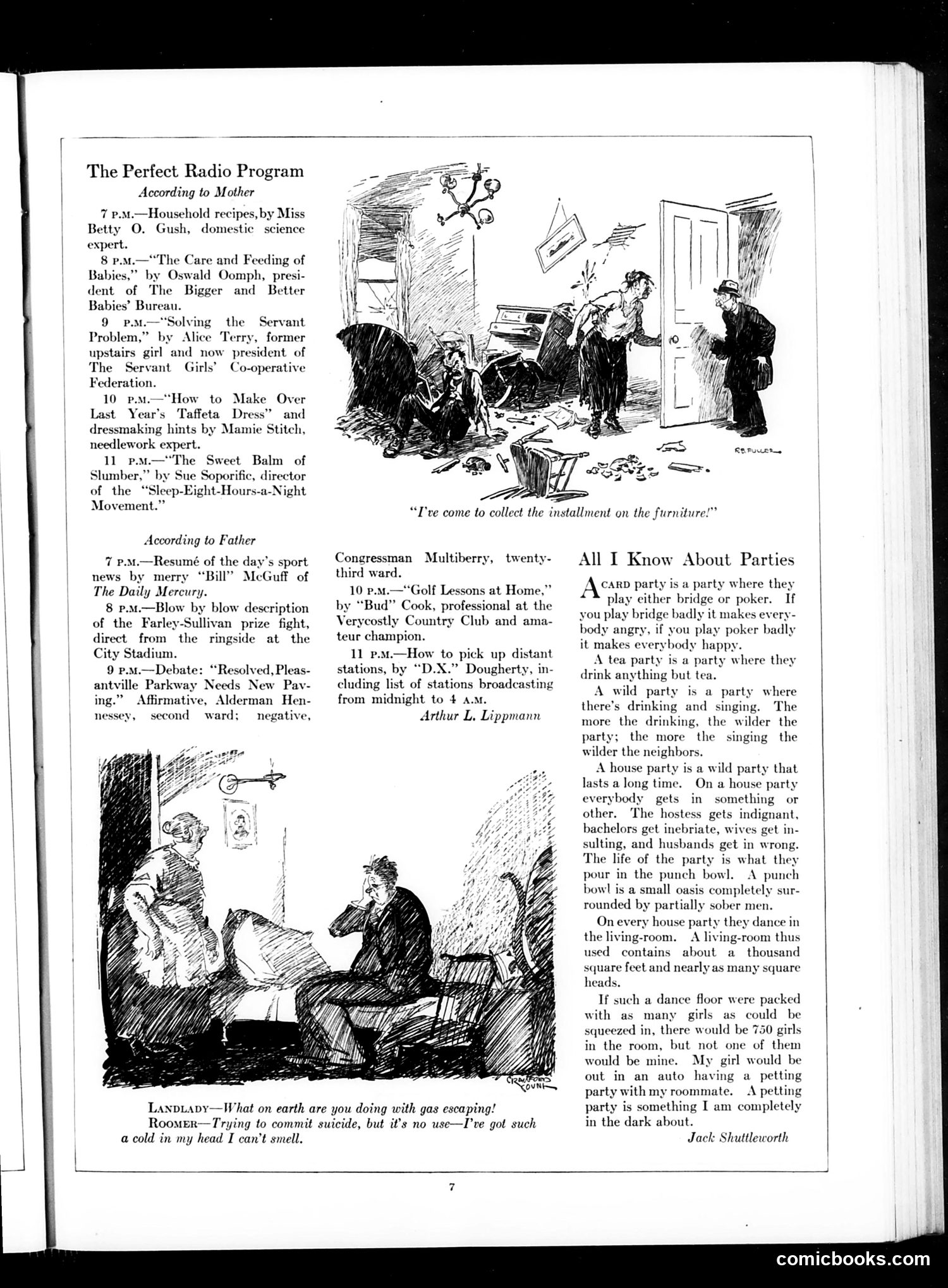
This page satirizes early 1920s radio programming preferences through a gender divide. "According to Mother" lists domestic-focused broadcasts (cooking, baby care, servant problems, sewing, sleep), while "According to Father" features sports, boxing, political debate, golf, and radio technology—mocking how men and women supposedly want entirely different content. The top cartoon depicts furniture repo men collecting an unpaid installment, a common financial anxiety of the era. "All I Know About Parties" by Jack Shuttleworth is a humorous essay defining party types (card parties, tea parties, house parties) with self-deprecating observations about social behavior—particularly the author's romantic frustration that his girlfriend attends "petting parties" (making out sessions) with his roommate instead of staying with him. The tone is wry rather than genuinely bitter, reflecting 1920s dating culture anxieties wrapped in humor.
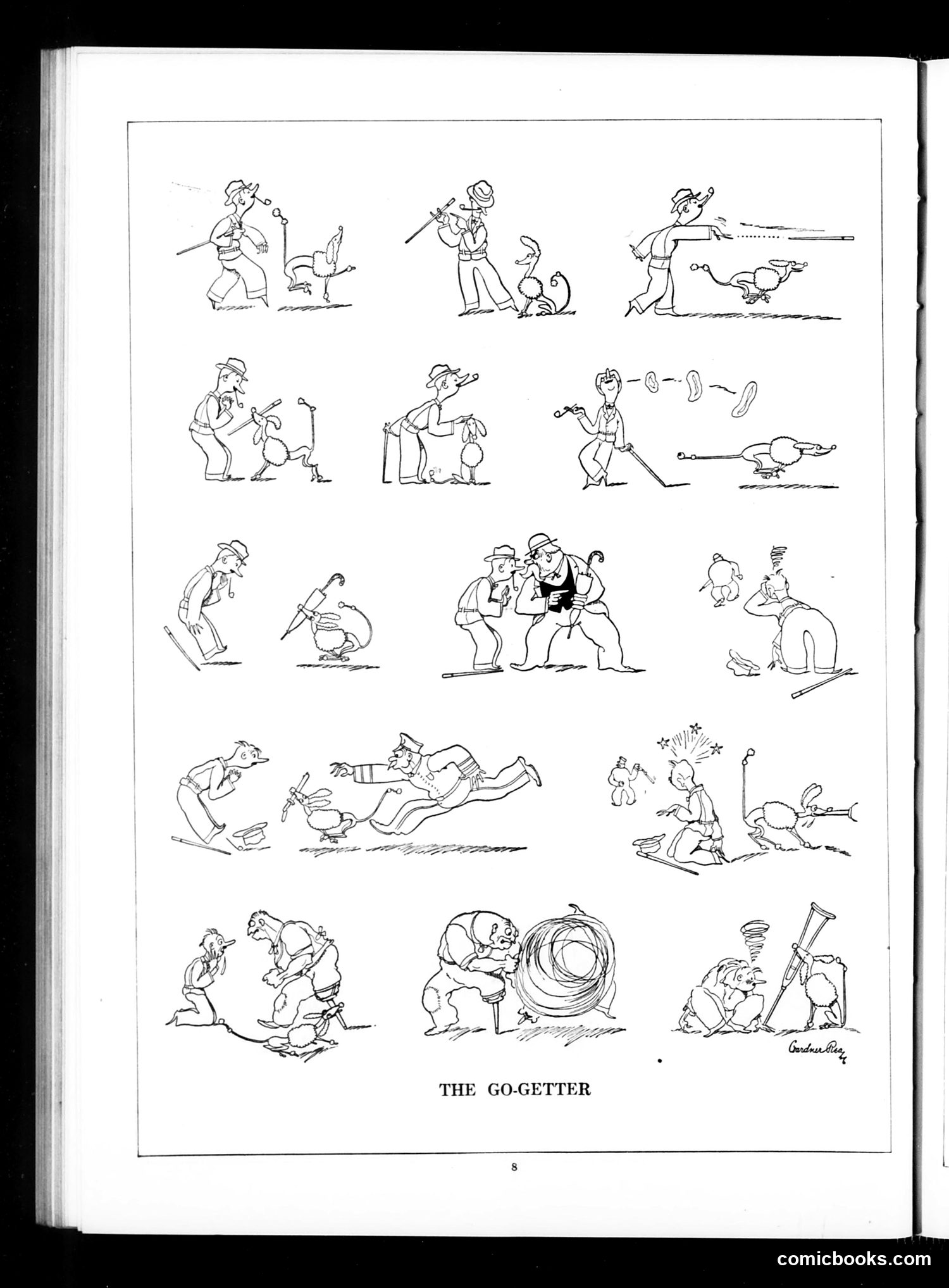
This comic strip illustrates various humorous scenarios featuring an energetic businessman character—"the go-getter"—pursuing success with exaggerated determination. The vignettes show him in comedic situations: attempting to catch or manage animals (rabbits, chickens), engaging in physical confrontations, struggling with equipment, and pursuing romantic or business endeavors with characteristic aggression. The satire targets the early 20th-century "go-getter" business culture—the ambitious, relentless entrepreneur archetype. By depicting this character constantly failing or causing chaos despite his frantic efforts, the cartoonist mocks the hypermasculine, aggressive business mentality of the era. The humor derives from the contrast between the character's boundless energy and determination versus his inevitable ridiculous failures, suggesting that mere hustle doesn't guarantee success or respectability.
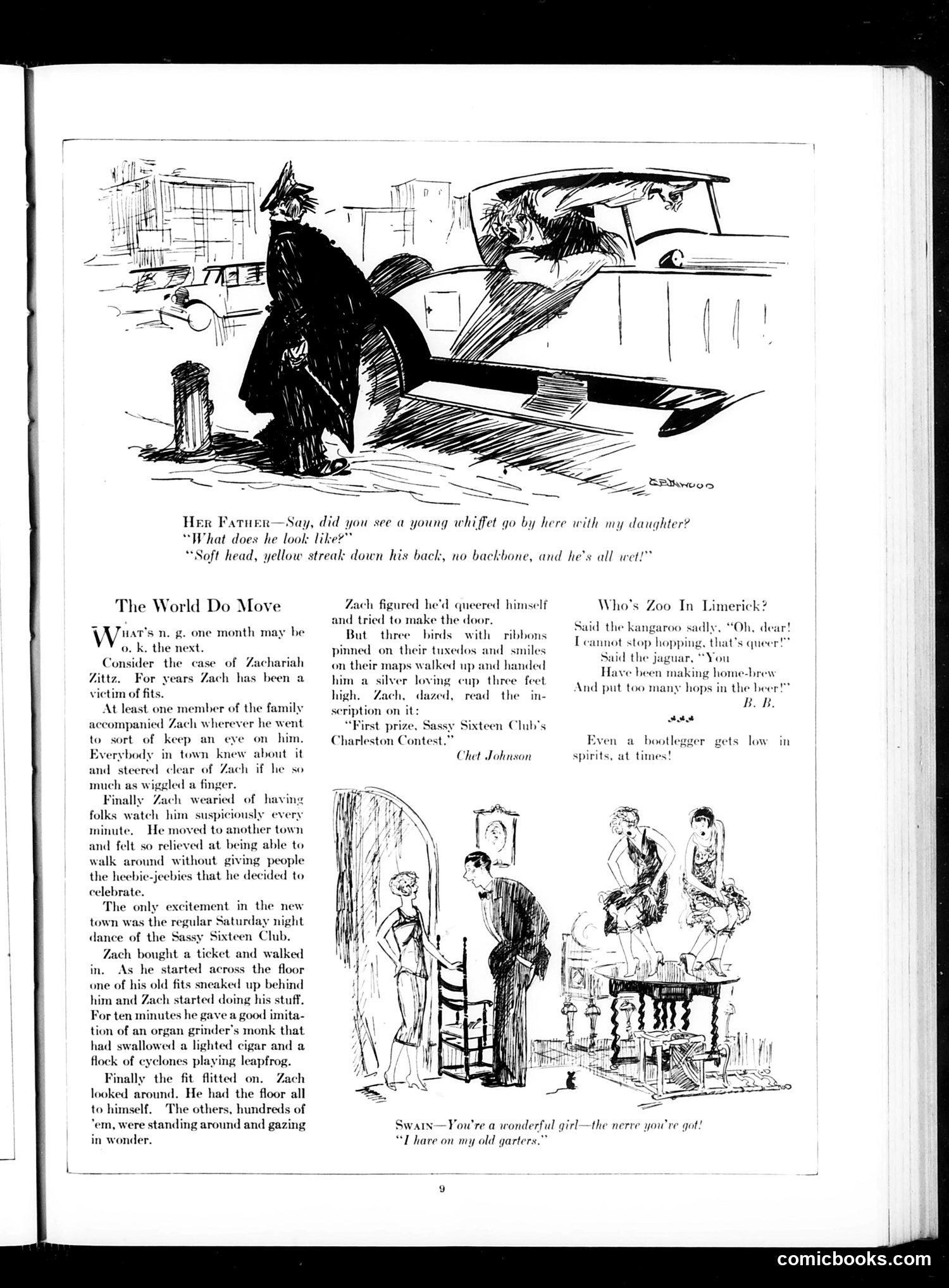
This page contains three distinct satirical pieces typical of 1920s humor: **Top cartoon**: A father describes his daughter's unsuitable boyfriend using animal insults—"soft head," "yellow streak," "no backbone," "all wet"—mocking a cowardly, weak-willed young man. The humor relies on dehumanizing metaphors common to period comedy. **"The World Do Move"**: A story about Zach, apparently a man with epileptic seizures ("fits"), who was long avoided by his hometown. Moving away, he attends a dance and has a public seizure. Rather than being shunned, he wins a Charleston dance contest prize, suggesting society's attitudes have changed. The joke's darker edge: his involuntary convulsions are mistaken for the fashionable Charleston dance. **"Who's Zoo in Limerick" and "Swats"**: Brief joke pieces—limericks mocking a kangaroo's drinking problem, and a flirtation joke about a woman's garters. The page reflects 1920s attitudes: casual mockery of disability, ethnic/animal stereotyping, and sexual double-entendre as standard humor.
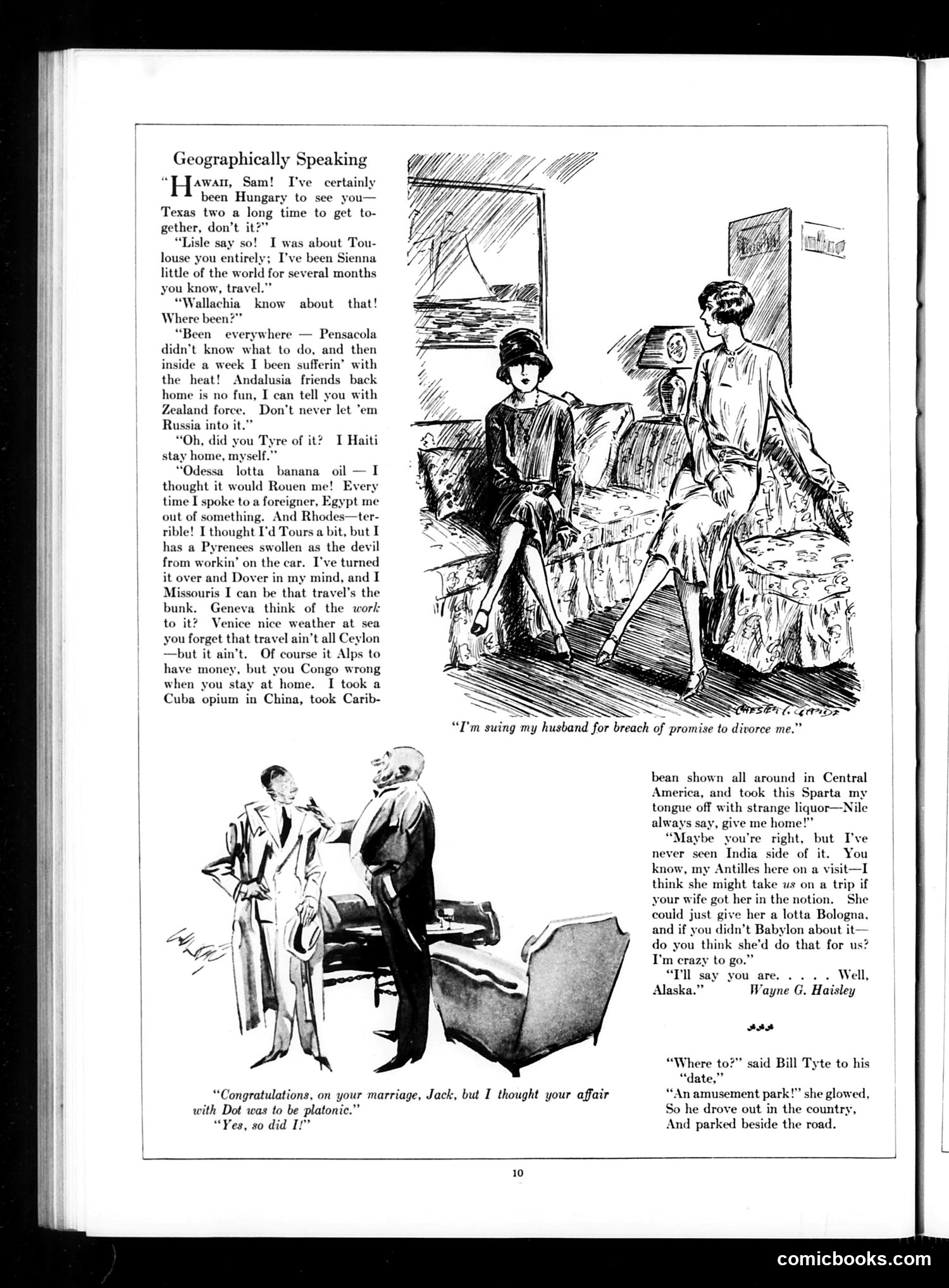
This page features pun-based humor exploiting place names. Two characters converse using city and country names as homophones for common words—"Hungary" (hungry), "Texas" (take us), "Toulouse" (tell us), "Sienna" (seen a), "Egypt" (ate), "Tours" (tours), "Dover" (dote over), "Congo" (can go), "Cuba" (could be a), etc. The joke relies on wordplay rather than political commentary. It's characteristic of early 20th-century American humor magazines that valued linguistic cleverness. The lower cartoons present separate jokes: one about a woman suing for "breach of promise to divorce" (ironically phrased), and another about a man taking his date to an amusement park where they park beside the road instead—implying romantic activity rather than actual entertainment. The humor is clean, domestic, and focused on romantic/marital situations typical of Judge's era.
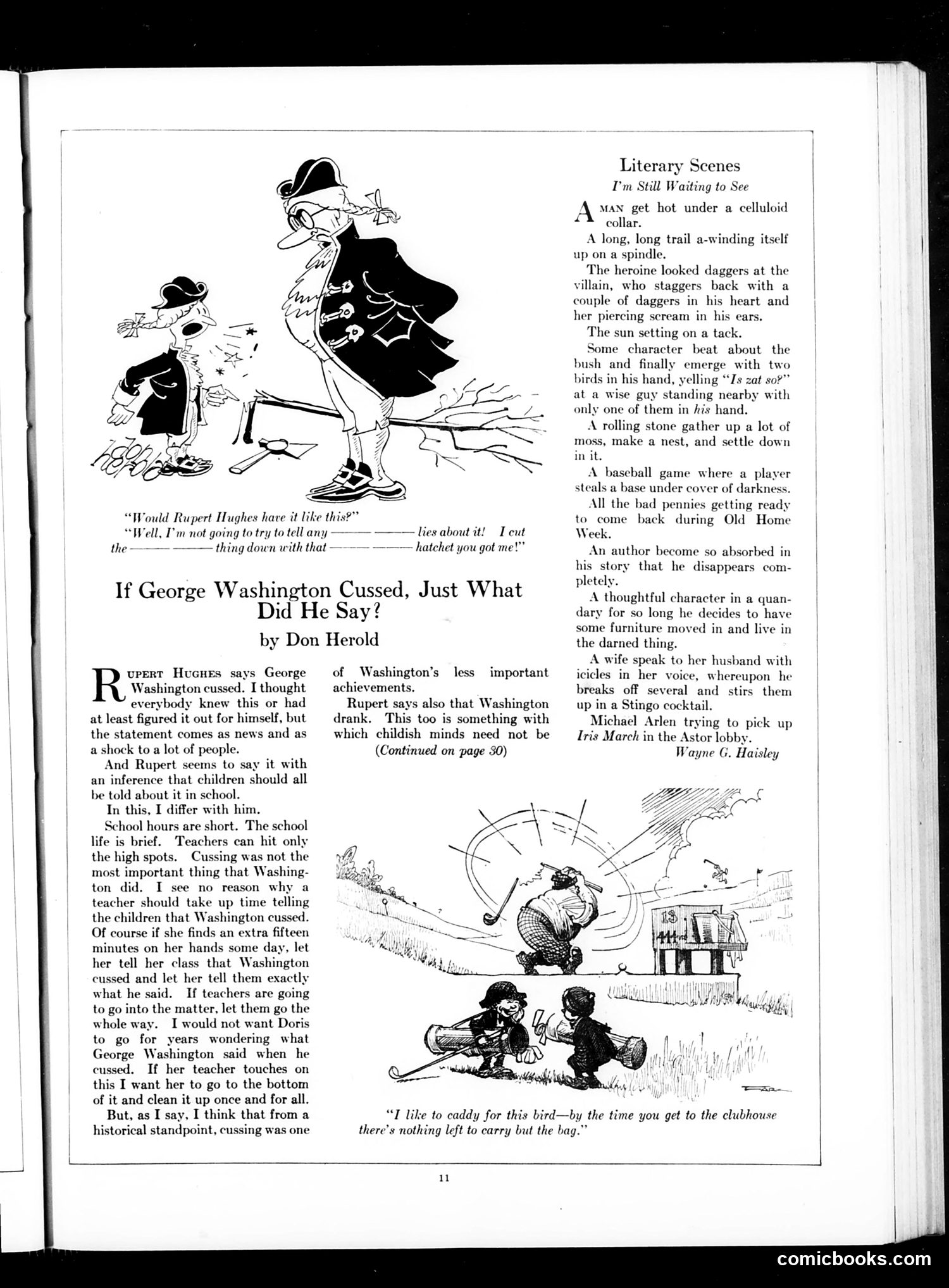
This page contains two satirical pieces: **Main Article: "If George Washington Cussed, Just What Did He Say?"** by Don Herold responds to claims by writer Rupert Hughes that George Washington cursed and drank. Herold argues sarcastically that while Washington may have done these things, they're historically unimportant and unnecessary to teach schoolchildren given limited classroom time. The cartoon shows two figures (likely Washington and a child) with dialogue censored by dashes, mocking the prudishness of omitting such details from history. **"Literary Scenes"** is a humor column mocking clichéd expressions in popular fiction—phrases like "looked daggers," "beat about the bush," and metaphors that don't hold up to literal interpretation ("a rolling stone gather up moss"). It's satirizing overworn literary tropes. **Social Context:** The pieces reflect 1920s-era debates about propriety in education and media, poking fun at both Victorian censorship attitudes and pulp fiction's tired conventions.
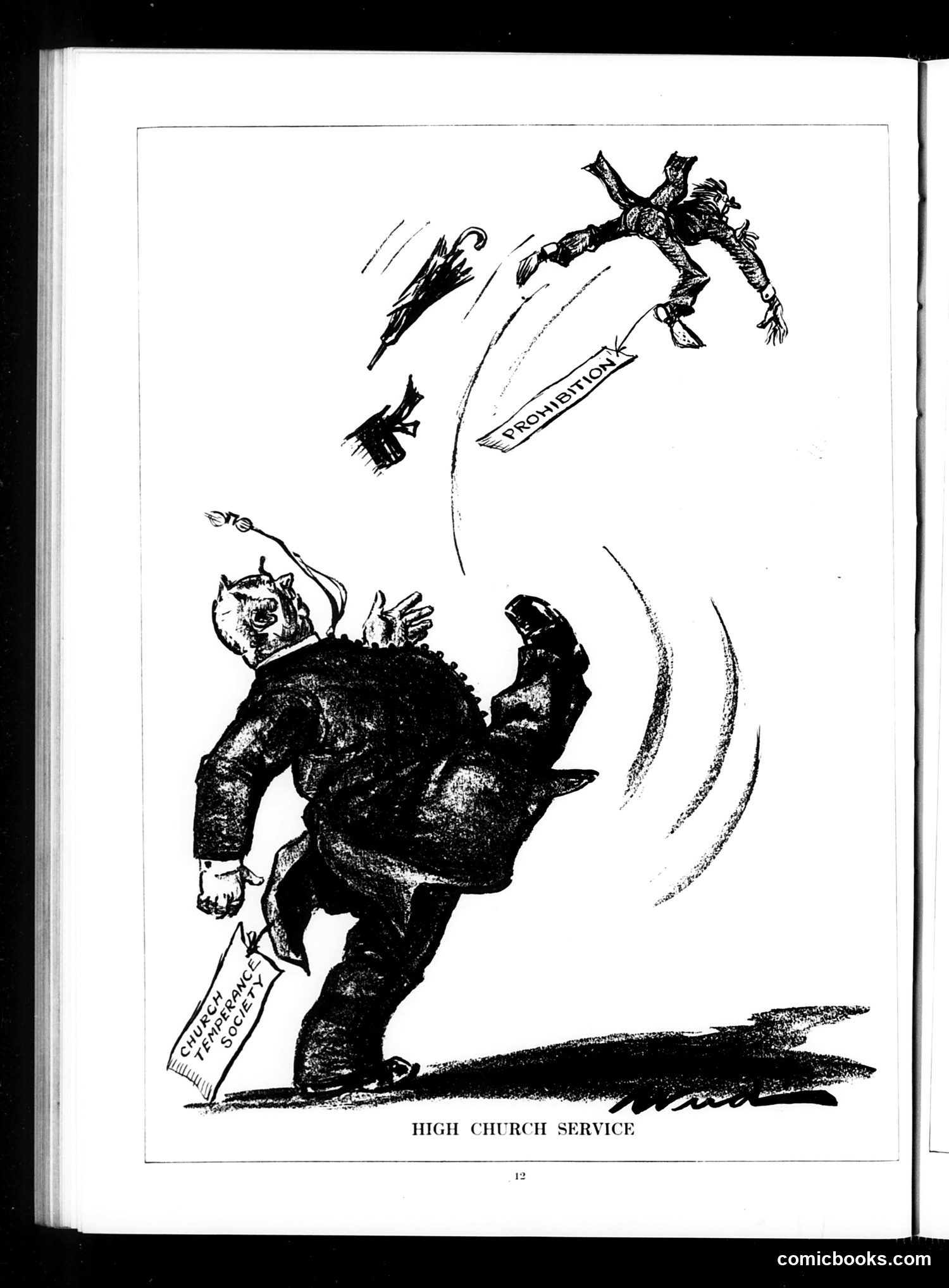
This political cartoon satirizes religious hypocrisy, specifically targeting the "High Church" tradition within Anglicanism. A rotund clergyman labeled "CHURCHYARD GOSSIP" kneels in prayer while demons and devils swarm above him, labeled "PROHIBITION." The figure appears to be a caricature of church leadership engaged in what the cartoonist views as corrupt or hypocritical behavior. The satire suggests that prominent religious figures preach morality (particularly Prohibition—the alcohol ban) while engaging in gossip, scandal, or other vices. The demons attacking the praying figure imply these are the consequences of such hypocrisy. This reflects broader early-20th-century American skepticism about religious authority and institutional integrity, particularly regarding Prohibition's enforcement and the gap between religious rhetoric and actual conduct.
This editorial page satirizes the collapse of Prohibition support among American institutions. The "Judge" figure presides as the nation reassesses the failed "noble experiment." The piece celebrates **Dr. Empringham**, author of the Episcopal Temperance Society's report abandoning Prohibition, praising his confession that he misled others. Judge mocks the Anti-Saloon League's propaganda while celebrating growing Congressional efforts to modify the Volstead Act. The satire's main target is **Bishop Manning** (New York City), who opposes his own denomination's anti-Prohibition stance. Judge ridicules Manning's dismissal of the Temperance Society—which counts 20 bishops and prominent layman William Jay Schieffelin as officers—as "unrepresentative," comparing his tactics to **Wayne B. Wheeler** (Anti-Saloon League leader). The message: Prohibition is collapsing even among its former champions, and those still defending it resort to absurd arguments.
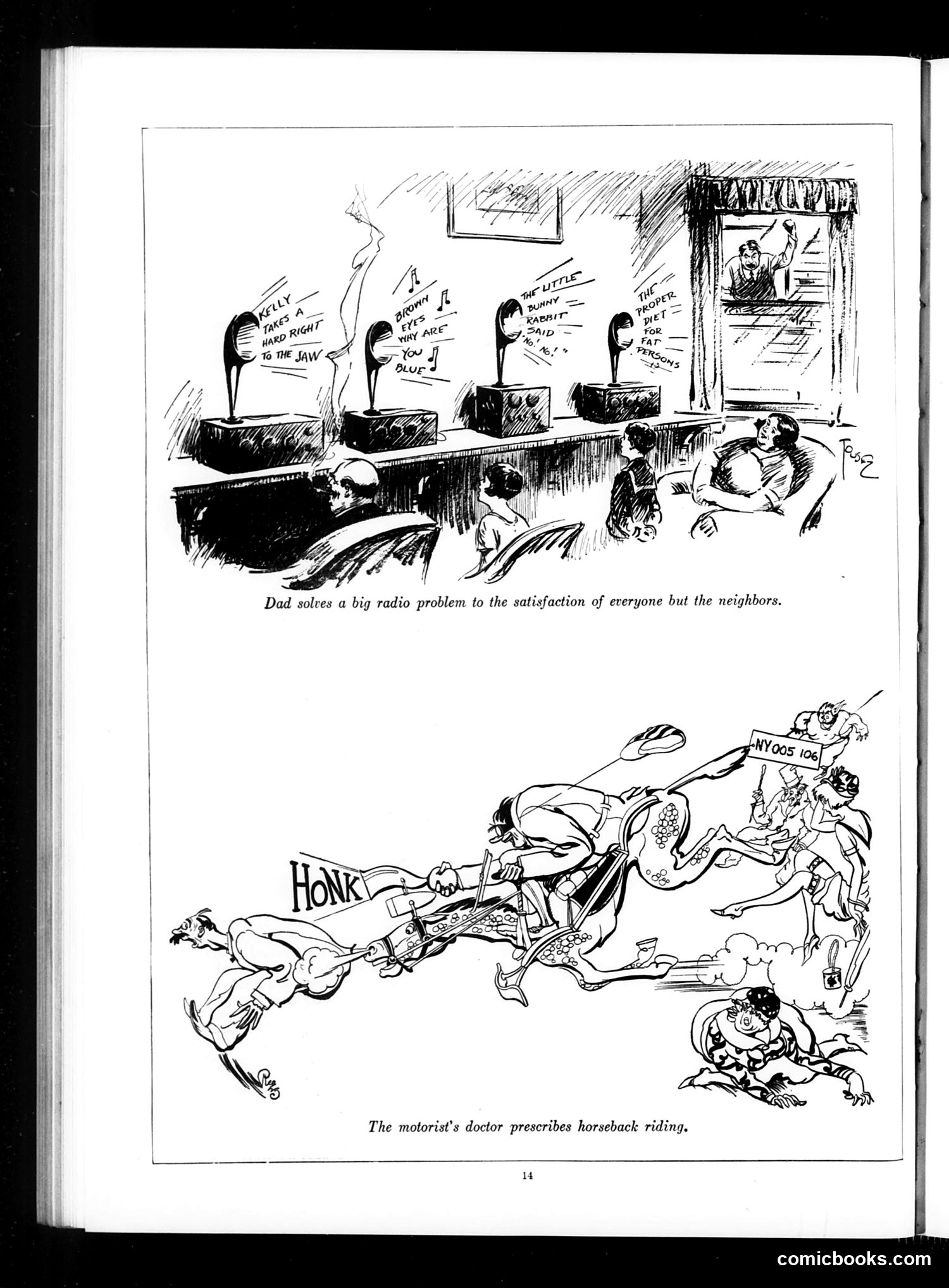
This page contains two satirical cartoons from an era when radio was a novel household technology. **Top cartoon:** "Dad solves a big radio problem to the satisfaction of everyone but the neighbors." Shows a family gathered around an early radio receiver with various family members complaining about programming ("Why such a hard night?", "Why are we on?", "The little rabbit said...", "The higher diet for fat persons"). Dad appears to have solved the problem, likely by turning up the volume excessively, causing disruption outside (visible through the window). **Bottom cartoon:** "The motorist's doctor prescribes horseback riding." Depicts a car driver being thrown from his vehicle in a collision, with onomatopoeia ("HONK") and chaos surrounding the accident scene. Both cartoons use slapstick humor to satirize modern anxieties—domestic technology and automobile safety—prevalent in early-to-mid 20th century American culture.
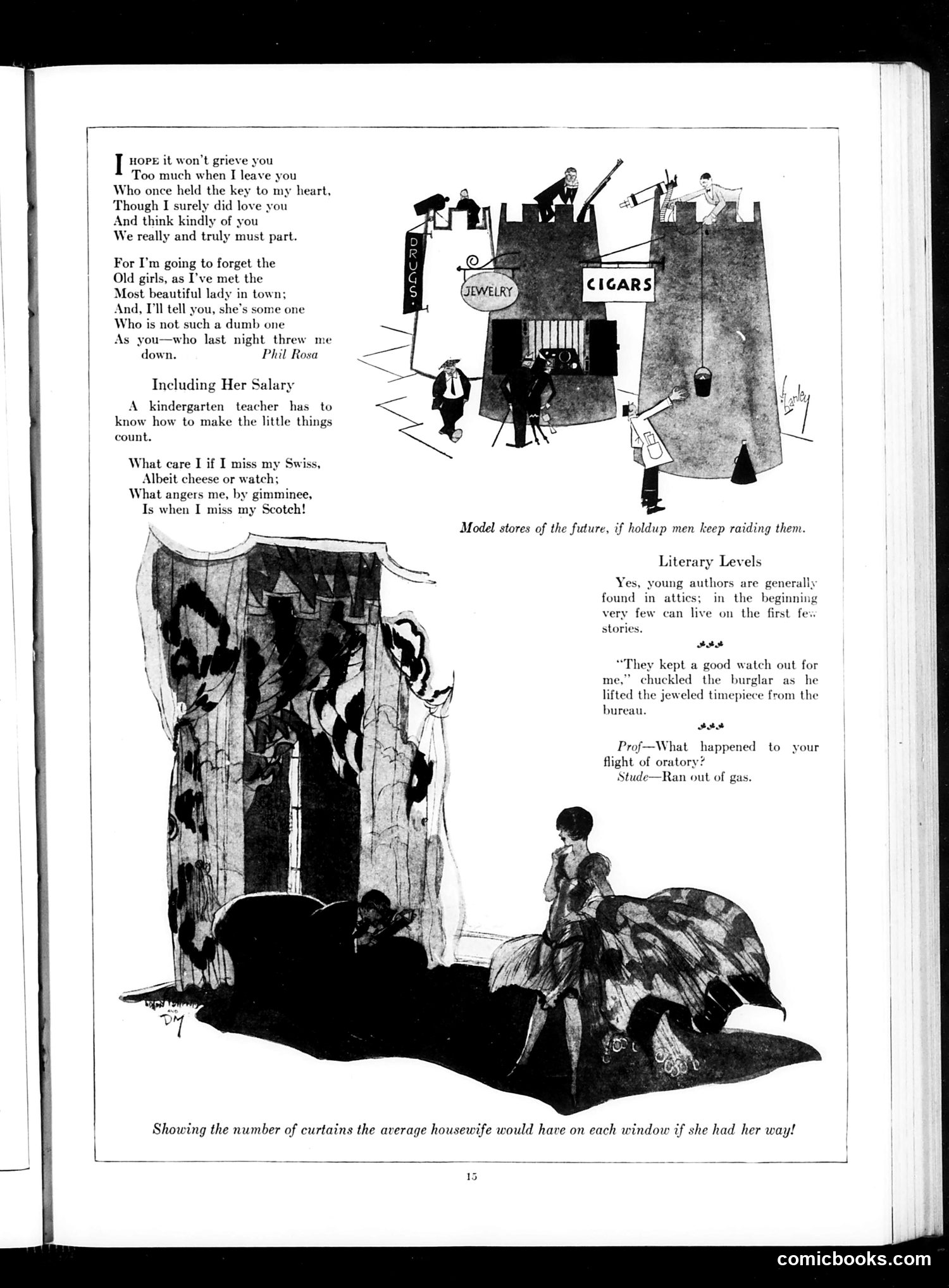
This page collects brief humorous pieces targeting early 20th-century social themes: **"Including Her Salary"** jokes that kindergarten teachers must be skilled accountants—suggesting women in education earned minimal wages and had to "make little things count" financially. **The Scotch/Swiss jokes** play on ethnic stereotypes about Scottish frugality versus Swiss precision. **"Model stores of the future"** satirizes urban crime (burglary/holdups) as so prevalent that future stores will resemble fortified castles. **"Literary Levels"** uses a pun: poor young authors live in "attics" and "can't live on the first few stories"—wordplay on both housing and writing. **The bottom illustration** mocks housewives' material desires, suggesting women would cover windows in excessive curtains if given unlimited budgets—a dig at feminine consumerism and domestic spending habits. The page reflects Jazz Age anxieties about crime, gender roles, economic disparity, and stereotypes common to 1920s satire.
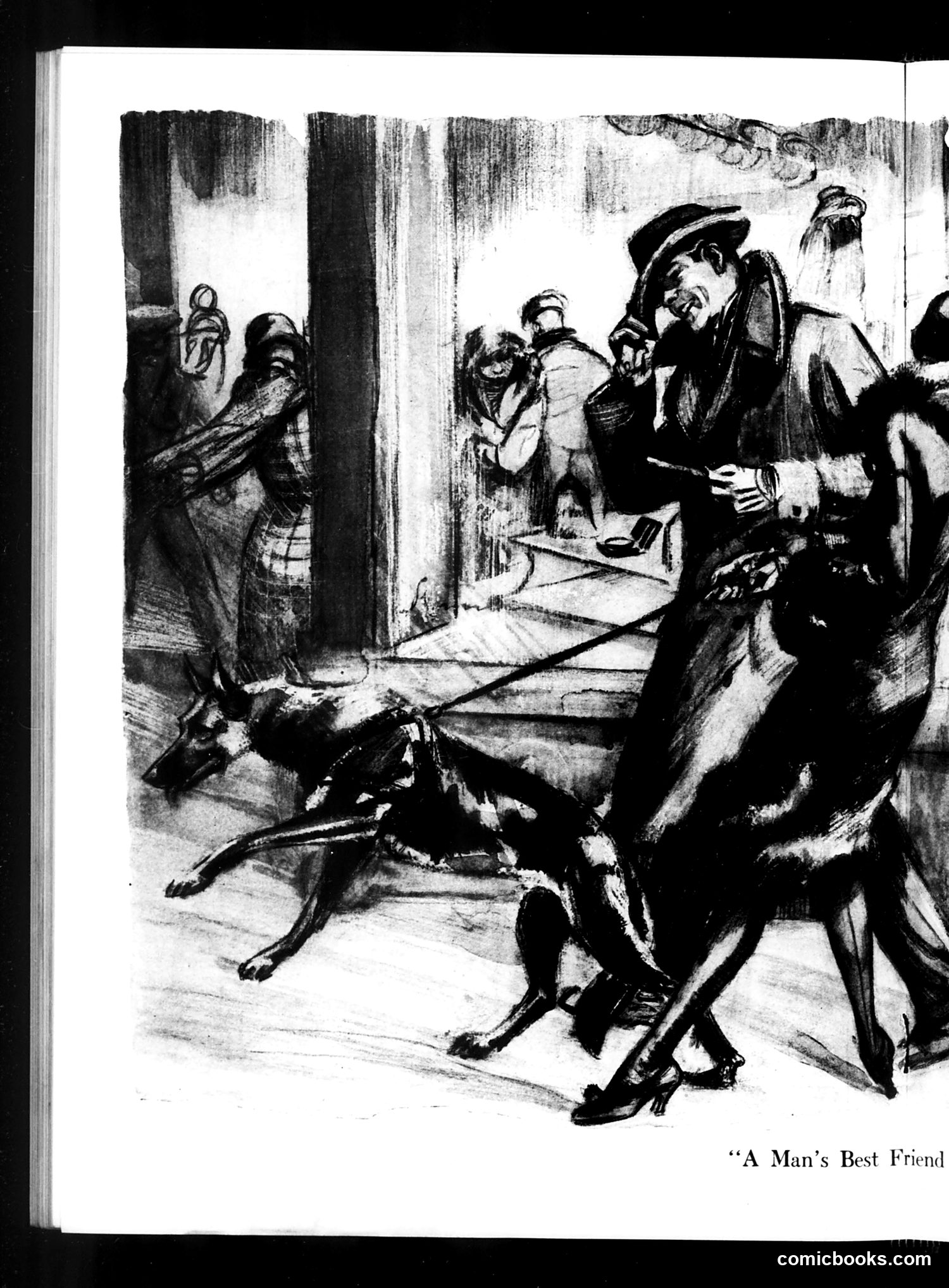
This Judge magazine illustration depicts a street scene with a man in a coat and hat accompanied by dogs. The caption "A Man's Best Friend" references the common saying that dogs are man's best friend. The cartoon appears to be satirizing urban life or social conditions, likely from the early-to-mid 20th century based on the art style. The man's shabby appearance and the presence of multiple dogs suggest commentary on poverty, homelessness, or economic hardship. The dogs may represent loyalty or companionship during difficult times, or possibly satirize the irony of someone with limited resources still keeping animals. Without additional context about Judge's publication date or specific issues addressed in that edition, the exact political or social target remains unclear.
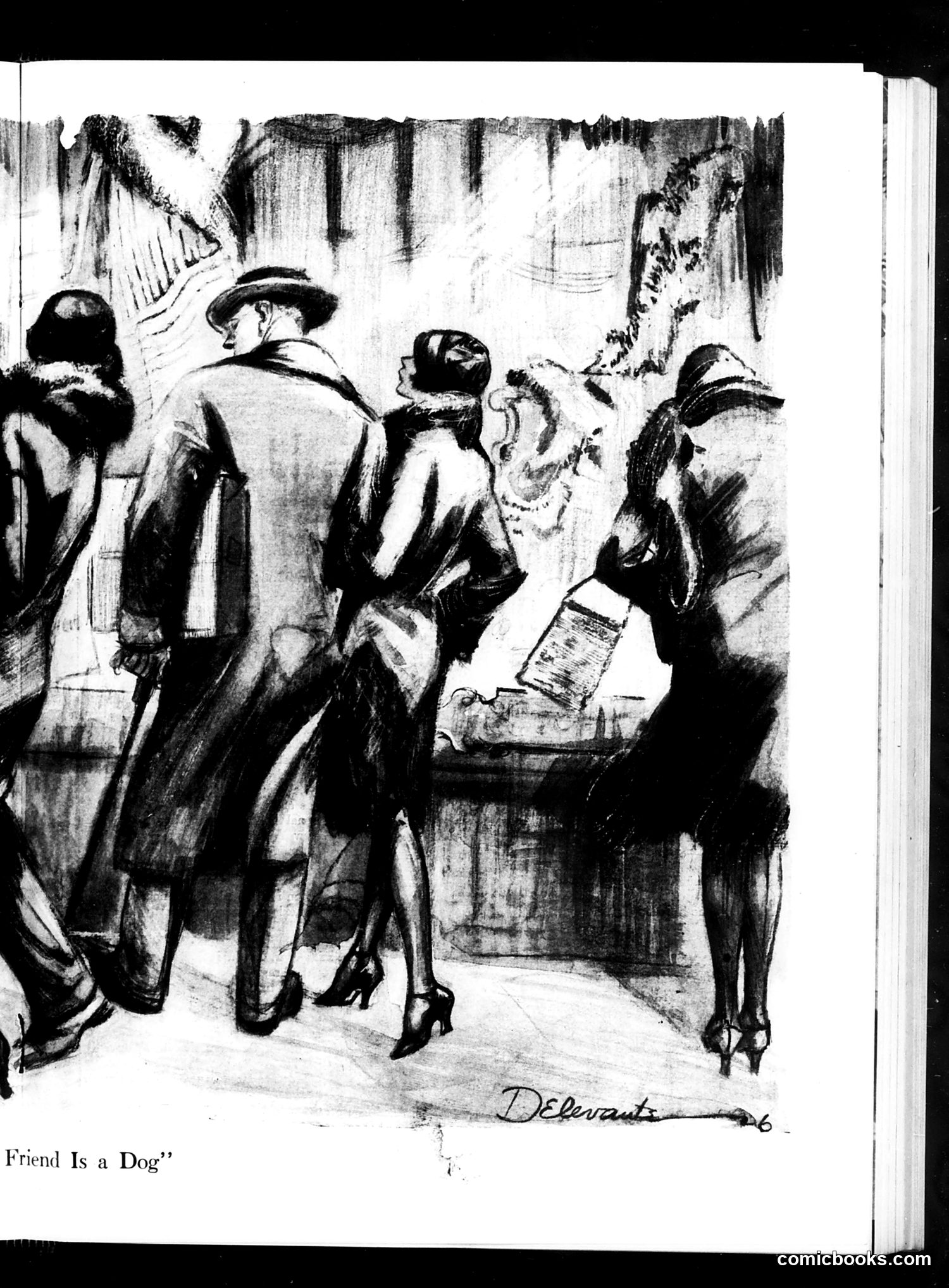
This cartoon depicts a street scene where several well-dressed figures in 1920s attire interact with what appears to be a woman of questionable repute or a streetwalker. The title "Friend Is a Dog" suggests satirical commentary on loyalty or betrayal in social relationships. The cartoon likely critiques the hypocrisy of respectable society—these formally-dressed individuals (possibly representing different social classes or professions) are engaging with or acknowledging someone society deemed disreputable, contradicting their public personas. The artist's signature reads "Delvarato" or similar. The humor appears to rest on exposing the gap between moral pretense and actual behavior among the "respectable" classes, a common theme in Judge magazine's social satire.
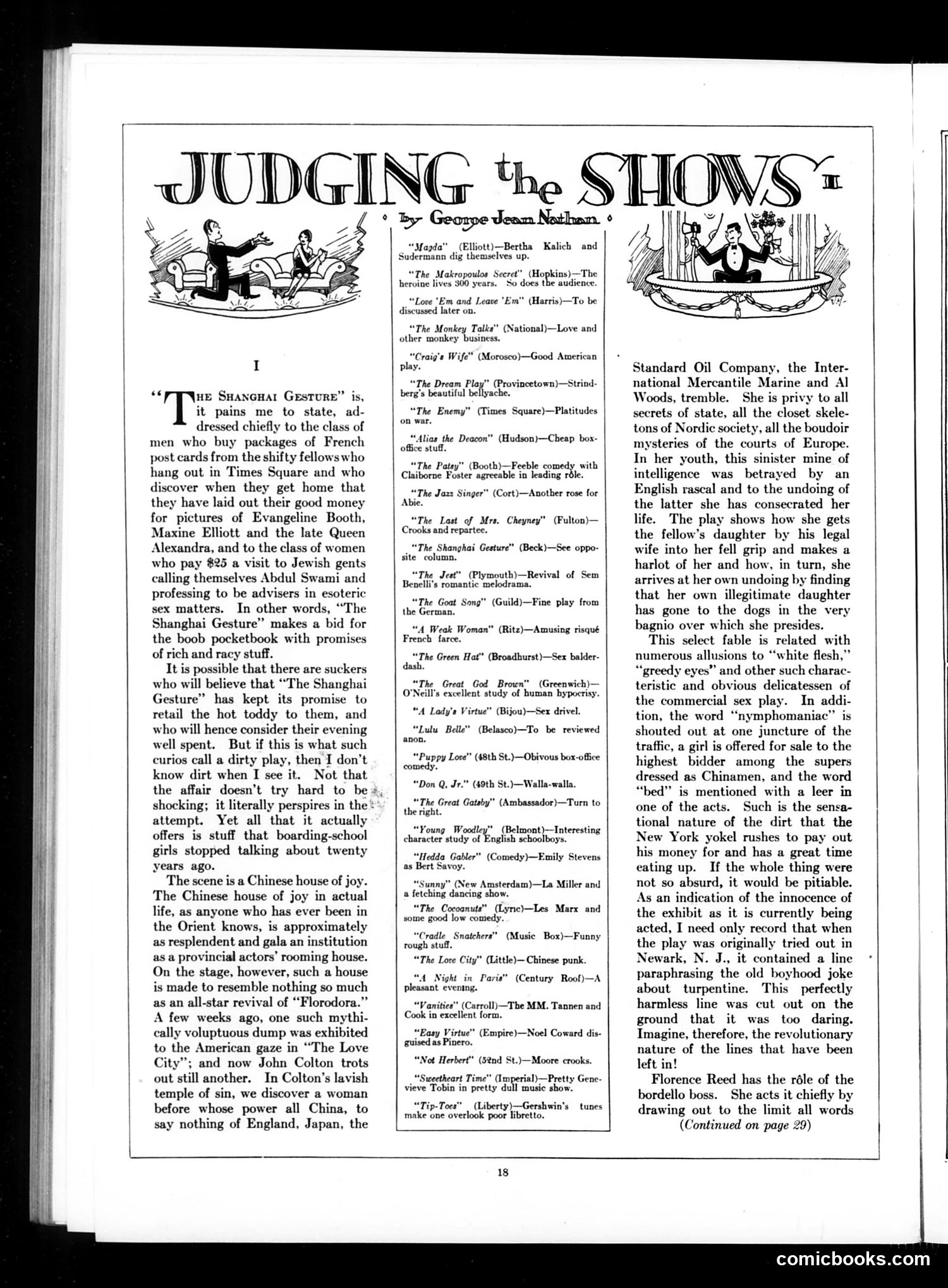
This page contains George Jean Nathan's theater reviews for *Judge* magazine. The main article critiques "The Shanghai Gesture," a play set in a Chinese brothel. Nathan argues the play merely exploits audiences with promises of scandalous content while delivering only tame material that "boarding-school girls stopped talking about twenty years ago." The satire targets both the play's sensationalism and the gullible theatergoers it aims to fleece—specifically men duped by fake French postcards and women visiting fraudulent spiritualists. Nathan dismisses the elaborate stage design of the "house of joy" as absurdly overdone compared to actual establishments. The page also lists other current Broadway productions with Nathan's brief, acerbic dismissals (praising some, mocking others for being cheap, obvious, or tedious). The satire's real target is commercial theater pandering to lowbrow audiences seeking thrills rather than substance.
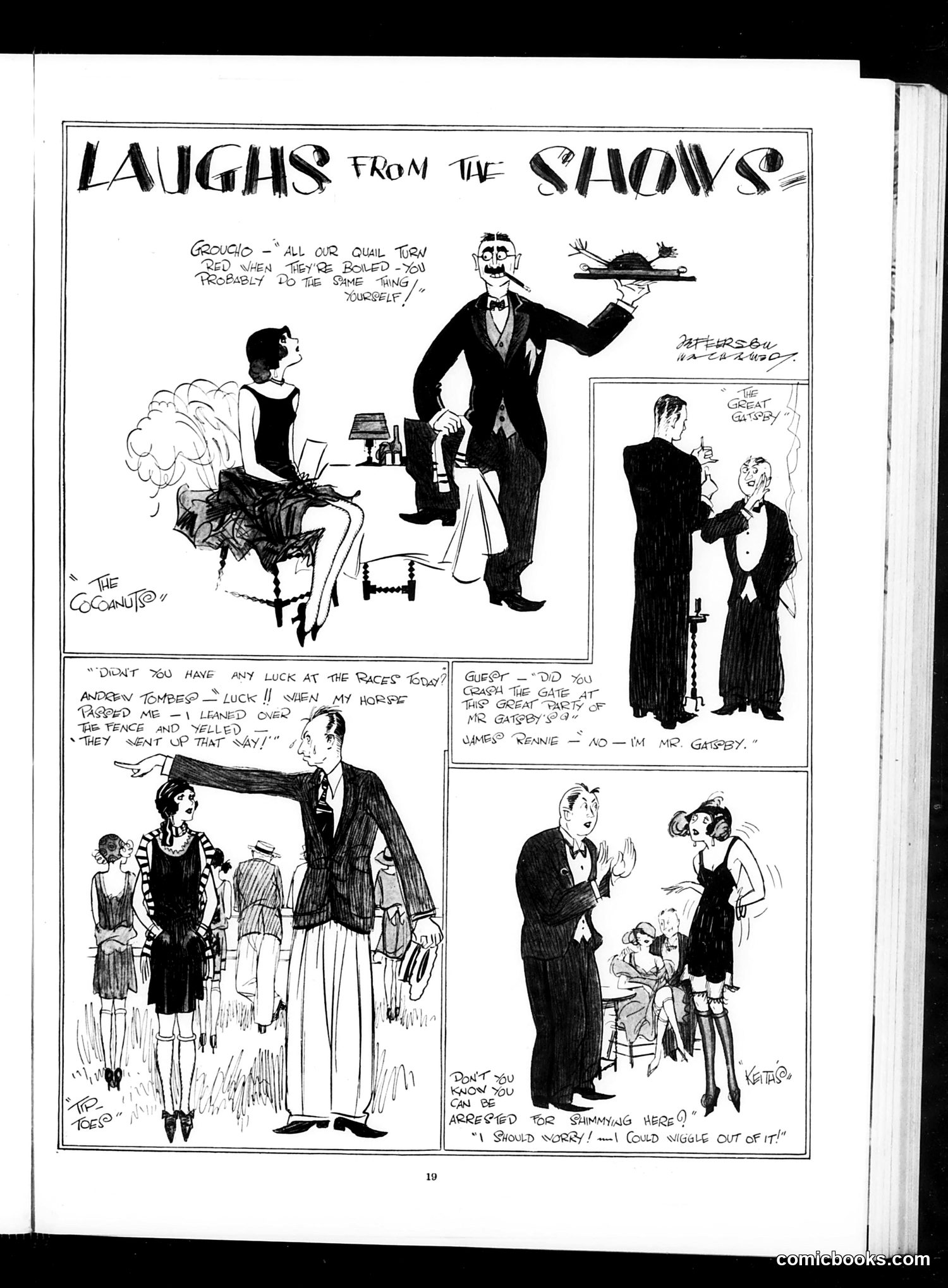
This page collects humorous vignettes from theatrical productions, likely from the 1920s based on the "Great Gatsby" reference. The comics satirize upper-class social situations through exaggerated characters and their foolish behavior. The top panel mocks a woman's fashion sense (her elaborate hat) by comparing her appearance to a roasted quail. Subsequent panels depict wealthy socialites in embarrassing situations: a man's horse accident at the races, someone crashing a fancy party and being mistaken for a guest, and a woman worried about being arrested for indecent exposure (suggesting her dress was too revealing). The humor relies on slapstick, misunderstandings, and poking fun at the pretensions of the wealthy classes. The style and references suggest these are satirical takes on popular Broadway shows or society scandals of the era, mocking both the vanity of the rich and the absurdity of their social conventions.
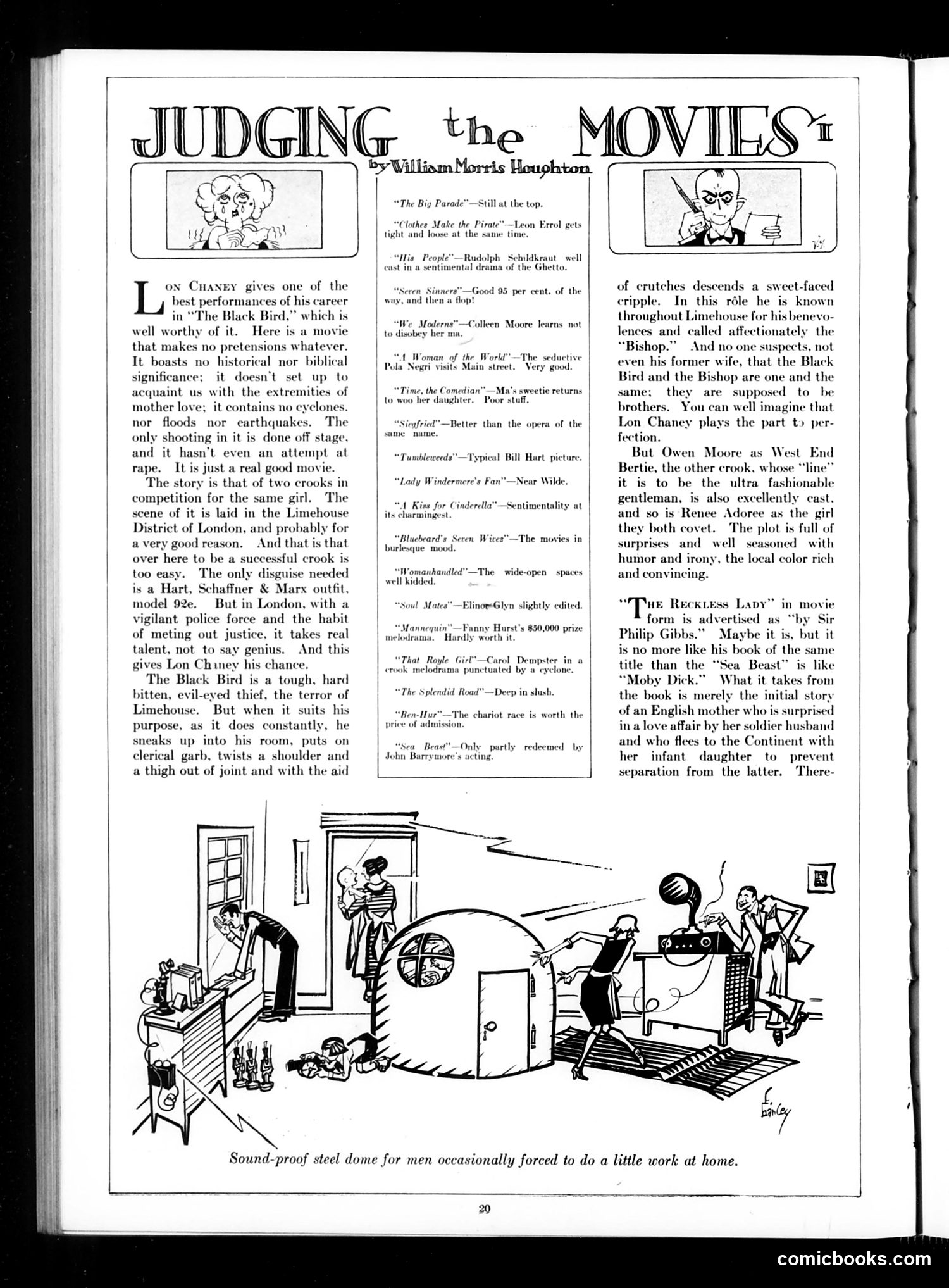
This page from Judge magazine presents satirical film reviews by William Morris Houghton. The main article praises Lon Chaney's performance in "The Black Bird," a crime drama set in London's Limehouse District, where Chaney plays a dual role: a ruthless thief and his disguised alter ego, an affectionate cripple called "the Bishop." The review highlights the film's modest storytelling—notably lacking the melodramatic excess (cyclones, floods, rape attempts) typical of contemporary cinema. The accompanying cartoon satirizes husbands forced to work at home, depicting domestic chaos in a cramped "sound-proof steel dome." Below are brief capsule reviews of other current films including "Ben-Hur," "The Big Parade," and adaptations of literary works, offering quick judgments on their relative merits. The tone is witty and dismissive toward pretentious or poorly executed films while praising honest entertainment.
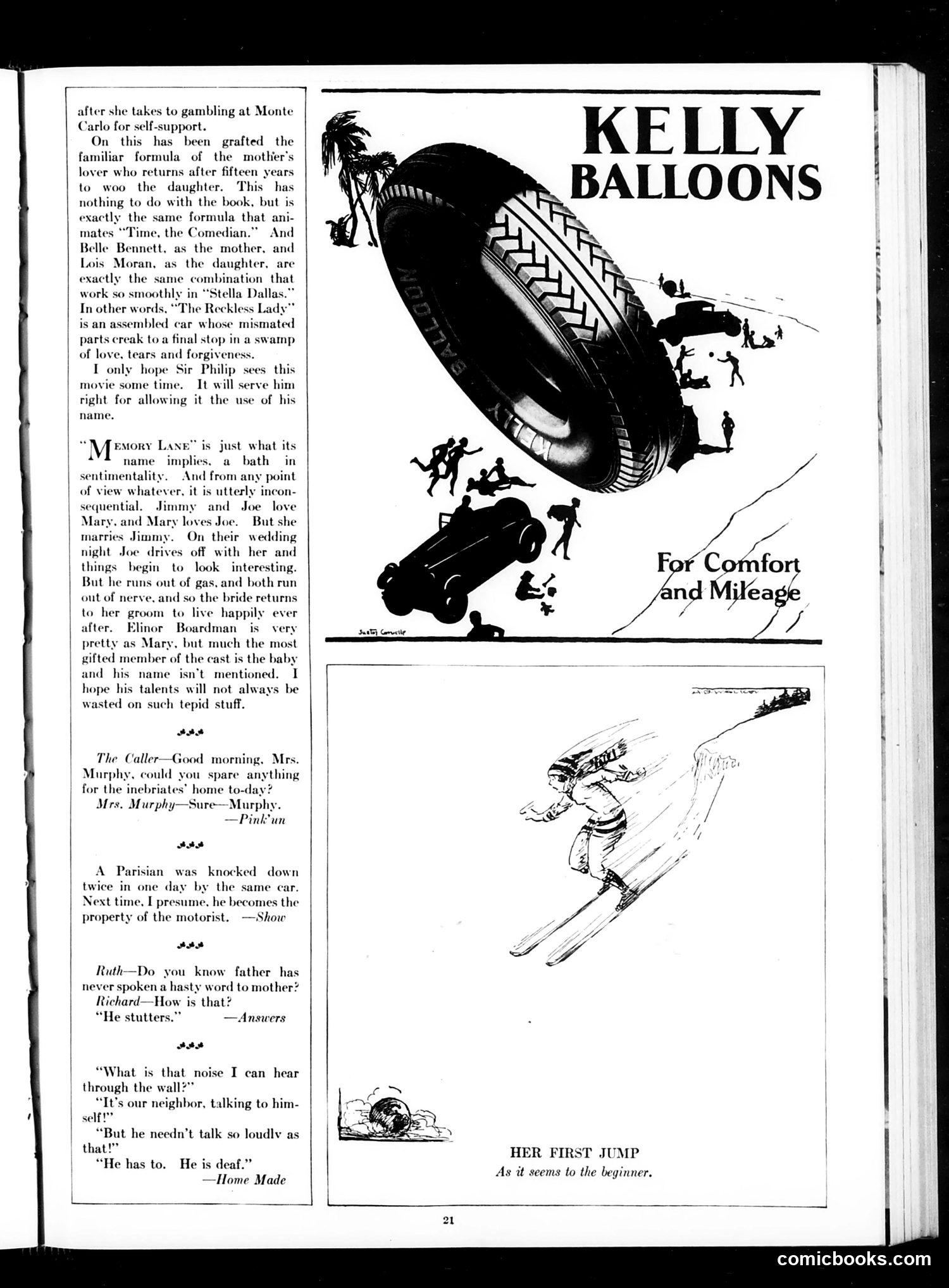
This page combines a **Kelly Balloons advertisement** (right side) with **film criticism** (left side). The balloon ad shows a humorous illustration of someone's first parachute jump—exaggerated for comedic effect—promoting balloons as practical products ("For Comfort and Mileage"). The left column critiques silent films: "The Reckless Lady" (which borrowed its title from Sir Philip Gibbs's book but used a recycled plot formula) and "Memory Lane" (a sentimental romance). The reviewer dismisses both as formulaic: tearful melodramas about love triangles and reconciliation. He notes the irony that the most talented cast member is an unnamed baby, suggesting the films themselves are juvenile. Below are typical humorous anecdotes from readers—jokes about deafness, stuttering, and Parisian traffic laws—filler content common in Judge magazine's satirical format.
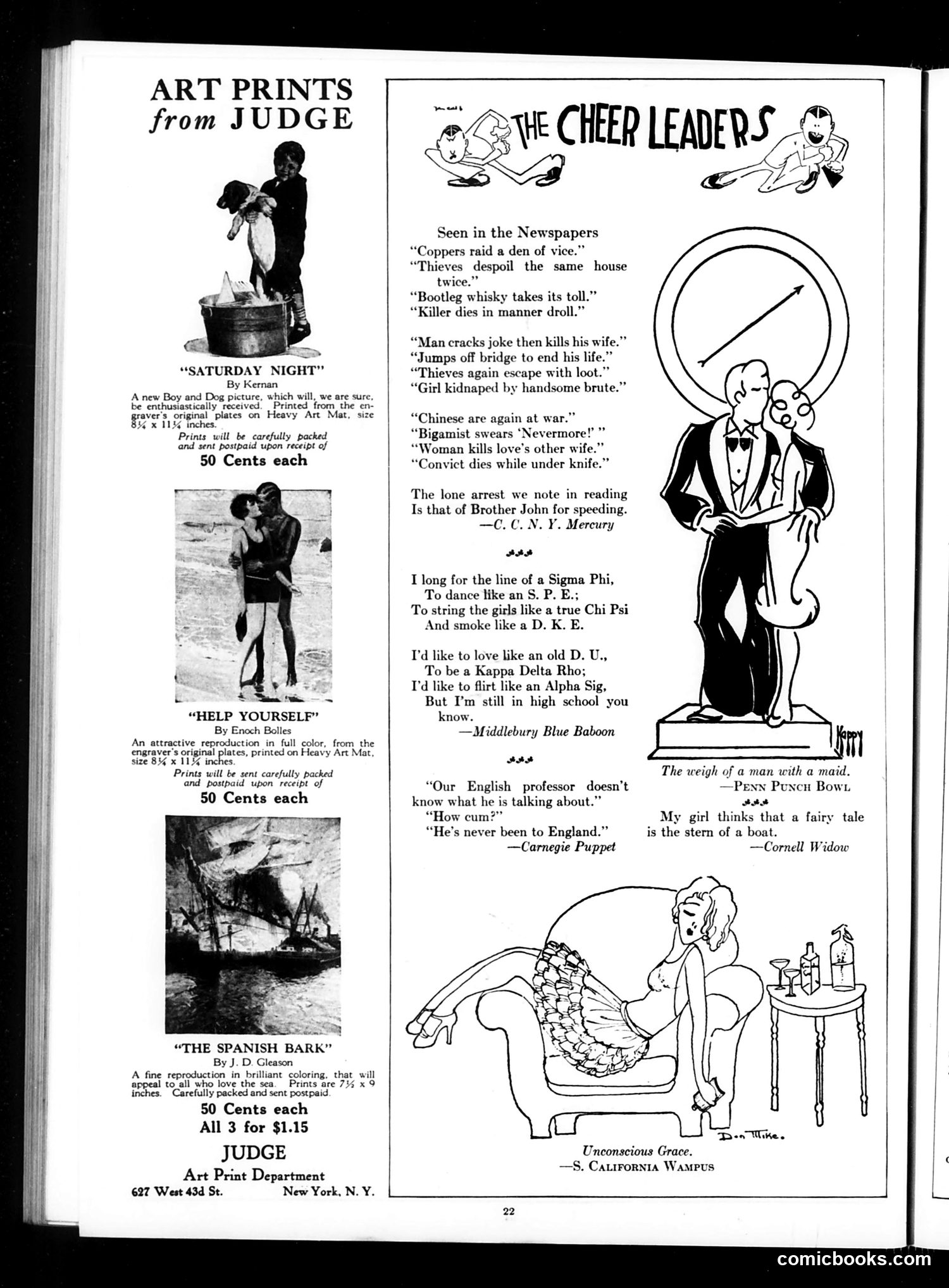
This page is primarily **advertising for Judge magazine art prints** (left side) and **humorous content** (right side). The main satirical piece, "The Cheer Leaders," mocks sensationalist newspaper headlines of the era. It lists dramatic crimes and scandals ("Man cracks joke then kills his wife," "Girl kidnaped by handsome brute") that dominated newspapers, then sarcastically notes the *only* arrest reported was "Brother John for speeding"—implying newspapers obsess over trivial traffic violations while ignoring serious crimes. The cartoons and jokes below satirize **college fraternity culture**, with references to Greek letter organizations (Sigma Phi, Chi Psi, D.K.E., etc.). One piece mocks a high schooler yearning for college fraternity life. Another jokes about an English professor who's "never been to England"—absurd authority without real knowledge. The bottom cartoon depicts a woman's "unconscious grace"—likely satirizing affected femininity or obliviousness. Overall, the page targets **journalistic sensationalism** and **collegiate pretension**, common Judge magazine targets.
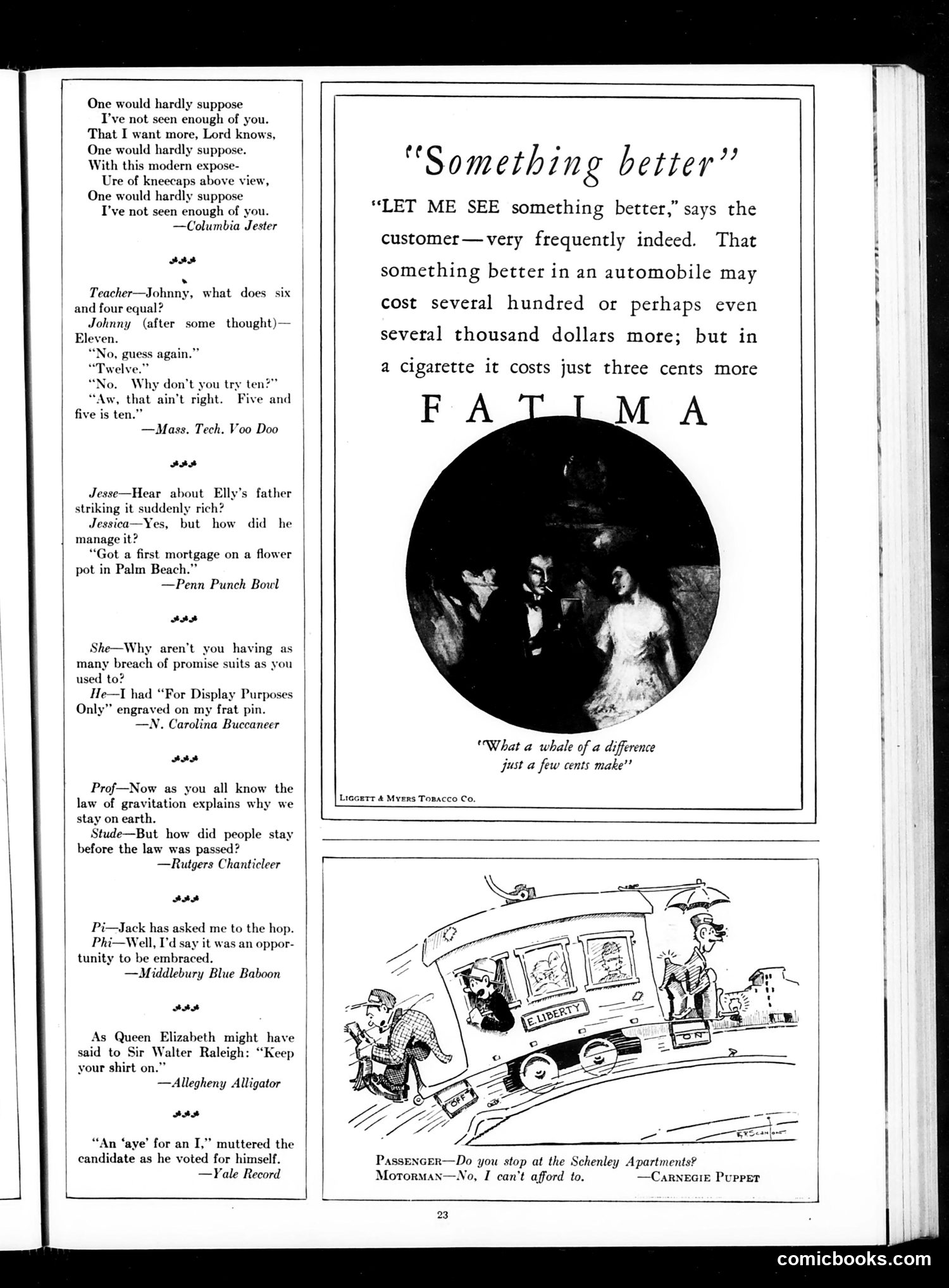
This page from *Judge* magazine contains multiple short jokes from college humor publications, plus one full advertisement for Fatima cigarettes. **The Fatima Ad:** The main visual is a cigarette advertisement claiming that paying just three cents more gets you a dramatically better product—illustrated by a theatrical scene showing the transformation. The caption "What a whale of a difference just a few cents make" uses hyperbole to mock consumer psychology: spending slightly more on cigarettes supposedly creates enormous value improvement, when in reality the difference is minimal. **The Jokes:** The left column collects brief, mostly clean humor from college newspapers (MIT, Penn, Rutgers, Yale, etc.). Most are puns or plays on misunderstandings—a student answering math questions incorrectly, confusion about mortgage terms, or wordplay about voting. They reflect early-20th-century collegiate wit aimed at young, educated readers. The motorman joke at bottom right mocks working-class poverty—a streetcar operator cannot afford to stop at an expensive apartment building.
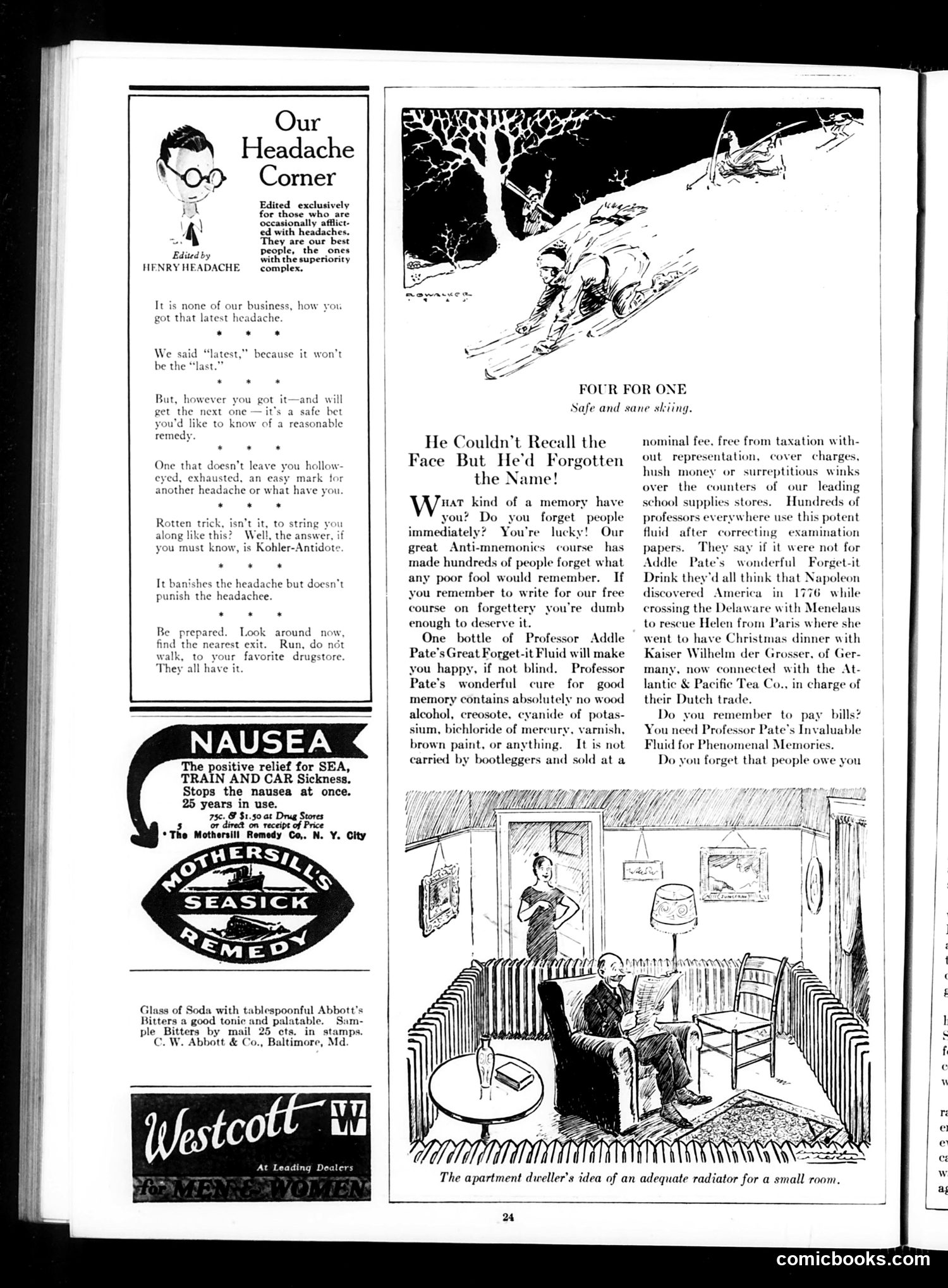
This Judge magazine page contains satirical advertisements mocking patent medicine and self-help scams of the early 20th century. **"Our Headache Corner"** (left): A mock advice column edited by "Henry Headache" that humorously promises relief through "Kohler-Antidot," playing on the era's proliferation of dubious headache remedies. **"Four for One"** (right): A fake advertisement for "Professor Addle Pate's Great Forget-it Fluid"—a satirical jab at memory-improvement courses and fraudulent tonics. The joke escalates absurdly, mixing obviously fake historical claims (Napoleon discovering America in 1776) with the promise that the product contains "absolutely no wood alcohol, creosote... or anything." **The satire's point**: These advertisements parody real mail-order scams and patent medicines that exploited Americans during this period, often making impossible claims or containing harmful ingredients. The cartoon exposes how consumers desperately sought solutions to everyday problems through unreliable, sometimes dangerous products. The secondary cartoons (skiing scene, radiator illustration) are unrelated illustrations.
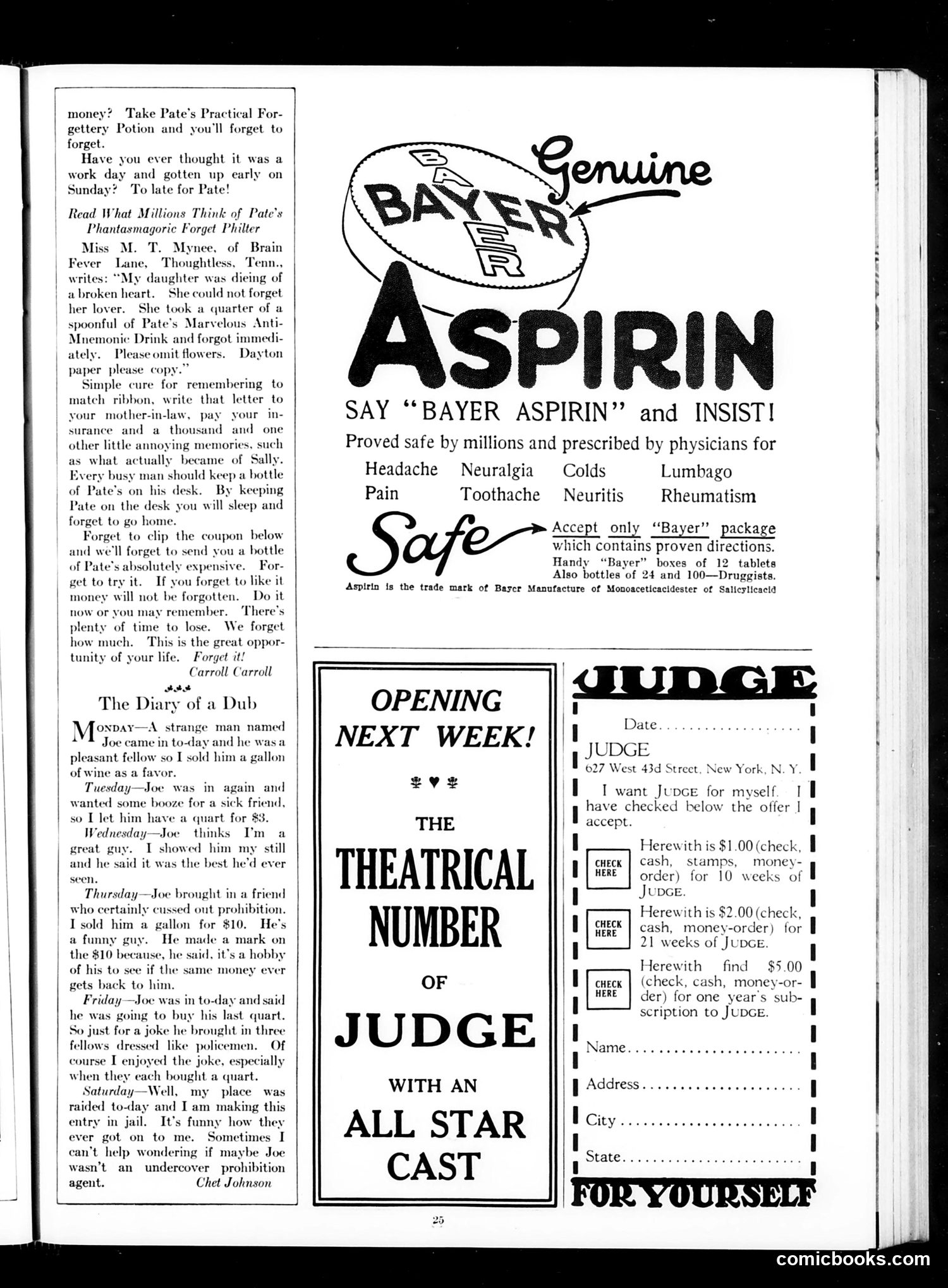
This page is primarily **advertising and promotional content** rather than political satire. The main elements include: 1. **"Pate's Forget Potion"** — A humorous fake-product advertisement satirizing patent medicines of the era. The joke plays on the absurdity of commercial nostrums promising miraculous cures; here, a "forgettery potion" promises to make people forget obligations and worries. 2. **"The Diary of a Dub"** — A short satirical piece mocking Prohibition-era bootlegging. A naive bootlegger repeatedly sells illegal alcohol to "Joe," eventually realizing (too late) that Joe was likely an undercover Prohibition agent posing as a customer. The satire targets both the illegality of alcohol sales and the bootlegger's gullibility. 3. **Bayer Aspirin advertisement** — A straightforward pharmaceutical ad emphasizing brand authenticity ("Say 'Bayer Aspirin' and insist!"), reflecting early 20th-century advertising practices. 4. **Judge subscription promotions** — House ads promoting the magazine's theatrical upcoming issue. The page reflects 1920s concerns: patent medicine skepticism, Prohibition enforcement, and early brand-name marketing.
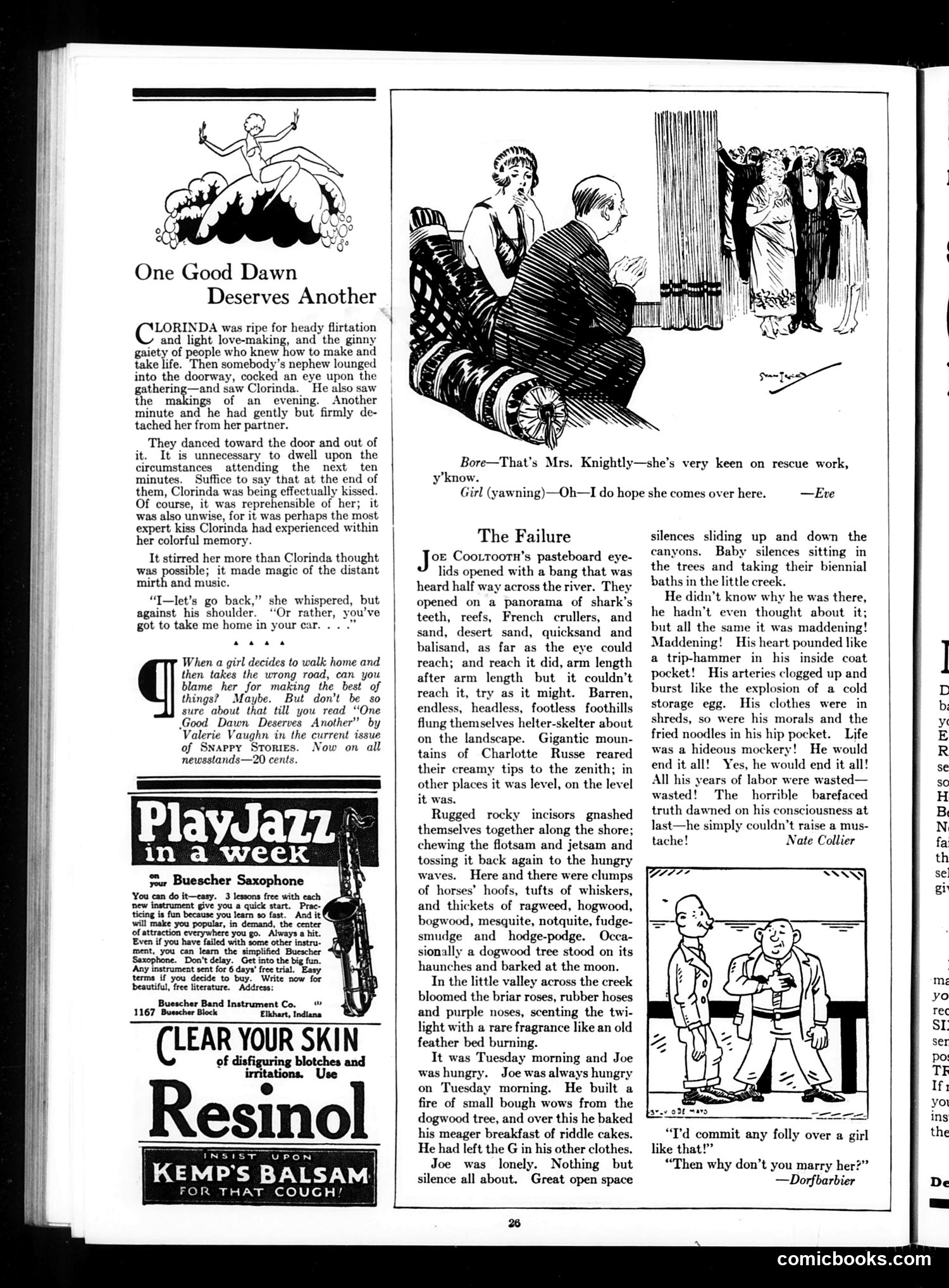
This page contains three distinct pieces: **"One Good Dawn Deserves Another"** (top left): A short story teaser advertising *Snappy Stories* magazine. It describes a young woman named Clorinda who abandons her dance partner for a man's advances, leading to a kiss. The story plays on 1920s-era sexual double standards—the narrator acknowledges the encounter is "reprehensible" yet frames it as romantic adventure. This targets the magazine's audience of young adults interested in risqué but ultimately conventional romance. **"The Failure"** (main text): An absurdist short story by Nate Collier featuring a character named Joe waking in a surreal desert landscape. The prose is intentionally nonsensical—mountains made of "Charlotte Russe" (a dessert), "horses' hoofs" growing as plants, a "dogwood tree" that barks. It's satirical mockery of overwrought literary description. Joe is simply hungry and lonely. The humor derives from the contrast between pretentious, flowery writing and mundane reality. **The cartoons and advertisements** fill remaining space—typical period content for *Judge* magazine.
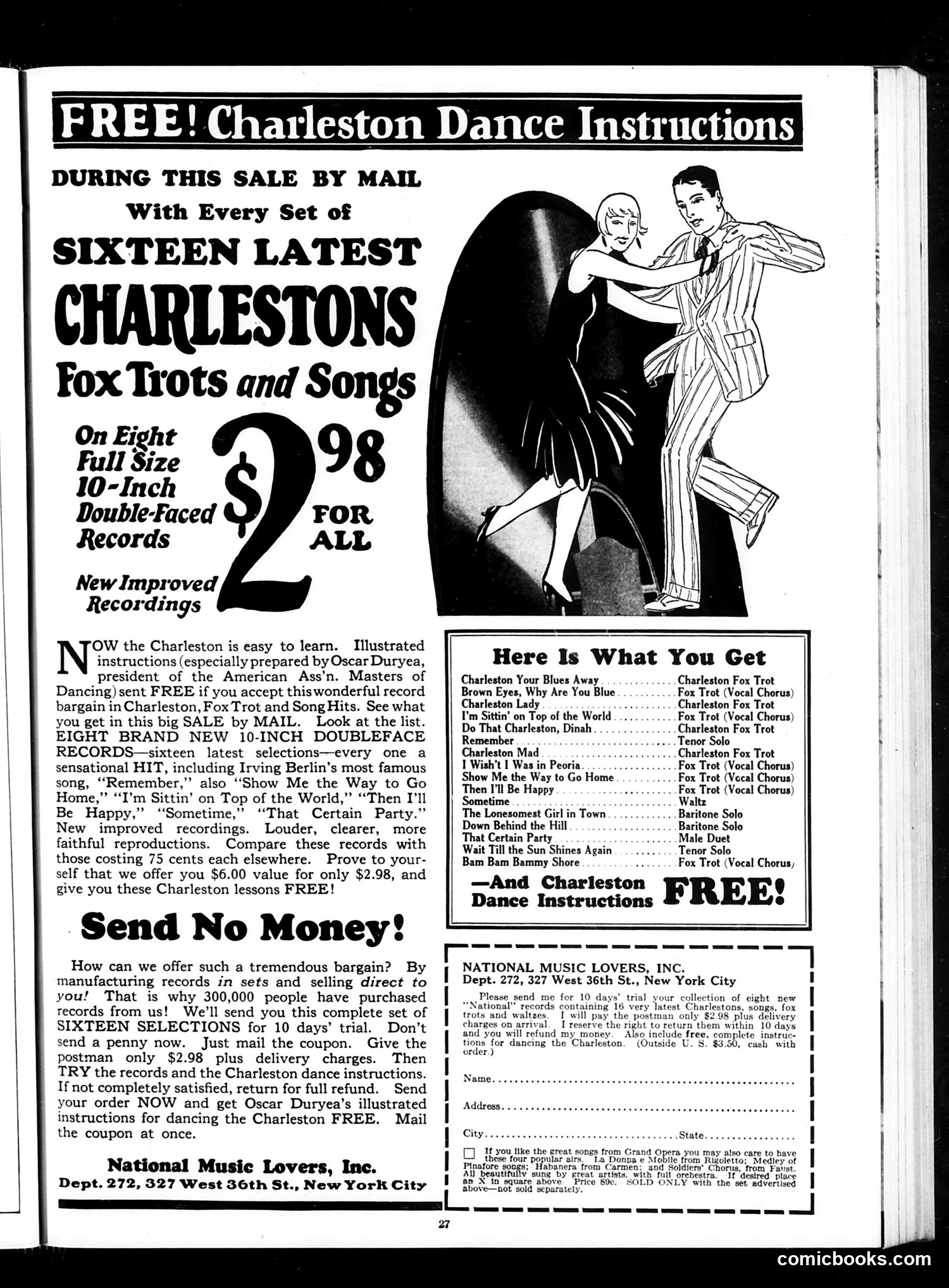
This is not a cartoon but a **mail-order advertisement** for phonograph records, capitalizing on the Charleston dance craze of the 1920s. The page offers sixteen recordings of Charleston, Fox Trot, and popular songs for $2.98 (payable to the postman—"send no money" upfront). The pitch emphasizes direct manufacturing and sales eliminate middlemen, enabling an impossibly cheap price for what normally costs $6.00. Critically, the advertisement includes **free Charleston dance instructions** prepared by Oscar Duryea, president of the American Association of Masters of Dancing. This reflects how the Charleston—a scandalous, energetic jazz-age dance—was novel enough that many Americans needed instruction to learn it. The songs listed reference popular 1920s hits, including Irving Berlin compositions. The entire appeal targets the dance-crazy public eager to learn and practice the Charleston at home with records and instructional guides. This is pure commerce exploiting a cultural moment, not satire.
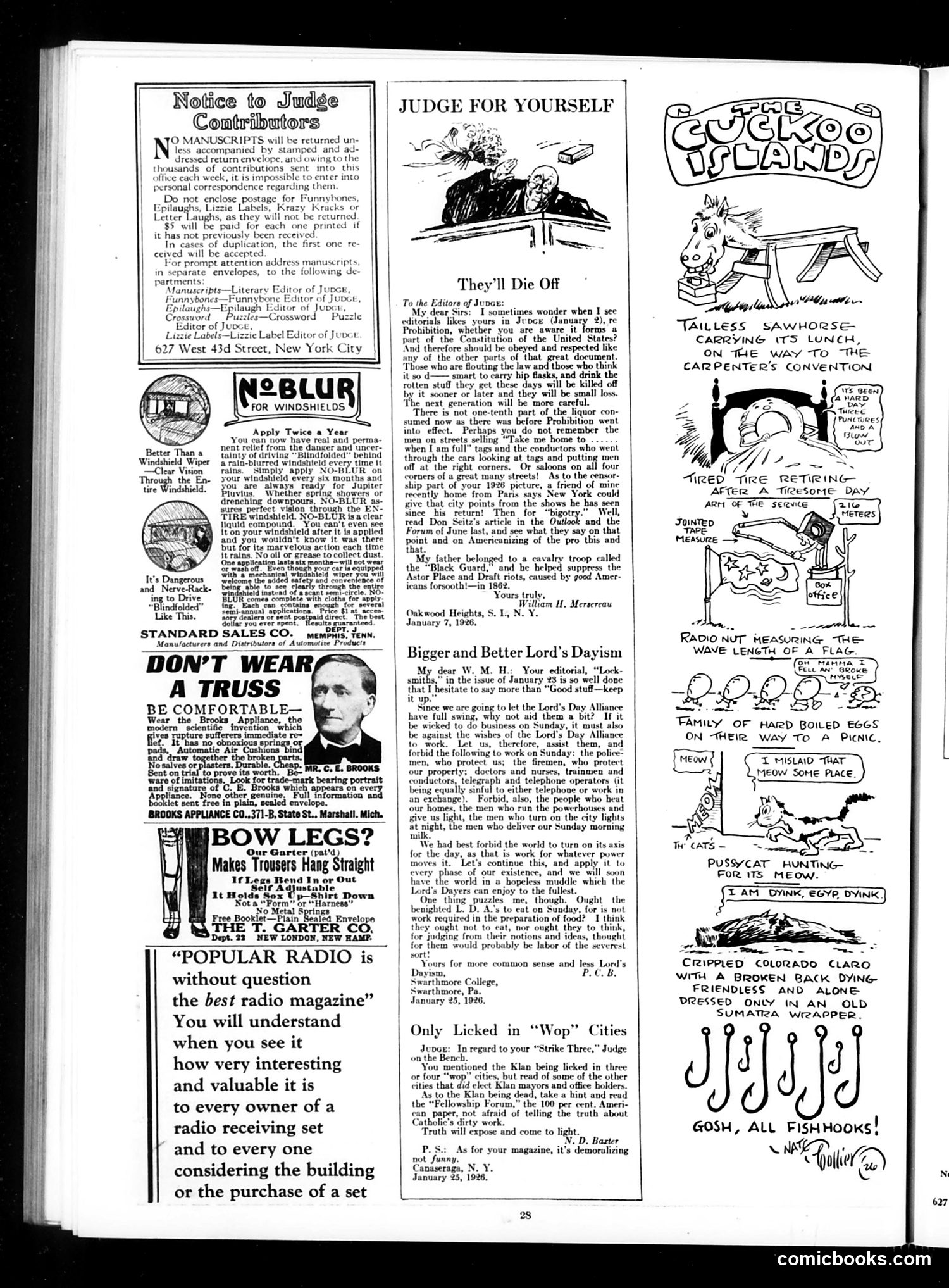
This page is primarily **advertisements and reader correspondence**, not political cartoons. The main content includes: **"They'll Die Off"** — A letter defending Prohibition (the constitutional ban on alcohol, 1920-1933). The writer argues that people flouting Prohibition laws will naturally "die off," and claims alcohol consumption has decreased significantly since Prohibition began. He references pre-Prohibition problems like street vendors and corner saloons, and defends "bigotry" as necessary Americanization. **The cartoons** on the right side are humor features unrelated to politics—including "Cuckoo Islands" (about tailless sawhorse carrying lunch) and various joke panels about retired tires, carpenters, fishing, and cats. These are light comic filler. The page also contains product advertisements (windshield wipers, trusses, garters, radio magazines) typical of 1920s magazines. The "Notice to Judge Contributors" is an editorial guideline for submitting material. The Prohibition letter represents **contemporary debate** about enforcing this unpopular constitutional amendment.
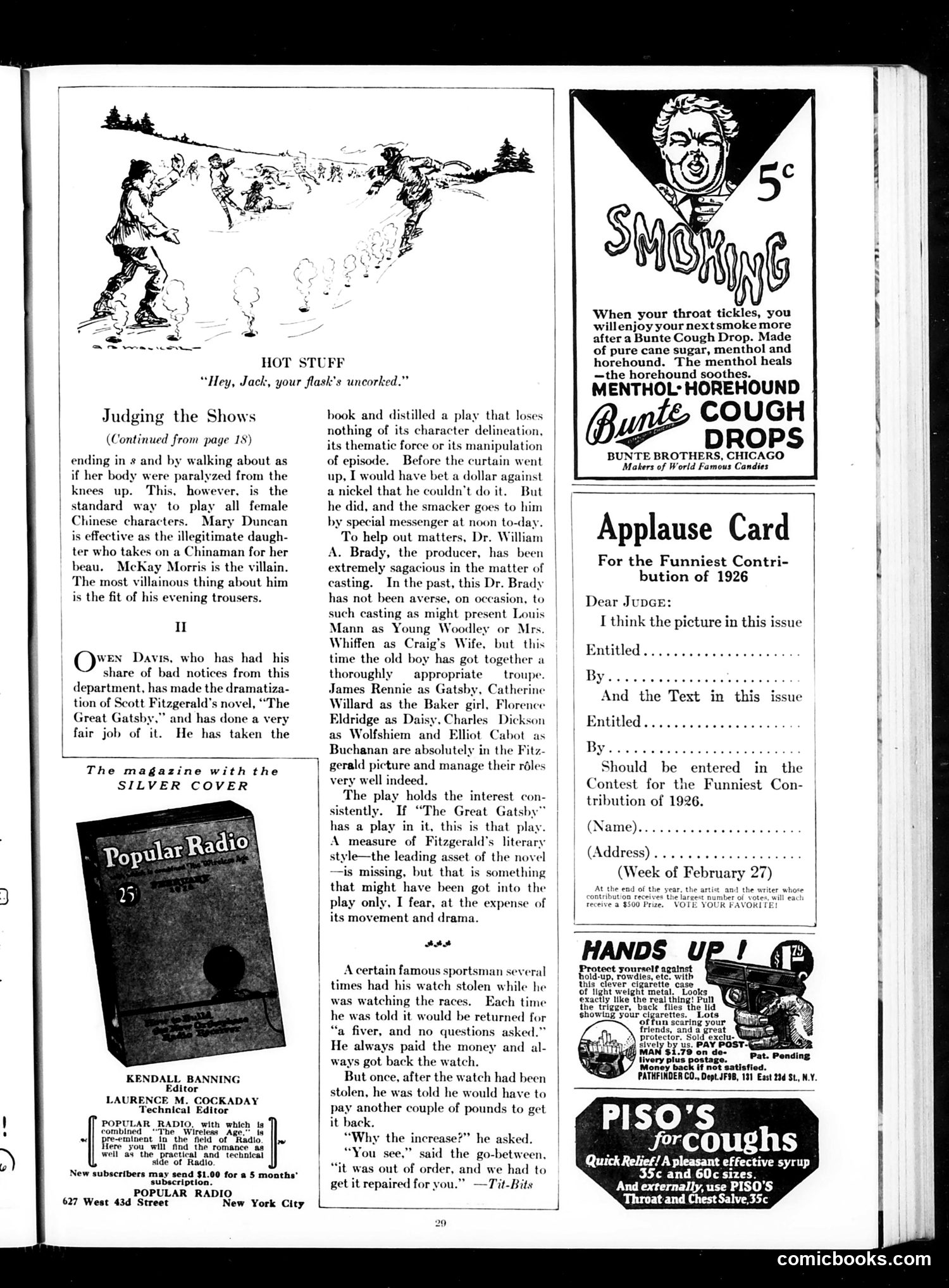
This is primarily **editorial content and advertisements** from Judge magazine (dated around February 1926, based on the contest date). The main text reviews theatrical productions, notably praising Owen Davis's stage adaptation of F. Scott Fitzgerald's *The Great Gatsby*, crediting its success to Davis's skillful dramatization and producer Dr. William Brady's appropriate casting choices. The cartoon "Hot Stuff" shows a casual scene of someone pointing out that a flask has uncorked—a reference to Prohibition-era humor (1920-1933), when alcohol was illegal but widely consumed in secret. The joke is the obviousness of the discovery. The anecdote at bottom involves a sportsman repeatedly paying thieves to recover his stolen watch, then resisting an additional repair charge—simple comedic irony about negotiating with criminals. The remainder consists of period advertisements: cough drops, a radio magazine subscription, a cigarette case marketed for "protection," and a comedy contest submission card—typical 1920s commercial fare reflecting contemporary consumer products and concerns.
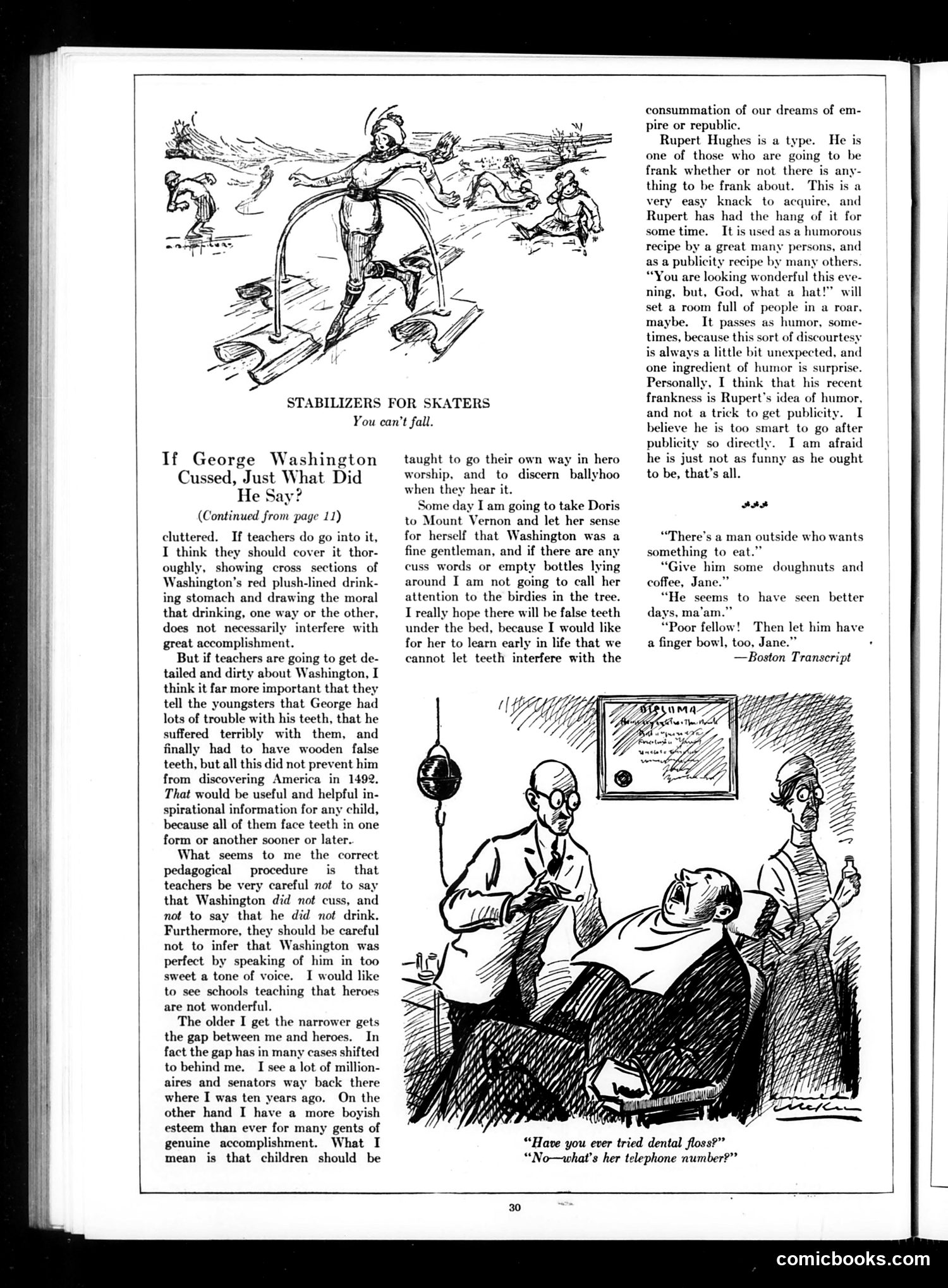
**Top Cartoon:** "Stabilizers for Skaters—You Can't Fall" depicts an exaggerated figure using extreme stabilizing equipment while ice skating, satirizing over-engineered solutions to simple problems. **Main Article:** A critique of how George Washington should be taught to children. The author argues against both sanitizing Washington (pretending he was perfect) and unnecessarily emphasizing his vices (drinking, cursing). The piece specifically criticizes Rupert Hughes (a real author/filmmaker known for sensationalized biographies) for pursuing "frankness" as a publicity stunt. The author advocates teaching that heroes were flawed but accomplished people—pragmatically noting Washington had false teeth yet still "discovered America," therefore dental problems needn't stop achievement. **Bottom Cartoon:** A wealthy woman charitably offers a poor man "doughnuts and coffee," then upgrades to include a "finger bowl" (fine dining etiquette) upon learning he's fallen from better circumstances—satirizing superficial, performative charity that confuses class markers with genuine help. The page critiques both pseudo-intellectual sensationalism and shallow social conventions.
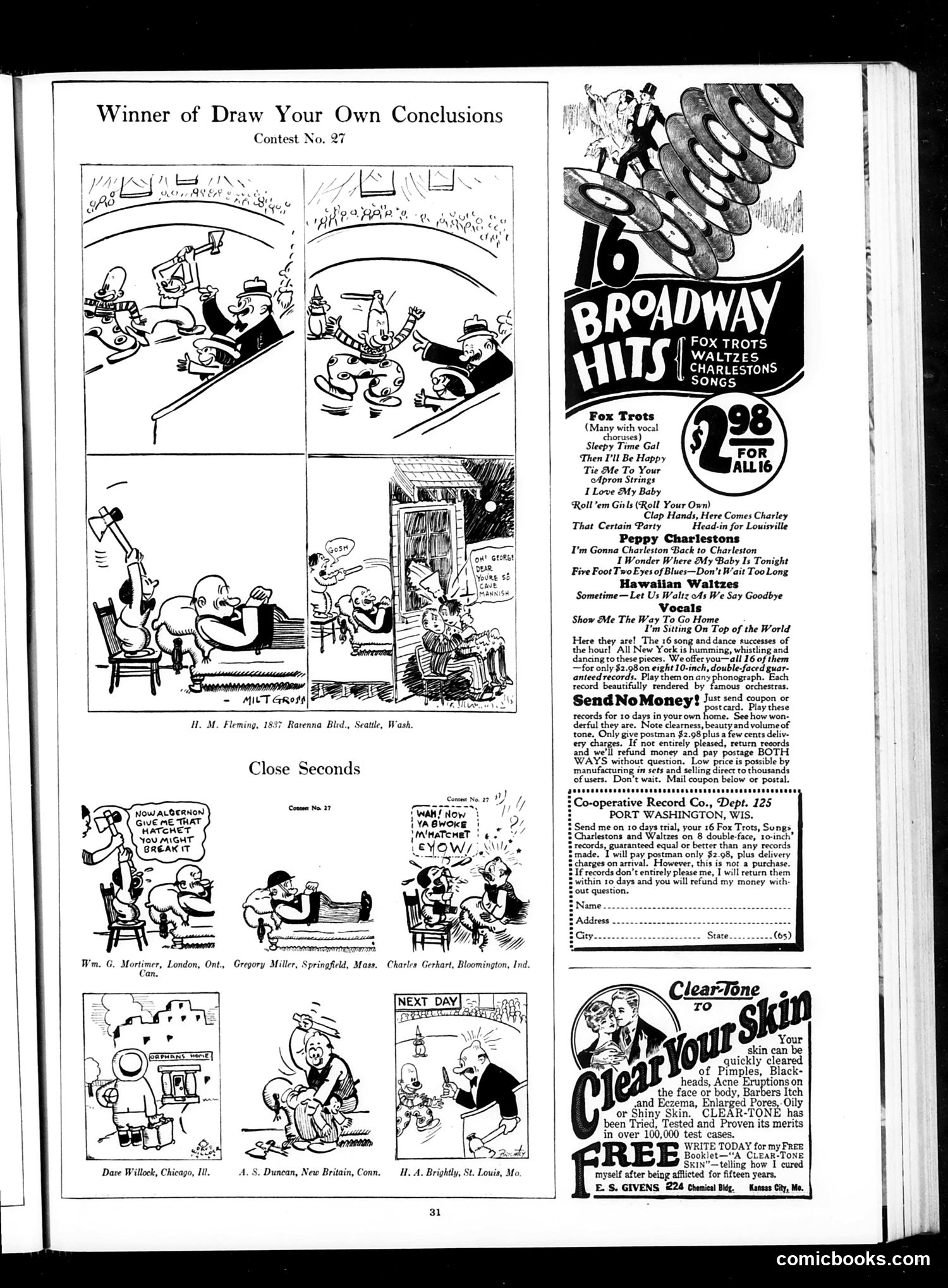
This page from *Judge* magazine combines editorial cartoons with period advertising, likely from the mid-1920s. **The Cartoons:** The top section shows the winner of "Draw Your Own Conclusions" Contest No. 27—a four-panel comic by "Milt Gross" depicting what appears to be a chaotic party or social gathering with exaggerated, cartoonish figures. The humor relies on visual absurdity rather than clear narrative; readers were apparently invited to interpret the scenes themselves (hence the contest title). Below, "Close Seconds" shows similar humorous vignettes with comedic situations involving everyday characters in awkward moments. **The Advertisements:** The right side advertises contemporary 1920s products: sheet music of popular dances (Fox Trots, Charlestons, waltzes), phonograph records, and skin-care treatments—reflecting the era's consumer culture and interests in modern entertainment and personal grooming. The cartoons' loose, energetic drawing style and absurdist humor typify 1920s American comic sensibilities, while the ads document period consumer aspirations.
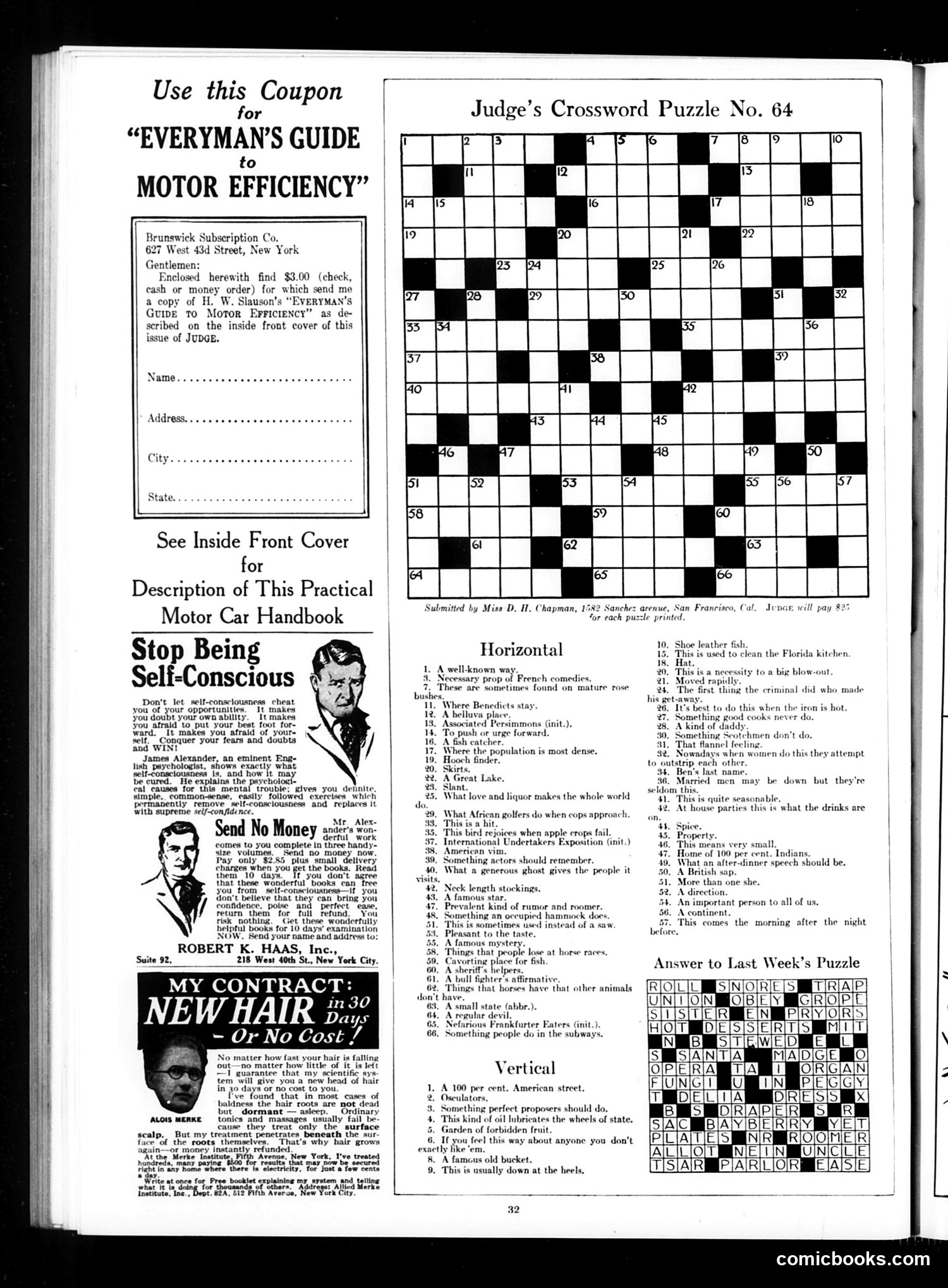
This page is primarily a **crossword puzzle** ("Judge's Crossword Puzzle No. 64") with accompanying advertisements rather than political satire. The advertisements reveal 1920s-era concerns: a motor efficiency handbook promoting fuel economy during post-WWI economic consciousness; James Alexander's self-help book on overcoming self-consciousness (reflecting Jazz Age anxieties); and notably, Alois Merke's hair-restoration treatment promising regrowth "or money instantly refunded"—a common mail-order remedy of the era. The crossword clues themselves contain mild social humor typical of the 1920s ("What love and liquor makes the whole world," "What African golfers do when cops approach" [alluding to Prohibition enforcement]). The puzzle answers shown below reference contemporary figures and concepts. The overall page represents **period advertising and entertainment** rather than political commentary—it's primarily commercial content targeting Judge's readership with products and diversions of that era.
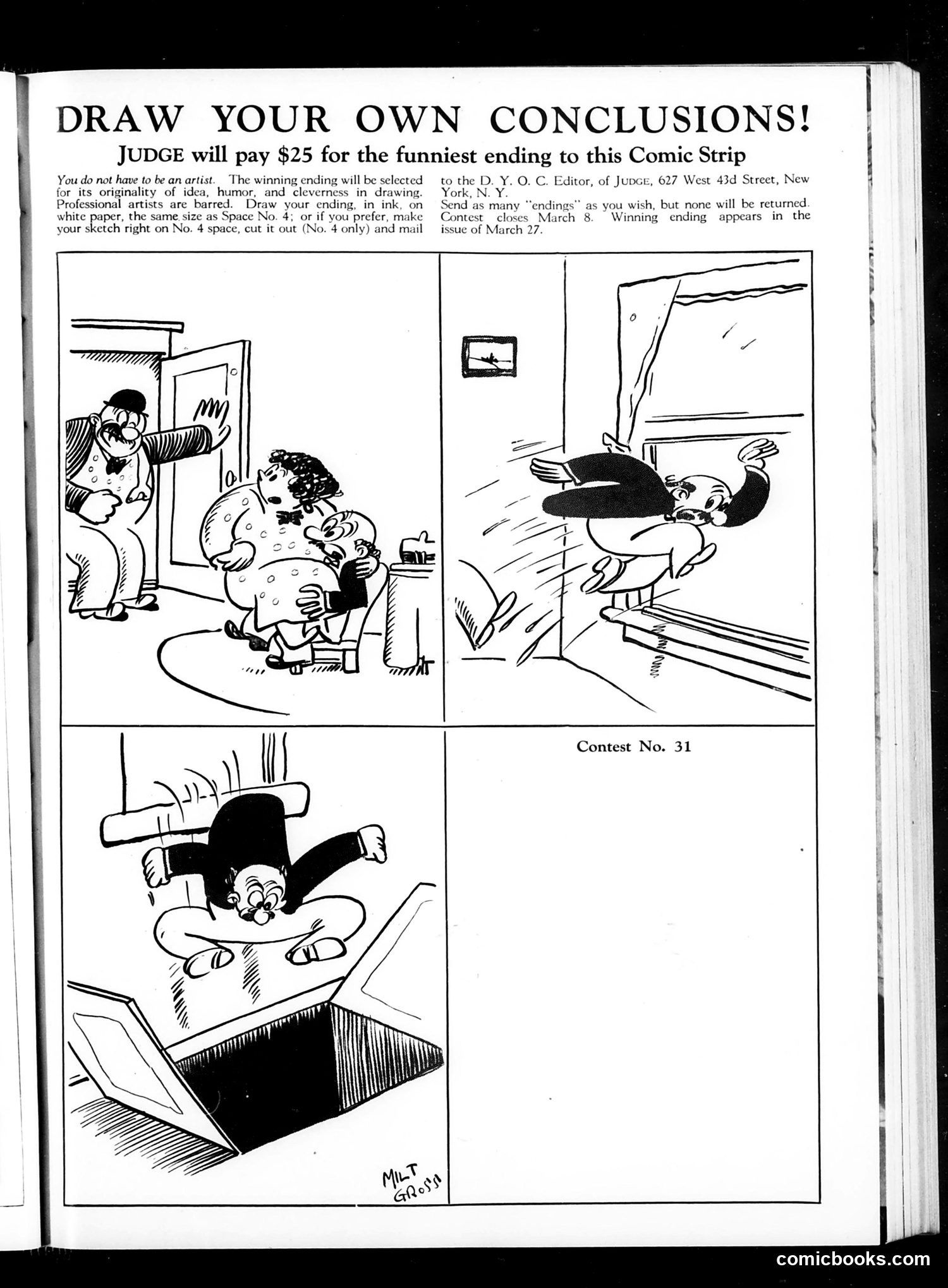
This is a reader-participation contest from *Judge* magazine offering $25 for the funniest ending to an incomplete comic strip. The three panels show: 1. **Top left**: A rotund man in a doorway gesturing at a woman and child 2. **Top right**: A man being violently ejected from a window or building 3. **Bottom**: A man in a top hat bursting from a box or container The setup appears to depict a domestic or comedic scenario—likely involving infidelity, mistaken identity, or physical comedy—where readers must supply the punchline. The crude, exaggerated caricature style was typical of early-20th-century satirical humor. Readers could submit multiple endings; the winning entry would appear in the March 27 issue. The contest welcomed non-professionals, emphasizing originality and humor over artistic skill. This format was popular in magazines as both entertainment and audience engagement.
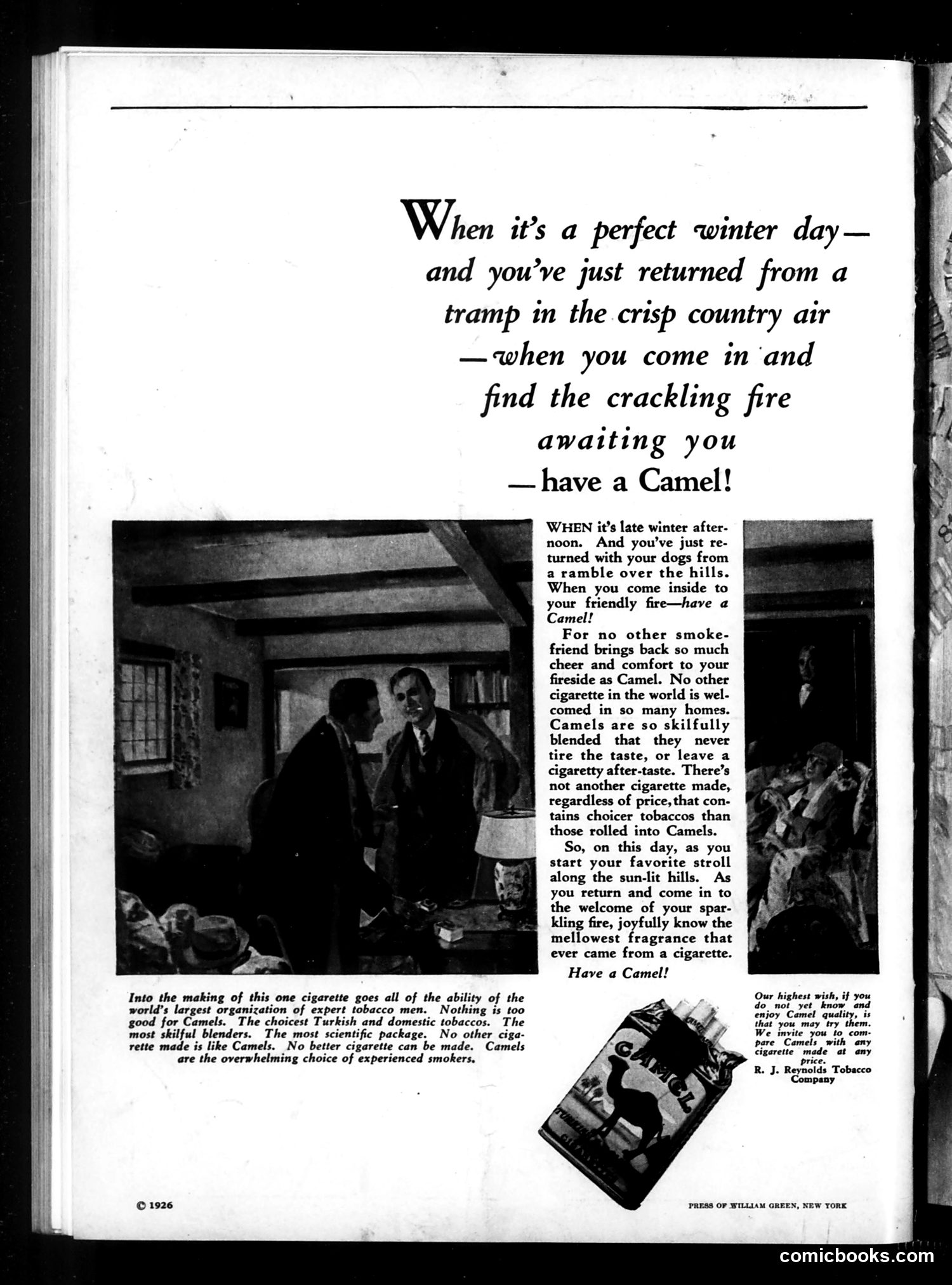
This is a **Camel cigarette advertisement**, not a political cartoon or satire. Dated 1926, it depicts a domestic winter scene: two men by a fireplace, one appearing to return from outdoor recreation. The ad uses the aspirational lifestyle marketing typical of early 20th-century tobacco advertising. It associates Camel cigarettes with comfort, leisure, and social companionship—returning cold and tired from a country walk, then warming by the fire with a cigarette. The copy emphasizes superior tobacco blending and claims Camels are "the overwhelming choice of experienced smokers." The R.J. Reynolds Tobacco Company uses emotional appeals (coziness, friendship, natural pleasure) rather than factual claims about quality. **For modern readers:** This represents pre-regulation cigarette marketing that openly advertised smoking as a wholesome lifestyle choice without health warnings. The casual domestic setting and emphasis on comfort reflect how smoking was then marketed as universally appropriate and beneficial.