
Judge, 1926-02-27 · page 32 of 36
Judge — February 27, 1926 — page 32: what you’re looking at
What you’re looking at
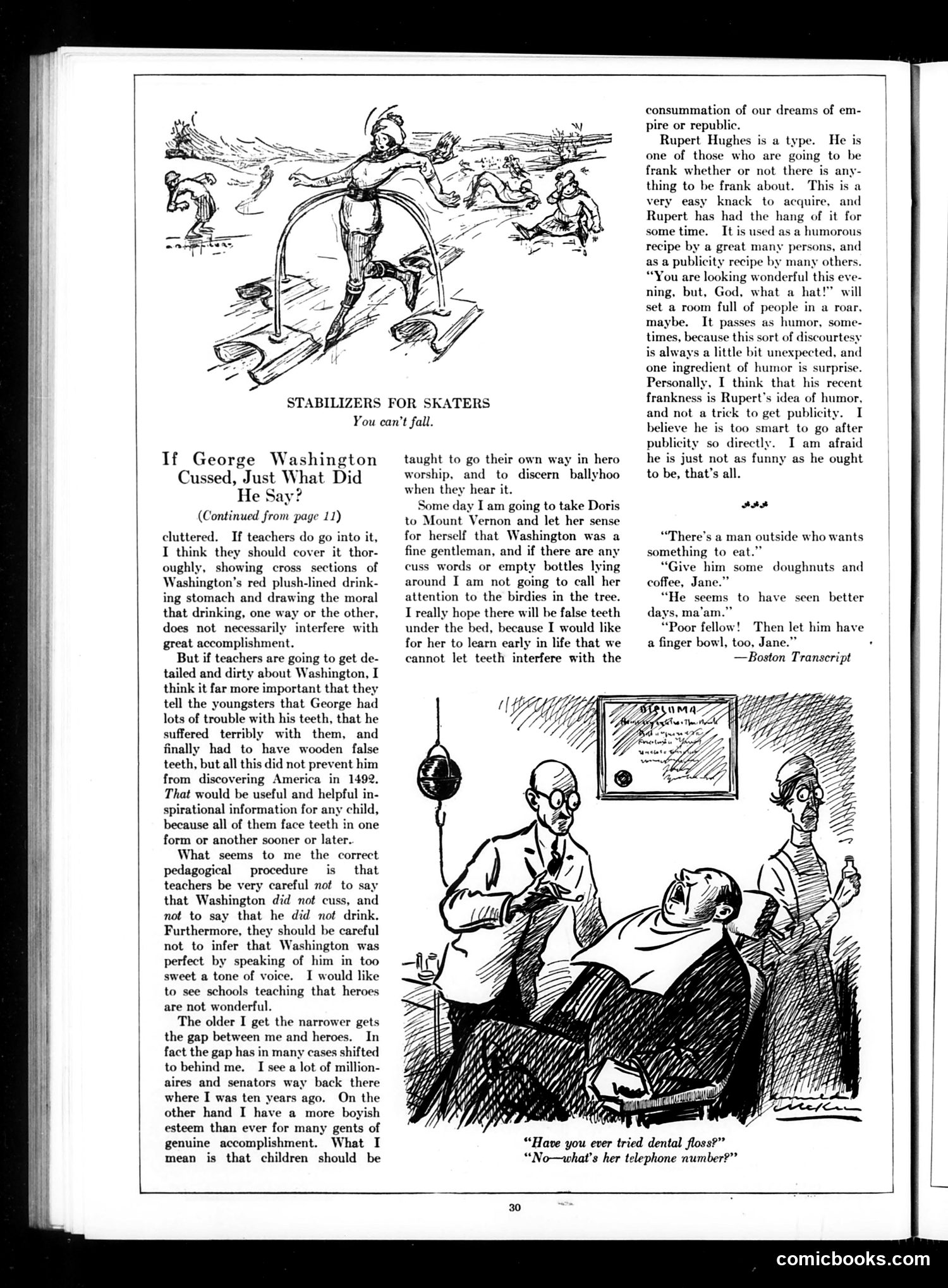
**Top Cartoon:** "Stabilizers for Skaters—You Can't Fall" depicts an exaggerated figure using extreme stabilizing equipment while ice skating, satirizing over-engineered solutions to simple problems. **Main Article:** A critique of how George Washington should be taught to children. The author argues against both sanitizing Washington (pretending he was perfect) and unnecessarily emphasizing his vices (drinking, cursing). The piece specifically criticizes Rupert Hughes (a real author/filmmaker known for sensationalized biographies) for pursuing "frankness" as a publicity stunt. The author advocates teaching that heroes were flawed but accomplished people—pragmatically noting Washington had false teeth yet still "discovered America," therefore dental problems needn't stop achievement. **Bottom Cartoon:** A wealthy woman charitably offers a poor man "doughnuts and coffee," then upgrades to include a "finger bowl" (fine dining etiquette) upon learning he's fallen from better circumstances—satirizing superficial, performative charity that confuses class markers with genuine help. The page critiques both pseudo-intellectual sensationalism and shallow social conventions.
📄 Transcribed text from this page (OCR, searchable)
Machine-transcribed from the original scan — historical spelling and the odd misread are preserved.
STABILIZERS FOR SKATERS You can’t fall. If George Washington Cussed, Just What Did He Say? (Continued from page 11) cluttered. If teachers do go into it, I think they should cover it thor- oughly, showing cross sections of Washington’s red plush-lined drink- ing stomach and drawing the moral that drinking, one way or the other, does not necessarily interfere with great accomplishment. But if teachers are going to get de- tailed and dirty about Washington, I think it far more important that they tell the youngsters that George had lots of trouble with his teeth, that he suffered terribly with them, and finally had to have wooden false teeth, but all this did not prevent him from discovering America in 1492. That would be useful and helpful in- spirational information for any child, because all of them face teeth in one form or another sooner or later. What seems to me the correct pedagogical procedure is that teachers be very careful not to say that Washington did not cuss, and not to say that he did not drink. Furthermore, they should be careful not to infer that Washington was perfect by speaking of him in too sweet a tone of voice. I would like to see schools teaching that heroes are not wonderful. The older I get the narrower gets the gap between me and heroes. In fact the gap has in many cases shifted to behind me. I see a lot of million- aires and senators way back there where I was ten years ago. On the other hand I have a more boyish esteem than ever for many gents of genuine accomplishment. What I mean is that children should be taught to go their own way in hero worship, and to discern ballyhoo when they hear it. Some day I am going to take Doris to Mount Vernon and let her sense for herself that Washington was a fine gentleman, and if there are any cuss words or empty bottles lying around I am not going to call her attention to the birdies in the tree. I really hope there will be false teeth under the bed, because I would like for her to learn early in life that we cannot let teeth interfere with the consummation of our dreams of em- pire or republic. Rupert Hughes is a type. He is one of those who are going to be frank whether or not there is any- thing to be frank about. This is a very easy knack to acquire, and Rupert has had the hang of it for some time. It is used as a humorous recipe by a great many persons, and as a publicity recipe by many others. “You are looking wonderful this ning, but, God, what a hat!” will set a room full of people in a roar, maybe. It passes as humor, some- times, because this sort of discourtesy is always a little bit unexpected, and one ingredient of humor is surprise. Personally, I think that his recent frankness is Rupert's idea of humor, and not a trick to get publicity. I believe he is too smart to go after publicity so directly. I am afraid he is just not as funny as he ought to be, that’s all. Rana “There's a man outside who wants something to eat.” “Give him some doughnuts and coffee, Jane.” “He seems to have seen better days, ma’am.”” “Poor fellow! Then let him have a finger bowl, too, Jane.” —Boston Transcript “Have you ever tried dental floss?” “No—hat’s her telephone number?” a comicbooks.com