
Judge, 1926-02-27 · page 22 of 36
Judge — February 27, 1926 — page 22: what you’re looking at
What you’re looking at
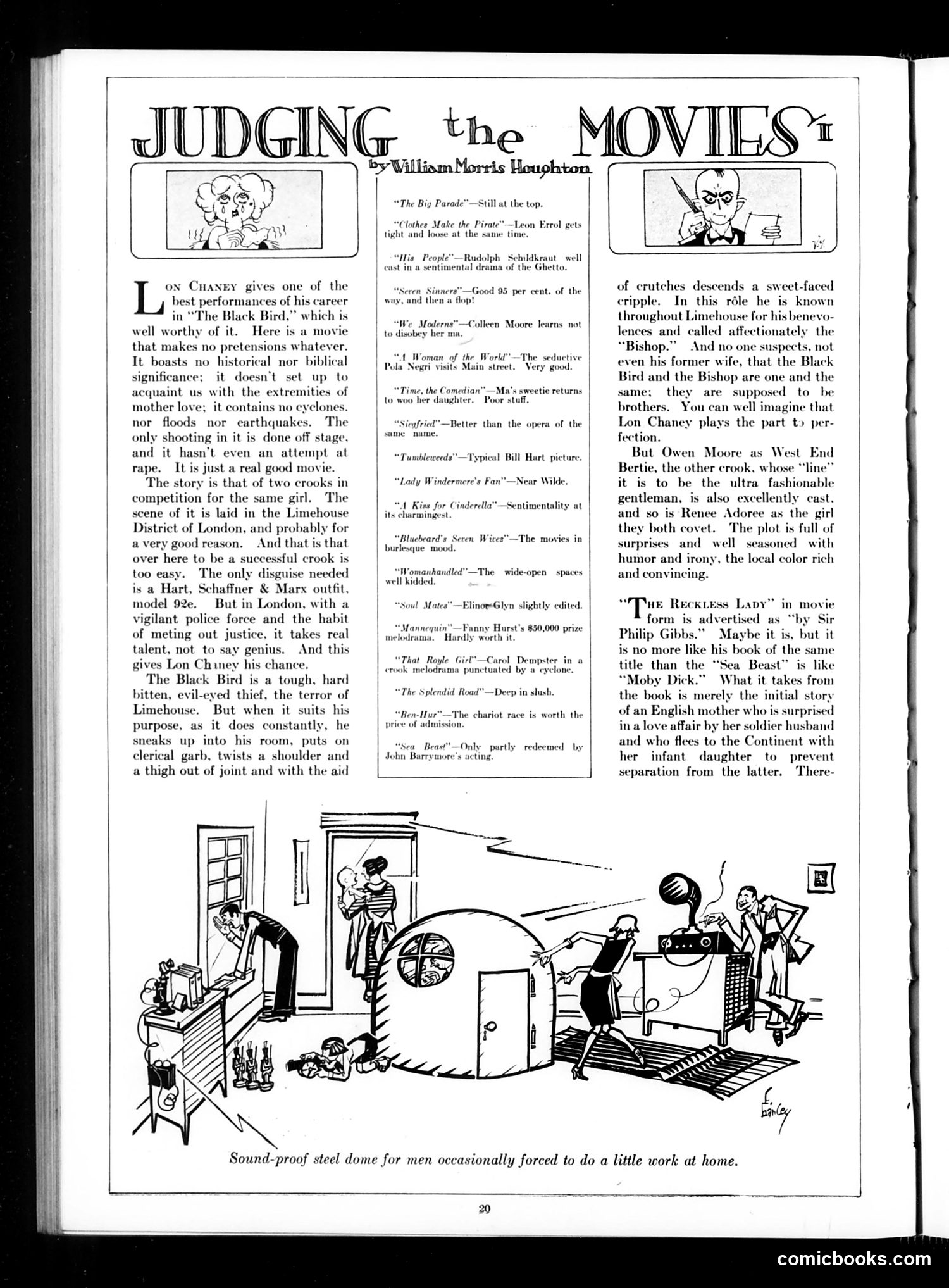
This page from Judge magazine presents satirical film reviews by William Morris Houghton. The main article praises Lon Chaney's performance in "The Black Bird," a crime drama set in London's Limehouse District, where Chaney plays a dual role: a ruthless thief and his disguised alter ego, an affectionate cripple called "the Bishop." The review highlights the film's modest storytelling—notably lacking the melodramatic excess (cyclones, floods, rape attempts) typical of contemporary cinema. The accompanying cartoon satirizes husbands forced to work at home, depicting domestic chaos in a cramped "sound-proof steel dome." Below are brief capsule reviews of other current films including "Ben-Hur," "The Big Parade," and adaptations of literary works, offering quick judgments on their relative merits. The tone is witty and dismissive toward pretentious or poorly executed films while praising honest entertainment.
📄 Transcribed text from this page (OCR, searchable)
Machine-transcribed from the original scan — historical spelling and the odd misread are preserved.
on Cuaney gives one of the L best performances of his career in “The E Bird,” which is well worthy of it. Here is a movie that makes no pretensions whatever. It boasts no historical nor biblical significance; it doesn’t set. up to acquaint us with the extremities of mother love; it contains no cyclones. nor floods nor earthquake he only shooting in it is done off stage. and it hasn't even an attempt at rape. It is just a real good movie. The story is that of two crooks in competition for the same girl. The scene of it is laid in the Limehouse District of London, and probably for a very good reason. And that is that over here to be a successful crook is too easy. The only disguise needed is a Hart, Schaffner & Marx outfit, model 92e. But in London, with a vigilant police force and the habit of meting out justice, it takes real talent, not to say genius. And this es Lon Chiney his ¢ The Black Bird is a tough, hard bitten, evil-eyed thief, the terror of Limehouse. But when it suits his purpose, as it does constantly, he sne: up into his room, puts on clerical garb, twists a shoulder and a thigh out of joint and with the aid “Clothes Make the it-and loose at the time “His People” cast in a sentim! Rudolph Schildkraut well drama of the Ghetto, “Seren Sinners"—Good 95 per cent. of the way, and then a flop! “We Moderns"—Colleen Moore learns not to disobey her ma. “1 Woman of the World” la Negri visits Main street. Very good. “Time, the Comedian” to woo her daughter. Poor stuff. | —Better than the opera of the “Tumbleweeds"—Typical Bill Hart picts “Lady Windermere's Fan’ Wilde. “A Kins for Cinderella” —Sentimentality at its charn “Bluebeard’s Seren Wives"—The movies in burlesque mood. “Womanhandled”—The wide-open spaces well kidded, “Soul Mates" —ElinowGlyn slightly edited. “Mannequin” —Fanny Hurst's $50,000 prize melodrama, Hardly worth it | “That Royle Girl*—Carol_ Dempster | crook melodrama punctuated by a cyclo “The Splendid Road” —Deep in slush. “Ben-Hur"—The chariot race is worth the price of admission. | | “Sea Beart"—Only partly redeemed by | John Barrymore's acting. Leon Errol gets UDGING, ‘ne MOVIES* | “The Big Parade”—Still at the top. Ma's sweetie returns | of crutches descends a sweet-faced cripple. In this réle he is known throughout Limehouse for his benevo- lences and called affectionately. the “Bishop.” And no one suspects, not n his former wife, that the Black Bird and the Bishop are one and the same; they are supposed to be brothers. You can well imagine that Lon Chaney plays the part t» per- fection. But Owen Moore as West End Bertie, the other crook, whose “line” it is to be the ultra fashionable gentleman, is also excellently cast. and so is Renee Adoree as the girl they both covet. The plot is full of surprises and well seasoned with humor and irony, the local color rich and convincing. “Tue Reckiess Lapy” in movie form is advertised as “by Sir Philip Gibbs.” Maybe it is, but it is no more like his book of the same title than the “Sea Beast” is like “Moby Di What it takes from the book is merely the initial story of an English mother who is surprised ina love affair by her soldier husband and who flees to the Continent with her infant daughter to separation from the latter. prevent There- comicbooks.com