
Judge, 1926-02-27 · page 13 of 36
Judge — February 27, 1926 — page 13: what you’re looking at
What you’re looking at
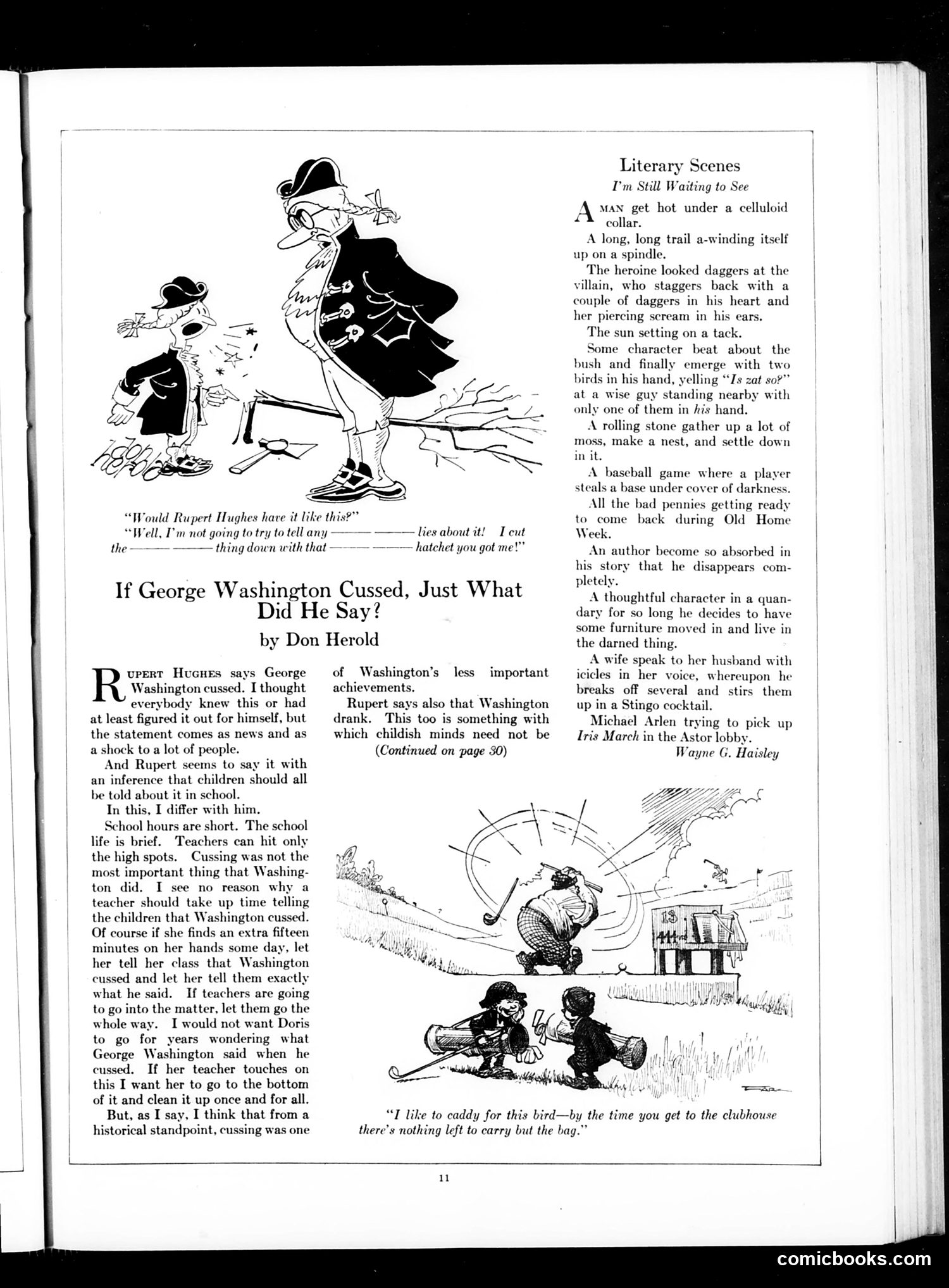
This page contains two satirical pieces: **Main Article: "If George Washington Cussed, Just What Did He Say?"** by Don Herold responds to claims by writer Rupert Hughes that George Washington cursed and drank. Herold argues sarcastically that while Washington may have done these things, they're historically unimportant and unnecessary to teach schoolchildren given limited classroom time. The cartoon shows two figures (likely Washington and a child) with dialogue censored by dashes, mocking the prudishness of omitting such details from history. **"Literary Scenes"** is a humor column mocking clichéd expressions in popular fiction—phrases like "looked daggers," "beat about the bush," and metaphors that don't hold up to literal interpretation ("a rolling stone gather up moss"). It's satirizing overworn literary tropes. **Social Context:** The pieces reflect 1920s-era debates about propriety in education and media, poking fun at both Victorian censorship attitudes and pulp fiction's tired conventions.
📄 Transcribed text from this page (OCR, searchable)
Machine-transcribed from the original scan — historical spelling and the odd misread are preserved.
“Would Rupert Hughes have it like this’ “Well, I'm not going to try to tell any ——— ——— lies about it! I cut the ———- ——— thing down with that — —— ——— hatchet you got me!” If George Washington Cussed, Just What Did He Say? by Don Herold upert Hucues says George Washington cussed. I thought everybody knew this or had at least figured it out for himself, but the statement comes as news and as a shock to a lot of people. And Rupert seems to say it with an inference that children should all be told about it in school. In this, I differ with him. School hours are short. The school life is brief. Teachers can hit only the high spots. Cussing was not the most important thing that Washing- ton did. I see no reason why a teacher should take up time telling the children that Washington cussed. Of course if she finds an extra fifteen minutes on her hands some day, let her tell her class that Washington cussed and let her tell them exactly what he said. If teachers are going to go into the matter, let them go the whole way. I would not want Doris to go for years wondering what George Washington said when he cussed. If her teacher touches on this I want her to go to the bottom of it and clean it up once and for all. But, as I say, I think that from a historical standpoint, cussing was one of Washington’s _ less achievements. Rupert says also that Washington drank. This too is something with which childish minds need not be (Continued on page 30) important Literary Scenes I'm Still Waiting to See A sax get hot under a celluloid ‘ collar. A long, long trail a-winding itself up on a spindle. The heroine looked daggers at the villain, who staggers back with a couple of daggers in his heart and her piercing scream in his ears. The sun setting on a tack. Some character beat about the bush and finally emerge with two birds in his hand, yelling “Zs zat so?” at a wise guy standing nearby with only one of them in his hand. A rolling stone gather up a lot of moss, make a nest, and settle down in it. A baseball game where a player steals a base under cover of darkness. All the bad pennies getting ready to come back during Old Home Week. An author become so absorbed in his story that he disappears com- pletely, A thoughtful character in a quan- dary for so long he decides to have some furniture moved in and live in the darned thing. A wife speak to her husband with icicles in her voice, whereupon he breaks off several and stirs them up in a Stingo cocktail. Michael Arlen trying to pick up Tris March in the Astor lobby. Wayne G. Haisley jj Bahay (o a “I like to caddy for this bird—by the time you get to the clubhouse there's nothing left to carry but the bag.” comicbooks.com