
Judge, 1926-02-27 · page 20 of 36
Judge — February 27, 1926 — page 20: what you’re looking at
What you’re looking at
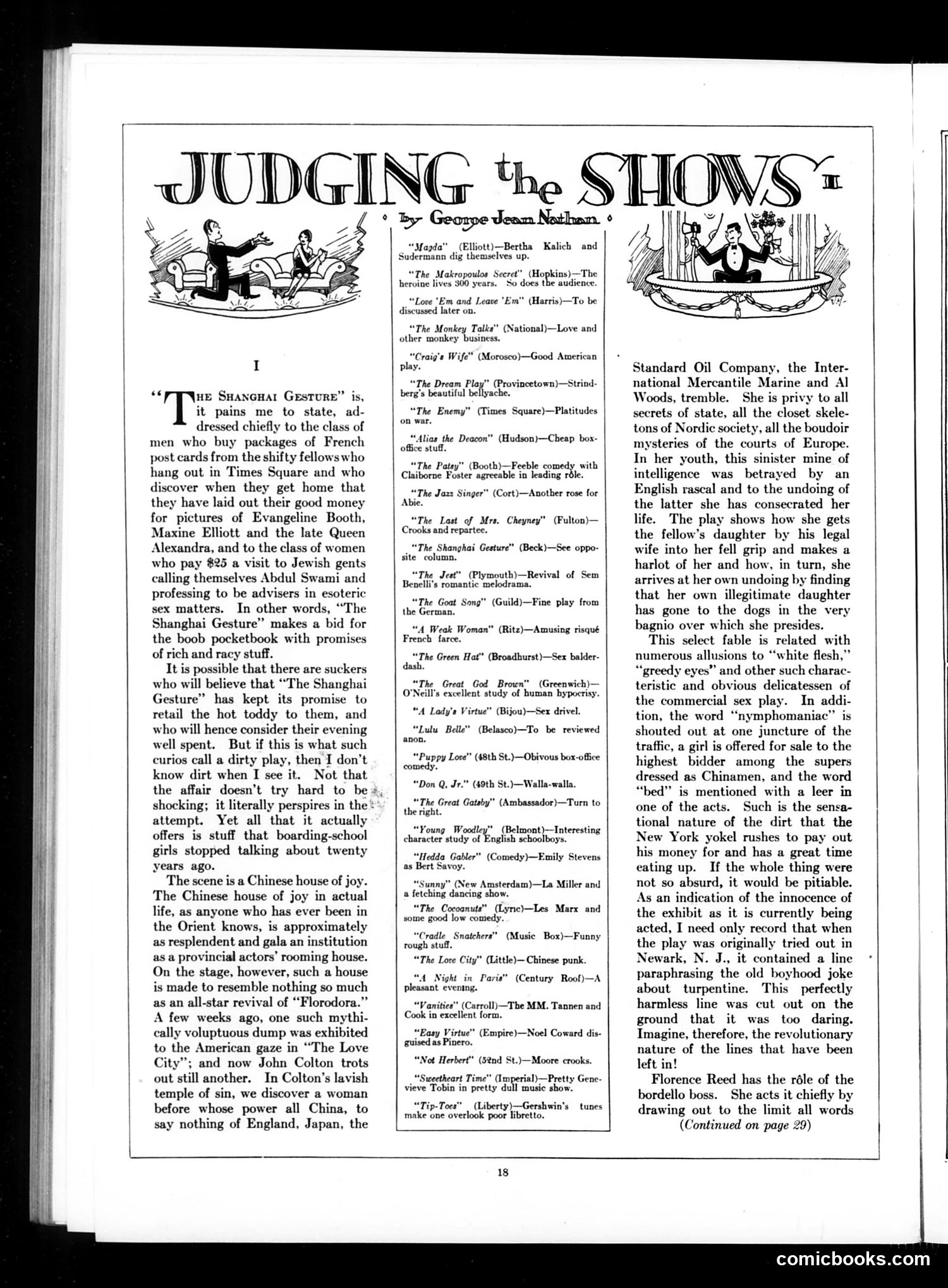
This page contains George Jean Nathan's theater reviews for *Judge* magazine. The main article critiques "The Shanghai Gesture," a play set in a Chinese brothel. Nathan argues the play merely exploits audiences with promises of scandalous content while delivering only tame material that "boarding-school girls stopped talking about twenty years ago." The satire targets both the play's sensationalism and the gullible theatergoers it aims to fleece—specifically men duped by fake French postcards and women visiting fraudulent spiritualists. Nathan dismisses the elaborate stage design of the "house of joy" as absurdly overdone compared to actual establishments. The page also lists other current Broadway productions with Nathan's brief, acerbic dismissals (praising some, mocking others for being cheap, obvious, or tedious). The satire's real target is commercial theater pandering to lowbrow audiences seeking thrills rather than substance.
📄 Transcribed text from this page (OCR, searchable)
Machine-transcribed from the original scan — historical spelling and the odd misread are preserved.
“ HE SHancuat GEsTuRE” is, it pains me to state, ad- dressed chiefly to the class of men who buy packages of French post cards from the shifty fellows who hang out in Times Square and who discover when they get home that they have laid out their good money for pictures of Evangeline Booth, Maxine Elliott and the late Queen Alexandra, and to the class of women who pay $25 a visit to Jewish gents calling themselves Abdul Swami and professing to be advisers in esoteric sex matters. In other words, “The Shanghai Gesture” makes a bid for the boob pocketbook with promises of rich and racy stuff. It is possible that there are suckers who will believe that “The Shanghai Gesture” has kept its promise to retail the hot toddy to them, and who will hence consider their evening well spent. But if this is what such curios call a dirty play, then I don’t know dirt when I see it. Not that the affair doesn’t try hard to be #, shocking; it literally perspires in the * attempt. Yet all that it actually offers is stuff that boarding-school girls stopped talking about twenty years ago. The scene is a Chinese house of joy. The Chinese house of joy in actual life, as anyone who has ever been in the Orient knows, is approximately as resplendent and gala an institution as a provincial actors’ rooming house. On the stage, however, such a house is made to resemble nothing so much as an all-star revival of “Florodora.” A few weeks ago, one such myt cally voluptuous dump was exhibited to the American gaze in “The Love ity”; and now John Colton trots out still another. In Colton’s lavish temple of sin, we discover a woman before whose power all China, to say nothing of England, Japan, the ° by Geonpe Jeam Nathan. “Mazda” (Elliott)—Bertha Kalich and Sudermann dig themselves up. “The Makropoulos Secret” (Hopkins)—The heroine lives 300 years. So does the audience, “Love "Em and Leave ‘Em" (Harris)—To be discussed later on. “The Monkey Talks” (National)—Love and other monkey business. i Cree Wife" (Morosco)—Good American Play. “The Dream Flog (Provincetown)—Strind- berg’s beautiful bellyache. “The Enemy” (Times Square)—Platitudes on war. “Alias the Deacon” (Hudson)—Cheap box- office stuff. “The Patsy” (Booth)—Feeble comedy with Claiborne Foster agreeable in leading rdle. “The Jazz Singer” (Cort)—Another rose for Abie. “The Last of Mrs. Cheyney” (Fulton)— Crooks and repartee. “The Shanghai Gesture” (Beck)—See oppo- site column. “The Jest” (Plymouth)—Revival of Sem Benelli's romantic melodrama. “The Goat Song” (Guild)—Fine play from the German. “A Weak Woman” (Ritz)—Amusing risqué French farce. dali Green Hot” (Broadhurst)—Sex balder- “The Great God Brown” (Greenwich)— O'Neill's excellent study of human hypocrisy. “A Lady's Virtue” (Bijou)—Sex drivel. “Lulu Belle” (Belasco)—To be reviewed anon. “Puppy Love” (48th St.)—Obivous box-office comedy. “Don Q, Jr.” (49th St.)—Walla-walla. “The Great Gatsby” (Ambassador)—Turn to the right. “Young Woodley” (Belmont) —Interesting a OE ee “Hedda Gabler” (Comedy)—Emily Stevens as Bert Savoy. “Sunny” (New Amsterdam)—La Miller and a fetching dancing show. “The Cocoanuts” (Lyric)—Les Marx and some good low comedy. “Cradle Snatchers” (Music Box)—Funny rough stufl. “The Love City” (Little)— Chinese punk. “4A Night in Paris (Century Roof)—A pleasant evening. “Vanities” (Carroll) —The MM. Tannen and ‘Cook in excellent form. “Easy Virtue” (Empire)—Noel Coward dis- guised as Pinero. “Not Herbert” (52nd St.)—Moore crooks. “Sweetheart Time” mperialy Pretty Gene. vieve Tobin in pretty dull music show. “Tip-Toea” (Liberty)—Gershwin's tunes make one overlook poor libretto. G the SHOWS = Standard Oil Company, the Inter- national Mercantile Marine and Al Woods, tremble. She is privy to all secrets of state, all the closet skele- tons of Nordic society, all the boudoir mysteries of the courts of Europe. In her youth, this sinister mine of intelligence was betrayed by an English rascal and to the undoing of the latter she has consecrated her life. The play shows how she gets the fellow’s daughter by his legal wife into her fell grip and makes a harlot of her and how, in turn, she arrives at her own undoing by finding that her own illegitimate daughter has gone to the dogs in the very bagnio over which she presides. This select fable is related with numerous allusions to “white flesh,” “greedy eyes” and other such charac- teristic and obvious delicatessen of the commercial sex play. In addi- tion, the word “nymphomaniac” is shouted out at one juncture of the traffic, a girl is offered for sale to the highest bidder among the supers dressed as Chinamen, and the word “bed” is mentioned with a leer in one of the acts. Such is the sensa- tional nature of the dirt that the New York yokel rushes to pay out his money for and has a great time eating up. If the whole thing were not so absurd, it would be pitiable. As an indication of the innocence of the exhibit as it is currently being acted, I need only record that when the play was originally tried out in Newark, N. J., it contained a line paraphrasing the old boyhood joke about turpentine. This perfectly harmless line was cut out on the ground that it was too daring. Imagine, therefore, the revolutionary nature of the lines that have been left in! Florence Reed has the réle of the bordello boss. She acts it chiefly by drawing out to the limit all words (Continued on page 29) comicbooks.com