
A complete issue · 37 pages · 1925
Judge — December 12, 1925
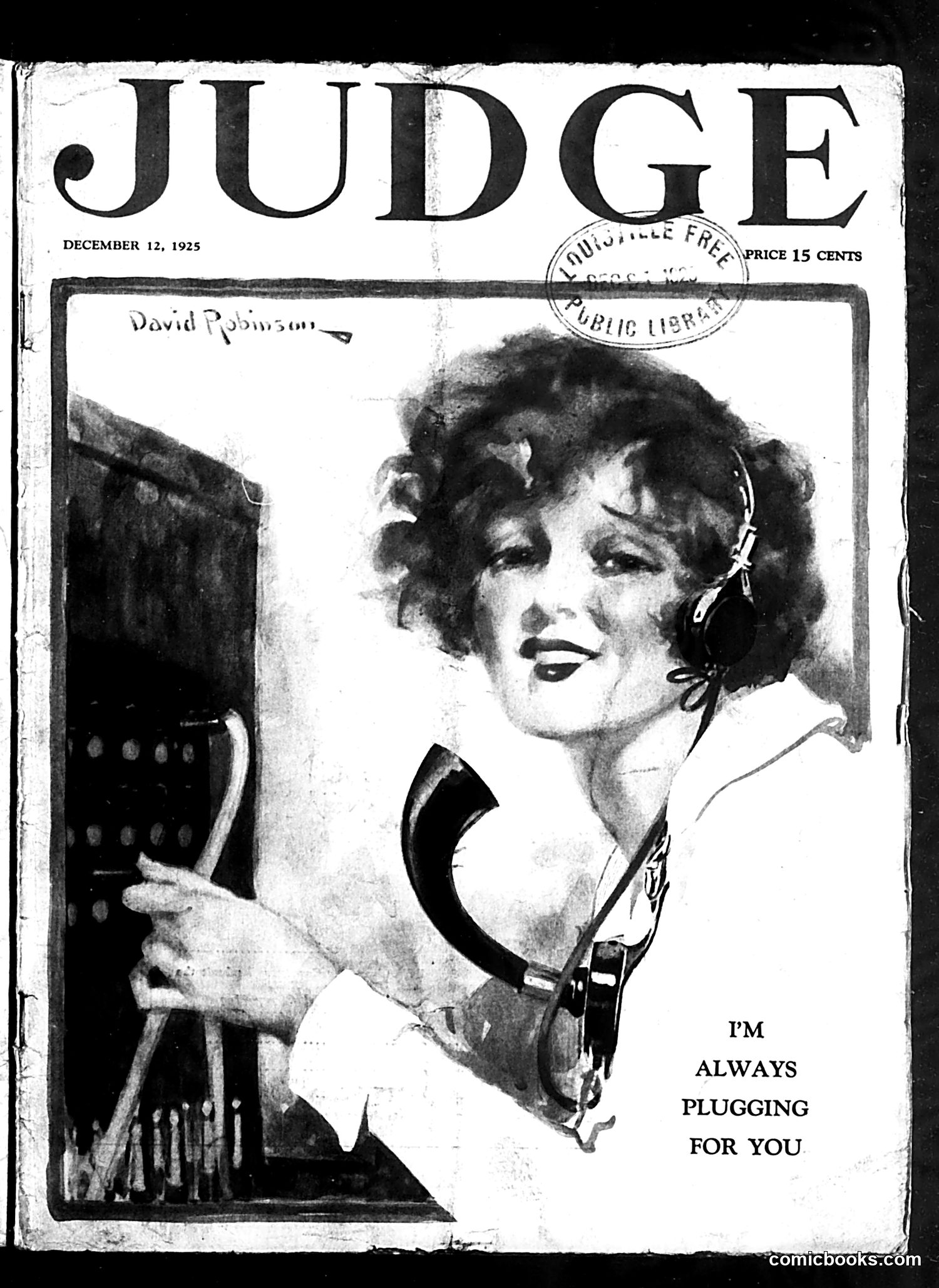
This is primarily a **magazine cover advertisement** rather than political satire. The image shows a woman with 1920s styling (short wavy hair, headband) holding a telephone handset, with the tagline "I'M ALWAYS PLUGGING FOR YOU." The humor relies on a **visual pun**: "plugging" simultaneously means both promoting/endorsing something and the literal action of connecting a telephone plug. The woman's pose with the telephone handset reinforces this double meaning. This appears to be an **advertisement for telephone service or equipment**, leveraging the era's association between modern technology and fashionable femininity. The cover's attribution to "David Robinson" suggests it's the work of a specific illustrator rather than political commentary. The 15-cent price indicates this is the magazine's front cover, used for marketing appeal.
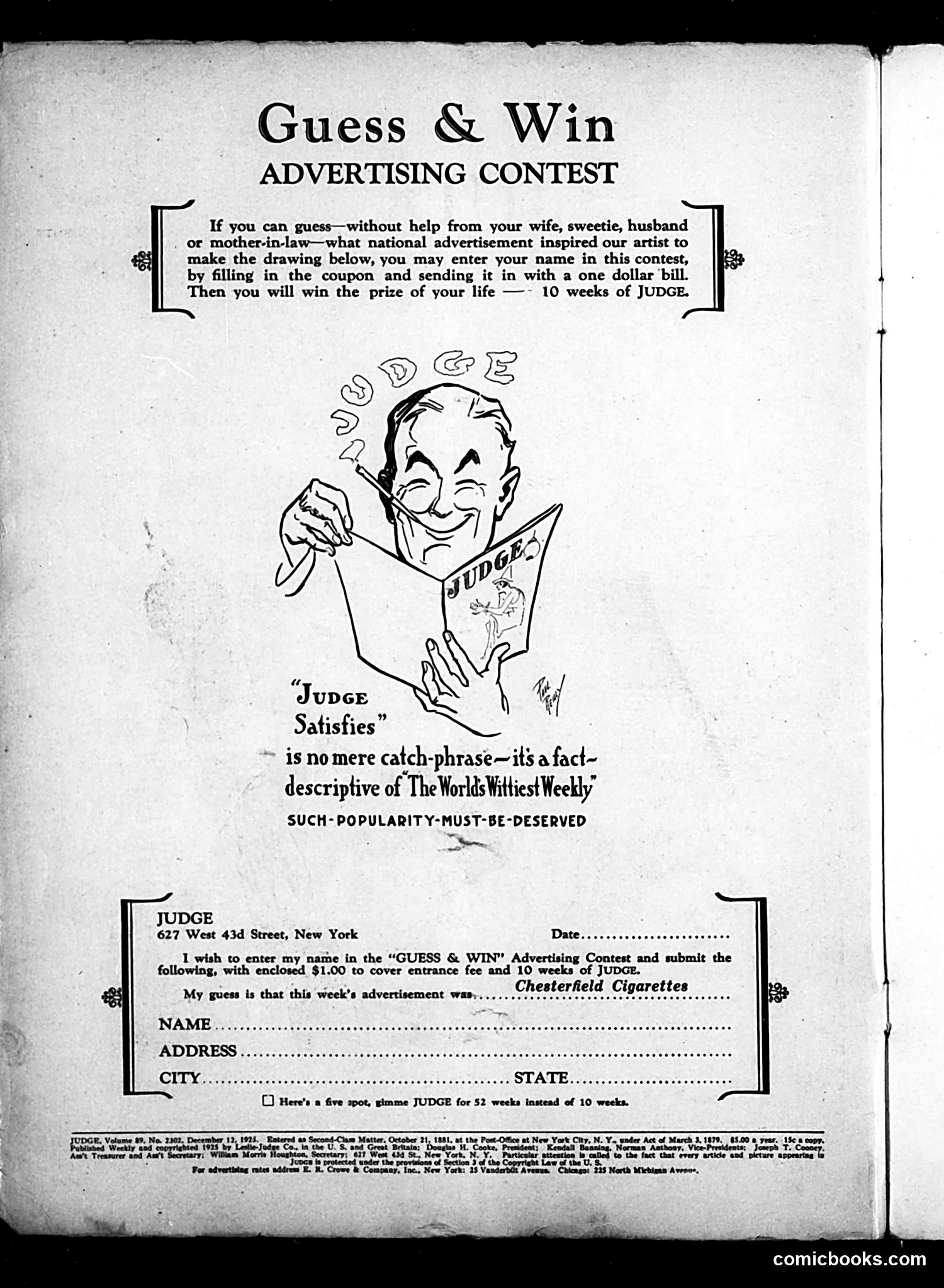
This is primarily a **contest advertisement** for *Judge* magazine, not a political cartoon. The page invites readers to guess which national advertisement inspired *Judge*'s own drawing—a caricatured man grinning while holding a *Judge* magazine with the word "JUDGE" appearing above his head. The contest promises 10 weeks of free *Judge* subscriptions as prizes for correct guesses (costing $1 to enter). The accompanying text claims "Judge Satisfies" is not merely a catchphrase but factually describes *Judge* as "The World's Wittiest Weekly." The exaggerated grin and self-congratulatory tone suggest satirical self-promotion—*Judge* is essentially mocking magazine advertising conventions while promoting itself.
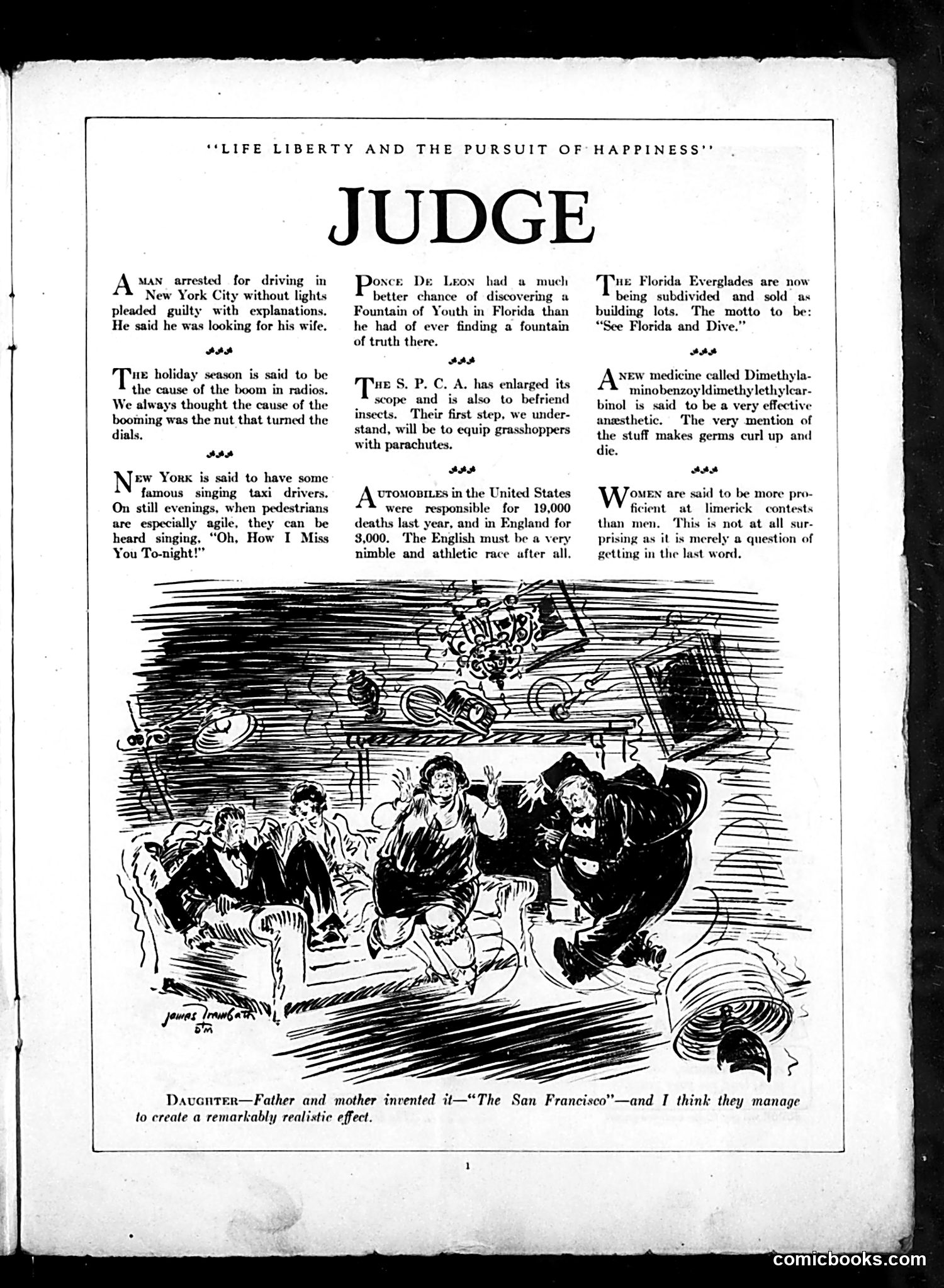
This *Judge* page presents satirical short items and a cartoon about maritime disaster. The main illustration depicts passengers in panic aboard a sinking ship, with the caption attributing the invention to "Father and mother" who "manage to create a remarkably realistic effect"—likely mocking either a theatrical production or safety drill that produced genuine terror. The surrounding text items mock various contemporary topics: a New York driver's excuse for reckless driving, the S.P.C.A.'s expansion efforts, automobile death statistics comparing the U.S. and England, and women's alleged superiority at limerick contests. These brief satirical notes use exaggeration and absurdity to comment on social trends and public concerns of the era, typical of *Judge*'s humorous editorial approach.
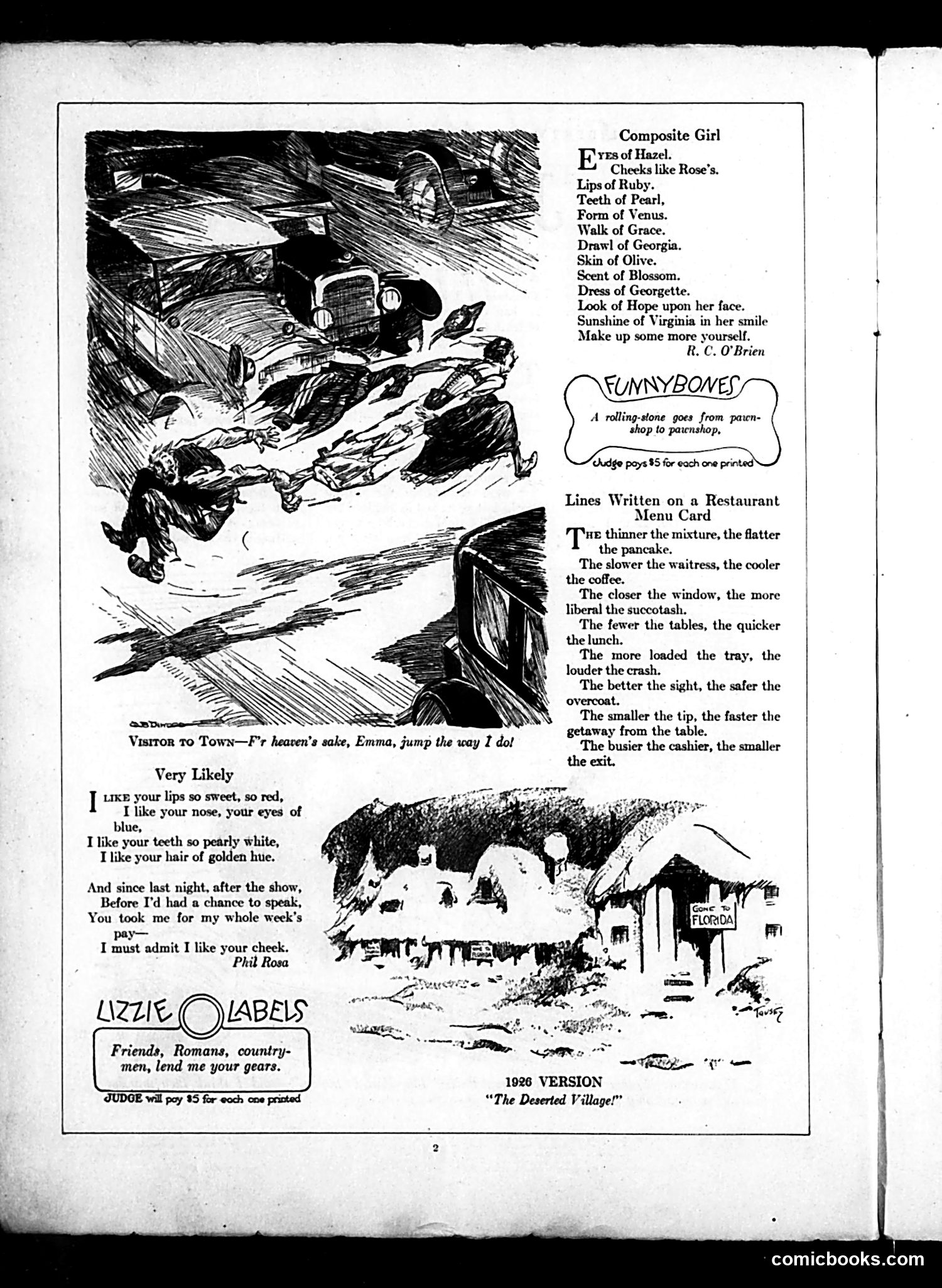
This page contains primarily **light humor and advertisements** rather than political satire. The content includes: **"Composite Girl"** — A playful list attributing female beauty features to various named women (Hazel, Rose, Ruby, etc.), followed by "Make up some more yourself" by R.C. O'Brien. This reflects early 20th-century magazine humor about idealized femininity. **"Funny Bones"** and **"Lizzie Labels"** — Joke sections offering small payments to readers for contributions. **"Lines Written on a Restaurant Menu Card"** and **"Very Likely"** — Humorous verse about dining and romantic attraction. The bottom illustration, **"1926 Version: The Deserted Village,"** appears to be a nostalgic or satirical commentary on rural American decline, though context is unclear. Overall, this page emphasizes **entertainment and reader participation** over political commentary.
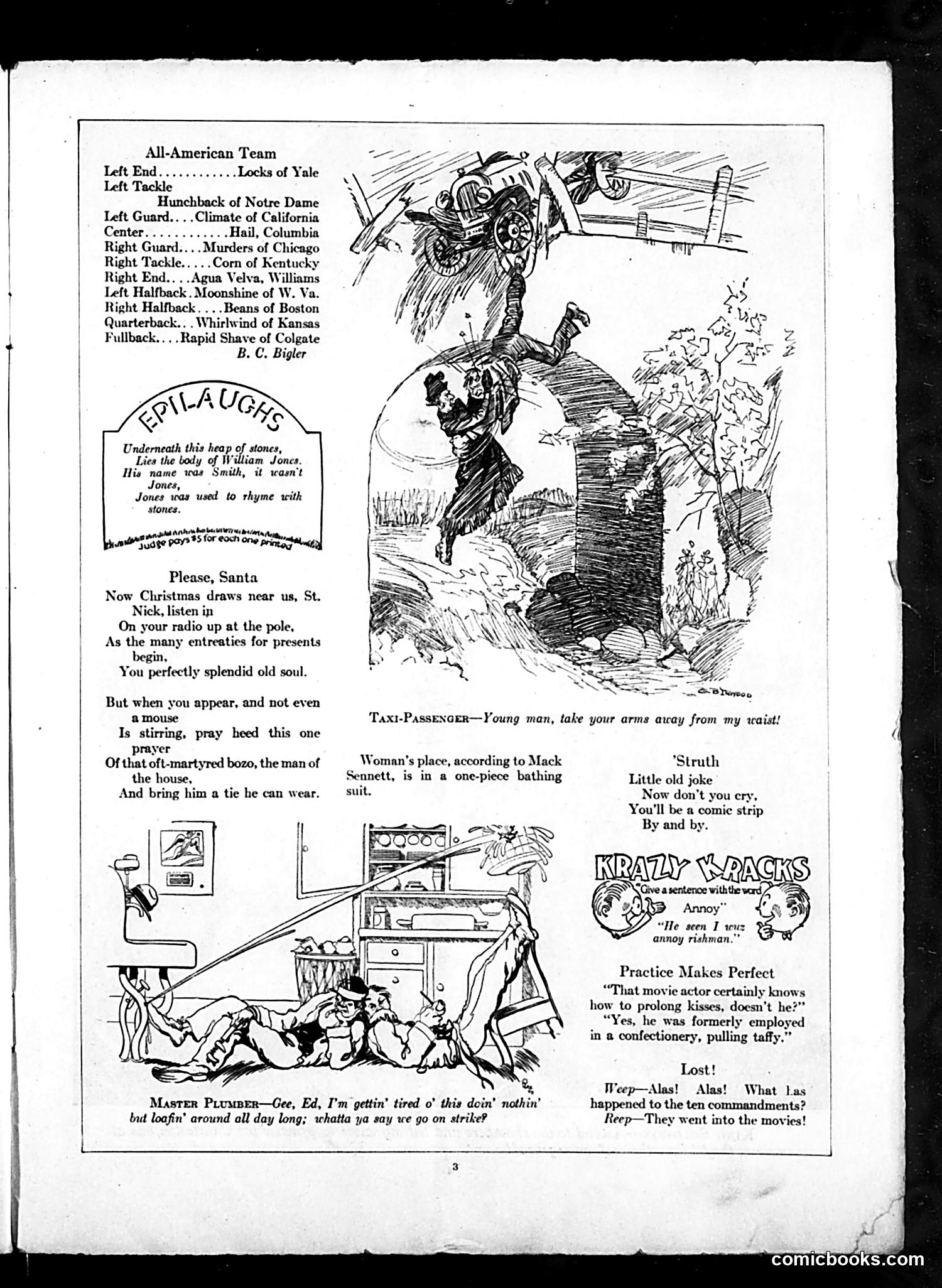
This page contains several unrelated humor pieces typical of Judge magazine's format: 1. **All-American Team**: A football roster listing, likely contemporary to publication. 2. **"Please, Santa"**: A poem asking St. Nick to bring "that oft-martyred bozo, the man of the house" a necktie—satirizing husbands as neglected or poorly dressed figures deserving gift attention. 3. **Master Plumber cartoon**: Shows workers lounging while a foreman threatens a strike, satirizing labor disputes and worker productivity concerns common to the era. 4. **"Krazy Kracks"**: Brief joke section about a movie actor's kissing technique. 5. **"Lost!"**: A joke about the Ten Commandments vanishing into movies, satirizing cinema's perceived moral influence. The page reflects working-class domestic and labor tensions alongside period anxieties about entertainment's cultural impact.
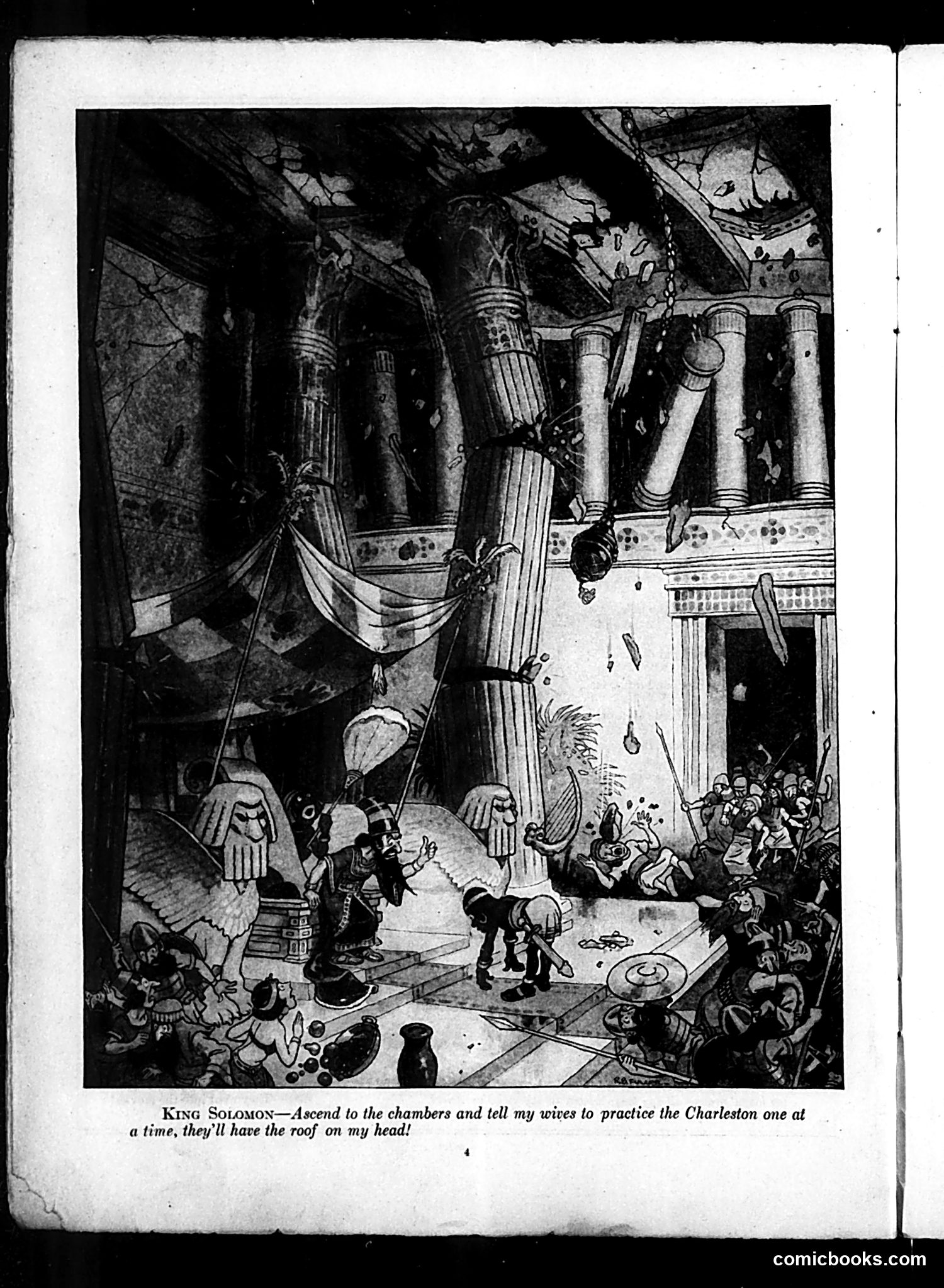
This appears to be a satirical illustration from *Judge* magazine depicting King Solomon in his palace, commanding his court to practice the Charleston dance. The caption quotes Solomon ordering his "voices" (likely courtiers or musicians) to rehearse the Charleston "one at a time" so "they'll have the roof on my head!" The joke references the 1920s Charleston dance craze, which was wildly popular but also controversial—criticized by conservatives as scandalous and undignified. By placing King Solomon (a biblical figure symbolizing wisdom and authority) in a modern setting obsessed with this "frivolous" dance, the cartoonist mocks either: the dance's overwhelming popularity, or satirizes those who viewed it as undermining traditional values and decorum. The chaotic scene emphasizes the dance's wild, uncontrollable nature.
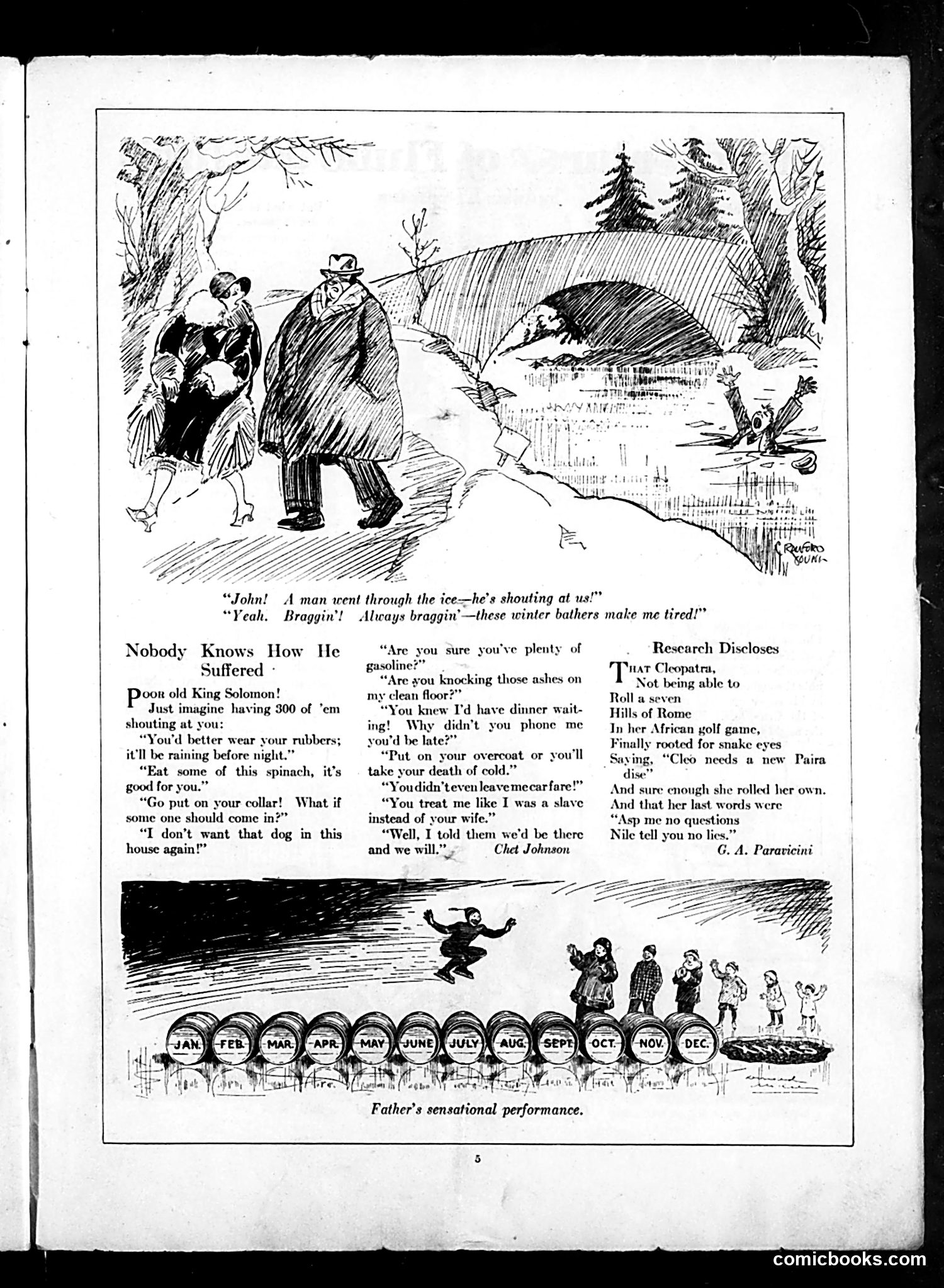
This page contains three separate humorous pieces satirizing domestic life and family behavior: **Top cartoon**: A winter scene where a man has fallen through ice while ice-bathing. His companions mock his predicament with jokes about "always braggin'" about winter bathing—satirizing the fashionable health trend of cold-water immersion popular in early 20th-century wellness culture. **Left column ("Nobody Knows How He Suffered")**: Mocks a man returning from ice-bathing, with family members criticizing his wet clothes and behavior—another jab at the ice-bathing fad. **Right column ("Research Discloses")**: Lists domestic grievances, suggesting wife "Cleo needs a new Paira shoes" and rolled her own car—satirizing women's emerging independence and consumerism. **Bottom cartoon**: Shows a father performing acrobatic stunts across months (labeled January through December), captioned "Father's sensational performance"—humorously depicting paternal exhaustion throughout the year.
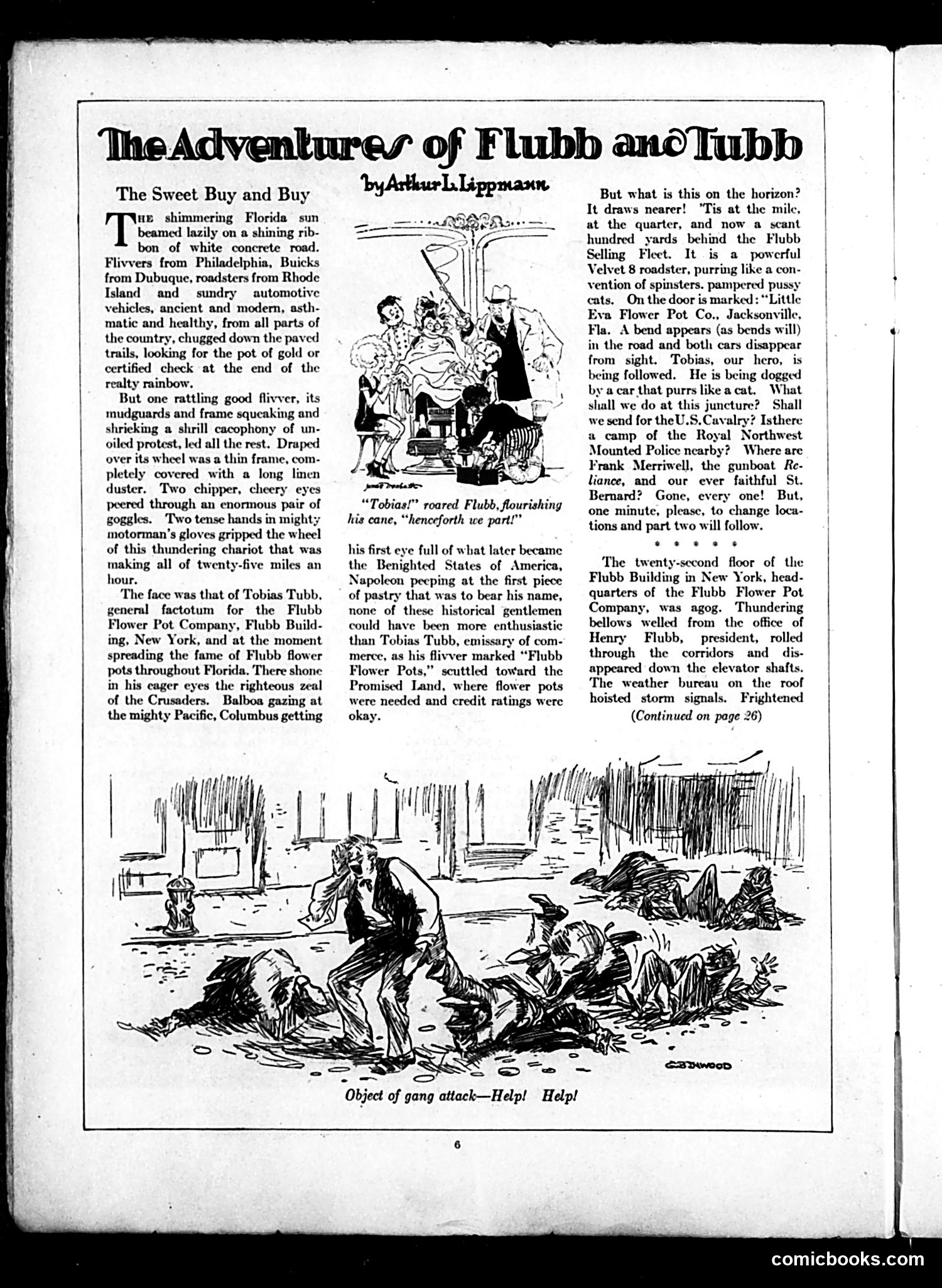
This is a serialized humorous story (not a political cartoon) satirizing the 1920s Florida real estate boom. Tobias Tubb, a salesman for the Flubb Flower Pot Company in New York, drives to Florida in a decrepit "flivver" (cheap car, likely Model T Ford) to sell flower pots—representing get-rich-quick schemes that lured Americans south during the speculative land rush. The satire mocks the era's unbridled optimism: Tubb is portrayed with religious fervor ("Crusaders," "Promised Land") selling mundane flower pots. The competing "Little Eva Flower Pot Co." from Jacksonville represents local competition. The melodramatic tone—gang attacks, dramatic confrontations—exaggerates the cutthroat business tactics of the period. The story ridicules both the desperate salesmen and the frenzy of speculation that characterized Florida's boom before its inevitable 1926 bust.
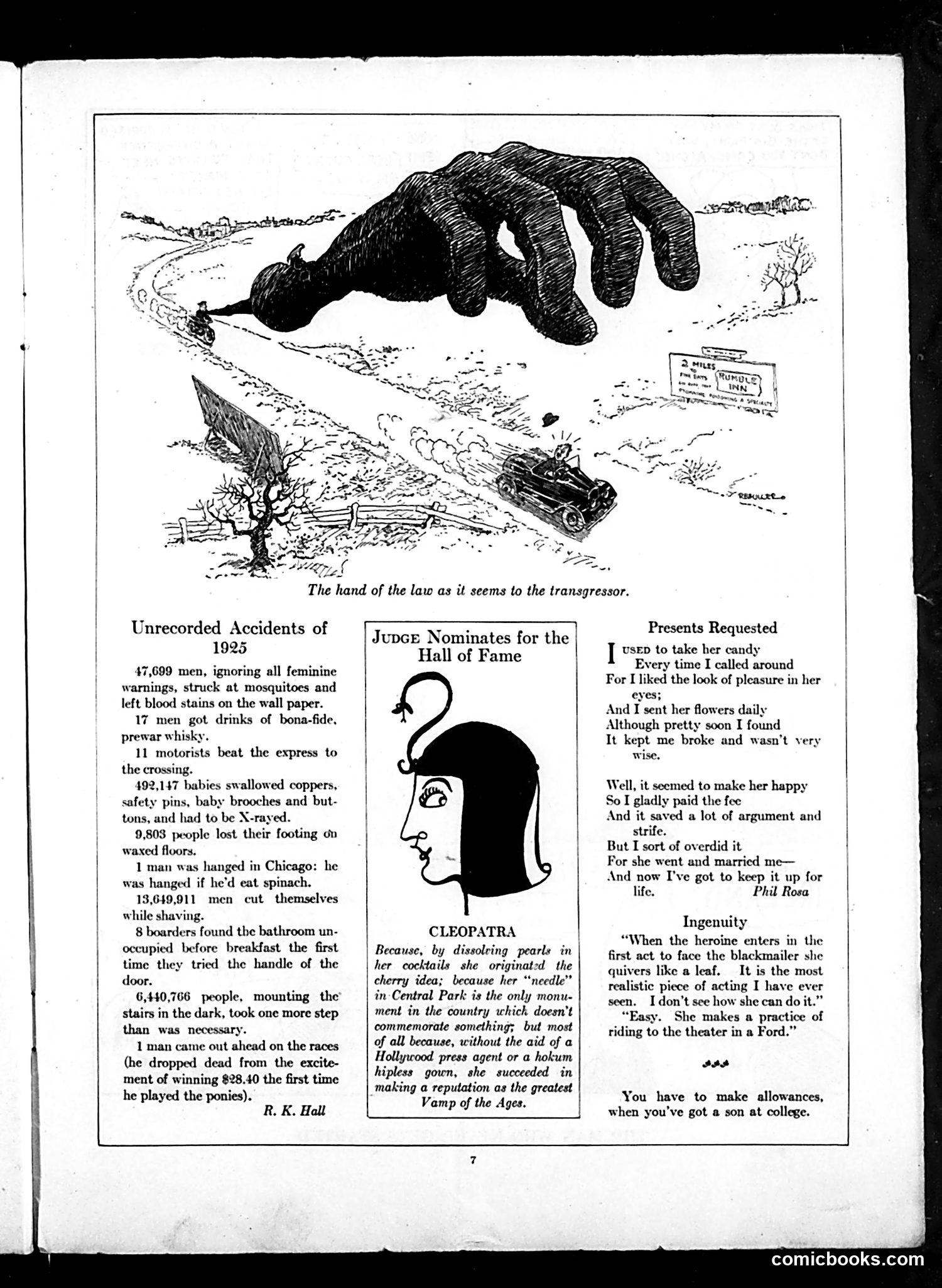
This Judge magazine page (1925) contains satirical humor about modern American life: **"Unrecorded Accidents of 1925"** by R.K. Hall lists absurdly specific statistics mocking both human carelessness and contemporary concerns—mosquito-borne disease, Prohibition-era whisky scarcity, dangerous automobiles, infant dangers, and mundane household accidents. The humor lies in treating trivial mishaps with census-like precision. **"Judge Nominates for the Hall of Fame: Cleopatra"** humorously honors the historical figure for "inventing" the cherry cocktail and maintaining her reputation as history's greatest seductress *without* modern Hollywood's press agents or scandalous fashion. It's gentle satire of 1920s celebrity culture's manufactured glamour. The remaining items are lighter social commentary: a poem about courtship expenses leading to unwanted marriage, and a theater joke about an actress's "realistic" fear stemming from Ford automobile rides. The grotesque hand imagery at top appears to represent legal judgment or fate crushing ordinary people—visualizing the page's theme of life's random hazards.
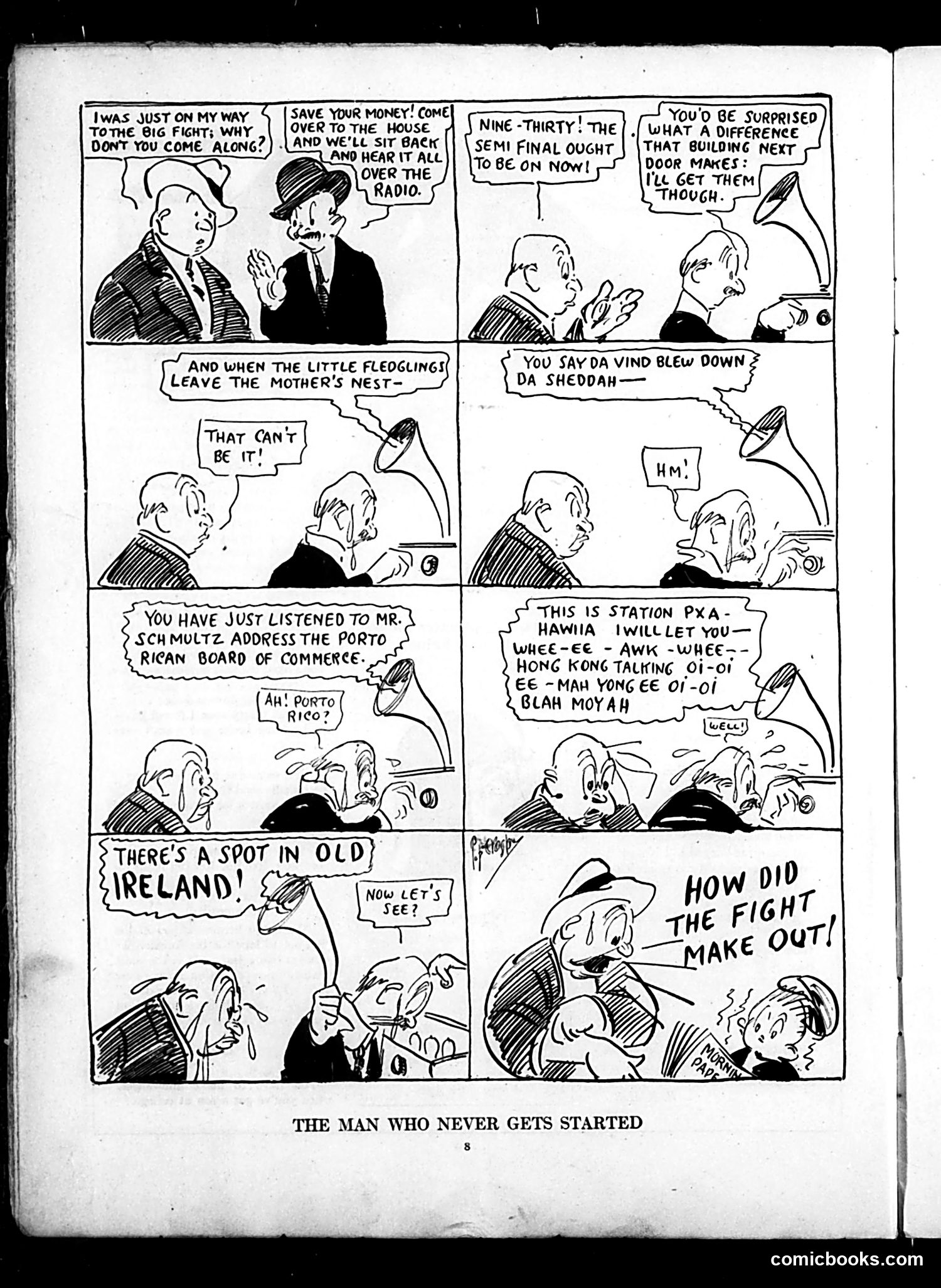
This comic satirizes a chronic procrastinator. The protagonist is invited to a boxing match but declines, proposing instead to listen to a radio broadcast at home—supposedly to save money. Once home, he gets distracted by increasingly absurd radio programming: a Puerto Rican Commerce Board address, a Hawaiian station with nonsensical chatter ("whee-ee-awk-whee"), and Irish tourist advertisements. Each distraction derails his original plan. By the final panel, when asked "How did the fight make out?" he's bewildered—he never actually listened to the fight broadcast either. The satire targets people who rationalize avoiding activities with excuses, only to waste time on other distractions instead. The radio references suggest this is from radio's early popularity era, when broadcasts were novel entertainment that could easily sidetrack listeners from their stated intentions.
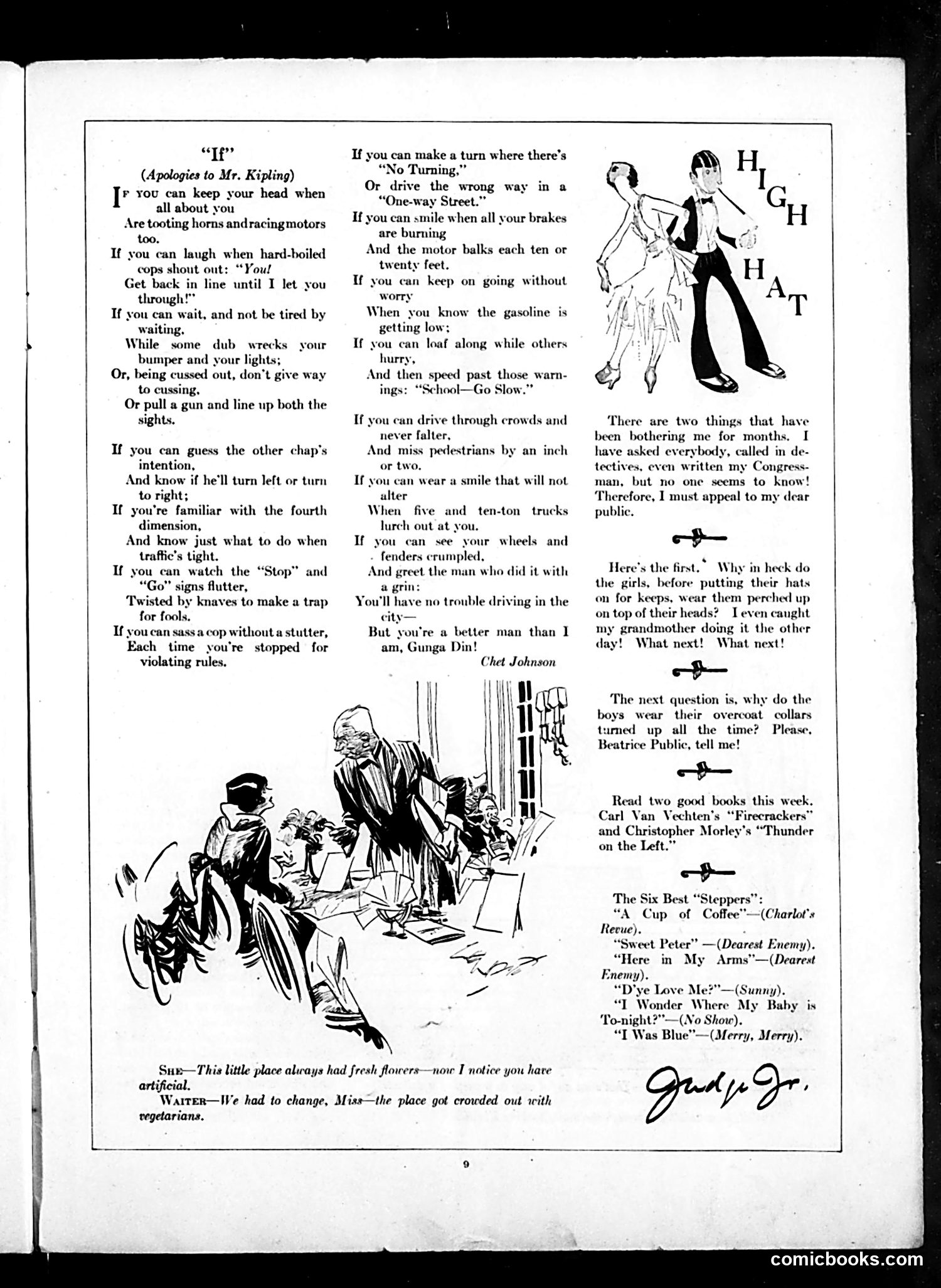
This page parodies Rudyard Kipling's famous poem "If—" to mock the chaos and dangers of 1920s city driving. The poem lists absurd driving scenarios—navigating confusing traffic signs, dodging pedestrians by inches, driving with broken brakes, encountering aggressive trucks—all presented as virtues necessary to survive automobile traffic. The satire targets both reckless drivers and the bewildering, poorly-regulated traffic conditions of the era. References to "Stop" and "Go" signs being "twisted by knaves to make a trap for fools" and cops barking orders suggest traffic enforcement was arbitrary and confusing. The closing line invokes Kipling's original ("you're a better man than I am, Gunga Din") to suggest that mastering urban driving requires superhuman skill—a humorous critique of dangerous, anarchic street conditions before standardized traffic laws. The page also includes lighter humor about fashion quirks and restaurant vegetarians.
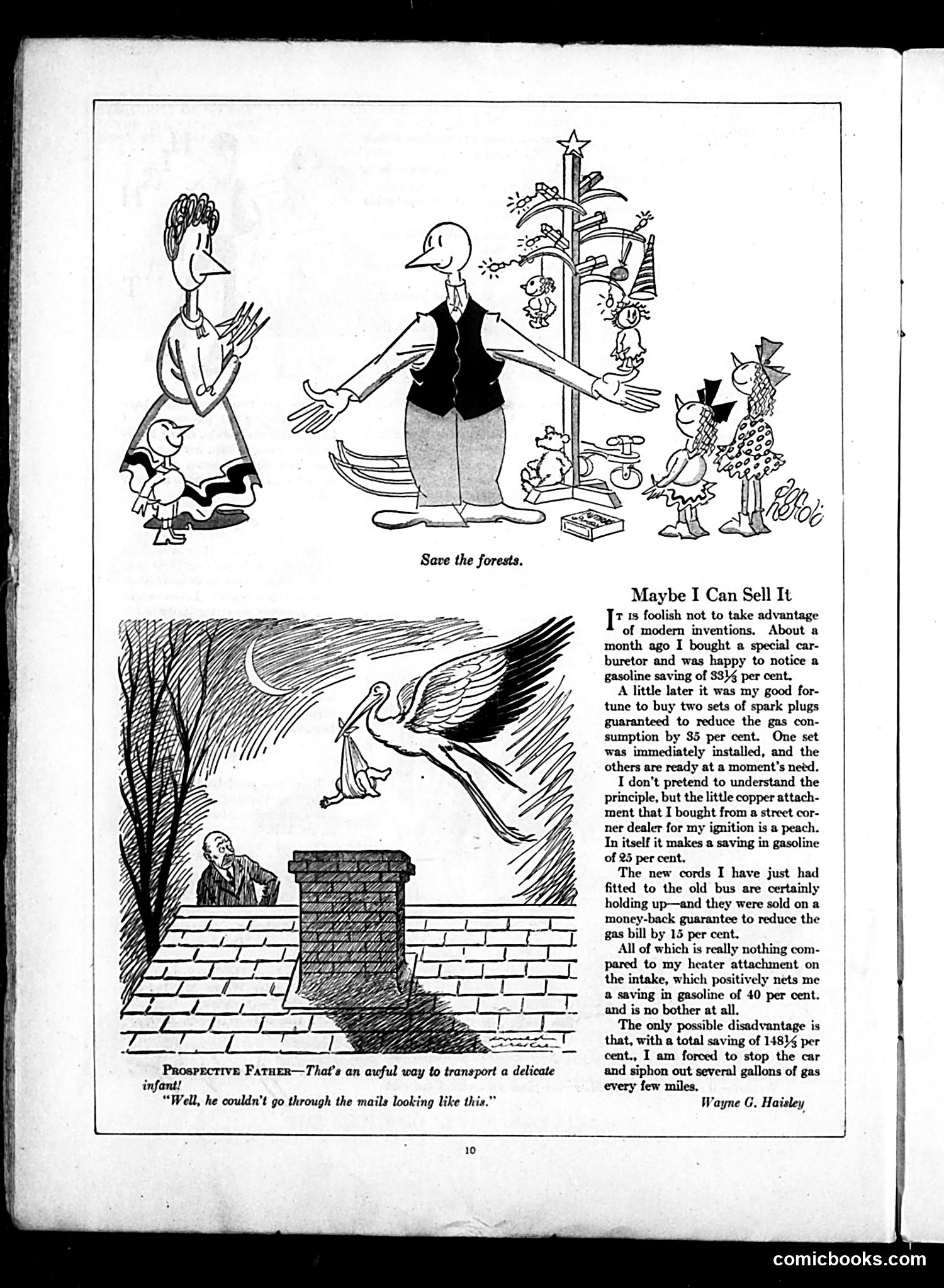
**Top cartoon:** A figure distributes Christmas presents to children around a decorated tree, contrasting with a concerned woman on the left. This advocates forest conservation during the holiday season—likely criticizing wasteful tree-cutting practices. **Bottom article/cartoon:** A satirical piece mocking gullible consumers. A man boasts of purchasing multiple automotive "efficiency" gadgets (carburetors, spark plugs, copper attachments, cords, heater attachments)—each claiming individual fuel savings of 15-40 percent. The joke: combined, they allegedly save 148½ percent, a mathematical impossibility revealing these are worthless street-corner scams. The man must now constantly drain excess gasoline, exposing the devices as frauds. The accompanying cartoon shows a "prospective father" concerned about mailing a delicate infant, with the punchline about appearance—likely commentary on how people and products are deceptively packaged or misrepresented, connecting thematically to the gadget-selling theme.
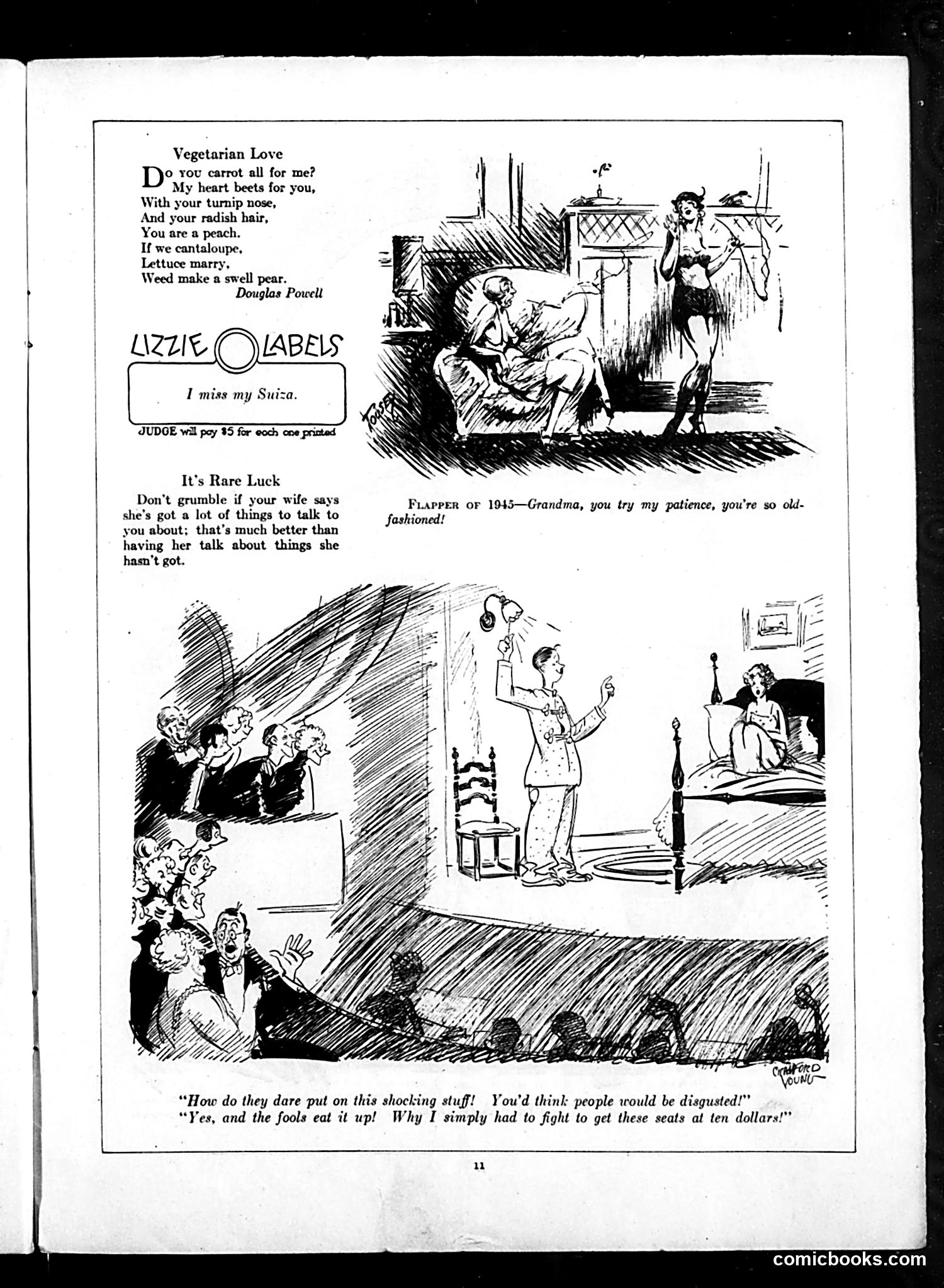
This page contains three separate humor pieces: **"Vegetarian Love"** is a pun-based poem playing on vegetable names as romantic language ("carrot all for me," "heart beets for you"). It's lighthearted wordplay with no deeper political meaning. **"Lizzie Labels"** appears to be a recurring feature offering payment ($15) for reader-submitted jokes or sayings. The visible example, "I miss my Suiza," likely refers to Suiza brand products. **"It's Rare Luck"** offers marriage advice: wives with plenty to discuss are preferable to those with nothing to say—inverted conventional complaint humor. **The theater cartoon** (bottom) depicts opera-goers complaining about "shocking" content while simultaneously paying premium prices ($10) and eagerly consuming it. This satirizes hypocrisy and moral posturing—patrons claiming outrage while gladly supporting the very entertainment they denounce. It's social commentary on audience pretense rather than political satire.
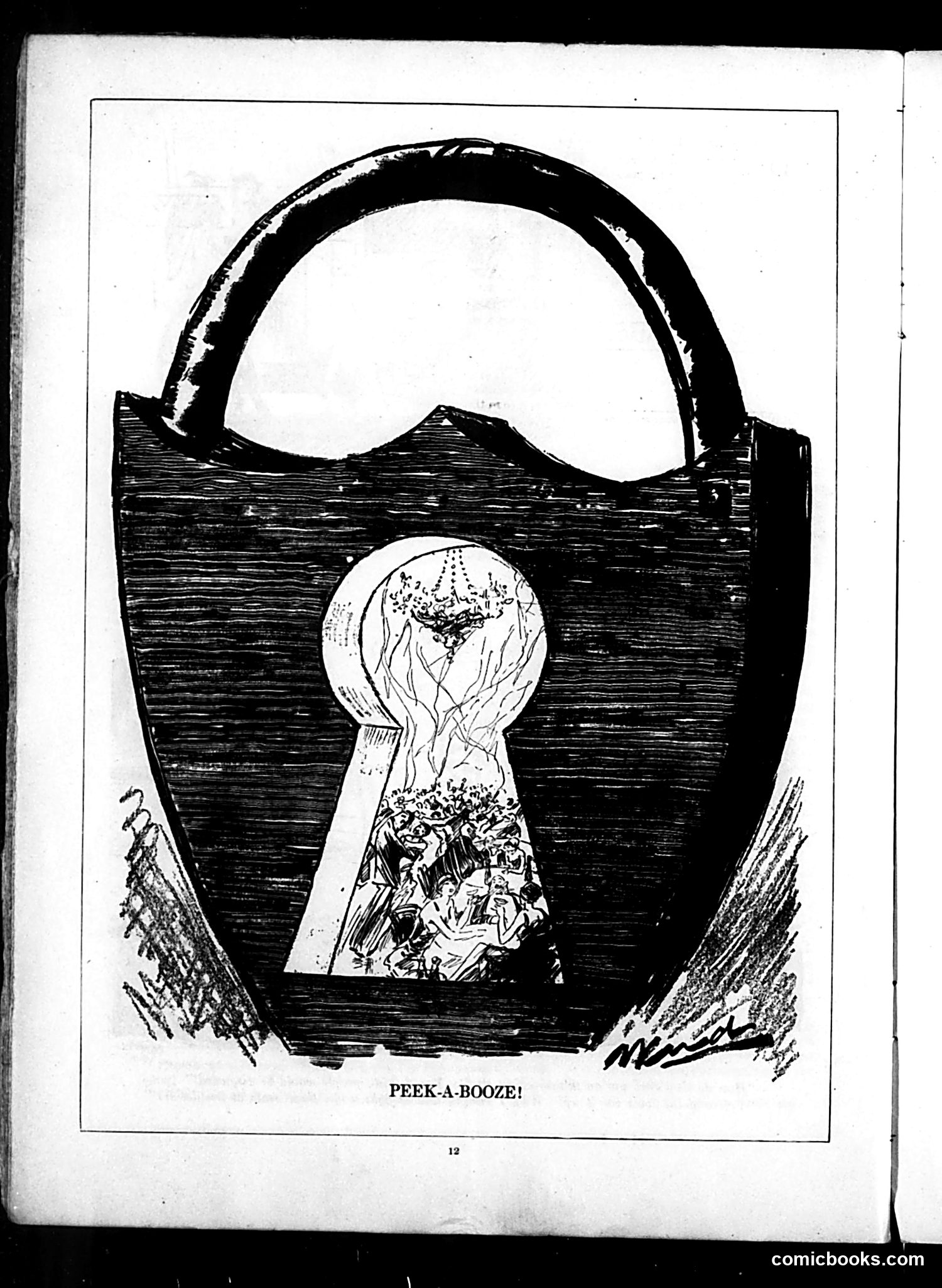
This is a satirical cartoon from *Judge* magazine depicting a keyhole view into what appears to be a speakeasy or illegal drinking establishment during Prohibition. The image shows revelers visible through the keyhole, suggesting hidden illicit alcohol consumption behind closed doors. The title "Peek-a-Booze!" is a pun combining "peek-a-boo" with "booze," mocking the secretive nature of illegal drinking during the Prohibition era (1920-1933). The heavy wooden door represents the barrier between law-abiding society and underground vice. The cartoon satirizes how Prohibition, intended to eliminate drinking, actually drove alcohol consumption into hidden, criminal venues rather than eliminating it—a common critique of the policy's failure.
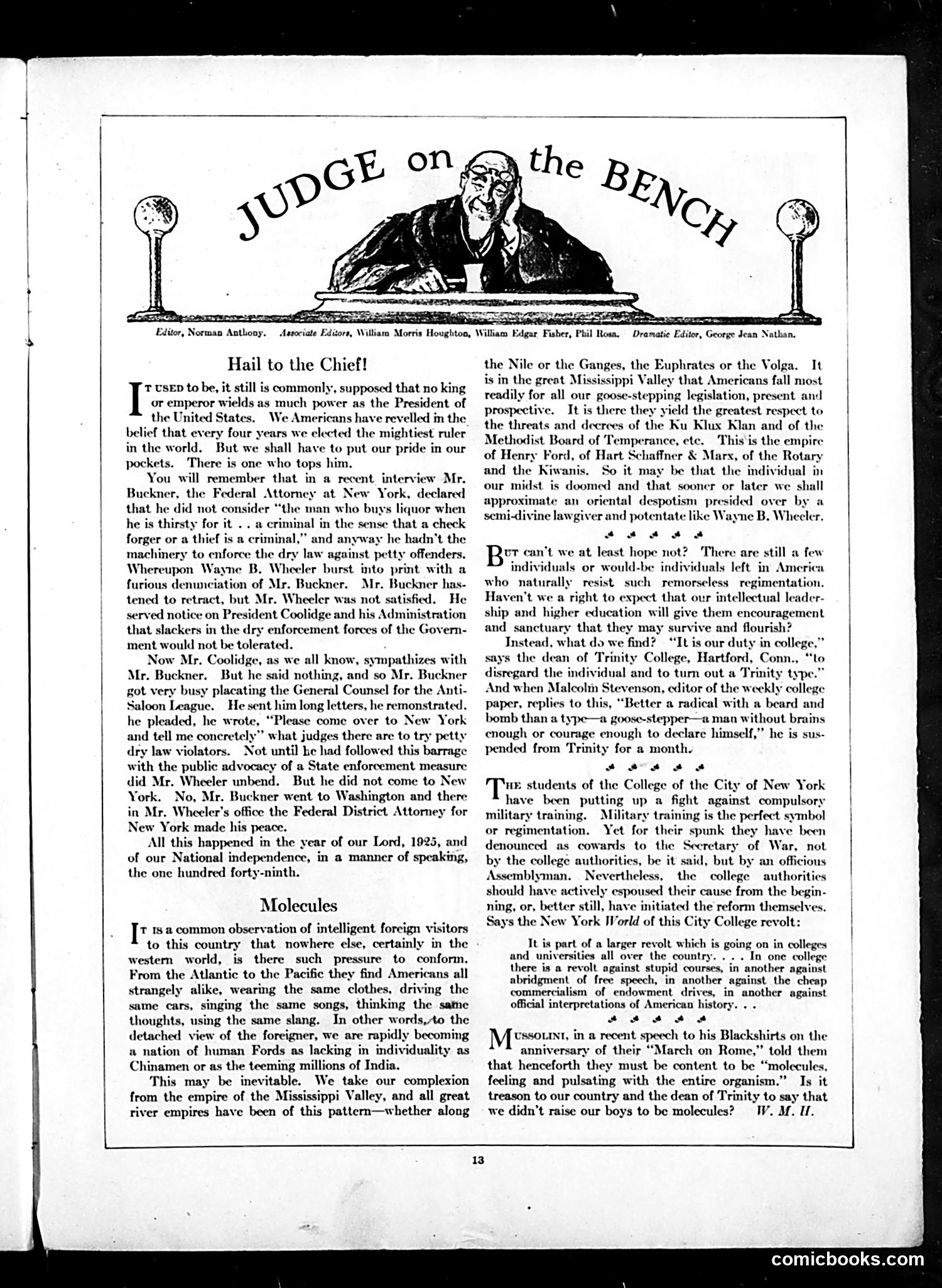
**The Main Cartoon:** The masthead shows a stern judge presiding, symbolizing Judge magazine's satirical authority. **"Hail to the Chief" Article:** This piece satirizes Wayne B. Wheeler, the powerful Anti-Saloon League leader during Prohibition. The article mocks Wheeler's influence over President Coolidge and Federal Attorney Buckner—suggesting Wheeler wields more power than the President himself. When Buckner made mild comments about not prosecuting casual liquor buyers, Wheeler publicly denounced him. Coolidge did nothing. Only after Buckner traveled to Wheeler's office in Washington and capitulated did Wheeler accept his apology. The satire: an unelected lobbyist now effectively controls federal enforcement policy. **"Molecules" Section:** This discusses American conformity—how citizens increasingly dress, think, and behave identically, losing individuality. It connects this uniformity to the Mississippi Valley's cultural dominance and to authoritarian movements (Ku Klux Klan, Methodist Board of Temperance), suggesting Americans are becoming "molecules" in a mass society rather than independent citizens. Both pieces critique loss of individual liberty and democratic accountability.
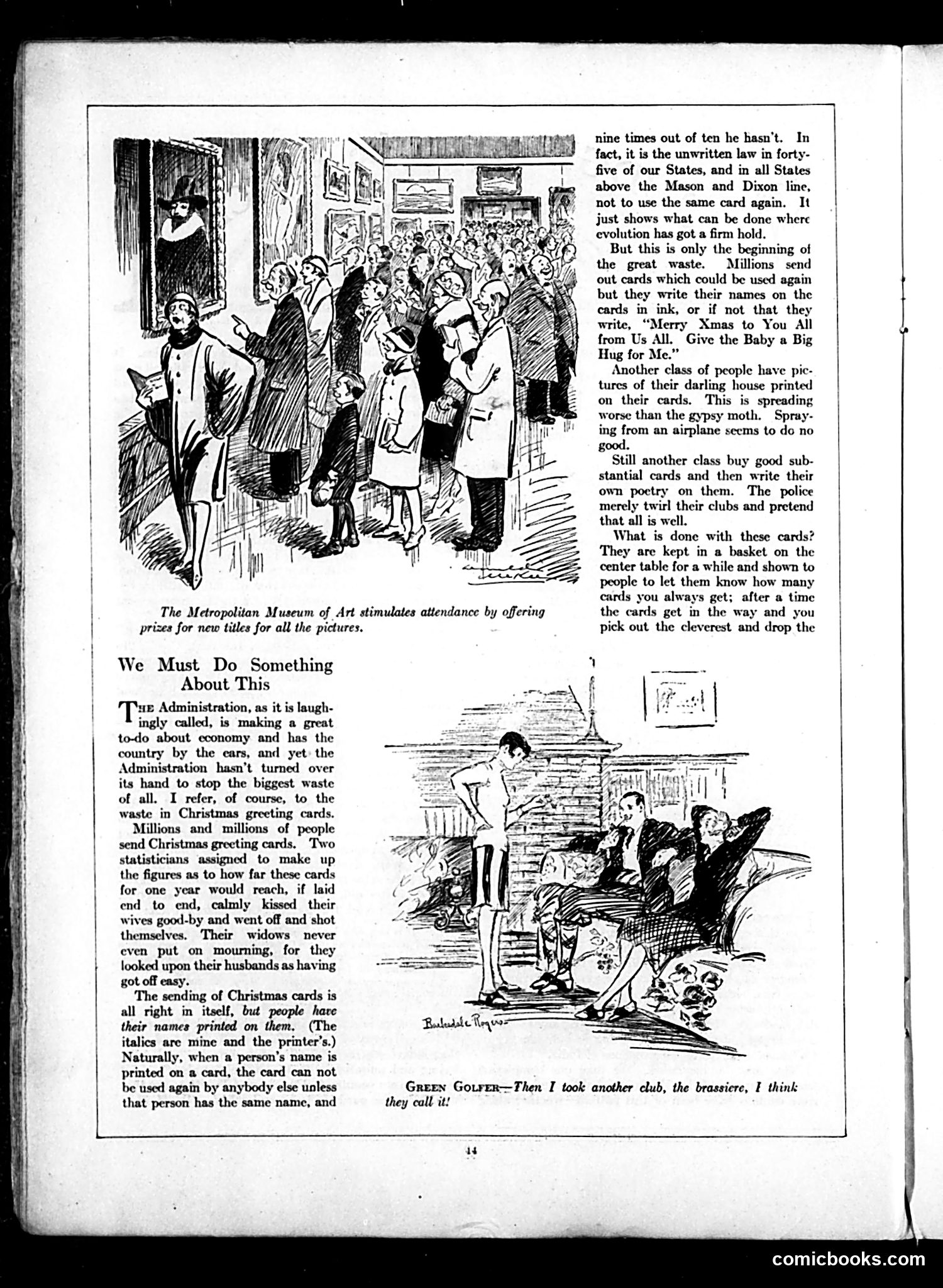
This page satirizes **waste in Christmas greeting cards**, a major concern during the early 20th century when mass production made cards affordable but custom-printed cards with names became standard. The main article mocks the custom of printing one's name on Christmas cards, which made them single-use only. The author argues this creates massive waste—millions of cards discarded annually. He also ridicules other wasteful practices: printing house pictures on cards, writing personalized poetry, and keeping cards displayed briefly before discarding them. The accompanying cartoons illustrate the absurdity. The top image shows a crowded gathering, apparently depicting the overwhelming volume of greeting card exchanges. The bottom cartoon features "Green Golfer," a recurring character, making a joke about golf club nomenclature (calling a "brassiere" a club), offering light relief from the serious waste critique. The satire targets both consumer excess and the lack of government oversight on waste—ironic coming from an administration claiming to promote economy.
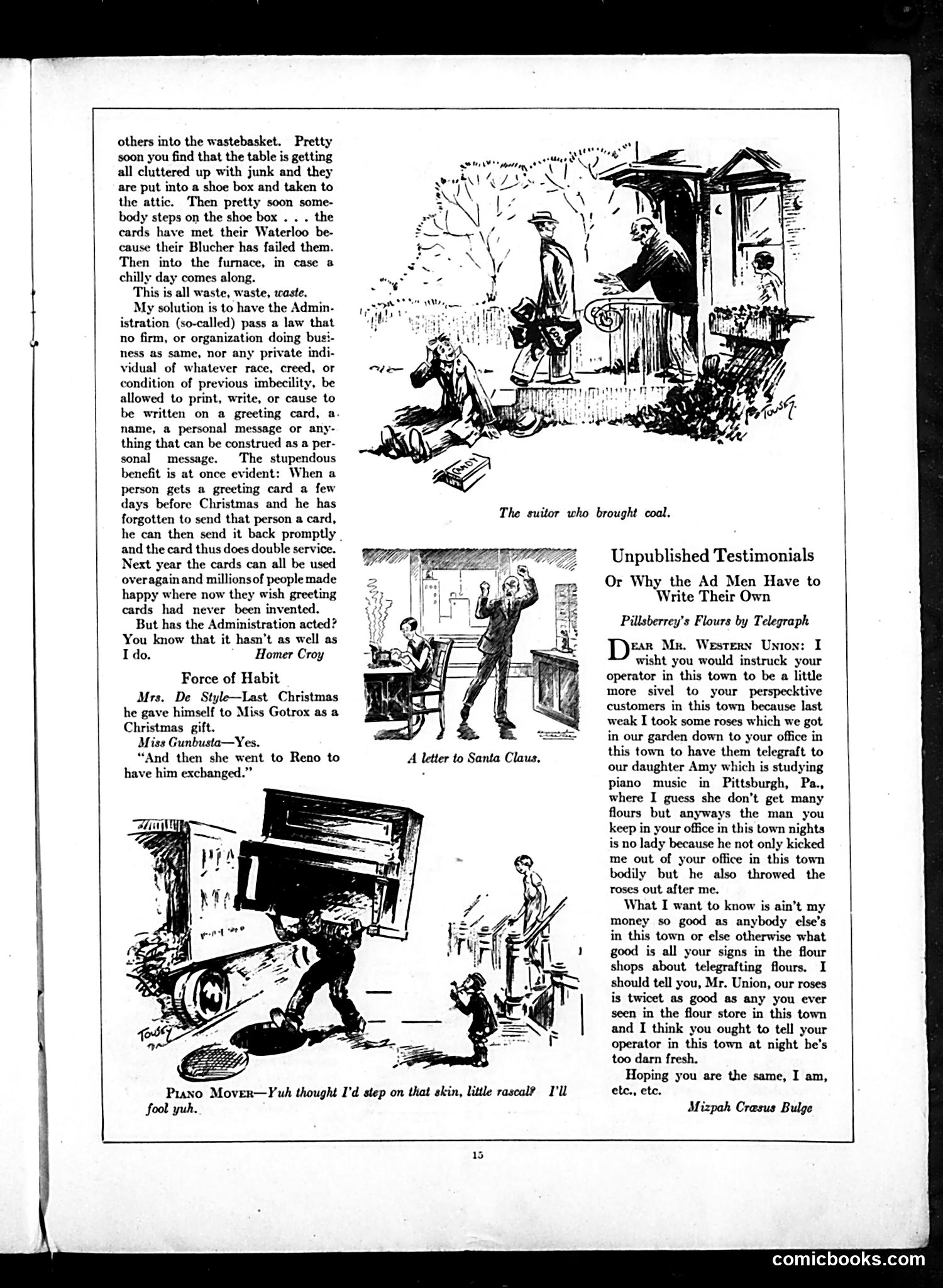
This page contains satirical commentary on early 20th-century consumer culture and advertising. **Main Content:** The left section features three humorous cartoons with captions mocking everyday situations: Christmas greeting cards creating waste, a divorce obtained through exchange (satirizing consumer return culture), and a piano mover's pun. **"Unpublished Testimonials" Section:** The right side satirizes advertising testimonials by featuring a deliberately poorly-written complaint letter from "Mizpah Cresus Bulge" to Western Union. The letter intentionally contains grammatical errors, misspellings ("flours" for "flowers," "sivel" for "civil"), and malapropisms, mocking both: 1. **Fake advertising testimonials** – companies routinely published customer praise letters that were obviously fabricated or heavily edited 2. **Actual customer complaints** – revealing the gap between polished ads and real customer experience The satire suggests advertisers had to write their own testimonials because genuine customers wouldn't produce sufficiently eloquent praise. The crude writing style undercuts advertising's aspirational tone while highlighting genuine customer frustration with poor service.
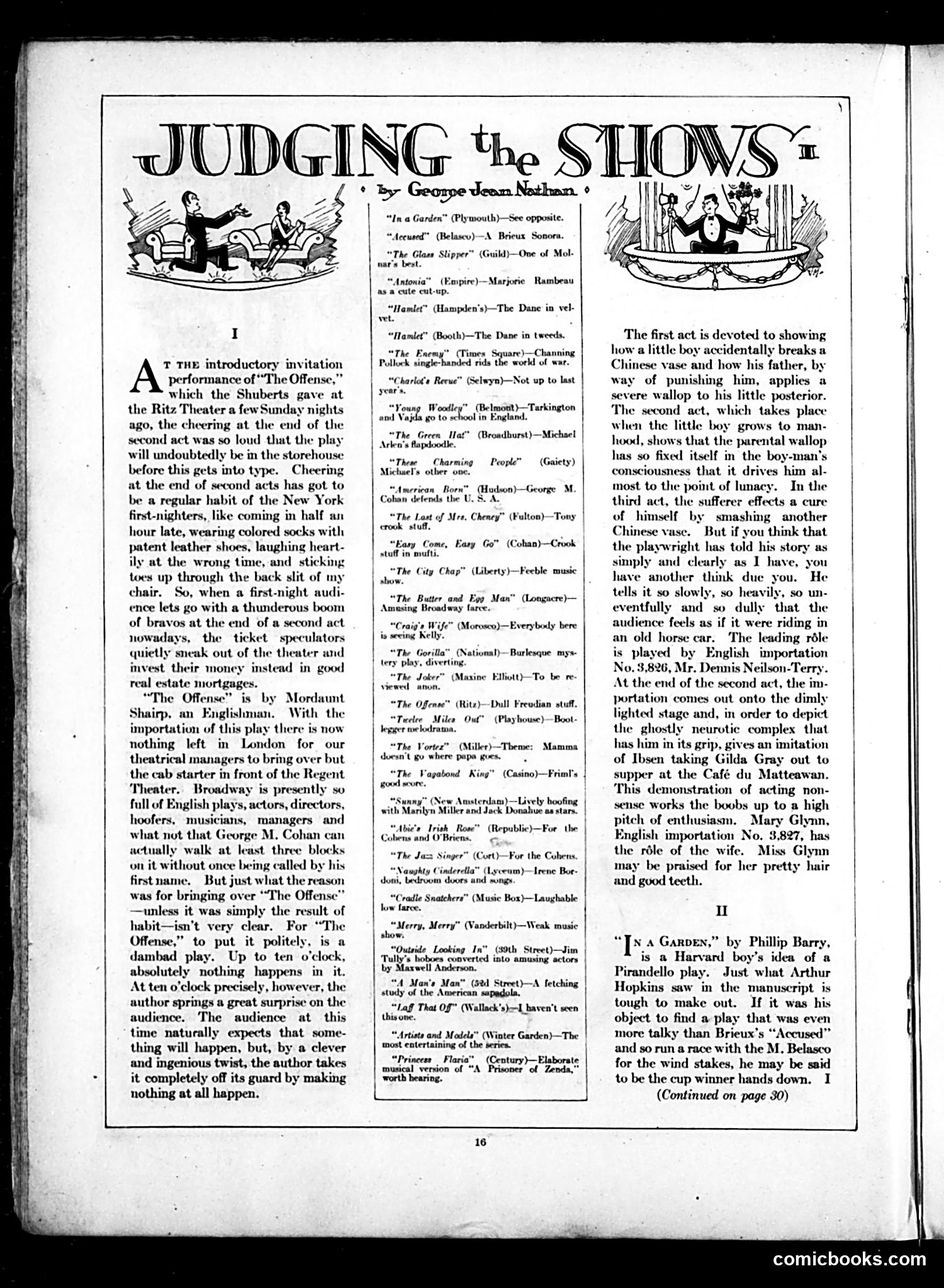
This is a theater review column by George Jean Nathan, a prominent drama critic of the 1920s. The main text satirizes "The Offense," an imported British play by Mordaunt Shairp at the Ritz Theater, mocking its dramatic structure: nothing happens for two hours, then at the climactic moment, nothing continues to happen. Nathan attacks the play as tedious and questions why Broadway keeps importing English theatrical material when local talent exists. The column's right side lists current Broadway productions with brief, often cutting judgments—some praising ("Sunny's" "lively hoofing"), others dismissive ("The City Chap"—"feeble music show"). The humor relies on Nathan's acerbic wit and insider knowledge of theatrical conventions. References to George M. Cohan, the Shubert brothers, and various theaters ground the satire in 1920s Broadway culture.
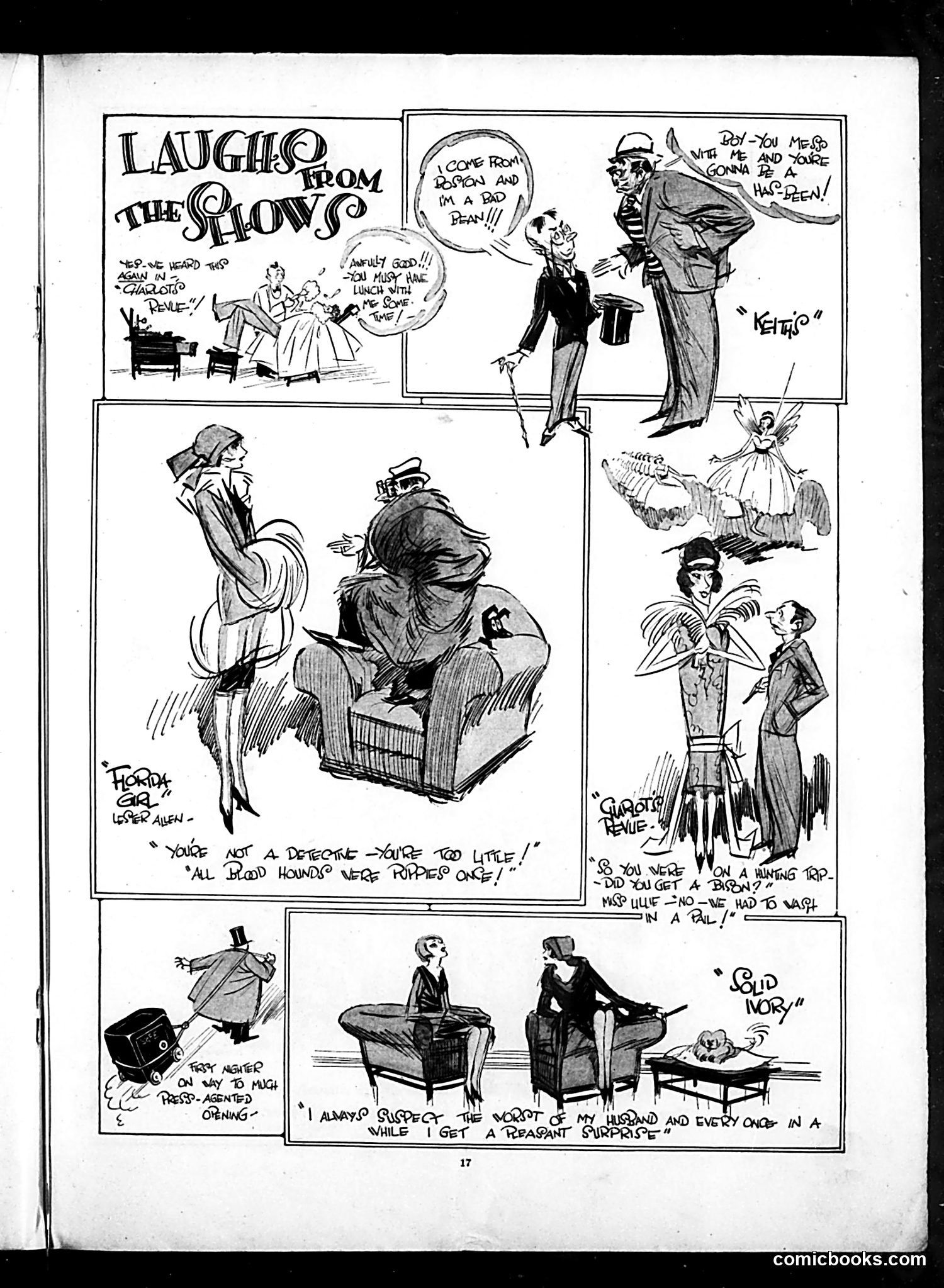
This page satirizes **vaudeville theater culture** through comic sketches mocking show-business couples and their dynamics. The top panels feature a husband and wife discussing their act—she complains about rehearsing while hungry; he brags he'll make her a "star." The sketches that follow depict typical vaudeville tropes: marital bickering, failed stunts (one figure appears to be falling), and performers in ridiculous costumes with wings. The humor targets the **gap between theatrical ambition and reality**—spouses constantly bickering, modest talent being oversold, and the chaos of putting on shows. The final panel shows a couple discussing how surprises in marriage come from "a restraint surprise"—suggesting infidelity or betrayal. This appears designed to amuse Judge's audience by mocking the pretensions and scandals of the vaudeville world, which was prominent American entertainment in the early 20th century.
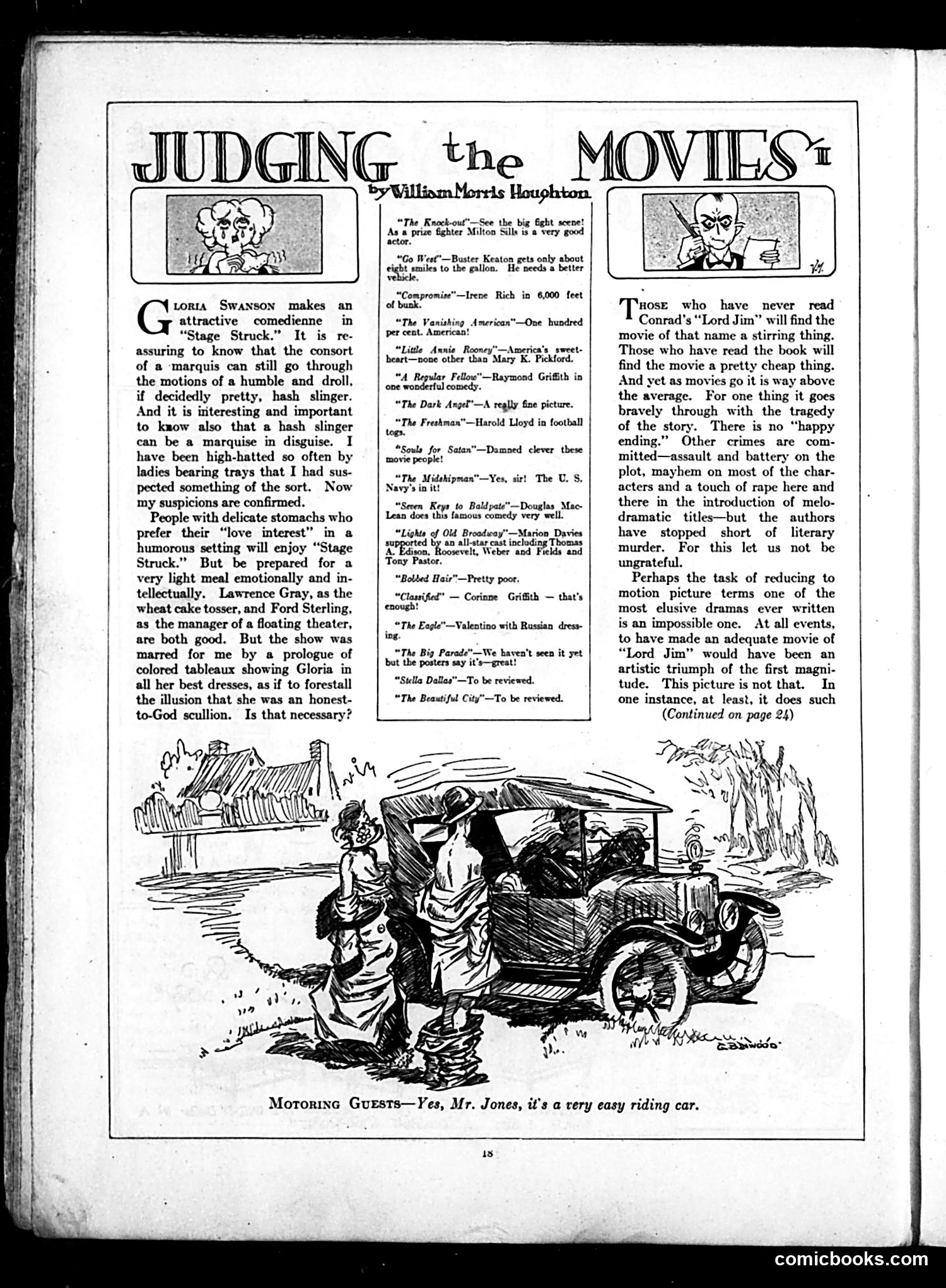
This is a film review column by William Morris Houghton critiquing contemporary silent movies. The page contains two main elements: **The Reviews:** Houghton sarcastically assesses recent films, notably mocking Gloria Swanson's "Stage Struck" for its pretentious opening sequence showing her in fancy dresses—undermining the film's premise that she's a humble hash-slinger-turned-marquise. He praises "The Dark Angel" and "The Freshman" (Harold Lloyd) while dismissing others as emotionally or intellectually light. **The Cartoon:** The bottom illustration captioned "Motoring Guests" depicts a couple struggling with an early automobile, likely commenting on the unreliability or difficulty of operating 1920s cars—a popular satirical subject of the era. The column represents typical Judge magazine content: snobby cultural criticism mixed with gentle humor about contemporary life and entertainment.
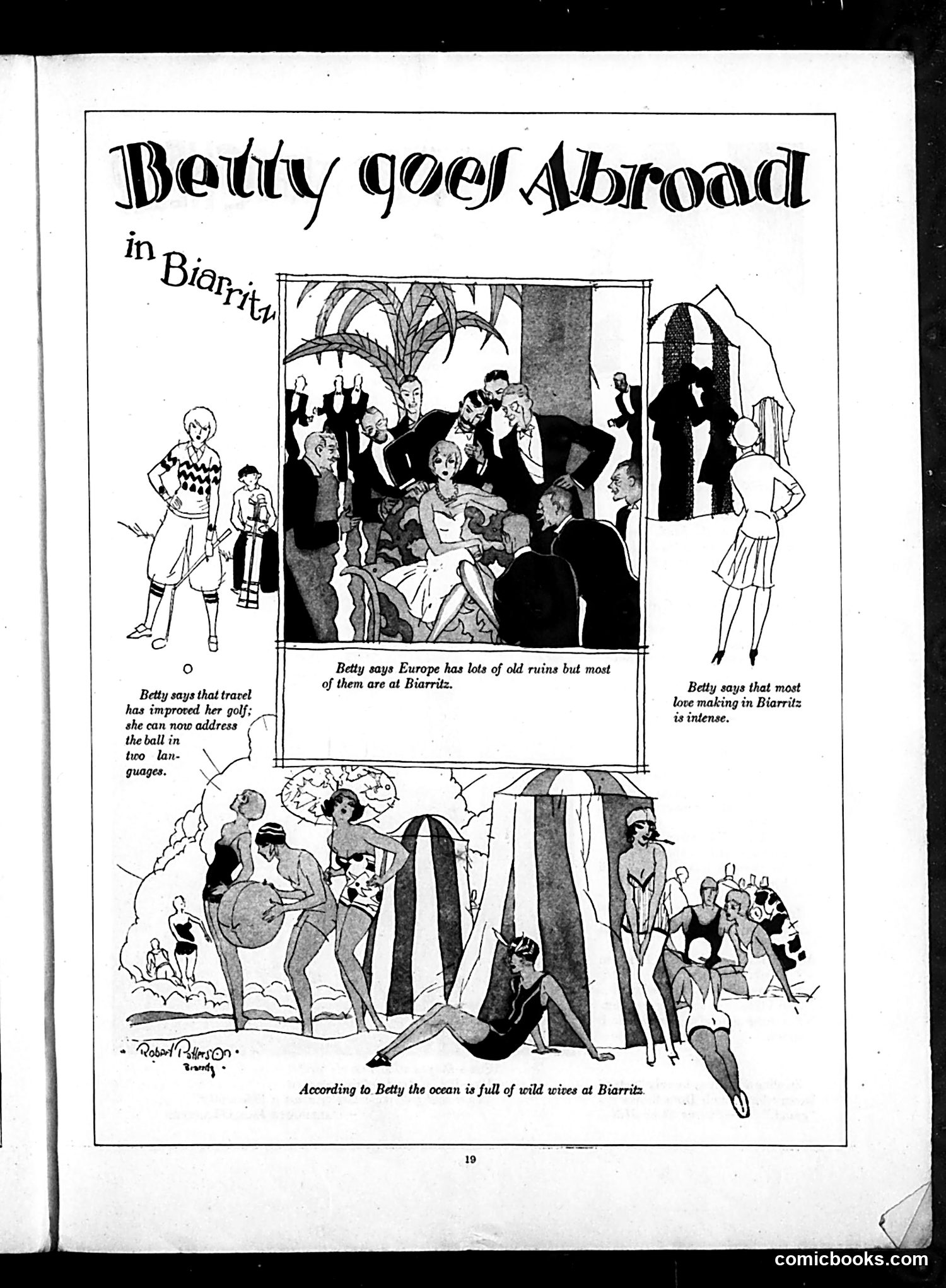
This is a humorous travel commentary featuring a character named Betty reporting from Biarritz (a French coastal resort town). The cartoon satirizes 1920s American tourist culture and European leisure society. Betty observes that European travel has improved her golf game and that she can now "address the ball in two languages." The central panel depicts high-society gatherings—the "old ruins" reference likely means both actual European historical sites and aging European aristocracy. The beach scene at bottom shows bathing and leisure activities, with the punchline that "the ocean is full of wild wives at Biarritz"—suggesting the resort attracts wealthy, uninhibited women seeking romantic adventures abroad. The satire targets both American tourists' superficial cultural engagement and European social excess, presented through Betty's gossipy observations about fashionable resort life.
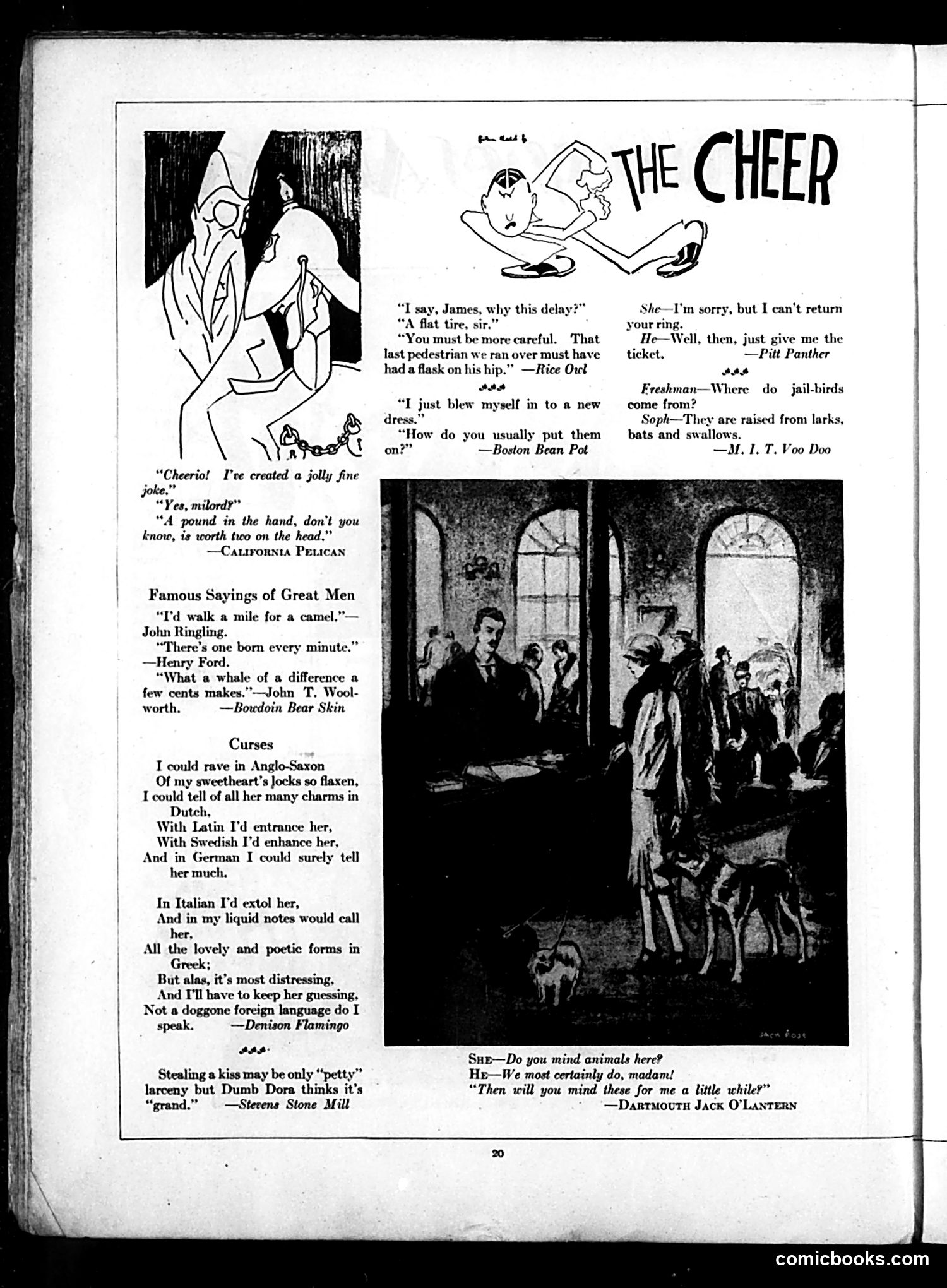
This is a **humor compilation page** featuring short jokes and witty exchanges from various college and humor publications, typical of Judge magazine's format. **Key content:** The jokes mock social pretensions and gender dynamics of the era. One exchange satirizes upper-class British affectation (a lord complaining about a "flat tire" after hitting a pedestrian). Another jokes about women's logic ("Dumb Dora"). A lengthy poem parodies romantic inability—a man fluent in multiple languages yet unable to express affection in English. **The illustration** (bottom) depicts what appears to be a social gathering, captioning a flirtation: a woman asks a man to mind her animals; he agrees, then she hands them to him—a clever reversal of expectations playing on double meaning of "mind." The page reflects **1920s social humor**: class mockery, courtship anxieties, and gentle sexism. References to college publications (MIT, Dartmouth, Pitt) indicate this targeted educated, young readers amused by undergraduate wit and romantic mishaps.
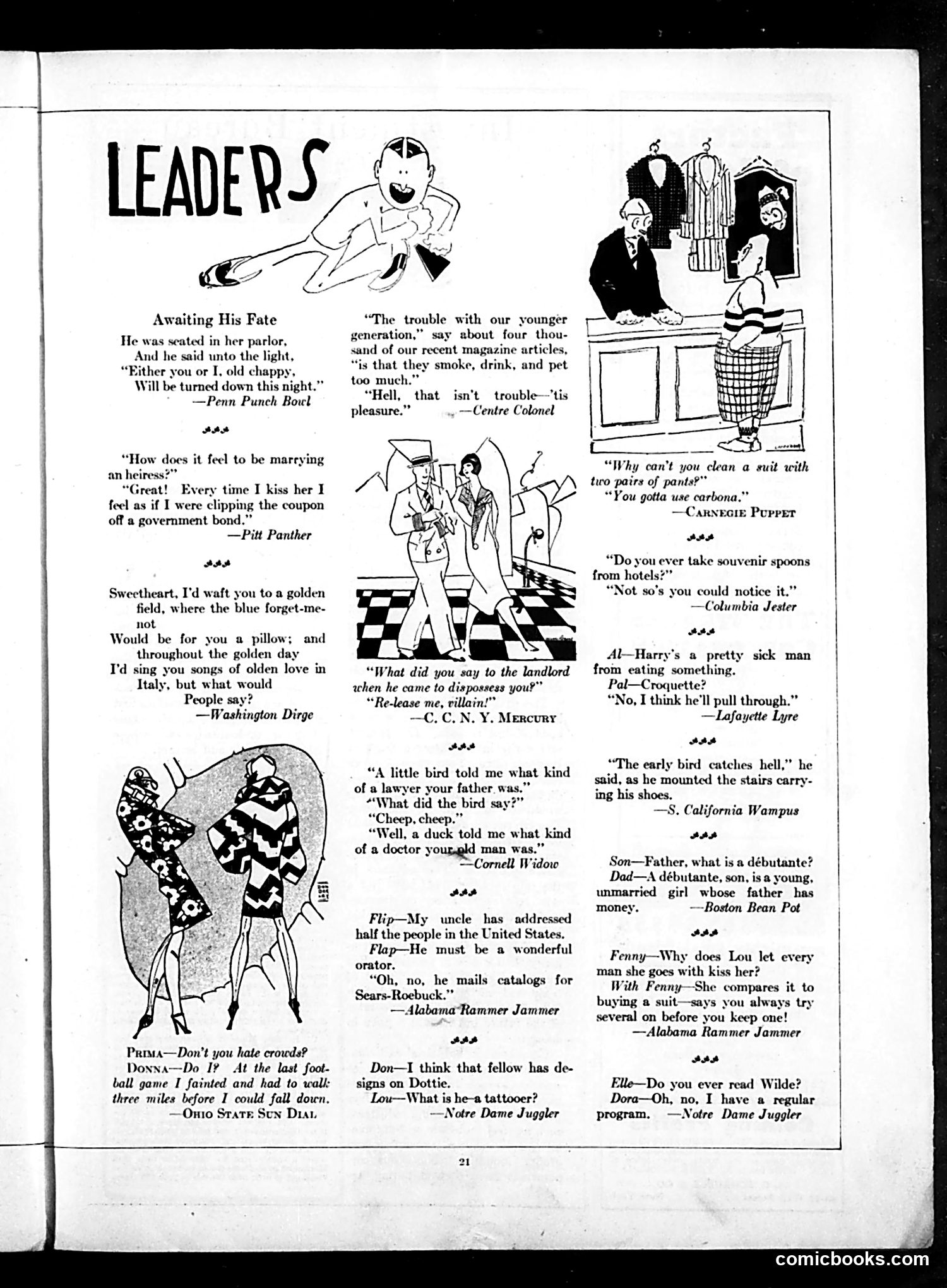
This page collects humorous quotes and jokes from college newspapers and satirical publications, organized under the heading "Leaders." The cartoons and quips target **social conventions and generational behavior** of the Jazz Age era. Key themes include: **Romance & Marriage**: Multiple jokes mock courtship rituals—a man proposing despite social disapproval, another comparing kissing an heiress to clipping bond coupons (marrying for money). **Youth Culture Criticism**: One quote directly addresses contemporary magazine complaints about younger generations smoking, drinking, and "petting" (physical affection), only to have a character dismiss these as pleasures rather than problems. **Social Pretense**: Jokes ridicule etiquette concerns ("what would people say?") and materialism (the débutante definition: a young unmarried girl whose father has money). **Comic Situations**: Visual gags include a couple in formal wear on a checkered floor, and physical humor (a woman fainting at crowds). The overall tone satirizes both contemporary social anxiety about youth morality and the absurdity of maintaining rigid social conventions.
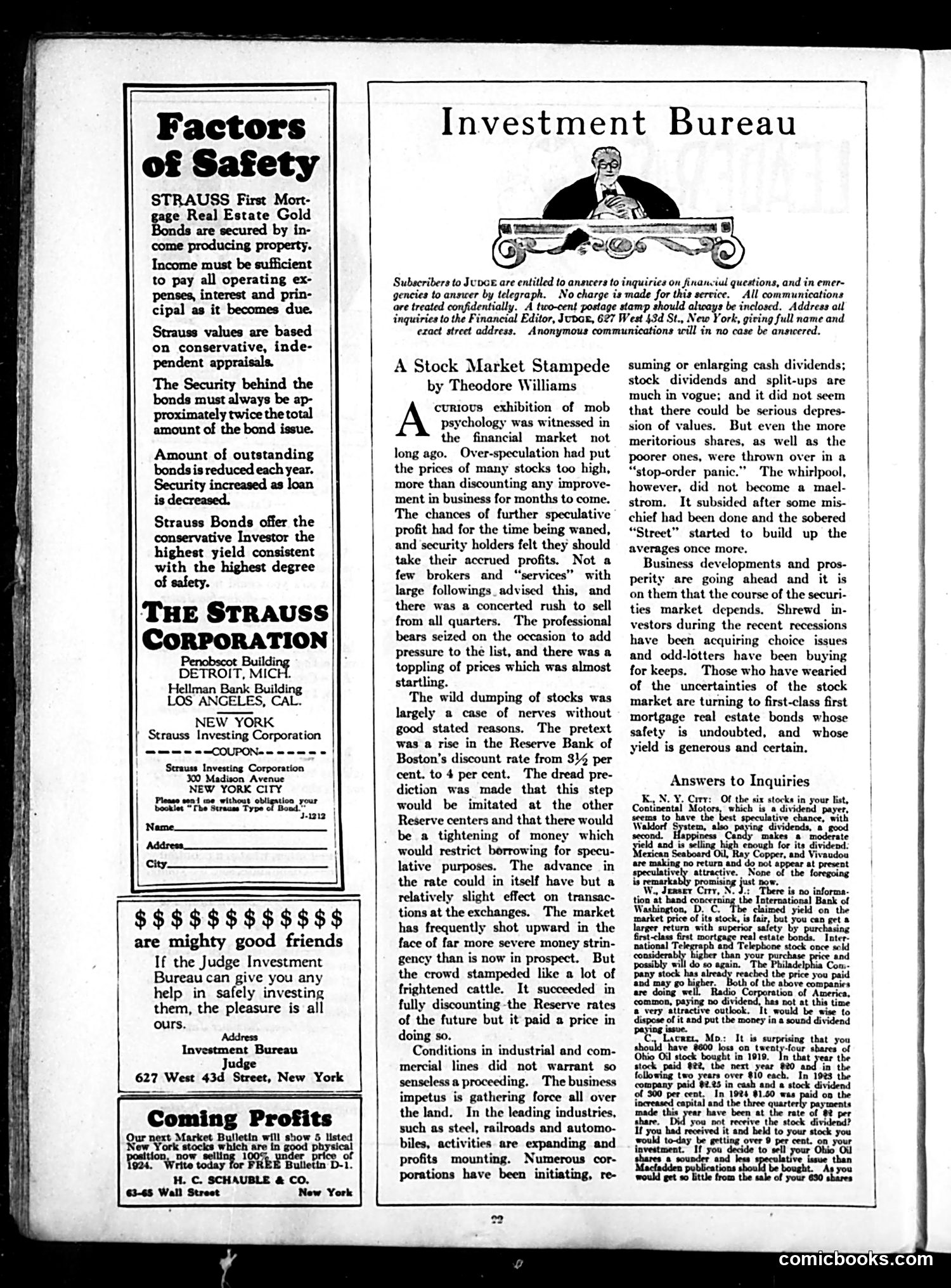
This is primarily a **financial advice page** from Judge magazine, mixing editorial content with investment advertising. The main article, "A Stock Market Stampede" by Theodore Williams, discusses a recent stock market panic caused by mob psychology rather than economic fundamentals. The trigger was the Federal Reserve Bank of Boston raising its discount rate from 3.5% to 4%, which spooked investors into selling despite healthy conditions in steel, railroads, and automobiles. Williams argues the market overreacted—like "frightened cattle"—and that underlying business fundamentals remained sound, with companies increasing dividends. The surrounding ads promote conservative investment products (Strauss bonds, Investment Bureau services) emphasizing safety and steady income rather than speculation. **For modern readers:** This illustrates that market panics driven by fear rather than facts are timeless. The anxiety about Fed rate increases and the disconnect between stock prices and actual business health remains relevant today.
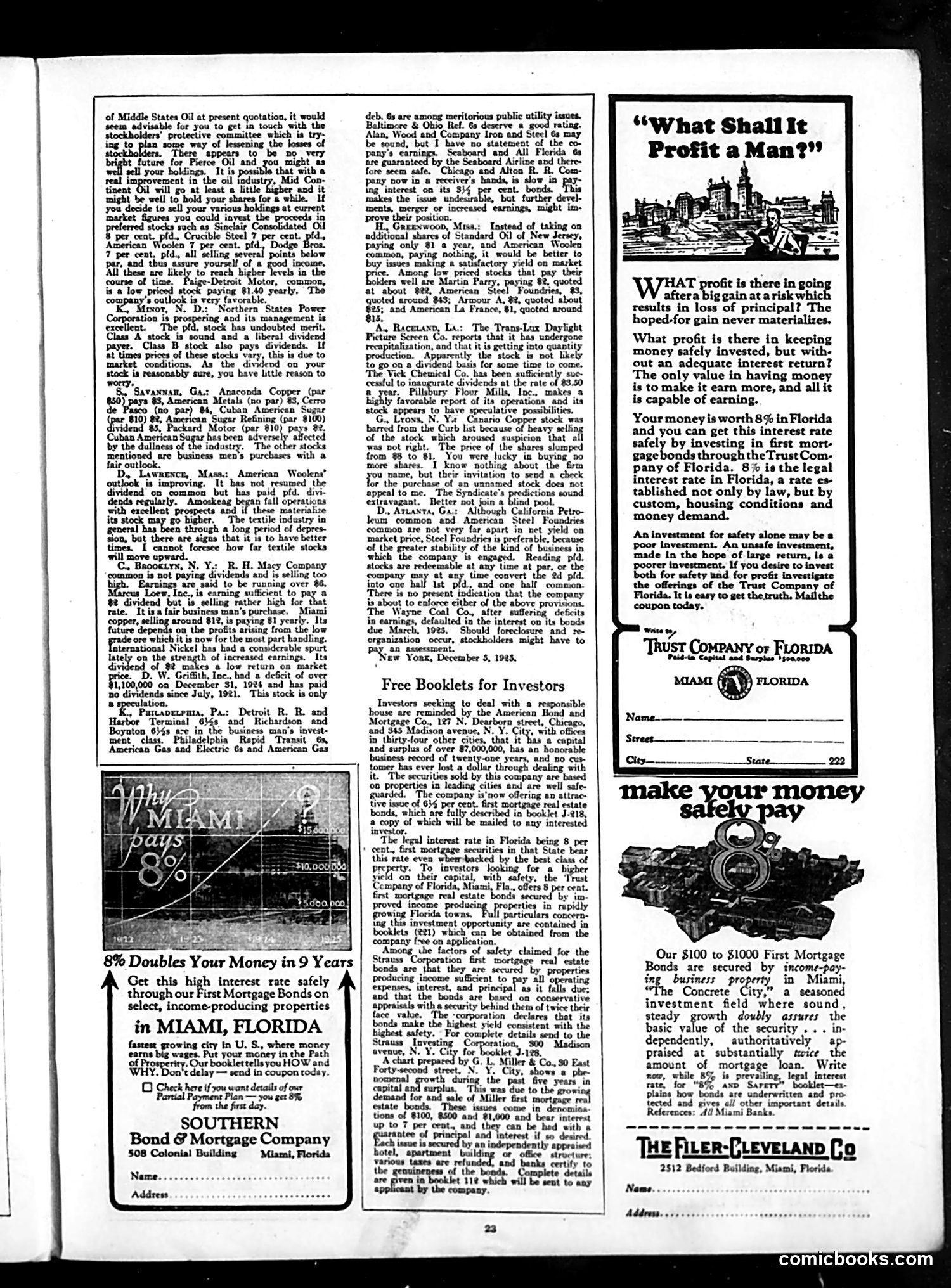
This page is primarily **financial advice and advertisements**, not political satire. The bulk consists of investment recommendations responding to reader questions about stocks (oil, steel, textiles, motors) and bonds—typical Judge magazine content from the 1920s economic era. The cartoons/ads promote Florida real estate and mortgage bonds, promising "8% Doubles Your Money in 9 Years" through Miami property investment. This reflects the famous Florida land boom of the 1920s, when speculative fever gripped investors. The headline "What Shall It Profit a Man?" (Biblical reference) ironically juxtaposes investment advice with morality—asking what good is profit if you lose your principal. It's a gentle warning about risky speculation disguised as practical guidance. **No identifiable political figures or caricatures appear.** The page reflects 1920s concerns: post-war market volatility, industrial restructuring, and get-rich-quick Florida schemes that would famously collapse within years.
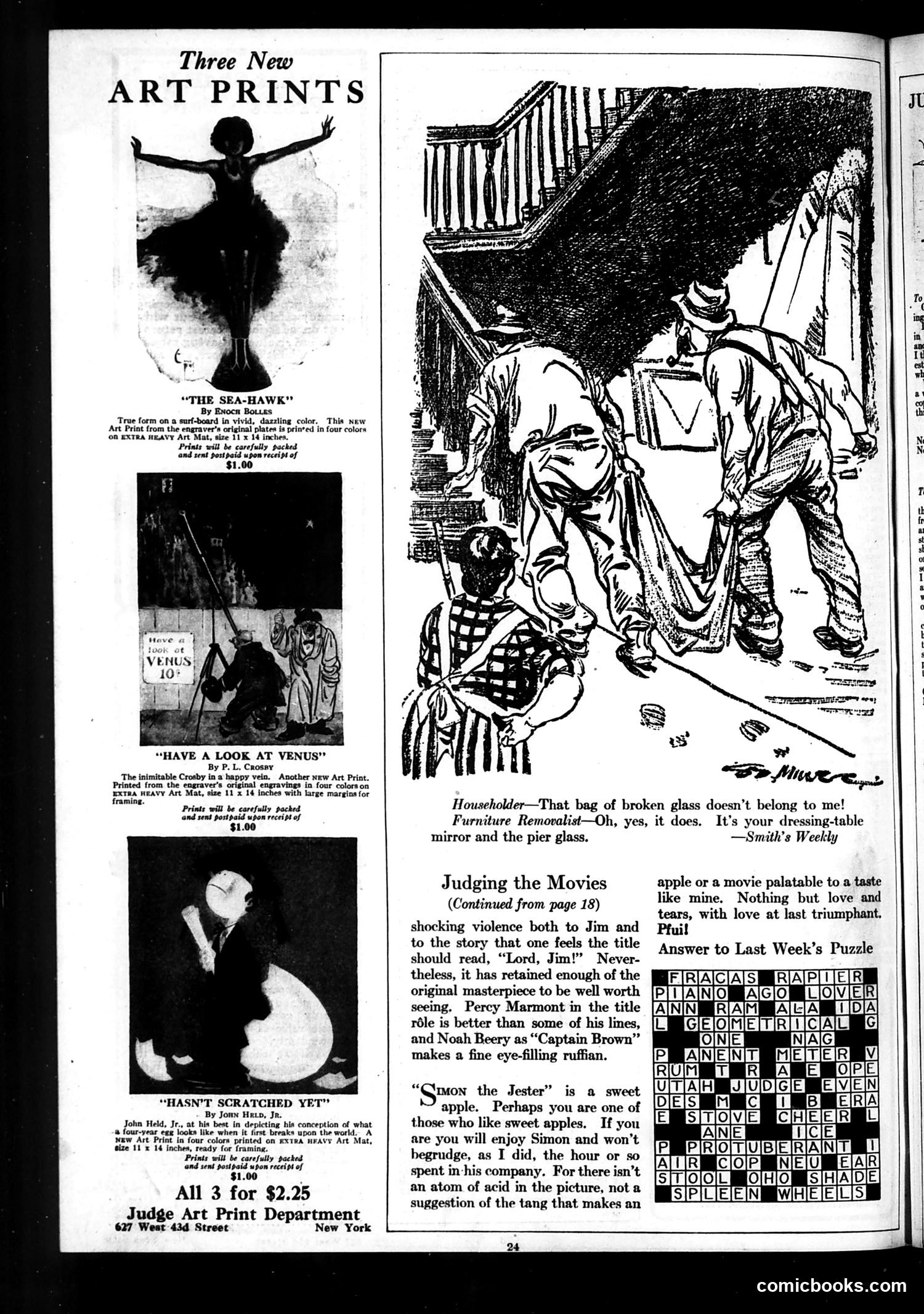
This page is primarily **advertising for art prints** rather than political satire. The left column promotes three new prints available from Judge's Art Print Department for $1 each (or all three for $2.25): 1. "The Sea-Hawk" by Enoch Bolles—a surf-board scene 2. "Have a Look at Venus" by P.L. Crosby—described as humorous 3. "Hasn't Scratched Yet" by John Held Jr.—depicting a cracked egg, playing on the era's slang The right side contains a **domestic humor cartoon** about furniture movers and broken glassware—a common working-class subject for satirical magazines of this era. Below that is a **movie review column** critiquing films like "Lord Jim" and "Simon the Jester," typical editorial content for Judge. The page reflects 1920s consumer culture and entertainment interests rather than political commentary.
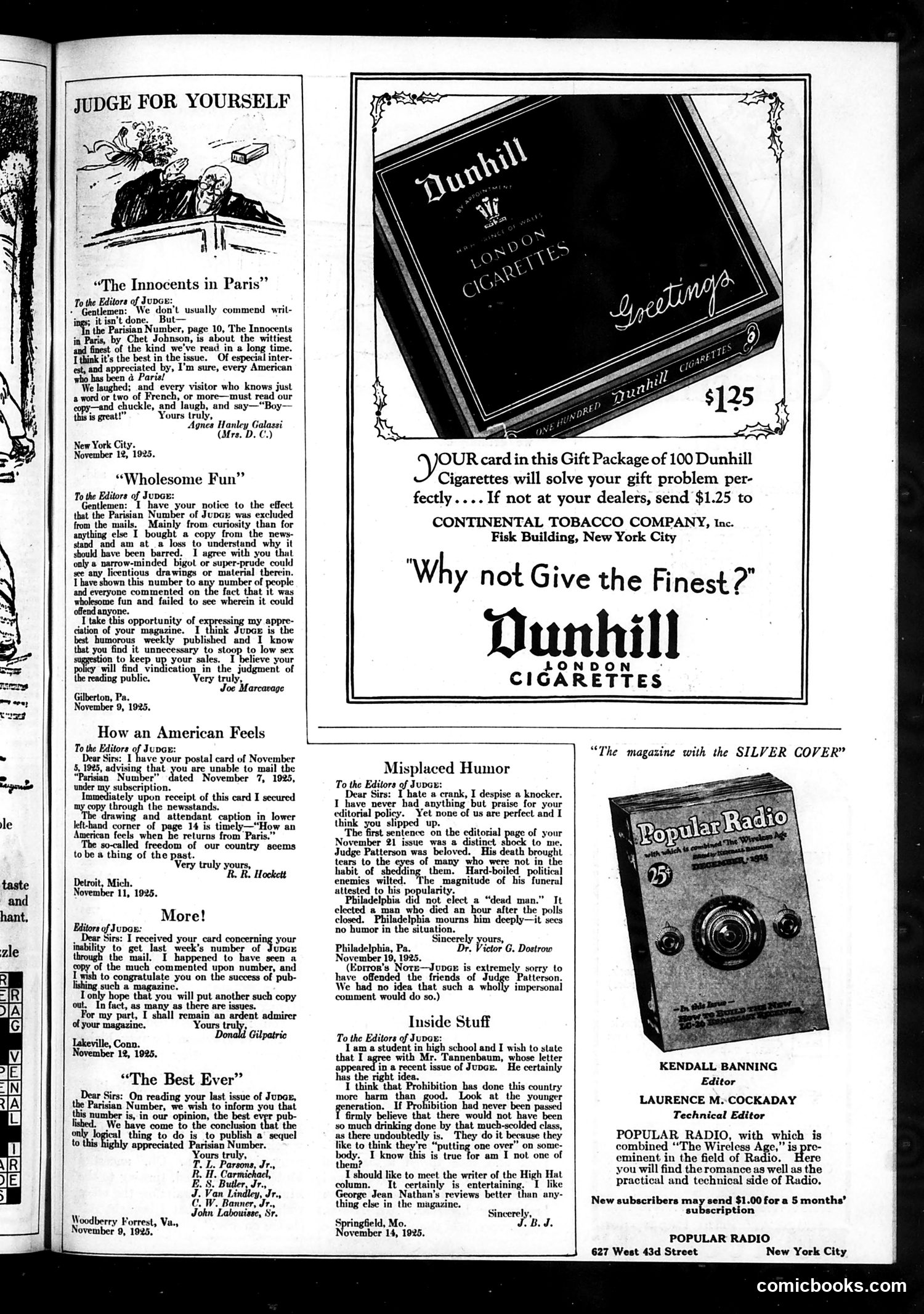
This page is primarily **letters to the editor** responding to Judge magazine's controversial "Parisian Number" (November 1925), which was **banned from the U.S. mails** under obscenity laws. **The Satire/Context:** The letters reveal a cultural clash. Readers defended the issue as "wholesome fun" and "the best ever," arguing only "narrow-minded bigots or super-prudes" would object. One writer invoked "freedom of our country" being lost. These letters mock **Prohibition-era censorship** and the tension between cosmopolitan sophistication (Paris = worldly, modern) and American moral guardianship. The censorship itself was the real humor for Judge's audience—that federal authorities deemed their Parisian content obscene enough to exclude from mails, while readers found nothing objectionable. **The page also includes** vintage advertising (Dunhill cigarettes, Popular Radio) and a "Misplaced Humor" letter criticizing an editorial about Judge Patterson (likely the magazine's founder), showing the magazine's self-reflective nature.
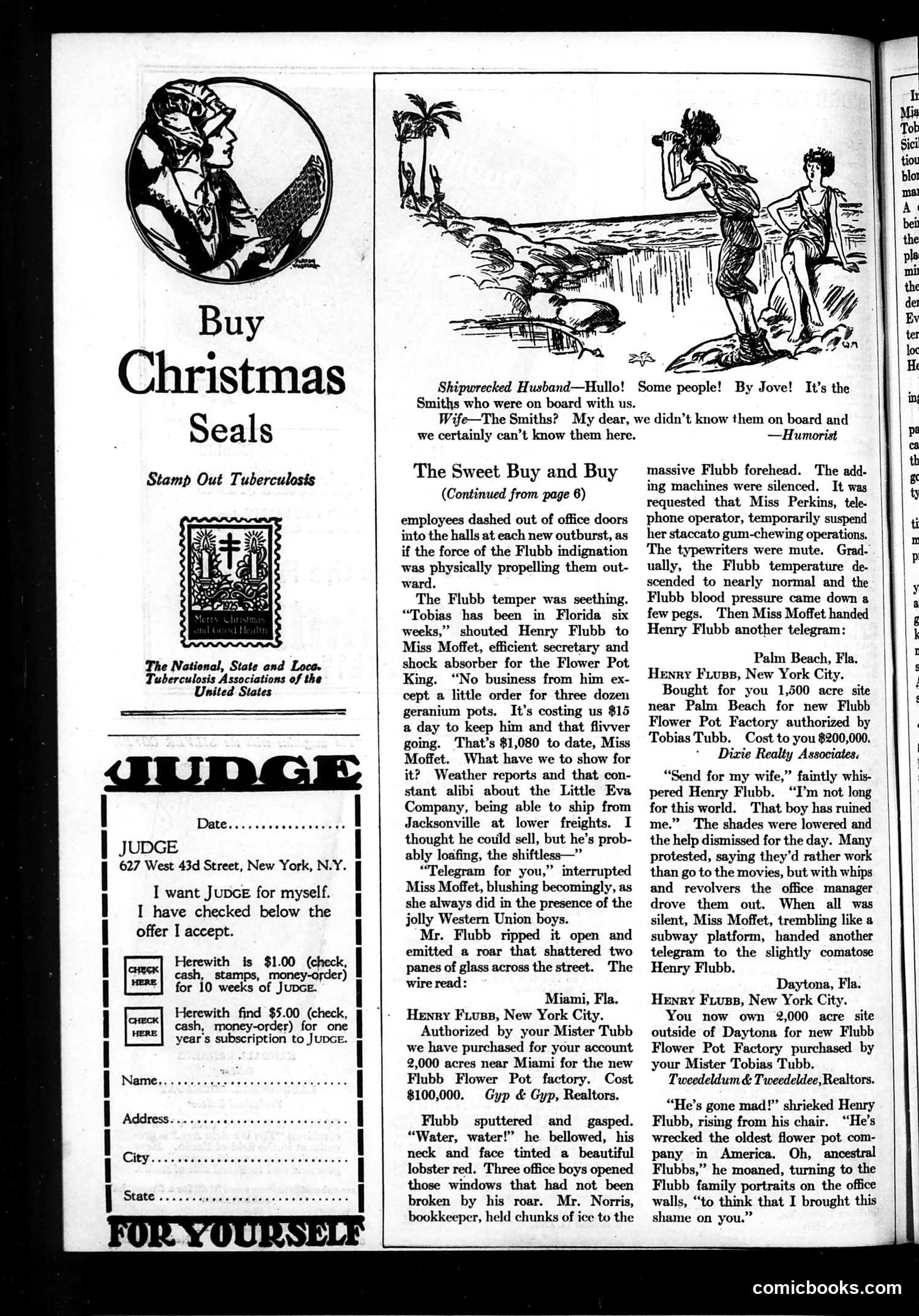
This page contains **advertising** (Judge magazine subscriptions, Christmas Seals tuberculosis campaign) and the **continuation of a serialized satirical story** titled "The Sweet Buy and Buy." The story mocks **speculative real estate fraud and misplaced trust**. Henry Flubb, a flower pot company owner, has authorized his employee Tobias Tubb to make business decisions while Flubb vacations in Florida. Tubb—apparently in cahoots with unscrupulous realtors ("Gyp & Gyp," "Tweedeldum & Tweedeldee")—secretly purchases vast tracts of worthless Florida land in Flubb's name for inflated prices ($100,000, $200,000), claiming authorization. Each telegram revealing a new purchase enrages Flubb further. The satire targets the **1920s Florida land boom**, when aggressive real estate schemes defrauded investors with fake property deals. The comical exaggeration—multiple purchases in different Florida locations, Flubb's theatrical rage response—underscores how easily businessmen could be swindled by smooth-talking con artists exploiting trust and distance.
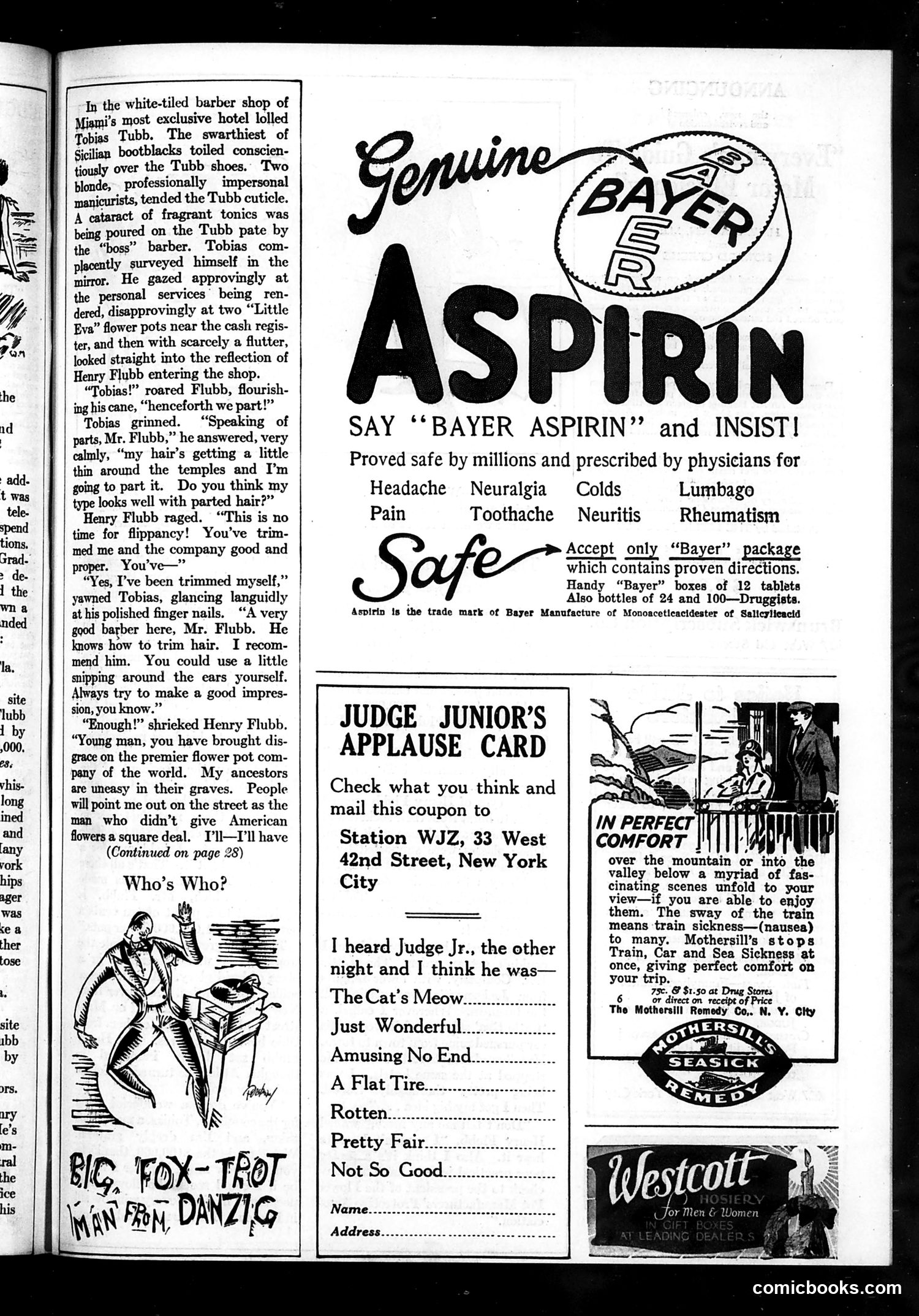
This page combines a satirical story with period advertisements. The main narrative concerns **Tobias Tubb**, a barber-shop character, and **Henry Flubb**, apparently a flower-pot company executive. Flubb accuses Tubb of misconduct that has damaged his business reputation and family honor—the specific nature remains unclear from the excerpt, though it involves trimming or cutting something belonging to Flubb's company. The satire appears to mock both men: Flubb's overwrought indignation about damaged "honor," and Tubb's infuriatingly calm deflection (he deliberately misinterprets "trimmed" as a haircut reference). The page also contains typical period advertisements: **Bayer Aspirin** (emphasizing safety and physician endorsement), **Mothersill's** seasickness remedy, and a **"Judge Junior's Applause Card"** radio feedback coupon—indicating this magazine had multimedia promotional tie-ins. The "Who's Who?" illustration references a **"Big Fox-Trot Man"** (likely contemporary dance/social commentary), though its specific meaning is unclear without additional context.
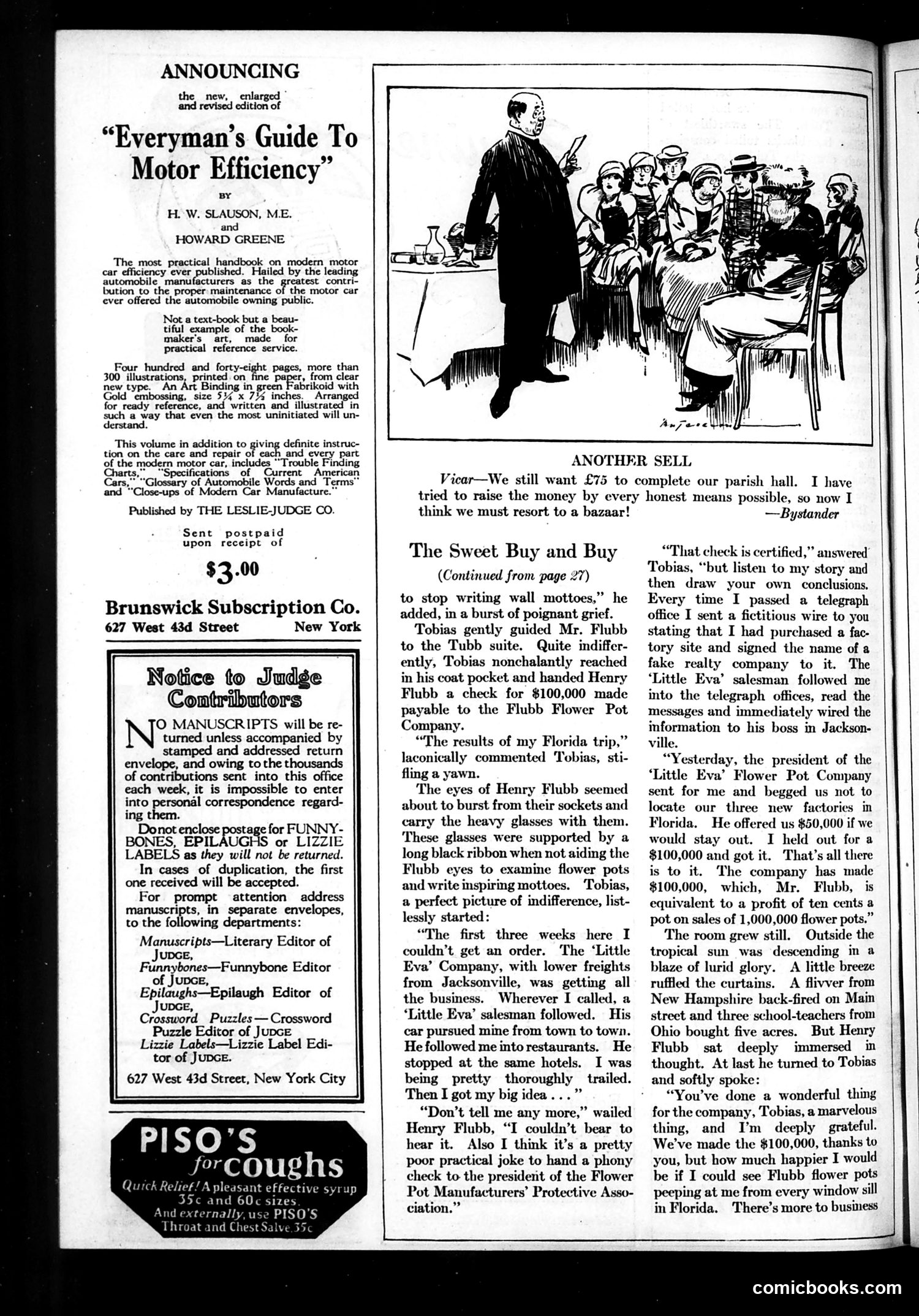
This page is primarily **advertising and editorial matter** rather than a political cartoon. The illustration at top shows a man (Tobias) presenting to an audience, likely depicting a scene from the serialized story "The Sweet Buy and Buy" (continued from page 27). The accompanying text is a business narrative about a flower pot salesman named Tobias who outcompetes a rival "Little Eva" company through persistent shadowing tactics, ultimately presenting Henry Flubb with a $100,000 check. The story's humor derives from **commercial competition and sales rivalry** of the early 20th century. The page also contains notices to Judge magazine contributors, advertisements for a motor efficiency guide and cough syrup, and a brief cartoon caption labeled "Another Sell" about parish fundraising—depicting mild ecclesiastical humor rather than political satire. The content reflects Judge's focus on **business, consumer culture, and gentle social comedy** rather than pointed political commentary.
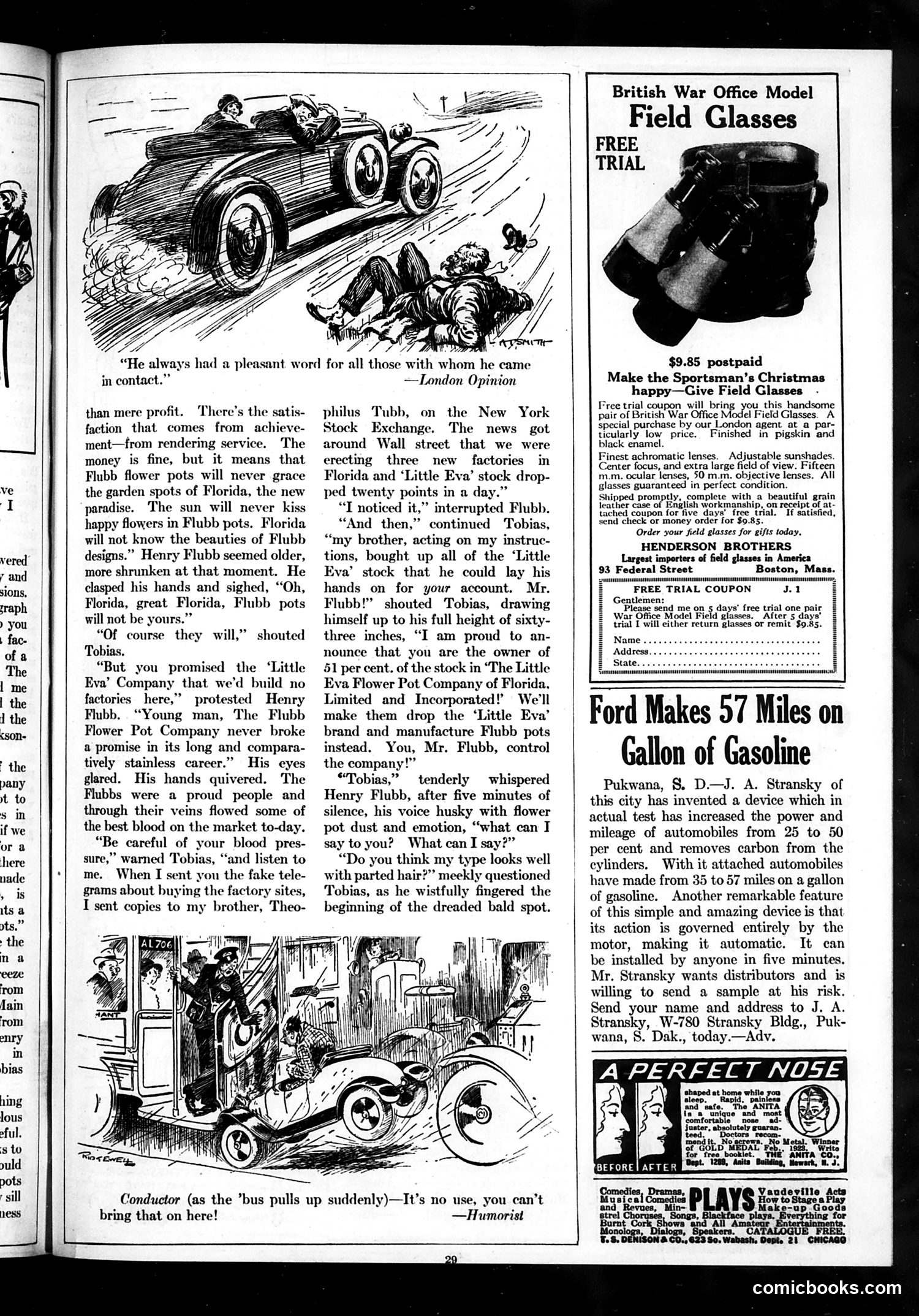
This page contains a serialized story about the Flubb Flower Pot Company alongside period advertisements and a cartoon. **The Main Story:** A narrative about business rivalry and stock manipulation. Character Tobias Tubb tricks elderly businessman Henry Flubb by spreading false rumors about factory expansion in Florida, causing "Little Eva" company stock to drop. Tobias's brother then buys the cheap stock for Flubb's account, making him controlling shareholder. The story satirizes Wall Street speculation and corporate deception common in early 20th-century business. **The Cartoon:** Shows a bus conductor addressing passengers, with the caption about being unable to "bring that on here"—likely satirizing overcrowding or an impossible request (unclear without fuller context). **Advertisements:** Include British War Office field glasses (wartime reference suggests WWI era) and a Ford efficiency claim (57 miles per gallon), plus cosmetic products. The page reflects early 1900s concerns about financial manipulation, corporate ambition, and consumer product culture.
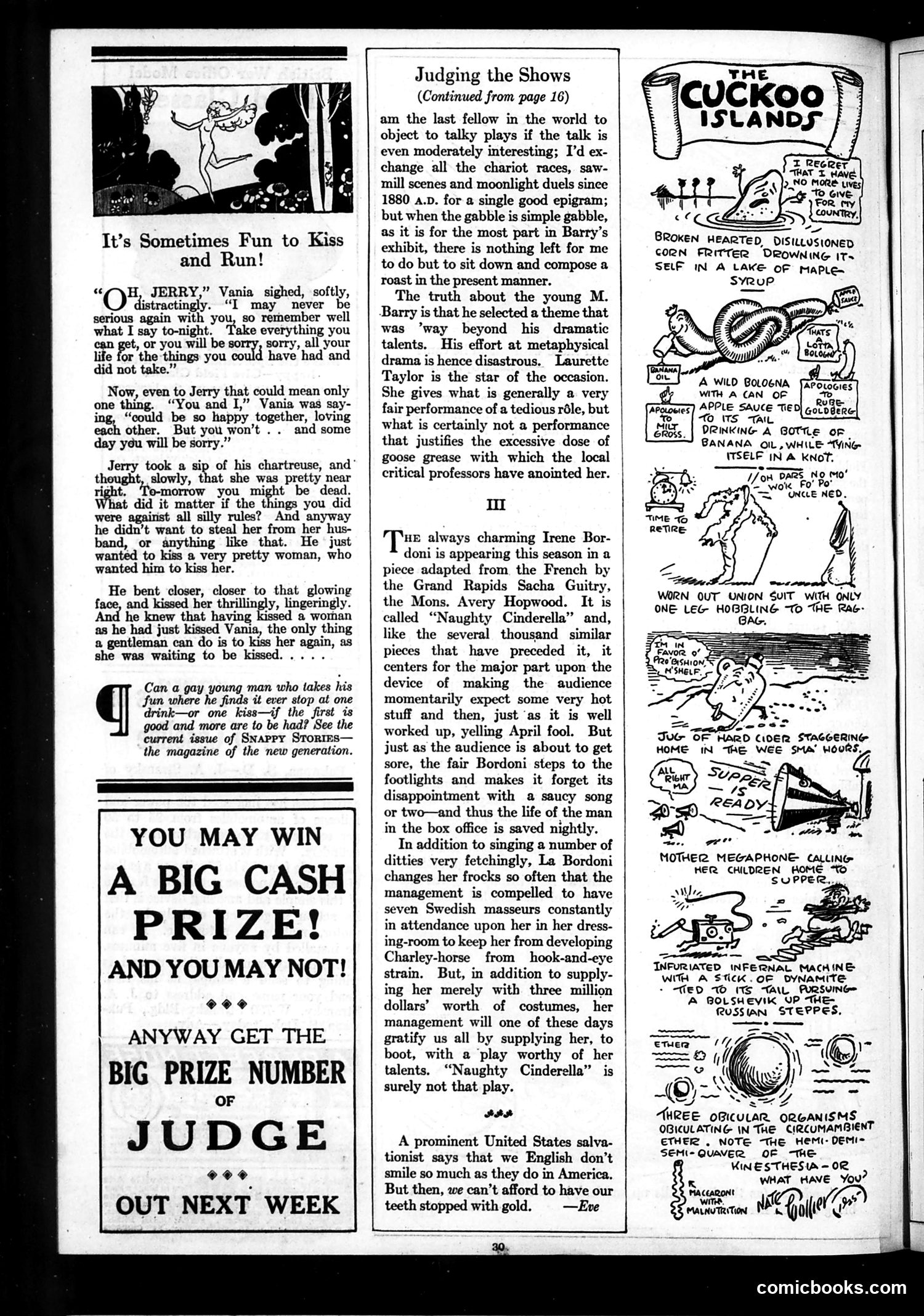
This Judge magazine page contains theater criticism and a romantic short story excerpt. The main content critiques Broadway shows: **"Judging the Shows"** reviews two theatrical productions. The critic dismisses a play by "young M. Barry" as dramatically incompetent despite dealing with ambitious metaphysical themes, though he praises actress Laurette Taylor's performance. He's more favorable toward Irene Bordoni in the French-adapted "Naughty Cinderella," a farce that employs the comedic device of building audience anticipation for scandalous moments, then deflating them with "April fool" letdowns. However, he notes Bordoni's frequent costume changes (requiring seven Swedish masseurs to prevent muscle strain) ultimately save the show nightly through her charm and song. The left column features a serialized romance story about a man named Jerry and a woman named Vania, promoting *Snappy Stories* magazine. The page reflects early 20th-century theater criticism's focus on star performers and technical spectacle rather than plot substance.
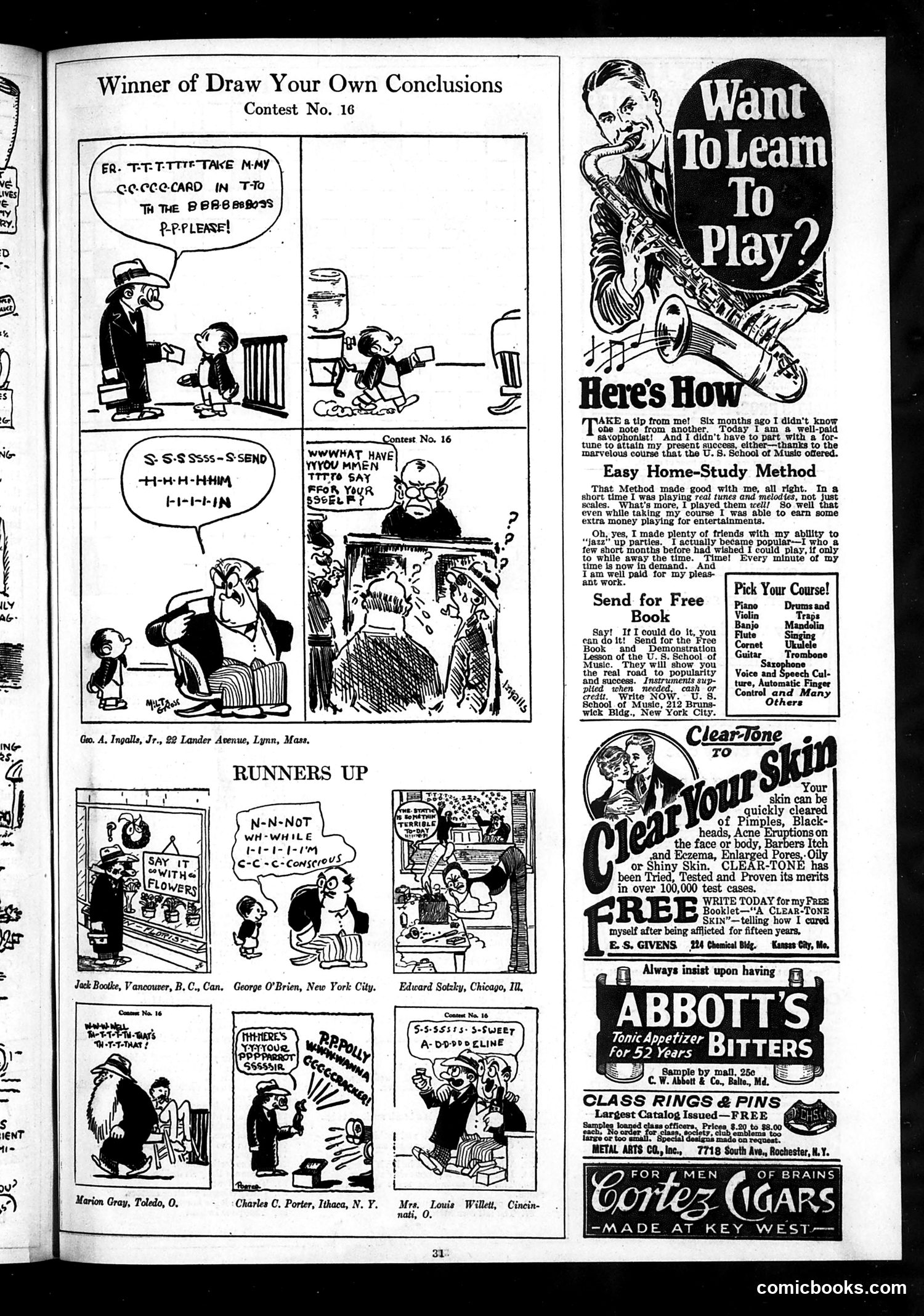
This page features a **music lesson advertisement contest winner** from what appears to be the 1920s-1930s era. The winning cartoon depicts a child asking an adult to take his "report card in to the barber boys"—a humorous non-sequitur drawing exercise. The main content is the **U.S. School of Music testimonial**, where a saxophonist claims he learned jazz quickly through their correspondence course, enabling him to earn money performing. This reflects the era's **fascination with jazz** and the emerging entertainment industry, plus the period's faith in mail-order self-improvement schemes. The "Runners Up" section shows other contest entries with absurdist humor typical of Judge magazine's satirical style. The surrounding **advertisements** (skin creams, bitters, class rings, cigars) represent typical early-20th-century patent medicine and mail-order marketing directed at working-class readers seeking social advancement or remedies. The page reflects American optimism about accessible self-improvement and entertainment culture during the Jazz Age.
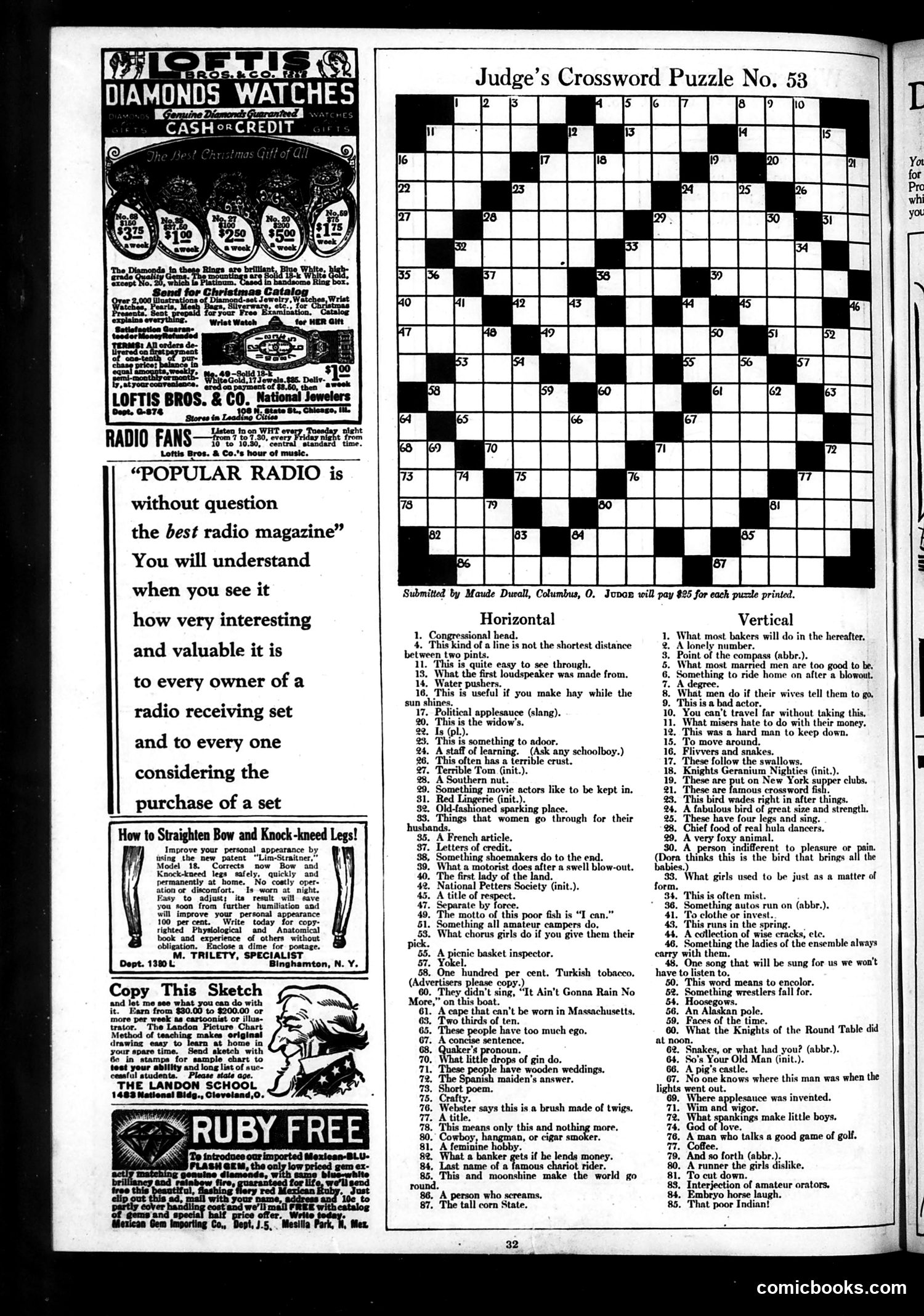
This page is primarily **advertisements and a crossword puzzle**, not political satire. The left side contains vintage ads for jewelry (Loftis Bros.), radio magazines, leg-straightening devices, art school courses, and gemstones—typical early 20th-century classified advertising. The main content is **"Judge's Crossword Puzzle No. 53,"** a substantial crossword with clues submitted by Maude Duvall of Columbus, Ohio. The clues reflect 1920s-30s vernacular and preoccupations: references to radio, automobiles ("flivvers"), jazz-age slang ("political applesauce"), and domestic humor about marriage and wives. Notably, several clues contain period gender stereotypes ("Things that women go through for their husbands"). There is **no political cartoon visible** on this page. It represents Judge magazine functioning as a general humor and puzzle publication rather than purely political satire, showing how such magazines diversified their content beyond editorial cartooning to maintain readership during this era.
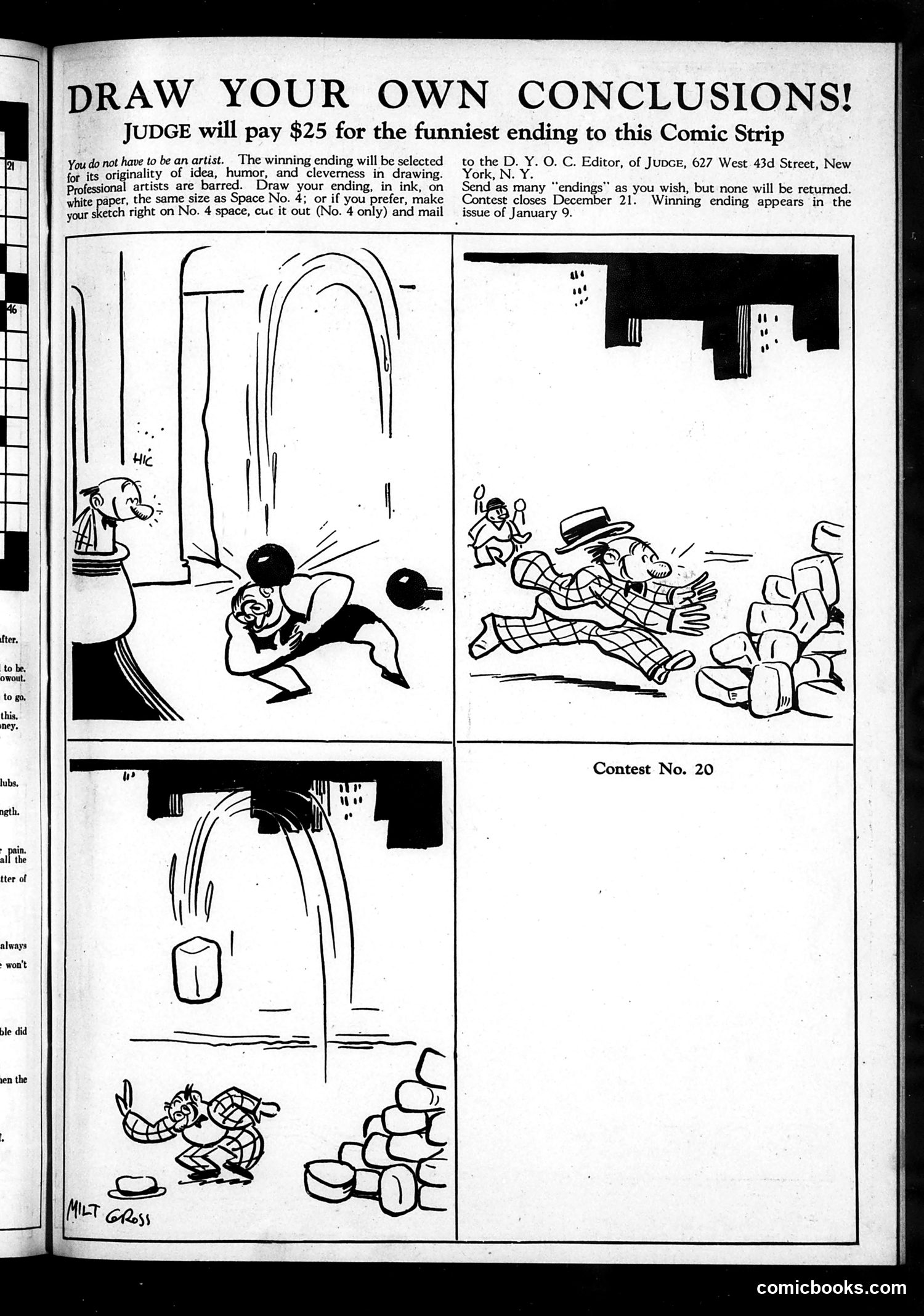
This is a reader-participation contest from *Judge* magazine. The page shows three incomplete comic strips (including one signed by Milt Gross, a prominent cartoonist of the era) where the final panel is blank. Readers are invited to draw their own humorous endings to these strips and submit them for a $25 prize—significant money during this period. The contest encourages originality and humor over artistic skill, explicitly barring professional artists from competing. The three visible strips show slapstick scenarios: a man being hit with a wrecking ball, someone caught in falling debris, and a figure dealing with water and blocks—typical physical-comedy setups common to 1920s-30s comic strips. Readers would complete the punchline visually. This represents *Judge*'s interactive approach to engaging its audience and filling content during the pre-television era.
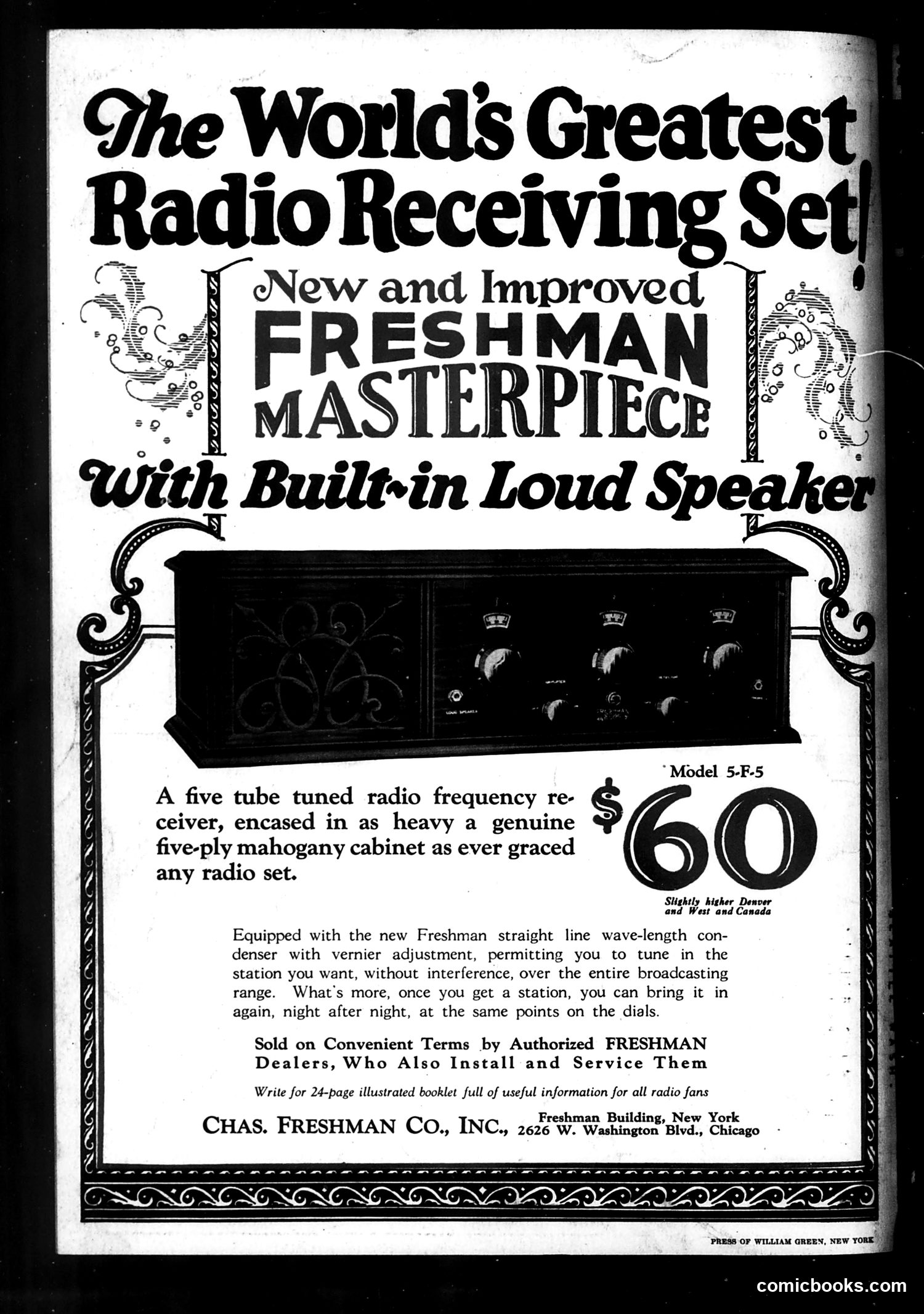
This page is primarily a **product advertisement**, not a political cartoon or satirical content. It promotes the Freshman Model 5-F-5 radio receiver—a five-tube radio set priced at $60, encased in mahogany cabinetry and featuring a built-in loudspeaker. The advertisement appeared in *Judge*, a satirical magazine, but contains no satire itself. Instead, it represents the kind of commercial content that funded such publications. The ad emphasizes the radio's technical features (straight-line wave-length condenser, vernier adjustment) and convenience, targeting middle-class consumers interested in the latest broadcasting technology. The ornamental decorative borders and typography reflect the design aesthetic of the 1920s era, when radio was an exciting new consumer product. There is no identifiable political or social commentary—it is straightforward commercial promotion by the Charles Freshman Company of New York and Chicago.

I can see this is a page from *Judge* magazine, but the image quality is too poor for me to reliably identify specific figures, text, or cartoon content. The page appears very dark with some circular or ornamental designs visible on the right side, and what looks like binding or edge markings on the left, but the actual cartoon(s) or satirical content are not legible enough for accurate analysis. The OCR text provided is also too corrupted to be useful. To explain this page's political or social satire accurately, I would need a clearer image where the illustrations and text are readable. I cannot responsibly guess at the meaning without being able to see the details.