
Judge, 1925-12-12 · page 15 of 37
Judge — December 12, 1925 — page 15: what you’re looking at
What you’re looking at
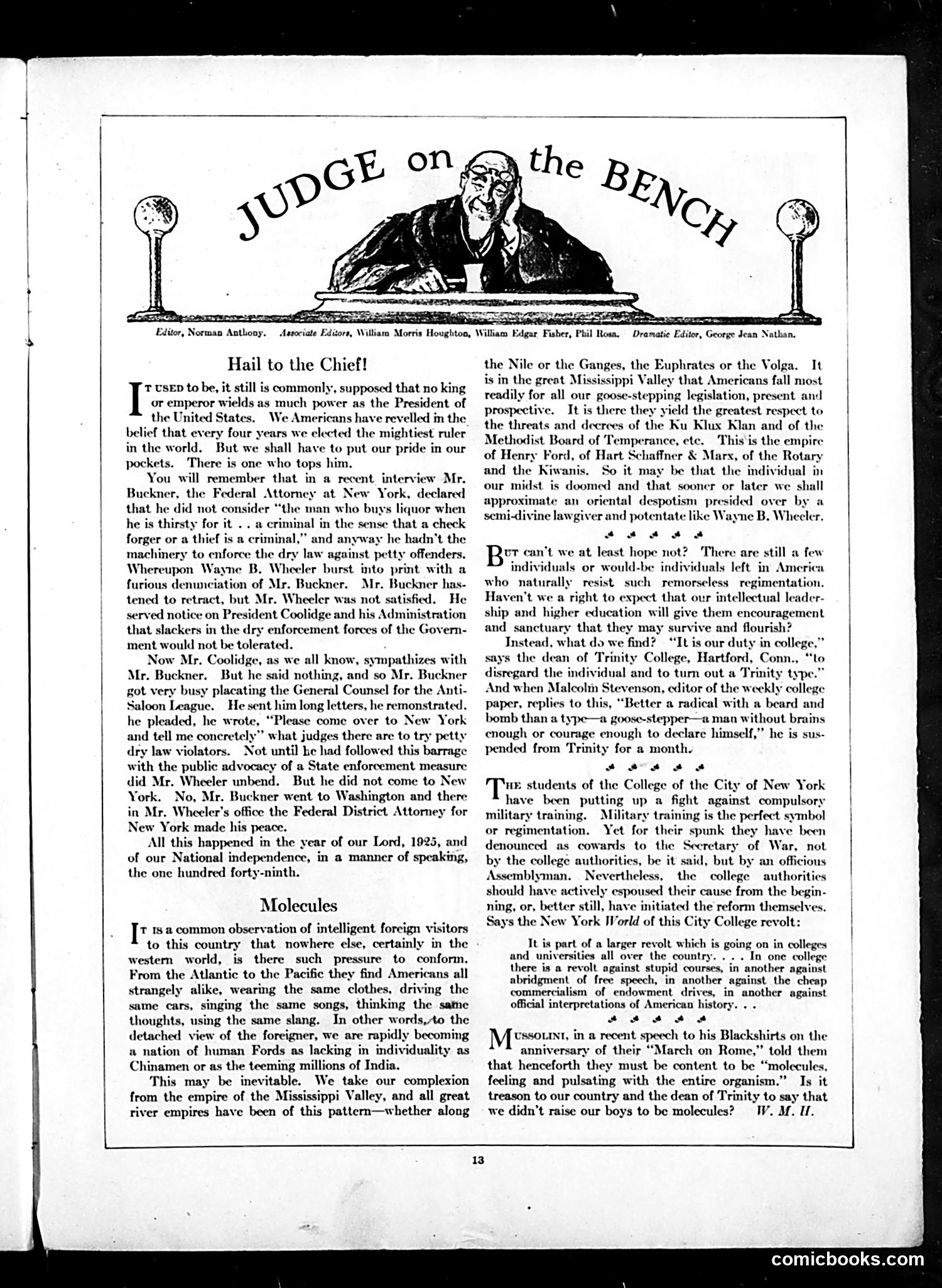
**The Main Cartoon:** The masthead shows a stern judge presiding, symbolizing Judge magazine's satirical authority. **"Hail to the Chief" Article:** This piece satirizes Wayne B. Wheeler, the powerful Anti-Saloon League leader during Prohibition. The article mocks Wheeler's influence over President Coolidge and Federal Attorney Buckner—suggesting Wheeler wields more power than the President himself. When Buckner made mild comments about not prosecuting casual liquor buyers, Wheeler publicly denounced him. Coolidge did nothing. Only after Buckner traveled to Wheeler's office in Washington and capitulated did Wheeler accept his apology. The satire: an unelected lobbyist now effectively controls federal enforcement policy. **"Molecules" Section:** This discusses American conformity—how citizens increasingly dress, think, and behave identically, losing individuality. It connects this uniformity to the Mississippi Valley's cultural dominance and to authoritarian movements (Ku Klux Klan, Methodist Board of Temperance), suggesting Americans are becoming "molecules" in a mass society rather than independent citizens. Both pieces critique loss of individual liberty and democratic accountability.
📄 Transcribed text from this page (OCR, searchable)
Machine-transcribed from the original scan — historical spelling and the odd misread are preserved.
Editor, Norman asilony. Associate Editor Hail to the Chief! T USED to be, it still is commonly, supposed that no king or emperor wields as much power as the President of the United States. We Americans have revelled in the belief that every four years we elected the mightiest ruler in the world. But we shall have to put our pride in our pockets. There is one who tops him. You will remember that in a recent interview Mr. Buckner, the Federal Attorney at New York, declared that he did not consider “the man who buys liquor when he is thirsty for it . . a criminal in the sense that a check forger or a thief is a criminal,” and anyway he hadn't the machinery to enforce the dry law against petty offenders. Whereupon Wayne B. Wheeler burst into print with a furious denunciation of Mr. Buckner. Mr. Buckner has- tened to retract, but Mr. Wheeler was not satisfied. He served notice on President Coolidge and his Adm ration that slackers in the dry enforcement forces of the Govern- ment would not be tolerated. Now Mr. Coolidge, as we all know, sympathizes with Mr. Buckner. But he said nothing, and so Mr. Buckner got very busy placating the General Counsel for the Anti- Saloon League. He sent him long letters, he remonstrated. he pleaded, he wrote, “Please come over to New York and tell me concretely” what judges there are to try petty dry law violators. Not until he had followed this barrage with the public advocacy of a State enforcement measure did Mr, Wheeler unbend. But he did not come to New York. No, Mr. Buckner went to Washington and there in Mr. Wheeler's office the Federal District Attorney for New York made his peace. All this happened in the year of our Lord, 1925, and of our National independence, in a manner of speaking, the one hundred forty-ninth. Molecules I" 18 a. common observation of intelligent foreign visitors to this country that nowhere else, certainly in the western world, is there such pressure to conform. From the Atlantic to the Pacific they find Americans all strangely alike, wearing the same clothes, driving the same cars, singing the same songs, thinking the same thoughts, using the same slang. In other words,o the detached view of the foreigner, we are rapidly becoming a nation of human Fords as lacking in individuality as Chinamen or as the teeming millions of India. This may be inevitable. We take our complexion from the empire of the Mississippi Valley, and all great river empires have been of this pattern—whether along , William Morris Houghton, Wi am digar Fuber, Phil Rosa, Dramatic Editor, George Jean Nathan. the Nile or the Ganges, the Euphrates or the Volga. It is in the great ) ippi Valley that Americans fall most readily for all our goose-ste] ping legislation, present and prospective. It is there they yield the greatest respect to the threats and deerces of the Ku Klux Klan and of the Methodist Board of Temperance, ete. This'is the empire of Henry Ford, of Hart Schaffner & Marx, of the Rotary and the Kiwanis. So it may be that the individual in our midst is doomed and that sooner or later we shall approximate an oriental despotism presided over by a semi-divine lawgiver and potentate like Wayne B. Wheeler. 444 wo B" can't we at least hope not? There are still a few individuals or would-be individuals left in America who naturally resist such remorseless regimentation. Haven't we a right to expect that our intellectual leader- ship and higher education will give them encouragement and sanctuary that they may survive and flourish? Instead, what do we find? “It is our duty in college,” says the dean of Trinity College, Hartford, Conn., “to disregard the individual and to turn out a Trinity type.” And when Malcolin Stevenson, editor of the weekly college paper, replies to this, “Better a radical with a beard and bomb than a type—a goose-stepper—a man without brains cnough or courage enough to declare himself,” pended from Trinity for a month. et AA A A HE students of the College of the City of New York have been putting up a fight against compulsory military training. Military training is the perfect symbol or regimentation. Yet for their spunk they have been denounced as cowards to the Secretary of War, not by the college authorities, be it said, but by an officious Assemblyman. Nevertheless, the college authori should have actively espoused their cause from the begin- ning, or, better still, have initiated the reform themselves. Says the New York World of this City College revolt: he is sus- It is part of a larger revolt which is going on in colleges and universities all over the country... . In one college there is a revolt against stupid courses, in another against abridgment of free speech, in another against. the cheap commercialism of endowment drives, in another against official interpretations of American history. tea eae USSOLINT, in a recent speech to his Blackshirts on the anniversary of their ‘March on Rome,” told them that henceforth they must be content to be “molecules, feeling and pulsating with the entire organism.” Is it treason to our country and the dean of Trinity to say that we didn’t raise our boys to be molecules? W.-M. UU. comicbooks.com