
Judge, 1925-12-12 · page 18 of 37
Judge — December 12, 1925 — page 18: what you’re looking at
What you’re looking at
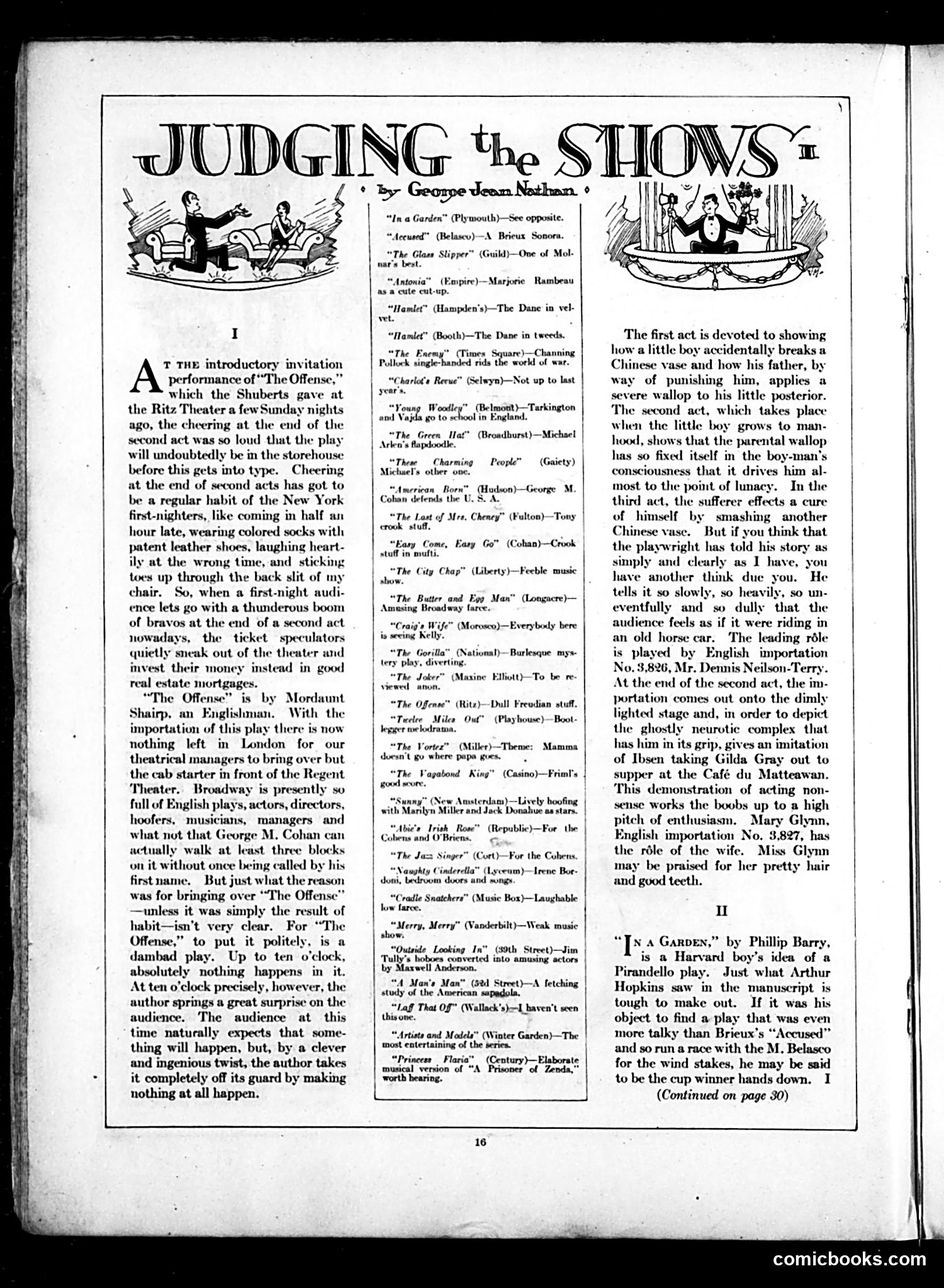
This is a theater review column by George Jean Nathan, a prominent drama critic of the 1920s. The main text satirizes "The Offense," an imported British play by Mordaunt Shairp at the Ritz Theater, mocking its dramatic structure: nothing happens for two hours, then at the climactic moment, nothing continues to happen. Nathan attacks the play as tedious and questions why Broadway keeps importing English theatrical material when local talent exists. The column's right side lists current Broadway productions with brief, often cutting judgments—some praising ("Sunny's" "lively hoofing"), others dismissive ("The City Chap"—"feeble music show"). The humor relies on Nathan's acerbic wit and insider knowledge of theatrical conventions. References to George M. Cohan, the Shubert brothers, and various theaters ground the satire in 1920s Broadway culture.
📄 Transcribed text from this page (OCR, searchable)
Machine-transcribed from the original scan — historical spelling and the odd misread are preserved.
UDGING ‘he SHOWS * T THE introductory invitation A performance of “The Offense,” which the Shuberts gave at the Ritz Theater a fewSunday nights ago, the cheering at the end of the second act was so loud that the play will undoubtedly be in the storehouse before this gets into type. Cheering at the end of second acts has got to be a regular habit of the New York first-nighters, like coming in half an hour late, wearing colored socks with patent leather shoes, laughing heart- ily at the wrong time, and sticking toes up through the back slit of my chair. So, when a first-night audi- ence lets go with a thunderous boom of bravos at the end of a second act nowadays, the ticket speculators quietly sneak out of the theater and invest their money instead in good real estate mortgages. “The Offense” is by Mordaunt Shairp, an Englishman. With the importation of this play there is now nothing left in London for our theatrical managers to bring over but the cab starter in front of the Regent Theater. Broadway is presently so full of English plays, actors, directors, hoofers, musicians, managers and what not that George M. Cohan can actually walk at least three blocks on it without once being called by his firstname. But just what the reason was for bringing over “The Offense” —unless it was simply the result of habit—isn't very clear. For “The Offense,” to put it politely, is a dambad play. Up to ten o'clock, absolutely nothing happens in it. At ten o'clock precisely, however, the author springs a great surprise on the audience. The audience at this time naturally expects that some- thing will happen, but, by a clever and ingenious twist, the author takes it completely off its guard by making nothing at all happen. * By Georpe Jeon Nathan. “In a Garden™ (Plywouth)—See opposite. “Accused” (Belascu)—A Brieux Sonora. “The Glass Slipper” (Guild)—One of Mol- nar's best. “Antonia” (Empire)—Marjorie Rambeau asa cule cut-up. “Hamlet” (Hampden's)—The Dane in vel- vet. “Hamlet” (Booth)—The Dane in tweeds. “The Enemy” (Times Square)—Channing Pollock single-handed rids the workd of war. rlot's Reewe” (Selwyn)—Not up to last y “Young Woodley” (Belmonit)—Tarkington | and Vaid goto schoo! in England. | "The Green Hat* (Broadburst)—Michsel Arlen’s flapdoodle. “These Charming People” Michwel's other ove. Gaiety) “American Born (Hudson)—George M. Cohan defends the U. 3. crook stuff, “Easy Come, Easy Go” (Cohan)—Crook stuff in mufti. “The City Chap” (Liberty)—Feeble music show. “The Butter and Egg Man” (Longacre)— Amasing Broadway farce. “Craig's Wife” (Morosco)—Everyboly bere is seeing Kelly. “The Gorilla” (National)—Burlesque mys- tery play, diverting. “The Joker” (Maxine Ellivtt)—To be re- viewed anon. “The Offense” (Ritz)—Dull Frevdian stuff. | “Teele Miler Out” (Playhouse)—Boot- Jegger melodrama. “The Vortez” (Miller)—Theme: Mamma duesn't gu where papa gues. “The Vagabord King” (Casino)—Friml's good sure. “Sunny” (New Amsterdam)—Lively boofing ‘Abie's Irish Rose” (Republic)—For the pens and O'Briens, “The Jaz Singer” (Cort)—For the Coens, | “Naughty Cinderella” (Lyceam)—Irene Bor- doni, bedroom doors and sungs. “Cradle Snatchers” (Music Box)}—Laughable low farce. ere, Merry” (Vanderbilt)—Weak music jide Looking In” (39th Street)—Jim by Maxwell Anderson. “A Man's Man” (52d Street)—A fetching study of the American sapadola, Flea A That Of” (Wallack’s)I haven't seen is one. “Artiste and Models” (Winter Garden)—The most entertaining of the series. “Princess, Floris (Century}— Elaborate musical version of “A Prisoner of Zenda,” ng. “The Last of Mrs. Cheney” (Fulton)—Tony | with Marilyn Miller and Jack Donahue as stars. | hoboes converted into amusing actors | The first act is devoted to showing how a little boy accidentally breaks a Chinese vase and how his father, by way of punishing him, applies a severe wallop to his little posterior. The second act, which takes place when the little boy grows to man- hood, shows that the parental wallop has so fixed itself in the boy-man’s consciousness that it drives him al- most to the point of lunacy. In the third act, the sufferer effects a cure of himself by smashing another Chinese vase. But if you think that the playwright has told his story as simply and clearly as I have, you have another think due you. He tells it so slowly, so heavily, so un- eventfully and so dully that the audience feels as if it were riding in an old horse car. The leading réle is played by English importation No. 3,826, Mr. Dennis Neilson-Terry. At the end of the second act, the im- portation comes out onto the dimly lighted stage and, in order to depict the ghostly neurotic complex that has him in its grip, gives an imitation of Ibsen taking Gilda Gray out to supper at the Café du Matteawan. This demonstration of acting non- sense works the boobs up to a high pitch of enthusiasm. Mary Glynn, English importation No. 3,827, has the rdle of the wife. Miss Glynn may be praised for her pretty hair and good teeth. Il | «A Garven,” by Phillip Barry, is a Harvard boy’s idea of a Pirandello play. Just what Arthur Hopkins saw in the manuscript is tough to make out. If it was his object to find a play that was even more talky than Brieux’s “Accused” and so run a race with the M. Belasco for the wind stakes, he may be said to be the cup winner hands down. I (Continued on page 30) comicbooks.com