
Judge, 1925-12-12 · page 11 of 37
Judge — December 12, 1925 — page 11: what you’re looking at
What you’re looking at
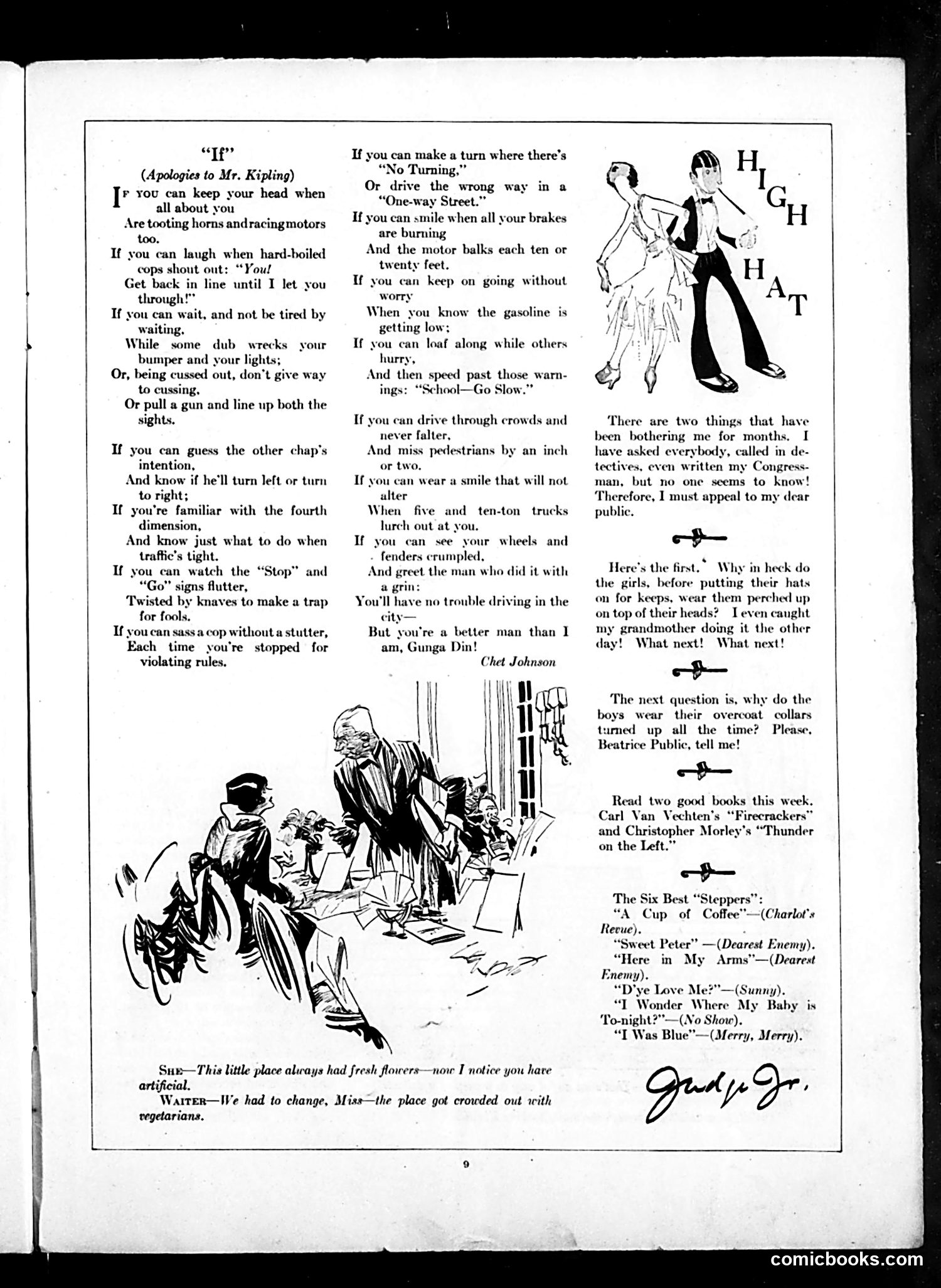
This page parodies Rudyard Kipling's famous poem "If—" to mock the chaos and dangers of 1920s city driving. The poem lists absurd driving scenarios—navigating confusing traffic signs, dodging pedestrians by inches, driving with broken brakes, encountering aggressive trucks—all presented as virtues necessary to survive automobile traffic. The satire targets both reckless drivers and the bewildering, poorly-regulated traffic conditions of the era. References to "Stop" and "Go" signs being "twisted by knaves to make a trap for fools" and cops barking orders suggest traffic enforcement was arbitrary and confusing. The closing line invokes Kipling's original ("you're a better man than I am, Gunga Din") to suggest that mastering urban driving requires superhuman skill—a humorous critique of dangerous, anarchic street conditions before standardized traffic laws. The page also includes lighter humor about fashion quirks and restaurant vegetarians.
📄 Transcribed text from this page (OCR, searchable)
Machine-transcribed from the original scan — historical spelling and the odd misread are preserved.
“te? (Apologies to Mr. Kipling) I you can keep your head when all about you Are tooting horns andracing motors too. If you can laugh when hard-boiled cops shout out: “You! Get back in line until I let you through!” Tf you can wait, and not be tired by waiting, While some dub wrecks your bumper and your lights; Or, being cussed out, don’t give way to cussing, Or pull a gun and line up both the sights. If you can guess the other chap’s intention, And know if he'll turn left or turn to right; If you're familiar with the fourth dimension, And know just what to do when traftic’s tight. If you can watch the “Stop” and “Go” signs flutter, Twisted by knaves to make a trap for fools. If youcan sass a cop without a stutter, Each time you're stopped for violating rules. If you can make a turn where there’s “No Turning,” Or drive the wrong way in a “One-way Street.” If you can smile when all your brakes are burning And the motor balks each ten or twenty feet. If you can keep on going without worry When you know the gasoline is getting low; If you can loaf along while others hurry, And then speed past thos ings: shool—Go Slow yarn- If you can drive through crowds and never falter, And miss pedestrians by an inch or two, If you can wear a smile that will not alter When five and ten-ton trucks lurch out at you. If you can see your wheels and fenders crumpled, And greet the man who did it with a grin: You'll have no trouble driving in the city— But you're a better man than I am, Gunga Din! Chet Johnson Sue—This little place always had fresh flowers—novw I notice you have artificial. Waiter—We had to change, Miss—the place got crowded out with vegetarians. There are two things that have been bothering me for months. I have asked everybody, called in de- tectives, even written my Congress- man, but no one seems to know! Therefore, I must appeal to my dear public. Here's the first.” Why in heck do the girls, before putting their hats on for keeps, wear them perched up on top of their heads? T even caught my grandmother doing it the other day! What next! What next! p> The next question is, why do the boys wear their overcoat collars turned up all the time? Please, Beatrice Public, tell me! =o Read two good books this week. Carl Van Vechten’s “Firecrackers” and Christopher Morley’s “Thunder on the Left.” = The Six Best “Stepper “A Cup of Coffee” Revue). “Sweet Peter” —(Dearest Enemy). “Here in My Arms”—(Dearest Enemy). “D'ye Love Me?’—(Sunny). “I Wonder Where My Baby is ‘To-night?”—(No Show). “I Was Blue”—(Merry, Merry). GS (Charlot's comicbooks.com