
A complete issue · 36 pages · 1925
Judge — November 28, 1925
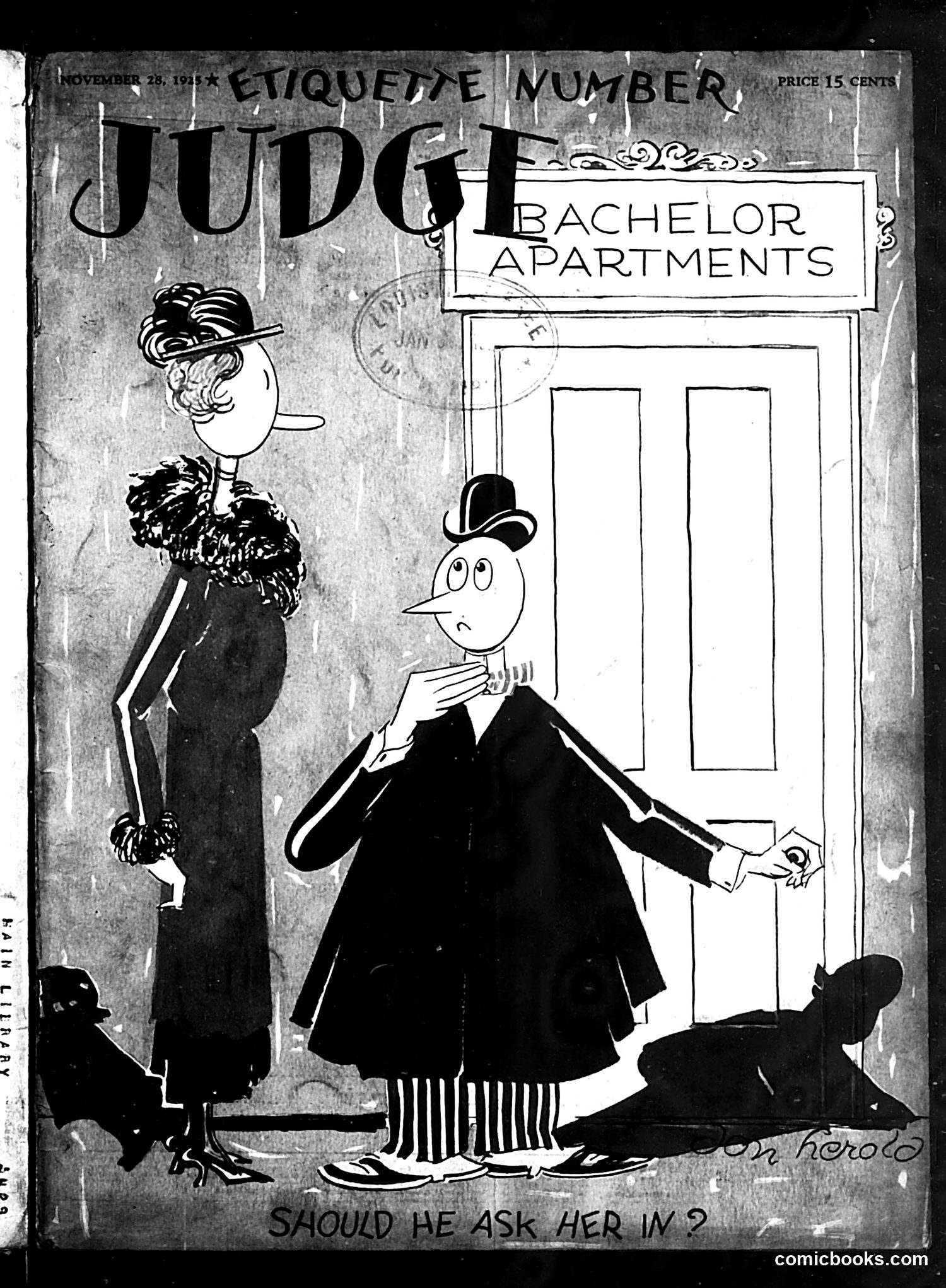
This cover satirizes bachelor apartment living and courtship etiquette. A formally dressed man in a top hat stands nervously outside apartment doors, accompanied by a fashionably dressed woman and two small dogs. The caption "SHOULD HE ASK HER IN?" poses the central joke. The satire critiques post-WWI social conventions around unmarried couples and propriety. The man's anxious posture and formal attire suggest uncertainty about whether inviting a woman to his private apartment would be socially acceptable or scandalous. The presence of the dogs appears to be a humorous detail—perhaps suggesting they could serve as chaperones. This reflects the era's rigid dating conventions and the sexual proprieties expected of respectable singles during the early 20th century.
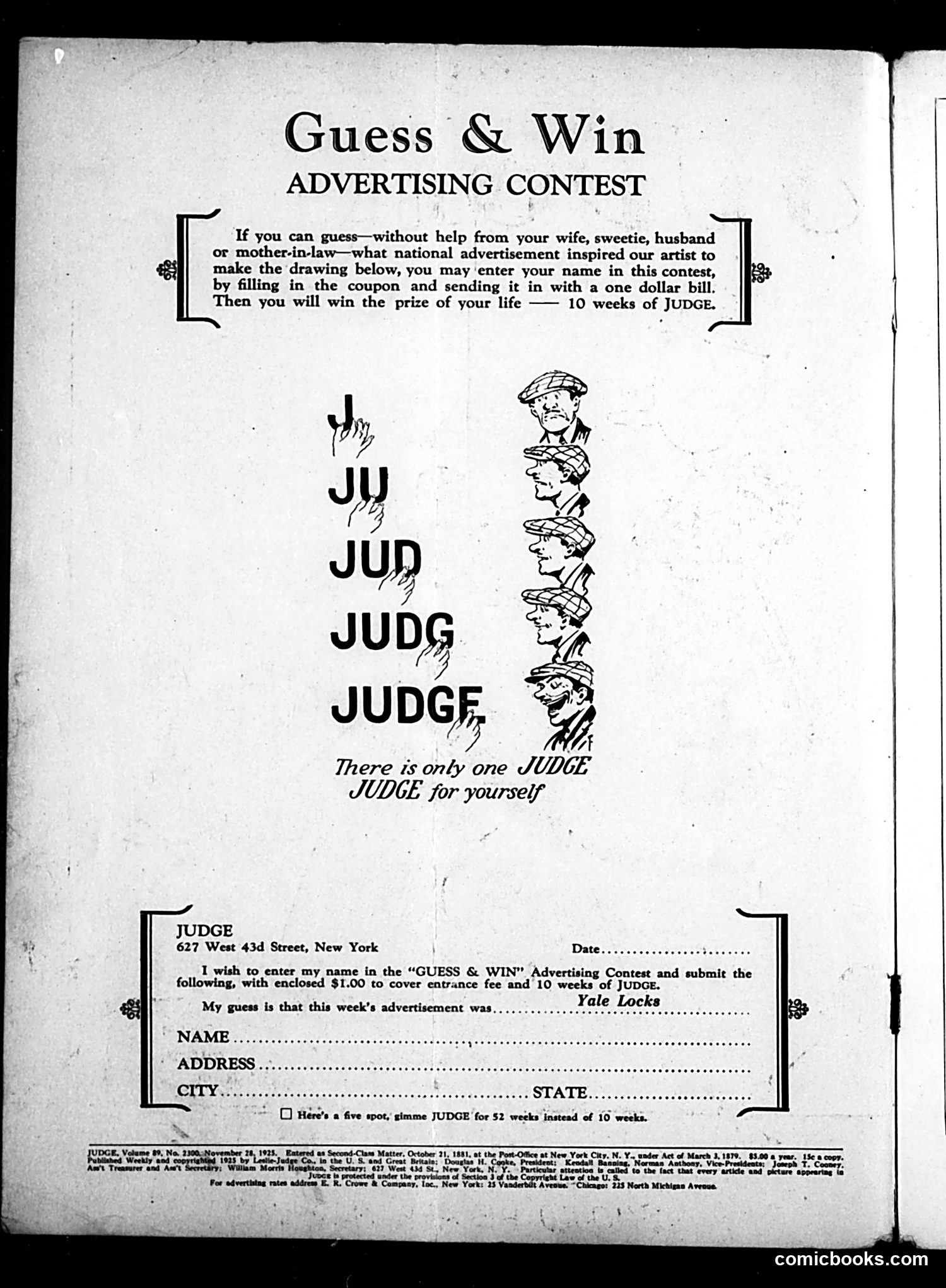
This page is primarily a **contest advertisement** for Judge magazine, not political satire. The visual pun plays on the magazine's name: a stack of men's heads labeled "JU," "JUD," "JUDG," and "JUDGE," with the tagline "There is only one JUDGE—JUDGE for yourself." The joke is straightforward wordplay—by stacking incomplete spellings of the word "JUDGE," the ad suggests readers should be their own judges (arbiters of taste/opinion) and subscribe to Judge magazine. The slogan encourages independent thinking. Contestants could win 10 weeks of free Judge subscription by correctly identifying which national advertisement inspired the artwork. This was a common promotional strategy for magazines of this era, combining reader engagement with brand recognition.
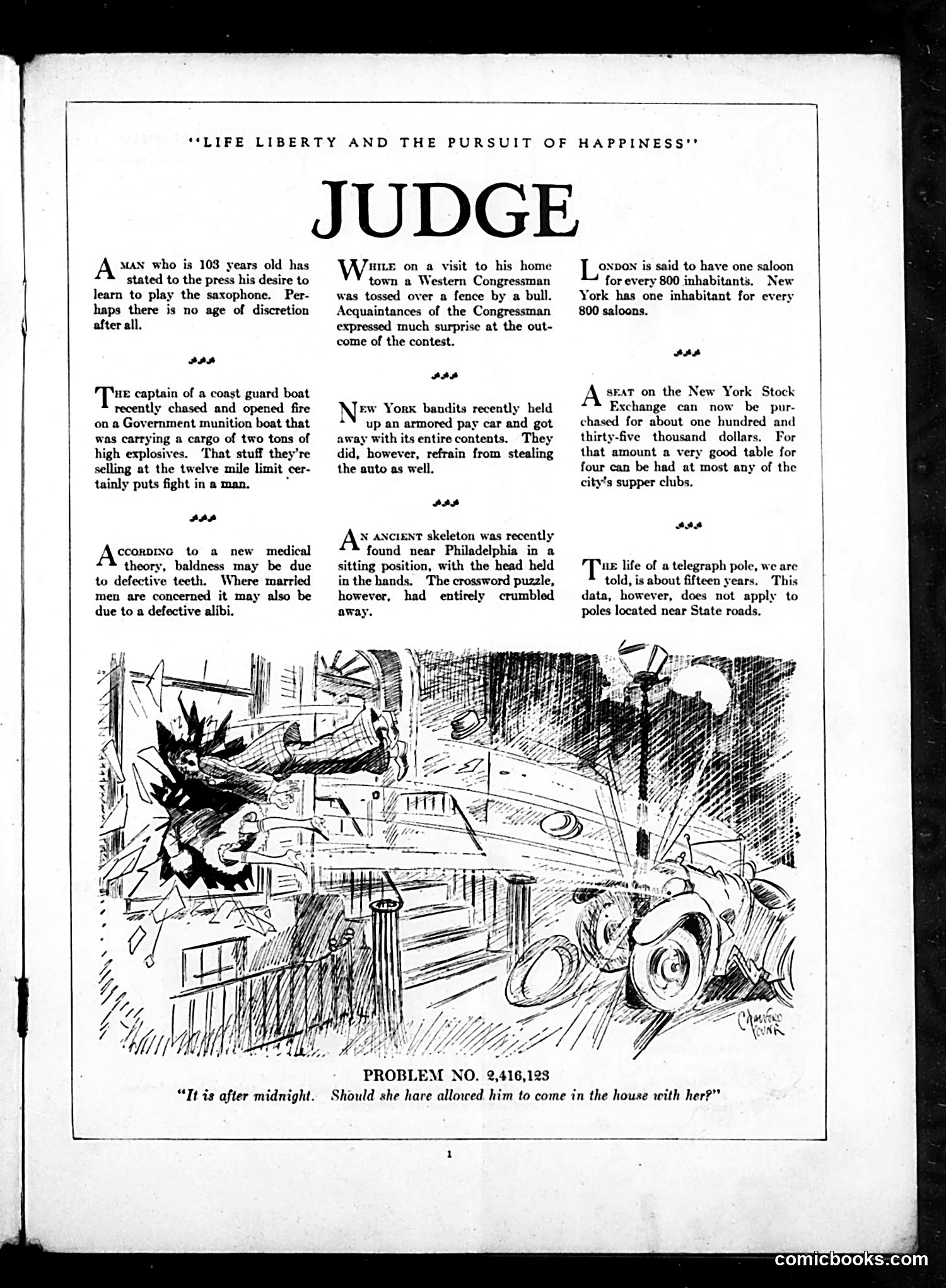
This page contains several brief humorous anecdotes rather than political cartoons. The items mock contemporary absurdities: a 103-year-old man wanting to learn discretion; a Congressman losing a fence-tossing contest with a bull; coast guard procedures for handling munitions; bandit behavior during a car robbery; and a skeleton's preserved sitting position. The main illustrated cartoon shows a chaotic domestic scene—a woman confronting a man arriving home after midnight, with furniture overturned and general disorder. The caption asks whether she should have "allowed him to come in the house with her," suggesting marital conflict and infidelity humor. The page title "Life Liberty and the Pursuit of Happiness" frames these as commentary on ordinary American life's comedic mishaps rather than specific political events.
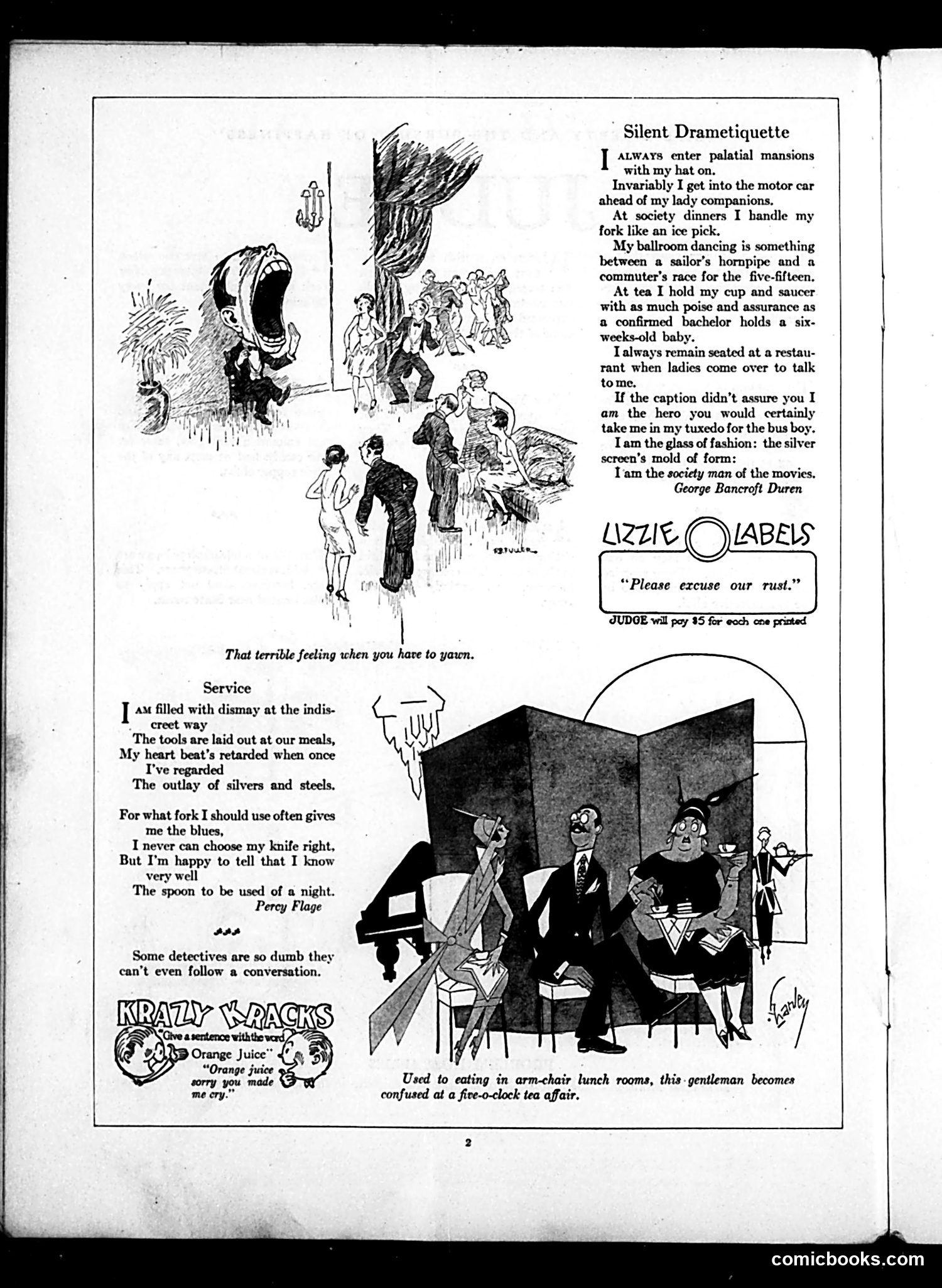
This page contains three humorous pieces satirizing modern etiquette and social awkwardness in the 1920s-30s era. **"Silent Drametiquette"** mocks the exaggerated, theatrical behavior of men in high society—holding teacups with affected precision, dancing poorly, remaining seated while women converse. The quote attributed to George Bancroft Duren criticizes men who perform false sophistication in social situations. **"Service"** satirizes dining etiquette confusion—the embarrassment of not knowing which fork to use, selecting wrong utensils, and general social anxiety at formal meals. **"Krazy Kracks"** is an advertisement for orange juice. The bottom cartoon depicts a man accustomed to casual arm-chair lunches becoming confused at a formal 5 o'clock tea—situational humor about class transitions. These pieces target anxieties about maintaining proper decorum in increasingly formalized social settings.
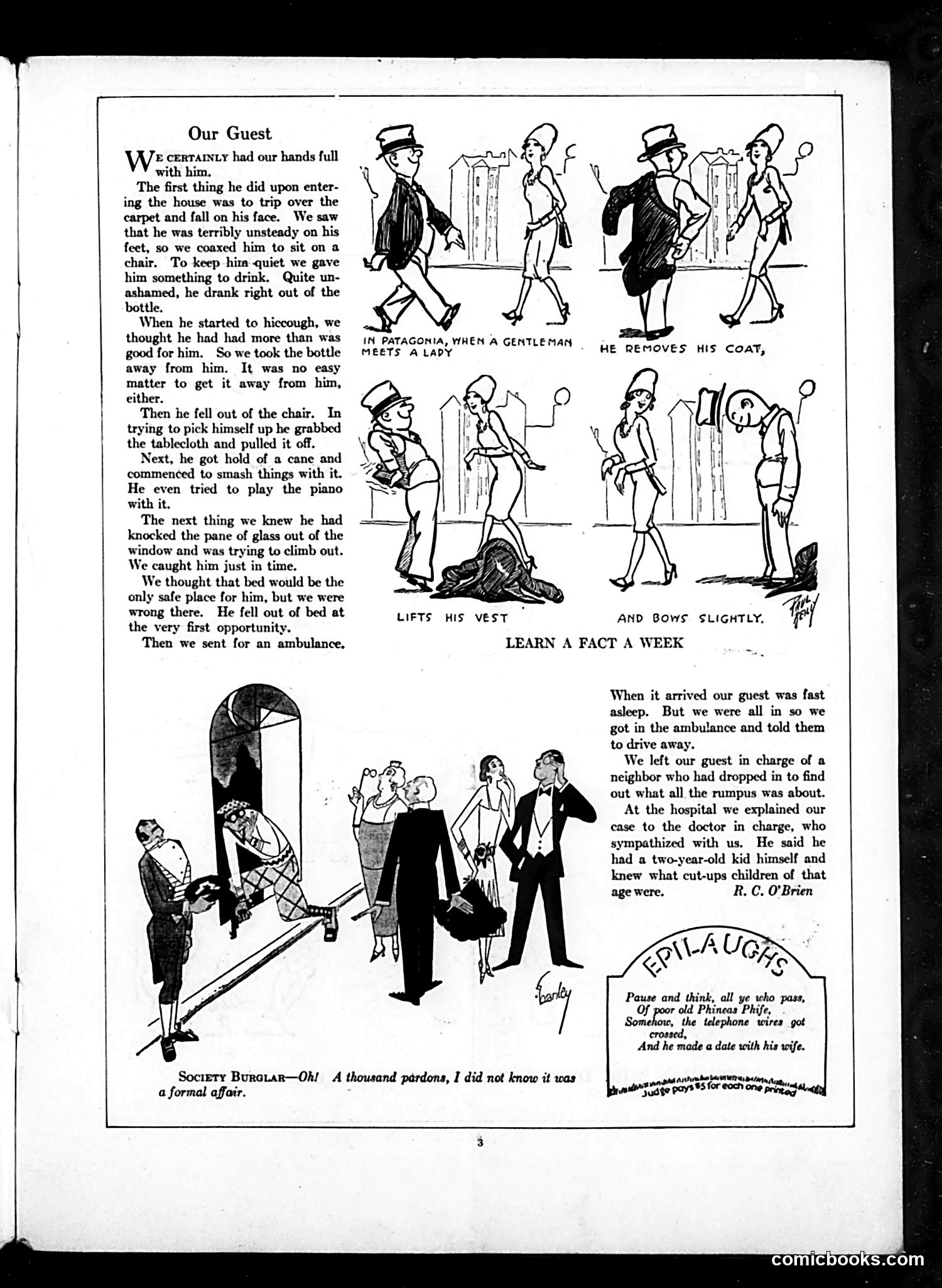
This humorous story depicts a drunk houseguest whose arrival creates domestic chaos. The narrative (left) describes his initial stumble, unsteadiness, and subsequent destructive behavior—knocking out a window pane, breaking furniture, and attempting to play piano while intoxicated. The sequential illustrations (top right) show his increasingly embarrassing conduct, including removing his coat and vest while attempting to bow to his hostess in what appears to be mockery of "Patagonian" social customs—a satirical reference to primitive or uncouth behavior. The final scene shows him being loaded into an ambulance while the mortified hosts explain to neighbors this was merely an unfortunate incident, not a formal social gathering. The satire targets intoxicated guests and their capacity for domestic destruction during social visits.
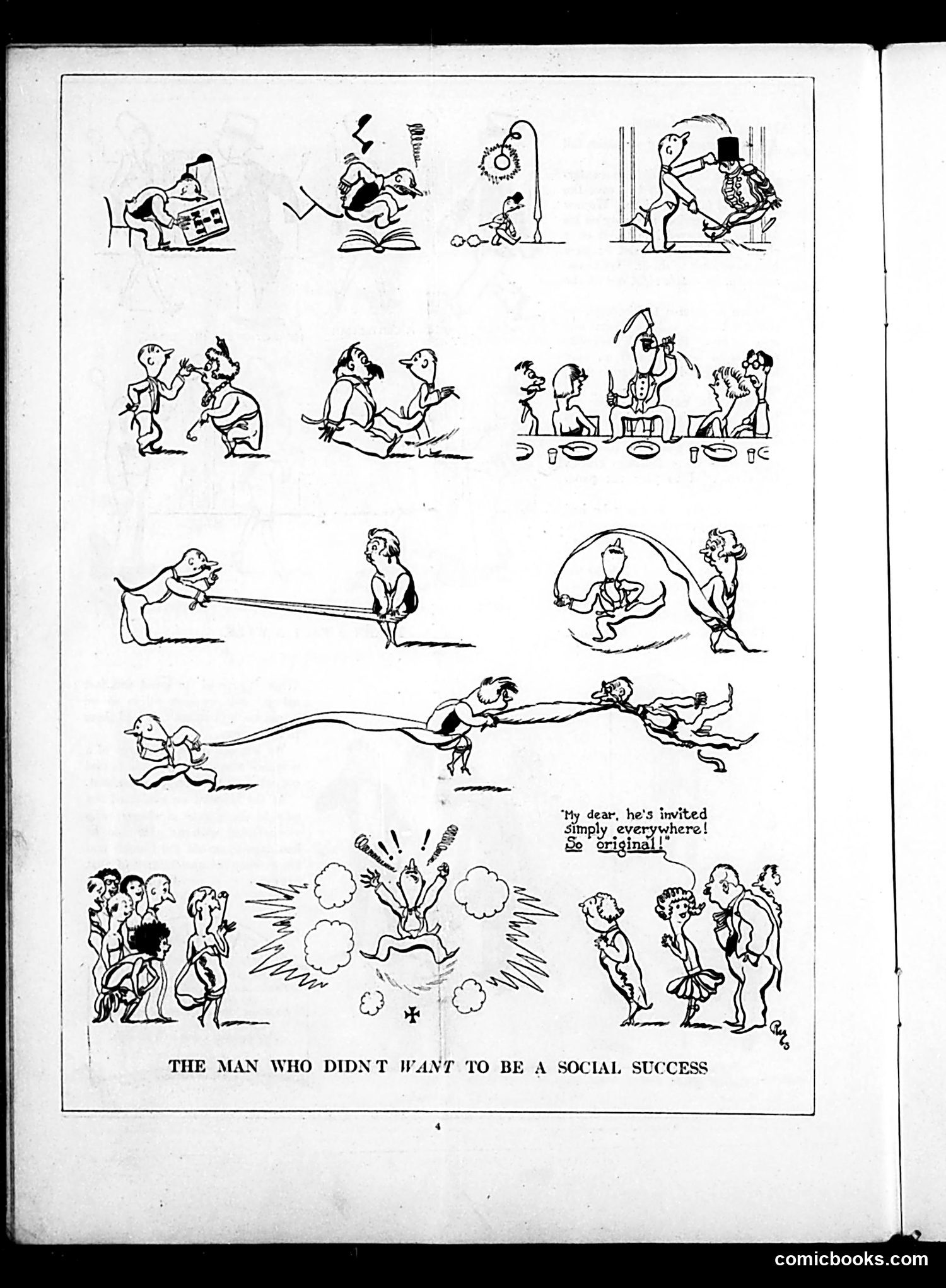
This cartoon satirizes a man who desperately tries to avoid social obligations. The sequential panels show him attempting to evade invitations and social events through increasingly absurd means: hiding, fleeing, using a tug-of-war rope, jumping through a hoop, and enduring an explosion-like confrontation with crowds. The final caption—"My dear, he's invited simply everywhere! So original!"—delivers the ironic punchline: his attempts to be antisocial have paradoxically made him fashionable. His very refusal to participate has become trendy, the opposite of his intention. The cartoon mocks both social climbers desperate for inclusion and the superficial nature of high society, where being exclusive or unusual becomes its own status symbol.
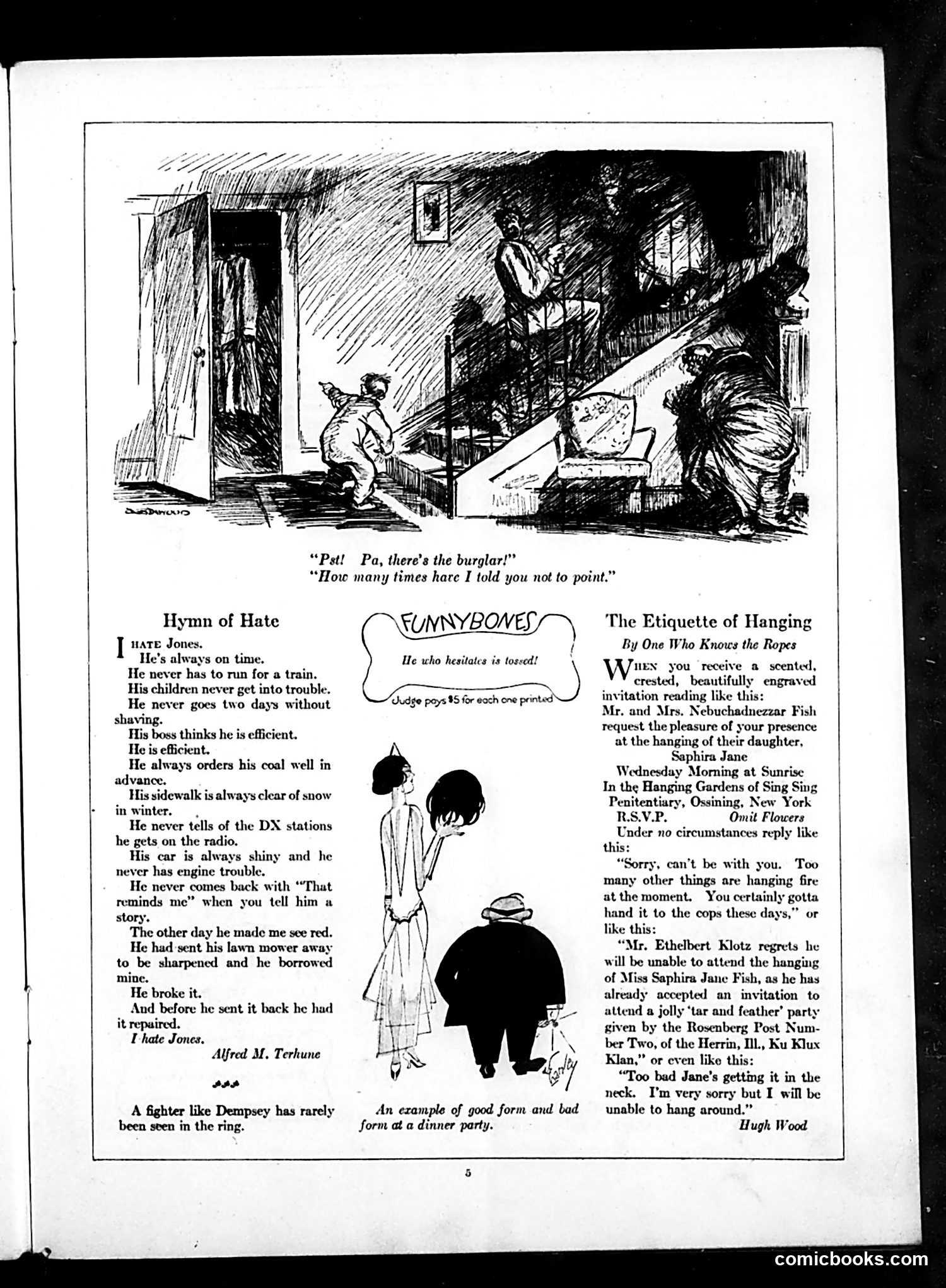
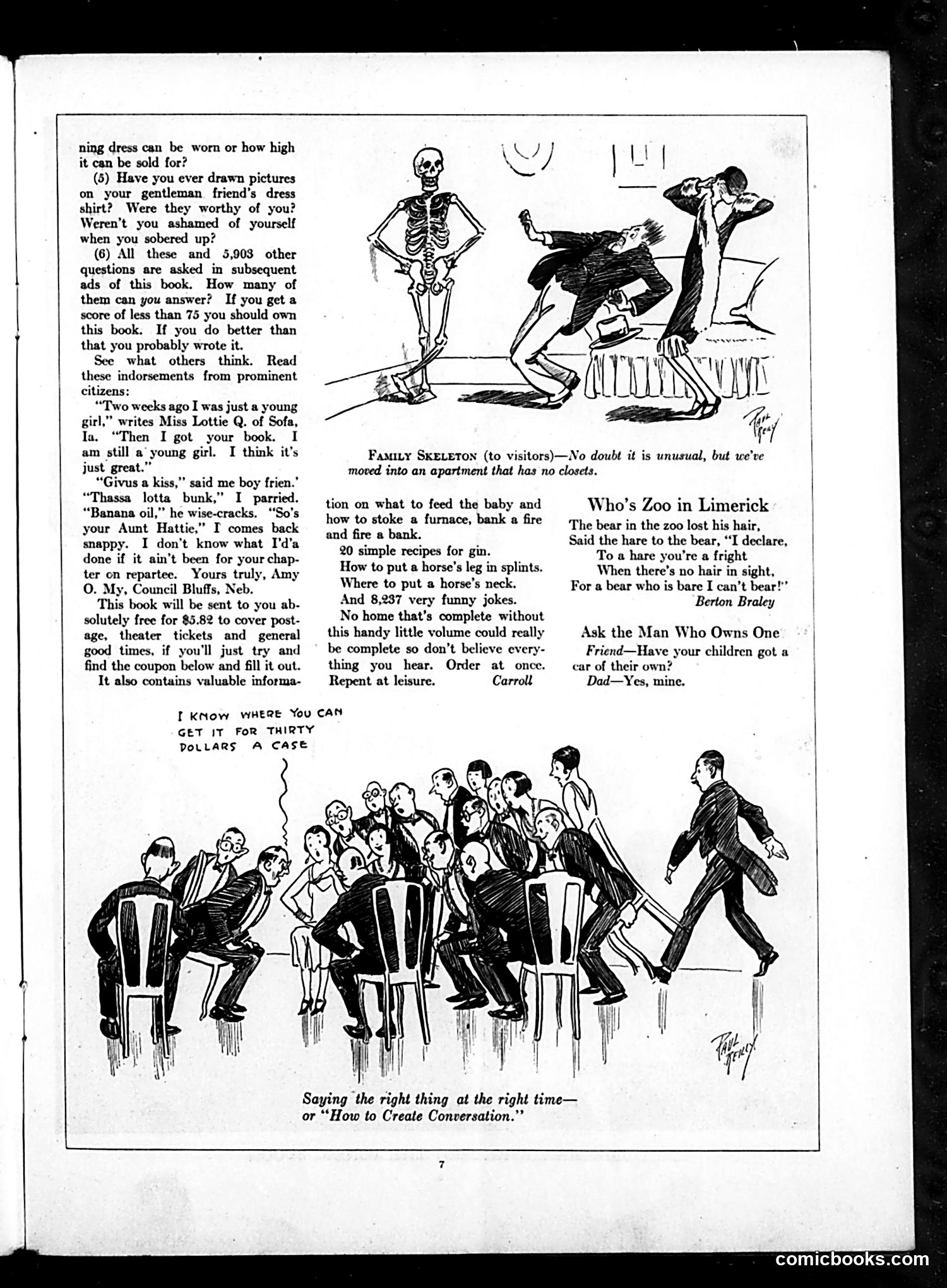
The top cartoon depicts a burglar caught in a home, with the caption "Pat! Pa, there's the burglar!" and the response "How many times have I told you not to point." This is a domestic humor joke about a child pointing at an intruder—the humor lies in the parent's exasperation at the child's rudeness even during a crisis. The "Hymn of Hate" by Alfred M. Terklune mocks Jones, an apparently well-known figure, through a list of irritating personality traits (always late, inefficient, etc.). The detailed complaints suggest Jones was a recognizable public figure, though the specific identity remains unclear without additional context. The right page contains satirical etiquette advice about a hanging, presented as a humorous invitation scenario, typical of Judge's dark social satire from this era.
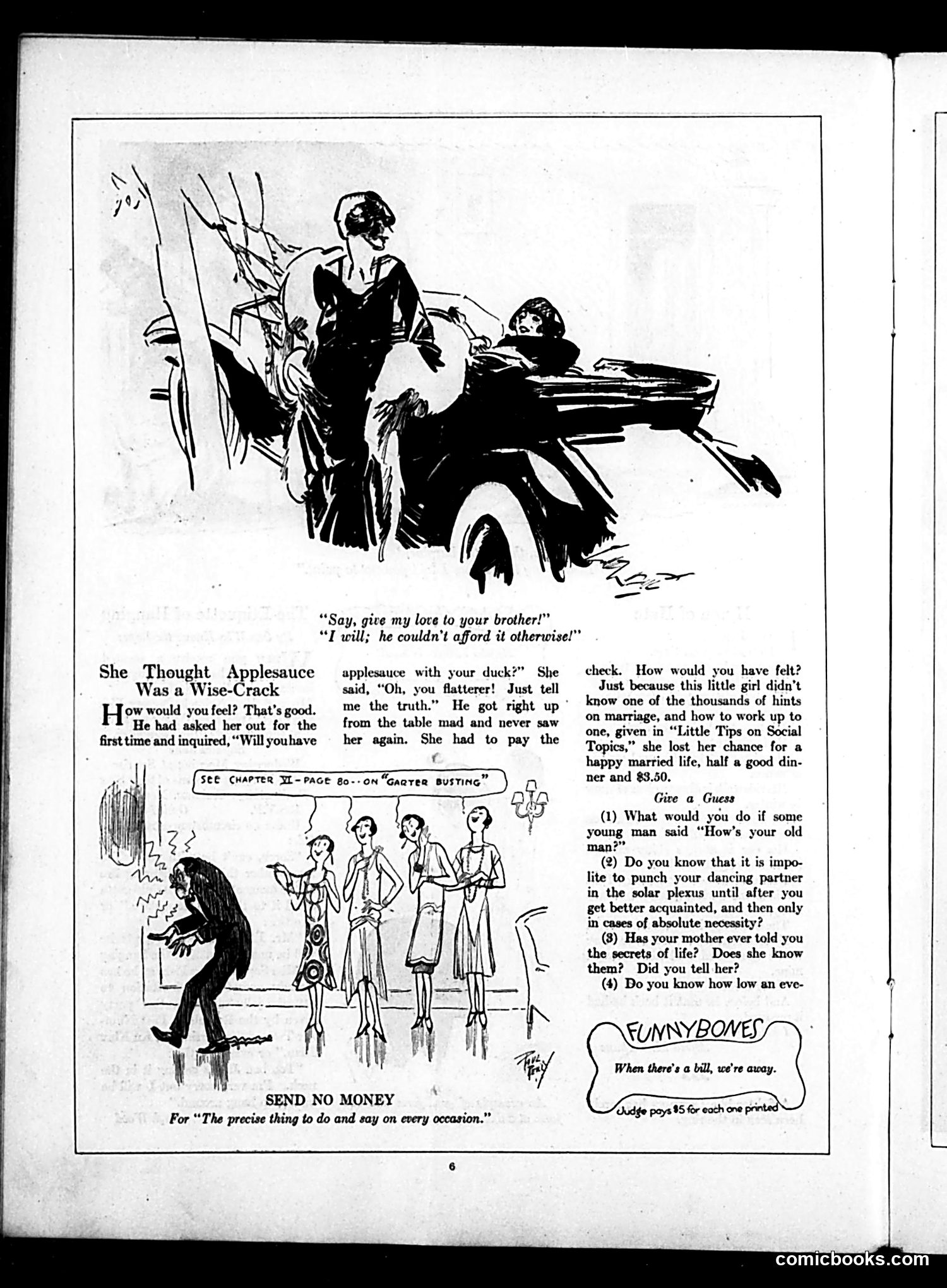
This page contains humor about courtship, etiquette, and marriage from an era when dating customs were formal and heavily governed by social rules. **"She Thought Applesauce Was a Wise-Crack"** satirizes the awkwardness of early dating. A man compliments a woman's appearance ("applesauce" = flattery/nonsense), she takes offense, he leaves angry, and she ends up paying for a cheap dinner alone—the joke being that her rejection of his compliment costs her financially and romantically. **The cartoon below** shows a man being ejected for asking "How's your old man?"—mocking overly strict etiquette rules about what topics are acceptable in polite conversation. **"Give a Guess"** poses rhetorical questions about dating propriety: punching dance partners, discussing life's secrets with mothers, and other social anxieties. The overall theme reflects 1920s-era anxiety about proper behavior in courtship and the gap between official rules and actual human interaction. The humor targets both rigid social conventions and their frequent violation.
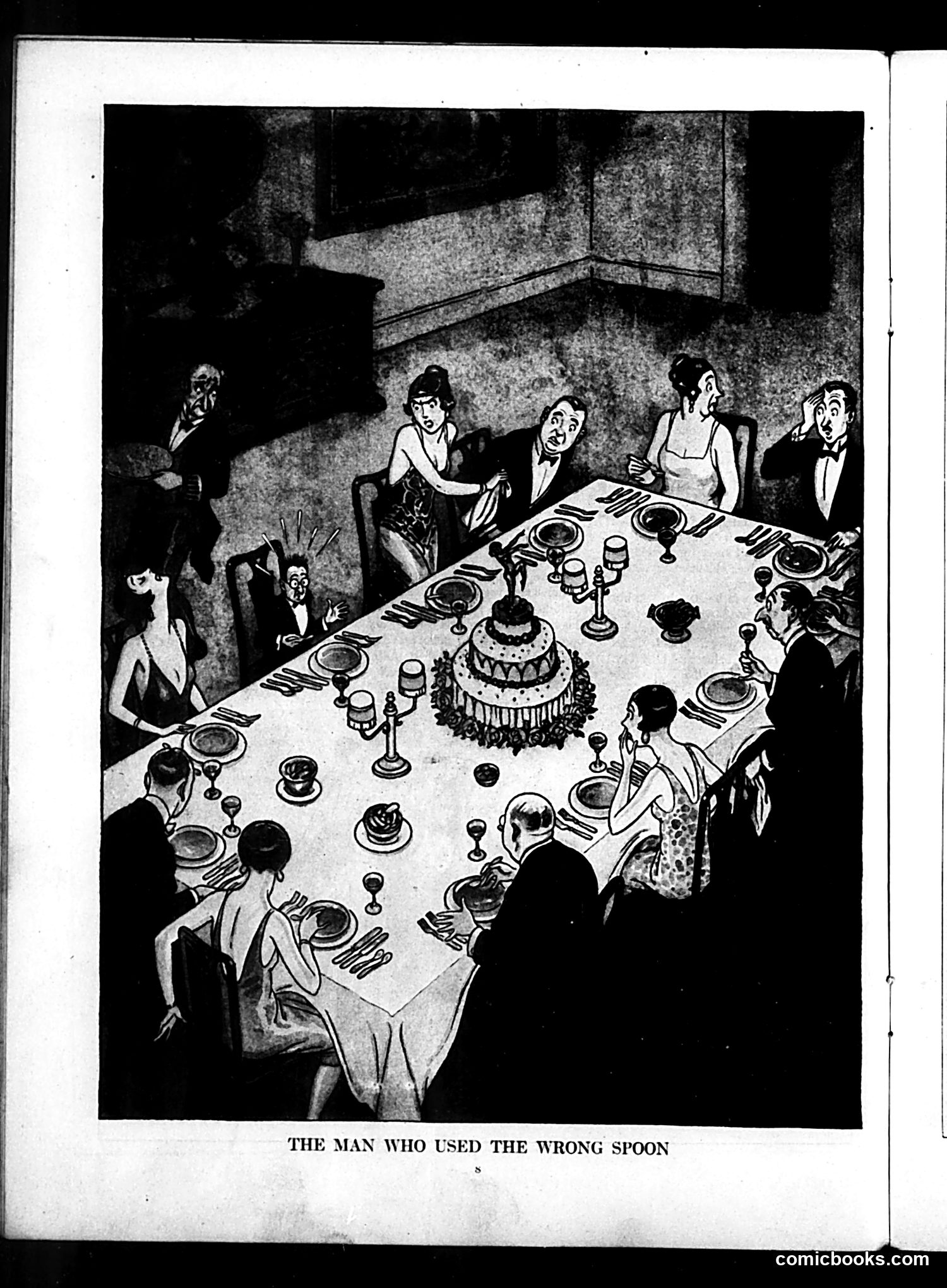
This Judge magazine illustration satirizes social anxiety around etiquette and proper dining conduct. The cartoon depicts a formal dinner party where guests are seated around an elaborate table with a decorative tiered cake centerpiece. The title suggests one diner has committed a faux pas by using an incorrect utensil—a situation that apparently warrants social ridicule. The joke targets the rigid class anxieties of early 20th-century society, where knowledge of proper silverware placement and dining protocol served as a marker of social standing. The other diners' exaggerated expressions indicate shock or judgment at this breach of decorum. The satire mocks both the triviality of such concerns and the social pretension they represent—the notion that using the "wrong" spoon at an upscale gathering constitutes genuine scandal.
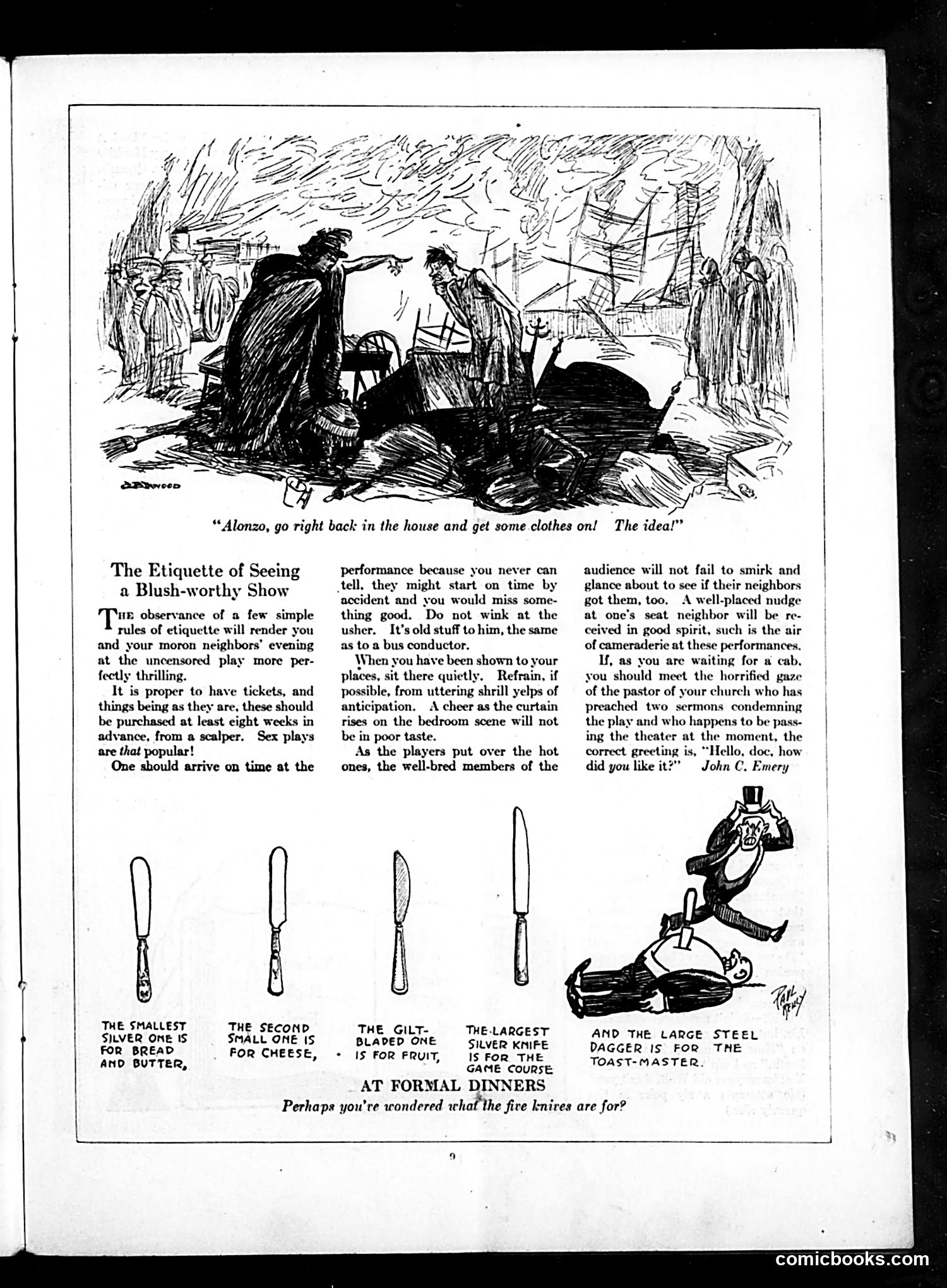
This page satirizes the popularity of risqué theatrical productions ("sex plays") in the 1920s-1930s and the social hypocrisy surrounding them. The cartoon shows a woman scolding a man for appearing in public undressed, while the article mockingly offers "etiquette rules" for attending scandalous plays. The satire targets: 1. **Theater culture**: Sex plays were enormously popular ("that popular!"), yet socially controversial 2. **Social hypocrisy**: The article notes clergy condemning these shows while secretly attending them—hence the joke about greeting your pastor outside the theater with casual friendliness 3. **Audience behavior**: The "well-bred" audience members smirking and nudging neighbors, treating crude humor as sophisticated entertainment The bottom section on formal dinner knives is unrelated filler content. The overall message criticizes middle-class Americans' simultaneous moral posturing and appetite for adult entertainment.
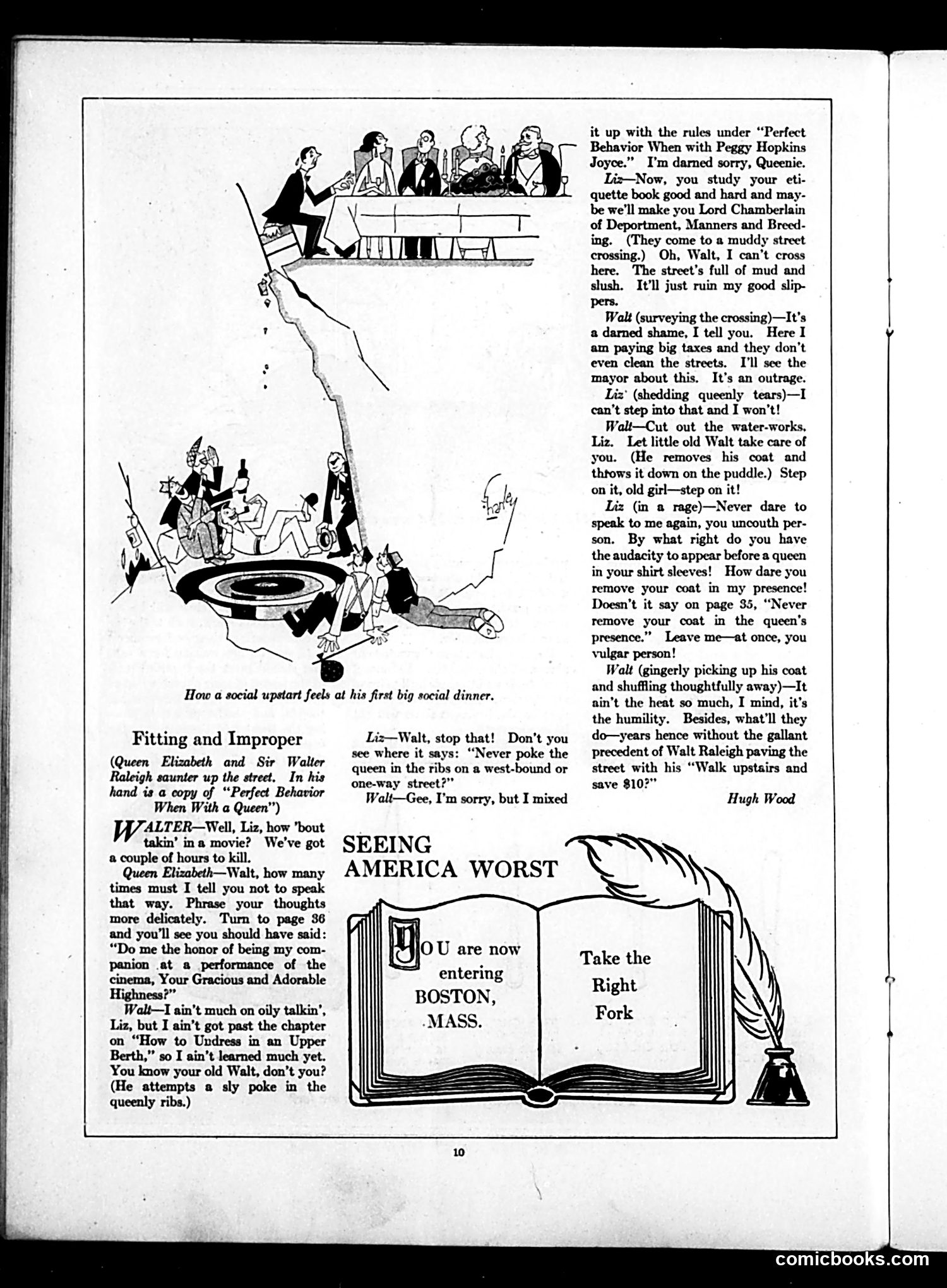
This satirical sketch mocks the absurdity of strict etiquette rules by pairing historical figures Queen Elizabeth and Sir Walter Raleigh with modern (1920s) slang and behavior. Walt speaks colloquially ("takin' in a movie," "how 'bout"), violating the queen's expectations of refined speech. The humor escalates when Walt consults a "Perfect Behavior" etiquette manual—yet still bundles the rules, mixing guidelines for the queen with those for actress Peggy Hopkins Joyce (a 1920s celebrity known for romantic scandals). The punchline satirizes class pretension: when Walt nobly removes his coat to cover a muddy puddle (referencing Raleigh's legendary gallantry), the queen is outraged—not grateful—because etiquette rules forbid removing one's coat in a queen's presence. The cartoon ridicules how rigid social codes contradict genuine kindness and common sense, and how the nouveau riche obsess over arbitrary rules while missing their point entirely.
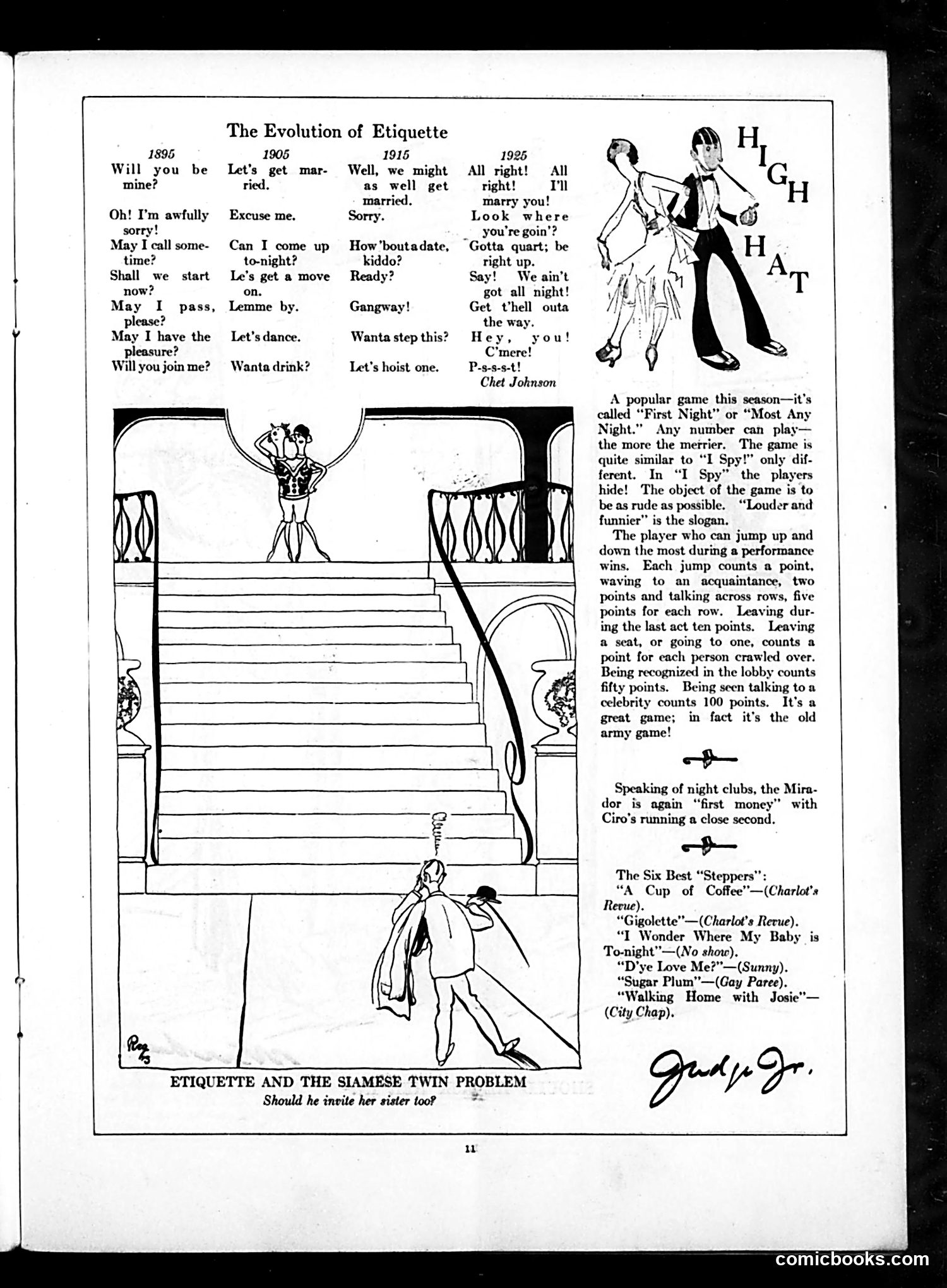
This satirical chart tracks the decline of courtship manners across three decades (1895–1925). In 1895, suitors are formally polite ("Will you be mine?" "May I call sometime?"). By 1905, behavior loosens slightly but remains respectful. By 1925, all pretense vanishes—men are crude and impatient ("Gotta quart; be right up," "Get t'hell outa the way"). The accompanying cartoon shows a woman on stairs encountering increasingly rude behavior, illustrating how social decorum has deteriorated. The text below satirizes a parlor game called "First Night" where players compete by being deliberately rude during theater performances—jumping, waving, talking across rows. This mocks how rudeness has become fashionable entertainment. The page reflects post-WWI anxieties about declining social standards, particularly around male-female interactions and public behavior during the Jazz Age.
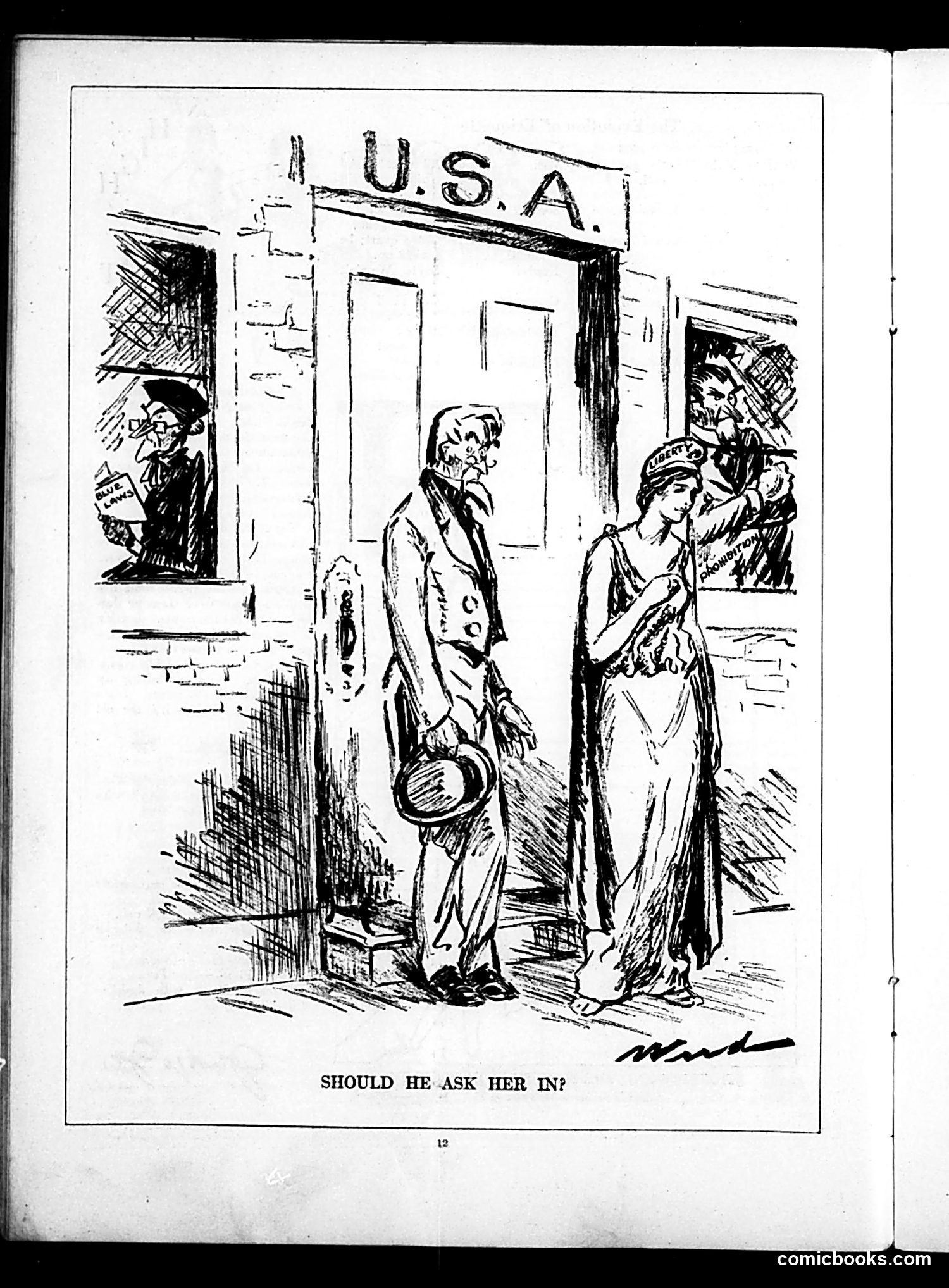
This cartoon depicts a man and woman standing outside a U.S. government building (marked "U.S.A."), with onlookers peering from windows. The caption poses the question "Should he ask her in?" The satire appears to address immigration or admission to America. The well-dressed man and elegantly-attired woman (who appears to be wearing a crown or tiara, suggesting royalty or a foreign nation personified) stand at the threshold. The anxious faces in the windows suggest uncertainty or debate about whether to permit entry. This likely reflects early 20th-century American attitudes toward immigration or international relations—specifically the tension between welcoming newcomers versus restricting entry. The woman's regal appearance suggests she may represent a specific foreign power or immigrant group being debated in contemporary politics.
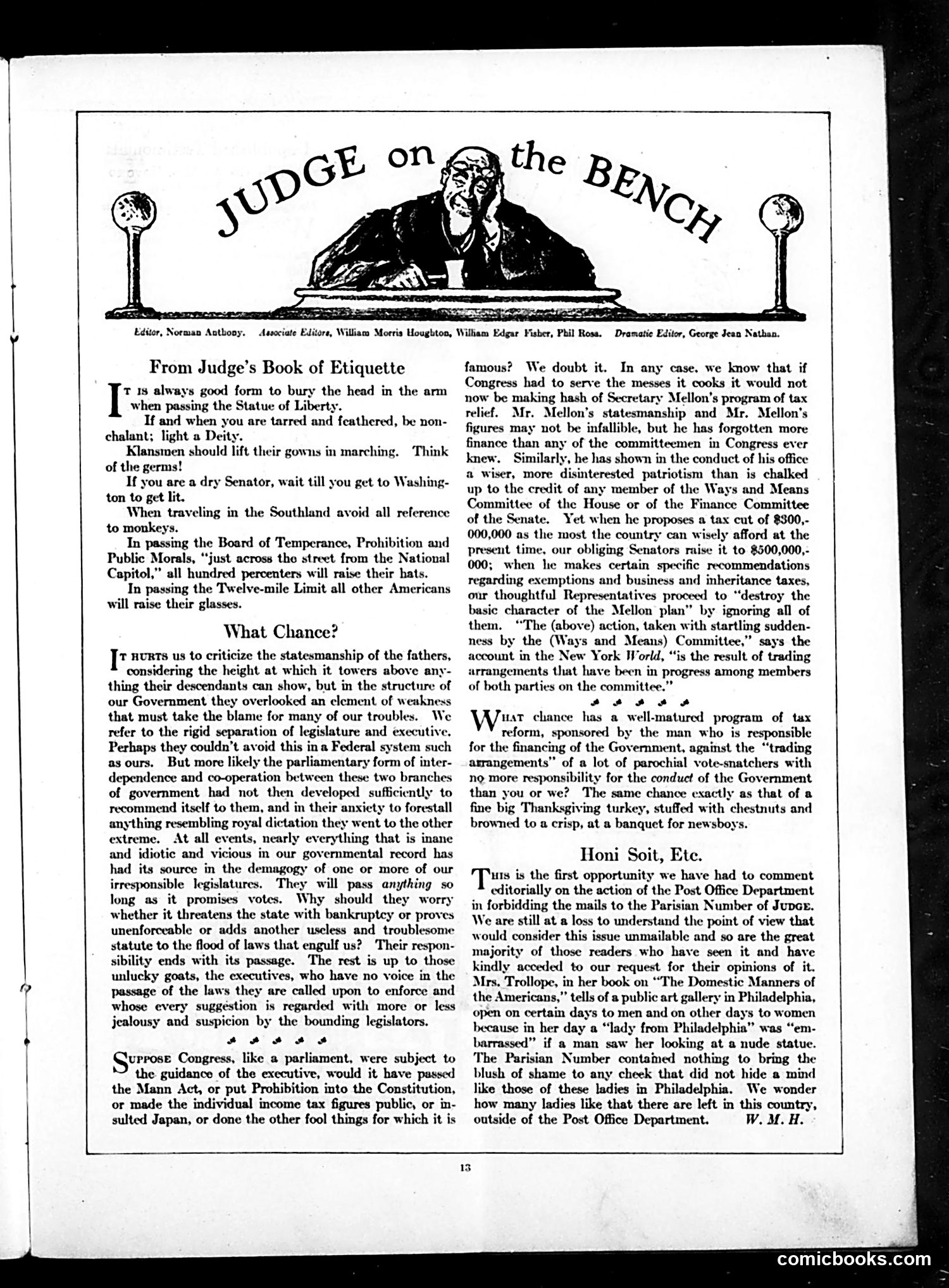
This page contains satirical commentary on American politics and social hypocrisy, circa the Prohibition era (1920s). **"Judge's Book of Etiquette"** mockingly presents absurd "rules" that highlight contemporary scandals: the KKK (reference to "Klansmen" and "tarred and feathered"), Prohibition enforcement ("Twelve-mile Limit"), and corruption among politicians ("dry Senator"). **"What Chance?"** critiques the separation of powers in U.S. government, arguing that Congress passes reckless legislation (specifically mentioning the Mann Act and Prohibition) without accountability since the executive branch must enforce it. **"Honi Soit, Etc."** defends Secretary of the Treasury Andrew Mellon's tax reform proposals against Congressional opposition, suggesting Congress sabotages competent executive plans for political advantage. The overall message attacks legislative irresponsibility, government hypocrisy regarding Prohibition, and the institutional dysfunction created by separating legislative and executive authority.
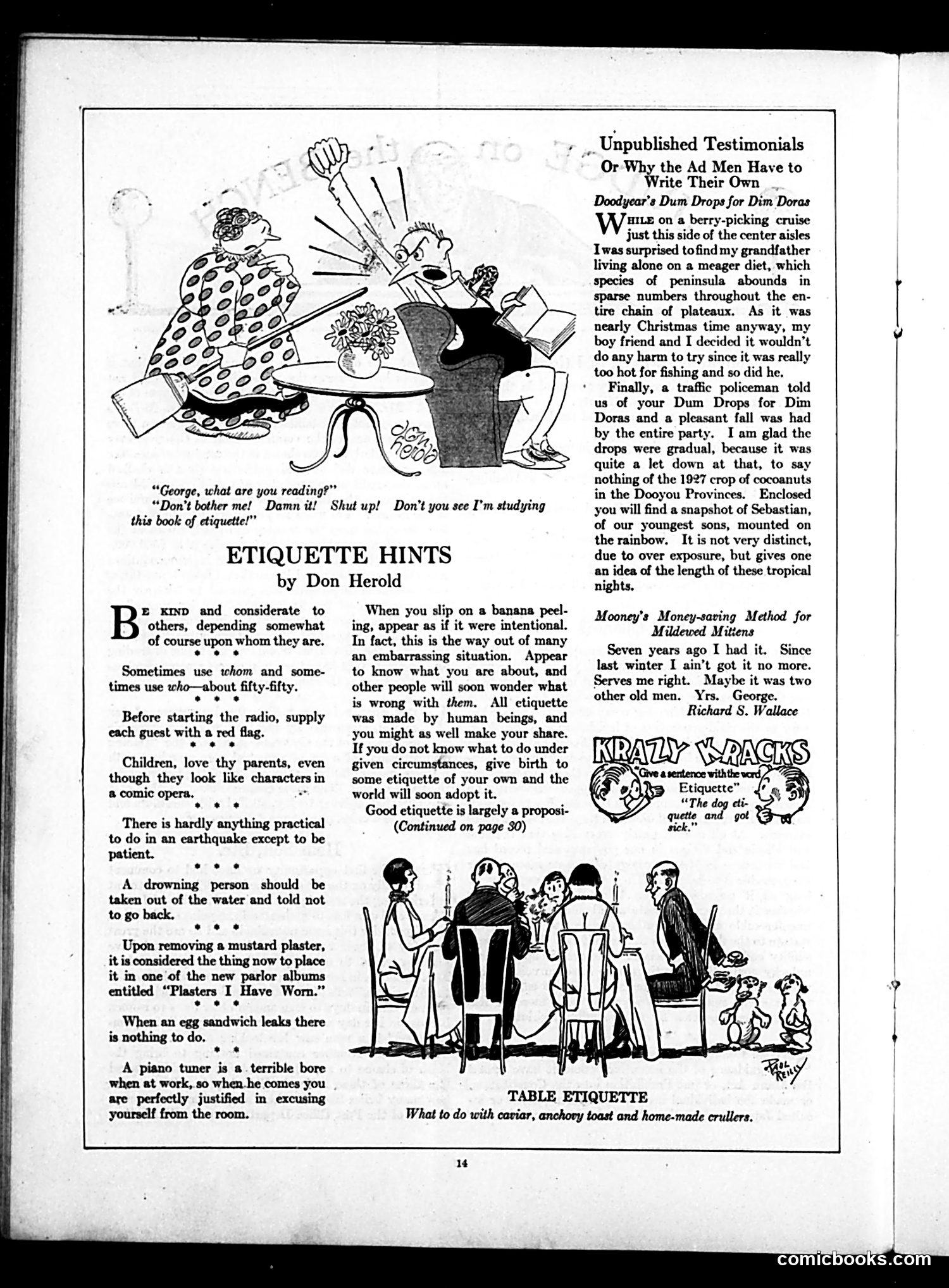
This page from *Judge* magazine contains satirical humor about etiquette and advertising. **The Opening Cartoon**: Shows a man irritably telling his wife to leave him alone while he studies an etiquette book—the irony being that studying etiquette hasn't made him more polite. **"Etiquette Hints" by Don Herold**: This is absurdist humor mocking etiquette advice columns. The "hints" are deliberately ridiculous (supply radio guests with red flags, tell drowning people not to go back, slip on banana peels "intentionally"). The joke is that arbitrary social rules are nonsensical anyway, so people might as well make up their own. **"Unpublished Testimonials"**: These parody the fake testimonials used in early 20th-century advertising. The absurd, rambling "customer reviews" for fictional products like "Dum Drops for Dim Doras" mock how obviously fabricated and bizarre advertising claims were. The gibberish descriptions (grandfather on a "meager diet" in "peninsula" areas, snapshot of a son "mounted on the rainbow") exaggerate the incoherence of real ads from that era. The page satirizes both rigid social conventions and deceptive advertising practices.
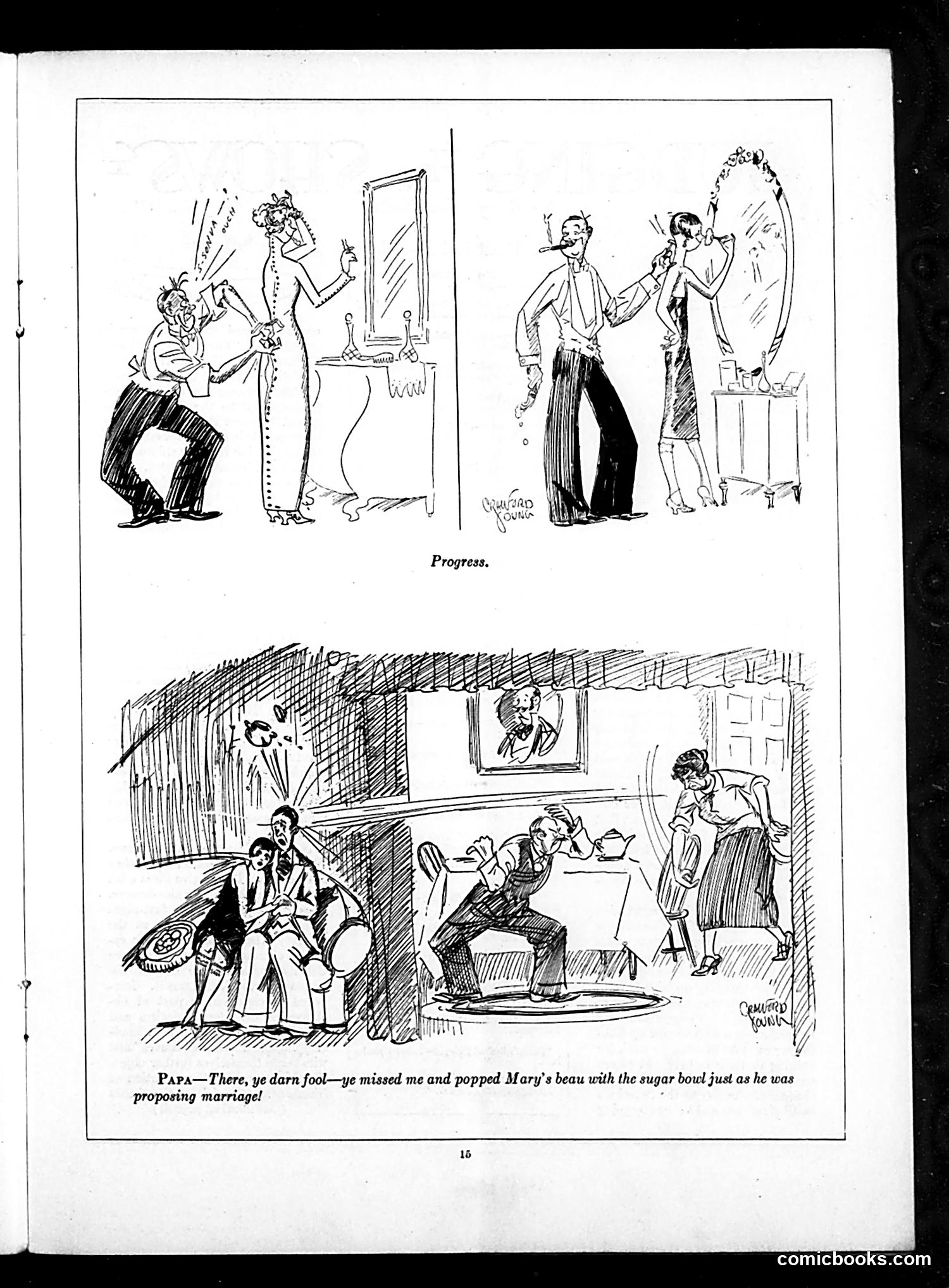
The top panel, titled "Progress," shows the evolution of courtship rituals across two scenes: on the left, a man formally proposes to a woman at her vanity; on the right, she admires herself in a mirror while a man holds her hand—suggesting women's increasing independence and self-focus. The bottom panel depicts a comedic domestic accident: a father, apparently attempting to hit someone with a sugar bowl, accidentally strikes his daughter's boyfriend during a marriage proposal. The caption has the father blaming "ye darn fool" for the mishap, though he himself caused it. The humor relies on physical comedy and the irony that despite "progress" in courtship customs, chaotic family dynamics and poorly-aimed violence remain constant. The satire gently mocks both romantic formality and working-class domestic chaos.
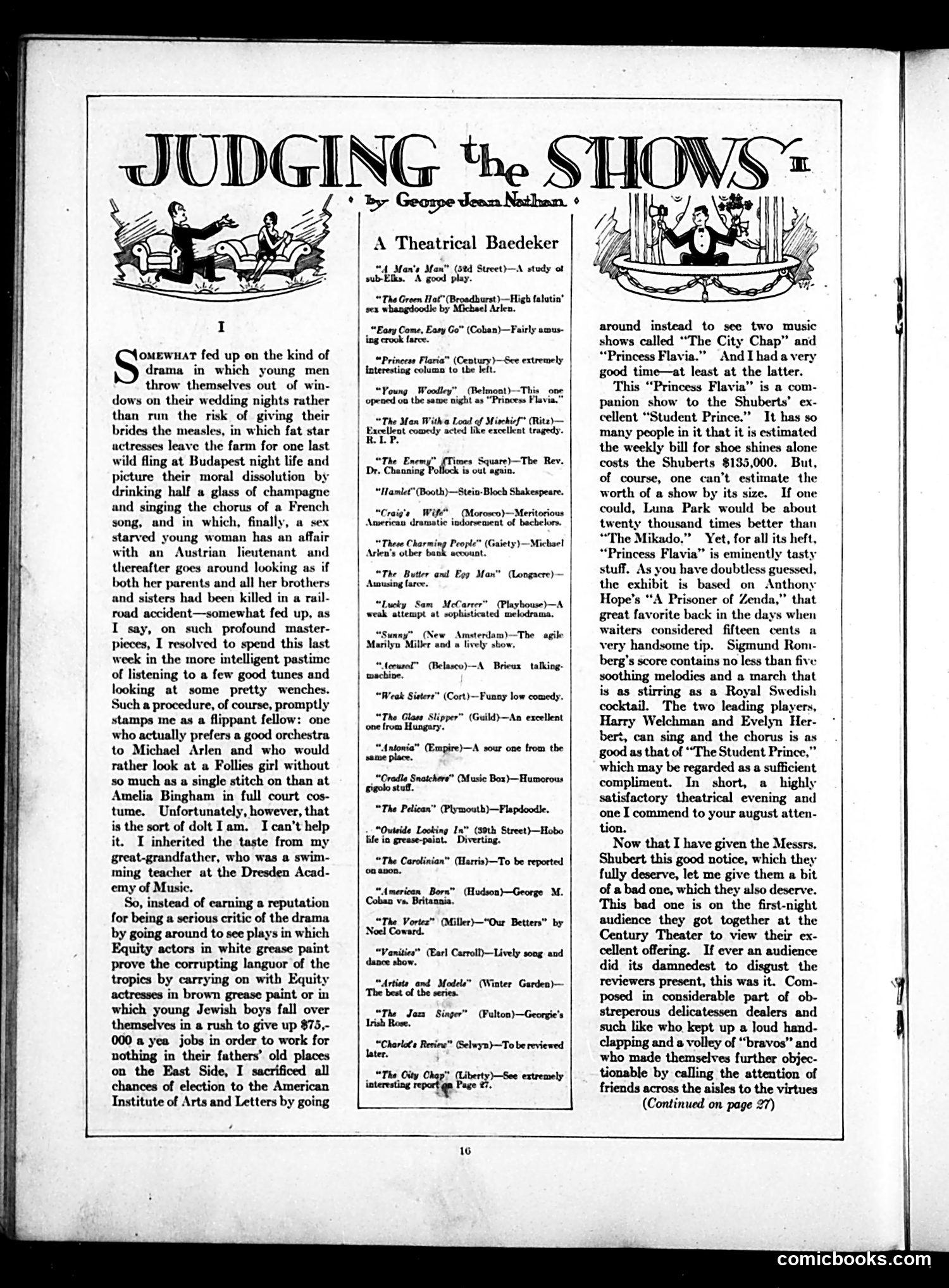
This is a theater review column by George Jean Nathan, a prominent drama critic of the 1920s. The accompanying illustrations show theater scenes with audiences and performers. **The Satire:** Nathan opens with mock-serious criticism of pretentious "art" dramas—plays featuring sexual transgression, moral decay, and psychological suffering treated as profound. He mocks their earnestness: characters throwing themselves from windows over measles, actresses dramatizing drinking champagne as moral dissolution. **The Point:** Nathan positions himself as preferring entertainment (orchestras, pretty women, "Follies girls") over self-important theatrical seriousness. He sarcastically claims this preference disqualifies him from respectability—he'll never join the American Institute of Arts and Letters because he'd rather enjoy himself than pontificate. **The Context:** This reflects 1920s theatrical debates between "serious" modernist drama and popular entertainment. Nathan defends populism and pleasure against pretentious intellectual criticism. The "Theatrical Baedeker" listing shows Nathan reviewing current Broadway productions with similarly irreverent one-liners, dismissing some as derivative of Michael Arlen or mere "flapdoodle."
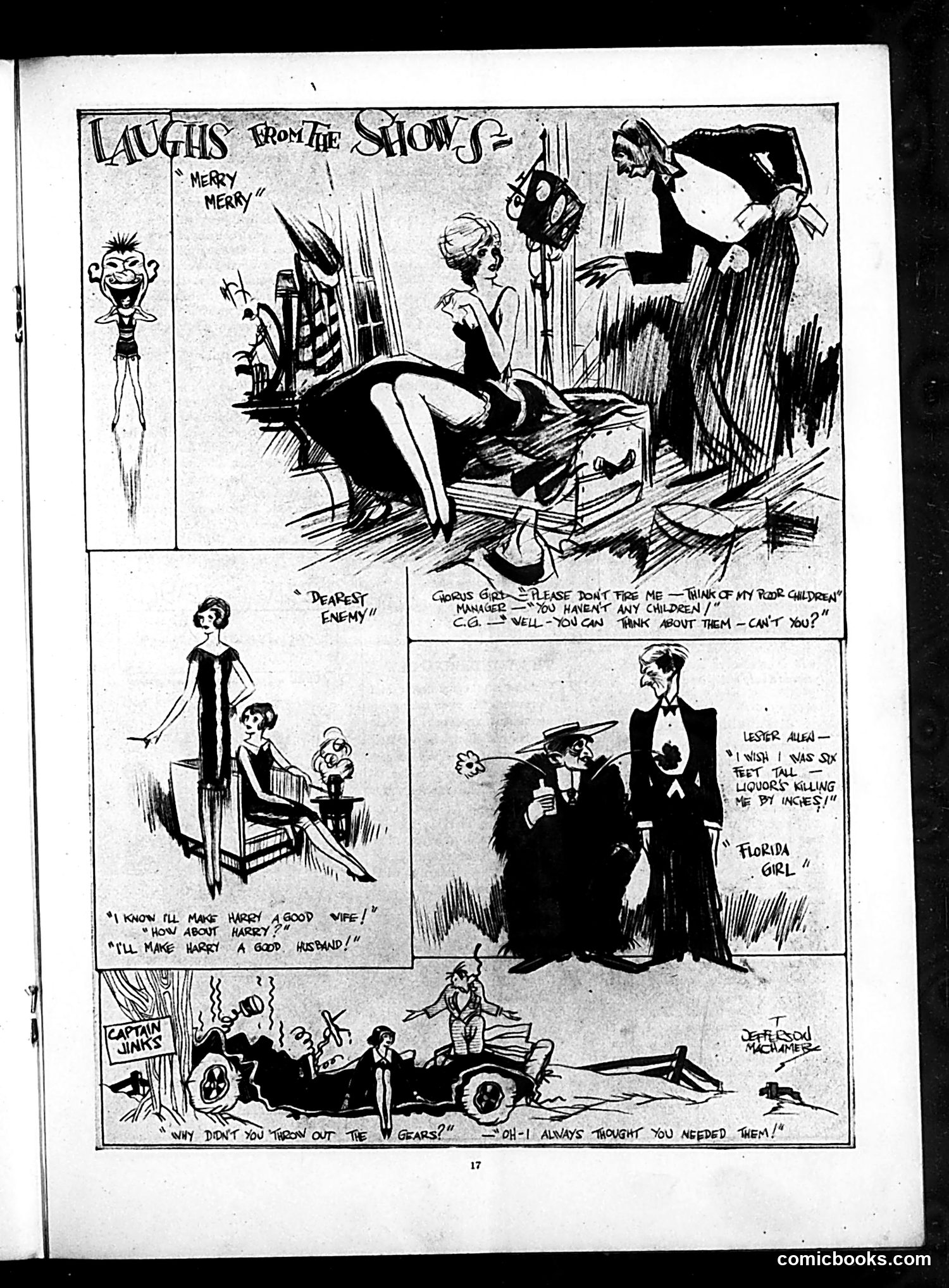
This is a theatrical satire featuring multiple vignettes mocking show-business characters and marital dynamics. The top scene depicts a circus or theatrical manager confronting a performer about her children, with the "Circus Girls Manager" callout indicating this concerns stage performers' domestic situations. The middle panels show variations on the theme of wives strategizing about marriage—one woman claims she'll "make Harry a good wife," while another boasts she'll "make Harry a good husband," reversing traditional gender expectations for comedic effect. The bottom scene references "Captain Jinks" and involves what appears to be an automobile accident, with dialogue about "throwing out the gears"—suggesting mechanical incompetence as humor. The overall satire targets theatrical world pretensions, gender role reversals in marriage, and physical comedy. The crude, exaggerated drawings and slapstick scenarios are typical of Judge magazine's style satirizing popular entertainment and contemporary social attitudes.
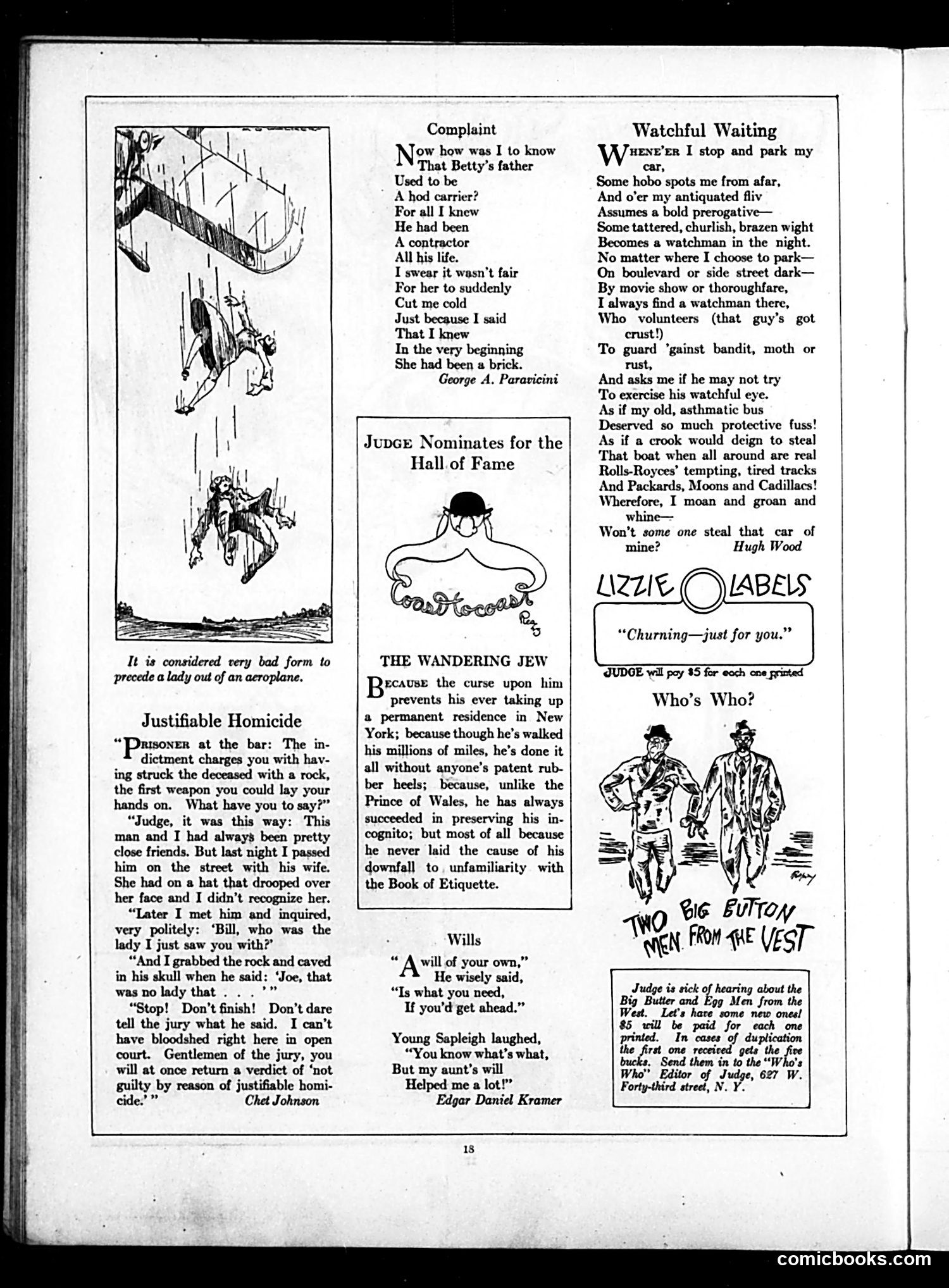
This page contains several satirical pieces from Judge magazine: **"Justifiable Homicide"** mocks courtroom decorum. A man strikes another with a rock after being insulted—the judge stops him before he can repeat the slur in court, then directs the jury to acquit him for "justifiable homicide," satirizing how certain insults were considered so offensive they warranted violence. **"Complaint"** by George A. Paravicini ridicules class anxiety: a man cuts off a woman after learning her father was a hod carrier (manual laborer), not a contractor, though she'd been a "brick" (reliable person) all along—mocking snobbish social climbing. **"The Wandering Jew"** nominates the legendary figure for a "Hall of Fame," praising him for never settling in New York, always maintaining anonymity, and crucially, never blaming his misfortunes on ignorance of etiquette—a satirical jab at blaming social failure on poor manners. **"Watchful Waiting"** humorously complains about vagrants who volunteer to guard parked cars overnight, seeking tips. **"Lizzie Labels"** and **"Who's Who?"** are humorous section headers soliciting reader submissions.
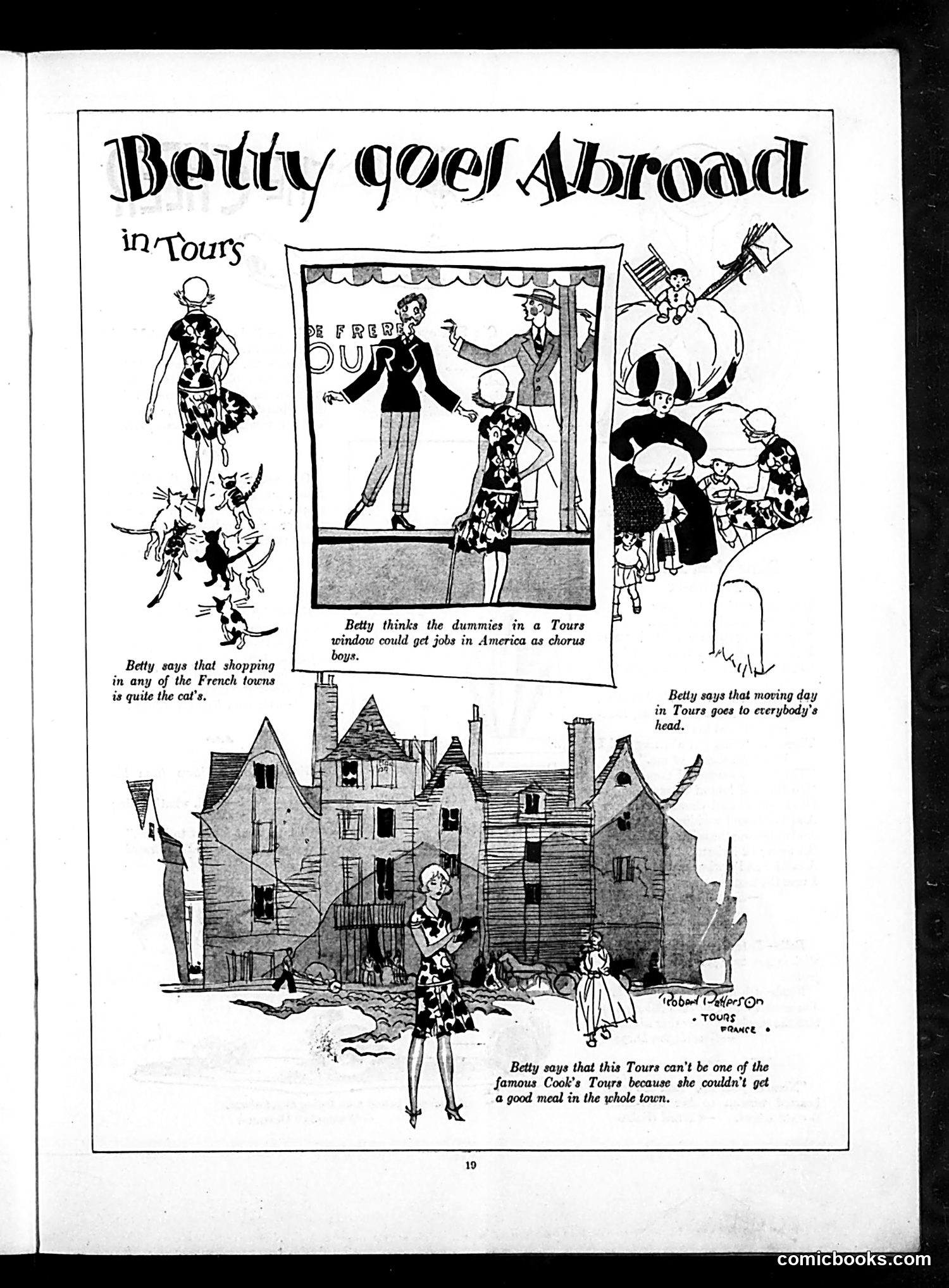
This comic follows "Betty," an American tourist in Tours, France, making satirical observations about European travel. The humor targets both American tourists and European destinations. The satire critiques: 1. **American cultural superiority**: Betty judges French architecture and commerce by American standards, finding them lacking 2. **Tourist superficiality**: She comments on shopping ("quite the cat's") and meals rather than cultural appreciation 3. **Cook's Tours**: References the famous pre-packaged tourist company, suggesting Betty expects standardized, comfortable experiences rather than authentic travel 4. **Food complaints**: A jab at French cuisine or Tours' restaurants not meeting American expectations The "dummies in a Tours window" joke suggests even mannequins could find work as chorus girls in America—implying American entertainers are interchangeable or that American standards are lower. The overall tone mocks Americans abroad as materialistic, demanding comfort, and unable to appreciate foreign culture on its own terms.
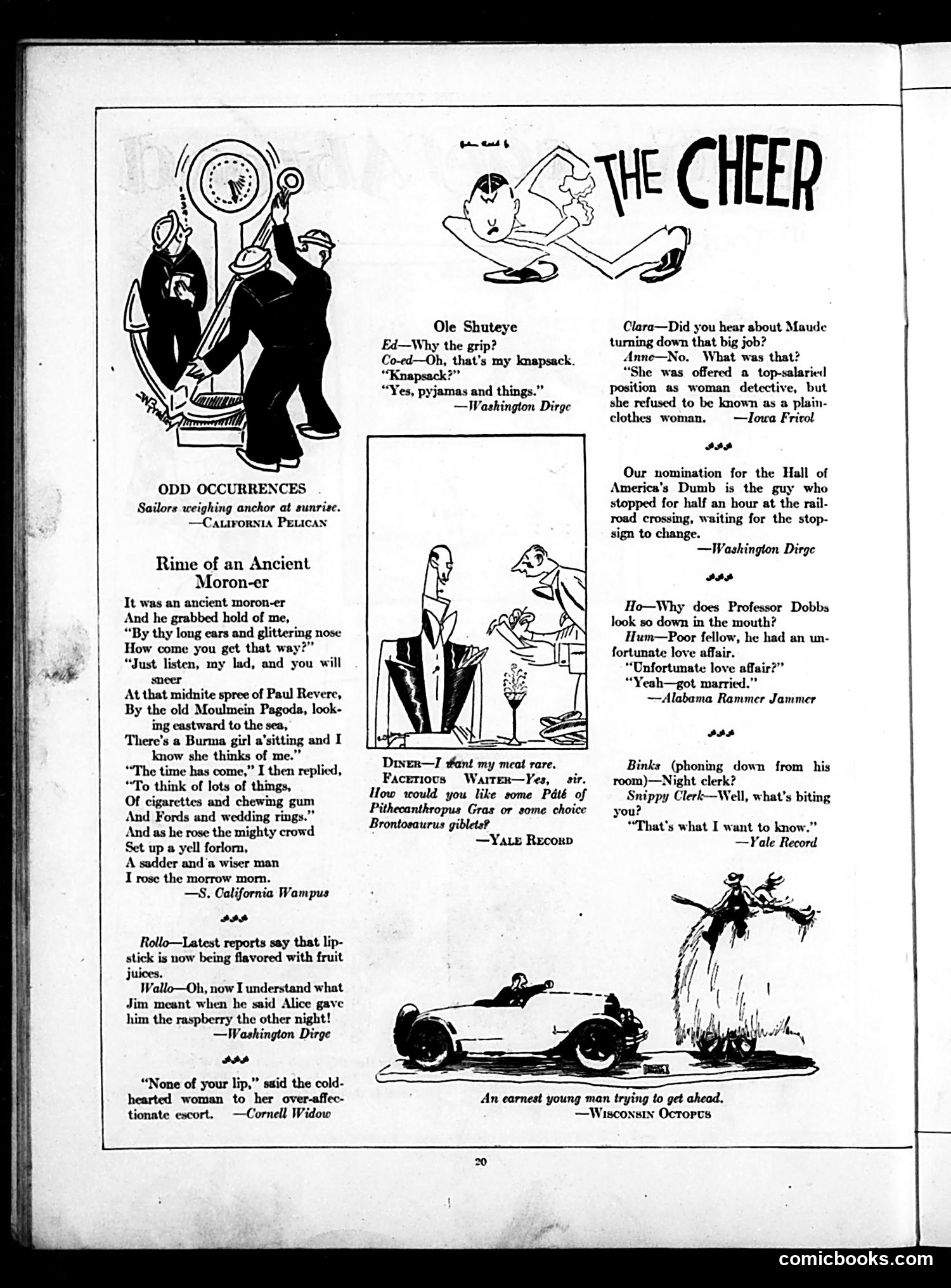
This is a humor page featuring short jokes and quips collected from various college newspapers and publications (indicated by attribution lines like "—Washington Dirge," "—Yale Record," "—Iowa Friol"). The content reflects 1920s campus and social comedy: co-eds carrying knapsacks with pajamas, lipstick flavored with fruit juices, jokes about plain-clothes detectives, and references to Fords (automobiles). There's wordplay on slang ("gave him the raspberry"), romantic mishaps, and domestic humor ("got married" as an unfortunate outcome). The cartoons are simple visual gags: figures weighing anchors at sunrise, a diner ordering exotic meats, and a motorist trying to pass ahead. The page satirizes college life, modern dating culture, and everyday absurdities of the era through mild, publishable wit—typical of Judge's lighthearted approach to American social commentary during the Jazz Age.
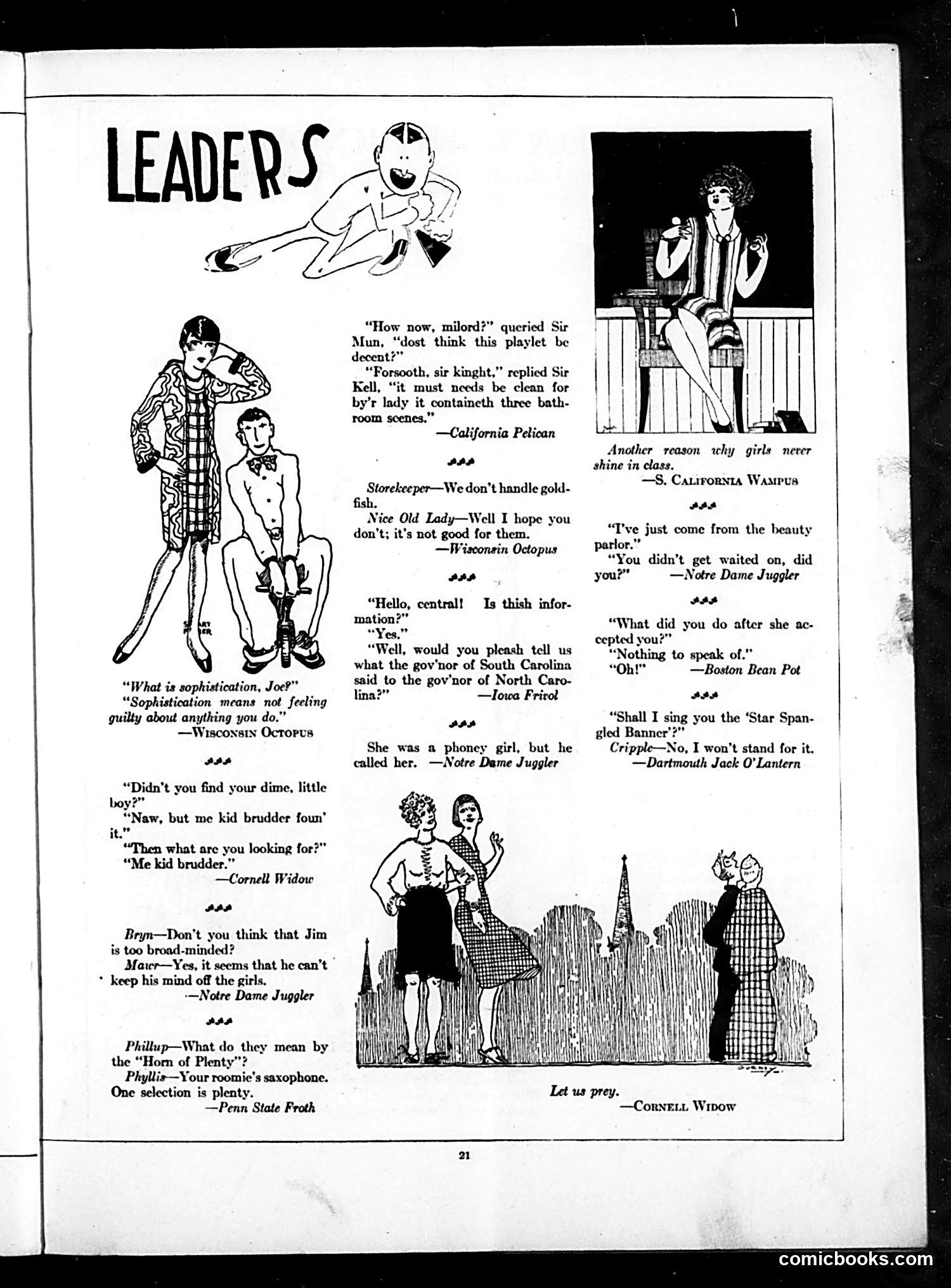
This is a **humor compilation page** from college and university humor magazines (Wisconsin Octopus, Notre Dame Juggler, Penn State Froth, etc.), not political satire. The jokes target: 1. **Moral relativism** ("sophistication means not feeling guilty") 2. **Urban working-class dialect humor** (the "kid brudder" joke using exaggerated accent) 3. **Dating/relationship mockery** (Jim being "broad-minded" about girls; the "phoney girl" joke) 4. **Prohibition-era references** (goldfish swallowing was a 1920s fad; the saxophone "Horn of Plenty" pun) 5. **Disability humor** (the wheelchair pun about the national anthem) The cartoon illustrations show flapper-era fashion and the "Let us prey" caption (pun on "pray") features church spires—likely mocking college attitudes toward religion. The page reflects **1920s college culture**: irreverent, cynical about morality, obsessed with dating, and using working-class/ethnic dialect as comedic fodder. These were syndicated jokes from competing university publications—a common collegiate competition of the era.
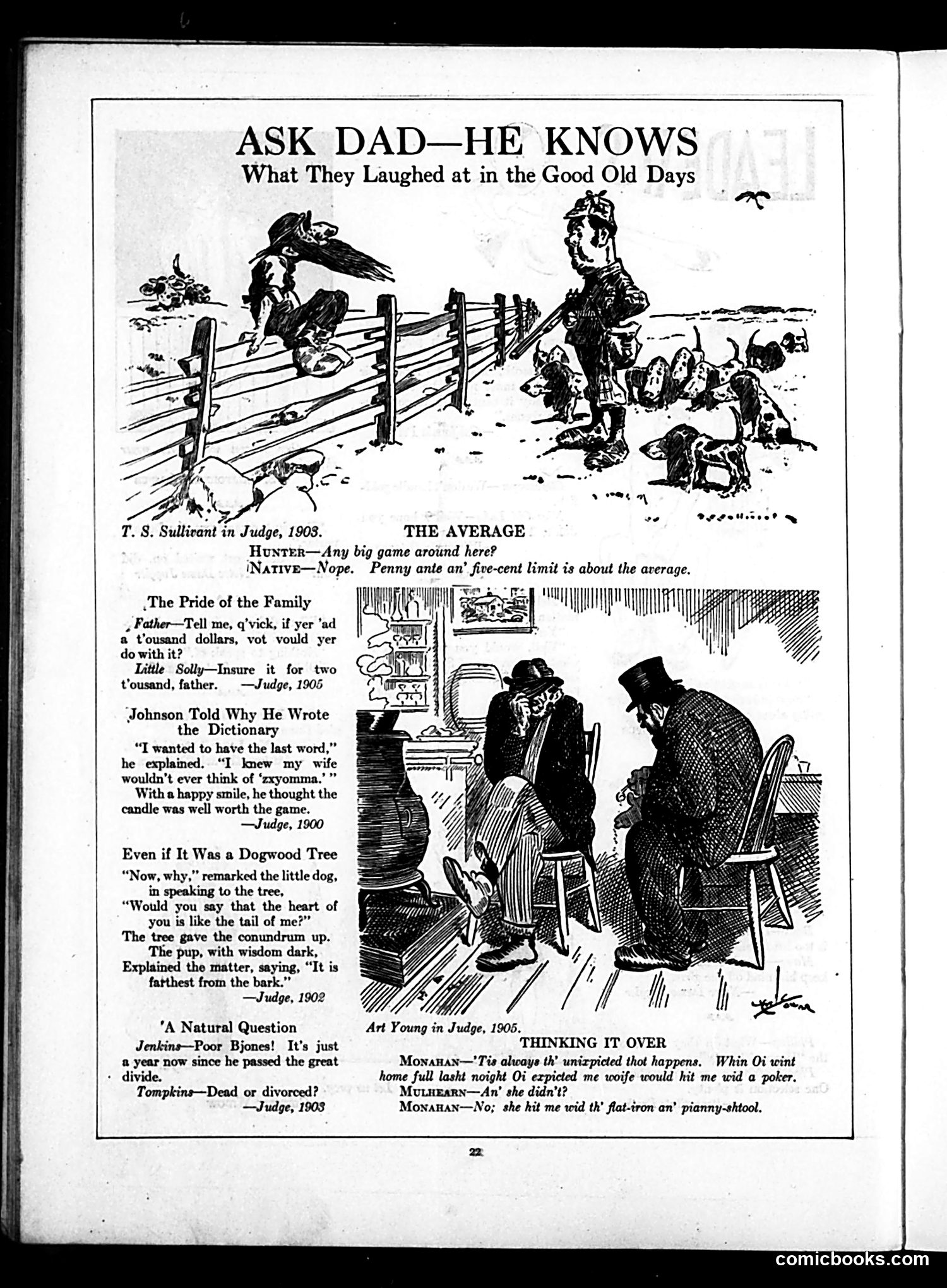
This page collects humorous anecdotes from early 1900s Judge magazine, aimed at nostalgic readers asking "what made our fathers laugh?" **The cartoons satirize:** 1. **"The Average"** — Mocks frontier life as small-time gambling (penny-ante poker), deflating romantic notions of the Wild West. 2. **"Pride of the Family"** — A Jewish immigrant father's son boasts he'd fraudulently insure money for double its value—satirizing perceived immigrant dishonesty and greed through exaggerated Yiddish dialect. 3. **"Johnson's Dictionary"** — Humorously suggests Dr. Johnson compiled his dictionary just to have the final word against his wife, mocking marital power struggles. 4. **"Dogwood Tree"** — A sentimental riddle about a dog and tree (the dog's tail is "farthest from the bark"). 5. **"Natural Question"** — Irish immigrants (indicated by thick brogue) joke about domestic violence—the husband expects his wife will hit him with a poker, but she surprises him by using a flat-iron and piano stool instead. The page reflects period attitudes: ethnic stereotyping, gender humor centered on spousal conflict, and nostalgia for "simpler times."
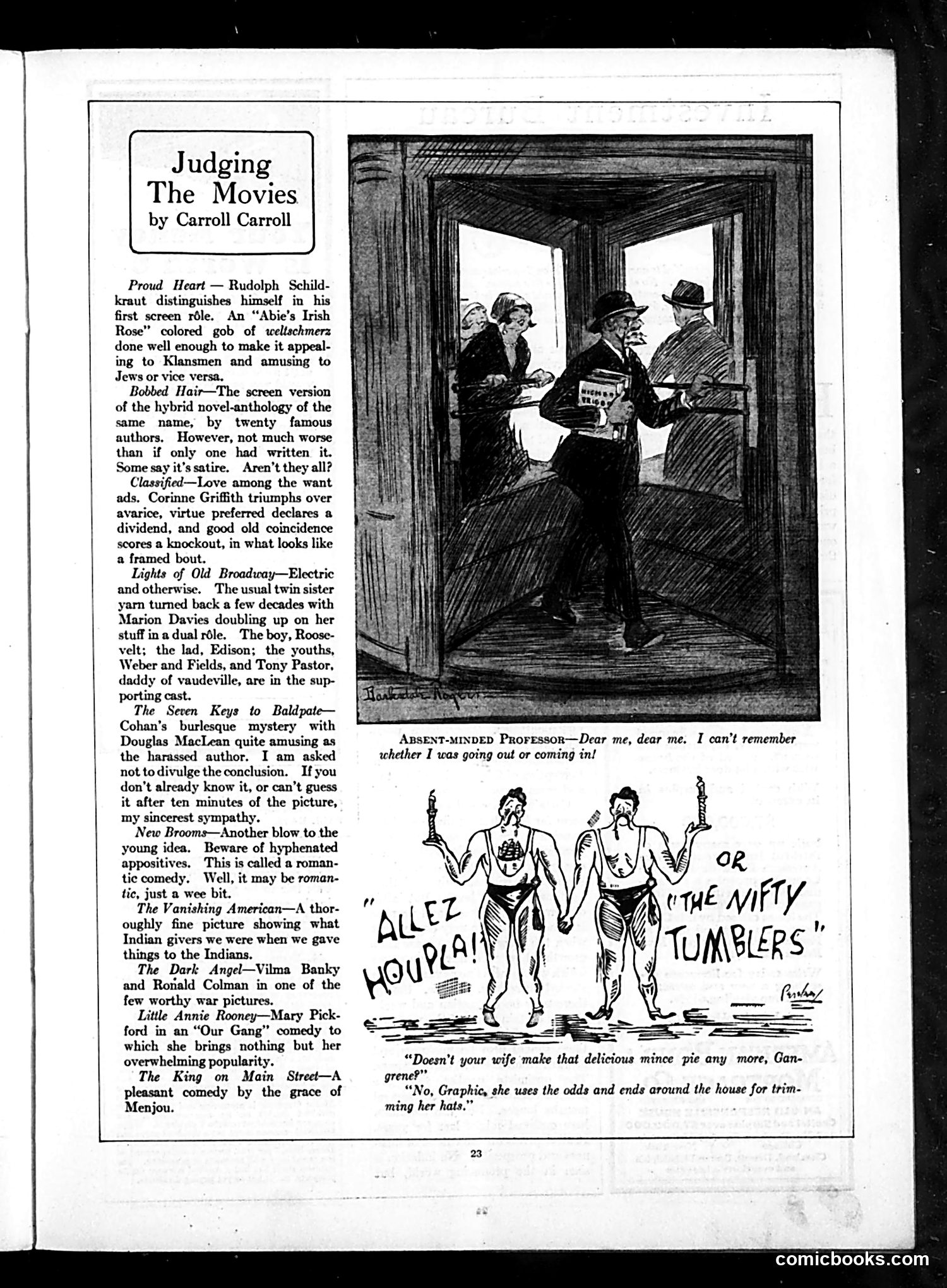
This page features Carroll Carroll's film reviews and two cartoons satirizing 1920s American life. The **top cartoon** shows an absent-minded professor confused about whether he's entering or leaving—a stock character type mocking academia's perceived disconnect from practical reality. The **bottom cartoon** ("The Nifty Tumblers") depicts two acrobatic men labeled "Allez Hoopla!" A married couple discusses the wife's hat-trimming: she now uses "odds and ends around the house" instead of making mince pie. The satire targets post-WWI consumer culture and women's changing roles—wives prioritizing fashionable appearance (hats) over domestic cooking duties, reflecting 1920s anxieties about modernization and shifting gender norms. The film reviews mock popular silent movies and their cultural politics, including a pointed reference to *Abie's Irish Rose* appealing to both "Klansmen and Jews"—a barbed comment on ethnic tensions of the era.
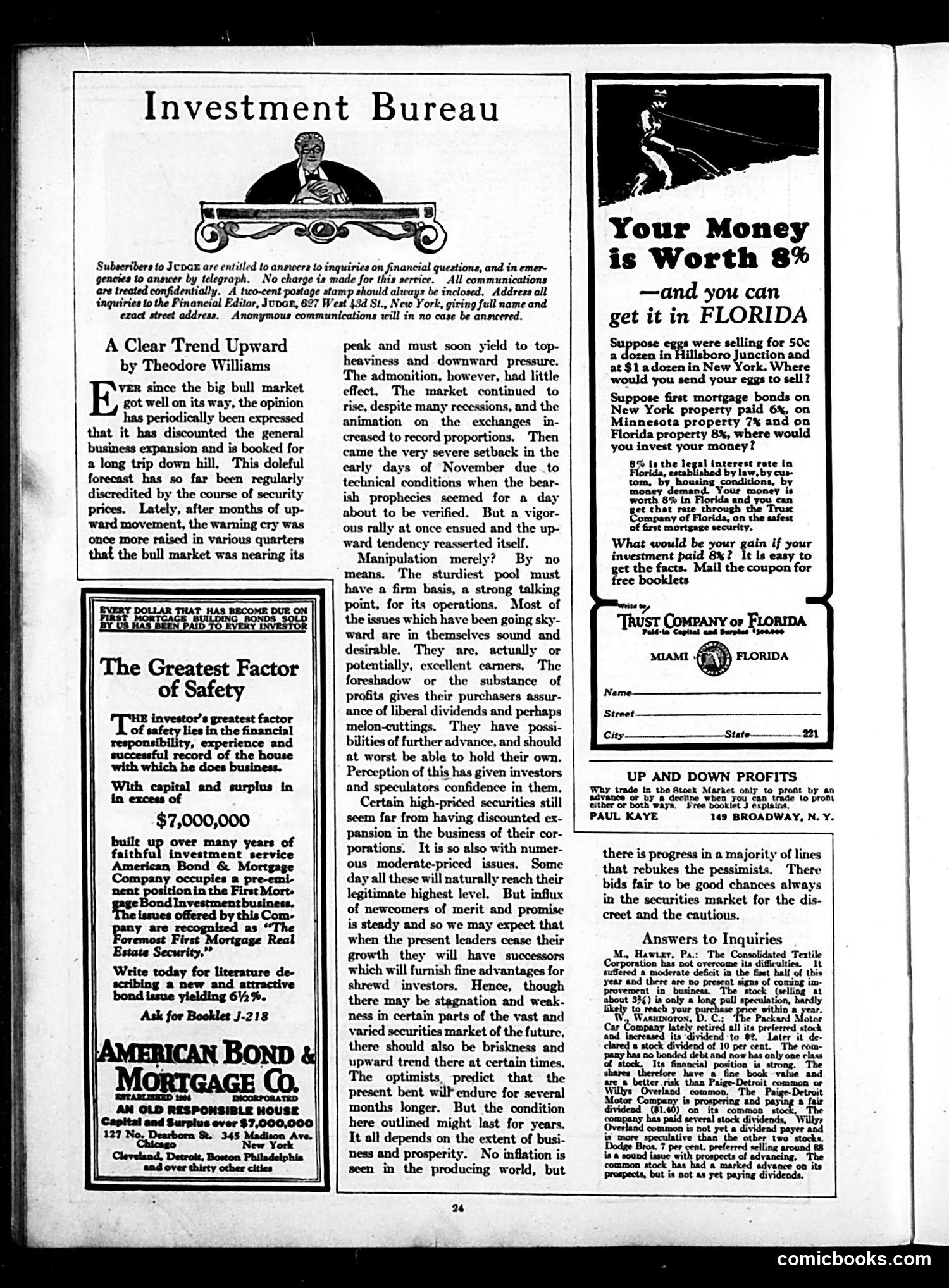
This page contains investment advertising and financial commentary from the 1920s bull market era. **Main Content:** Theodore Williams's article "A Clear Trend Upward" defends the bull market against persistent pessimist predictions. He argues the market's rise is justified by genuinely sound companies with real earnings potential, not mere manipulation. Williams predicts the uptrend could continue for months or years, depending on actual business expansion. **Advertisements:** - American Bond & Mortgage Co. emphasizes safety through capital/surplus ($7M) - Trust Company of Florida promotes 8% returns on mortgages versus lower rates elsewhere (New York 6%, Minnesota 7%) **Context for Modern Readers:** This page reflects 1920s optimism before the 1929 crash. The recurring "bear market warnings" Williams dismisses would prove prophetic within a decade. The Trust Company ad typifies the era's speculative real estate fever in Florida, which preceded its own 1926 boom-bust cycle.
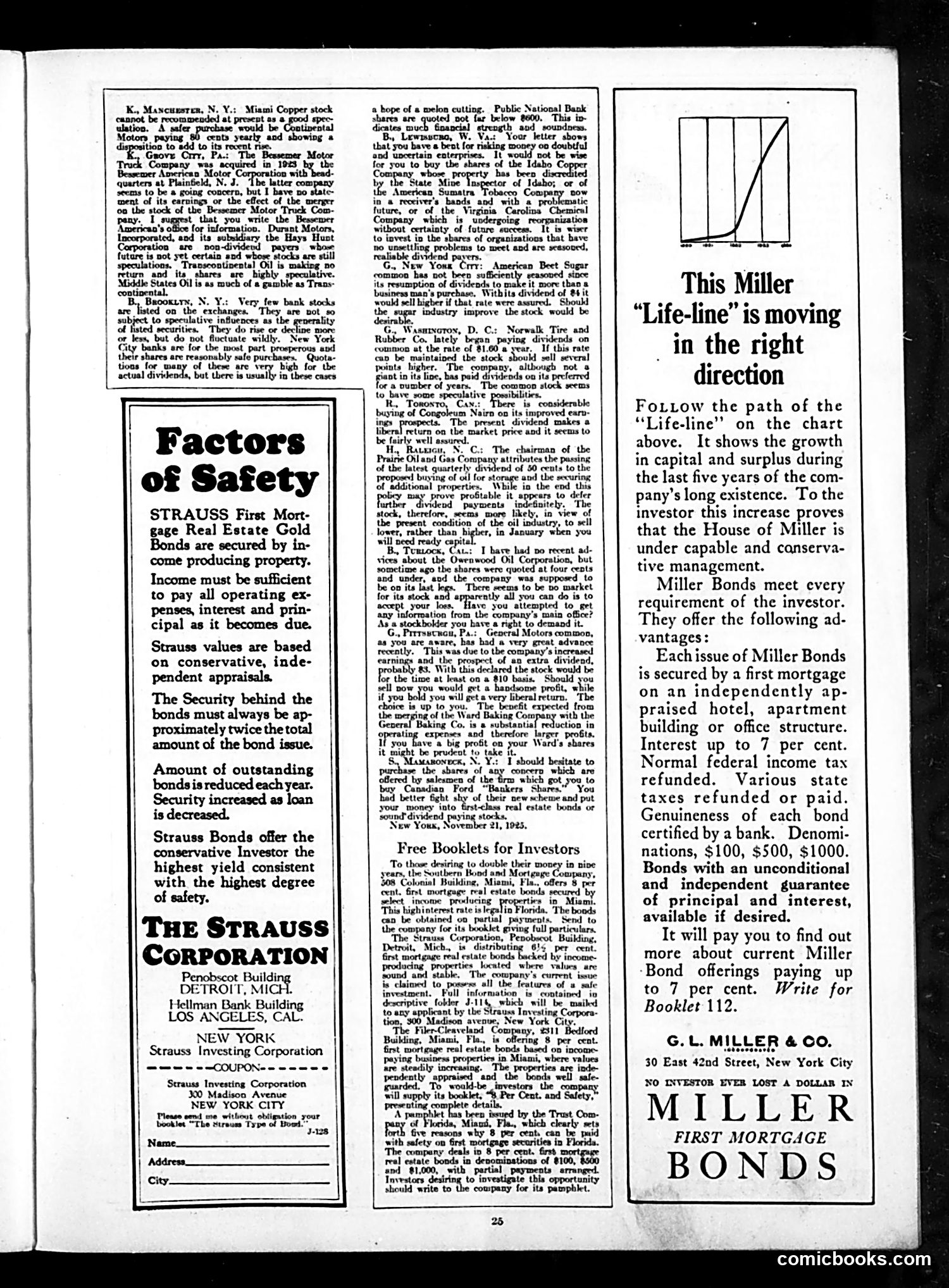
This is primarily **advertising and investment advice**, not satire or political commentary. The page contains: 1. **Investment Q&A column** addressing reader inquiries about various stocks (American Motors, Bessemer Motor Truck, Idaho Copper, sugar companies, tire manufacturers, oil stocks) 2. **Two bond advertisements**: "Factors of Safety" promoting Strauss First Mortgage Real Estate Gold Bonds, and a competing "Miller First Mortgage Bonds" advertisement 3. **One small chart** (upper right) showing a "Life-line" graph tracking Miller company's capital and surplus growth over five years The content reflects 1920s investment culture—promoting conservative real estate-backed bonds as safe alternatives to volatile stock markets. There is no political cartoon or satire visible. This appears to be a financial advice/advertising page from Judge magazine's investment section, targeting middle-class readers seeking secure investments during the prosperous but uncertain 1920s economy.
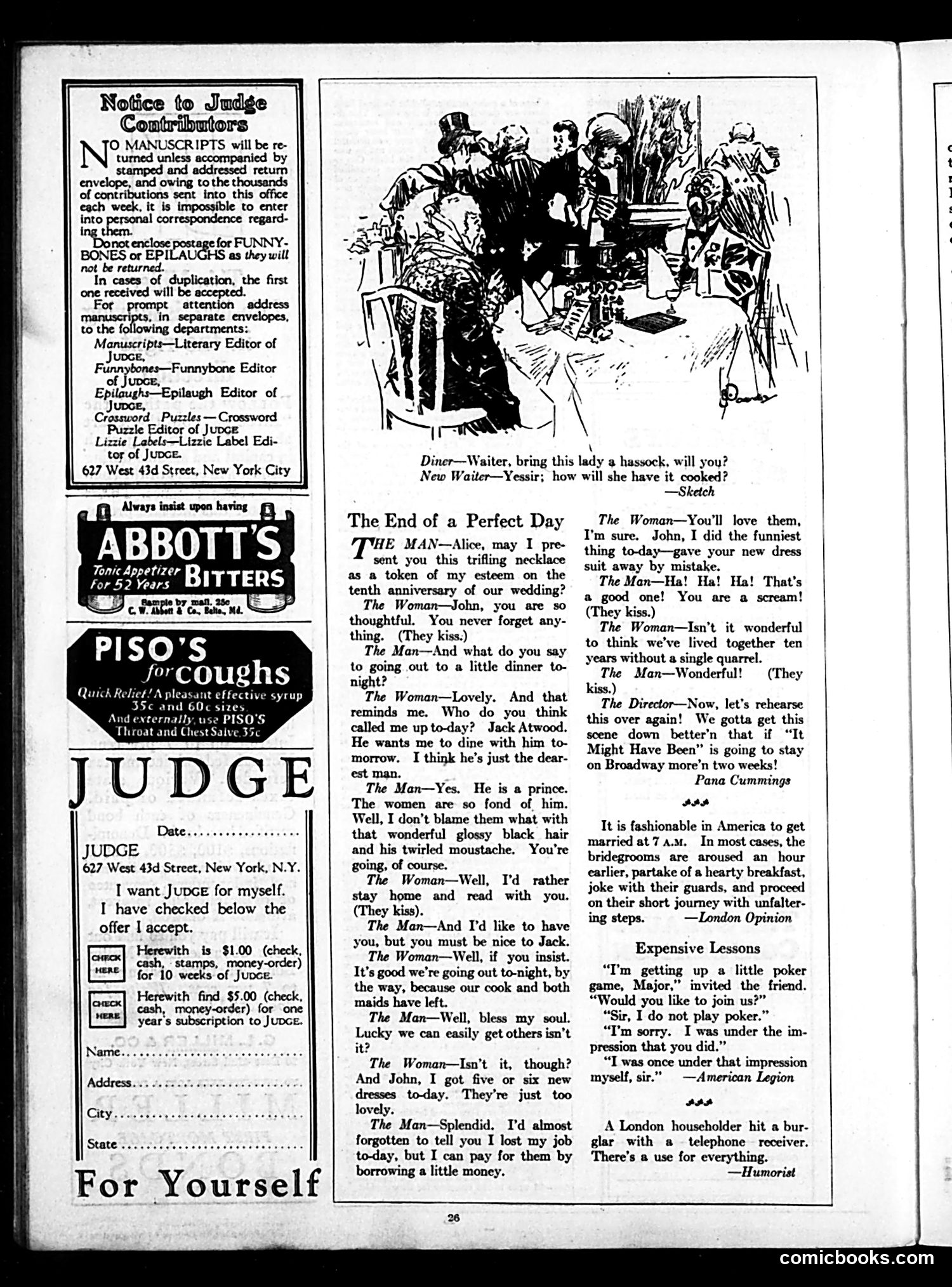
This page features a multi-panel domestic comedy sketch mocking upper-middle-class marriage and hypocrisy. The central satire follows a couple's tenth anniversary dinner, where the husband presents jewelry while casually revealing he's lost his job—a detail the wife ignores while discussing her expensive new dresses. The joke exposes the era's gender dynamics: the wife accepts the husband's financial disasters with indifference while pursuing her own spending, while he remains obliviously compliant. The sketch culminates with a stage director breaking character, suggesting this "perfect day" is merely theatrical performance—ironic commentary on marital facades. The sketch likely dates from the 1910s-1920s, satirizing Jazz Age consumerism and the strain of maintaining appearances despite financial instability. The surrounding page contains typical Judge magazine elements: advertisements (Piso's cough syrup, Abbott's Bitters) and submission guidelines for contributors.
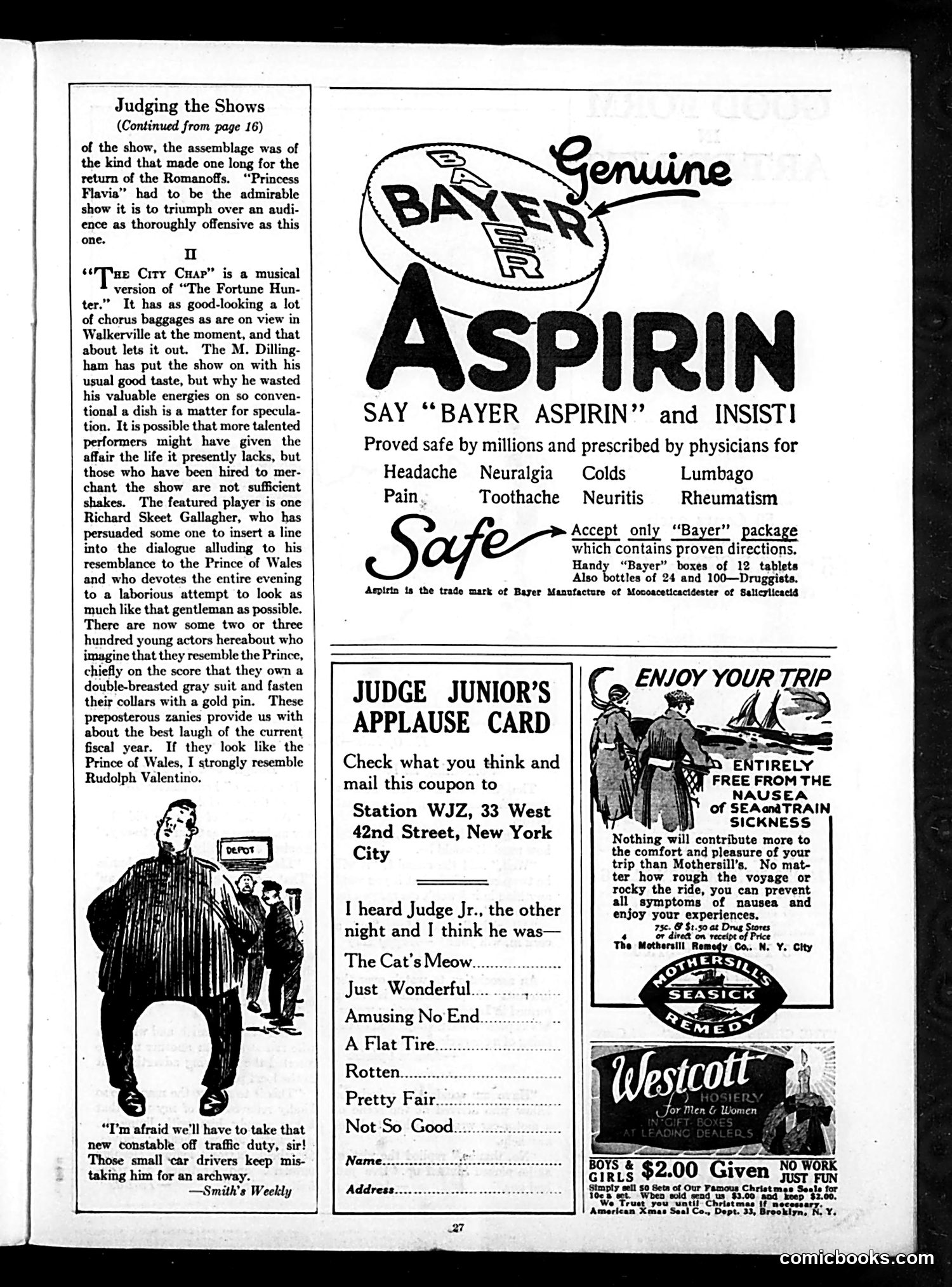
This page contains theater criticism, a political cartoon, and period advertising. The **theater reviews** discuss current Broadway productions. The critic is notably caustic, describing one audience as so "offensive" he longs for the Romanoffs' return (referencing the recently-executed Russian royal family), and sarcastically praising an actress for triumphing *despite* her audience. He ridicules actor Richard Skeet Gallagher's attempt to resemble the Prince of Wales—a fashionable affectation of young actors at the time who owned double-breasted suits and gold collar pins. The **Smith's Weekly cartoon** shows a small car driver mistaking a constable for an archway—likely poking fun at early automobile traffic and tiny vehicles. The **advertising** includes Bayer Aspirin (emphasizing it's "proven safe"), Mothersill's anti-nausea remedy, and children's religious gift boxes—typical period patent medicine and consumer goods marketing. The page reflects 1920s-era theatrical culture and early automotive humor.
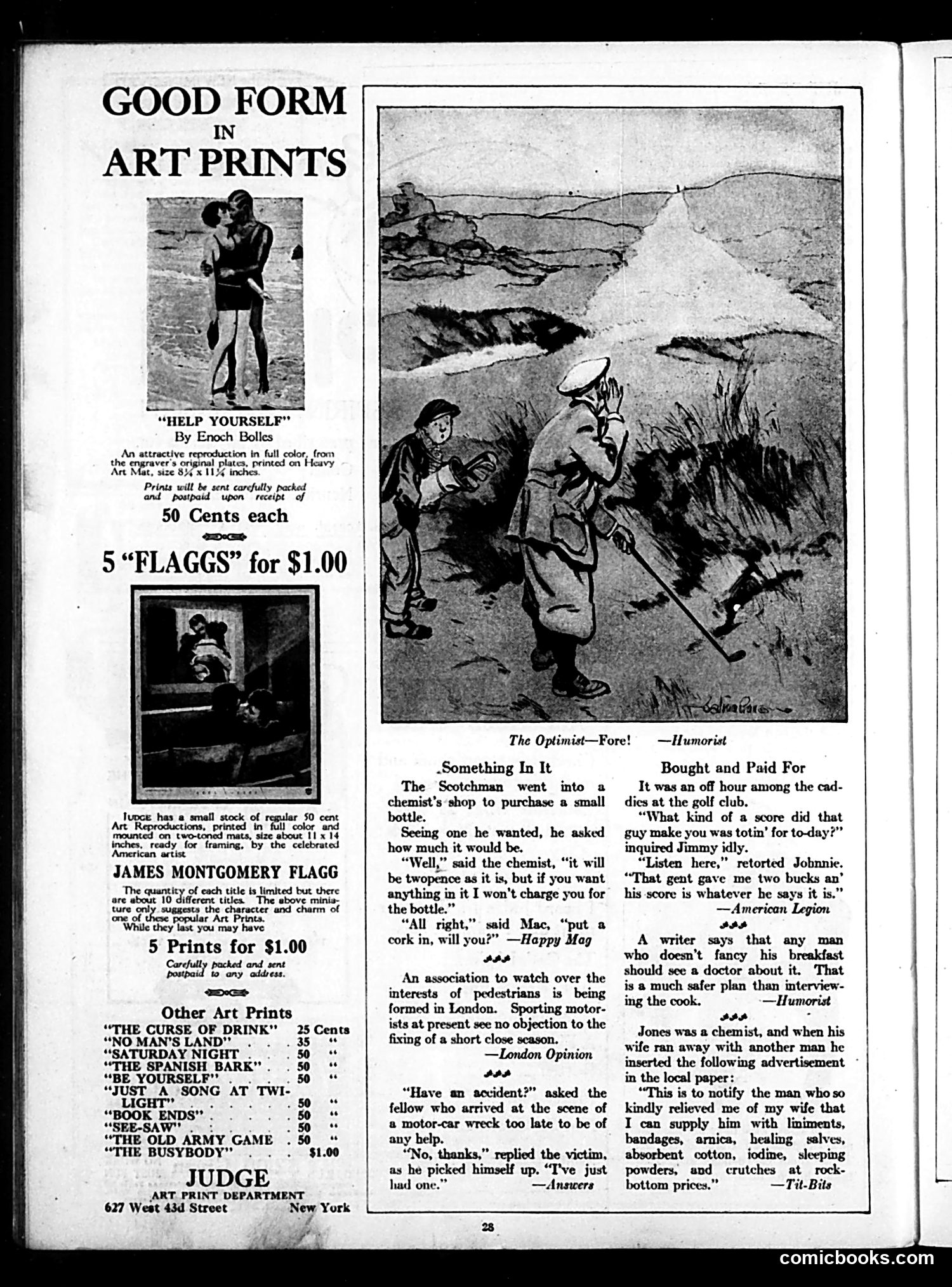
This page is primarily **advertising** for art prints, particularly works by popular illustrator James Montgomery Flagg and artist Enoch Bolles. The main visual is "The Optimist—Fore!", a cartoon about golf. ## The Main Cartoon The cartoon depicts two golfers in a bunker during play. "The Optimist" title suggests dark humor: despite being trapped in sand, one golfer maintains cheerful confidence—hence the golf command "Fore!" (warning of an incoming ball). The joke plays on optimism in the face of failure. ## The Anecdotes The page includes brief humorous stories satirizing various social types: - A **Scottish cheapskate** negotiating a chemist's bottle price - **Motorists endangering pedestrians** (reflecting early 20th-century traffic anxiety) - **Golf caddies inflating scores** for tips - A **chemist's revenge advertisement** after his wife leaves him These represent common Judge magazine fare: gentle social satire targeting universal human follies (stinginess, dishonesty, marital discord) rather than specific political targets.
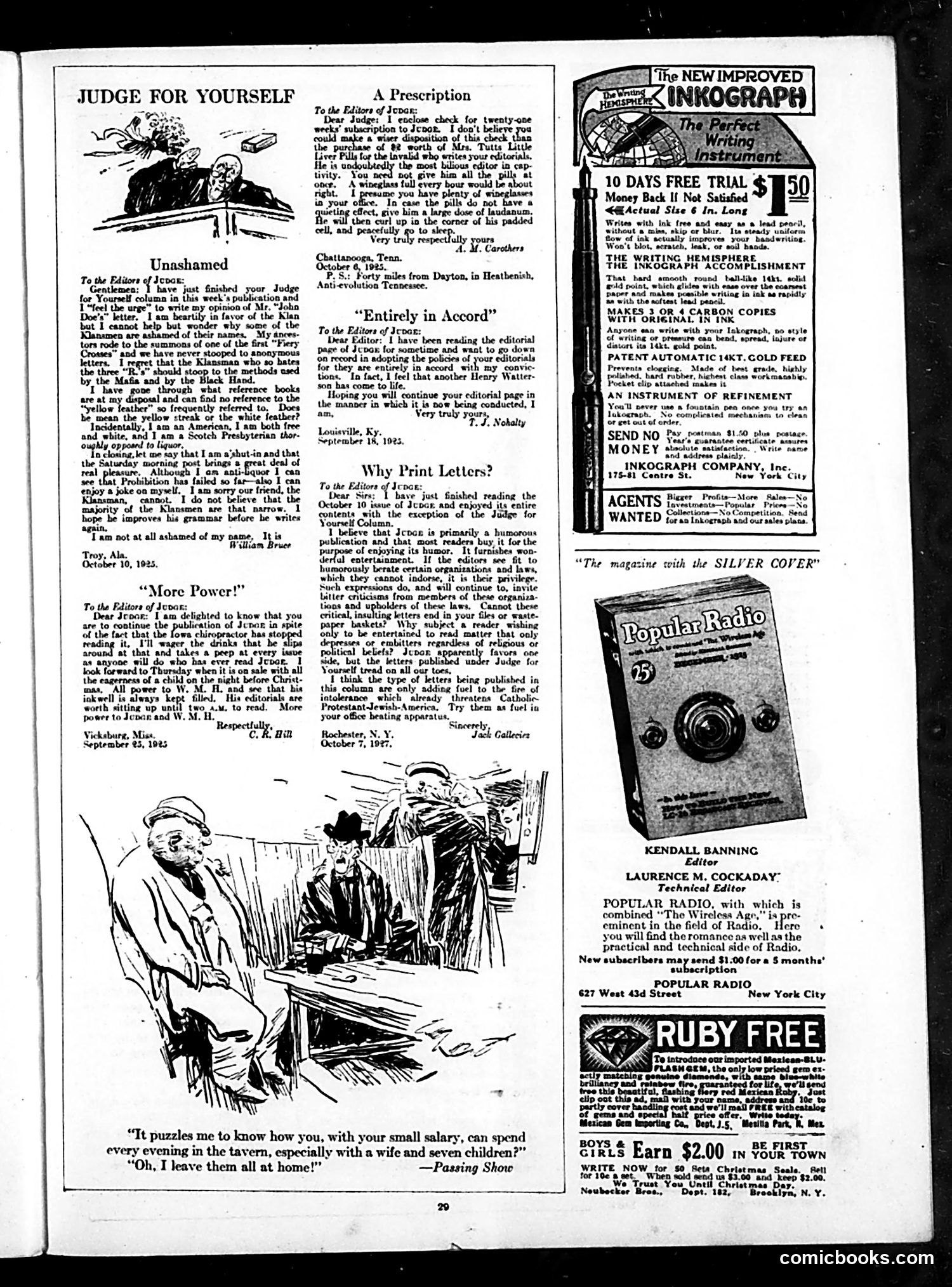
This page consists primarily of **reader letters to the editor**, not political cartoons. The editorial cartoon shown depicts a casual conversation about tavern-going—clearly satirizing the contradiction of someone claiming poverty while spending evenings in bars with a large family at home. **Key Content:** The letters reveal Judge's 1925 context: readers discussing the magazine's editorial stance on **evolution and anti-Klan sentiment**. One writer praises Judge for opposing the Ku Klux Klan (referenced as being active in "Anti-evolution Tennessee"), while another criticizes the magazine for publishing divisive letters attacking Protestants, Jews, and Catholics. **Historical Context:** The Scopes "Monkey Trial" (Dayton, Tennessee, 1925) is implicitly referenced. Readers are debating whether Judge should print incendiary religious/political content, even in letters. This reflects 1920s tensions over modernism, evolution, and organized hate groups. The page is otherwise filled with period advertisements for the Inkograph pen and Popular Radio magazine.
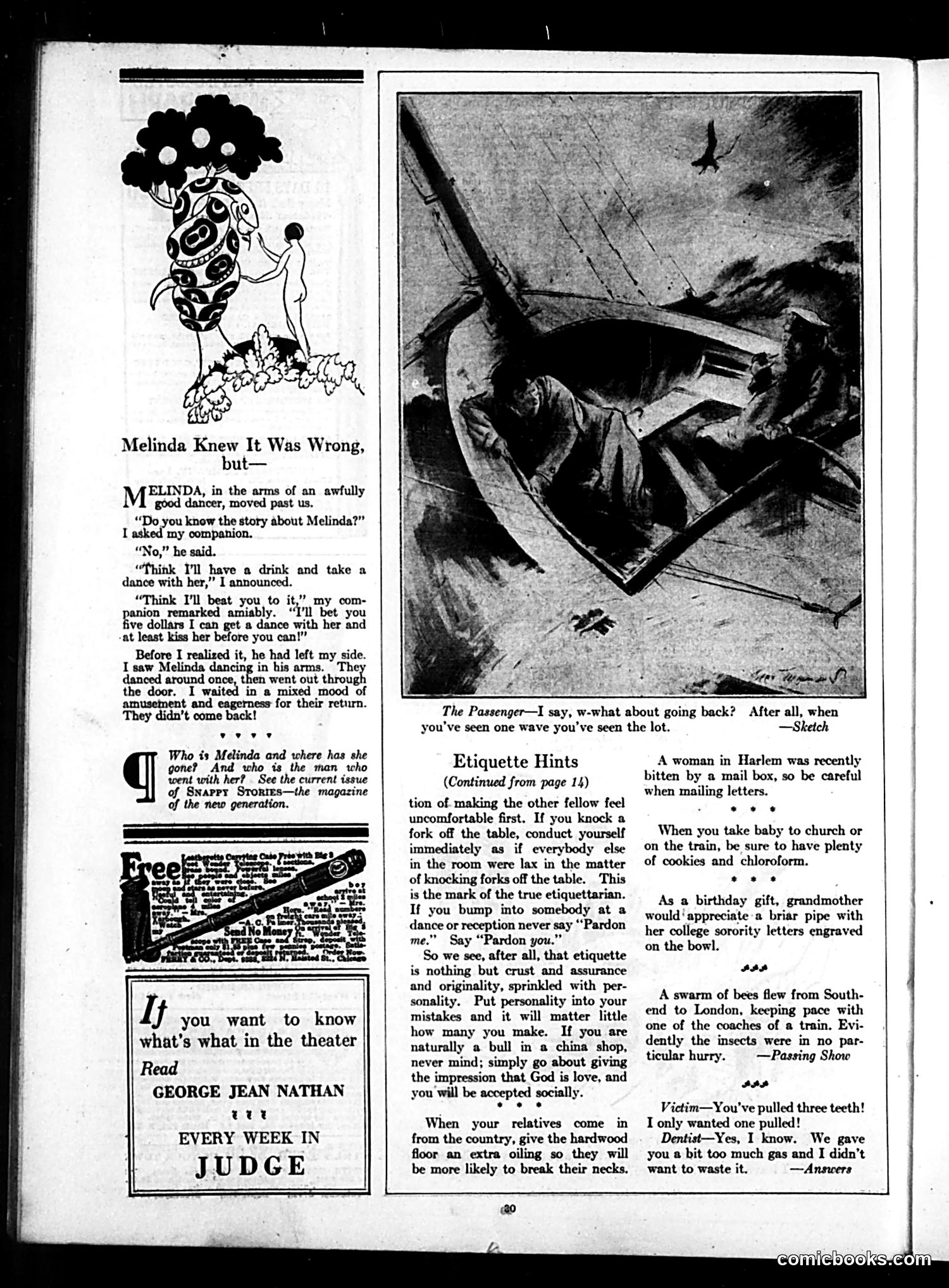
This page combines a serialized story with satirical "advice" humor typical of 1920s-era Judge magazine. **"Melinda Knew It Was Wrong, but—"** is a flirtation narrative: a woman named Melinda dances with the narrator's companion, who bets he can kiss her before the narrator can. They exit together and don't return—implying an elopement or indiscretion. It's a teaser for "Snappy Stories," a companion magazine, designed to hook readers with romantic scandal. **"Etiquette Hints"** is deadpan satire inverting actual etiquette rules. The joke: true sophistication means *brazenly* covering up social blunders with confidence and charm rather than apologizing. Fake it till you make it. The examples ("beat you to it," breaking relatives' necks) mock both pretentious etiquette culture and the "new generation's" amoral casualness—a recurring Judge theme criticizing post-WWI youth. The page also advertises George Jean Nathan's theater column and contains humorous anecdotes mocking modern life (mail-box bites, careless dentists).
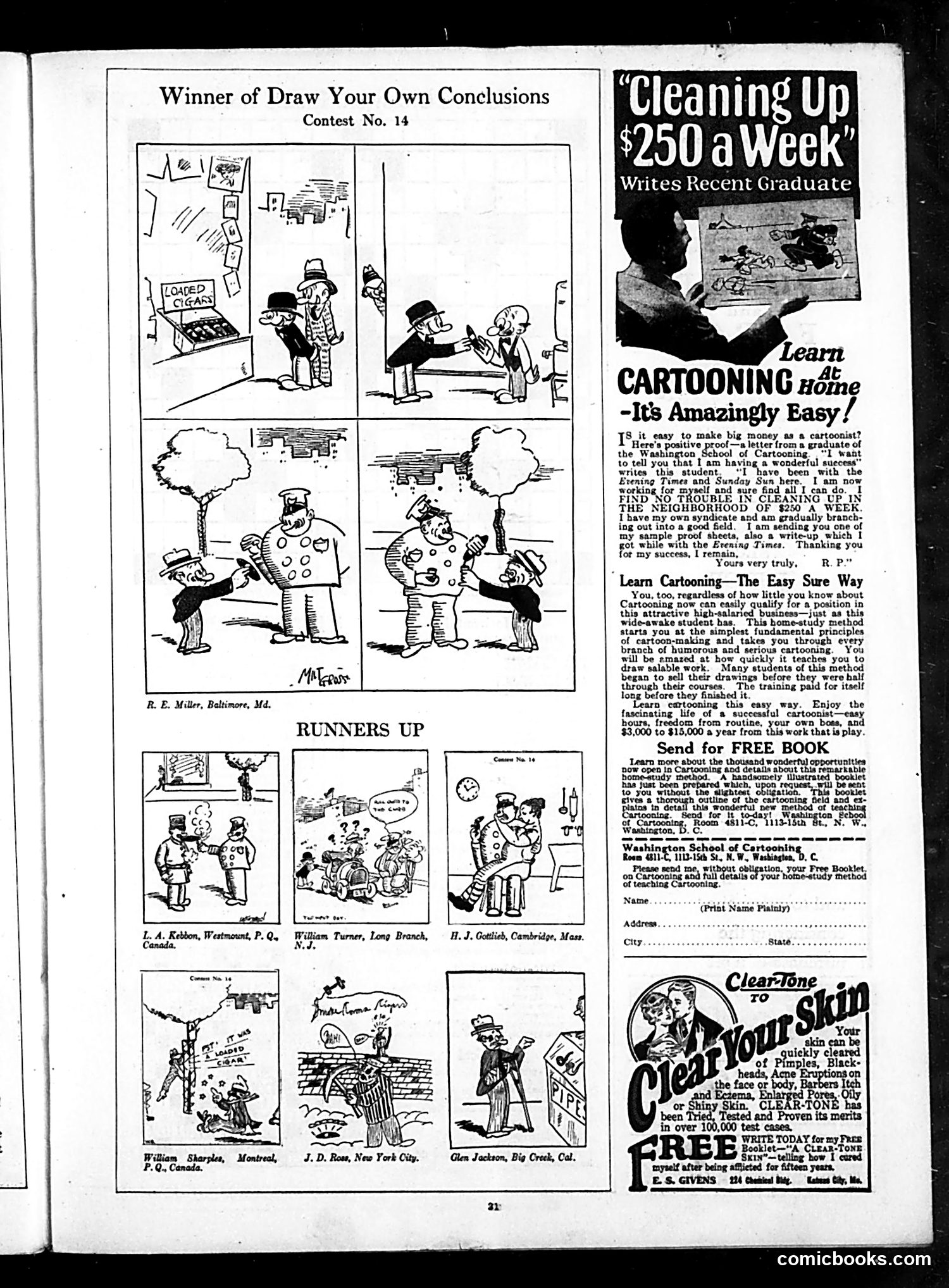
This page from *Judge* magazine showcases the winning and runner-up entries for "Draw Your Own Conclusions Contest No. 14"—a cartooning competition. **The Contest Winner (top):** R.E. Miller's four-panel cartoon depicts a con artist or charlatan operating a "LOADED" scheme, likely a confidence game where he manipulates naive victims. The humor satirizes street-level grifters and their marks. **The Advertisements:** The page is dominated by ads exploiting readers' aspirations. Most prominent is the Washington School of Cartooning's misleading testimonial claiming easy $250/week income—a common mail-order scheme promising quick riches through home study. This advertisement ironically undercuts the contest itself, suggesting cartooning success is far harder than advertised. **Secondary ads** for skin treatments (ClearTone) use similar deceptive tactics, promising miracle cures. **The satire:** The juxtaposition—a contest celebrating cartooning talent alongside predatory ads promising instant cartooning success—likely critiques both con artists AND the false promises targeting Depression-era readers desperate for income.
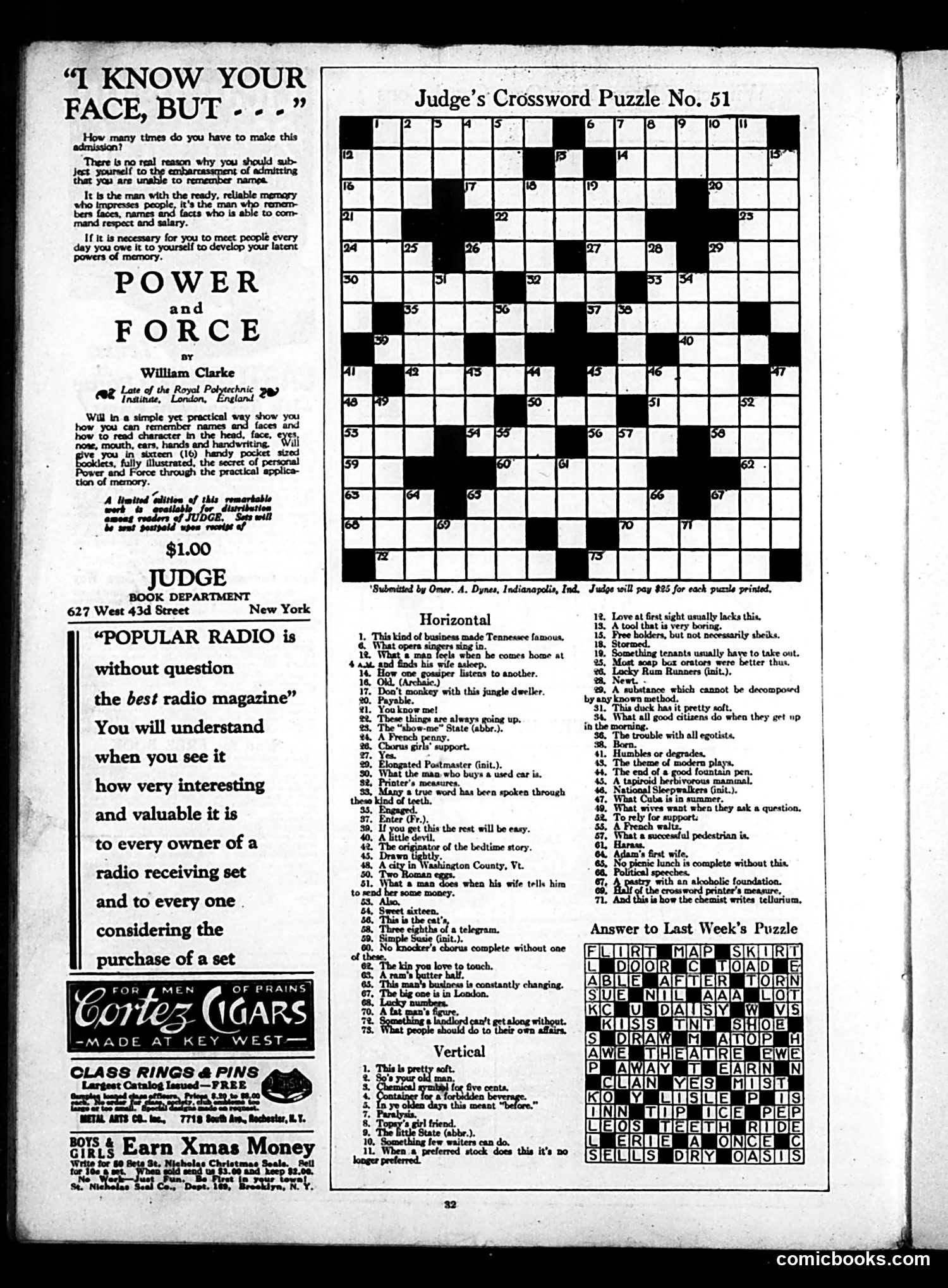
This page is primarily **advertising and a crossword puzzle**, not satirical editorial content. The left side features advertisements for: - A memory training book ("Power and Force" by William Clarke) - Popular Radio magazine - Cortez cigars - Class rings and pins - A boys' Christmas money-earning scheme The dominant content is **Judge's Crossword Puzzle No. 51** with horizontal and vertical clues, plus the answer key to the previous week's puzzle. The small cartoon at the top left—"I Know Your Face, But..."—is too small and unclear to identify specific figures or satirical intent from this image. This appears to be a typical magazine issue page mixing editorial puzzles with commercial advertisements, rather than featuring prominent political or social satire.
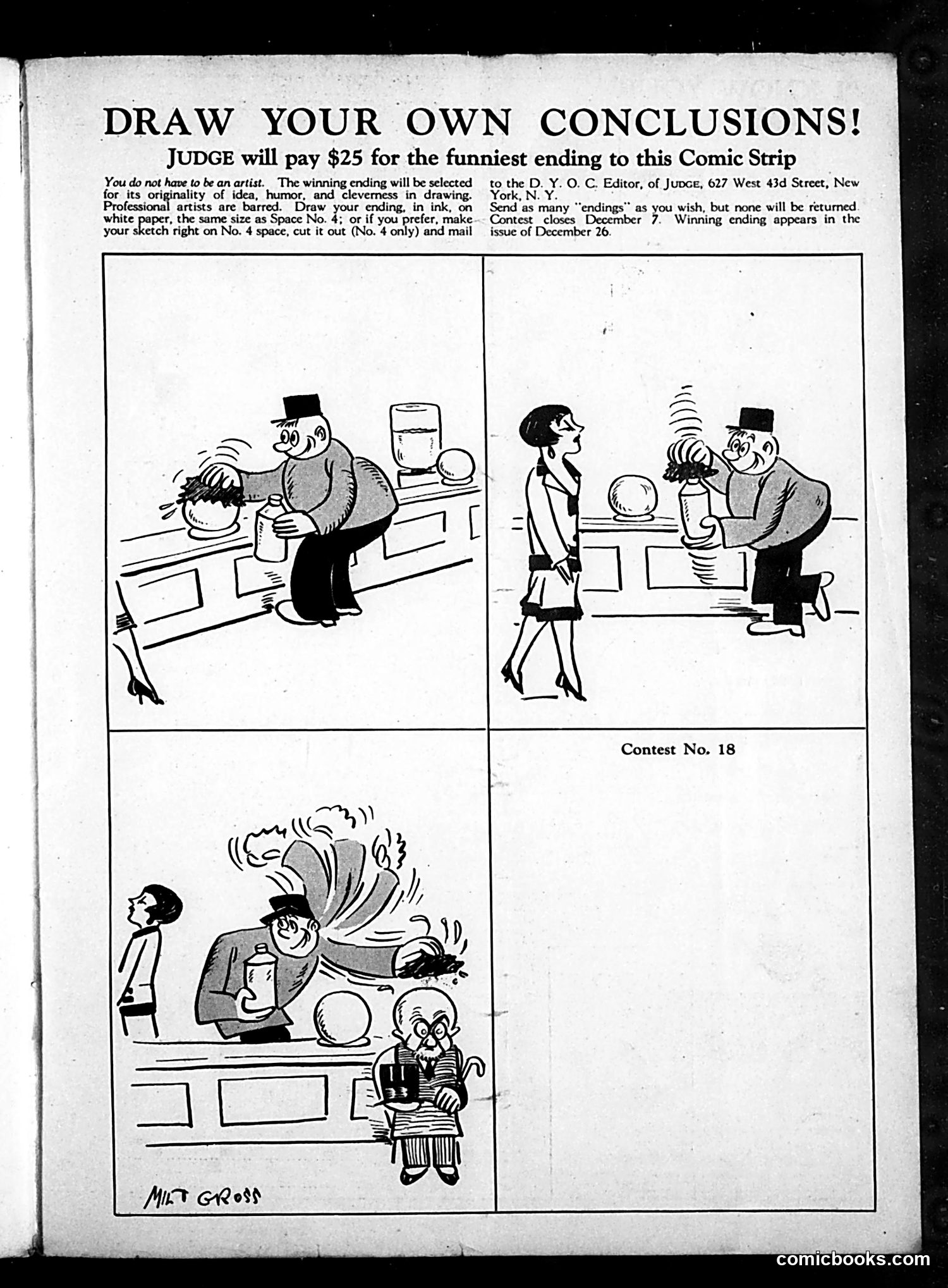
This is a **reader-participation contest page**, not a political cartoon. Judge magazine invited readers to complete an unfinished comic strip for a $25 prize. The three completed panels (by artist Milt Gross) show a slapstick domestic scenario: a man in a top hat appears to be juggling or managing items at a counter while interacting with a woman and child. The humor seems to involve physical comedy and domestic chaos—possibly depicting marital mishaps or child-rearing mishaps typical of 1920s-30s vaudeville-style humor. **The joke:** Readers had to invent a fourth panel (the blank space labeled "No. 4") that would deliver a funny punchline to conclude the sequence. The contest required originality of humor rather than artistic skill, explicitly barring professional artists. This reflects Judge's approach: soliciting audience participation in humor-making, appealing to the magazine's readership during the interwar period.
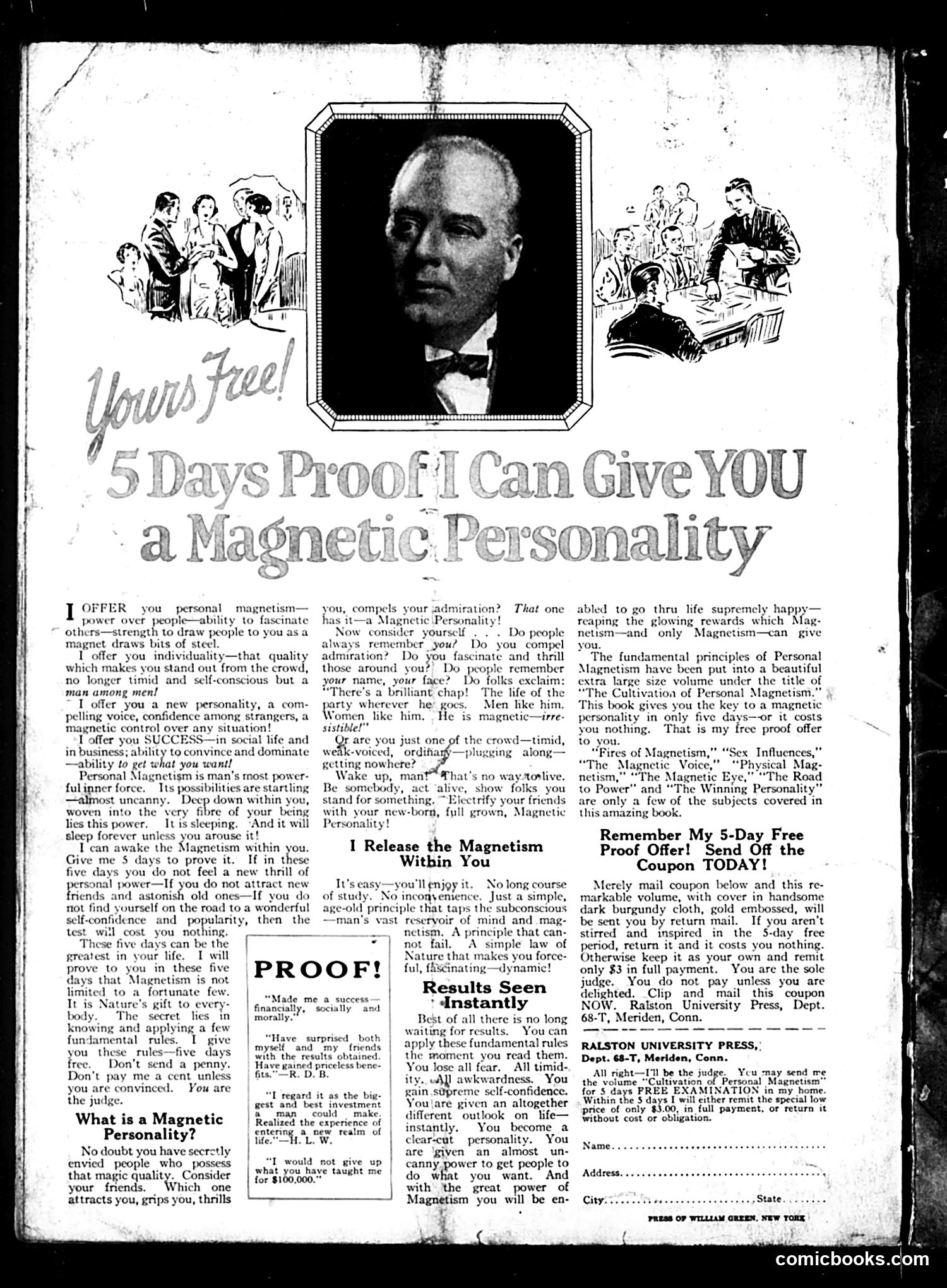
This page is primarily **advertising, not political satire**. It's a promotional piece for a self-help book on "Personal Magnetism" by Ralston University Press. The central figure is an unnamed man in formal attire (the book's author or representative). The surrounding illustrations show social scenarios—groups of people, confident individuals—depicting the promised benefits: social success, business dominance, and romantic appeal. The satire, if any, is **implicit rather than explicit**: Judge magazine's inclusion of this earnest self-help pitch may itself be mocking the era's pseudoscientific "magnetism" craze and American obsession with self-improvement through mail-order courses. The breathless promises ("get people to do what you want," results "instantly") and the free 5-day trial gimmick would have struck contemporary readers as both commercially aggressive and slightly absurd. The testimonial quotes ("made me a success") represent typical advertising rhetoric designed to seem credible through fabricated social proof—something satirical magazines often mocked by republishing them.