
Judge, 1925-11-28 · page 18 of 36
Judge — November 28, 1925 — page 18: what you’re looking at
What you’re looking at
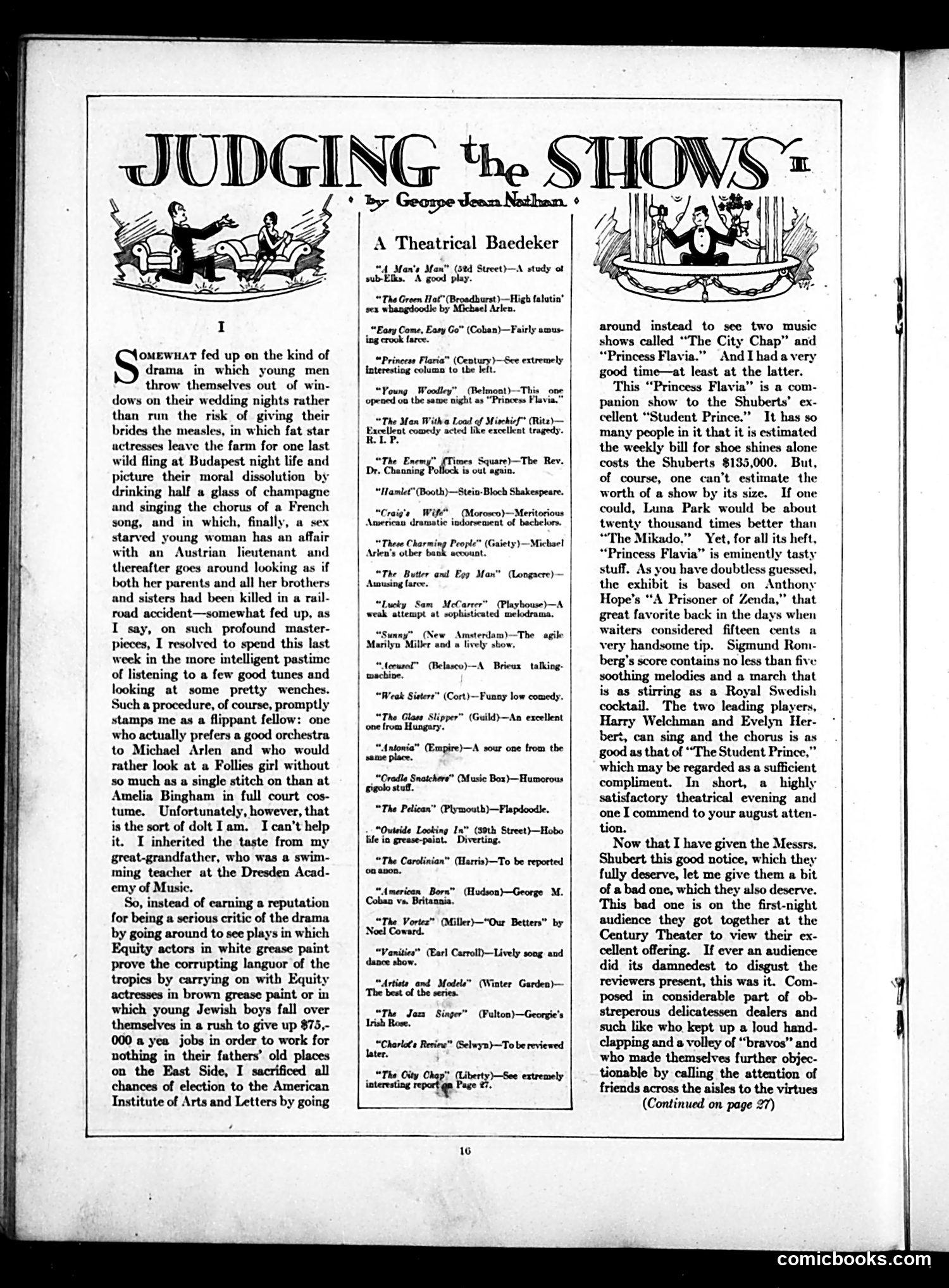
This is a theater review column by George Jean Nathan, a prominent drama critic of the 1920s. The accompanying illustrations show theater scenes with audiences and performers. **The Satire:** Nathan opens with mock-serious criticism of pretentious "art" dramas—plays featuring sexual transgression, moral decay, and psychological suffering treated as profound. He mocks their earnestness: characters throwing themselves from windows over measles, actresses dramatizing drinking champagne as moral dissolution. **The Point:** Nathan positions himself as preferring entertainment (orchestras, pretty women, "Follies girls") over self-important theatrical seriousness. He sarcastically claims this preference disqualifies him from respectability—he'll never join the American Institute of Arts and Letters because he'd rather enjoy himself than pontificate. **The Context:** This reflects 1920s theatrical debates between "serious" modernist drama and popular entertainment. Nathan defends populism and pleasure against pretentious intellectual criticism. The "Theatrical Baedeker" listing shows Nathan reviewing current Broadway productions with similarly irreverent one-liners, dismissing some as derivative of Michael Arlen or mere "flapdoodle."
📄 Transcribed text from this page (OCR, searchable)
Machine-transcribed from the original scan — historical spelling and the odd misread are preserved.
JUDGING "be SHOWS drama in which young men throw themselves out of win- dows on their wedding nights rather than run the risk of giving their brides the measles, in which fat star actresses leave the farm for one last wild fling at Budapest night life and picture their moral dissolution by drinking half a glass of champagne and singing the chorus of a French song, and in which, finally, a sex starved young woman has an affair with an Austrian lieutenant and thereafter goes around looking as if both her parents and all her brothers and sisters had been killed in a rail- road accident—somewhat fed up, as I say, on such profound master- pieces, I resolved to spend this last week in the more intelligent pastime of listening to a few good tunes and looking at some pretty wenches. Such a procedure, of course, promptly stamps me as a flippant fellow: one who actually prefers a good orchestra to Michael Arlen and who would rather look at a Follies girl without so much as a single stitch on than at Amelia Bingham in full court cos- tume. Unfortunately, however, that is the sort of dolt lam. I can’t help it. I inherited the taste from my great-grandfather, who was a swim- ming teacher at the Dresden Acad- emy of Music. So, instead of earning a reputation for being a serious critic of the drama by going around to see plays in which Equity actors in white grease paint prove the corrupting languor of the tropics by carrying on with Equity actresses in brown grease paint or in which young Jewish boys fall over themselves in a rush to give up 875,- 000 a yea jobs in order to work for nothing in their fathers’ old places on the East Side, I sacrificed all chances of election to the American Institute of Arts and Letters by going G tram fed up on the kind of * By Geoxpe Jeon Nathan. A Theatrical Baedeker “4 Man's Man” (5d Street)—A study of sub-Elks. A good play. “The Green Hot" (Beoadburst) High falatin’ ‘bangdoodle by Michee! sex wi interesting colums to the left. “Young Woodley” | (Belmont) “This one opened oo the same night as “Princess Flavia.” “The Man With a Load of Mischirf* (Ritz)— | Excellent comedy acted like excellent tragedy. RLP. “The E; uare)—The Rev. Dr. eerie A htiaeg is eee “Hamlet” (Booth)—Stein-Bloch Shakespeare. “Craig's Wife” —(Morosco)—Meritorious American dramatic indorsement of bachelors. Tees Charming People” (Gaiety)—Michse! Arlen’s other bank account. Amusing farce. | “Ewoky Sam McCareer” (Playhouse)—A weak attempt at sophisticated melodrama, “Sunny” (New Amsterdam)—The agile Marilyn Miller and a lively show, “toeueed” (Belasco)—A. Brieux talking- machine. “The Glass Slipper” (Guild)—An excellent one from Hungary. “Antonia” (Empire)—A sour one trom the same place. “Cradle Snatchers” (Music Box)—Humorous sigolo stuff. “The Pelican” (Plymouth)—Flapdoodle. Outcide Looking In” (30th Street)—Hobo life in grease-paint. Diverting. “The Carolinian" (Harris)—To be reported on anon. “American Bers (Hudson)—George M. Coban vs. Britannia. “The Vortes” (Miller)—“Our Betters” Noel Coward. Ls “Vanities” (Earl Carroll)—Lively song and show. “Artiste and Models” (Winter Garden)— The best of the series. prt tht! Singer” (Fulton)—Georgie's planeta Review” (Selwyn)—To be reviewed ._ “The City Chap" Neogene extreme! 2 ly iene ““Eary Come, Eary Go” (Coban)—Fairly amus- Waeni bee ger bon | “Princess Flaria” (Century)—Sce extremely | “The Butter ond Egg Man" (Longacre)— | “Weak Sisters” (Cort)—Punny low comedy. | around instead to see two music shows called “The City Chap” and “Princess Flavia.” And I had a very good time—at least at the latter. This “Princess Flavia” is a com- panion show to the Shuberts’ ex- cellent “Student Prince.” It has so many people in it that it is estimated the weekly bill for shoe shines alone costs the Shuberts $135,000. But, of course, one can’t estimate the worth of a show by its size. If one could, Luna Park would be about twenty thousand times better than “The Mikado.” Yet, for all its heft, “Princess Flavia” is eminently tasty stuff. As you have doubtless guessed, the exhibit is based on Anthony Hope’s “A Prisoner of Zenda,” that great favorite back in the days when waiters considered fifteen cents a very handsome tip. Sigmund Rom- berg’s score contains no less than five soothing melodies and a march that is as stirring as a Royal Swedish cocktail. The two leading players, Harry Welchman and Evelyn Her- bert, can sing and the chorus is as good as that of “The Student Prince,” which may be regarded as a sufficient compliment. In short, a_ highly satisfactory theatrical evening and one I commend to your august atten- tion. Now that I have given the Messrs. Shubert this good notice, which they fully deserve, let me give them a bit of a bad one, which they also deserve. This bad one is on the first-night audience they got together at the Century Theater to view their ex- cellent offering. If ever an audience did its damnedest to disgust the reviewers present, this was it. Com- posed in considerable part of ob- streperous delicatessen dealers and such like who kept up a loud hand- clapping and a volley of “‘bravos” and who made themselves further objec- tionable by calling the attention of friends across the aisles to the virtues (Continued on page 27) oe comicbooks.com