
Judge, 1925-11-28 · page 15 of 36
Judge — November 28, 1925 — page 15: what you’re looking at
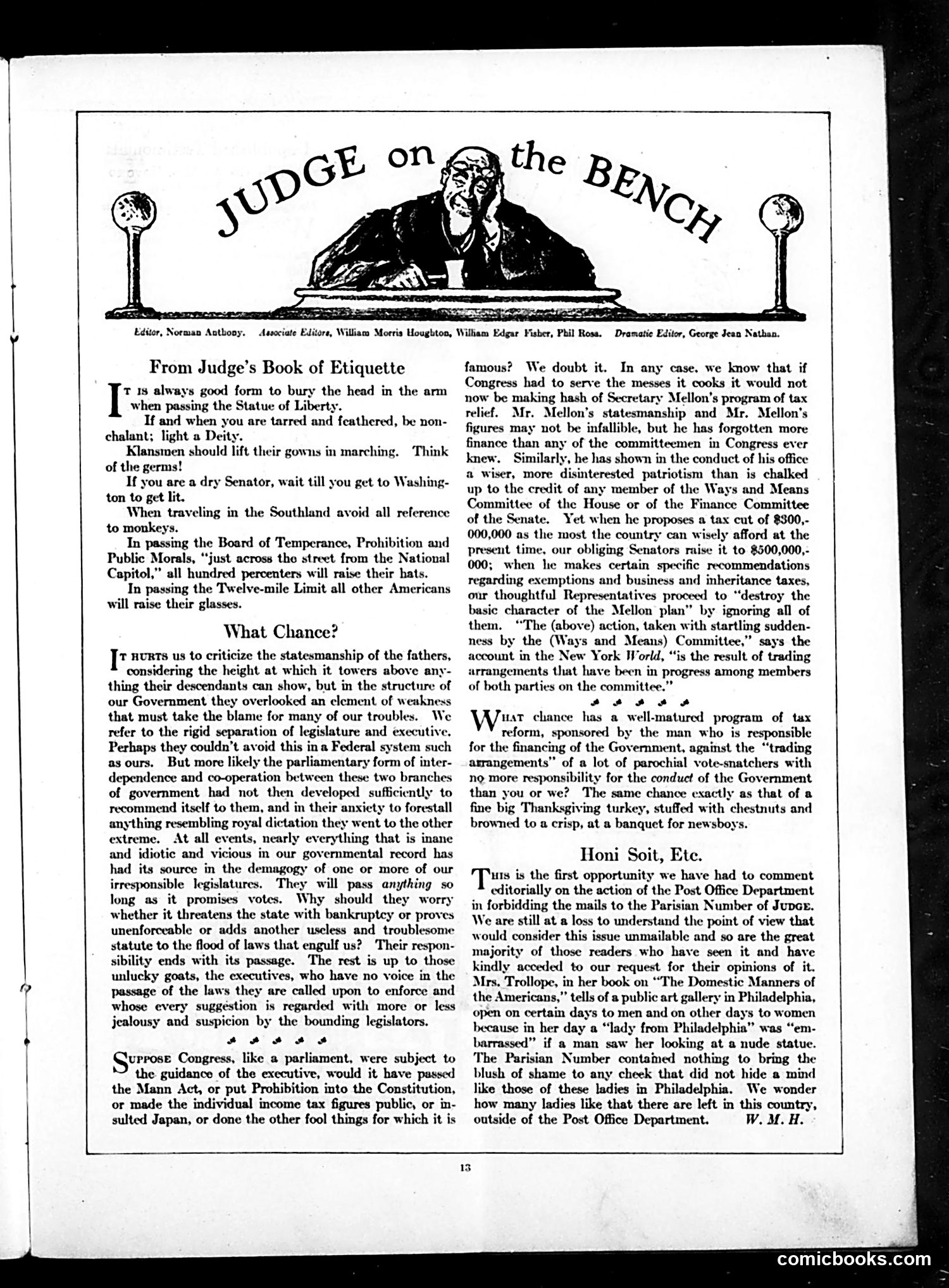
What you’re looking at
This page contains satirical commentary on American politics and social hypocrisy, circa the Prohibition era (1920s). **"Judge's Book of Etiquette"** mockingly presents absurd "rules" that highlight contemporary scandals: the KKK (reference to "Klansmen" and "tarred and feathered"), Prohibition enforcement ("Twelve-mile Limit"), and corruption among politicians ("dry Senator"). **"What Chance?"** critiques the separation of powers in U.S. government, arguing that Congress passes reckless legislation (specifically mentioning the Mann Act and Prohibition) without accountability since the executive branch must enforce it. **"Honi Soit, Etc."** defends Secretary of the Treasury Andrew Mellon's tax reform proposals against Congressional opposition, suggesting Congress sabotages competent executive plans for political advantage. The overall message attacks legislative irresponsibility, government hypocrisy regarding Prohibition, and the institutional dysfunction created by separating legislative and executive authority.
📄 Transcribed text from this page (OCR, searchable)
Machine-transcribed from the original scan — historical spelling and the odd misread are preserved.
Editor, Norman Anthony. Associate Editore, Wil From Judge’s Book of Etiquette T 18 always good form to bury the head in the arm when passing the Statue of Liberty. Tf and when you are tarred and feathered, be non- chalant; light a Deity. Klansmen should lift their gowns in marching. Think of the germs! If you are a dry Senator, wait till you get to Washing- ton to get lit. When traveling in the Southland avoid all reference to monkeys. In passing the Board of Temperance, Prohibition and Public Morals, “‘just across the street from the National Capitol,” all hundred percenters will raise their hats. In passing the Twelve-mile Limit all other Americans will raise their glasses. What Chance? I" HURTS us to criticize the statesmanship of the fathers, considering the height at which it towers above any- thing their descendants can show, but in the structure of our Government they overlooked an clement of weakness that must take the blame for many of our troubles. W refer to the rigid separation of legislature and executive. Perhaps they couldn’t avoid this in a Federal system such as ours. But more likely the parliamentary form of inter- dependence and co-operation between these two branches of government had not then developed sufficiently to recommend itself to them, and in their anxiety to forestall anything resembling royal dictation they went to the other extreme. At all events, nearly everything that is inane and idiotic and vicious in our governmental record has had its source in the demagogy of one or more of our irresponsible legislatures. They will pass anything so Jong as it promises votes. Why should they worry whether it threatens the state with bankruptcy or proves unenforceable or adds another useless and troublesome statute to the flood of laws that engulf us? Their respon- sibility ends with its passage. The rest is up to those unlucky goats, the executives, who have no voice in the passage of the laws they are called upon to enforce and whose every suggestion is regarded with more or less jealousy and suspicion by the bounding legislators. s~e eas Svrrose Congress, like a parliament, were subject to the guidance of the executive, would it have passed the Mann Act, or put Prohibition into the Constitution, or made the individual income tax figures public, or in- sulted Japan, or done the other fool things for which it is im Morris Houghton, William Edgar Fisher, Phil Rosa. Dramatic Editor, George Jean Nathan. famous? We doubt it. In any case. we know that if Congress had to serve the messes it cooks it would not now be making hash of Secretary Mellon’s program of tax relief. Mr. Mellon’s statesmanship and Mr. Mellon’s figures may not be infallible, but he has forgotten more finance than any of the committeemen in Congress ever knew. Similarly, he has shown in the conduct of his office a wiser, more disinterested patriotism than is chalked up to the credit of any member of the Ways and Means Committee of the House or of the Finance Committee of the Senate. Yet when he proposes a tax cut of $300,- 000,000 as the most the country can wisely afford at the present time, our obliging Senators raise it to $500,000,- 000; when he makes certain specific recommendations regarding exemptions and business and inheritance taxes, our thoughtful Representatives proceed to “destroy the basic character of the Mellon plan” by ignoring all of them. ‘The (above) action, taken with startling sudden- ness by the (Ways and Means) Committee,” says the account in the New York World, “is the result of trading arrangements that have been in progress among members of both parties on the committee.” -~eea ae We chance has a well-matured program of tax reform, sponsored by the man who is responsible for the financing of the Government, against the “trading arrangements” of a lot of parochial vote-snatchers with no more responsibility for the conduct of the Government than you or we? The same chance exactly as that of a fine big Thanksgiving turkey, stuffed with chestnuts and browned to a crisp, at a banquet for newsboys. Honi Soit, Ete. Tus is the first opportunity we have had to comment editorially on the action of the Post Office Department in forbidding the mails to the Parisian Number of Jupce. We are still at a loss to understand the point of view that would consider this issue unmailable and so are the great majority of those readers who have seen it and have kindly acceded to our request for their opinions of it. Mrs, Trollope, in her book on “The Domestic Manners of the Americans,” tells of a public art gallery in Philadelphia, open on certain days to men and on other days to women because in her day a “lady from Philadelphia” was “em- barrassed” if a man saw her looking at a nude statue. The Parisian Number contamed nothing to bring the blush of shame to any cheek that did not hide a mind like those of these ladies in Philadelphia. We wonder how many ladies like that there are left in this country, outside of the Post Office Department. W. M. H. comicbooks.com San ahh