
A complete issue · 37 pages · 1925
Judge — November 14, 1925
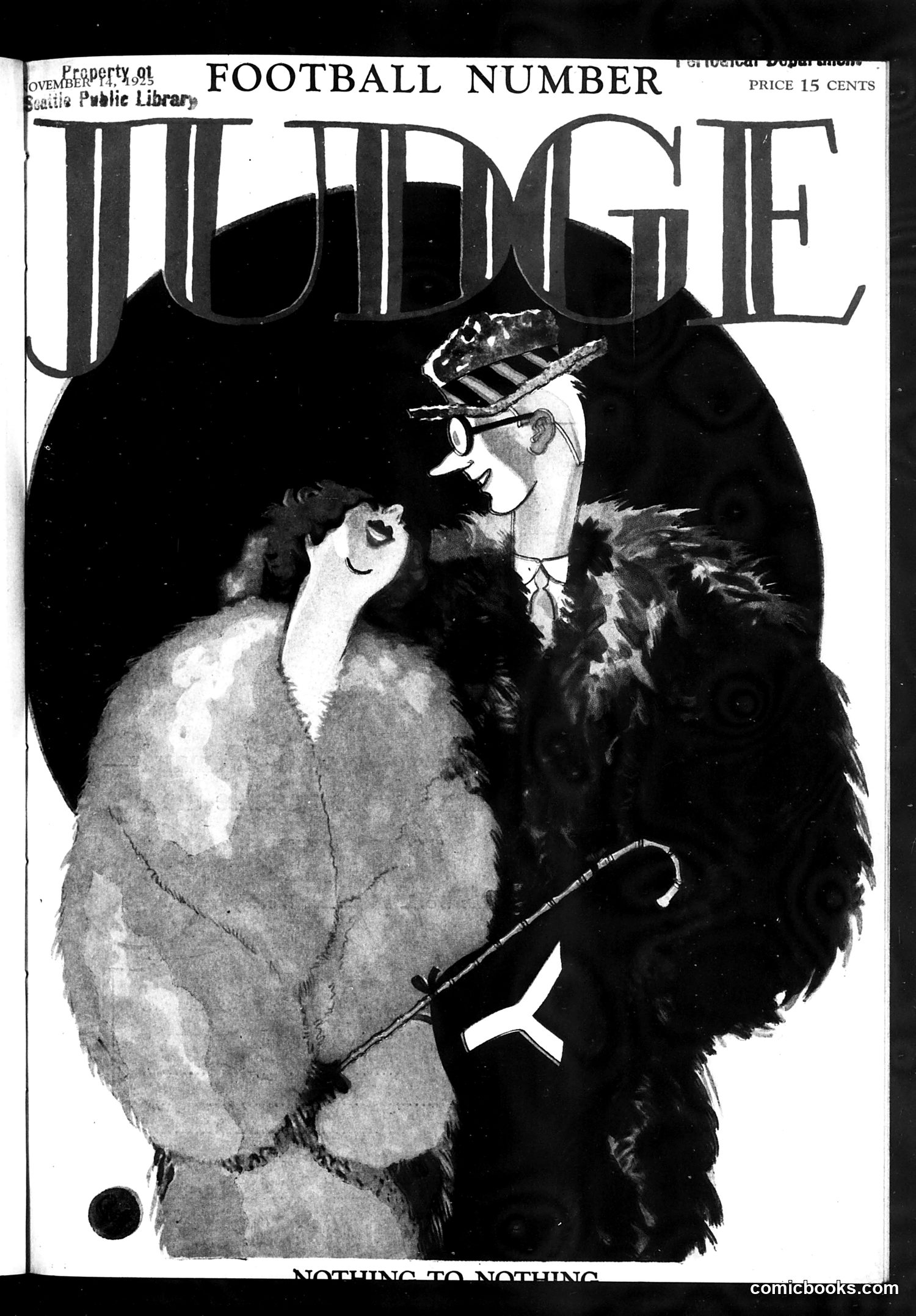
This appears to be a satirical football-themed cover from Judge magazine, priced at 15 cents. The illustration shows two fashionably dressed women in 1920s style clothing (fur coats, cloche hats) examining what appears to be a football with a magnifying glass or monocle. The caption reads "NOTHING TO NOTHING." The satire likely mocks the growing female interest in football during the 1920s, a period when women were gaining new social freedoms. The "NOTHING TO NOTHING" reference suggests the joke concerns women attending games primarily for social spectacle and fashion rather than understanding the sport itself. The exaggerated, comical depiction of their examination of the football reinforces this mockery of female sports fans as superficial observers.
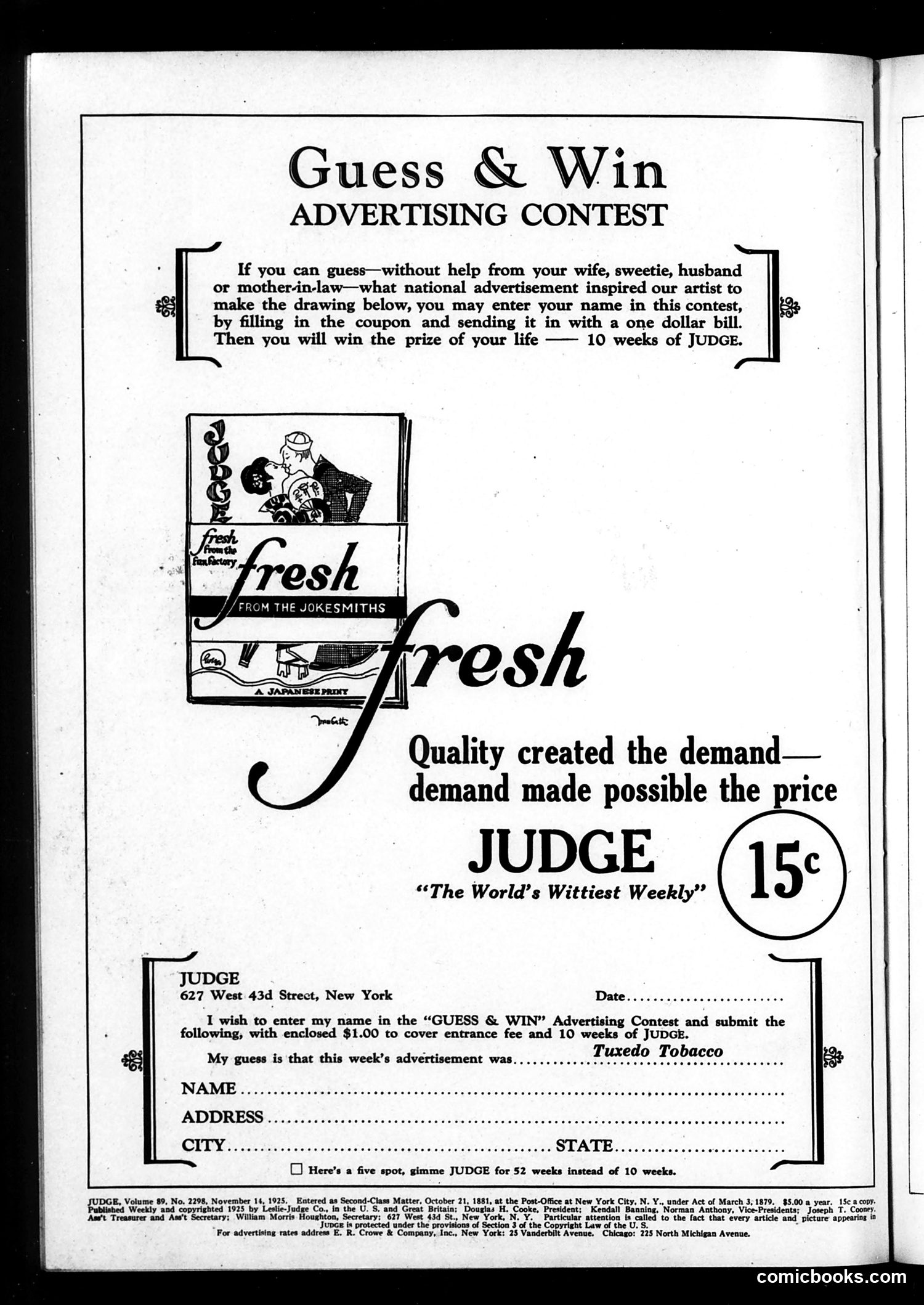
This page is primarily a **advertising contest** for Judge magazine itself and for **Tuxedo Tobacco**, a popular smoking product of the era. The contest invites readers to guess which national advertisement inspired the drawing shown—a man in a hat holding what appears to be a product. The prize is "10 weeks of JUDGE" (the magazine itself), with entry costing $1. The satire appears gentle: the ad jokes that quality products create demand, which enables affordable pricing. Tuxedo Tobacco is advertised as "The World's Wittiest Weekly" at 15 cents. This reflects **early 20th-century marketing practices** where magazines ran contests and cross-promoted products to boost circulation and advertising revenue. The humor relies on readers' familiarity with contemporary advertisements.
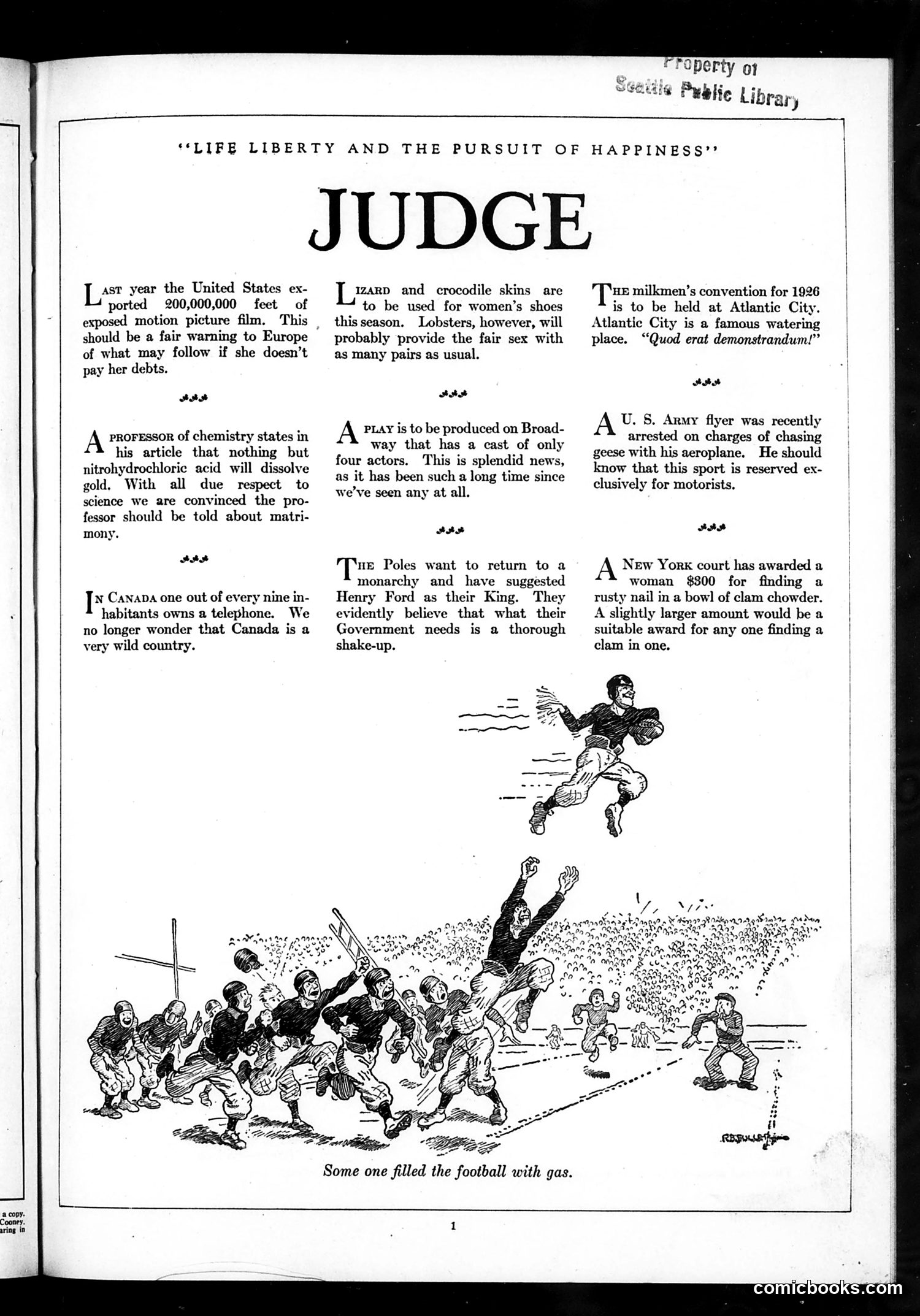
This satirical page contains brief editorial quips rather than a single cartoon. The main illustration depicts a football game where "someone filled the football with gas"—likely referencing a recent incident where a football exploded or malfunctioned during play, causing chaos. The text items mock various contemporary issues: Canadian telephone prevalence, European debts, chemistry professors dismissing unconventional science, a Broadway play with only four actors, Polish political desires, women's fashion (lizard/crocodile shoes), an Army pilot chasing geese, and a New York court awarding minimal damages for injury. The satirical tone targets both institutions and absurd news stories of the era, using humor to comment on social follies and legal peculiarities.
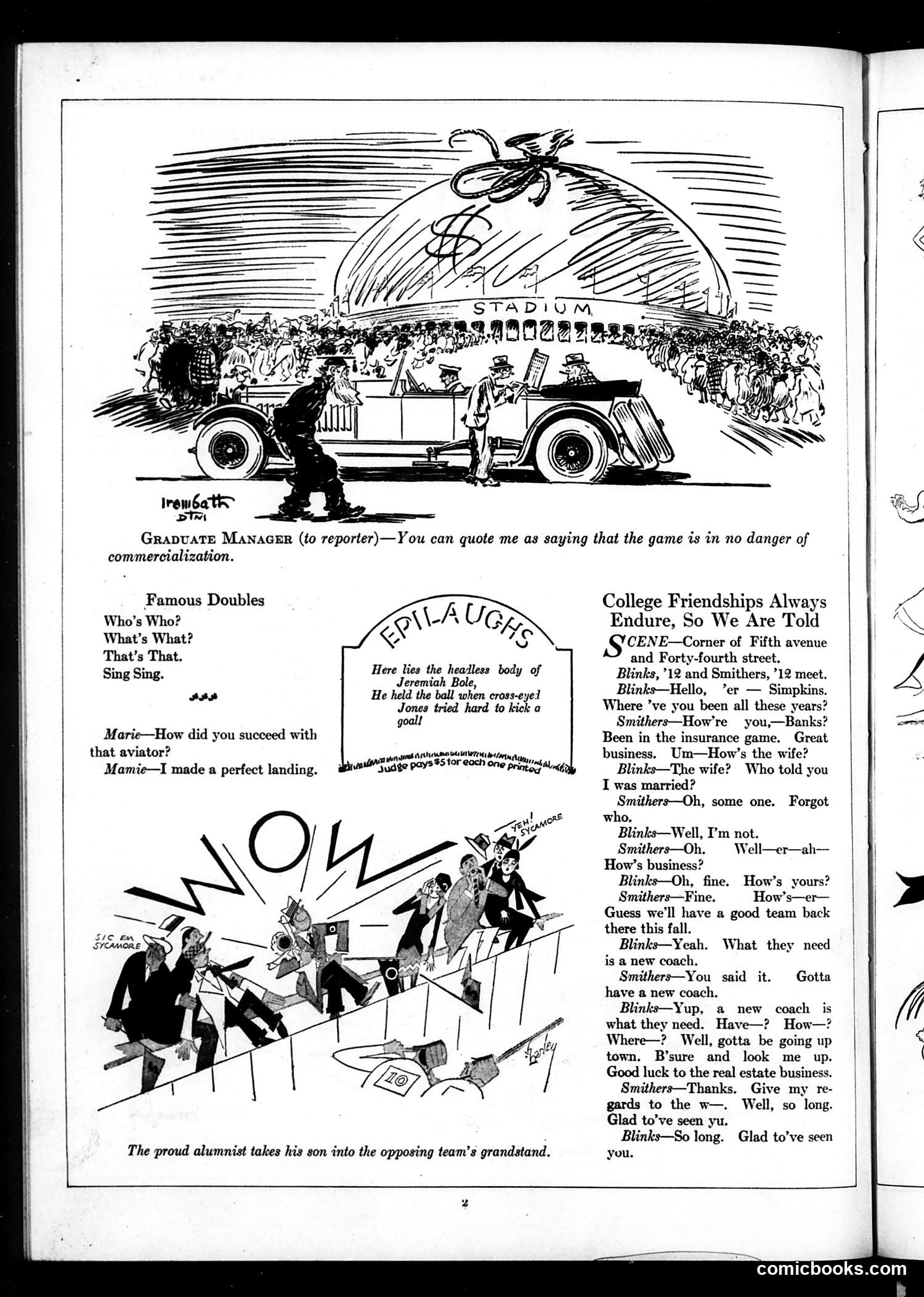
This page satirizes commercialization of college sports, particularly football. The top cartoon shows a stadium filled with spectators and an automobile (representing modern consumer culture) parked prominently in front, captioned with a manager claiming "the game is in no danger of commercialization"—clearly ironic given the vehicle's prominent placement. The lower cartoon depicts chaos at a game, with what appears to be an alumnus proudly taking his son into the opposing team's grandstand, creating conflict. This mocks overinvestment by alumni in college athletics. The "Famous Doubles" and "College Friendships" sections present witty dialogues satirizing how alumni reconnect, with references to insurance and business replacing genuine collegiate bonds—further criticizing how commercialism has corrupted college life and traditions.
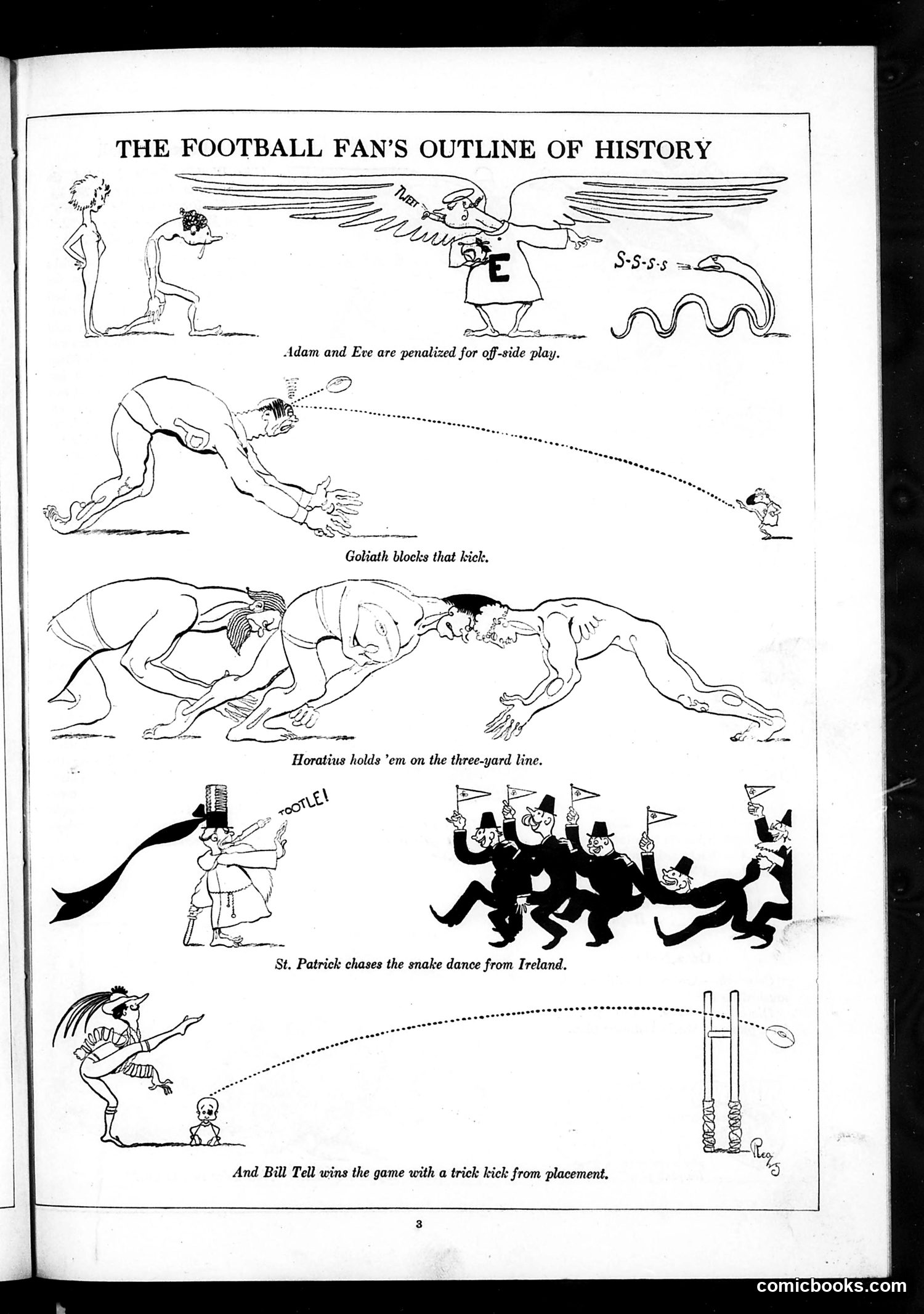
This humorous page uses football analogies to reframe historical events. The captions pair sports terminology with famous moments: - **Adam and Eve's "off-side play"** references the biblical Fall of Man as a rule violation - **Goliath blocking a kick** depicts the biblical giant in football terms - **Horatius holding "the three-yard line"** compares the Roman hero's bridge defense to football strategy - **St. Patrick chasing snakes** becomes a coach expelling opposing players - **Bill Tell's trick kick** shows his famous arrow shot as a placement kick The satire mocks how Americans understood history primarily through the lens of football, reducing grand historical narratives to sports metaphors. This likely reflects early 20th-century American sports culture's dominance in popular discourse.
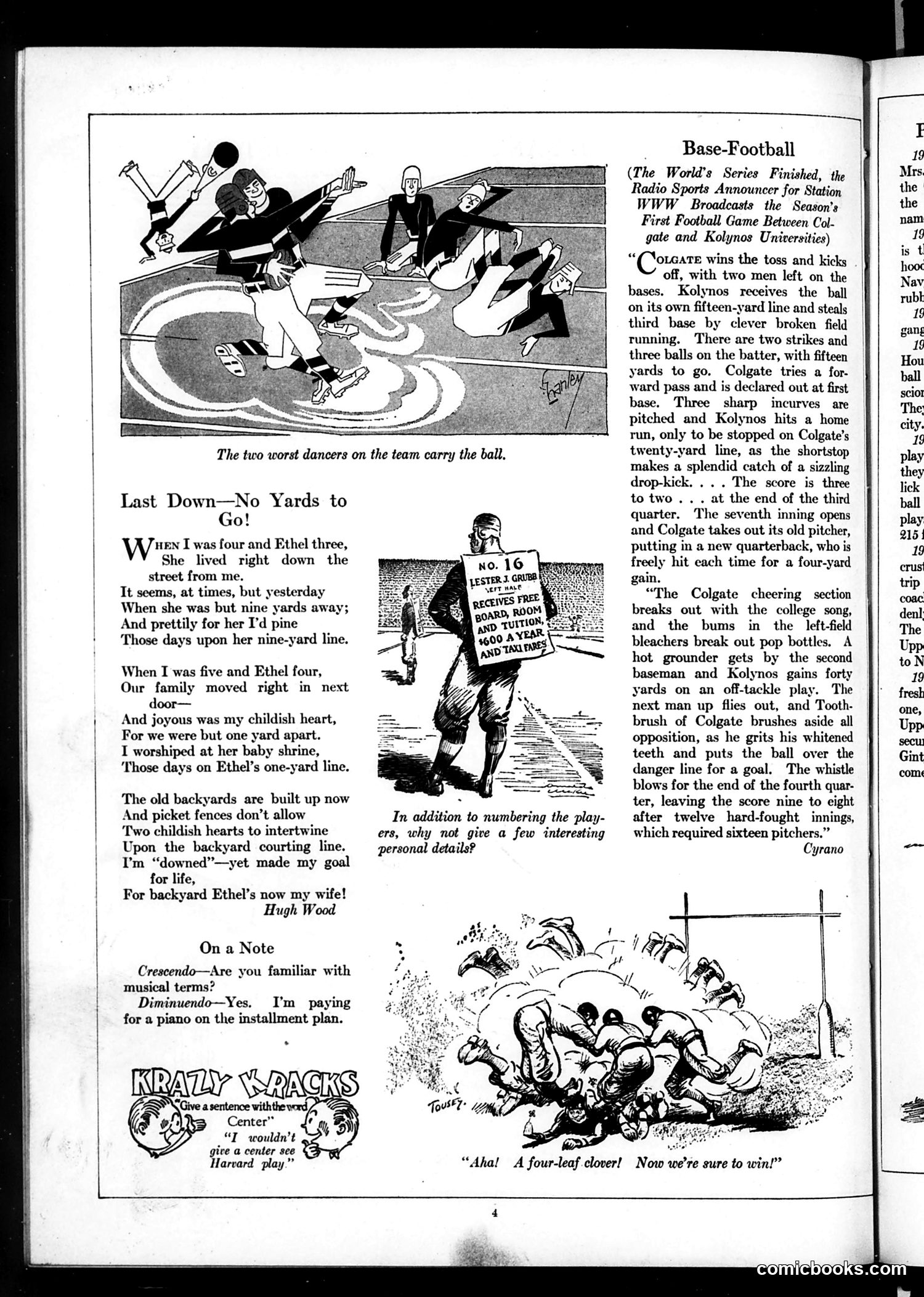
This page contains sports content rather than political satire. The main article, "Base-Football," describes a college football game between Colgate and Kolynos Universities broadcast on WWW radio. The narrative details game plays in humorous, exaggerated fashion—including broken-field running and home runs—mixing baseball and football terminology for comedic effect. "Last Down—No Yards to God" is a sentimental poem by Hugh Wood about childhood memories near a nine-yard line. A small humor section titled "On a Note" contains a brief joke about musical terms and piano installment plans. The "Krazy Kracks" section offers wordplay humor. The cartoons illustrate the sports content but lack political commentary—this is entertainment-focused content typical of Judge's lighter offerings.
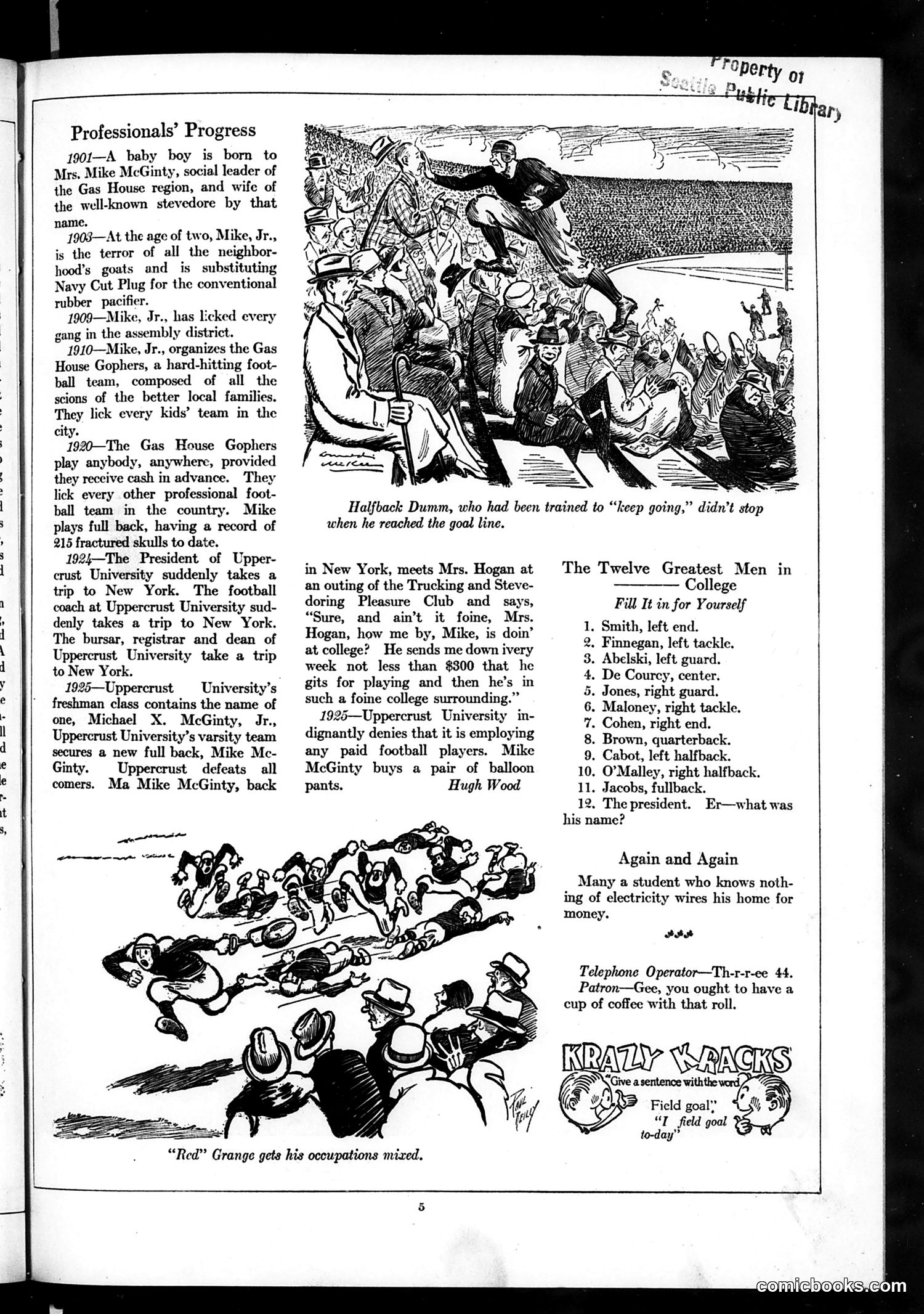
This page contains satirical sports commentary rather than political cartoons. The main content is "Professionals' Progress," a humorous biographical sketch of Mike McGinty Jr., tracking his life from 1904 (birth) through 1925 (buying balloon pants). The satire mocks the trajectory of a mediocre athlete: starting as a neighborhood terror, organizing a football team, playing professionally, and eventually becoming a college player—suggesting he succeeded despite lacking genuine talent. The cartoons below illustrate the absurdity through visual humor: the football scene shows chaotic play, while "'Red' Orange gets his occupations mixed" depicts someone confused about his job. The "Twelve Greatest Men in College" is likely satirizing inflated sports celebrity culture of the 1920s. These pieces collectively mock both amateur athletics and professional sports culture's inflated importance in American society.
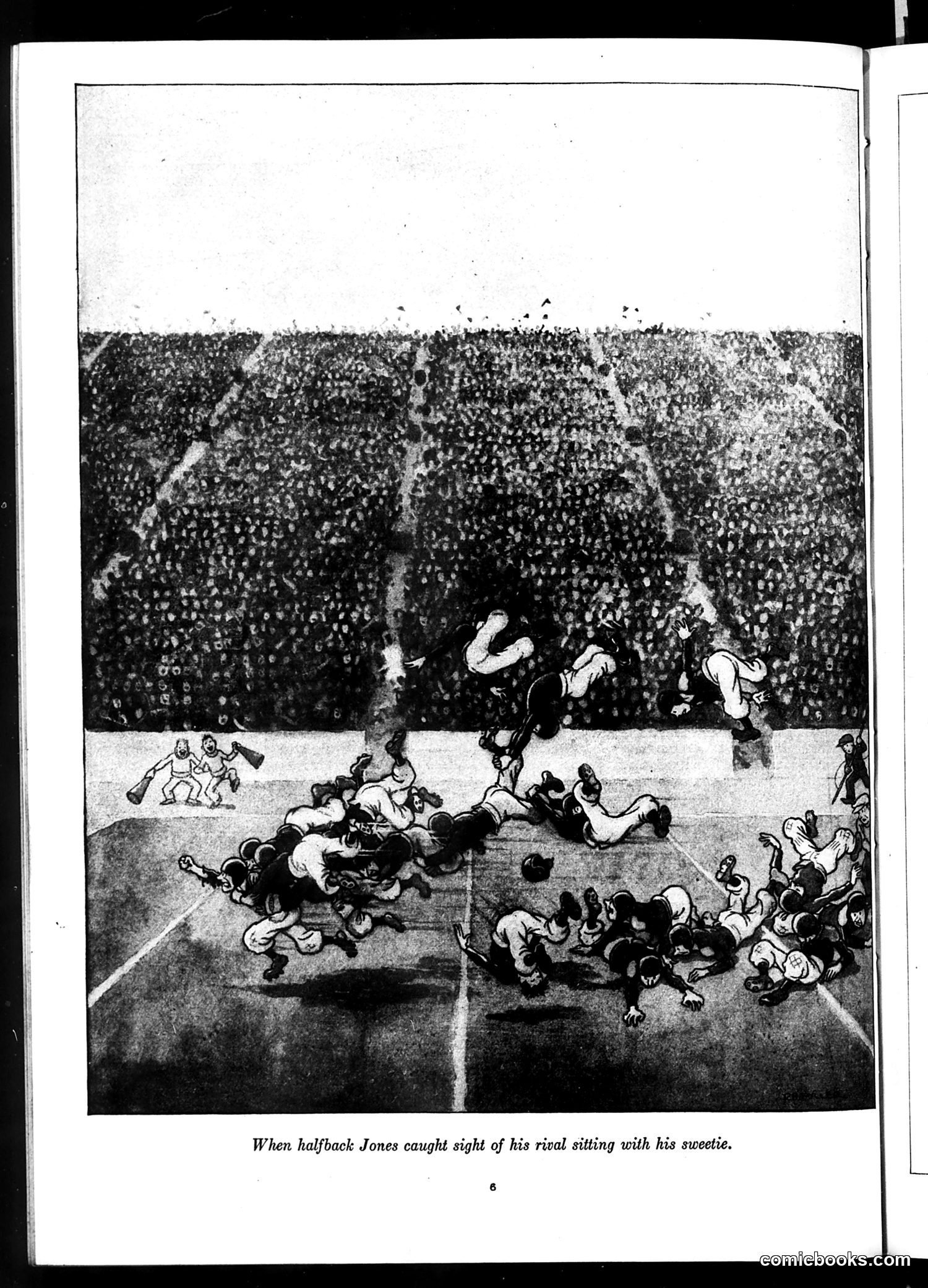
This is a sports humor illustration from *Judge* magazine depicting a football rivalry played for comedic effect. The caption references "halfback Jones" discovering his rival in a romantic situation with "his sweetie" (girlfriend). The image shows a crowded football stadium with masses of spectators in the background. On the field, players are engaged in what appears to be a chaotic scrimmage or pile-up around the ball, with several players sprawled on the ground in exaggerated poses. The joke seems to be that Jones's emotional reaction to seeing his rival with his girlfriend causes confusion or mayhem on the field—suggesting his distraction or rage disrupts the play. This plays on the common trope of romantic jealousy affecting athletic performance, rendered here as slapstick stadium comedy.
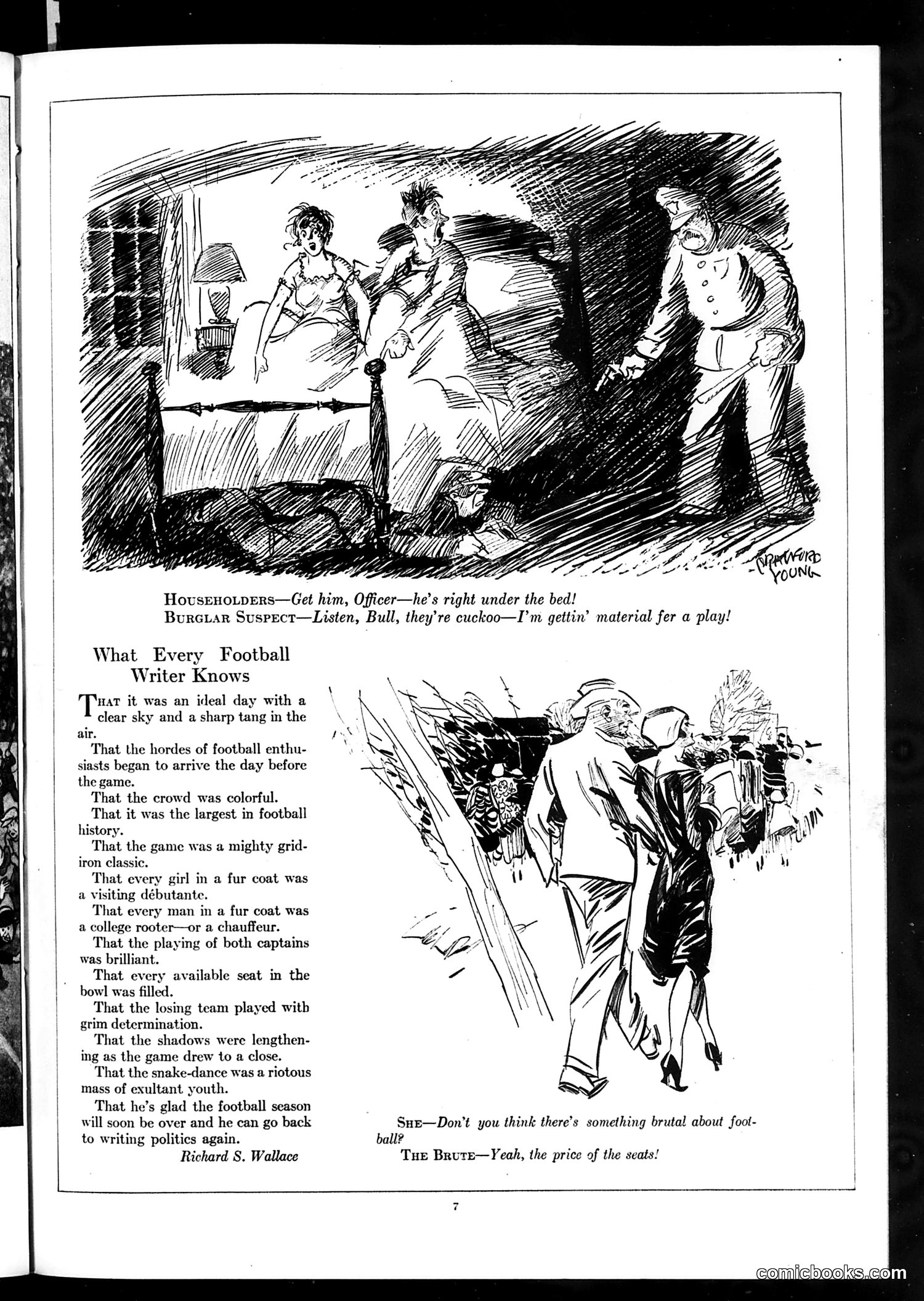
This page contains two separate pieces of satire: **Top cartoon:** A domestic burglary scene where householders chase a burglar hiding under a bed. The burglar's quip—that he's gathering "material for a play"—suggests he finds their panic amusing and theatrical. It's gentle satire on how people react to crime. **"What Every Football Writer Knows":** Richard S. Wallace satirizes sports journalism clichés. The piece mocks the predictable, formulaic language football writers use: describing games as "mighty" classics, crowds as "largest in history," all players as "brilliant." The final line is the punchline—writers hate football season and can't wait to return to "real" writing (politics). This skewers both lazy sportswriting and intellectual snobbery about football as a serious subject. **Bottom cartoon:** A conversation between "Sue" and "The Brute" plays on double meaning—she asks if football is "brutal," but he interprets it as commenting on expensive ticket prices, not violence. Light social satire on inflation.
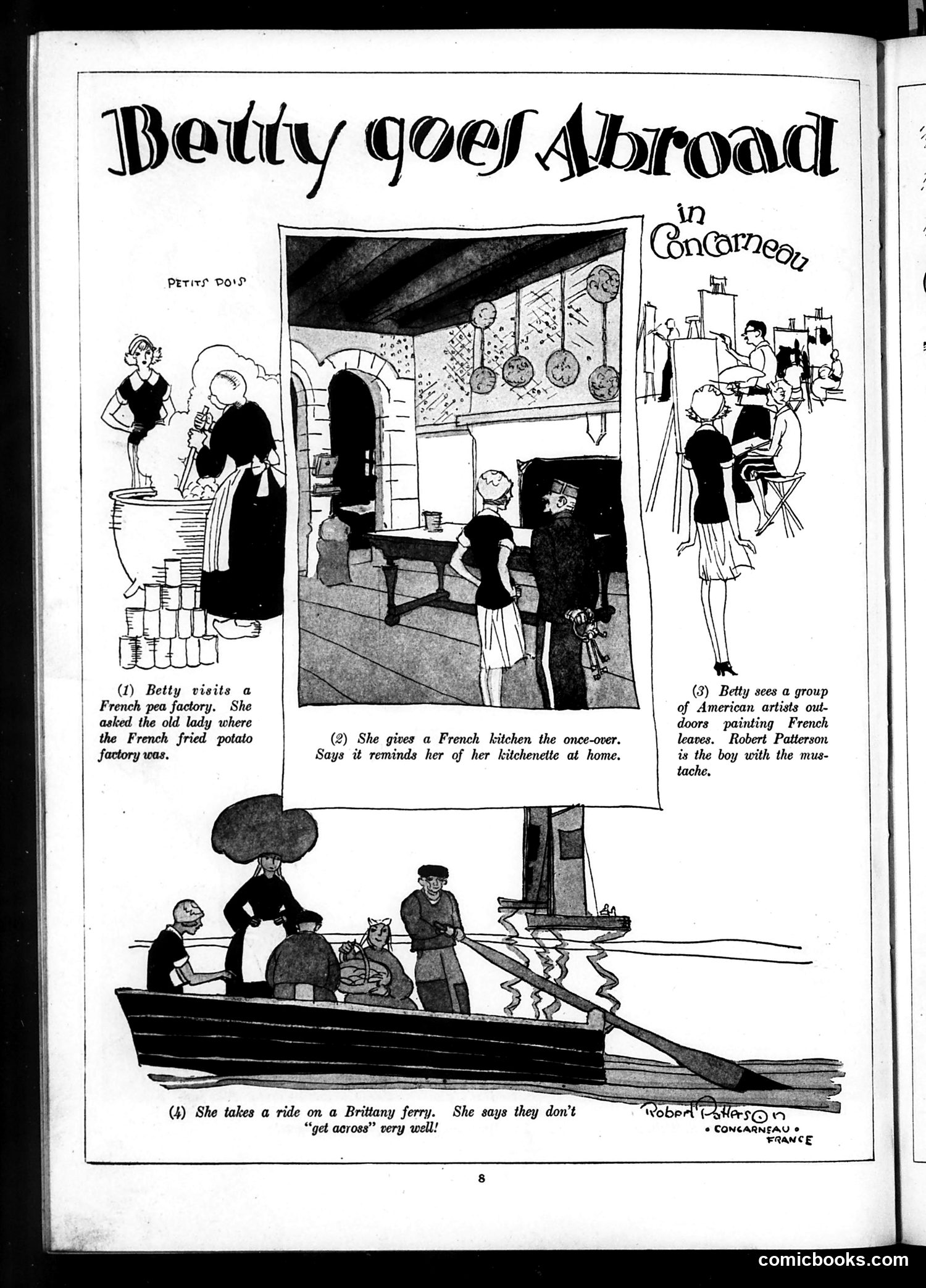
This is a humorous travelogue comic strip by Robert Castors featuring an American girl named Betty visiting France. The satire relies on fish-out-of-water comedy and national stereotypes: 1. Betty visits a French pea factory and naively asks about "French fried potatoes"—a joke suggesting Americans don't understand French cuisine or that "French fries" is a misnomer. 2. She compares a French kitchen to her own small kitchenette, mocking American domestic limitations. 3. She encounters American artists painting outdoors in France—a reference to the expatriate artist community in Europe. 4. On a Breton ferry, she quips that the boats don't "get across very well," poking fun at French maritime inefficiency. The humor targets both American ignorance of European culture and gentle ribbing of French capabilities, typical of 1920s-era Judge magazine comedy.
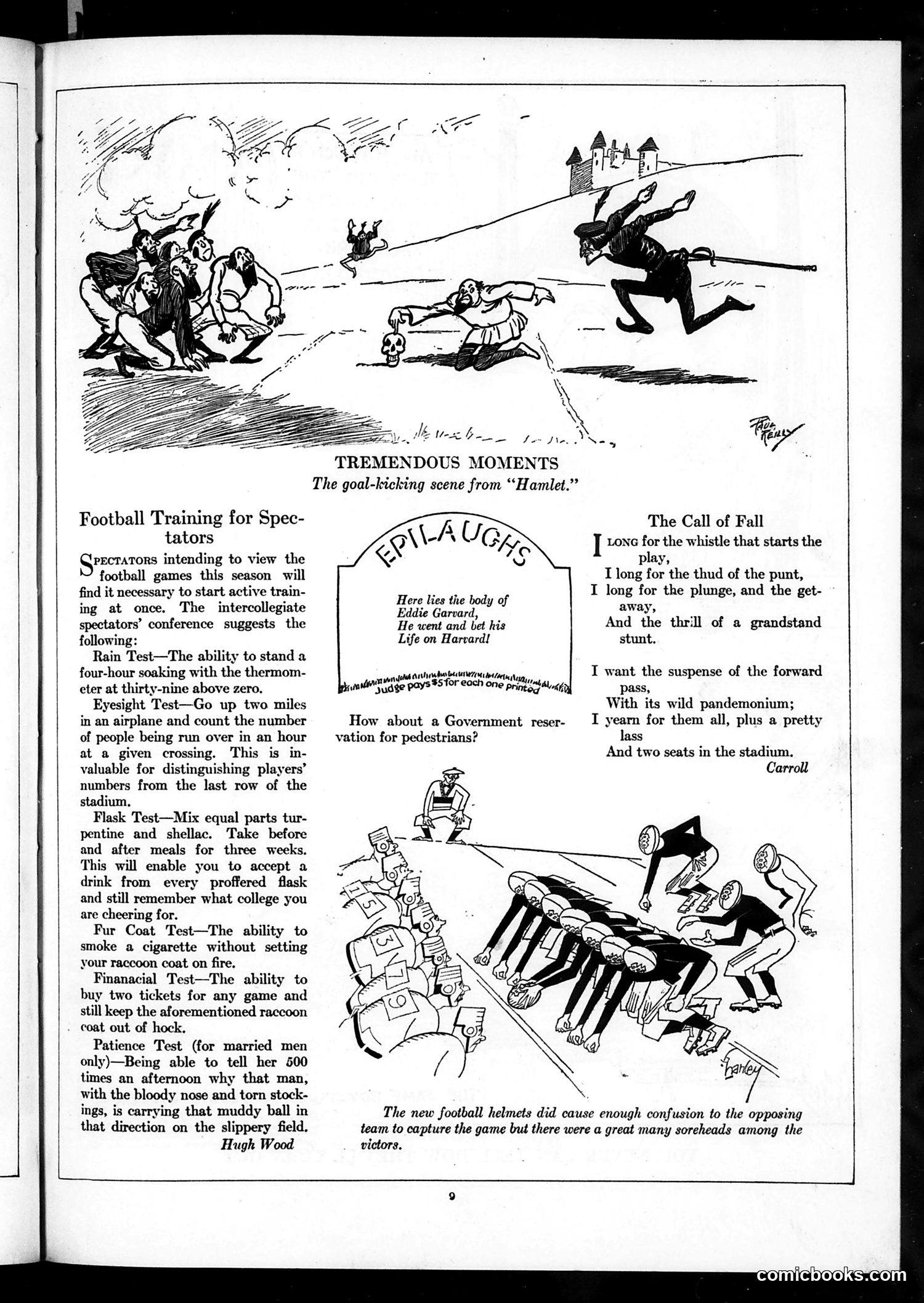
This page satirizes college football culture through multiple angles: **"Football Training for Spectators"** (by Hugh Wood) mocks the elaborate "preparation" spectators supposedly need, listing absurd "tests": enduring rain and cold, spotting players from airplane height, drinking whatever's offered while staying loyal to one's school, smoking without igniting fur coats (fashionable at the time), affording tickets without pawning possessions, and—for married men—explaining the game 500 times to wives. The humor targets both the sport's weather-dependent inconvenience and the excessive drinking culture at games. **"Tremendous Moments"** shows Shakespearean actors performing a goal-kick scene from *Hamlet*, conflating high drama with football absurdity. **"How about a Government reservation for pedestrians?"** sarcastically suggests pedestrians need federal protection from traffic, shown via cartoon of people being hit by cars—a swipe at urban danger and careless driving. **The football helmet cartoon** jokes that new helmets caused confusion but produced "soreheads among the victors"—a pun on both injuries and poor sportsmanship. The overall tone reflects 1920s-30s skepticism toward football's cultural prominence.
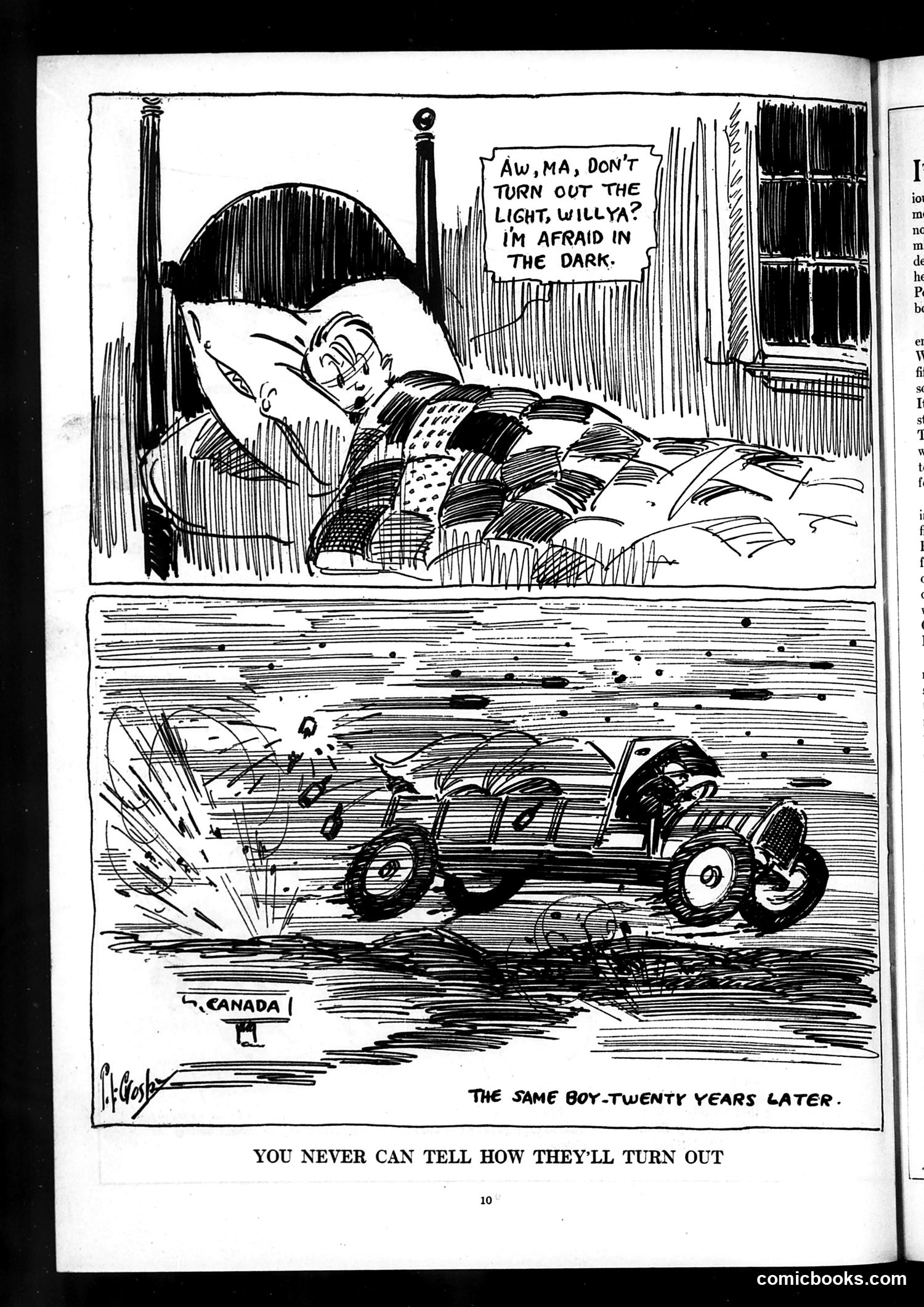
This two-panel cartoon presents a cautionary narrative about unpredictable child development. The top panel shows a young boy expressing fear of the dark to his mother—a vulnerable, dependent child seeking comfort. The bottom panel, captioned "The Same Boy—Twenty Years Later," depicts that same person as an adult driving recklessly in a car, appearing dangerous and out of control. The cartoon's message, reinforced by the title "You Never Can Tell How They'll Turn Out," warns that childhood behavior or parental indulgence doesn't predict adult outcomes. A fearful, coddled child might become a reckless adult. It appears to critique overprotective parenting, suggesting that sheltering children from fear could paradoxically produce irresponsible behavior later. The satire targets both parental permissiveness and the general unpredictability of human development.
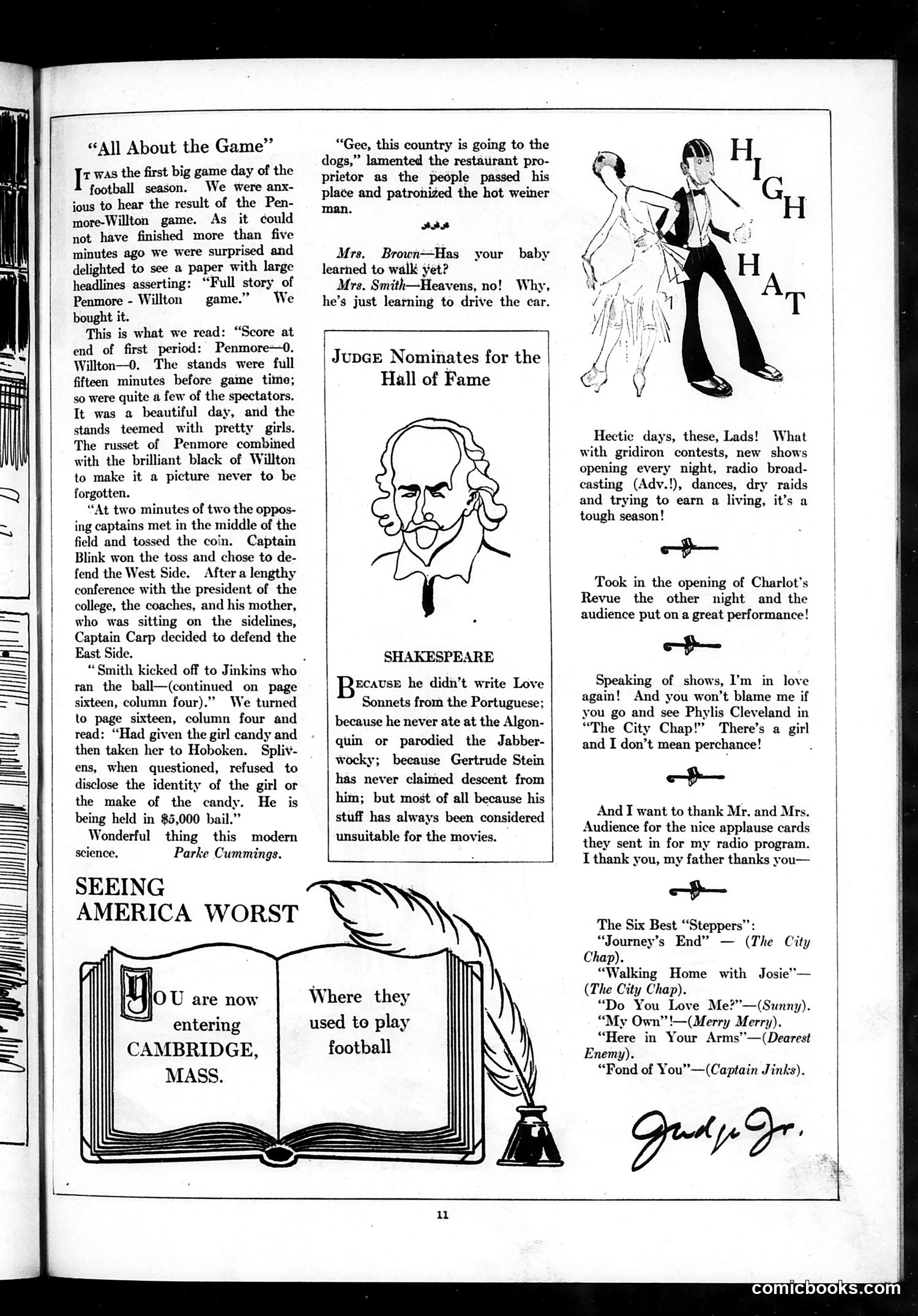
This page satirizes multiple aspects of 1920s American culture: **"All About the Game"**: Mocks sensationalist newspaper journalism. A sports paper promises "full story" of a football game but delivers only vague pleasantries, then abruptly cuts to an unrelated crime story about a girl receiving candy—illustrating how newspapers prioritize scandal over actual sports reporting. **"Seeing America Worst"**: A brief joke about Cambridge, Massachusetts replacing football fields with commercial development, lamenting urban modernization. **Shakespeare nomination**: Ironically "nominates" Shakespeare for a "Hall of Fame" *because* his work was considered unsuitable for movies—satirizing Hollywood's sanitization of classic literature and the period's anxiety about cinema's influence on culture. **Other jokes**: Mock modern parenting (children learning to drive cars before walking), restaurant proprietors losing business to street vendors, and celebrity gossip about shows and radio programs. The page reflects 1920s anxieties: rapid urbanization, mass media sensationalism, and entertainment industry influence on society.
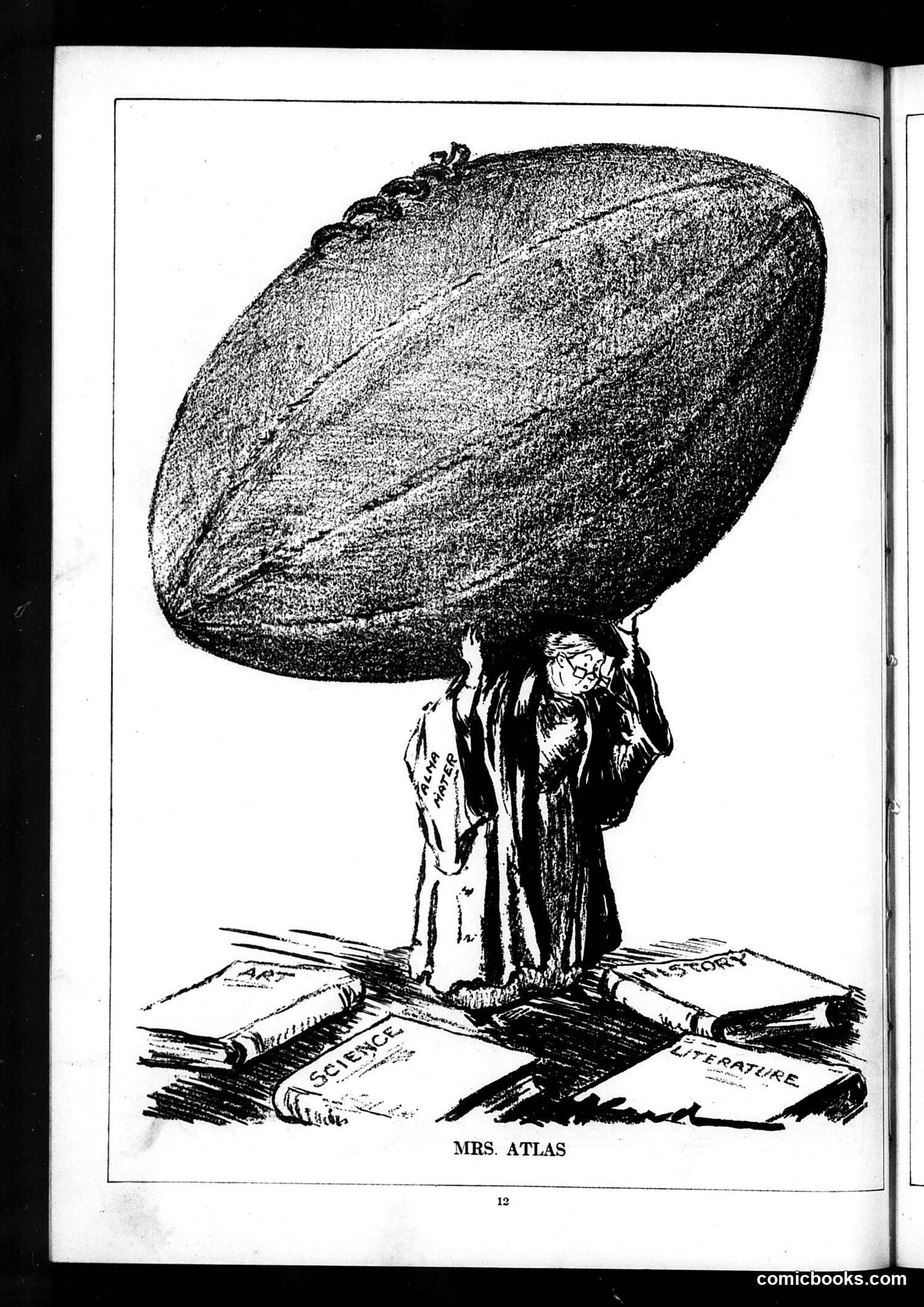
This political cartoon depicts a woman bearing an enormous globe on her shoulders, standing atop stacked books labeled "Science," "Literature," and other subjects. The figure is titled "Mrs. Atlas," invoking the mythological titan who holds up the heavens. The satire appears to criticize or comment on women's educational and intellectual burdens during the era when Judge magazine was published (likely early-to-mid 20th century). The cartoon suggests that women—personified as "Mrs. Atlas"—are expected to shoulder the weight of knowledge, culture, and learning while managing domestic responsibilities. The stacked books beneath her emphasize education's heavy load, making this likely social commentary on women's evolving roles in education and society.
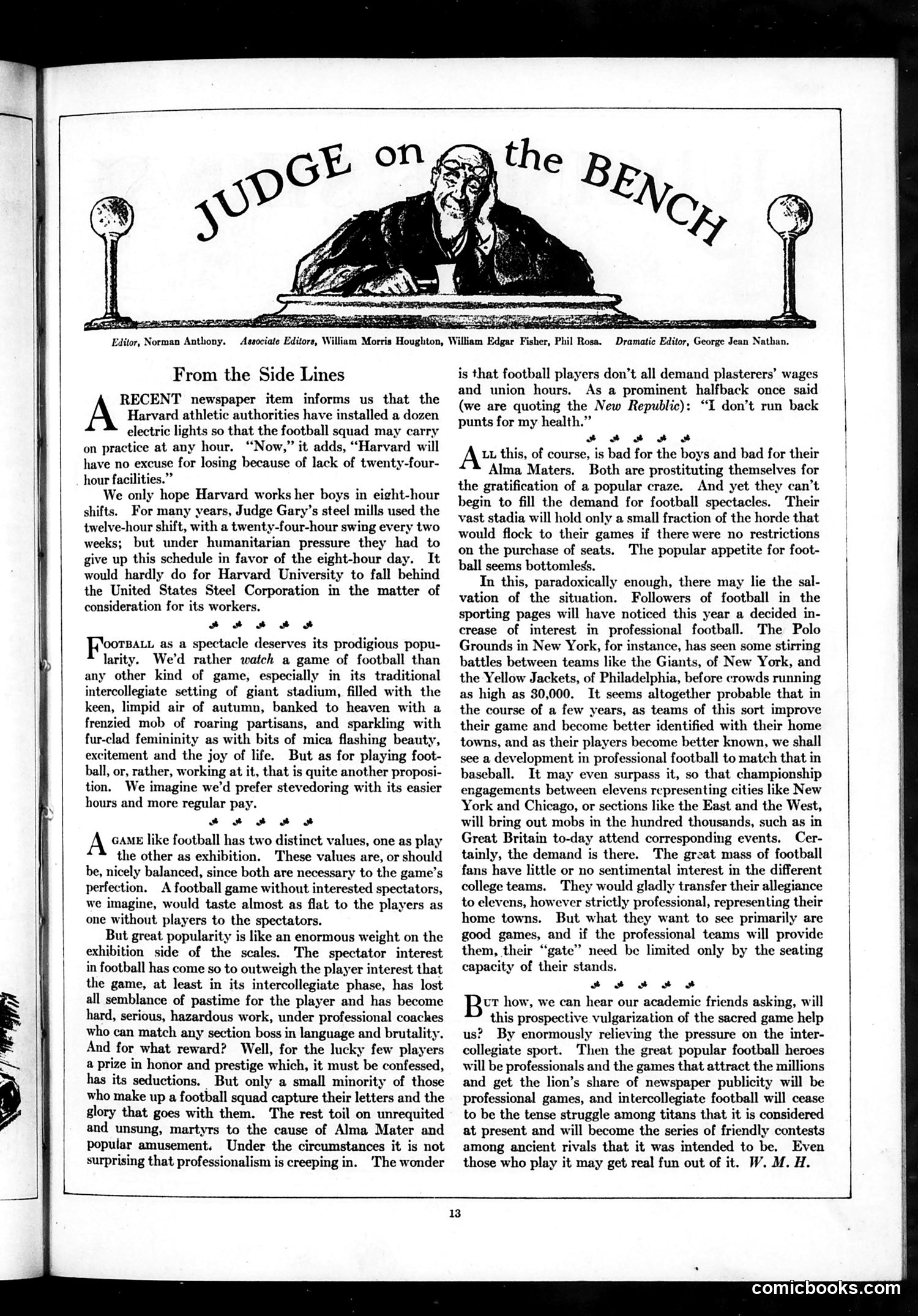
This editorial column satirizes the growing professionalization and exploitation within college football. The piece critiques Harvard's installation of electric lights for practice as implying the university works athletes like factory laborers—comparing Harvard unfavorably to even Judge Gary's steel mills, which abandoned brutal twelve-hour shifts under humanitarian pressure. The core argument: college football has become "hard, serious, hazardous work" for players who receive little reward beyond honor for a few letter-winners, while most remain "unrequited and unsung, martyrs." The author notes the paradox that spectator demand is bottomless yet players can't demand fair wages like other workers. The satire targets both universities and fans for treating amateur athletes as entertainment commodities rather than students, arguing this exploitation may ironically drive college players toward professional football—which the author suggests might actually resolve the crisis by finally providing proper compensation. The masthead identifies this as written by W.M.H. (William Morris Houghton or similar).
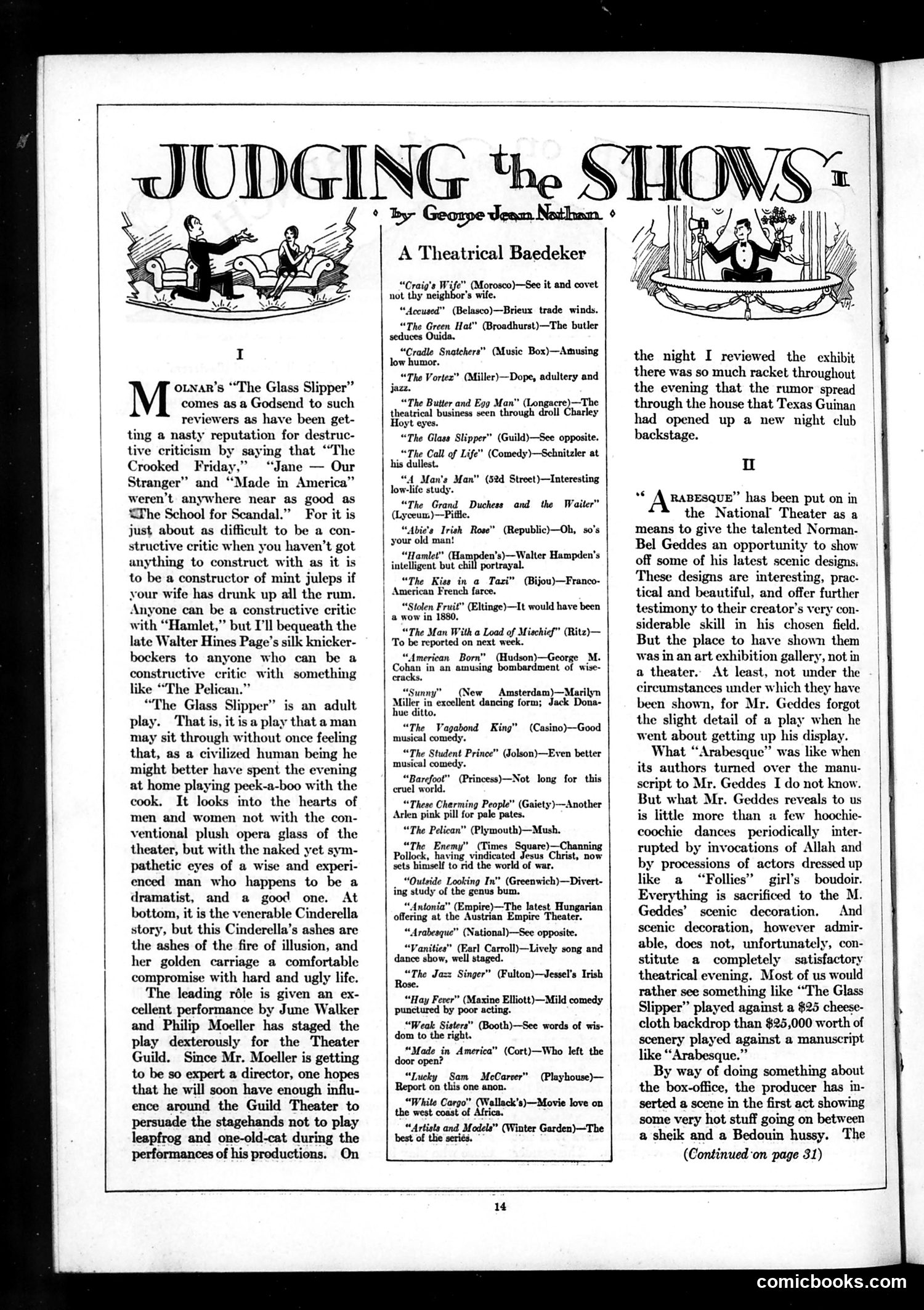
This page contains theater reviews by George Jean Nathan for *Judge* magazine. The main article praises Molnar's *"The Glass Slipper"* as a sophisticated adult play—a Cinderella adaptation with emotional depth, performed well by June Walker and directed by Philip Moeller for the Theater Guild. Nathan opens with gentle satire about destructive critics who lack constructive skills (comparing it to making mint juleps without rum). He argues *"The Glass Slipper"* rises above mere conventional theater fare because it examines human hearts "with naked yet sympathetic eyes" rather than through artifice. The sidebar "Theatrical Baedeker" offers quick, snarky judgments on current Broadway shows—brief quips recommending or dismissing productions. This format allows *Judge* to cover the theater season through humor and social commentary on what audiences valued in 1920s Broadway entertainment. The satire targets both pretentious theater and mediocre productions of the era.
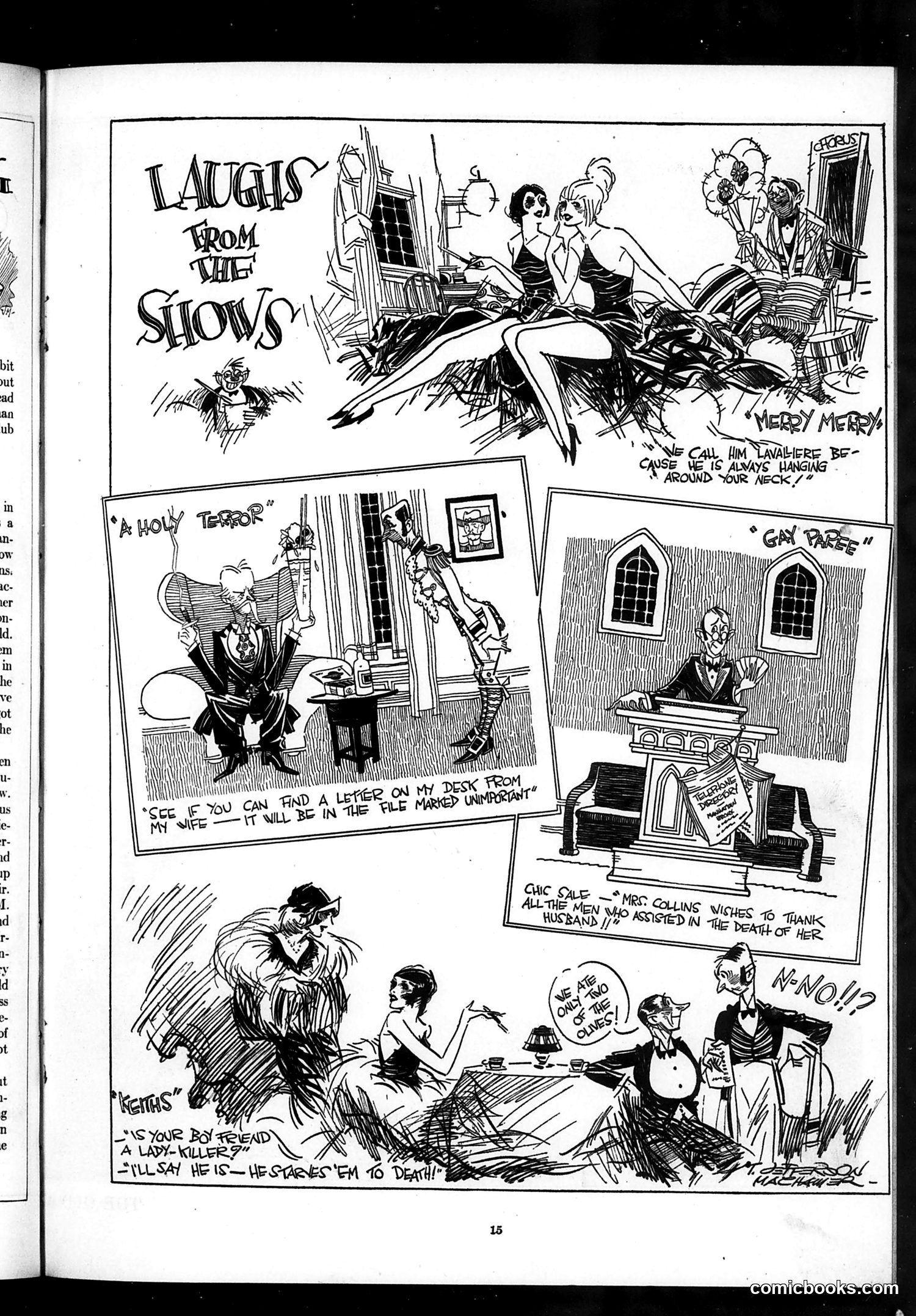
This is a theatrical satire page featuring three comic sketches mocking stage productions and performers of the era (appears to be early 20th century, based on Judge magazine's run). The top panel shows two women in revealing costumes amid theatrical chaos, labeled "Merry Merry"—likely satirizing risqué musical comedy shows popular at the time. The middle panels parody melodramatic plots: "A Holy Terror" shows an exaggerated villain; "Gay Tares" depicts a church scene with a widow celebrating her husband's death. The bottom panel, "Hetras," mocks overwrought dramatic acting, showing a supposed "lady-killer" character. The satire targets both the absurd plots of contemporary theater and the hammy, exaggerated acting styles that characterized popular stage productions. The crude sexual innuendos and violent subject matter reflect Judge's irreverent humor toward entertainment establishment conventions.
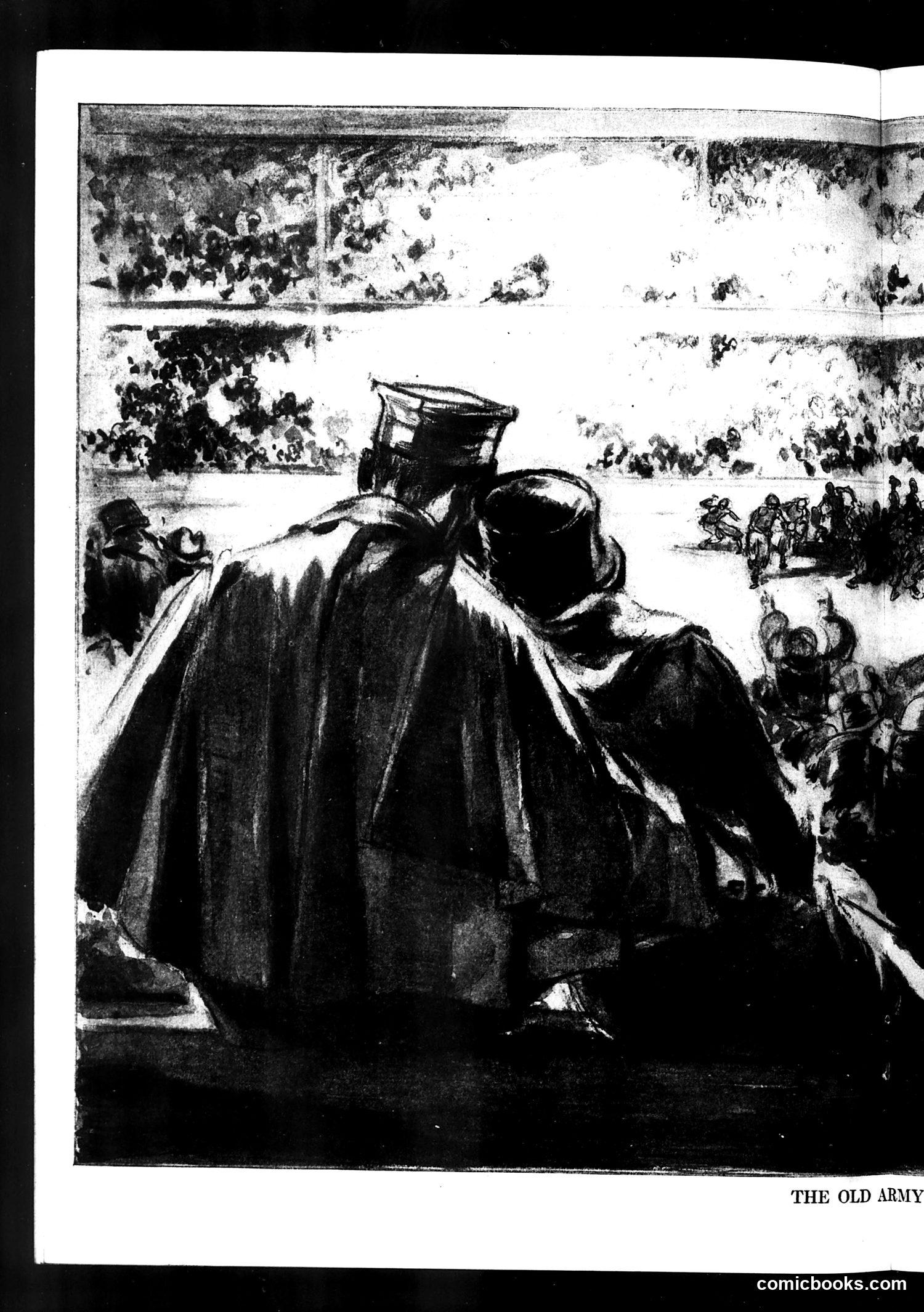
This appears to be a satirical illustration titled "The Old Army," showing figures in military dress observing what seems to be a gathering or military formation in the distance. The central figure wears a heavy cape and hat, drawn in a caricatured style typical of Judge magazine's political satire. Without a clear date or additional context visible on the page, the specific historical reference is unclear. However, the composition suggests commentary on military institution, possibly critiquing outdated military practices, leadership, or the contrast between old guard military officers and contemporary events. The dramatic cloaked figure and distant gathering suggest either nostalgia for past military glory or ironic commentary on military relevance. The OCR text is largely corrupted, preventing precise interpretation of the accompanying article or caption that would clarify the satirical target.
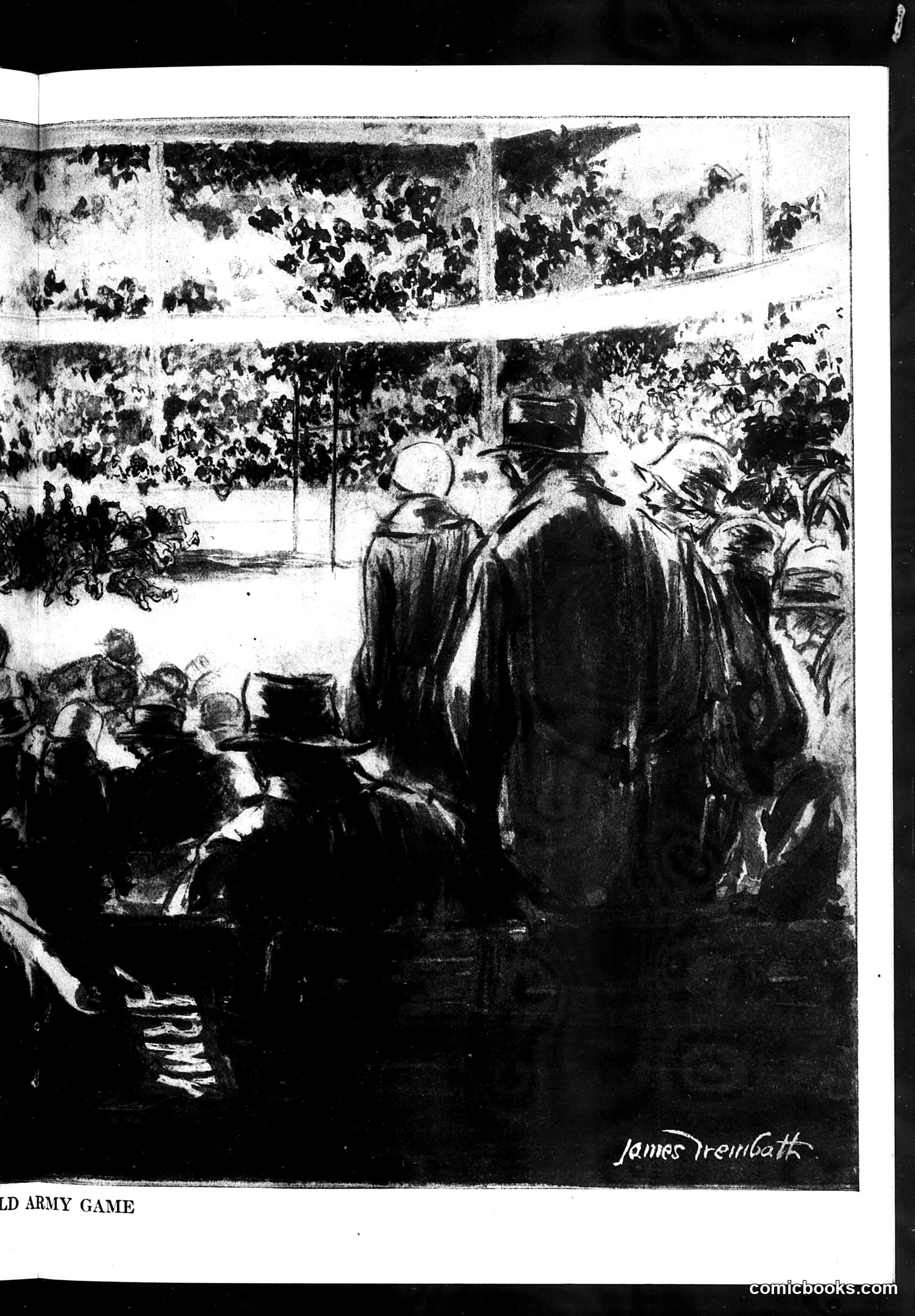
The page shows a sketch signed by James Preimlrath depicting what appears to be a crowded arena or amphitheater scene with spectators in the upper tiers and several figures in formal dress (top hats and coats) in the foreground arena floor. The partial text visible reads "LD ARMY GAME," suggesting this relates to a military or athletic event. However, the OCR text is almost entirely corrupted, providing no readable caption or context to interpret the cartoon's specific satirical point. Without legible accompanying text identifying the figures or explaining the joke, I cannot reliably explain what political or social commentary this cartoon intended to convey to Judge's contemporary readers. To properly analyze this cartoon's meaning would require either a clearer image of the text or additional historical context about the event referenced.
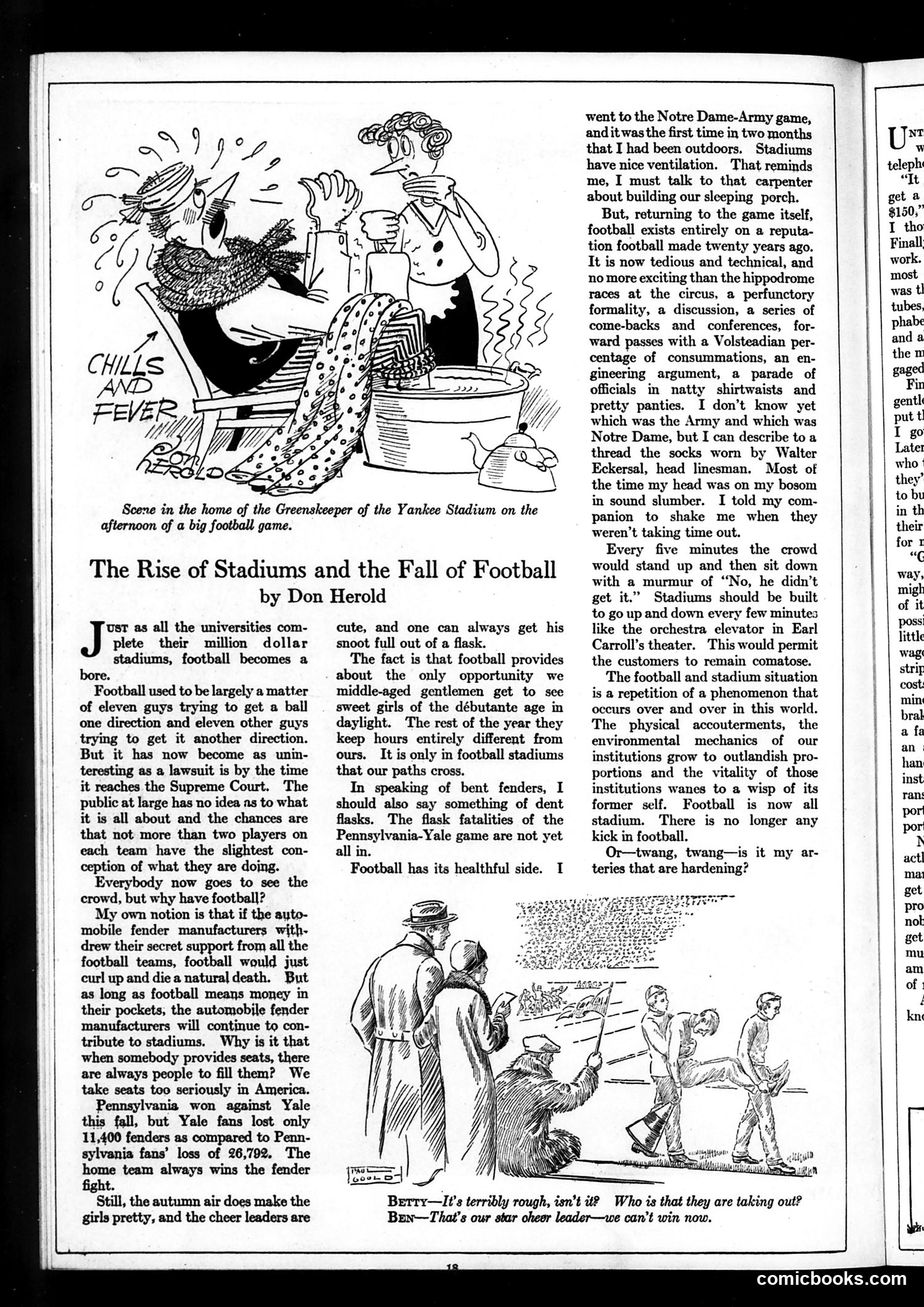
Don Herold's satirical essay argues that football has become boring despite—or because of—massive new stadium construction at universities. The top cartoon shows a spectator at Yankee Stadium suffering from "chills and fever," depicting the illness of stadium attendance. Herold's central joke is that **automobile fender manufacturers secretly fund football teams** because car accidents from fans driving to games damage vehicles, generating repair business. He notes Pennsylvania-Yale fans lost "26,792 fenders" versus Yale's "11,400"—a darkly comic claim that traffic accidents are the real measure of game attendance. He mocks football's decline: it's now "tedious and technical," featuring endless conferences and forward passes (likely referencing Prohibition-era flask drinking—"Volsteadian percentage"). The game itself has become incomprehensible; he fell asleep during Notre Dame-Army and could only describe the linesman's socks. The caption cartoon ("Berry—It's terribly rough, isn't it? / Ben—That's our star cheer leader—we can't win now") shows injured cheerleaders, extending the accident/injury theme. The satire targets both football's loss of vigor and Americans' excessive reverence for seating capacity.
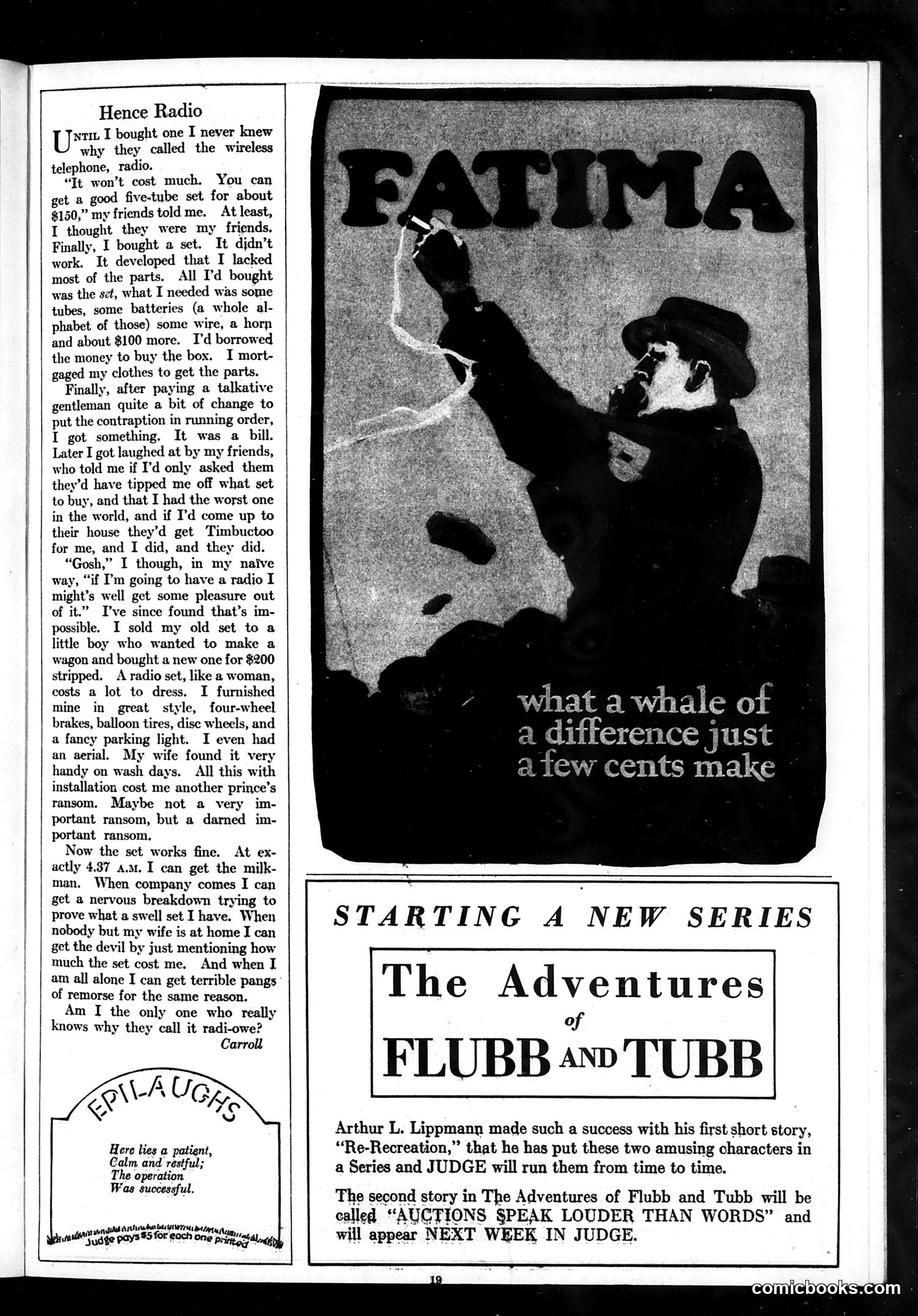
This humorous essay by Carroll satirizes the hidden costs of purchasing an early radio set. The author was sold on the promise of an affordable "$150 five-tube set" by friends, only to discover the advertised price excluded essential components—tubes, batteries, wire, and installation labor—ultimately costing him $250+ and requiring him to mortgage his clothes. The satire targets both deceptive sales practices and the author's own naïveté. The punchline—"radi-owe"—is a play on "radio" and "owe," suggesting the device should be called a debt instrument. Additional humor comes from the radio's uselessness (it only receives the milkman at 4:37 a.m.) and its marital consequences (his wife uses the aerial for laundry; he suffers guilt over the expense). The page also advertises a new comic series, "The Adventures of Flubb and Tubb," by Arthur L. Lippmann.
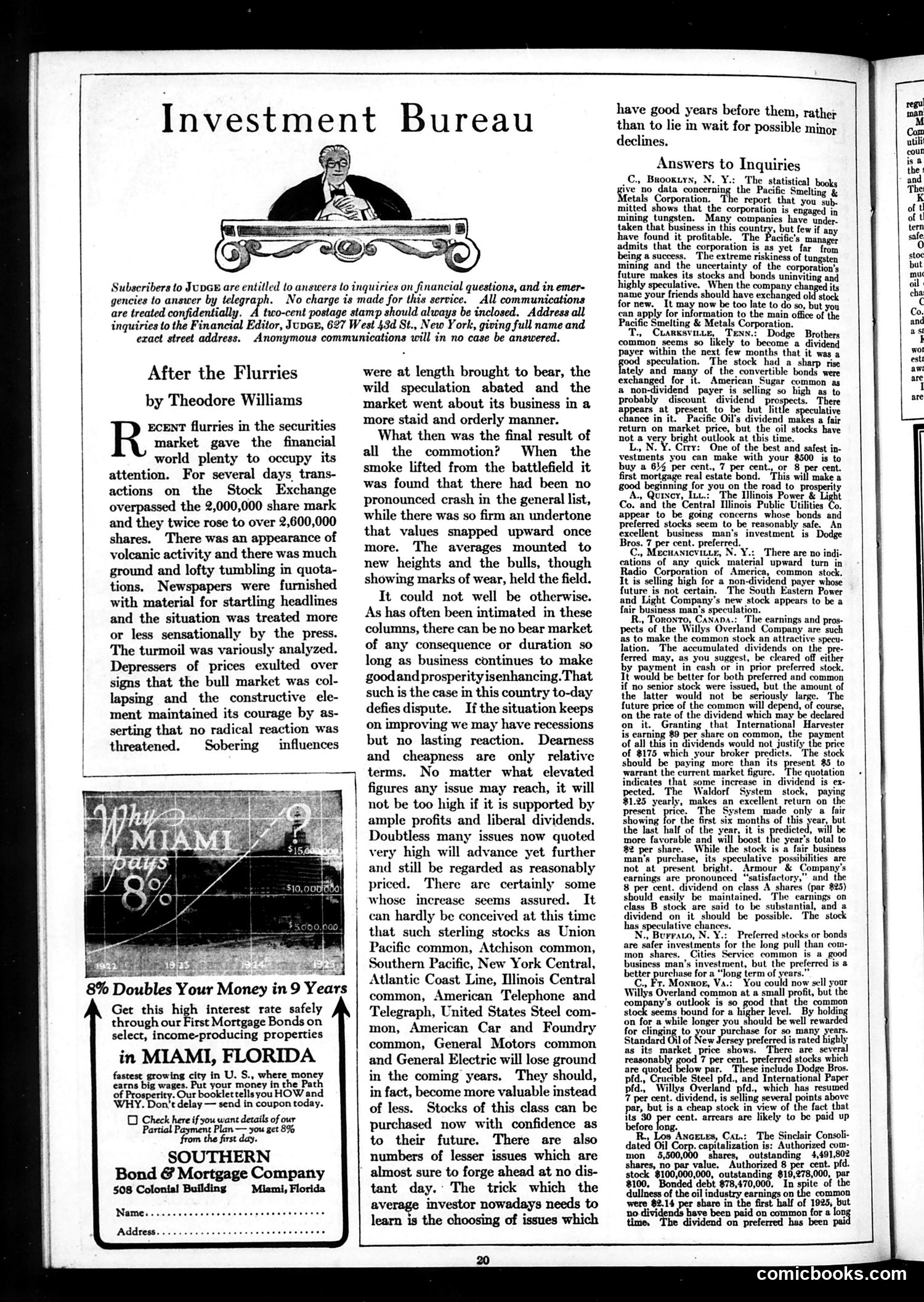
This page contains a financial advice column ("Investment Bureau") and Theodore Williams's article "After the Flurries," discussing recent stock market volatility. The piece reassures readers that despite dramatic trading activity and sensational newspaper headlines, the underlying market fundamentals remain sound because American business prosperity is genuine and sustainable. Williams recommends blue-chip stocks (Union Pacific, AT&T, U.S. Steel, General Motors, General Electric) as reliable long-term investments. The satire appears mild—the "flurries" (market turbulence) are presented as temporary overreactions by speculators and pessimistic press, while rational investors should recognize that strong corporate profits justify current stock valuations. The page also includes a Miami real estate advertisement promising 8% returns, typical of the era's investment marketing. No specific political figures or caricatures are visible in the text or image provided.
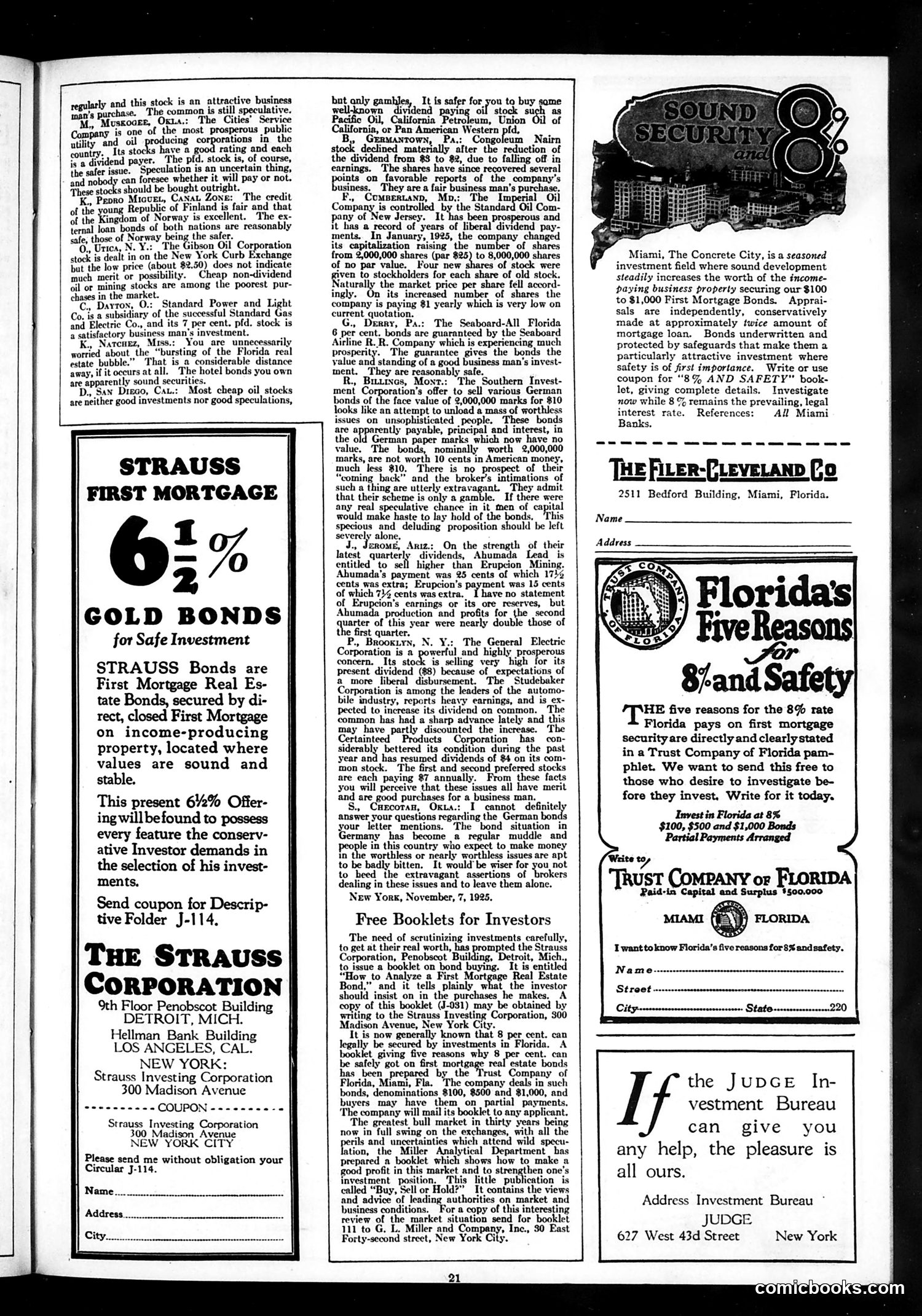
This page is **primarily advertising and financial advice**, not satire or political commentary. It's a reader Q&A section answering investment questions about stocks, bonds, and corporate securities. The page contains multiple investment firm advertisements (Strauss Corporation, Filer-Cleveland Co., Trust Company of Florida, Judge Investment Bureau) promoting bonds and stocks as "safe" investments. This reflects the **1920s investment boom** preceding the 1929 crash—these ads confidently tout various securities' safety and dividend potential. The irony for modern readers: **this page advertises investments as sound and secure during the exact period before the catastrophic market collapse**. The confidence in "safe" oil stocks, real estate bonds, and industrial securities became tragically misplaced within years. The advice columns themselves reflect period concerns: Florida real estate speculation, oil stock volatility, and bond ratings—topics that would soon become cautionary tales of 1920s financial excess.
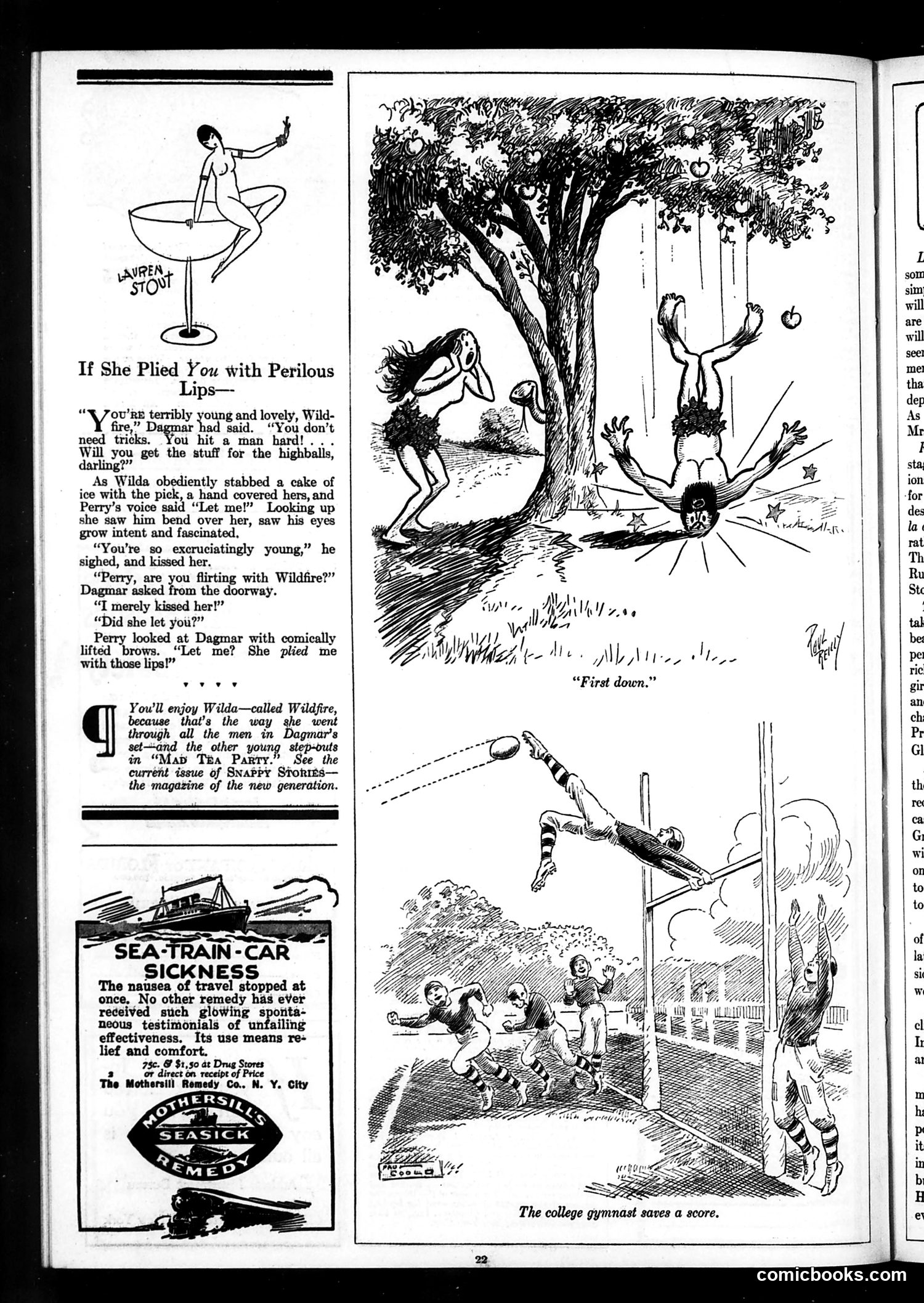
This page contains two narrative elements: **Top Story: "If She Plied You with Perilous Lips"** A serialized romance/drama featuring characters named Wilda ("Wildfire"), Dagmar, and Perry. The text describes flirtation and romantic tension—Perry kisses Wilda, and when Dagmar discovers this, Perry claims Wilda initiated it ("she plied me with those lips"). The story appears designed to titillate 1920s readers with modern, bold female sexuality. A promotional note promises readers will "enjoy Wilda" by following her exploits in the magazine *Snappy Stories*, aimed at "the new generation." **Bottom Cartoons:** Two unrelated sports gags: one about seasickness (advertising Mothersill's Remedy), and one captioned "The college gymnast saves a score"—showing acrobatic students performing a rescue or stunt. The page exemplifies Judge's mix of serialized fiction, sports humor, and advertising—targeting young, urban readers interested in modern romance and entertainment.
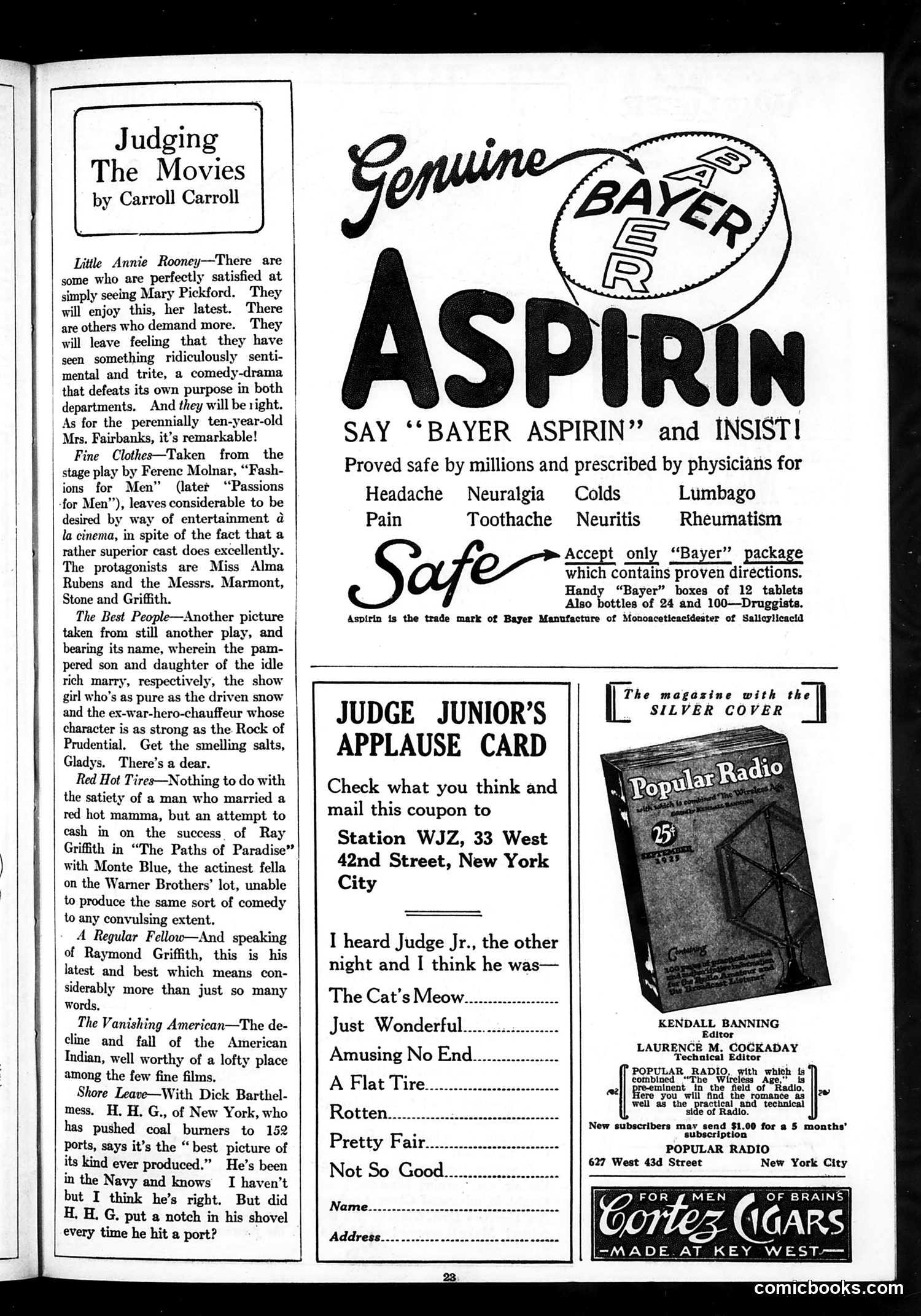
This page primarily contains **movie reviews by Carroll Carroll** and period advertisements rather than political cartoons. The reviews critique early 1920s silent films—notably featuring Mary Pickford in "Little Annie Rooney" and Dick Barthelmess in "Shore Leave"—with a sardonic tone mocking both sentimental plots and weak adaptations of stage plays. The satire targets **Hollywood's creative bankruptcy**: stage-to-screen conversions that lose entertainment value, and melodramatic "pure show girl" and "reformed war hero" character types that Carroll finds risible. The page also advertises **Bayer Aspirin** (emphasizing "Genuine Bayer"), **Popular Radio magazine**, and **Cortez cigars**—typical 1920s consumer products. A reader poll ("Judge Junior's Applause Card") invites feedback on radio programming via station WJZ. Historically, this reflects the era when cinema was still establishing itself as distinct from theater, and when radio was an emerging mass medium competing for audience attention.
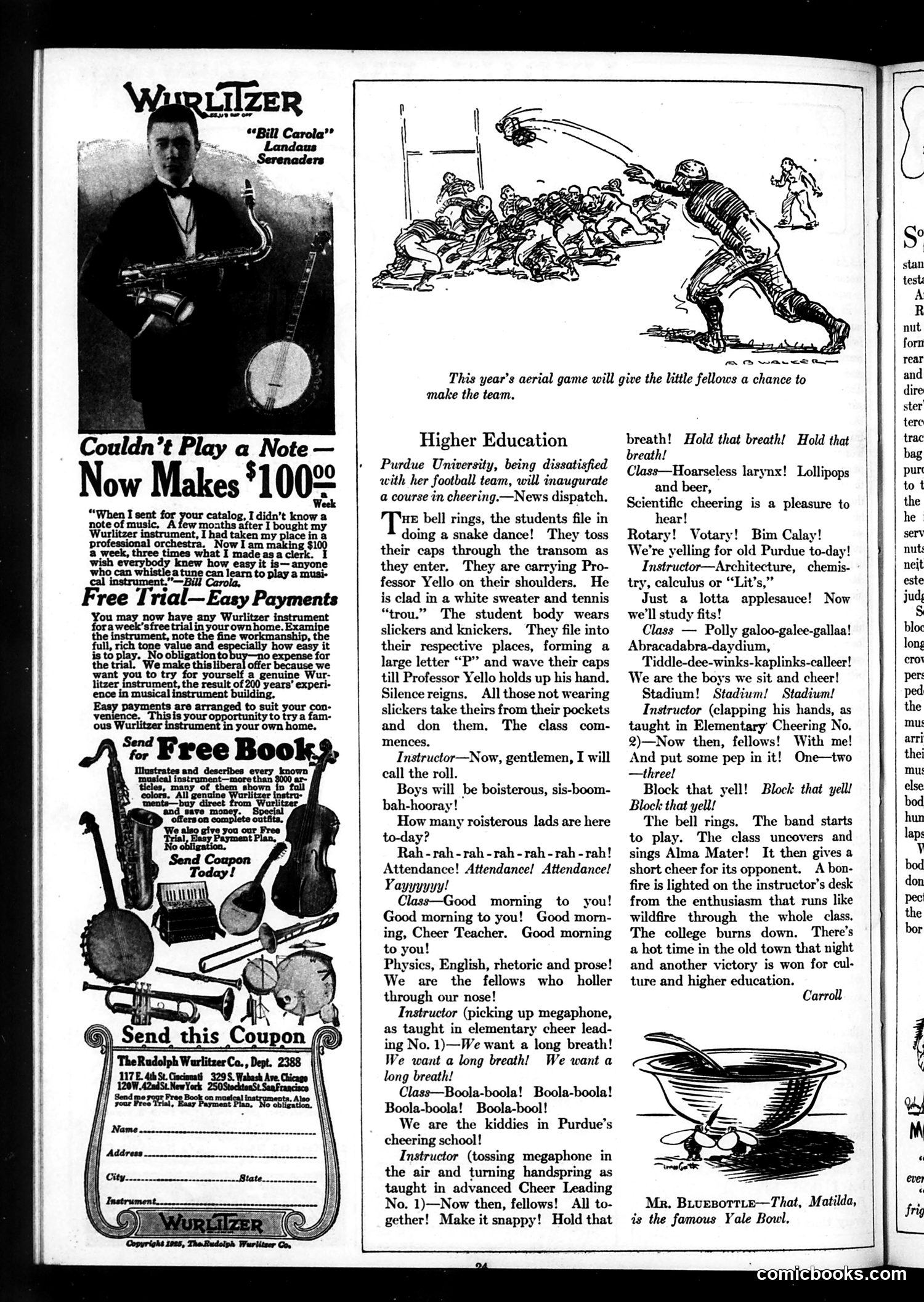
This page contains two pieces: **Left side:** A Wurlitzer musical instrument advertisement. The headline mocks someone ("Bill Carole") who "couldn't play a note" but now earns $100—implying the Wurlitzer's ease of use transformed them into a paying musician. It's a straightforward product ad with a free-trial coupon. **Right side:** A satirical article titled "Higher Education" about Purdue University establishing a formal "cheering" course. The satire critiques the absurdity of institutionalizing college pep rallies—depicting an instructor teaching elaborate cheering techniques with the same seriousness as academic subjects like physics and chemistry. The joke escalates ridiculously: students learn megaphone technique, handsprings, and vocal exercises until "the college burns down" from their enthusiasm. The final caption references "the famous Yale Bowl" (Yale's football stadium), extending the joke to mock collegiate athletic culture more broadly. **Overall:** The page satirizes how American universities prioritize football spectacle and student cheering over actual academics.
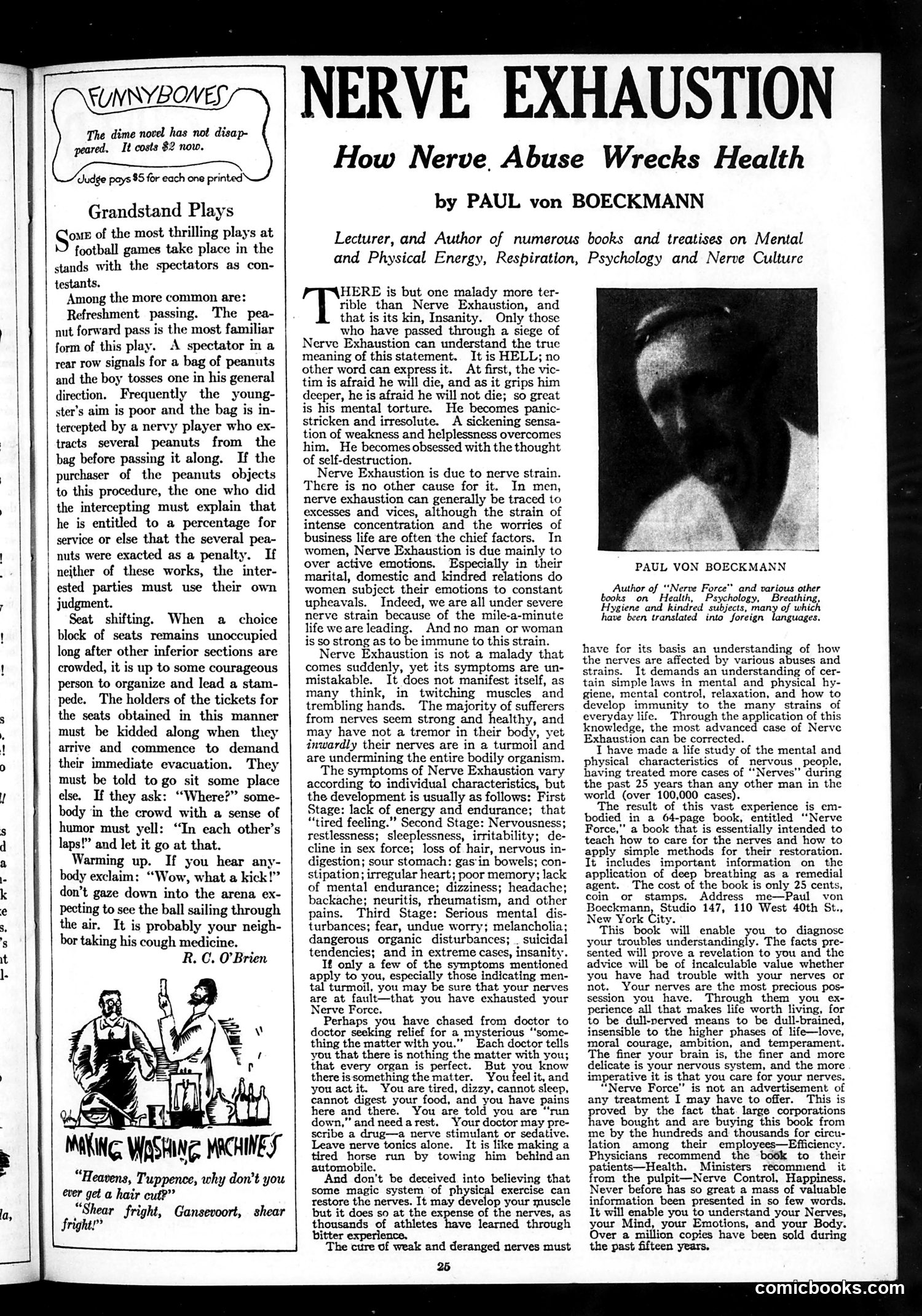
This Judge magazine page contains two distinct items: **"Grandstand Plays"** (left): A humorous essay by R.C. O'Brien describing pranks spectators pull at football games—stealing peanuts passed between rows, commandeering better seats through coordinated rushes, and using "cough medicine" (likely alcohol) as cover. The satire mocks rowdy fan behavior and the creative excuses troublemakers invent. **"Nerve Exhaustion"** (right): A lengthy advertorial by Paul von Boeckmann promoting his book about nervous breakdown. He describes it as worse than death itself, claiming modern life's relentless pace ("mile-a-minute") causes nerve strain, particularly affecting women through emotional upheaval. The text promises his book will diagnose and cure nervous conditions—typical early 20th-century medical pseudoscience marketing. The humor juxtaposition is unintentional: readers anxious about stadium misbehavior could then read about how such stress causes "nerve exhaustion," perhaps prompting book purchases.
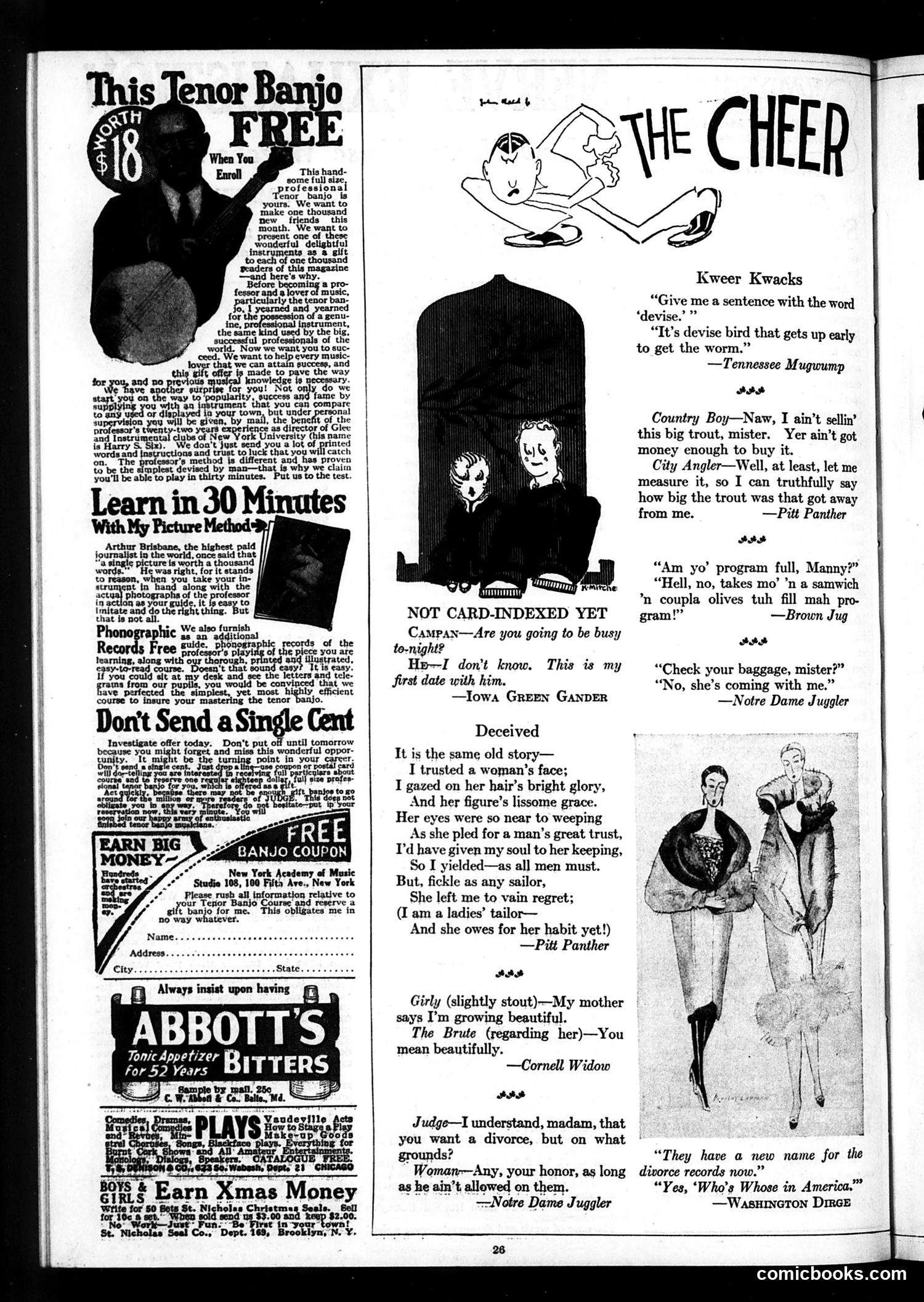
This page from *Judge* magazine consists primarily of **advertisements and humor jokes** rather than political cartoons. The main content includes: 1. **"Learn Banjo in 30 Minutes"** — A mail-order advertisement promising rapid musical instruction using "picture method," with endorsements from music professors. This reflects early 20th-century direct-mail marketing optimism. 2. **"The Cheer" section** — A collection of brief, punchy jokes playing on wordplay and gender dynamics. Examples include: - A woman on a first date being "not card-indexed" (organized/catalogued) - A poem about a man deceived by a woman who owes money to a ladies' tailor - Jokes about wives, divorce, and misunderstandings between men and women 3. **Other period ads** — Abbott's Bitters (a patent medicine) and offers for Christmas sales. The humor reflects 1920s attitudes: light mockery of courtship, marriage, and consumer culture. The jokes are genteel rather than satirical, targeting contemporary social dynamics rather than political figures.
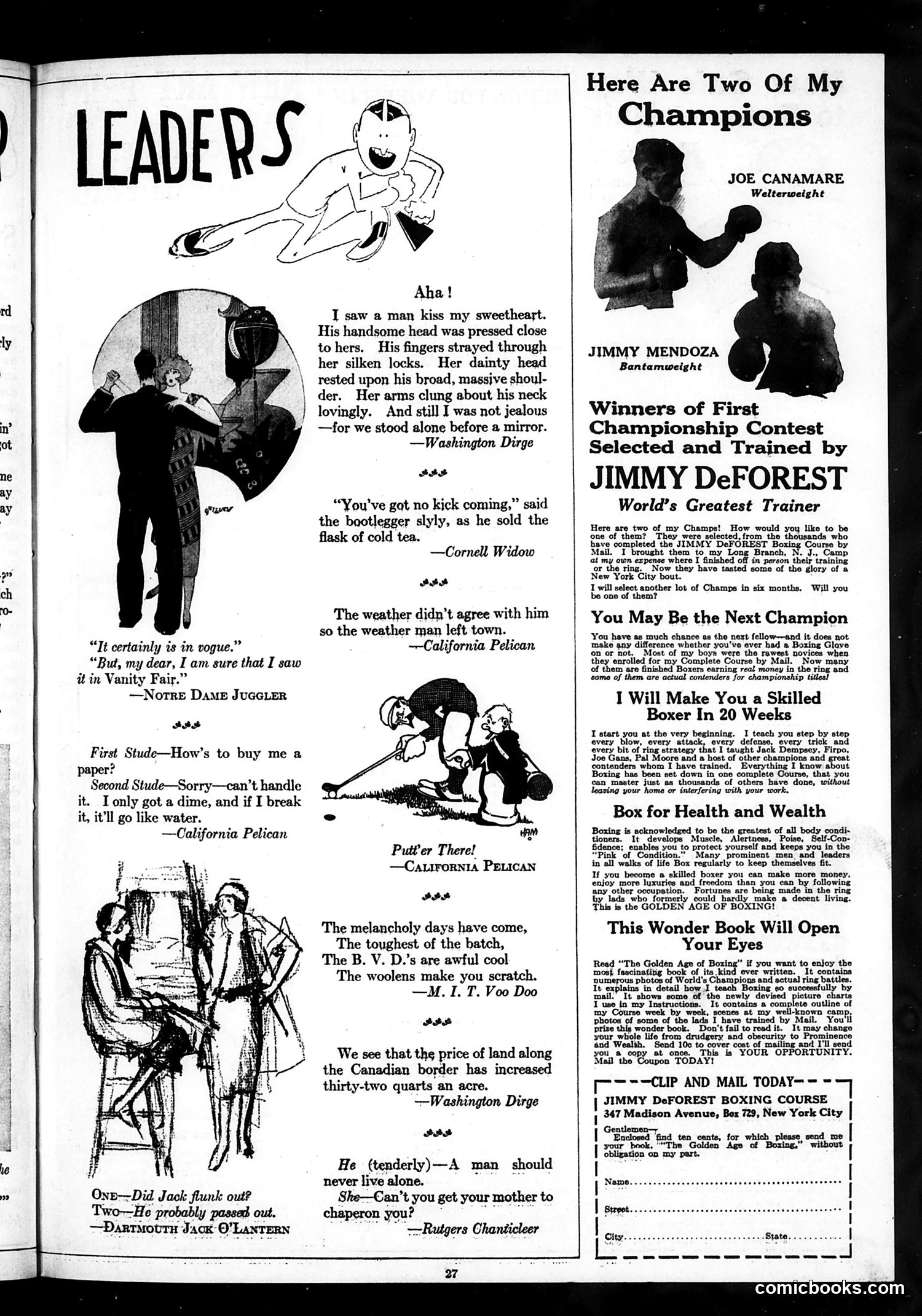
This Judge magazine page mixes humor with advertising. The left side contains college humor jokes from various universities (Notre Dame, California, Cornell, etc.)—mostly light, era-appropriate gags about romance, money troubles, and seasonal clothing. The references are now obscure. The right side is a boxing advertisement for Jimmy DeForest's mail-order boxing course. DeForest claims he trained famous boxers (Dempsey, Firpo) and showcases two "champions" he produced: Joe Canamare and Jimmy Mendoza. The ad promises readers they can become skilled boxers in 20 weeks and earn money in the ring. This reflects the 1920s-30s boxing craze when boxing was hugely popular and mail-order self-improvement courses were common advertising. The "rags-to-riches" boxing narrative and emphasis on physical conditioning and earning money reflects era-specific values about masculinity and social mobility.
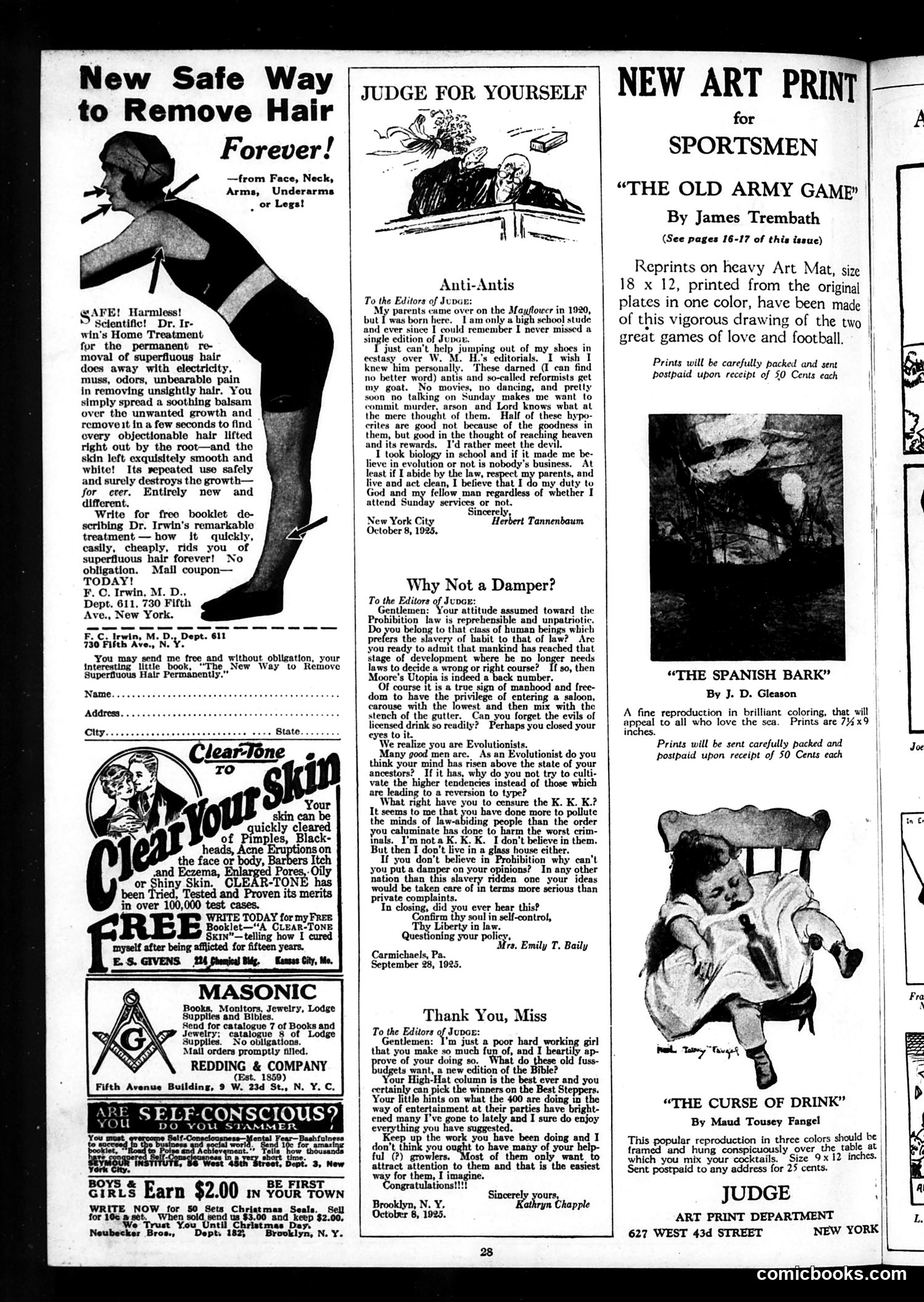
This page is primarily **advertising and reader letters**, not political cartoons. The content reflects 1920s American social debates: **Letters Section ("Judge For Yourself"):** Two readers debate Prohibition and social reform. Herbert Tannenbaum, a young high school student, attacks "antis" and reformists who oppose movies, dancing, and Sunday activities—expressing youthful frustration with moral restrictions. Emily T. Bailey defends Prohibition as necessary law, dismissing those who view it as "slavery of habit." **Context:** This captures the genuine cultural clash of the 1920s between traditionalist reformers and modernists who resisted restrictions on entertainment and alcohol. The magazine positioned itself as skeptical of rigid moralism. **Advertisements:** The page features typical period ads—hair removal treatments, skin care products ("Clear-Tone"), and Masonic organizations—reflecting consumer culture and available remedies of the era. The page reveals *Judge's* role as a forum for middle-class readers debating Jazz Age social changes rather than primarily delivering editorial satire.
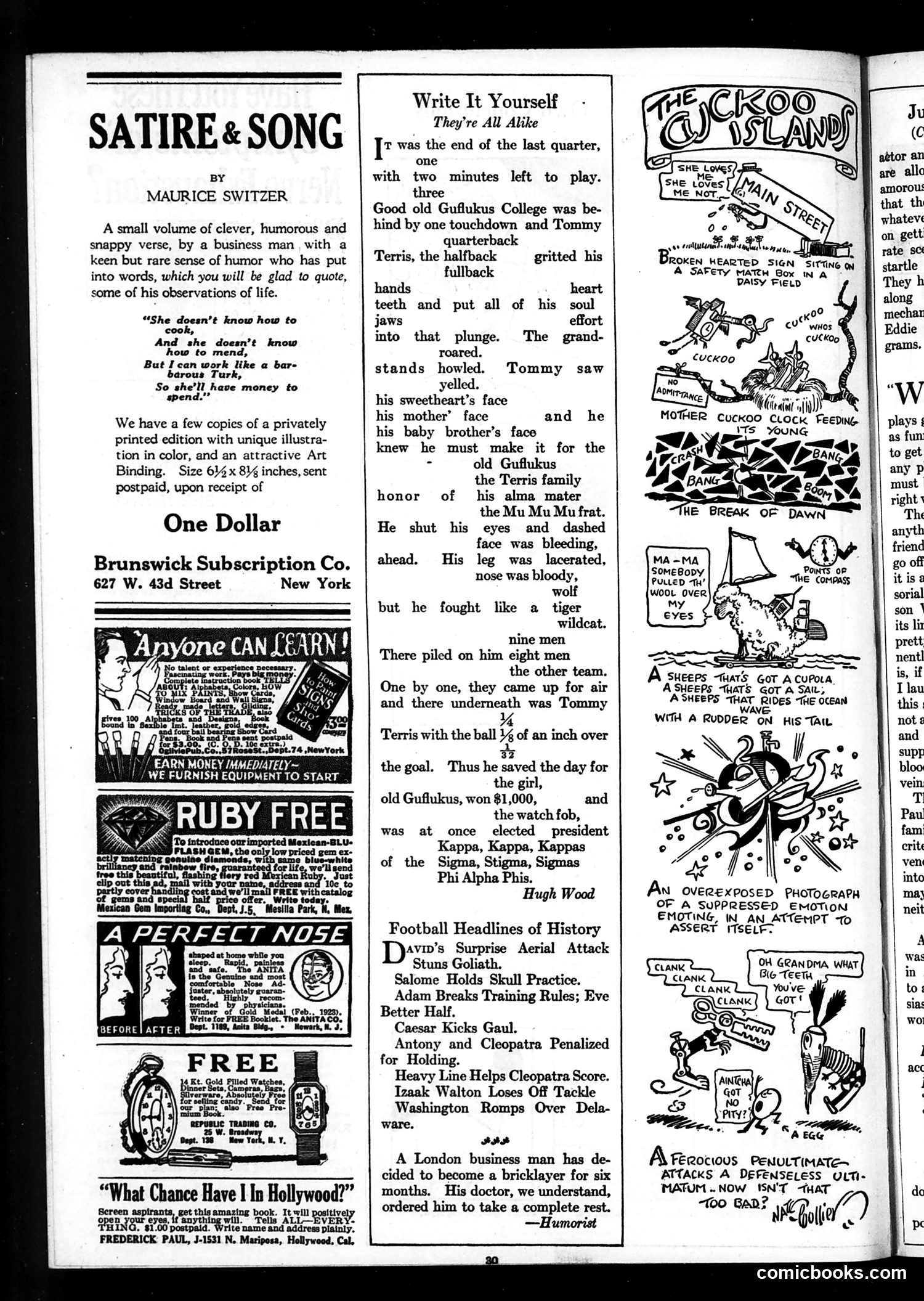
This page contains satirical writing and cartoons typical of 1920s humor magazine content. **"Write It Yourself: They're All Alike"** by Hugh Wood parodies formulaic college football fiction. The text humorously lists generic story elements (sweetheart's face, mother's face, baby brother's face, alma mater, fraternity) that authors repetitively include, demonstrating how predictable and interchangeable these narratives are. The joke targets both sentimental sports stories and their clichéd emotional appeals. **"Football Headlines of History"** creates absurdist humor by retrofitting modern football terminology onto historical events—"David's Surprise Aerial Attack Stuns Goliath," "Caesar Kicks Gaul." The anachronism is the joke itself. **The Cuckoo Island cartoons** appear to be whimsical, surrealist drawings with nonsensical captions about sheep with sails and other absurdities—typical of avant-garde humor emerging in the 1920s. **The page also contains period advertisements** for self-help books and correspondence courses, reflecting Judge's commercial function alongside satire. The overall tone reflects 1920s sophistication: literary parody, historical wordplay, and surrealist imagery rather than slapstick.
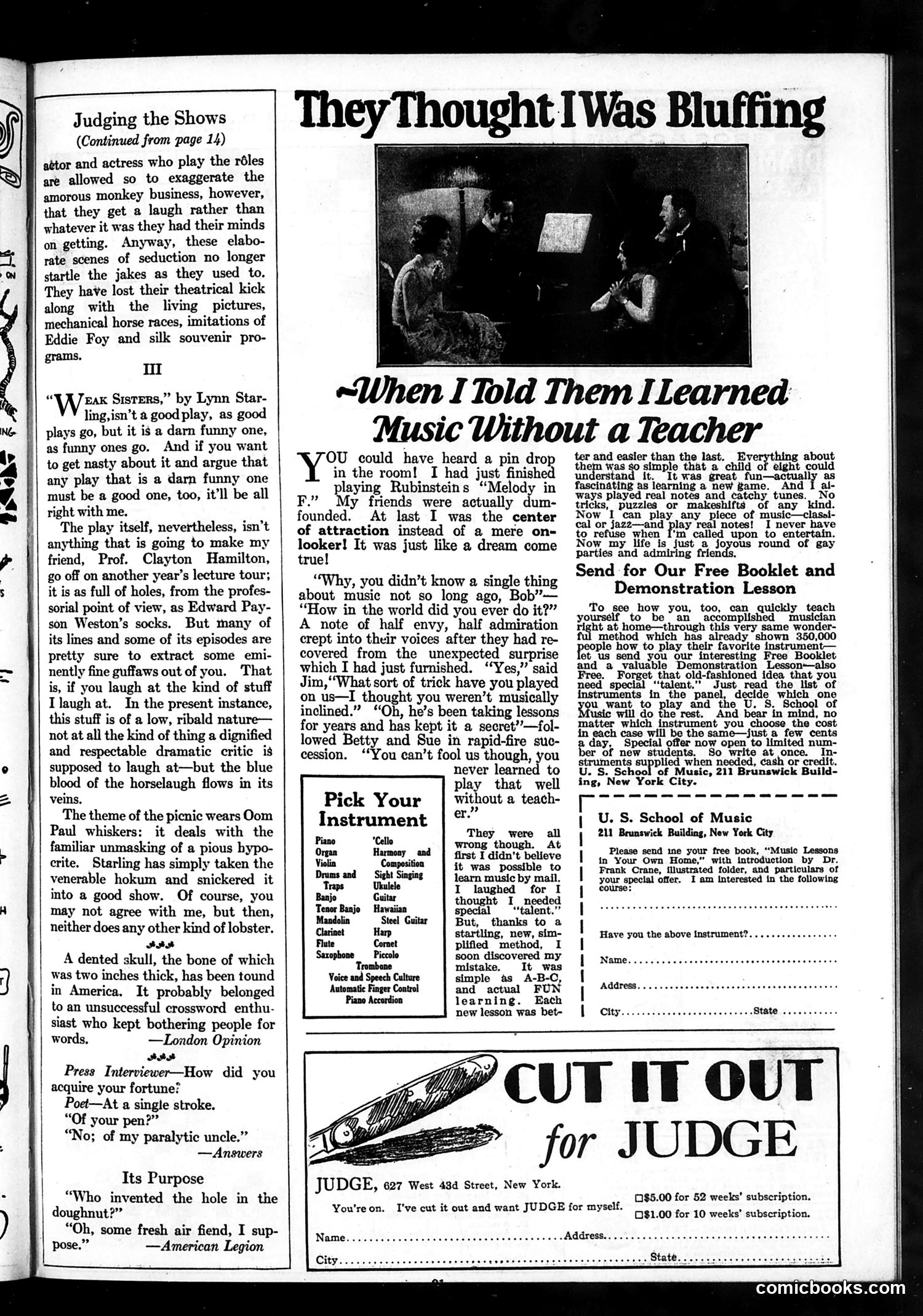
This page from Judge magazine contains theater reviews and advertisements rather than political cartoons. **"Judging the Shows"** critiques contemporary Broadway plays, including "Weak Sisters" by Lynn Starling. The reviewer praises it as funny despite poor plot structure, noting audiences enjoy "ribald" humor. References to "Eddie Foy" (a vaudeville performer) and "mechanical horse races" indicate the reviewer's dismissal of theatrical novelties. **"They Thought I Was Bluffing"** is an advertisement disguised as a personal anecdote. It promotes mail-order music lessons, claiming the narrator learned piano without a teacher—a surprising achievement to friends. The ad emphasizes accessibility: anyone can learn, it's "simple as A-B-C," and actual "FUN." This reflects early 20th-century direct-mail marketing tactics targeting middle-class Americans seeking self-improvement. The page includes typical Judge humor: brief jokes about interviews, doughnuts, and crossword puzzles—lighthearted social commentary common to the era's satirical magazines.
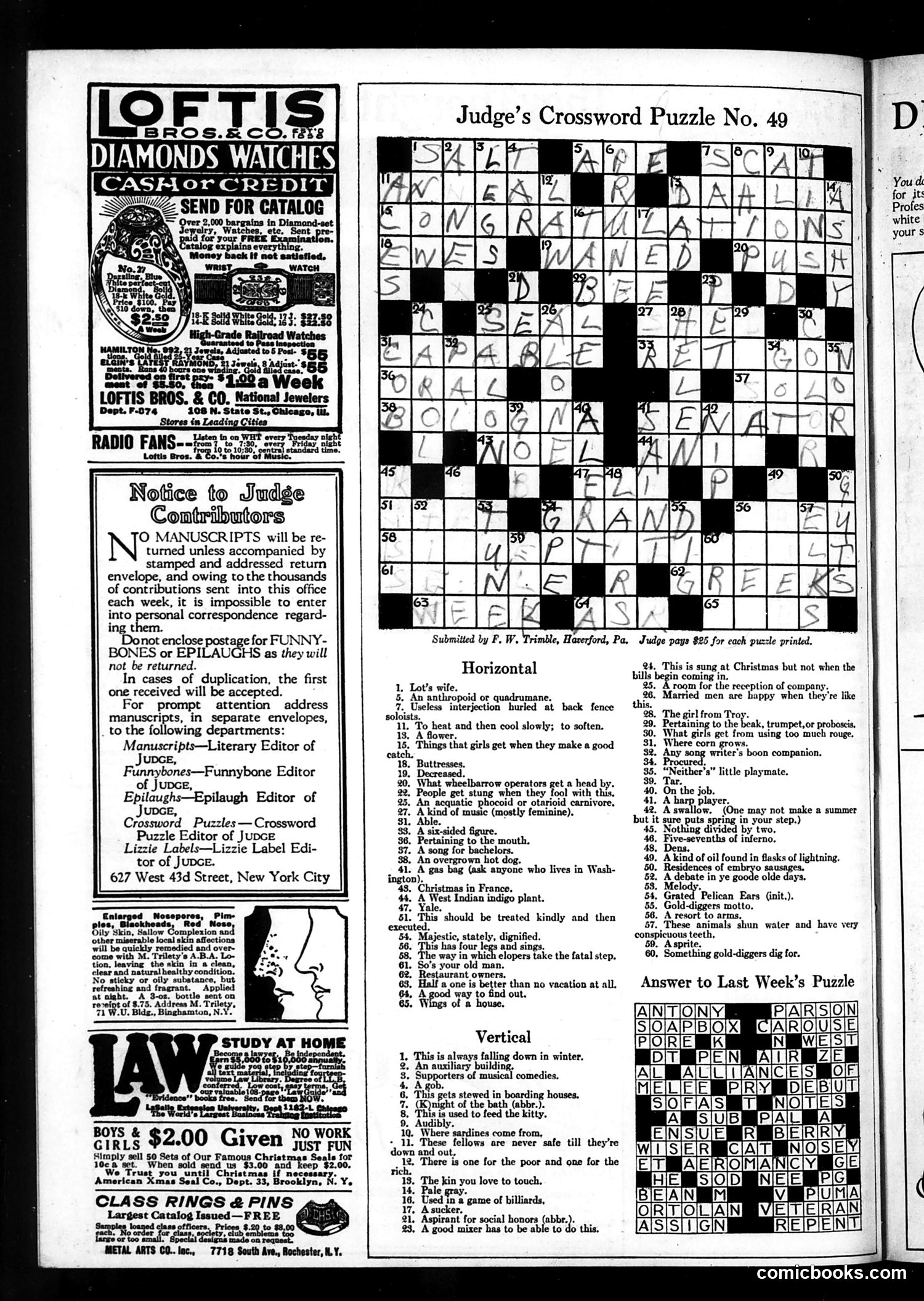
This page is primarily **administrative and advertising content** from Judge magazine, not satirical commentary. It consists of: 1. **Masthead/Notices**: Instructions for manuscript contributors, explaining submission procedures and departments (Literary, Funnybone, Epilaugh, Crossword Puzzle editors). 2. **Advertisements**: Including Loftis Diamonds/Watches (cash or credit jewelry sales), a Law School correspondence course, boys' Christmas seal sales scheme, and class rings/pins. 3. **Crossword Puzzle #49**: The main content—a judge's crossword puzzle with clues and the previous week's answer key visible. 4. **Illustration**: A small profile sketch (purpose unclear from image quality). The page reflects early-to-mid 20th century magazine operations: soliciting reader contributions, hawking consumer goods and educational opportunities, and providing entertainment (the crossword). There is **no apparent political or social satire** on this particular page—it's purely operational/commercial content.
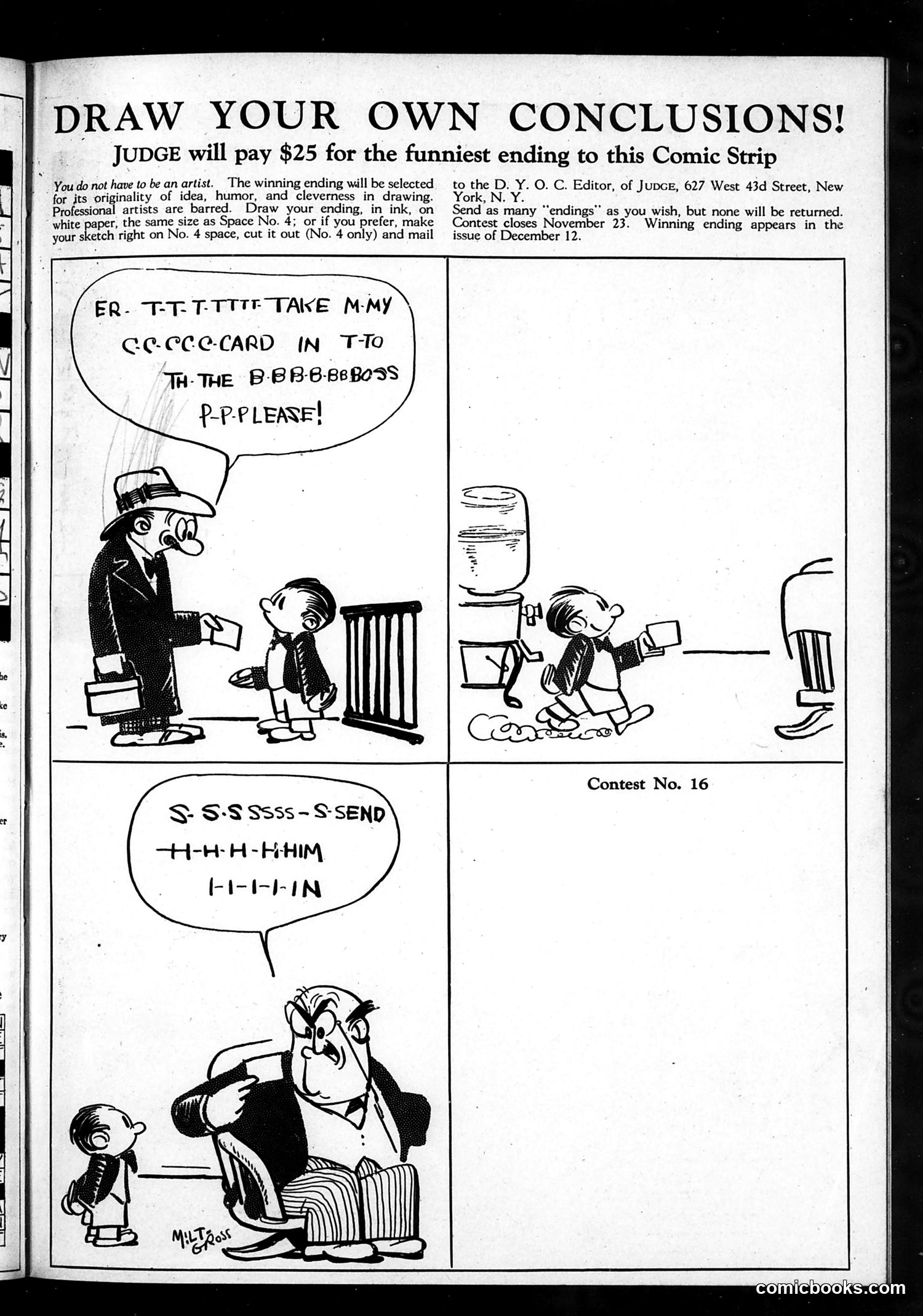
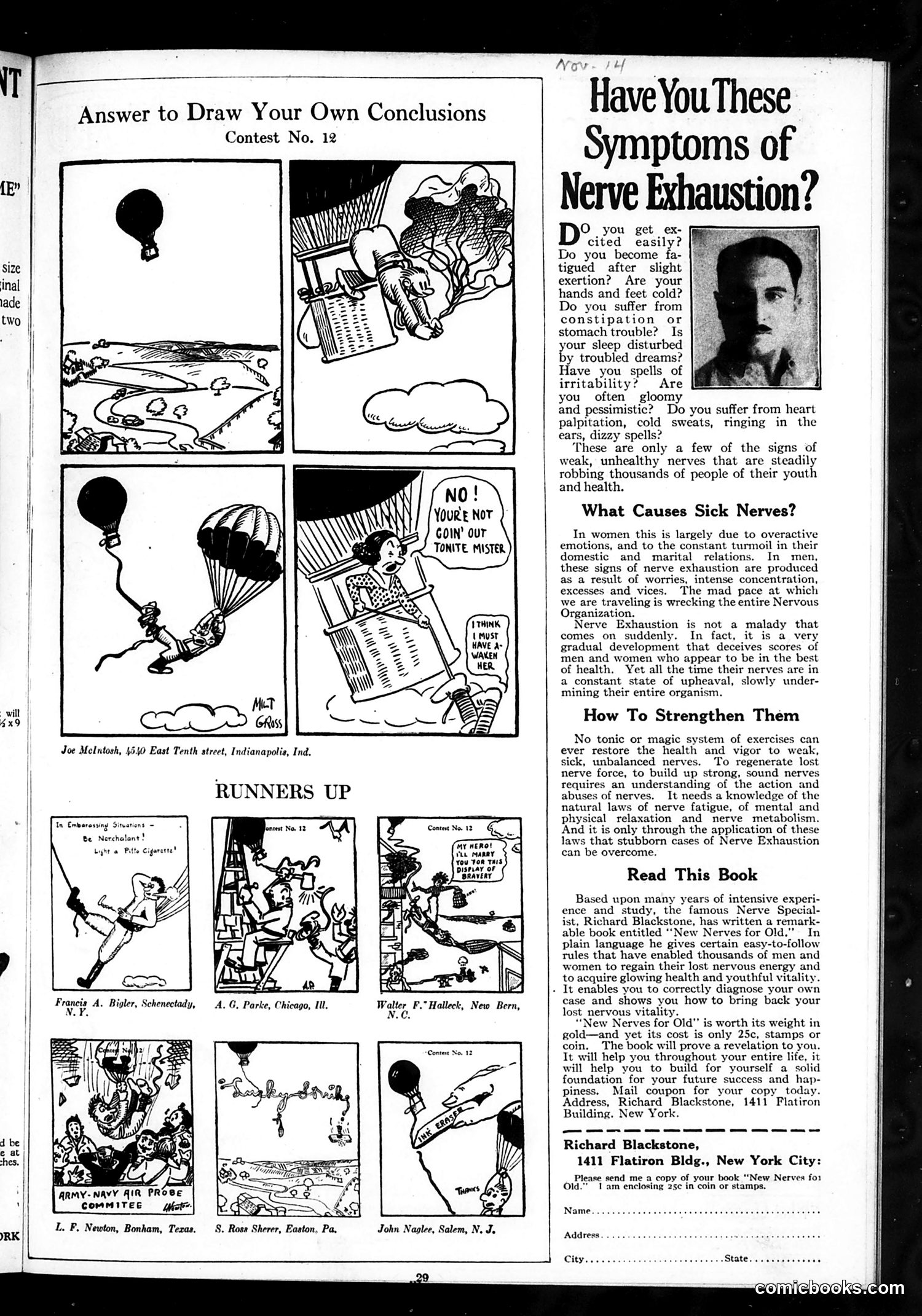
This page presents a reader-participation contest where Judge magazine invites amateur (non-professional) cartoonists to complete an unfinished comic strip for a $25 prize. The three-panel strip shows a man attempting to send his child to the barber. The child's stammering speech pattern ("Er-t-t-t-tiff take m-my cc-ccc-card...") indicates a severe stutter. In the second panel, the child runs away. The final panel shows an angry man (presumably the barber, given the context) telling the child "s-s-s-sss-s-send h-h-h-him i-i-i-i-in." **The joke setup:** The barber appears to be mocking the child's stutter by imitating it—a form of ridicule. Readers were invited to supply a humorous conclusion to this scenario. The satire reflects early 20th-century attitudes toward disability and mockery as entertainment, treating a child's speech impediment as comedic fodder rather than a condition warranting sympathy.
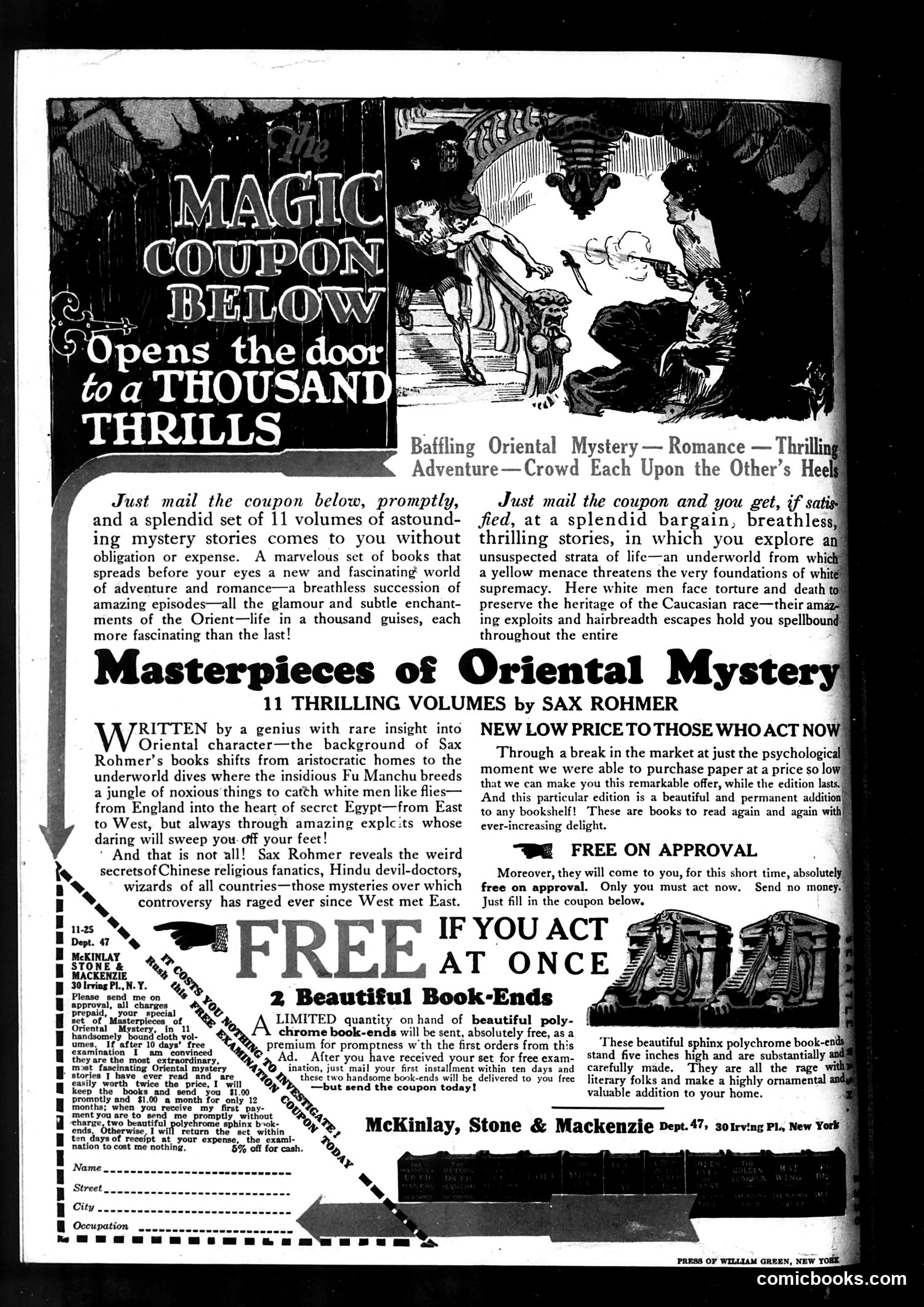
This page is primarily **advertising, not political satire**. It promotes Sax Rohmer's "Masterpieces of Oriental Mystery"—11-volume book sets sold by mail order. The ad exploits **"Yellow Peril" anxieties** prevalent in early 20th-century America. It explicitly promises stories where "white men face torture and death to preserve the heritage of the Caucasian race" against threats from "a yellow menace." The books feature the villain Fu Manchu, a Chinese criminal mastermind—a character reflecting Western racial paranoia about Asian immigrants and foreign influence. The marketing targets readers' fears: mysterious "Chinese religious fanatics," "Hindu devil-doctors," and Oriental conspiracies. The "FREE ON APPROVAL" offer and bonus sphinx book-ends create urgency. This represents mainstream commercial exploitation of **racist stereotypes and xenophobia**, presenting them as entertainment. Modern readers should recognize this as period propaganda normalizing anti-Asian sentiment through popular literature.

I appreciate your detailed instructions, but I must be honest about what I can determine from this image: the reproduction quality is too degraded for me to read the OCR text clearly or identify specific figures, captions, or cartoons with confidence. The image shows what appears to be a page with circular/spiral patterns and some darker figures, but the poor contrast and grain prevent me from discerning details that would be necessary for accurate historical interpretation. To properly explain the satire, political references, and jokes to a modern reader—as you've asked—I would need either a clearer image or you to provide the OCR text legibly. I'd rather acknowledge these limits than risk misidentifying historical figures or events. Could you share the OCR text more clearly, or provide a higher-resolution image?