
Judge, 1925-11-14 · page 16 of 37
Judge — November 14, 1925 — page 16: what you’re looking at
What you’re looking at
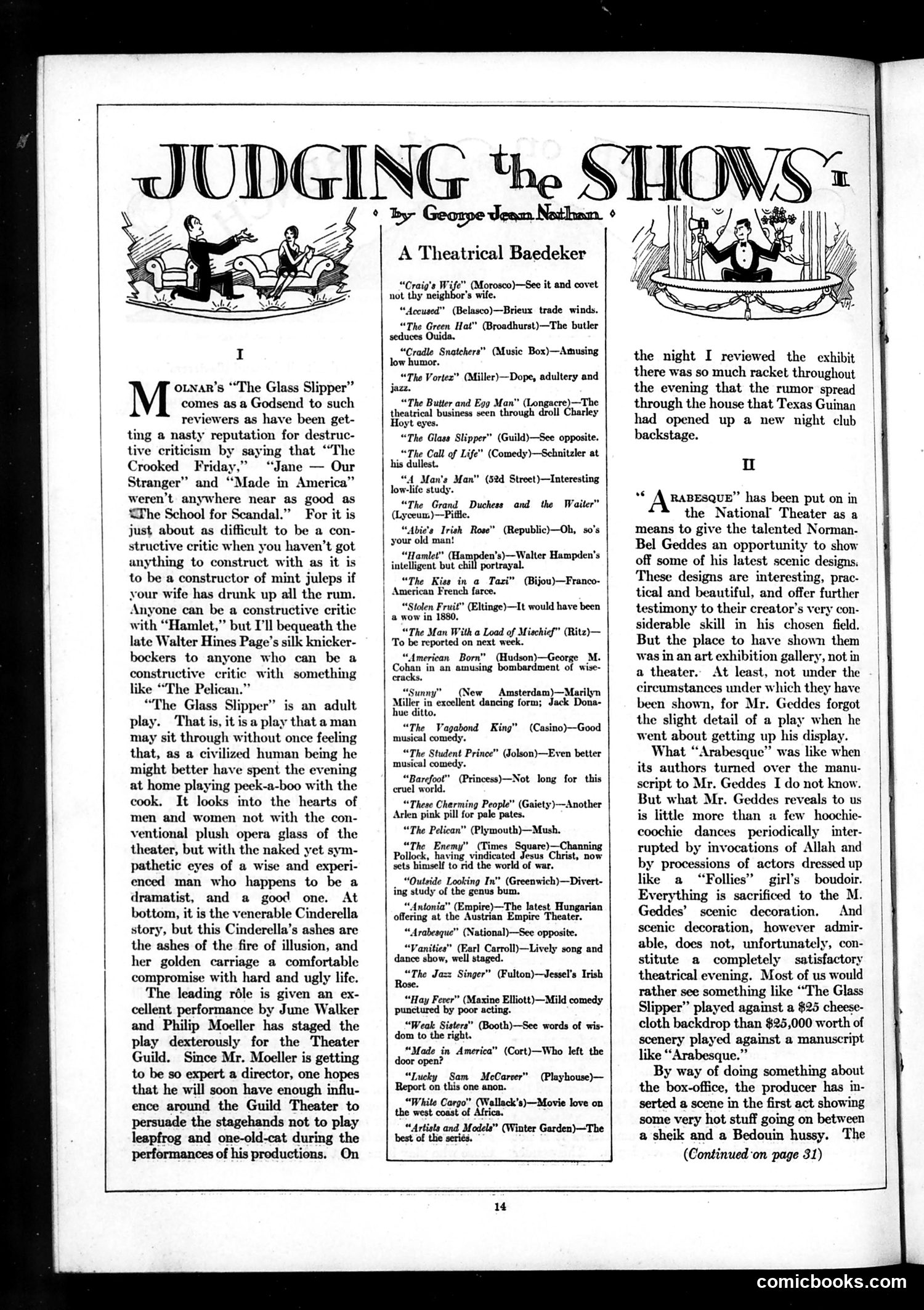
This page contains theater reviews by George Jean Nathan for *Judge* magazine. The main article praises Molnar's *"The Glass Slipper"* as a sophisticated adult play—a Cinderella adaptation with emotional depth, performed well by June Walker and directed by Philip Moeller for the Theater Guild. Nathan opens with gentle satire about destructive critics who lack constructive skills (comparing it to making mint juleps without rum). He argues *"The Glass Slipper"* rises above mere conventional theater fare because it examines human hearts "with naked yet sympathetic eyes" rather than through artifice. The sidebar "Theatrical Baedeker" offers quick, snarky judgments on current Broadway shows—brief quips recommending or dismissing productions. This format allows *Judge* to cover the theater season through humor and social commentary on what audiences valued in 1920s Broadway entertainment. The satire targets both pretentious theater and mediocre productions of the era.
📄 Transcribed text from this page (OCR, searchable)
Machine-transcribed from the original scan — historical spelling and the odd misread are preserved.
otnar’s “The Glass Slipper” M comes as a Godsend to such reviewers as have been get- ting a nasty reputation for destruc- tive criticism by saying that “The Crooked Friday,” Stranger” and “Made in America” weren’t anywhere near as good as Whe School for Scandal.” For it is just about as difficult to be a con- structive critic when you haven’t got anything to construct with as it is to be a constructor of mint juleps if your wife has drunk up all the rum. Anyone can be a constructive critic with “Hamlet,” but I'll bequeath the late Walter Hines Page’s silk knicker- bockers to anyone who can be a constructive critic with something like “The Pelican.” “The Glass Slipper” is an adult play. That is, it isa play that a man may sit through without once feeling that, as a civilized human being he might better have spent the evening at home playing peek-a-boo with the cook. It looks into the hearts of men and women not with the con- ventional plush opera glass of the theater, but with the naked yet sym- pathetic eyes of a wise and experi- enced man who happens to be a dramatist, and a good one. At bottom, it is the venerable Cinderella story, but this Cinderella’s ashes are the ashes of the fire of illusion, and her golden carriage a comfortable compromise with hard and ugly life. The leading rdéle is given an ex- cellent performance by June Walker and Philip Moeller has staged the play dexterously for the Theater Guild. Since Mr. Moeller is getting to be so expert a director, one hopes that he will soon have enough influ- ence around the Guild Theater to persuade the stagehands not to play leapfrog and one-old-cat during the performances of his productions. On NG ‘be SHOWS * by Geoxpe Jeam Nothan. A Theatrical Baedeker “Craig's Wife”. (Morosco)—See it and covet not thy neighbor's wife. “Accused” (Belasco)—Brieux trade winds. “The Green Hat” (Broadhurst)—The butler seduces Oui “Cradle Snatchers” (Music Box)—Amusing low humor. _ “The Vortex” (Miller)—Dope, adultery and jazz. “The Butter and Egg Man" (Longacre) —The theatrical business seen through droll Charley Hoyt eyes. “The Glass Slipper” (Guild)—See opposite. “The Call of Life” (Comedy)—Schnitzler at his dullest. “A Man's Man” (52d Street)—Interesting low-life study. “The Grand Duchess and the Waiter” (Lyceum )—Pitile. “Abie's Irish Rose” (Republic)—Ob, so’s your old man! “Hamlet” (Hampden’ Rasch) falter Hampden's intelligent but chill portrayal. “The Kiss in a Taxi” (Bijou)—Franco- American French farce. “Stolen Fruit” (Eltinge)—It would have been a wow in 1880, “The Man With a Load af Mischief” (Ritz)— ‘To be reported on next week. “American Born” (Hudson)—George M. Conta in an amusing bombardment of wise- cra nny" (New — Amsterdam)—Marilyn Miller in excellent dancing form; Jack Dona- hue ditto. “The Vagabond King” musical comedy. “The Shades Prine” Golson)—Even better musical co! “Barefoot” cruel world. “These Charming People” (Gaiety)—Another Arlen pink pill for pale pates. “The Pelican” (Plymouth)—Mush. “The Enemy” (Times Sguare)—Channing Pollock, having vindicated Jesus Christ, now sets himself to rid the world of war. “Outside Looking In" (Greenwich)—Divert- ing study of the genus bum. “4ntonia” (Empire)—The latest Hungarian offering at the Austrian Empire Theater. Arabesque” (National)—See opposite. Vanities” (Earl Carroll)—Lively song and dance show, well staged. mee Jazz Singer” (Fulton)—Jessel’s Irish (Casino)—Good ‘rinses Nu long for this — Fever” (Maxine Elliott)—Mild comedy punctured by poor acting. “Weak Sisters” (Booth)—See words of wis- dom to the right. “Made ia America” (Cort)—Who left the door open? “Luel Sam McCarver” (Playhouse) Reputt c this one atone rhc ae “White Cargo” (Wallack’s)—Movie love on the west coast of Africa. “Artists and Models” (Winter Garden)—The best of the seriés. the night I reviewed the exhibit there was so much racket throughout the evening that the rumor spread through the house that Texas Guinan had opened up a new night club backstage. 0 ss AMBzSQuE” has been put on in the National Theater as a means to give the talented Norman- Bel Geddes an opportunity to show off some of his latest scenic designs. These designs are interesting, prac- tical and beautiful, and offer further testimony to their creator's very con- siderable skill in his chosen field. But the place to have shown them was in an art exhibition gallery, not in a theater.. At least, not under the circumstances under which they have been shown, for Mr. Geddes forgot the slight detail of a play when he went about getting up his display. What “Arabesque” was like when its authors turned over the manu- script to Mr. Geddes I do not know. But what Mr. Geddes reveals to us is little more than a few hoochie- coochie dances periodically inter- rupted by invocations of Allah and by processions of actors dressed up like a “Follies” girl’s boudoir. Everything is sacrificed to the M. Geddes’ scenic decoration. And scenic decoration, however admir- able, does not, unfortunately, con- stitute a completely satisfactory theatrical evening. Most of us would rather see something like ‘The Glass Slipper” played against a $25 cheese- cloth backdrop than $25,000 worth of scenery played against a manuscript like “‘Arabesque.”” By way of doing something about the box-office, the producer has in- serted a scene in the first act showing some very hot stuff going on between a sheik and a Bedouin hussy. The (Continued ‘on page 31) comicbooks.com