
Judge, 1925-11-14 · page 15 of 37
Judge — November 14, 1925 — page 15: what you’re looking at
What you’re looking at
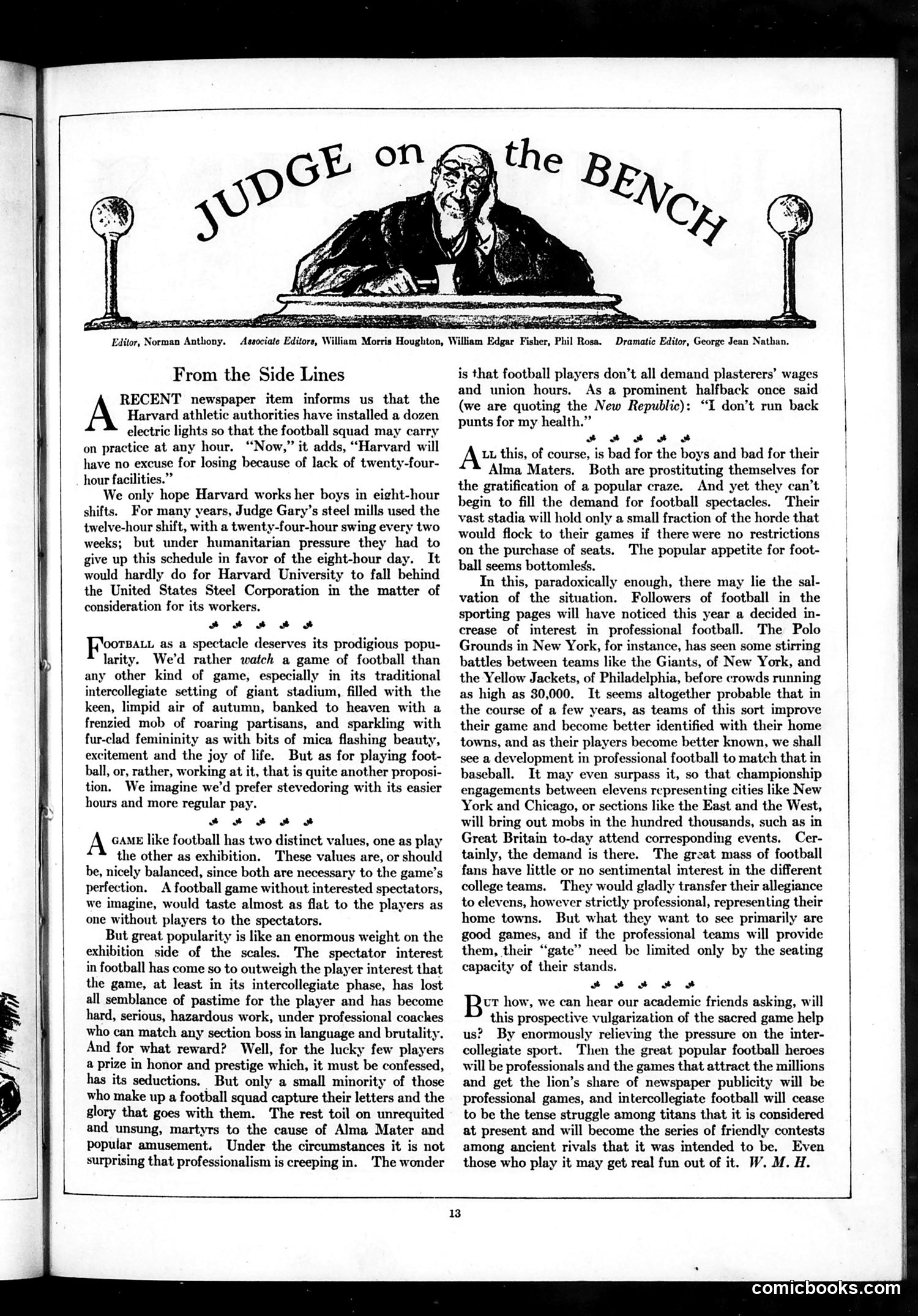
This editorial column satirizes the growing professionalization and exploitation within college football. The piece critiques Harvard's installation of electric lights for practice as implying the university works athletes like factory laborers—comparing Harvard unfavorably to even Judge Gary's steel mills, which abandoned brutal twelve-hour shifts under humanitarian pressure. The core argument: college football has become "hard, serious, hazardous work" for players who receive little reward beyond honor for a few letter-winners, while most remain "unrequited and unsung, martyrs." The author notes the paradox that spectator demand is bottomless yet players can't demand fair wages like other workers. The satire targets both universities and fans for treating amateur athletes as entertainment commodities rather than students, arguing this exploitation may ironically drive college players toward professional football—which the author suggests might actually resolve the crisis by finally providing proper compensation. The masthead identifies this as written by W.M.H. (William Morris Houghton or similar).
📄 Transcribed text from this page (OCR, searchable)
Machine-transcribed from the original scan — historical spelling and the odd misread are preserved.
From the Side Lines RECENT newspaper item informs us that the Harvard athletic authorities have installed a dozen electric lights so that the football squad may carry on practice at any hour. “Now,” it adds, “Harvard will have no excuse for losing because of lack of twenty-four- hour facilities.” We only hope Harvard works her boys in eight-hour shifts. For many years, Judge Gary’s steel mills used the twelve-hour shift, with a twenty-four-hour swing every two weeks; but under humanitarian pressure they had to give up this schedule in favor of the eight-hour day. It would hardly do for Harvard University to fall behind the United States Steel Corporation in the matter of consideration for its workers. FF HH SH Frootsaut as a spectacle deserves its prodigious popu- larity. We'd rather watch a game of football than any other kind of game, especially in its traditional intercollegiate setting of giant stadium, filled with the keen, limpid air of autumn, banked to heaven with a frenzied mob of roaring partisans, and sparkling with fur-clad femininity as with bits of mica flashing beauty, excitement and the joy of life. But as for playing foot- ball, or, rather, working at it, that is quite another proposi- tion. We imagine we'd prefer stevedoring with its easier hours and more regular pay. ses a GAME like football has two distinct values, one as play the other as exhibition. These values are, or should be, nicely balanced, since both are necessary to the game’s perfection. A football game without interested spectators, we imagine, would taste almost as flat to the players as one without players to the spectators. But great popularity is like an enormous weight on the exhibition side of the scales. The spectator interest in football has come so to outweigh the player interest that the game, at least in its intercollegiate phase, has lost all semblance of pastime for the player and has become hard, serious, hazardous work, under professional coaches who can match any section boss in language and brutality. And for what reward? Well, for the lucky few players a prize in honor and prestige which, it must be confessed, has its seductions. But only a small minority of those who make up a football squad capture their letters and the glory that goes with them. The rest toil on unrequited and unsung, martyrs to the cause of Alma Mater and popular amusement. Under the circumstances it is not surprising that professionalism is creeping in. ‘The wonder is that football players don’t all demand plasterers’ wages and union hours. As a prominent halfback once said (we are quoting the New Republic): “I don’t run back punts for my health.” et eH HH SM uu this, of course, is bad for the boys and bad for their Alma Maters. Both are prostituting themselves for the gratification of a popular craze. And yet they can’t begin to fill the demand for football spectacles. Their vast stadia will hold only a small fraction of the horde that would flock to their games if there were no restrictions on the purchase of seats. The popular appetite for foot- ball seems bottomless. In this, paradoxically enough, there may lie the sal- vation of the situation. Followers of football in the sporting pages will have noticed this year a decided in- crease of interest in professional football. The Polo Grounds in New York, for instance, has seen some stirring battles between teams like the Giants, of New York, and the Yellow Jackets, of Philadelphia, before crowds running as high as 30,000. It seems altogether probable that in the course of a few years, as teams of this sort improve their game and become better identified with their home towns, and as their players become better known, we shall see a development in professional football to match that in baseball. It may even surpass it, so that championship engagements between elevens representing cities like New York and Chicago, or sections like the East and the West, will bring out mobs in the hundred thousands, such as in Great Britain to-day attend corresponding events. Cer- tainly, the demand is there. The great mass of football fans have little or no sentimental interest in the different college teams. They would gladly transfer their allegiance to elevens, however strictly professional, representing their home towns. But what they want to see primarily are good games, and if the professional teams will provide them, their “gate” need be limited only by the seating capacity of their stands. tt et eo ut how, we can hear our academic friends asking, will this prospective vulgarization of the sacred game help us? By enormously relieving the pressure on the inter- collegiate sport. Then the great popular football heroes will be professionals and the games that attract the millions and get the lion’s share of newspaper publicity will be professional games, and intercollegiate football will cease to be the tense struggle among titans that it is considered at present and will become the series of friendly contests among ancient rivals that it was intended to be. Even those who play it may get real fun out of it. W. M. H. comicbooks.com