
Judge, 1925-11-14 · page 20 of 37
Judge — November 14, 1925 — page 20: what you’re looking at
What you’re looking at
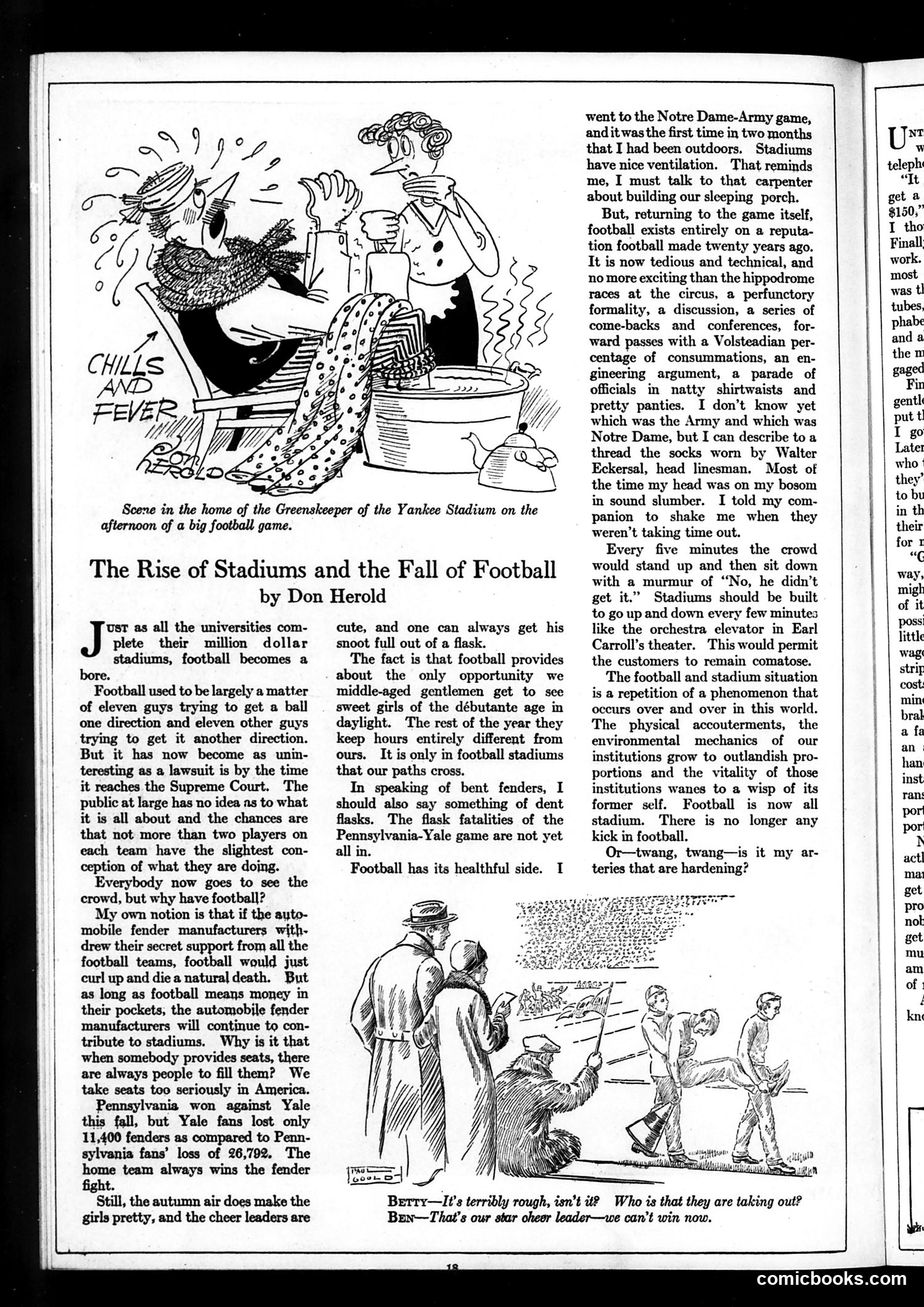
Don Herold's satirical essay argues that football has become boring despite—or because of—massive new stadium construction at universities. The top cartoon shows a spectator at Yankee Stadium suffering from "chills and fever," depicting the illness of stadium attendance. Herold's central joke is that **automobile fender manufacturers secretly fund football teams** because car accidents from fans driving to games damage vehicles, generating repair business. He notes Pennsylvania-Yale fans lost "26,792 fenders" versus Yale's "11,400"—a darkly comic claim that traffic accidents are the real measure of game attendance. He mocks football's decline: it's now "tedious and technical," featuring endless conferences and forward passes (likely referencing Prohibition-era flask drinking—"Volsteadian percentage"). The game itself has become incomprehensible; he fell asleep during Notre Dame-Army and could only describe the linesman's socks. The caption cartoon ("Berry—It's terribly rough, isn't it? / Ben—That's our star cheer leader—we can't win now") shows injured cheerleaders, extending the accident/injury theme. The satire targets both football's loss of vigor and Americans' excessive reverence for seating capacity.
📄 Transcribed text from this page (OCR, searchable)
Machine-transcribed from the original scan — historical spelling and the odd misread are preserved.
————, Scene in the home of the Greenskeeper of the Yankee Stadium on the afternoon of a big football game. The Rise of Stadiums and the Fall of Football by Don Herold ust as all the universities com- plete their million dollar stadiums, football becomes a bore. Football used to be largely a matter of eleven guys trying to get a ball one direction and eleven other guys trying to get it another direction. But it has now become as unin- teresting as a lawsuit is by the time it reaches the Supreme Court. The public at large has no idea as to what it is all about and the chances are that not more than two players on each team have the slightest con- ception of what they are doing. Everybody now goes to see the crowd, but why have football? My own notion is that if the ayto- mobile fender manufacturers with- drew their secret support from all the football teams, football would just curl up and die a natural death. But as long as football means money in their pockets, the automobile fender manufacturers will continue to con- tribute to stadiums. Why is it that when somebody provides seats, there are always people to fill them? We take seats too seriously in America. Pennsylvania won against Yale this fall, but Yale fans lost only 11,400 fenders as compared to Penn- sylvania fans’ loss of 26,792. The home team always wins the fender fight. Still, the autumn air does make the girls pretty, and the cheer leaders are cute, and one can always get his snoot full out of a flask. The fact is that football provides about the only opportunity we middle-aged gentlemen get to see sweet girls of the débutante age in daylight. The rest of the year they keep hours entirely different from ours. It is only in football stadiums that our paths cross. In speaking of bent fenders, I should also say something of dent flasks. The flask fatalities of the Pennsylvania-Yale game are not yet all in. Football has its healthful side. I Berry—It’s terribly rough, isn’t it? went to the Notre Dame-Army game, and it was the first time in two months that I had been outdoors. Stadiums have nice ventilation. That reminds me, I must talk to that carpenter about building our sleeping porch. But, returning to the game itself, football exists entirely on a reputa- tion football made twenty years ago. It is now tedious and technical, and no more exciting than the hippodrome races at the circus, a perfunctory formality, a discussion, a series of come-backs and conferences, for- ward passes with a Volsteadian per- centage of consummations, an en- gineering argument, a parade of officials in natty shirtwaists and pretty panties. I don’t know yet which was the Army and which was Notre Dame, but I can describe to a thread the socks worn by Walter Eckersal, head linesman. Most of the time my head was on my bosom in sound slumber. I told my com- panion to shake me when they weren’t taking time out. Every five minutes the crowd would stand up and then sit down with a murmur of “No, he didn’t get it.” Stadiums should be built to go up and down every few minutes like the orchestra elevator in Earl Carroll’s theater. This would permit the customers to remain comatose. The football and stadium situation is a repetition of a phenomenon that occurs over and over in this world. The physical accouterments, the environmental mechanics of our institutions grow to outlandish pro- portions and the vitality of those institutions wanes to a wisp of its former self. Football is now all stadium. There is no longer any kick in football. Or—twang, twang—is it my ar- teries that are hardening? Who is that they are taking out? Bun—That’s our star oheor leader—we can’t win now. comicbooks.com