
A complete issue · 36 pages · 1925
Judge — September 5, 1925
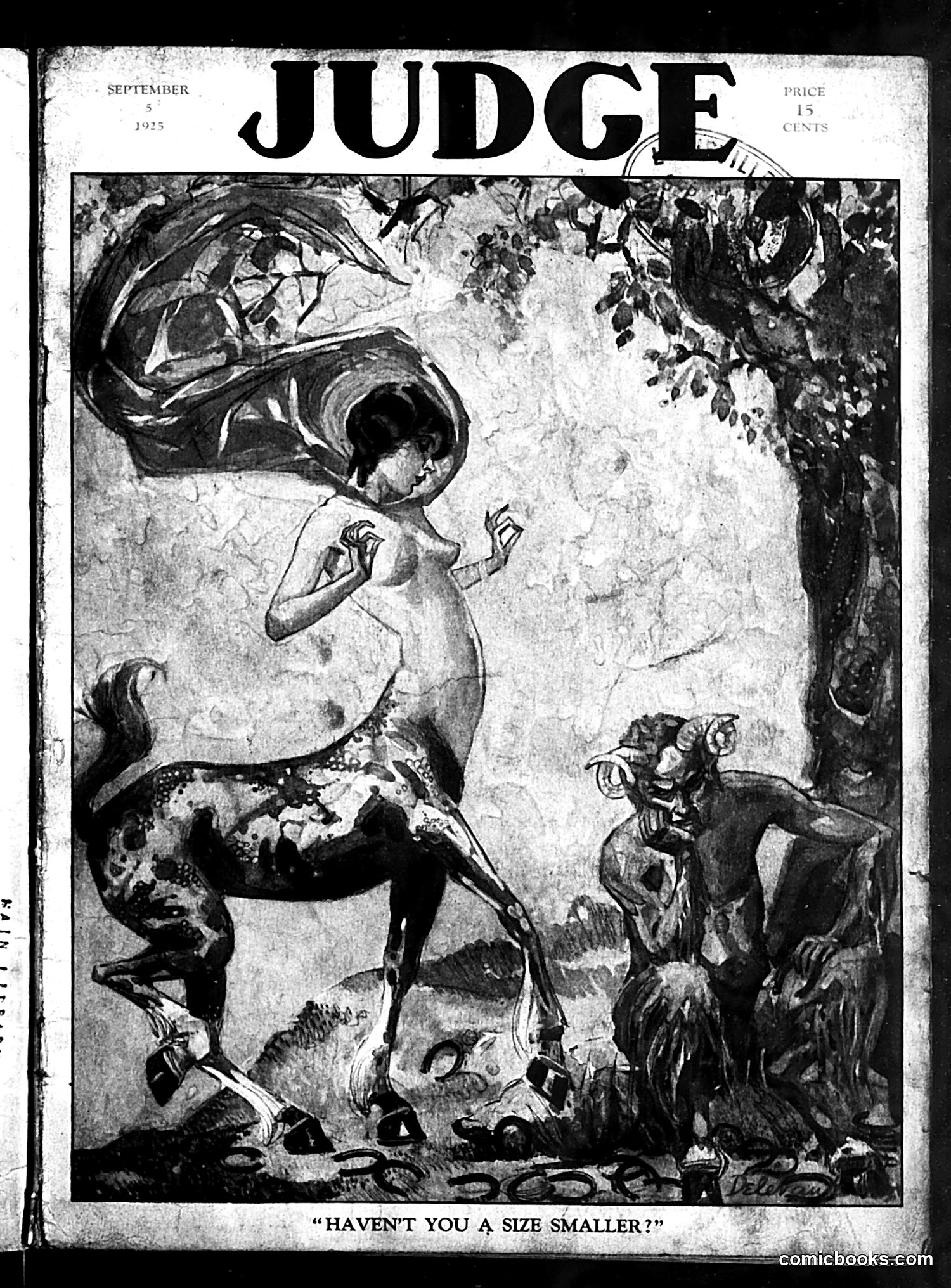
This cover depicts a fairy-tale scene with a woman (possibly representing a character like Cinderella or similar) surrounded by anthropomorphic animals—appearing to be monkeys or apes. The caption "Haven't You a Size Smaller?" suggests a joke about shoe-fitting or perhaps satirizes wealth/class distinctions through the lens of a fairy tale. The imagery may reference contemporary anxieties about evolution or "primitive" behavior, common satirical tropes in 1920s American humor. The woman's distressed pose and the animals' apparent demand could mock social pretensions or consumer culture. Without additional context or byline, the specific social or political commentary remains unclear, though the piece exemplifies Judge's reliance on exaggerated, somewhat crude visual humor typical of the era.
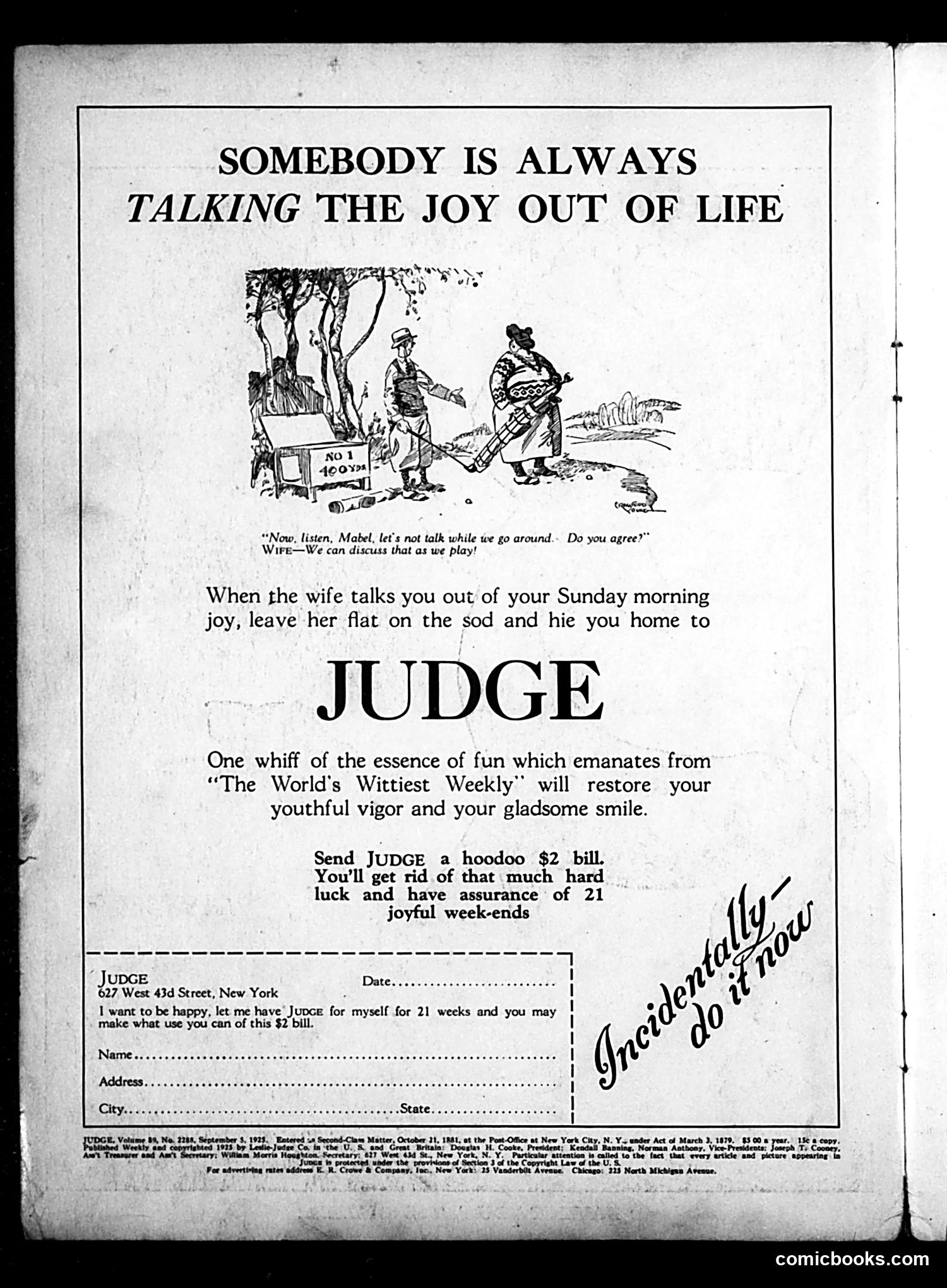
This is a **full-page advertisement** for *Judge* magazine itself, not political commentary. The ad uses humor to promote subscriptions by depicting a domestic scene where a wife interrupts her husband's leisure time (Sunday golf) with conversation—a common source of marital tension in early 20th-century humor. The joke targets husbands: reading *Judge* supposedly provides enough entertainment to offset nagging wives and restore "youthful vigor." The ad promises 21 weeks of humor for a $2 hoodoo bill (slang for currency). This reflects period assumptions about gender roles—wives as nags, husbands seeking escape through leisure and humor magazines. The satire is self-directed: *Judge* markets itself as domestic relief from marriage itself.
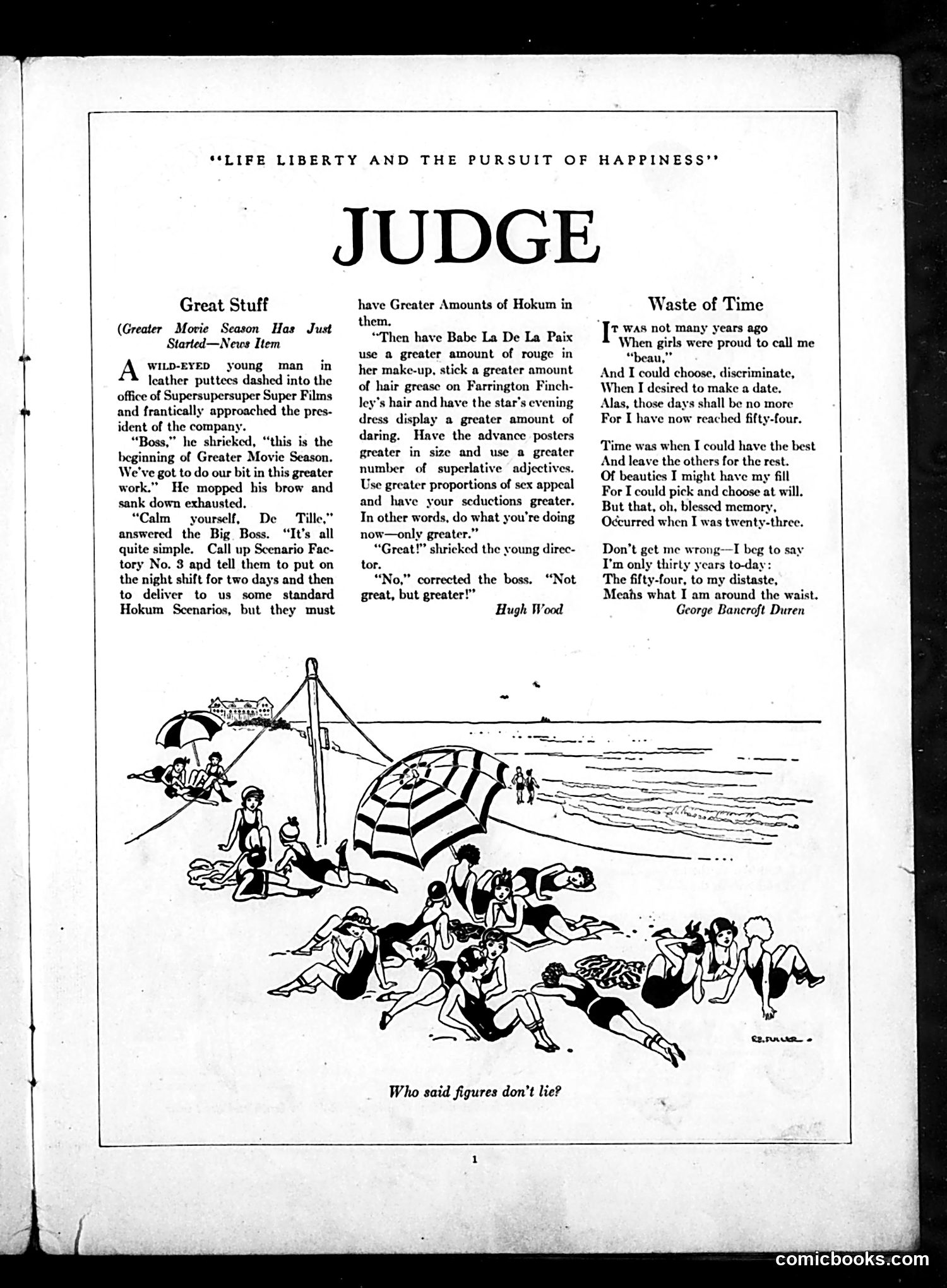
This page contains three distinct pieces: **"Great Stuff" (left):** A brief anecdote about a young filmmaker pitching "hokum scenarios" to a movie studio boss, arguing that bigger, more exaggerated content will succeed. It satirizes the emerging film industry's shift toward sensationalism and spectacle over substance. **"Waste of Time" (right):** A poem by George Bancroft Duren reflecting on aging, contrasting youthful beauty with middle age. The speaker regrets lost youth and beauty ("I have now reached fifty-four"). **Central illustration:** A beach scene with umbrellas, swimmers, and lounging figures captioned "Who said figures don't lie." This visual pun mocks the contradiction between idealized female body representations in media/advertising versus realistic bodies—humorously suggesting even "figure" statistics are deceptive. All three pieces critique contemporary American culture's emphasis on appearance and exaggeration.
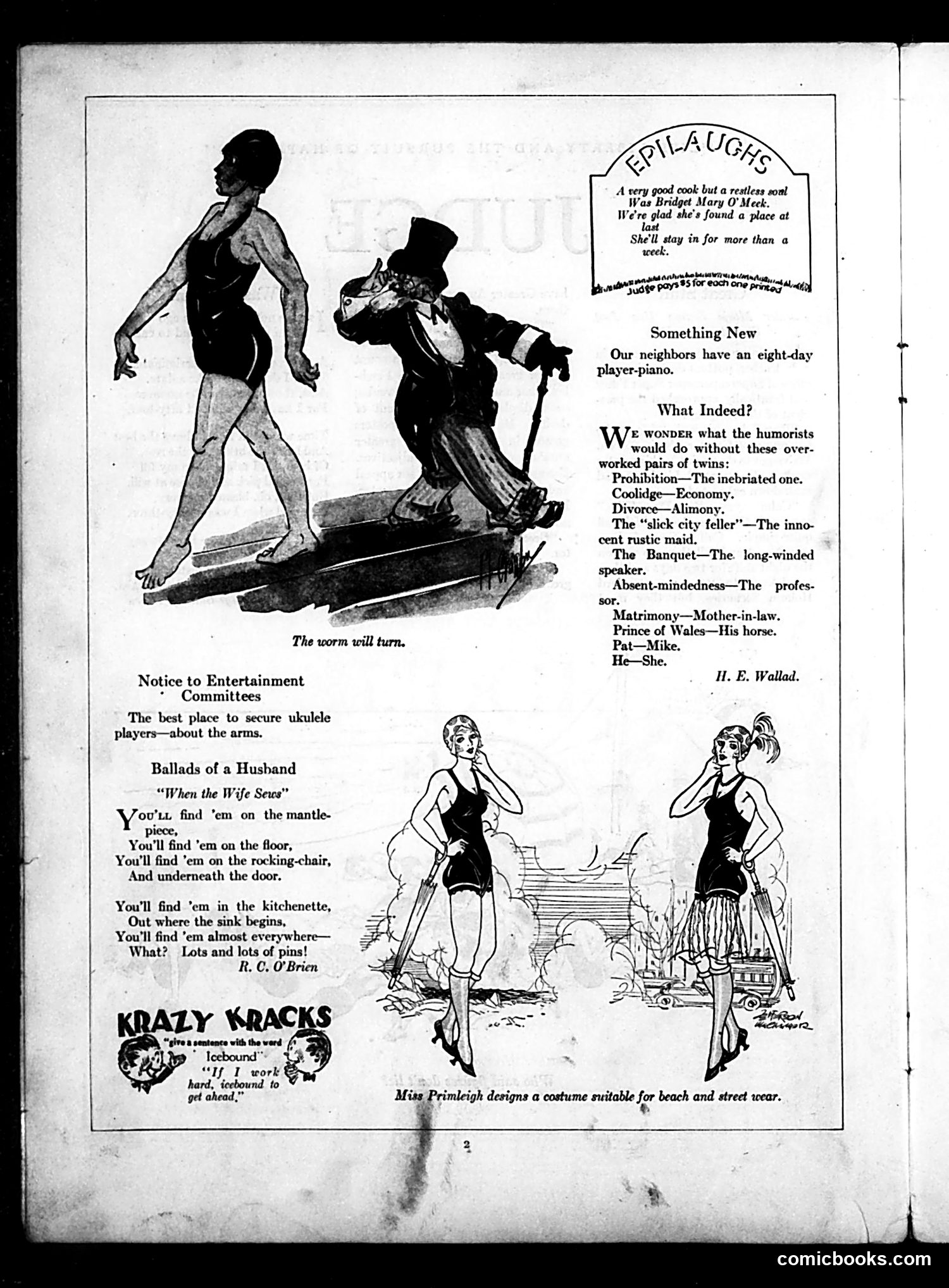
This page contains mixed content: humor pieces, an advertisement, and fashion illustrations rather than political cartoons. The main cartoon "The worm will turn" depicts a large muscular man and a small formally-dressed man on a seesaw, illustrating the proverb that even the meek will eventually rebel or assert themselves. "Ballads of a Husband" is a humorous poem listing locations where wives can be found, playing on domestic stereotypes of the era. "What Indeed?" lists comedic "pairs of twins" — contrasting concepts humorists rely upon for jokes (Prohibition/The inebriated one, Divorce/Alimony, etc.). The lower section features fashion illustrations by "Miss Primeigh" showing 1920s-style beach and street wear — typical Judge advertising content of the period rather than satire.
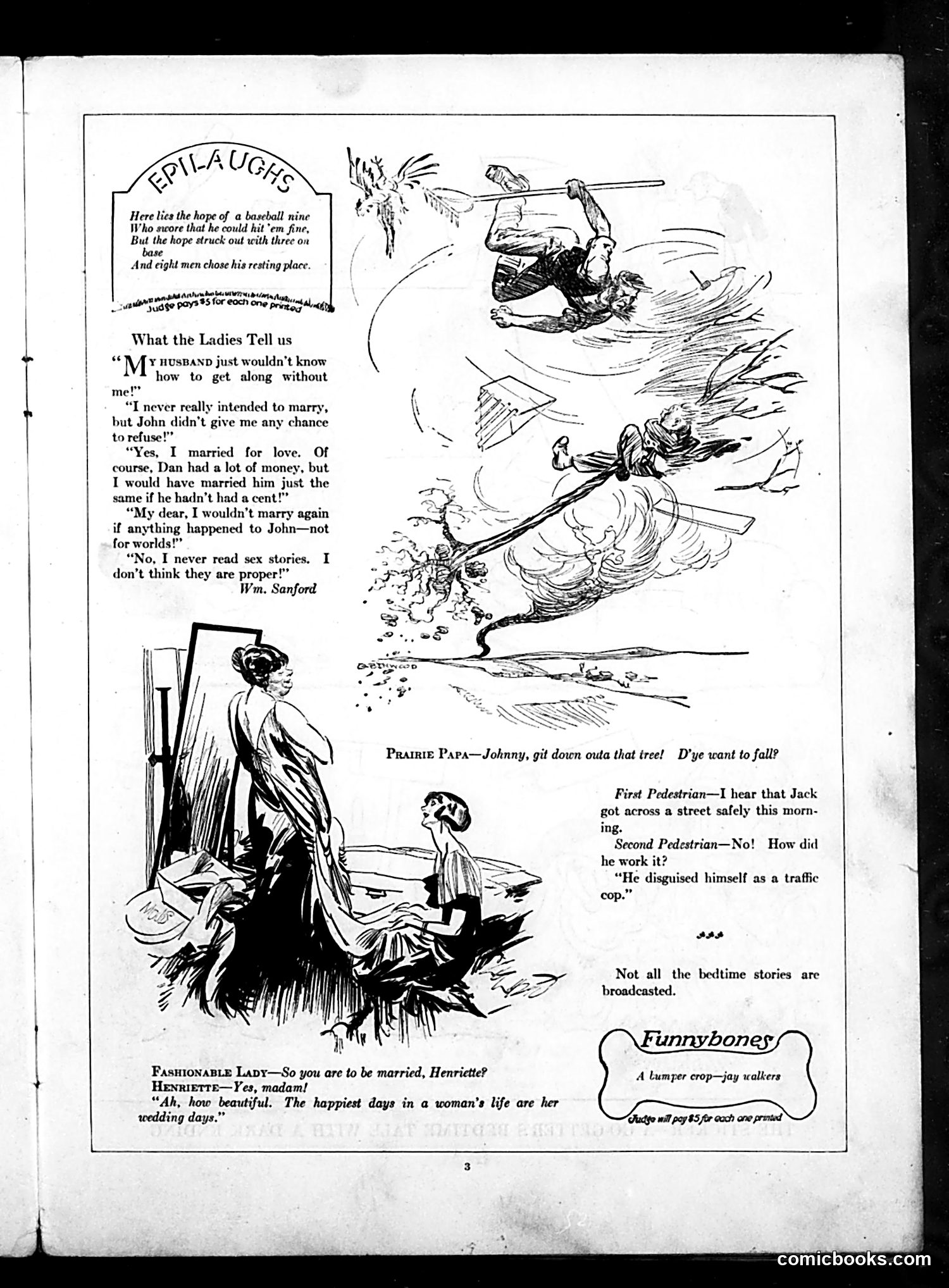
This page from *Judge* magazine contains several unrelated humor pieces rather than a unified political cartoon. **"Epilaughs"** presents a baseball epitaph—straightforward sports humor with no political reference. **"What the Ladies Tell Us"** features quotes from women about marriage, presenting satirical commentary on gender relations and women's expectations. The quotes suggest women marry for love (or money) but would prefer different outcomes—typical early-20th-century commentary on matrimonial attitudes. **"Prairie Papa"** depicts a comedic domestic scene where a father warns his son away from climbing a tree. **Lower cartoons** include jokes about street safety and wedding preparations, along with a "Funnybones" section offering light humor. The page primarily offers social satire about marriage and domestic life rather than political commentary. The humor targets gender relations and family dynamics common to the era.
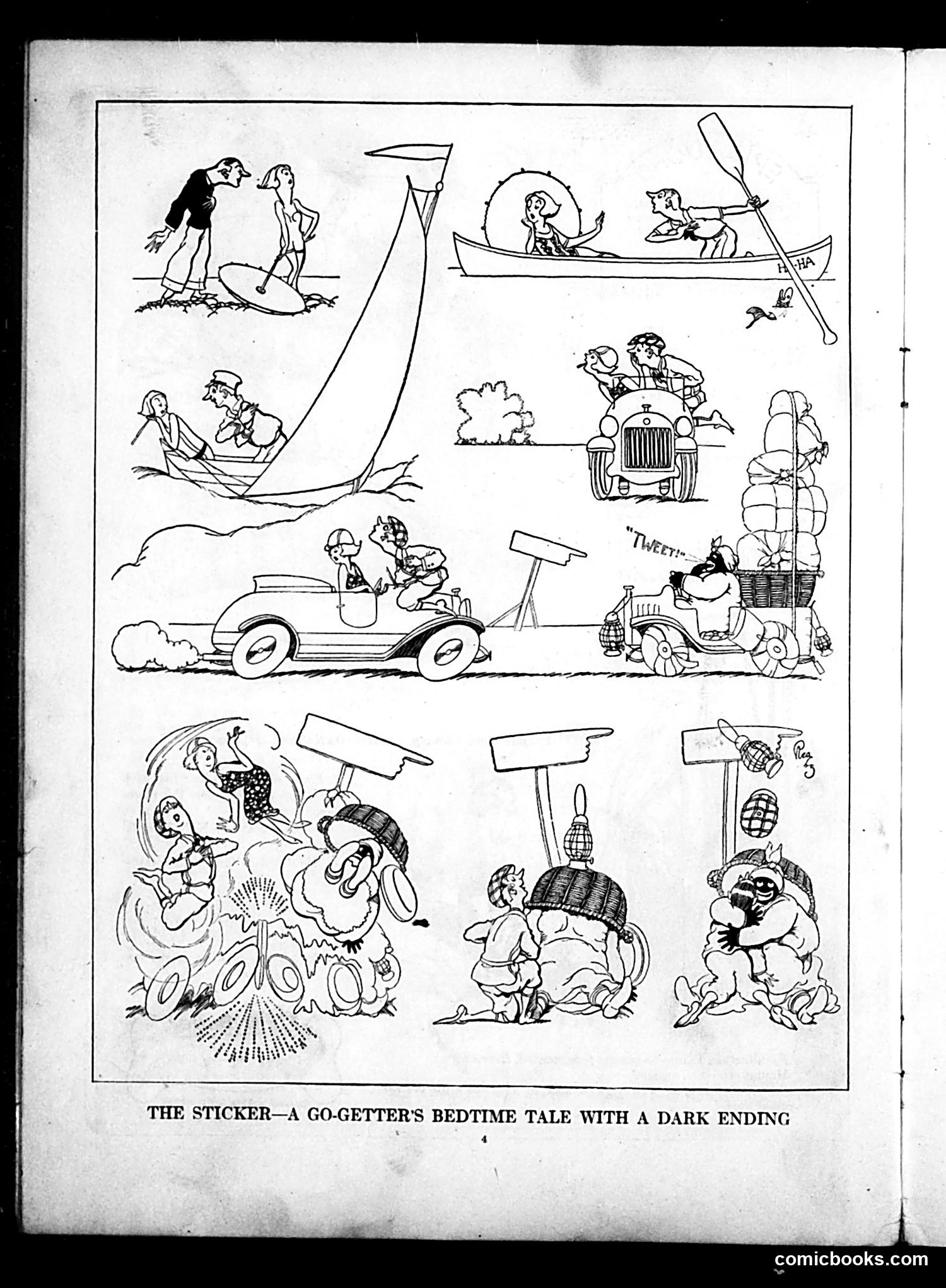
This comic presents a satirical "success story" in reverse. The upper panels show an ambitious man progressing through various modes of transportation and leisure—from surfing and boating to automobiles and airplanes—depicting the acquisitive dreams of an early 20th-century "go-getter" (ambitious businessman/entrepreneur). However, the bottom panels reveal the dark conclusion: the final three panels show the man repeatedly struck by a large hammer or mallet, presumably representing financial ruin or failure. The title's promise of a "bedtime tale with a dark ending" subverts the conventional rags-to-riches narrative, instead mocking the era's obsession with material accumulation and suggesting such ambitions inevitably lead to downfall. It's a cautionary satire about unchecked consumerism and greed.
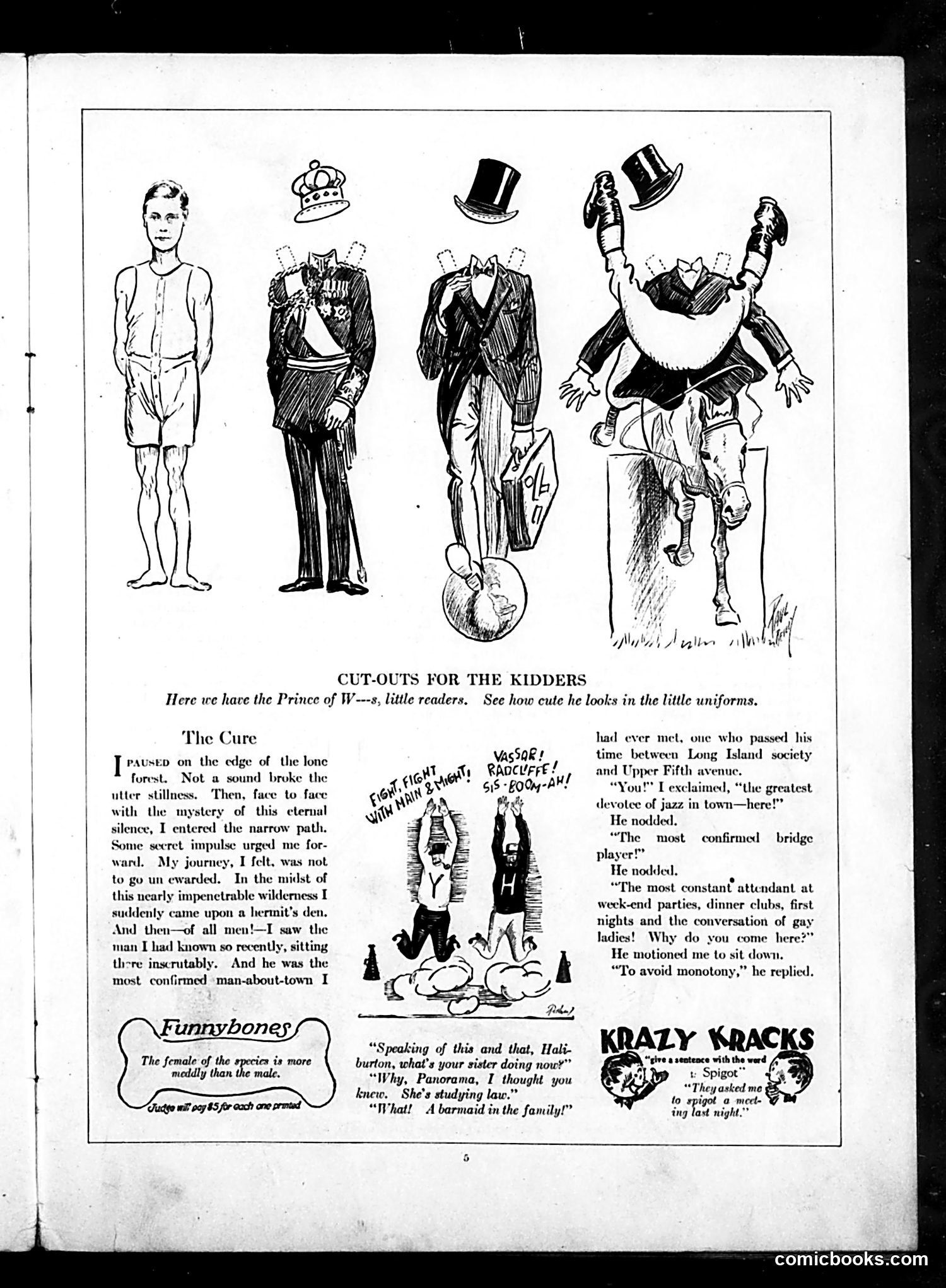
This page from *Judge* magazine contains children's paper cut-outs and a short story called "The Cure." **The Cut-outs**: The top section shows a boy in underwear and four elaborate costumes—including military dress, formal wear, and riding attire—meant for children to cut out and dress the figure in, following a common magazine feature of that era. **"The Cure"**: The accompanying story appears to satirize urban social climbing and affected sophistication. A narrator encounters a man obsessed with appearing cosmopolitan—attending society events, bridge games, and fashionable parties. The man's pretension and constant socializing are framed as a kind of affliction requiring "cure." The page also includes period humor boxes like "Funnybones" and an advertisement section, typical of early-20th-century magazine layouts.
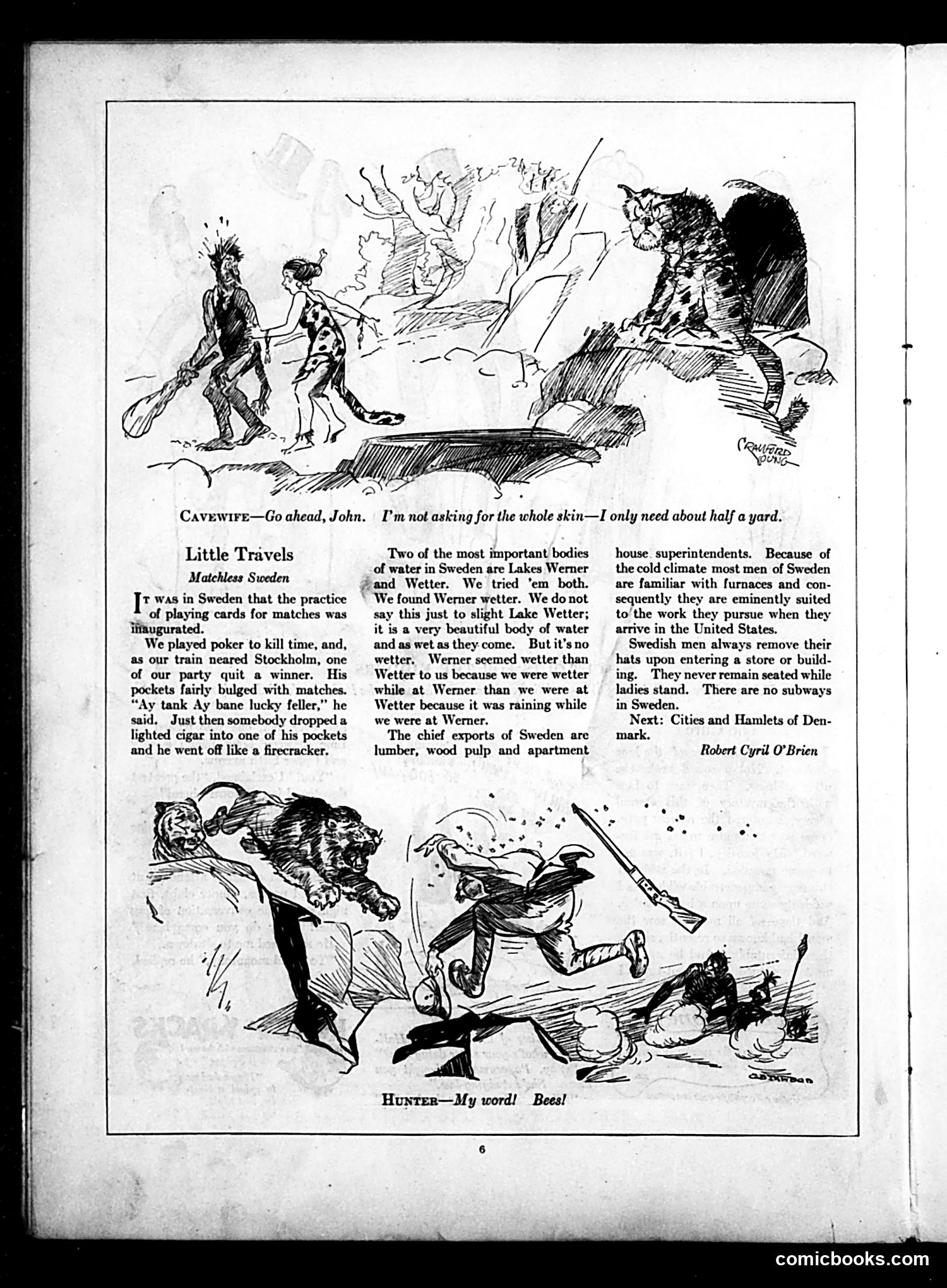
This page contains two cartoons and a humorous travel essay about Sweden by Robert Cyril O'Brien. **Top cartoon ("Cavewife")**: A domestic scene where a woman tells her husband to go hunting, saying she only needs "about half a yard" of animal skin—a joke about women's modest clothing needs versus men's exaggerated hunting efforts. **Travel essay**: O'Brien satirizes Swedish culture through absurdist humor: a man's match-filled pockets ignite like a firecracker; Lakes Werner and Wetter are distinguished only by the author being wetter at Werner because it rained there; Swedish men are suited to American furnace work due to cold climate familiarity. The humor relies on circular logic and non-sequiturs rather than political commentary. **Bottom cartoon ("Hunter")**: Shows a hunter being attacked or chased by game, reversing expected power dynamics—likely commenting on hunting mishaps or hubris. The page exemplifies Judge's lighthearted satirical style, mixing visual gags with absurdist travel writing rather than pointed political critique.
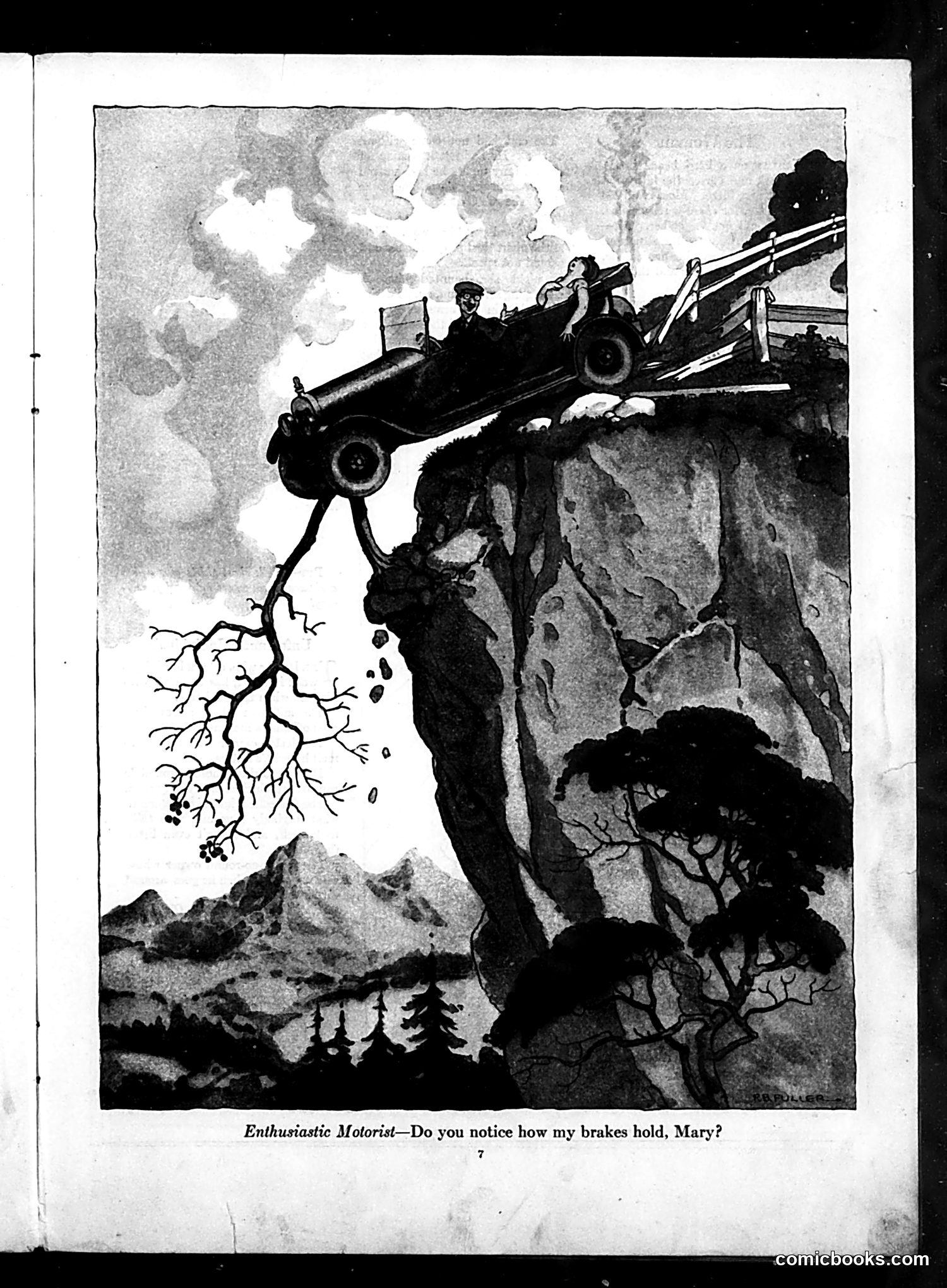
This satirical cartoon depicts an early automobile driver precariously positioned on a cliff edge, seemingly demonstrating his vehicle's braking capabilities to a passenger named Mary. The humor lies in the dangerous absurdity of the situation: the motorist is testing his brakes at the literal edge of a precipice, where any failure would result in a fatal plunge. The cartoon satirizes the overconfident "enthusiastic motorist" of the early automotive era—a figure who combines reckless behavior with misplaced pride in newfangled automobile technology. By placing him in an obviously perilous position while boasting about mechanical reliability, the artist mocks both early drivers' arrogance and the public's anxious skepticism about automobile safety during this transitional period of transportation.
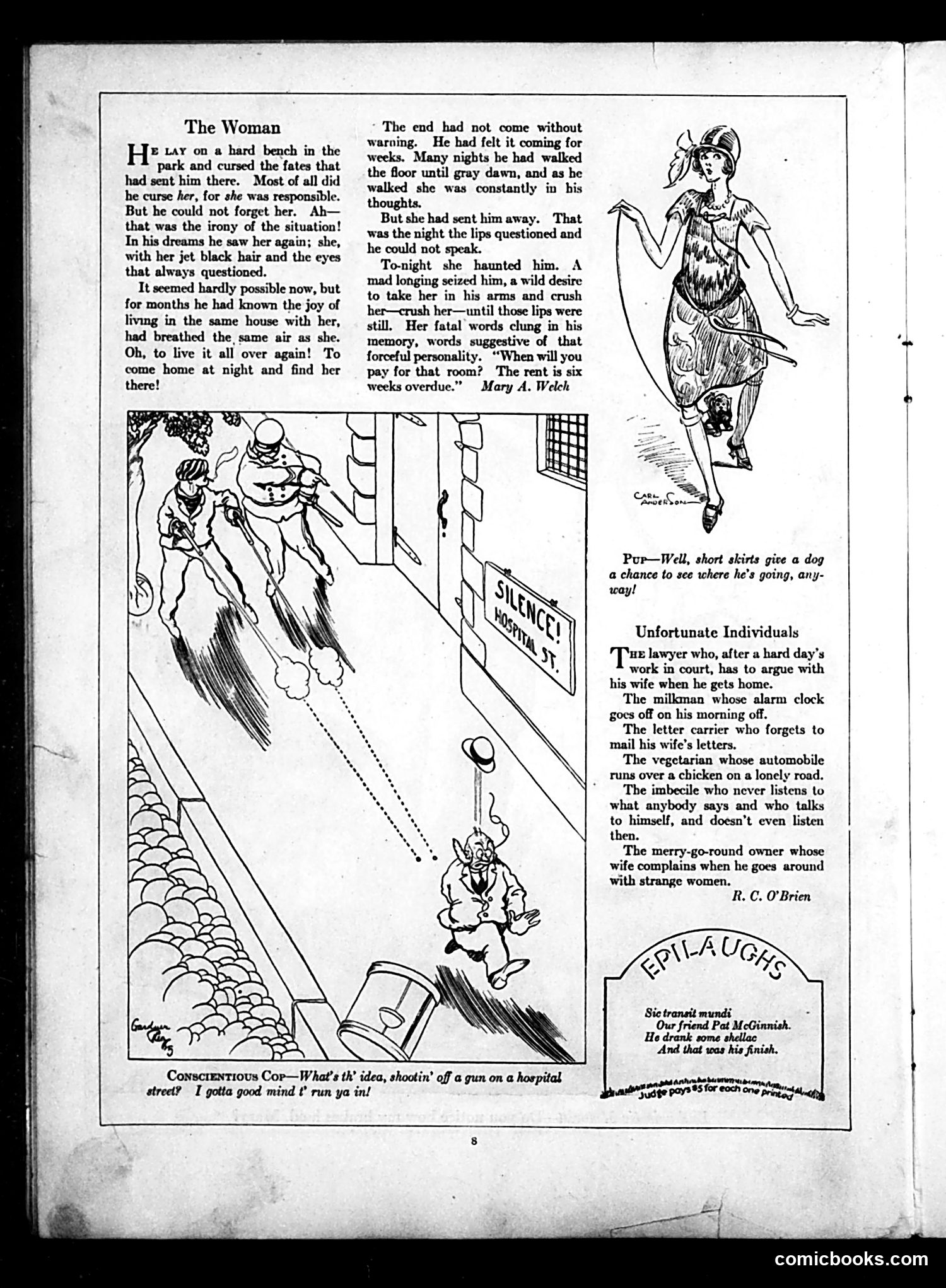
This page contains three distinct pieces of early 20th-century humor: **"The Woman"** is a melodramatic short story about a man estranged from his wife over unpaid rent. The irony—emphasized in the text—is that despite his resentment, he cannot stop thinking of her. The story critiques romantic desperation and domestic financial conflict. **The "Conscientious Cop" cartoon** satirizes women's fashion. A policeman confronts someone firing a gun near a hospital; the response jokes that short skirts justify reckless behavior because they reveal where one is going. This mocks both the cop's concerns and the excuse itself. **"Unfortunate Individuals"** by R.C. O'Brien is a humorous list of people facing absurd misfortunes—lawyers arguing with wives, milkmen woken by alarms on days off, and notably, a man who dies from drinking shellac. This gentle satire pokes fun at everyday annoyances and bad luck. The cartoons reflect early 20th-century concerns: domestic discord, changing women's fashion norms, and working-class mishaps.
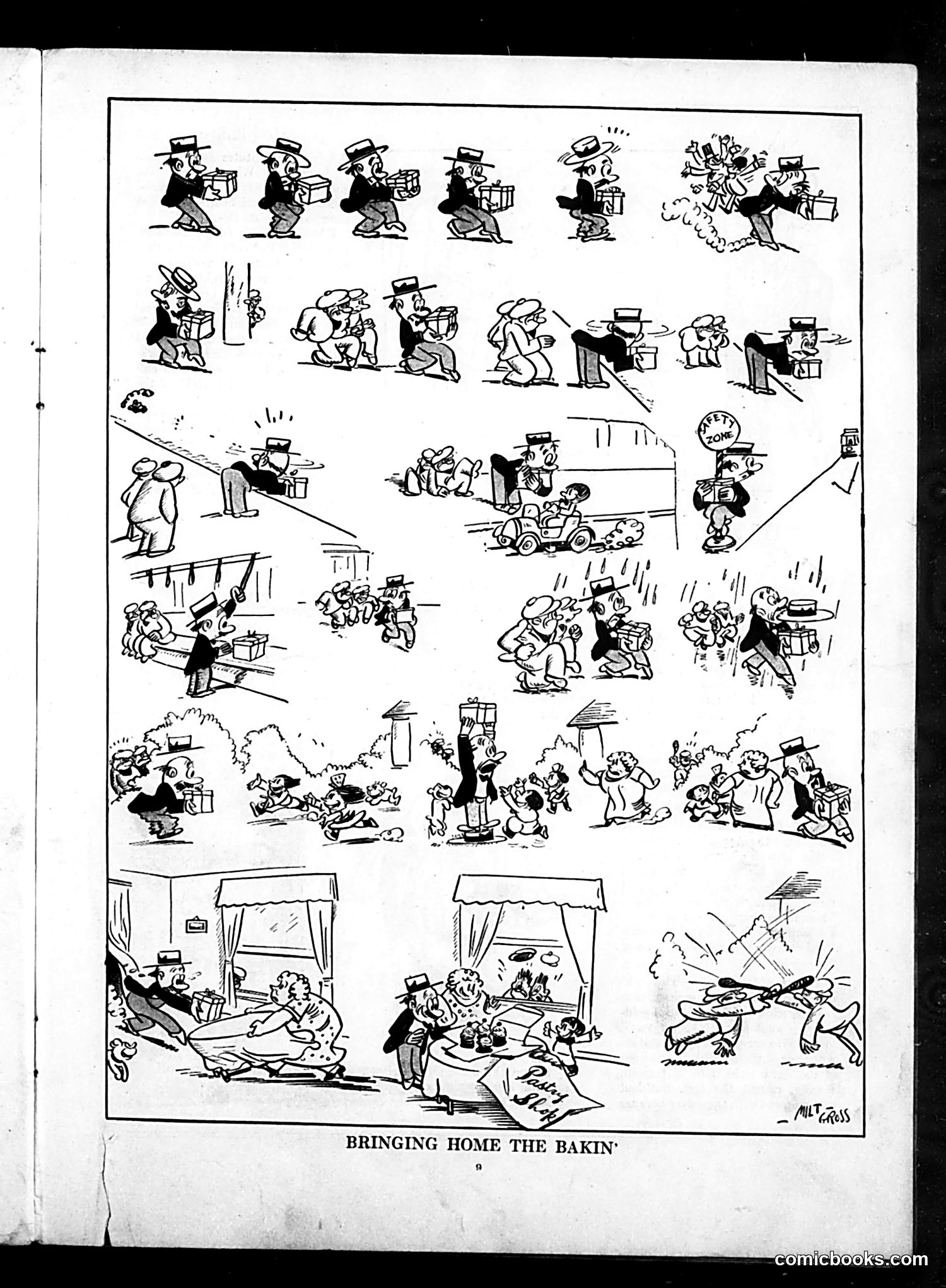
This comic strip by Milt Gross depicts a humorous domestic scenario about transporting baked goods home from a bakery. The sequential panels show a man (wearing a hat, appearing to be the main character) attempting to carry baked items—likely bread or pastries—through various mishaps and obstacles. The title's pun on "bacon" (typically "bringing home the bacon," meaning earning income) substitutes "bakin'" (baking), playing on working-class domestic life. The comic shows slapstick comedy as the character struggles with his purchase, encountering various troubles during transport—collisions, drops, and general chaos with other pedestrians and obstacles. The humor reflects early 20th-century American comedy's emphasis on physical comedy and domestic situations, likely resonating with readers familiar with bakery shopping challenges of the era.
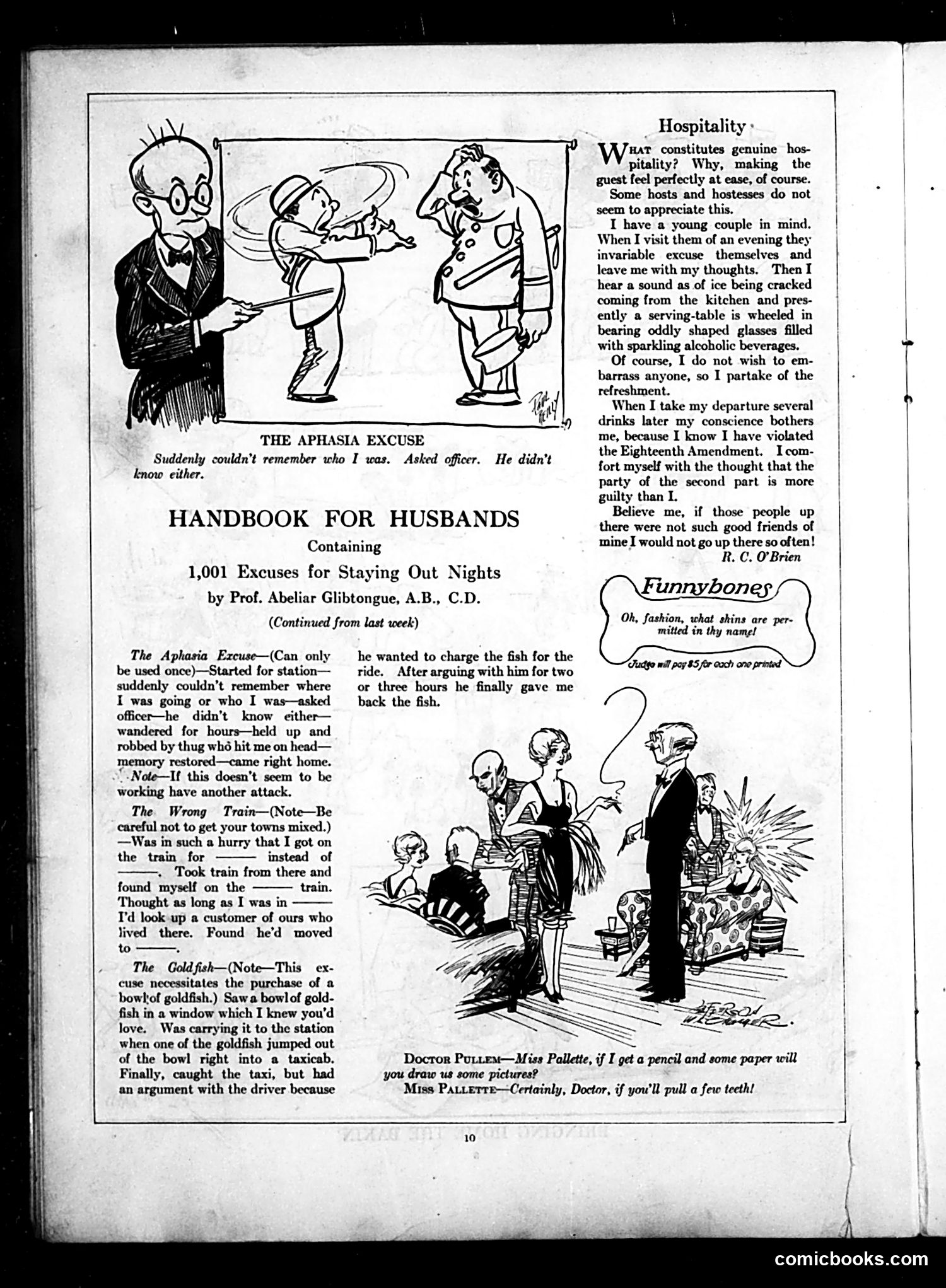
This Judge magazine page satirizes married men's excuses for staying out late, a recurring anxiety in early 20th-century domestic life. **"The Aphasia Excuse"** mocks a husband claiming amnesia—he "couldn't remember who I was"—to explain his absence. The joke's absurdity (even the police officer doesn't know him) suggests such excuses are transparently ridiculous. **"Handbook for Husbands"** presents fake justifications: the "Wrong Train" excuse, the "Goldfish" gambit (purchasing a pet to justify hours away). These parody real marital conflicts over husbands' nighttime activities. **"Hospitality"** critiques hosts who abandon guests while fetching drinks, violating social etiquette—a contemporary concern about proper entertaining. **"Funnybones"** and the dentist cartoon are unrelated quips about fashion and dental work. The satire targets husbands' creative dishonesty and the domestic friction of the era, when wives' anxieties about their husbands' whereabouts were a stock subject for humor. The Eighteenth Amendment reference dates this to Prohibition era (1920-1933).
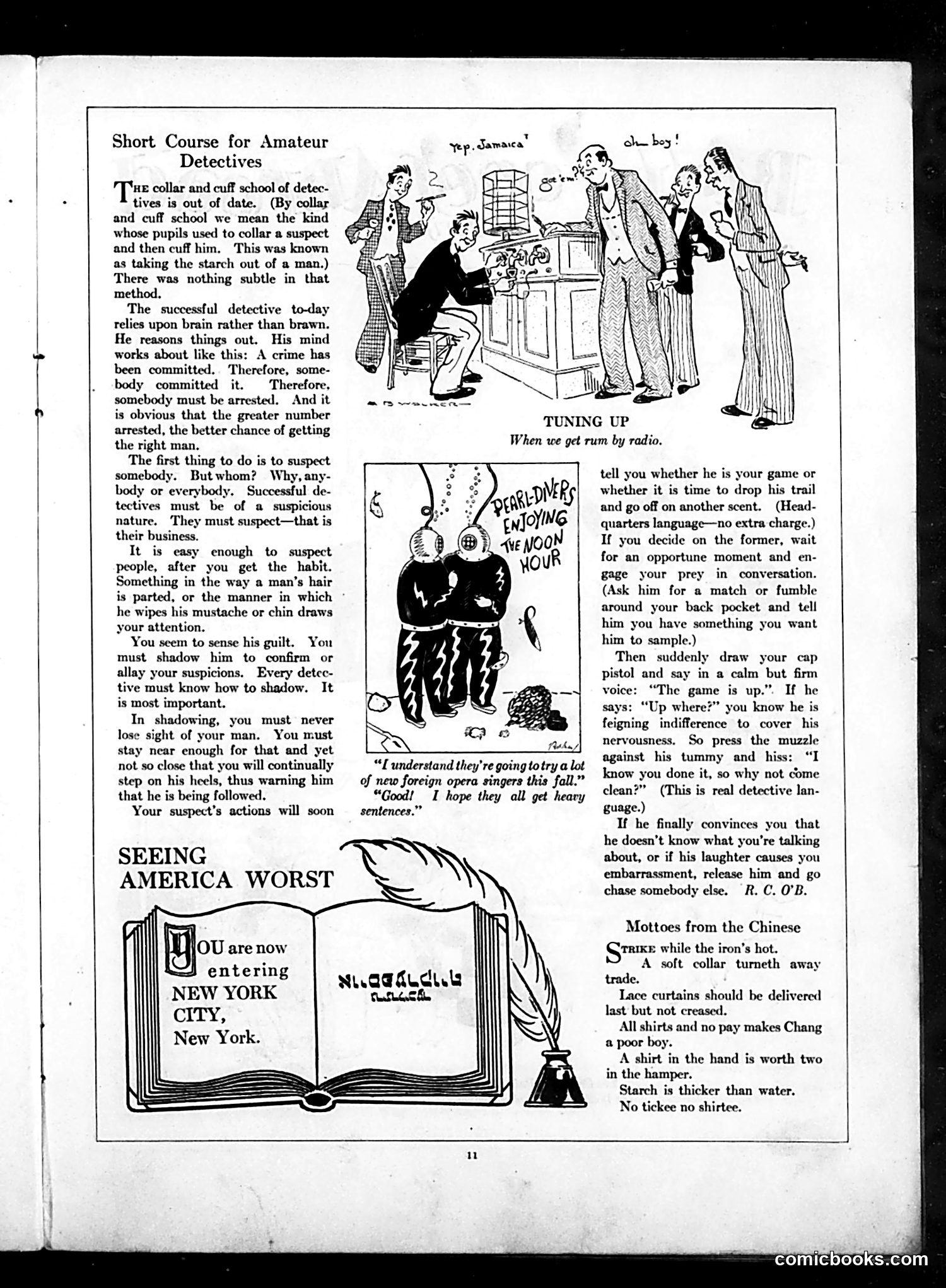
This page satirizes early 20th-century detective methods through humor. The main article mocks "amateur detectives" who use illogical reasoning: if a crime occurs, somebody must have done it, so arrest many people and hope to catch the guilty party. It ridicules the supposed "science" of detective work—shadowing suspects based on trivial details like how they part their hair, then confronting them with a toy pistol demanding confessions. The "Tuning Up" cartoon jokes about radio broadcasts replacing live entertainment, with characters hoping foreign opera singers will perform poorly (get "heavy sentences"). "Seeing America Worst" advertises New York City tourism. The page concludes with mock "Chinese Mottoes"—stereotypical fortune-cookie style sayings poking fun at Chinese immigrants and laundry services (references to starch, shirts, and "no tickee no shirtee," a period racial stereotype).
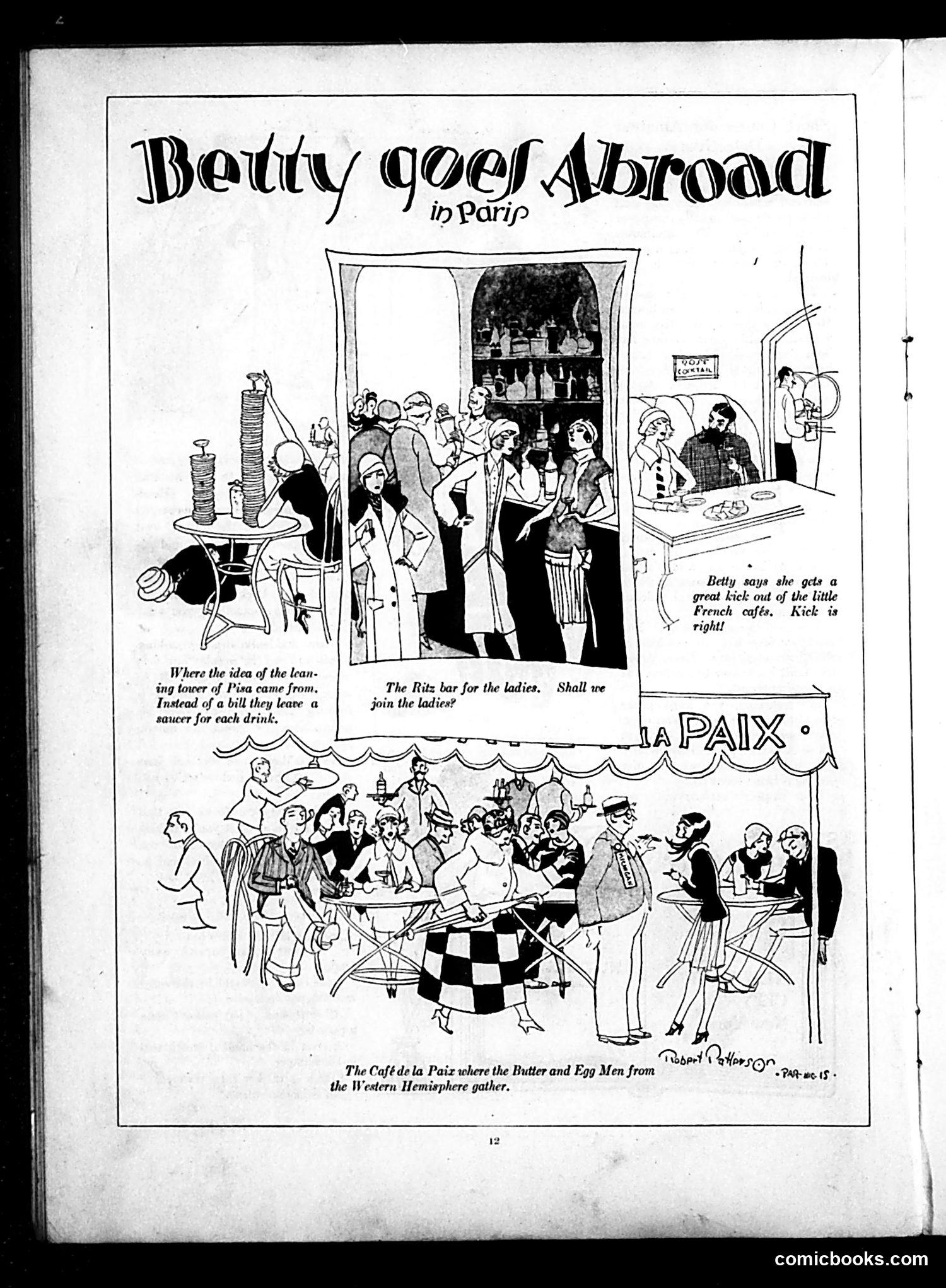
This satirical comic mocks American tourists in 1920s Paris. The top panels show Betty discovering Parisian attractions—a leaning tower of stacked dishes (parodying the Tower of Pisa), a chic bar, and cafés. The bottom panel depicts "the Café de la Paix" where "Butter and Egg Men from the Western Hemisphere gather"—a period slang term for wealthy, unsophisticated American businessmen who'd made fortunes and now flaunted wealth abroad. The cartoon ridicules American tourists as culturally clueless spenders who replace authentic European experiences with gaudy American-style establishments and excess. The "kick" Betty gets from "little French cafés" suggests she's enjoying superficial, commercialized tourism rather than genuine culture. This reflects post-WWI American prosperity and the stereotype of brash American wealth abroad.
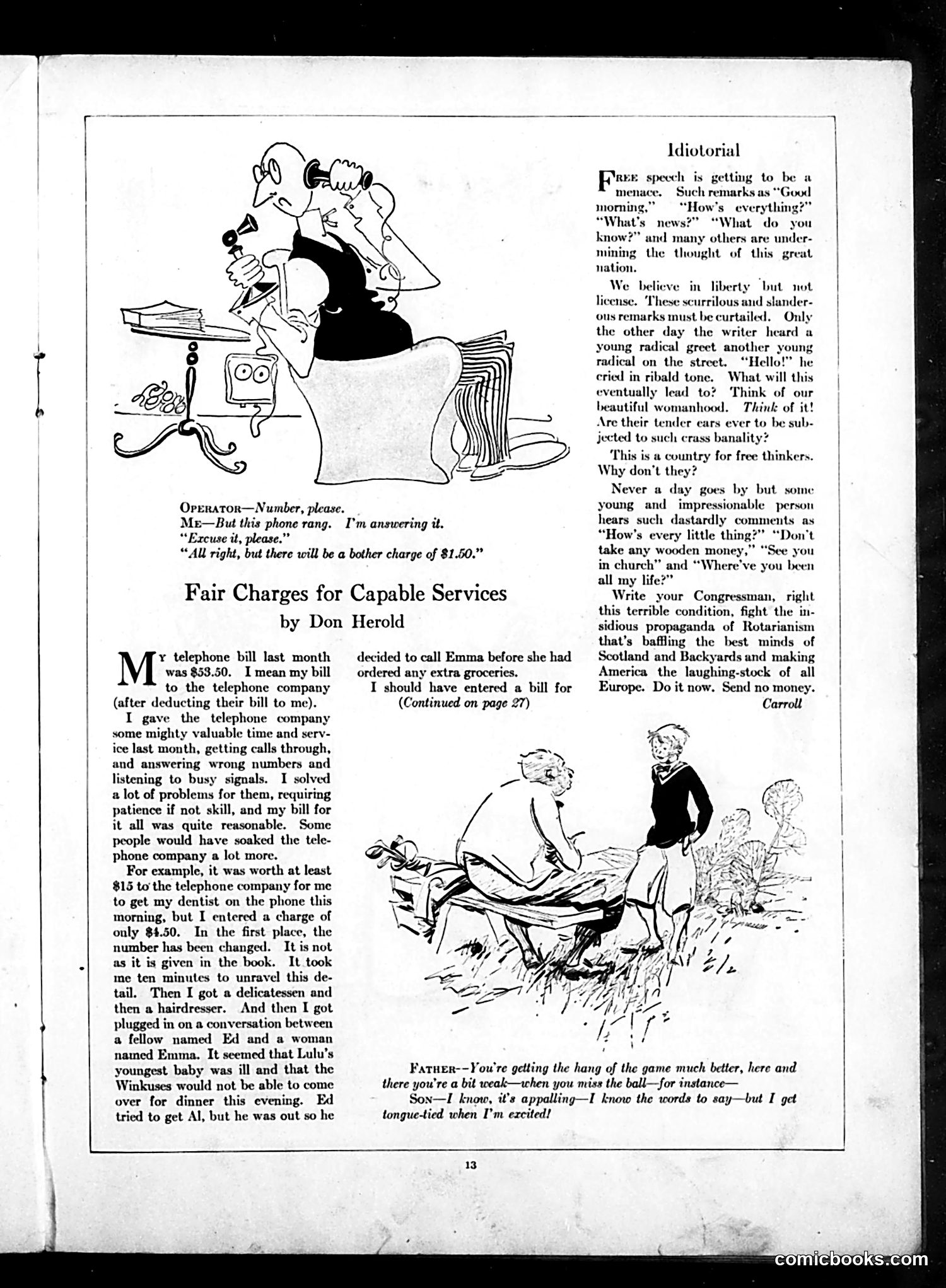
**Main Article ("Fair Charges for Capable Services"):** Don Herold satirizes telephone company billing by proposing customers should charge *the company* for services rendered—answering wrong numbers, solving connection problems, and wasting time trying to reach the correct party. He details spending ten minutes reaching his dentist after being connected to a delicatessen and hairdresser, then overhearing a private conversation between "Ed" and "Emma." The satire critiques both inefficient telephone service and the absurdity of the $53.50 bill he received. **"Idiotorial" Column:** A mock editorial satirizing censorship advocates by ironically attacking "free speech" as dangerous. It claims ordinary greetings ("Hello!" "How's everything?") are subversive radical propaganda undermining society, specifically threatening "womanhood." The column mocks moral panic and calls to write Congressmen—itself satirizing overwrought complaints to politicians about trivial matters. **Bottom Cartoon:** A father-son golf scene where the son admits getting "tongue-tied" during excitement—a gentle gag about youthful nervousness.
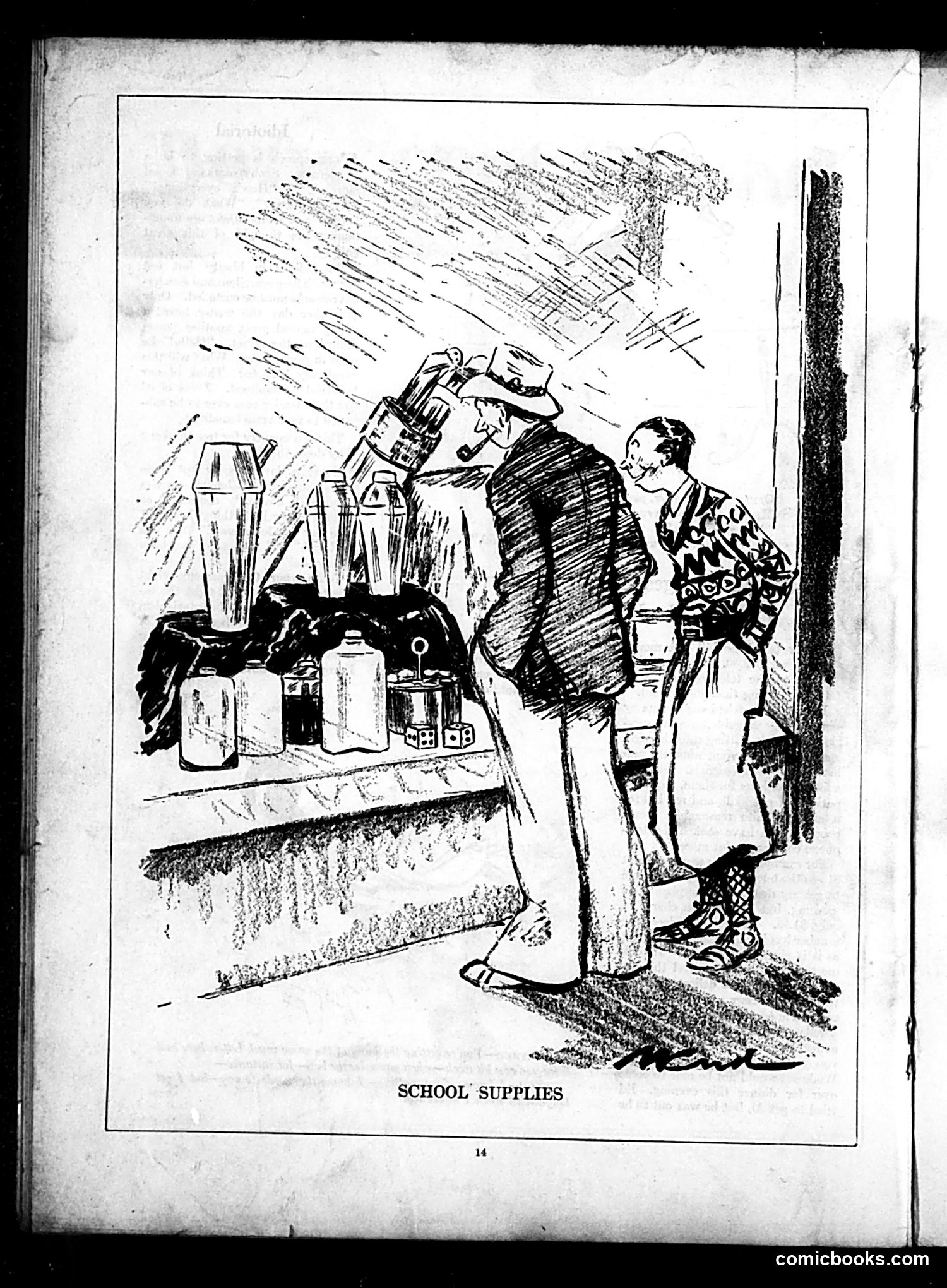
This cartoon depicts a merchant or shopkeeper displaying wares to a customer, with the caption "School Supplies." The image appears to satirize inflated pricing or poor quality of school materials. The central figure—a rotund businessman in a heavy coat—presents various bottles and containers (likely ink, paste, or other supplies) alongside coffins stacked in the background. The coffins suggest the supplies are either worthless, dangerous, or that purchasing them amounts to financial death for families. The well-dressed customer observes this questionable merchandise with apparent skepticism. The satire likely critiques either merchant price-gouging on school supplies, the poor quality of available materials, or broader economic concerns affecting working families trying to afford children's education during the magazine's era (appears to be early 20th century).
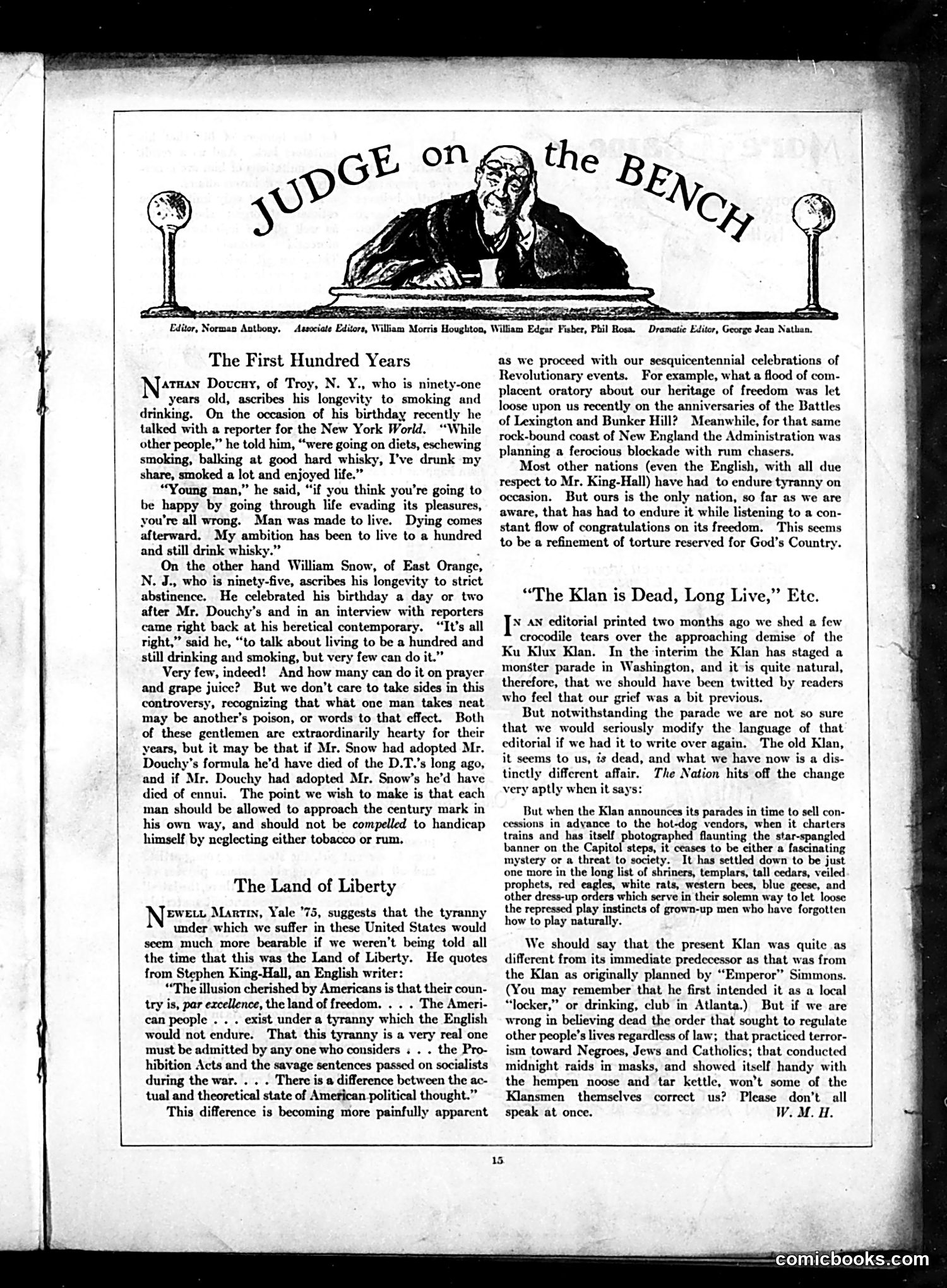
The **"Judge on the Bench"** masthead presents a judicial figure evaluating contemporary issues. This page contains three editorial commentaries: 1. **"The First Hundred Years"**: Contrasts two centenarians—Nathan Doucey, who credits longevity to smoking and drinking, versus William Snow, who attributes his health to strict abstinence. The satire mocks the smugness of health advice and suggests Americans' obsession with prescribed living. 2. **"The Land of Liberty"**: Critiques American hypocrisy. The piece quotes English writer Stephen King-Hall arguing that America preaches freedom while practicing tyranny—citing Prohibition enforcement and persecution of socialists. The satire targets the absurdity of celebrating Revolutionary anniversaries while simultaneously imposing increasingly restrictive laws. 3. **"The Klan is Dead, Long Live," Etc.**: Acknowledges the Klan's 1925 Washington parade, correcting an earlier editorial prediction of the organization's demise. This reflects contemporary uncertainty about the Klan's actual power and trajectory during the 1920s. The page critiques American contradictions: between lifestyle dogmatism, libertarian rhetoric versus actual restrictions, and political naiveté.
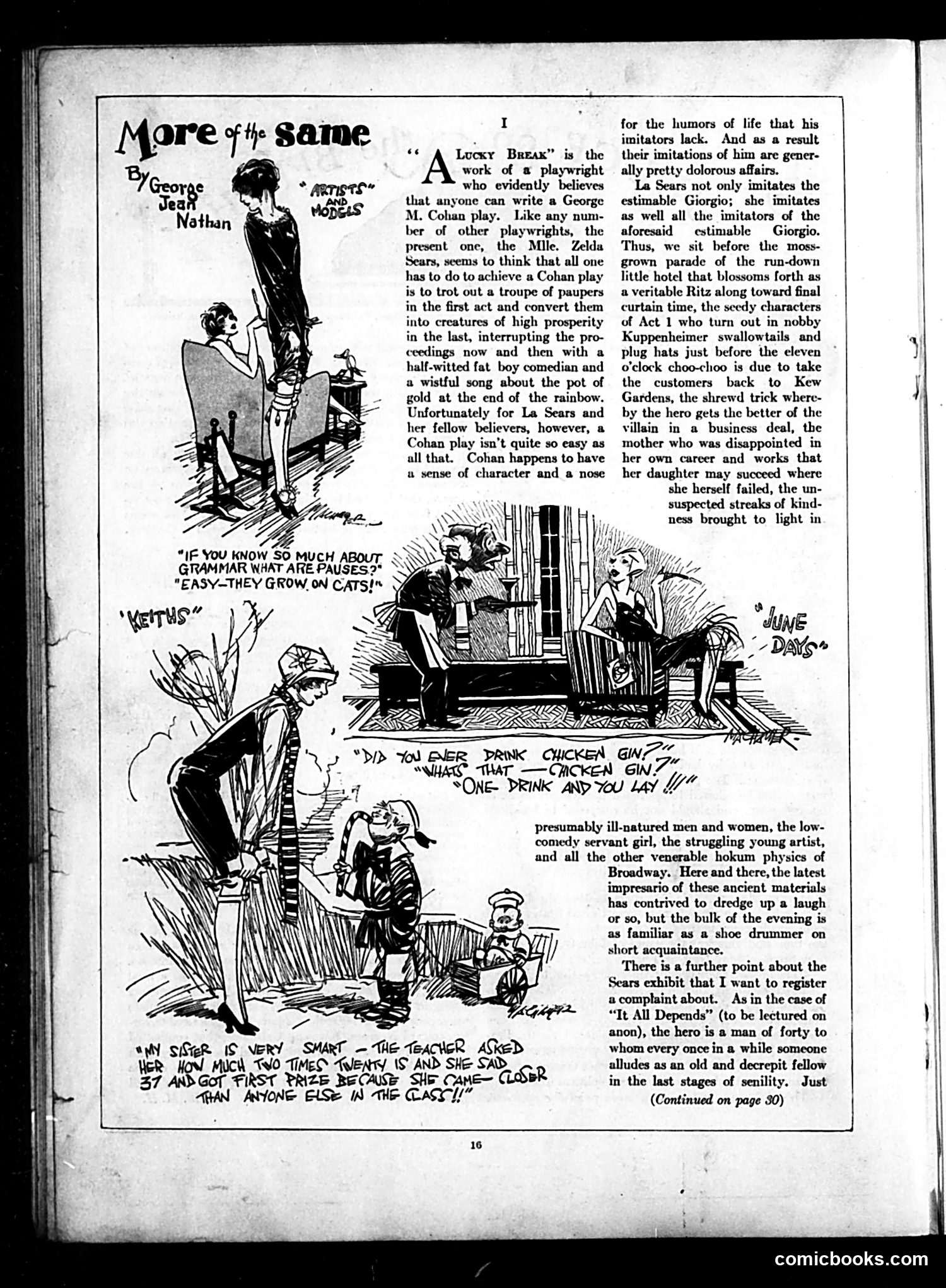
This page reviews **"A Lucky Break,"** a play by Zelda Sears that mimics George M. Cohan's theatrical formula. The critic argues Sears merely copies Cohan's surface elements—impoverished characters transformed into prosperity, fat comedians, sentimental songs about rainbows—without understanding his actual talent for character development and humor. The cartoons below illustrate the clichéd Broadway "hokum" being satirized: scenes of bumbling servants, grammar jokes, and predictable pauper-to-riches plotting. The critique suggests that while Sears and imitators believe following Cohan's recipe guarantees success, they miss what made his plays work—genuine wit and insight into human nature. This reflects early 1900s theater criticism mocking derivative Broadway productions that substituted formula for originality. Cohan was Broadway's dominant figure; his methods were widely imitated but rarely matched.
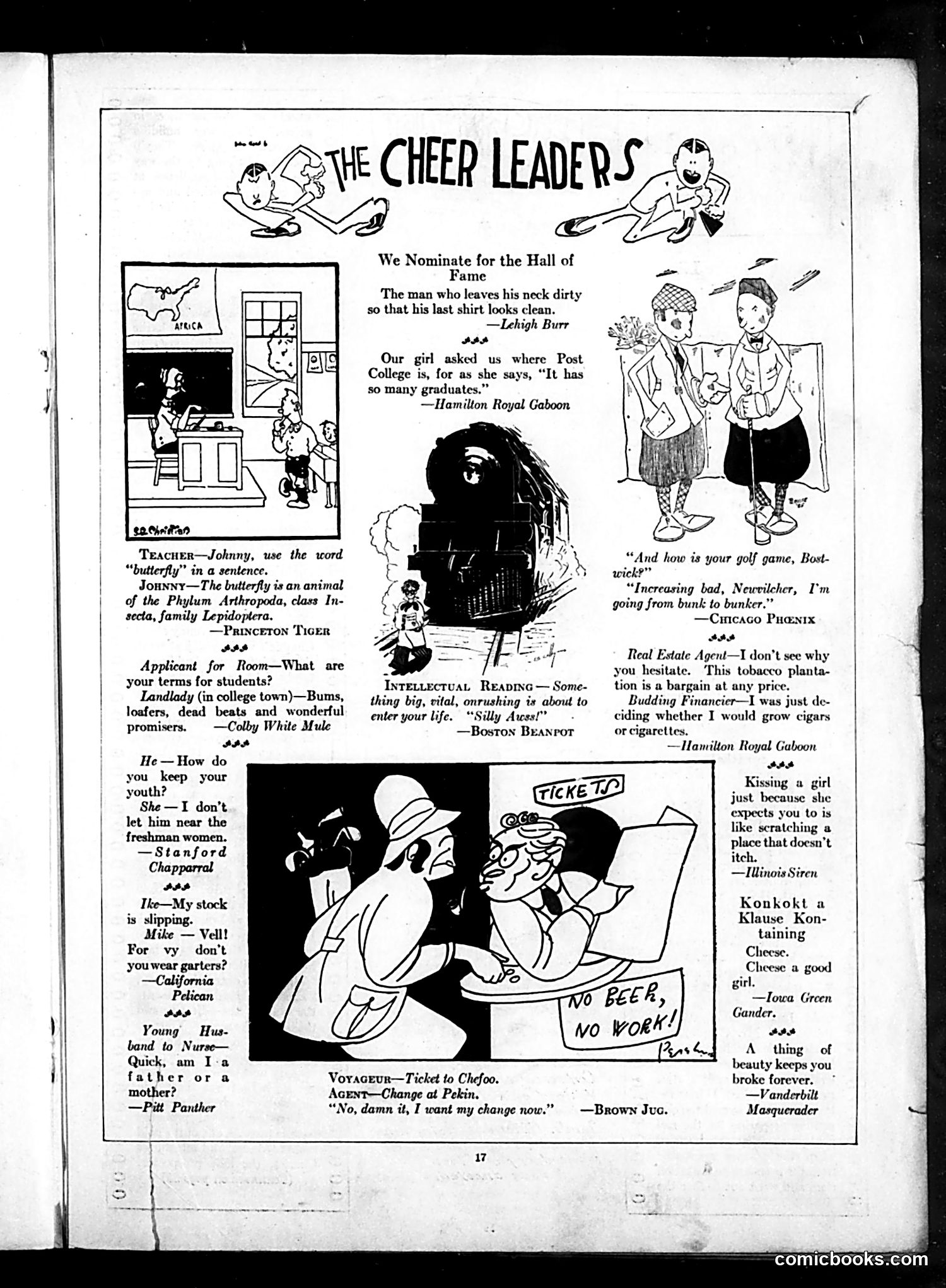
This page from *Judge* magazine is a collection of humorous one-liners and jokes sourced from college newspapers across America. The "Hall of Fame" nominations mock everyday situations with gentle satire. The jokes target college life: a landlady describing student tenants as "bums, loafers, dead beats"; a teacher frustrated when a student gives a pedantic zoological definition instead of a simple sentence; a confused new father asking a nurse if he's a "father or a mother" (likely a gender-role joke). The central cartoon shows a ticket agent refusing to make change, captioned with a traveler's complaint—likely satirizing penny-pinching service workers or travel frustrations. Other jokes reference social expectations (kissing obligations), golf, real estate schemes, and Post College's reputation for graduating many students. The humor is mild, collegiate, and reflects 1920s-era campus culture without targeting specific political figures or events.
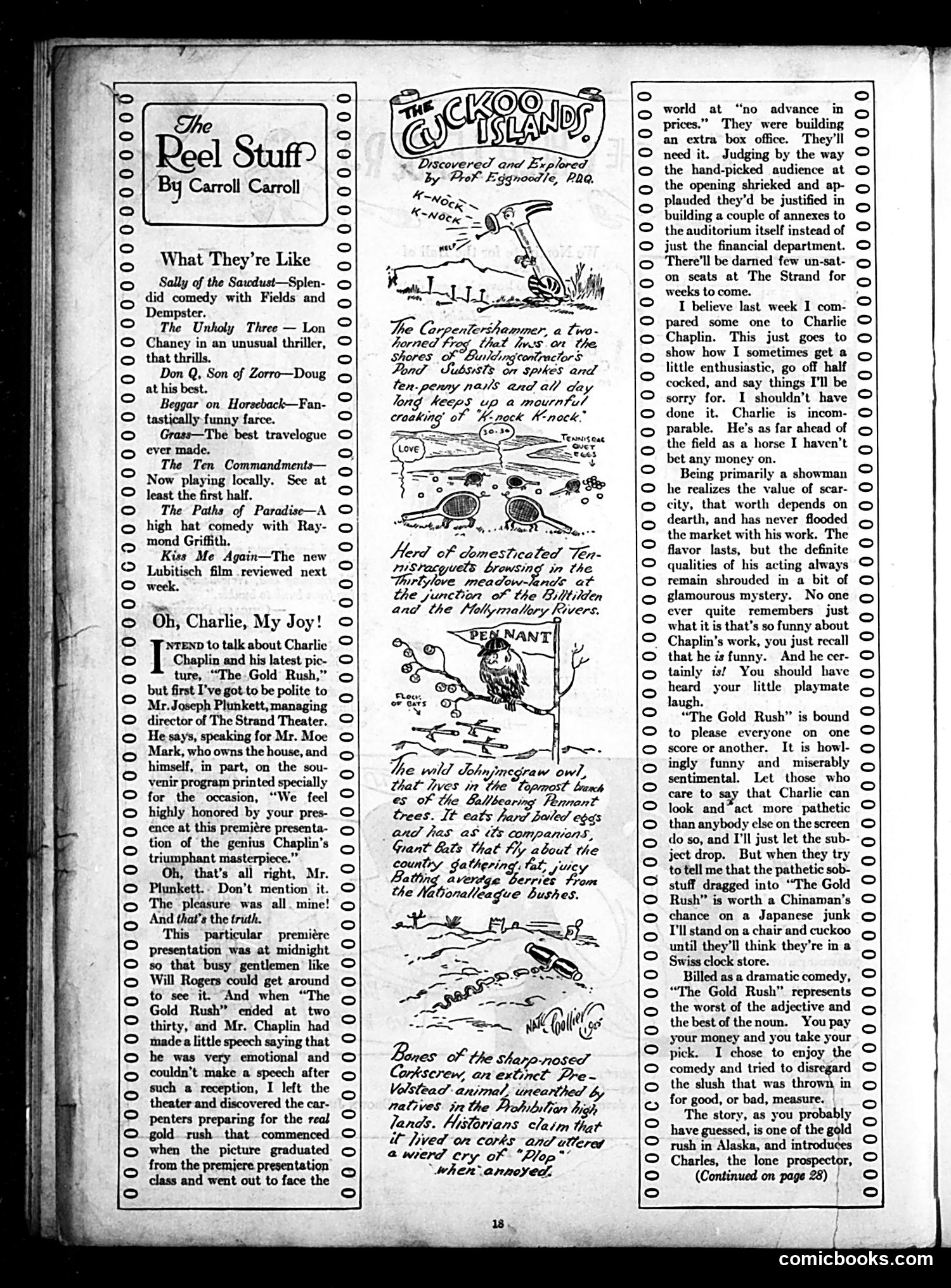
This page contains two distinct elements: a film review column and a humorous pseudo-scientific illustration series. **The Review Section:** Carroll Carroll critiques Charlie Chaplin's film "The Gold Rush," praising it as superior to all other contemporary comedies. The author describes attending a midnight premiere at The Strand Theater, noting the enthusiastic audience response and the film's immediate commercial success. **The Cartoon Series:** "The Cuckoo Islands" features absurdist illustrations of fictional creatures and locations discovered by "Bok Eggnoodte, Ph.D." The drawings parody scientific expedition documentation with invented animals like a "carpentershammer" (a two-horned frog), domesticated "tenrusracyuels," and a "jotyjnegraw owl." The humor relies on nonsensical names and ridiculous descriptions presented in mock-serious naturalist style—a common Judge magazine format satirizing pseudo-intellectual exposition and pseudo-science popular in the 1920s. The page represents typical Judge content: entertainment criticism alongside absurdist visual humor targeting contemporary cultural pretensions.
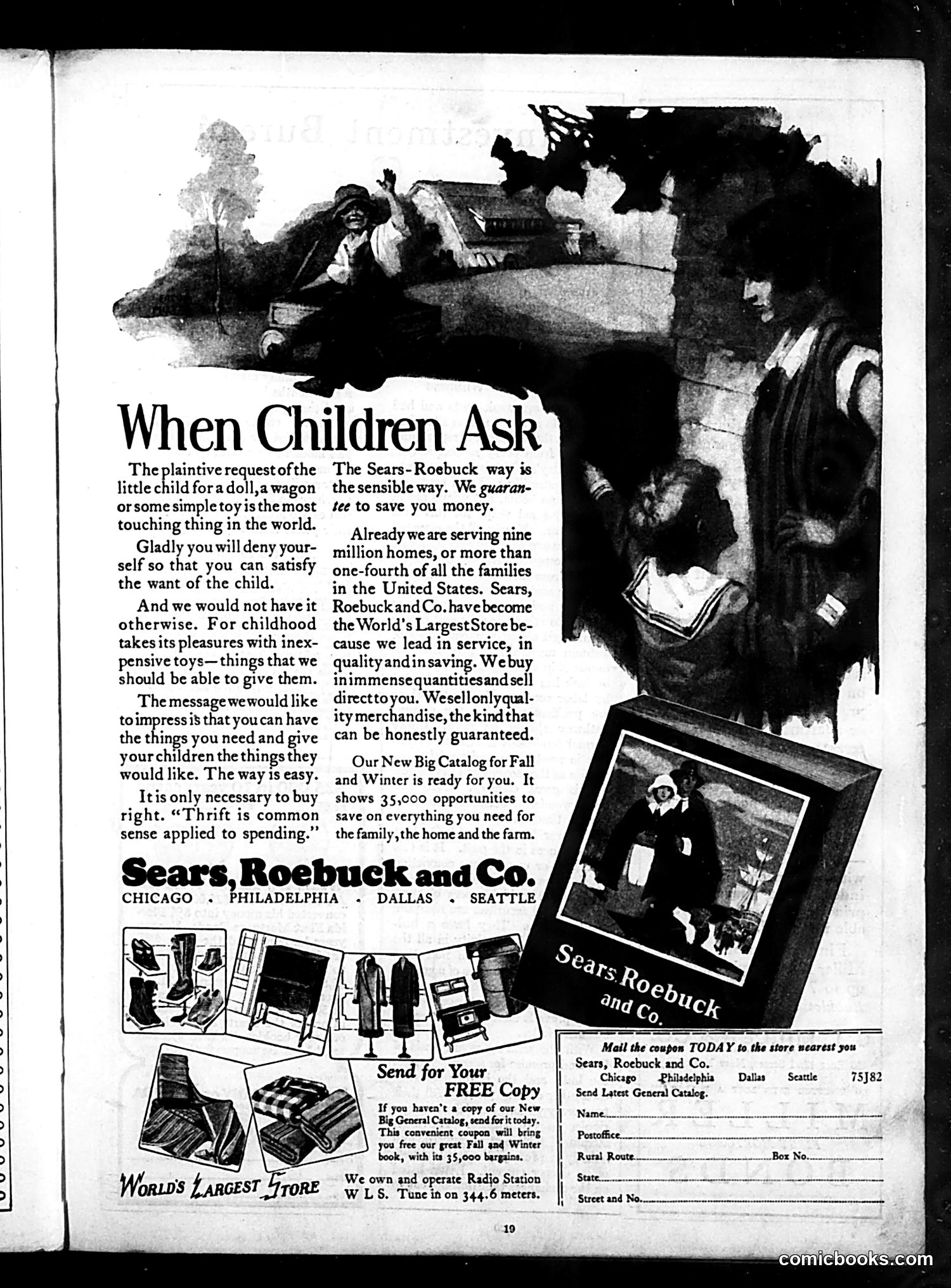
This is primarily a **Sears, Roebuck and Co. advertisement**, not political satire. The page uses emotional appeal rather than humor or social commentary. The ad's rhetorical strategy plays on parental guilt and economic anxiety: it acknowledges parents' desire to deny themselves for children's happiness, then pivots to suggest that Sears allows families to have *both* necessities and children's toys through "thrift"—bulk purchasing and direct sales eliminate middlemen costs. The illustration depicts a father figure gesturing expansively toward a rural homestead, suggesting abundance and security. The ad claims Sears serves "nine million homes" (one-fourth of American families), positioning the catalog as democratizing access to goods. The phrase "Thrift is common sense applied to spending" reflects Depression-era or post-WWI economic messaging emphasizing budgeting. The "World's Largest Store" branding and radio station reference (W.L.S.) show Sears' dominant market position circa early 20th century. **This is advertising, not satire.**
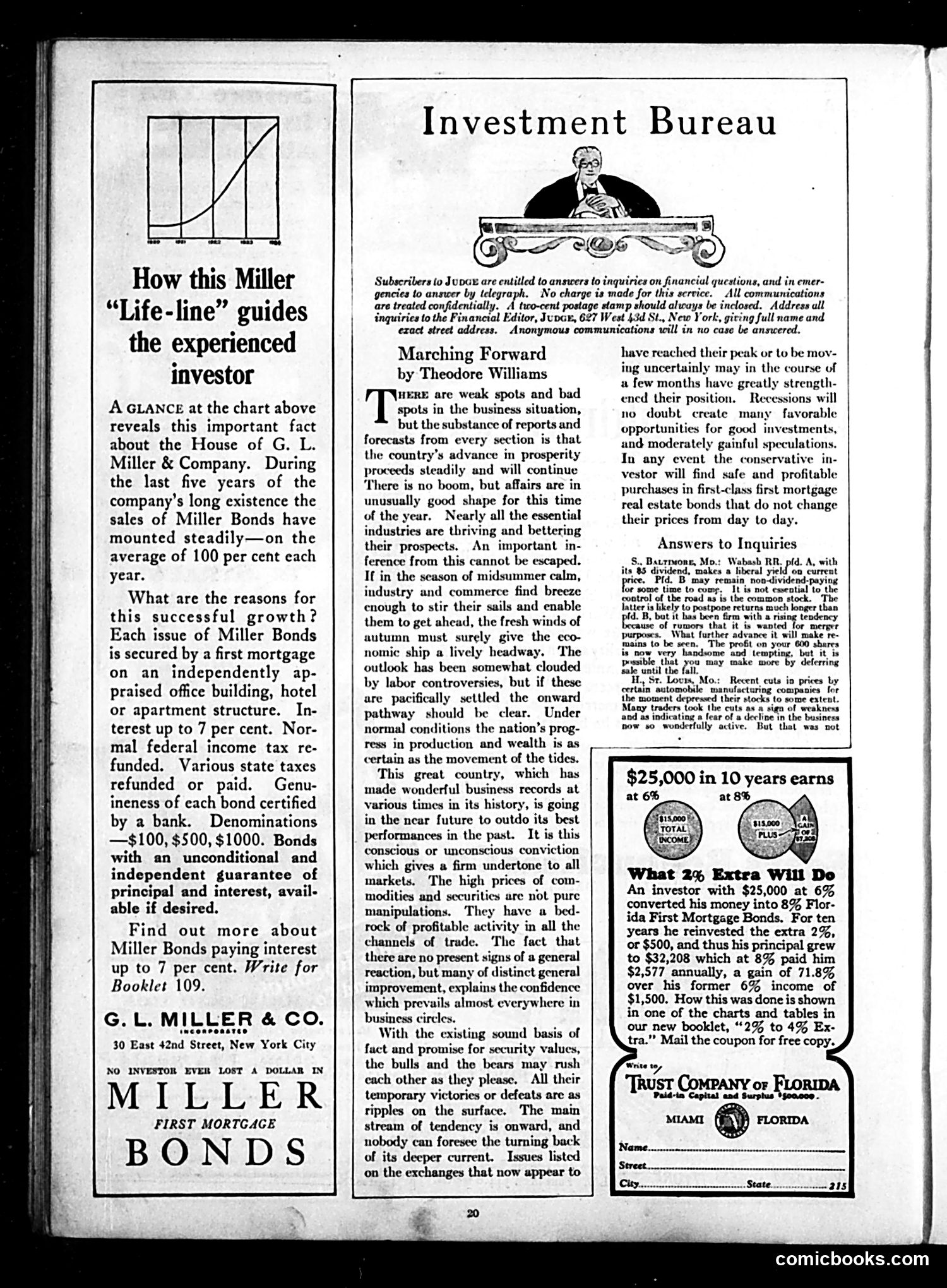
This page combines investment advertising with financial commentary from Judge magazine (likely early 1920s, based on style). **The Advertisements:** Two major ads promote financial products: G.L. Miller & Company's first-mortgage bonds (left) and Trust Company of Florida's investment opportunity (right). Both make confident claims about safety and returns—Miller promises "no investor ever lost a dollar," a guarantee that appears increasingly hollow given the 1929 crash loomed. **The Editorial Content:** Theodore Williams's "Marching Forward" column offers optimistic economic analysis, claiming steady prosperity, thriving industries, and confident markets. It dismisses labor controversies as minor obstacles to inevitable progress. **The Satire:** Judge's placement of this content—pairing rosy economic predictions with aggressive bond-selling—likely mocks the disconnect between financial industry optimism and underlying economic fragility. The confident tone about "certain as the movement of tides" prosperity now reads as darkly ironic to readers who know the Great Depression followed within years.
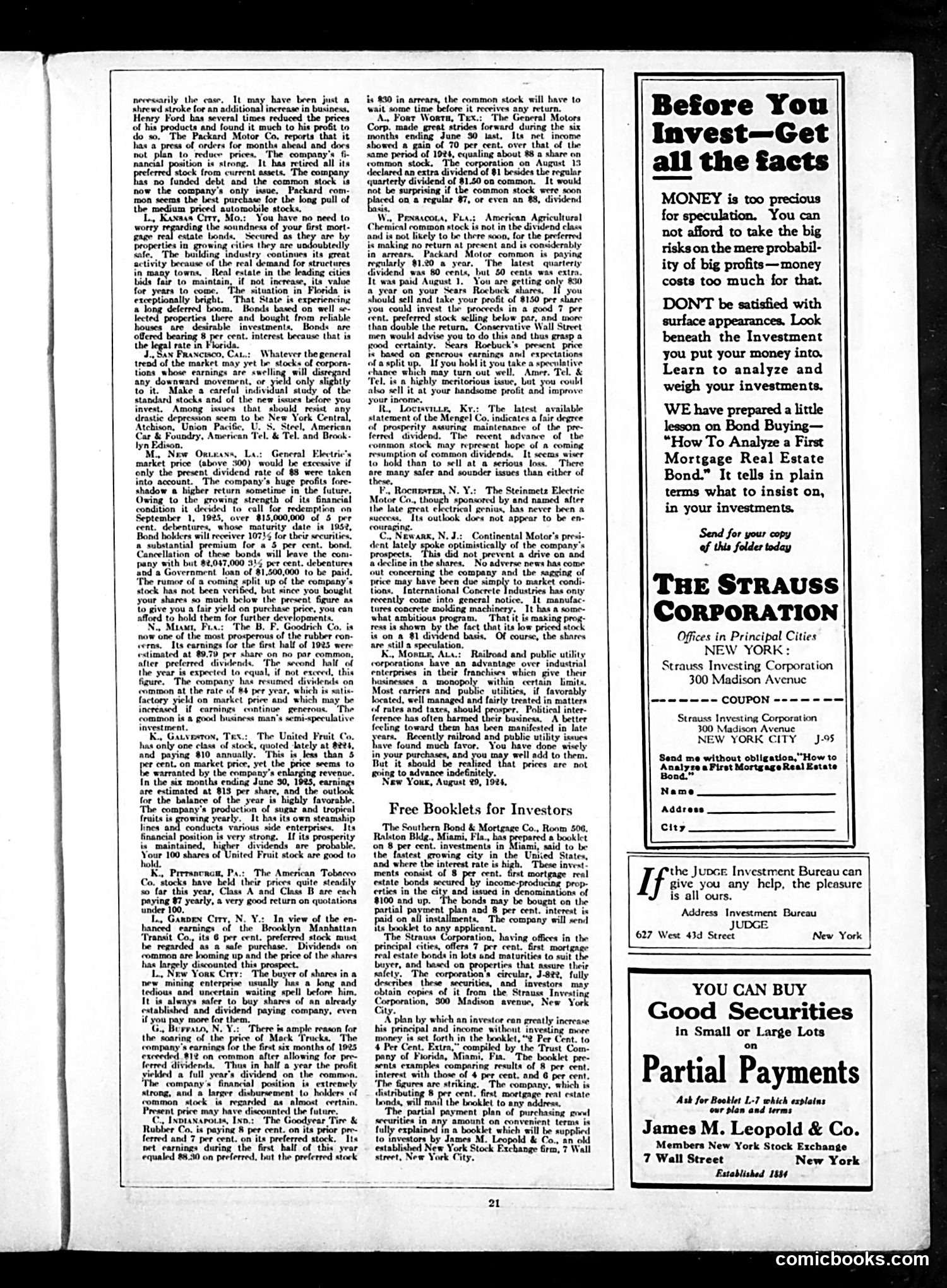
This page is primarily **financial advice columns and investment advertisements**, not political satire. The "Judge" masthead indicates this is from the satirical magazine, but this particular section focuses on stock market guidance rather than humor. The content addresses investor questions about purchasing stocks during what appears to be a **1920s economic period** (references to Ford price reductions, Packard Motors, Sears Roebuck). The prominent sidebar titled "Before You Invest—Get all the facts" warns readers against speculation, cautioning that "MONEY is too precious for speculation." The advertisements promote investment services: The Strauss Corporation offers stock advice, while James M. Leopold & Co. advertises purchasing securities on "Partial Payments." **Key historical context**: This reflects the era before the 1929 stock market crash—a time when investment advice columns were booming and ordinary citizens were increasingly participating in stock markets. The cautionary tone about avoiding risky speculation ironically preceded the speculative bubble that would devastate investors.
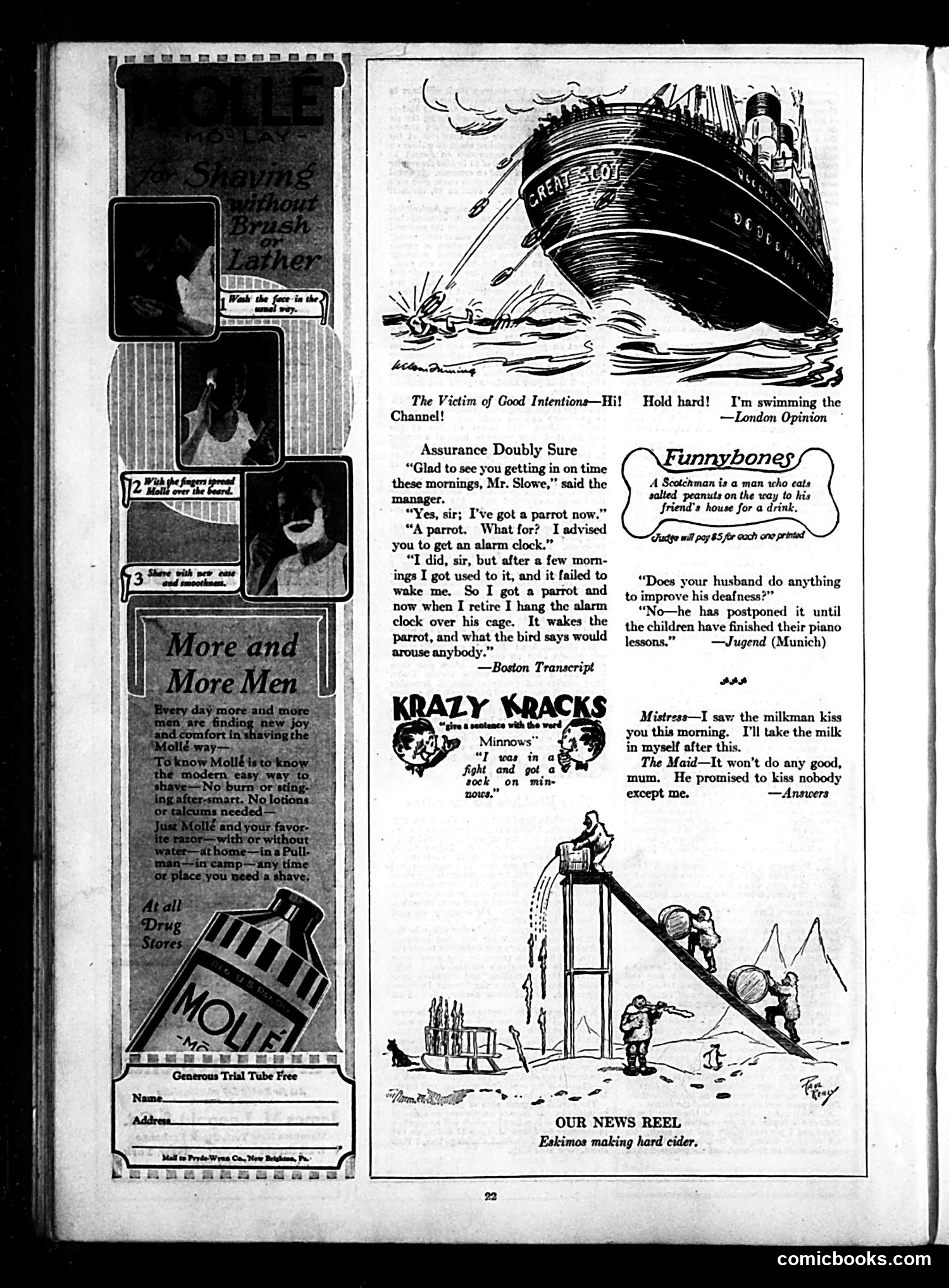
This page contains several humor pieces satirizing everyday life and social foibles: **"The Victim of Good Intentions"** depicts a ship ("Great Scott") wrecked—a visual pun on the name, suggesting well-meaning but misguided actions lead to disaster. **"Assurance Doubly Sure"** mocks a worker who replaced an ineffective alarm clock with a parrot, reasoning the bird's profanity upon waking would arouse him better than mechanical noise. It satirizes absurd problem-solving. **"Krazy Kracks"** presents a child's malapropism joke—answering a vocabulary prompt with "minnows" instead of "minows" (mishearing "in the nose"). **"Funnybones"** are brief gags about Scottish frugality, a husband's procrastination, and a maid's infidelity. **"Our News Reel"** jokes about Eskimos making hard cider—presumably absurd because of Arctic climate. The page is typical early-20th-century light satirical humor targeting common people's foibles rather than political figures.
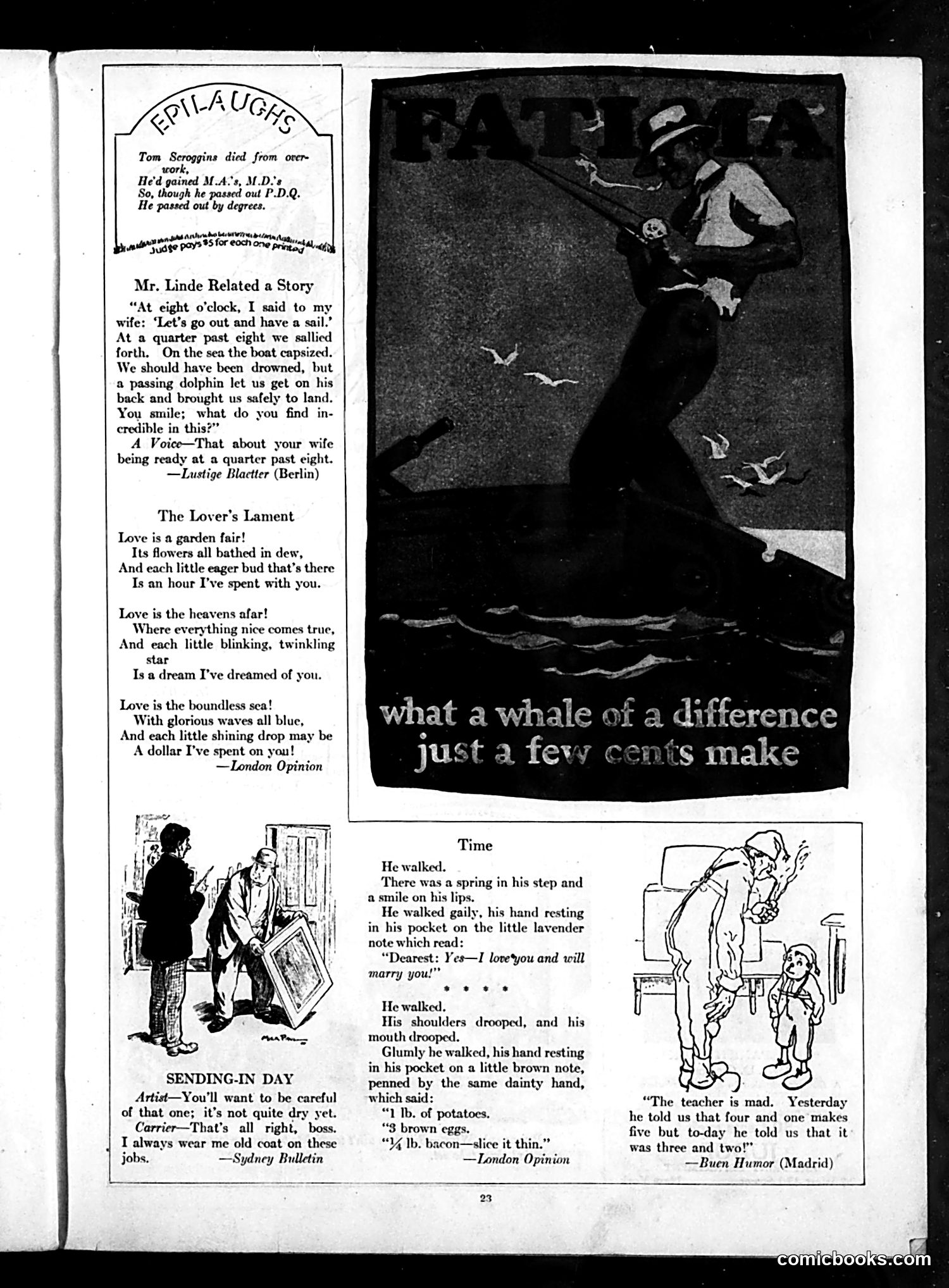
This page from *Judge* magazine contains several short humorous pieces typical of early 20th-century satirical journalism: **"Epilaughs"** opens with a pun on Tom Scroggins's death "by degrees"—he earned multiple advanced degrees (M.A., M.D., P.D.Q.) but worked himself to death. **"Mr. Linde Related a Story"** jokes about spousal unreliability: a man claims a dolphin rescued him from a capsized boat, but the real incredibility, a voice suggests, is his wife being ready on time. **"The Lover's Lament"** satirizes romantic poetry by comparing love's value to dollars spent—a dig at commercialized sentimentality. **"Time"** contrasts a man's joy upon receiving a love note with his dejection upon receiving a grocery list from the same woman—mocking how marriage deflates romantic expectation. **"Sending-in Day"** is a brief joke about an artist warning a carrier about wet paint; the carrier dismisses concern because he wears an old coat. The page reflects period humor: marital disillusionment, class-conscious workplace comedy, and gentle mockery of artistic and romantic pretension.
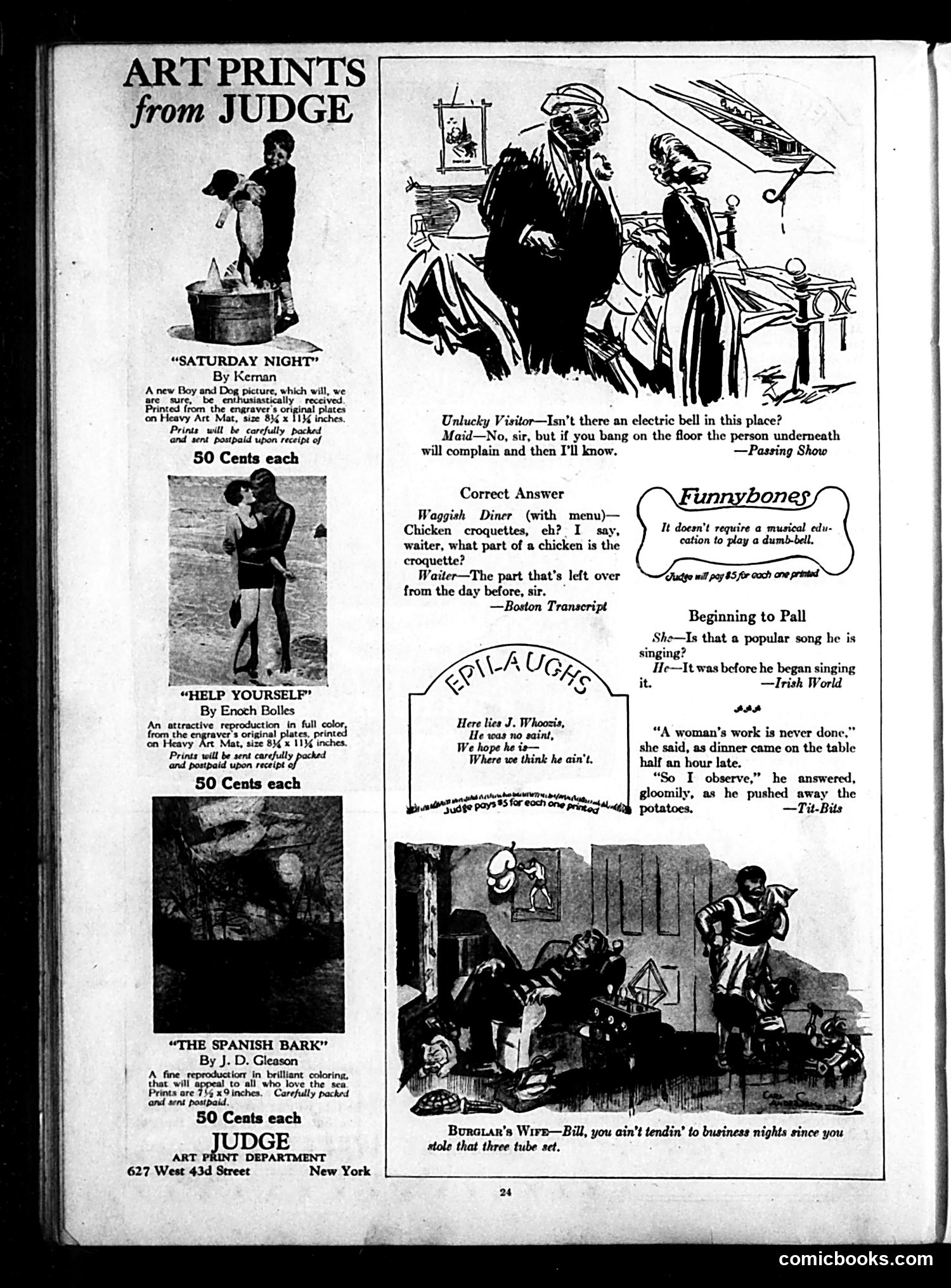
This page from *Judge* magazine contains several elements: art print advertisements and humor comics/jokes. **Art Prints Section (left):** Judge advertised reproductions of original artworks by artists like Kernan, Enoch Bolles, and J.D. Gleason, priced at 50 cents each. These were marketed as quality prints from engravers' original plates—a common mail-order business for magazines. **Humor Comics/Jokes (right):** The page includes several short satirical pieces mocking everyday life: - A maid's admission that she has no doorbell but relies on complaints from downstairs neighbors - A waiter's joke about chicken croquettes being leftover scraps - A husband's sardonic response to his wife's claim that "a woman's work is never done"—he observes dinner is late anyway - A reference to someone's irresponsible behavior after acquiring a radio tube set These jokes target domestic absurdities and marital dynamics typical of *Judge's* satirical humor aimed at middle-class readers.
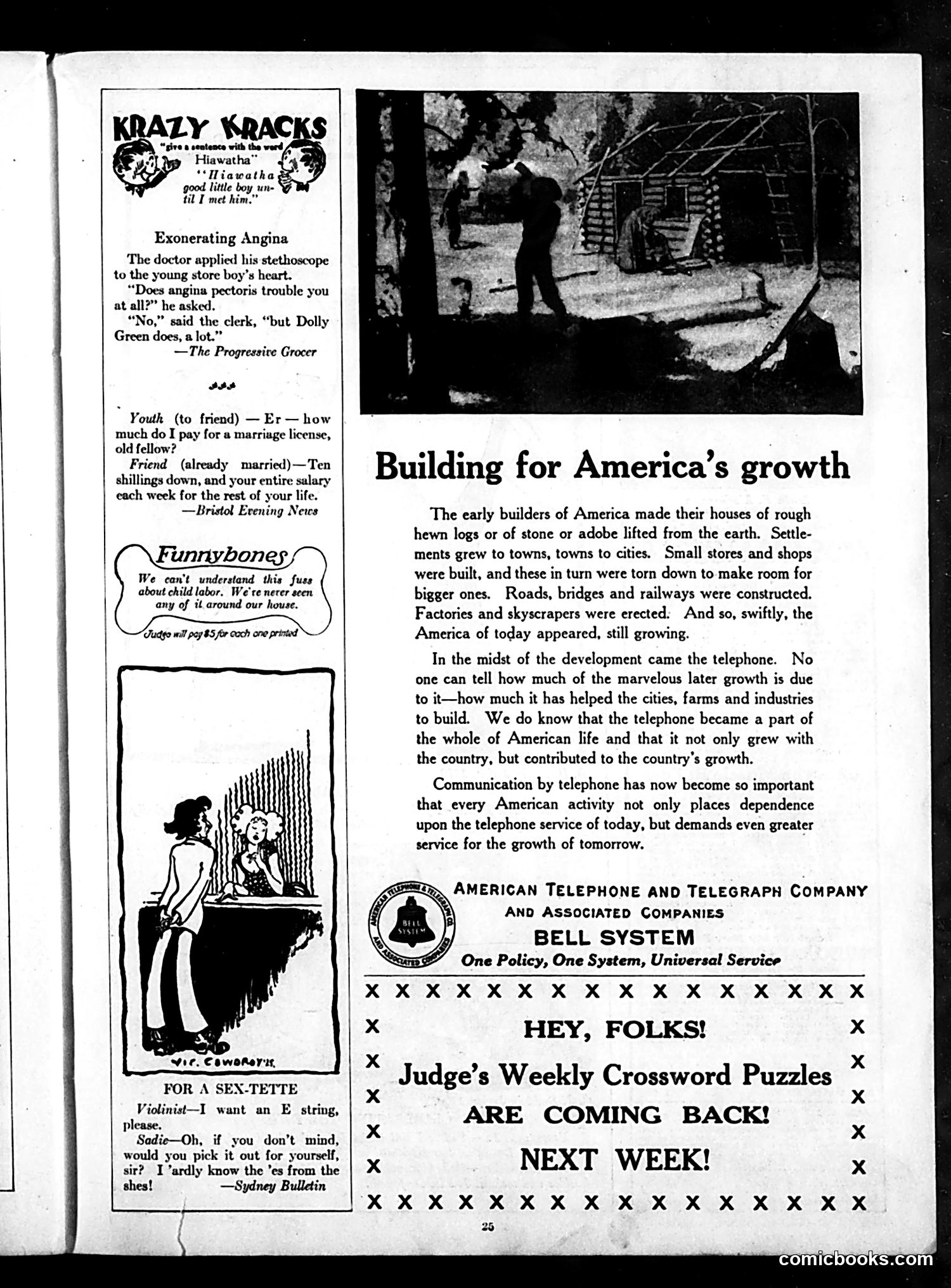
This page mixes **humor columns** (left side) with a **Bell System advertisement** (right side). The left side contains brief jokes typical of Judge's satirical format: - **"Exonerating Angina"**: A pun on a young store clerk's heart condition; his real romantic trouble is a girl named Dolly Green. - **Marriage License joke**: Cynical humor about marriage costs—ten shillings upfront, then lifelong financial servitude. - **"Funnybones"**: A deadpan gag dismissing child labor concerns as irrelevant to the speaker's household (likely satirizing complacency about industrial exploitation). The right side is a **AT&T/Bell System corporate advertisement** touting the telephone's role in American growth and infrastructure. It's propaganda dressed as civic boosterism—claiming the telephone "contributed to the country's growth" and framing telephone service as essential to American progress. The contrast is notable: genuine social satire alongside corporate messaging. The page reflects 1920s-30s Judge content: cynical about marriage and labor while hosting advertisements for technological "progress."
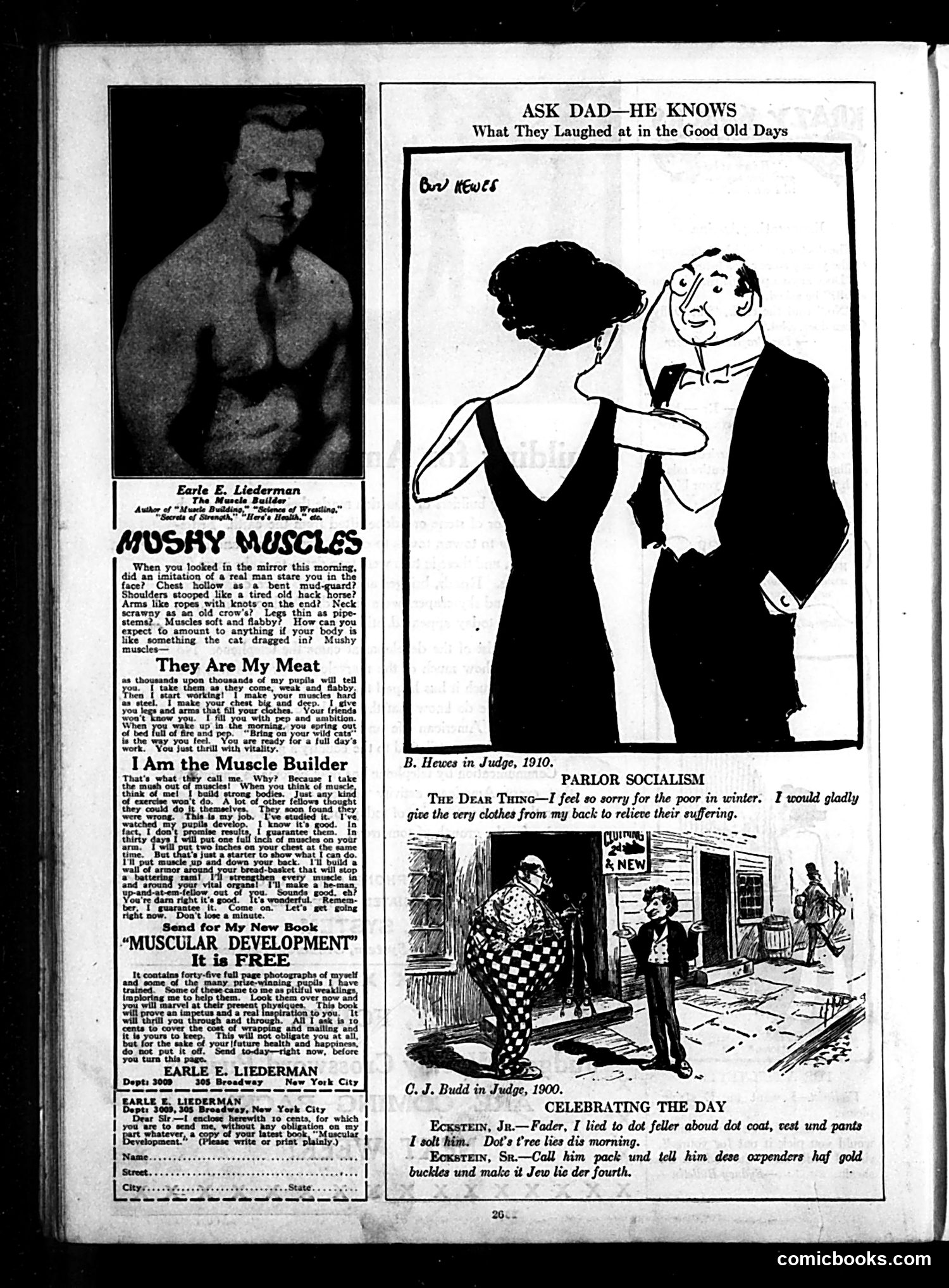
This page contains three distinct satirical pieces targeting different subjects: **"Mushy Muscles"** (left): An advertisement masquerading as self-help, by Earle E. Liederman. It mocks men who neglect physical fitness, using shame to sell a muscle-building program. This reflects early 20th-century anxiety about masculine vigor. **"Parlor Socialism"** (top right): A cartoon satirizing wealthy women's performative charity. The joke: a woman expresses sympathy for poor winter sufferers but only offers *old* clothes from her closet—charity that costs her nothing while allowing self-congratulation. This mocks upper-class hypocrisy regarding poverty. **"Celebrating the Day"** (bottom right): A cartoon with Yiddish-accented dialogue mocking Jewish immigrants. A father instructs his son to deceive a customer about secondhand goods, counting lies as a form of celebration (implying dishonesty is culturally typical). This is an ethnic stereotype common to the era. All three pieces reflect Judge's satirical targets: physical weakness, class pretension, and immigrant communities.
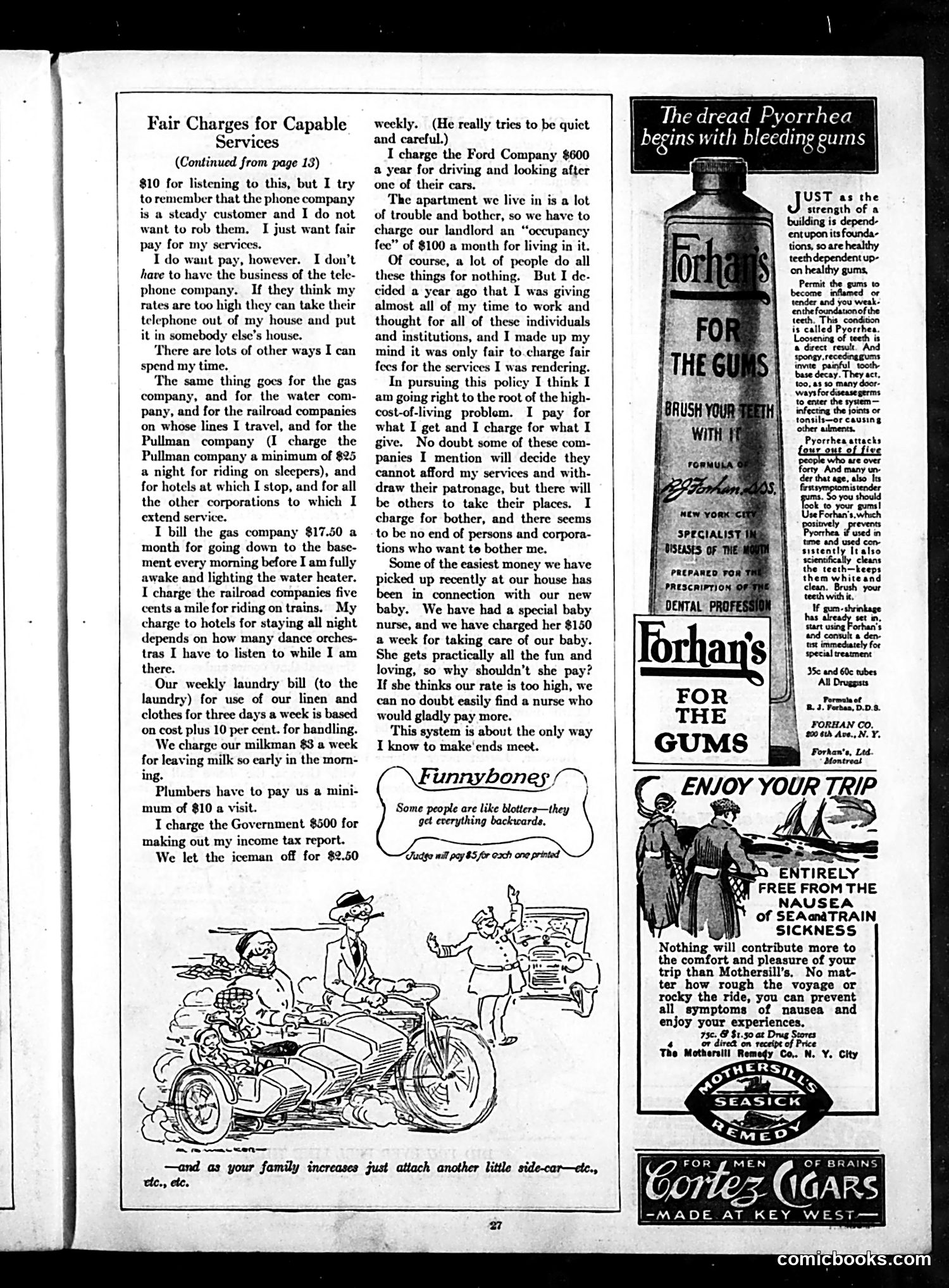
This page is primarily **advertising and satirical commentary** rather than political cartoons. The main content is "Pair Charges for Capable Services," a humorous essay complaining about excessive fees charged by various service providers—telephone, gas, water, railroad, laundry, plumbers, and government tax filing. The author sarcastically catalogs inflated costs while noting these companies provide minimal service in return. The cartoon below depicts a family on a motorcycle with sidecar, illustrating the essay's joke: as family size grows, people simply "attach another little side-car—etc." The right side contains period advertisements for Forhan's toothpaste, Mothersill's Seasickness Remedy, and Cortez Cigars—typical early 20th-century patent medicines and consumer goods. The satire targets **corporate pricing practices and inflation**, a recurring complaint during this era.
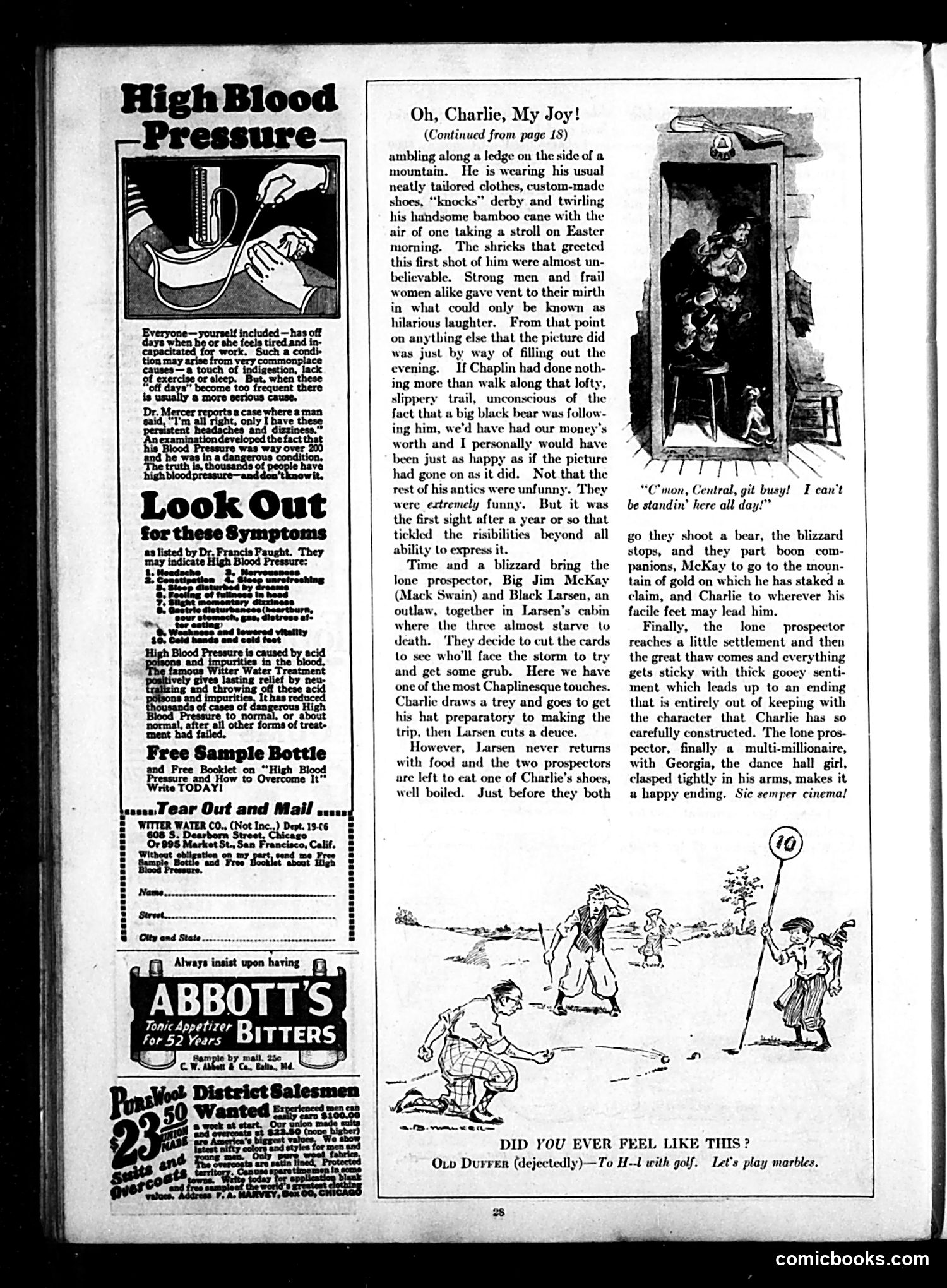
This page contains a film review of Charlie Chaplin's "The Gold Rush" alongside period advertisements and a small cartoon. **Main Content:** The article praises Chaplin's physical comedy—particularly his famous scene walking on a mountain ledge in his signature bowler hat and cane. The reviewer emphasizes the humor of Chaplin's obliviousness to danger (a pursuing bear). The plot involves prospectors during a gold rush, starvation, card-playing for survival, and a shoe-eating scene. The reviewer criticizes the sentimental ending as inconsistent with Chaplin's carefully-crafted comedic character. **Bottom Cartoon:** A simple gag showing "Old Duffer" dejected about golf, proposing marbles instead—a commentary on aging or frustration with sports. **Advertisements:** Period promotions for blood pressure remedies, Abbott's Bitters tonic, and sales positions—typical early 20th-century magazine content. The page reflects cinema criticism of the silent film era and Chaplin's major popularity during this period.
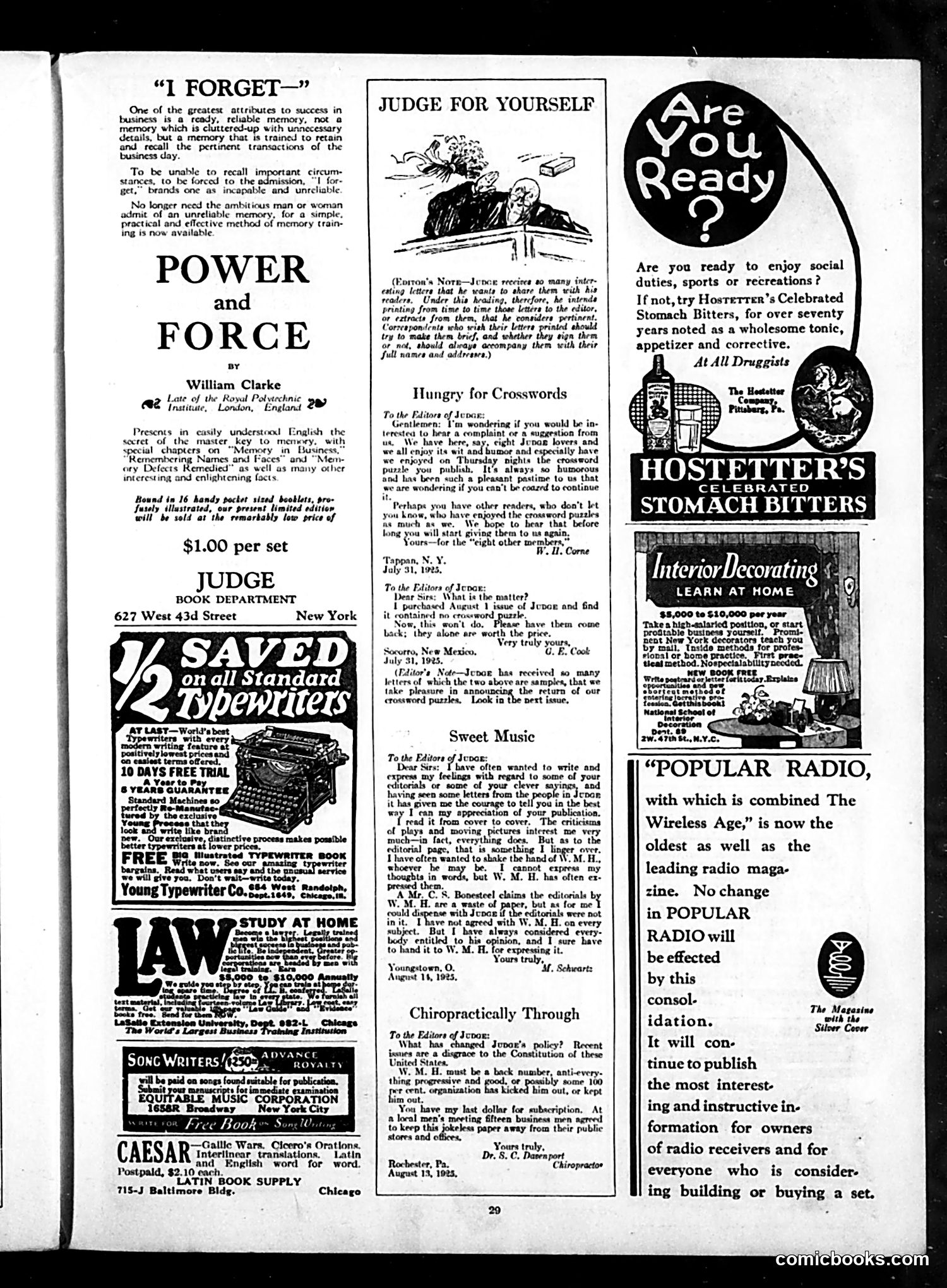
This is primarily an **advertising page**, not a political cartoon. The main content consists of classified advertisements for educational courses, typewriters, and books—typical of Judge magazine's revenue model. The only editorial content is a "Judge for Yourself" section featuring **reader letters complaining about a missing crossword puzzle**. Multiple subscribers from different regions wrote in 1925 expressing disappointment that August's issue lacked the crossword puzzle they enjoyed. The editor's note promises its return in the next issue. This reflects early 20th-century magazine culture: crossword puzzles were a popular novelty feature, and reader engagement through puzzles and letters-to-the-editor built loyal audiences. The complaints suggest crosswords had become an expected, valued part of Judge's appeal—significant enough that their absence prompted multiple complaints. The page otherwise advertises memory-training books, typewriters, law courses, and music instruction—typical working-class self-improvement products of the era.
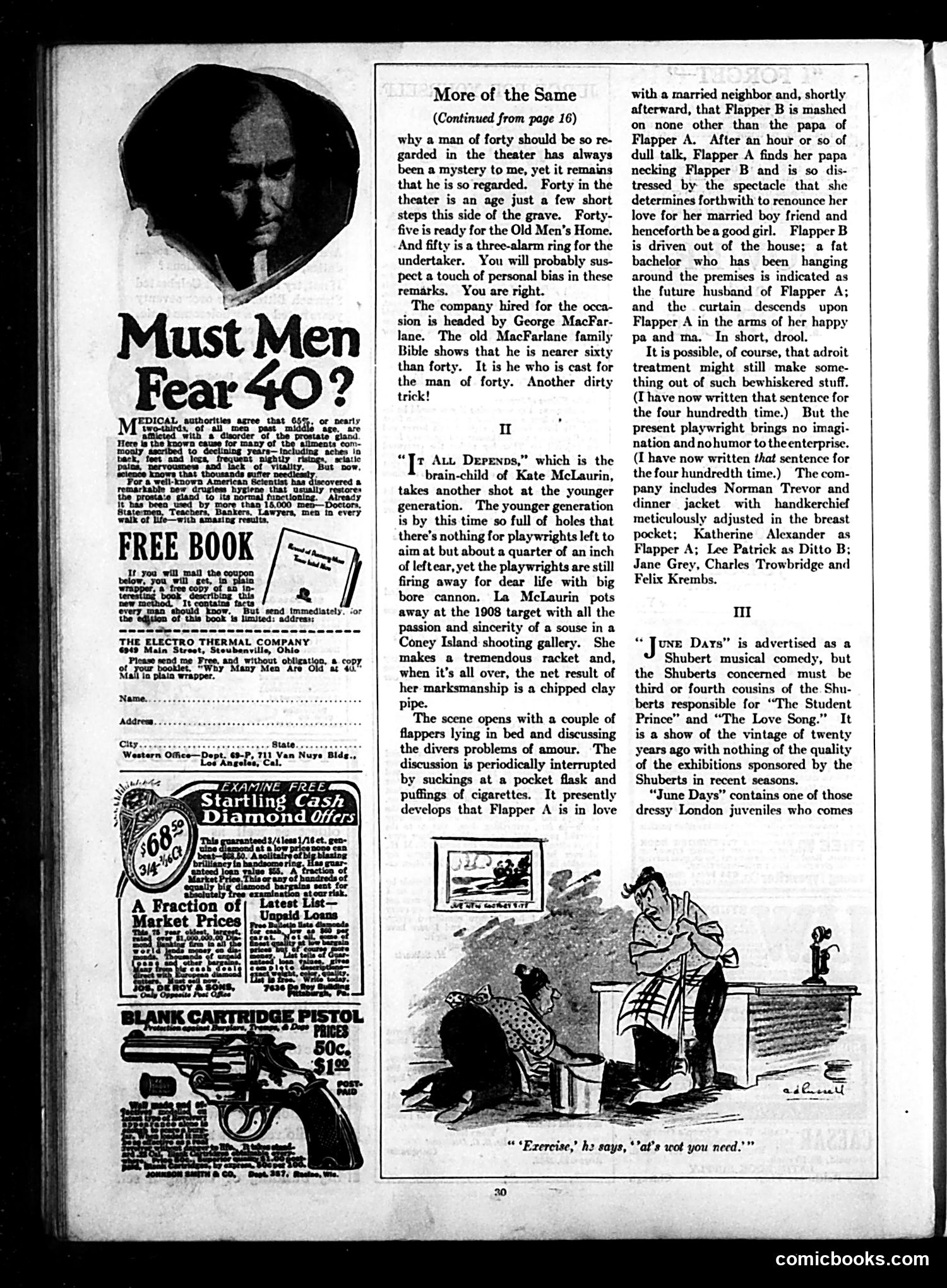
This page from **Judge** contains theater reviews critiquing three contemporary Broadway plays. The main article, "More of the Same," attacks the absurdity of casting a nearly-60-year-old actor (George MacFarlane) to play a 40-year-old man, sarcastically noting that forty itself is considered decrepit in theater. The reviewer mockingly dismisses "It All Depends" by Kate McLaurin as tired generational criticism—a play about flappers (young women) in bed discussing romantic entanglements with married men and each other's fathers. The plot's resolution (the flapper reforms and marries a suitable man) is dismissed as meaningless "drool." "June Days," a Shubert musical, is criticized as dated and inferior to the Shuberts' acclaimed earlier work like "The Student Prince." The cartoon at bottom depicts a physical exercise scene with the caption "Exercise, he says, 'of a'ned you need,'" likely commenting on health fads. The page reflects 1920s-era theater criticism and contemporary anxieties about youth culture and morality.
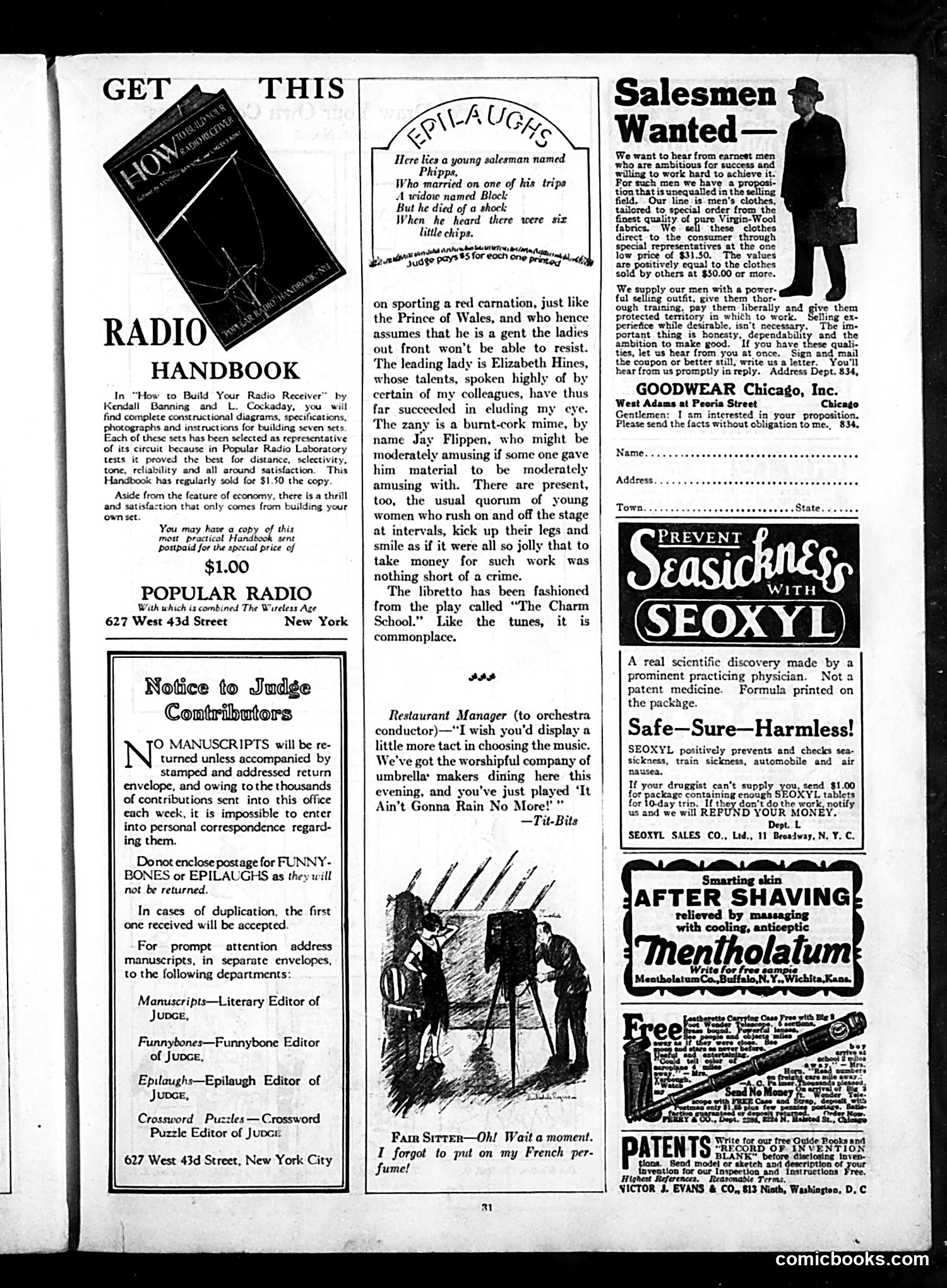
This page is primarily **advertising and editorial notices**, not political satire. The main content includes: **"Epilaughs" section**: Brief humorous epitaphs and jokes, including one about a salesman named Phipps who married a widow with six children (the "little chips"), and restaurant/theater anecdotes—typical lightweight humor for Judge's readers. **Central cartoon**: Shows what appears to be a theatrical or social scene with figures in formal dress, likely satirizing theatrical pretension or social climbing, though specifics aren't entirely clear from the image. **Advertisements**: Radio handbooks, patent services, and men's clothing sales positions dominate the page—reflecting 1920s consumer interests in new technology and entrepreneurship. **Overall purpose**: This is a typical Judge issue page mixing low-brow humor, trade notices, and period advertisements rather than sharp political commentary. The satire here is genteel and social rather than political.
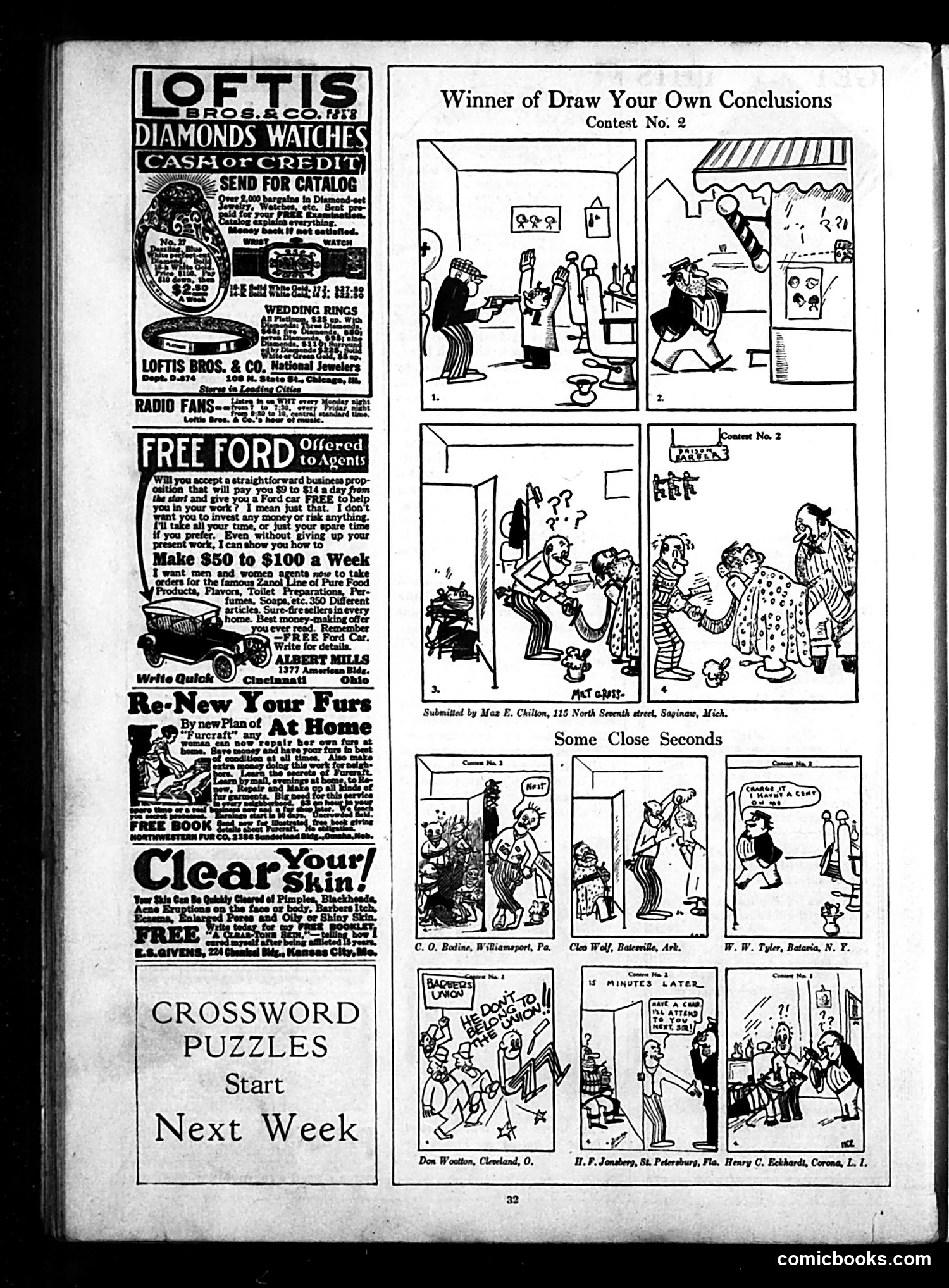
This page features advertising and cartoons. The upper section shows "Winner of Draw Your Own Conclusions Contest No. 2"—four cartoon panels depicting humorous domestic and social scenarios, submitted by readers. The bottom section, titled "Some Close Seconds," displays six additional cartoon entries that didn't win the contest. These appear to be gag cartoons capturing everyday comedic moments: family situations, social mishaps, and domestic humor typical of 1920s-30s Judge magazine content. The cartoons rely on visual comedy and situational humor rather than political satire. The left column contains period advertisements for jewelry, Ford automobiles, fur restoration, and skin treatments—typical commercial content of the era. A "Crossword Puzzles Start Next Week" notice appears at bottom, indicating future content. The page is primarily entertainment-focused rather than satirical.
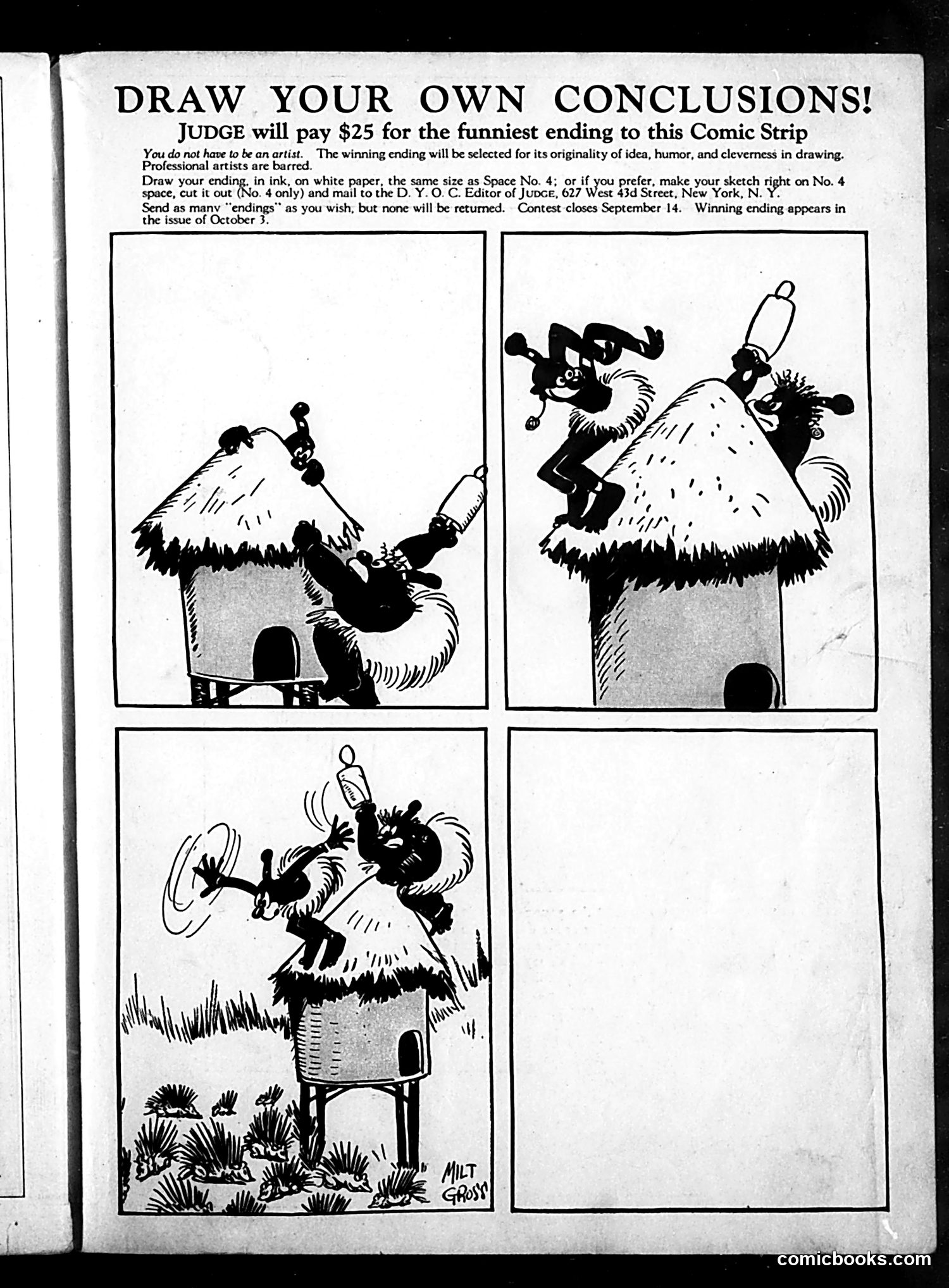
This is a reader participation feature, not a political cartoon. Judge magazine is inviting amateur readers to complete an unfinished comic strip for a $25 prize (substantial money in the era this appears to be from, likely 1920s-1930s based on style). The three completed panels show a furry creature (appears to be an animal character, possibly a dog or similar) climbing on a thatched-roof hut, engaging in increasingly chaotic behavior—juggling bottles and creating mayhem. The fourth panel is blank, awaiting reader submissions. The appeal targets non-professionals: artists are barred from competing, and submissions need only show originality of idea and humor, not drawing skill. This democratized comedy creation, allowing readers to participate in the magazine's humor production. The winning entry would appear in Judge's October issue.
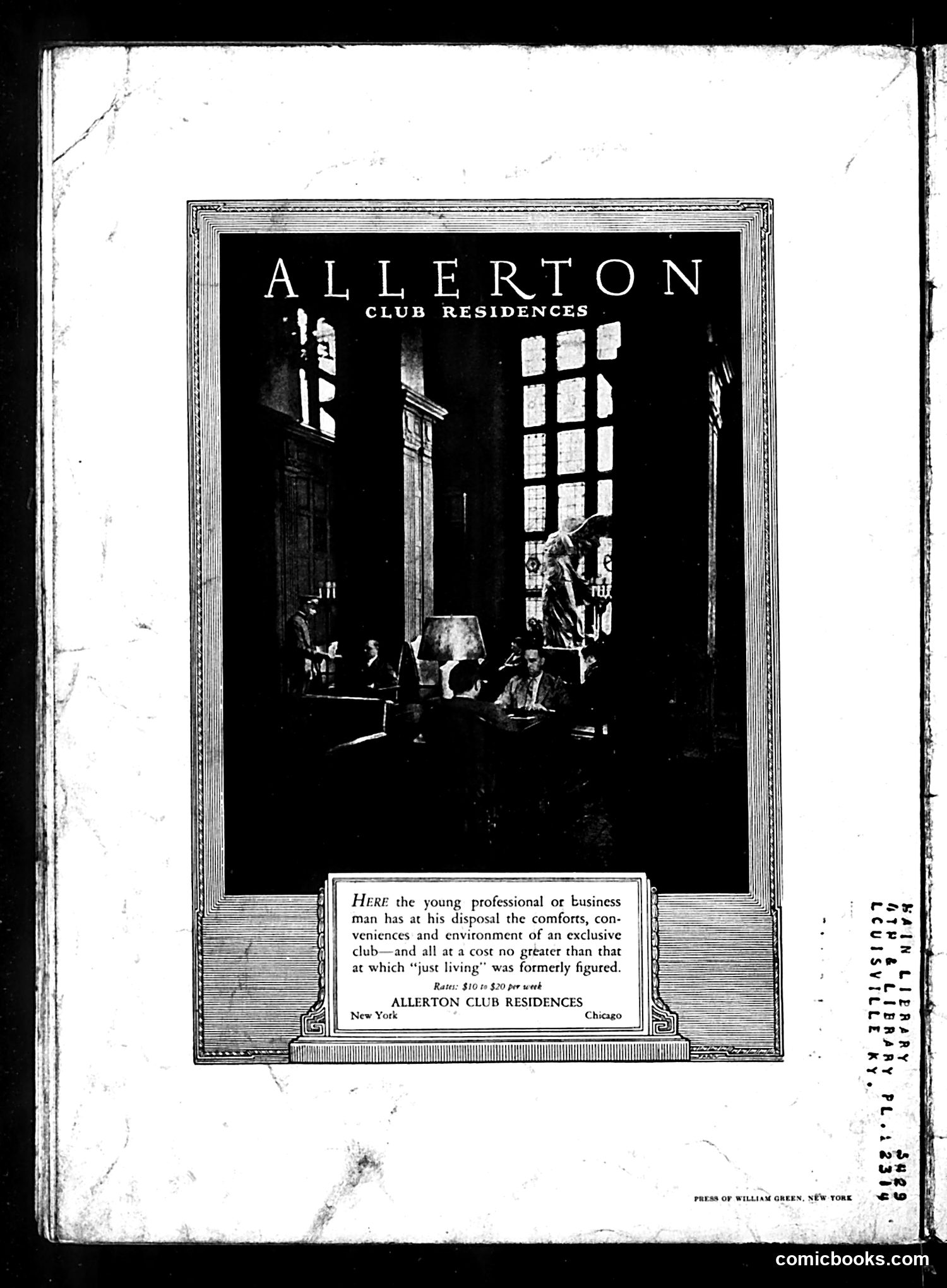
This is a **full-page advertisement**, not political satire. It promotes the Allerton Club Residences, upscale residential clubs in New York and Chicago marketed to young professionals and businessmen. The ad's appeal is economic: it promises exclusive club amenities—comfortable furnishings, social environment, and services—at rates ($10-$20 weekly) comparable to ordinary rent. The dramatic photograph shows an elegant interior with large windows and well-dressed residents socializing. The pitch targets urban young men seeking middle-class respectability and community without premium pricing. This reflects early 20th-century residential culture where such clubs provided housing alternatives to boarding houses or cramped apartments, positioning themselves as affordable pathways to professional status and social belonging.