
Judge, 1925-09-05 · page 32 of 36
Judge — September 5, 1925 — page 32: what you’re looking at
What you’re looking at
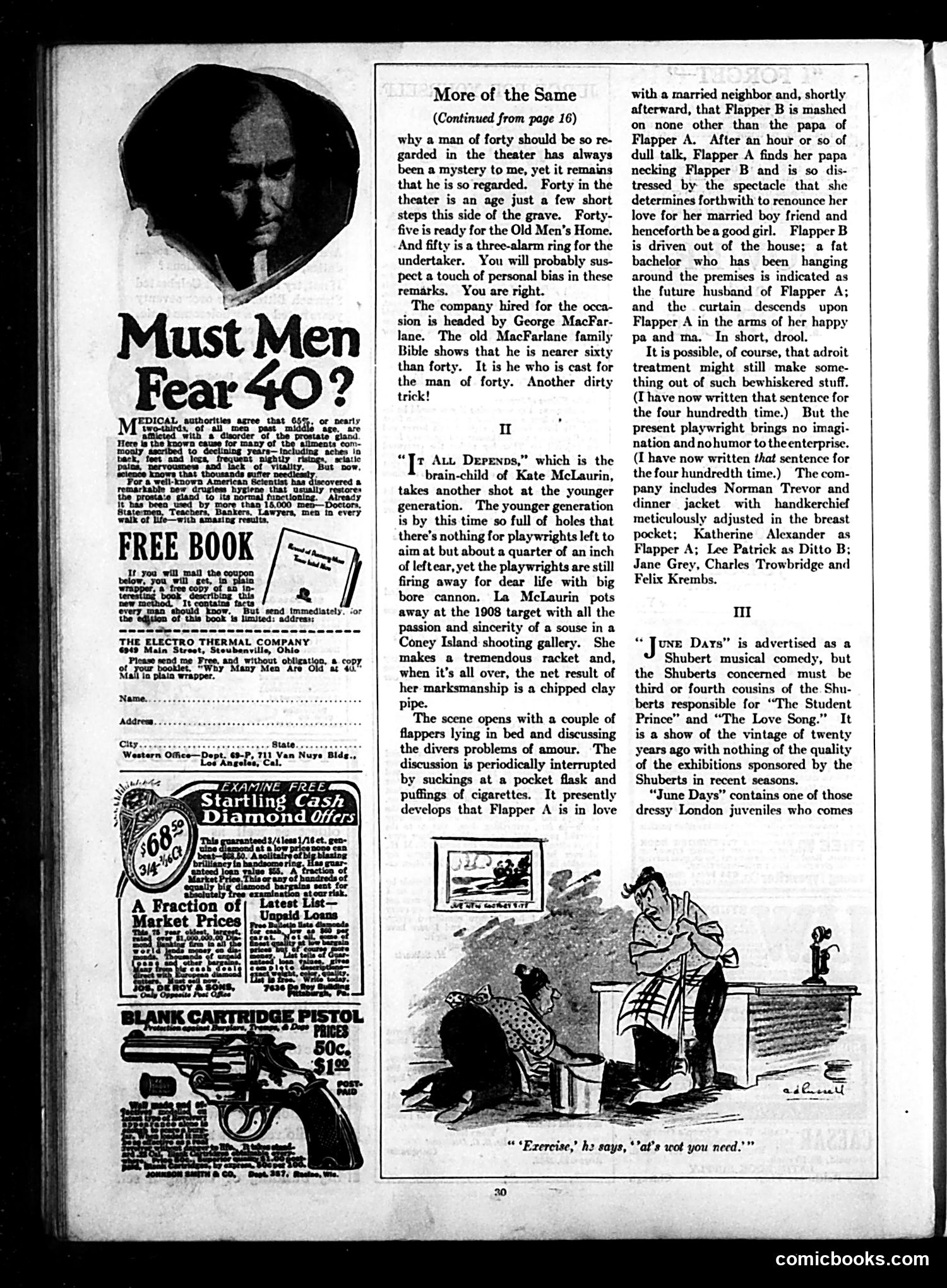
This page from **Judge** contains theater reviews critiquing three contemporary Broadway plays. The main article, "More of the Same," attacks the absurdity of casting a nearly-60-year-old actor (George MacFarlane) to play a 40-year-old man, sarcastically noting that forty itself is considered decrepit in theater. The reviewer mockingly dismisses "It All Depends" by Kate McLaurin as tired generational criticism—a play about flappers (young women) in bed discussing romantic entanglements with married men and each other's fathers. The plot's resolution (the flapper reforms and marries a suitable man) is dismissed as meaningless "drool." "June Days," a Shubert musical, is criticized as dated and inferior to the Shuberts' acclaimed earlier work like "The Student Prince." The cartoon at bottom depicts a physical exercise scene with the caption "Exercise, he says, 'of a'ned you need,'" likely commenting on health fads. The page reflects 1920s-era theater criticism and contemporary anxieties about youth culture and morality.
📄 Transcribed text from this page (OCR, searchable)
Machine-transcribed from the original scan — historical spelling and the odd misread are preserved.
Must Men Fear 40? Mak 2athorities agree, that ‘Stat Bankers. Lai walk of life cor ]! 700 will mal the myou will get, 1 plata Pa: tree copy of ab io Soeiar emer cs 2 every ‘should: Know, it send tmmediately. ‘or the Of this book is limited: address Scundpameasasaassancstaaceon THE ELECTRO THERMAL COMPANY 249 Main Street, Steubenville, Ohio Please send me Free. and without oblieat “wi any ale ee ope bod Mi Men Are oT Startling Cash \) Diamond Offers More of the Same (Continued from page 16) why a man of forty should be so re- garded in the theater has always been a mystery to me, yet it remains that he is so regarded. Forty in the theater is an age just a few short steps this side of the grave. Forty- five is ready for the Old Men’s Home. And fifty is a three-alarm ring for the undertaker. You will probably sus- pect a touch of personal bias in these remarks. You are right. The company hired for the occa- sion is headed by George MacFar- lane. The old MacFarlane family Bible shows that he is nearer sixty than forty. It is he who is cast for the man of forty. Another dirty trick! Ir “Tt Att Depenps,” which is the brain-child of Kate McLaurin, takes another shot at the younger generation. The younger generation is by this time so full of holes that there’s nothing for playwrights left to aim at but about a quarter of an inch of leftear, yet the playwrights are still firing away for dear life with big bore cannon. La McLaurin pots away at the 1908 target with all the passion and sincerity of a souse in a Coney Island: shooting gallery. She makes a tremendous racket and, when it’s all over, the net result of her marksmanship is a chipped clay Pipe. The scene opens with a couple of flappers lying in bed and discussing the divers problems of amour. The discussion is periodically interrupted by suckings at a pocket flask and puffings of cigarettes. It presently develops that Flapper A is in love with a married neighbor and, shortly afterward, that Flapper B is mashed on none other than the papa of Flapper A. After an hour or so of dull talk, Flapper A finds her papa necking Flapper B and is so dis- tressed by the spectacle that she determines forthwith to renounce her love for her married boy friend and henceforth be a good girl. Flapper B is driven out of the house; a fat bachelor who has been hanging around the premises is indicated as the future husband of Flapper A; and the curtain descends upon Flapper A in the arms of her happy pa and ma. In short, drool. It is possible, of course, that adroit treatment might still make some- thing out of such bewhiskered stuff. (Thave now written that sentence for the four hundredth time.) But the present playwright brings no imagi- nation and nohumor tothe enterprise. (I have now written that sentence for the four hundredth time.) The com- pany includes Norman Trevor and dinner jacket with handkerchief meticulously adjusted in the breast pocket; Katherine Alexander as Flapper A; Lee Patrick as Ditto B; Jane Grey, Charles Trowbridge and Felix Krembs. mm unE Days” is advertised as a Shubert musical comedy, but the Shuberts concerned must be third or fourth cousins of the. Shu- berts responsible for “The Student Prince” and “The Love Song.” It is a show of the vintage of twenty years ago with nothing of the quality of the exhibitions sponsored by the Shuberts in recent seasons. “June Days” contains one of those dressy London juveniles who comes comicbooks.com