
Judge, 1925-09-05 · page 18 of 36
Judge — September 5, 1925 — page 18: what you’re looking at
What you’re looking at
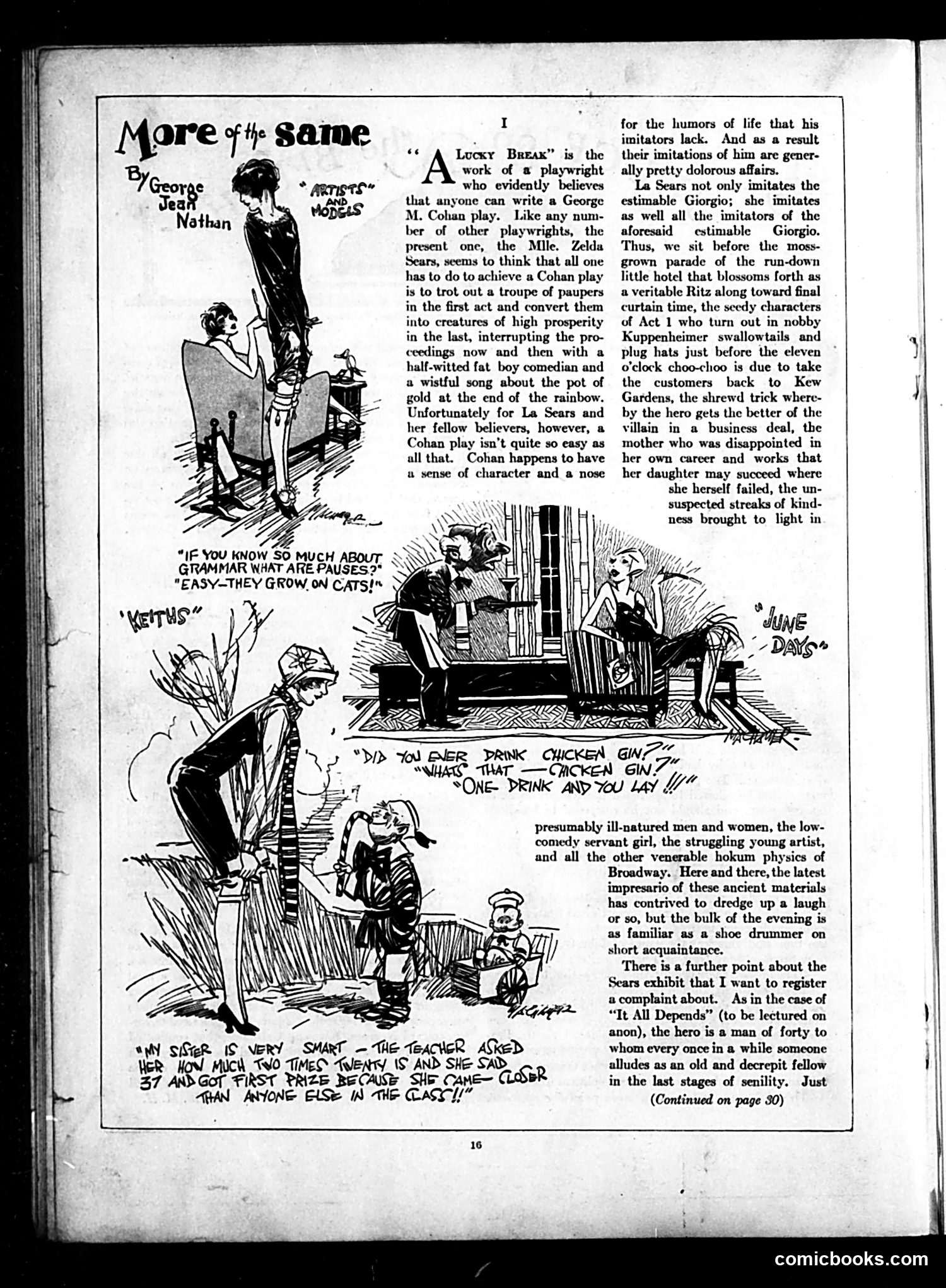
This page reviews **"A Lucky Break,"** a play by Zelda Sears that mimics George M. Cohan's theatrical formula. The critic argues Sears merely copies Cohan's surface elements—impoverished characters transformed into prosperity, fat comedians, sentimental songs about rainbows—without understanding his actual talent for character development and humor. The cartoons below illustrate the clichéd Broadway "hokum" being satirized: scenes of bumbling servants, grammar jokes, and predictable pauper-to-riches plotting. The critique suggests that while Sears and imitators believe following Cohan's recipe guarantees success, they miss what made his plays work—genuine wit and insight into human nature. This reflects early 1900s theater criticism mocking derivative Broadway productions that substituted formula for originality. Cohan was Broadway's dominant figure; his methods were widely imitated but rarely matched.
📄 Transcribed text from this page (OCR, searchable)
Machine-transcribed from the original scan — historical spelling and the odd misread are preserved.
same ee ti Lucxy Breax” is the work of a playwright who evidently believes that anyone can write a George M. Cohan play. Like any num- ber of other playwrights, the present one, the Mlle. Zelda Sears, seems to think that all one has to do to achieve a Cohan play is to trot out a troupe of paupers in the first act and convert them into creatures of high prosperity in the last, interrupting the pro- ceedings now and then with a half-witted fat boy comedian and a wistful song about the pot of gold at the end of the rainbow. Unfortunately for La Sears and her fellow believers, however, a Cohan play isn’t quite so easy as all that. Cohan happens to have a sense of character and a nose More 7%: Beeor e ‘ Jea' “IF You KNOW SO MUCH ABOUT GRAMMAR WHAT ARE PAUSES 2° "EASY—THEY GROW ON CATSIN EXER DRINK CHICKEN presumably and all the MM Nex | | \~adl 9 ey { yi 4 Zz _—~ f] E/ 1 Sao ease PRES BEOUSE SUE Cane- CSR t AVIONE ElSe IN THE CASl/” lyse TWAT —CACKEN SONG DRINK AND OU Lay Y/7 for the humors of life that his imitators lack. And as a result their imitations of him are gener- ally pretty dolorous affairs. La Sears not only imitates the estimable Giorgio; she imitates as well all the imitators of the aforesaid estimable _ Giorgio. Thus, we sit before the moss- grown parade of the run-down little hotel that blossoms forth as a veritable Ritz along toward final curtain time, the seedy characters of Act 1 who turn out in nobby Kuppenheimer swallowtails and plug hats just before the eleven o'clock choo-choo is due to take the customers back to Kew Gardens, the shrewd trick where- by the hero gets the better of the villain in a business deal, the mother who was disappointed in her own career and works that her daughter may succeed where she herself failed, the un- suspected streaks of kind- ness brought to light in GN, GINA, ill-natured men and women, the low- comedy servant girl, the struggling young artist, other venerable hokum physics of Broadway. Here and there, the latest impresario of these ancient materials has contrived to dredge up a laugh or so, but the bulk of the evening is as familiar as a shoe drummer on short acquaintance. There is a further point about the Sears exhibit that I want to register acomplaint about. As in the case of “Tt All Depends” (to be lectured on anon), the hero is a man of forty to whom every once in a while someone alludes as an old and decrepit fellow in the last stages of senility. Just (Continued on page 30) — comicbooks.com