
Judge, 1925-09-05 · page 27 of 36
Judge — September 5, 1925 — page 27: what you’re looking at
What you’re looking at
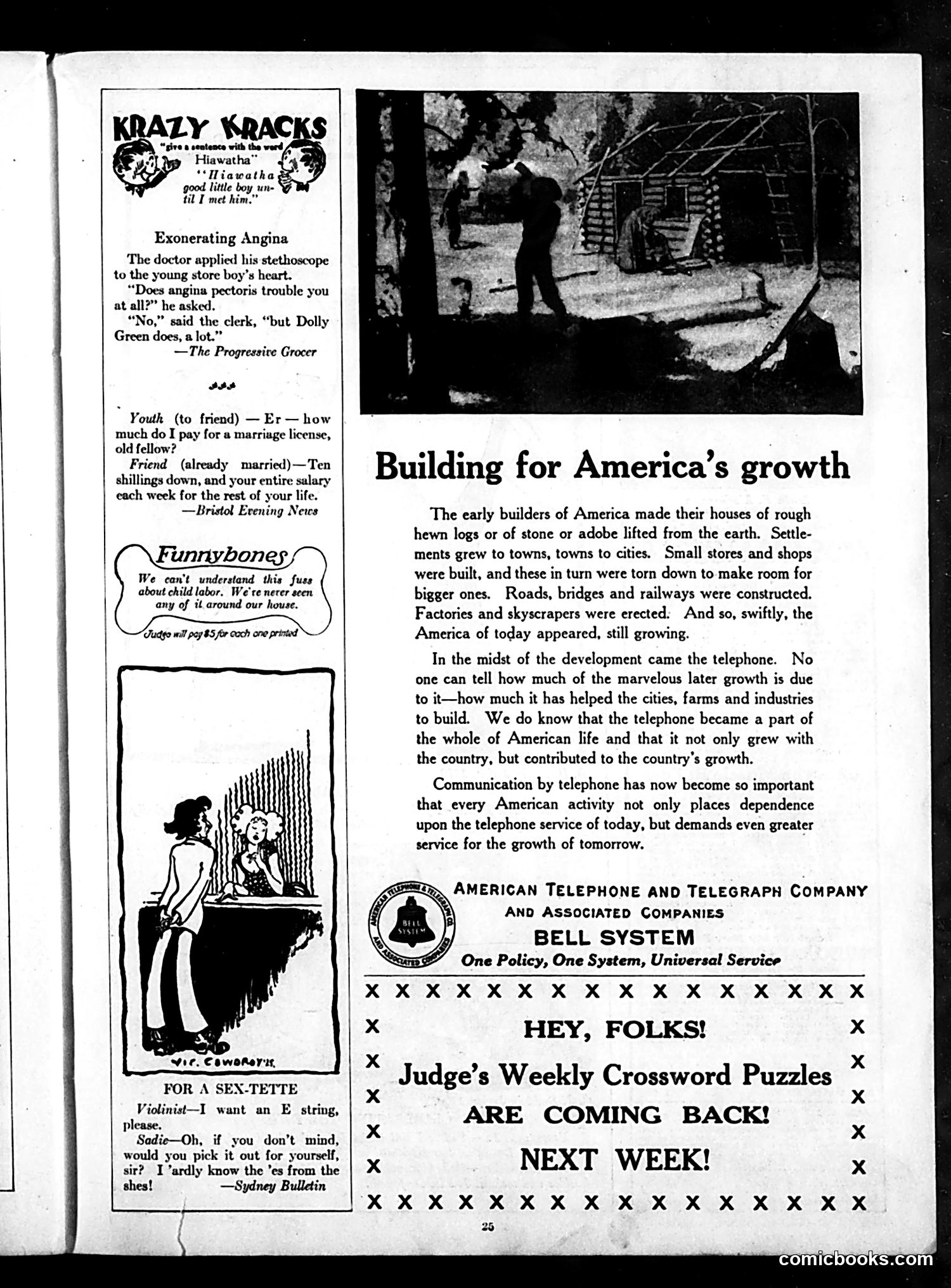
This page mixes **humor columns** (left side) with a **Bell System advertisement** (right side). The left side contains brief jokes typical of Judge's satirical format: - **"Exonerating Angina"**: A pun on a young store clerk's heart condition; his real romantic trouble is a girl named Dolly Green. - **Marriage License joke**: Cynical humor about marriage costs—ten shillings upfront, then lifelong financial servitude. - **"Funnybones"**: A deadpan gag dismissing child labor concerns as irrelevant to the speaker's household (likely satirizing complacency about industrial exploitation). The right side is a **AT&T/Bell System corporate advertisement** touting the telephone's role in American growth and infrastructure. It's propaganda dressed as civic boosterism—claiming the telephone "contributed to the country's growth" and framing telephone service as essential to American progress. The contrast is notable: genuine social satire alongside corporate messaging. The page reflects 1920s-30s Judge content: cynical about marriage and labor while hosting advertisements for technological "progress."
📄 Transcribed text from this page (OCR, searchable)
Machine-transcribed from the original scan — historical spelling and the odd misread are preserved.
good little boy un- til I met him.” Exonerating Angina The doctor applied his stethoscope to the young store boy’s heart. “Does angina pectoris trouble you at all?” he asked. “No,” said the clerk, “but Dolly Green does, a lot.” —The Progressive Grocer AID Youth (to friend) — Er — how much do I pay for a marriage license, old fellow? Friend (already married)—Ten shillings down, and your entire salary each week for the rest of your life. —Bristol Evening News Funnybones We can't understand this fuss about child labor. We're never seen any of it around our house. Building for America’s growth The early builders of America made their houses of rough hewn logs or of stone or adobe lifted from the earth. Settle- ments grew to towns, towns to cities. Small stores and shops were built, and these in turn were torn down to make room for bigger ones. Roads, bridges and railways were constructed. Factories and skyscrapers were erected: And s0, swiftly, the America of today appeared, still growing. In the midst of the development came the telephone. No one can tell how much of the marvelous later growth is due to it—how much it has helped the cities, farms and industries to build. We do know that the telephone became a part of the whole of American life and that it not only grew with the country, but contributed to the country’s growth. Communication by telephone has now become so important that every American activity not only places dependence upon the telephone service of today, but demands even greater service for the growth of tomorrow. AMERICAN TELEPHONE AND TELEGRAPH COMPANY AND ASSOCIATED COMPANIES BELL SYSTEM One Policy, One System, Universal Service x xX XXX XXX XX XXX HEY, FOLKS! > a ee Judge’s Weekly Crossword Puzzles Sadie—Oh, if you don’t mind, would you pick it out for yourself, NEXT WEEK! shes! —Sydney Bulletin XX _X XOX X_ PKK KK | XXX Violinist—I want an E string, q Rha. ARE COMING BACK! sir? I ’ardly know the ’es from the 25