
Judge, 1925-09-05 · page 13 of 36
Judge — September 5, 1925 — page 13: what you’re looking at
What you’re looking at
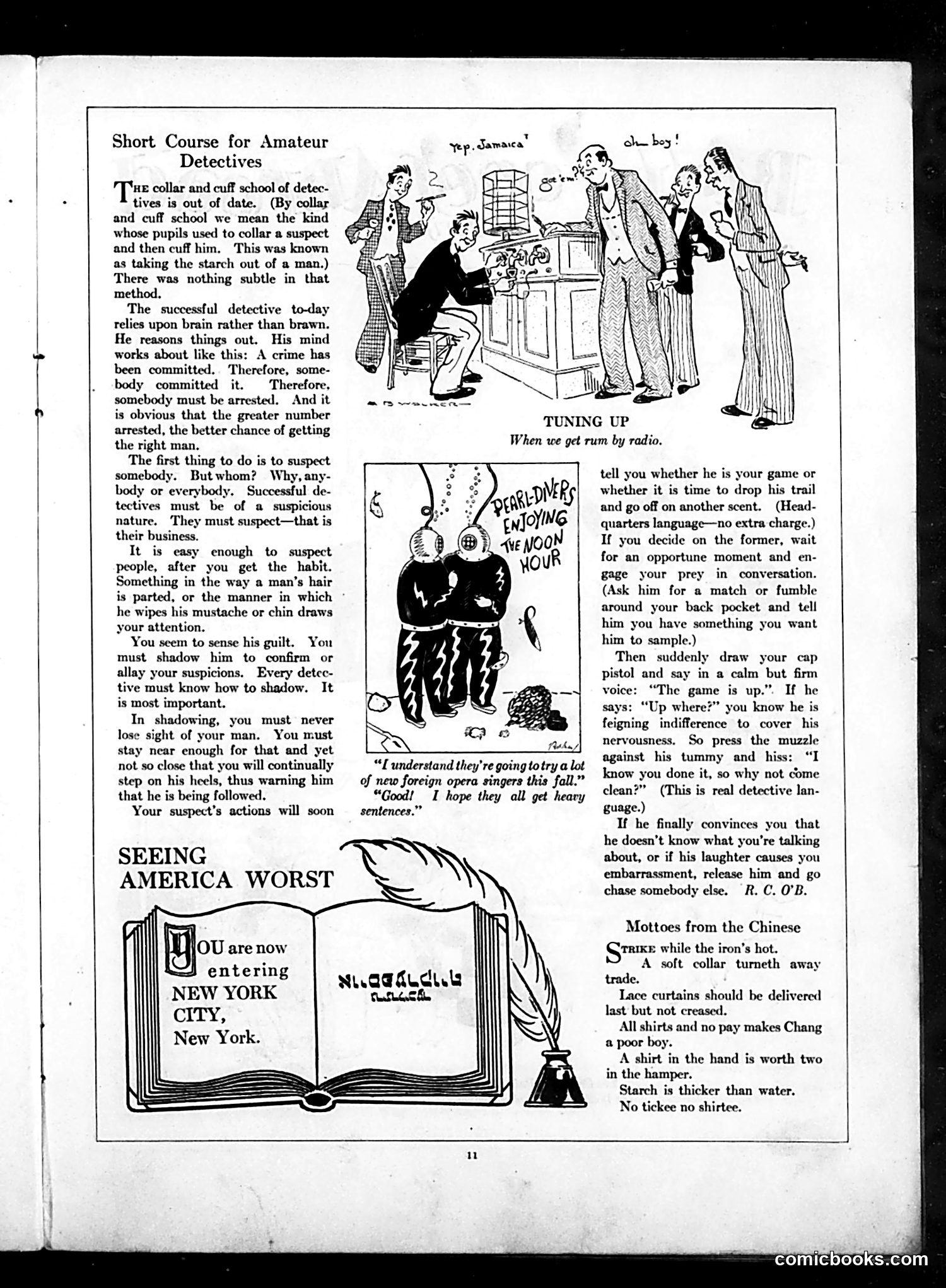
This page satirizes early 20th-century detective methods through humor. The main article mocks "amateur detectives" who use illogical reasoning: if a crime occurs, somebody must have done it, so arrest many people and hope to catch the guilty party. It ridicules the supposed "science" of detective work—shadowing suspects based on trivial details like how they part their hair, then confronting them with a toy pistol demanding confessions. The "Tuning Up" cartoon jokes about radio broadcasts replacing live entertainment, with characters hoping foreign opera singers will perform poorly (get "heavy sentences"). "Seeing America Worst" advertises New York City tourism. The page concludes with mock "Chinese Mottoes"—stereotypical fortune-cookie style sayings poking fun at Chinese immigrants and laundry services (references to starch, shirts, and "no tickee no shirtee," a period racial stereotype).
📄 Transcribed text from this page (OCR, searchable)
Machine-transcribed from the original scan — historical spelling and the odd misread are preserved.
Short Course for Amateur Detectives HE collar and cuff school of detec- tives is out of date. (By collar and cuff school we mean the kind whose pupils used to collar a suspect and then cuff him. This was known as taking the starch out of a man.) There was nothing subtle in that method. The successful detective to-day relies upon brain rather than brawn. He reasons things out. His mind works about like this: A crime has been committed. Therefore, some- body committed it. Therefore, somebody must be arrested. And it is obvious that the greater number arrested, the better chance of getting the right man. The first thing to do is to suspect somebody. Butwhom? Why, any- body or everybody. Successful de- tectives must be of a suspicious nature. They must suspect—that is their business. It is easy enough to suspect people, after you get the habit. Something in the way a man’s hair is parted, or the manner in which ° he wipes his mustache or chin draws your attention. You seem to sense his guilt. You must shadow him to confirm or allay your suspicions. Every detec- tive must know how to shadow. It is most important. In shadowing, you must never lose sight of your man. You must stay near enough for that and yet not so close that you will continually step on his heels, thus warning him that he is being followed. Your suspect’s actions will soon SEEING AMERICA WORST OU are now entering NEW YORK CITY, New York. TUNING UP When we get rum by radio. “L understand they're going totry a lot of new foreign opera singers this fall.” “Good! sentences.” = | Nagai TeateS fle T hope they all get heavy tell you whether he is your game or whether it is time to drop his trail and go off on another scent. (Head- quarters language—no extra charge.) If you decide on the former, wait for an opportune moment and en- gage your prey in conversation. (Ask him for a match or fumble around your back pocket and tell him you have something you want him to sample.) Then suddenly draw your cap pistol and say in a calm but firm voice: “The game is up.” If he says: “Up where?” you know he is feigning indifference to cover his nervousness. So press the muzzle against his tummy and hiss: “I know you done it, so why not come clean?” (This is real detective lan- guage.) If he finally convinces you that he doesn’t know what you're talking about, or if his laughter causes you embarrassment, release him and go chase somebody else. R. C. O’B. Mottoes from the Chinese ‘TRIKE while the iron’s hot. A soft collar turneth away trade. Lace curtains should be delivered last but not creased. All shirts and no pay makes Chang a poor boy. A shirt in the hand is worth two in the hamper. Starch is thicker than water. No tickee no shirtee.