
Judge, 1925-09-05 · page 17 of 36
Judge — September 5, 1925 — page 17: what you’re looking at
What you’re looking at
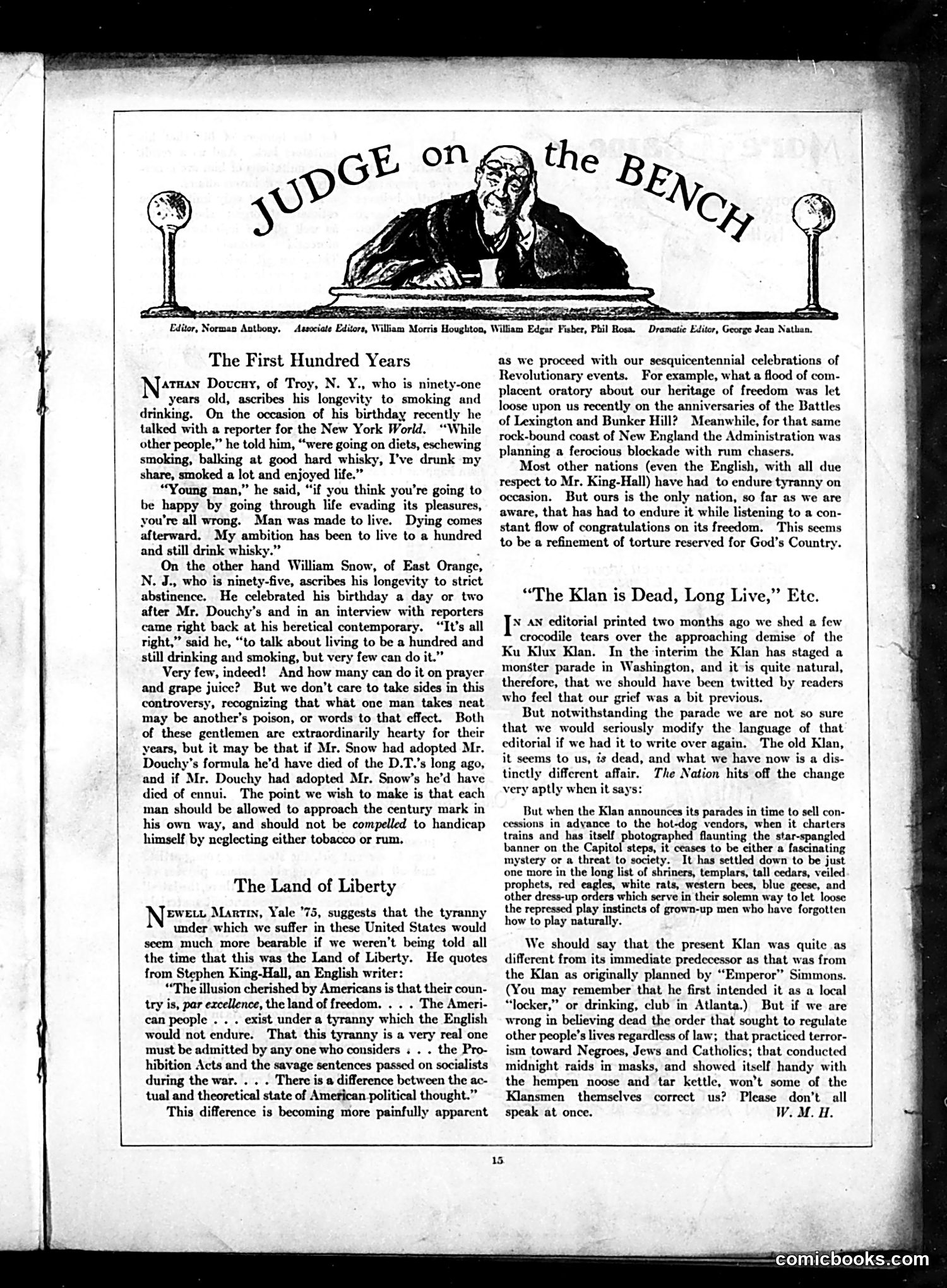
The **"Judge on the Bench"** masthead presents a judicial figure evaluating contemporary issues. This page contains three editorial commentaries: 1. **"The First Hundred Years"**: Contrasts two centenarians—Nathan Doucey, who credits longevity to smoking and drinking, versus William Snow, who attributes his health to strict abstinence. The satire mocks the smugness of health advice and suggests Americans' obsession with prescribed living. 2. **"The Land of Liberty"**: Critiques American hypocrisy. The piece quotes English writer Stephen King-Hall arguing that America preaches freedom while practicing tyranny—citing Prohibition enforcement and persecution of socialists. The satire targets the absurdity of celebrating Revolutionary anniversaries while simultaneously imposing increasingly restrictive laws. 3. **"The Klan is Dead, Long Live," Etc.**: Acknowledges the Klan's 1925 Washington parade, correcting an earlier editorial prediction of the organization's demise. This reflects contemporary uncertainty about the Klan's actual power and trajectory during the 1920s. The page critiques American contradictions: between lifestyle dogmatism, libertarian rhetoric versus actual restrictions, and political naiveté.
📄 Transcribed text from this page (OCR, searchable)
Machine-transcribed from the original scan — historical spelling and the odd misread are preserved.
The First Hundred Years ATHAN Dovcny, of Troy, N. Y., who is ninety-one years old, ascribes his longevity to smoking and drinking. On the occasion of his birthday recently he talked with a reporter for the New York World. “While other people,” he told him, “were going on diets, eschewing smoking, balking at good hard whisky, I’ve drunk my share, smoked a lot and enjoyed life.” “Young man,” he said, “if you think you're going to be happy by going through life evading its pleasures, you're all wrong. Man was made to live. Dying comes afterward. My ambition has been to live to a hundred and still drink whisky.” On the other hand William Snow, of East Orange, N. J., who is ninety-five, ascribes his longevity to strict abstinence. He celebrated his birthday a day or two after Mr. Douchy’s and in an interview with reporters came right back at his heretical contemporary. “It’s all right,” said he, “to talk about living to be a hundred and still drinking and smoking, but very few can do it.” Very few, indeed! And how many can do it on prayer and grape juicc? But we don’t care to take sides in this controversy, recognizing that what one man takes neat may be another's poison, or words to that effect. Both of these gentlemen arc extraordinarily hearty for their years, but it may be that if Mr. Snow had adopted Mr. Douchy’s formula he’d have died of the D.T.’s long ago, and if Mr. Douchy had adopted Mr. Snow’s he’d have diced of ennui. The point we wish to make is that each man should be allowed to approach the century mark in his own way, and should not be compelled to handicap himself by neglecting either tobacco or rum. The Land of Liberty EWELL Martin, Yale '75, suggests that the tyranny under which we suffer in these United States would seem much more bearable if we weren't being told all the time that this was the Land of Liberty. He quotes from Stephen King-Hall, an English writer: “The illusion cherished by Americans is that their coun- try is, par excellence, the land of freedom. . . . The Ameri- can people . . . exist under a tyranny which the English would not endure. That this tyranny is a very real one must be admitted by any one who considers s . . the Pro- hibition Acts and the savage sentences passed on socialists during the war. . . . There is a difference between the ac- tual and theoretical state of American political thought.” This difference is becoming more painfully apparent as we proceed with our sesquicentennial celebrations of Revolutionary events. For example, what a flood of com- placent oratory about our heritage of freedom was let loose upon us recently on the anniversaries of the Battles of Lexington and Bunker Hill? Meanwhile, for that same rock-bound coast of New England the Administration was planning a ferocious blockade with rum chasers. Most other nations (even the English, with all due respect to Mr. King-Hall) have had to endure tyranny on occasion. But ours is the only nation, so far as we are aware, that has had to endure it while listening to a con- stant flow of congratulations on its freedom. This seems to be a refinement of torture reserved for God’s Country. “The Klan is Dead, Long Live,” Etc. It AN editorial printed two months ago we shed a few crocodile tears over the approaching demise of the Ku Klux Klan. In the interim the Klan has staged a monster parade in Washington, and it is quite natural, therefore, that we should have been twitted by readers who feel that our grief was a bit previous. But notwithstanding the parade we are not so sure that we would seriously modify the language of that editorial if we had it to write over again. The old Klan, it seems to us, is dead, and what we have now is a dis- tinctly different affair. The Nation hits off the change very aptly when it says: But when the Klan announces its parades in time to sell con- cessions in adyance to the hot-dog vendors, when it charters trains and has itself photographed flaunting the star-spangled banner on the Capitol steps, it ceases to be either a fascinating mystery or a threat to society. It has settled down to be just one more in the long list of shriners, templars, tall cedars, veiled prophets, red eagles, white rats, western bees, blue geese, and other dress-up orders which serve in their solemn way to let loose the repressed play instincts of grown-up men who have forgotten how to to play naturally. We should say that the present Klan was quite as different from its immediate predecessor as that was from the Klan as originally planned by “Emperor” Simmons. (You may remember that he first intended it as a local “locker,” or drinking, club in Atlanta.) But if we are wrong in believing dead the order that sought to regulate other people’s lives regardless of law; that practiced terror- ism toward Negroes, Jews and Catholics; that conducted midnight raids in masks, and showed itself handy with the hempen noose and tar kettle, won't some of the Klansmen themselves correct us? Please don’t all speak at once. W. M. H. =comicbooks.com ——_/