
A complete issue · 36 pages · 1925
Judge — August 8, 1925
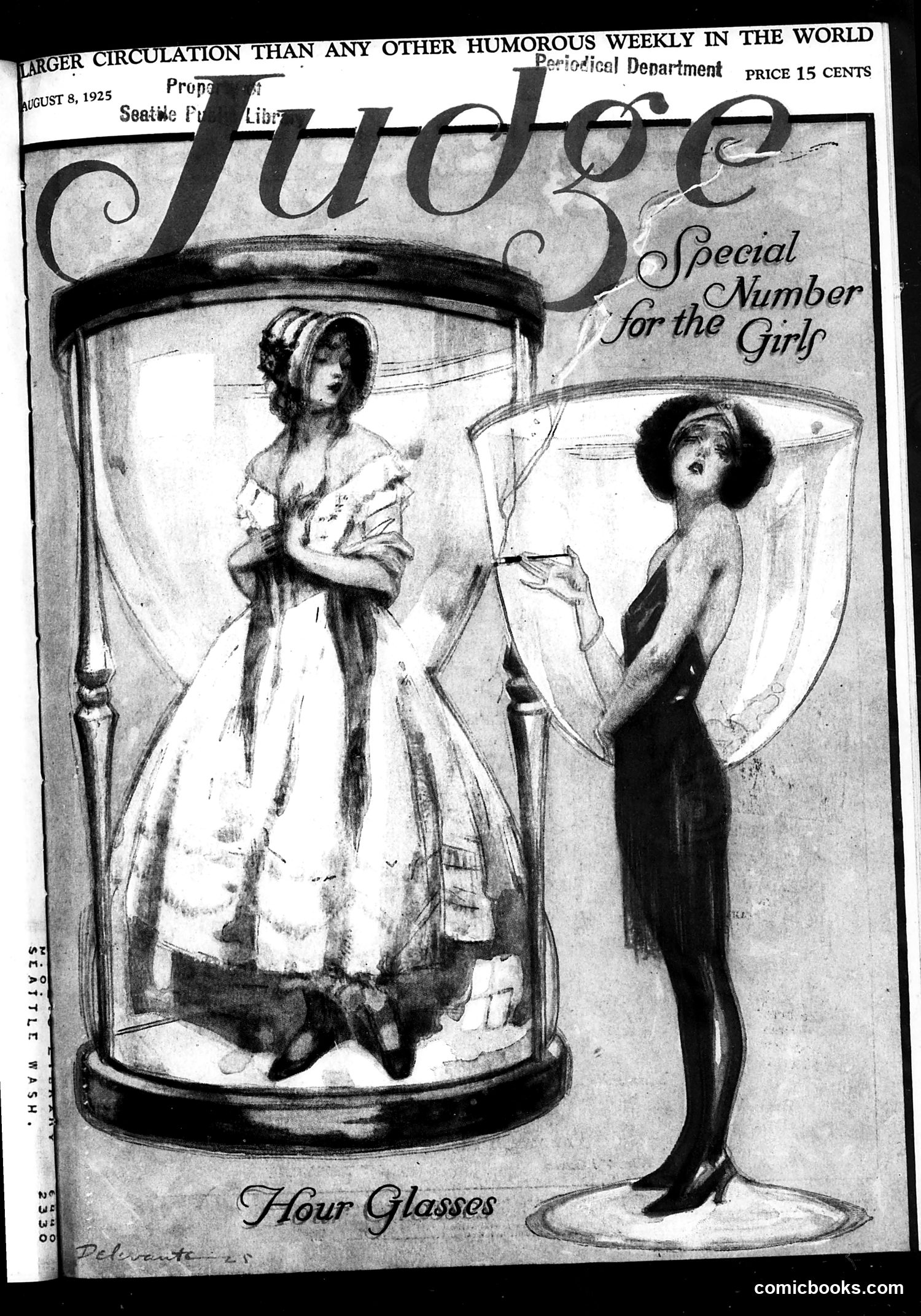
This is a visual pun on the term "hour glasses"—a double entendre playing on both the sand-filled timekeeping device and women's bodies. The cartoon depicts two women in what appear to be large hourglasses, with their figures emphasizing curvaceous silhouettes fashionable in the 1920s. The caption "Special Number for the Girls" indicates this was marketed toward female readers. The satire likely mocks both the objectification of women's bodies and the era's obsession with physical appearance and fashion. Judge magazine frequently used such risqué humor targeting women's changing roles during the Jazz Age, when women gained voting rights and greater social freedom, yet remained subject to intense scrutiny about their appearance and femininity.
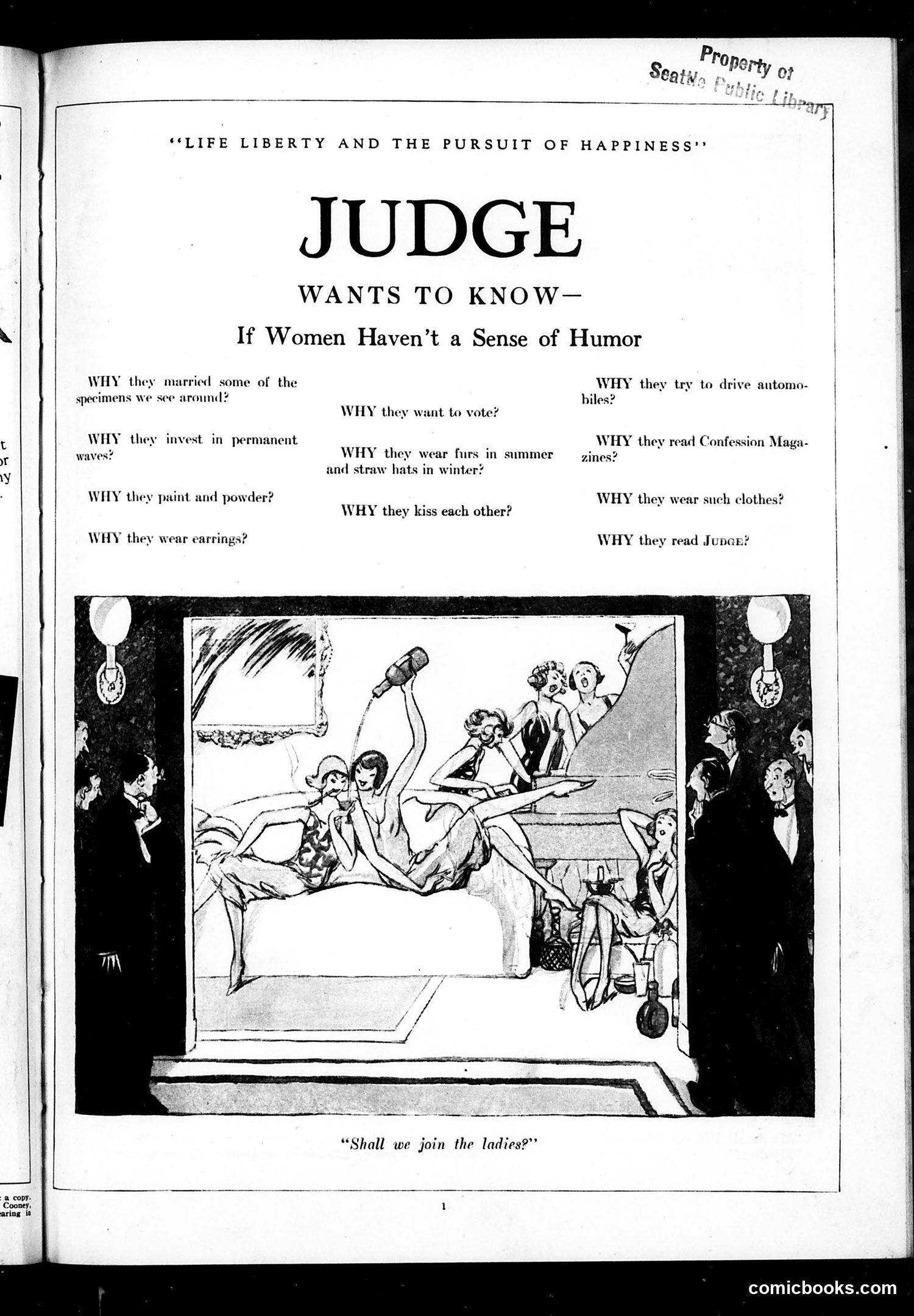
This satirical piece from *Judge* magazine mocks women's behavior and motivations through a series of rhetorical "Why" questions. The headline frames the entire joke: a "Judge" wants to know if women possess a sense of humor, then lists contradictory female behaviors—voting, wearing furs and hats, investing in permanent waves, reading *Confession* magazines, driving automobiles. The cartoon depicts women in a bedroom scene engaging in apparently frivolous activities (lounging, drinking), with men observing from the sides asking "Shall we join the ladies?" The satire's point: women's choices and interests appear illogical or superficial to the (male) author. The piece relies on period misogyny—women are portrayed as vain, irrational, and incomprehensible to men—treating this as inherently humorous rather than critiquing such attitudes.
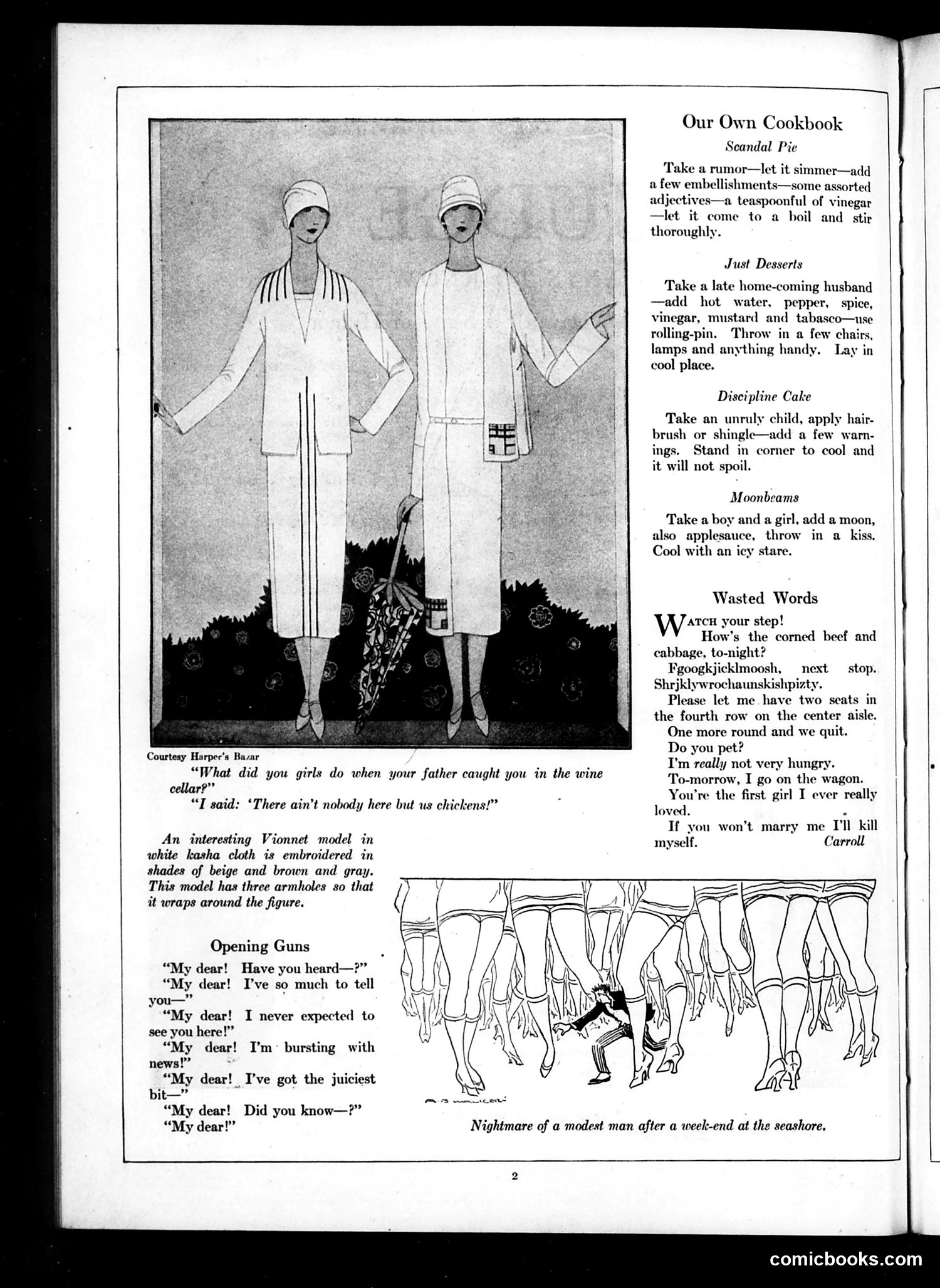
This page combines satirical humor with fashion illustration and social commentary typical of 1920s Judge magazine. The main illustration shows two women in fashionable Vionnet gowns, demonstrating contemporary women's fashion. The accompanying caption jokes about female propriety: when caught in a wine cellar, the girls claimed "There ain't nobody here but us chickens!"—a humorous deflection of impropriety during Prohibition. The right column contains "Our Own Cookbook"—satirical "recipes" mocking domestic life. "Scandal Pie," "Just Desserts," and "Discipline Cake" use food preparation metaphors to comment on marital discord, infidelity, and child-rearing. "Wasted Words" satirizes female chatter and romantic sentimentality through exaggerated dialogue. The bottom cartoon depicts exhausted men at the seashore—visual humor about masculine fatigue from female company.
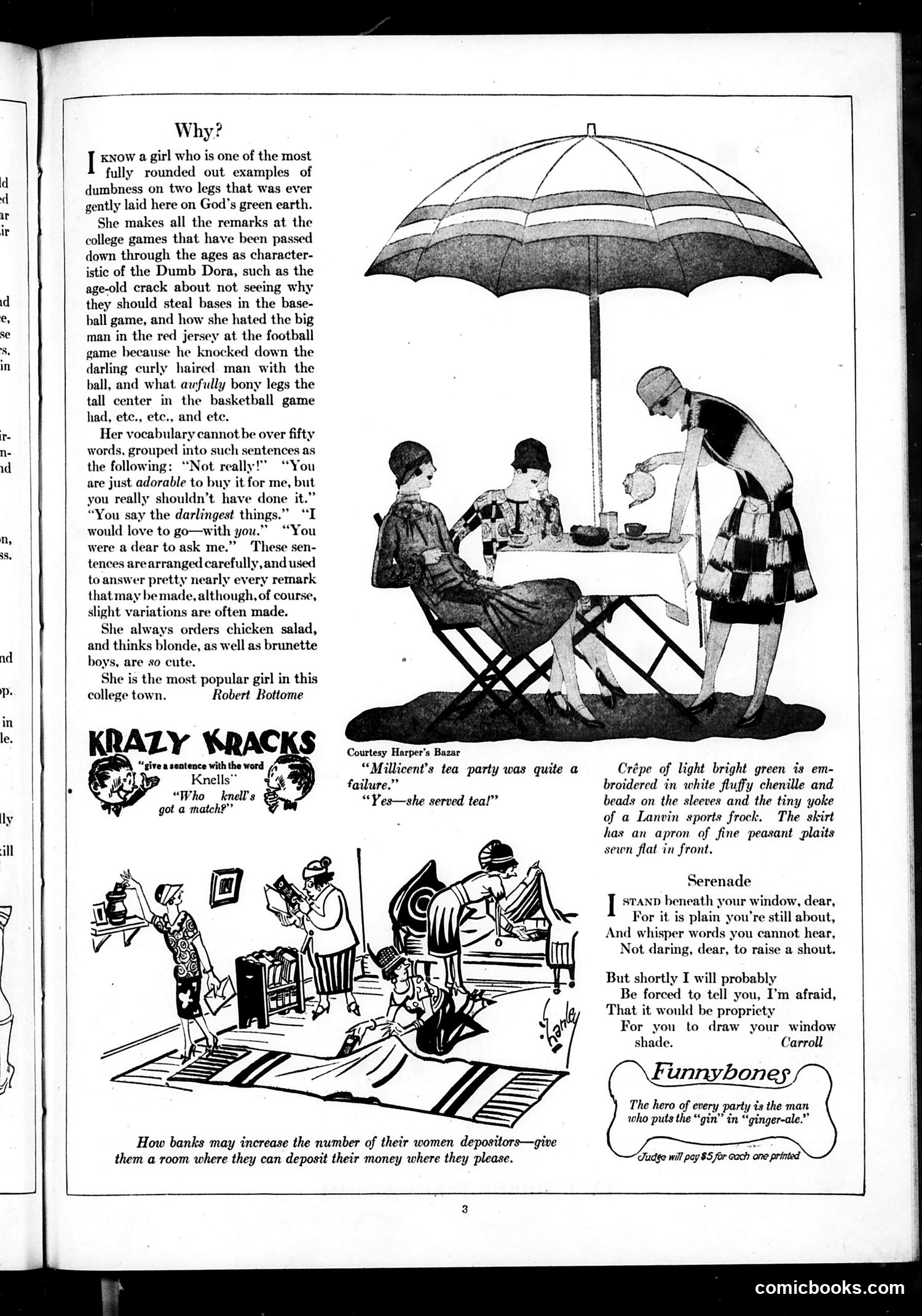
This page combines social satire with humor and advertisements typical of 1920s-era Judge magazine. **"Why?" essay** satirizes a stereotypical "dumb" college girl who makes nonsensical remarks about sports (stealing bases, knocking down players) and uses an extremely limited vocabulary. The piece mocks both her intellectual limitations and her popularity despite these deficiencies—reflecting period anxieties about modern women's education and social prominence. **"Serenade" poem** gently mocks romantic clichés of serenading beneath windows, humorously warning against disturbing window shades. **"Krazy Kracks"** and **"Funnybones"** are standard joke sections common to the era. The illustrated tea party scene and bank depositor cartoon are unrelated social commentary items. Overall, the page reflects 1920s satirical attitudes toward gender roles, romance, and modern social behavior.
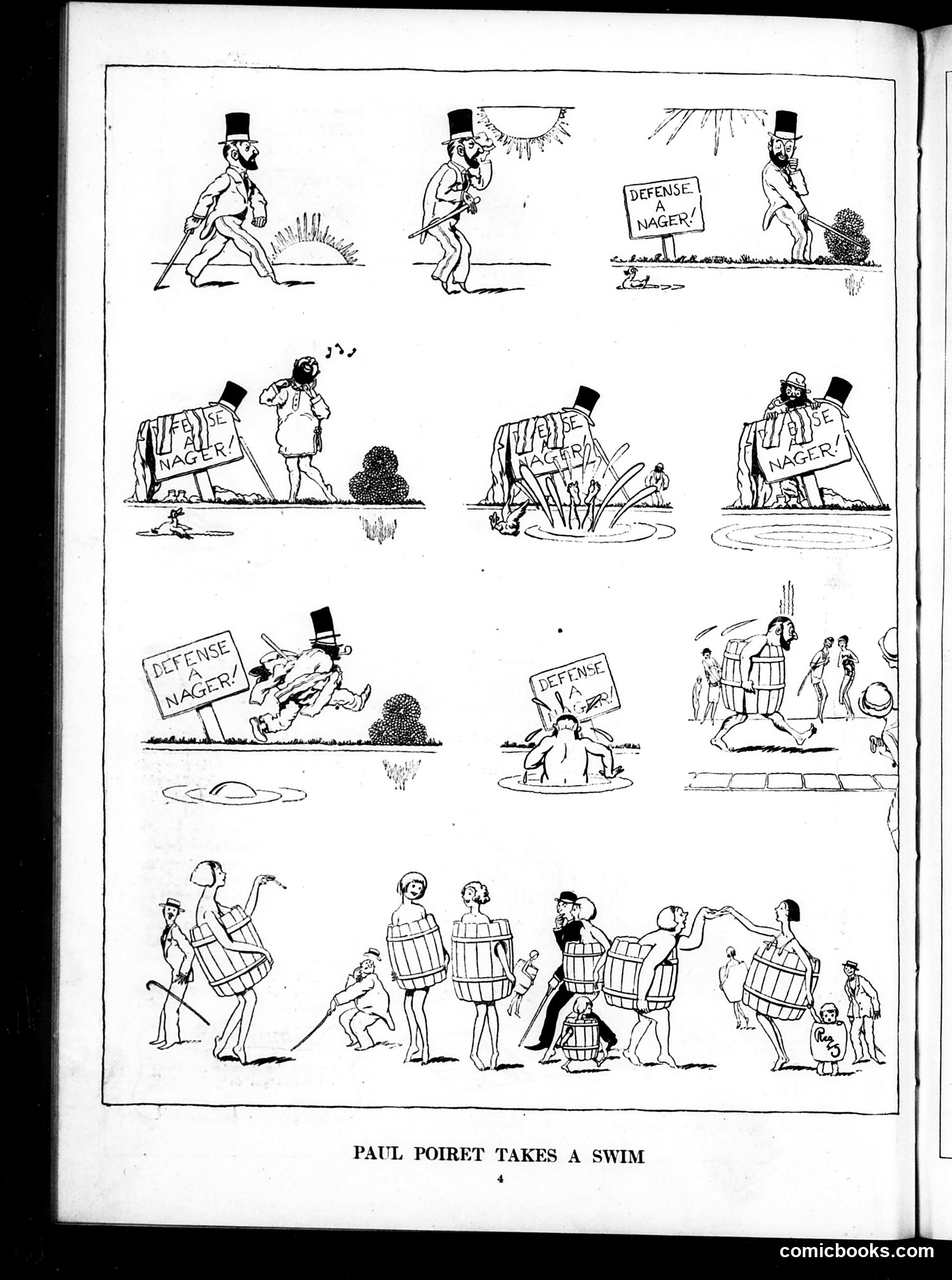
This satirical comic strips Paul Poiret, the famous French fashion designer, attempting to swim while wearing one of his own extremely restrictive designs—a barrel-like garment labeled "DEFENSE A NAGER!" (Defense Against Swimming). The joke mocks Poiret's notoriously impractical haute couture silhouettes, which prioritized artistic vision over wearability. His designs, especially during the 1910s, were so constrictive they literally prevented normal movement and activities like swimming. The bottom panel shows people in barrel costumes, suggesting his fashion enslaves wearers. The satire criticizes how high fashion prioritizes appearance over function, rendering women immobilized in his designs—a commentary on both fashion excess and women's restricted mobility in early 20th-century society.
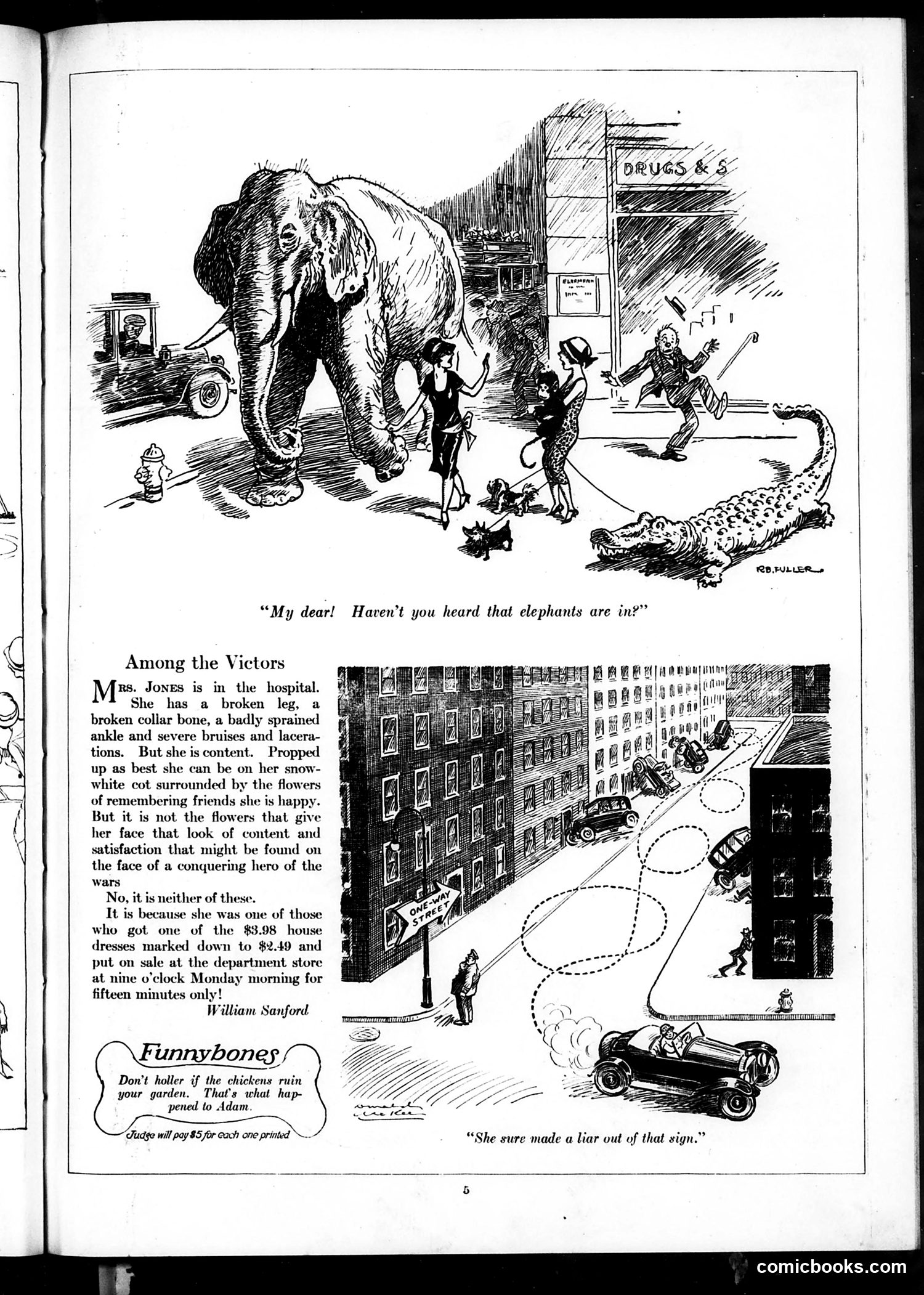
This page contains satirical humor typical of early 20th-century Judge magazine. The top cartoon shows a street scene with an elephant, crocodile, and various people near a "Drugs & Co." storefront, captioned "My dear! Haven't you heard that elephants are in?" This appears to be social satire about fashionable trends—the joke being that exotic animals have become a fad among the wealthy or fashionable set. "Among the Victors" by William Sanford describes Ms. Jones's hospital stay following injuries, then undercuts expectations by revealing her true satisfaction comes from purchasing discounted dresses (reduced from $8.98 to $2.49) at a department store sale—satirizing women's consumer priorities over actual misfortune. The "Funnybones" section contains a brief joke about chickens damaging a garden. The lower illustration depicts a chaotic street scene with automobiles and figures, captioned "She sure made a liar out of that sign."
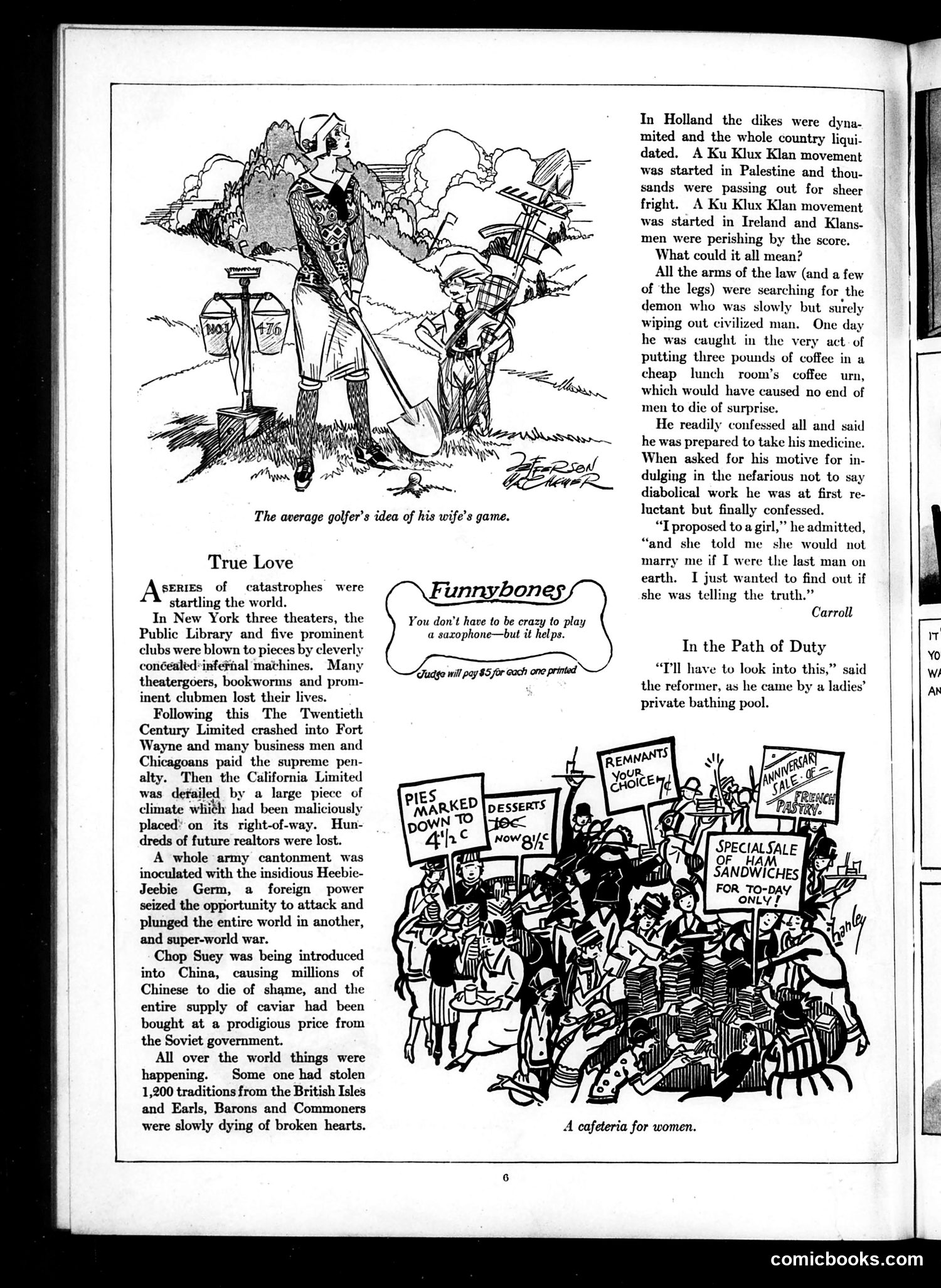
**Top Cartoon**: "The average golfer's idea of his wife's game" depicts a woman playing golf while her husband imagines her as a violent warrior with weapons and explosives. The satire mocks husbands who condescendingly view their wives' interests (golf) as inherently destructive or ridiculous—a commentary on gender attitudes and marital dismissiveness. **"True Love" Section**: This surreal satirical narrative catalogs absurd catastrophes (bombed theaters, train crashes, sabotaged railroads, plague, world war, KKK movements in unexpected places, stolen British traditions) culminating in a man poisoning a lunch room's coffee. His motivation: his girlfriend rejected him. The joke satirizes the disconnect between grandiose global chaos and petty personal grievance—suggesting some men's wounded pride drives destructive behavior. **Bottom Cartoon**: "A cafeteria for women" shows women at a crowded food service with sale signs. It appears to mock women's shopping behavior, stereotyping them as bargain-hunters, though the exact criticism remains unclear. Both pieces reflect 1920s-era attitudes toward gender roles and anxieties about modernization.
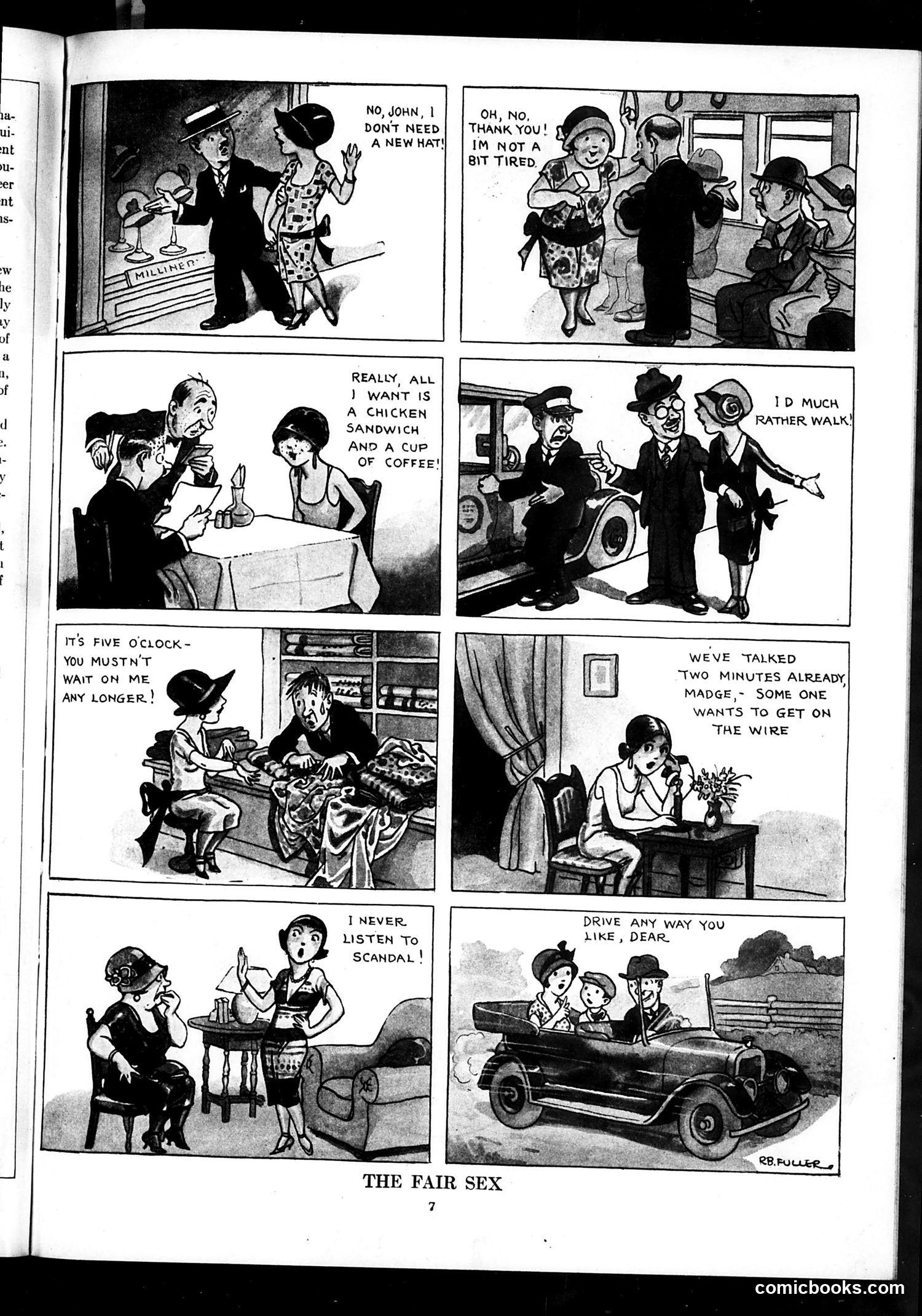
This comic satirizes women's behavior and social pretenses through a series of domestic vignettes. The narrative follows a couple's evening, mocking female inconsistency: A woman refuses her husband's offer of a new hat, claiming she doesn't need one—yet later complains she's tired. She insists she only wants simple food (chicken sandwich and coffee), but when he tries to leave at 5 o'clock, she demands he stay. She boasts about never listening to scandal while gossiping on the telephone. Finally, she tells him to "drive any way you like," then presumably backseat drives. The satire targets the perceived contradiction between women's stated desires and their actual behavior—a common trope in early 20th-century humor. The title "The Fair Sex" is ironic, suggesting women are anything but fair or straightforward. The comic reflects period attitudes about female inconsistency and manipulation in marriage, presenting these behaviors as inherent feminine traits worthy of ridicule.
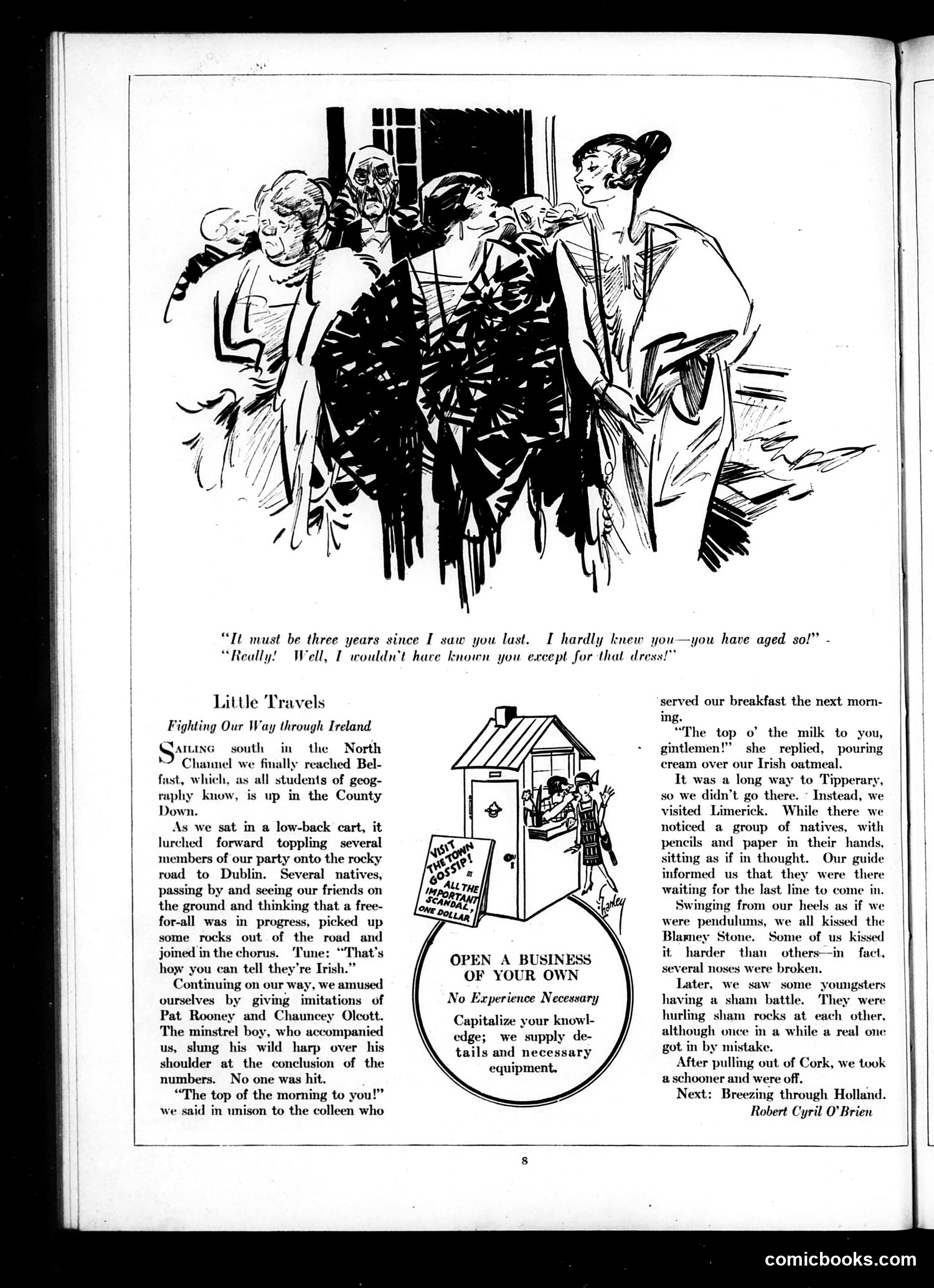
**The Top Cartoon:** A joke about aging and fashion. Two women reunite after three years; one comments the other has aged considerably. The reply—that she wouldn't have recognized her companion except for her dress—implies the dress itself is so outdated or unfashionable that it's the only recognizable thing about her. The satire targets women's vanity regarding both appearance and fashion trends. **"Little Travels" Essay:** A humorous travelogue mocking both Irish stereotypes and American tourists. The author satirizes Irish speech patterns ("The top o' the milk"), crude behavior (kissing the Blarney Stone so vigorously noses break), and American ignorance (confusing geography, making poor Irish imitations). The ad for "Open a Business" offers capitalization on "knowledge"—itself a joke, since the essay demonstrates the travelers possess none. The humor depends on exaggerated ethnic caricatures typical of early 20th-century American media.
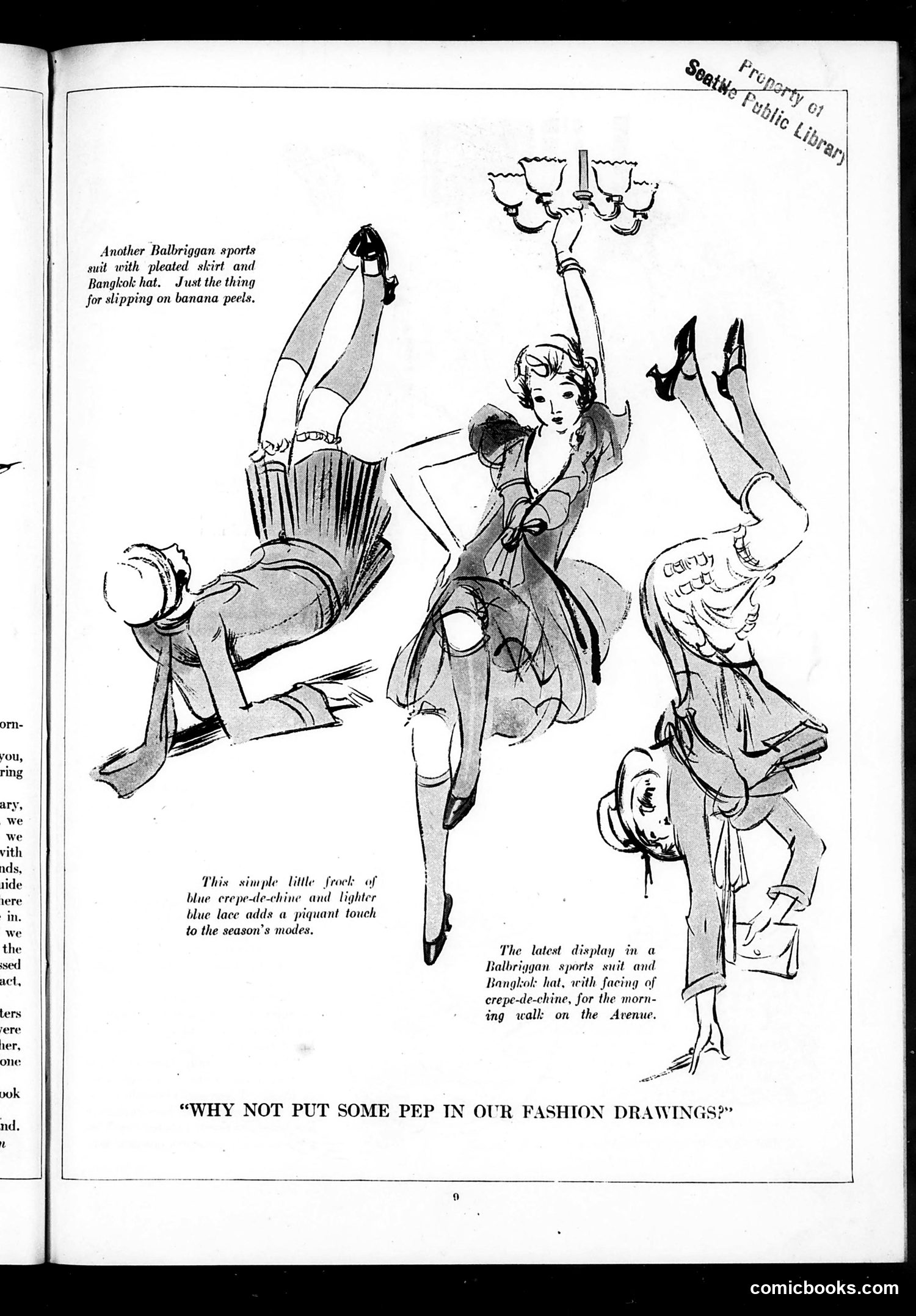
This page satirizes fashionable women's sportswear of the era through exaggerated physical comedy. The headline "WHY NOT PUT SOME PEP IN OUR FASHION DRAWINGS?" frames the joke: rather than static poses, the illustrated women are depicted in absurdly acrobatic positions—tumbling, doing handstands, and performing gymnastic moves. The satire targets both the fashion industry and women's fashion choices. The captions mock specific garments (Balbriggan suits, Bangkok hats, crepe-de-chine) while the comic illustrations suggest that such "sporty" outfits are impractical and lead to physical mishaps ("slipping on banana peels"). The central irony: promotional fashion drawings typically present elegant, composed figures, but this designer instead shows women literally upside-down and flailing—implying the fashions are ridiculous or dangerous rather than glamorous. It's social satire on both women's fashion consumption and advertising conventions.
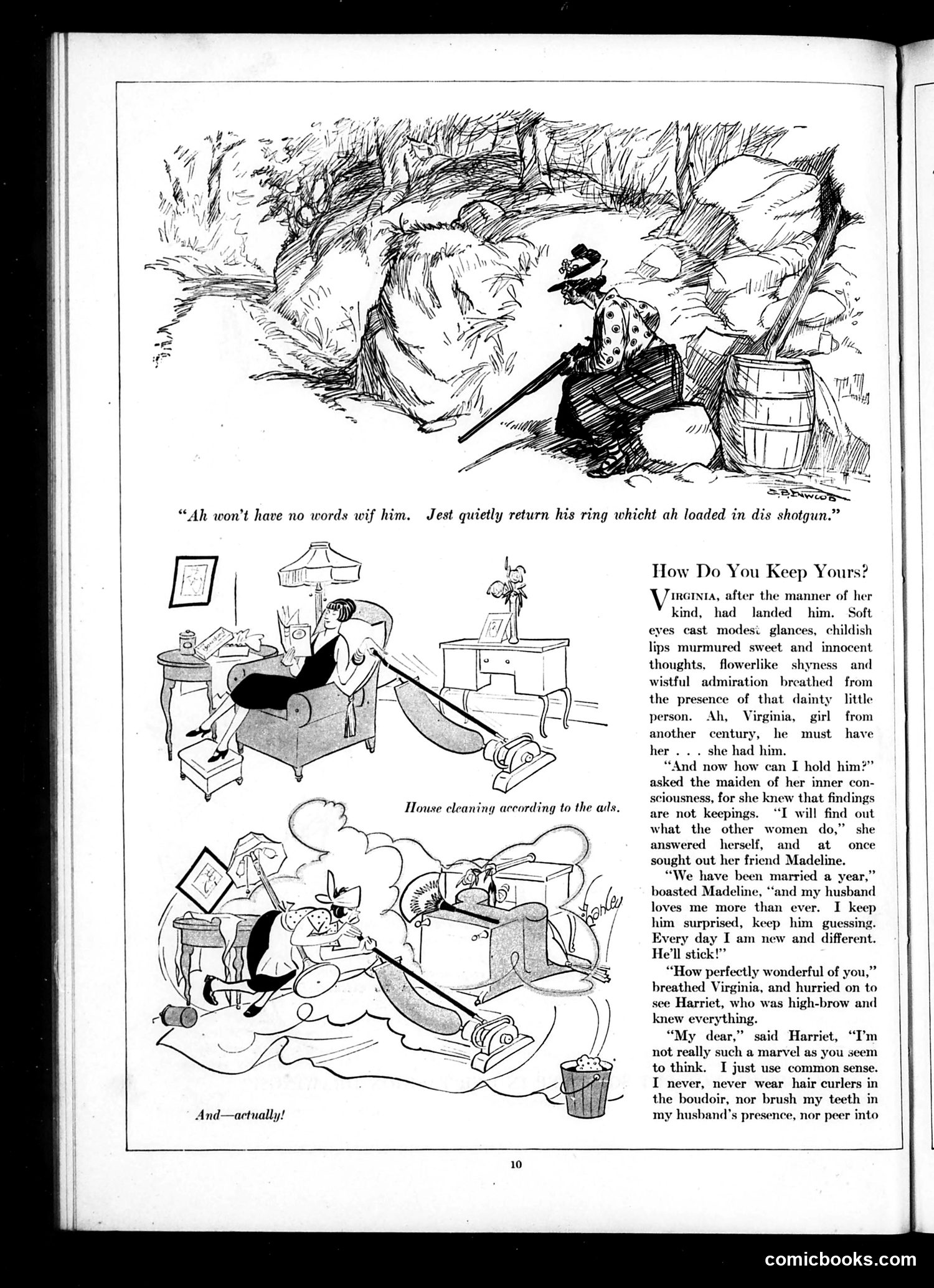
This page from *Judge* satirizes early 20th-century advice about maintaining marriage. The story follows "Virginia," a young woman seeking secrets to "keep" her husband after marriage. She consults two friends with opposite approaches: **Madeline** advocates constant novelty and surprises to maintain excitement, while **Harriet** recommends practical common sense—never appearing in curlers or performing unglamorous grooming in front of one's husband. The cartoons humorously illustrate these contrasting philosophies: the top shows idealized house-cleaning "according to the arts," while the bottom depicts the chaotic reality ("actually"). The satire targets the era's obsession with women maintaining an artificially perfect appearance and perpetually mysterious demeanor to sustain male interest. It mocks both the elaborate performance required and the pretense that marriage stability depends on a wife's constant self-presentation rather than genuine companionship or mutual respect.
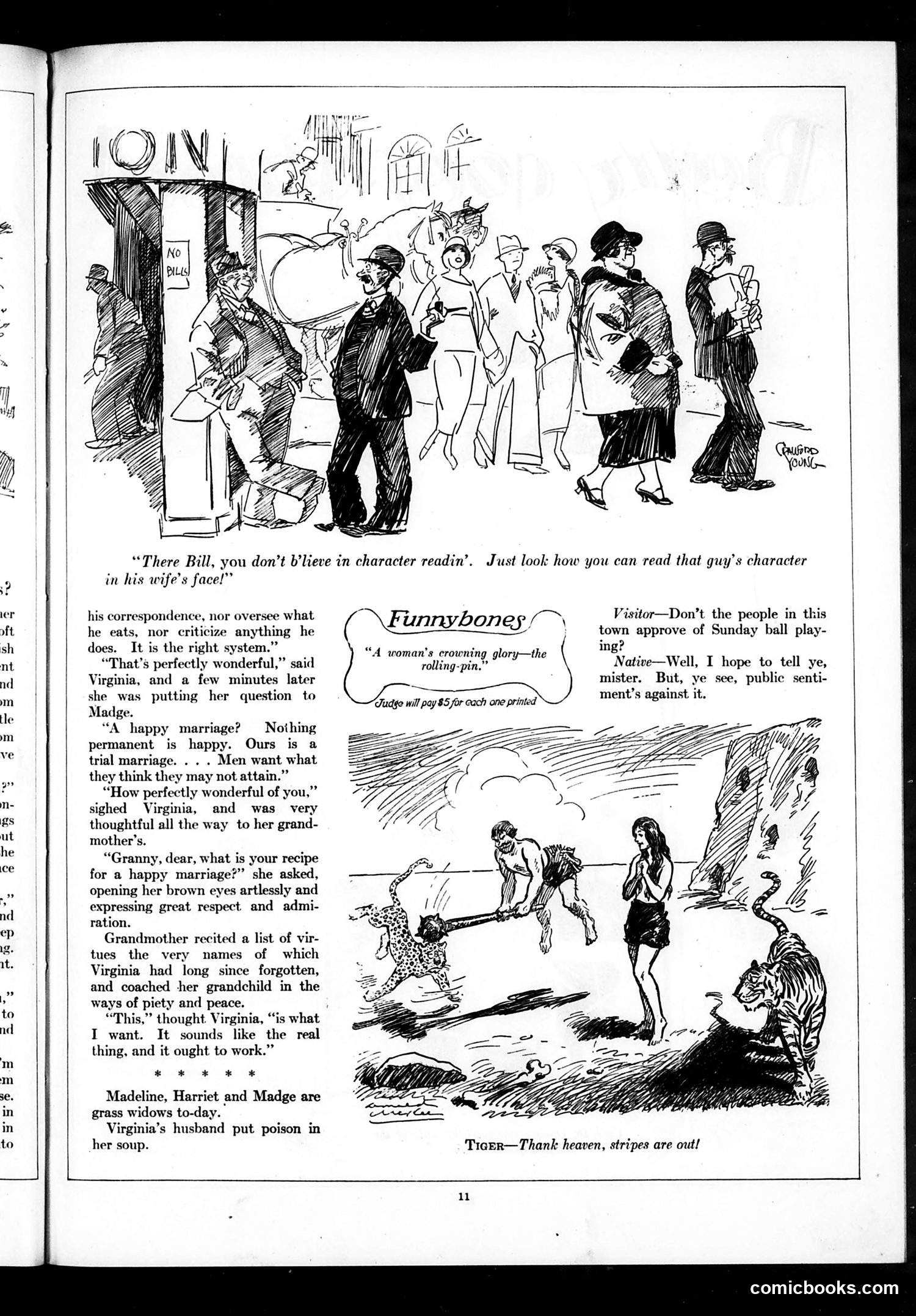
**Top Cartoon:** A domestic scene satirizing "character reading"—a popular pseudoscience of the era. The joke mocks this practice by suggesting a man can read someone's character from his wife's face, implying wives reveal their husbands' true nature through their expressions. **"Funnybones" Section:** A narrative about Virginia seeking marriage advice. The satire critiques modern marriage attitudes: her acquaintance describes marriage as temporary ("trial marriage"), while grandmother offers traditional virtues. The dark punchline—Virginia's husband poisons her soup—is gallows humor suggesting the marriage advice failed catastrophically. The reference to "grass widows" (women separated from husbands) reinforces the cynical tone. **Bottom Cartoon:** Depicts people encountering a tiger, captioned "Thank heaven, stripes are out!" This appears to be fashion satire—relieved the tiger has no stripes, perhaps referencing striped clothing trends. The page reflects early-20th-century anxieties about changing marriage values and modern skepticism toward traditional domestic advice.
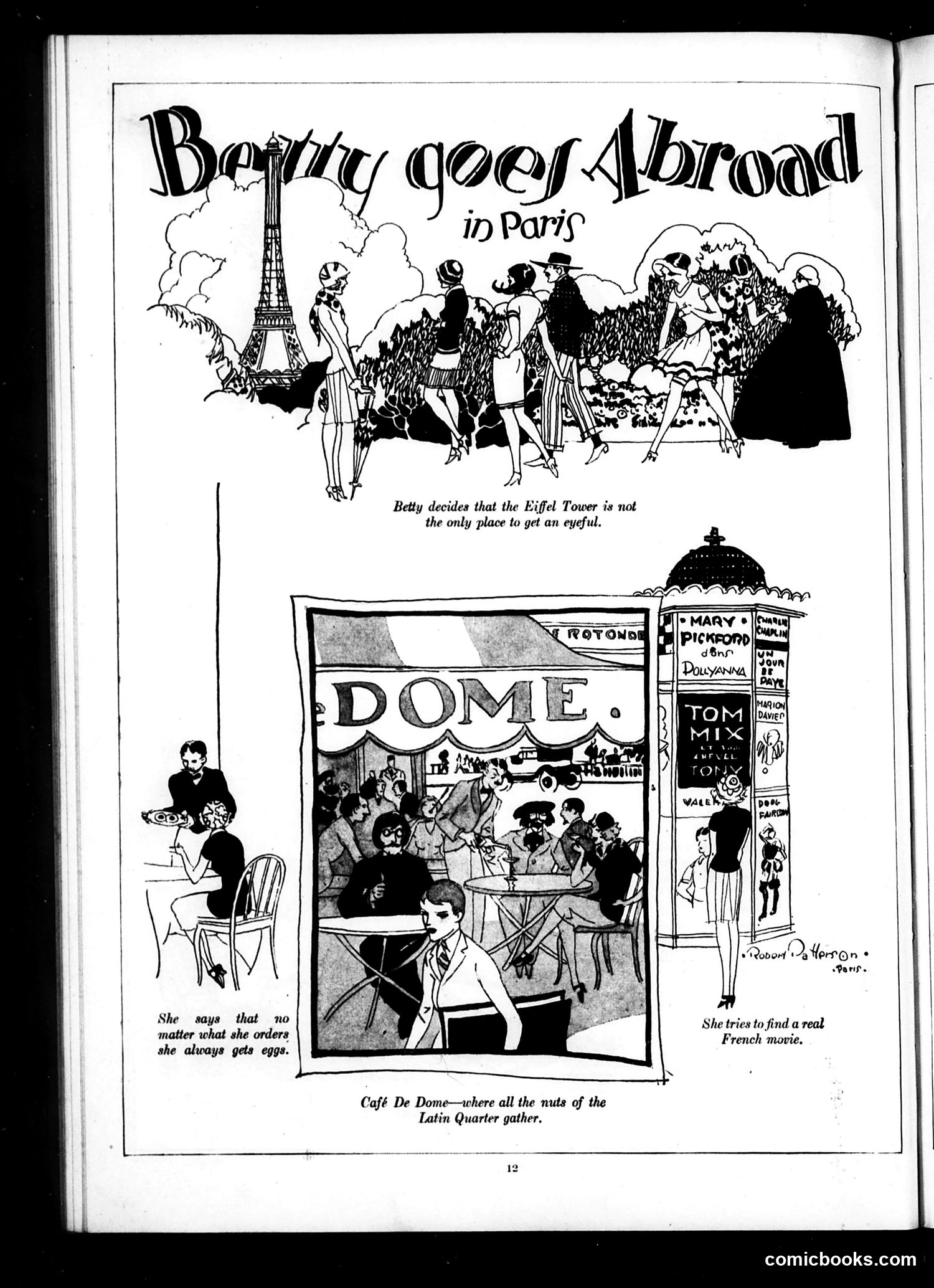
This is a satirical story about an American woman named Betty visiting Paris. The humor targets both American tourists and French culture: **The setup:** Betty goes to Paris expecting exotic experiences. The title play on "berrying" (gathering) suggests superficial tourism. **The jokes:** - At the Café de Dome (a real Parisian bohemian hangout), Betty complains that no matter what she orders, she gets eggs—mocking either French cuisine or her inability to order properly in French. - She seeks authentic "French movies" but finds only commercial establishments like "Tom Mix" (an American Western star), suggesting Paris was becoming Americanized or that tourists couldn't escape American culture. - The Eiffel Tower reference plays on the cliché that tourists only want famous photo-ops, not genuine cultural experiences. The satire works on two levels: mocking American tourists' superficiality while suggesting Paris itself offers little authentic culture beyond famous landmarks. The "nuts of the Latin Quarter" reference dismisses Parisian bohemians as eccentrics.
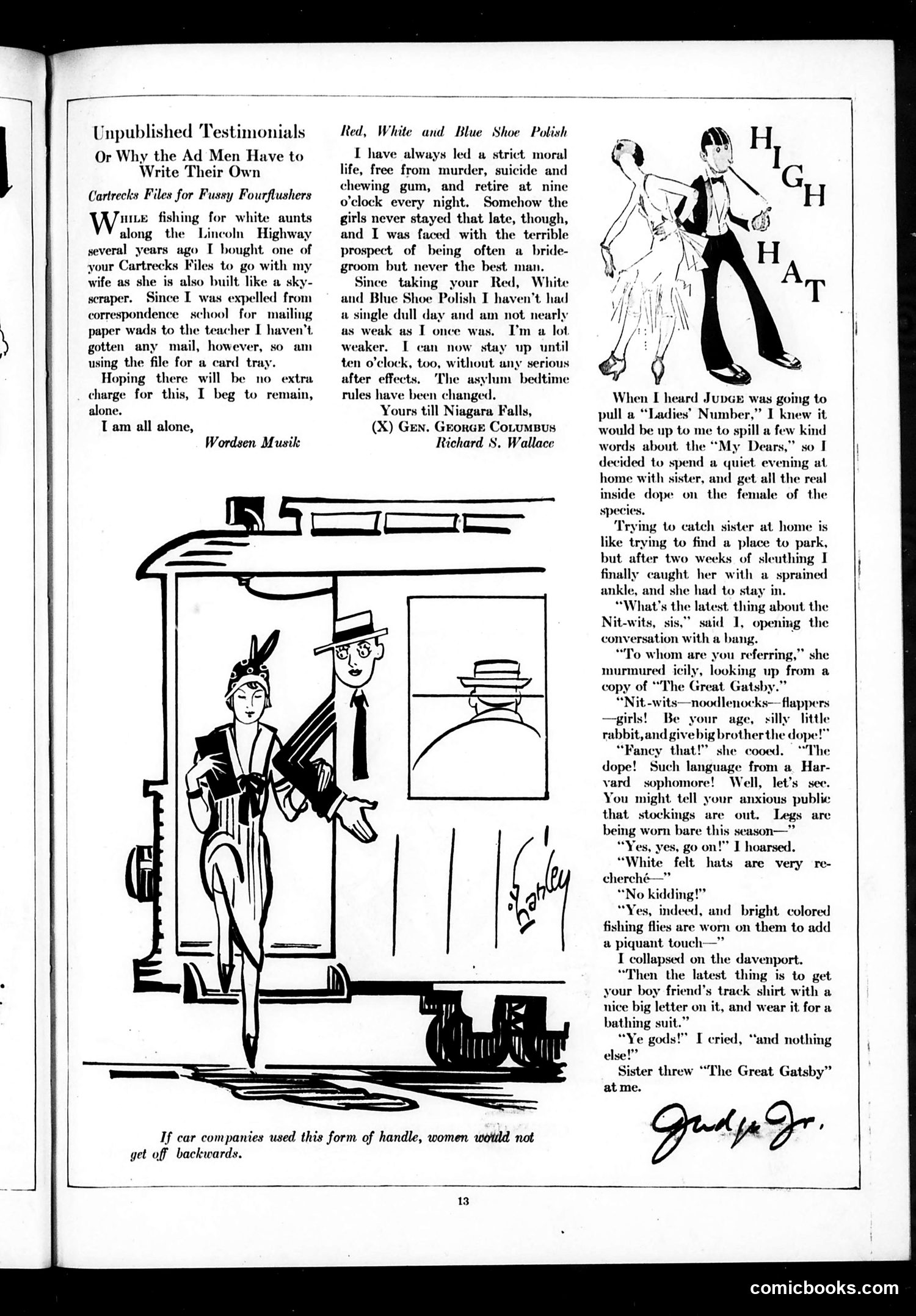
This page satirizes fake testimonials used in advertising. The left column mocks product endorsements through absurd letters claiming to be from real customers—a common advertising practice. The first testimonial, supposedly from "Wordsen Musik," claims to use a Cartrecks File (a filing system) as a card tray instead of its intended purpose, joking that he never receives mail due to being expelled from correspondence school. The second, attributed to "Gen. George Columbus" (a pseudonym), praises Red, White and Blue Shoe Polish while admitting it makes him weaker and has gotten him sent to an asylum—inverting the typical glowing testimonial. The right side features a conversation between a brother and sister about current fashions and social trends among young women (flappers). She mentions bare legs, fishing flies worn as decoration on stockings, and wearing a boyfriend's lettered track shirt as a bathing suit. The satire mocks both frivolous fashion trends and the brother's attempts to gather "inside dope" on female behavior, likely reflecting 1920s anxieties about modern women's independence and changing social mores.
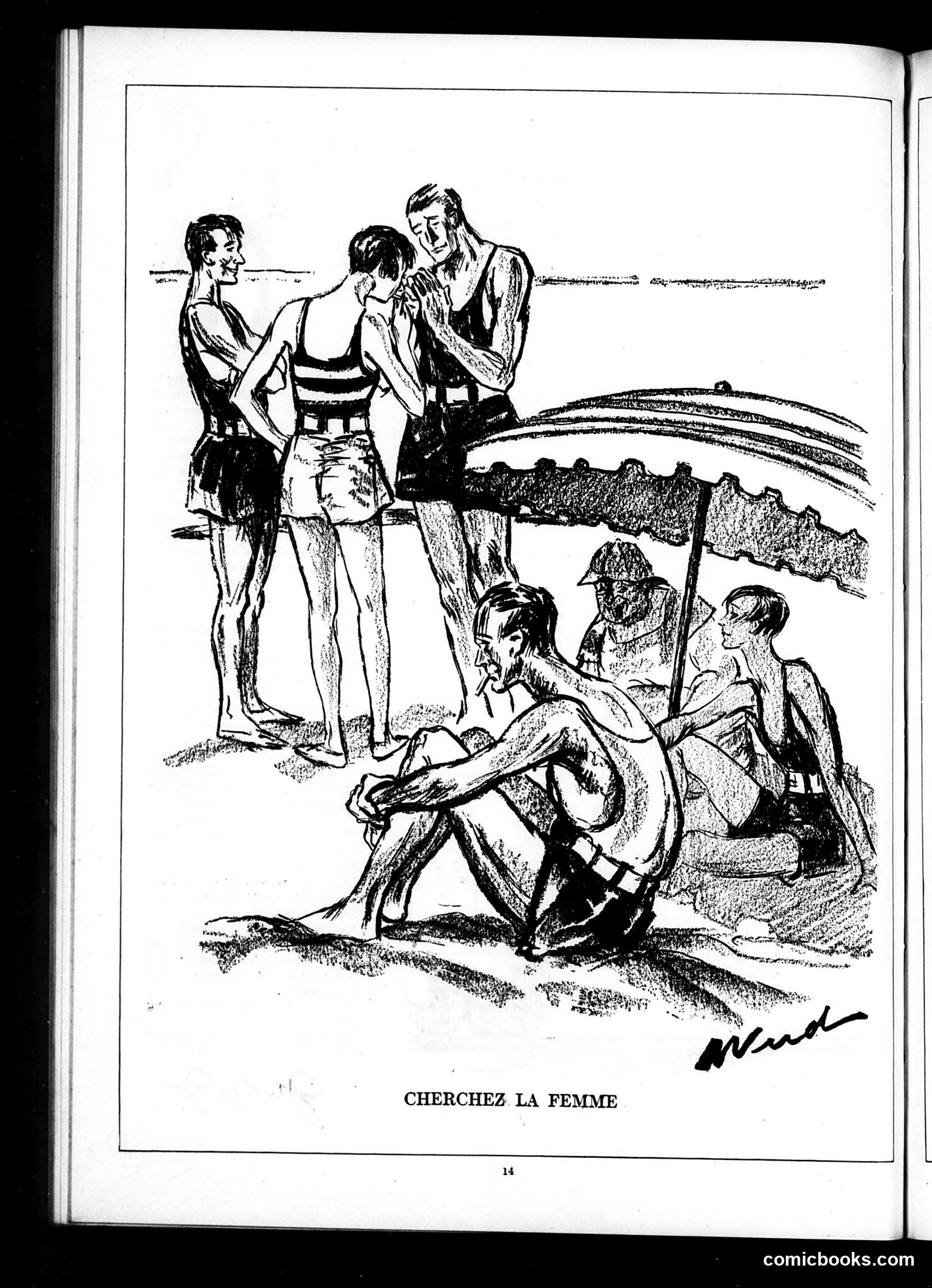
This cartoon illustrates the French proverb "cherchez la femme" — suggesting that behind any problem or crime, you'll find a woman responsible. The image shows a beach scene where three well-dressed men (standing) appear to be interrogating or discussing matters with several scantily-clad men (seated/crouching below). The satire suggests that these men are distracted or implicated due to female presence or influence — though notably, the actual woman isn't clearly visible in the foreground, reinforcing the joke's ironic logic. The cartoon likely mocks both the proverb itself and era attitudes blaming women for men's misdeeds or poor judgment. It's a commentary on how men deflected responsibility by attributing their problems to female influence or temptation.
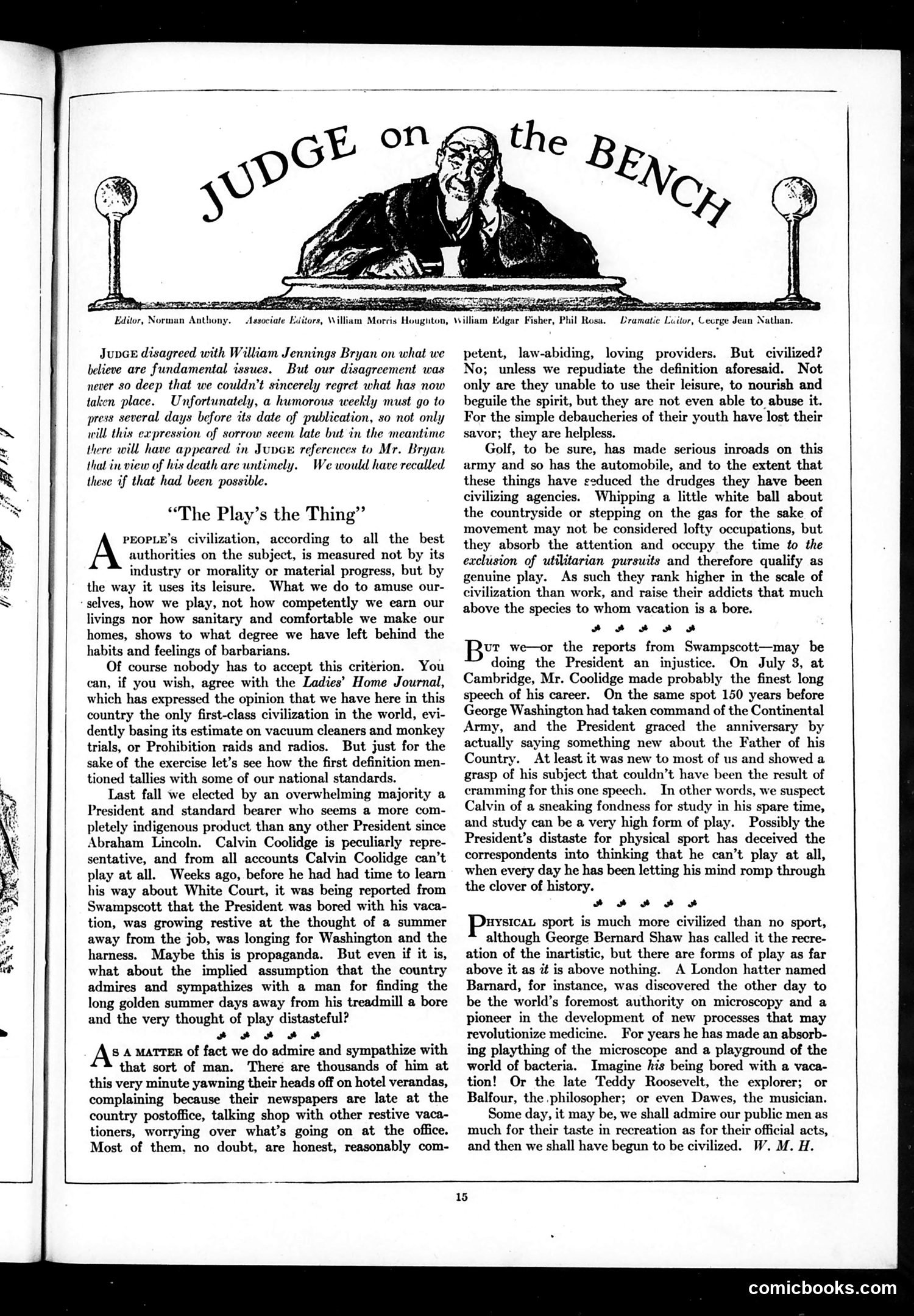
This page contains an editorial tribute following William Jennings Bryan's death. The editor acknowledges that Judge magazine disagreed with Bryan on "fundamental issues" but expresses regret that critical references to him will appear in upcoming issues before the publication date—a constraint of weekly magazine production. The main article, "The Play's the Thing," satirizes American civilization and President Calvin Coolidge specifically. Judge argues that a society's leisure activities—not industrial progress—measure true civilization. The piece mocks Coolidge as the epitome of American failure: he reportedly found vacation boring, preferred work to play, and couldn't enjoy leisure time. This criticizes both the president and the broader American work culture he represents—millions of businessmen similarly unable to relax or enjoy themselves beyond golf and automobiles. The satire suggests that Americans' inability to truly play or amuse themselves (despite claiming superior civilization) reveals their barbarism, contrasting sharply with the "Ladies' Home Journal" position that America's civilization rests on vacuum cleaners and material goods.
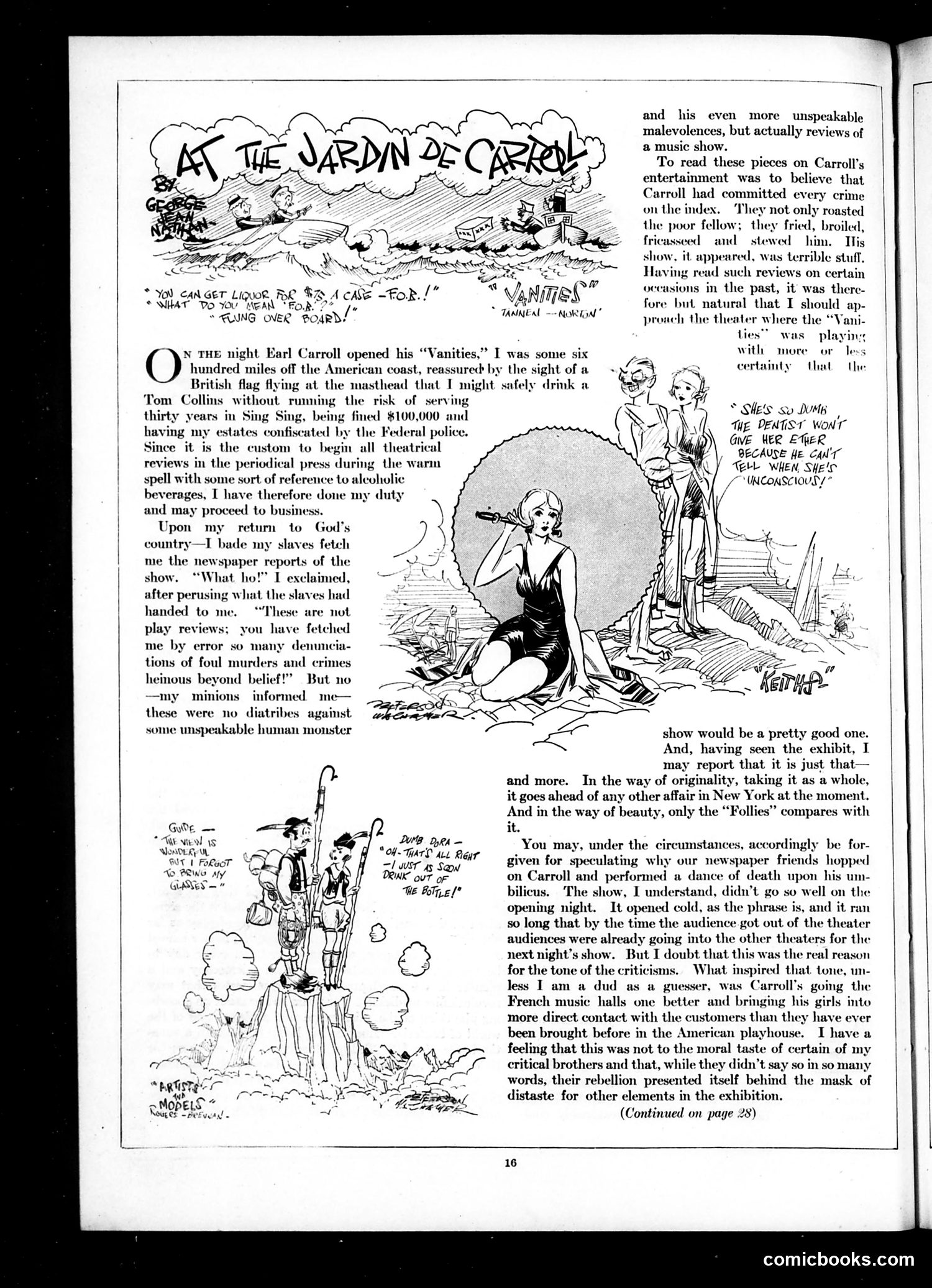
This page satirizes harsh newspaper reviews of Earl Carroll's theatrical revue "Vanities." The author argues critics savagely attacked the show—describing their reviews as murderous denunciations—when their real objection was moral, not artistic. The cartoons mock the reviewers' hypocrisy. Top sketches show characters complaining about the show's content in exaggerated ways. The author suggests critics disliked Carroll bringing "his girls into more direct contact with the customers" (implying scandalous choreography or staging) but disguised this prudish objection behind claims about artistic quality. The opening alcohol reference satirizes the magazine convention of beginning theater reviews with obligatory drinking jokes. The broader point: newspapers claimed artistic grounds for condemnation while actually objecting to the show's sexual suggestiveness—a critique of both censorious moralism and journalistic dishonesty during the 1920s theatrical era.
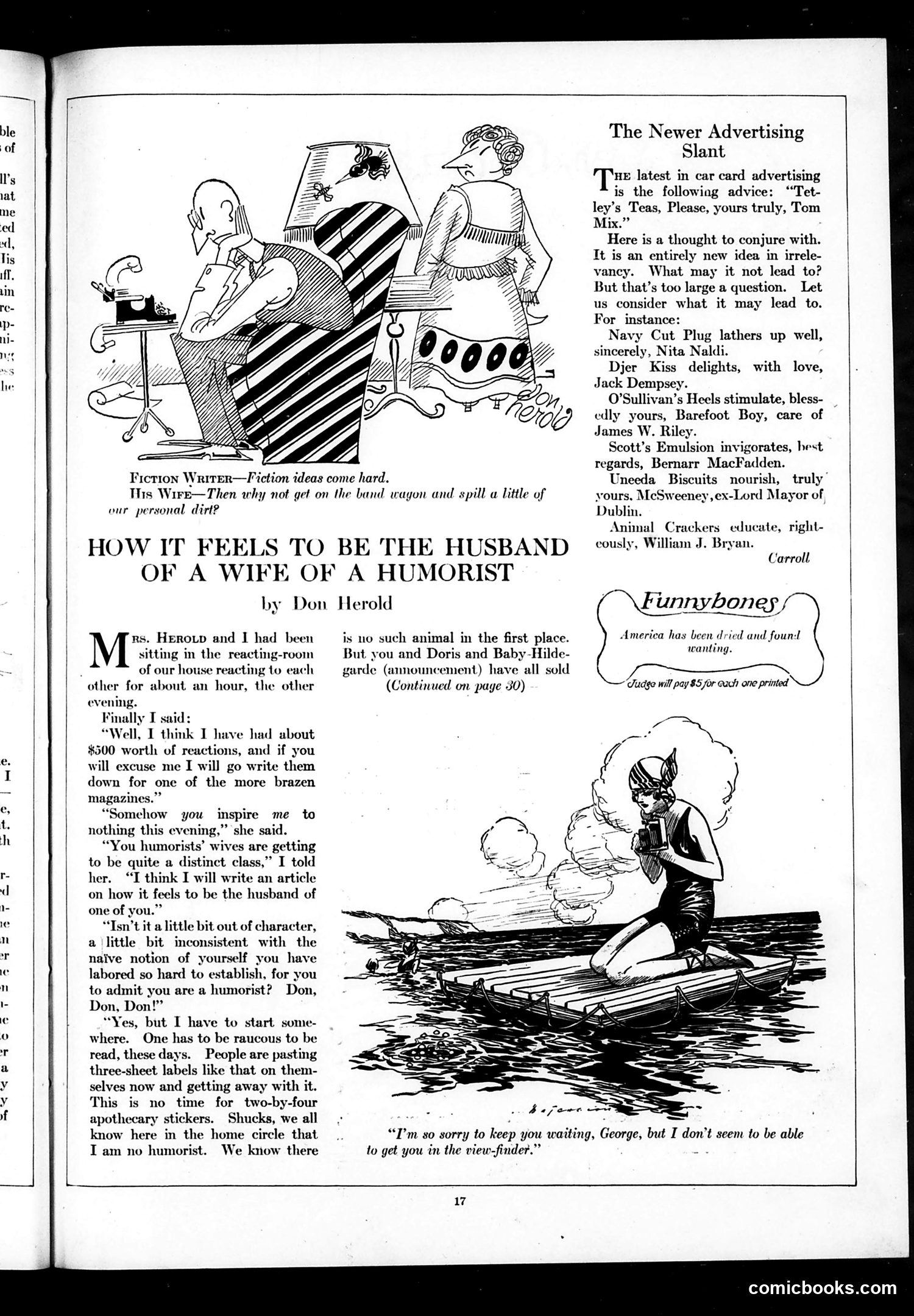
This satirical article by Don Herold mocks the growing trend of humorists' wives becoming a recognized social type—women married to men who write humor for magazines. Herold humorously complains that his wife inspires him "to nothing," then ironically announces he'll write about being a humorist's husband, despite claiming he's "no humorist" and that "no such animal" exists. The piece satirizes both the pretension of self-proclaimed humorists and the celebrity culture of the 1920s-30s. The accompanying "Newer Advertising Slant" section parodies modern endorsement ads by imagining celebrities (Nita Naldi, Jack Dempsey, William Jennings Bryan) promoting mundane products with absurdly casual signatures—mocking hollow celebrity advertising's irrelevance to actual product quality. The bottom cartoon shows a photographer unable to frame his subject, likely commenting on the difficulty of capturing modern life's chaos.
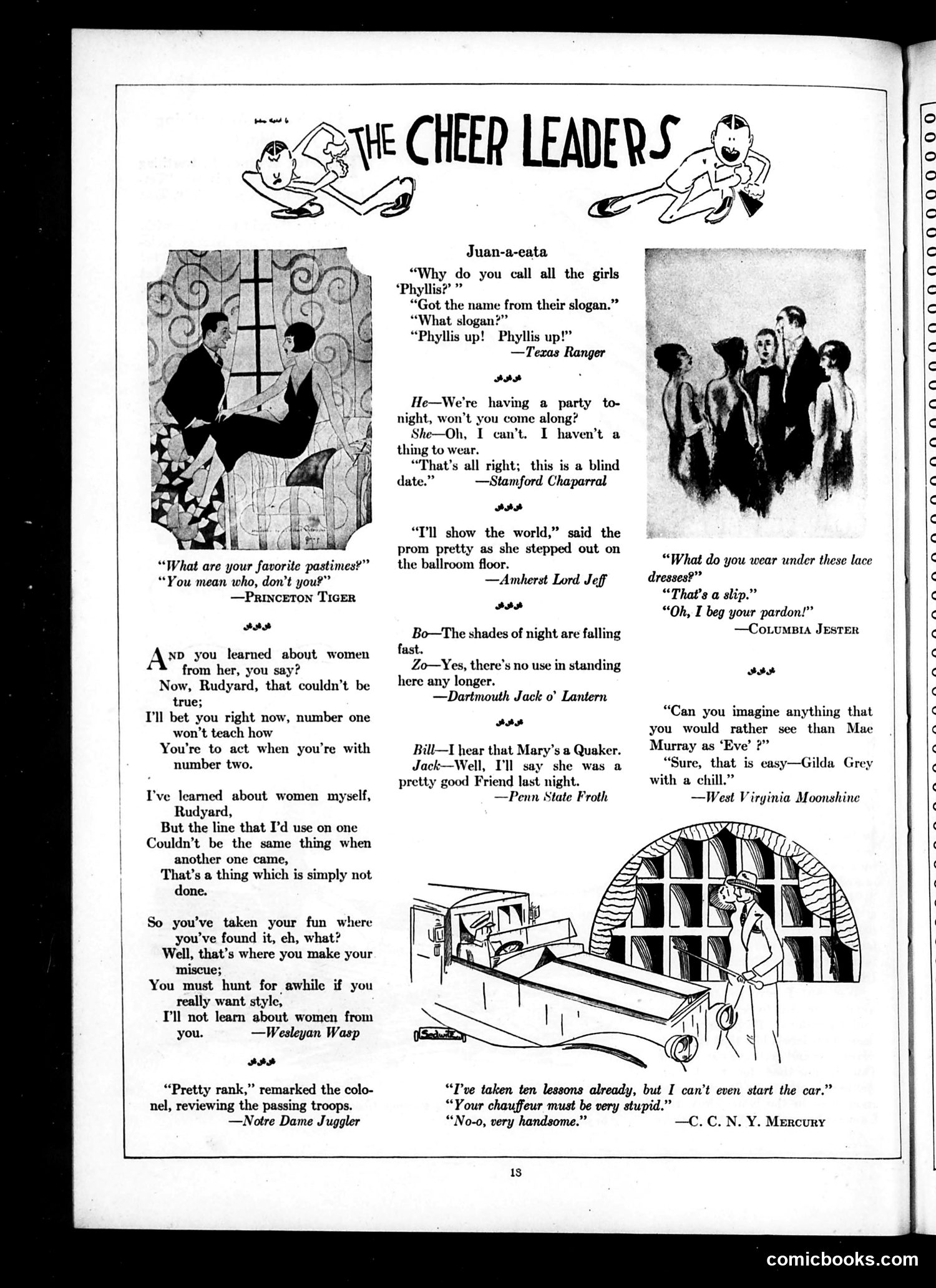
This page collects brief jokes and quips from college humor magazines (identified by their mastheads: Princeton Tiger, Wesleyan Wasp, Texas Ranger, etc.). The content reflects 1920s-era collegiate comedy focused on dating, romance, and flirtation. Key themes include: **Dating/Romance humor**: Multiple jokes about romantic pursuit, blind dates, and courtship etiquette. The "Juan-a-eata" joke plays on "Phyllis up" as a cheer-derived pickup line. **Gender dynamics**: Heavy emphasis on women's clothing (the "slip" misunderstanding, the "what do you wear under" joke) and appearance (Mae Murray and Gilda Grey were contemporary actresses/dancers). **Sexual innuendo**: Subtle references to intimate behavior ("pretty good Friend," "handsome chauffeur" distracting from driving lessons). The page satirizes college social life and the preoccupations of young men, presenting dating as a game requiring strategic "style" rather than genuine connection. The illustrations show typical 1920s social scenes—couples at windows, group gatherings, and automobile situations.
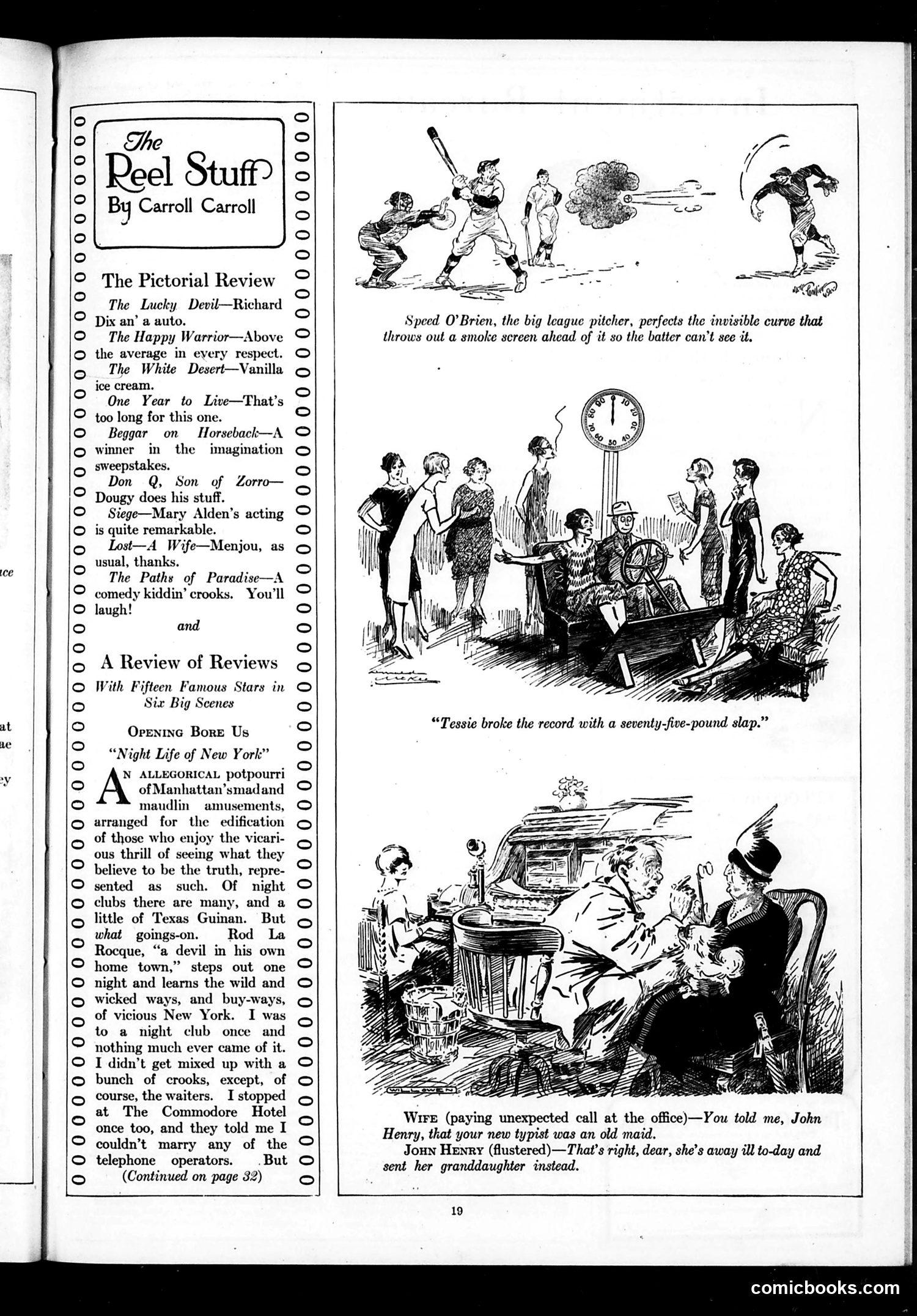
This Judge page contains two unrelated satirical pieces: **Top section** ("The Reel Stuff"): A film review column by Carroll Carroll critiquing current movies, using humorous one-liners. It references contemporary 1920s films and stars like Richard Dix and Adolphe Menjou. The reviews are brief jokes about the movies' quality or plots. **Bottom cartoons**: Two separate gags: 1. **Baseball cartoon**: Satirizes pitcher "Speed O'Brien" by depicting an absurdly exaggerated pitching technique—throwing a "smoke screen" so thick the batter cannot see the ball. This mocks either O'Brien specifically or the era's tendency to mythologize sports stars' abilities. 2. **Office cartoon**: A marital comedy: A wife catches her husband with a young woman at his office. He claims his typist is "an old maid" away ill, but the young woman present is supposedly her granddaughter. The joke relies on the obvious implausibility of this excuse—suggesting infidelity or at minimum deception. The page mixes entertainment reviews with humorous domestic and sports satire typical of 1920s Judge magazine.
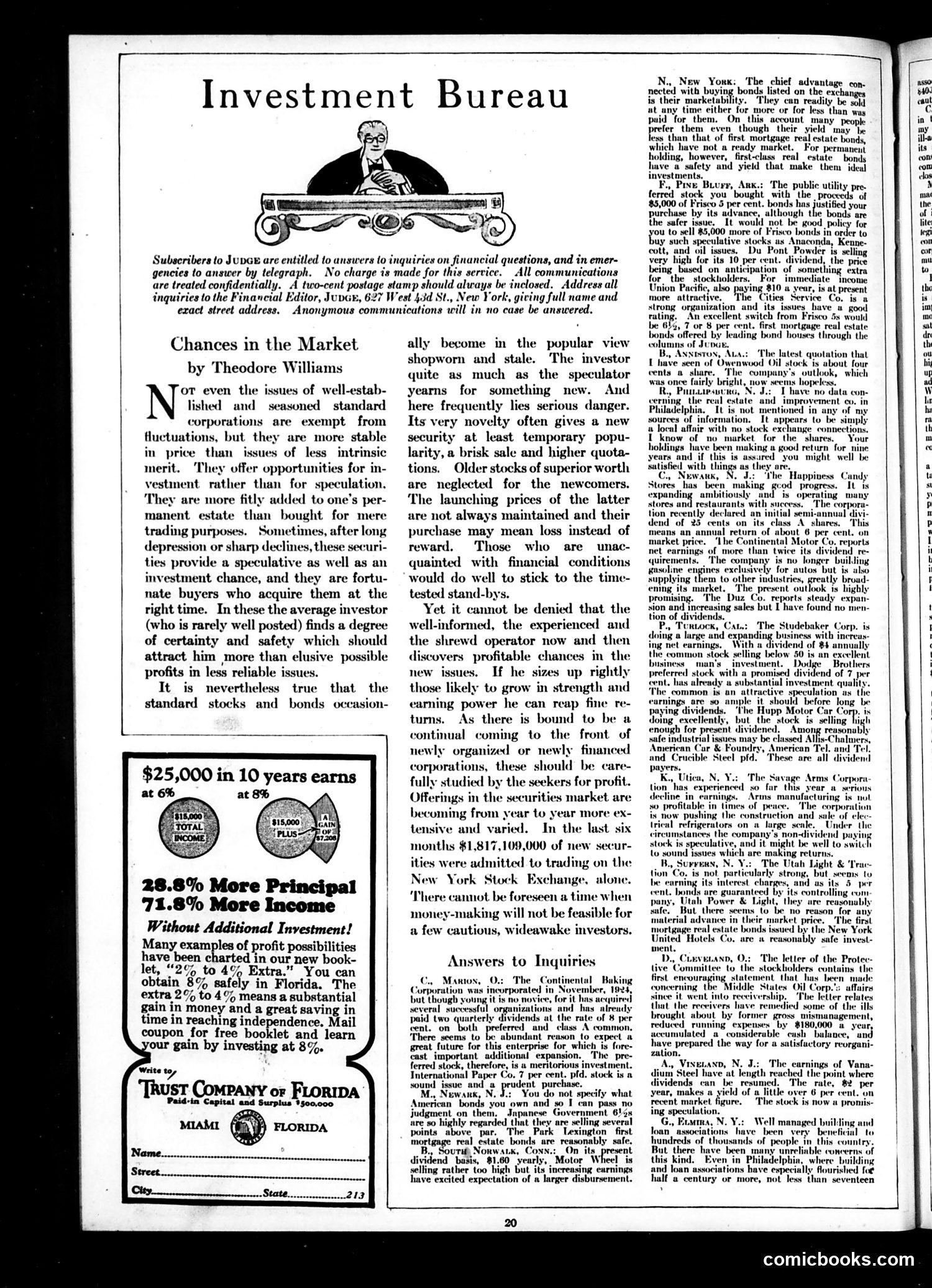
This page is primarily **financial advice content**, not satire. It features Judge magazine's "Investment Bureau"—a legitimate service answering subscribers' questions about stocks and bonds. The main article, "Chances in the Market" by Theodore Williams, offers conservative investment guidance: established stocks are safer than speculative new issues, though shrewd investors can profit from newly-financed corporations if carefully studied. The piece notes $1.8 billion in new securities were admitted to the New York Stock Exchange in six months. A sidebar advertisement for the Trust Company of Florida promotes 8% returns on Florida investments—appearing to reference the 1920s Florida real estate boom. The "Answers to Inquiries" section provides specific recommendations on various stocks and bonds (International Paper, Japanese Government bonds, etc.). **This is straightforward financial journalism**, not satirical commentary. It reflects early-20th-century investment culture and Judge's role as a publication serving affluent readers interested in wealth management.
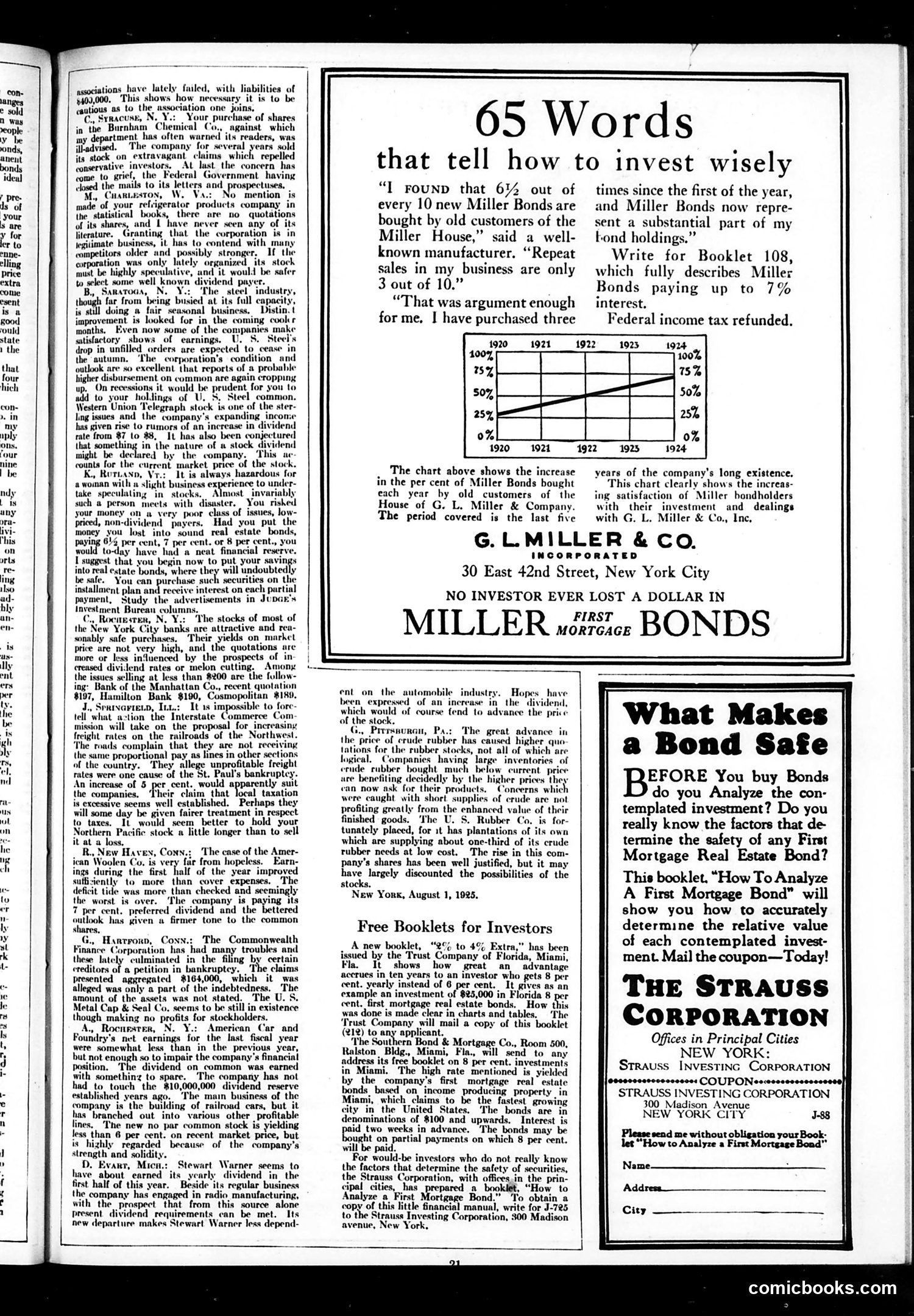
This page is primarily **financial advertising and investment advice**, not political satire or cartoon content. The main feature is a G.L. Miller & Co. advertisement promoting "Miller Bonds" — first mortgage bonds paying 7% interest with federal income tax refunded. The ad claims "NO INVESTOR EVER LOST A DOLLAR IN MILLER FIRST MORTGAGE BONDS" and includes a chart showing increasing bond purchases from 1920-1924. The left column contains investment advice responses to readers' questions about various stocks (railroads, banks, manufacturing companies). An adjacent box advertises "The Strauss Corporation" offering a booklet titled "How To Analyze A First Mortgage Bond." **Context for modern readers**: This represents the pre-1929 stock market boom era when investment advice was freely dispensed in popular magazines, and bonds were heavily marketed as "safe" investments. The repeated emphasis on safety and guaranteed returns reflects pre-Depression optimism about financial markets. There are no political cartoons or satirical commentary visible on this page.
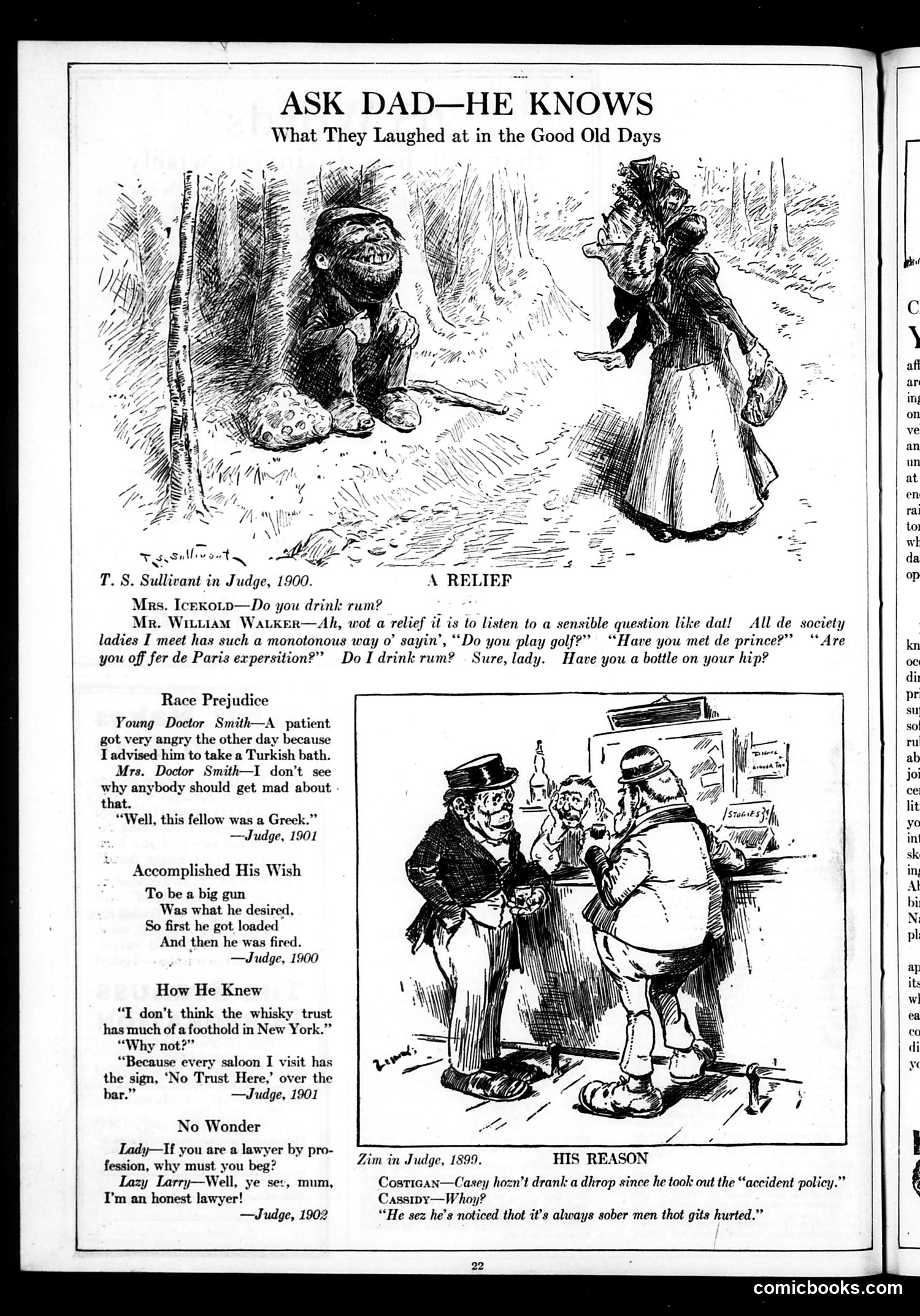
This page collects satirical jokes and cartoons from Judge (1899-1902), showcasing period humor targeting Irish and immigrant communities, along with social commentary on drinking culture and professions. **Key Content:** The top cartoon depicts a man with exaggerated racial caricature features speaking to a woman in what appears to be a forest setting—illustrating stereotypical immigrant or working-class speech patterns. **Recurring Themes:** - **Ethnic stereotyping**: Multiple jokes mock Irish immigrants ("Casey," "Costigán") and Greeks, using dialect humor - **Alcohol culture**: Heavy drinking is portrayed as normal among working-class men and mistrusted in business - **Professional dishonesty**: Lawyers are depicted as inherently deceptive - **Insurance satire**: One joke darkly suggests a man avoids drinking to collect accident insurance rather than stay safe The humor relies entirely on ethnic caricature, class-based stereotypes, and assumptions about immigrant behavior that modern readers would recognize as crude prejudice. The "relief" framing suggests these represent jokes considered acceptable entertainment in that era.
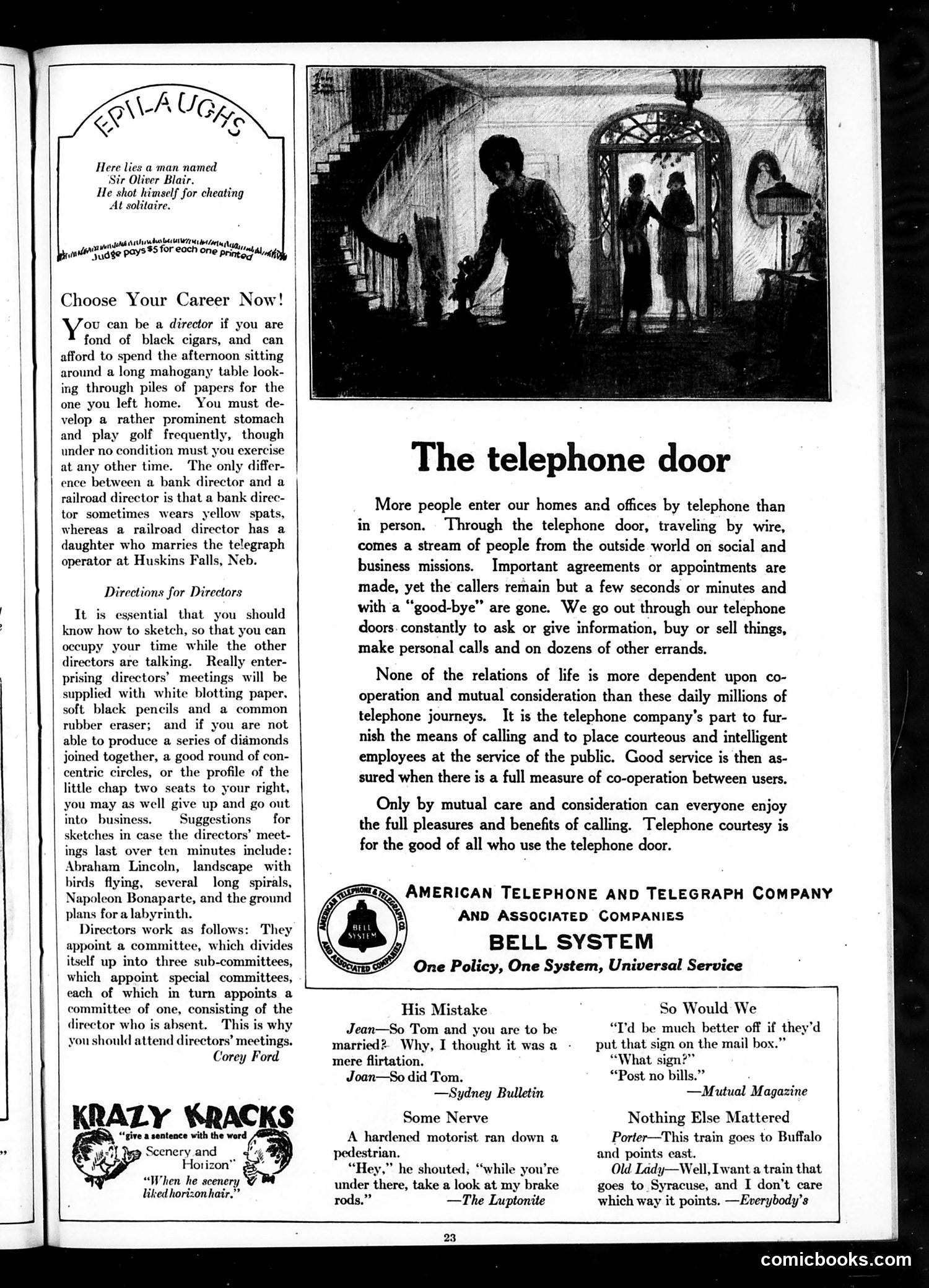
This Judge magazine page contains satirical commentary on corporate life and a Bell System advertisement. **The "Choose Your Career Now!" section** mocks corporate directors as lazy, incompetent bureaucrats who spend afternoons sketching doodles while pretending to work. The satire suggests directors are distinguished only by trivial markers (cigars, golf habits, yellow spats) and that their committee structure is deliberately circular nonsense—designed so absent directors stay absent. This reflects early 20th-century skepticism about corporate management's actual productivity. **The "Telephone Door" section** is a earnest Bell System advertisement (not satire) framing the telephone as a gateway enabling modern business and social life. It emphasizes mutual responsibility between company and users for "courtesy." **The bottom jokes** are light humor about misunderstandings and life priorities—unrelated to the page's main content. The page juxtaposes corporate satire with corporate advertising, a common Judge strategy highlighting the gap between how institutions presented themselves and public perception of their actual function.
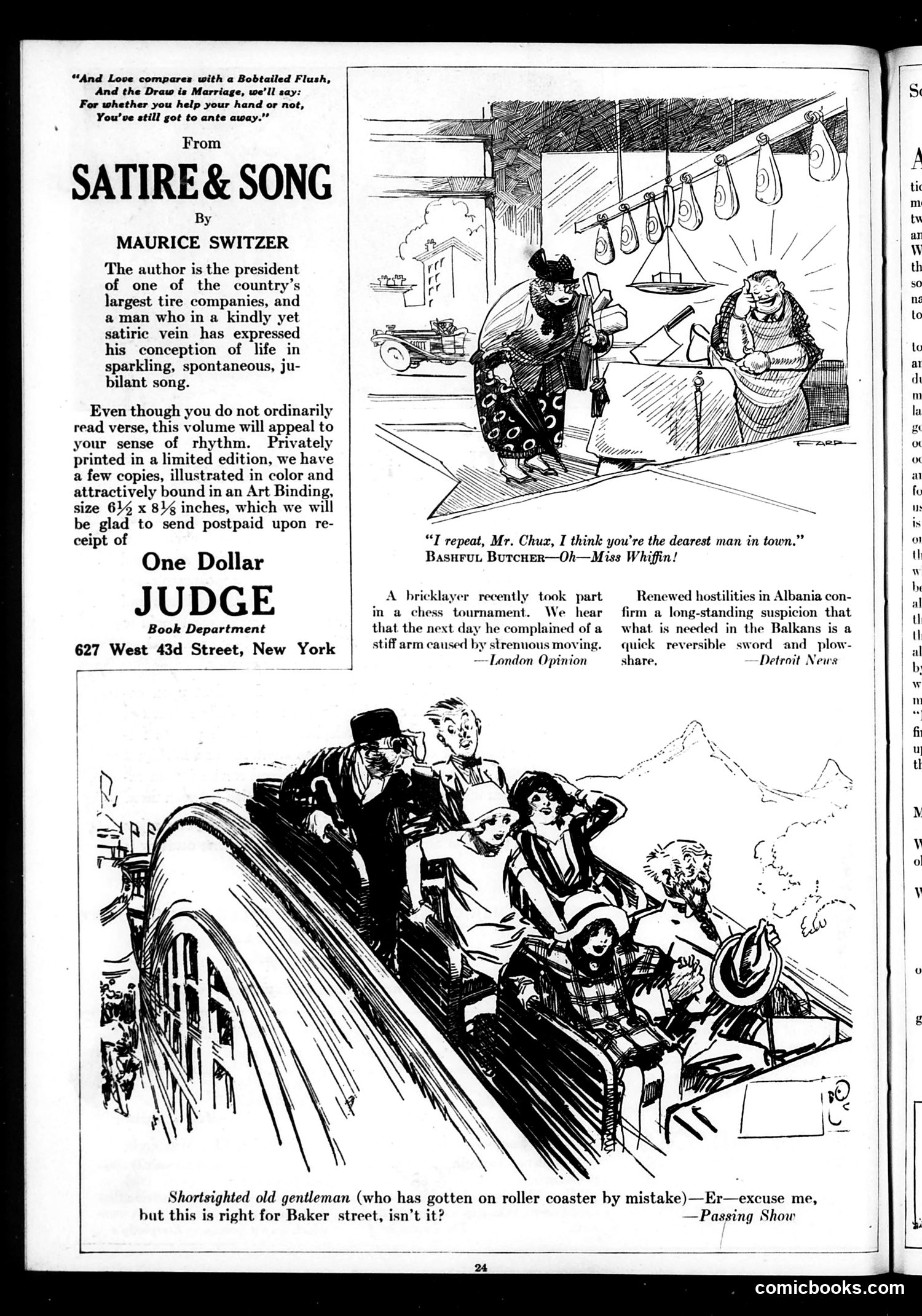
This page contains **advertising and humor** rather than political cartoons. The top section advertises Maurice Switzer's book *Satire & Song*—a poetry collection by the president of a tire company, emphasizing its witty, satirical nature. Below are three separate **joke cartoons**: 1. **"Dearest Man in Town"**: A flirtation joke where a woman compliments a man (Mr. Chuz), attributed to "Bashful Butcher." 2. **Chess/Bricklayer joke**: A pun about a bricklayer in a chess tournament complaining of arm stiffness from "strenuous moving"—playing on the double meaning of chess moves and physical labor. 3. **Roller Coaster mishap**: An elderly, nearsighted man accidentally boards a roller coaster, confusing it with Baker Street transportation, asking if this is the right direction. These are light, pun-based humor typical of Judge magazine's style—no deep political content, just genteel comic amusement for early 20th-century readers.
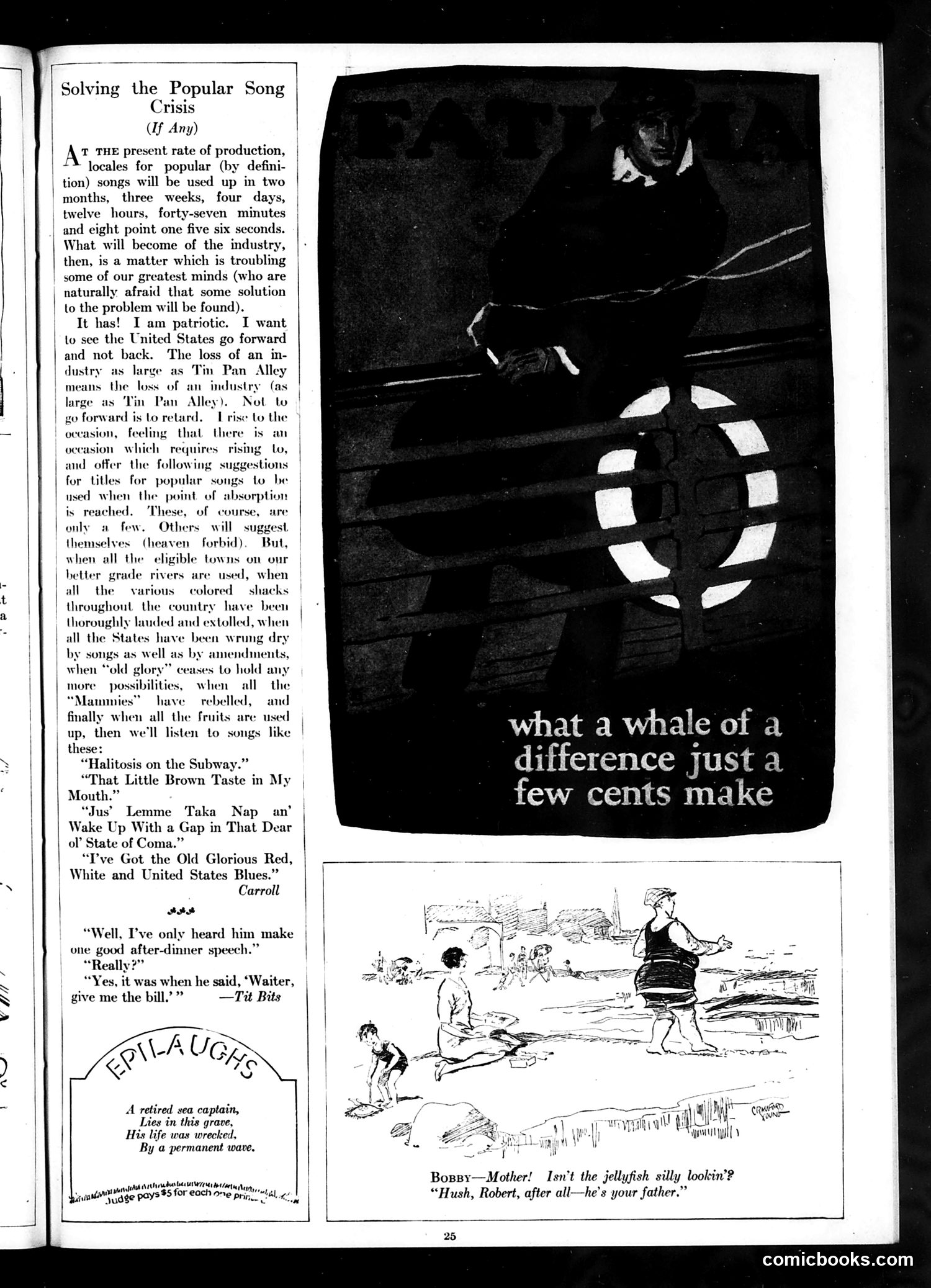
The main article satirizes the impending crisis in Tin Pan Alley (the popular music industry). The author humorously warns that at current production rates, all possible song subjects—geographical locations, states, iconic imagery like the American flag—will be exhausted within months. He offers absurdist alternative song titles like "Halitosis on the Subway" and "That Little Brown Taste in My Mouth" to mock how banal and exhausted popular song topics have become. The upper advertisement promotes a product with the slogan "what a whale of a difference just a few cents make," using a theatrical/nautical image. The bottom cartoon depicts a beach scene where a mother responds to her son's question about a jellyfish looking silly by saying "he's your father"—a common joke structure of the era making fun of absent or ineffectual fathers. The page reflects early 20th-century anxieties about mass cultural production and satirizes both the music industry's creative exhaustion and contemporary family humor conventions.
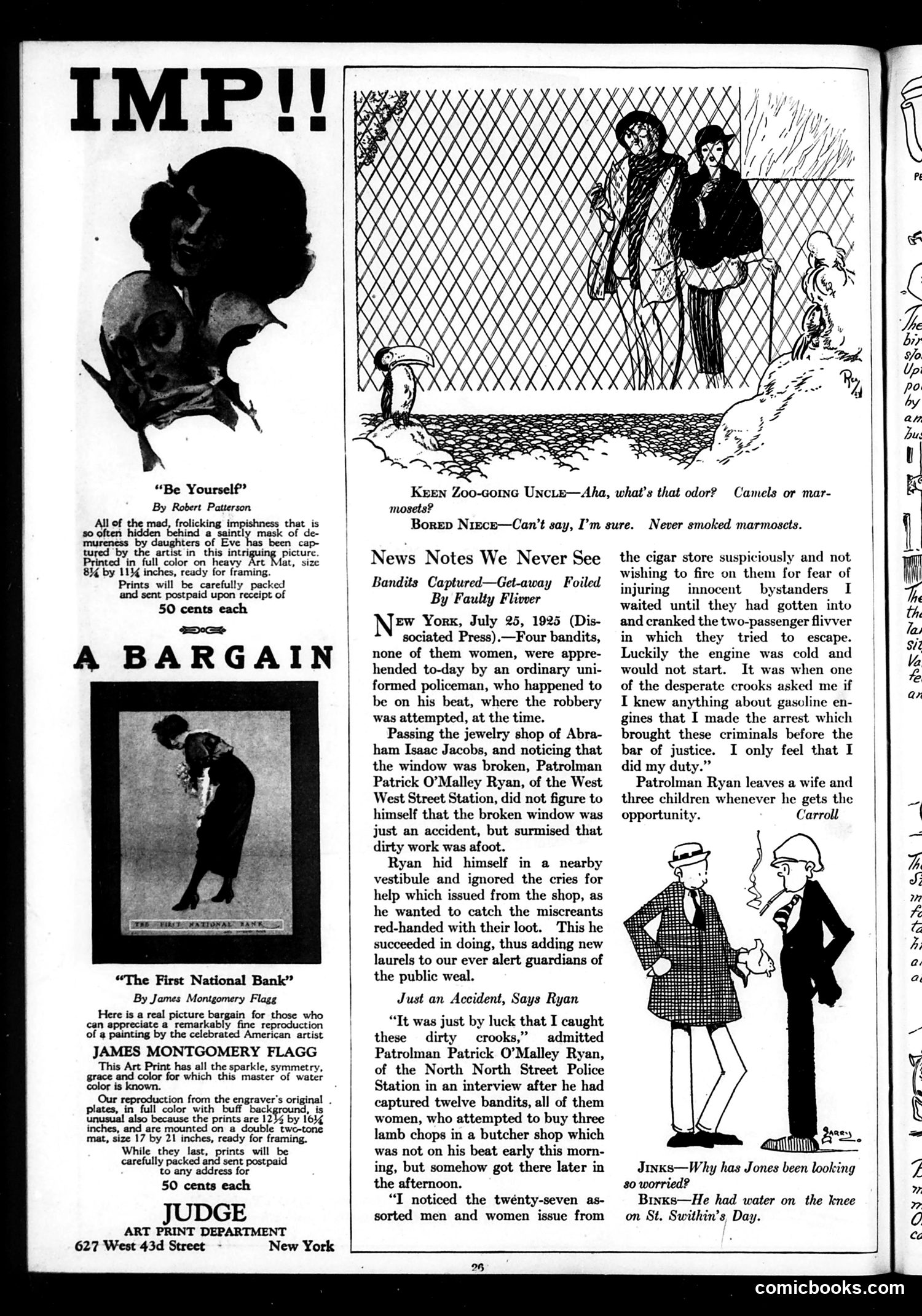
This page from Judge (dated July 25, 1925) contains satirical content mocking police incompetence and newspaper crime reporting: **"News Notes We Never See"** is a mock-heroic piece satirizing both newspapers' breathless crime coverage and police inefficiency. The headline promises a robbery foiled, but the story reveals absurdity: Patrolman Patrick O'Malley Ryan catches bandits almost accidentally—first "twelve bandits, all of them women" attempting to buy lamb chops at a butcher shop, then criminals escaping in a broken-down "flivver" (cheap car) that won't start. The satire targets how police take credit for trivial successes and how newspapers inflate minor incidents into heroic narratives. Ryan's admission—"It was just by luck"—undercuts the entire heroic framing, yet he still receives credit "for duty." The page also advertises art prints by James Montgomery Flagg and includes light humor about a zoo uncle and camels, plus a final joke about "water on the knee" on St. Swithin's Day (a weather folklore reference).
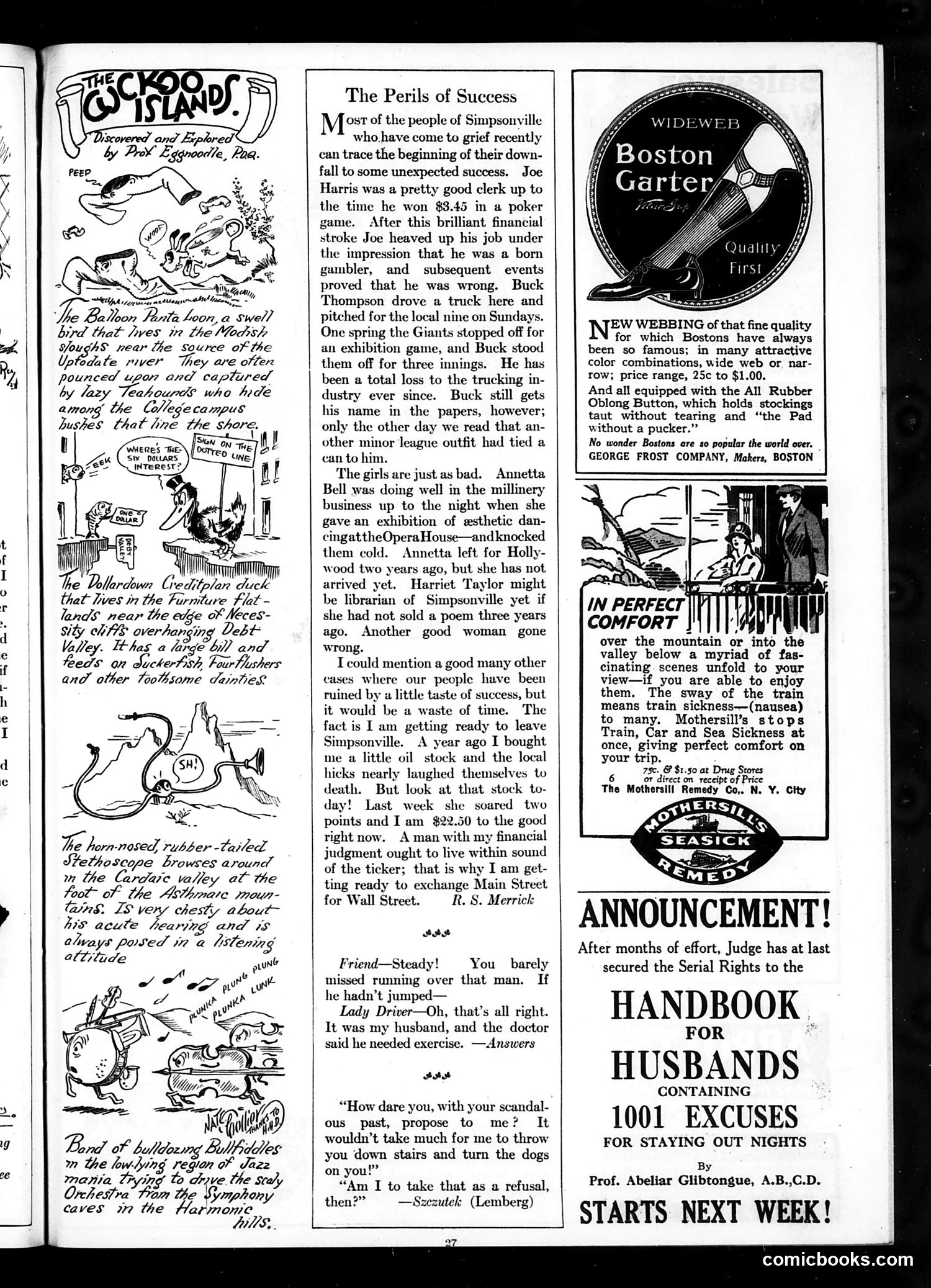
This page satirizes how unexpected success ruins ordinary people. The author traces Simpsonville residents' downfalls to minor windfalls: Joe Harris won $3.45 at poker and quit his clerk job, convinced he's a natural gambler; Buck Thompson pitched three innings against the Giants and abandoned his trucking career; dancer Annetta Bell went to Hollywood after one successful performance and disappeared; poet Harriet Taylor sold one poem and abandoned her librarian prospects. The irony: the author himself bought oil stock, saw it gain $22.50, and now considers himself financially astute enough to leave Main Street for Wall Street—seemingly unaware he's repeating the very pattern he's mocking. The humor lies in this self-deception: small success breeds dangerous overconfidence. The "Cuckoo Islands" cartoons on the left appear to be whimsical nature illustrations unrelated to the main article.
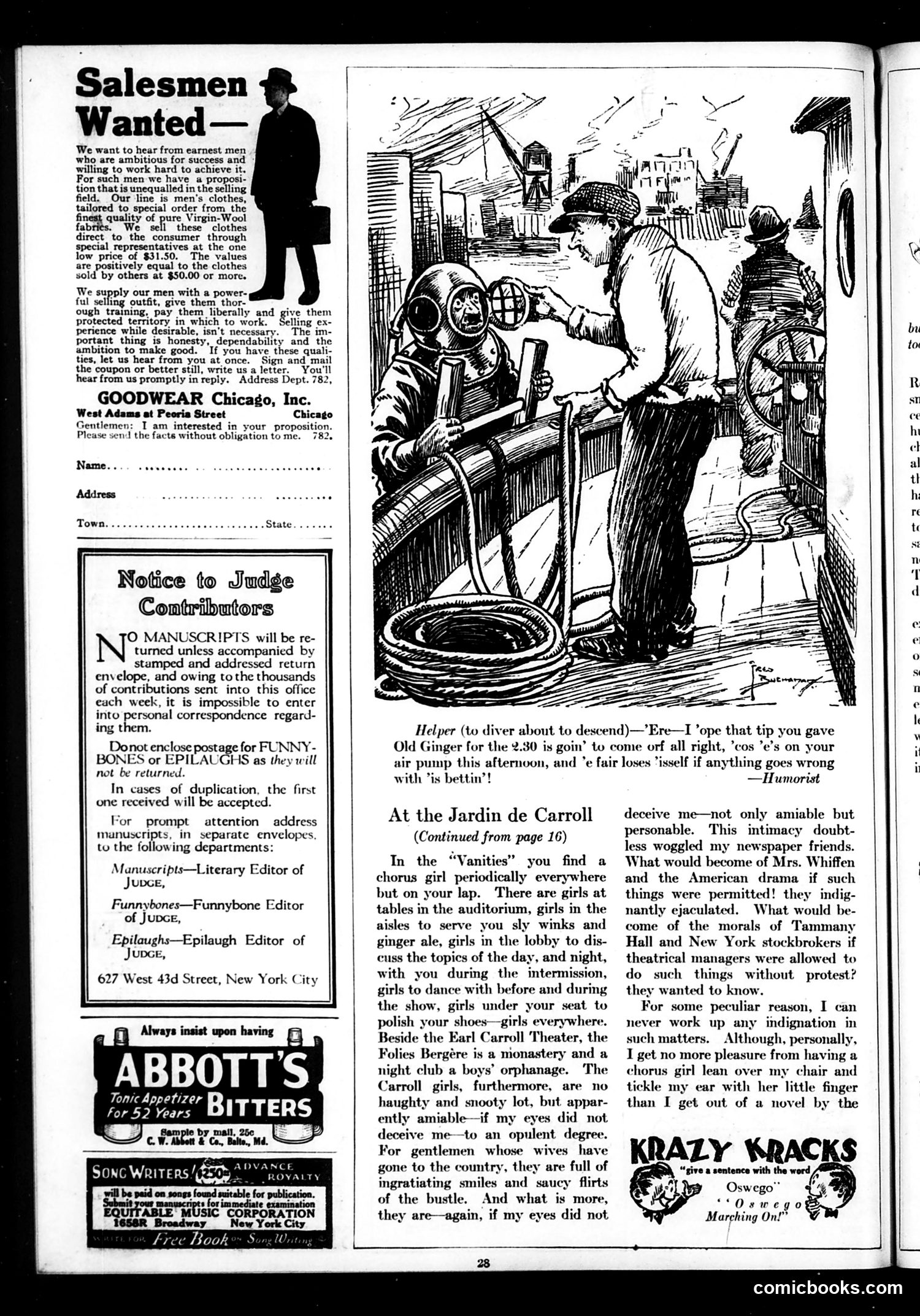
This page contains primarily **advertising and administrative content** rather than political satire. The main visual element is a cartoon depicting a **deep-sea diver** about to descend, with a helper offering a tip about a horse race bet ("Old Ginger for the 2.30"). The joke is that the diver hopes the tip proves worthwhile during his underwater work—a humorous contrast between dangerous labor and gambling speculation. The page is dominated by: - A job recruitment ad from Goodyear Chicago for suit salesmen - Publisher's notices about manuscript submissions - Patent medicine and music publishing advertisements The second column discusses the "Jardin de Carroll" (Earl Carroll Theater), noting its abundance of chorus girls and contrasting American theatrical propriety with French venues like the Folies Bergère. This reflects 1920s anxieties about theatrical morality and female performers. **No significant political satire is evident** on this page—it reflects typical Judge magazine content mixing humor, advertising, and social commentary about entertainment and commerce.
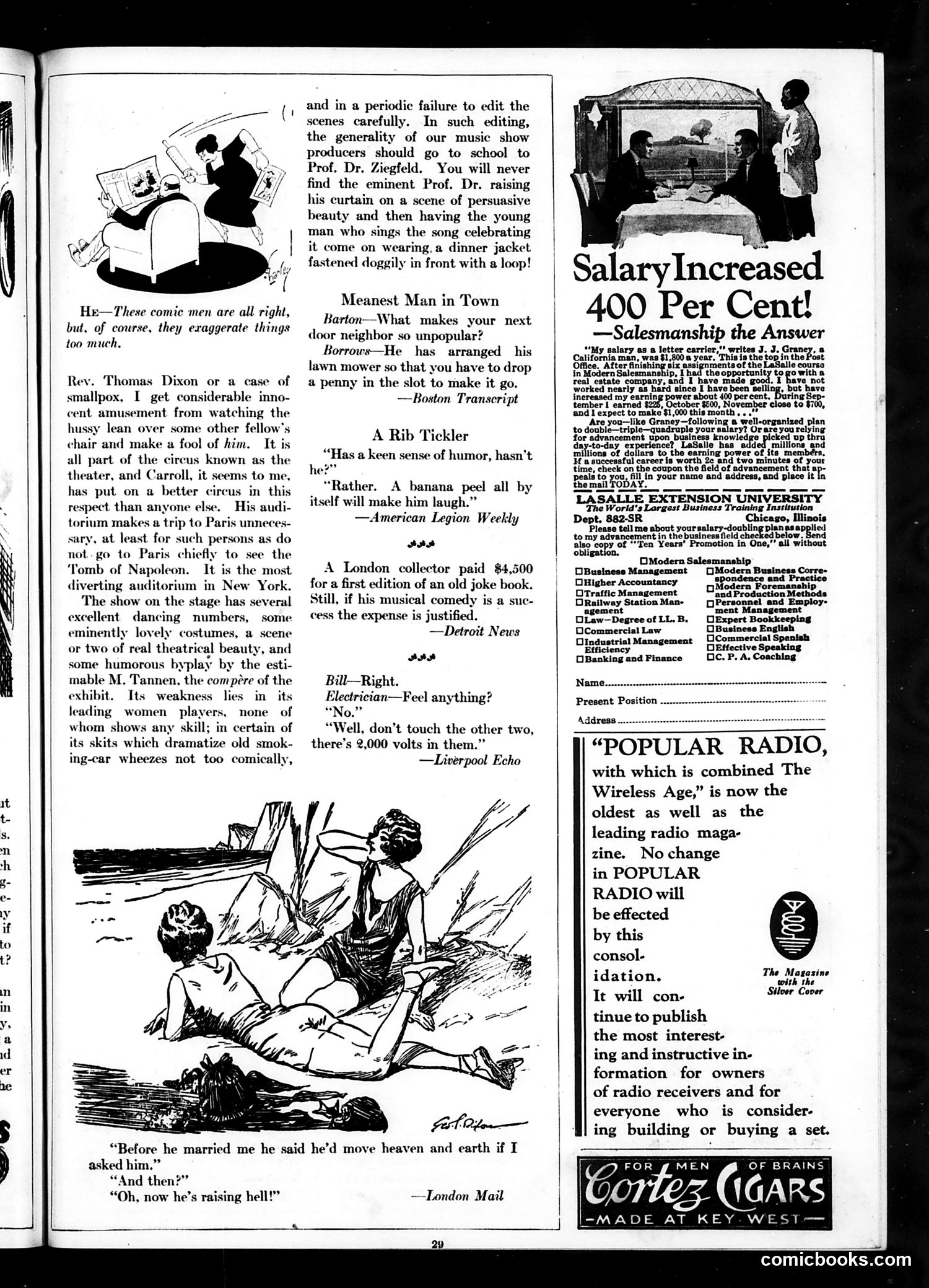
This page contains several humorous anecdotes and advertisements typical of early 20th-century American humor magazines. **The main cartoons/jokes** poke fun at everyday frustrations: - A review of a theatrical production criticizes weak performances by leading actresses and poorly edited scenes, referencing Florenz Ziegfeld (famous theater producer) as a model of professional standards. - "Meanest Man in Town" jokes about a neighbor who installed a penny slot on his lawn mower—satirizing both penny-pinching and the emerging slot-machine culture. - "A Rib Tickler" mocks someone with such simple humor that a banana peel alone makes him laugh. - A final marriage joke plays on the contrast between a husband's pre-marriage promises versus his current behavior. **The right side** features a LaSalle Extension University advertisement claiming a mail carrier increased his salary 400% through their business courses—a common sales pitch for correspondence schools of this era, targeting working-class readers seeking advancement. The page reflects period concerns: theatrical quality, neighborly annoyance, and economic self-improvement aspirations.
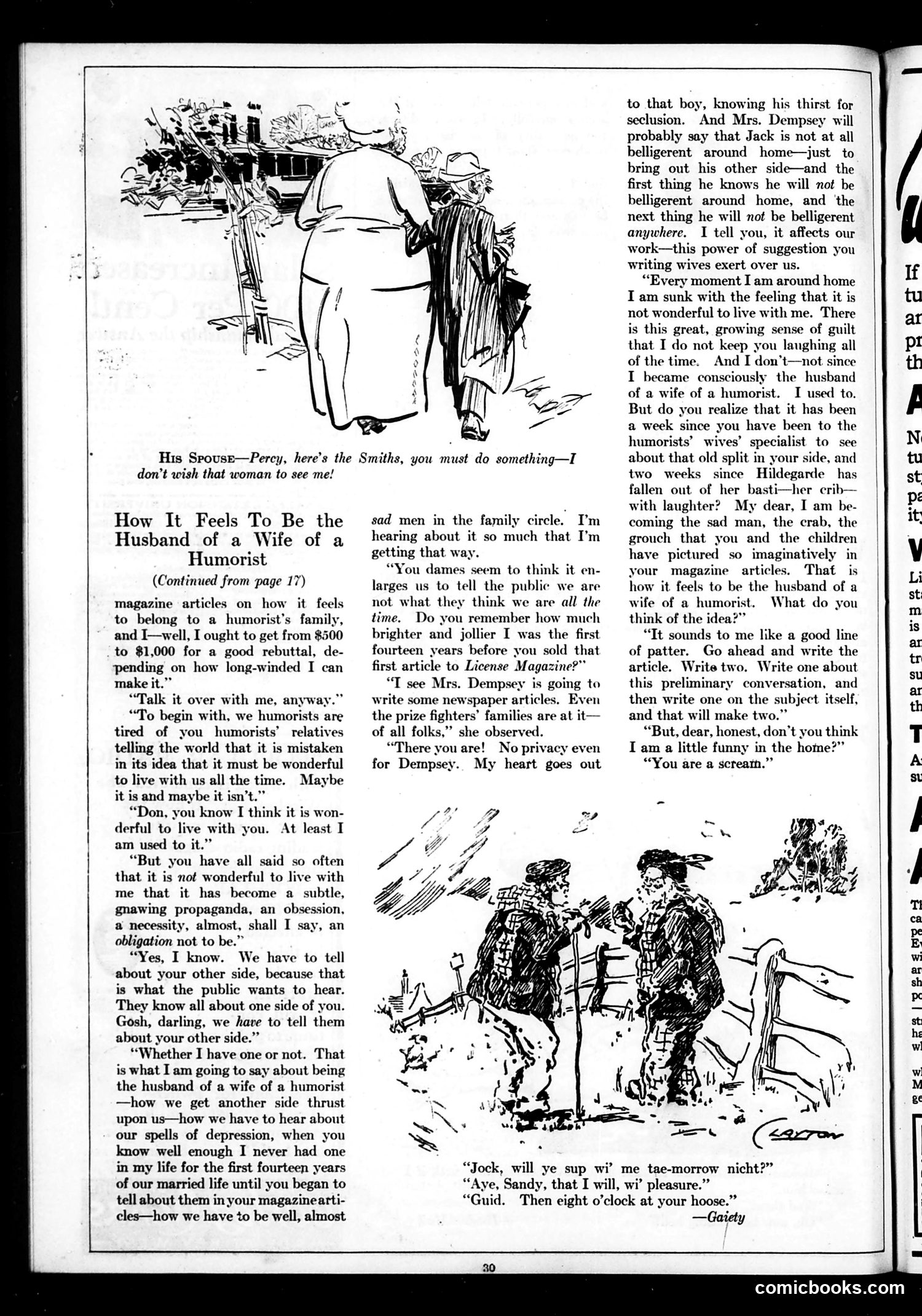
This satirical article mocks the trend of women humorists publishing magazine pieces about their domestic lives—specifically, wives writing unflattering accounts of their husbands' personalities to entertain readers. The central complaint: a husband argues that his wife's published articles claiming he's melancholy, difficult, or unfunny have become self-fulfilling prophecies. By repeatedly telling the public he's "not wonderful to live with," she's actually made him depressed and genuinely unhappy. He notes he was cheerful before she started selling articles to magazines like *Life*. The satire targets both the exploitative nature of "domestic life" magazine writing and the absurdity of women profiting from intimate family details. A secondary joke references boxer Jack Dempsey and his wife similarly monetizing their private life, suggesting this is becoming a widespread problem. The bottom cartoon (unrelated) shows Scottish dialect humor.
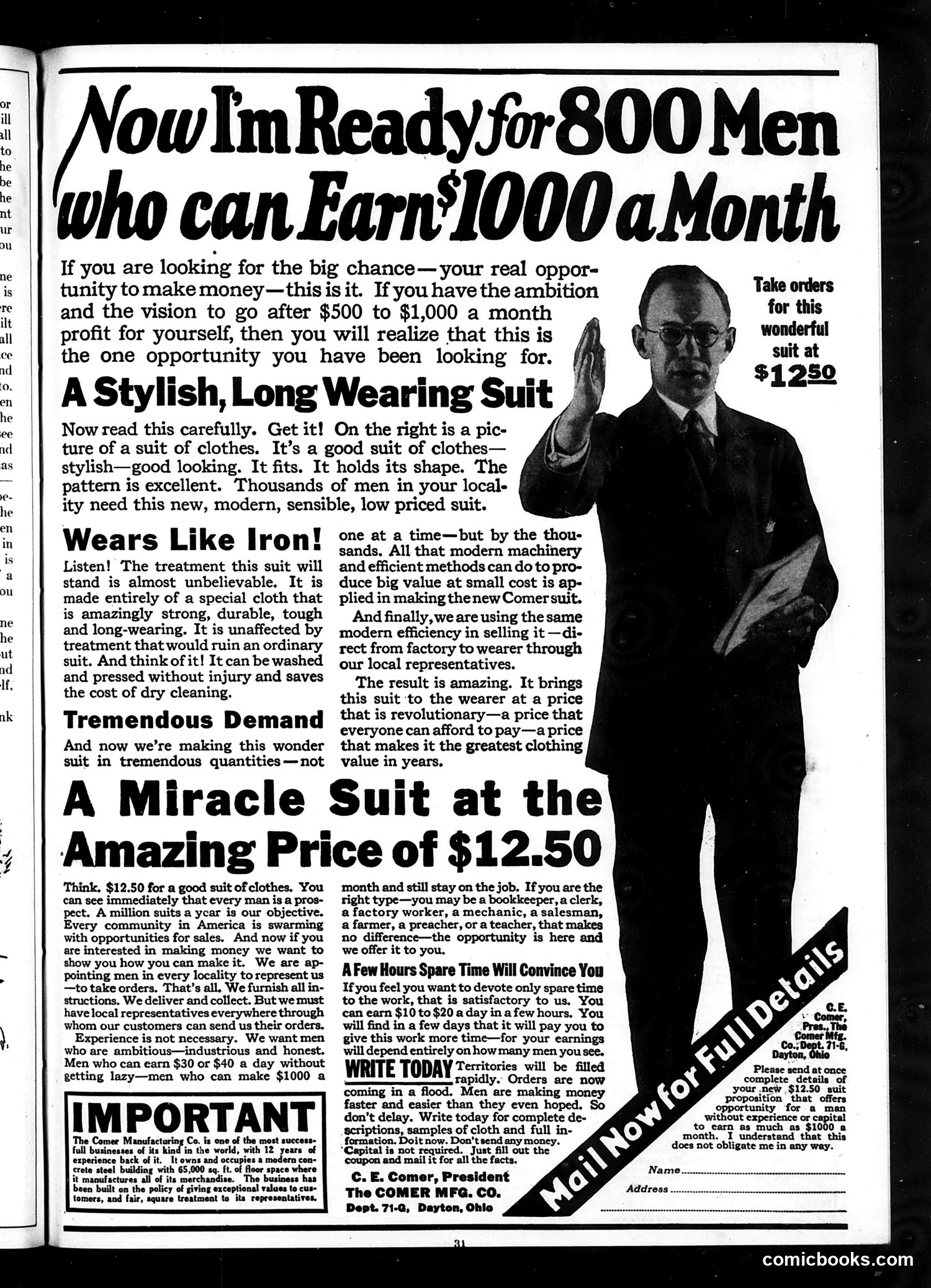
This is primarily a **sales advertisement**, not a political cartoon. The Comer Manufacturing Company is recruiting door-to-door salesmen to sell suits at $12.50 each, promising agents $30-$40 daily ($500-$1,000 monthly profit). **The pitch's appeal to modern readers:** The ad exploits economic anxiety common in the early 20th century, targeting ambitious but struggling men with promises of quick wealth requiring "no experience necessary." The language emphasizes the suit's durability ("Wears Like Iron") and revolutionary affordability to justify sales potential—every man supposedly a prospect. **What's revealing historically:** This reflects the era's direct sales/commission model before modern employment regulations, minimal consumer protection, and manufacturers' willingness to make expansive earnings claims. The photo shows a professional man in business dress, implying the suit signals respectability and upward mobility. **Notable:** The ad's aggressive recruitment language ("Territories will be filled rapidly") suggests this business model was competitive and time-sensitive—common pressure tactics in boom-era sales schemes.
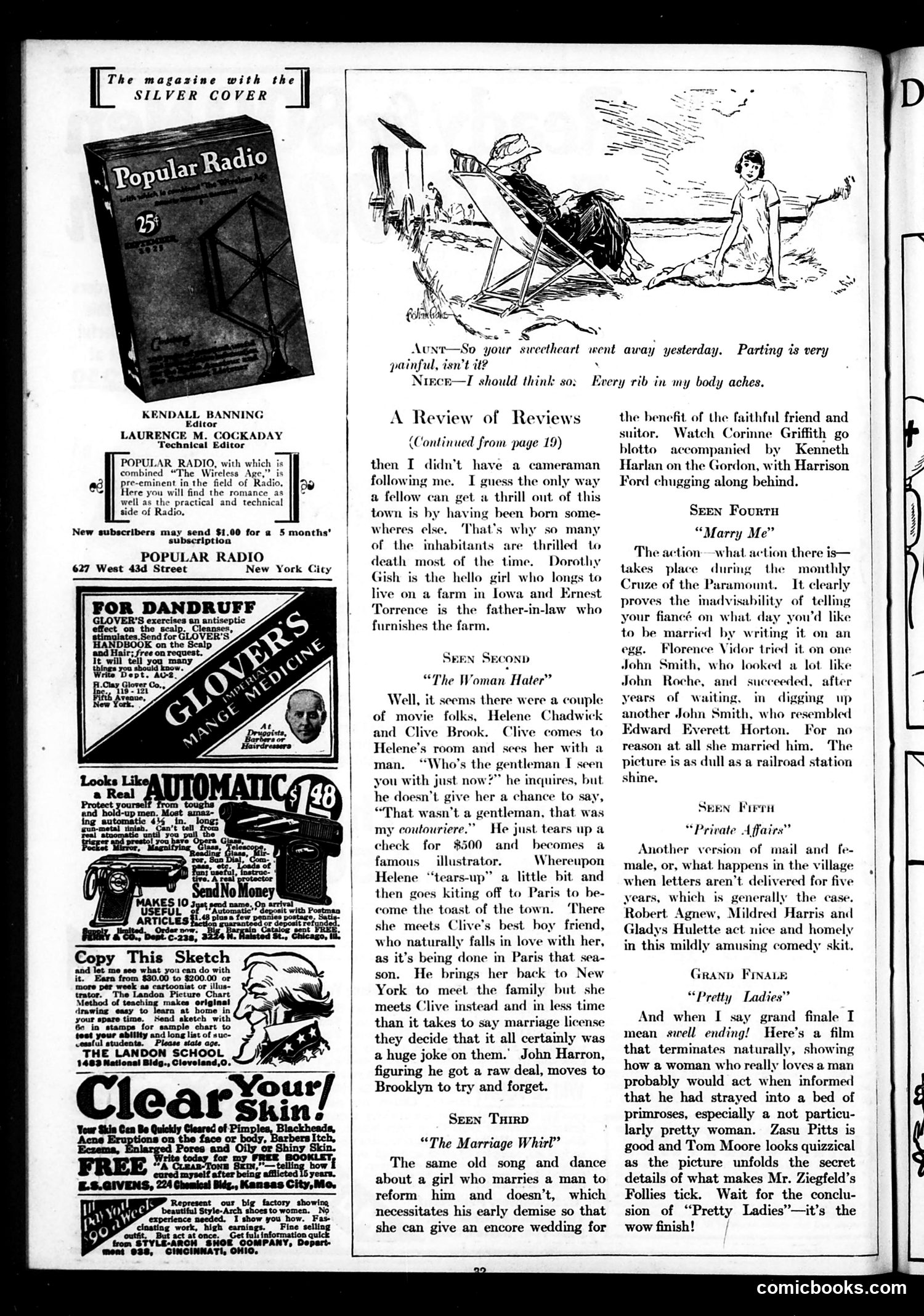
This page is primarily **advertising and film reviews** rather than political satire. The left side features ads for Popular Radio magazine, dandruff treatment, and other products typical of 1920s magazines. The main content is "A Review of Reviews"—brief, sarcastic critiques of five silent films: *The Woman Hater*, *The Marriage Whirl*, *Marry Me*, *Private Affairs*, and *Pretty Ladies*. The reviewer employs dry humor, mocking predictable plots and wooden performances. For example, *Marry Me* is dismissed as "as dull as a railroad station shine," while *The Marriage Whirl* features the tired trope of a woman marrying a man to reform him. The single cartoon at the top—showing an aunt and niece discussing a sweetheart's departure—is a mild joke about romantic heartbreak, with the niece complaining that "every rib in my body aches" from the pain of separation. This page reflects 1920s entertainment culture and advertising rather than political commentary.
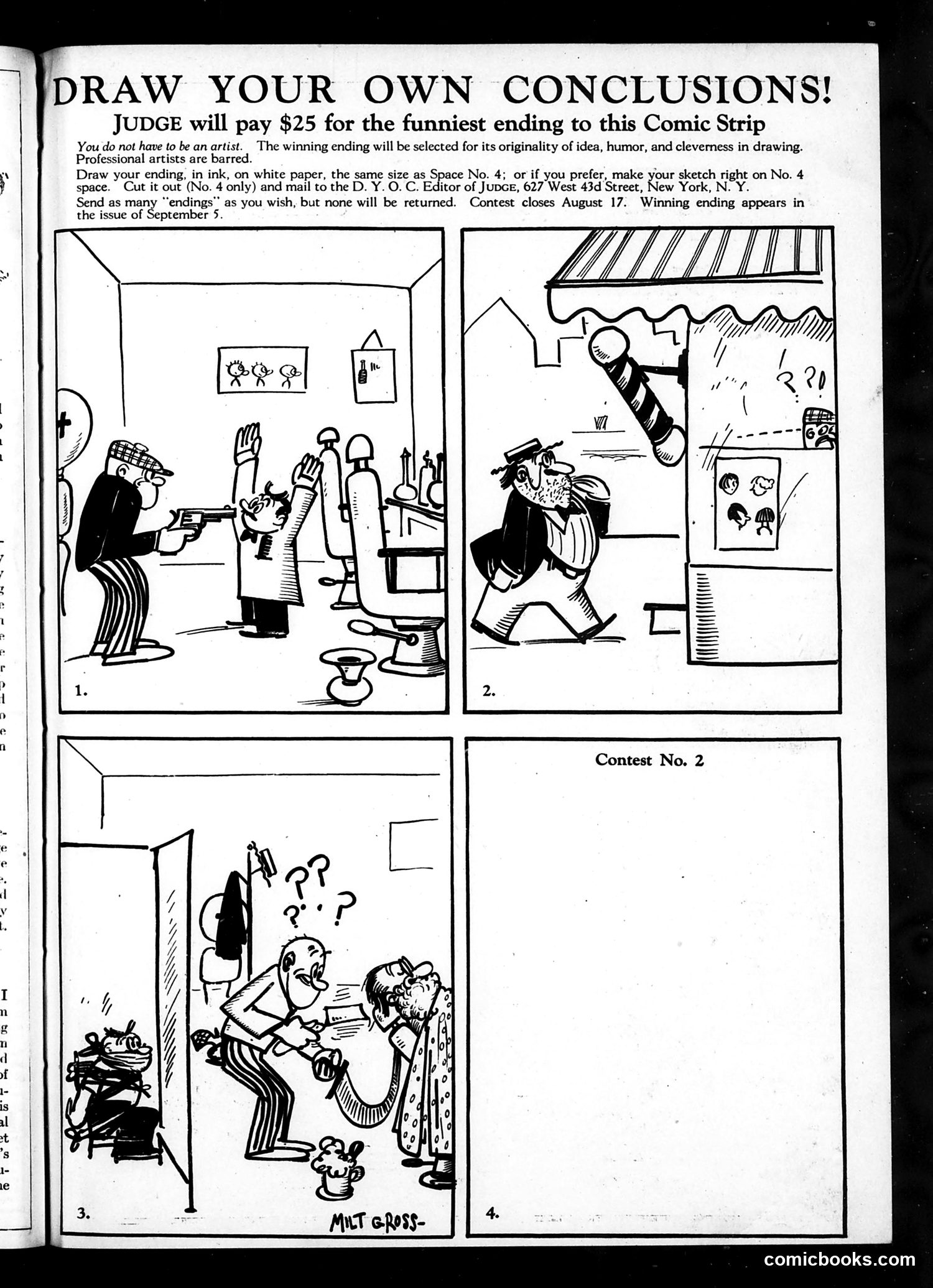
This is a reader-participation contest page, not political commentary. Judge magazine invited amateur submissions to complete comic strip narratives—a populist entertainment feature. Three incomplete comic strips are shown: 1. **Panel 1**: A man with a gun confronts what appear to be laboratory assistants or scientists, suggesting a crime or heist scenario. 2. **Panel 2**: A burglar escapes through a window while someone pursues, implying a theft or break-in story. 3. **Panel 3**: (Signed "Milt Gross") A confused man confronts a woman at a door with question marks overhead—ambiguous domestic or comedic situation. **Panel 4** is blank—readers' space to provide the ending. The contest offered $25 (substantial money in this era) for the cleverest conclusion, barring professional artists to ensure amateur participation. This reflects early-20th-century mass audience engagement with popular humor publications.
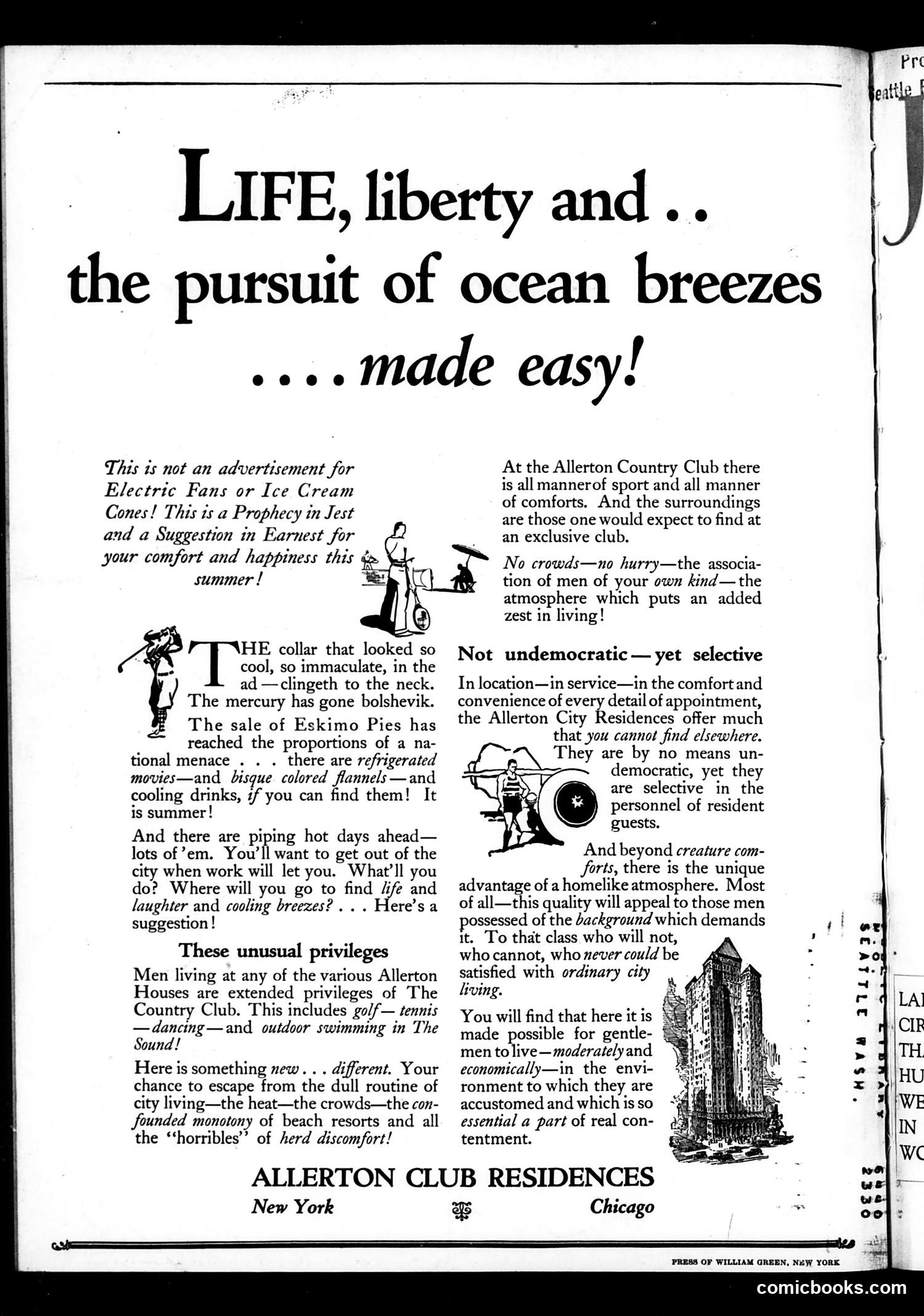
This is primarily **advertising disguised as social commentary** for the Allerton Club Residences. The satire targets early 1920s urban discomfort—"mercury has gone bolshevik" is a joke equating summer heat with radical politics (Bolshevism was a contemporary fear). References to Eskimo Pies and refrigerated drinks mock the desperation of hot-weather relief. The real message, however, is a class-based pitch: the Allerton Club offers wealthy men escape from "herd discomfort" and "ordinary city living" while maintaining exclusivity. The phrase "Not undemocratic—yet selective" is the key contradiction: the ad claims egalitarian principles while explicitly screening residents by social "background." The cartoon illustrates gentlemen enjoying leisure—golf, tennis, swimming—contrasting urban heat and crowds with exclusive country-club comfort. This appeals to the interwar upper-class anxiety about maintaining status while appearing modern and reasonable.