
Judge, 1925-08-08 · page 17 of 36
Judge — August 8, 1925 — page 17: what you’re looking at
What you’re looking at
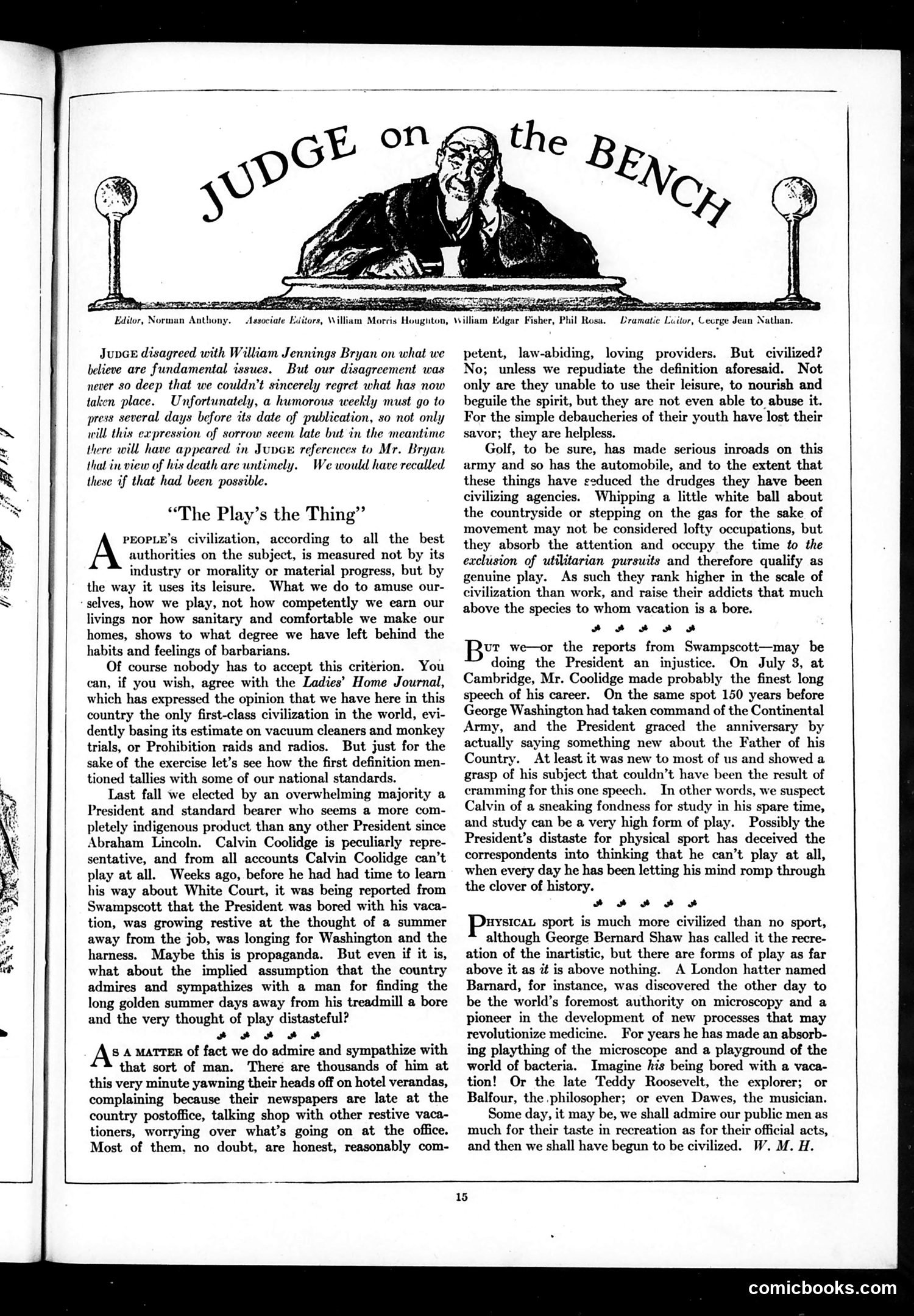
This page contains an editorial tribute following William Jennings Bryan's death. The editor acknowledges that Judge magazine disagreed with Bryan on "fundamental issues" but expresses regret that critical references to him will appear in upcoming issues before the publication date—a constraint of weekly magazine production. The main article, "The Play's the Thing," satirizes American civilization and President Calvin Coolidge specifically. Judge argues that a society's leisure activities—not industrial progress—measure true civilization. The piece mocks Coolidge as the epitome of American failure: he reportedly found vacation boring, preferred work to play, and couldn't enjoy leisure time. This criticizes both the president and the broader American work culture he represents—millions of businessmen similarly unable to relax or enjoy themselves beyond golf and automobiles. The satire suggests that Americans' inability to truly play or amuse themselves (despite claiming superior civilization) reveals their barbarism, contrasting sharply with the "Ladies' Home Journal" position that America's civilization rests on vacuum cleaners and material goods.
📄 Transcribed text from this page (OCR, searchable)
Machine-transcribed from the original scan — historical spelling and the odd misread are preserved.
Chores A Editor, Norman Anthony. is Houghton, JuvGE disagreed with William Jennings Bryan on what we believe are fundamental issues. But our disagreement was never so deep that we couldn’t sincerely regret what has now taken place. Unfortunately, a humorous weekly must go to press several days before its date of publication, so not only will this expression of sorrow seem late but in the meantime there will have appeared in JuvcE references to Mr. Bryan that in view of his death are untimely. We would have recalled these if that had been possible. “The Play’s the Thing” PEOPLE’s civilization, according to all the best A authorities on the subject, is measured not by its industry or morality or material progress, but by the way it uses its leisure. What we do to amuse our- - selves, how we play, not how competently we earn our livings nor how sanitary and comfortable we make our homes, shows to what degree we have left behind the habits and feelings of barbarians. Of course nobody has to accept this criterion. You can, if you wish, agree with the Ladies’ Home Journal, which has expressed the opinion that we have here in this country the only first-class civilization in the world, evi- dently basing its estimate on vacuum cleaners and monkey trials, or Prohibition raids and radios. But just for the sake of the exercise let’s see how the first definition men- tioned tallies with some of our national standards. Last fall we elected by an overwhelming majority a President and standard bearer who seems a more com- pletely indigenous product than any other President since Abraham Lincoln. Calvin Coolidge is peculiarly repre- sentative, and from all accounts Calvin Coolidge can’t play at all. Weeks ago, before he had had time to learn his way about White Court, it was being reported from Swampscott that the President was bored with his vaca- tion, was growing restive at the thought of a summer away from the job, was longing for Washington and the harness. Maybe this is propaganda. But even if it is, what about the implied assumption that the country admires and sympathizes with a man for finding the long golden summer days away from his treadmill a bore and the very thought of play distasteful? ee eas As A MATTER of fact we do admire and sympathize with that sort of man. There are thousands of him at this very minute yawning their heads off on hotel verandas, complaining because their newspapers are late at the country postoffice, talking shop with other restive vaca- tioners, worrying over what’s going on at the office. Most of them, no doubt, are honest, reasonably com- . William Edgar her, Phil Rosa, Lramatic Laitor, Cecrge Jean Nathan. petent, law-abiding, loving providers. But civilized? No; unless we repudiate the definition aforesaid. Not only are they unable to use their leisure, to nourish and beguile the spirit, but they are not even able to abuse it. For the simple debaucheries of their youth have lost their savor; they are helpless. Golf, to be sure, has made serious inroads on this army and so has the automobile, and to the extent that these things have seduced the drudges they have been civilizing agencies. Whipping a little white ball about the countryside or stepping on the gas for the sake of movement may not be considered lofty occupations, but they absorb the attention and occupy the time to the exclusion of utilitarian pursuits and therefore qualify as genuine play. As such they rank higher in the scale of civilization than work, and raise their addicts that much above the species to whom vacation is a bore. FAA aS Bz we—or the reports from Swampscott—may be doing the President an injustice. On July 3, at Cambridge, Mr. Coolidge made probably the finest long speech of his career. On the same spot 150 years before George Washington had taken command of the Continental Army, and the President graced the anniversary by actually saying something new about the Father of his Country. At least it was new to most of us and showed a grasp of his subject that couldn’t have been the result of cramming for this one speech. In other words, we suspect. Calvin of a sneaking fondness for study in his spare time, and study can be a very high form of play. Possibly the President’s distaste for physical sport has deceived the correspondents into thinking that he can’t play at all, when every day he has been letting his mind romp through the clover of history. Cr a ee eo Prmstca sport is much more civilized than no sport, although George Bernard Shaw has called it the recre- ation of the inartistic, but there are forms of play as far above it as it is above nothing. A London hatter named Barnard, for instance, was discovered the other day to be the world’s foremost authority on microscopy and a pioneer in the development of new processes that may revolutionize medicine. For years he has made an absorb- ing plaything of the microscope and a playground of the world of bacteria. Imagine his being bored with a vaca- tion! Or the late Teddy Roosevelt, the explorer; or Balfour, the philosopher; or even Dawes, the musician. Some day, it may be, we shall admire our public men as much for their taste in recreation as for their official acts, and then we shall have begun to be civilized. W. M. H. comicbooks.com