
Judge, 1925-08-08 · page 27 of 36
Judge — August 8, 1925 — page 27: what you’re looking at
What you’re looking at
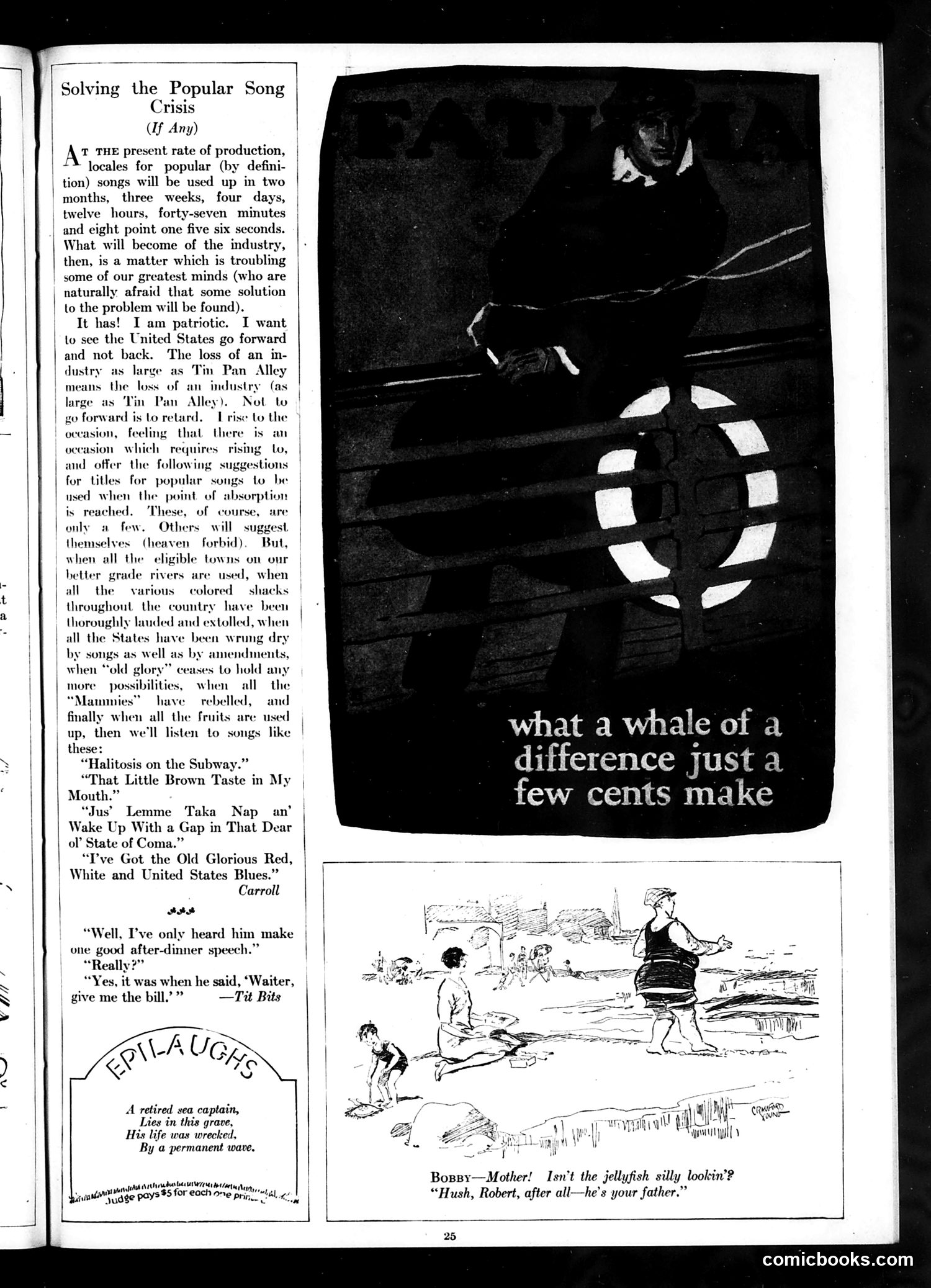
The main article satirizes the impending crisis in Tin Pan Alley (the popular music industry). The author humorously warns that at current production rates, all possible song subjects—geographical locations, states, iconic imagery like the American flag—will be exhausted within months. He offers absurdist alternative song titles like "Halitosis on the Subway" and "That Little Brown Taste in My Mouth" to mock how banal and exhausted popular song topics have become. The upper advertisement promotes a product with the slogan "what a whale of a difference just a few cents make," using a theatrical/nautical image. The bottom cartoon depicts a beach scene where a mother responds to her son's question about a jellyfish looking silly by saying "he's your father"—a common joke structure of the era making fun of absent or ineffectual fathers. The page reflects early 20th-century anxieties about mass cultural production and satirizes both the music industry's creative exhaustion and contemporary family humor conventions.
📄 Transcribed text from this page (OCR, searchable)
Machine-transcribed from the original scan — historical spelling and the odd misread are preserved.
VHA” NSF Solving the Popular Song Crisis (If Any) T THE present rate of production, ~* locales for popular (by defini- tion) songs will be used up in two months, three weeks, four days, twelve hours, forty-seven minutes and eight point one five six seconds. What will become of the industry, then, is a matter which is troubling some of our greatest minds (who are naturally afraid that some solution to the problem will be found). It has! I am patriotic. I want lo see the United States go forward and not back. The loss of an in- | dustry as large as Tin Pan Alley means the loss of an industry (as large as ‘Tin Pan Alley). Not go forward is to retard. | [rise Lo the ceasion, feeling that there is an weasion which requires rising lo, and offer the following suggestions for titles for popular songs to be | | used when the point. of absorption is reached. These, of course, only a few. Others will sugg themselves (heaven forbid). But, when all the eligible towns on our better grade ers ure used, when all the various colored — shacks throughout the country have been thoroughly lauded and extolled, when | all the States have been wrung dry by songs as well as by amendments, when “old glory es lo hold any more possibilities, when all the “Mammies” have rebelled, and finally when all the fruits are used up, then we'll listen to songs like these: “Halitosis on the Subway.” “That Little Brown Taste in My Mouth.” “Jus’ Lemme Taka Nap an’ Wake Up With a Gap in That Dear ol’ State of Coma.” “T’ve Got the Old Glorious Red, White and United States Blues.” Carroll Ra td “Well, I’ve only heard him make one good after-dinner speech.” “Really?” “Yes, it was when he said, ‘Waiter, give me the bill.’ ” —Tit Bits UGS Gat .UG Bs A retired sea captain, Lies in this grave, His life was wrecked, By a permanent wave. ahs dt dat eagle aN Ln pays 85 for e0ch ae prin @ “ . s bs what a whale of a difference just a few cents make <a Nh Ay yu] spotty 9 jain S Bossy—Mother! Isn't the jellyfish silly lookin’? “Hush, Robert, after all—he’s your father.” 25 comicbooks.com