
Judge, 1925-08-08 · page 5 of 36
Judge — August 8, 1925 — page 5: what you’re looking at
What you’re looking at
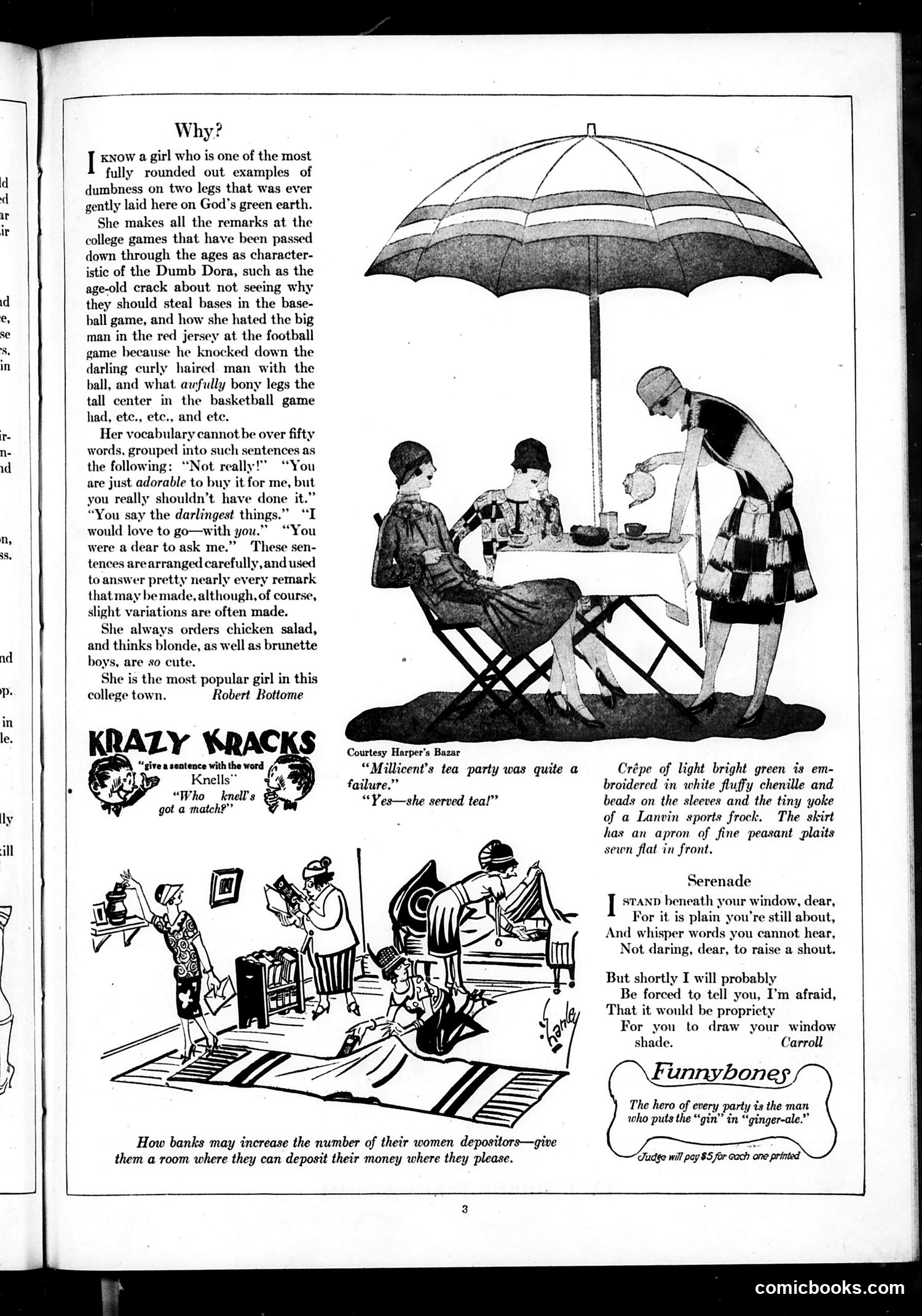
This page combines social satire with humor and advertisements typical of 1920s-era Judge magazine. **"Why?" essay** satirizes a stereotypical "dumb" college girl who makes nonsensical remarks about sports (stealing bases, knocking down players) and uses an extremely limited vocabulary. The piece mocks both her intellectual limitations and her popularity despite these deficiencies—reflecting period anxieties about modern women's education and social prominence. **"Serenade" poem** gently mocks romantic clichés of serenading beneath windows, humorously warning against disturbing window shades. **"Krazy Kracks"** and **"Funnybones"** are standard joke sections common to the era. The illustrated tea party scene and bank depositor cartoon are unrelated social commentary items. Overall, the page reflects 1920s satirical attitudes toward gender roles, romance, and modern social behavior.
📄 Transcribed text from this page (OCR, searchable)
Machine-transcribed from the original scan — historical spelling and the odd misread are preserved.
Why? Know a girl who is one of the most fully rounded out examples of dumbness on two legs that was ever gently laid here on God’s green earth. She makes all the remarks at the college games that have been passed down through the ages as character- istic of the Dumb Dora, such as the age-old crack about not seeing why they should steal bases in the base- ball game, and how she hated the big man in the red jersey at the football game because he knocked down the darling curly haired man with the ball, and what. azwfully bony legs the tall center in the basketball game had, ete., etc., and ete. Her vocabulary cannot be over fifty words, grouped into such sentences as the following: “Not really!" “You are just adorable to buy it for me, but you really shouldn’t have done it.” “You say the darlingest things.” “I would love to go—with you.” “You were a dear to ask me.” These sen- tences arearranged carefully,and used to answer pretty nearly every remark that may be made, although, of course, slight variations are often made. She always orders chicken salad, and thinks blonde, as well as brunette boys, are so cute. She is the most popular girl in this college town. Robert Bottome Knells” “Who knell’s got a match?” Courtesy Harper's Bazar “Millicent’s tea party was quite a failure.” “Yes—she served teal” How banks may increase the number of their women depositors—give them a room where they can deposit their money where they please. Crépe of light bright green is em- broidered in white fluffy chenille and beads on the sleeves and the tiny yoke of a Lanvin sports frock. The skirt has an apron of fine peasant plaits sewn flat in front. Serenade I STAND beneath your window, dear, For it is plain you're still about, And whisper words you cannot hear, Not daring, dear, to raise a shout. But shortly I will probably Be forced to tell you, I’m afraid, That it would be propriety For you to draw your window shade. Carroll Funnybones The hero of every party is the man who puts the “gin” in “ginger-ale.” comicbooks.com