
A complete issue · 36 pages · 1925
Judge — August 1, 1925
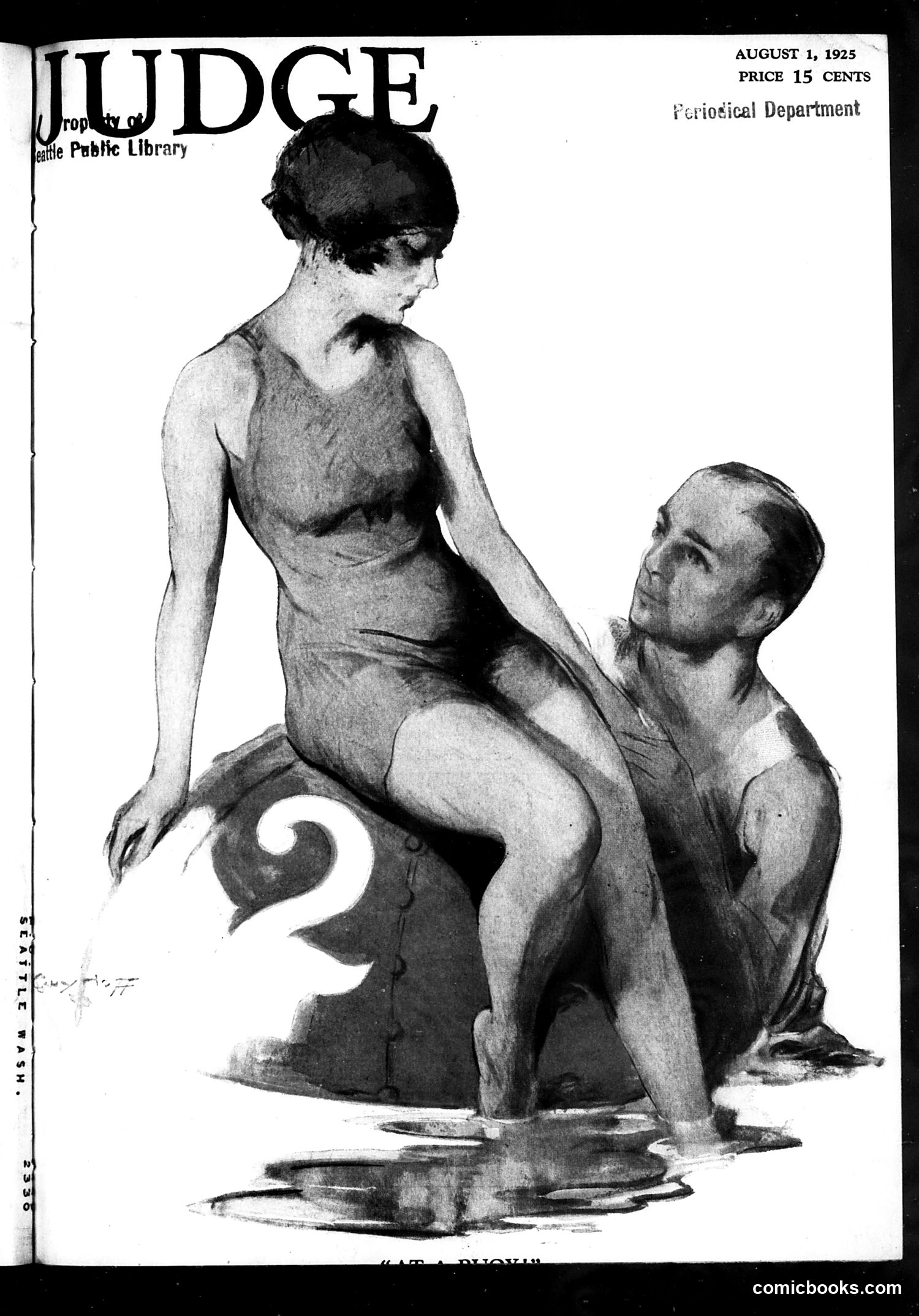
This appears to be a humorous illustration rather than political commentary. The image depicts two figures in swimwear positioned with a large question mark, suggesting uncertainty or confusion about the situation depicted. Given the 1925 date and bathing attire, this likely relates to contemporary debates about changing social mores—particularly the "flapper" era's more revealing fashions and shifting gender roles. The question mark may satirize public confusion or concern about modern courtship practices, dating customs, or appropriate behavior for women during this period of rapid social change. Without visible text identifying specific figures or events, the exact satirical target remains unclear, though it certainly comments on 1920s social anxieties about modernity and morality.
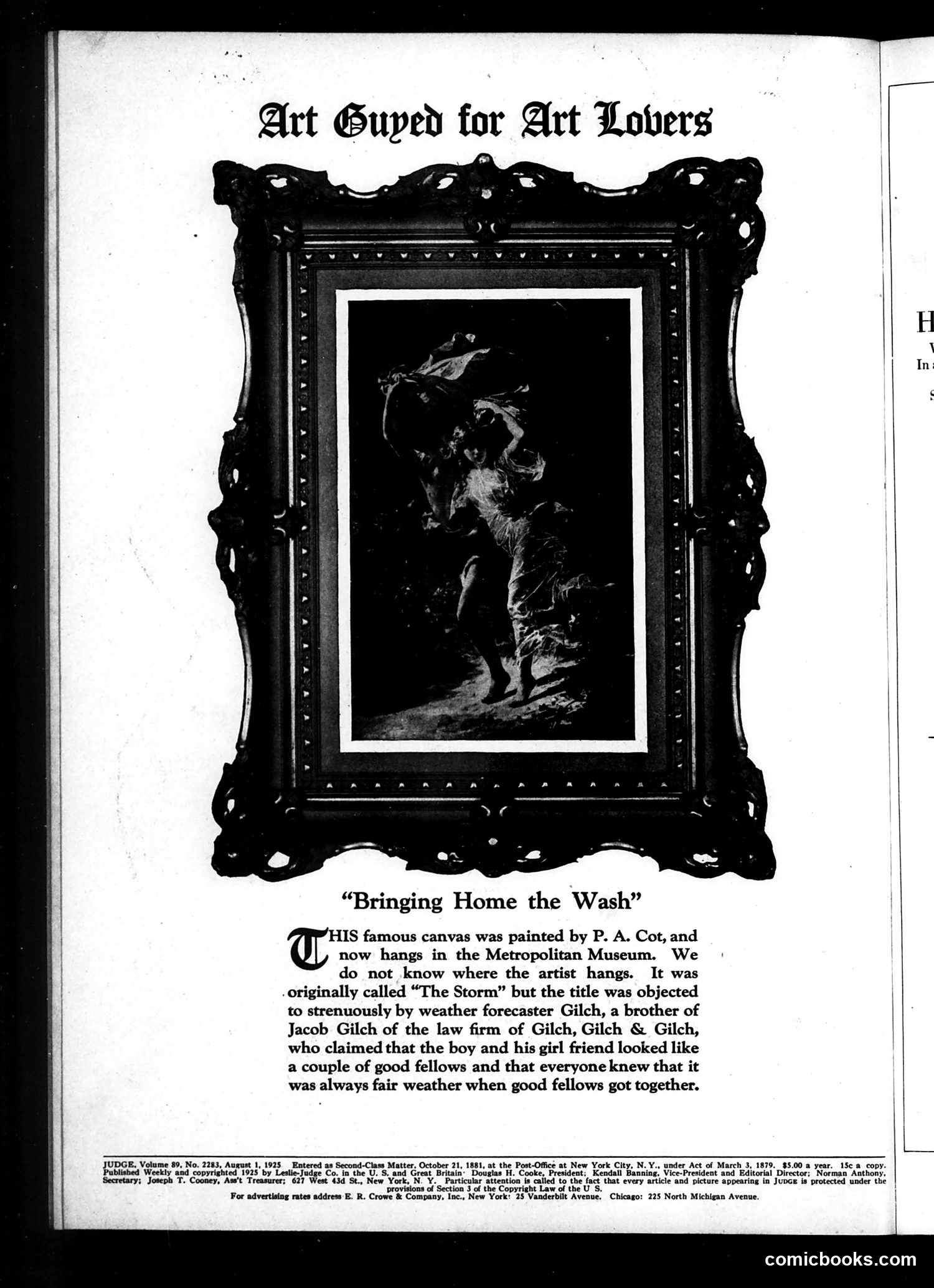
This page features P.A. Cot's famous painting, originally titled "The Storm," which now hangs in the Metropolitan Museum. The text reveals the painting's retitling resulted from a complaint by weather forecaster Gilch, brother of a prominent lawyer. Gilch objected to the original title because the painting depicts a young couple and their dog in what he considered clearly good weather—he claimed "everyone knew that it was always fair weather when good fellows got together." The satire mocks Gilch's pedantic, literal-minded objection to the artistic title, suggesting he prioritized factual accuracy over poetic interpretation. The anecdote humorously illustrates the clash between scientific precision and artistic expression.
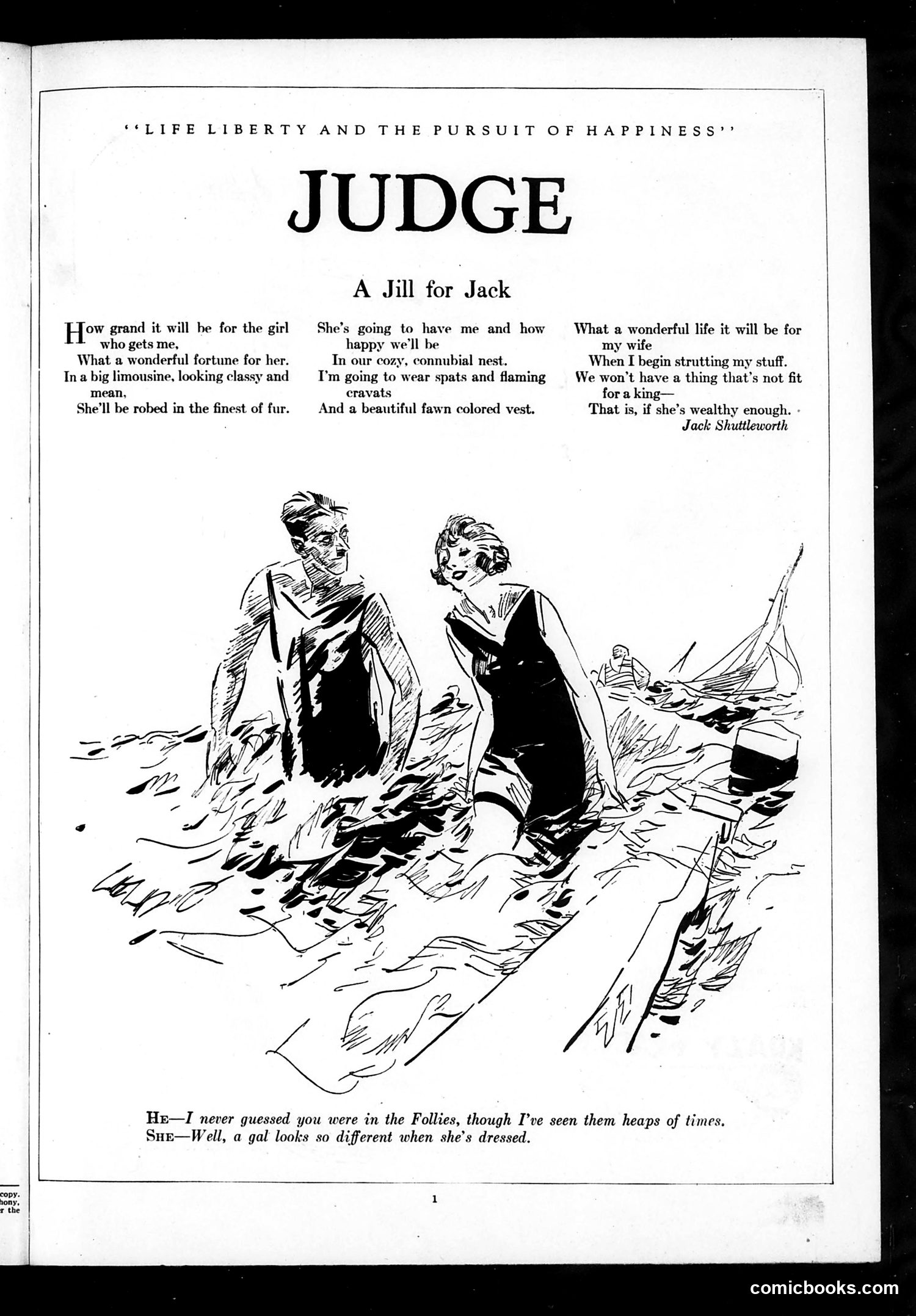
This page from *Judge* magazine appears to be a romantic/social satire rather than political commentary. The cartoon depicts a couple on a beach, with Jack Shuttleworth's accompanying verse celebrating marriage prospects. The humor hinges on class aspiration: Jack anticipates marrying a wealthy woman ("if she's wealthy enough"), fantasizing about luxury (limousines, fine furs, fancy clothing). The dialogue at bottom—where "she" notes how differently a girl appears when dressed up—suggests the satire targets superficial romantic judgments based on appearance and wealth rather than genuine character. The title "A Jill for Jack" invokes the nursery rhyme, playing with traditional courtship expectations of the era. This reflects early 20th-century anxieties about marriage, social climbing, and materialism.
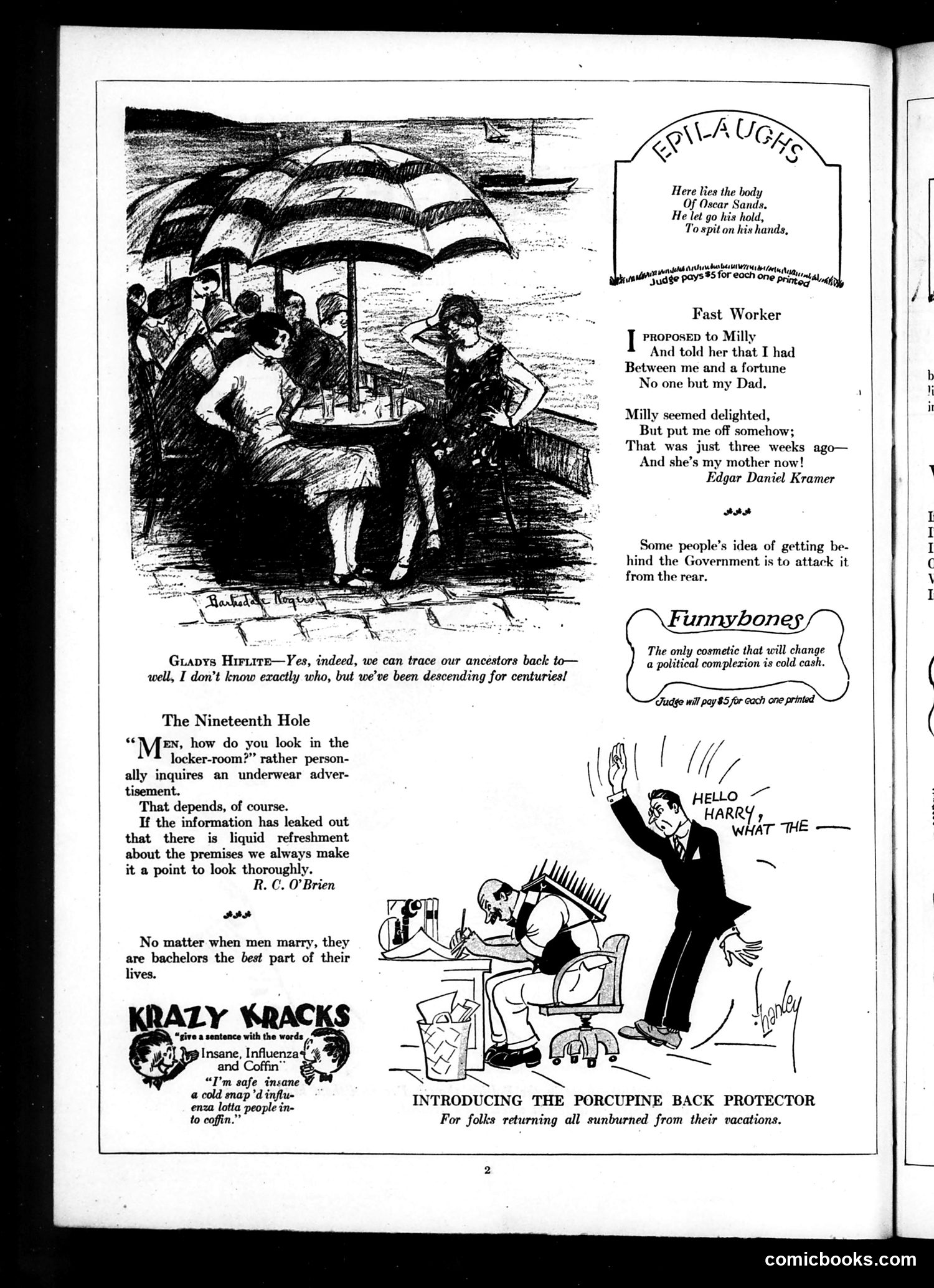
This page contains mixed satirical content and advertisements from an American humor magazine. The main cartoon depicts people sheltering under a large umbrella at what appears to be a seaside resort, captioned with a joke about ancestry. Below that, "The Nineteenth Hole" offers brief satirical observations about male behavior and locker-room culture, likely referencing golf club social dynamics. The "Funnybones" section makes a joke about political corruption and bribes ("cold cash"). The bottom cartoon, "Introducing the Porcupine Back Protector," satirizes vacation sunburns through a visual gag showing a man greeting a colleague who appears to have suffered severe sunburn. The page also includes product advertisements like "Krazy Kracks" coffee, typical of magazine filler content from this era.
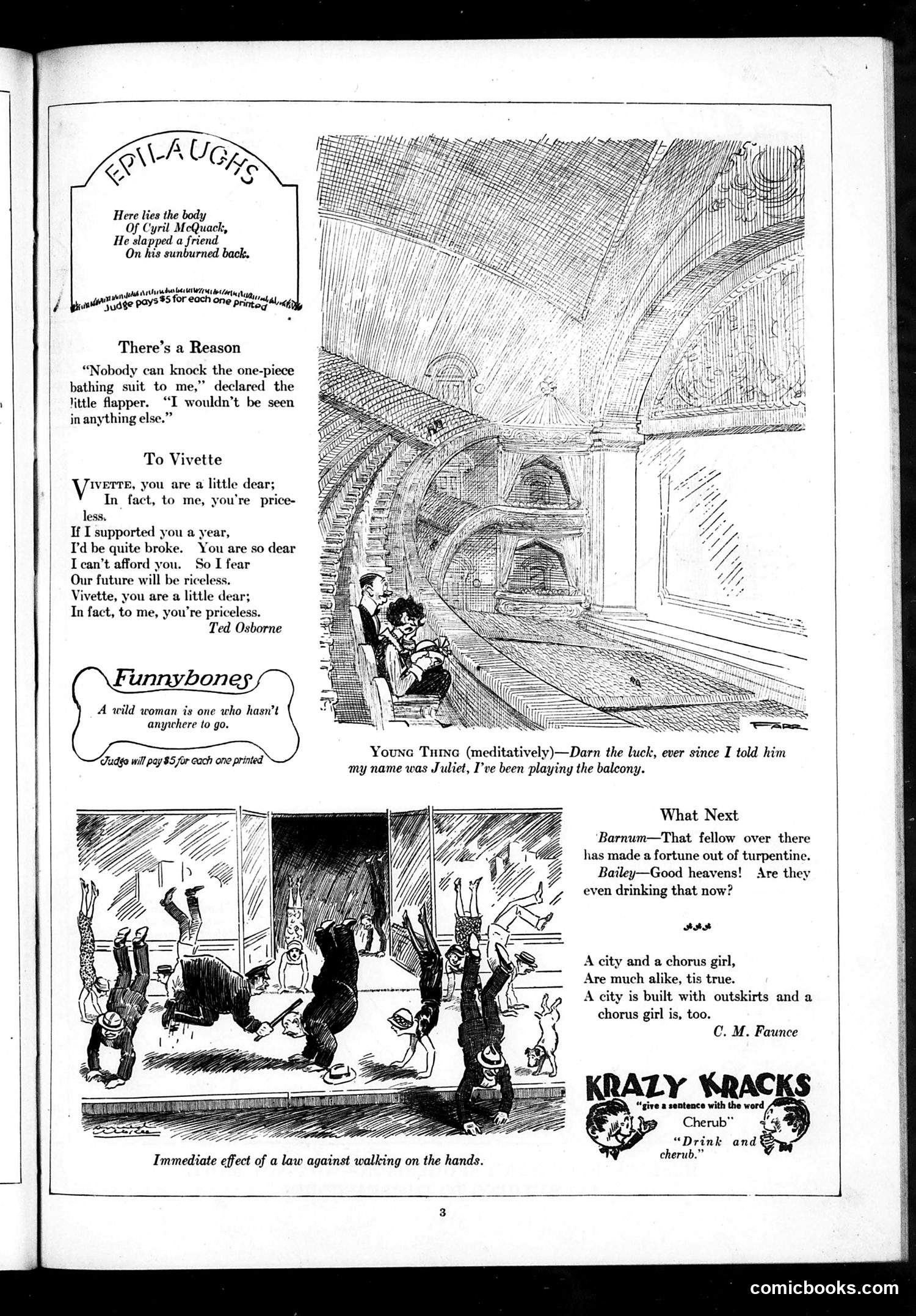
This page consists primarily of humor pieces and advertisements rather than political commentary. The "Epilaughs" section contains a mock tombstone epitaph for "Cyril McQuack" and a poem "To Vivette" by Ted Osborne about an expensive woman. The main cartoon depicts acrobats performing handstands, captioned "Immediate effect of a law against walking on the hands"—a simple absurdist joke about an imaginary legal prohibition. A dialogue exchange labeled "What Next" and "Young Thing" contains mild social commentary about chorus girls and urban life, with a quote attributed to C.M. France. The page concludes with a "Krazy Krack" advertisement for a beverage. Overall, this appears to be a lighthearted humor and advertising page without significant political satire or historical references requiring special context.
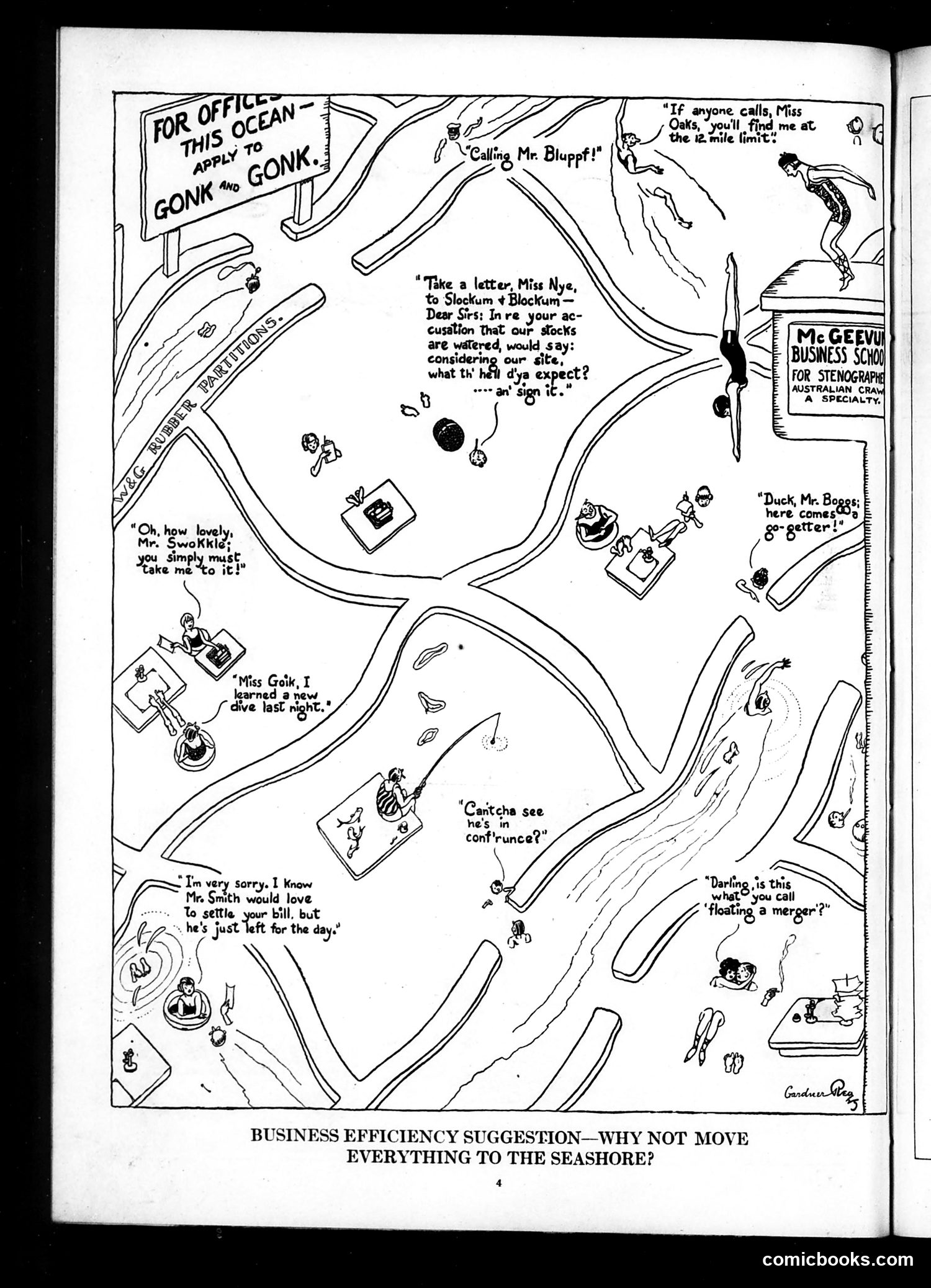
This page presents a satirical map of an office building redesigned as waterfront operations. The cartoon mocks business efficiency proposals by suggesting offices relocate to the ocean. The humor works through absurdist imagery: people conduct business from floating desks, swimming, and makeshift platforms in water. Speech bubbles contain deadpan office dialogue ("Take a letter, Miss Nye," "Duck Mr. Rossi—here comes a go-getter!") that contrasts sharply with the chaotic maritime setting. References include real business names (McGeevy Business School, advertising for stenography), creating intentional incongruity between formal business culture and an impossible, ridiculous workplace scenario. The title explicitly identifies the satire: mocking "business efficiency" trends of moving operations "to the seashore"—likely referencing actual proposals during this era's industrial reorganization or corporate relocation schemes. The joke targets over-zealous modernization and efficiency mania.
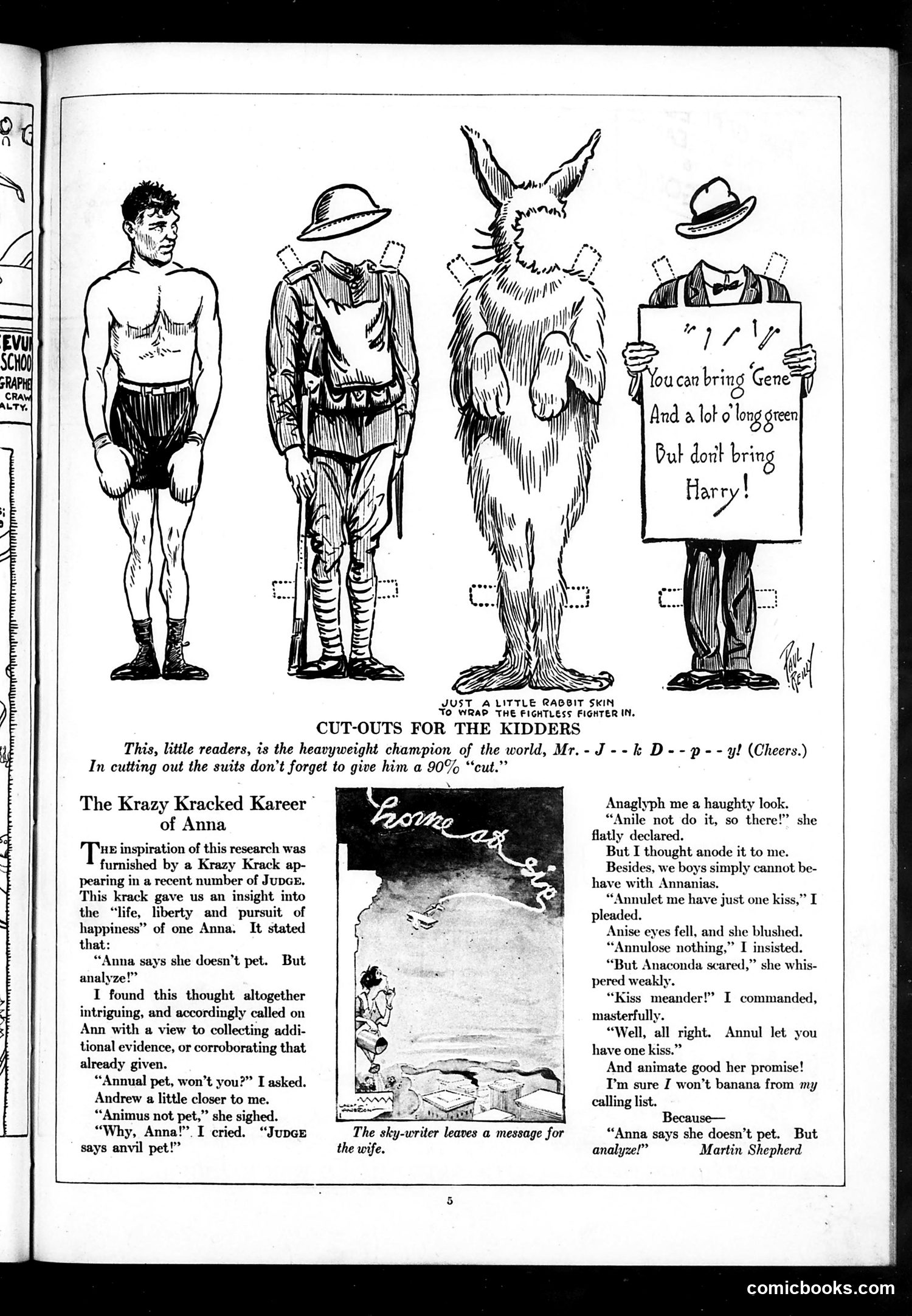
This page contains two distinct items: **Top Section - "Cut-Outs for the Kidders":** Paper dolls depicting a boxer ("the heavyweight champion of the world, Mr. J---k D---p--y!"), with alternative outfits including a cowboy suit and a demonic/satyr costume. The joke warns readers to give the figure a "90% cut" when assembling—likely satirizing a famous boxer of the era through crude caricature and suggesting violence or degradation. **Bottom Section - "The Krazy Kracked Kareer of Anna":** A romantic short story with illustration about a character named Anna who "doesn't pet" but will analyze things instead. The piece satirizes modern courtship behavior and psychological analysis trends of the 1920s-30s, with the repeated joke that Anna refuses traditional romance but permits intellectual discussion. Both items reflect period humor about masculinity, boxing culture, and evolving social attitudes toward courtship and women's independence.
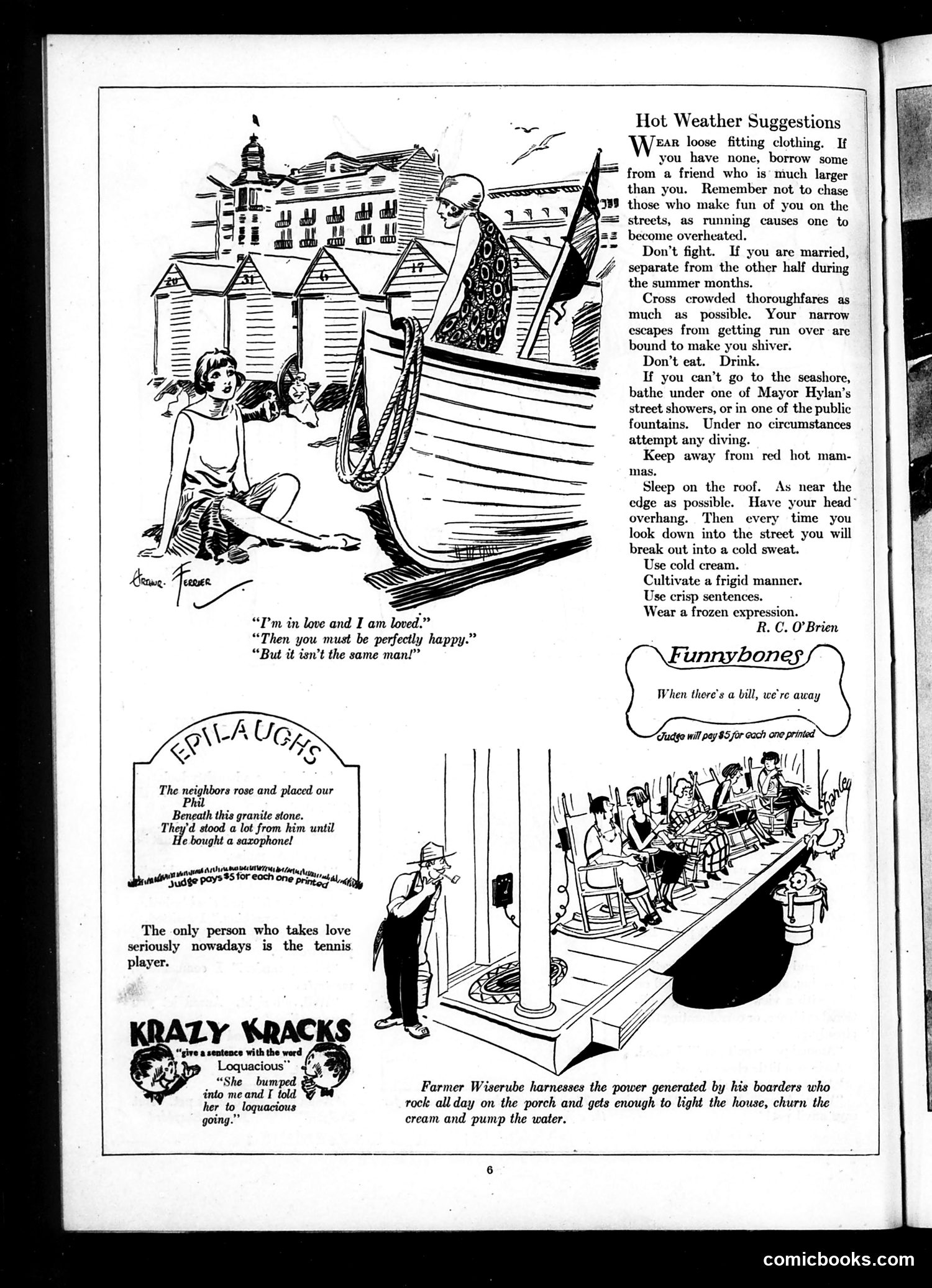
This page from *Judge* magazine contains several pieces of 1920s-era satirical humor: **"Hot Weather Suggestions"** offers absurdist advice for summer survival, referencing Mayor Hylan's public street showers—a real NYC municipal initiative. The jokes mock overheated tempers and romantic complications during summer. **"Epilaughs"** presents humorous epitaphs, including one about a neighbor driven to murder by someone buying a saxophone—satirizing the instrument's popularity and annoyance as a noisy fad in the 1920s. **"Krazy Kracks"** is a punny wordplay joke using "loquacious." **"Funnybones"** cartoon depicts "Farmer Wiserube" literally harnessing his rocking-chair-bound boarders' kinetic energy to power household utilities—a visual pun on the idea of extracting productivity from lazy summer guests. This satirizes both rural hospitality burdens and human-powered labor absurdity. The overall tone reflects common 1920s magazine humor: lighthearted social observation, domestic comedy, and wordplay-based gags.
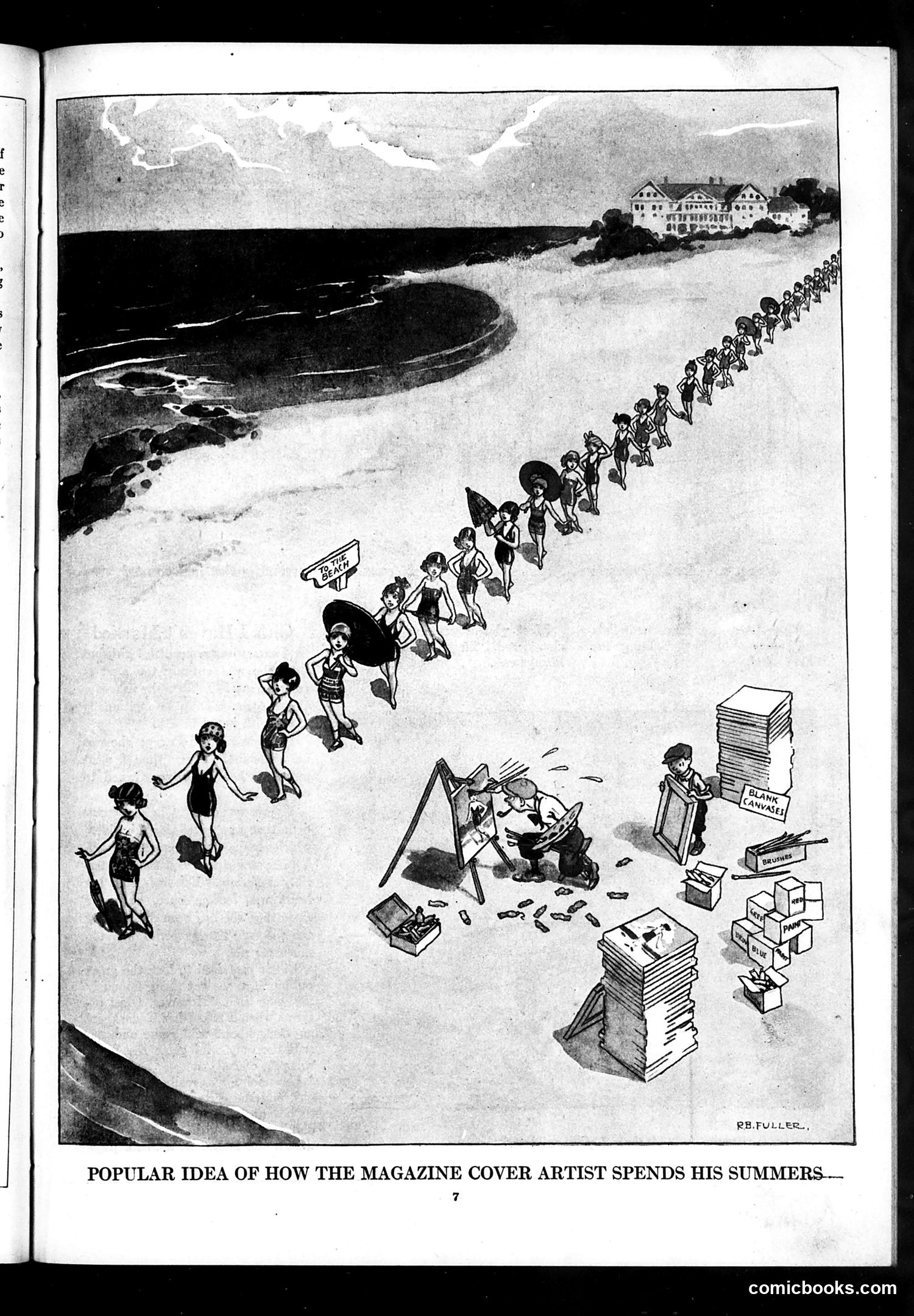
This satirical cartoon by P.B. Fuller mocks the romantic notion of how magazine cover artists supposedly spend their summers. The caption presents a humorous contrast: while the public imagines cover artists relaxing at scenic seaside cottages with elegant leisure activities, the reality depicted shows them frantically working—surrounded by stacks of papers, blank forms, rejection notices, and scattered materials at a makeshift beach setup. The long line of figures trudging toward this chaotic work scene represents the procession of aspiring or working artists. The cartoon satirizes both the public's idealized perception of artistic life and the actual grinding labor, administrative burden, and commercial pressures facing professional illustrators. It's a commentary on the gap between artistic romance and commercial reality in the magazine publishing industry.
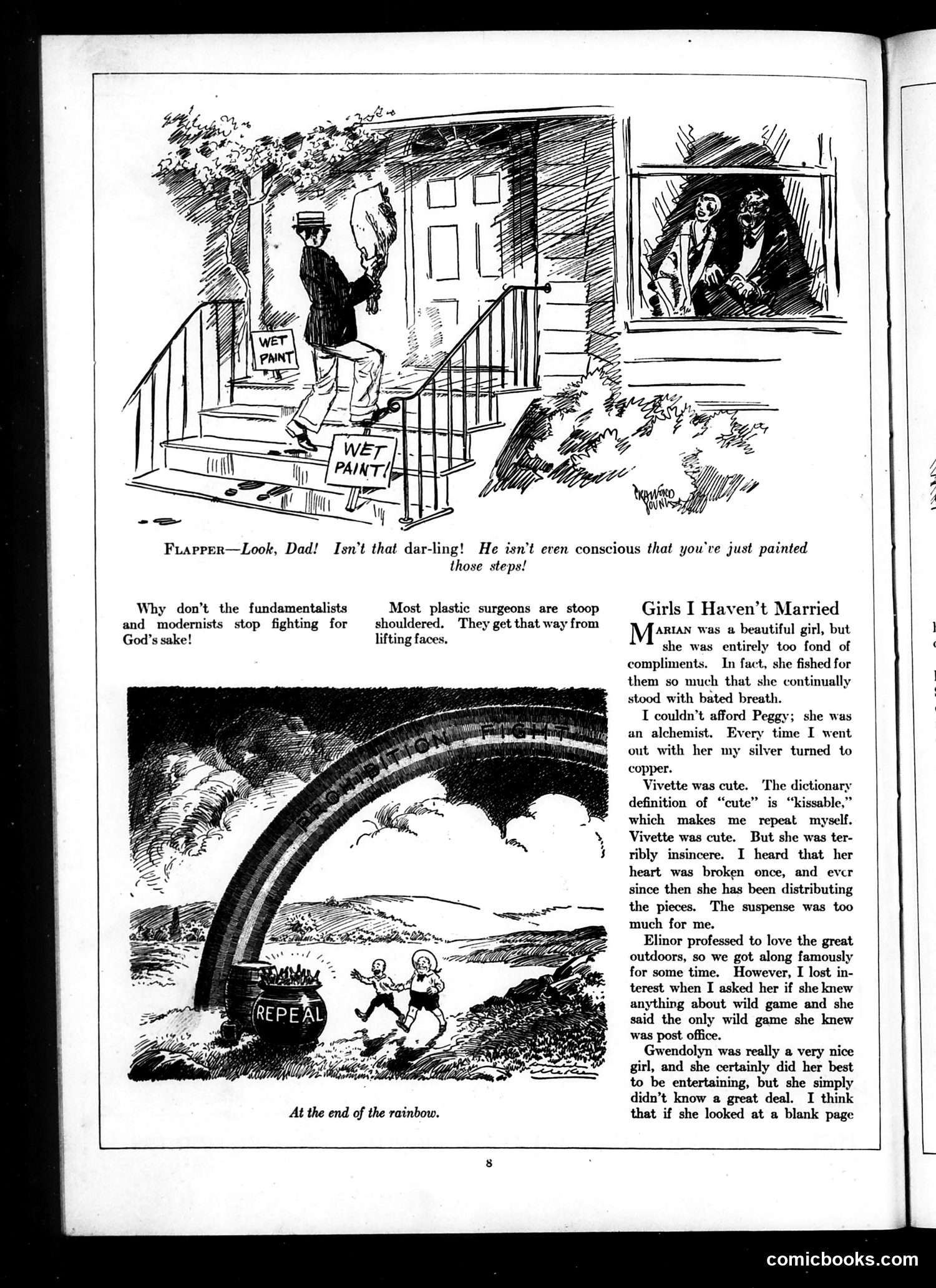
This page contains multiple satirical pieces reflecting 1920s American culture: **Top cartoon ("Flapper"):** A man, oblivious to freshly painted steps, is being observed by his daughter and neighbors. The satire mocks absent-minded fathers and the generational divide—the young "flapper" finds her father's cluelessness amusing rather than respectable. **"Fundamentalists and Modernists":** A one-liner joke referencing the era's intense theological debate between religious fundamentalists and modernists over biblical interpretation—a major cultural conflict of the 1920s. The joke dismisses both sides as equally pointless. **"At the end of the rainbow":** The cartoon depicts Prohibition enforcement—the "Repeal" figure chases citizens, satirizing how the 1920 Prohibition law created chaos and futile enforcement efforts. **"Girls I Haven't Married":** A humorous column listing failed romantic prospects, each representing female stereotypes (the vain girl, the materialistic "alchemist," the insincere cutie). This satirizes romantic disappointment and female types.
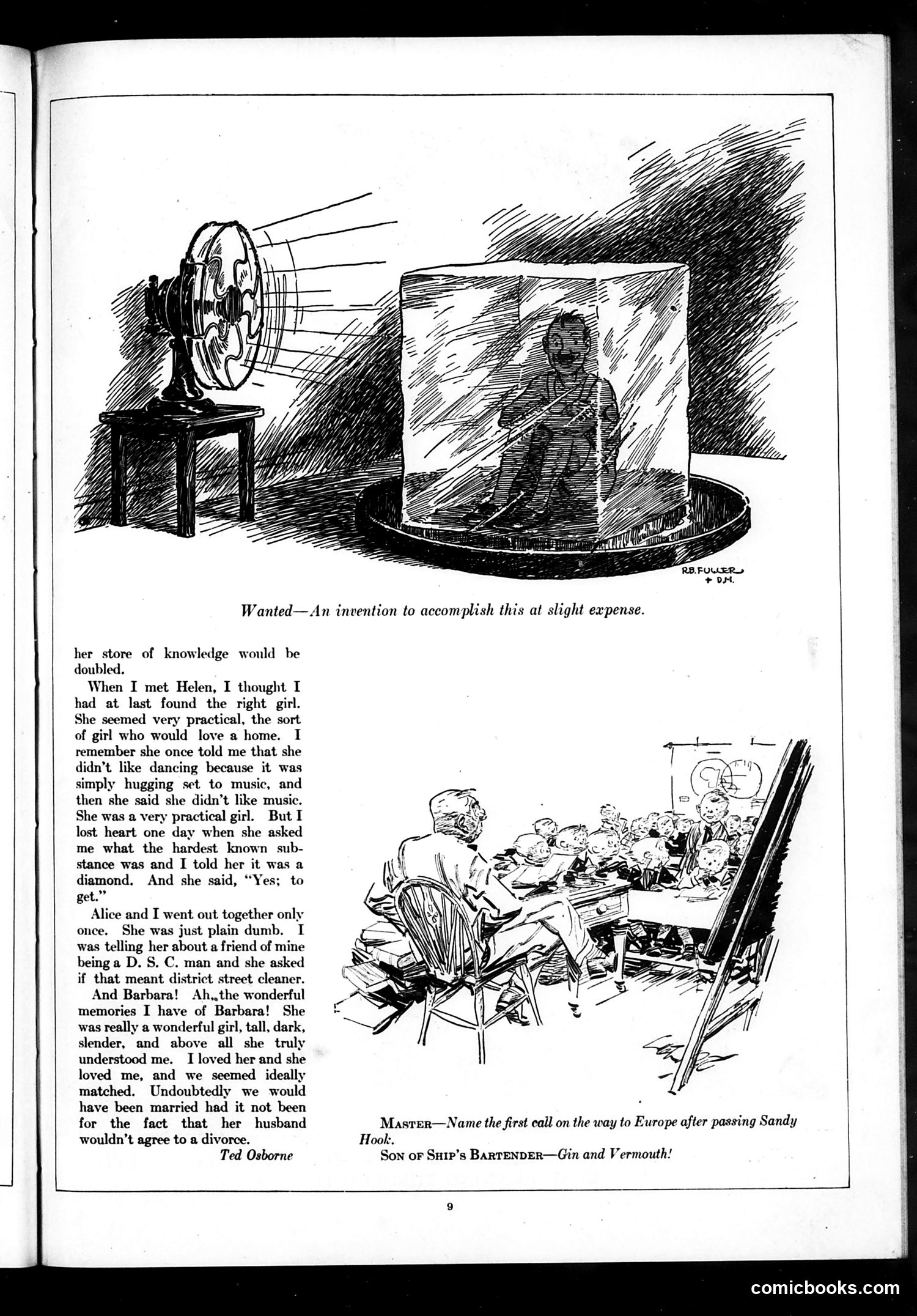
The page contains two distinct satirical pieces: **Top cartoon**: "Wanted—An invention to accomplish this at slight expense" shows a projector displaying a woman's image inside a glass dome. The satire mocks the desire for an affordable way to obtain an idealized woman—treating courtship/marriage as a mechanical problem to be engineered rather than a human relationship. **Text story by Ted Osborne**: A humorous monologue about the narrator's romantic failures. He dismisses Helen (too practical), Alice (unintelligent—she misunderstands "D.S.C. man"), and praises Barbara as his ideal match—only to reveal she's already married and won't divorce. The joke satirizes men's unrealistic expectations of women and the narrator's self-delusion about his romantic prospects. **Bottom caption**: A ship's master and bartender exchange—likely mocking naval terminology or drunken sailors, playing on "Sandy Hook" (New Jersey location) as a setup for a joke about alcohol. The page reflects early 20th-century attitudes toward gender, courtship, and class, presented through Judge magazine's characteristic cynical humor.
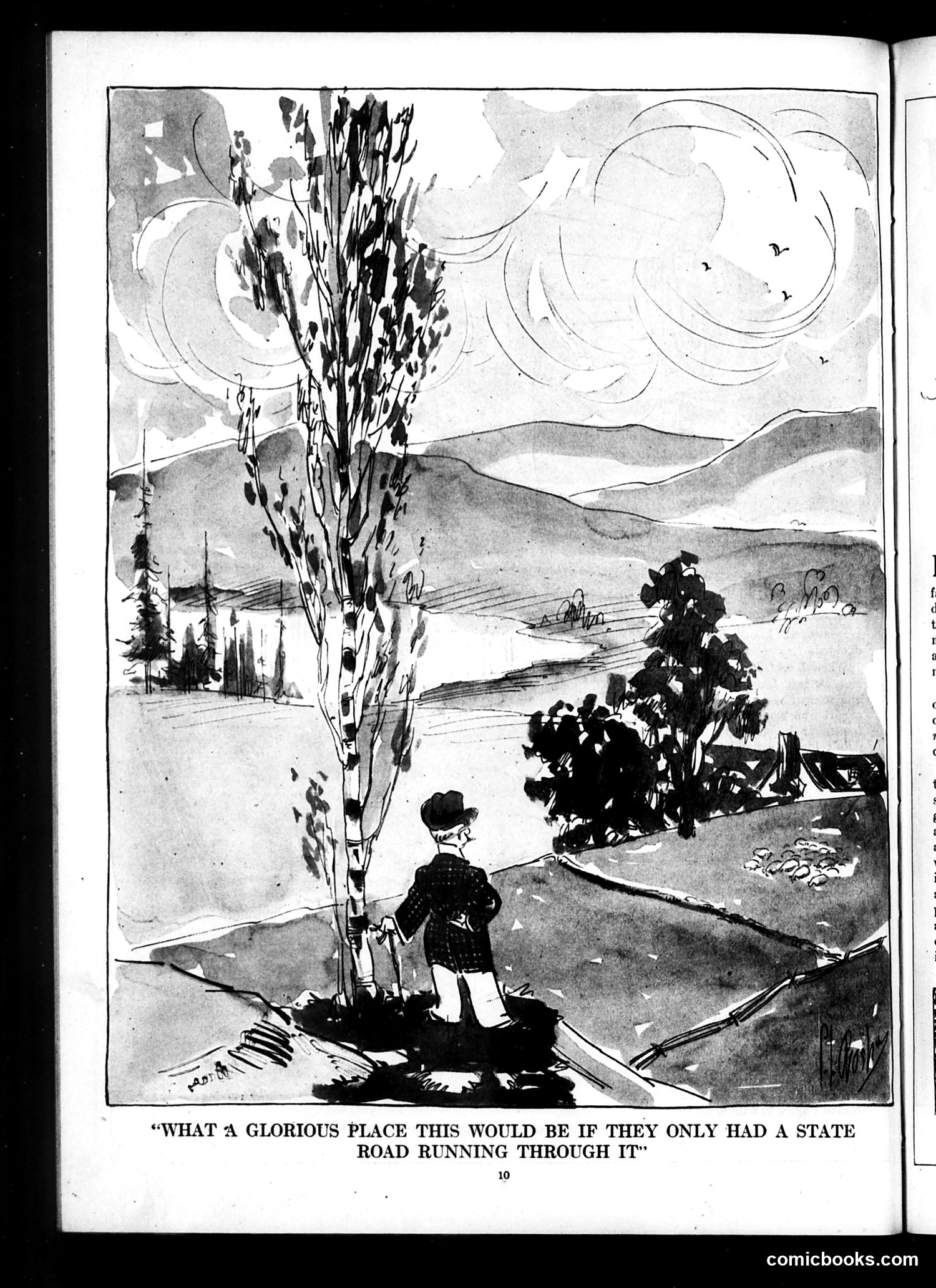
This single-panel cartoon depicts a well-dressed woman standing beneath a tall poplar tree, gazing at a scenic landscape with mountains, water, and vegetation. The caption reads: "What a glorious place this would be if they only had a state road running through it." **The Satire:** The joke critiques American attitudes toward nature and progress. The woman finds the pristine natural landscape beautiful yet incomplete—she views it primarily through the lens of commercial development and accessibility via a state highway. This satirizes early 20th-century priorities that valued infrastructure and commerce over preserving wilderness. The cartoon mocks those who cannot appreciate nature without roads, tourism, and "progress," suggesting a disconnect between aesthetic appreciation and practical modernization impulses. The implication is ironic: improving access would likely destroy the very qualities making the location desirable.
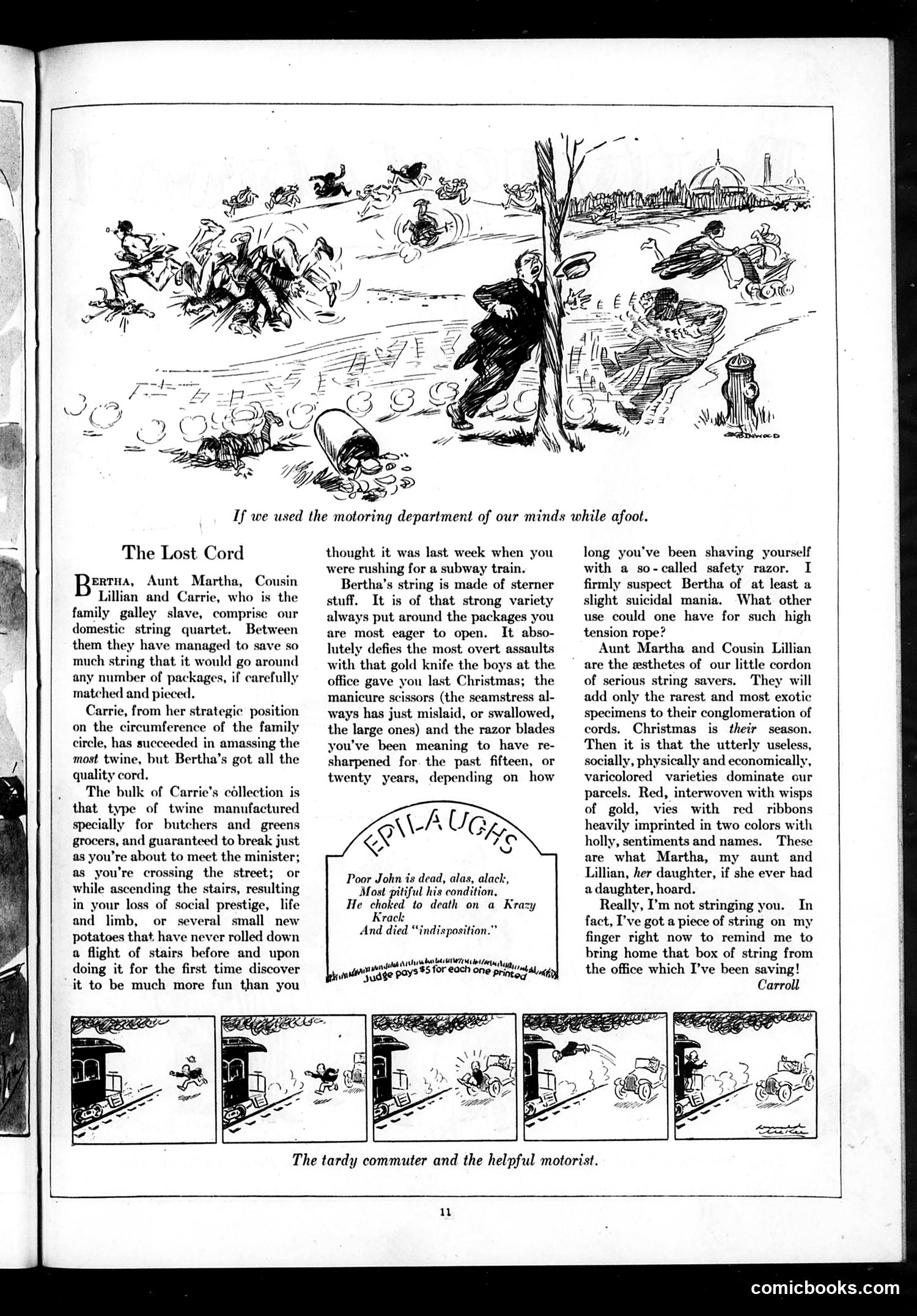
This humorous piece satirizes the Depression-era practice of saving and hoarding string and twine—a common domestic economy measure when resources were scarce. The story describes four women in a family who obsessively collect different types of string for reuse: Carrie accumulates butcher's twine (notably fragile), while Bertha saves premium-quality cord so durable it resists cutting with knives, scissors, or dull razors—humorously suggesting suicidal tendencies. Aunts Martha and Lillian are portrayed as aesthetes who collect decorative Christmas ribbons and colored cords, valuing sentimentality over utility. The narrator ends by admitting to keeping string at the office as a reminder to bring home more. The satire mocks the obsessive frugality of the era, presenting string-saving as both economically necessary and psychologically quirky. The accompanying comic strip below depicts an unrelated scene of a motorist helping a stranded commuter—content appears disconnected from the main story.
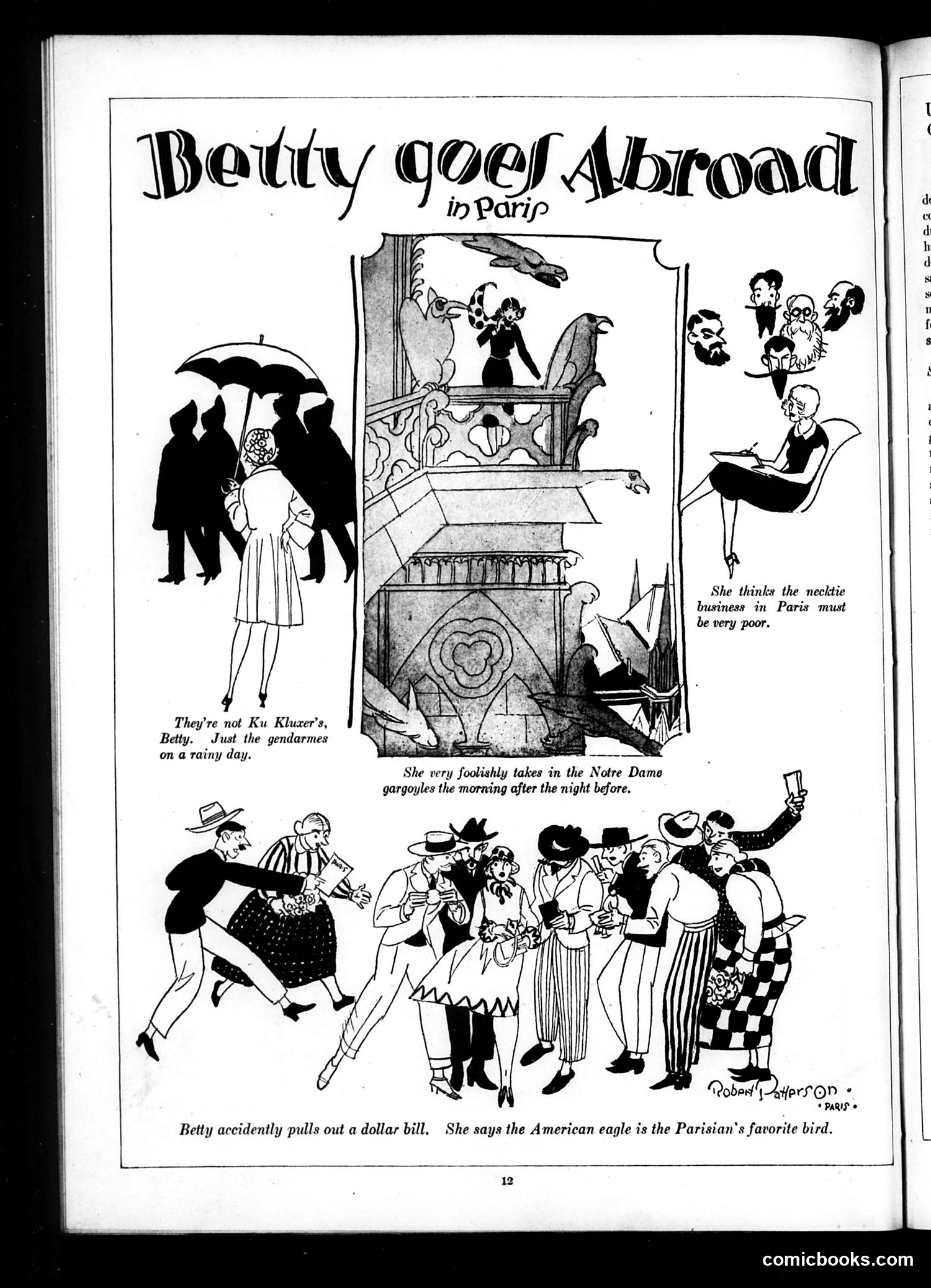
This is a humorous comic strip about an American woman named Betty visiting Paris. The satire plays on American tourist stereotypes and cultural misunderstandings: 1. **The gendarmes (French police) in rain gear** are mistaken for KKK members—a joke about how unfamiliar foreign uniforms can seem ominous to Americans. 2. **Notre Dame's gargoyles**: Betty foolishly interprets them as real creatures, suggesting American naïveté about European architecture and history. 3. **The dollar bill finale**: When Betty accidentally displays American currency, Parisians react with enthusiasm, satirizing the French as money-obsessed and mercenary toward American tourists. The "American eagle" reference plays on the dollar bill's imagery while mocking Parisian materialism. The comic mocks both American tourist ignorance abroad and French greed—a common Judge magazine theme circa the 1920s-30s.
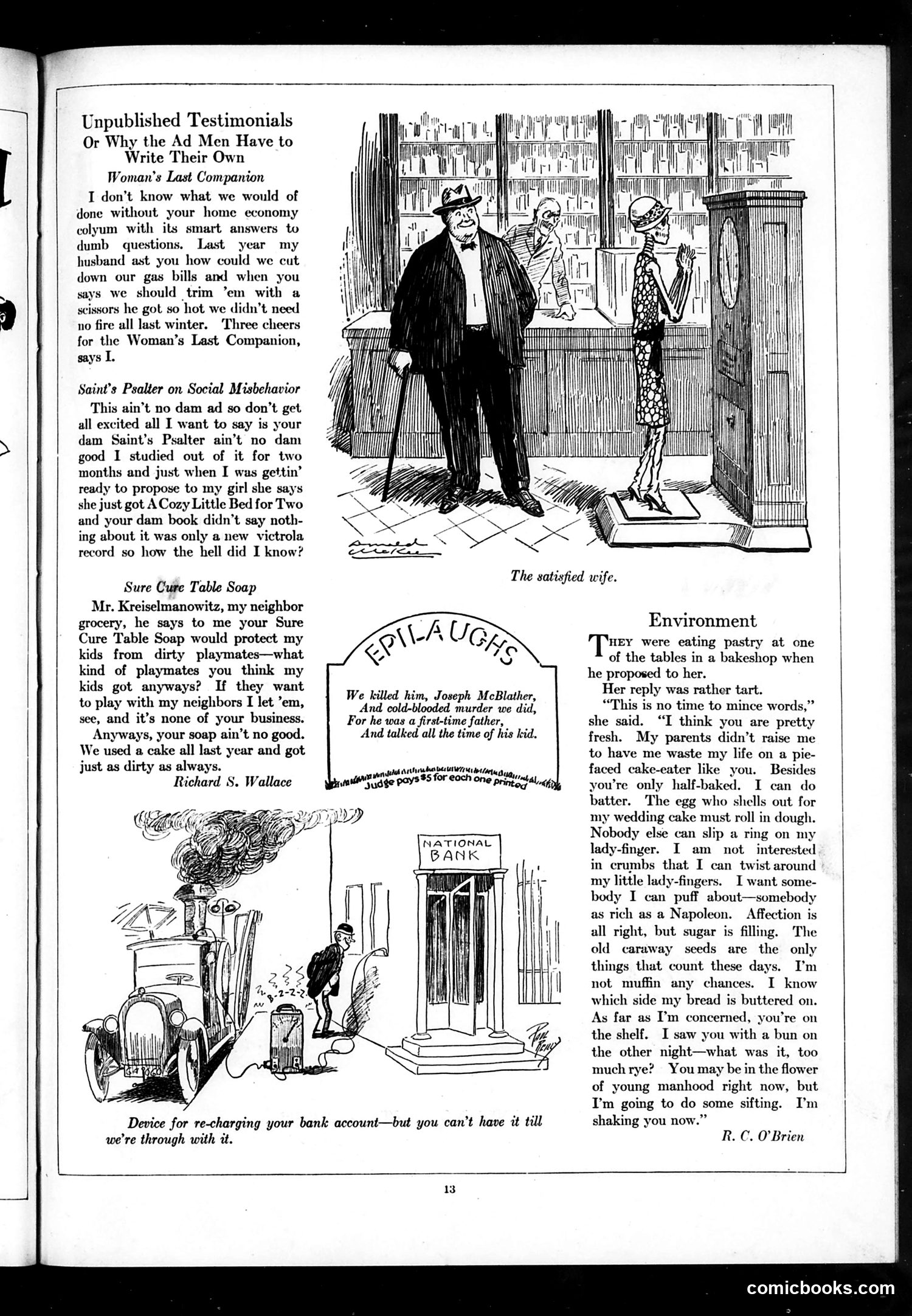
This page satirizes *advertising testimonials*—fake endorsements that advertisers write themselves because real customers won't provide favorable ones. The left column presents deliberately terrible "testimonials" from people with working-class names (Richard S. Wallace, Mr. Kreiselmanowitz), mocking products like "Woman's Last Companion" and "Sure Cure Table Soap." Each testimonial backfires: the advice caused marital discord, the soap didn't work, the book provided useless guidance. The humor lies in these "satisfied customers" actually complaining while supposedly praising the products. The accompanying cartoon of the "satisfied wife" reinforces this irony—she looks anything but satisfied. The bottom cartoon mocks another ad cliché: "Device for re-charging your bank account"—suggesting advertisers prey on financial desperation while keeping customers' money trapped. The "Environment" section is a separate humor piece using baking terminology as double entendre in a rejection scene, unrelated to the testimonials theme above it.
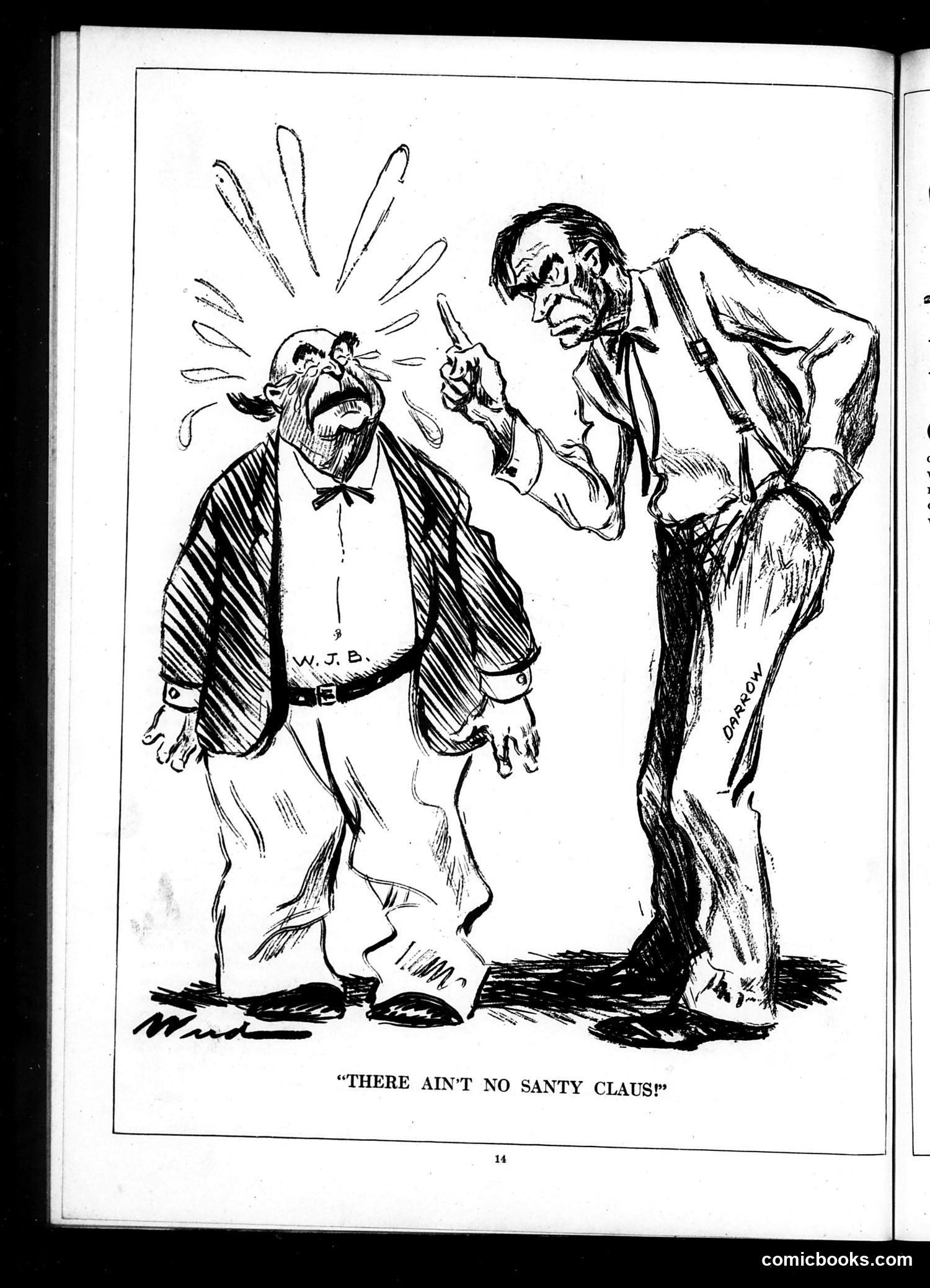
This political cartoon depicts two men in a confrontational scene. The figure on the left, labeled "W.J.B." on his shirt, appears shocked and distressed, with radiating lines expressing his dismay. The figure on the right, labeled "DARROW," is shown as a stern, aggressive man pointing accusingly while holding what appears to be a knife or blade. The caption—"There Ain't No Santy Claus"—suggests this references a disillusionment or harsh truth being delivered. W.J.B. likely refers to William Jennings Bryan, and Darrow is probably Clarence Darrow, the famous lawyer. This cartoon likely depicts a moment of confrontation between them, possibly relating to the Scopes Trial (1925) or another public dispute, where one figuratively "destroys the innocence" of the other through argument or exposure of uncomfortable truths.
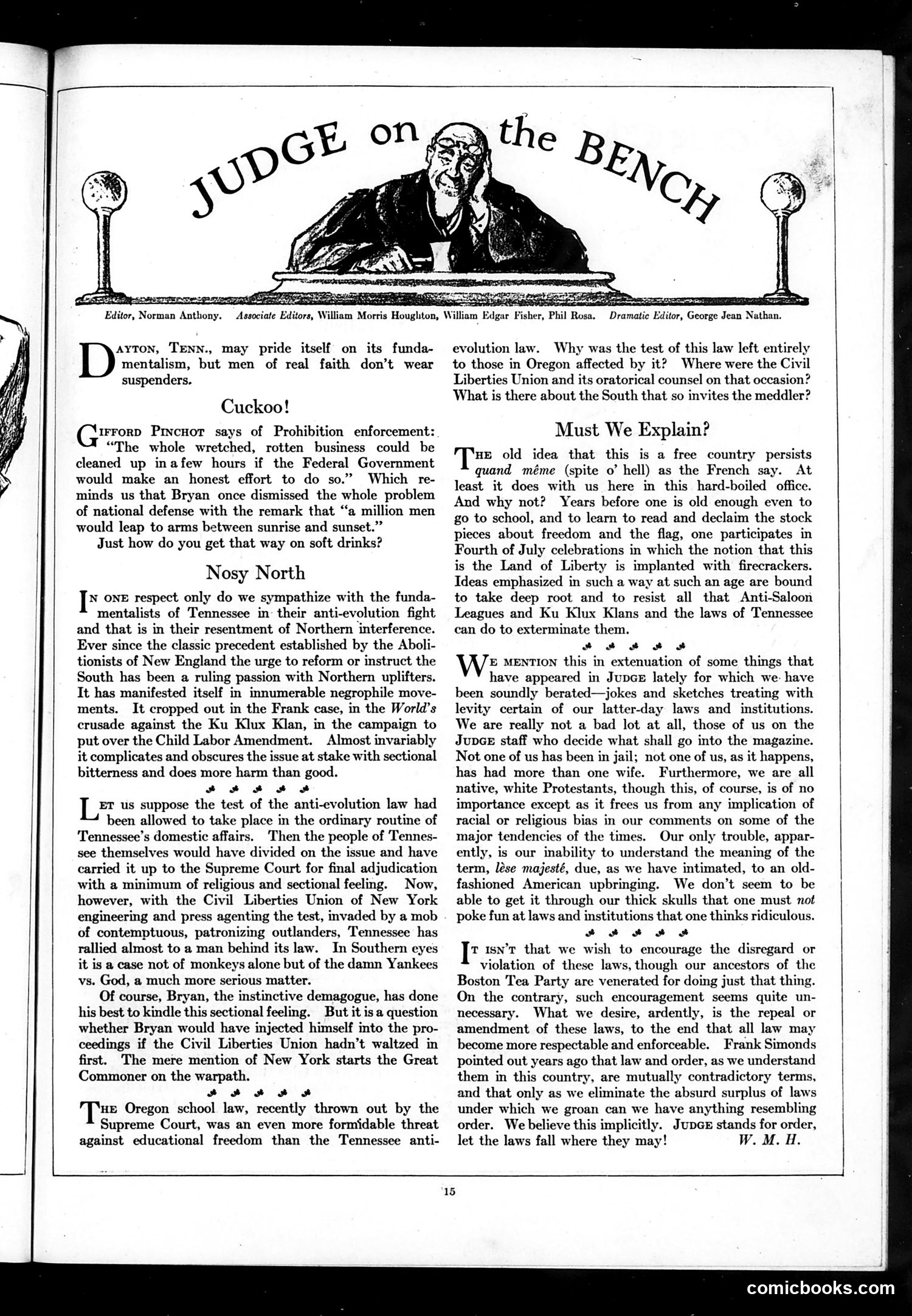
This page satirizes Northern interference in Southern affairs, specifically regarding Tennessee's anti-evolution law (the 1925 Scopes trial context). The editorial criticizes the **Civil Liberties Union of New York** for "engineering and press agenting" the legal test, arguing that outside agitation transformed a local issue into a sectional conflict pitting "the damn Yankees vs. God." The writer suggests the case would have resolved more rationally without Northern "uplift" and patronizing intervention—a pattern dating to abolitionism. The cartoonist/editors ironically defend their own irreverent commentary about laws and institutions, invoking American freedom. They argue that childhood indoctrination about liberty ("implanted with firecrackers") makes citizens naturally resistant to restrictive laws like Prohibition and anti-evolution statutes. The satire targets both paternalistic Northern reformers *and* Southern defensiveness, while paradoxically defending the magazine's right to mock such regulations. The "Judge on the Bench" header suggests moral authority evaluating cultural conflicts.
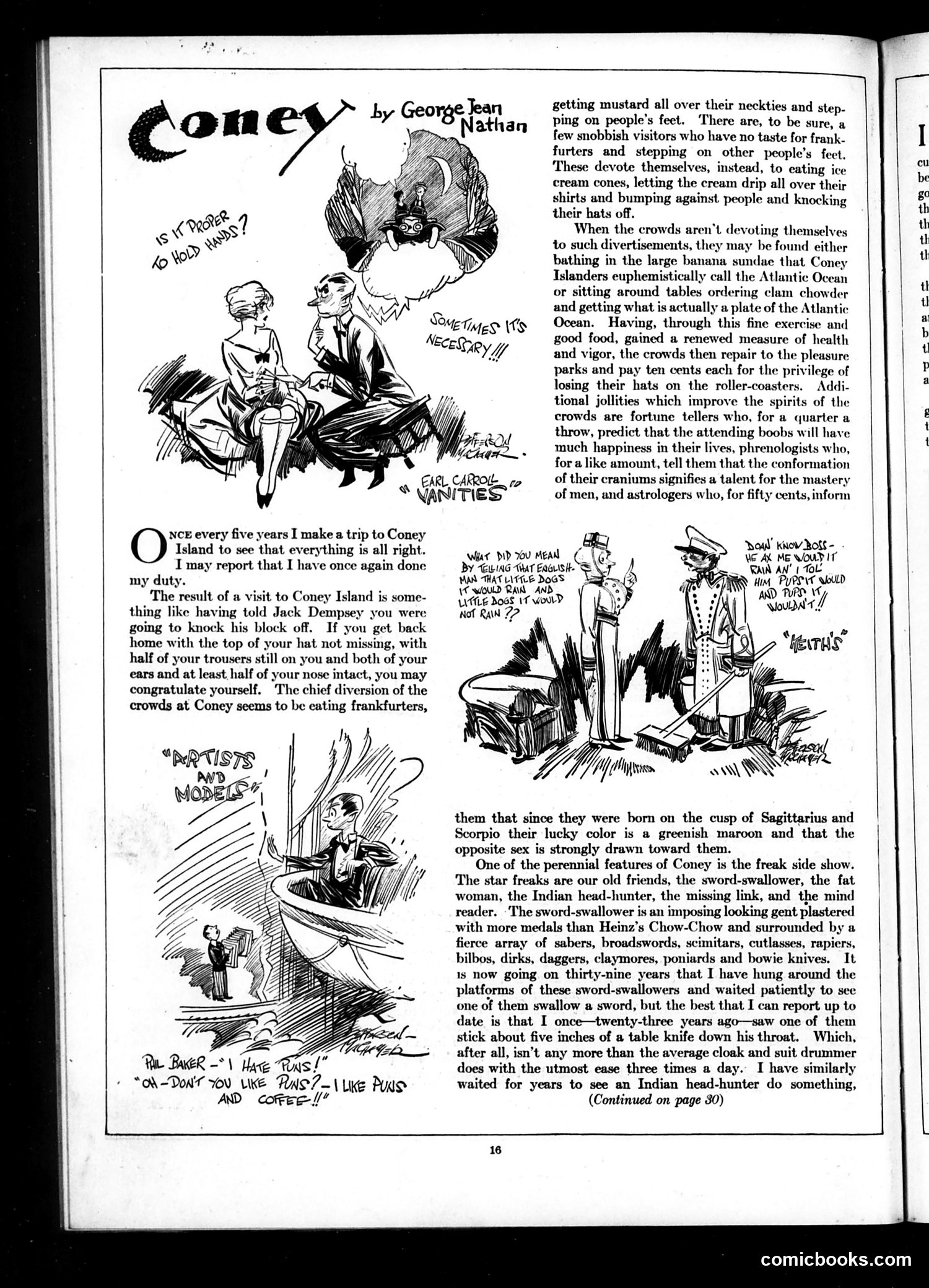
This satirical essay mocks the chaos and low-brow amusements of Coney Island, a popular working-class beach resort near New York. Nathan (the author) claims to inspect the place every five years, arriving to find crowds obsessed with eating messy frankfurters and ice cream while stepping on each other and losing their hats on roller coasters. The humor targets the gullible masses who pay fortune tellers, phrenologists, and astrologers for dubious predictions, and who gather around carnival "freaks" (sword-swallowers, fat women, "missing links") without ever witnessing anything genuinely remarkable. The accompanying cartoons by Earl Carroll mock these same crowds and their desperate pursuit of cheap thrills. The satire reflects early 20th-century attitudes: skepticism toward mass entertainment, contempt for working-class behavior, and ridicule of pseudoscience. The tone is snobbishly dismissive of ordinary people's pleasures.
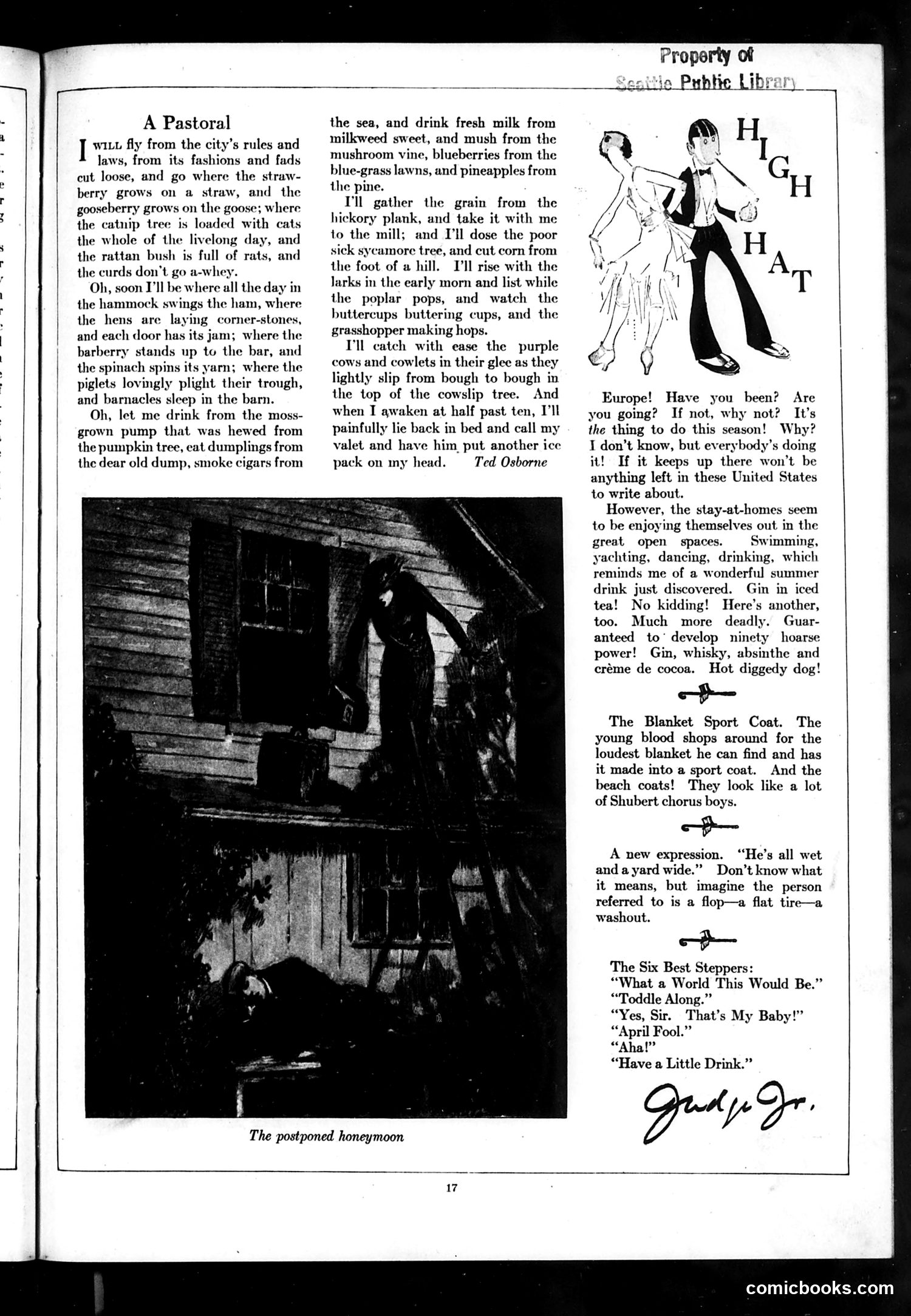
This page contains two distinct pieces of satirical commentary typical of Judge's 1920s output. **"A Pastoral"** is a humorous poem mocking romantic idealization of rural life. It employs absurdist wordplay—puns where nature produces manufactured items (catnip trees bearing cats, pumpkin trees, corn from hillsides)—to ridicule the back-to-nature movement popular among urban Americans. The final ironic twist reveals the speaker as a leisure-class urbanite who still requires a valet and ice packs, undermining the pastoral fantasy. **The right-side column** contains casual social commentary by "Ted Osborne" (the author) about 1920s fashions and trends: overseas travel as fashionable, gin cocktails, loud sport coats, and slang expressions. The accompanying illustration shows a couple in formal dress, likely referencing the "postponed honeymoon" caption, which appears to satirize delayed post-war marriages. The tone throughout is light social satire targeting middle and upper-class American lifestyle choices and fads rather than serious political critique.
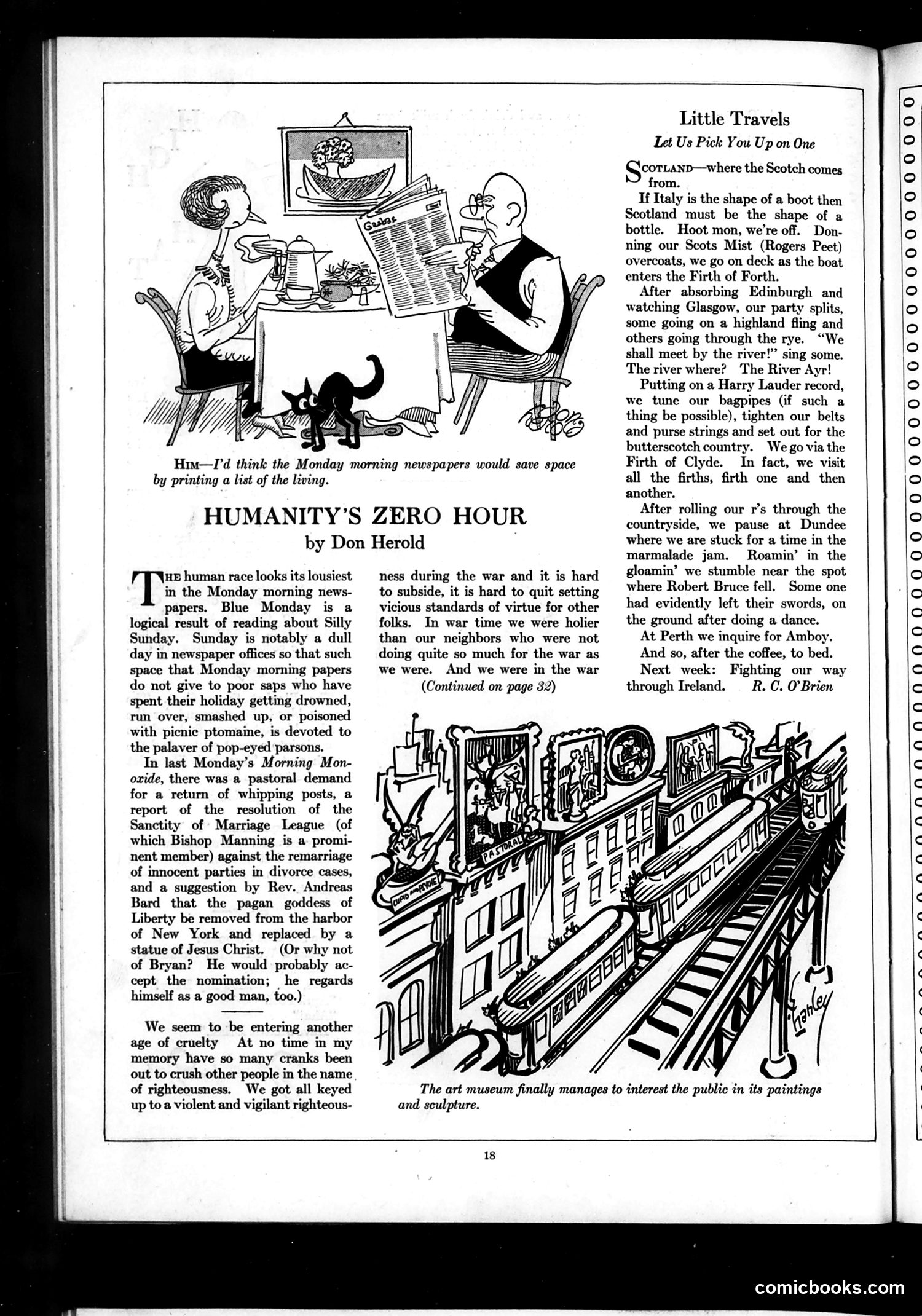
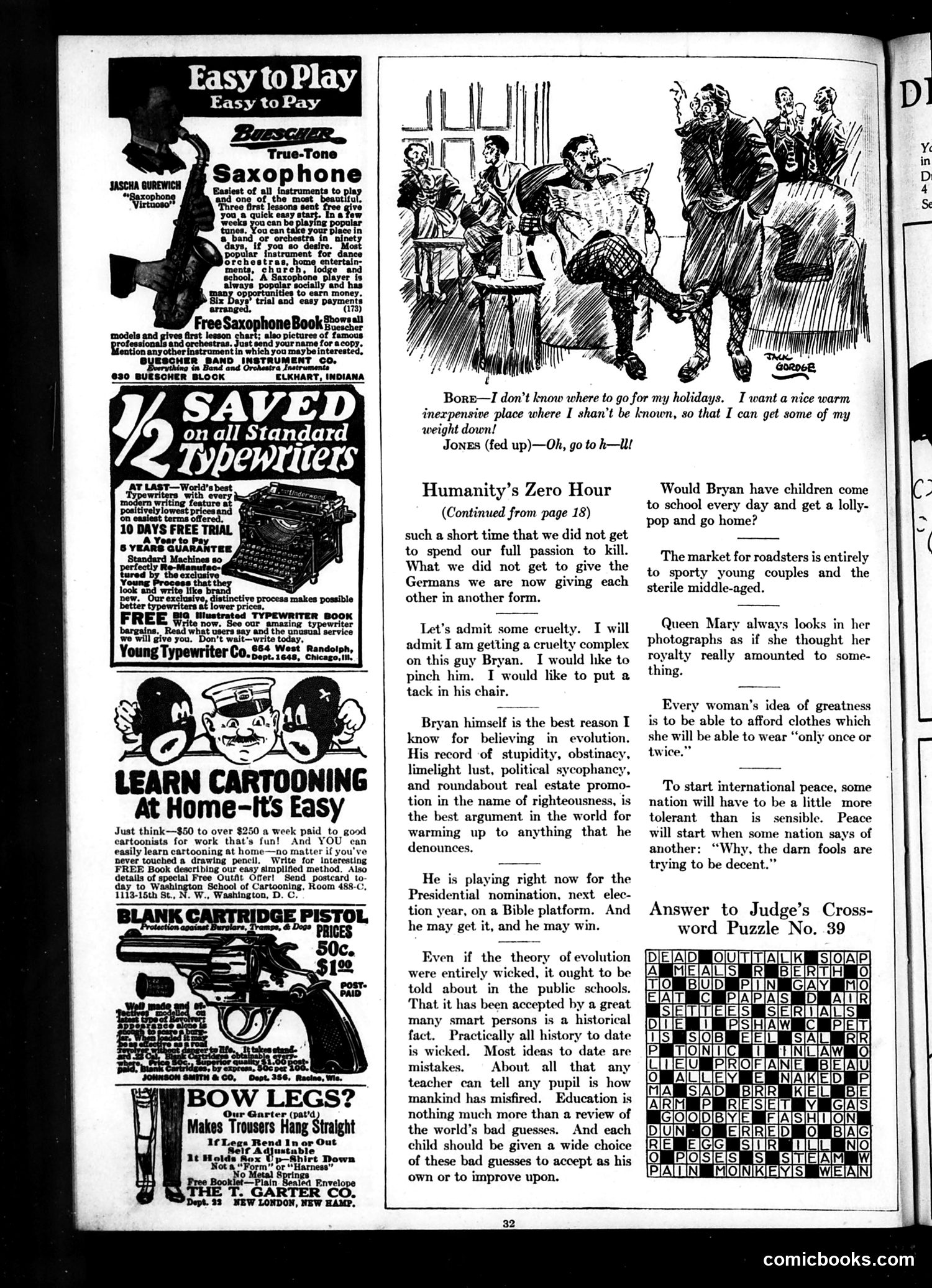
This page contains two pieces of satirical commentary on 1920s American society: **"Humanity's Zero Hour" by Don Herold** (main article) critiques post-WWI moral crusading. Herold argues that Americans, energized by wartime righteousness, have become overzealous in imposing virtue standards on others during peacetime. He specifically references Bishop Manning's campaign against remarriage of divorced persons and Rev. Andreas Bard's proposal to replace the Statue of Liberty with a Jesus Christ statue. Herold suggests this represents dangerous "vigilant righteousness"—Americans channeling wartime fervor into domestic moral policing. **The opening cartoon** shows a man reading Monday newspapers to his companion, with the caption joking that Monday papers waste space listing the living (implying they're full of Sunday's death reports). This supports Herold's point that newspapers sensationalize tragedy. **"Little Travels"** is a humorous travel piece about Scotland, using ethnic stereotypes (bagpipes, "Hoot mon," rolling r's) for comedic effect—typical of the era's casual caricature humor.
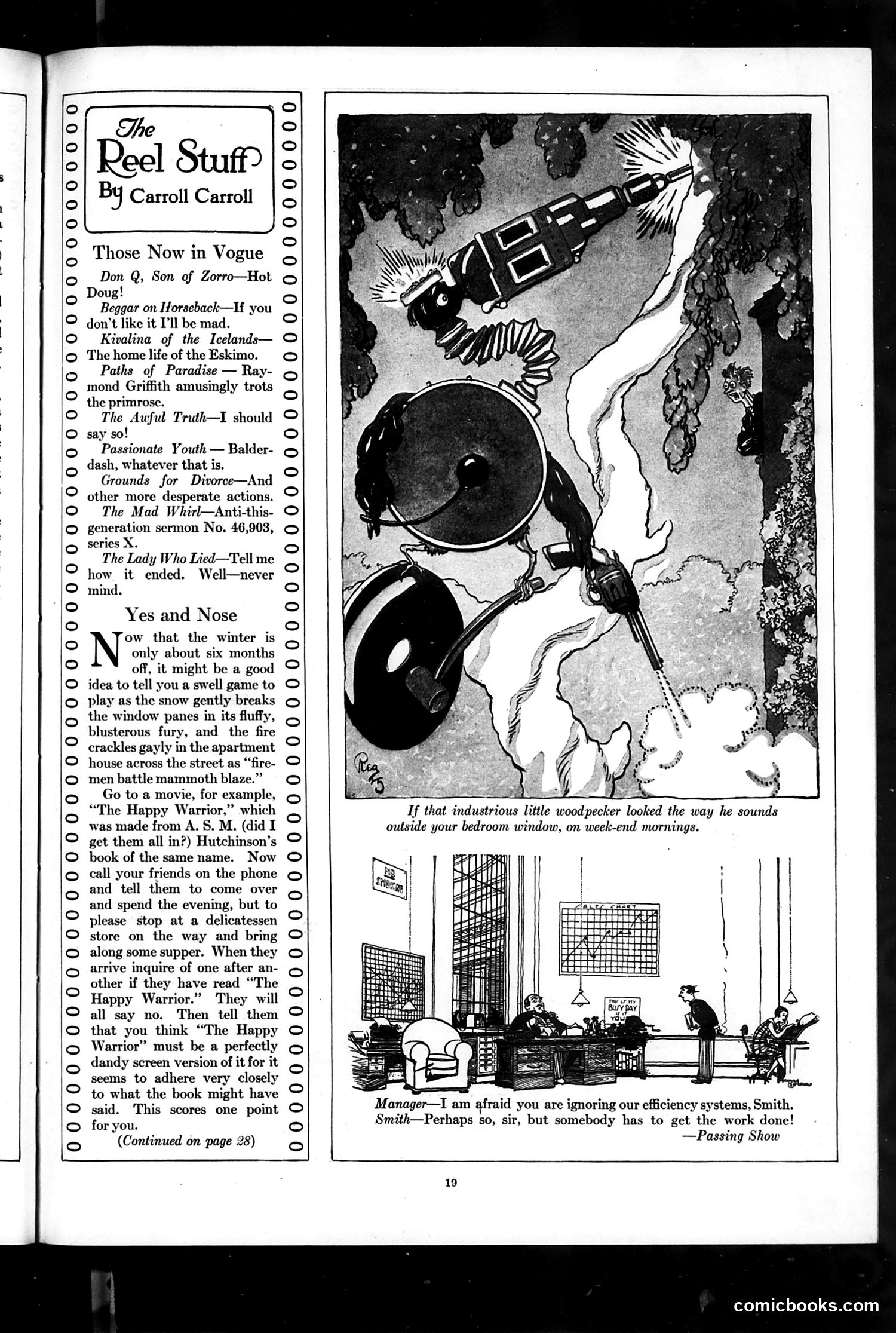
**Top Section - "The Reel Stuff":** Carroll Carroll reviews current movies in vogue (circa early 1920s based on titles like "Don Q, Son of Zorro" and "Beggar on Horseback"). This is straightforward film criticism, not satire. **Main Cartoon - "Yes and Nose":** The large illustration depicts a woodpecker outside a bedroom window. The accompanying text suggests recommending the film "The Happy Warrior" (based on A.S.M. Hutchinson's novel) to friends, then claiming it faithfully adapts the book—though the author suspects it doesn't. The joke: you score a social point by confidently praising something you haven't actually verified, exploiting others' unfamiliarity with the source material. **Bottom Cartoon:** A manager confronts employee "Smith" about ignoring efficiency systems. Smith replies that "somebody has to get the work done," suggesting tension between bureaucratic procedure and practical productivity—a common 1920s workplace satire theme about management versus actual labor. The page mixes light social humor with gentle workplace criticism typical of Judge's satirical approach.
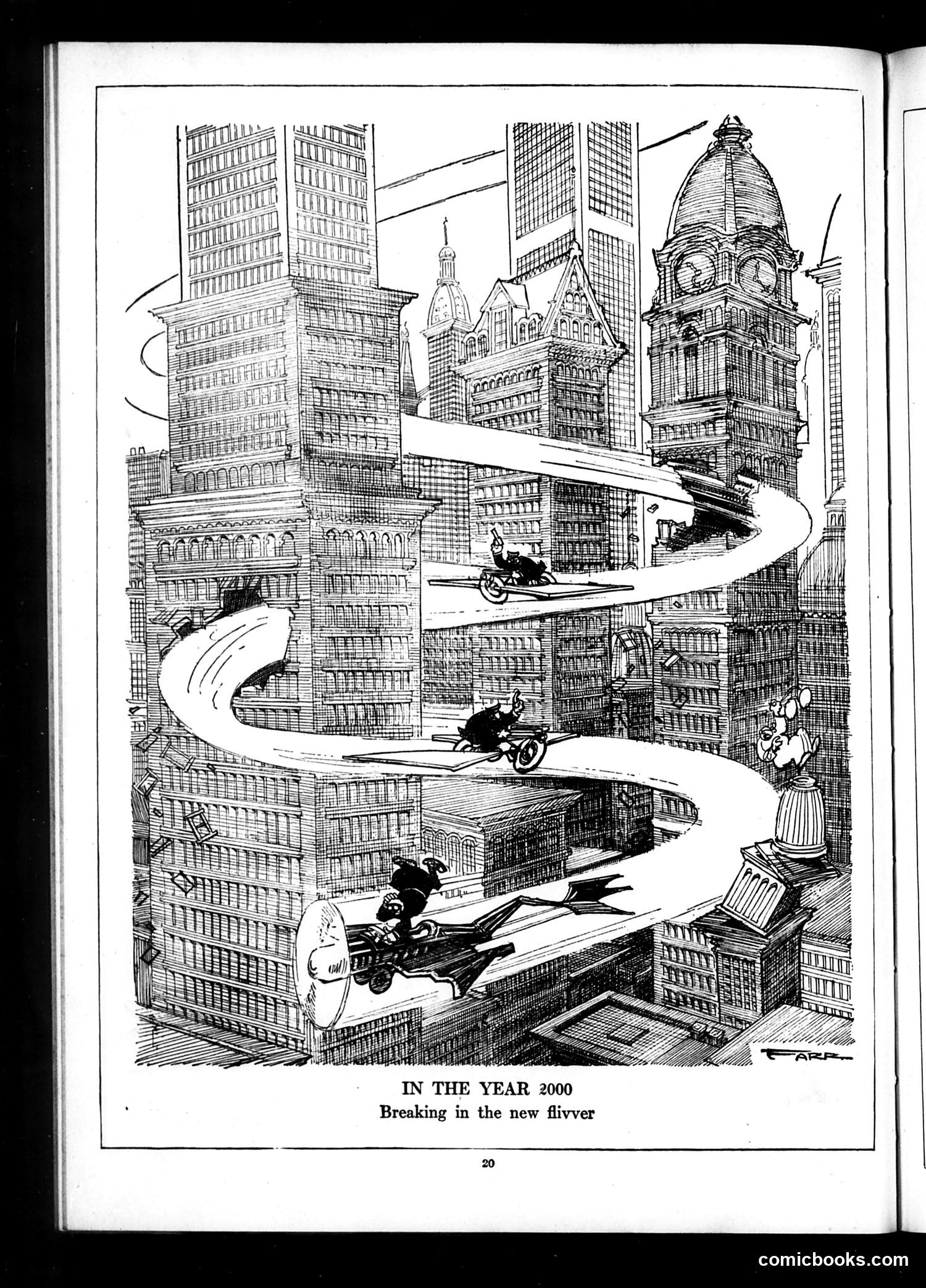
This futuristic satire depicts early 1900s Americans testing flying automobiles in a bustling cityscape. The title references Henry Ford's "Model T" (colloquially called the "flivver"), suggesting this is a Judge magazine piece from the 1910s-1920s. The cartoon mocks the era's optimistic predictions about automobile technology and urban life. Multiple drivers navigate impossible spiral roads around skyscrapers and landmarks, creating chaotic, dangerous conditions—satirizing both the predicted prevalence of automobiles and anxieties about traffic congestion and safety. The exaggerated architectural detail and crowded composition emphasize how absurd such a future would be: turning cities into vertical traffic zones where vehicles endanger pedestrians (visible at right). It's a humorous critique of unchecked technological enthusiasm and urban planning assumptions of that era.
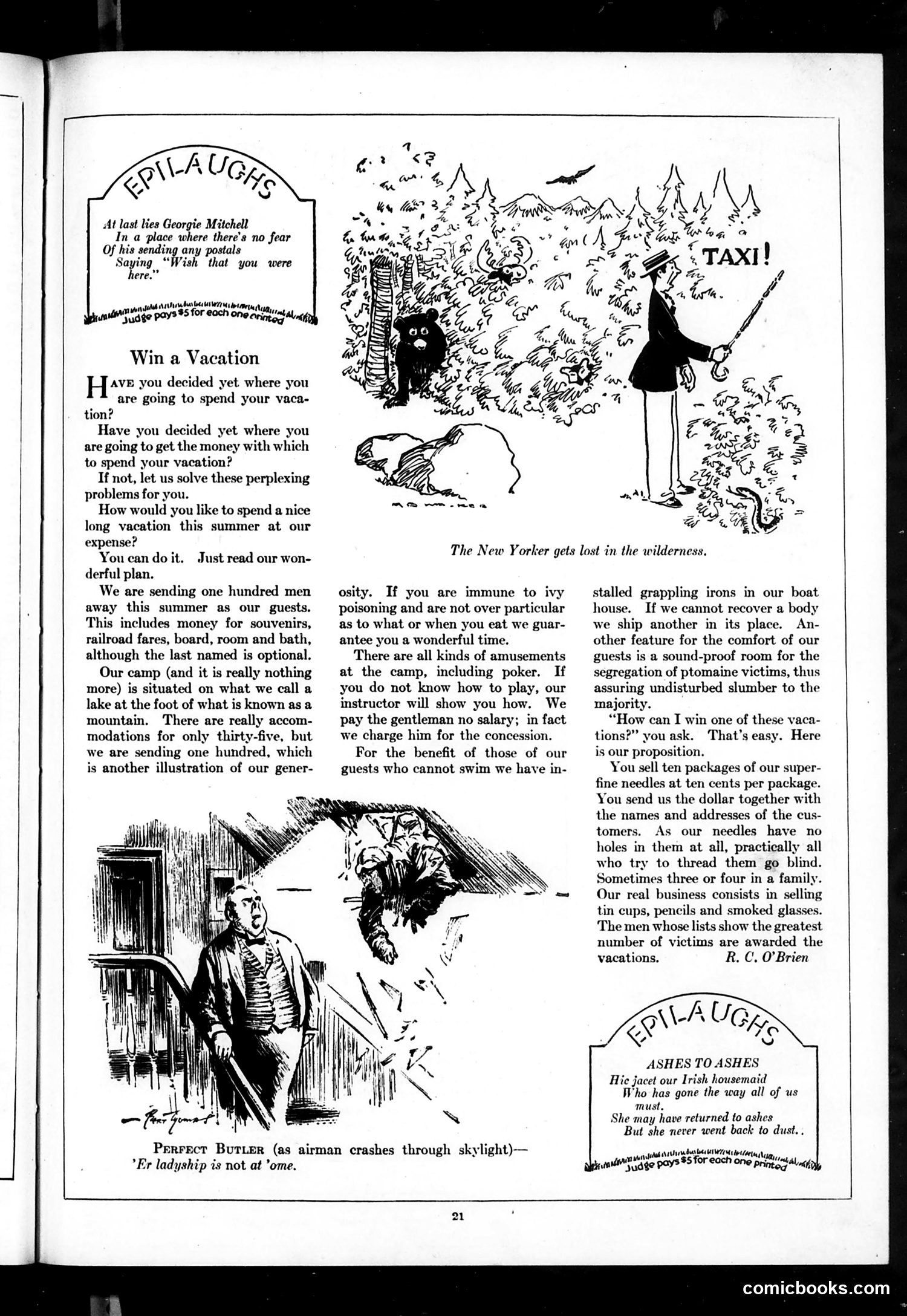
This page contains satirical pieces mocking turn-of-the-century American consumer culture and schemes. **"Win a Vacation"** is a darkly comedic exposure of fraudulent mail-order contests. The "wonderful plan" promises free vacations but reveals the scam: readers sell defective needles (with no holes) to customers who go blind trying to thread them. The company's real profit comes from selling tin cups and smoked glasses to the victims. The vacation "camp" is deliberately overcrowded and dangerous (featuring grappling irons for recovering drowned guests). The satire targets both predatory companies exploiting consumers and the blind greed of people chasing "free" offers. **"The New Yorker Gets Lost in the Wilderness"** depicts an urban sophisticate lost in nature, calling "TAXI!" — mocking the helplessness of city dwellers removed from civilization. **Other ephemera** include jokes about a butler and brief epitaphs. The overall tone satirizes American consumer schemes and urban pretension circa the early 1900s.
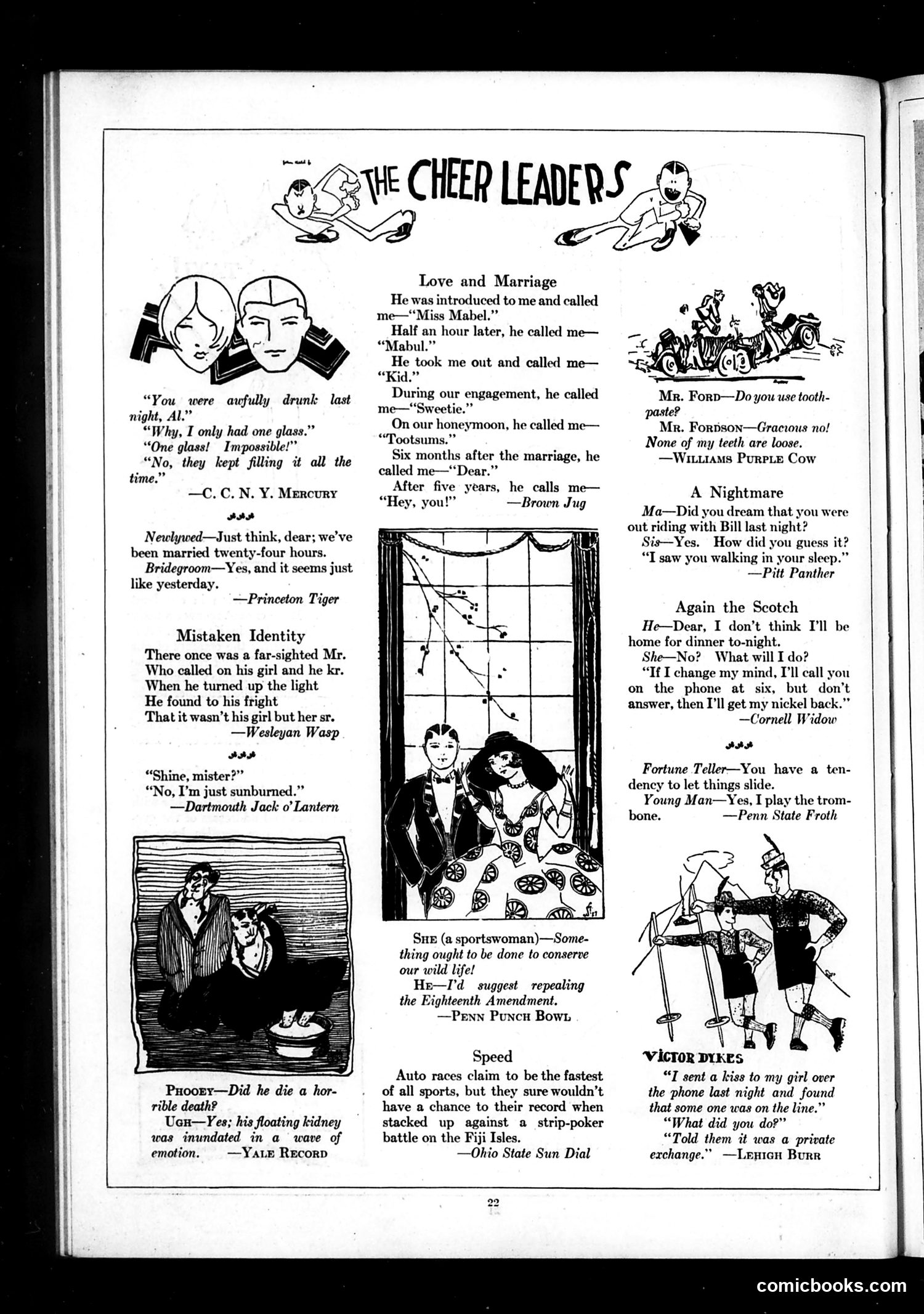
This page from *Judge* magazine collects humorous anecdotes and jokes sourced from college newspapers (C.C.N.Y. Mercury, Princeton Tiger, Wesleyan Wasp, Yale Record, etc.). The content reflects early 20th-century college humor: **Main themes:** - **Marital decline**: "Love and Marriage" satirizes how pet names deteriorate from romantic ("Sweetie") to dismissive ("Hey, you!") over years of marriage - **Prohibition-era humor**: References to drinking ("one glass" repeatedly filled) and the Eighteenth Amendment (prohibition)—Sue's sportsman quip suggesting repeal to "conserve wild life" is satirical wordplay - **Period courtship anxieties**: Mistaken identity and awkward romantic situations - **Ethnic/regional stereotypes**: The "Scotch" joke plays on Scottish frugality (avoiding phone charges) The central illustration shows a couple at a window, likely depicting the "Nightmare" joke about a daughter sleepwalking with a boy. **For modern readers**: These jokes rely on assumptions about gender roles, marriage disenchantment, and dated slang that require historical context to parse fully.
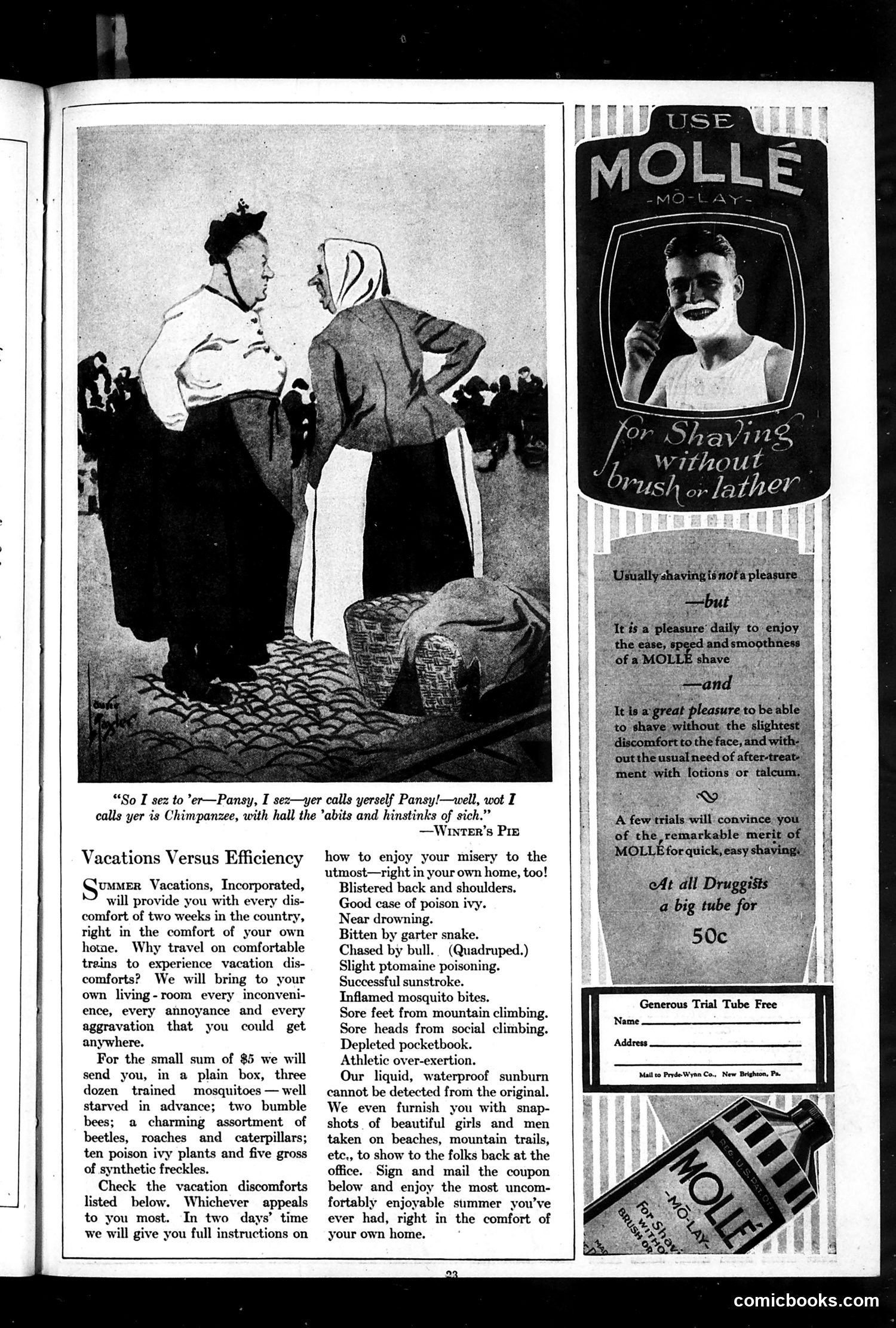
This page contains two distinct pieces: **Left: "Vacations Versus Efficiency"** — A satirical advertisement for a fake service promising to deliver all the *discomforts* of a country vacation to your home instead. The joke mocks the reality that vacations often involve mosquitoes, sunburn, exhaustion, financial drain, and other miseries. Rather than travel for leisure, customers can simply pay $5 to experience these annoyances at home. The humor targets both the absurdity of vacation marketing and the American public's aspirations to leisure that rarely match reality. **Right: "Use Mollé" Advertisement** — A genuine product ad for Mollé shaving cream, featuring a man's headshot and promotional copy about brushless shaving. **Top Illustration:** Shows two women in conversation, with accompanying dialogue using exaggerated working-class dialect ("So I sez to 'er"). The woman on the right is called "Pansy" but is compared unfavorably to a chimpanzee. This reflects period stereotyping humor, though the specific target is unclear.
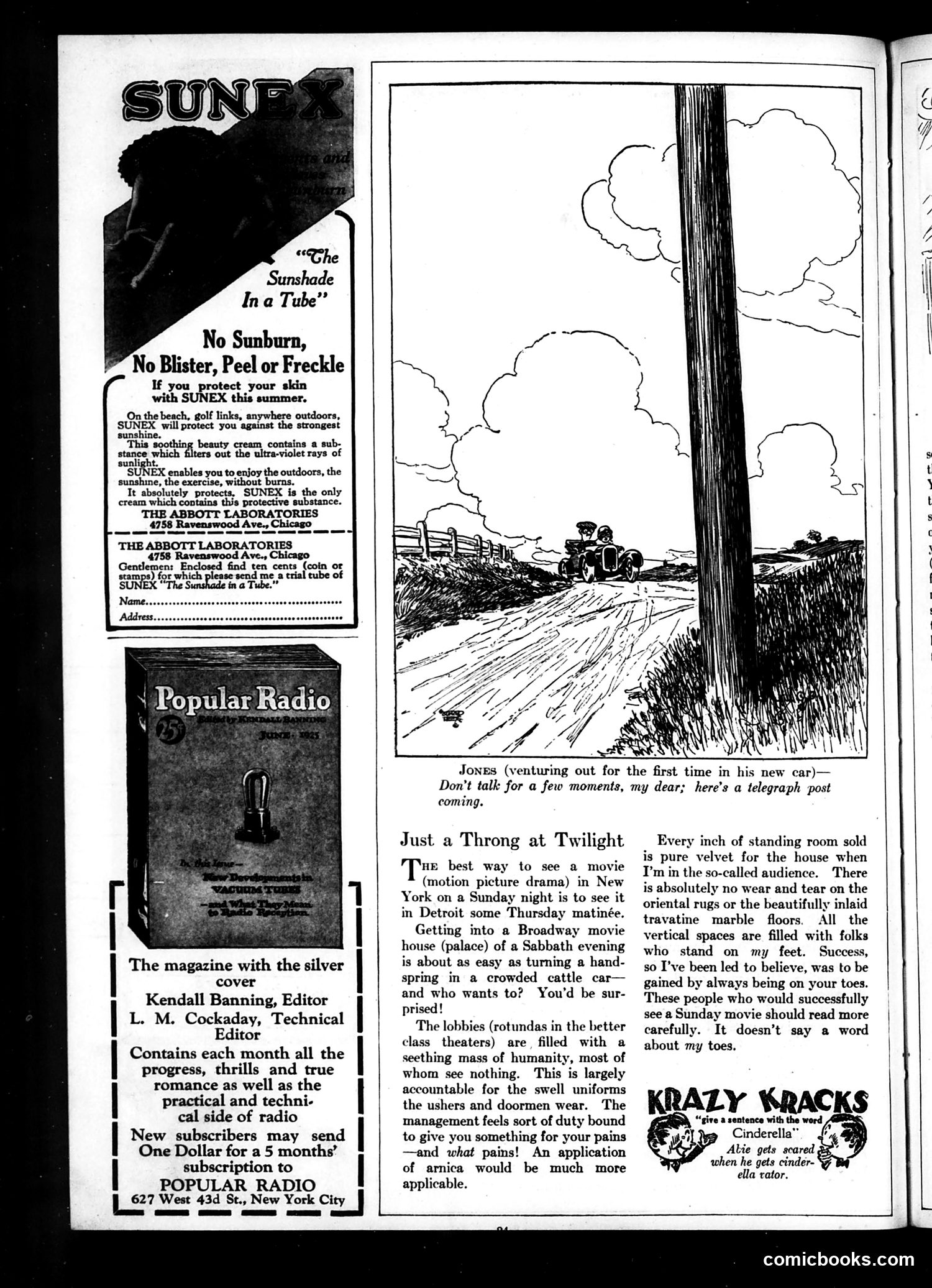
This page contains three unrelated items typical of early 20th-century magazines: **Advertisement (top left):** SUNEX sunscreen, promoting protection from sunburn and freckles—reflecting period beauty standards valuing pale skin. **Cartoon (center right):** A simple joke about a man in a new automobile warning his companion not to talk because "there's a telegraph post coming." This appears to reference early automobile accidents or the novelty/danger of motorcar driving. **Article: "Just a Throng at Twilight"** Satirizes the crowded conditions at Broadway movie theaters on Sunday nights. The author humorously describes being literally trampled—people standing on his feet—while sardonic about the management's use of uniformed ushers as compensation for terrible conditions. The piece mocks both the mob scene and theater economics. **Advertisement (bottom):** "Krazy Kracks" and "Popular Radio" magazine ads fill remaining space. The page reflects 1920s-era concerns: automobile culture, urban leisure activities, and film as mass entertainment.
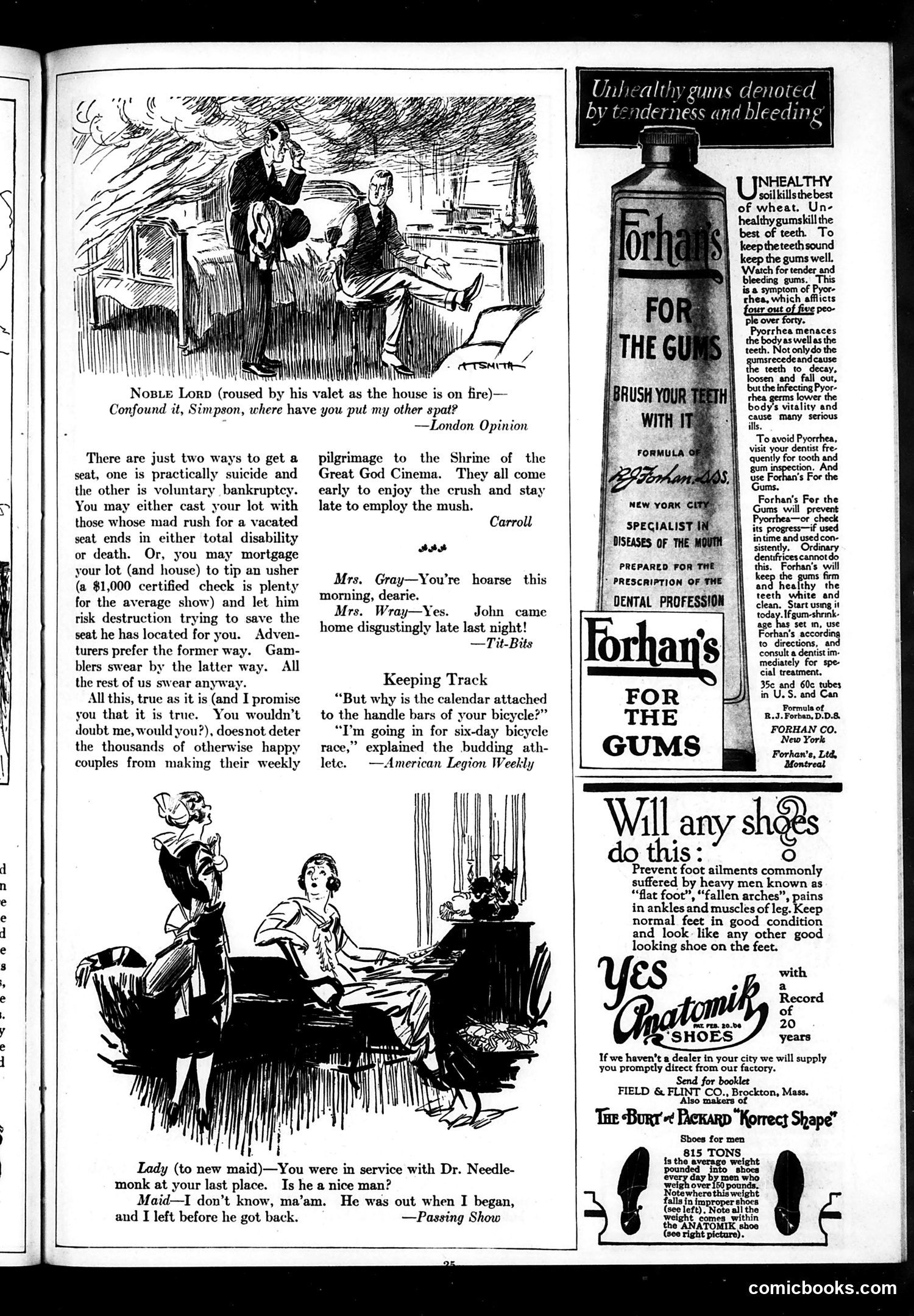
This page from *Judge* magazine consists primarily of **humorous anecdotes and advertisements** rather than political cartoons. The satirical text pieces mock early 20th-century social situations: theater-going crowds crushing each other for seats (requiring either risking injury or bribing ushers with $1,000); a wife's hoarse voice from her husband coming home late; and a maid's useless employment reference from a doctor she never actually saw. The advertisements are equally period-specific: **Forhan's** toothpaste warns of pyorrhea (gum disease), claiming their product prevents teeth decay; **Anatomik shoes** promise to correct "flat foot" and "fallen arches"—common complaints among heavy men. Both ads reflect early-20th-century anxieties about bodily health using pseudo-scientific language. The cartoons illustrate these scenarios with period-appropriate ink drawings. The overall tone is gentle domestic humor typical of *Judge*'s middle-class audience, combined with commercial pitches for products addressing common physical complaints of the era.
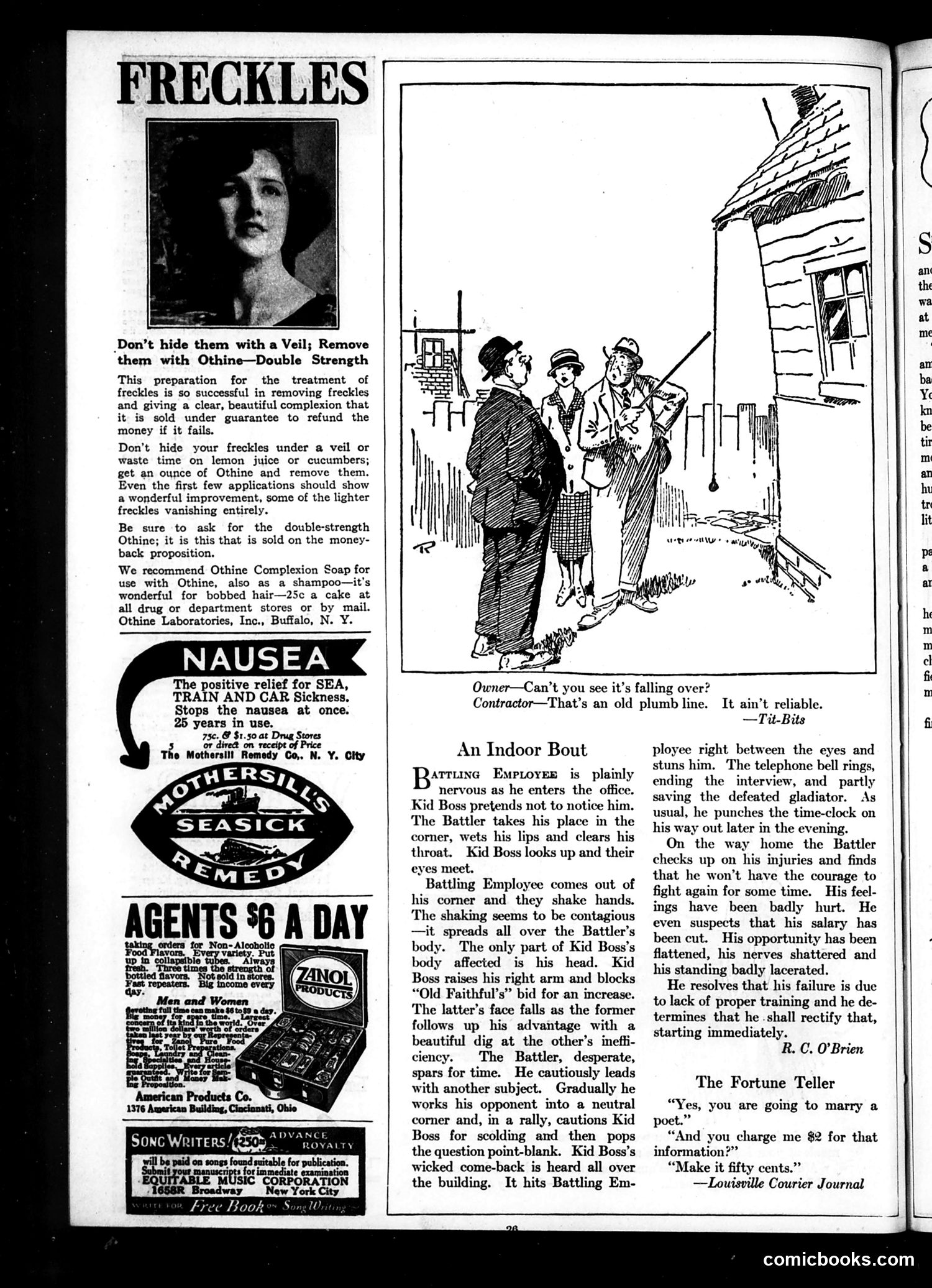
This page from *Judge* magazine contains advertisements and humorous short stories reflecting early 20th-century American workplace and beauty culture. The **"Freckles" advertisement** targets women's insecurities about appearance, promoting "Othine" freckle remover as superior to home remedies (lemon juice, veils). This reflects era-specific beauty standards emphasizing pale, unmarked skin. **"An Indoor Bout"** is a satirical story comparing a nervous employee's salary negotiation with a boxing match. The "Battler" (employee) nervously confronts his boss ("Kid Boss"), uses stalling tactics, and ultimately gets rejected—suffering humiliation. The satire mocks workplace power imbalances and employees' anxiety around wage discussions. **"The Fortune Teller"** is a brief joke about a charlatan fortune teller who, when challenged about overcharging for obvious predictions, self-deprecatingly reduces her fee to fifty cents—humor based on acknowledged fraud. Together, these represent *Judge*'s mix of consumer advertising and satirical commentary on workplace dynamics and social pretensions.
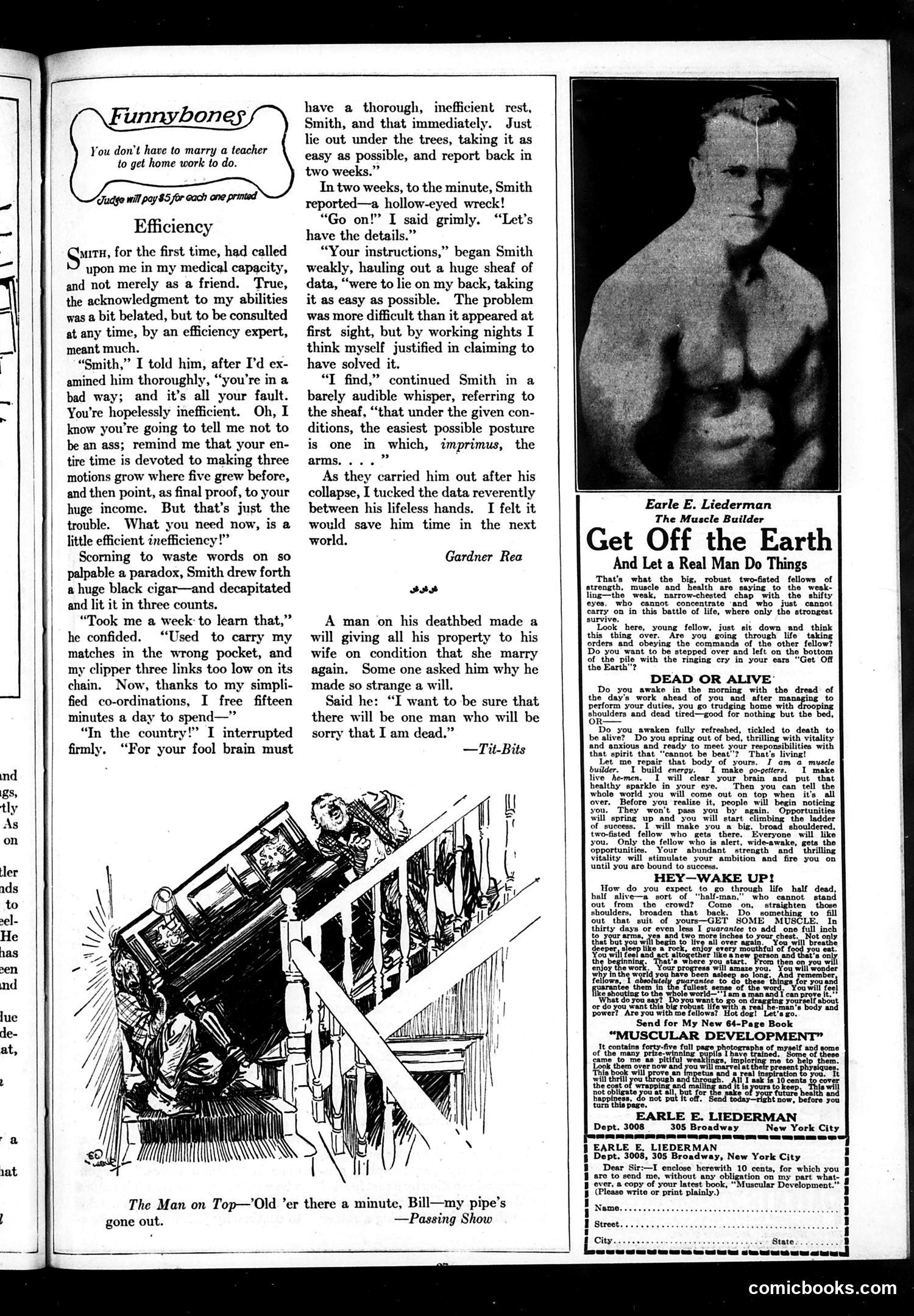
This page contains two satirical pieces from *Judge* magazine: **"Efficiency"** (main story): A doctor tells an overworked efficiency expert named Smith that he's "hopelessly inefficient" and needs complete rest. Smith takes this literally, attempting to optimize even lying down by working through the night to find the mathematically "easiest possible posture." He returns two weeks later as a "hollow-eyed wreck"—the satire mocking obsessive optimization culture and how efficiency-obsession can destroy health. **"The Man on Top"** (cartoon): Shows a man tumbling down stairs, illustrating the phrase about a dying man's will—a darkly comic image accompanying a brief anecdote. **Right column**: Advertisement for "Muscular Development" by Earle E. Liederman, using aggressive masculine rhetoric ("Get Off the Earth") to sell bodybuilding courses—typical early-20th-century ads targeting insecure men with promises of strength and success. The page satirizes the era's obsession with efficiency systems and competitive masculinity.
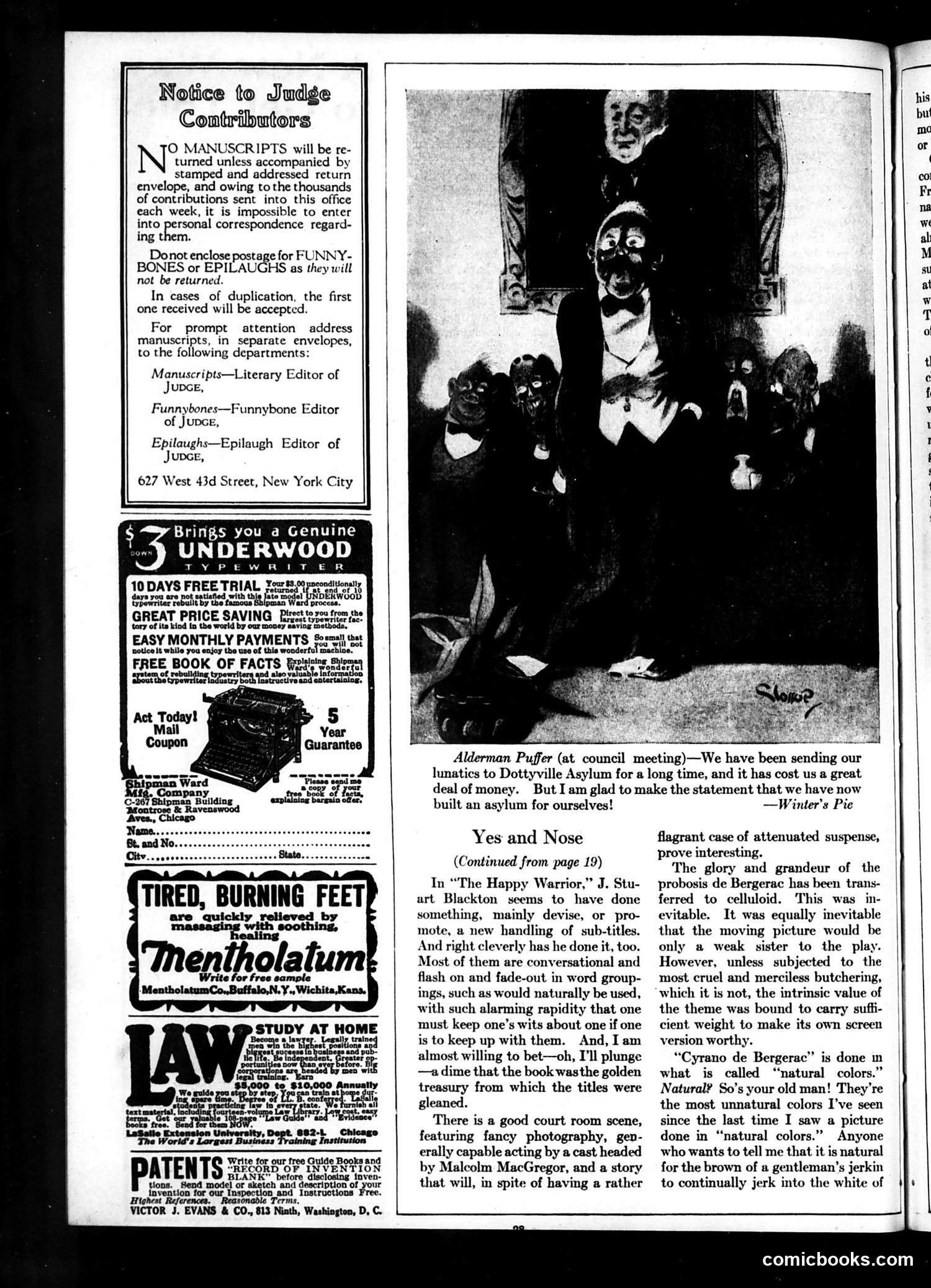
This page is primarily **administrative and advertising**, with one cartoon joke. The main cartoon features **Alderman Puffer** at a city council meeting. The satire is a self-deprecating pun: he boasts that while the city spent money sending lunatics to "Dottyville Asylum," they've now "built an asylum for ourselves"—meaning the council members themselves are crazy. The grotesque illustration of twisted faces supports this joke about municipal incompetence or dysfunction. The page otherwise contains: - Submission guidelines for Judge contributors - Period advertisements (Underwood typewriters, Mentholatum, correspondence courses on law) - A film review of "The Happy Warrior" and "Cyrano de Bergerac," criticizing the latter's artificial "natural color" cinematography The content reflects early 20th-century concerns: asylum costs, bureaucratic absurdity, and skepticism about emerging film technology.
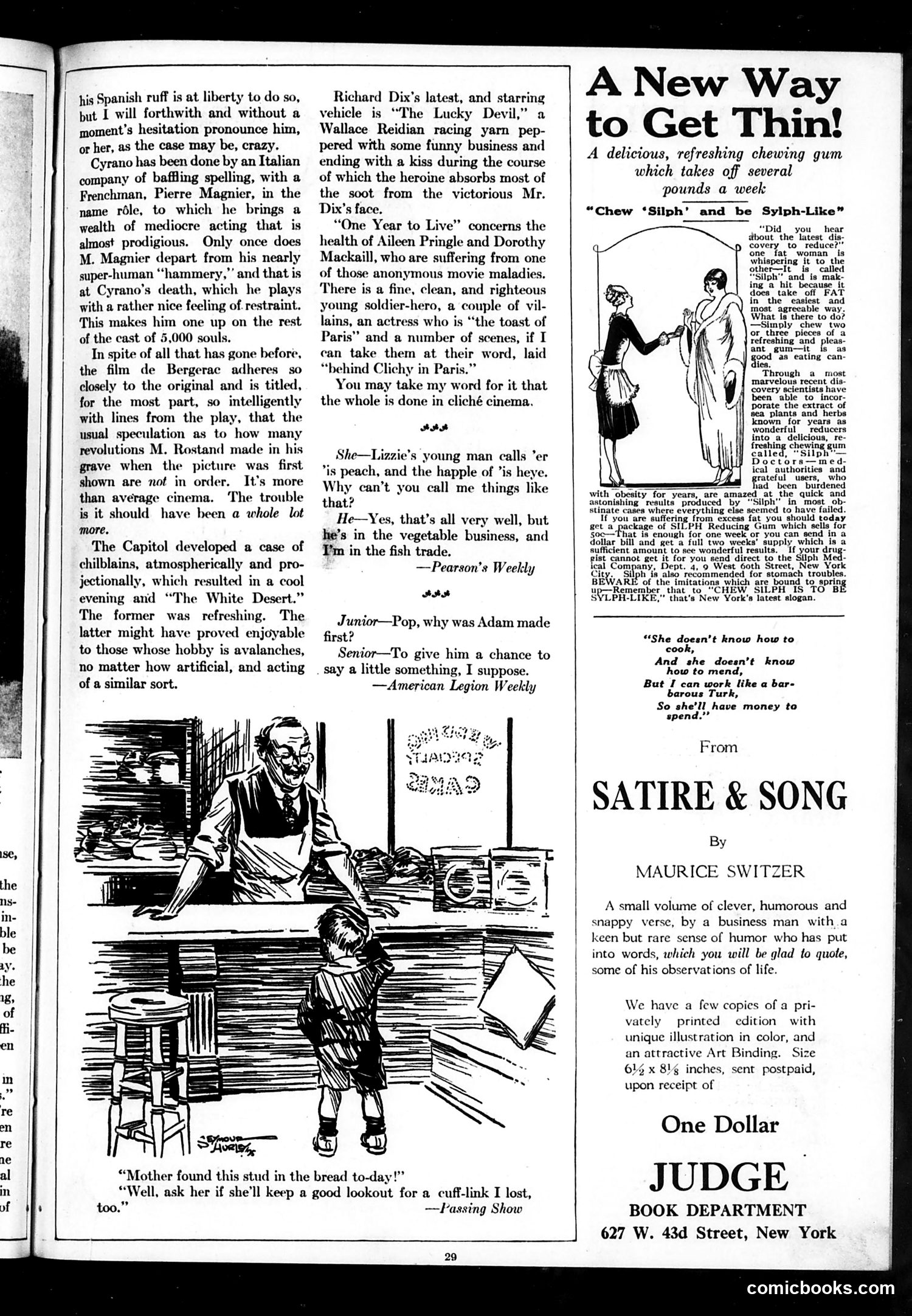
This page contains film reviews and advertisements typical of 1920s entertainment journalism. **The cartoons/jokes:** - A domestic humor piece about a mother finding a stud button in bread and a man joking about losing a cuff-link—typical working-class domestic comedy of the era. - A dialogue joke contrasting romantic nicknames ("peach," "apple of my eye") between a vegetable seller and fish merchant, playing on occupational differences. **The advertisements:** The prominent "Silph" reducing gum ad satirizes weight-loss products marketed to women, promising effortless fat reduction through chewing. This reflects 1920s beauty standards obsessed with thinness. **The film reviews** criticize several movies: a mediocre Italian production of *Cyrano de Bergerac*, Richard Dix's racing film *The Lucky Devil*, and *One Year to Live*, dismissing them as derivative or relying on tired cinematic clichés. The overall tone is characteristic Judge satire—mocking consumer culture, Hollywood conventions, and period anxieties about appearance.
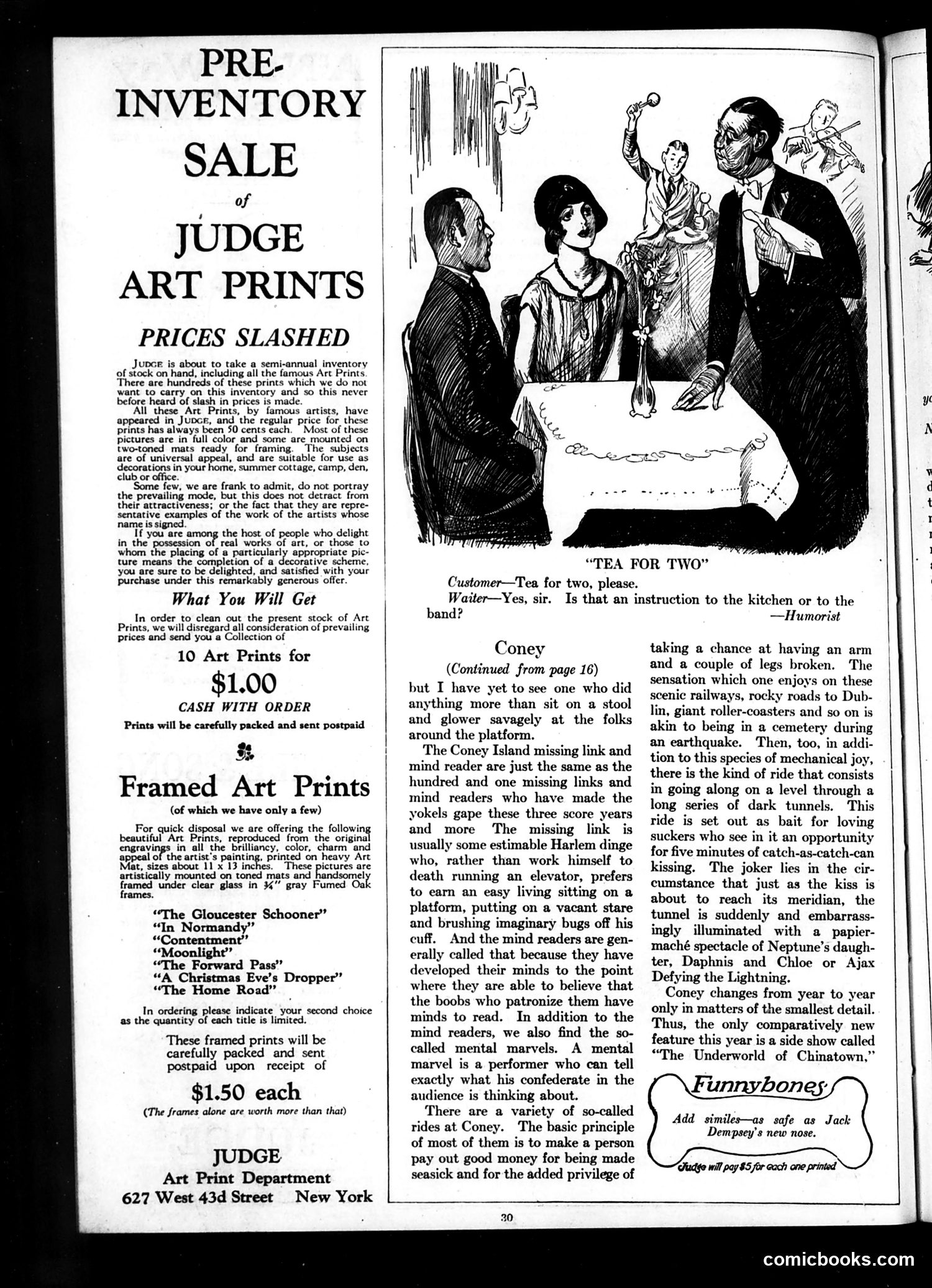
This page contains **primarily advertising** for Judge's art print clearance sale, with a small satirical cartoon and brief humorous column. The cartoon labeled **"Tea for Two"** depicts a restaurant scene where a customer orders "tea for two," and the waiter humorously asks if this is "an instruction to the kitchen or to the band?"—joking that the phrase (from a popular 1924 song) might be ambiguous. The satire mocks either misunderstanding or the ubiquity of the song reference in contemporary culture. The **"Coney" column** continues discussion of Coney Island attractions, satirizing common carnival performers: "missing links" (typically performers in blackface or brownface presenting themselves as evolutionary exhibits—offensive by any era's standards), mind readers, and carnival ride operators. The author mocks their transparently fraudulent acts while noting the public's gullible enthusiasm. The **main content** is the art print sale advertisement, offering 10 prints for $1.00 to clear inventory before the semi-annual stocktaking.
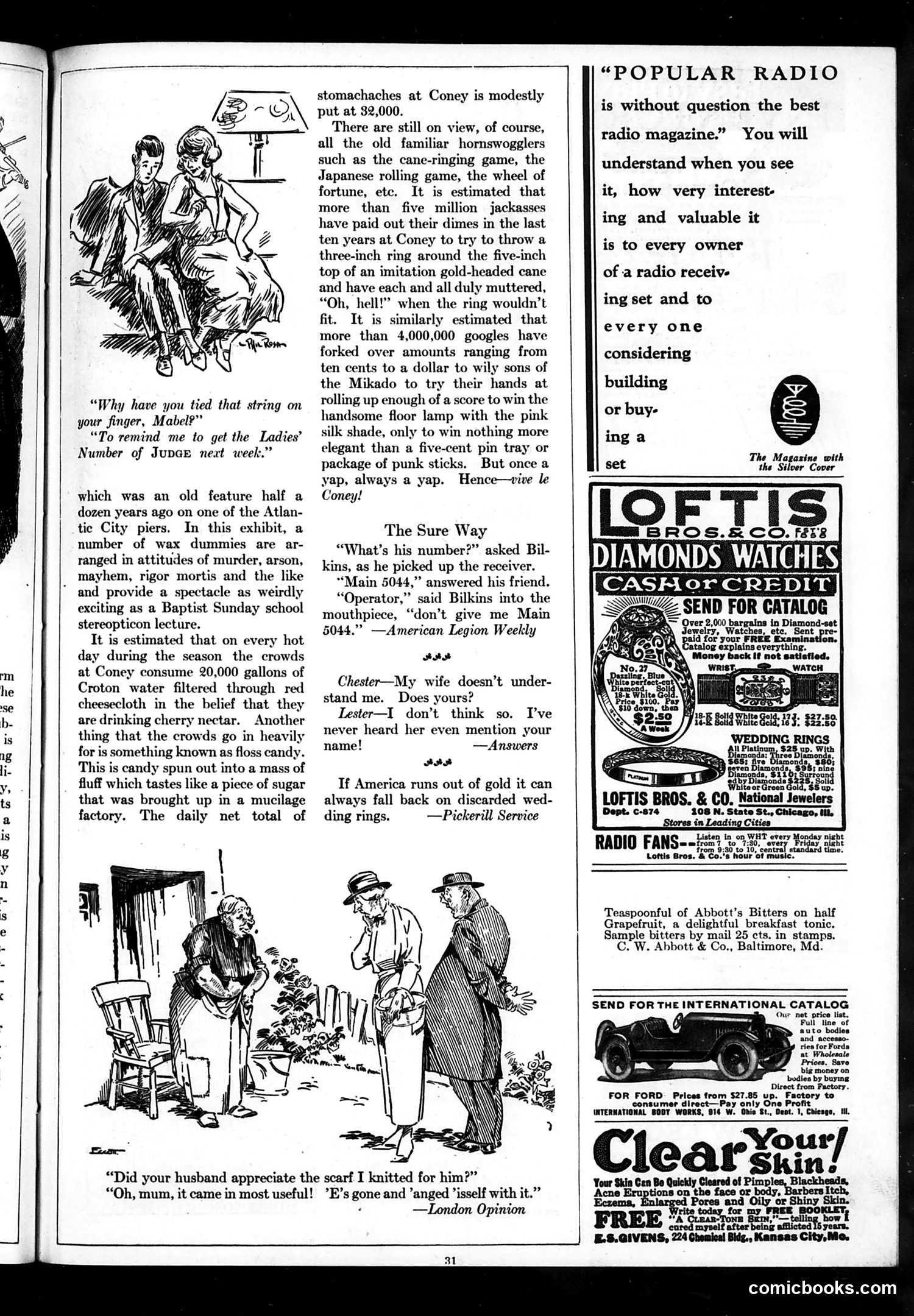
This page contains several short jokes and advertisements typical of 1920s satirical humor. **The cartoons:** The top illustration shows two people at what appears to be an amusement park, with a caption about tying a string as a reminder. The bottom cartoon depicts a British domestic scene where a wife mentions her husband used a knitted scarf to hang himself—dark humor playing on the scarf's inadvertent usefulness. **The jokes** target everyday absurdities: Coney Island's exploitative games that bilk customers of money for cheap prizes; a telephone operator who deliberately ignores a request; marital misunderstanding; and economic anxiety about gold reserves. **The advertising** dominates the right side, hawking Popular Radio magazine, Loftis Bros. diamonds and watches, Ford auto bodies, and a skin-clearing product—typical commercial appeals of the era. The overall tone mocks American consumer culture, working-class gullibility at amusement parks, and domestic life, with particular British humor in the final cartoon.
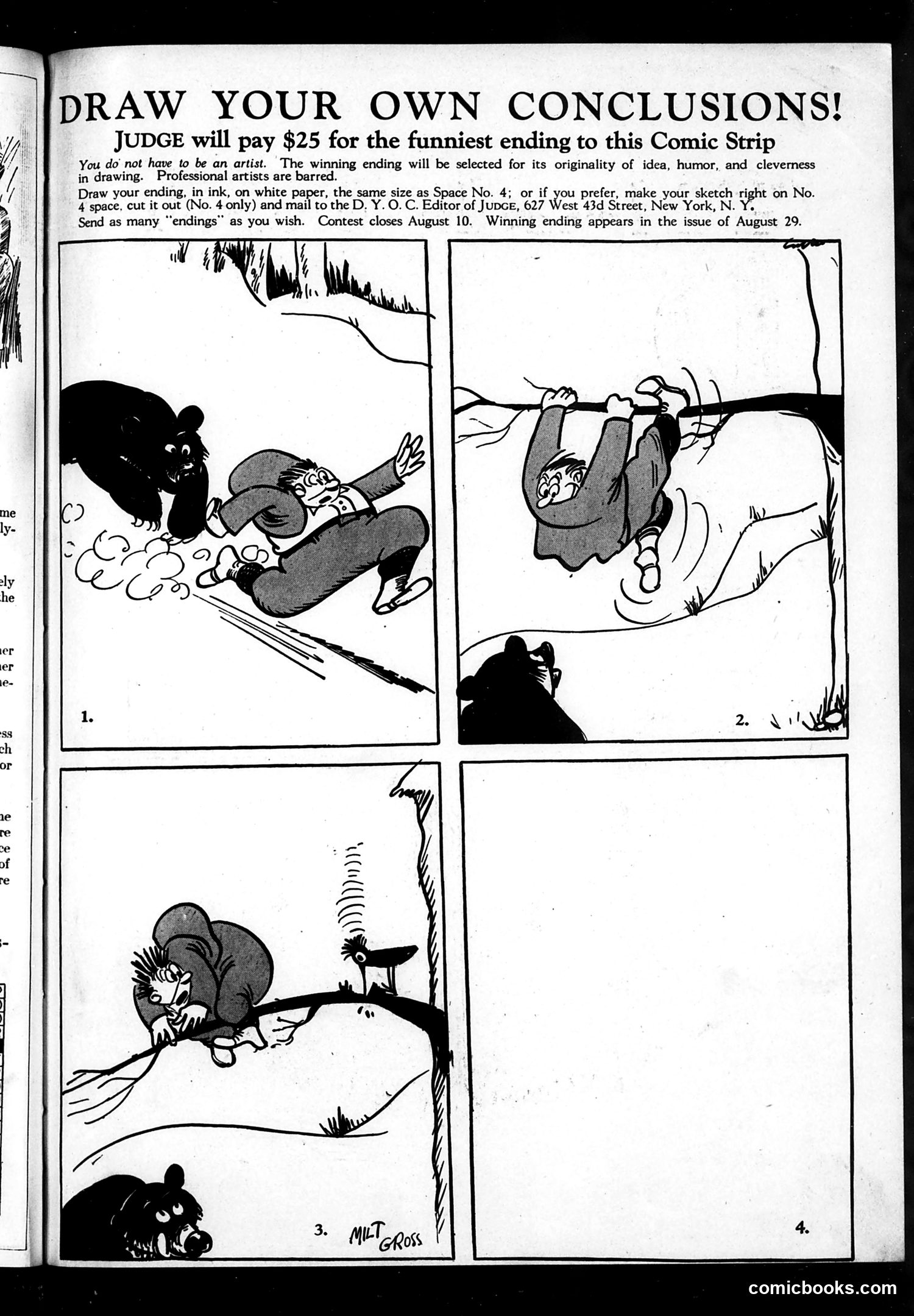
This is a reader participation contest from Judge magazine's "Draw Your Own Conclusions" feature. The comic strip shows a person being chased by a bear through escalating situations: Panel 1 depicts the person fleeing a bear; Panel 2 shows them swinging from a branch while the bear pursues below; Panel 3 shows them perched on a cliff edge with the bear approaching. Panel 4 is blank—the contest's point. Readers were invited to submit humorous endings to this chase sequence, with the winner receiving $25 (significant money in the early 20th century). The contest explicitly barred professional artists, making it accessible to amateurs. This reflects Judge's interactive approach to humor, engaging readers as co-creators rather than passive consumers. The satire relies on slapstick physical comedy rather than political commentary.
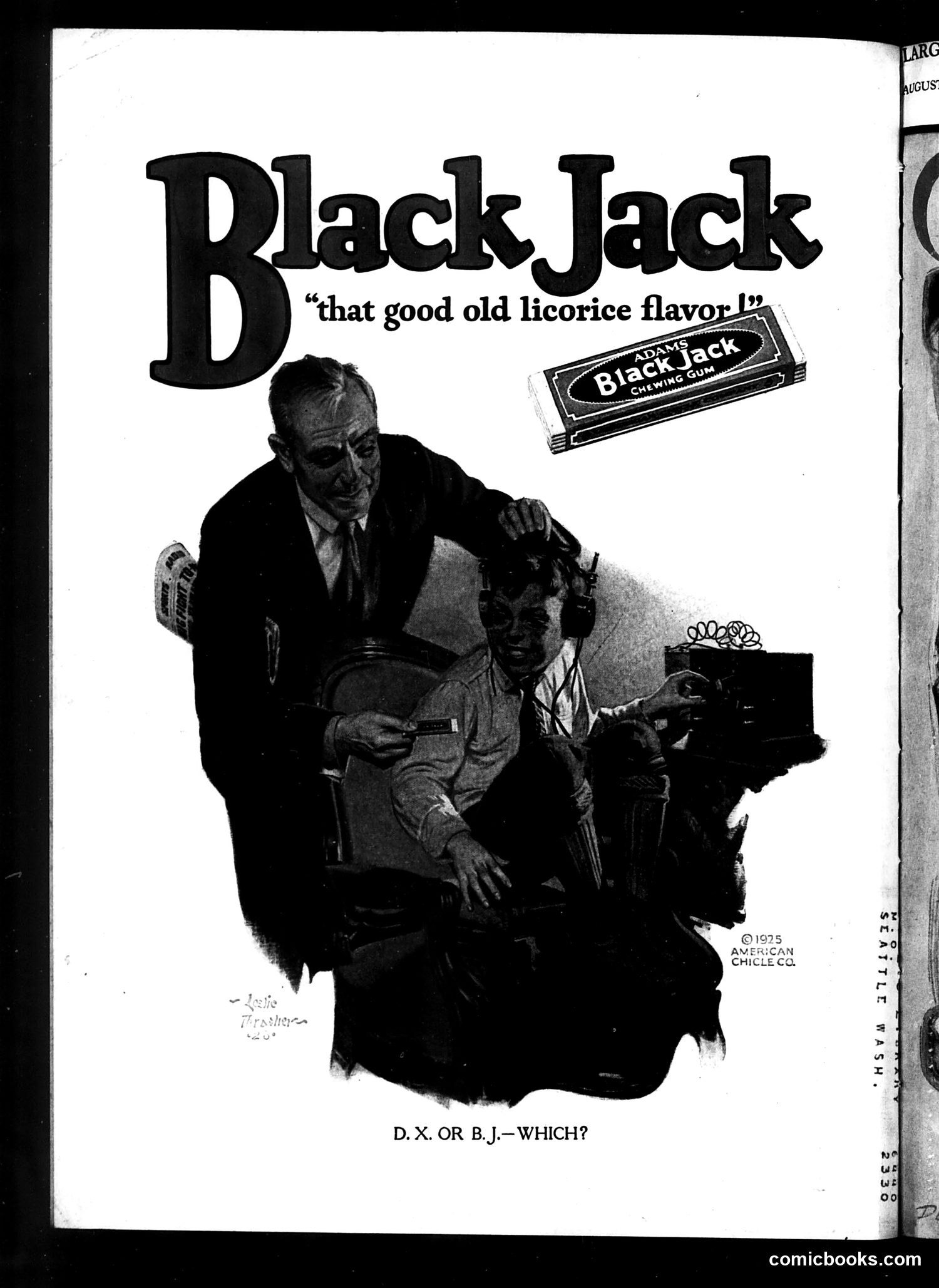
This is an advertisement for Adams' Black Jack chewing gum, featuring the product's tagline "that good old licorice flavor!" The image shows an adult man with a young boy, both examining or considering something, with the cryptic caption "D.X. OR B.J.—WHICH?" The initials likely refer to competing products or brands of the era, suggesting a comparison or choice between options. The advertisement uses the appeal of a father-son moment to market the gum to families. The "licorice flavor" emphasis was a major selling point for Black Jack gum during this period. This represents typical early 20th-century consumer advertising targeting household purchasing decisions through emotional, relatable domestic scenes.