
Judge, 1925-08-01 · page 17 of 36
Judge — August 1, 1925 — page 17: what you’re looking at
What you’re looking at
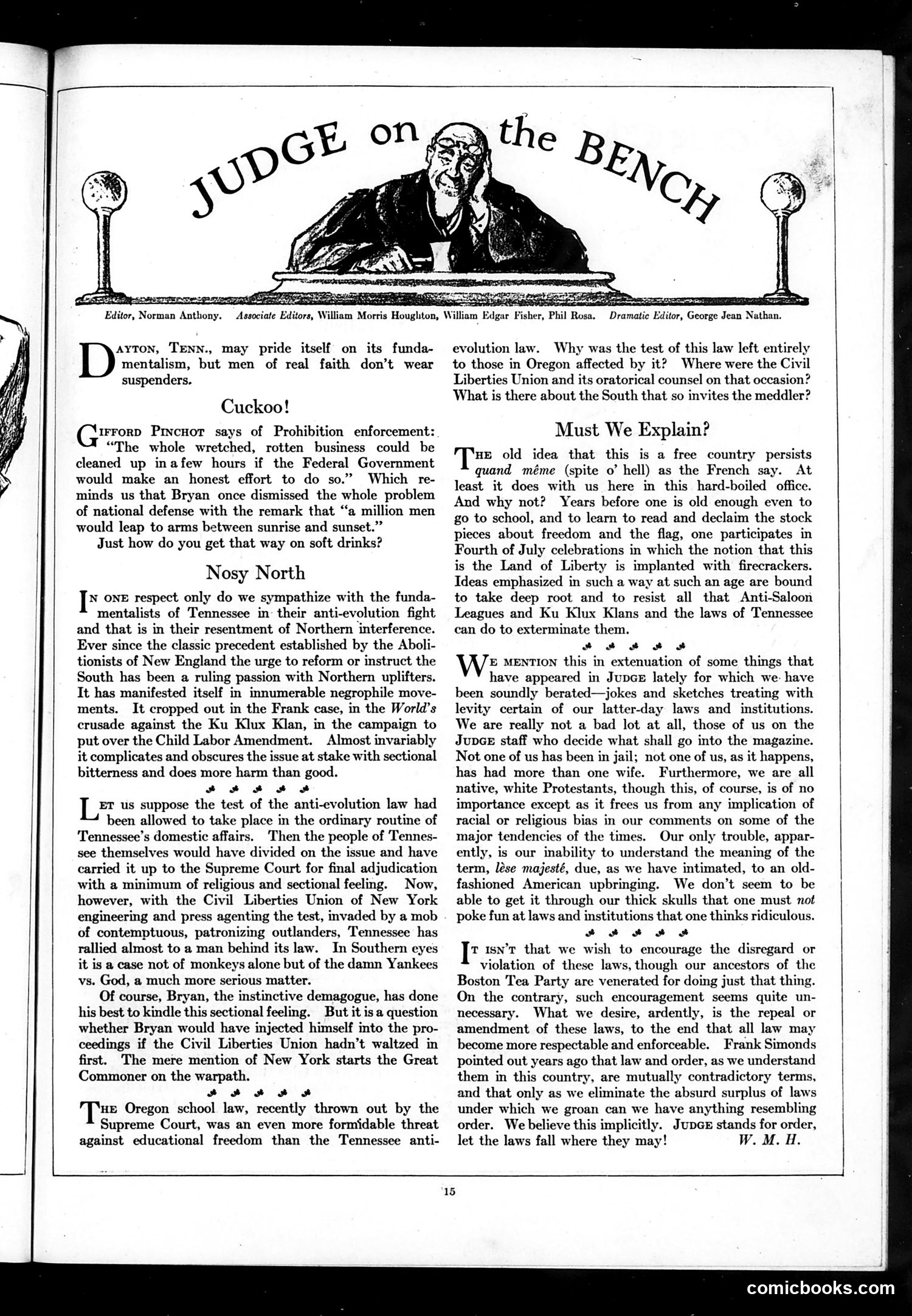
This page satirizes Northern interference in Southern affairs, specifically regarding Tennessee's anti-evolution law (the 1925 Scopes trial context). The editorial criticizes the **Civil Liberties Union of New York** for "engineering and press agenting" the legal test, arguing that outside agitation transformed a local issue into a sectional conflict pitting "the damn Yankees vs. God." The writer suggests the case would have resolved more rationally without Northern "uplift" and patronizing intervention—a pattern dating to abolitionism. The cartoonist/editors ironically defend their own irreverent commentary about laws and institutions, invoking American freedom. They argue that childhood indoctrination about liberty ("implanted with firecrackers") makes citizens naturally resistant to restrictive laws like Prohibition and anti-evolution statutes. The satire targets both paternalistic Northern reformers *and* Southern defensiveness, while paradoxically defending the magazine's right to mock such regulations. The "Judge on the Bench" header suggests moral authority evaluating cultural conflicts.
📄 Transcribed text from this page (OCR, searchable)
Machine-transcribed from the original scan — historical spelling and the odd misread are preserved.
Associate Editors, mentalism, but men of real faith don’t wear Yee Tenn., may pride itself on its funda- suspenders. Cuckoo! IrForD Prncuor says of Prohibition enforcement: “The whole wretched, rotten business could be cleaned up inafew hours if the Federal Government would make an honest effort to do so.” Which re- minds us that Bryan once dismissed the whole problem of national defense with the remark that “a million men would leap to arms between sunrise and sunset.” Just how do you get that way on soft drinks? Nosy North I ONE respect only do we sympathize with the funda- mentalists of Tennessee in their anti-evolution fight and that is in their resentment of Northern interference. Ever since the classic precedent established by the Aboli- tionists of New England the urge to reform or instruct the South has been a ruling passion with Northern uplifters. It has manifested itself in innumerable negrophile move- ments. It cropped out in the Frank case, in the World’s crusade against the Ku Klux Klan, in the campaign to put over the Child Labor Amendment. Almost invariably it complicates and obscures the issue at stake with sectional bitterness and does more harm than good. sae ao LL us suppose the test of the anti-evolution law had been allowed to take place in the ordinary routine of Tennessee’s domestic affairs. Then the people of Tennes- see themselves would have divided on the issue and have carried it up to the Supreme Court for final adjudication with a minimum of religious and sectional feeling. Now, however, with the Civil Liberties Union of New York engineering and press agenting the test, invaded by a mob of contemptuous, patronizing outlanders, Tennessee has rallied almost to a man behind its law. In Southern eyes it is a case not of monkeys alone but of the damn Yankees vs. God, a much more serious matter. Of course, Bryan, the instinctive demagogue, has done his best to kindle this sectional feeling. But it isa question whether Bryan would have injected himself into the pro- ceedings if the Civil Liberties Union hadn’t waltzed in first. The mere mention of New York starts the Great Commoner on the warpath. cr rr T= Oregon school law, recently thrown out by the Supreme Court, was an even more formidable threat against educational freedom than the Tennessee anti- jam Morris Houghton, William E isher, Phil Rosa. Dramatic Editor, George Jean Nathan. evolution law. Why was the test of this law left entirely to those in Oregon affected by it? Where were the Civil Liberties Union and its oratorical counsel on that occasion? What is there about the South that so invites the meddler? Must We Explain? HE old idea that this is a free country persists quand méme (spite o’ hell) as the French say. At least it does with us here in this hard-boiled office. And why not? Years before one is old enough even to go to school, and to learn to read and declaim the stock pieces about freedom and the flag, one participates in Fourth of July celebrations in which the notion that this is the Land of Liberty is implanted with firecrackers. Ideas emphasized in such a way at such an age are bound to take deep root and to resist all that Anti-Saloon Leagues and Ku Klux Klans and the laws of Tennessee can do to exterminate them. oe od od W: MENTION this in extenuation of some things that have appeared in Jupce lately for which we: have been soundly berated—jokes and sketches treating with levity certain of our latter-day laws and institutions. We are really not a bad lot at all, those of us on the JupGE staff who decide what shall go into the magazine. Not one of us has been in jail; not one of us, as it happens, has had more than one wife. Furthermore, we are all native, white Protestants, though this, of course, is of no importance except as it frees us from any implication of racial or religious bias in our comments on some of the major tendencies of the times. Our only trouble, appar- ently, is our inability to understand the meaning of the term, lése majesté, due, as we have intimated, to an old- fashioned American upbringing. We don’t seem to be able to get it through our thick skulls that one must not poke fun at laws and institutions that one thinks ridiculous. et AH aS T isn’t that we wish to encourage the disregard or violation of these laws, though our ancestors of the Boston Tea Party are venerated for doing just that thing. On the contrary, such encouragement seems quite un- necessary. What we desire, ardently, is the repeal or amendment of these laws, to the end that all law may become more respectable and enforceable. Frank Simonds pointed out years ago that law and order, as we understand them in this country, are mutually contradictory terms, and that only as we eliminate the absurd surplus of laws under which we groan can we have anything resembling order. We believe this implicitly. JupGE stands for order, let the laws fall where they may! W. M. H. comicbooks.com