
A complete issue · 36 pages · 1924
Judge — December 13, 1924
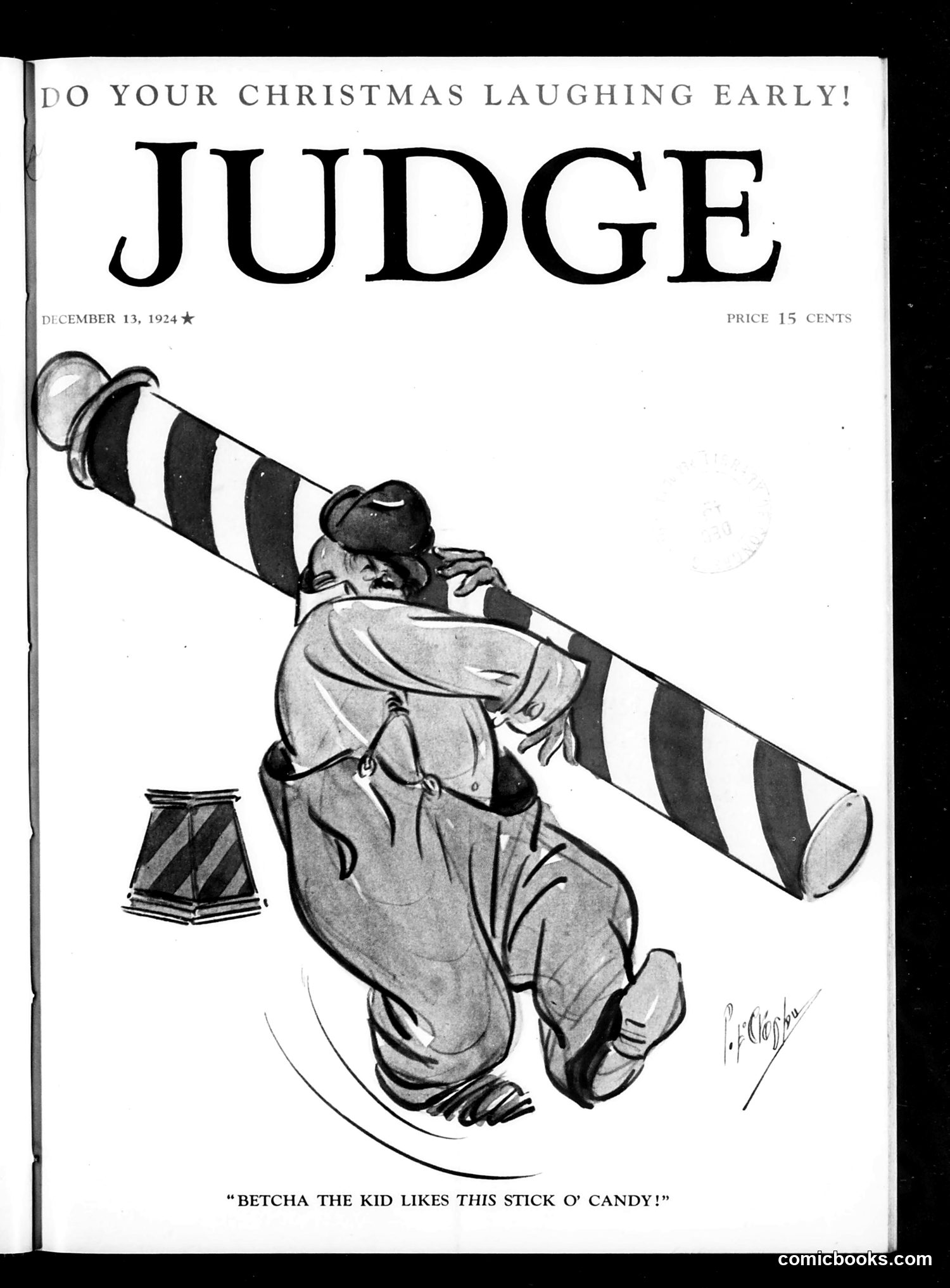
This is a Christmas advertisement cover for **Judge** magazine (December 13, 1924), priced at 15 cents. The illustration depicts a character in oversized clothing struggling with a large striped candy cane or "stick o' candy," with the caption "BETCHA THE KID LIKES THIS STICK O' CANDY!" The image appears to be a straightforward holiday advertisement rather than political satire. It plays on the appeal of large novelty candies as Christmas gifts for children. The exaggerated size of the candy relative to the small child creates comic effect through visual disproportion—a common advertising technique of the era. The phrase "betcha" reflects casual 1920s American speech patterns. Without additional context on the page's other contents, this appears primarily promotional rather than satirical in nature.
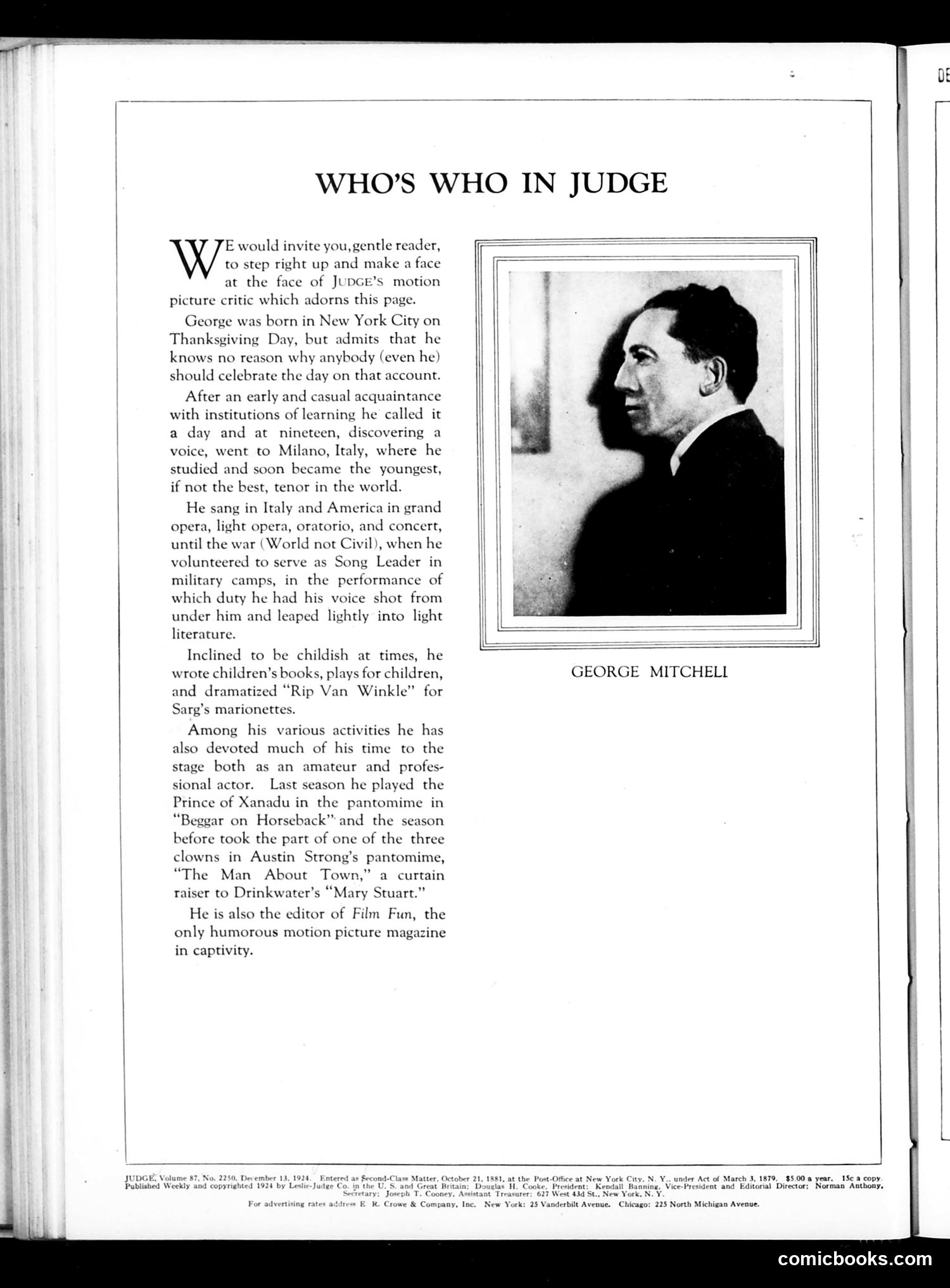
This is a biographical profile rather than a political cartoon. It introduces **George Mitchell**, a multi-talented entertainer born in New York on Thanksgiving Day. Mitchell had an accomplished career as an opera tenor (trained in Milan, Italy) who performed in grand opera, light opera, and concert work. During World War I, he served as a Song Leader in military camps. Beyond music, Mitchell was notably active in theatrical performance—both amateur and professional—playing roles in pantomimes like "Beggar on Horseback" and "The Man About Town." Most notably for *Judge* readers, **Mitchell served as editor of *Film Fun*, described as "the only humorous motion picture magazine in captivity"**—a publication likely distributed in prisons or institutions, hence the wry phrasing.
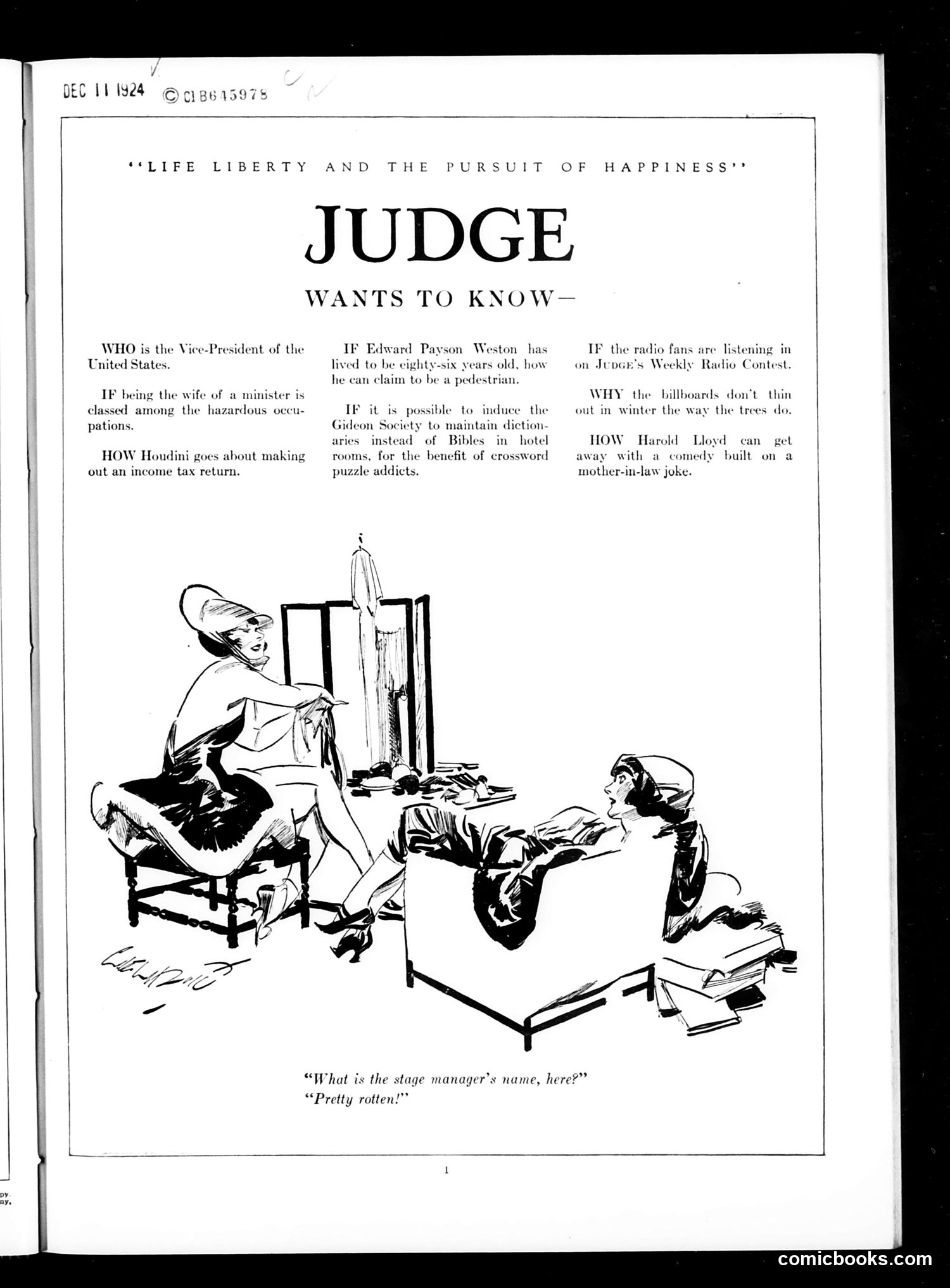
This page contains a "Judge Wants to Know" section—the magazine's satirical question-and-answer format posing absurd or pointed inquiries about contemporary issues. The illustration depicts a theatrical scene where a woman sits directing, while a man lies on the floor in an exaggerated pose. The caption reads: "What is the stage manager's name, here?" "Pretty rotten!" This appears to satirize theater management or possibly critiques a specific stage production through wordplay—the answer "Pretty rotten" is a pun on the stage manager's name (likely referencing someone in theater at that time, though the specific identity is unclear today). The surrounding questions mock various social concerns: ministerial wives facing hazardous occupations, tax returns, religious organizations, radio contests, winter billboards, and Harold Lloyd comedies. The satire targets contemporary middle-class anxieties and popular culture.
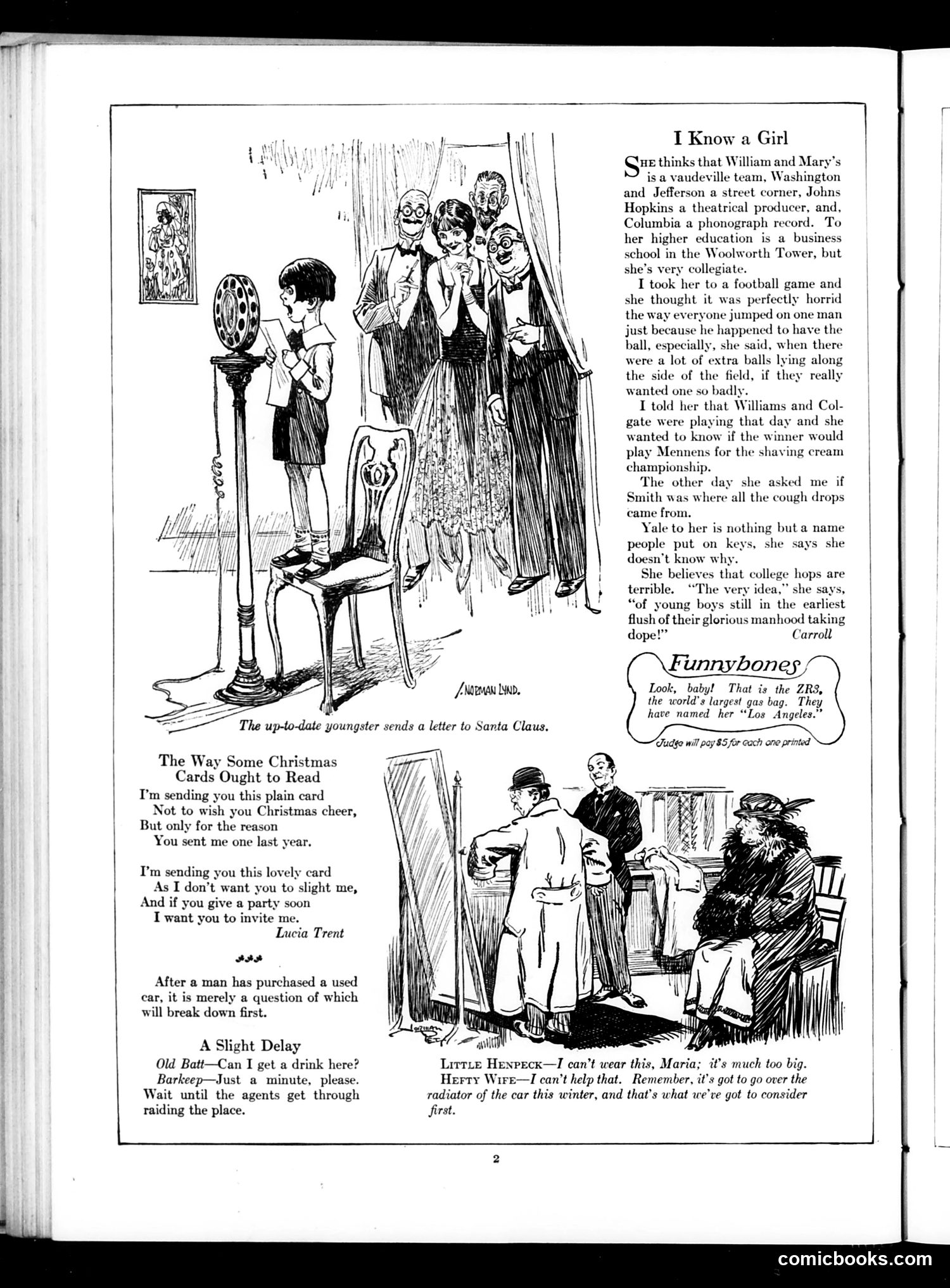
This page contains three separate humorous pieces rather than political cartoons: 1. **"I Know a Girl"** - A social commentary about a young woman interested in sports and college. The joke mocks both her ignorance (not knowing what "college hops" are) and the era's dismissive attitude toward women's education. 2. **"The Way Some Christmas Cards Ought to Read"** - Satirizes insincere holiday greetings, presenting brutally honest alternatives to typical Christmas wishes (e.g., "I don't want you to slight me"). 3. **"A Slight Delay"** and **"Funnybones"** - Brief comic sketches about everyday situations: a man waiting for agents during a raid, and a woman uncomfortable wearing an oversized radiator cover in winter. The page represents typical early 20th-century magazine humor—social satire focused on manners, gender roles, and domestic situations rather than politics.
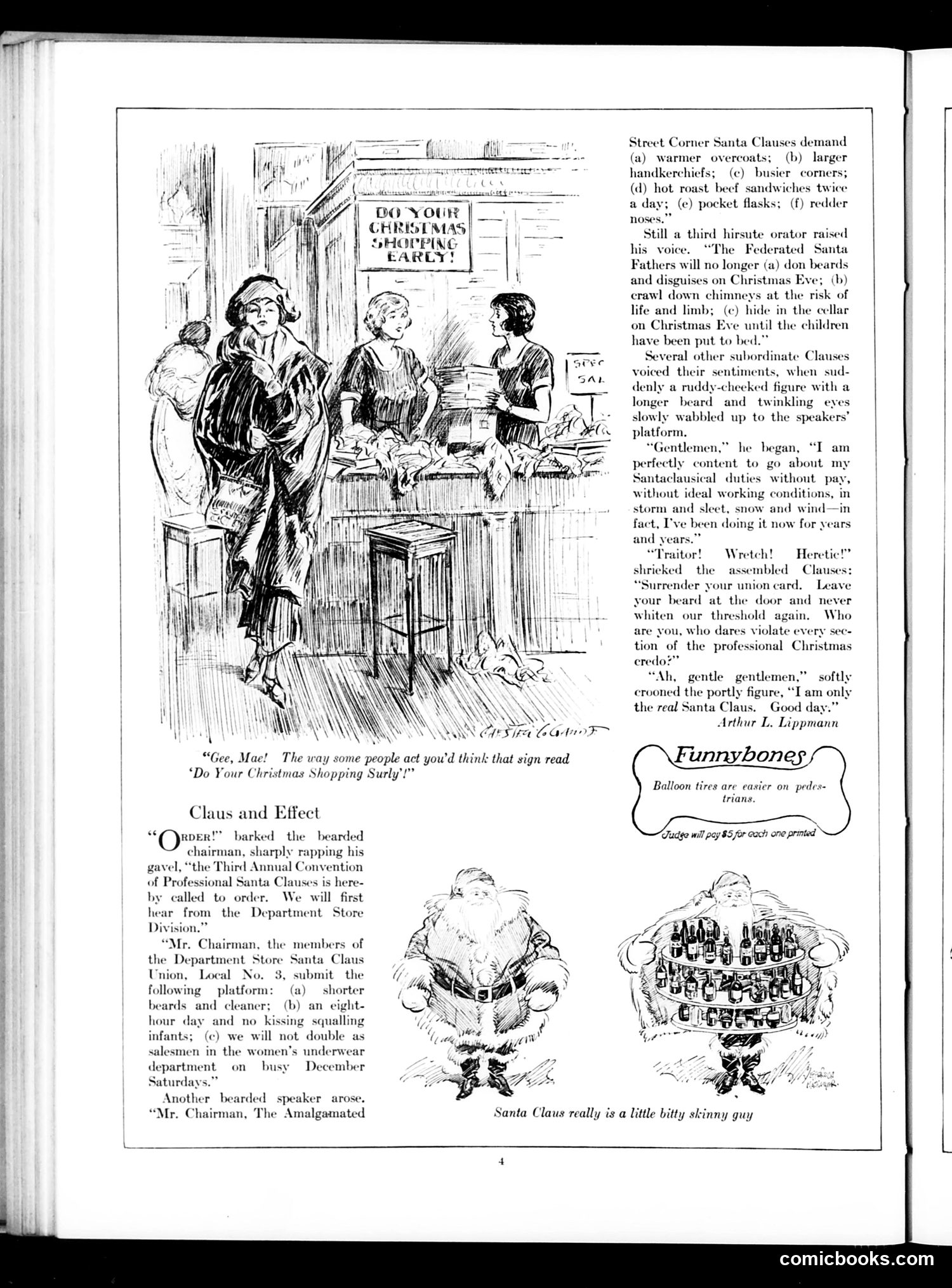
This page satirizes professional department store Santas through a labor-union meeting scene. The cartoon depicts Santa Clauses organizing collectively, with various "clauses" (puns on "Santa Claus") demanding better working conditions: shorter beards, eight-hour days, no doubled shifts during busy Saturdays, and refusing to work in harsh winter weather. The satire targets the emerging labor movement of the early 20th century by applying union rhetoric and formal meeting procedures to the absurd scenario of Santas striking. The punchline rests on the verbal wordplay between "Claus" and "clause" (contract terms), while mocking both aggressive unionization and the commercialization of Christmas through cheap department-store Santas. The "Funnybones" cartoon below offers lighter comic relief about Santa's weight.
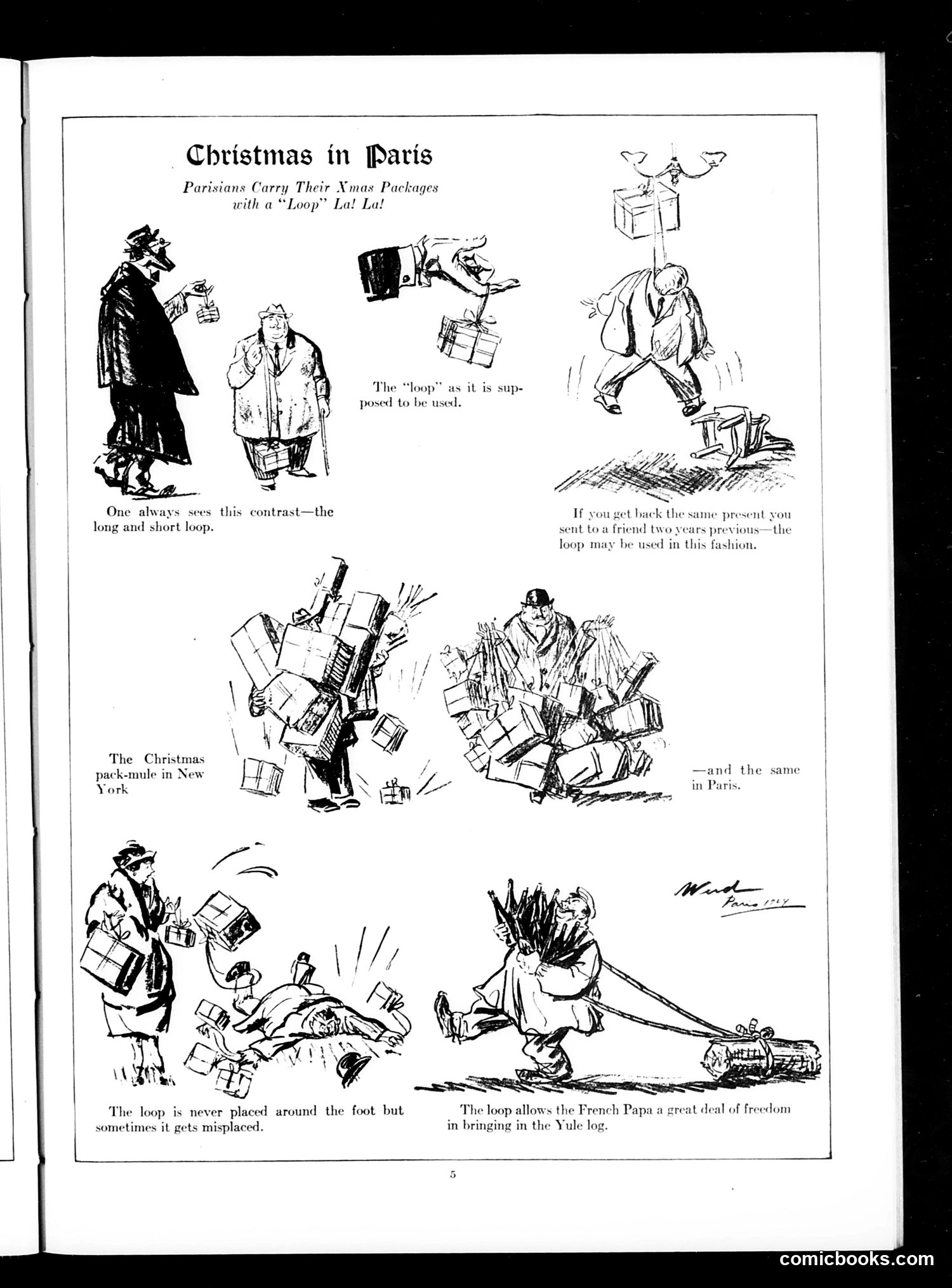
This Judge cartoon compares Christmas gift-giving customs between New York and Paris through humorous illustrations of men struggling with packages. The central joke involves a "loop" (a cord or ribbon loop) supposedly used by Parisians to carry multiple Christmas gifts. The satire mocks the contrast between American and French Christmas practices—showing chaotic American men overwhelmed by packages versus French men using this ingenious "loop" system. The repeated gag of the loop being "misplaced" (humorously placed around someone's foot rather than for carrying gifts) and its utility in dragging in a Yule log emphasizes cultural differences in holiday logistics. The piece pokes fun at both American excess in gift-giving and French ingenuity, using physical comedy to highlight transatlantic contrasts in holiday traditions.
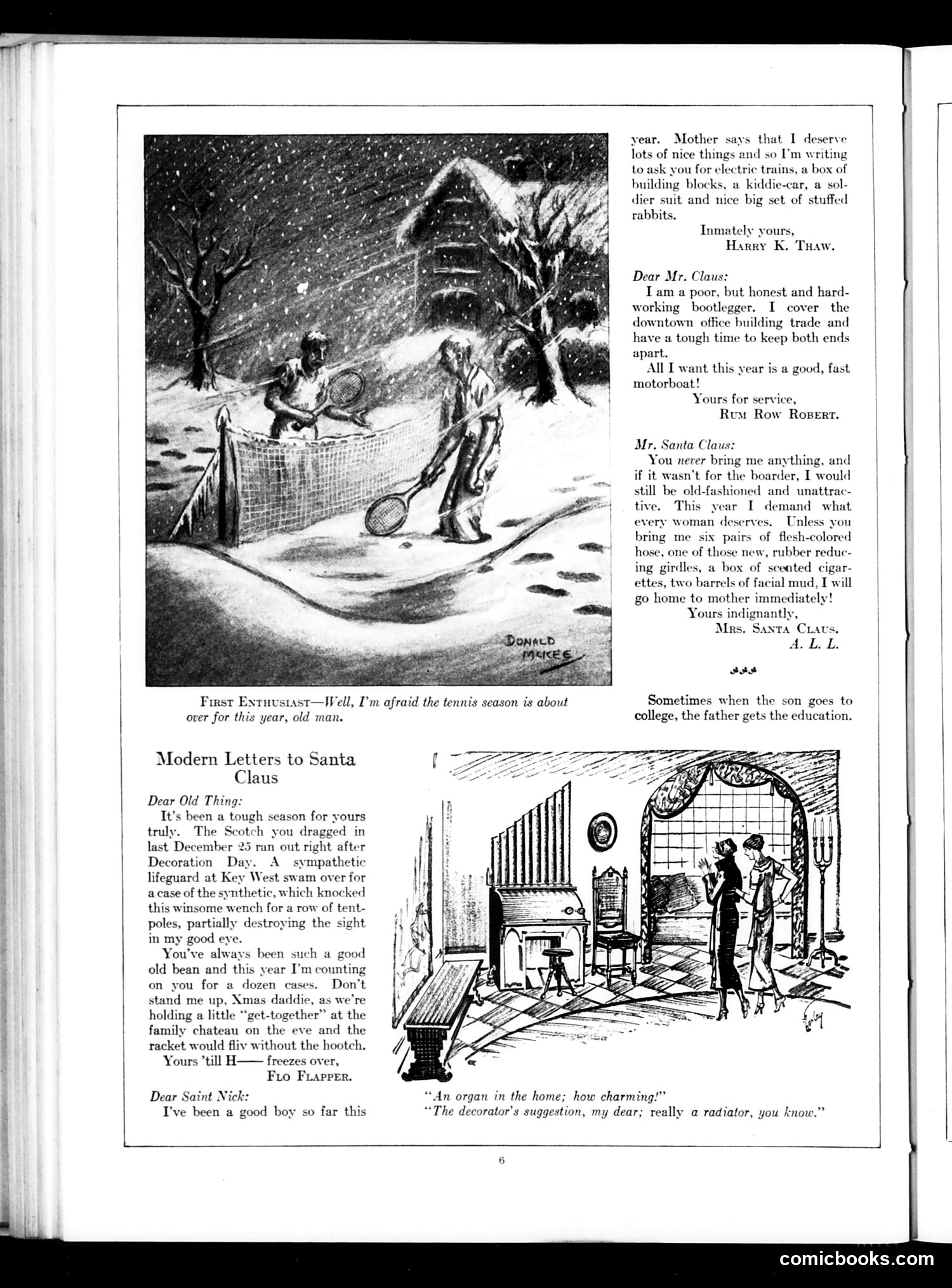
This satirical page mocks Prohibition-era society through humorous letters to Santa. The humor depends on understanding 1920s alcohol prohibition: **Key references:** - **"Flo Flapper"** seeks Scotch whiskey and "synthetic" (bootleg liquor), openly requesting "a dozen cases" for a party—openly flouting Prohibition laws - **"Rum Row Robert"** (a bootlegger) wants a motorboat to smuggle illegal alcohol across waters - **Mrs. Santa Claus** requests "flesh-colored hose" and reducing girdles—fashionable items for modern women - **Young Harry K. Thaw** writes an innocent child's wish list, contrasting sharply with the adult debauchery The satire targets how Prohibition created widespread lawbreaking: wealthy people openly seeking illegal alcohol, bootleggers as commonplace businessmen, and society's hypocrisy. The contrast between the innocent child's letter and adults' brazen alcohol requests emphasizes how normalized criminal behavior had become under Prohibition.
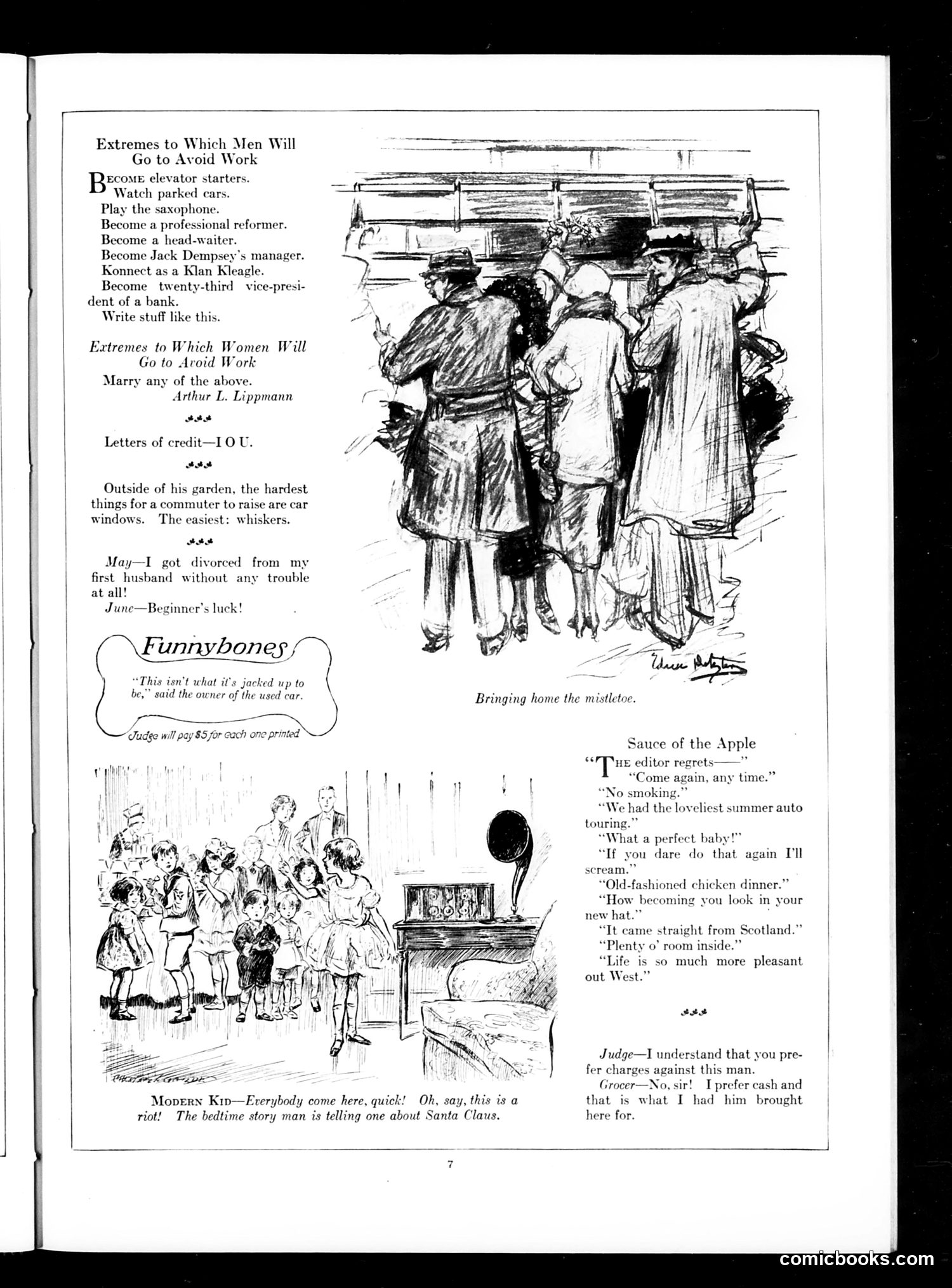
This page presents satirical commentary on American social attitudes circa the 1920s. **Top Section ("Extremes to Which Men Will Go to Avoid Work"):** A humorous list mocking various occupations and dodges men employ to escape "real" work—including elevator operators, car watchers, saxophonists, and notably "Klan Kleagle" (KKK recruiter). The satire suggests these are all equally frivolous or disreputable ways to earn a living. **"Extremes to Which Women Will Go to Avoid Work":** The punchline—"Marry any of the above"—reflects the era's assumption that marriage was women's preferred alternative to employment. **Other Items:** Brief humorous observations about divorce ("Beginner's luck"), used cars, and commuters. **"Modern Kid" Cartoon:** Children interrupt bedtime with excitement, wanting Santa Claus stories instead of sleep—capturing period anxieties about children's unruliness. **"Sauce of the Apple" & "Judge" Dialogue:** Slice-of-life domestic vignettes and a grocer preferring cash payment over credit. The overall tone is light social satire typical of 1920s Judge magazine humor.
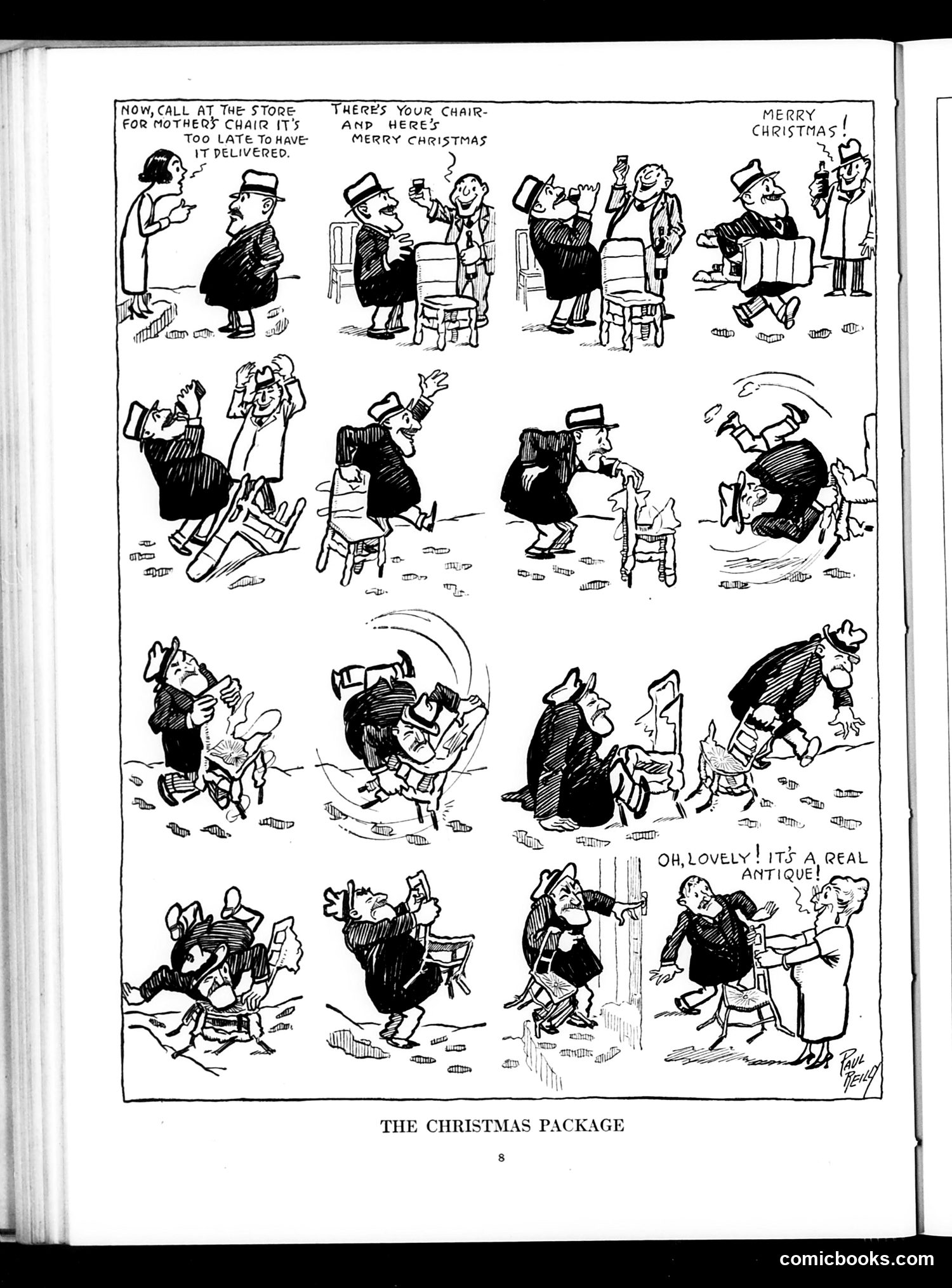
This comic satirizes the chaos of last-minute Christmas shopping and gift-giving. The narrative follows a man attempting to buy a mothers chair as a gift, only to discover it's too late for delivery. Rather than admit defeat, he improvises: he sits in various chairs throughout town, eventually presenting himself as the "gift"—a living "antique" chair for his mother to use. The humor derives from the absurdity of this solution and the desperation of holiday shoppers facing time constraints. The sequential panels show escalating physical comedy as he performs increasingly undignified poses. The satire gently mocks both the commercialization of Christmas and the frantic, often ridiculous lengths people go to fulfill holiday obligations when preparation fails.
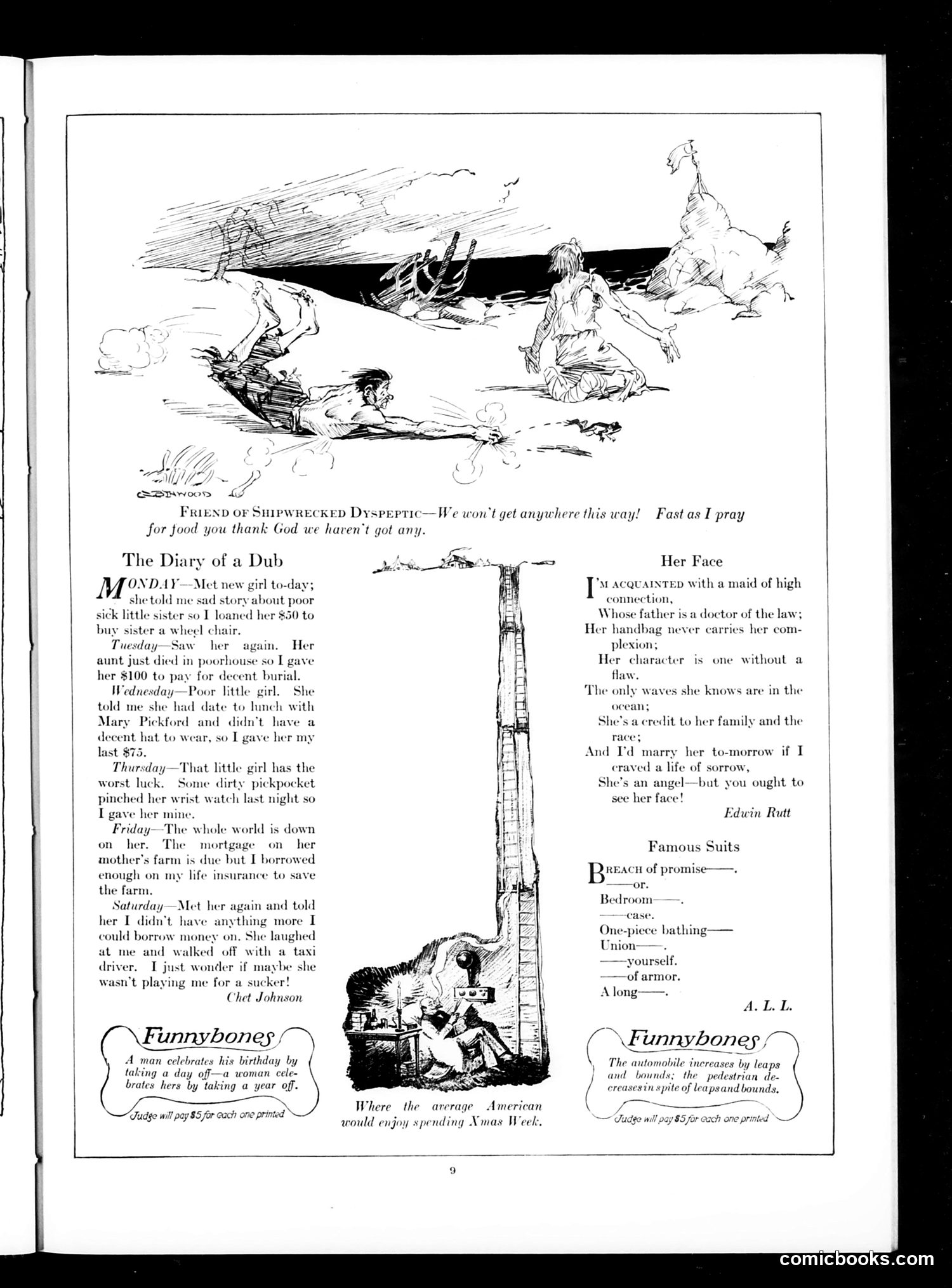
This page contains three separate humorous pieces satirizing early 20th-century social types and behaviors: **"The Diary of a Dub"** mocks a naive, gullible young man who repeatedly gives money to a woman with increasingly implausible sob stories—a sick sister, dead aunt, needed hat, stolen watch, farm mortgage. He realizes too late she's played him "for a sucker," suggesting common anxieties about con artists and romantic deception. **"Her Face"** presents a satirical poem about a "maid of high connection" with perfect character and family credentials—except she's unattractive ("you ought to see her face"), making her unmarriageable despite her virtues. This mocks superficiality and the marriage market. The cartoons and "Funnybones" jokes address contemporary concerns: desperate poverty (shipwrecked dyspeptic, poorhouse), women's vanity, automobiles (a new menace to pedestrians), and gender differences in aging. The page reflects pre-1920s urban American anxieties about class mobility, con artists, and rapidly changing social conditions.
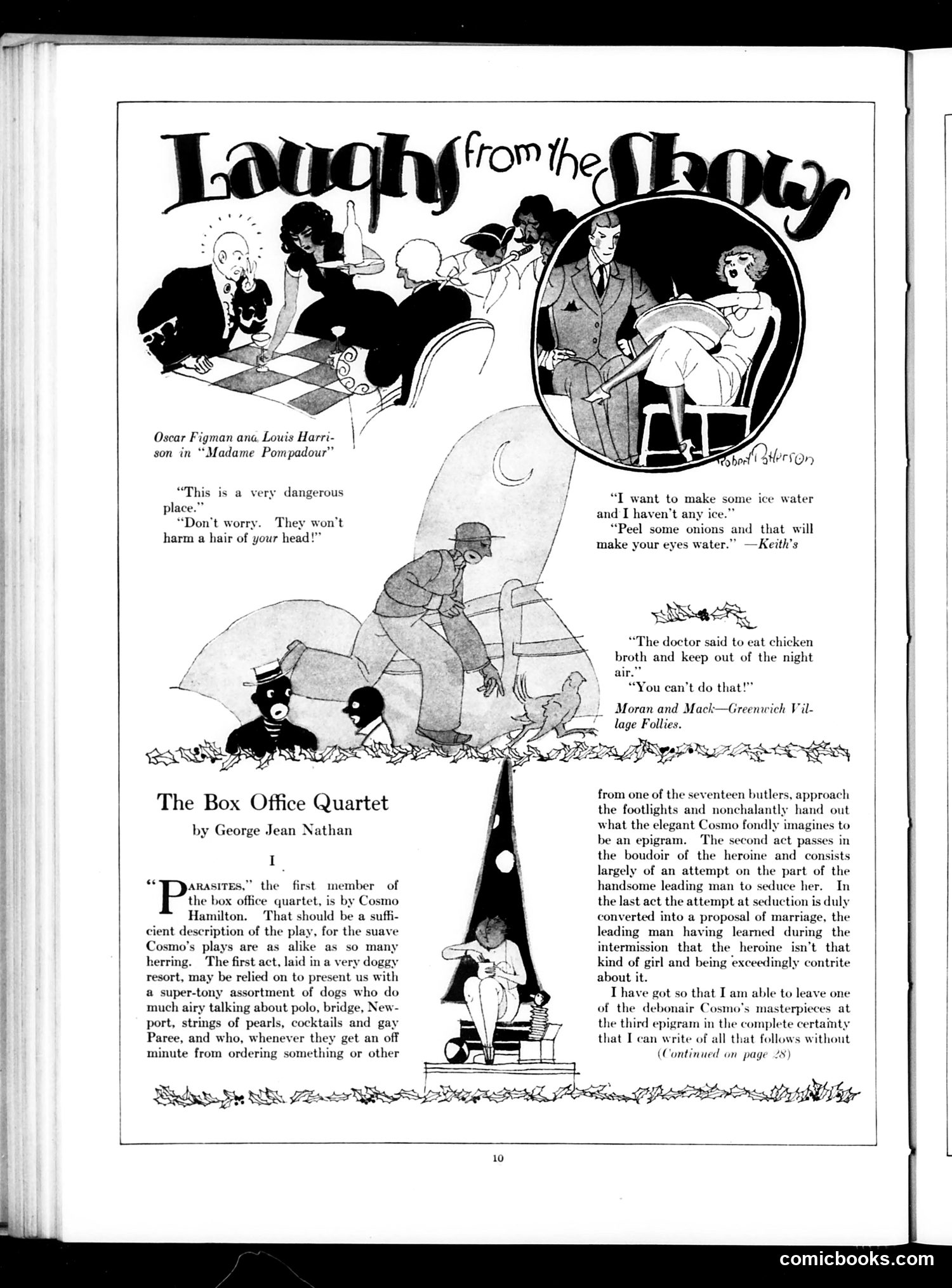
This page combines theatrical reviews with vaudeville humor. The top section showcases comedy bits from popular stage shows: "Madame Pompadour" (featuring actors Oscar Figman and Louis Harrison) and performances from Keith's and the Greenwich Village Follies, presenting simple joke exchanges meant to elicit laughs. The main content is George Jean Nathan's sardonic theater criticism of "The Box Office Quartet," specifically reviewing Cosmo Hamilton's play "Parasites." Nathan mocks Hamilton's formulaic comedies—setting them in wealthy locales (doggy resorts, boudoirs), populated with wealthy stereotypes discussing polo and pearls, and following predictable seduction-to-marriage plots. Nathan's tone is dismissive, suggesting Hamilton's plays are so repetitive and predictable that critics need only read the opening to accurately predict the entire ending. This represents typical Judge satire: theatrical insider commentary on predictable commercial entertainment formulas.
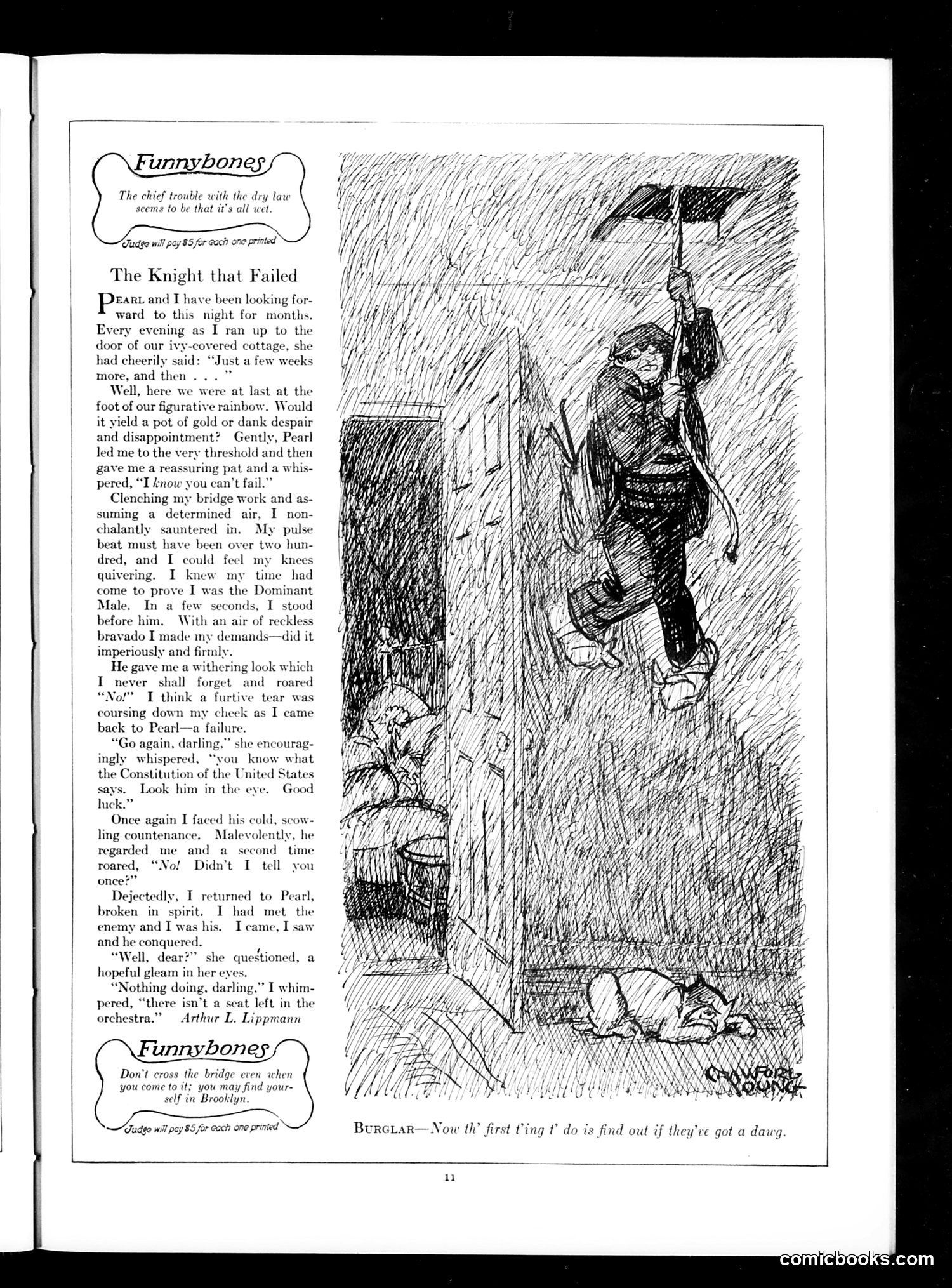
This story satirizes Prohibition's failure through domestic comedy. A husband promises his wife Pearl he'll obtain an illegal alcoholic drink (the "pot of gold" at the rainbow's end), positioning himself as the "Dominant Male" who must prove his worth. He attempts to bribe a speakeasy doorman twice, invoking the Constitution's authority, but is rejected both times. He returns defeated—"I came, I saw and he conquered"—confessing failure. The punchline subverts expectations: his real problem isn't Prohibition enforcement but mundane reality—no theater seats available. The joke mocks both the era's widespread lawbreaking (husbands expected to obtain illegal liquor) and the gap between grand masculine ambitions and petty domestic reality. The page's header joke ("dry law seems to be all wet") reinforces the satire: Prohibition, intended to eliminate drinking, actually thrives underground.
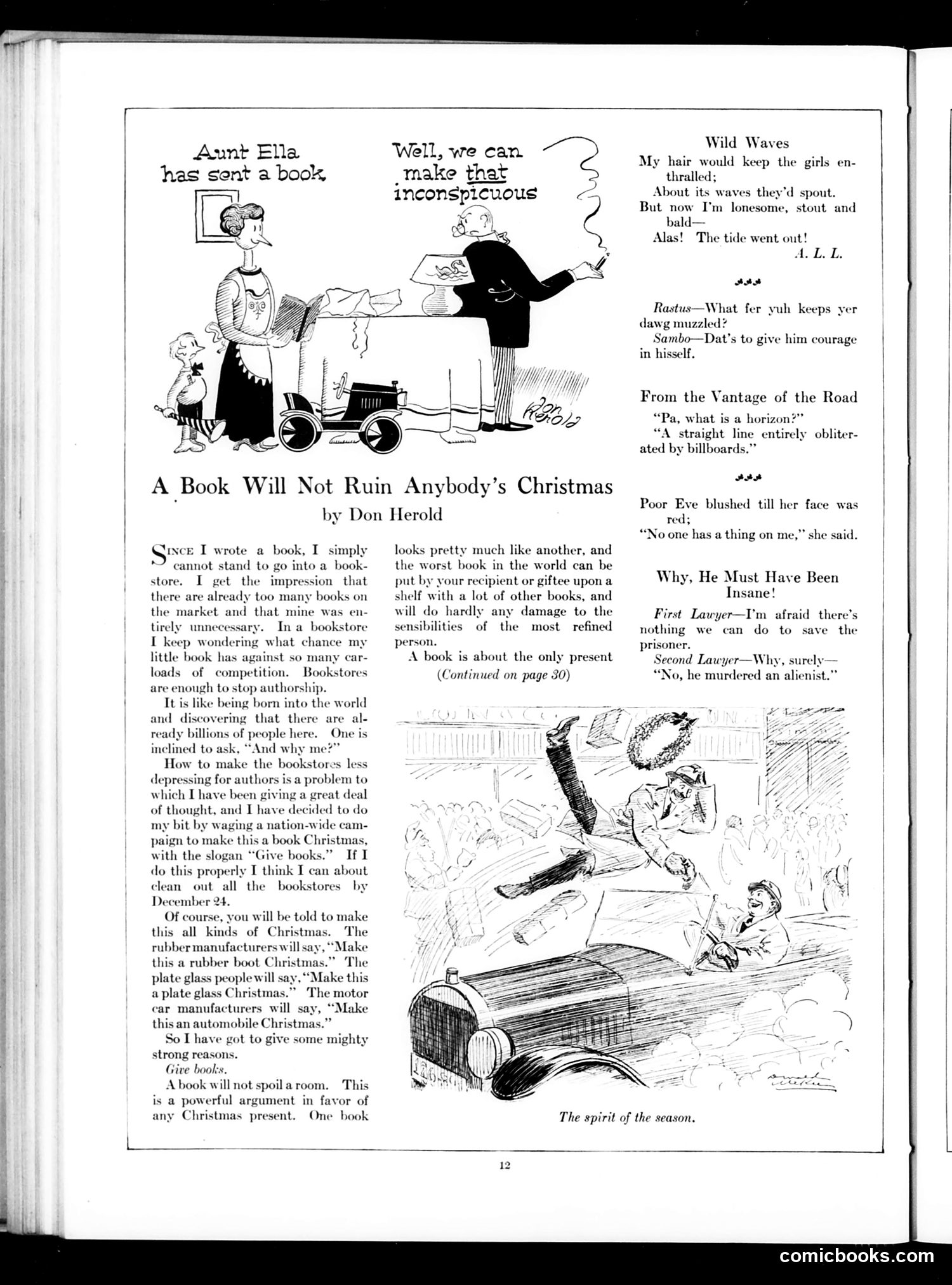
This page presents **Don Herold's humorous essay arguing for books as Christmas gifts**, accompanied by period comic strips and jokes. **Main Content:** Herold satirizes authors' anxiety about their books competing in overcrowded markets. His tongue-in-cheek campaign urges "Give books" as Christmas presents because books won't damage a room—unlike rubber manufacturers promoting rubber boots or car makers pushing automobiles. The joke targets consumerism and manufactured holiday spending trends. **Supporting Material:** - Top cartoon: A woman receives an unwanted book from "Aunt Ella" and plots to hide it—ironic given Herold's pro-book argument - Bottom illustration captioned "The spirit of the season" shows children playing with a toy car in snow - Side jokes include racial dialect humor ("Rastus/Sambo"), a pun about baldness ("tide went out"), and legal satire about defending an "alien" murderer **Context:** This reflects 1920s-30s American anxieties about mass production, advertising saturation, and consumerism—concerns surprisingly modern in tone.
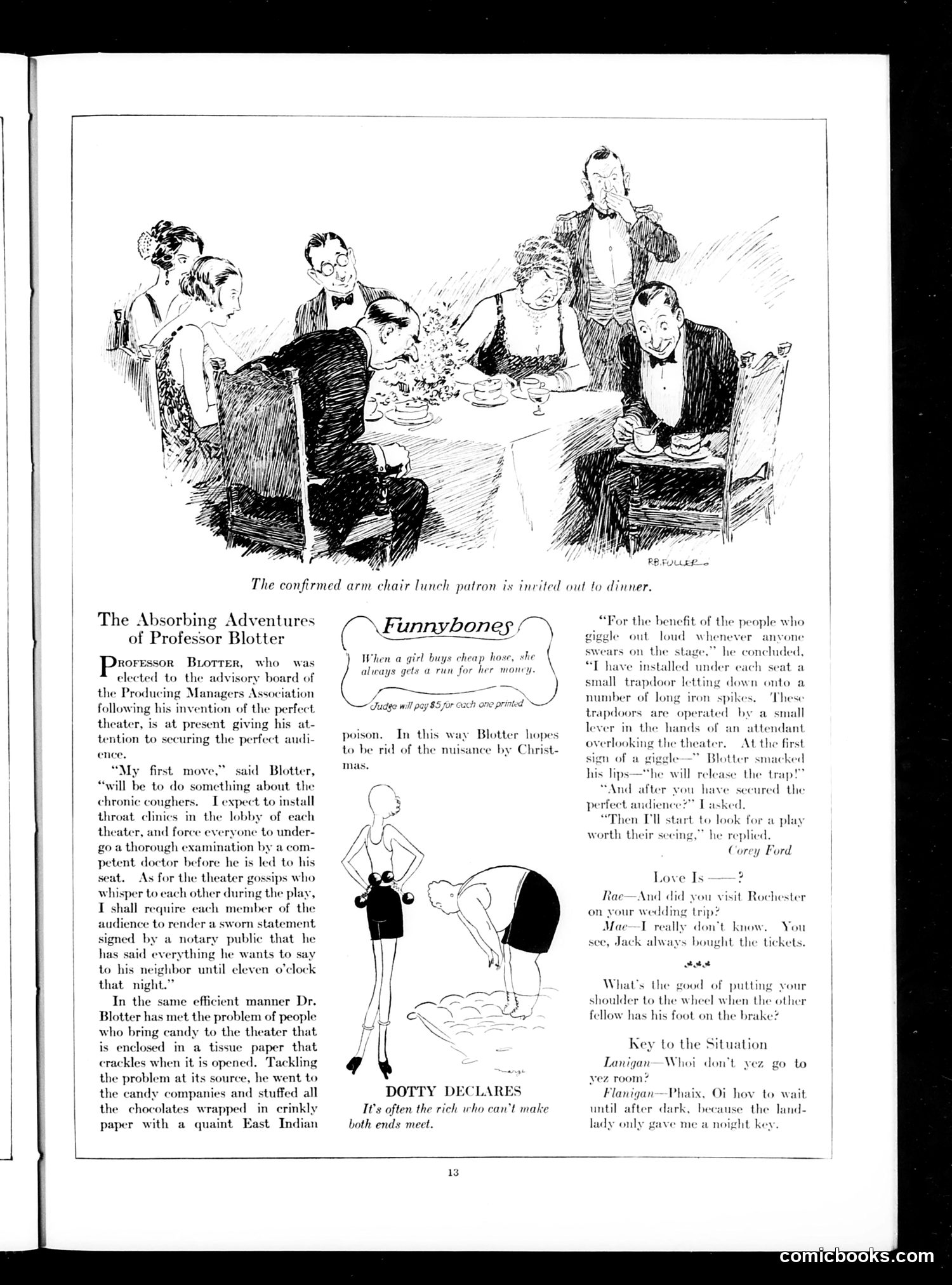
This page satirizes **Professor Blotter**, a fictional theater reformer obsessed with creating the "perfect audience." The satire mocks both theatrical annoyances and overzealous problem-solving. Blotter's proposed solutions are absurdly draconian: mandatory throat clinics to stop coughers, sworn statements to silence gossips, and most darkly, **trapdoors with iron spikes** to eliminate giggling audience members. The final detail—operated by an attendant who will "release the trap"—transforms the joke into pitch-black comedy about authoritarian control disguised as consumer satisfaction. The accompanying "Funnybones" section offers lighter humor about female audiences and cheap hosiery. Other brief gags mock marriage (wives unaware of destinations), class anxiety (the poor landlady restricting key access), and wealth (the rich unable to balance budgets). The overall target is the era's growing managerial culture—the impulse to "efficiently" engineer human behavior rather than accept ordinary social friction. Blotter embodies this impulse taken to homicidal extremes.
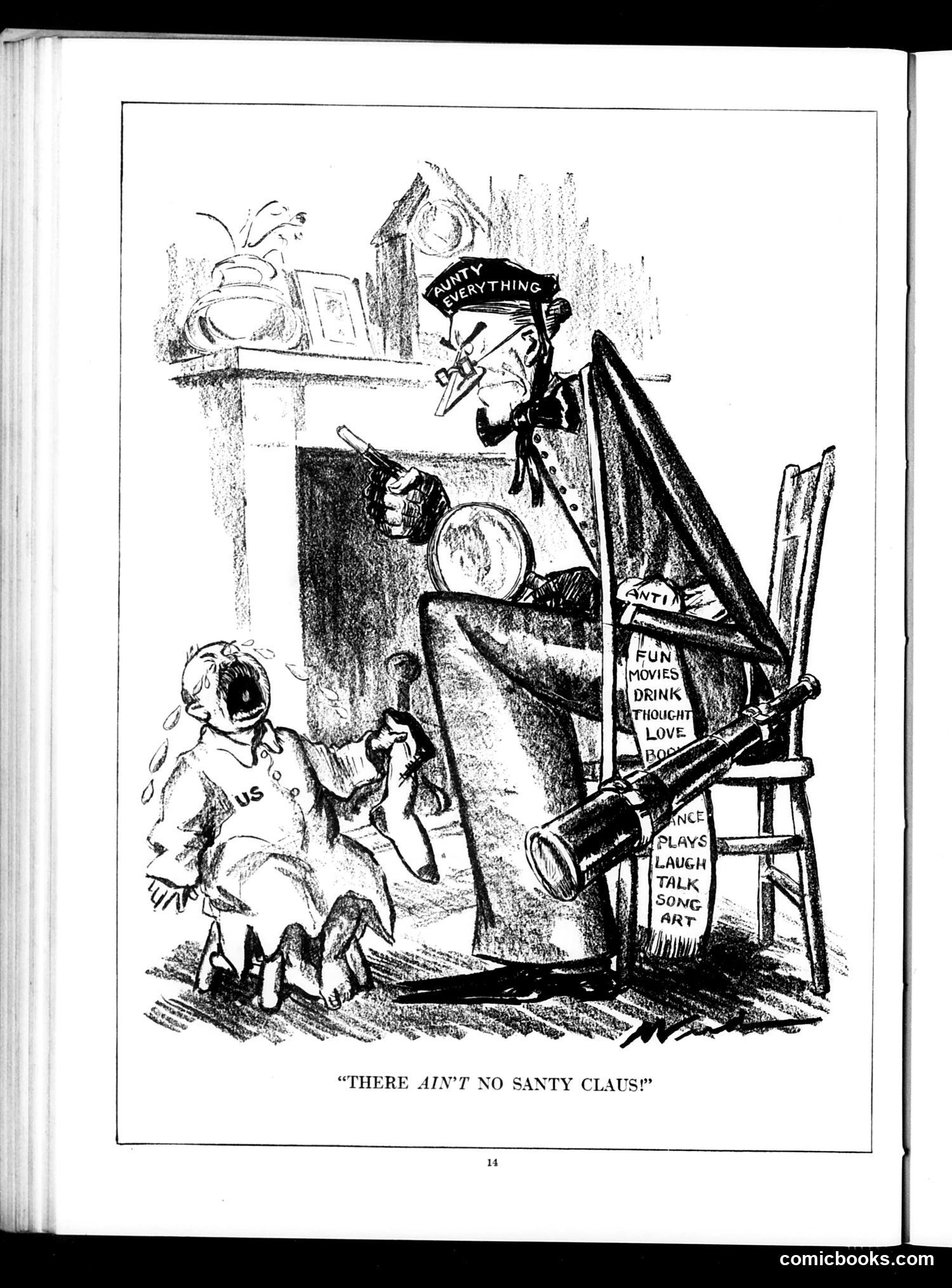
This Judge cartoon depicts a disillusioned child confronting a figure labeled "EVERYTHING" who wears a hat reading "EVERYTHING" and a cape listing commercial entertainment: "FUN MOVIES DRINK THOUGHT LOVE" and other commodities. The adult appears to be a cynical merchant or showman profiting from false promises. The satire critiques how commercialized entertainment and consumer culture exploit childhood innocence by selling materialistic substitutes for genuine values. The child's tears and the phrase "There ain't no Santy Claus" suggest that commercialism has destroyed the magic and authenticity of childhood wonder, replacing it with hollow consumer goods and manufactured experiences. This reflects early-to-mid 20th-century social anxiety about capitalism's corrosive effect on American values and childhood.
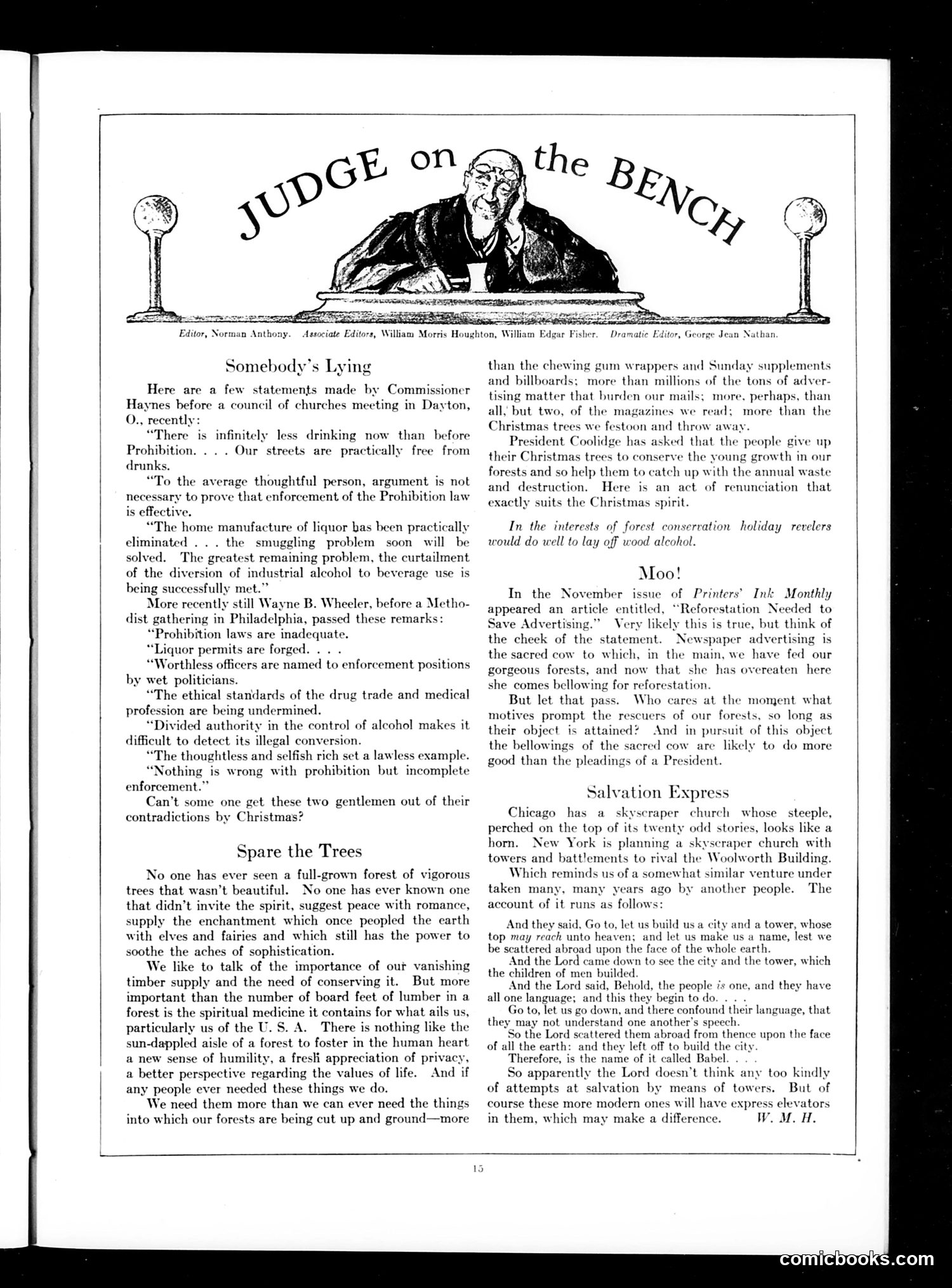
This page satirizes the contradictions within Prohibition enforcement circa the early 1920s. The title article, "Somebody's Lying," directly attacks Commissioner Haynes and Wayne B. Wheeler (likely the Anti-Saloon League's prominent leader), who publicly contradicted each other about Prohibition's success. Haynes claimed drinking had "infinitely" decreased and enforcement was "effective"; Wheeler simultaneously argued that Prohibition laws were "inadequate" with widespread corruption, forged permits, and unethical enforcement. Judge's satire: these two pillars of the Prohibition movement couldn't agree on basic facts, exposing the movement's dishonesty or incompetence. The secondary articles on trees and reforestation are unrelated editorial commentary on conservation and forest management, including President Coolidge's Christmas tree conservation plea—lighter fare padding the page.
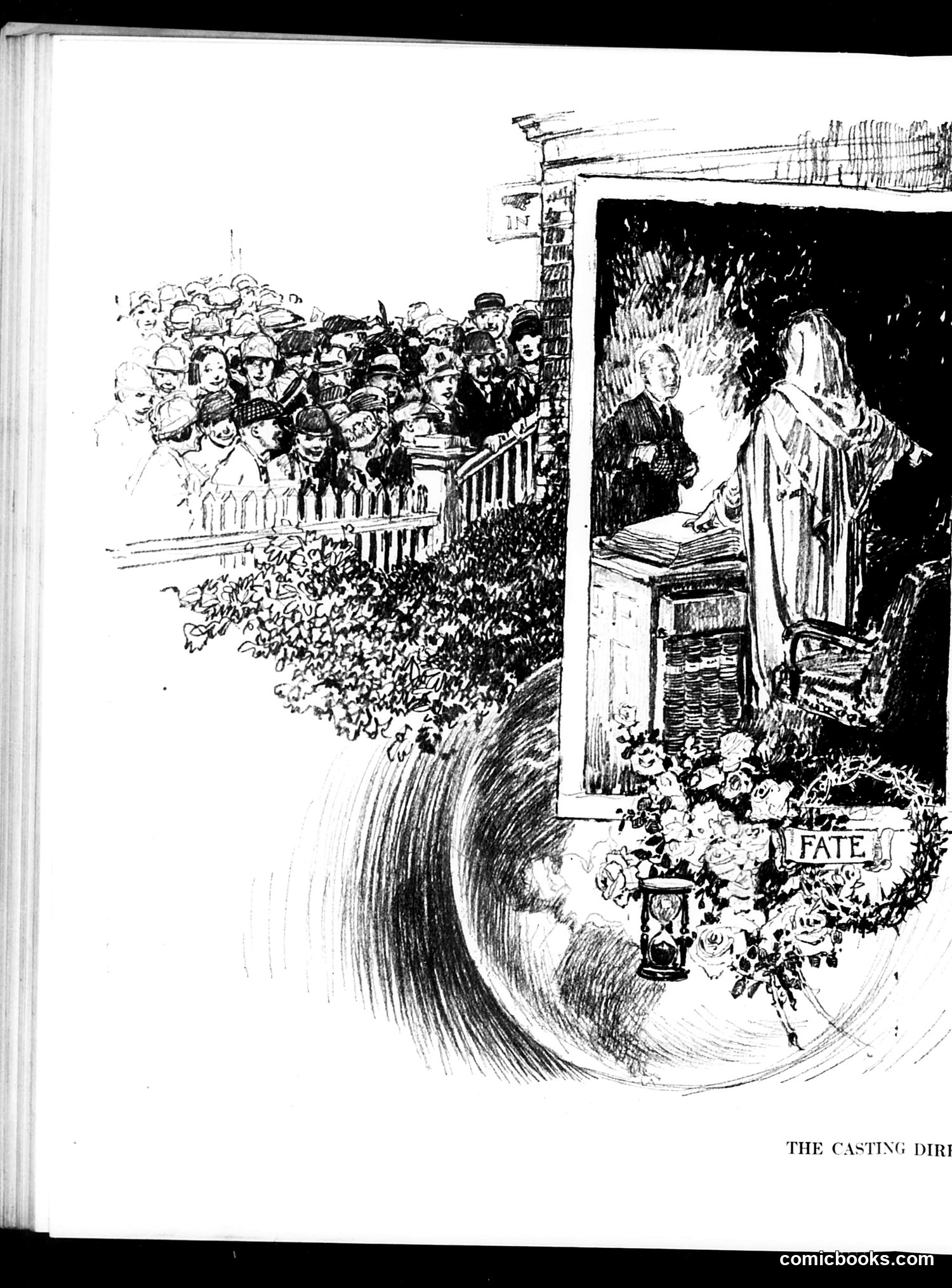
This Judge magazine illustration depicts a theatrical casting scene with clear satirical intent. On the left, a large crowd of hopeful performers—depicted with exaggerated features and wearing period hats—press against a fence, seeking opportunity. On the right, an interior scene shows what appears to be a casting director or theatrical authority figure examining candidates, with "FATE" labeled on a decorative urn or vessel. The satire appears to comment on the theatrical world's gatekeeping and the arbitrary nature of success—how fate, rather than merit, often determines who succeeds in show business. The massive crowd versus the selective few admitted inside emphasizes the competitive desperation of aspiring performers and the power imbalance between those controlling opportunity and those seeking it.
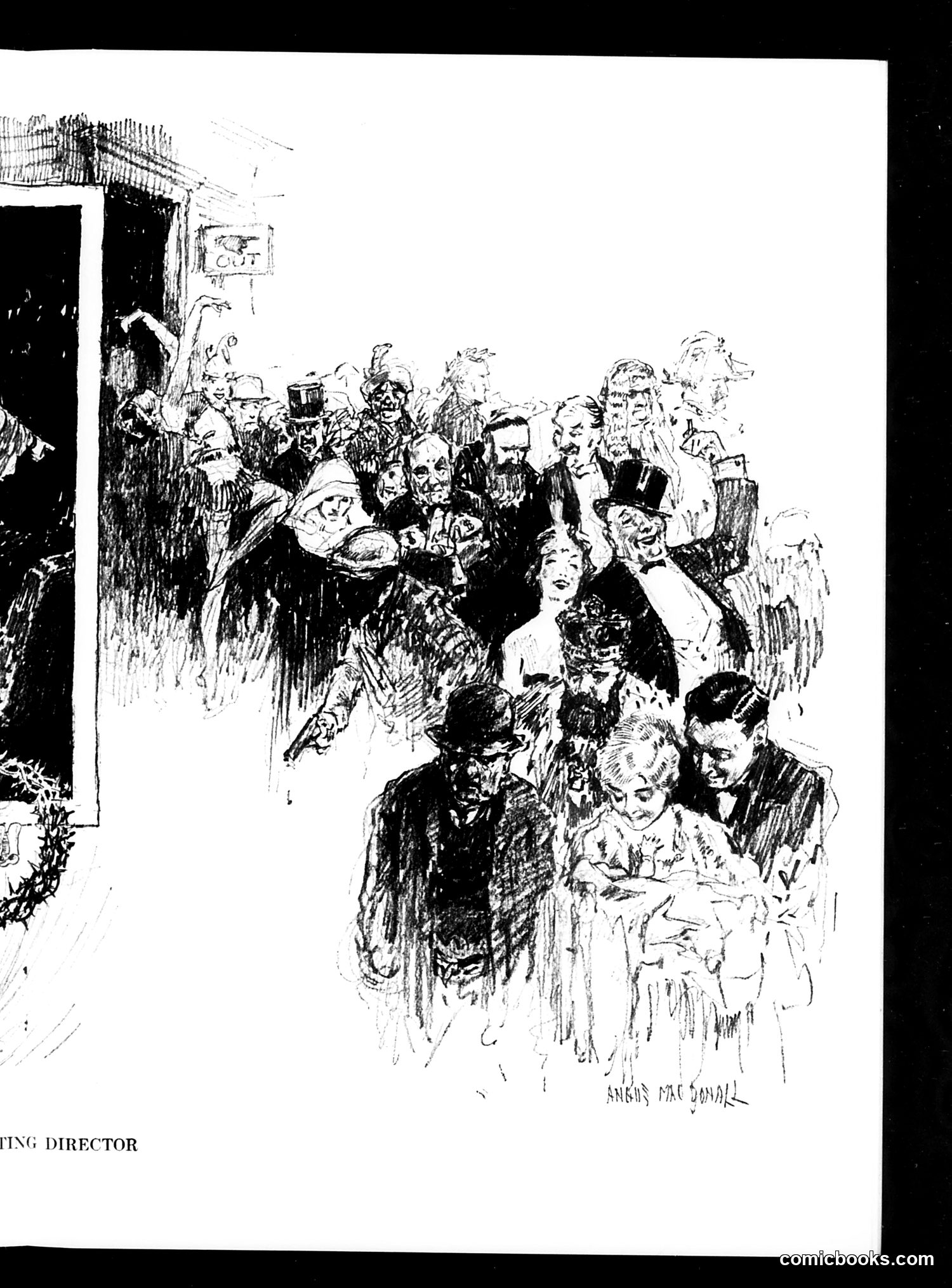
This is a sketch by Angus MacDonnell showing a crowded scene of well-dressed people (men in top hats and formal wear, women in period dress) gathered at what appears to be a formal social event or reception. The figures are densely packed and rendered in MacDonnell's characteristic sketchy style. The partial text visible at bottom left reads "TING DIRECTOR," suggesting this may relate to a theatrical or social event director. Without clearer OCR text or a visible caption explaining the specific satire, I cannot definitively identify which political figures or social situation is being mocked. The drawing appears to satirize either high society pretension or a specific contemporary event, but the precise subject remains unclear from the image alone.
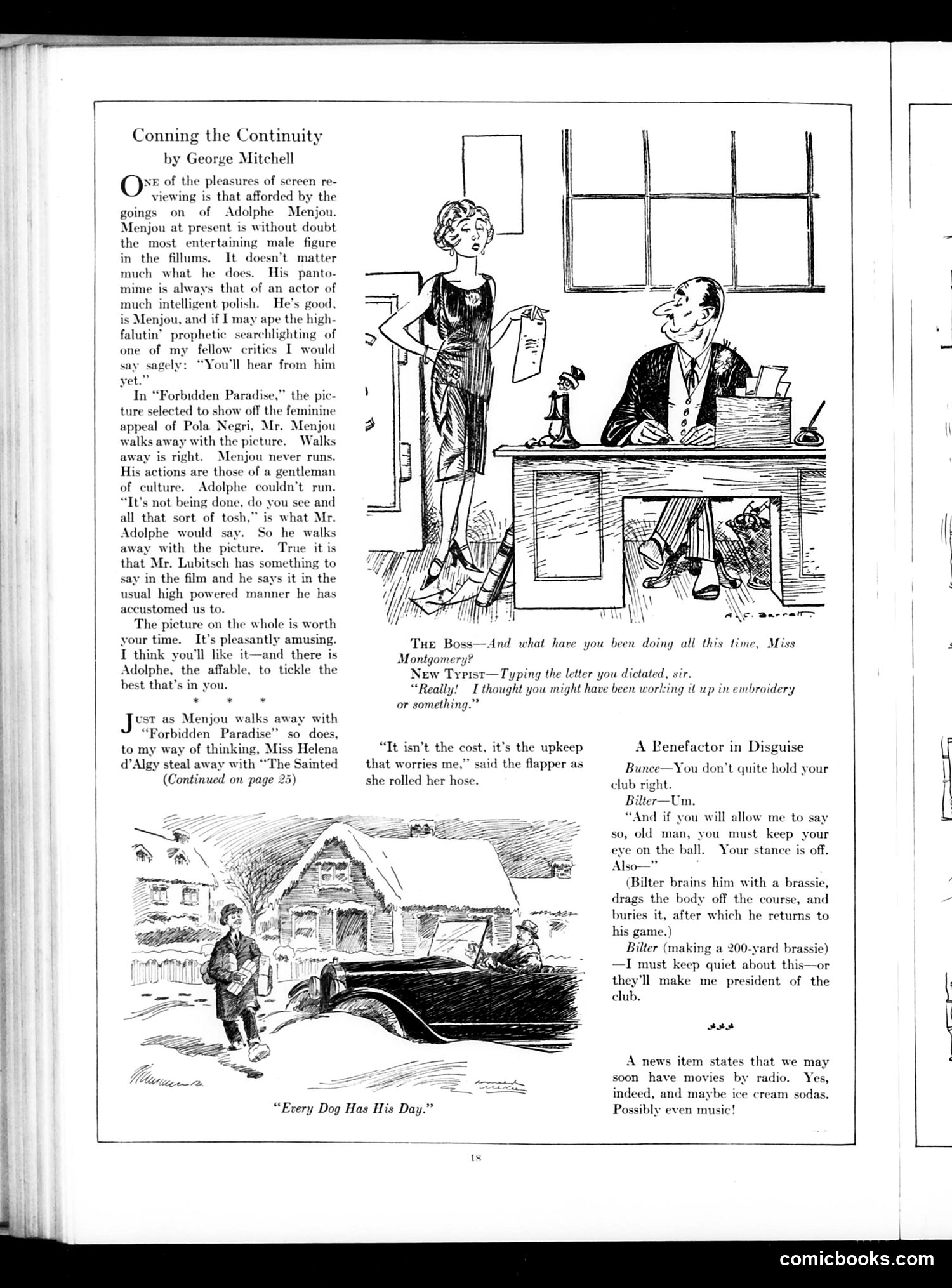
This page contains film criticism and humor pieces from the silent film era. The main article praises actor Adolphe Menjou's refined pantomime in "Forbidden Paradise" (featuring Pola Negri), noting he "never runs" because it wouldn't befit a gentleman of culture—he merely walks away with scenes. Director Lubitsch also receives credit. The cartoons below are workplace and social gags: a boss confronts a typist about idleness, a flapper worries about stocking upkeep costs rather than initial expense, and a golf instructor who kills a student for suggesting he'd become club president. The final item jokes about rumored radio-broadcast movies, sarcastically suggesting they might also include ice cream sodas and music—mocking technological speculation of the era. The humor relies on 1920s social attitudes about class, gender roles, and emerging technology rather than substantive satire.
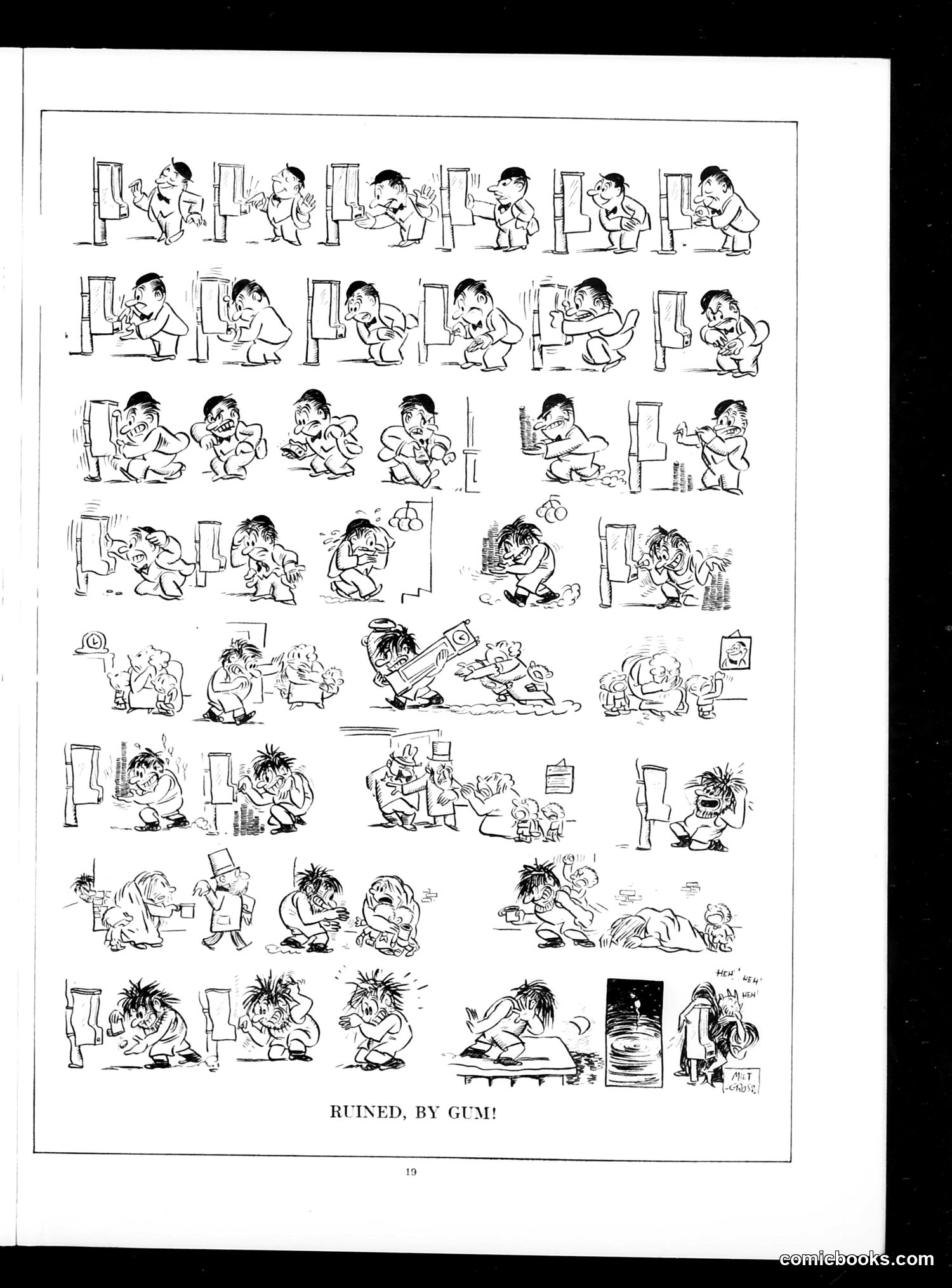
This is a sequential comic strip showing a man's escalating mishap with chewing gum. The title suggests the protagonist's exasperation as gum causes cumulative disaster. The narrative progresses from the top: a man repeatedly encounters and interacts with gum stuck to various surfaces and objects. His expressions shift from curiosity to frustration as the sticky substance spreads, contaminating his clothing, surroundings, and possessions. By the strip's conclusion, he appears thoroughly defeated—covered in gum residue with destroyed belongings scattered around him. The satire likely mocks the then-popular habit of chewing gum and its messy consequences, poking fun at both the product's ubiquity in American culture and users' carelessness about disposing of it responsibly. The exaggerated consequences serve as comedic critique.
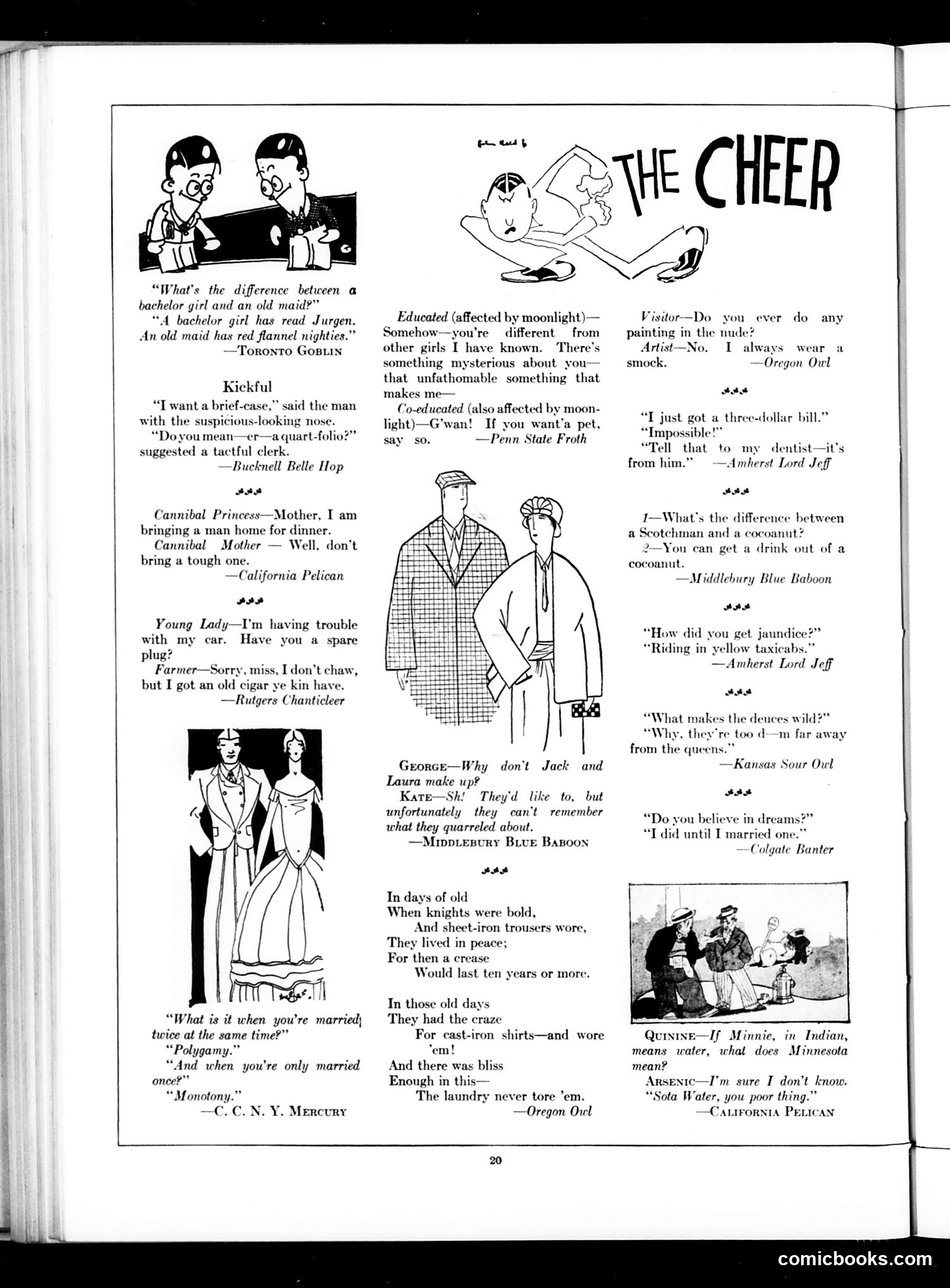
This page collects humor submissions from college newspapers, typical of early 20th-century satirical magazines. The jokes target contemporary social attitudes and college life: **Key themes:** - **Gender roles**: References to "bachelor girls" (modern, independent women) versus traditional "old maids," and jokes about courting and marriage as monotonous - **Prohibition-era humor**: The "brief-case" joke alludes to smuggling alcohol in cases (the man's "suspicious-looking nose" suggests a drinker) - **Class/ethnic humor**: The Scotchman/coconut joke relies on Scottish stereotypes about frugality - **Courtship rituals**: Multiple jokes about romance, necking in cars, and awkward dating - **Laundry as drudgery**: A nostalgia poem about medieval armor that never needed pressing, contrasting with modern clothing maintenance The cartoon illustrations (formal couple, two men in conversation) support the dating/marriage themes. Overall, this represents college humor reflecting Jazz Age anxieties about changing social conventions, gender dynamics, and modern life's inconveniences.
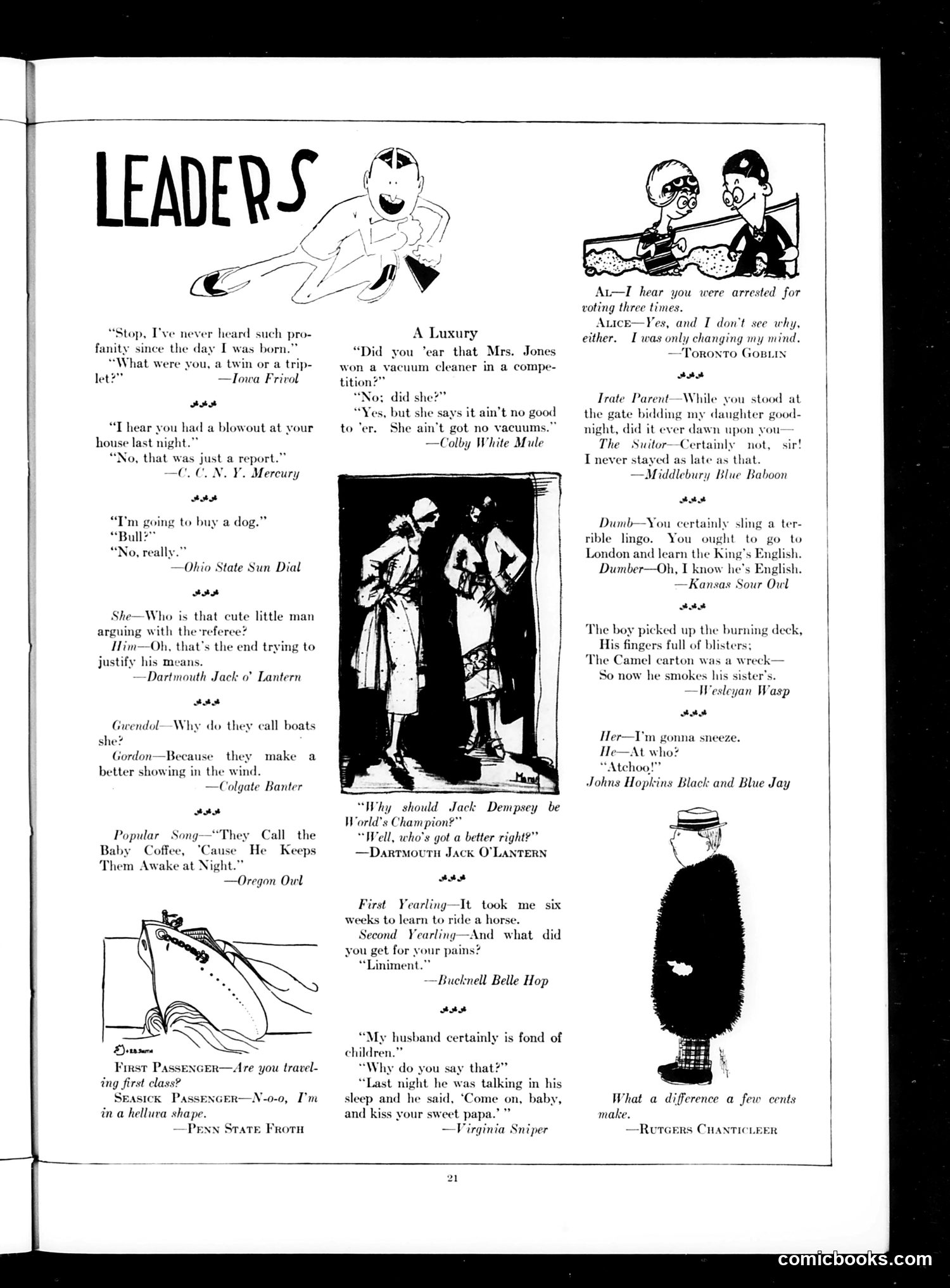
This is a humor compilation page from *Judge*, a satirical magazine, featuring jokes and quips sourced from college newspapers (indicated by bylines like "Iowa Frivol," "Ohio State Sun Dial," etc.). The content consists of brief, punchy jokes typical of 1920s-era college humor—mostly wordplay and observational gags about dating, travel, and daily life. Notable examples: - A woman voting three times and claiming she was "changing my mind" (topical satire on women's recent voting rights) - Puns on "bull" and vacuum cleaners lacking "vacuums" - A Jack Dempsey reference (famous heavyweight boxer of the era) - Slapstick humor about seasickness and a burning cigarette carton The two illustrated panels show generic domestic/social scenes without specific political figures. The overall tone is lighthearted, apolitical satire aimed at college-age readers—humor focused on relationships, absurdist logic, and mild social observation rather than substantive commentary.
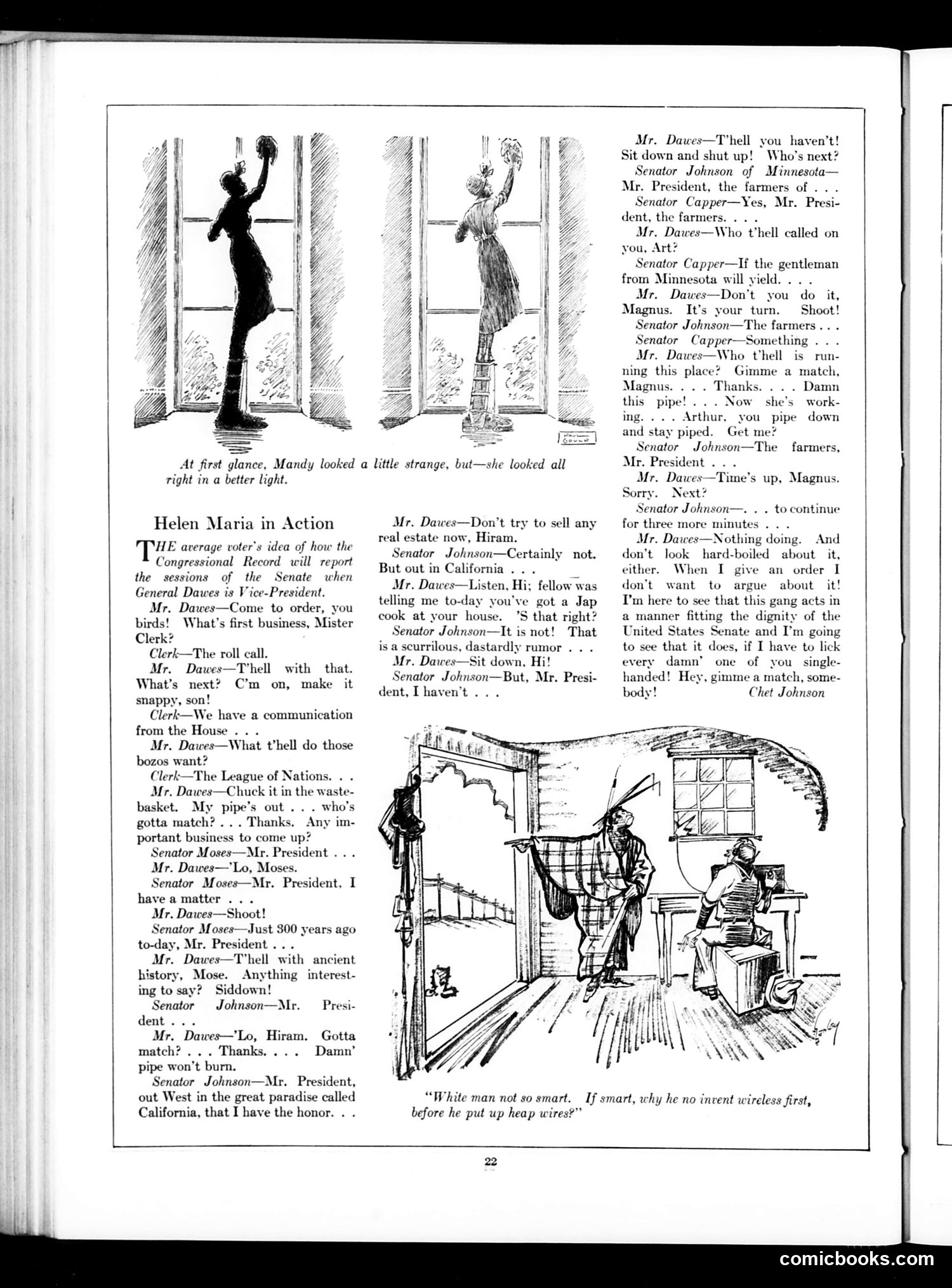
This 1921 Judge cartoon satirizes **Charles G. Dawes**, newly elected Vice President, by depicting how he'd conduct Senate proceedings. The satire mocks Dawes's reputation as a no-nonsense, crude businessman more interested in his pipe than parliamentary procedure. The joke: Dawes constantly interrupts senators (Johnson of Minnesota, Capper, Moses) asking for matches, dismissing their concerns about farmers and the League of Nations, and ordering them to "sit down and shut up." He runs the Senate like a factory floor rather than a deliberative body—impatient, profane, and contemptuous of protocol. The bottom illustration appears unrelated, featuring a stereotyped "Chinese" character making broken-English commentary about wireless invention. The satire targets anxiety about appointing a rough businessman to high office during a period when the Senate maintained stronger institutional pride.
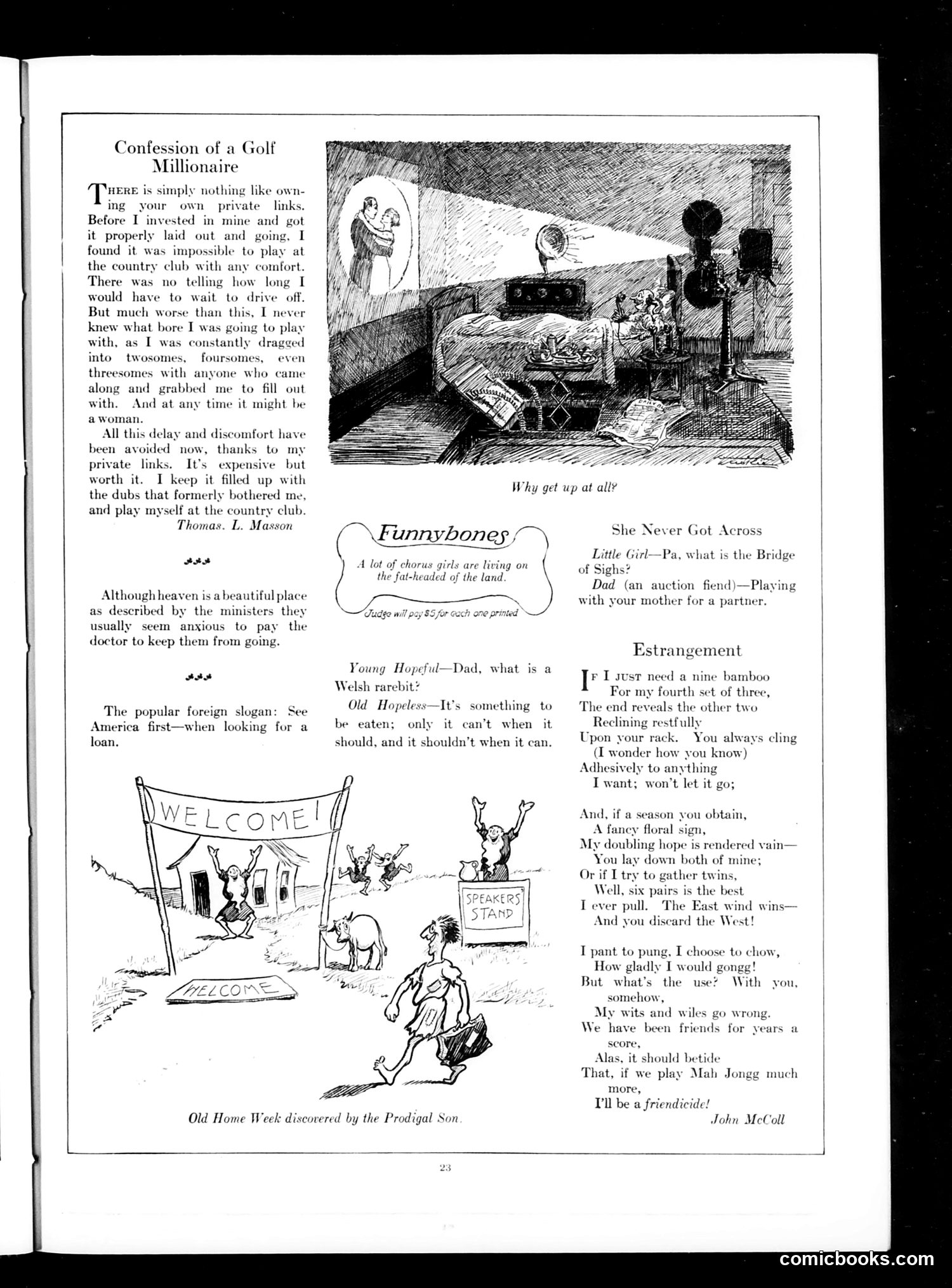
This page contains satirical humor typical of early 20th-century Judge magazine, targeting wealthy leisure culture and marital dynamics. **"Confession of a Golf Millionaire"** mocks the ultra-rich obsession with exclusive recreation. The author boasts about building private golf links to avoid waiting at country clubs and, most revealingly, to exclude women golfers—presented as the ultimate annoyance. The satire targets both snobbish wealth-flaunting and misogyny disguised as convenience. **"Old Home Week"** cartoon (bottom left) shows a town welcoming visitors, likely satirizing nostalgic Americana tourism. **"Funnybones"** contains brief jokes ridiculing ministers' hypocrisy and foreign loan-seeking using "See America First" rhetoric. **"Estrangement"** by John McColl is a poem about Mah-Jongg, a then-fashionable parlor game. The speaker laments how playing with a long-time friend reveals incompatibility, threatening their friendship—satirizing how recreational gaming exposes relationship cracks among the leisured classes. The overall theme: satire of wealthy Americans' recreational pursuits and the social tensions they reveal.
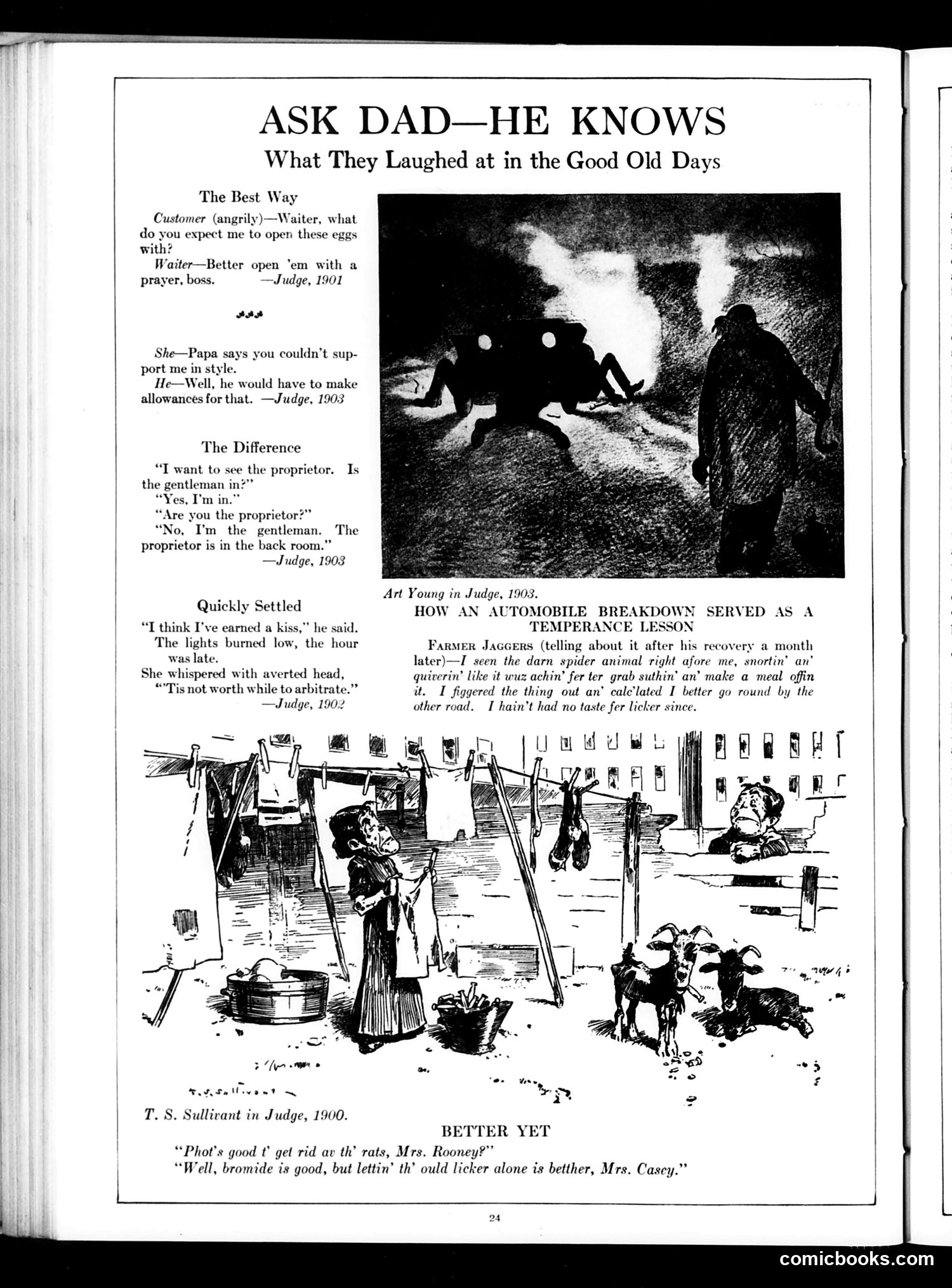
This page from Judge (early 1900s) collects brief jokes under "Ask Dad—He Knows," presented as humor from "the Good Old Days." **The jokes** are simple vaudeville-style quips: a waiter's irreverent suggestion to pray over bad eggs; a suitor's wordplay about needing "allowances" to support his girlfriend; confusion between a proprietor and "a gentleman"; and a young woman refusing a kiss. **The bottom cartoons** are more pointed: The **"Automobile Breakdown" cartoon** uses a farmer's dialect mishap for temperance messaging. The farmer misinterprets a broken-down automobile's mechanical struggle as a supernatural creature, frightening him away from alcohol. The humor lies in rural ignorance of new technology, while the message promotes sobriety. The **"Better Yet" caption** mocks Irish immigrants (the names "Rooney" and "Casey" signal this), suggesting that simply abstaining from whiskey ("licker") works better than poison for rat control—a stereotypical jab at Irish drinking habits. Overall, the page reflects early-1900s attitudes: dismissive humor about immigrants, rural people, new technology, and promotion of temperance ideology.
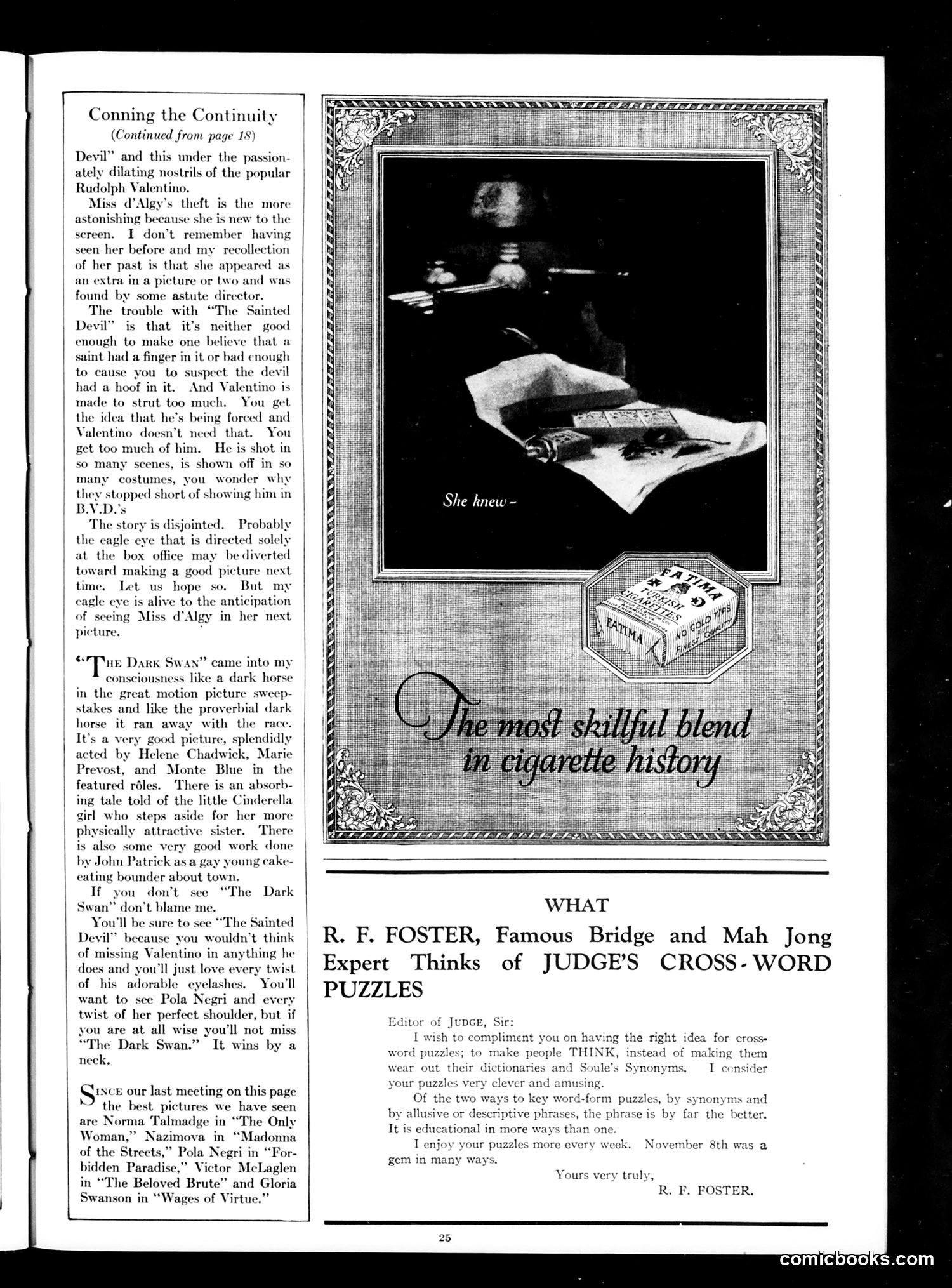
This page contains **film criticism** (left column) and **advertising** (right side). The main content is a review of silent films, particularly "The Sainted Devil" starring Rudolph Valentino and "The Dark Swan." The critic criticizes Valentino's performance as forced and overexposed—the film shows him in too many scenes and costumes, making his acting appear artificial. He praises "The Dark Swan" (featuring Helene Chadwick and Marie Prevost) as the superior film, noting it has better storytelling and supporting performances. The right side is a **Fatima cigarette advertisement** disguised as editorial content—a letter praising Judge magazine's crossword puzzles from R.F. Foster, a bridge and Mah Jong expert. This was common advertising practice in 1920s magazines. The photograph's caption "She knew—" is deliberately vague, likely supporting the cigarette brand's marketing approach of suggestion over explicit claims.
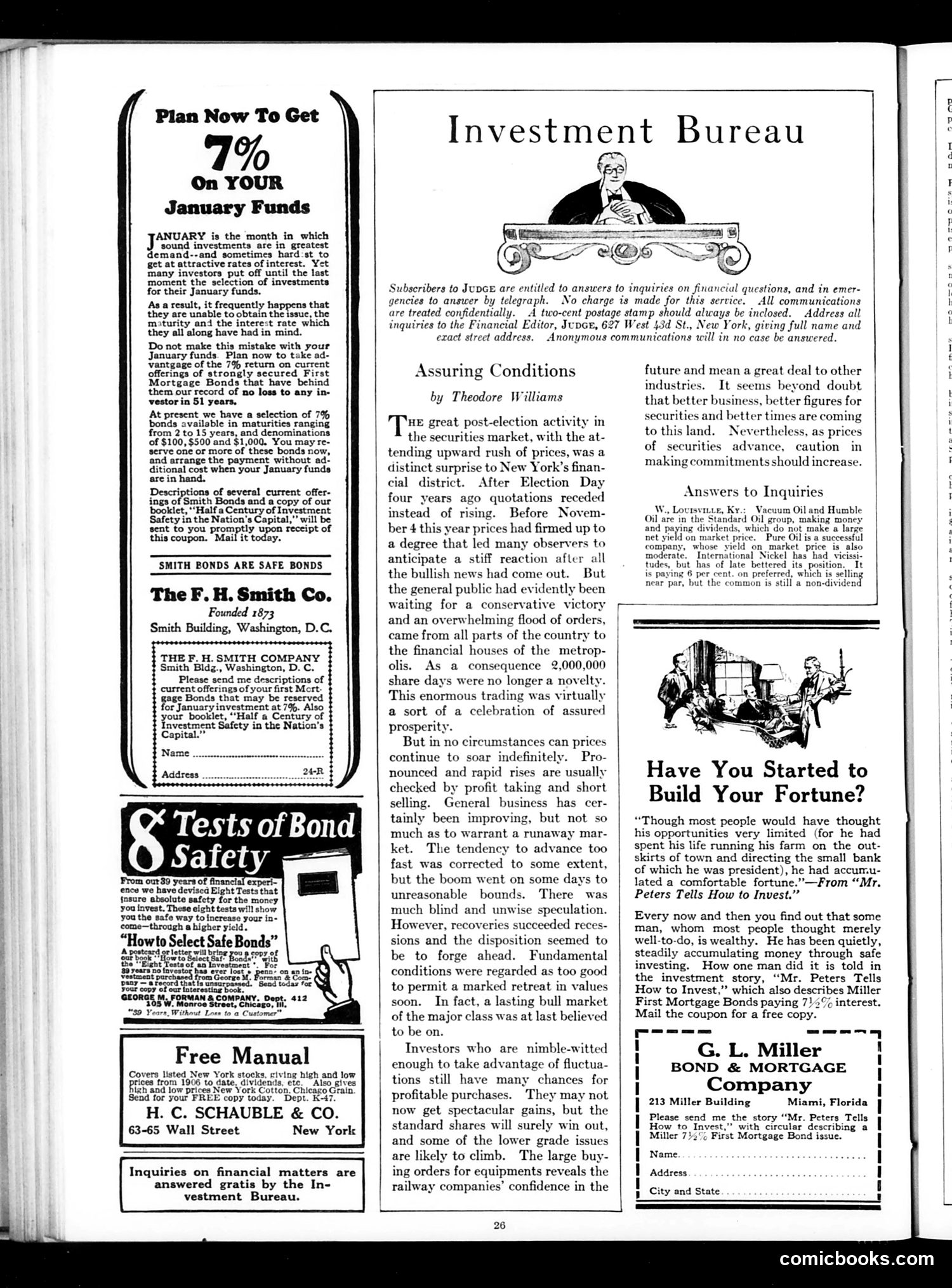
This is primarily a **financial services advertising page** from Judge magazine, likely from the 1920s post-election period. The main content is Theodore Williams's article "Assuring Conditions," which celebrates the stock market surge following a recent conservative electoral victory. Williams notes that the post-election market boom—with 2,000,000 share trading days—represents public confidence in "assured prosperity," though he cautiously warns that prices cannot rise indefinitely and profit-taking will eventually check the rally. The page is dominated by **investment advertising**: F.H. Smith Company promoting safe 7% bonds, tests for bond safety, and various financial manuals. An "Investment Bureau" section offers free financial advice to Judge subscribers. The satire is implicit rather than explicit—the page reflects the **1920s investment bubble mentality**, where financial publications breathlessly promoted securities to ordinary readers as sure paths to wealth. The earnest tone and proliferation of investment schemes now reads as darkly ironic, given that this optimism preceded the 1929 crash. No specific political figures are caricatured; instead, the page satirizes the era's financial culture itself.
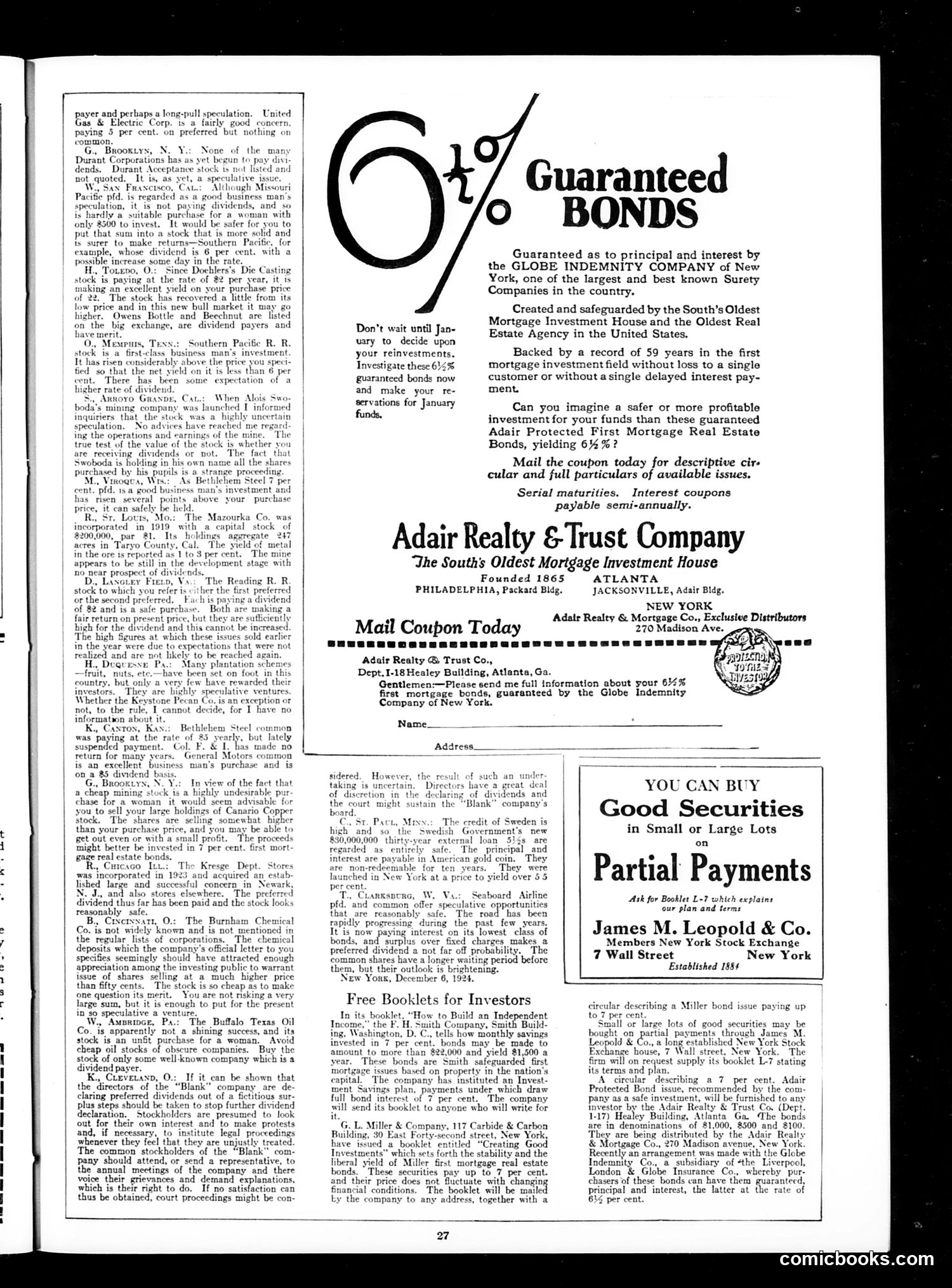
This page from *Judge* magazine is dominated by a large advertisement for "6½% Guaranteed Bonds" offered by Adair Realty & Trust Company of Atlanta, described as "The South's Oldest Mortgage Investment House" (founded 1865). The bulk of the page consists of an investment advice column answering reader questions about various stocks—Doeblers Die Casting, Southern Pacific Railroad, Bethlehem Steel, and others. The responses offer practical guidance on dividend yields, stock safety, and suitability for different investor types (notably, several answers address whether stocks are appropriate for women investors, reflecting era-specific gender assumptions about finance). There are no political cartoons visible. The small text box in the lower right advertises "Good Securities in Small or Large Lots on Partial Payments" by James M. Leopold & Co. The page reflects 1920s investment culture and advertising practices rather than satirical content.
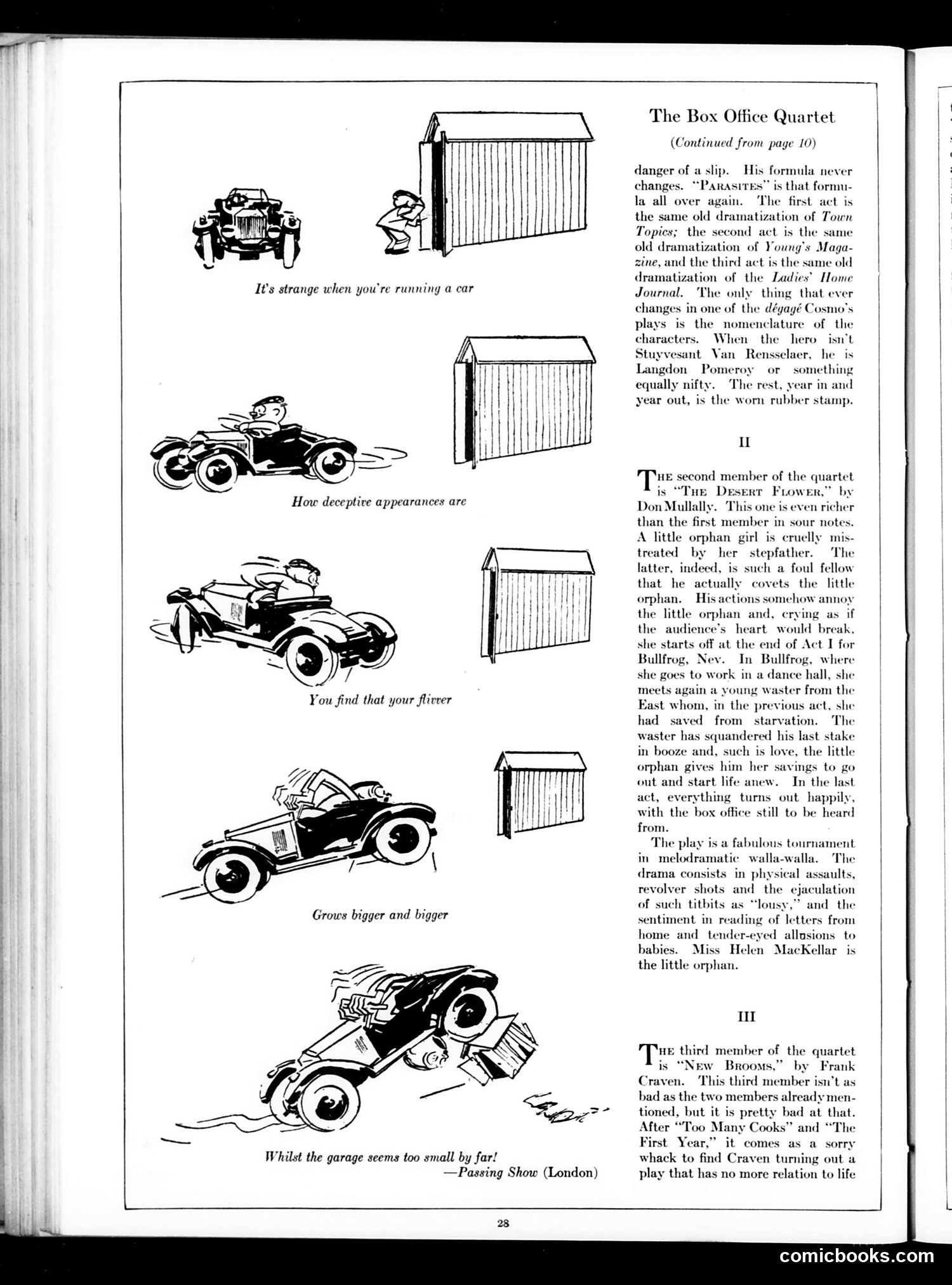
This page reviews four Broadway plays, sarcastically criticizing their formulaic nature and melodramatic plots. The left side shows comic illustrations of cars getting progressively larger and more absurd—a visual metaphor for theatrical exaggeration. The text describes three plays: "Parasites" (repeatedly recycling plots from *Town Topics*, *Young's Magazine*, and *Ladies' Home Journal* with only character name changes); "The Desert Flower" by Don Mullally (a sentimental melodrama about an orphan girl involving abandonment, starvation, and unlikely romantic redemption); and "New Brooms" by Frank Craven (criticized as disappointing compared to his earlier successes). The satire targets Broadway's reliance on tired formulas, clichéd character types, and emotional manipulation—essentially arguing that commercial theater sacrifices originality for guaranteed box-office appeal. The absurd car illustrations reinforce this point about theatrical excess masquerading as entertainment.
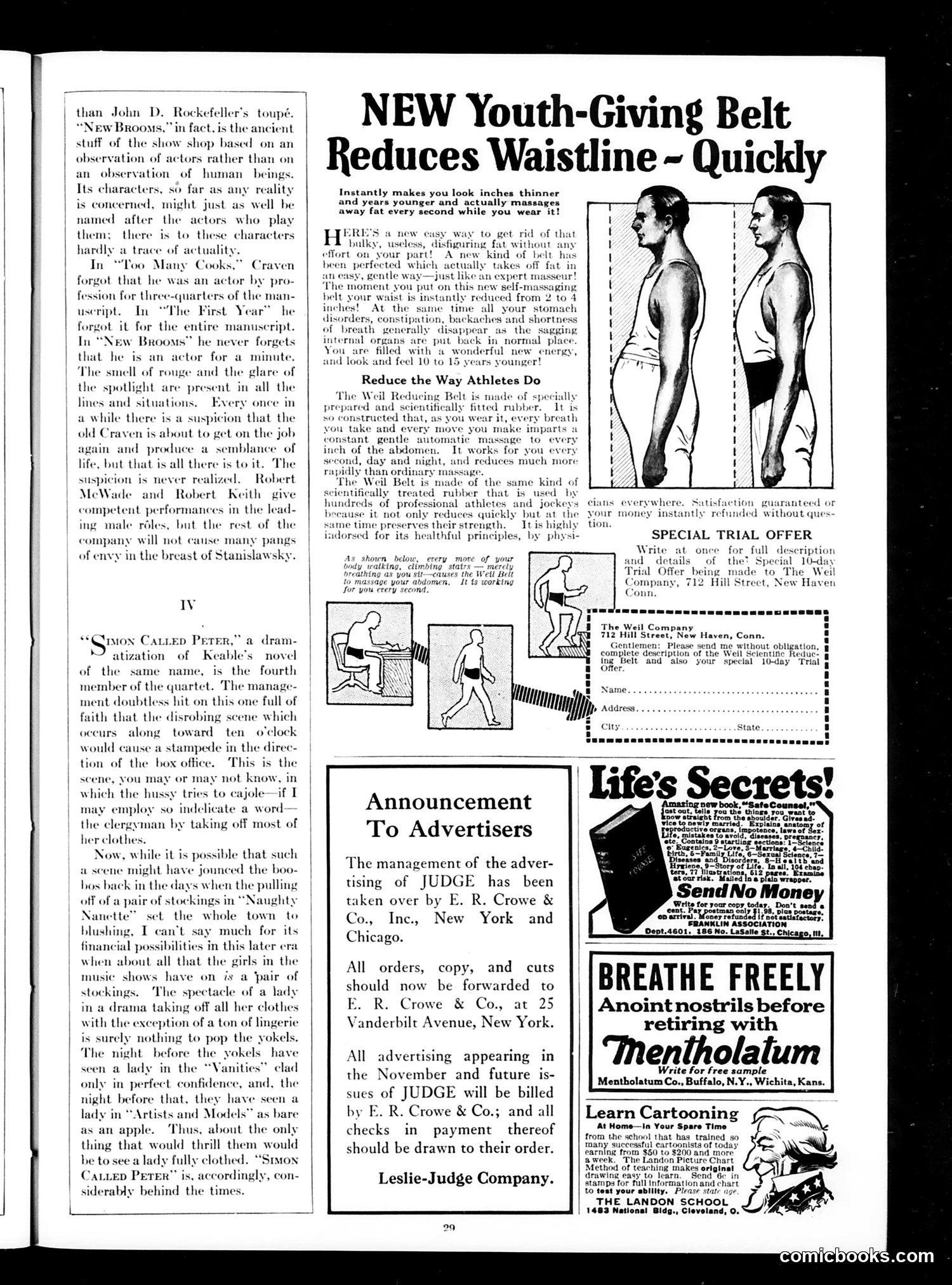
This page is primarily **advertising and trade announcements** rather than political satire. The main content features a **"Weil Reducing Belt"** advertisement—a weight-loss device marketed to women. The ad uses before-and-after illustrations showing a man's torso (note: depicted as male, not female) to demonstrate claimed fat reduction. The pitch emphasizes quick results, improved digestion, and looking "10 to 15 years younger." This reflects **1920s-era weight-loss culture**: the product claims scientific authority ("athletically treated rubber"), promises effortless results, and targets vanity and health anxieties simultaneously. The page also contains a small **announcement to advertisers** about Judge magazine's advertising management changing hands to E.R. Crowe & Co. The left column discusses theatrical reviews (unrelated to the ads), critiquing several Broadway plays. **The satire or humor here is primarily in the advertisement itself**—the exaggerated claims and pseudoscientific language typical of vintage "miracle" diet products.
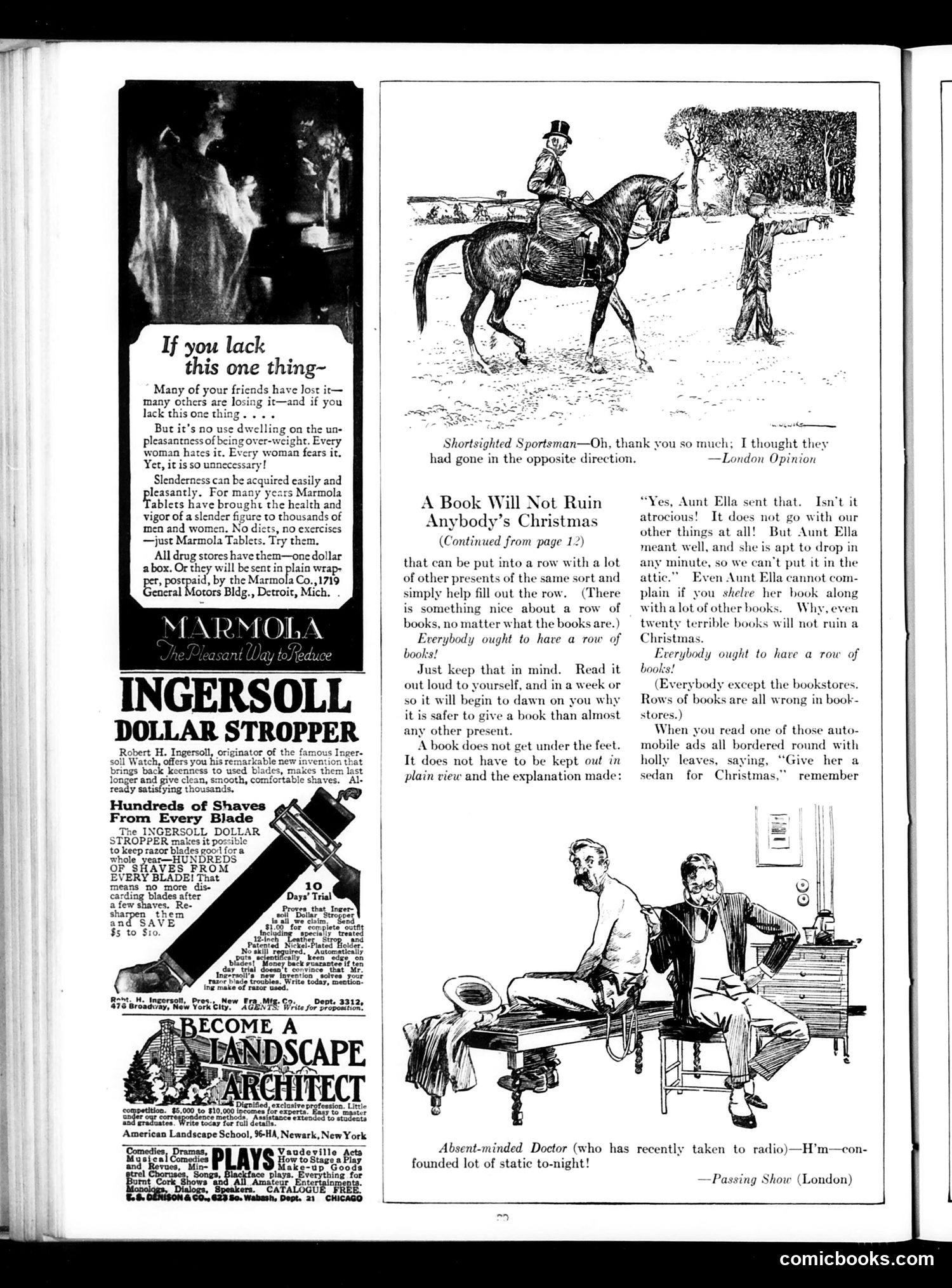
This is primarily a **advertisements and humor page**, not a political cartoon. The content includes: **Main Advertisements:** - Marmola Tablets (weight-loss product) with earnest copy about women's anxiety over being overweight - Ingersoll Dollar Stropper (razor blade sharpener) - Landscape architecture school and vaudeville acts **Humor Content:** Two captioned illustrations offer light social satire: 1. **"Shortsighted Sportsman"** - A gentleman on horseback thanks someone for directions, noting he thought he'd gone the opposite way. The joke: his poor eyesight caused confusion. 2. **"Absent-minded Doctor"** - A doctor recently involved with radio complains about "static" while sitting with a colleague. The implied joke plays on radio's novelty and suggests the doctor is confused about whether he's experiencing actual radio interference or is simply forgetful. A sidebar article discusses Christmas gift-giving, arguing books make safe presents that won't clash with existing décor (unlike Aunt Ella's atrocious gift). The page reflects early 20th-century consumer culture and gentle, non-political humor typical of Judge magazine's lighter content.
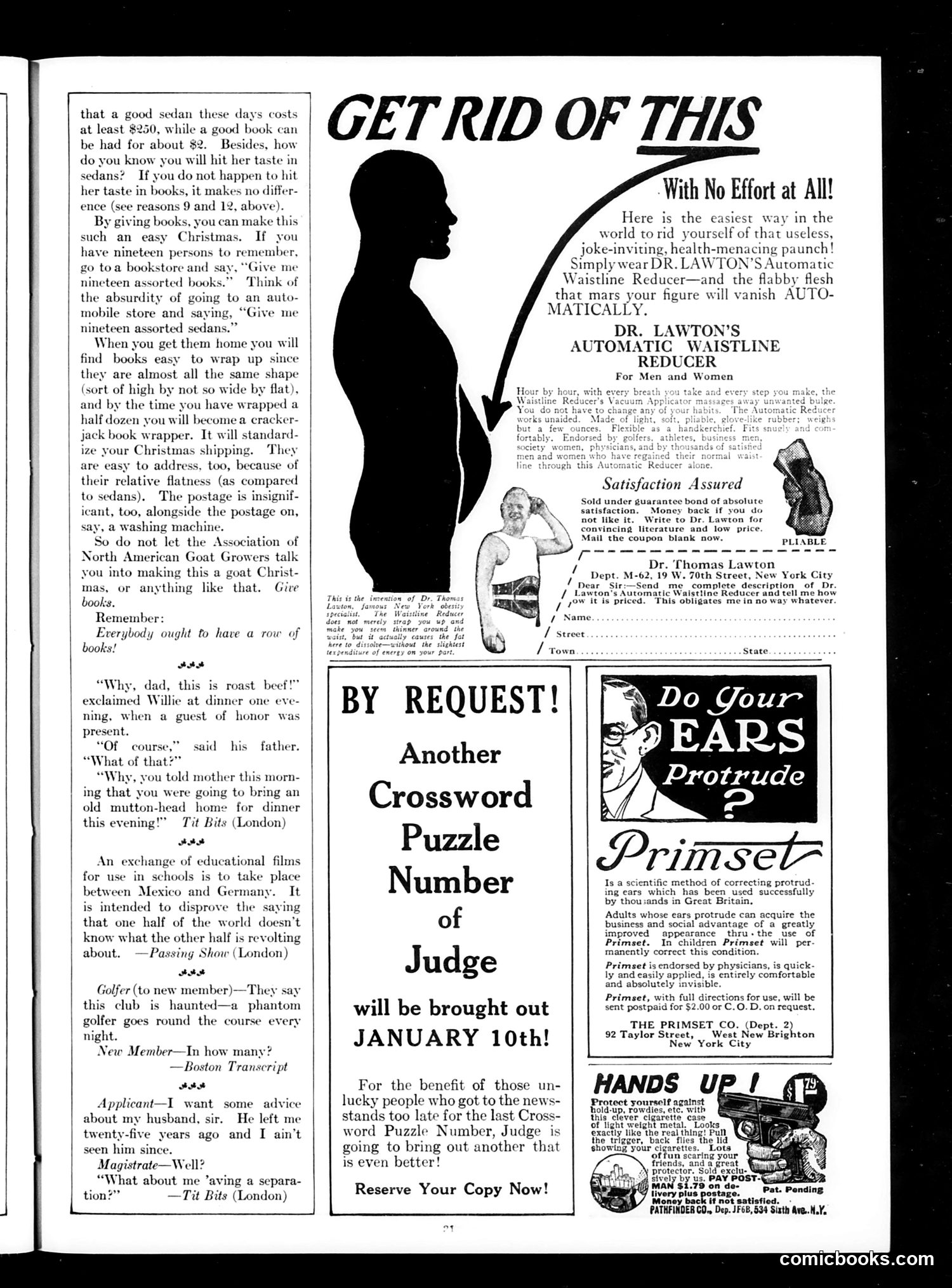
This page mixes editorial content with advertisements typical of early 20th-century American magazines. **Main Editorial Content:** The left column argues for giving books as Christmas gifts—a practical, affordable alternative to expensive goods like automobiles. The piece satirizes consumer culture by contrasting books' low cost ($2) with sedans ($250+), emphasizing their ease of wrapping and shipping. It mocks the absurdity of "standardized" gift-giving and pokes fun at marketing schemes (like the "Association of North American Goat Growers" promoting goats as gifts—likely a made-up example of ridiculous holiday commerce). **Humor Section:** Brief jokes about dinner table misunderstandings and educational film exchanges between Mexico and Germany. **Advertisements:** Three main ads promote mail-order products: Dr. Lawton's weight-reduction device, Primset (an ear-correction treatment), and protective eyewear. These represent typical pseudoscientific remedies marketed to insecure consumers in this era. The page reflects early 20th-century concerns about consumption, appearance anxiety, and commerce.
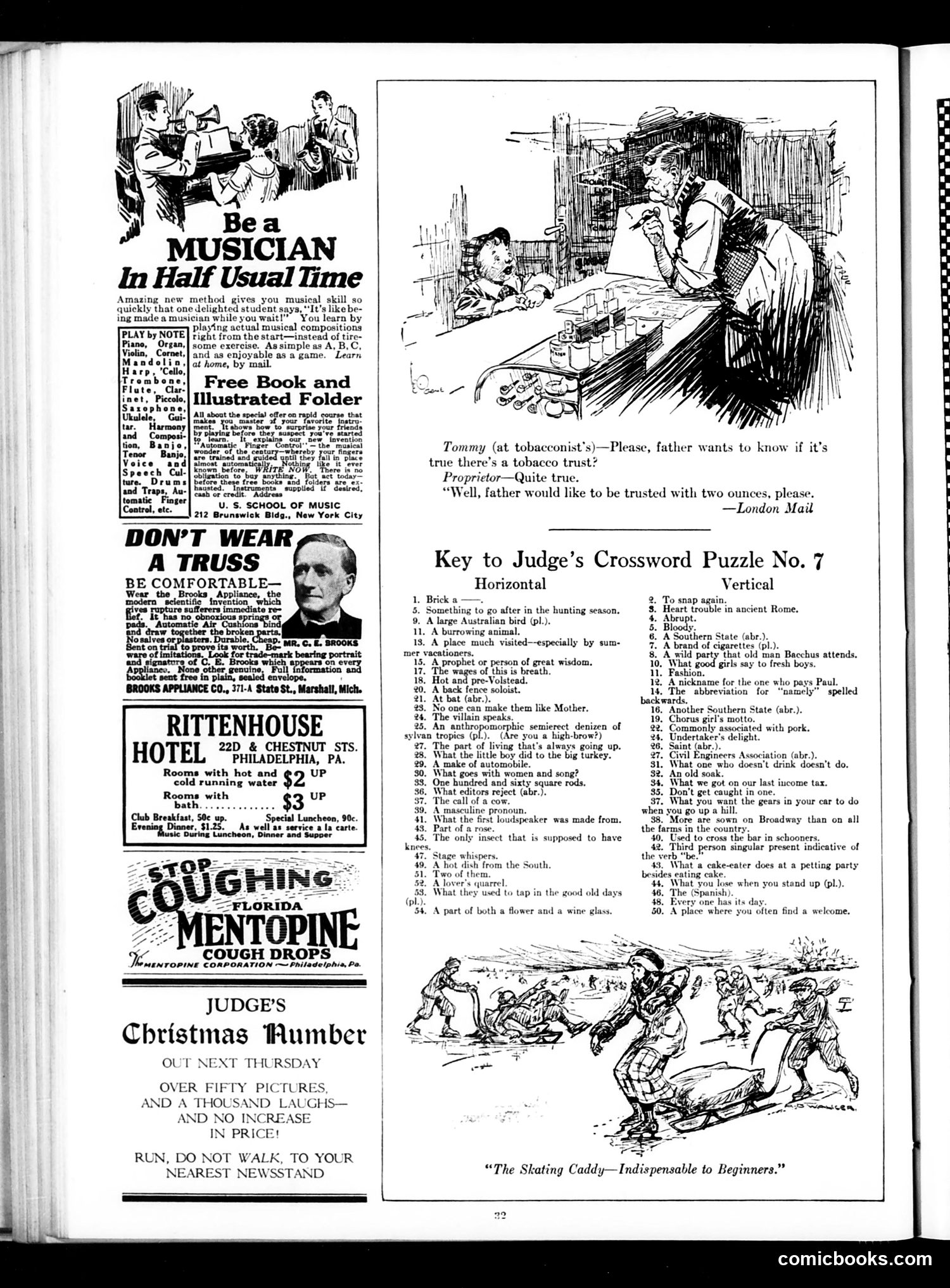
This page is primarily **advertising and puzzle content** rather than political satire. The main cartoon shows a child asking a tobacconist whether there's a "tobacco trust," leading to a pun: the proprietor confirms it's true, then the father wants to be "trusted" (given credit) for two ounces of tobacco. This is wordplay exploiting the double meaning of "trust" — both the monopolistic business practice and extending credit — likely reflecting contemporary awareness of tobacco industry consolidation. The advertisements promote self-improvement products (music lessons, medical devices) typical of early 20th-century periodicals. The page concludes with Judge's Christmas issue promotion and a crossword puzzle answer key, suggesting this is a regular magazine feature rather than satirical content. The skating illustration below is captioned as "indispensable to beginners," appearing to be light humor about winter recreation rather than political commentary.
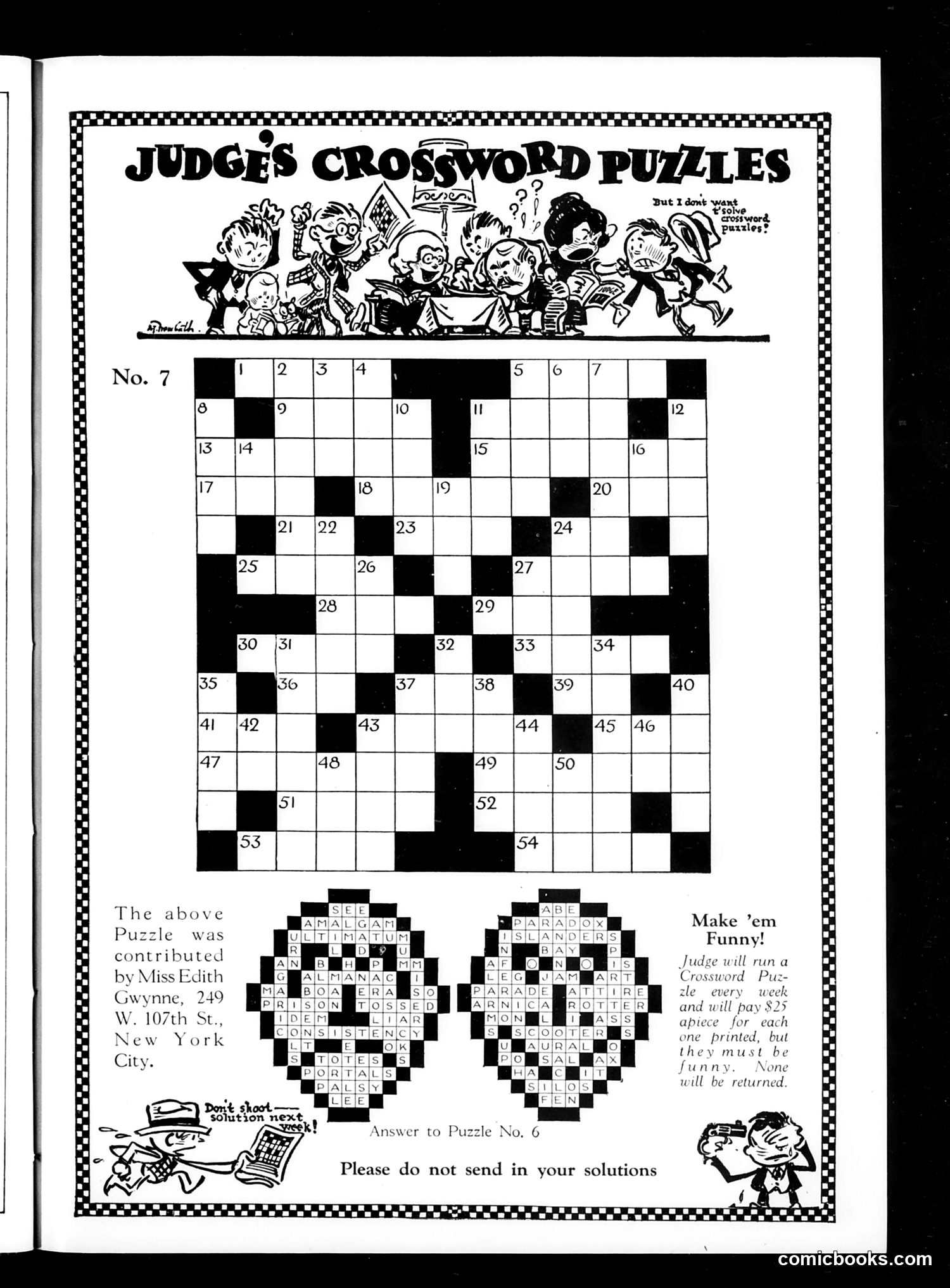
This page presents **Puzzle No. 7**, a crossword puzzle contributed by a reader named Miss Edith Gwyn. The cartoon header shows cheerful figures exclaiming "But I don't want to do crossword puzzles!"—a humorous contradiction to the puzzle content itself. The main feature includes the blank crossword grid and the **answer key to Puzzle No. 6** displayed below, showing the completed solution in a decorative diamond pattern. A "Make 'em Funny!" sidebar advertises that Judge magazine will pay $25 per puzzle for funny crossword submissions, accepting reader contributions. The cartoons flanking the answer key reinforce the lighthearted tone typical of Judge's satirical approach. This represents the magazine's popular puzzle section, combining entertainment with reader engagement—a common feature in early-to-mid 20th century American publications.
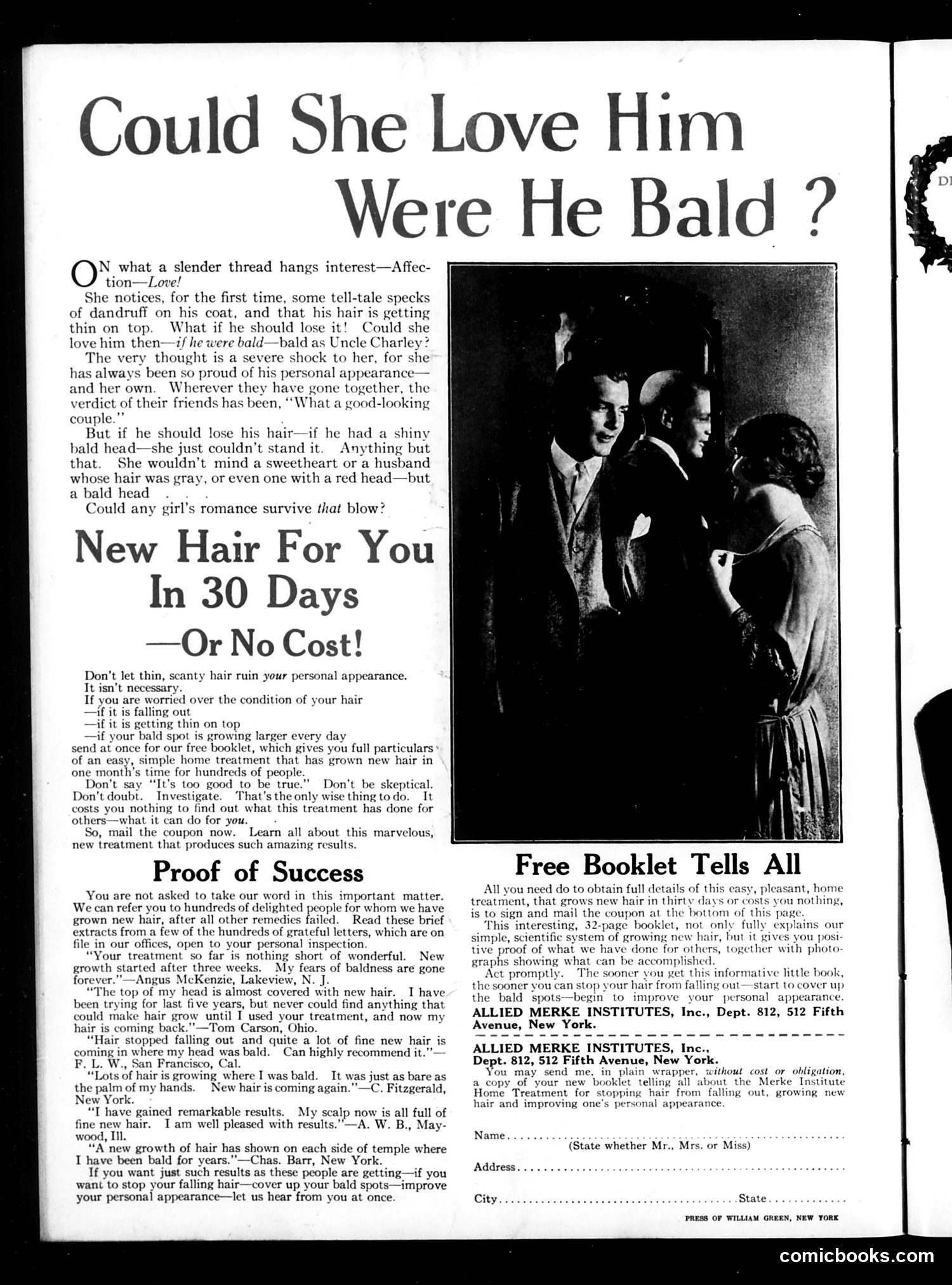
This page is primarily a **hair-loss treatment advertisement**, not a political cartoon. It uses satirical social commentary as a marketing hook. The "satire" frames male baldness as a romantic catastrophe. The opening narrative suggests a woman's love depends entirely on her boyfriend's hair—she couldn't accept him "bald as Uncle Charley" despite accepting gray or red hair. This mocks *contemporary anxieties* about masculine appearance and suggests that baldness threatens romantic desirability. The advertisement then pivots: it promises a home treatment that grows new hair in 30 days "or no cost." The "Proof of Success" section includes testimonials from alleged satisfied customers. **Context for modern readers:** This reflects early 20th-century advertising that weaponized insecurity—particularly targeting men's fears about aging and attractiveness. The sexist framing (a woman's fickle affections) was standard advertising rhetoric of the era, designed to shame men into purchasing remedies for natural hair loss. The page demonstrates how magazines monetized social anxiety long before modern marketing.