
A complete issue · 36 pages · 1924
Judge — October 18, 1924
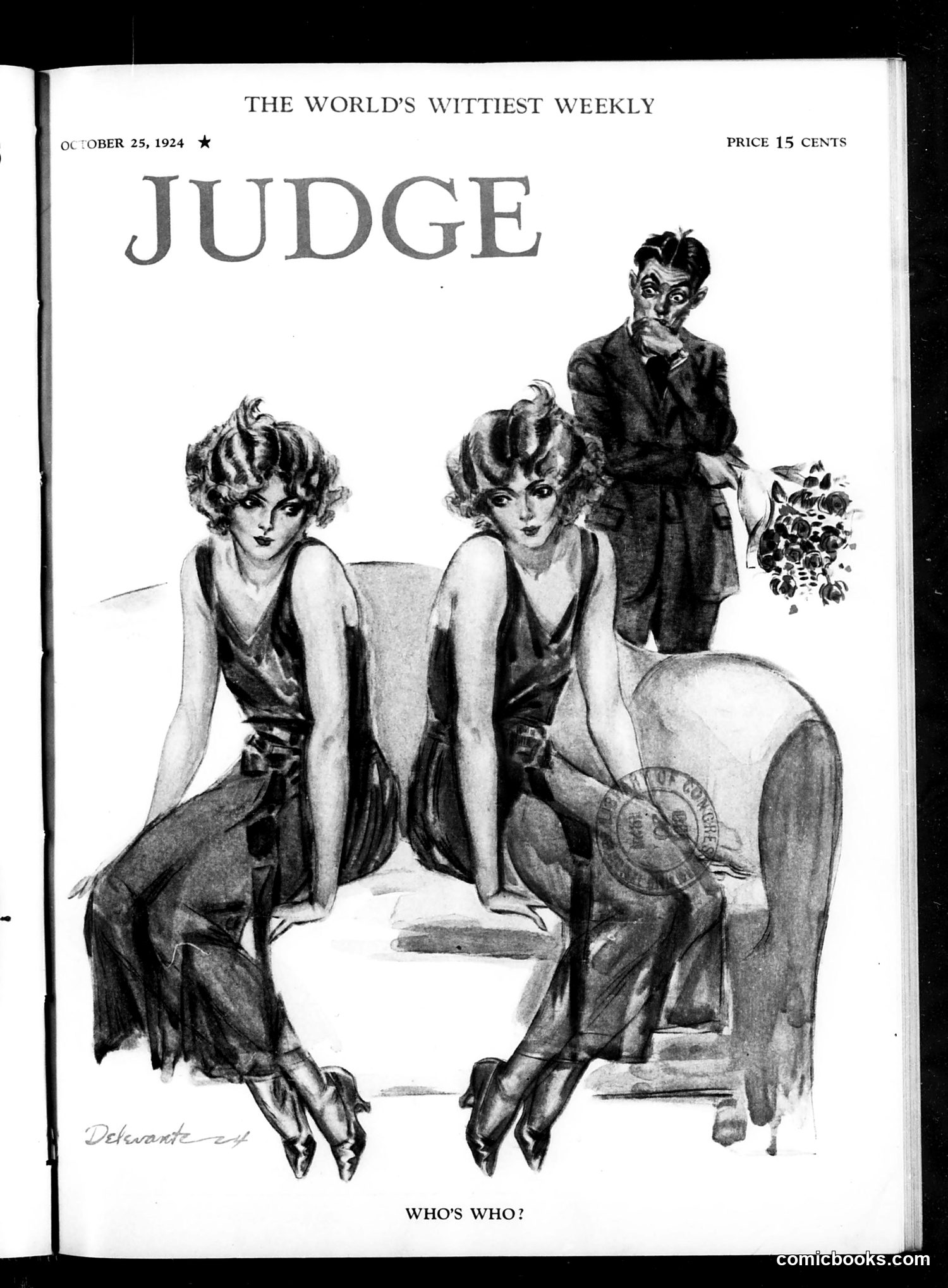
This cover presents a visual joke titled "Who's Who?" featuring two nearly identical women in fashionable 1920s attire seated together, with a bewildered man standing behind them holding flowers. The satire appears to target the popular 1920s fashion trend of women adopting similar bobbed hairstyles and revealing clothing—so much so that they became visually indistinguishable. The confused gentleman's inability to tell them apart, despite presumably knowing them, mocks both the uniformity of modern female fashion and the era's anxieties about changing women's appearance and independence. This reflects broader Jazz Age concerns about women's increasing social freedom and the loss of traditional markers of individual identity through conventional appearance.
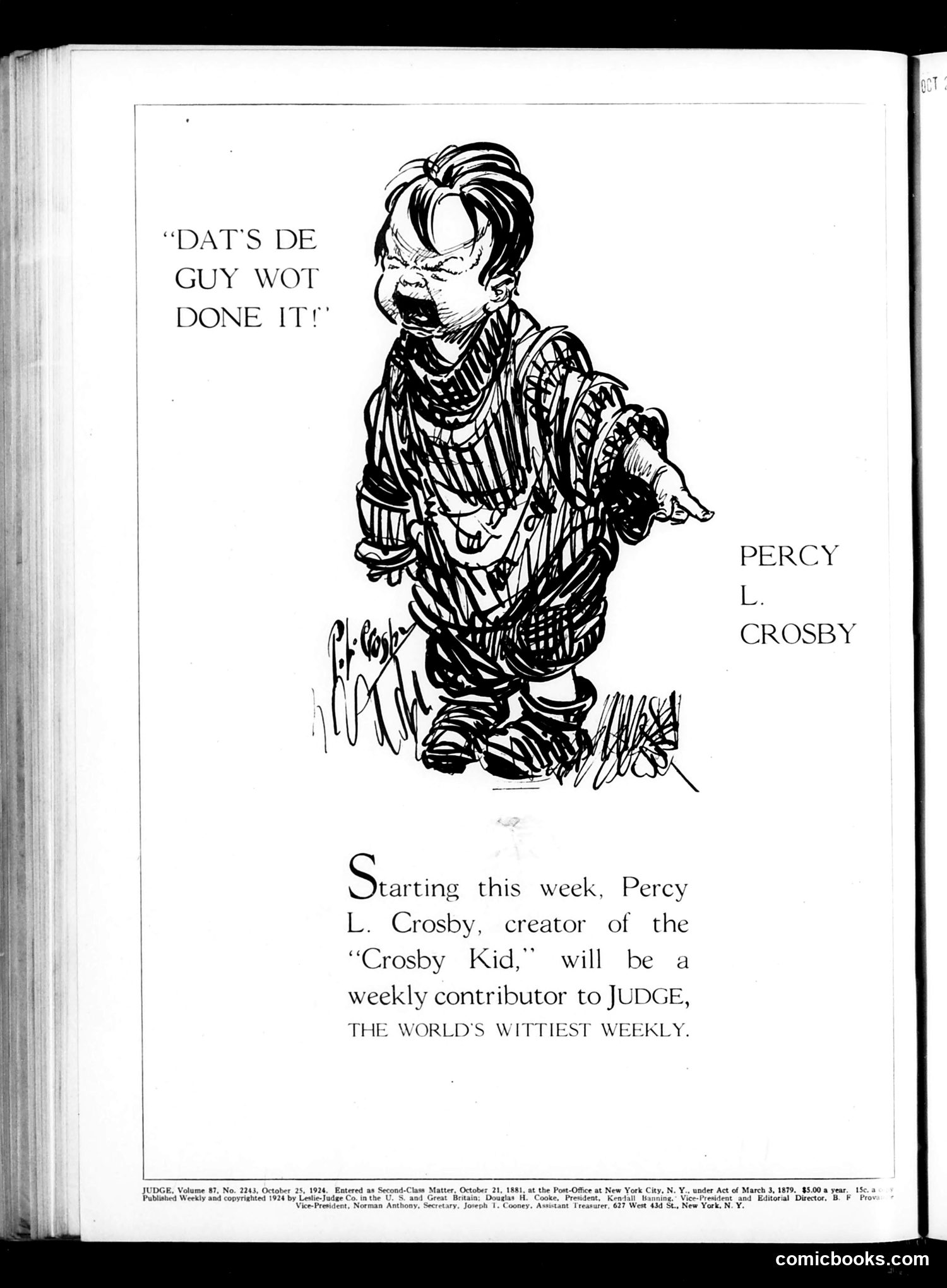
This page announces Percy L. Crosby as a new weekly contributor to *Judge* magazine, beginning October 25, 1924. The cartoon shows Crosby's signature character, the "Crosby Kid"—a mischievous, poorly-dressed child with an angry expression and pointing finger, saying "DAT'S DE GUY WOT DONE IT!" The joke plays on the character's typical role: the Kid was known for getting into trouble and blaming others. By having the character blame Crosby himself for his creation, the page humorously introduces the cartoonist to readers. The poorly-dressed, street-urchin appearance of the Kid reflected 1920s popular interest in working-class and immigrant child characters. This announcement celebrates Crosby's comedic talent while promoting his weekly contributions to the satirical magazine.
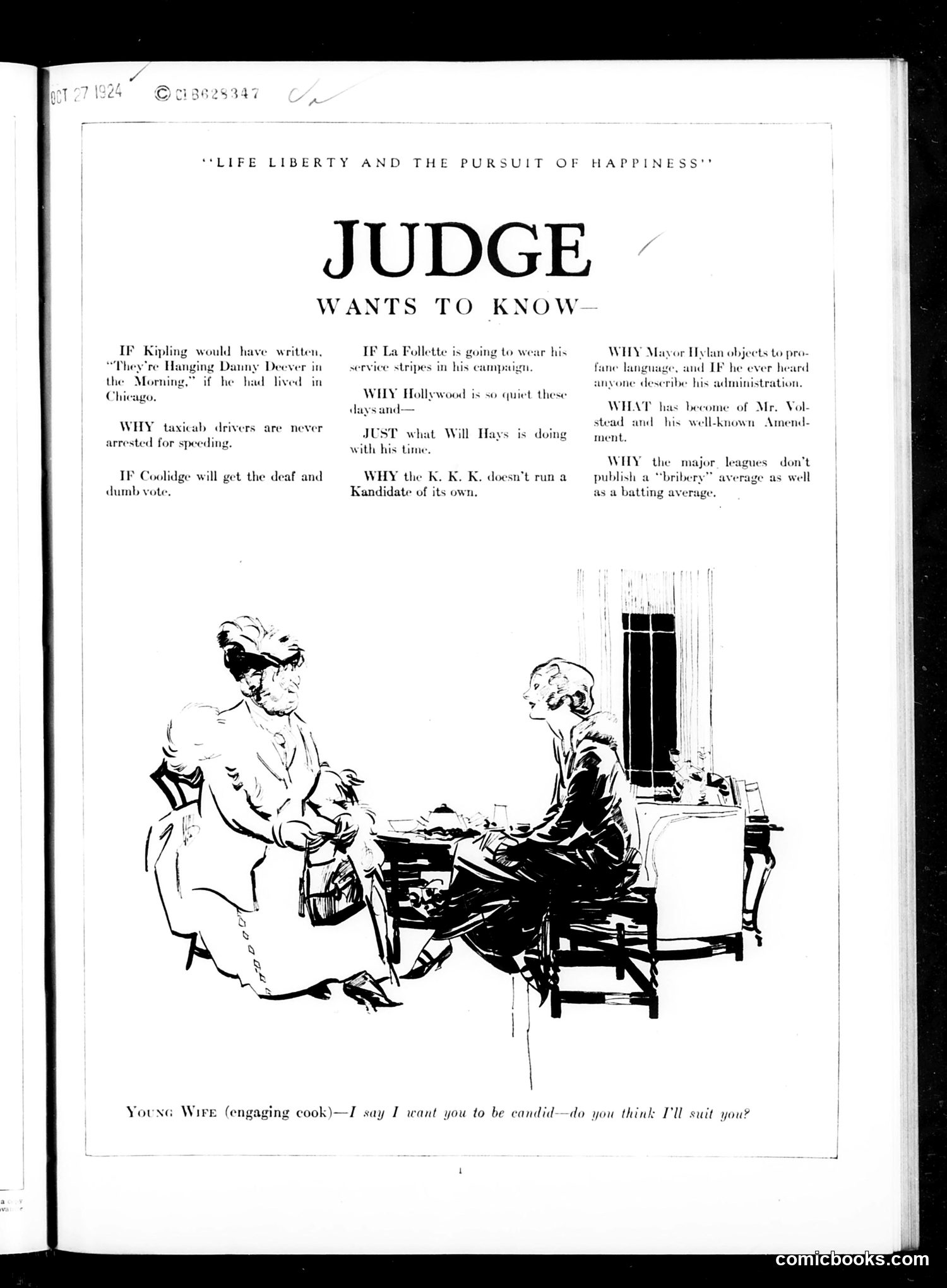
This page from Judge presents a satirical section titled "Judge Wants to Know"—a recurring feature posing absurdist questions about contemporary politics and culture. The questions reference early 20th-century figures and events: Kipling, Coolidge, La Follette, Hollywood's quietness, Will Hays (film industry censor), the K.K.K., and Mayor Hylan. The illustration below depicts a young woman asking a man about being "candid" during courtship—likely satirizing contemporary discussions about honesty in relationships or gender dynamics. The "Wants to Know" format's humor relies on readers recognizing topical references—politicians, cultural figures, and scandals of the moment—to understand the implicit critique. Without that contemporaneous knowledge, the specific targets and satirical points remain largely opaque to modern readers unfamiliar with this era's news cycle.
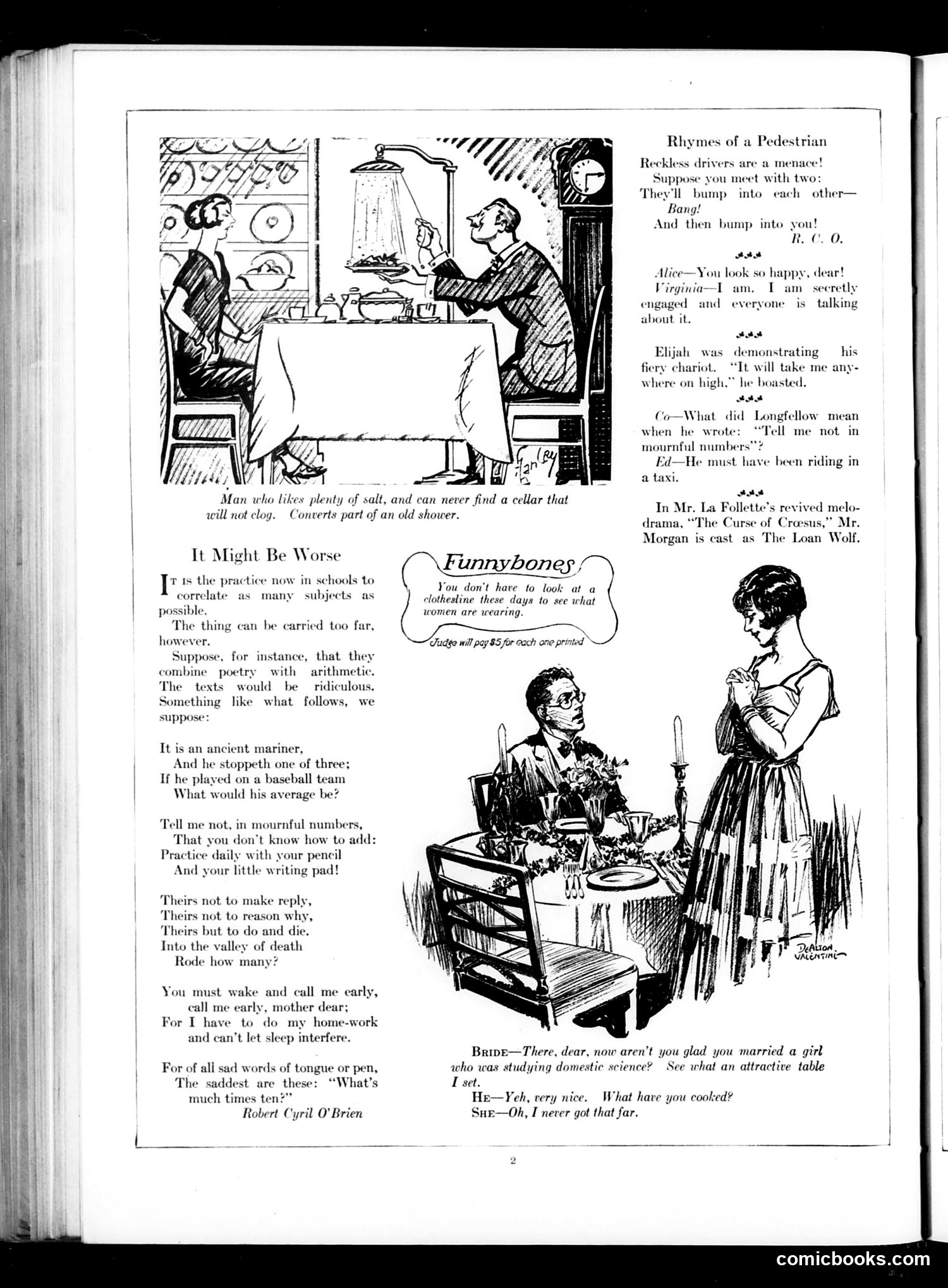
This page contains several distinct pieces of satire and humor: **"Rhymes of a Pedestrian"** (top right): Humorous observations about street traffic and near-collisions, including a quip about taxi drivers. The satire targets reckless driving and pedestrian dangers in urban areas. **"It Might Be Worse"** (left): A poem mocking the trend of combining unrelated school subjects—specifically poetry with arithmetic. The satire critiques overcomplicated educational curricula and the absurdity of mixing disciplines. **"Funnybones"** (center/right): A cartoon showing a bride and groom, where the bride boasts about her domestic skills. The satire targets both newlyweds' unrealistic expectations and the era's gendered assumptions about women's domestic roles. The page reflects early 20th-century American concerns about urban modernization, educational reform, and marital dynamics.
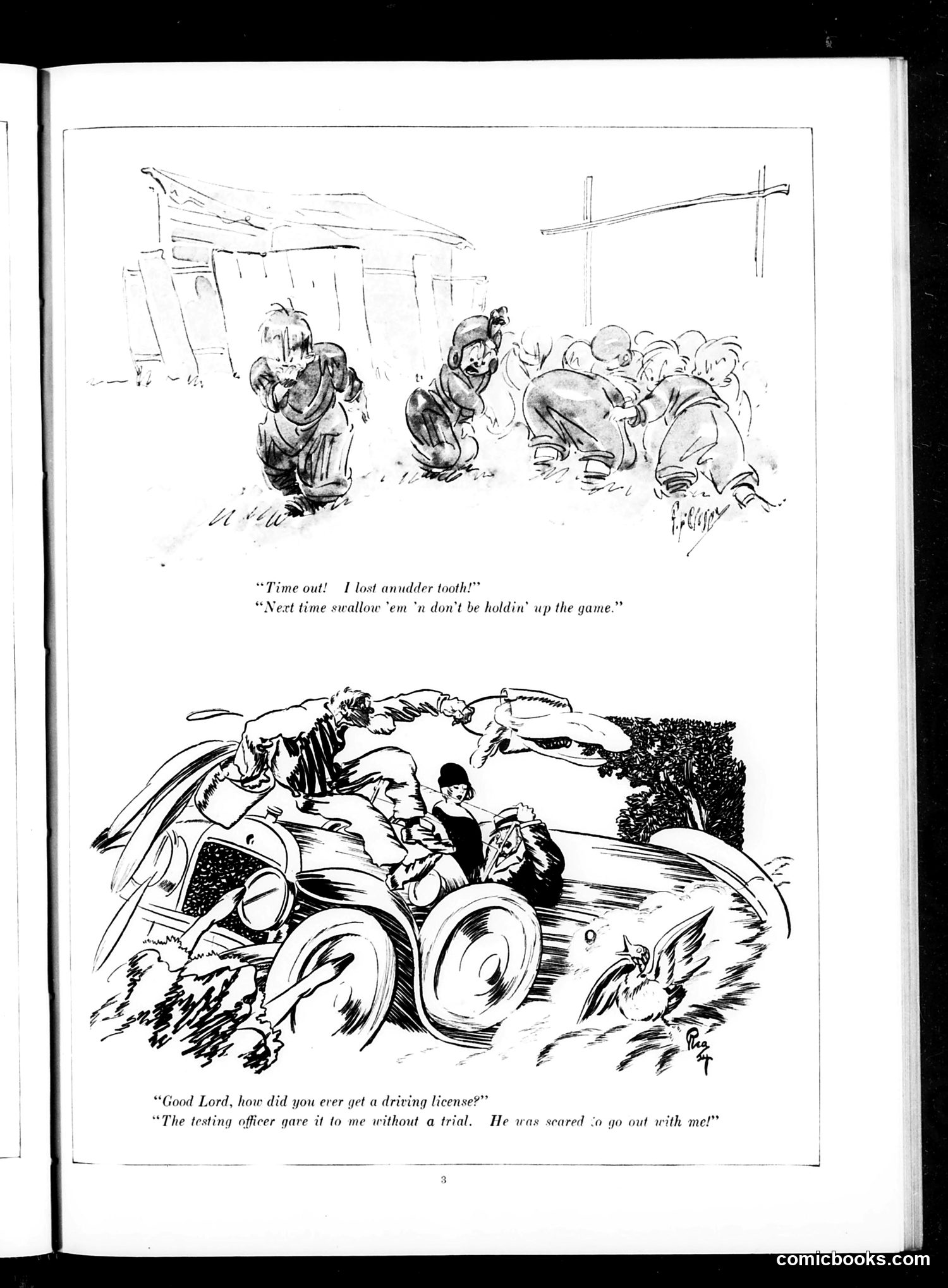
This page contains two comic panels satirizing baseball and reckless driving: **Top panel**: Baseball players discuss game etiquette. One player has lost a mouthful of teeth, prompting the comment about not "holdin' up the game" by swallowing them. This mocks rough play and missing teeth as routine hazards of early baseball. **Bottom panel**: A chaotic car crash scene. The driver explains he obtained his license "without a trial" because the testing officer "was scared" to ride with him. This satirizes the ease of obtaining driving licenses and dangerous drivers on early 1900s roads—when automobile regulation was minimal and licensing standards were loose or nonexistent. Both panels use exaggerated humor to critique safety standards in contemporary American leisure and transportation.
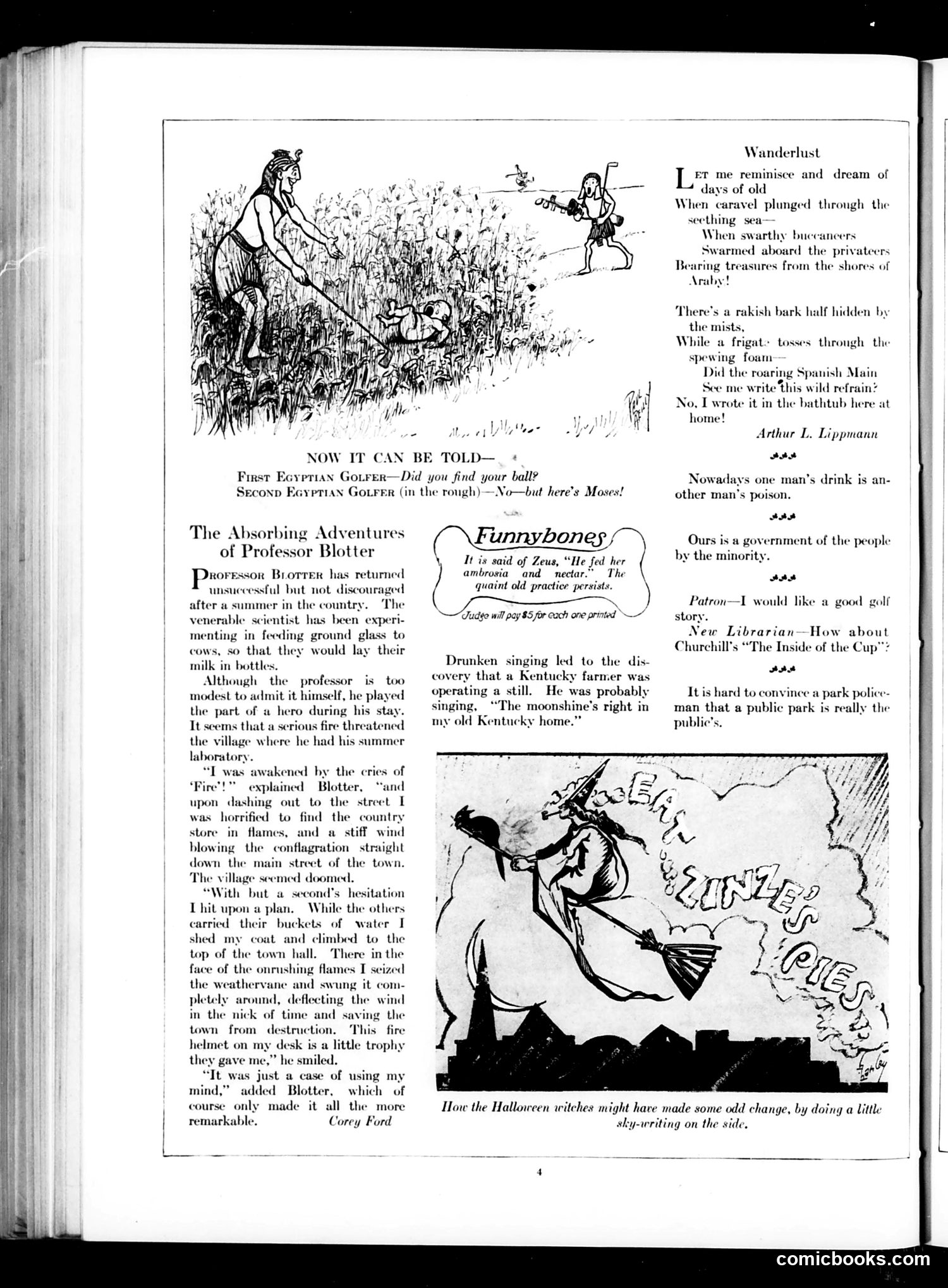
This page mixes humorous fiction and commentary typical of Judge magazine's satirical format. "The Absorbing Adventures of Professor Blotter" tells of a scientist who feeds ground glass to cows to make them produce milk in bottles—a absurdist joke on industrial efficiency. The "Funnybones" section contains brief witticisms about government ("Ours is a government of the people by the minority") and social observation. The Halloween illustration shows witches engaged in "sky-writing"—a reference to aerial advertising, then a novelty. The caption suggests witches might modernize their traditional pranks using contemporary technology, satirizing how even supernatural folklore gets absorbed into commercialism and modern advertising culture.
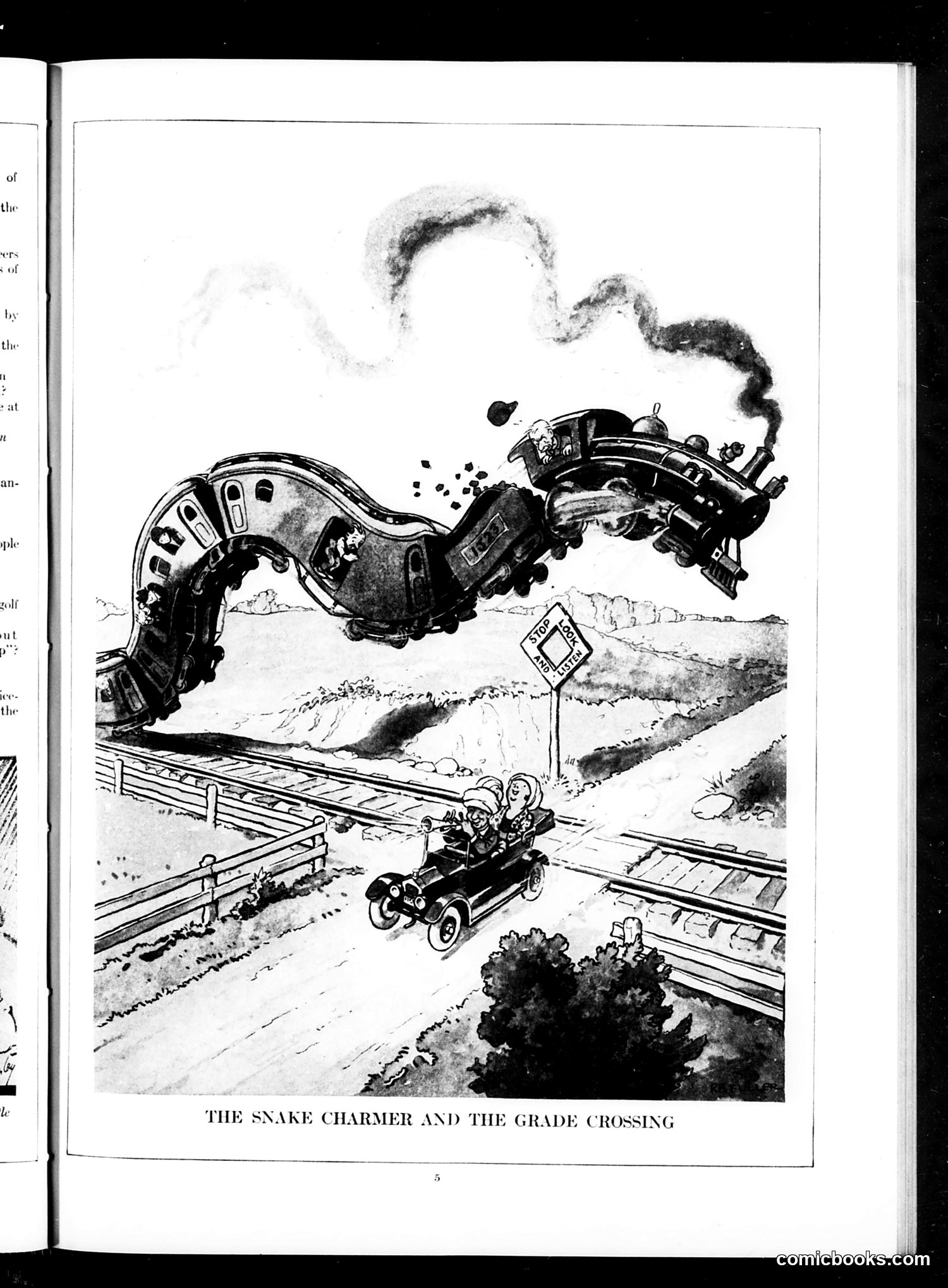
This satirical cartoon depicts a serpentine train performing acrobatic feats above a railroad grade crossing where a car full of passengers waits. The "snake" metaphor likely refers to a railroad company's deceptive or dangerous practices—snaking through the landscape while posing hazards. The grade crossing (where road and rail intersect at the same level) was a genuine safety concern in early 20th-century America, responsible for numerous accidents and fatalities. The cartoon appears to mock railroad companies as "charming" or manipulative operators while highlighting the genuine danger they posed to ordinary motorists and passengers. The precarious positioning of the vehicle suggests public vulnerability to railroad industry practices and inadequate safety regulations at these intersections—a legitimate progressive-era concern.
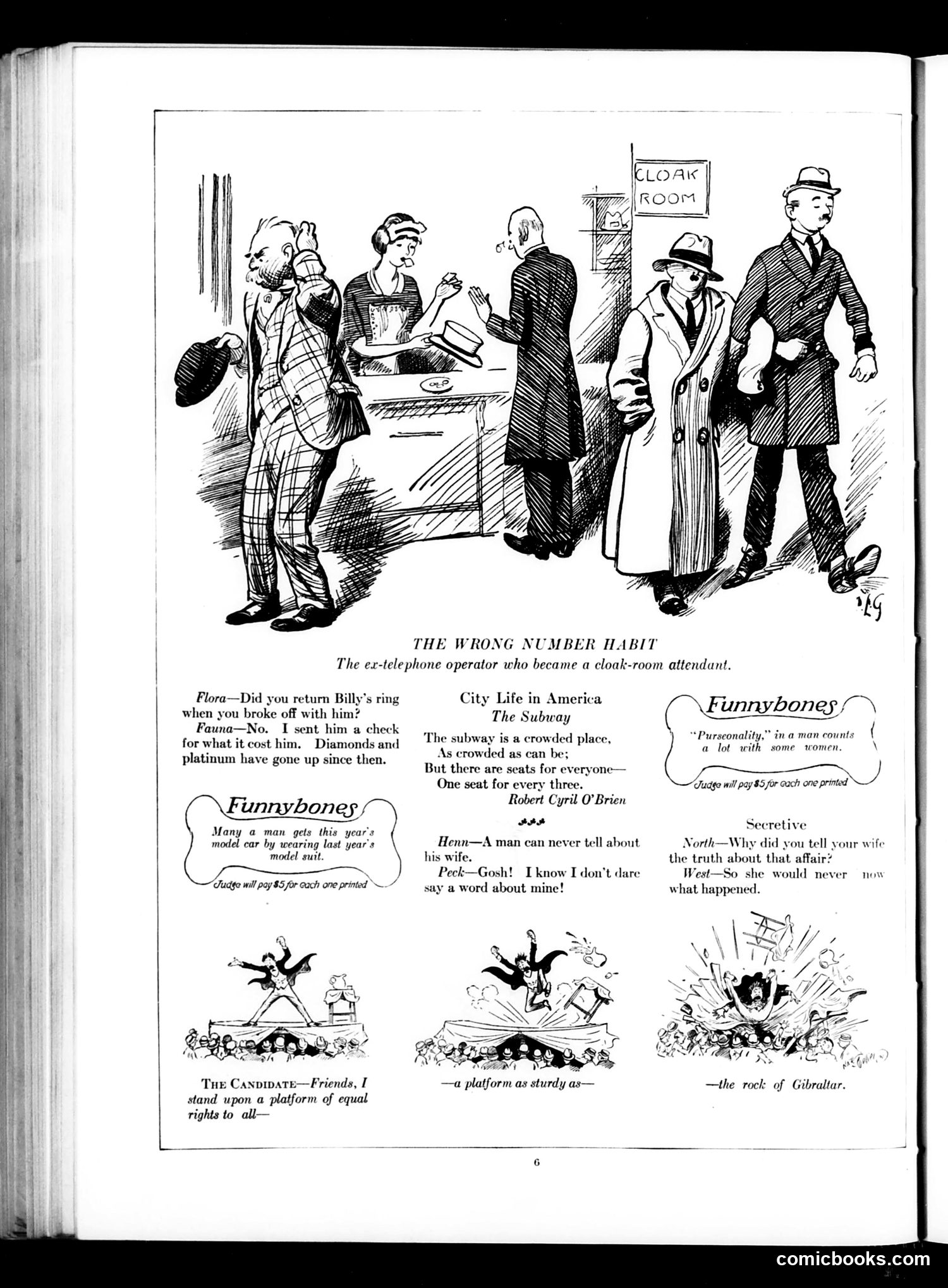
This page from *Judge* magazine contains several short satirical pieces mocking early 20th-century American social behavior: **"The Wrong Number Habit"** depicts a former telephone operator now working as a cloak-room attendant—satirizing job transitions and the absurdity of bureaucratic mishaps. **"City Life in America: The Subway"** jokes about crowded subway conditions with the paradox that "one seat for every three" people, mocking urban infrastructure inadequacy. The **"Funnybones"** section offers one-liners: one mocks materialism (men buying new cars while wearing shabby suits); another satirizes female mercenary behavior (a woman sends an ex-boyfriend a check for his expensive ring rather than returning it, noting diamonds have appreciated). **"Secretive"** humorously portrays male anxiety about honesty in relationships—men fear telling wives the truth about infidelity. **"The Candidate"** shows a politician collapsing mid-speech about "equal rights," suggesting hypocrisy or instability in political rhetoric. The satire targets consumerism, gender relations, urban life, and political dishonesty—themes reflecting concerns of the Jazz Age era.
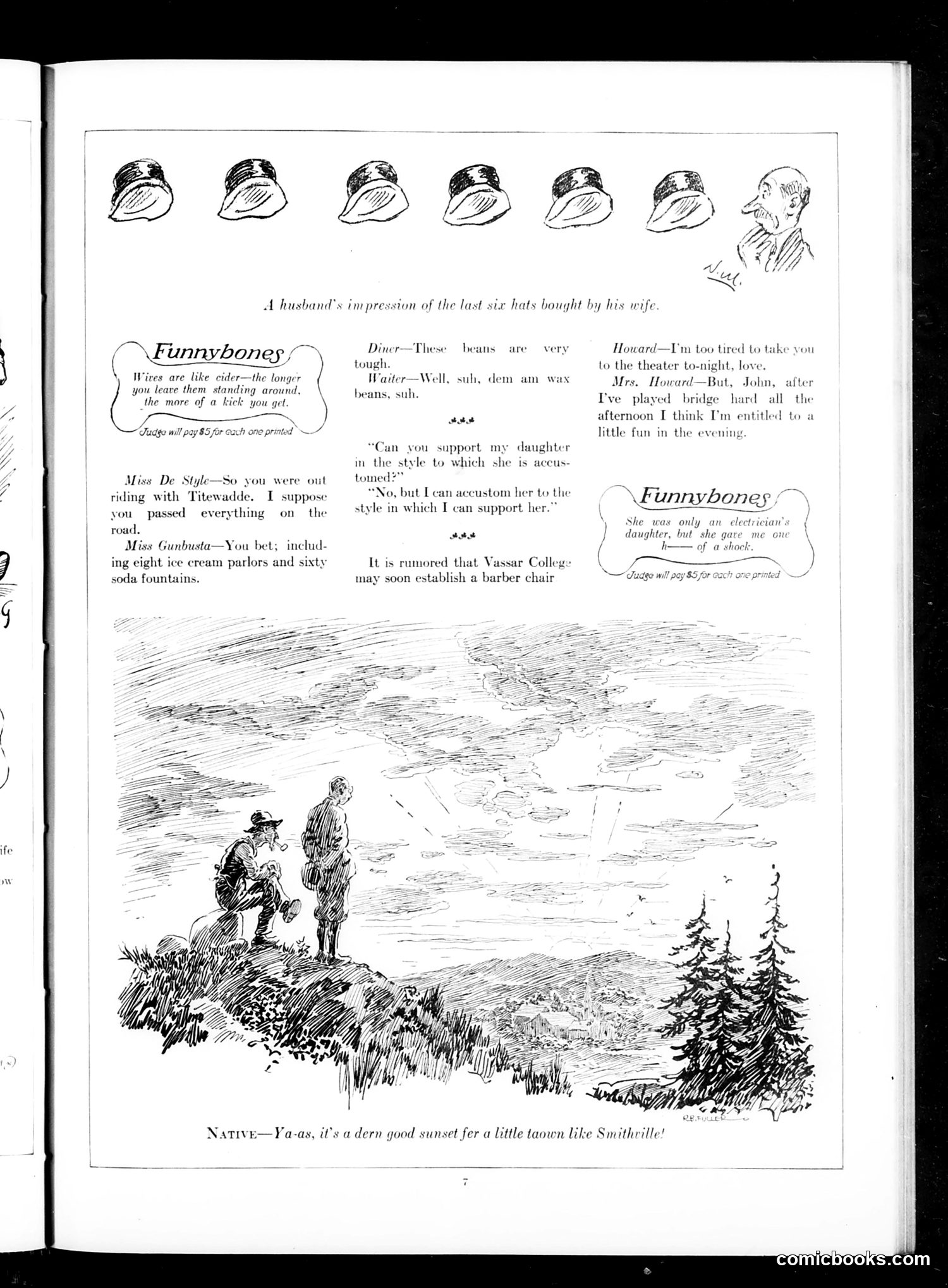
This page contains several short humor pieces satirizing early 20th-century domestic and social life: **Top Section:** Six identical hats shown as "a husband's impression"—likely mocking wives' expensive hat purchases and suggesting they all look the same despite their cost. **"Funnybones" Jokes:** Brief comedic quips about wires, dating etiquette, and food, plus a dialogue about supporting a daughter's lifestyle—the punchline mocking men unable to afford their wives' expensive tastes. **Bottom Illustration:** Two figures overlooking a landscape at sunset, captioned about "Smithville"—appears to be a sentimental rural scene, possibly contrasting with the urban shopping/consumption jokes above. **Overall Theme:** The page satirizes consumer culture, particularly women's fashion spending and courtship economics, while maintaining gentle domestic humor typical of Judge's middle-class audience. The repeated hat imagery emphasizes wasteful female consumerism—a common complaint in period satire.
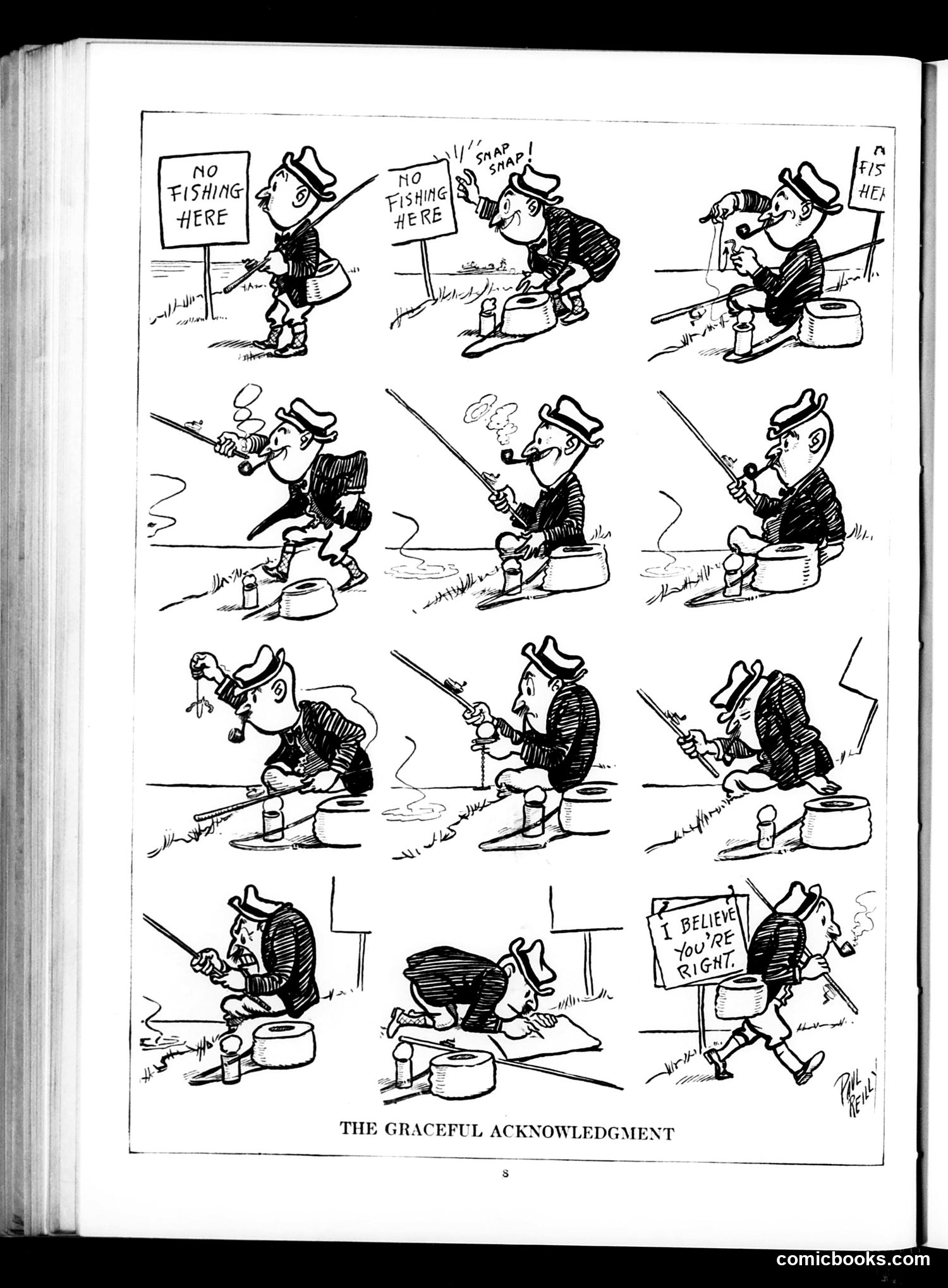
This single-panel comic strip depicts a fisherman repeatedly violating a "No Fishing Here" sign. The sequence shows him progressively catching fish despite the prohibition, then attempting to evade enforcement (likely a park ranger or authority figure). In the final panels, he's caught red-handed but presents a sign reading "I Believe You're Right"—a performative, insincere acknowledgment meant to placate the official. The satire mocks people who acknowledge rules or criticism only when confronted, while continuing their prohibited behavior when unwatched. It critiques dishonest, performative compliance—agreeing superficially to authority while disregarding actual regulations. The humor derives from the character's transparent hypocrisy and the universal human tendency to give lip service to rules we don't respect.
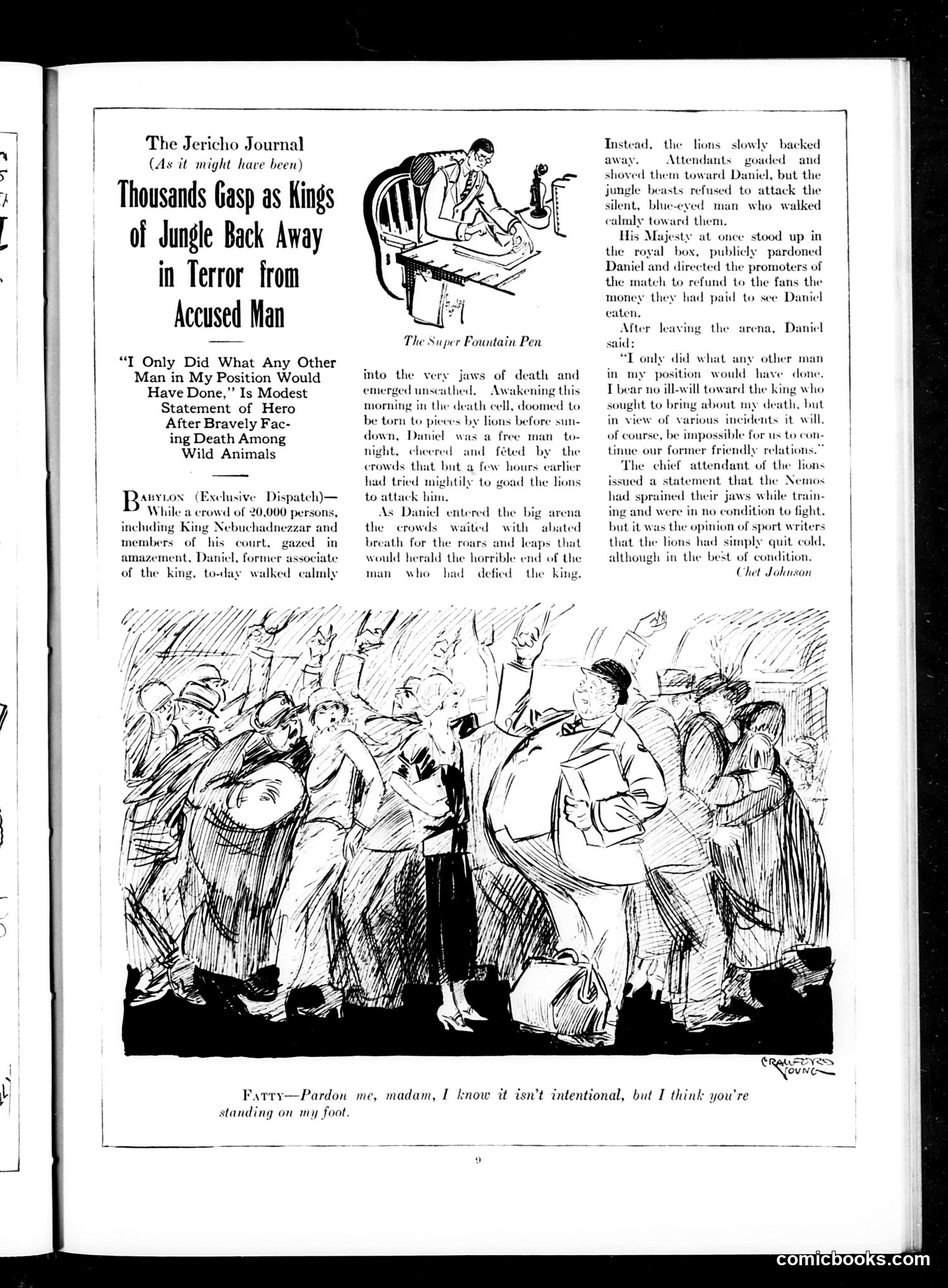
This page satirizes the Biblical story of Daniel in the lion's den (Daniel 6) by reimagining it as a sensational newspaper event. The satire works on multiple levels: **The Setup:** Daniel, condemned to death by a king whose laws he defied, is thrown to lions—but the lions mysteriously refuse to attack him (as in the original Bible story). **The Satire:** Judge mocks how the press would cover such an event with breathless sensationalism, fake quotes, and post-hoc rationalizations. Daniel gives a modest, diplomatic statement; the king immediately reverses course; sportswriters invent excuses (the lions "sprained their jaws" or "quit cold"). **The Point:** The cartoon critiques how newspapers fabricate narratives and how authority figures conveniently flip positions when faced with public opinion. The bottom cartoon's caption—someone stepping on another's foot—suggests the crowded absurdity of it all. The "Super Fountain Pen" advertisement is unrelated filler.
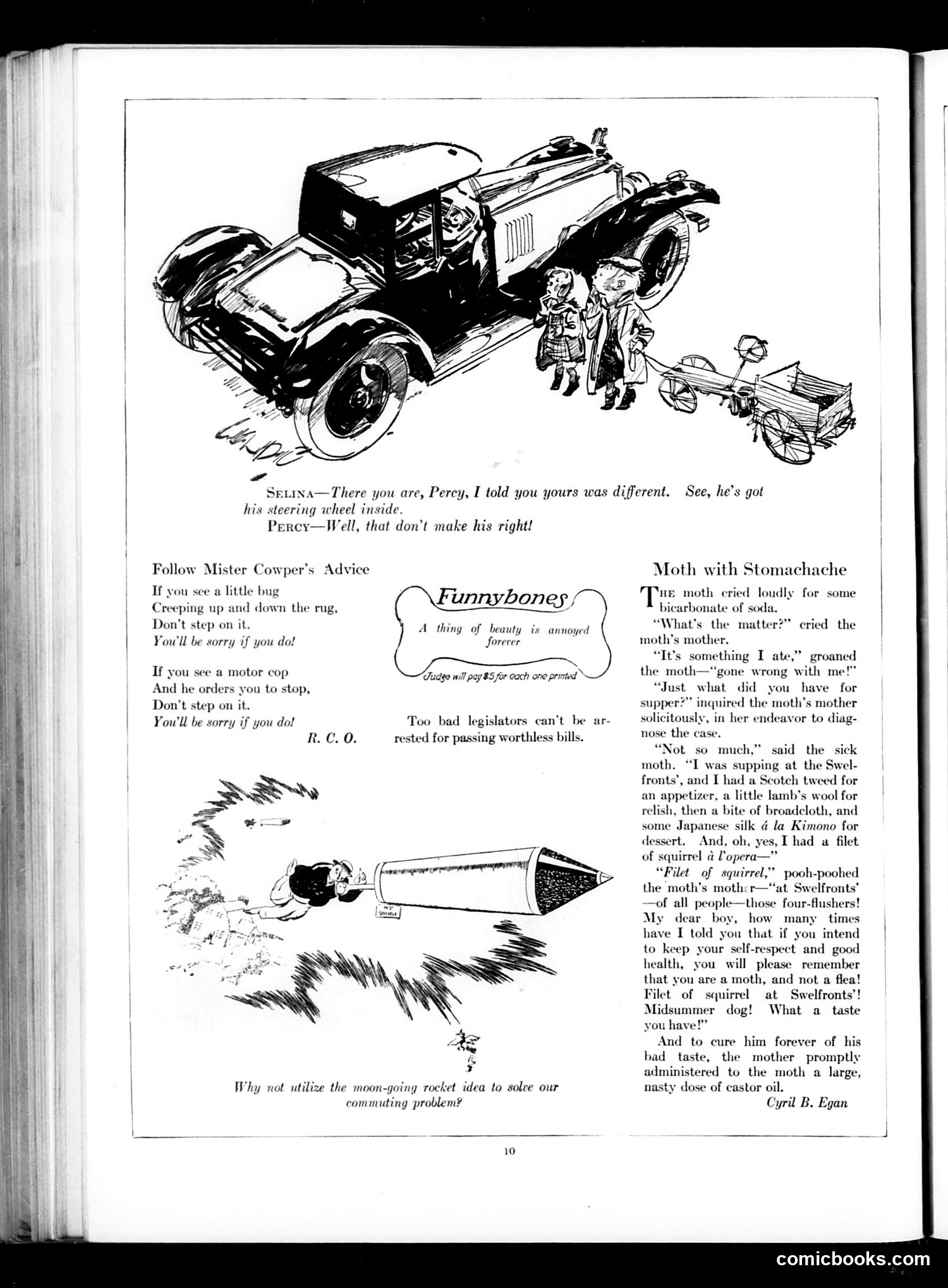
This page contains three distinct satirical pieces: **Top cartoon**: Two characters (Selina and Percy) examine automobiles. The joke mocks early car design inconsistencies—Percy's vehicle has its steering wheel positioned differently from Selina's, yet he defensively insists his arrangement is correct. This satirizes the era's lack of standardization in automobile manufacturing. **"Follow Mister Cowper's Advice"**: Parodies safety advice by suggesting you shouldn't step on bugs OR obey traffic cops, with identical consequences. The absurdity—equating moral guilt from harming insects with legal trouble—mocks overblown moralistic warnings. **"Moth with Stomachache"**: A humorous story where a moth suffers indigestion after eating fancy restaurant fabrics (wool, silk, broadcloth, squirrel meat) at "Swelfronts'" restaurant. The moth's mother scolds him for dining at a pretentious establishment and gives him castor oil. This likely satirizes class-conscious dining and social pretension among wealthy patrons. The "moon-going rocket" commuting joke at bottom appears unrelated filler humor.
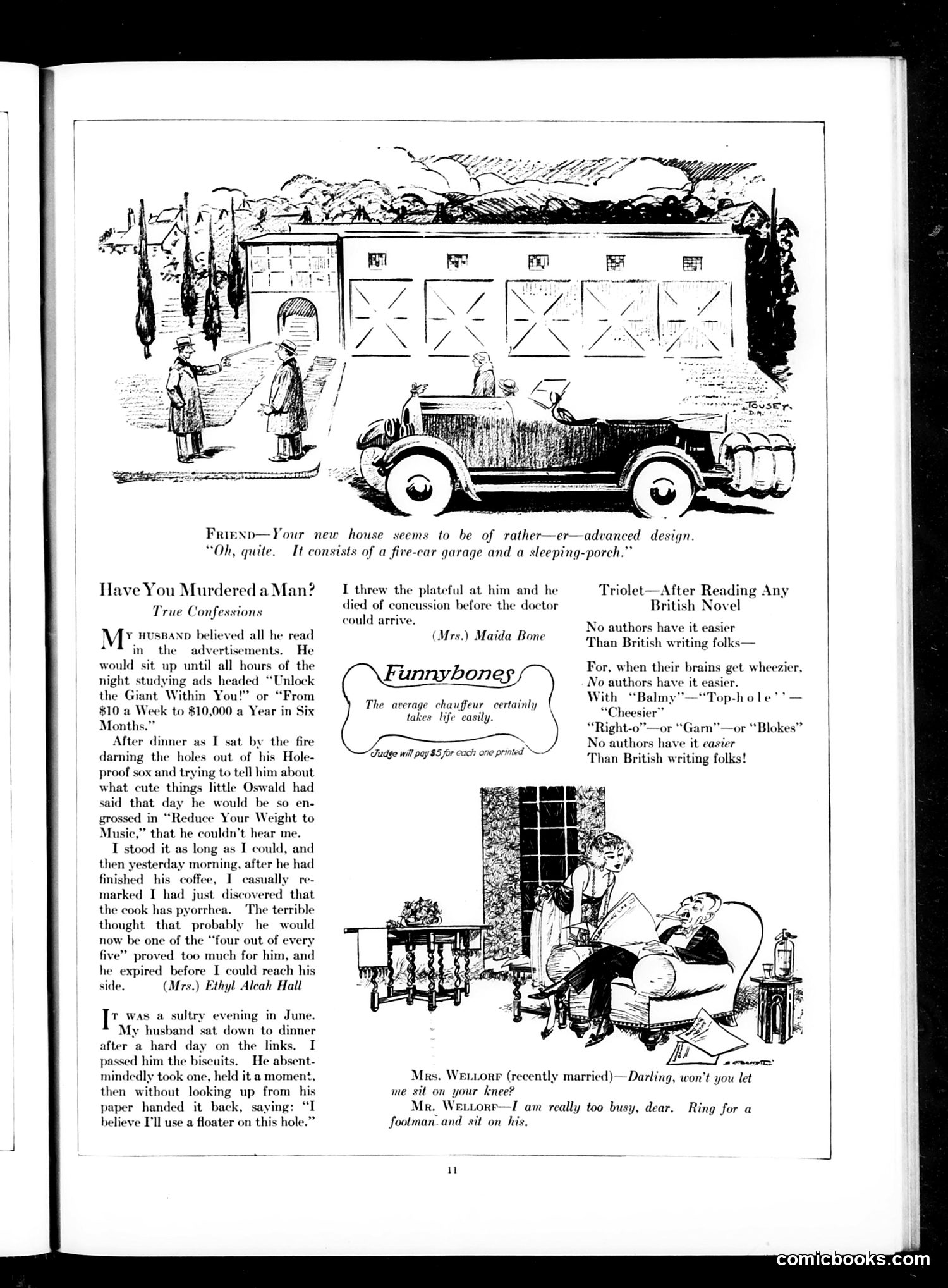
This page from *Judge* contains satirical humor targeting early 20th-century American consumer culture and gender dynamics. The top cartoon mocks modernist architecture—a homeowner proudly describes his "advanced design" house as merely "a fire-car garage and a sleeping-porch," deflating pretentious design trends. The "True Confessions" section presents darkly comic monologues from wives who murdered their husbands over trivial annoyances: one husband obsessed with self-help advertisement promises ("Unlock the Giant Within You!"), another distracted by golf during dinner. The satire targets both gullible men and the advertising industry's manipulative claims. "Funnybones" contains brief jokes: one mocks chauffeurs as lazy; another depicts marital dynamics where a busy husband refuses his new wife's affection, so she summons a footman instead—suggesting infidelity or role-reversal humor. The "Triolet" mocks British novelists for relying on British slang and colloquialisms ("Top-hole," "Garn," "Blokes") as lazy writing shortcuts rather than genuine literary talent.
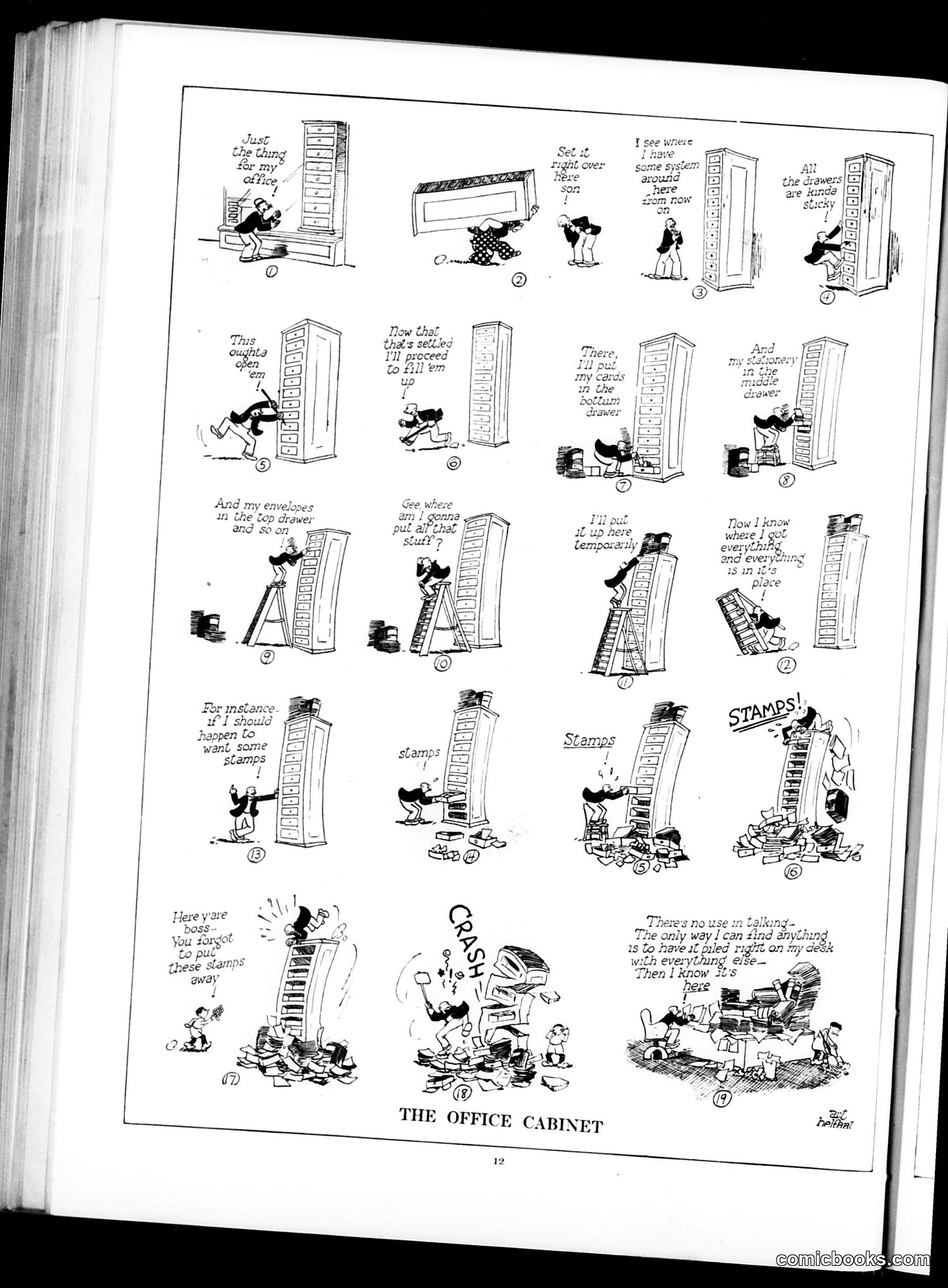
This is a humorous sequential comic depicting the chaos of office file organization. The strip shows a businessman's escalating frustration with an office filing cabinet as he attempts to locate documents. The satire targets the universal modern office problem: despite organized filing systems, important papers inevitably become lost, misplaced, or inaccessible. As the comic progresses, the cabinet literally overflows and explodes with accumulated papers and stamps, culminating in complete pandemonium. The joke is that no filing system—no matter how carefully maintained—can prevent office disorder. The final panels show the cabinet's destruction and scattered contents, with the punchline suggesting that finding anything in an office is ultimately futile. This reflects early-20th-century frustrations with bureaucratic inefficiency and growing office culture.
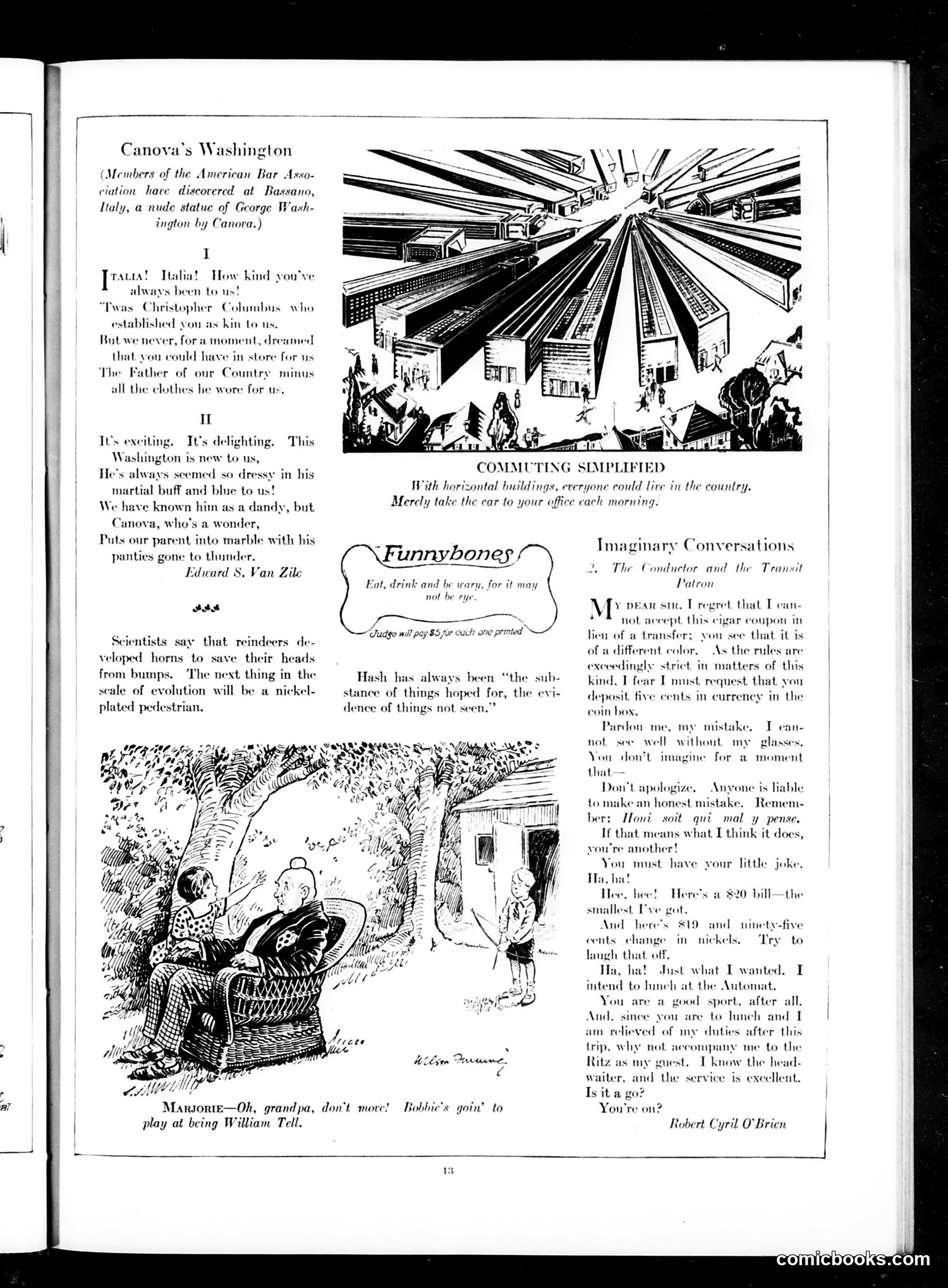
This page satirizes the discovery of a nude marble statue of George Washington allegedly sculpted by Antonio Canova in Italy. The poem by Edward S. Van Zile mocks both the implausibility of such a discovery and America's embarrassment at the Father of his Country depicted without clothing—particularly his "panties gone to thunder." The satire works on multiple levels: it questions whether Italy would actually possess such a statue, jokes about Washington's famous propriety ("always seemed so dressy"), and gently ridicules American prudishness about classical nudity. The humor relies on the incongruity of the dignified, fully-clothed historical figure stripped bare in marble form. The page also contains unrelated humor: a "Commuting Simplified" diagram about futuristic horizontal buildings, scientific observations, and an "Imaginary Conversation" between a transit conductor and passenger arguing over a cigar coupon.
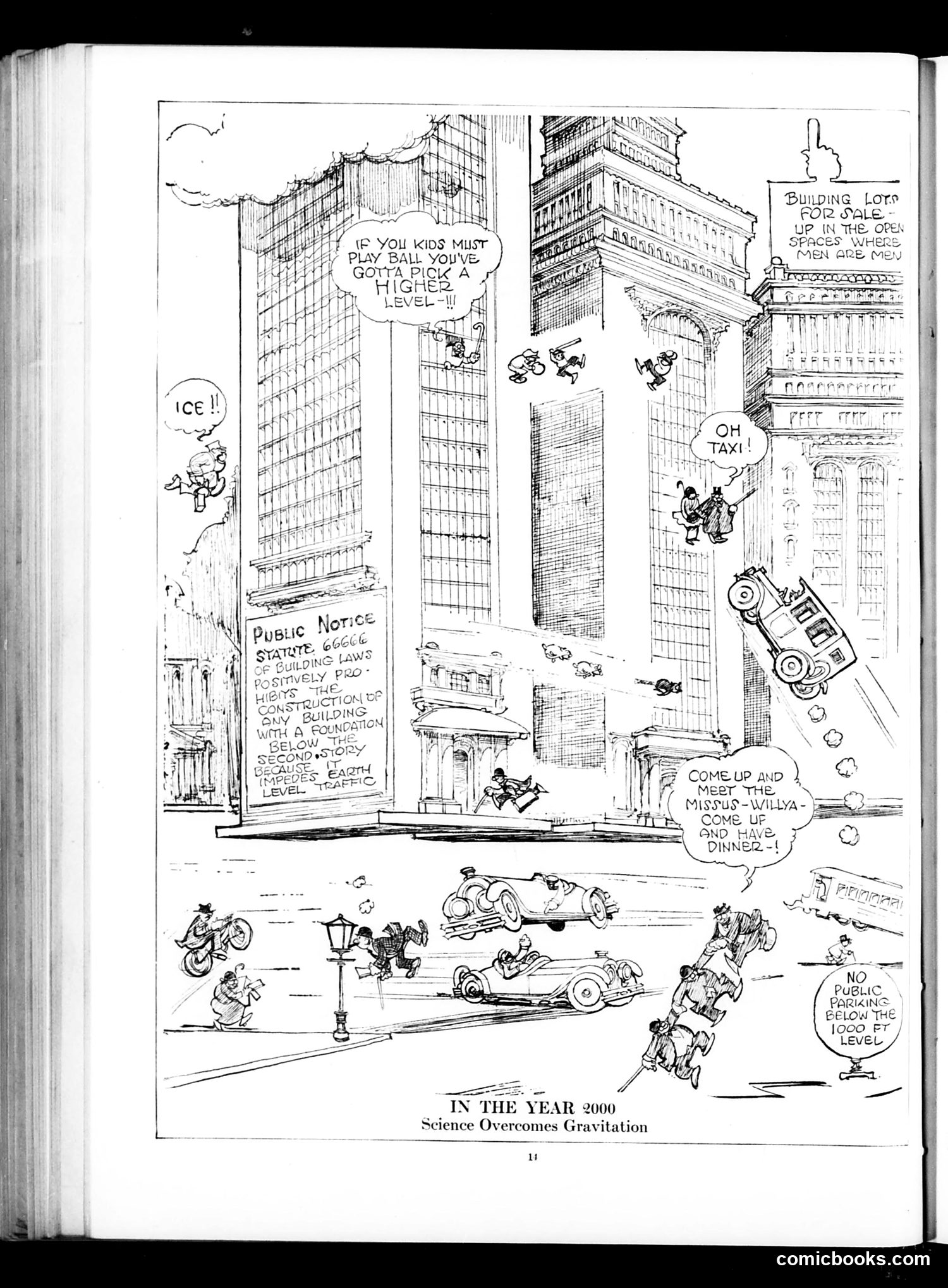
This is a futuristic satire imagining New York City in the year 2000 after gravity has been eliminated by science. The humor derives from showing how urban congestion problems might be "solved" through vertical expansion rather than realistic city planning. The cartoon depicts: - **Children playing ball** on building facades at extreme heights - **Traffic** (cars, taxis, motorcycles) floating at multiple vertical levels between skyscrapers - **Public notices** addressing construction and traffic regulations in three dimensions - **Residential and commercial activity** distributed throughout the vertical space The satire mocks early 20th-century optimism about technological solutions to urban problems. Rather than addressing overcrowding through sensible planning, the cartoon suggests society would simply stack all activities vertically, creating equally chaotic conditions but in three dimensions instead of two. It's a gentle critique of techno-utopianism—the naive belief that science alone can solve fundamental social problems without addressing root causes. The comic assumes Judge's readers would find this extrapolation both amusing and slightly absurd.
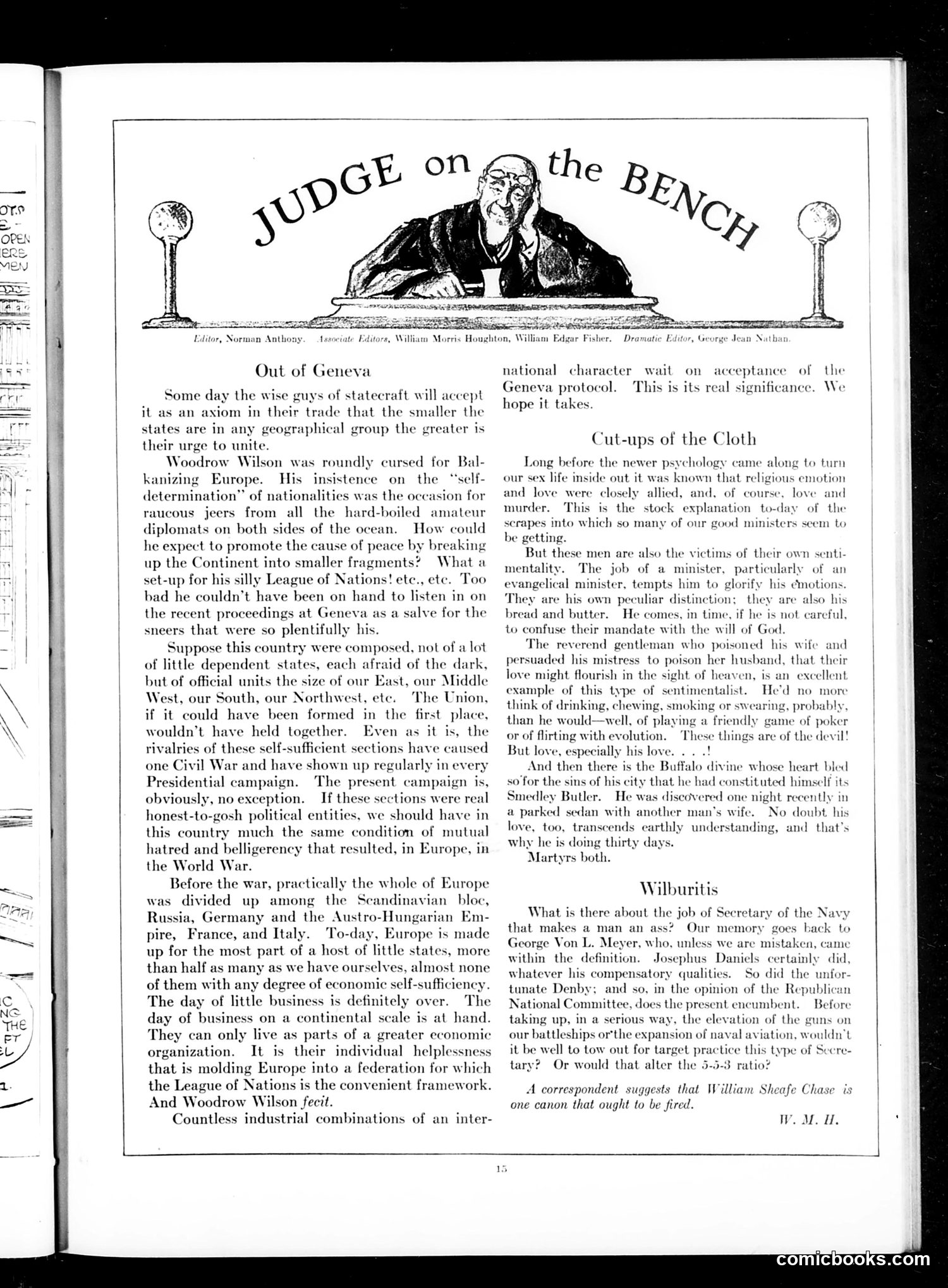
This page from Judge magazine contains two satirical essays criticizing President Woodrow Wilson and Protestant ministers. **"Out of Geneva"** defends Wilson's post-WWI policy of breaking up large European empires into smaller, self-determining nations—a decision widely mocked at the time. The author argues that small states naturally seek economic union for survival, making Wilson's "Balkanization" ultimately wise. The piece suggests the League of Nations provides the framework these fragmented nations need to cooperate on a continental scale. **"Cut-ups of the Cloth"** satirizes evangelical ministers who fall into sexual and moral scandals. Judge mocks the hypocrisy of clergymen who strictly condemn drinking, smoking, and dancing as "of the devil," yet justify illicit love affairs as spiritually justified. The essay references specific scandals involving unnamed ministers, including one in Buffalo, likely alluding to real contemporary cases of ministerial misconduct that shocked the public. Both pieces use satire to critique powerful figures' moral contradictions and questionable judgment.
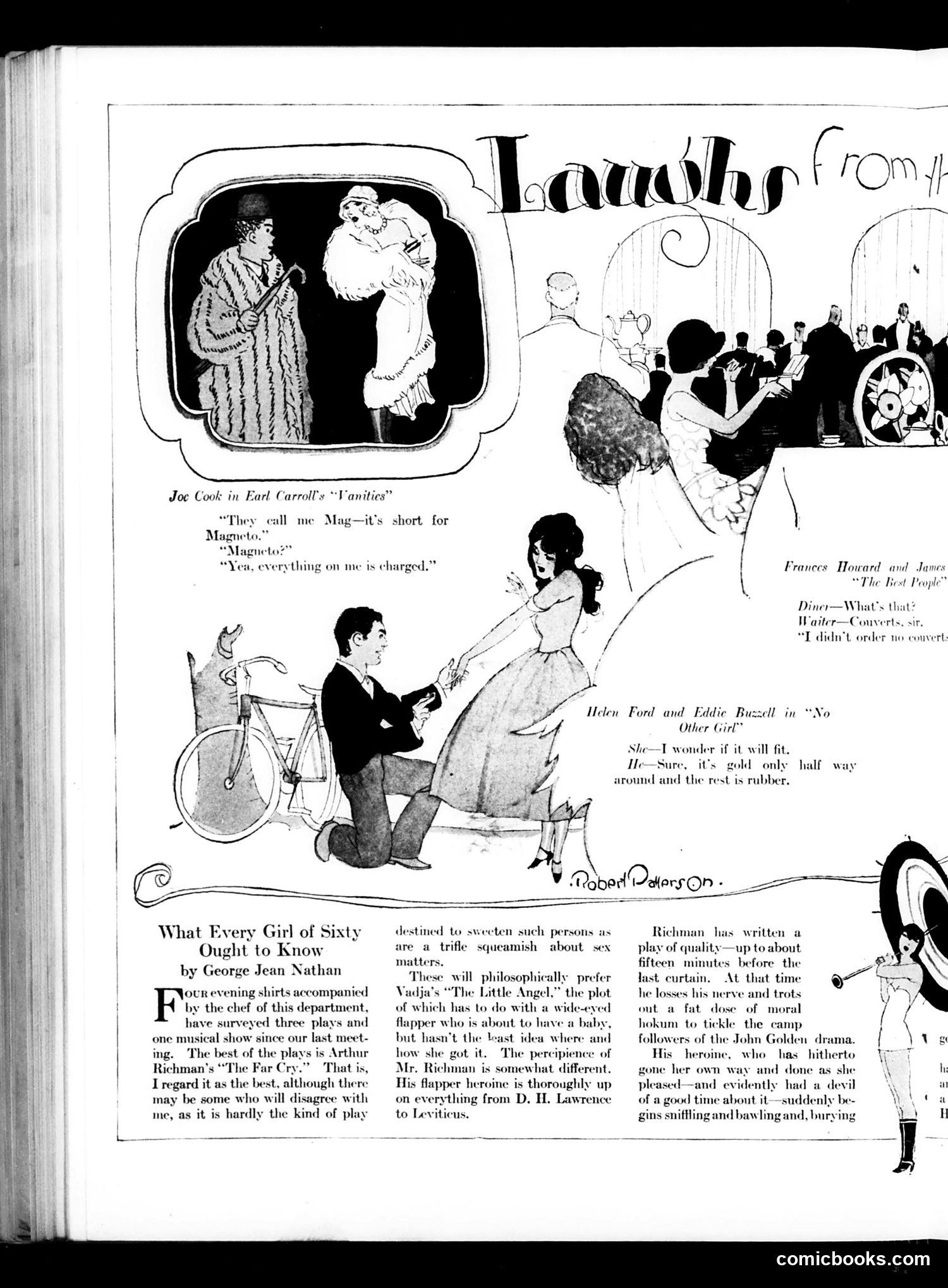
This page from *Judge* magazine contains theatrical reviews and jokes about Broadway shows. The main content is George Jean Nathan's review of Arthur Richman's play "The Far Cry," which Nathan praises as the best recent play he's seen. The satire focuses on the play's flapper heroine—a sexually liberated young woman who is pregnant but doesn't know how she got that way. Nathan's point is that Richman, unlike other playwrights, doesn't resort to moral lecturing. However, the review notes that even Richman eventually adds "moral hokum" at the end to satisfy conservative audiences who followed "the John Golden drama" (conventional theatrical productions). The scattered jokes above mock theater-goers and stage jargon. The overall satire criticizes both playwrights who pander to prudish audiences and the audiences themselves who demand moral lessons rather than honest storytelling about modern (1920s) sexual attitudes.
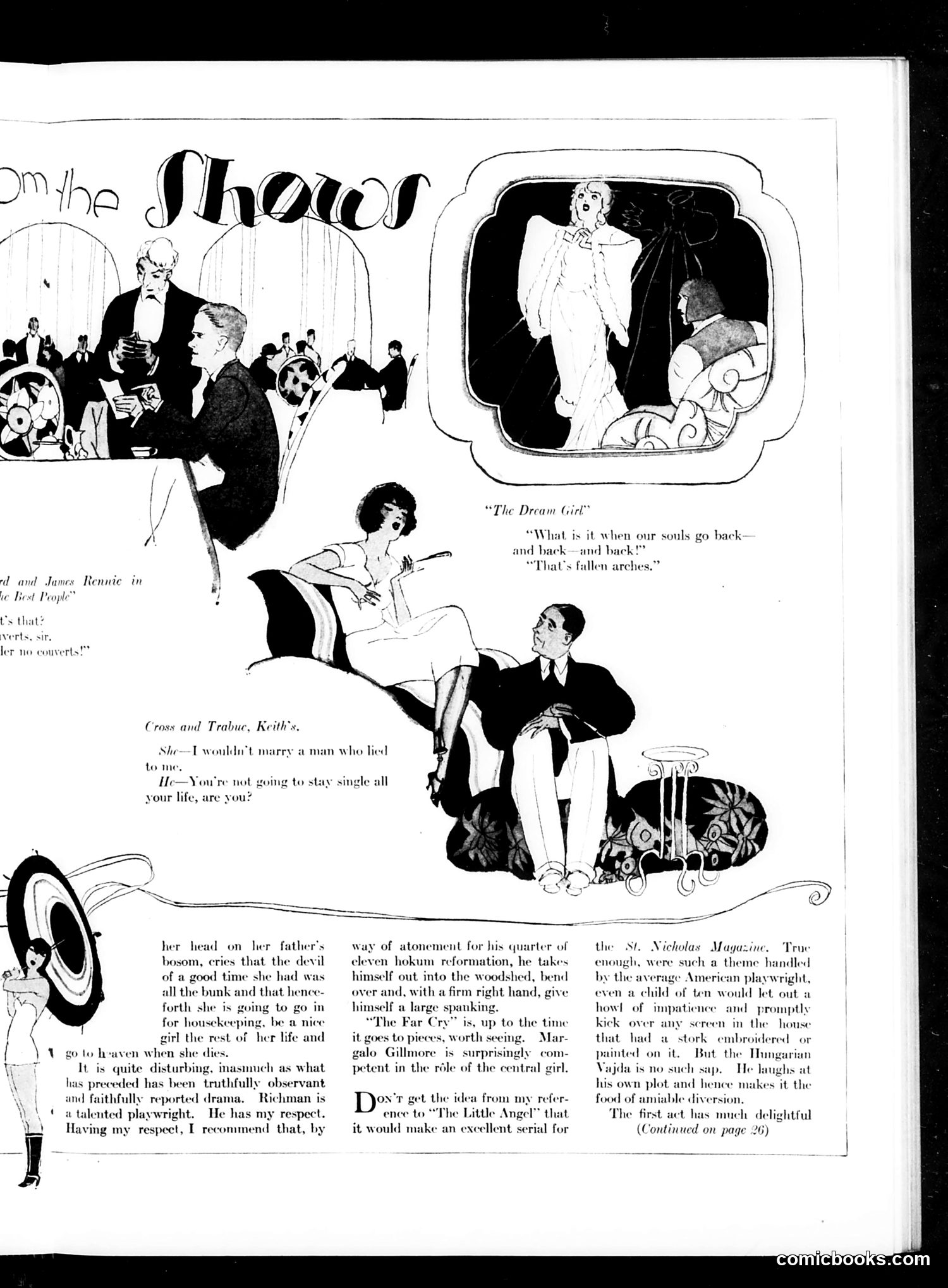
This page reviews theatrical productions from the early 20th century. The main cartoons illustrate scenes from plays: **"The Dream Girl"** (top right): Shows a dramatic scene with dialogue about souls and "fallen arches"—likely a pun satirizing the play's pretentious spiritual themes. **"Cross and Trabuc, Keith's"** (center): Depicts a couple's conversation where the woman refuses to marry a liar. The reviewer criticizes the playwright Richman for recycling tired dramatic clichés about moral reformation and redemption. **"The Far Cry"** (referenced in text): The reviewer mocks this play's heavy-handed moralizing—suggesting that if American playwrights handled spiritual themes, audiences would riot and destroy any sentimental décor (embroidered screens with storks). The satire targets early 1900s theatrical sentimentality and predictable plots. The tone suggests Judge's readers appreciated sharp criticism of overwrought drama that preached morality through melodrama rather than genuine wit or originality.
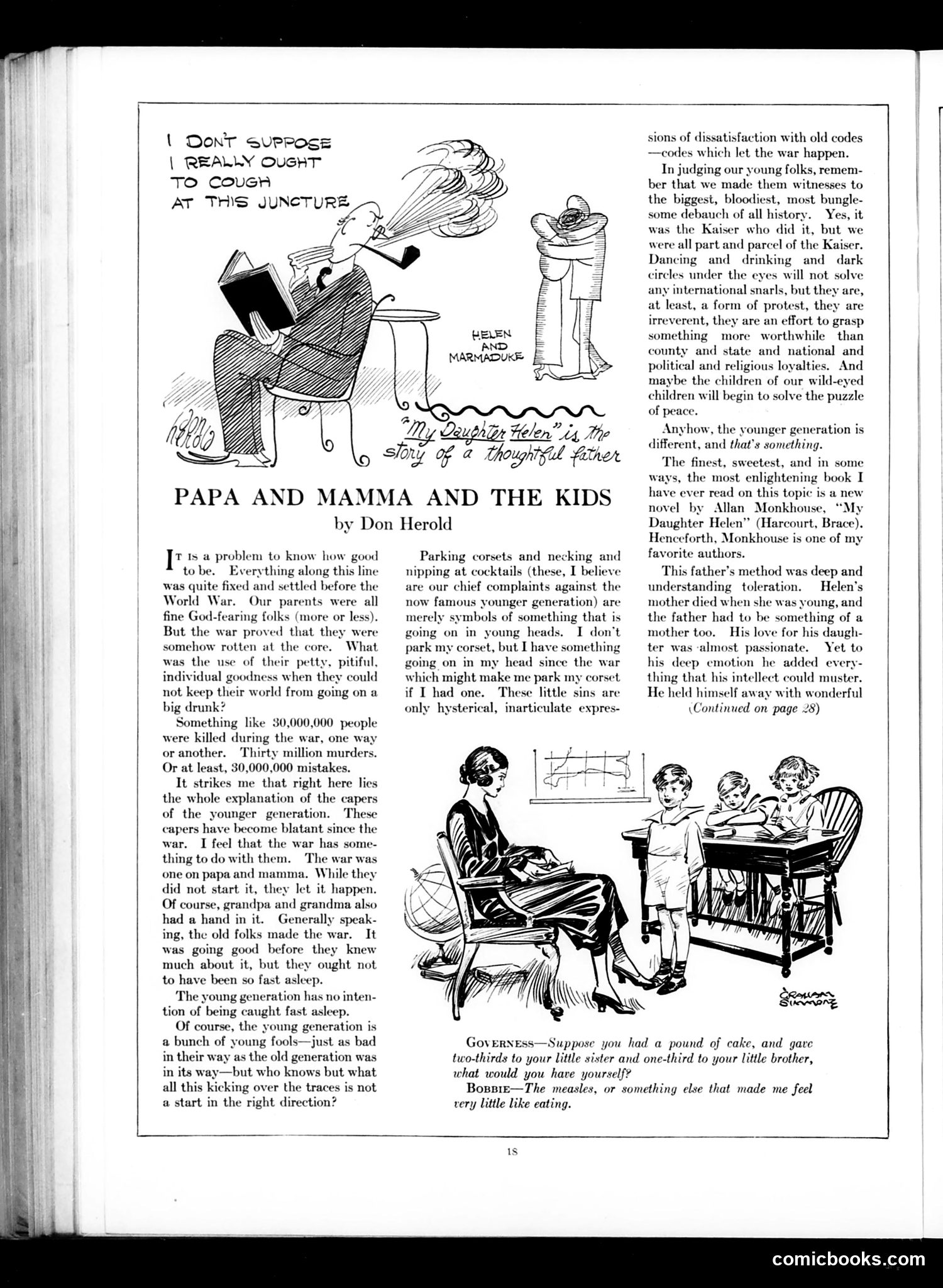
This article by Don Herold addresses the post-WWI "younger generation" and their rebellious behavior. The cartoon (top left) shows a father trying to read while his children create chaos—illustrating the generational clash. **The Context:** Herold argues that young people's apparent misconduct—"parking corsets," necking, drinking, dancing—is actually *protest* against their parents' generation. The older generation, he contends, failed catastrophically by allowing World War I (which killed ~30 million people) to happen despite claiming moral superiority. **The Satire:** Rather than condemning youth as "fools," Herold reframes their rule-breaking as *justified rebellion*. Their "hysterical" behavior represents rejection of outdated social codes that proved bankrupt when they couldn't prevent global catastrophe. **The Point:** The younger generation's seeming recklessness isn't senseless—it's a form of irreverent protest against failed parental authority and obsolete loyalties. Herold suggests their chaos might actually represent progress toward solving real problems like international peace. The dialog below (governess/Bobby) offers comic relief on unrelated topics.
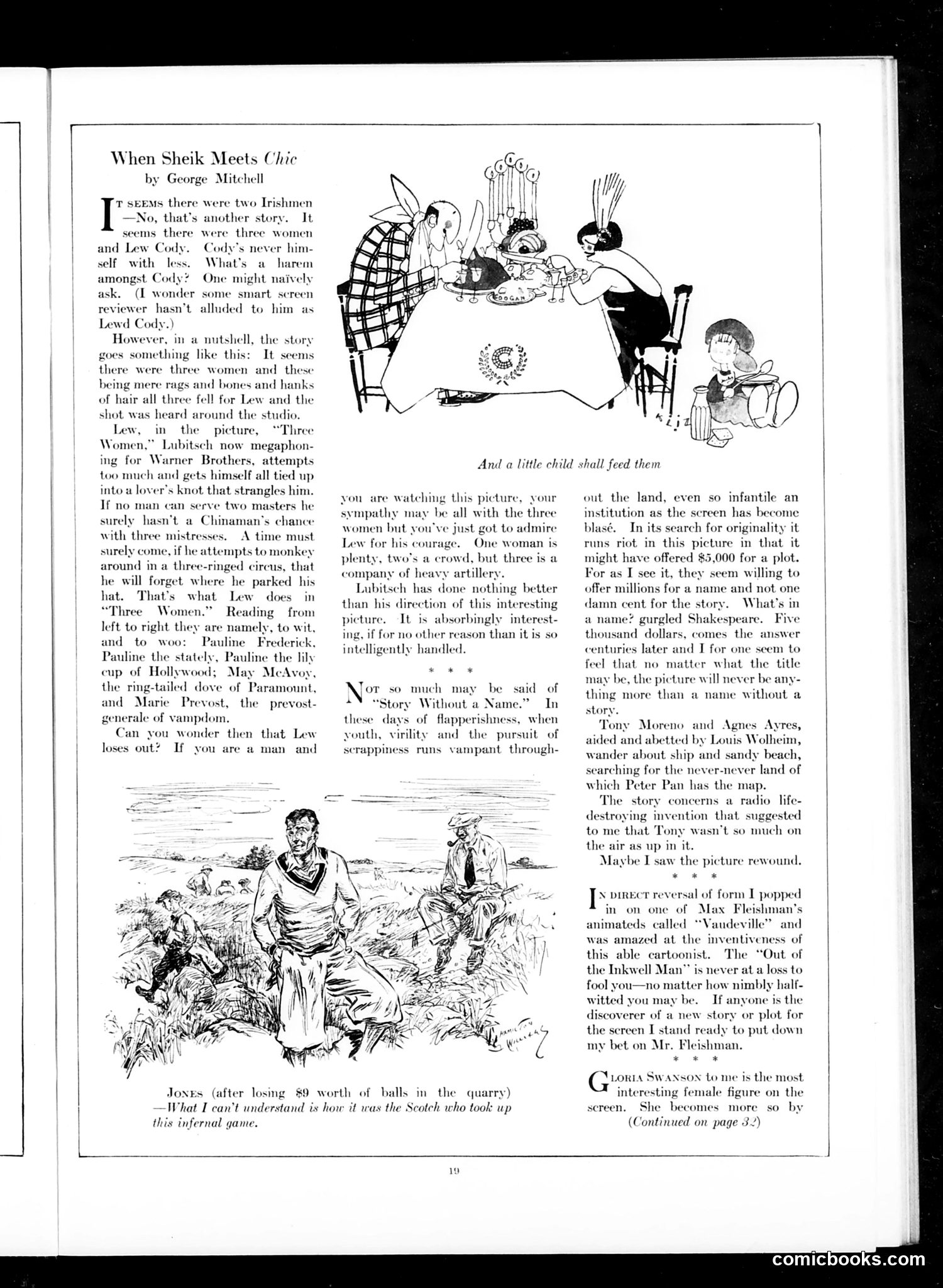
This page reviews three contemporary films, satirizing Hollywood's obsession with star power over substance. **"When Sheik Meets Chic"** critiques Lew Cody in *Three Women* (directed by Lubitsch for Warner Brothers). The joke: Cody's character juggles three mistresses—actresses Pauline Frederick, May McAvoy, and Marie Prevost—and inevitably "loses out." The satire mocks both Cody's inability to manage multiple romantic entanglements and Hollywood's reliance on glamorous casting rather than plot. A second review skewers *Story Without a Name*, featuring Tony Moreno and Agnes Ayres. The critic complains the studio spent millions acquiring a title while refusing to invest in actual storytelling—a pointed jab at Hollywood's backwards priorities. Finally, the piece praises Max Fleishman's animated *Vaudeville* short and the "Out of the Inkwell Man" cartoon, celebrating genuine creative inventiveness. Throughout, the satire targets 1920s cinema's vapid emphasis on star names and exotic scenarios over substantive narratives.
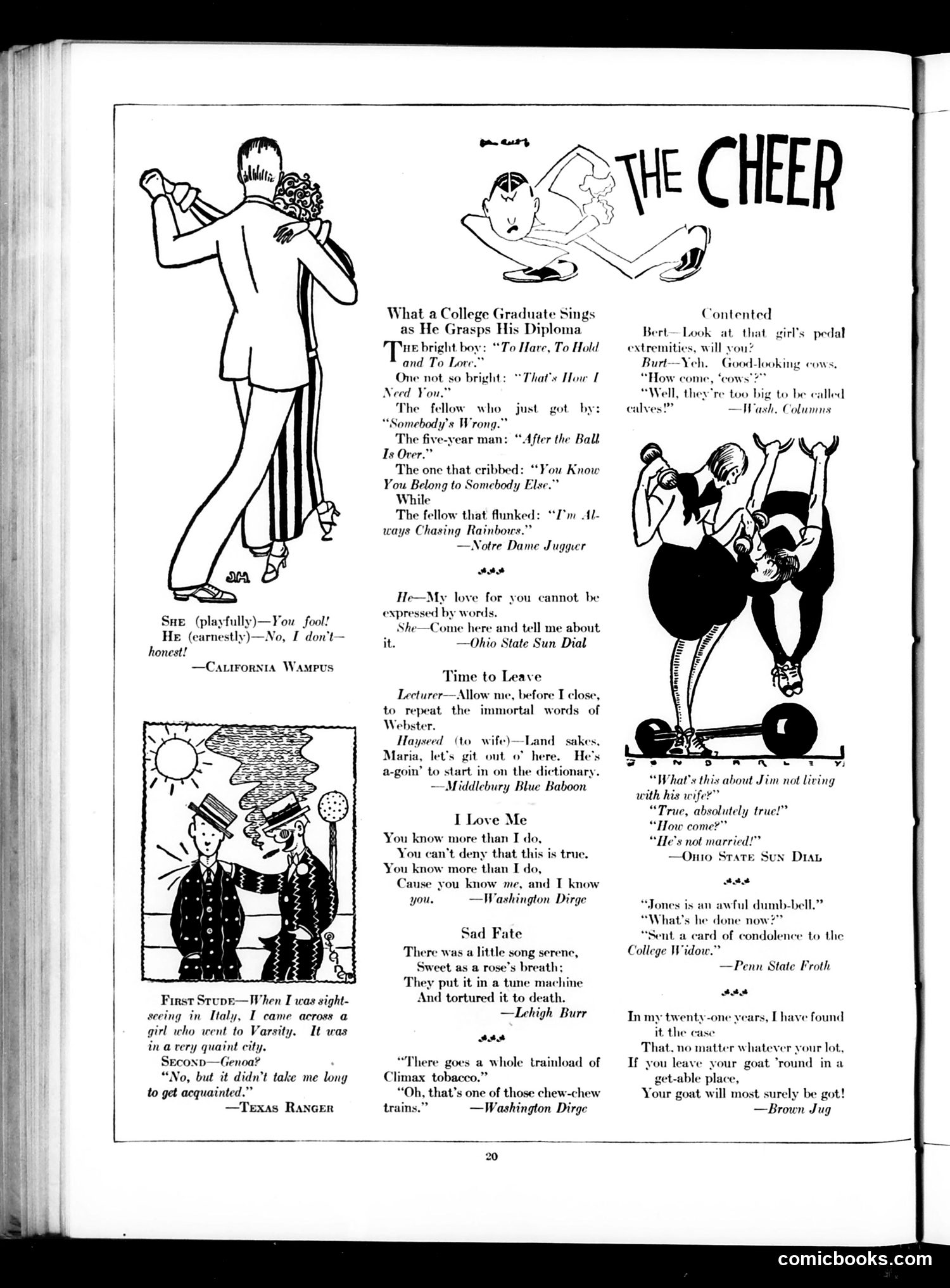
This page satirizes college life and romance through several sketched vignettes and humorous quotes attributed to different college publications. The main cartoon shows a man carrying a woman, captioned with dialogue about her "pedal extremities" (legs)—mocking flirtation between college students. The "College Graduate" section jokes about different student types by the songs they'd sing: the bright student sings romantic standards; the lazy student sings "Somebody's Wrong"; the five-year student (one who took extra years) sings "After the Ball Is Over"; and the cheater sings "You Belong to Somebody Else"—each choice humorously matching the student's academic situation. Other sketches mock familiar college scenarios: a lecturer boring students by quoting Webster, a mismatched marriage inquiry, failed romantic declarations, and a joke about someone's goat disappearing. The humor targets timeless college stereotypes—academic struggles, romance, boredom in lectures—rather than specific political events. The sourcing from various college humor magazines (Notre Dame, Ohio State, Penn State, etc.) suggests this was a compilation celebrating collegiate wit.
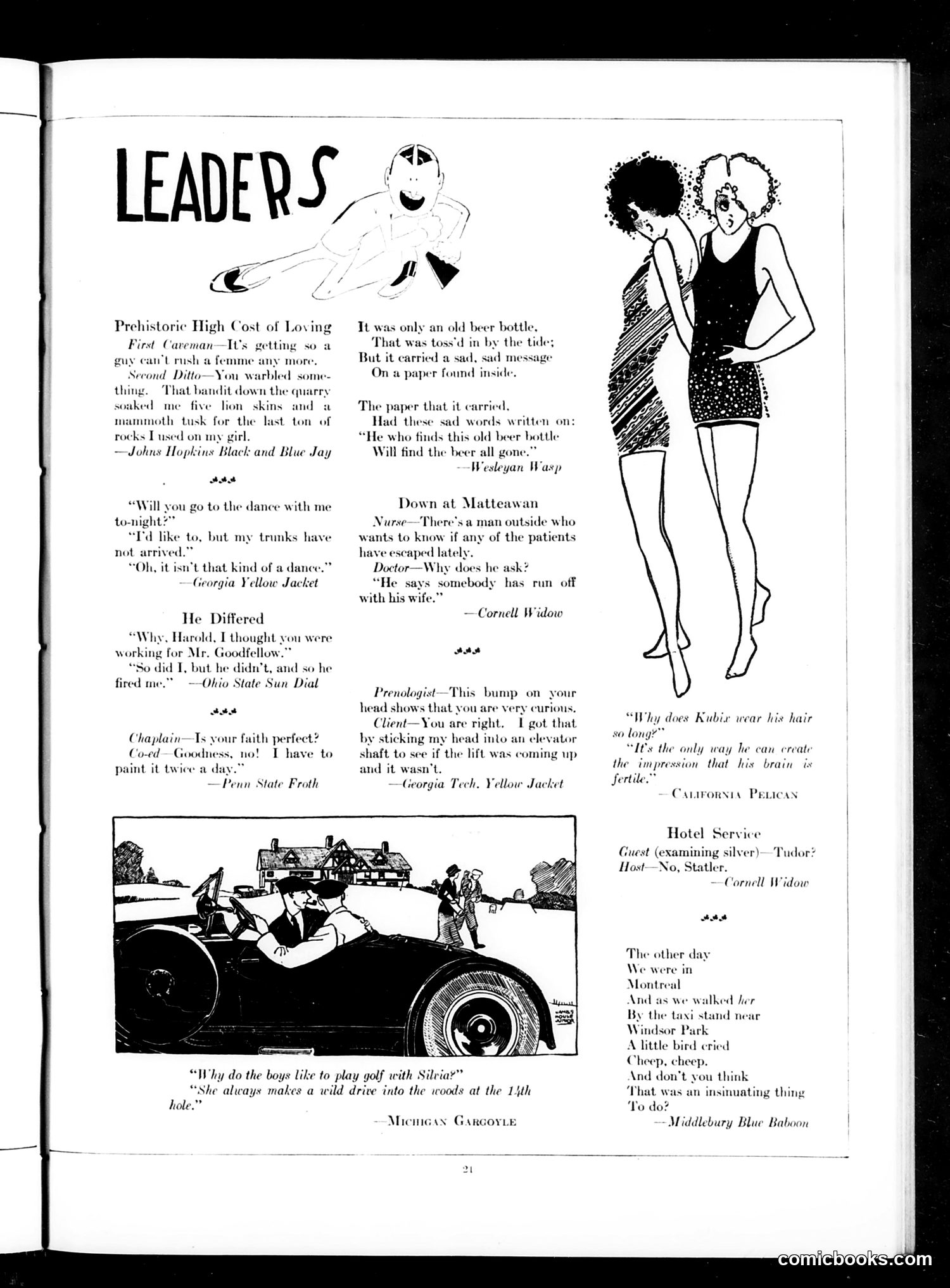
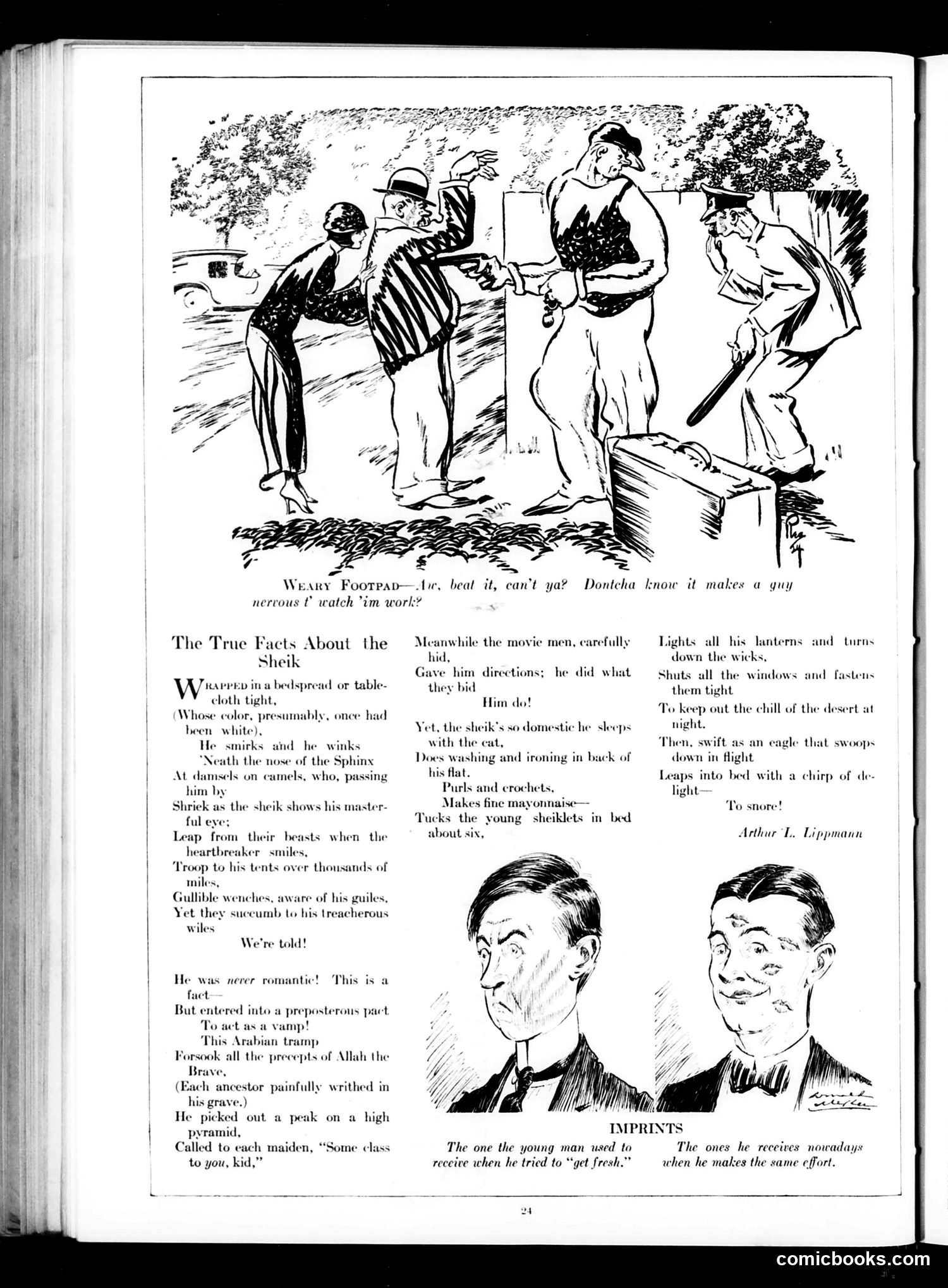
This page collects humorous anecdotes and jokes from college humor magazines (circa 1920s, based on masthead references like Cornell Widow, Georgia Tech). The content satirizes dating customs, workplace dynamics, and social pretension through brief comedic exchanges. **Key satirical targets:** - **Dating inflation**: The "Prehistoric High Cost of Loving" mocks how expensive courtship has become (men must give valuables just for a chance), suggesting economic anxiety about modern romance - **Class/status anxiety**: Jokes about jobs ("He differed"), faith performance, and social climbing reflect Depression-era concerns - **Gender stereotypes**: Women are portrayed as mercenary ("wild drive") or unpredictable; a wife "running off" is comic fodder - **Physical appearance**: The "long hair/fertile brain" joke mocks pretentious intellectuals The illustrations—a caveman couple, two fashionable women—use visual humor to reinforce the written jokes. The overall tone is light satire aimed at college-age readers, poking fun at courtship rituals, employment precarity, and social pretension rather than advancing serious political commentary.
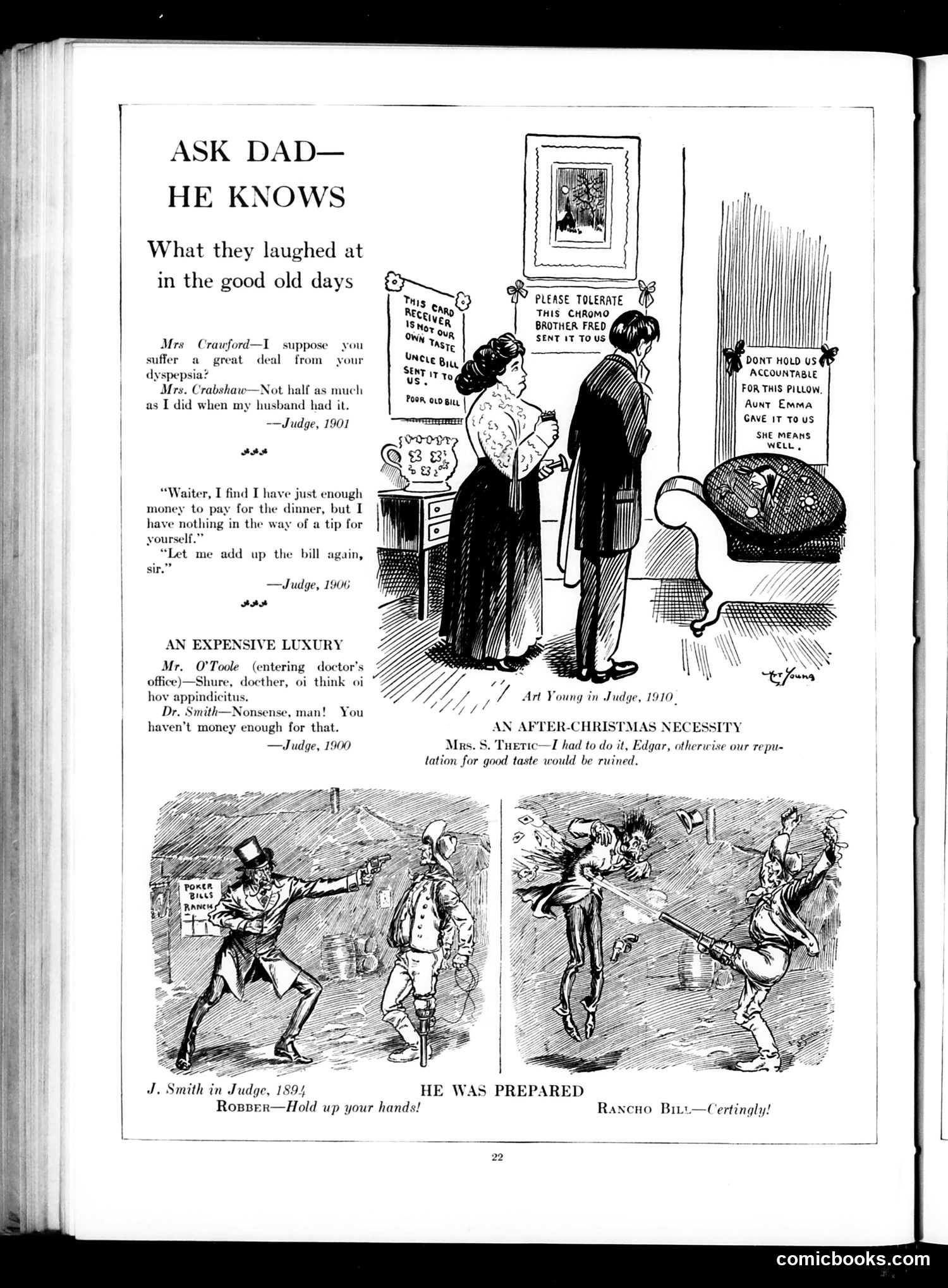
This page collects brief satirical jokes from Judge magazine's "Ask Dad—He Knows" column, contrasting humor from different decades (1894-1910). The satire targets: **Social pretension and etiquette:** The "After-Christmas Necessity" joke mocks upper-class anxiety about reputation—a woman must return an ugly gift to maintain appearances of good taste. **Class and money:** Multiple jokes ridicule economic anxieties. A diner lacks tip money; a poor Irish immigrant (O'Toole, with stereotypical dialect) cannot "afford" appendicitis because he lacks funds for surgery; a waiter recalculates a bill, implying the customer miscalculated due to poverty. **Domestic discord:** A wife takes schadenfreude in her husband's dyspepsia, suggesting marital unhappiness. **The broader point:** The column's title promises nostalgic wisdom, but instead delivers cynical observations about money, status, and human nature—suggesting these "good old days" were no better morally than the present. The cartoons (by Art Young and others) reinforce themes of crime, poverty, and social desperation through exaggerated illustration.
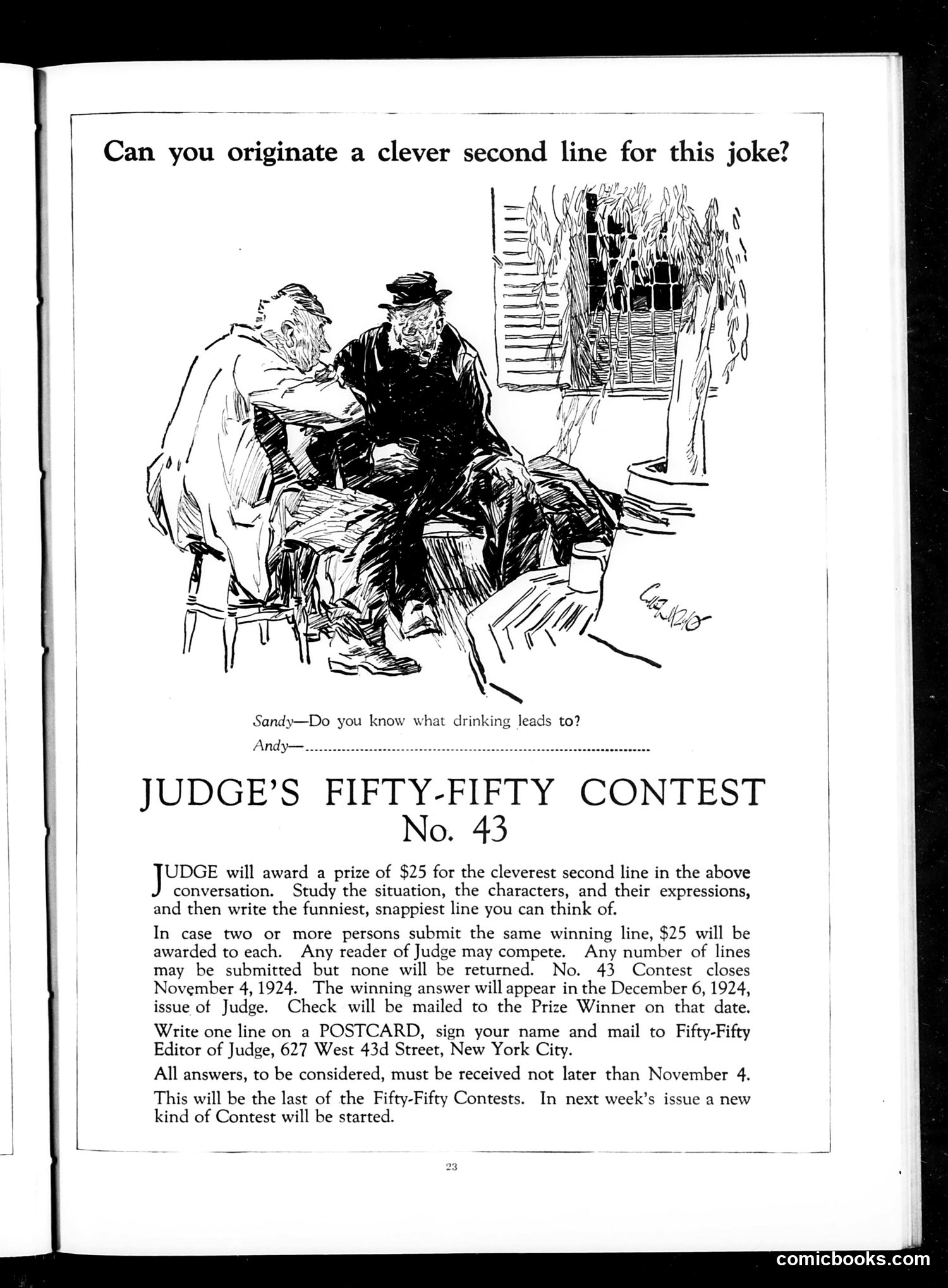
This page presents Judge's final "Fifty-Fifty Contest"—a reader participation feature offering $25 for the cleverest punchline to an incomplete joke. **The Setup:** Two men, labeled Sandy and Andy, are depicted in what appears to be a bar or social setting. Sandy asks, "Do you know what drinking leads to?" The cartoon invites readers to supply Andy's clever response. **The Joke's Point:** The humor relies on double meaning—"drinking leads to" could mean either drunkenness/intoxication OR literally lead the person somewhere (to a bar, home, etc.). Readers were expected to provide witty, unexpected answers that subvert the expected moral warning about alcohol. **Historical Context:** This 1924 contest predates Prohibition's repeal (1933), making alcohol humor edgy but still publishable in a satirical magazine aimed at adults. The page itself is primarily instructional text about contest rules rather than editorial content.
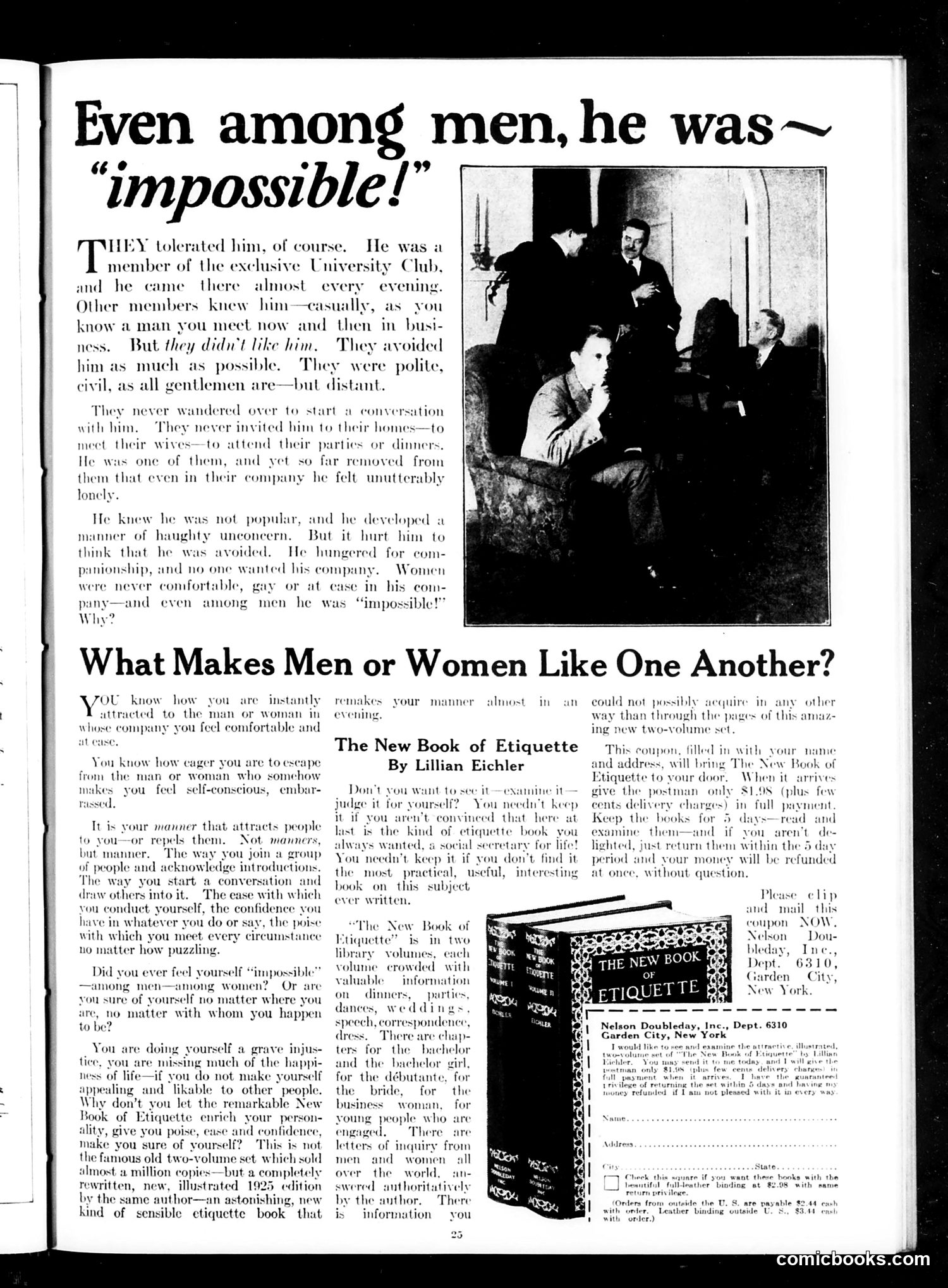
This page combines a cautionary narrative with advertising for an etiquette book. The story describes a socially awkward man at an exclusive University Club—tolerated but actively avoided by other members. Despite being technically "one of them," his poor social manner (not manners, but demeanor) makes him feel "unutterably lonely" even in their company. The text emphasizes that it's not *what* you do in social situations but *how* you do it—your confidence, poise, and ease in conversation. The awkward man's "naughty unconcern" is a defensive mask for his genuine longing for companionship. This setup segues into advertising "The New Book of Etiquette" by Lillian Eichler (1925), presented as a solution to such social paralysis. The book promises to teach readers the invisible social skills that make people likable and comfortable around others—essentially, to transform one's social persona and eliminate self-consciousness. The satire targets early-20th-century anxieties about social class, belonging, and self-improvement through purchased expertise.
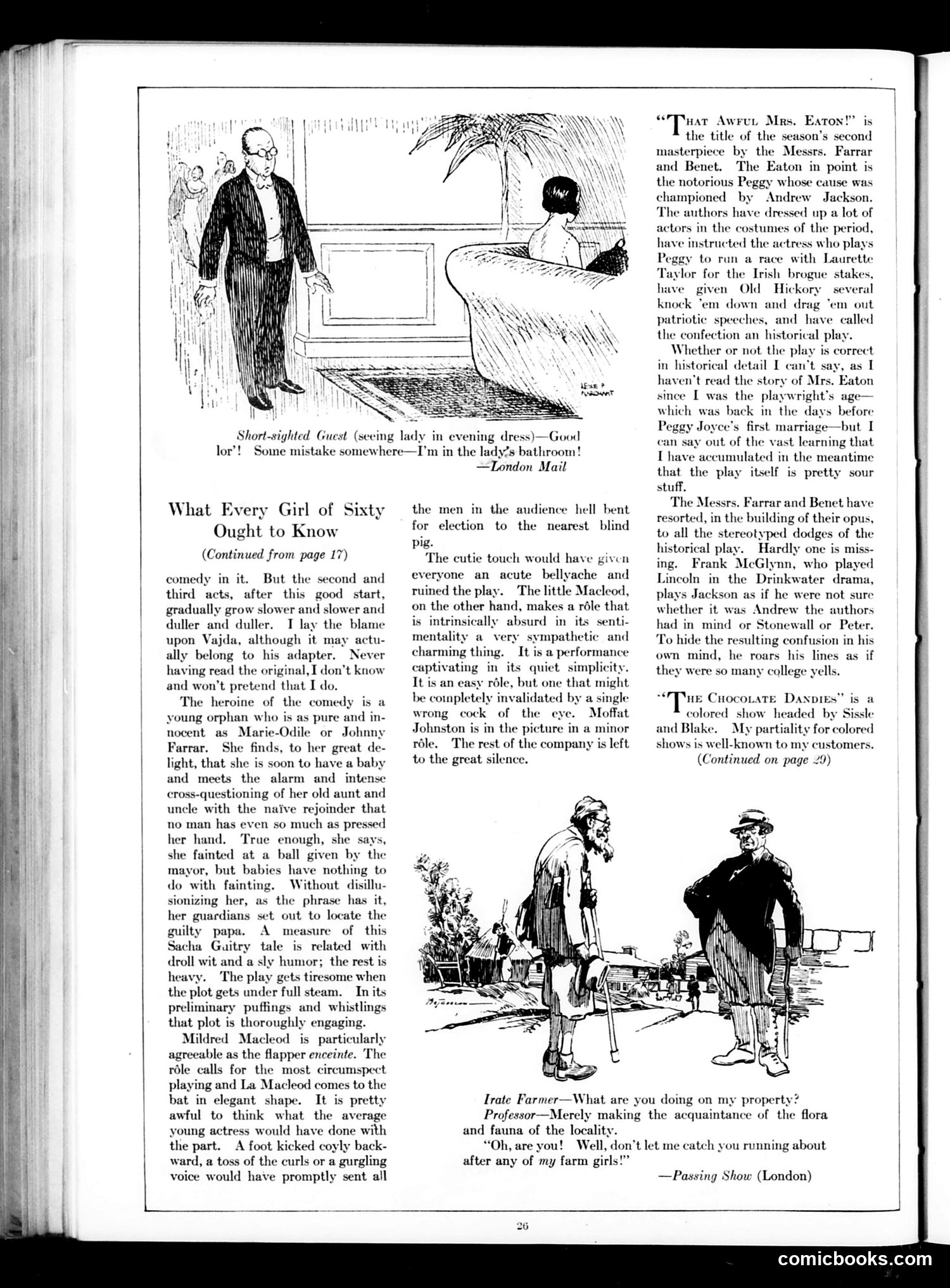
The page contains two distinct elements: **Top cartoon**: A "short-sighted guest" mistakes a lady's bathroom for a ballroom. The joke relies on the visual confusion—the gentleman sees a woman in evening dress and assumes he's in the wrong social space, missing the obvious bathroom setting. It's a mild, sight-gag style humor typical of early 20th-century magazines. **Main text**: Theatre reviews by what appears to be a drama critic. The reviews discuss: - "What Every Girl of Sixty Ought to Know"—a play about an innocent young orphan who becomes pregnant without understanding how, treated with dry wit - "That Awful Mrs. Eaton"—a historical play about Peggy Eaton (Andrew Jackson's controversial associate), which the reviewer dismisses as tedious and reliant on theatrical clichés - Brief mention of "The Chocolate Dandies," a colored show The reviews showcase period attitudes toward theatre and social propriety, particularly the handling of pregnancy as a plot device requiring delicate treatment.
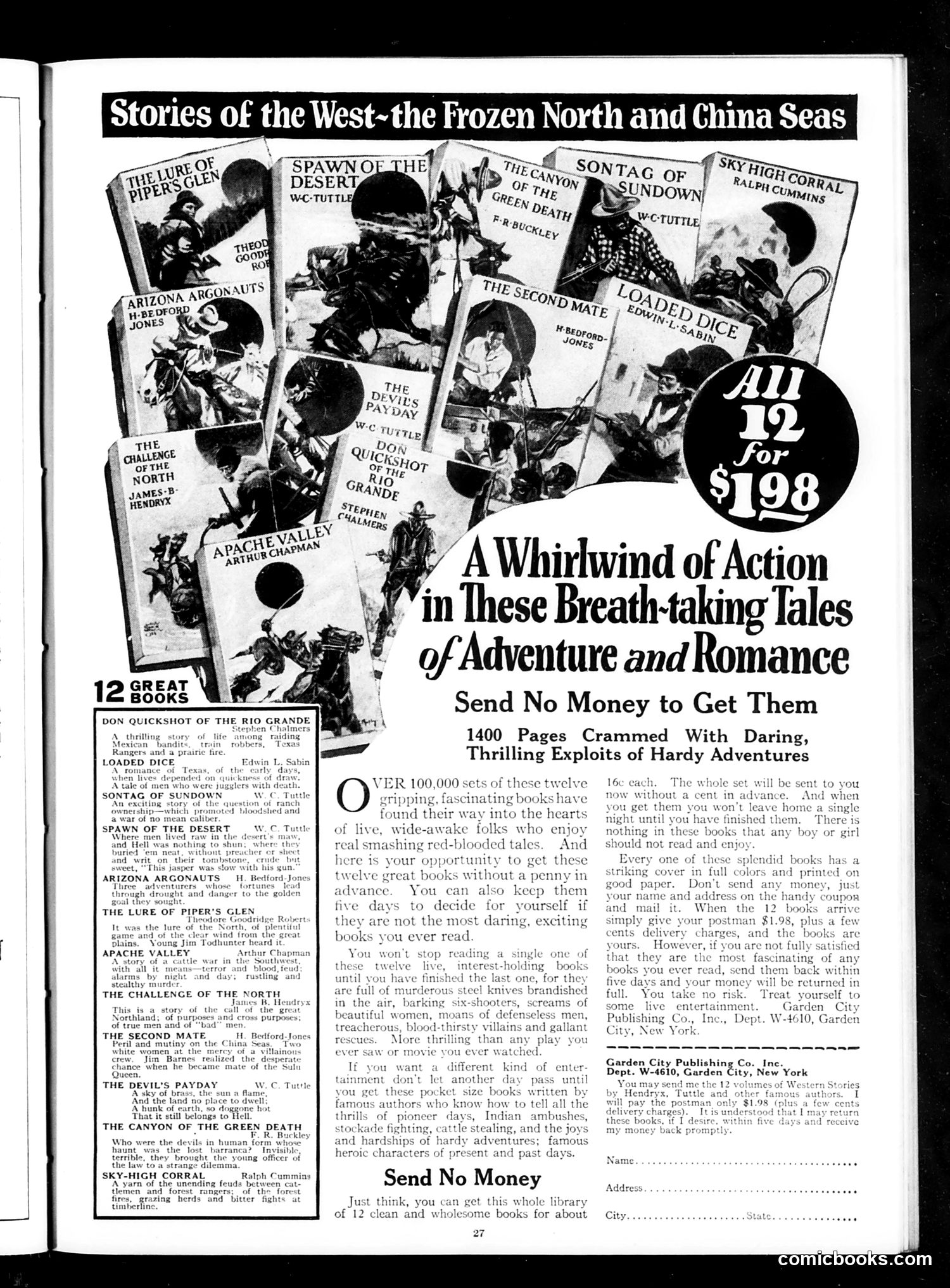
This page is primarily **advertising**, not satirical content. It's a book club promotion from Garden City Publishing Co. selling a 12-book Western adventure series ("Stories of the West—the Frozen North and China Seas") for $1.98. The books listed include Western and adventure titles by period authors like W.C. Tuttle, B.M. Bower, and others—typical pulp fiction of the era. The ad uses promotional language common to mail-order book clubs: "Send No Money," "1400 Pages," "Over 100,000 sets," and a five-day trial period. There is **no political satire or cartoon** on this page. It appears in Judge magazine (likely 1920s-1930s) but functions as a straight commercial advertisement exploiting popular appetite for adventure stories. The "breath-taking tales" pitch and Western imagery reflect contemporary entertainment tastes rather than commentary on them.
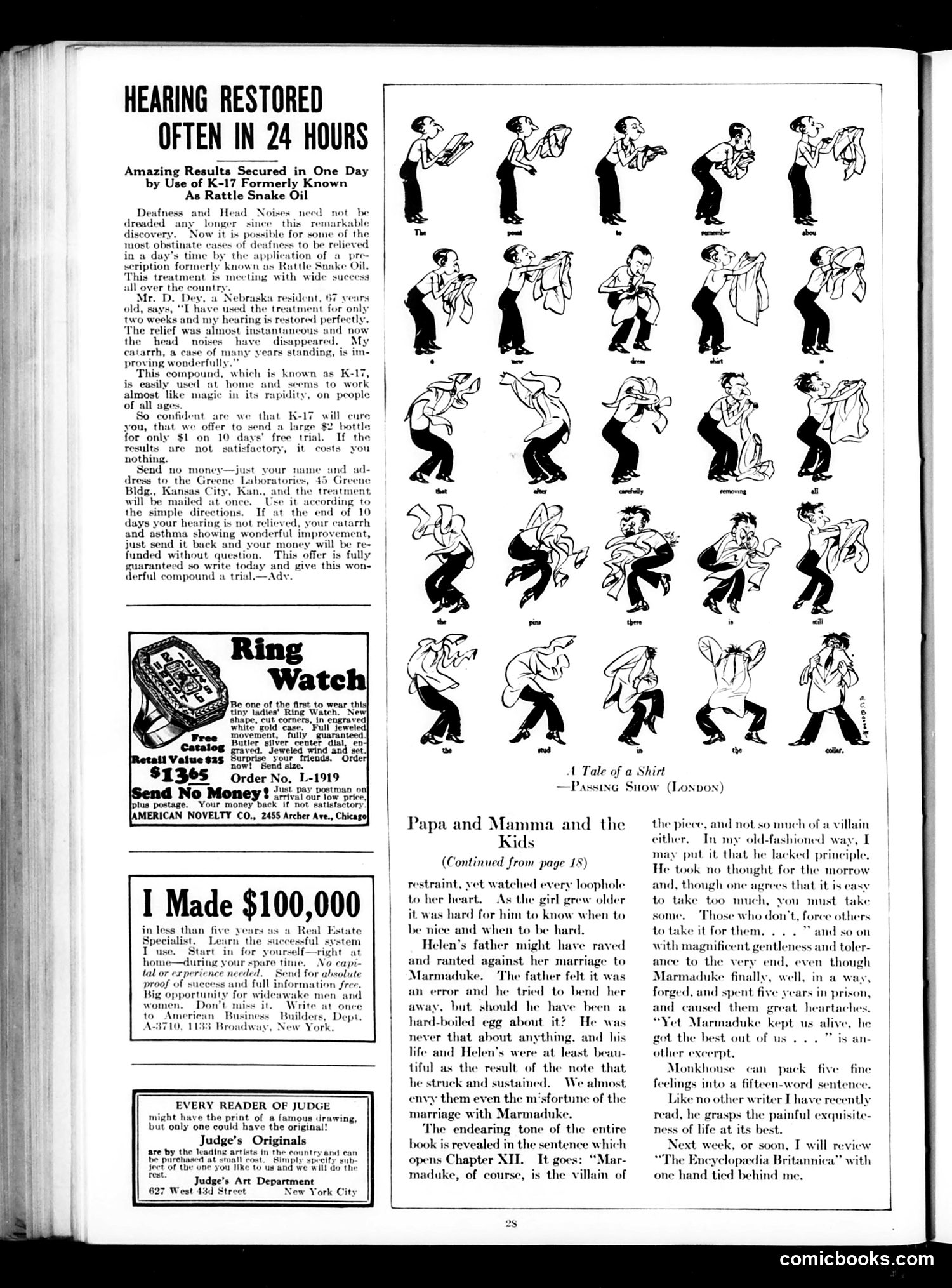
This page is primarily **advertising**, not political satire. The main content consists of several dubious mail-order product pitches typical of early 20th-century magazines: 1. **"K-17" Deafness Cure**: A patent medicine advertisement falsely claiming to restore hearing in 24 hours, previously marketed as "Rattle Snake Oil." The testimonial from a Nebraska resident is characteristic of fraudulent medical advertising of this era. 2. **Ring Watch**: A novelty item advertisement promising to surprise friends. 3. **Real Estate and Business Opportunity Ads**: Promising wealth-building schemes. The right side contains a serialized story, "Papa and Mamma and the Kids," with literary commentary. The **cartoon sequence** (center-right) appears to illustrate the story's scenes rather than provide political commentary. This page represents how *Judge* magazine supplemented editorial content with advertisements—many now recognized as scams—reflecting the lack of consumer protection in that period.
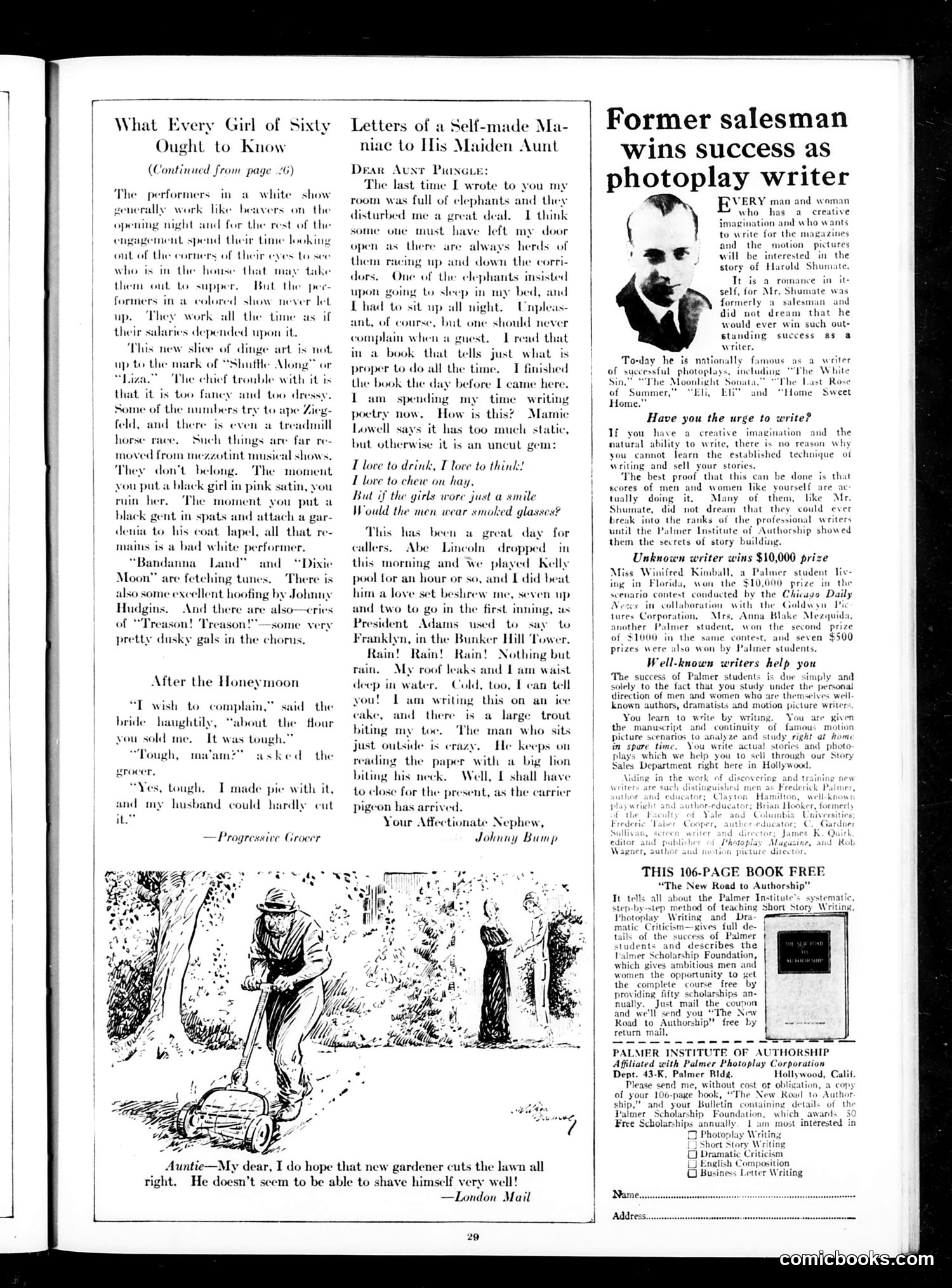
This page from Judge contains several distinct pieces of satirical content: **Main Cartoon (bottom):** A single-panel joke about marital disappointment. A wife complains to her husband about a new gardener who "can't shave himself very well," implying the gardener's incompetence extends beyond lawn care. The humor relies on domestic wit—a common Judge staple mocking marriage and household management. **Left Column:** Contains two pieces mocking racial stereotypes. "What Every Girl of Sixty Ought to Know" critiques Black theatrical performances ("dinge art"), complaining they imitate white performers rather than maintaining authentic "mezzotint musical shows." This reflects era-typical racist attitudes toward Black entertainment. The "Letters" section is absurdist humor featuring a fictional eccentric character describing surreal situations (elephants in his room, playing pool with Abraham Lincoln). **Right Column:** Straightforward advertisement for the Palmer Institute of Authorship, promoting writing instruction and scholarships—not satirical content. The page represents Judge's mix of genteel domestic humor, offensive racial commentary typical of early 20th-century publishing, and practical advertising.
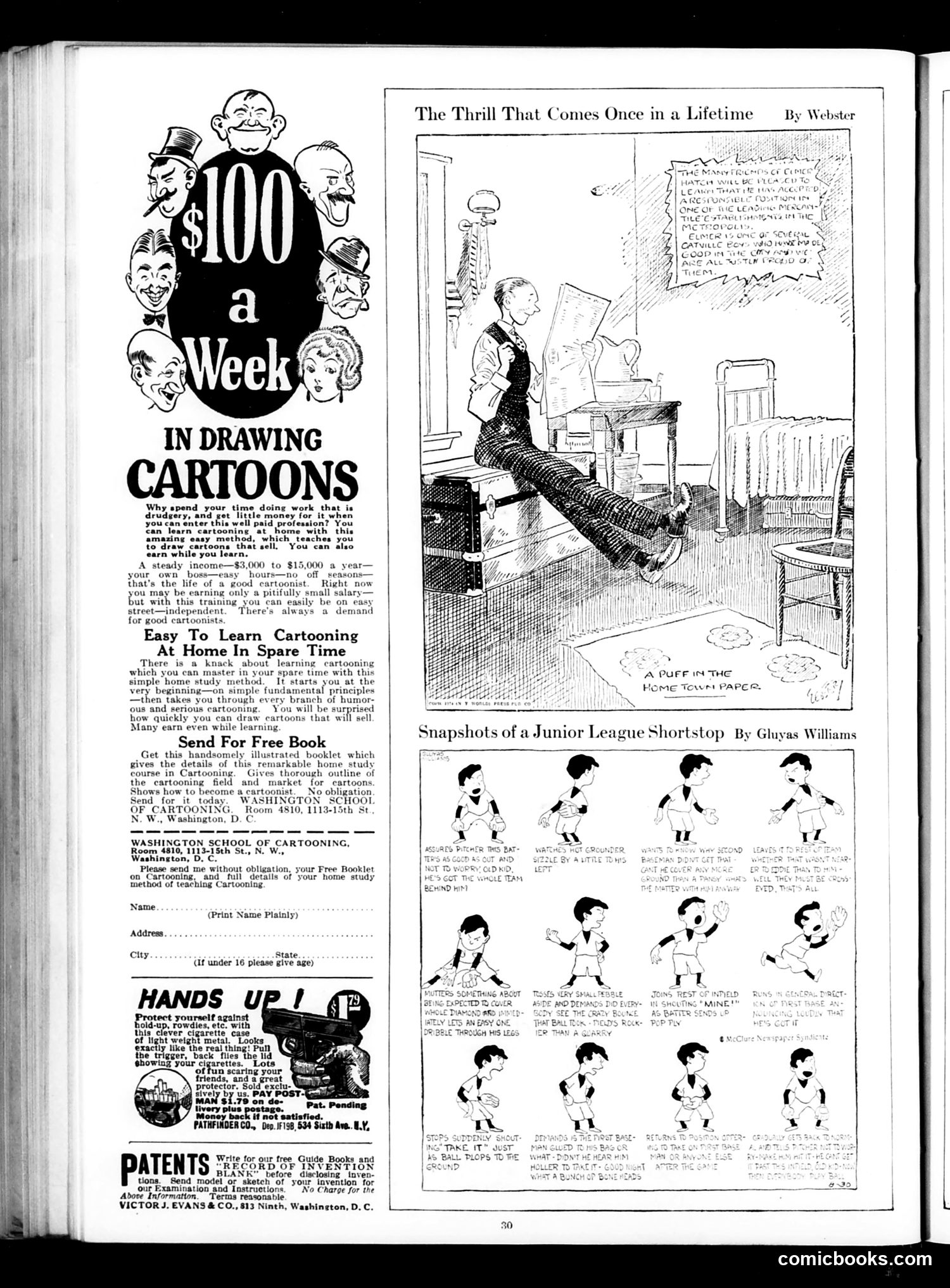
This page is primarily **advertising for cartooning instruction**, not political satire. The main content promotes the Washington School of Cartooning's home-study program, promising steady income ($3,000-$15,000 yearly) for aspiring cartoonists working spare time. The large cartoon by Webster titled "The Thrill That Comes Once in a Lifetime" depicts a man kicking his feet up at a desk while reading a rejection slip—likely satirizing the emotional rollercoaster of a cartoonist's career, where rare acceptances produce outsized joy. The right panel, "Snapshots of a Junior League Shortstop" by Gluyas Williams, shows cartoon vignettes of baseball players in various positions and moments—essentially a visual gag collection about the sport. The page also contains period advertisements for a novelty cigarette case and patent services. The context reflects 1920s-30s American attitudes about cartooning as an accessible, lucrative home profession.
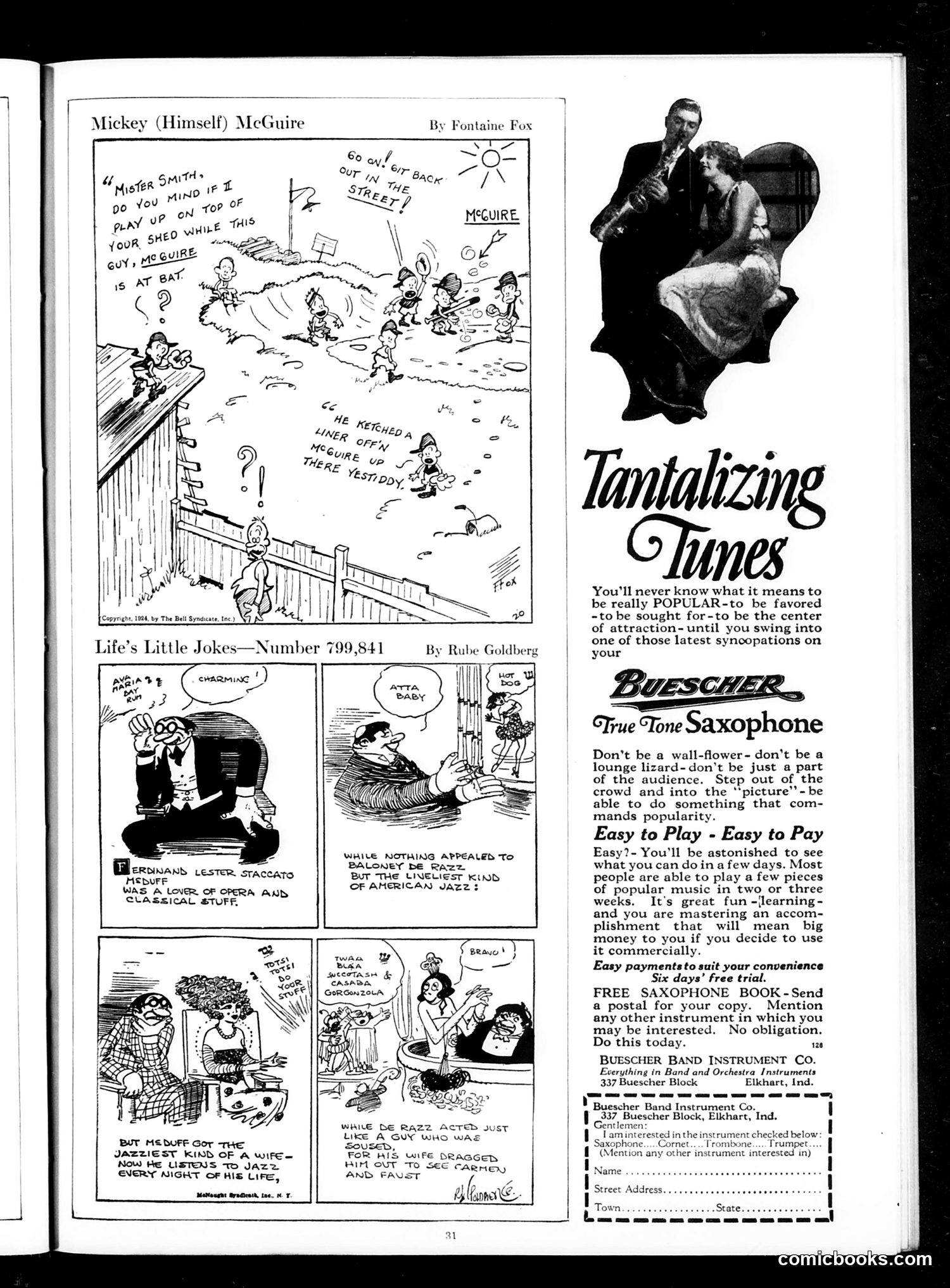
**The Comics:** "Life's Little Jokes" by Rube Goldberg presents a domestic scenario: a man named Ferdinand Lester once loved opera and classical music, but his wife introduced him to jazz. Now he listens to jazz every night—apparently against his will. The joke satirizes how jazz (then considered lowbrow popular music) was spreading from youth culture into respectable households, disrupting traditional tastes. The wife "dragged" him into this modern craze, suggesting jazz represented an unwanted generational divide. **The Advertising:** The Buescher saxophone advertisement exploits social anxiety about popularity and modernity. It promises that learning saxophone will transform you from a "wall-flower" or "lounge lizard" into someone "popular"—positioning the instrument as essential to being modern and socially desirable during the Jazz Age. **Historical Context:** This page reflects the 1920s cultural conflict between traditional (classical) and modern (jazz) entertainment, with jazz perceived as transgressive but increasingly mainstream.
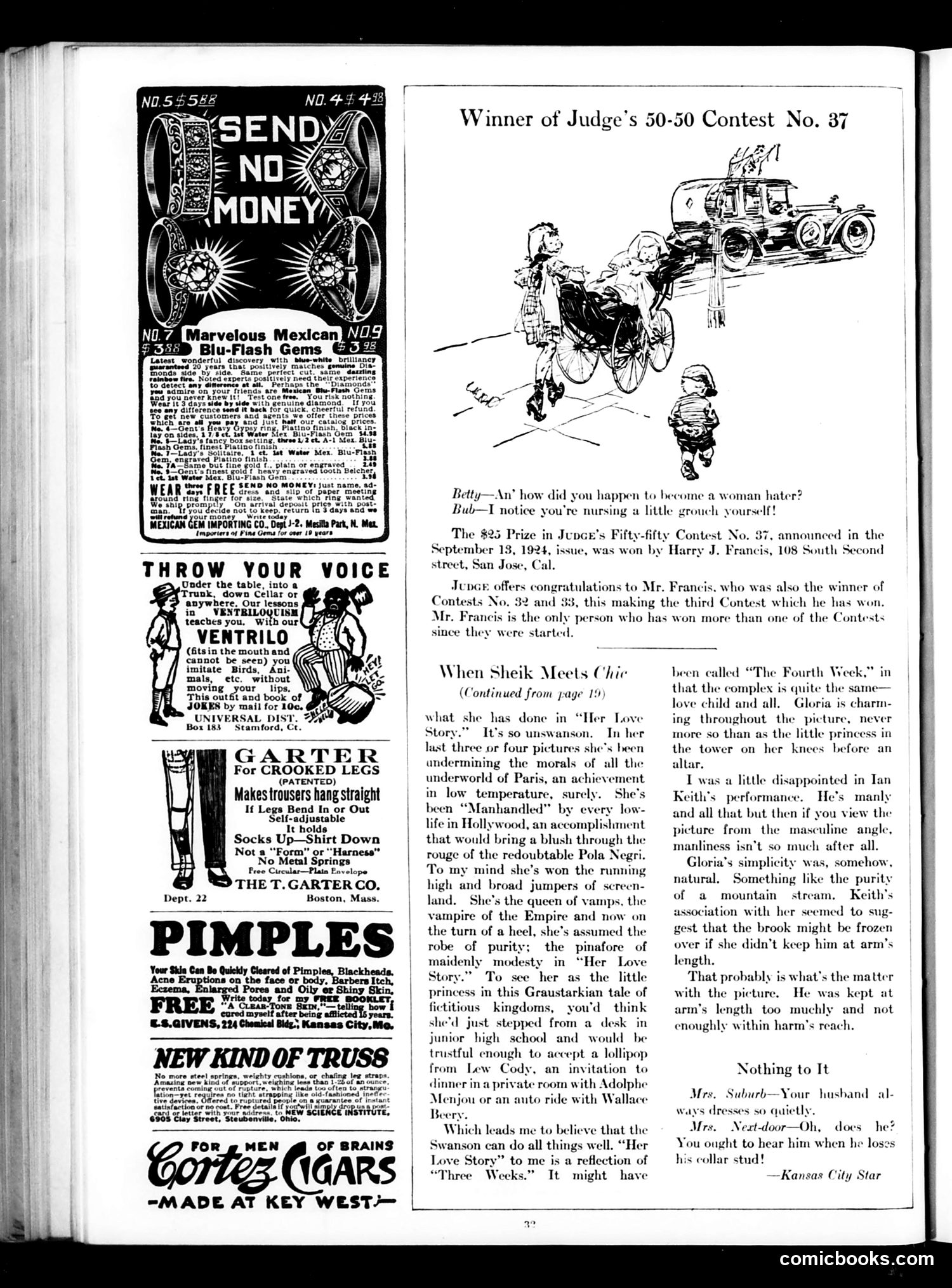
This page combines a humor cartoon with period advertisements and film criticism. **The Main Cartoon** depicts a "50-50 Contest" winner—a domestic humor joke where a man (Bub) explains he became a "woman hater" after noticing his female companion nursing a growth on herself. The joke relies on the era's cruder physical humor and marital discord comedy typical of 1920s magazines. **The Film Criticism** reviews Gloria Swanson's "Her Love Story," comparing her to Pola Negri and discussing her roles as both vamp and innocent. It references contemporary male actors (Wallace Beery, Lew Cody, Adolphe Menjou) and critiques Swanson's versatility versus her co-star Ian Keith's performance. **The Advertisements** are period-standard: mail-order ventriloquism lessons, garter devices for crooked legs, pimple cures, and trusses—reflecting early 20th-century consumer culture and modest sensibilities about bodily concerns. The page represents Judge's mix of satirical content and commercial appeals to working-class readers.
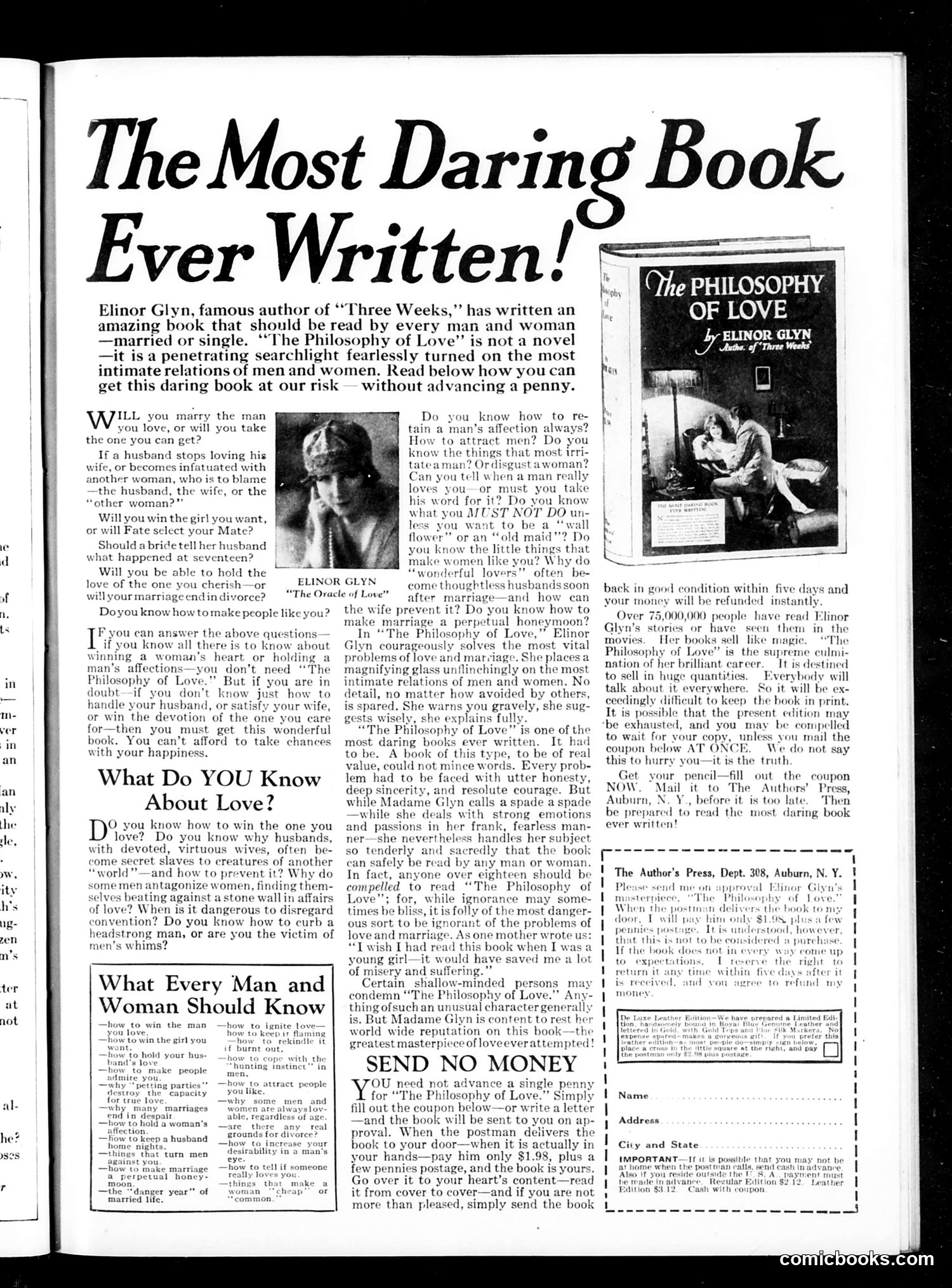
This is primarily a **book advertisement**, not political satire. It promotes Elinor Glyn's non-fiction work on relationships and marriage. **Key context for modern readers:** Elinor Glyn was a famous early 20th-century author, known for the scandalous novel *Three Weeks*. This advertisement positions "The Philosophy of Love" as a daring, frank guide to intimate relations—radical for its era when such topics were considered improper for public discussion. The sales pitch emphasizes the book's controversial honesty: it addresses taboo questions about infidelity, divorce, attraction, and marital dissatisfaction. The repeated phrase "most daring" signals this challenges Victorian prudishness about discussing sexuality and relationships openly. The ad promises readers can obtain the book "without advancing a penny"—a risk-free trial offer typical of early 20th-century direct marketing. **What's notable:** Judge magazine running this suggests early modernist attitudes toward sexual frankness, positioning such discussions as sophisticated and necessary rather than scandalous.
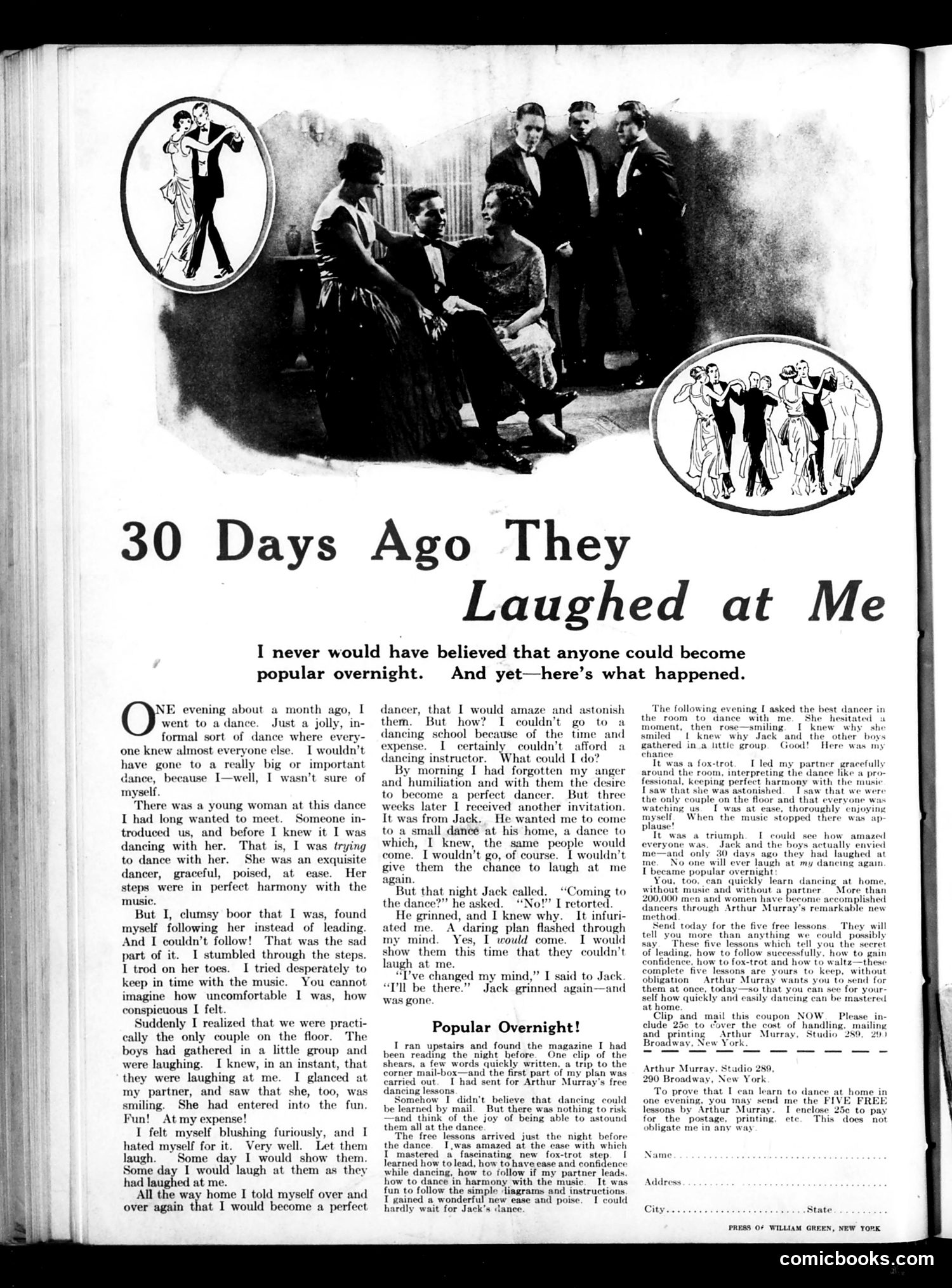
This page combines a short story with an advertisement for **Arthur Murray's dance lessons** — a famous correspondence course in ballroom dancing popular in the early-to-mid 20th century. The narrative satirizes social anxiety and vanity: a clumsy dancer is publicly humiliated at a party, vows revenge through self-improvement, then mysteriously becomes an accomplished dancer within 30 days using mail-order lessons. He returns to triumph before the same mocking group. The **joke/satire** targets both the protagonist's shallow desire for social validation and the absurd promise of instant expertise: the implication that Arthur Murray's lessons deliver near-miraculous transformation. The two circular vignettes show the "before" (mocking crowd) and "after" (admiring crowd). This reflects 1920s-30s anxieties about self-improvement, social status, and the marketing of confidence through consumer products — the idea that you can "purchase" popularity.