
Judge, 1924-10-18 · page 20 of 36
Judge — October 18, 1924 — page 20: what you’re looking at
What you’re looking at
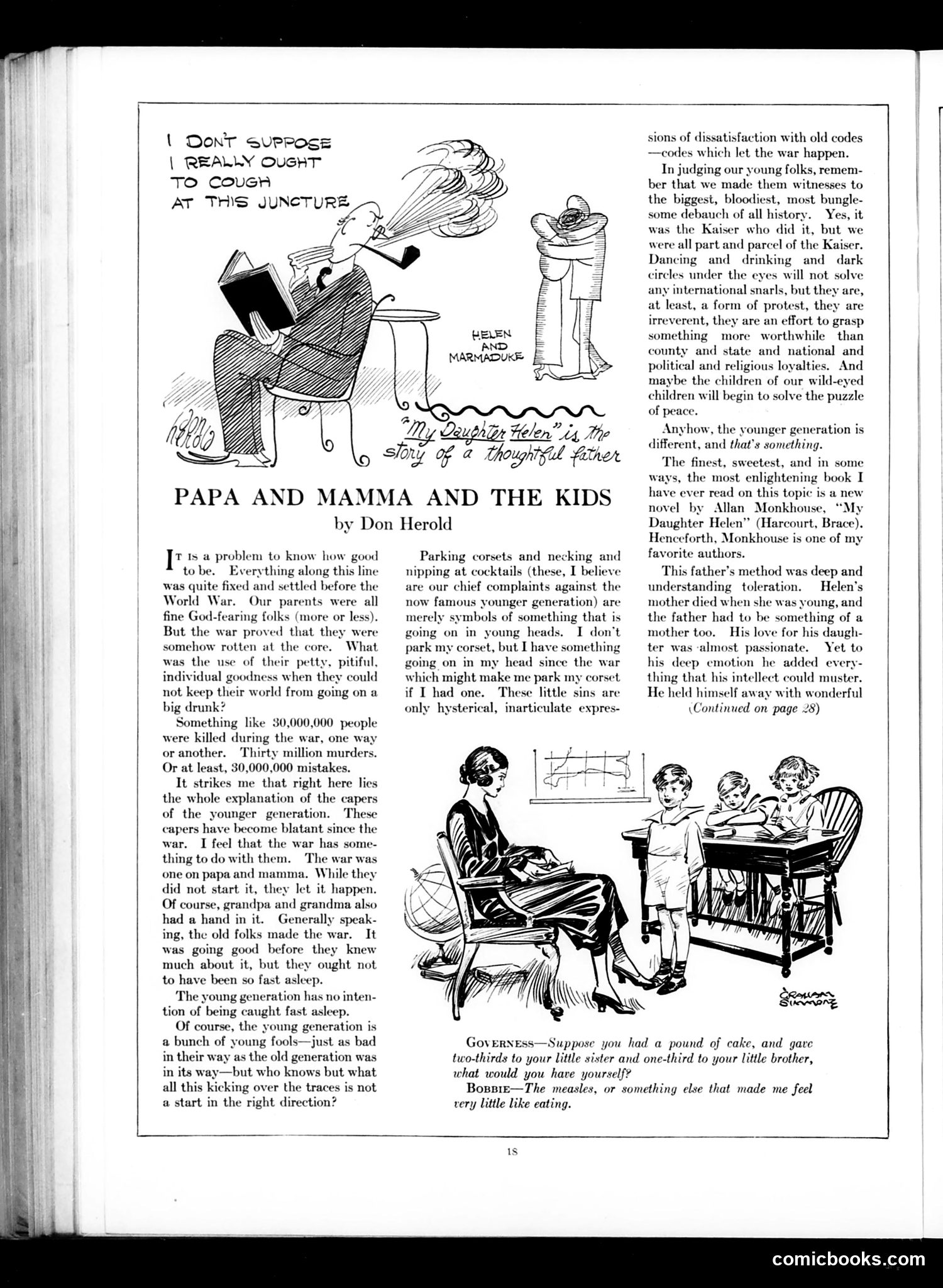
This article by Don Herold addresses the post-WWI "younger generation" and their rebellious behavior. The cartoon (top left) shows a father trying to read while his children create chaos—illustrating the generational clash. **The Context:** Herold argues that young people's apparent misconduct—"parking corsets," necking, drinking, dancing—is actually *protest* against their parents' generation. The older generation, he contends, failed catastrophically by allowing World War I (which killed ~30 million people) to happen despite claiming moral superiority. **The Satire:** Rather than condemning youth as "fools," Herold reframes their rule-breaking as *justified rebellion*. Their "hysterical" behavior represents rejection of outdated social codes that proved bankrupt when they couldn't prevent global catastrophe. **The Point:** The younger generation's seeming recklessness isn't senseless—it's a form of irreverent protest against failed parental authority and obsolete loyalties. Herold suggests their chaos might actually represent progress toward solving real problems like international peace. The dialog below (governess/Bobby) offers comic relief on unrelated topics.
📄 Transcribed text from this page (OCR, searchable)
Machine-transcribed from the original scan — historical spelling and the odd misread are preserved.
\ Dont suPPOge | REALLY OUGHT TO Cousr AT THIS JUNCTURE x Y, HELEN AND MARMADUKE 2, DQupnGr Helen” &4 The stiff @ Choughisih Lather PAPA AND MAMMA AND THE KIDS by Don Herold . Is a problem to know how good tobe. Everything along this line was quite fixed and settled before the World War. Our parents were all fine God-fearing folks (more or less). But the war proved that they were somehow rotten at the core. What was the use of their petty, pitiful, individual goodness when they could not keep their world from going on a big drunk? Something like 30,000,000 people were killed during the war, one way or another. Thirty million murders. Or at le 30,000,000 mistakes. It strikes me that right here lies the whole explanation of the capers of the younger generation. These capers have become blatant since the war. I feel that the war pme- thing todo with them. The war was one on papa and mamma. While they did not start it, they let it happen. Of course. pa and grandma also had a hand in it. Generally speak- ing, the old folks made the war. It was going good before they knew much about it, but they ought not to have been so fast asleep. ‘The young generation has no inten- tion of being caught fast asleep. Of course, the young generation is a bunch of young fools—just as bad in their way as the old generation was in its way—but who knows but what all this kicking over the traces is not a start in the right direction? Parking corsets and necking and nipping at coc (these, I believe are our chief complaints against the now famous younger generation) are merely symbols of something that is going on in young heads. I don't park my corset, but I have something going on in my head since the war which might make me park my corse if I had one. These little sins are only hysterical, inarticulate expres sions of dissatisfaction with old codes —codes which let the war happen. In judging our young folks, remem- ber that we made them witnesses to the biggest, bloodiest, most bungle- istory. Yes, it r who did it, but we were all part and parcel of the Kaiser. Dancing and drinking and dark circles under the eyes will not solve any international snarls, but they are, at least, a form of protest, they are irreverent, they are an effort to grasp something more worthwhile than county and state and national and political and religious loyalties. And maybe the children of our wild-eyed children will begin to solve the puzzle of peace. was the K: Anyhow, the younger generation is different, and that’s something. and in some vays, the most enlightening book I ever read on this topic is a new novel by Allan Monkhouse, “My Daughter Helen” (Harcourt, Brace). Henceforth, Monkhouse is one of my favorite authors. This father’s method was deep and understanding toleration. Helen's mother died when she was young, and the father had to be something of a mother too. His love for his daugh- ter was -almost passionate. Yet to his deep emotion he added every- thing that his intellect could muster. He held himself away with wonderful (Continued on page 28) GoverNEss—Suppose you had a pound of cake, and gave two-thirds to your little sister and one-third to your little brother, what would you have yourself? Bossre—The measles, or something else that made me feel very little like eating. comicbooks.com