
Judge, 1924-10-18 · page 28 of 36
Judge — October 18, 1924 — page 28: what you’re looking at
What you’re looking at
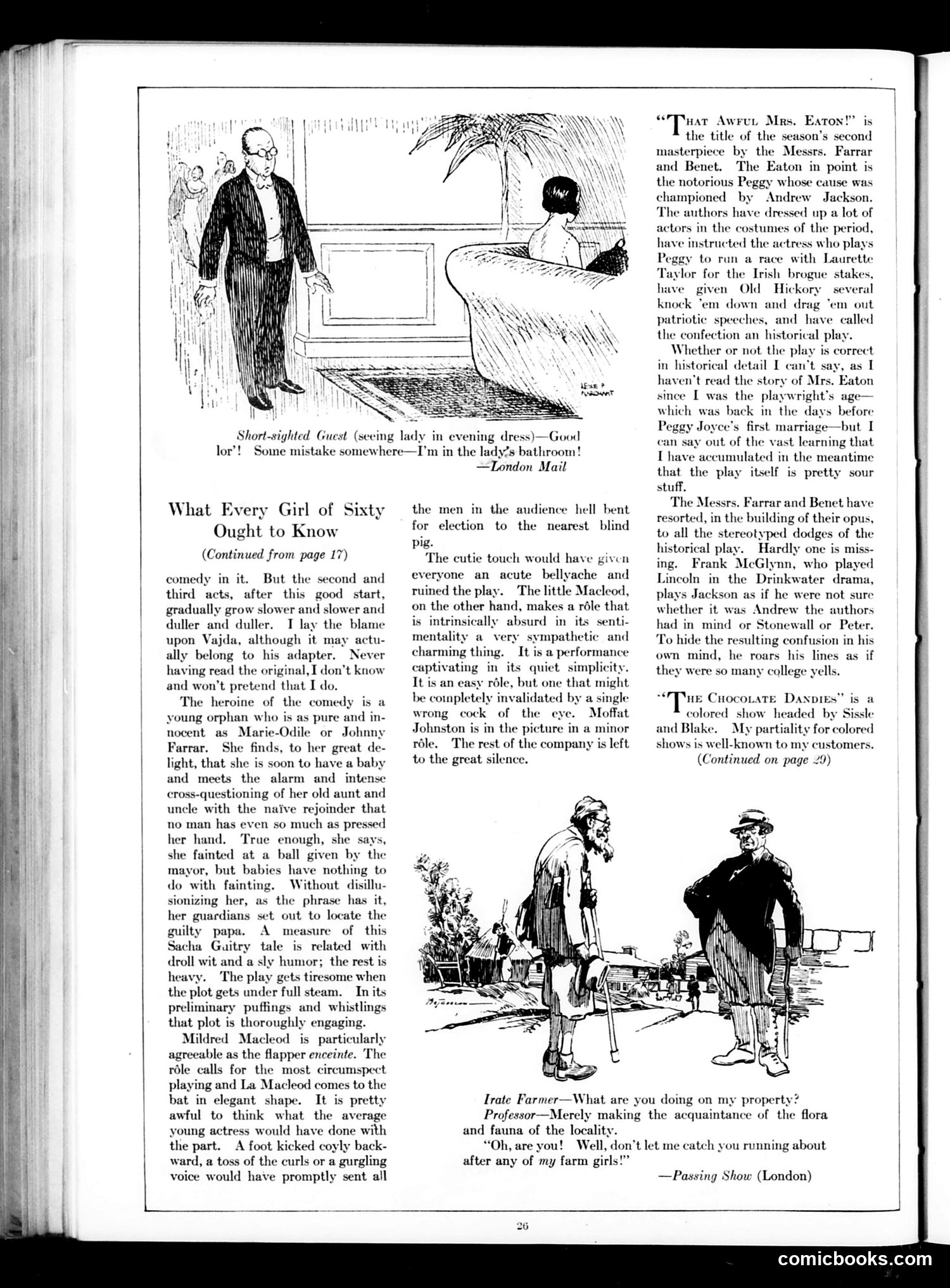
The page contains two distinct elements: **Top cartoon**: A "short-sighted guest" mistakes a lady's bathroom for a ballroom. The joke relies on the visual confusion—the gentleman sees a woman in evening dress and assumes he's in the wrong social space, missing the obvious bathroom setting. It's a mild, sight-gag style humor typical of early 20th-century magazines. **Main text**: Theatre reviews by what appears to be a drama critic. The reviews discuss: - "What Every Girl of Sixty Ought to Know"—a play about an innocent young orphan who becomes pregnant without understanding how, treated with dry wit - "That Awful Mrs. Eaton"—a historical play about Peggy Eaton (Andrew Jackson's controversial associate), which the reviewer dismisses as tedious and reliant on theatrical clichés - Brief mention of "The Chocolate Dandies," a colored show The reviews showcase period attitudes toward theatre and social propriety, particularly the handling of pregnancy as a plot device requiring delicate treatment.
📄 Transcribed text from this page (OCR, searchable)
Machine-transcribed from the original scan — historical spelling and the odd misread are preserved.
| | Short-sighted Guest (seeing lady in evening dress) —Good lor’! Some mistake somewhere—I’m in the lady’s bathroom! What Every Girl of Sixty Ought to Know (Continued from page 17) comedy in it. But the second and third acts, after this good start, gradually grow slower and slower and duller and duller. T lay the blame upon Vajda, although it may actu- ally belong to his adapter. Never having read the original, I don’t know and won't pretend that I do. The heroine of the comedy is a young orphan who is as pure and in- nocent as Marie-Odile or Johnny Farrar. She finds, to her great de- light, that she is soon to have a baby and meets the alarm and intense cross-questioning of her old aunt and uncle with the nalve rejoinder that no man has even so much as pressed her hand. True enough, she says, she fainted at a ball given by the mayor, but babies have nothing to do with fainting. Without disillu- sionizing her, as the phrase has it, her guardians set out to locate the guilty papa. A measure of this Sacha Guitry tale is related with droll wit and a sly humor; the rest is hez The play gets tiresome when the plot gets under full steam. In its preliminary puffings and whistlings that plot is thoroughly engaging. Mildred Macleod is particularly agreeable as the flapper enceinte. The role calls for the most circumspect playing and La Macleod comes to the bat in elegant shape. It is pretty awful to think what the average young actress would have done with the part. A foot kicked coyly back- ward, a toss of the curls or a gurgling voice would have promptly sent all London Mail the men in the audience hell bent for election to the nearest blind pig. The cutie touch would have given everyone an acute bellyache and ruined the play. The little Macleod, on the other hand, makes a réle that is intrinsically absurd in its senti- mentality ‘y sympathetic and charming thing. It is a performance captivating in its quiet simplicity. It is an easy réle, but one that might be completely invalidated by a single wrong cock of the e} Moffat Johnston is in the picture in a minor role. The rest of the company is left to the great silence. Tuat Awrut Mrs. Eaton!” is the title of the season’s second masterpiece by the Messrs. Farrar and Benet. The Eaton in point is the notorious Peggy whose cause was championed by Andrew Jackson. The authors have dressed up a lot of actors in the costumes of the period, have instructed the actress who plays Peggy to run a race with Laurette lor for the Irish brogue stakes, have given Old Hickory several knock ‘em down and drag ‘em out patriotic speeches, the confection an historical play. Whether or not the play is correct in historical detail I can’t say, as I haven't read the story of Mrs. Eaton since I was the playwright's age— which was back in the days before Peggy Joyce's first marriage—but I can say out of the vast learning that T have accumulated in the meantime that the play itself is pretty sour stuff. The Messrs. Farrar and Benet have resorted, in the building of their opus, to all the stereotyped dodges of the historical play. Hardly one is miss- ing. Frank McGlynn, who played Lincoln in the Drinkwater drama, plays Jackson as if he were not sure whether it was Andrew the authors had in mind or Stonewall or Peter. To hide the resulting confusion in his own mind, he roars his lines as if they were so many college yells. “Pune Cuocotate Danpies” is a colored show headed by Sissle and Blake. My partiality for colored shows is well-known to my customers. (Continued on page 29) Irate Farmer—What are you doing on my property? Professor—Merely making the acquaintance of the flora and fauna of the locality. “Oh, are you! Well, don’t let me catch you running about after any of my farm girls!” —Passing Show (London) comicbooks.com