
Judge, 1924-10-18 · page 21 of 36
Judge — October 18, 1924 — page 21: what you’re looking at
What you’re looking at
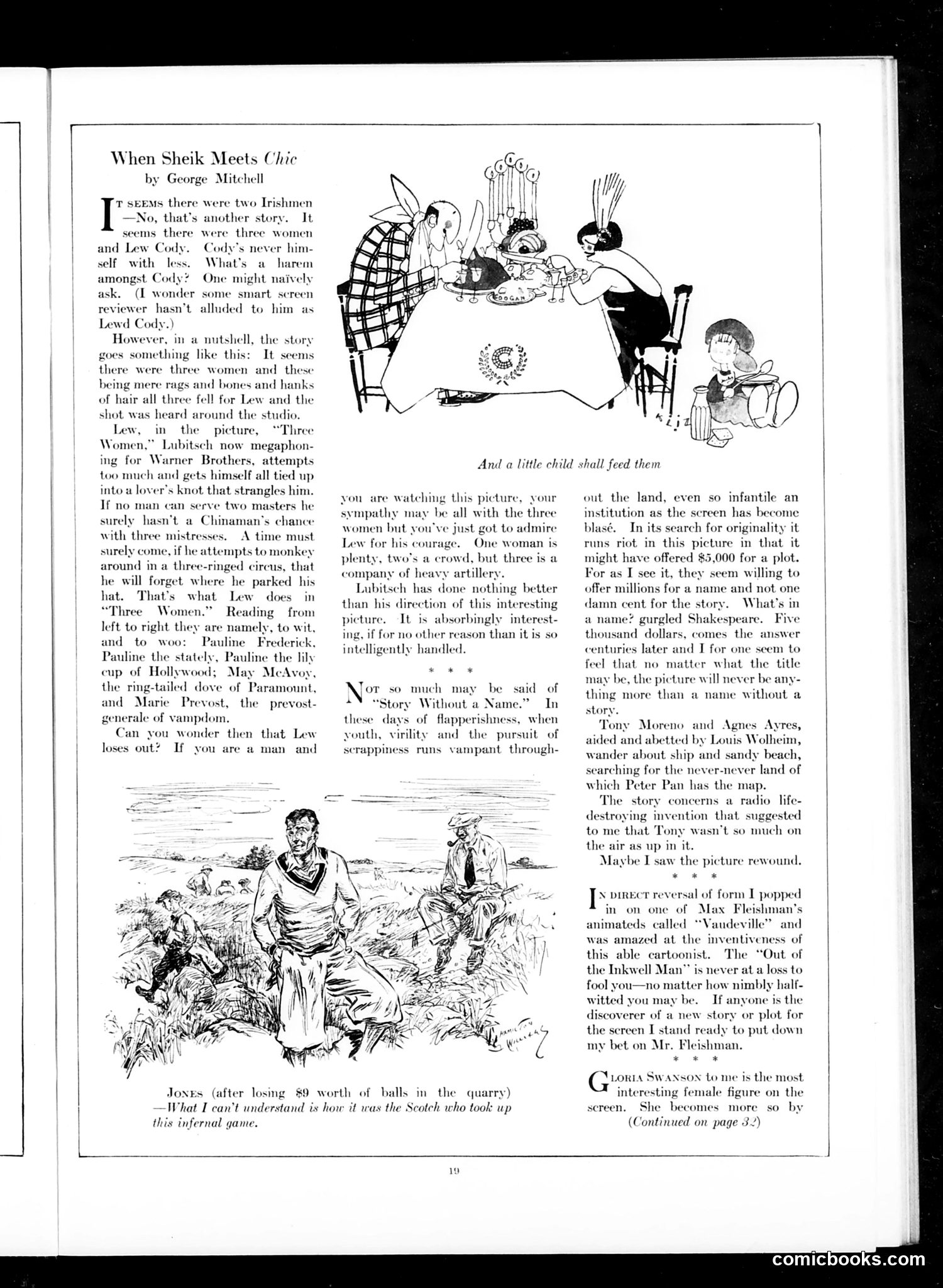
This page reviews three contemporary films, satirizing Hollywood's obsession with star power over substance. **"When Sheik Meets Chic"** critiques Lew Cody in *Three Women* (directed by Lubitsch for Warner Brothers). The joke: Cody's character juggles three mistresses—actresses Pauline Frederick, May McAvoy, and Marie Prevost—and inevitably "loses out." The satire mocks both Cody's inability to manage multiple romantic entanglements and Hollywood's reliance on glamorous casting rather than plot. A second review skewers *Story Without a Name*, featuring Tony Moreno and Agnes Ayres. The critic complains the studio spent millions acquiring a title while refusing to invest in actual storytelling—a pointed jab at Hollywood's backwards priorities. Finally, the piece praises Max Fleishman's animated *Vaudeville* short and the "Out of the Inkwell Man" cartoon, celebrating genuine creative inventiveness. Throughout, the satire targets 1920s cinema's vapid emphasis on star names and exotic scenarios over substantive narratives.
📄 Transcribed text from this page (OCR, searchable)
Machine-transcribed from the original scan — historical spelling and the odd misread are preserved.
When Sheik Meets Chic by George Mitchell T SEEMS there were two Irishmen —No, that’s another story. It seems there were three women and Lew Cody. self with less. What's a amongst Cody? One might naively ask. (I wonder some smart screen reviewer hasn't alluded to him as Lewd Cody.) However, in a nutshell, the story goes something like this: th id these being mere rags and bones and hanks of hair all three fell for Lew and the shot was heard around the studio. Lew, in the picture, ‘Three Women,” Lubitsch now megaphon- ing for Warner Brothers, attempts too much and gets himself all tied up into a lover's knot that strangles him. If no man can serve two masters he surely hasn’t a Chinaman’s chance with three mistresses. A time must surely come, if he attempts to monkey around in a three-ringed circus, that he will forget. where he parked his hat. That's what Lew “Three Women.” left to right the: and to Cody's never him- harem It seems were three womer does in Reading from are namely, to wit, auline Frederick, Pauline the stately, Pauline the lily cup of Hollywood; May McAvoy, the ring-tailed dove of Paramount, and Marie Prevost, the nerale of vampdom, Can you wonder then that Lew loses out? If you are a man and woo: prevost- And a little child shall feed them you are watching this picture, your sympathy may be all with the three women but you've just got to admire One woman is two's a crowd, but. three is a artillery, Lubitsch has done nothing better than his direction of this interesting picture. Low for his courage. plenty company of he It is absorbingly interest ing, if for no other reason than it is so intelligently handled. * * Norse much may be said of AN “Story Without a Name.” In these days of flapperishness, when youth, virility and) the pursuit of Scrappiness runs vampant through- Jones (after losing $9 worth of —What I can’t understand is how it was the Scotch who took up this infernal game. balls in the quarry) out the land, even so infantile an institution as the screen has become blasé. In its search for originality it runs riot in this picture in that it might have offered $5,000 for a plot. For as I see it, they seem willing to offer millions for a name and not one damn cent for the story. What's a name? gurgled Shakespeare. thousand dollars, comes the answer centuries later and I for one seem to feel that no matter what the title may be, the picture will never be any- thing more than a name without a story. Tony Moreno and Agnes Ayres, aided and abetted by Louis Wolheim, wander about ship and sandy beach, searching for the never-never land of which Peter Pan has the map. in Five The story concerns a radio life- destroying invention that suggested to me that Tony wasn’t so much on the air as up in it. Maybe I saw the picture rewound. I pirect reversal of form I popped in on one of Max Fleishman’s animateds called Vaudeville” and amazed at the inventiveness of this able cartoonist. The “Out of the Inkwell Man” is never at a loss to fool you—no matter how nimbly half- witted you may be. discoverer of a new story or plot for the sereen I stand ready to put down my bet on Mr. Fleishman. ee * Gers Swanson to me is the most interesting female figure on the screen. Sh If anyone is the becomes mo so by (Continued on page 3.) comicbooks.com