
A complete issue · 37 pages · 1924
Judge — September 20, 1924
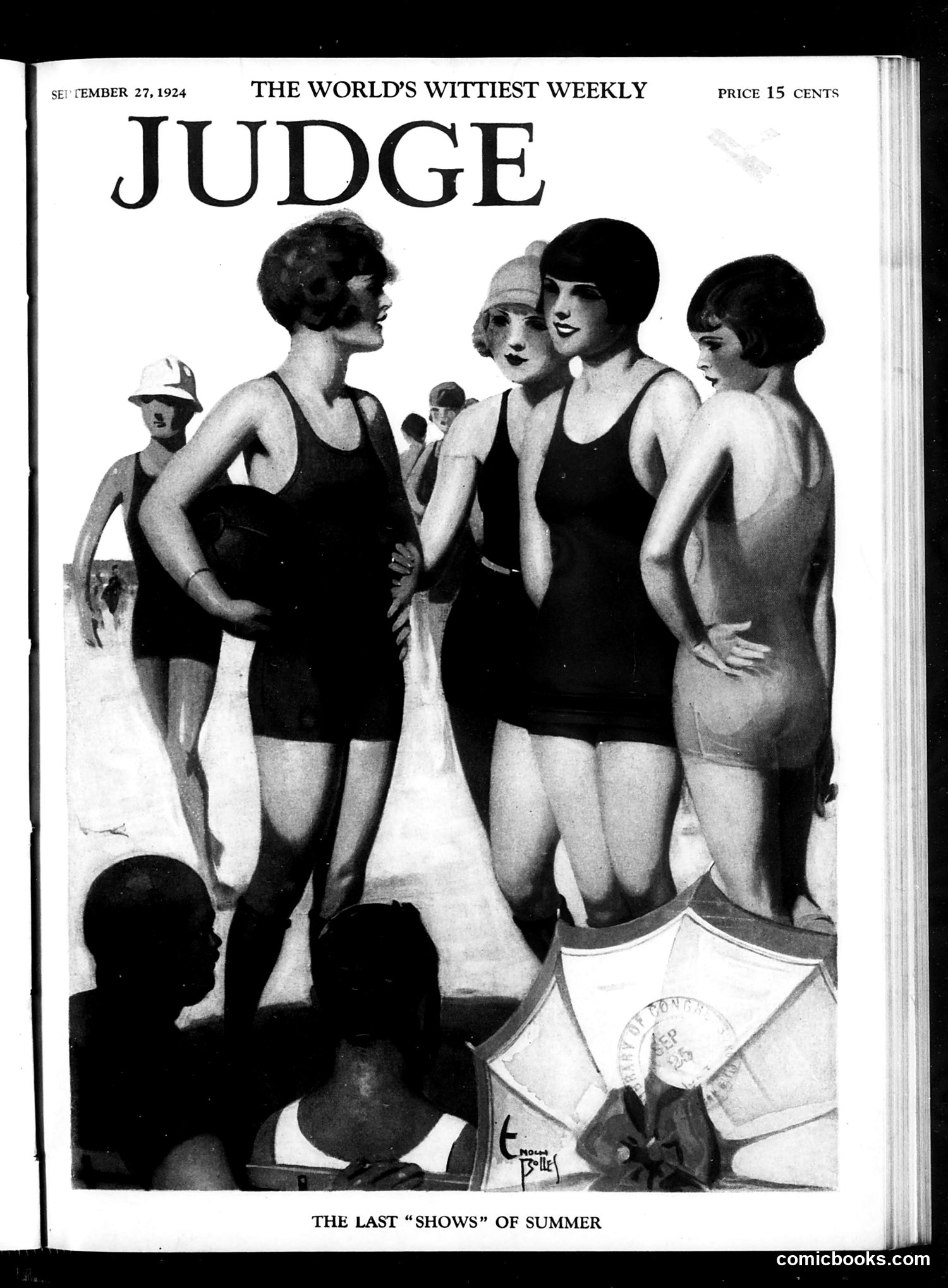
This September 1924 *Judge* cover satirizes the end-of-summer beach season. The image shows four women in bathing suits at a beach, with the caption "The Last 'Shows' of Summer"—a pun on theatrical "shows" and the display of swimmers' bodies. The satire targets the fashion and social customs of the 1920s Jazz Age. Women's bathing attire had become increasingly revealing compared to Victorian-era standards, which some found scandalous. The word "shows" suggests these beach gatherings functioned as public spectacles where women's swimwear (and bodies) were prominently displayed. The cartoon mocks both the exhibitionism of beachgoers and society's fascination with observing summer fashion trends before the season ended.
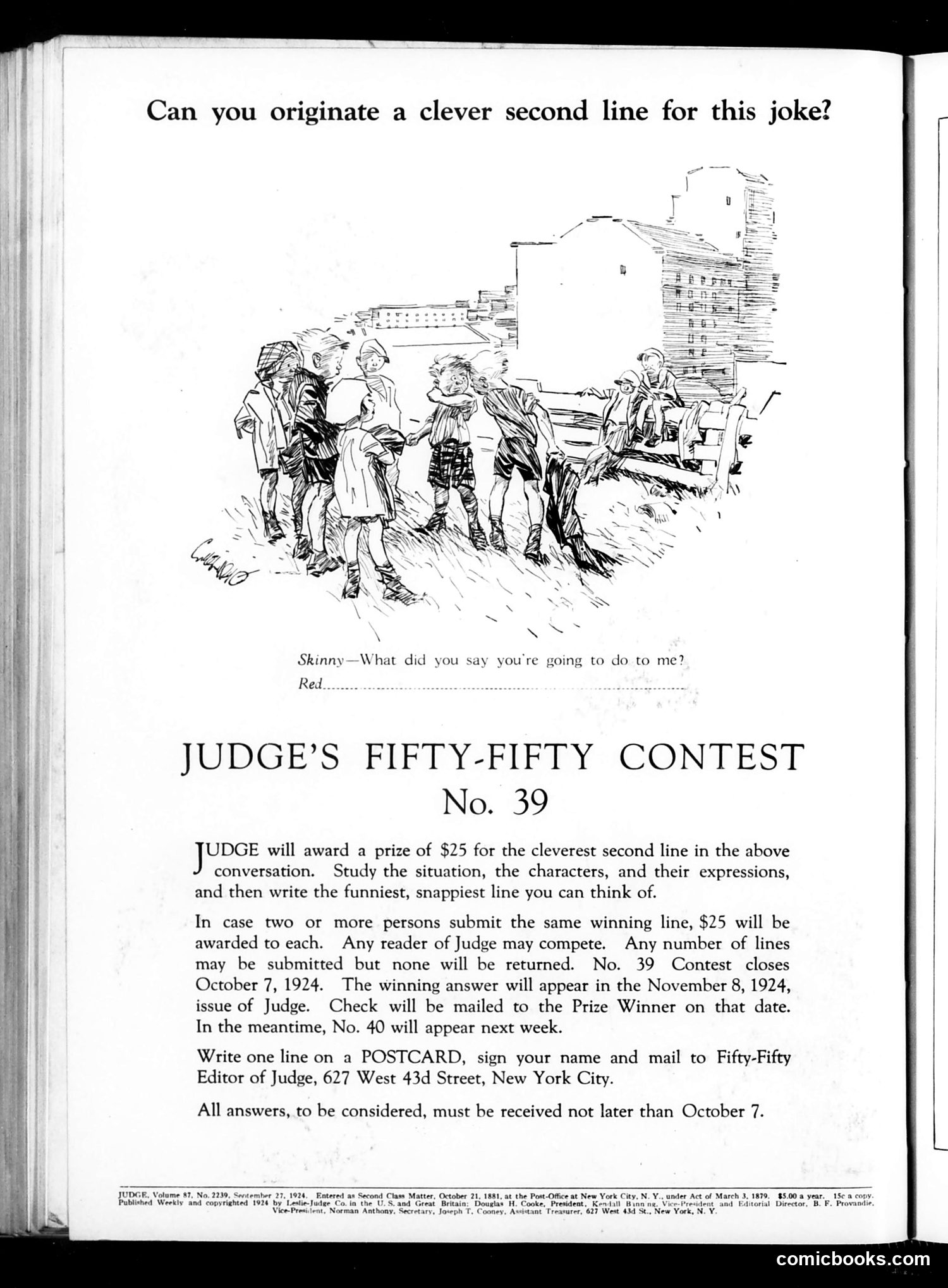
This page presents a humor contest rather than political satire. The illustration shows children in an urban setting with tenement buildings. One child named "Skinny" appears to threaten another child called "Red," who responds with an unfinished line. The "Judge's Fifty-Fifty Contest No. 39" invites readers to complete Red's comeback—the "clever second line" that would best respond to Skinny's threat. The $25 prize reflects the magazine's practice of crowdsourcing humor from its readership. The scenario depicts working-class urban childhood, likely resonating with 1920s audiences familiar with street gangs and neighborhood conflicts among poor children. The contest format was typical of Judge's interactive content, encouraging reader participation while generating material for future issues.
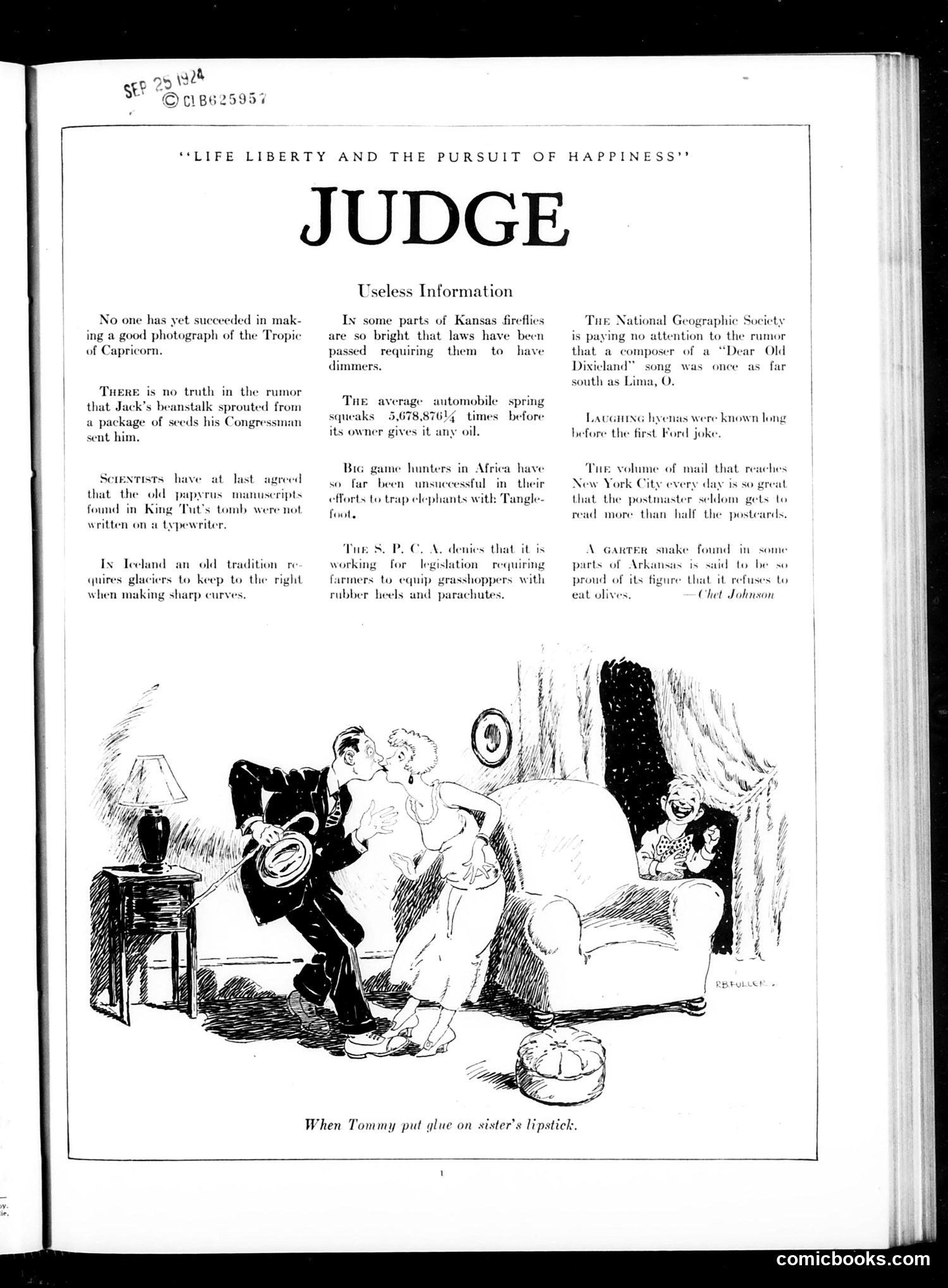
This page features a single cartoon captioned "When Tommy put glue on sister's lipstick." The image depicts a domestic scene of childhood mischief: a young boy has apparently applied adhesive to his sister's cosmetics as a prank. An adult man (likely the father, wearing a hat and formal attire) reacts with exaggerated dismay or alarm, while the sister sits on a couch discovering the damage. The humor is situational rather than political—it's a relatable domestic comedy about sibling pranks and parental reaction. The page also includes an "Useless Information" section with various trivia items and anecdotes, typical of Judge magazine's miscellaneous content filler.
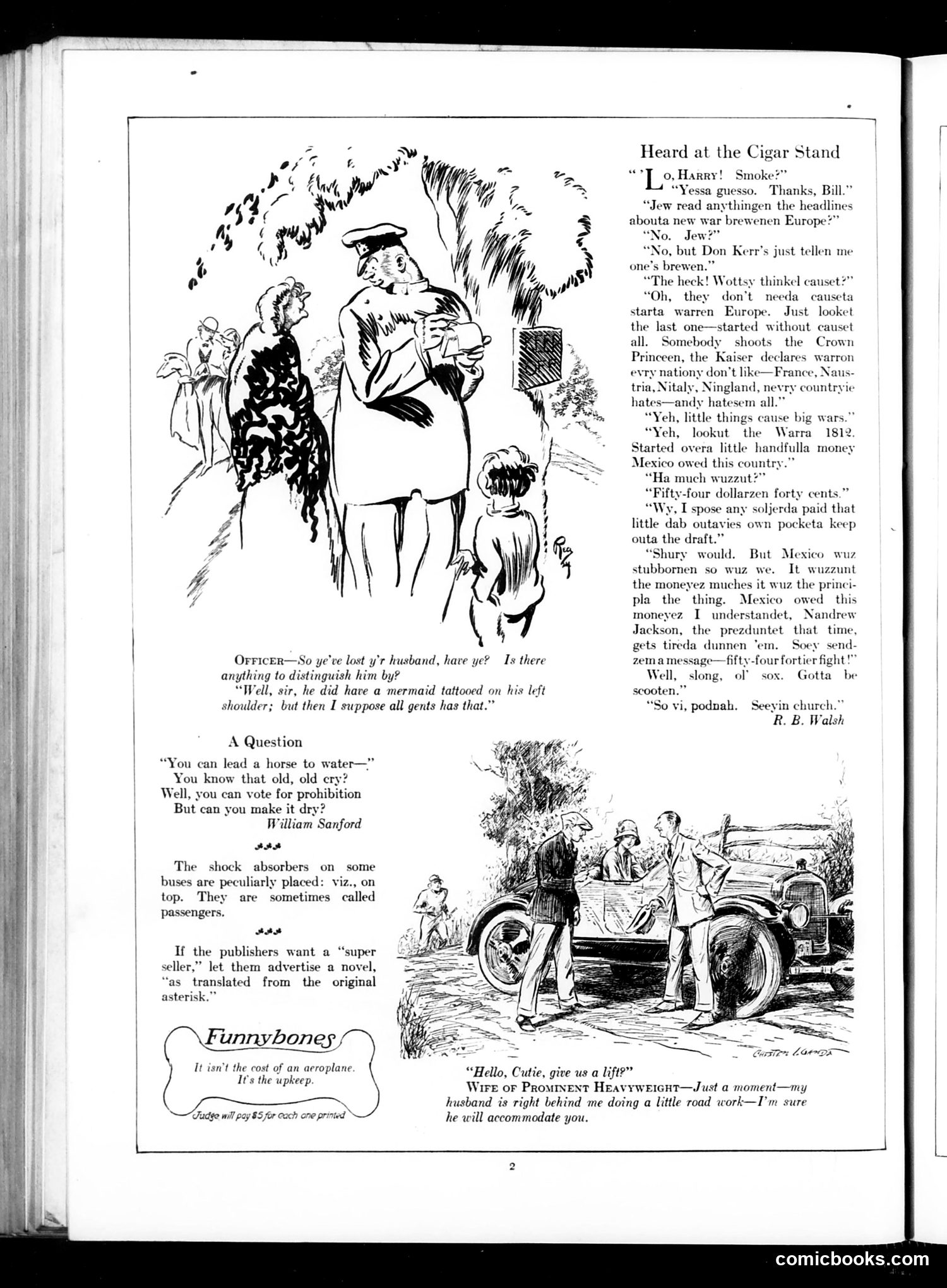
The top cartoon "Heard at the Cigar Stand" satirizes early 20th-century European political tensions. Men discuss how minor conflicts spark major wars—referencing the Balkan Wars (1912-1913) and broader imperial rivalries. The dialogue mocks how small debts (Mexico owing money) and nationalist pride escalate into continental conflict. The implied critique: Europe's great powers use trivial pretexts to justify warfare. The middle section includes William Sanford's poem "A Question" about Prohibition—skeptically asking if laws can actually prevent drinking. The bottom cartoon shows a woman asking a man for a ride, claiming her husband is working nearby. It's a flirtation joke playing on the woman's deceptive excuse to ride with the stranger.
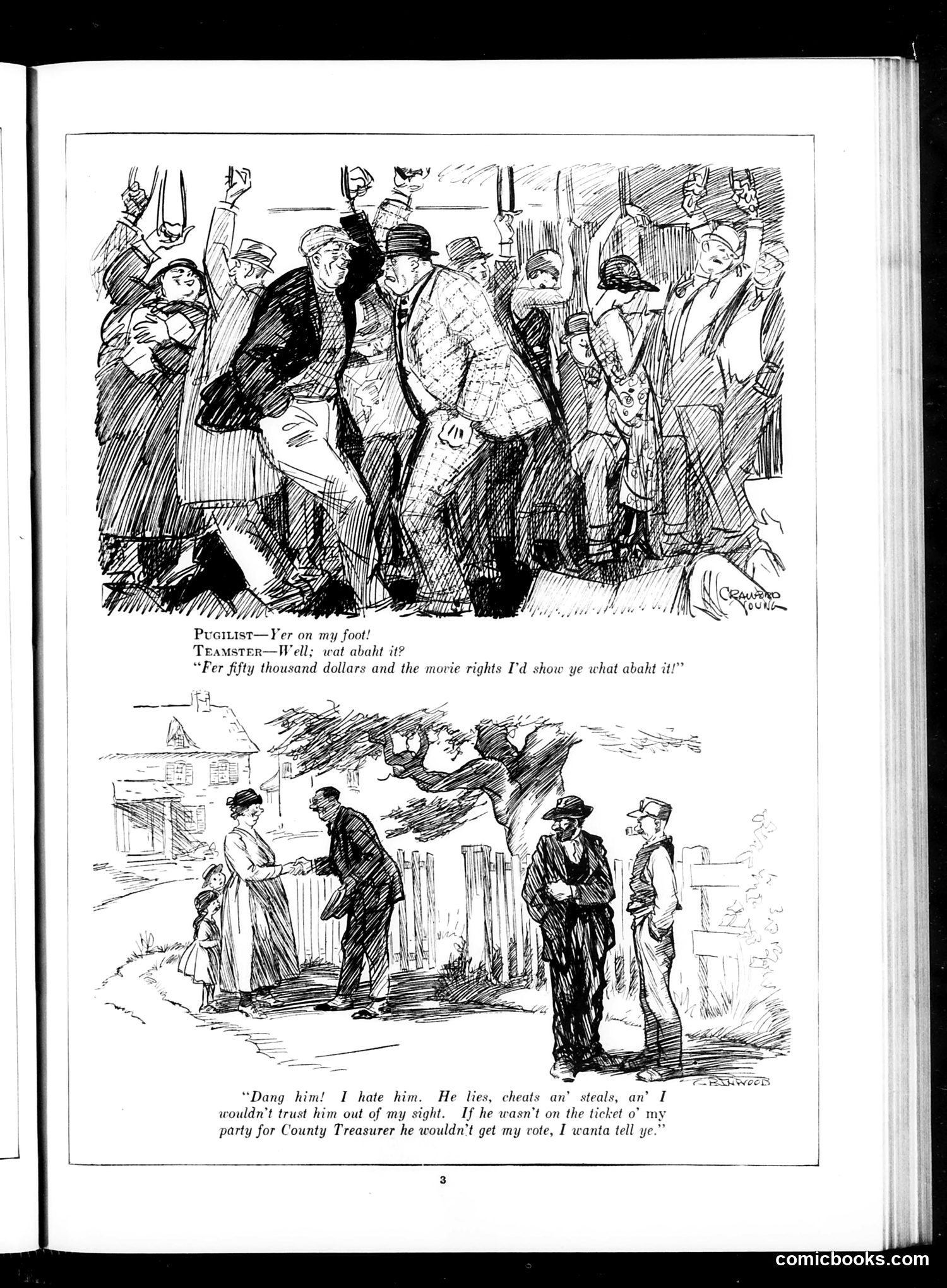
This page from *Judge* magazine contains two satirical scenes about election fraud and political corruption. **Top panel:** A crowded urban scene depicts a "Populist" and "Teamster" (labor union member) negotiating over vote-buying. The Populist offers "$50 thousand dollars and the movie rights" to secure the Teamster's support, satirizing how politicians allegedly purchased votes through bribes and favors during this era. **Bottom panel:** A rural scene shows a man angrily denouncing a politician to a woman and child at a fence, claiming the politician lies, cheats, steals votes, and only earned his vote through a corrupt "ticket" deal for County Treasurer. The man threatens to withdraw support if the politician wasn't on his party's slate. Together, these cartoons mock widespread election fraud and transactional politics in early 20th-century America.
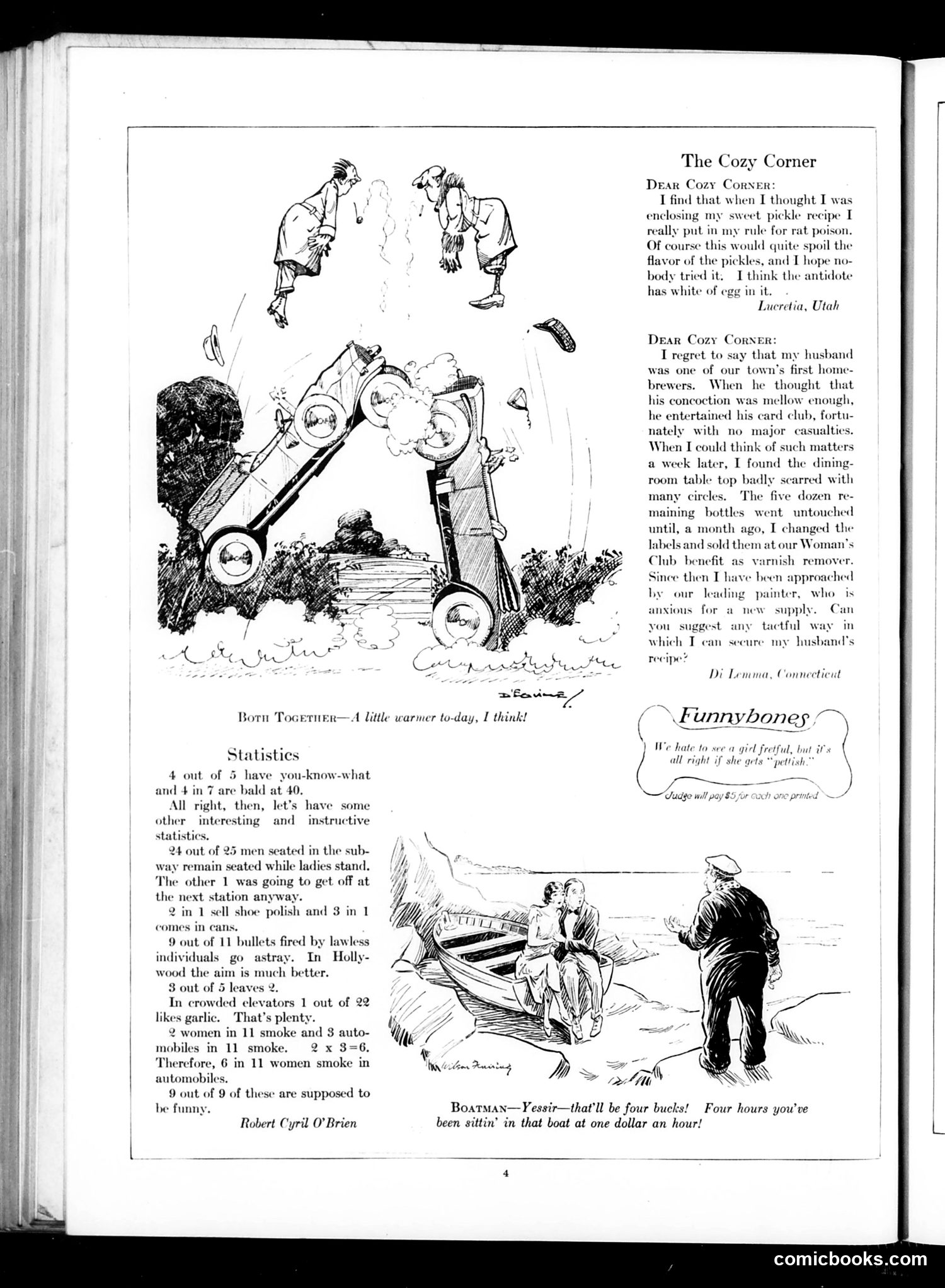
This page contains three distinct humor sections: **"Born Together"** (top): A satirical cartoon showing a car accident with multiple vehicles colliding explosively, captioned "A little warmer to-day, I think!" This appears to mock early automobile dangers and winter driving conditions. **"Statistics"** (middle-left): Robert Cyril O'Brien presents absurd statistical "facts"—like "4 out of 5 have you-know-what" and claims about shoe polish, cans, garlic preferences, and women smoking in automobiles. This satirizes the contemporary trend of using statistics to "prove" dubious social observations. **"Funnybones"** and **"Boatman"** (right): Brief comic vignettes about petty social situations and monetary transactions. The page exemplifies Judge's humor style: exaggerated social commentary through statistics, slapstick imagery, and everyday absurdities reflecting early 20th-century American life.
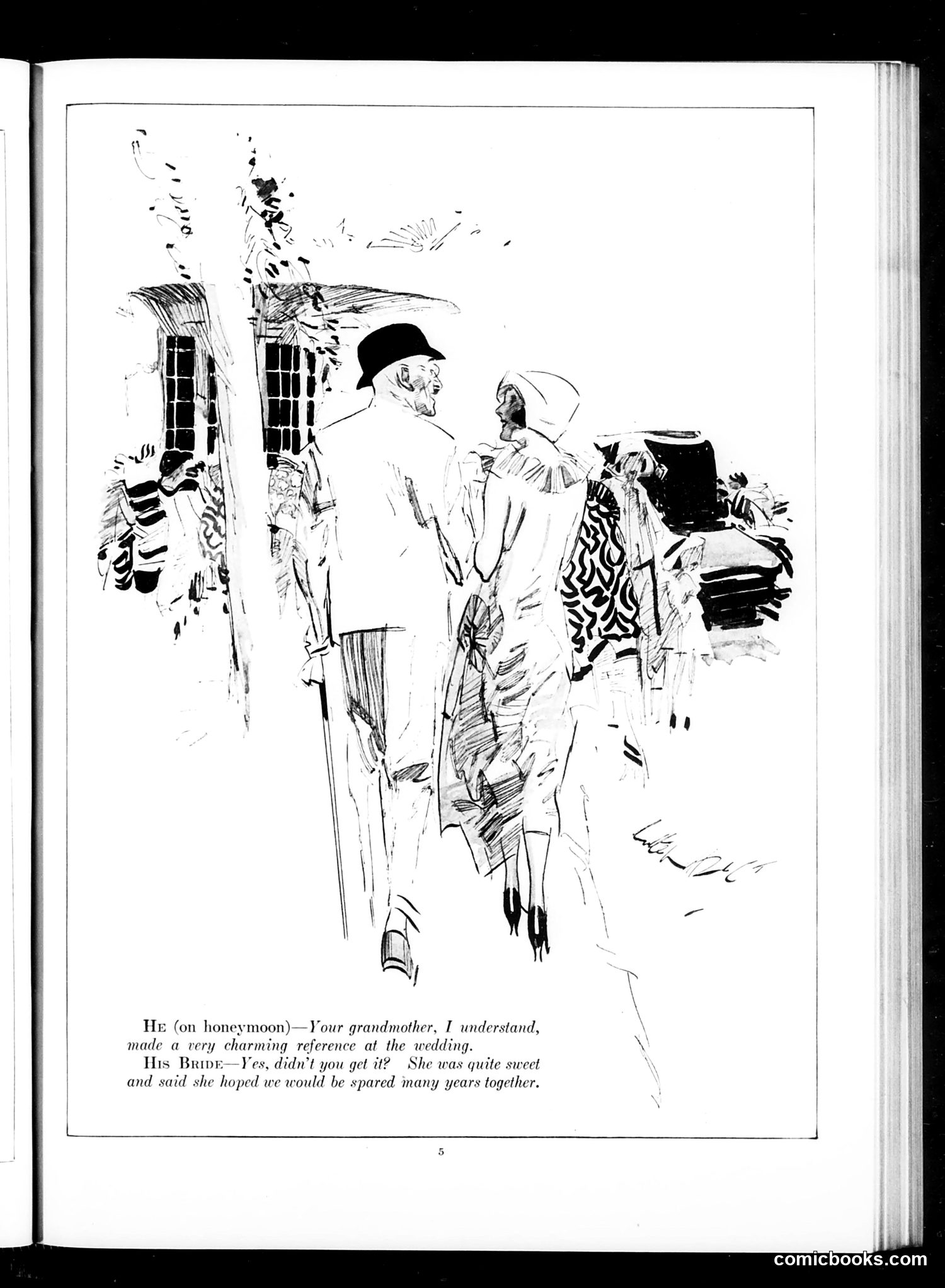
This is a domestic humor cartoon typical of early 20th-century *Judge* magazine. The joke relies on a play on words: the groom's bride says her grandmother made a "charming reference" hoping they'd be "spared many years together"—which sounds like a blessing but actually means the opposite. The grandmother was essentially wishing the marriage would be short, disguising an insult as a compliment. The cartoon satirizes: - Family dynamics and in-law relationships - The gap between polite wedding etiquette and actual sentiments - Marital discord (the implied unhappiness of the grandmother toward the union) The bride finds this backhanded insult amusing rather than insulting, suggesting either that she shares the grandmother's doubts or that she appreciates the wit. It's gentle satire about social hypocrisy and unspoken marital pessimism presented through domestic comedy.
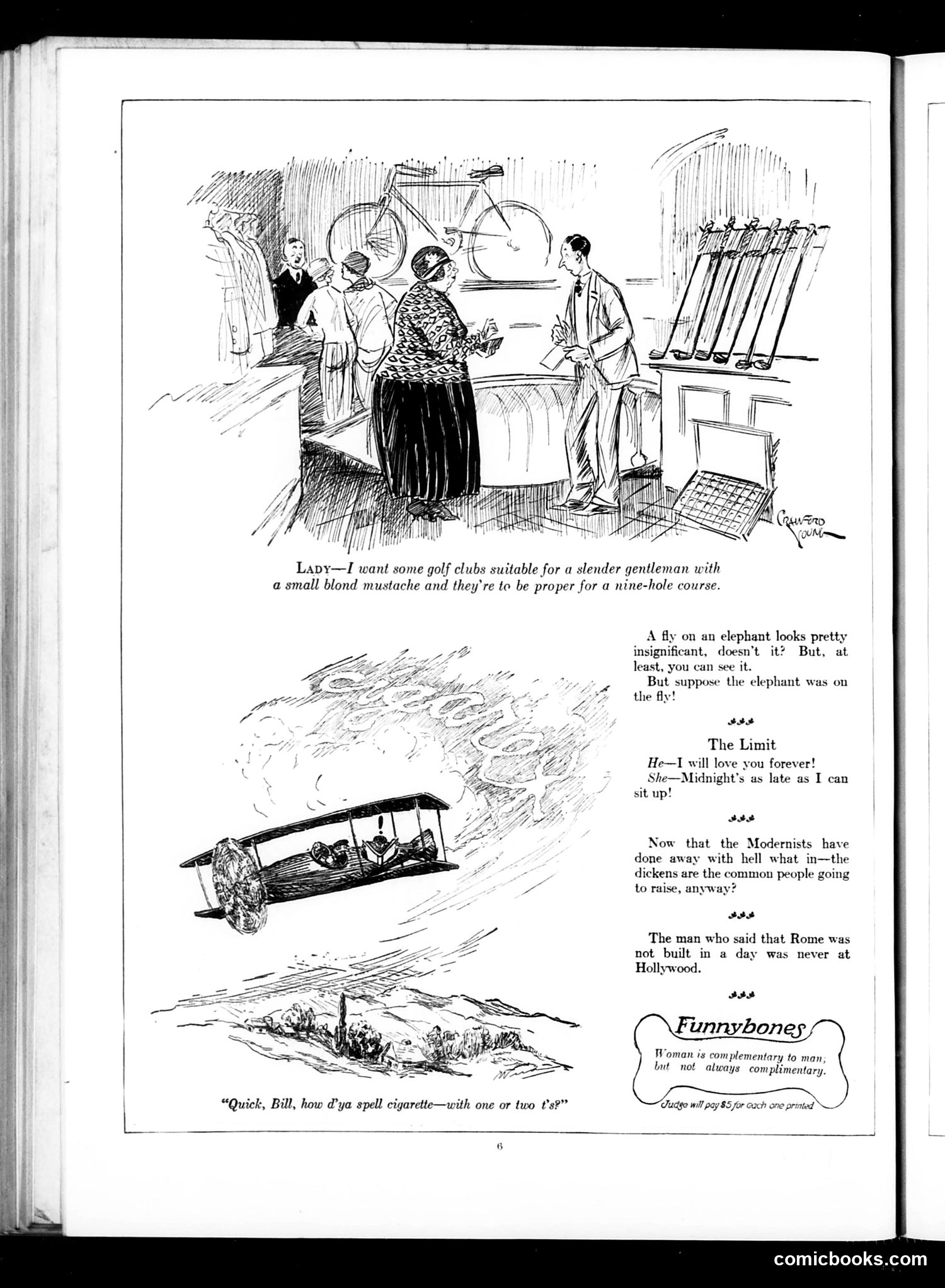
This Judge magazine page contains multiple satirical items typical of early 20th-century American humor: **Top cartoon**: A woman asks a golf shop clerk for clubs for "a slender gentleman with a small blond mustache" suitable for a nine-hole course. This appears to be a veiled reference to Adolf Hitler, identifiable by the specific physical description (small blond mustache was his distinctive feature). The nine-hole course may suggest something diminished or inferior, though the exact satirical point is somewhat unclear without more context. **Lower sections**: Brief humorous quips on various topics—modernism rejecting religious concepts ("done away with hell"), Hollywood's rapid construction/development, and gender relations ("woman is complementary to man, but not always complimentary"). The page mixes political satire with general humor typical of Judge's approach: combining topical references with everyday observational comedy for American readers of that era.
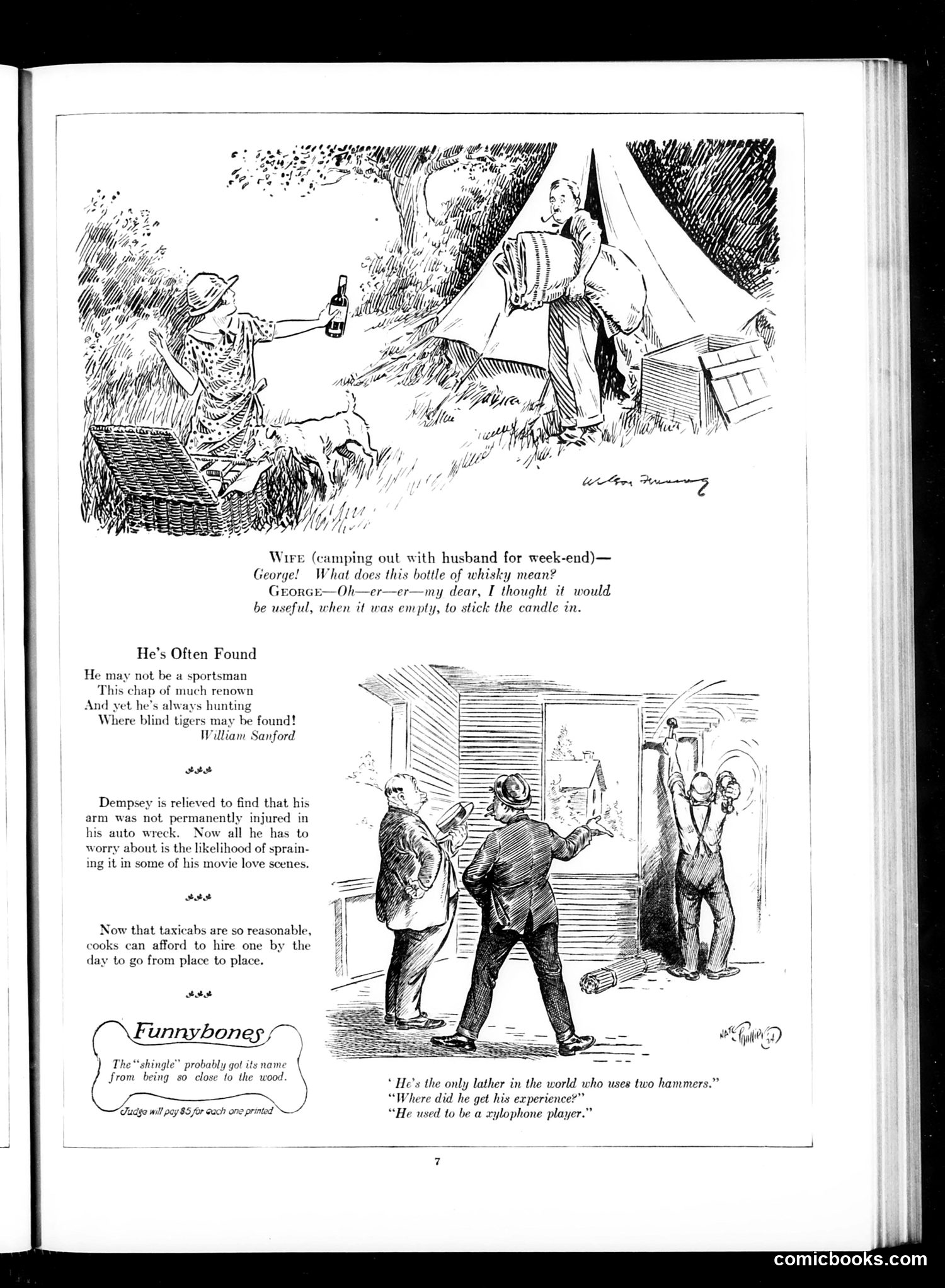
This page contains multiple satirical cartoons and jokes reflecting early 20th-century American life: **Top cartoon**: A wife confronts her husband about a whisky bottle during a camping trip. His excuse—using the empty bottle as a candleholder—is transparently absurd, satirizing men's drinking habits and weak excuses to wives. **"He's Often Found"**: References "blind tigers" (illegal speakeasies during Prohibition), mocking men who frequent underground bars while claiming to be sportsmen. **Dempsey reference**: Jack Dempsey, the famous boxer, recently had an auto accident. The joke satirizes his transition to silent film acting, joking he'll injure his arm doing movie romance scenes rather than boxing. **Taxicab joke**: Mocks the newly affordable taxi service by suggesting even servants now hire daily transportation—commenting on changing class dynamics. **"Shingle" and "lather" jokes**: Puns about barbers (shingles/signs, lather/father) and xylophone players—typical period wordplay humor. The overall tone reflects Jazz Age social commentary on Prohibition, modernization, and class changes.
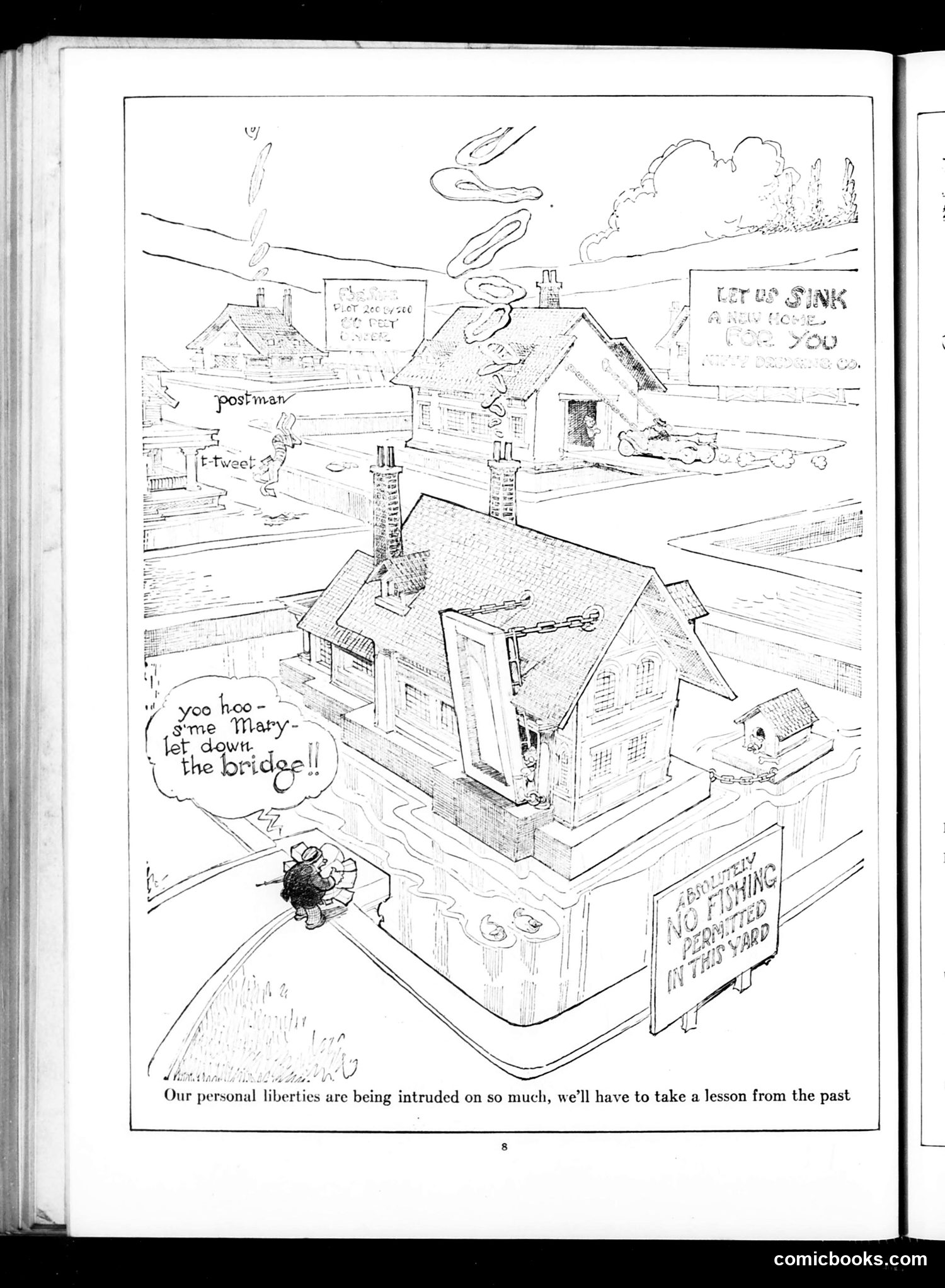
This is a single-panel political cartoon satirizing government intrusion on personal freedoms. The central image depicts a colonial-era house being examined or inspected, with various officials and figures around it labeled "postman," "tweet," and signs reading "let us sink a new house in you" and "absolutely no fishing permitted in this yard." The cartoon's message—stated in the caption—warns that excessive government regulation of citizens' private liberties has become so pervasive that Americans must look back to the founding era for lessons on personal freedom. The colonial setting symbolizes the original American values of liberty, suggesting those principles are being eroded by modern bureaucratic overreach and surveillance. The specific intrusions (mail inspection, restrictions on private property use) exemplify this loss of privacy.
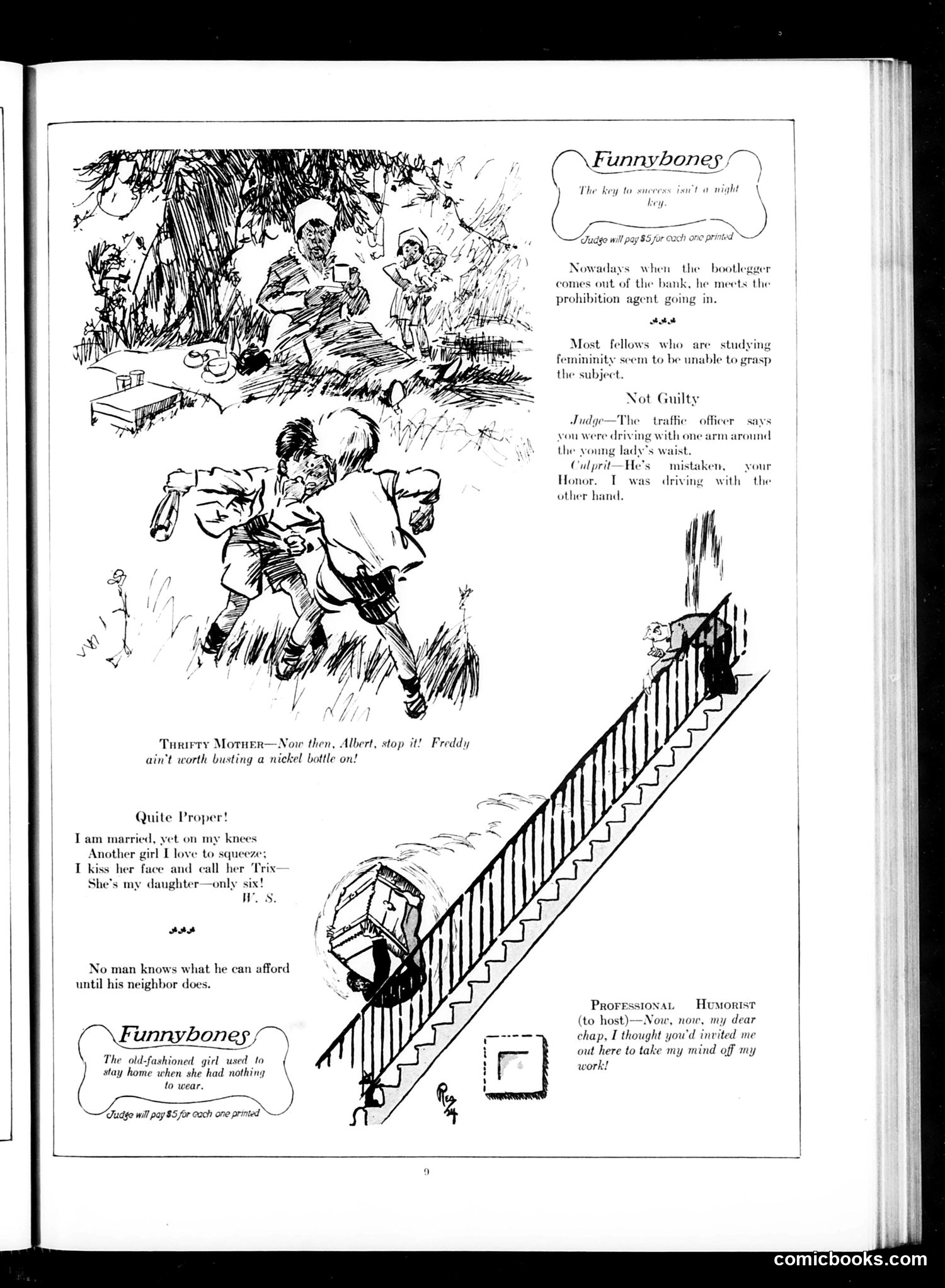
This Judge magazine page contains several short humorous sketches satirizing early 20th-century American social issues: **"Not Guilty"** mocks drunk driving excuses—a driver accused of one-handed driving while embracing a woman claims he was using his other hand, an absurd deflection. **Bootlegger/Prohibition joke** references the 1920s-30s Prohibition era, when alcohol was illegal. The humor lies in the contradiction: bootleggers (illegal alcohol sellers) now interact with prohibition agents as legitimate businesspeople, suggesting Prohibition's ineffectiveness and the corruption it enabled. **"Quite Proper"** uses ironic language—calling a father's affection for his six-year-old daughter "proper" while describing it in exaggerated romantic terms, satirizing sentimental Victorian parenting styles. Other items mock gender stereotypes ("femininity" being incomprehensible to men) and consumer culture ("no man knows what he can afford until his neighbor does"). The sketches are light social commentary typical of Judge's satirical approach to contemporary manners and follies.
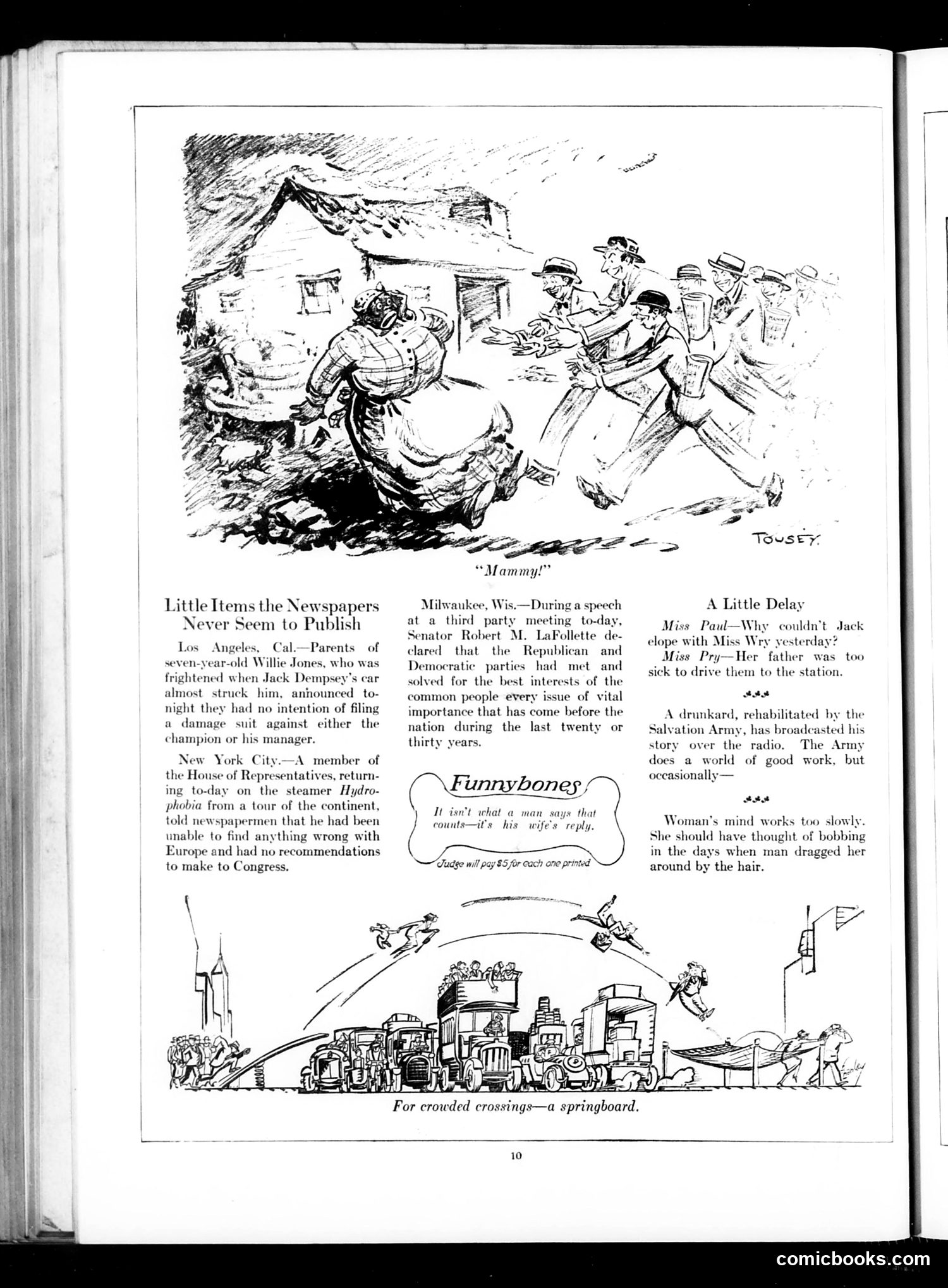
This page from *Judge* satirizes American political and social absurdities through brief humorous items and cartoons. **"Little Items the Newspapers Never Seem to Publish"** presents three satirical news-briefs mocking public figures: 1. **Los Angeles item**: Parents of a boy nearly hit by boxer Jack Dempsey's car refuse to sue—satirizing the era's litigation culture and celebrity privilege. 2. **New York item**: A congressman returning from Europe claims he found nothing wrong there and has no recommendations for Congress—mocking political obstruction and the uselessness of some legislators. 3. **Milwaukee item**: Senator Robert LaFollette (a Progressive/third-party figure) declares Republicans and Democrats have solved all vital national issues—satirizing partisan gridlock and the false claim of political progress. The bottom cartoon shows a "springboard" for crowded street crossings—absurdist visual humor. Other brief jokes mock gender relations typical of 1920s humor: women's slowness, bobbing haircuts, and marital dynamics. The page dates approximately to the early 1920s based on references to Dempsey and bobbing hairstyles.
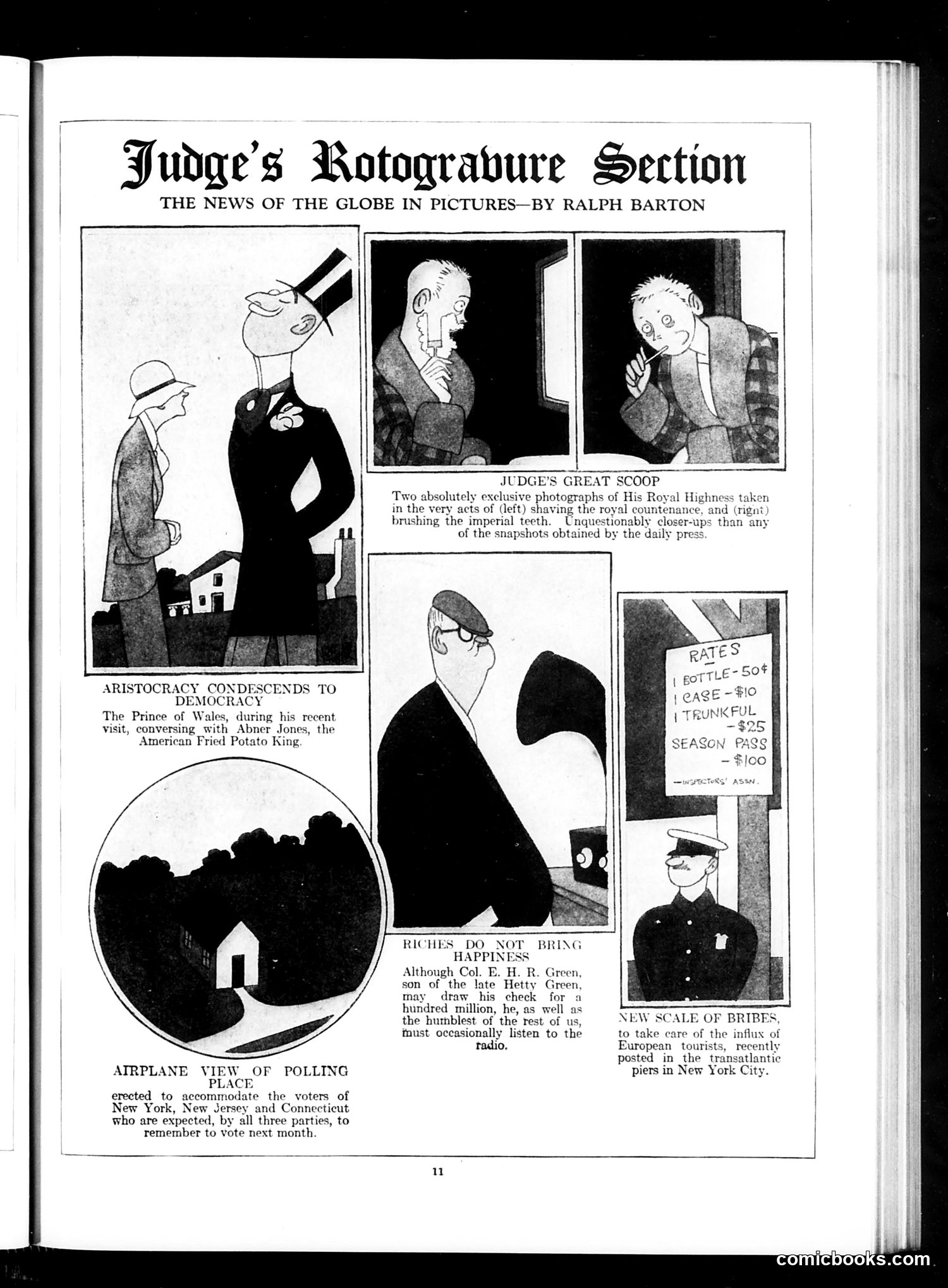
This page from Judge magazine contains satirical commentary on 1920s American society: **"Aristocracy Condescends to Democracy"** mocks the Prince of Wales's recent visit to America by depicting him conversing with "Abner Jones, the American Fried Potato King"—a caricature contrasting Old World nobility with New World commercial vulgarity. **"Judge's Great Scoop"** is faux-exclusive photographs of the Prince shaving and brushing teeth, satirizing tabloid culture's obsession with royal minutiae. **"Riches Do Not Bring Happiness"** references Colonel E. H. R. Green (son of the famous miser Hetty Green), suggesting even inherited wealth cannot exempt the wealthy from ordinary life's indignities. **"Airplane View of Polling Place"** jokes about accommodating voters across three northeastern states for an upcoming election. **"New Scale of Bribes"** depicts a posted rate card for bribing European tourists—satirizing corruption and the commercialization of immigration. The cartoons collectively mock wealth, politics, and American materialism of the era.
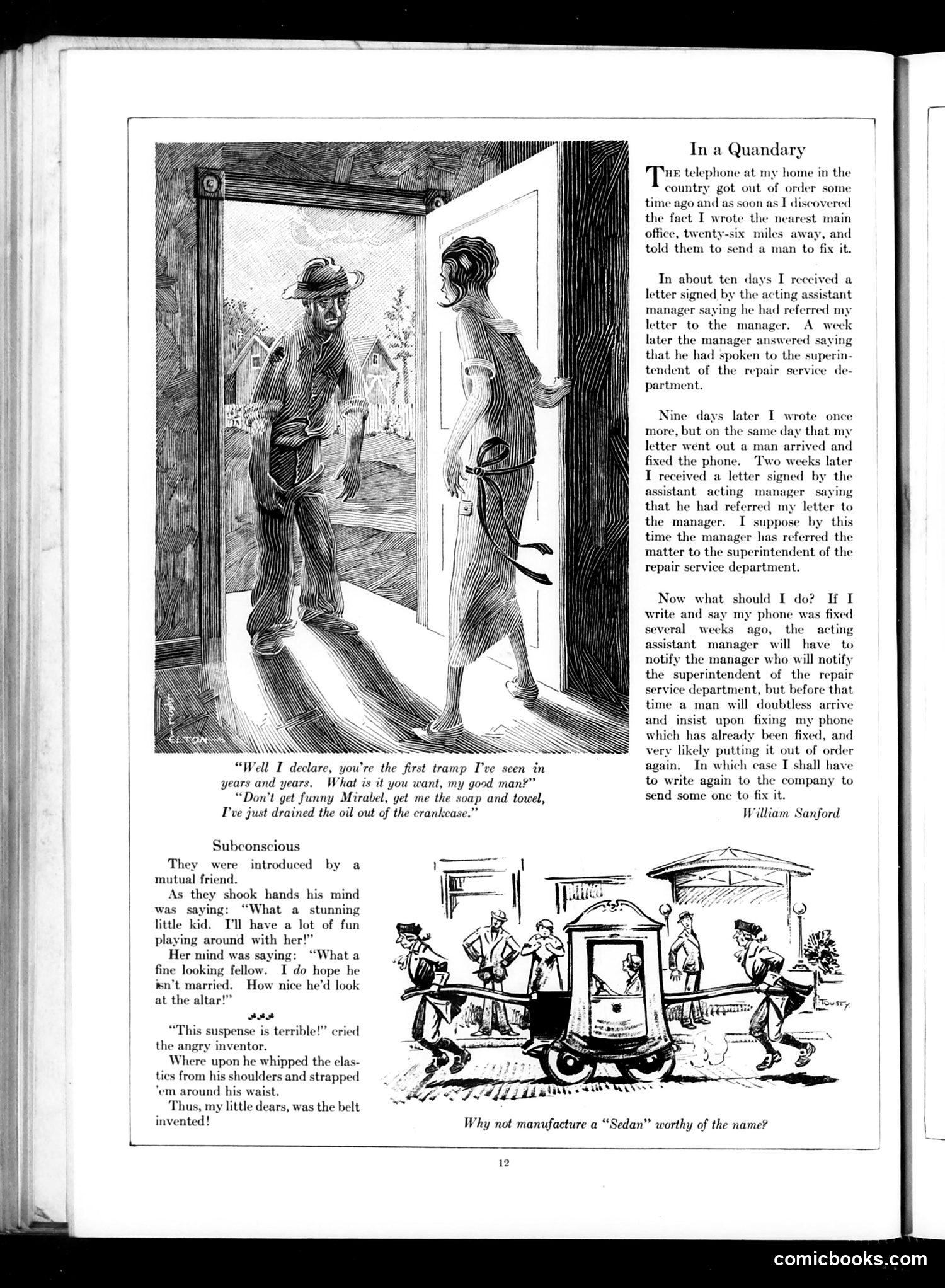
**"In a Quandary"** (by William Sanford) satirizes bureaucratic inefficiency. The author describes a broken telephone that triggers an absurd chain of administrative referrals—each manager passing the complaint to the next rather than solving it. When a repairman finally fixes it independently, the bureaucratic system continues, threatening to break the phone again through unnecessary "fixes." The satire targets corporate red tape and the disconnect between field workers and management hierarchies—a common complaint during the early 20th century industrial era. **The cartoon above** shows a woman mistaking a tramp for her husband, asking him to fix her car's crankcase. The joke plays on social anxiety about class boundaries: she addresses him formally ("my good man") while he treats her casually, suggesting the ironic reversal that the working man is more competent and straightforward than the gentleman she expected. The remaining short pieces use absurdist humor about subconscious thoughts and a whimsical origin story for the safety belt.
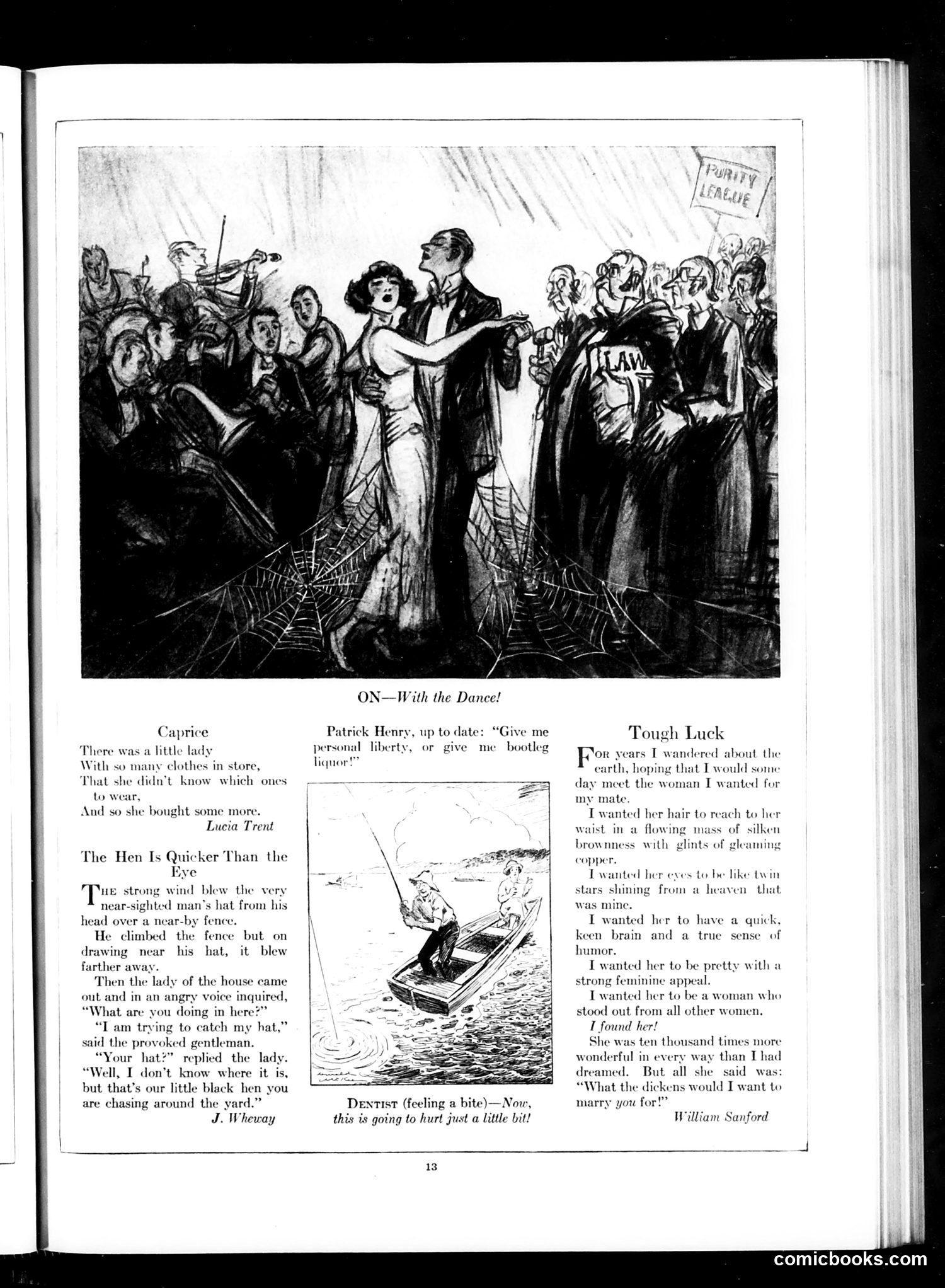
This page contains four humorous pieces satirizing 1920s American social issues: **"Caprice"** mocks consumer excess, particularly women's frivolous spending habits—a woman buys clothes she doesn't need, then buys more. **"The Hen Is Quicker Than the Eye"** is a slapstick joke about a nearsighted man mistaking a chicken for his hat, playing on visual confusion and class differences (he's trespassing on someone's property). **"ON—With the Dance!"** references Prohibition-era bootlegging. It adapts Patrick Henry's famous revolutionary quote, replacing "liberty" with "bootleg liquor"—satirizing how Americans prioritized illegal alcohol over patriotic ideals during the 1920s alcohol ban. **"Tough Luck"** is a romantic comedy where a man spends years seeking his ideal woman, finally finds her, but she rejects him—poking fun at unrealistic male expectations. The page's main cartoon depicts a lively speakeasy or dance scene, supporting the Prohibition-era satire.
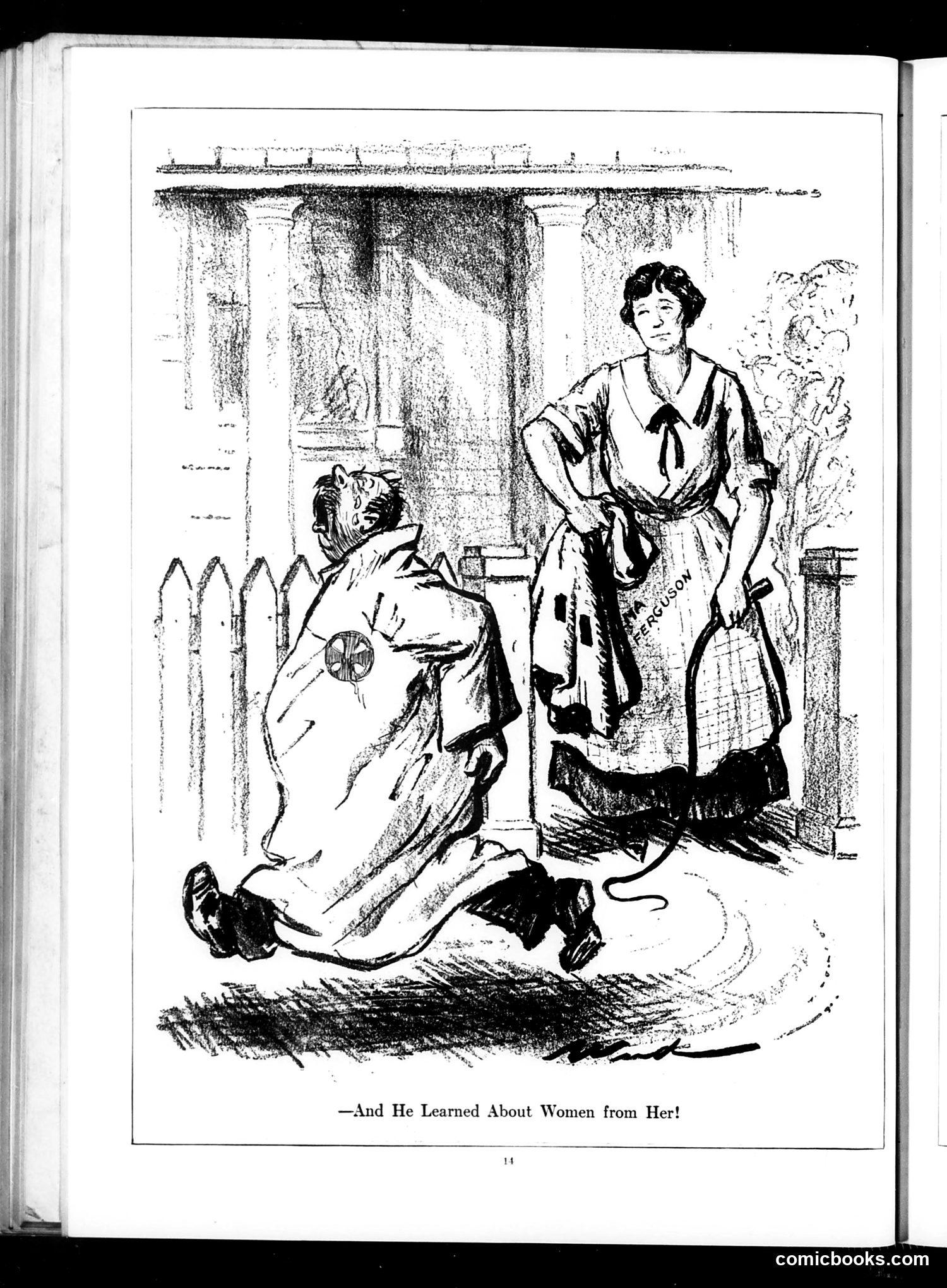
This cartoon depicts a man sitting on the ground wrapped in blankets or clothing, appearing disheveled or distressed, while a woman stands nearby looking at him. The caption reads: "—And He Learned About Women from Her!" The satire appears to mock the idea that observing or interacting with a particular woman has taught the man about women in general. The man's bedraggled appearance suggests negative consequences from this "education"—implying the cartoon is satirizing either foolish male naïveté about women, or perhaps critiquing how a single woman's behavior might unfairly inform male attitudes toward all women. Without additional context about the specific issue of Judge, the exact target remains unclear, though the humor relies on conventional early-20th-century gender stereotypes about romantic or domestic conflict.
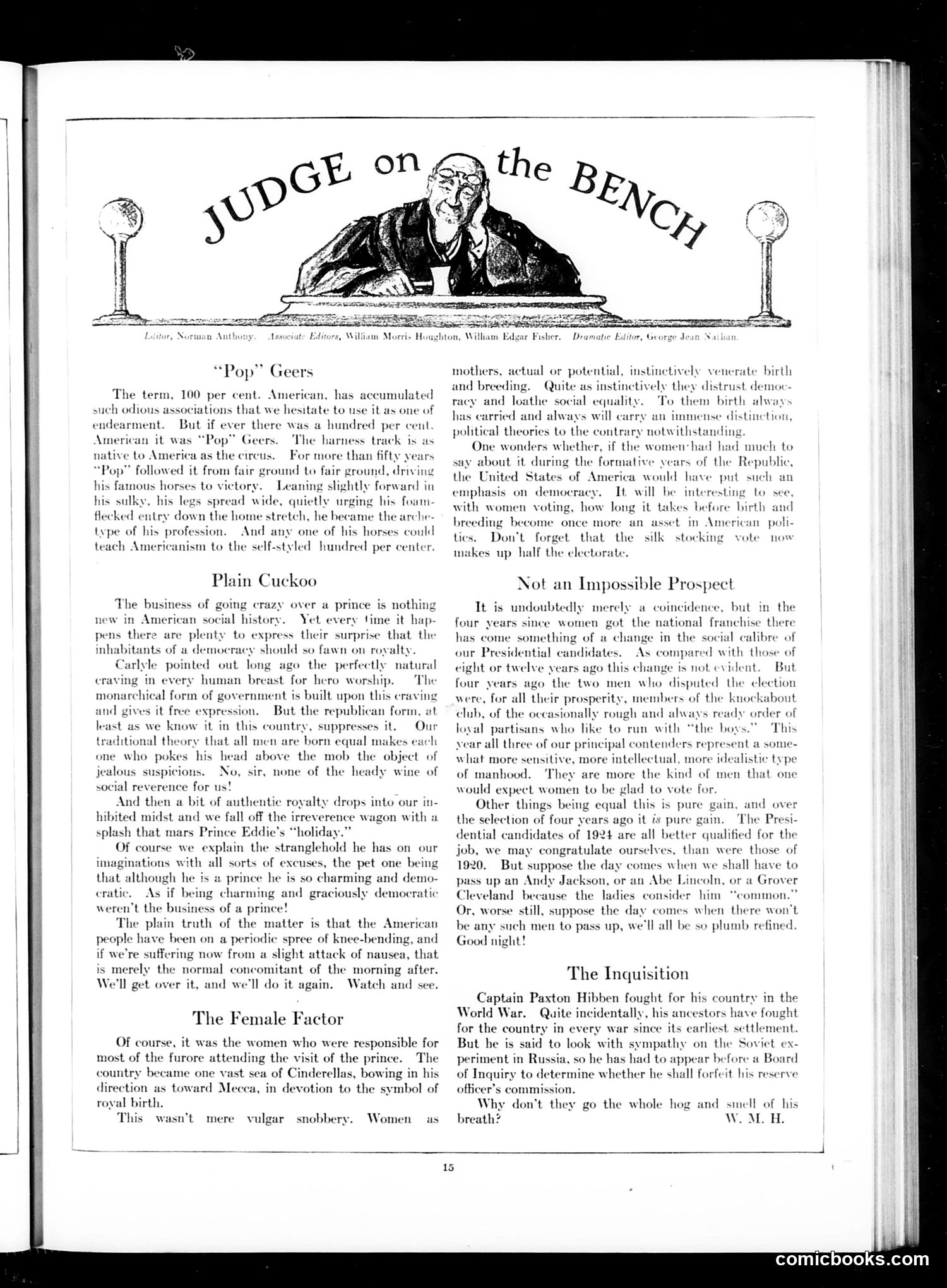
This satirical page from Judge magazine critiques American attitudes toward royalty and social hierarchy, particularly following a royal visit (likely Prince Edward's 1924 tour). **Main Points:** "Pop" Geers celebrates a genuinely American figure—a renowned harness-racing driver—as embodying authentic American values, contrasting him with artificial "100 per cent. American" nationalism. The longer pieces mock Americans' contradictory behavior: we claim democratic ideals yet obsess over visiting royalty ("Plain Cuckoo," "The Female Factor"). The satire suggests women especially crave hierarchy and "birth and breeding" despite democratic principles. **The Inquisition** briefly comments on Captain Paxton Hibben, a World War I veteran facing a Board of Inquiry, likely regarding Soviet sympathies. The overall tone: Americans *say* they believe in equality but reveal deep, suppressed desires for aristocracy whenever royalty appears. The woman's vote, newly granted, supposedly accelerates this return to valuing social status over democratic ideals.
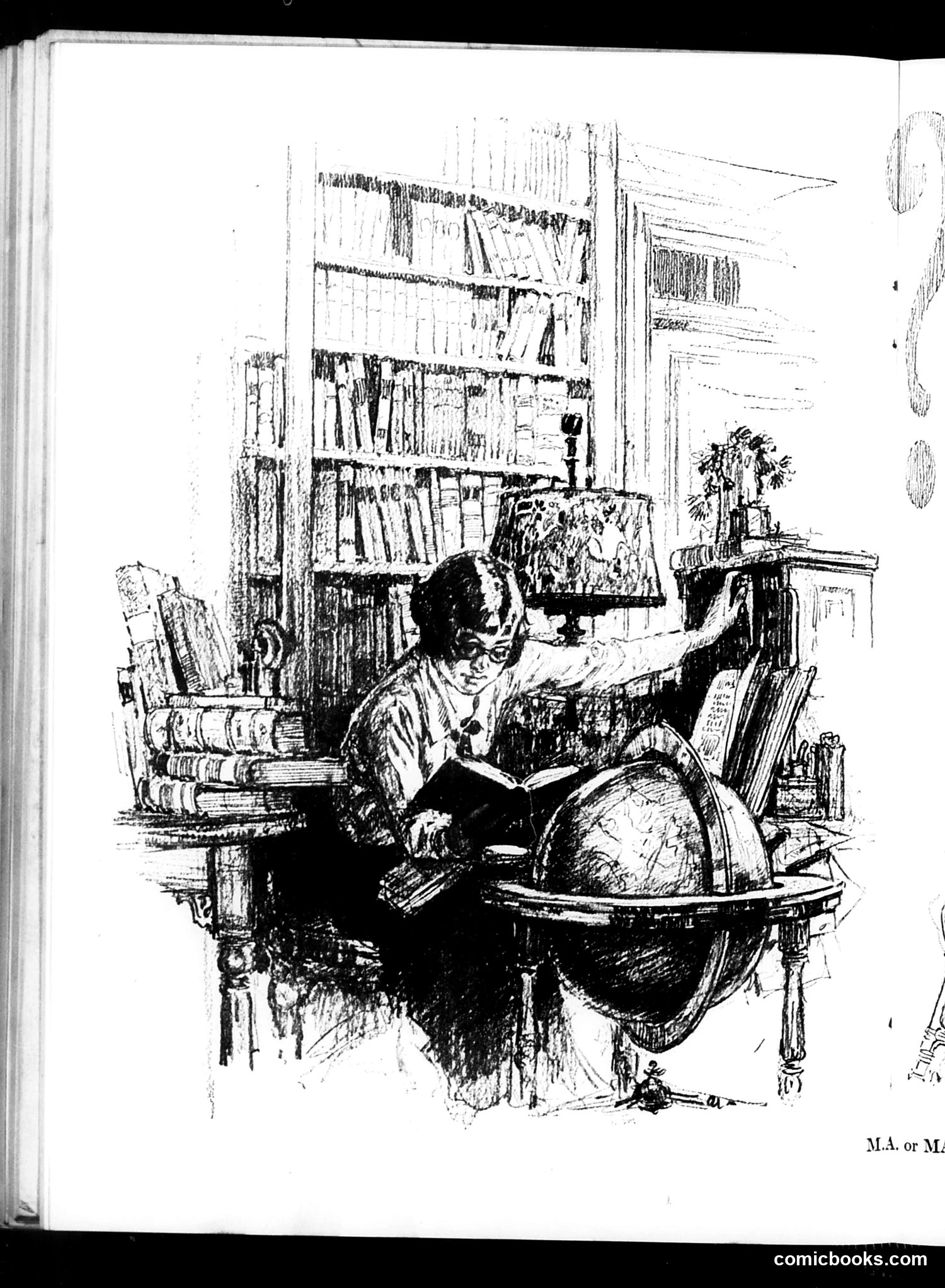
This appears to be a sketch of a scholar or academic surrounded by books, globes, and educational materials in what looks like a library or study. The figure is seated amid volumes, maps, and scientific instruments, suggesting intellectual pursuit. The partial caption "M.A. or M..." likely refers to academic degrees (Master of Arts or Master of Science). The satire appears to critique academic pretension or the pursuit of higher education—possibly mocking overwrought scholarly ambition or the gap between academic credentials and practical knowledge. However, without the complete caption and clearer context, I cannot definitively identify the specific target of satire or historical reference intended by this Judge magazine cartoon. The OCR text is too fragmentary for precise interpretation.
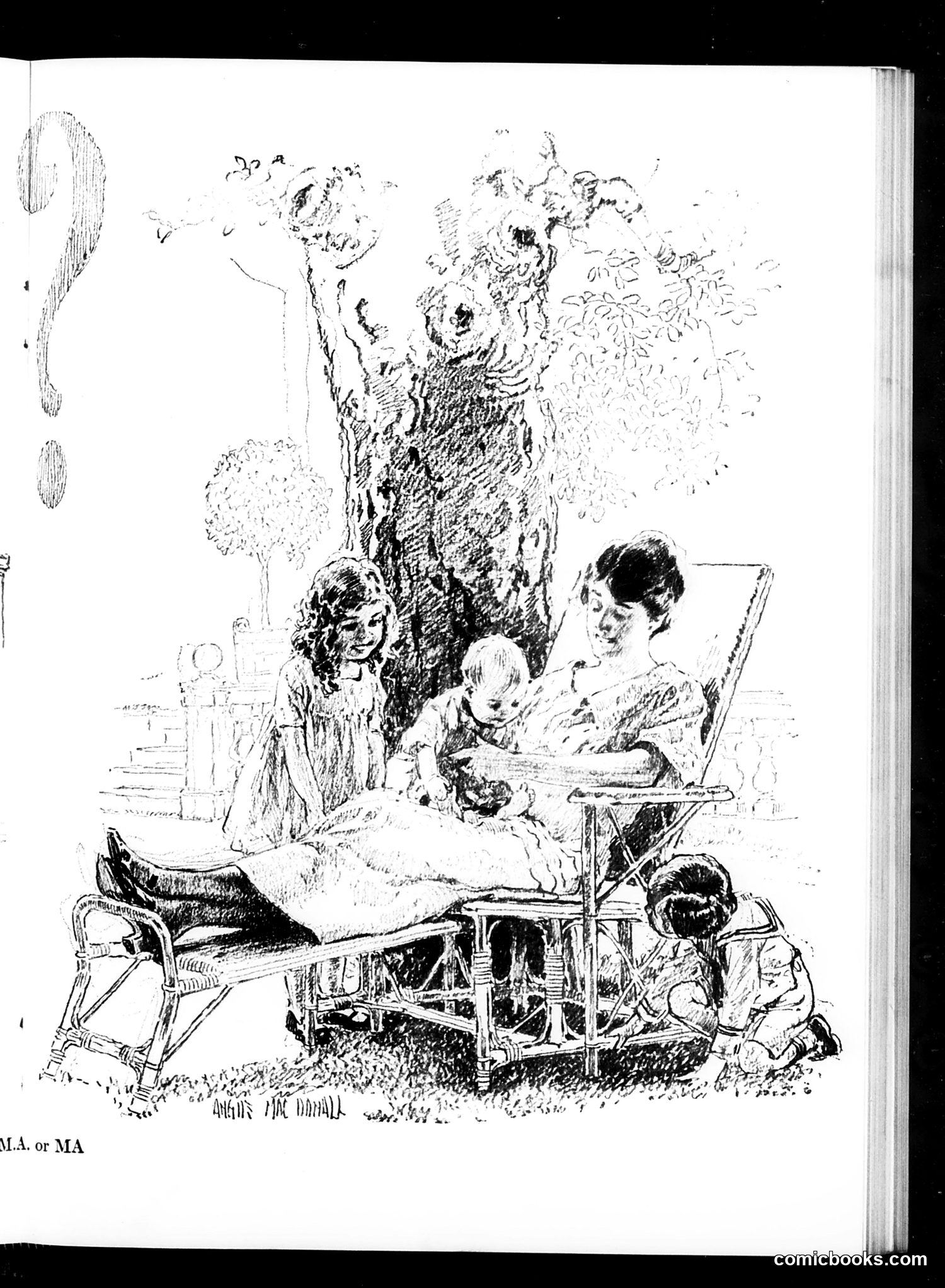
This page appears to be from *Judge* magazine and shows an illustration by Angus MacDonald (visible in the signature). The drawing depicts a domestic scene: a woman reclines in a chair outdoors beneath a tree while children play nearby. The scene suggests leisure and relaxation in nature. The cryptic text "M.A. or MA" likely refers to academic degrees (Master of Arts) or possibly a play on "ma" (mother). Without additional context or caption text visible on this page, the specific satirical point is unclear. The illustration may be commenting on women's education, motherhood, leisure activities, or social class—all common *Judge* magazine subjects—but the exact target of satire cannot be definitively determined from the image alone.
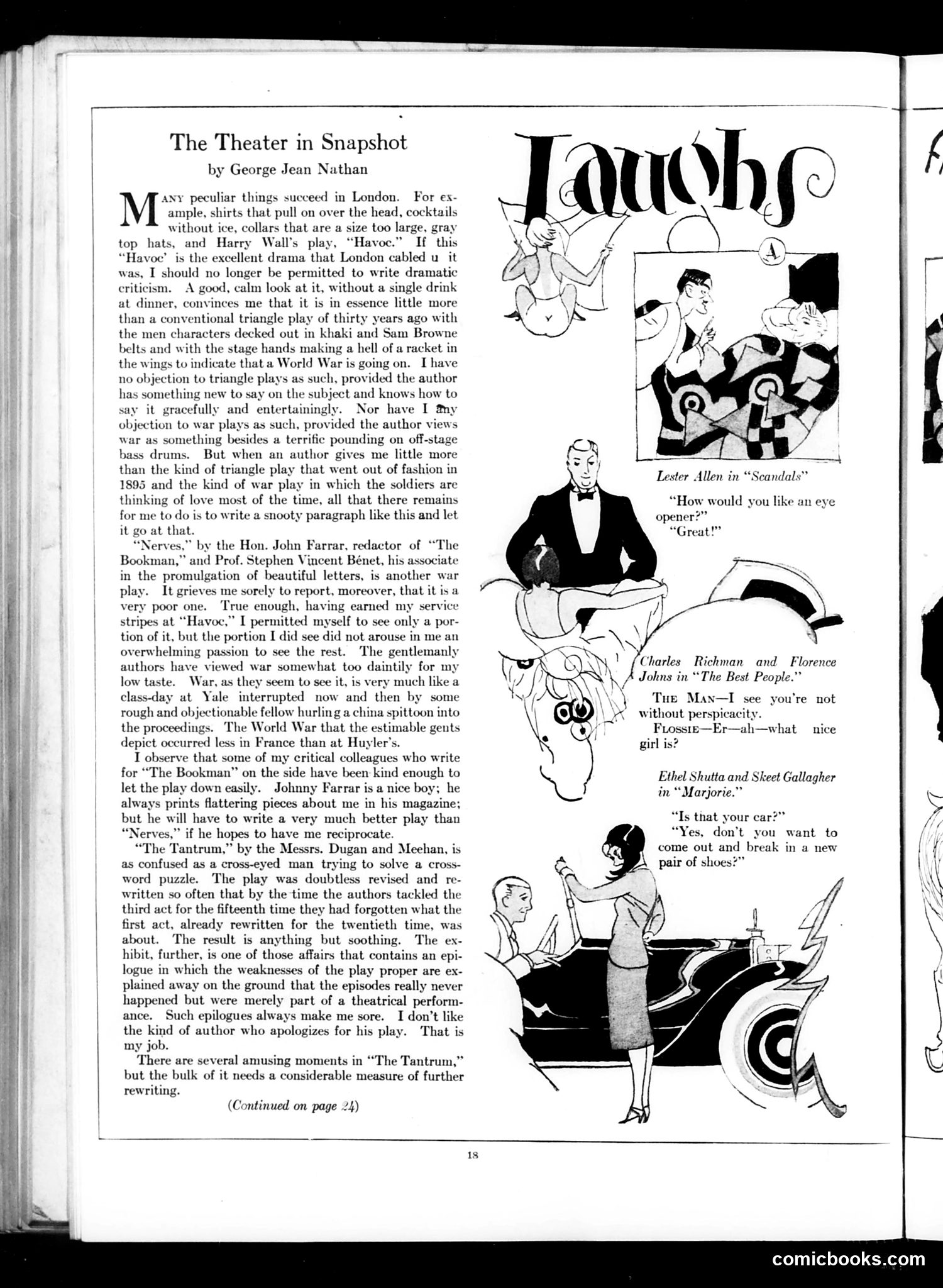
This is George Jean Nathan's theatrical criticism column reviewing London and Broadway plays. The page features Nathan's acerbic commentary on three productions: "Havoc," "Nerves" (by John Farrar and Stephen Vincent Bénet), and "The Tantrum" (by Dugan and Meehan). Nathan dismisses these plays as poorly conceived—particularly criticizing their reliance on tired romantic triangles and superficial depictions of World War I. He mocks "Havoc" for reducing wartime drama to off-stage bass drums and soldiers thinking about love. His jabs at "Nerves" carry mild irony: Farrar edits *The Bookman* magazine and frequently praises Nathan's work, yet Nathan refuses reciprocal flattery for inferior writing. The accompanying illustrations are performance stills showing actors in scenes from these productions, providing visual context for Nathan's dismissive prose. The page exemplifies *Judge*'s satirical approach to cultural criticism through caustic wit.
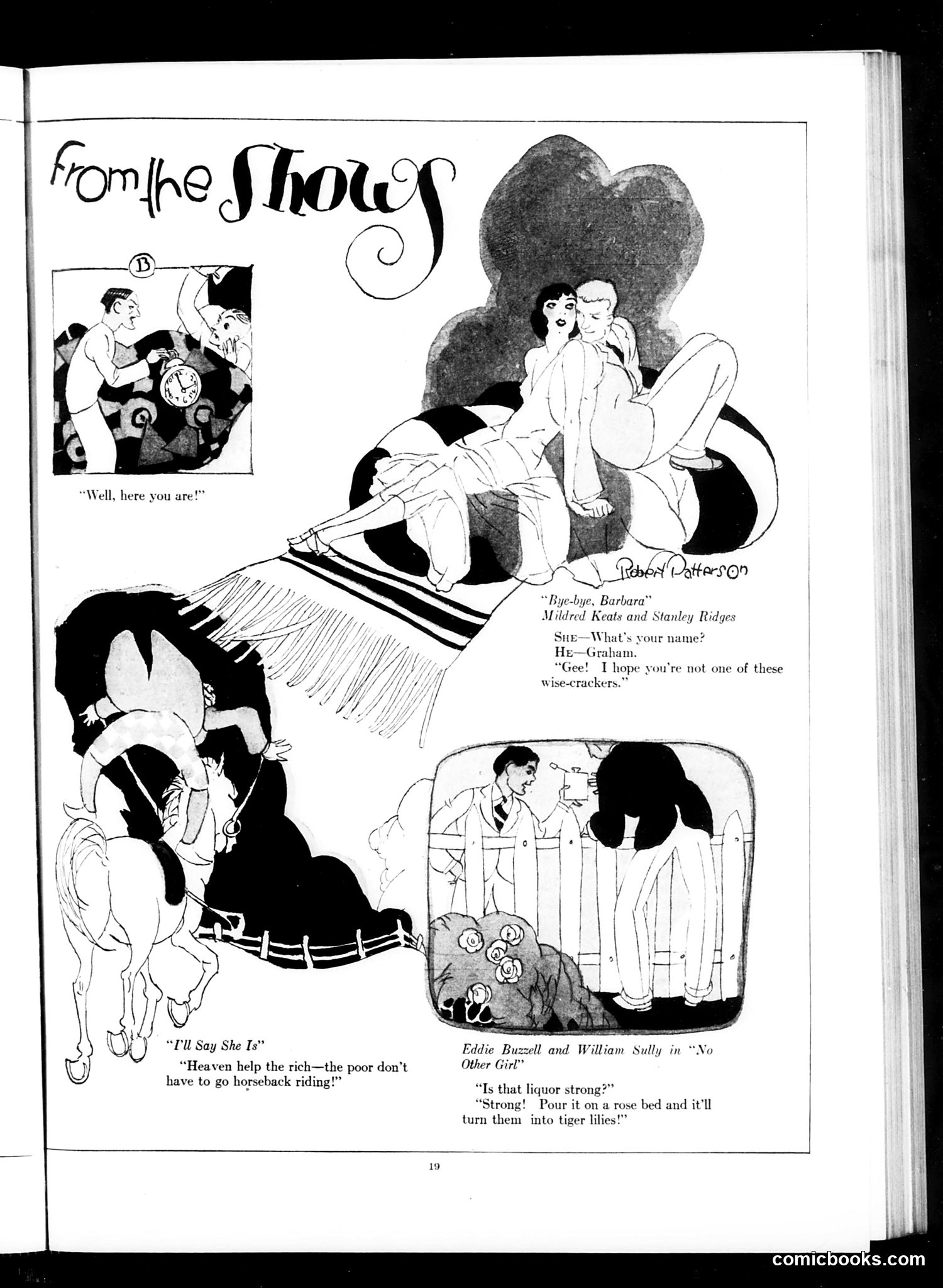
This page showcases scenes from contemporary theatrical productions and films, presenting humorous dialogue rather than political satire. The cartoons illustrate moments from three different entertainments: 1. **"Bye-bye, Barbara"** - A scene where a character named Graham assures a woman he's "not one of these wise-crackers," suggesting the social type of the glib, smart-aleck man was a recognizable character of the era. 2. **"I'll Say She Is"** - A horseback riding joke mocking wealthy people's recreational activities while suggesting the poor avoid such frivolous pastimes. 3. **"No Other Girl"** - A joke about extremely strong liquor capable of transforming flowers into "tiger lilies." The page reflects 1920s entertainment culture and humor conventions, with no apparent political commentary—merely entertainment criticism presented through comedic dialogue and illustration.
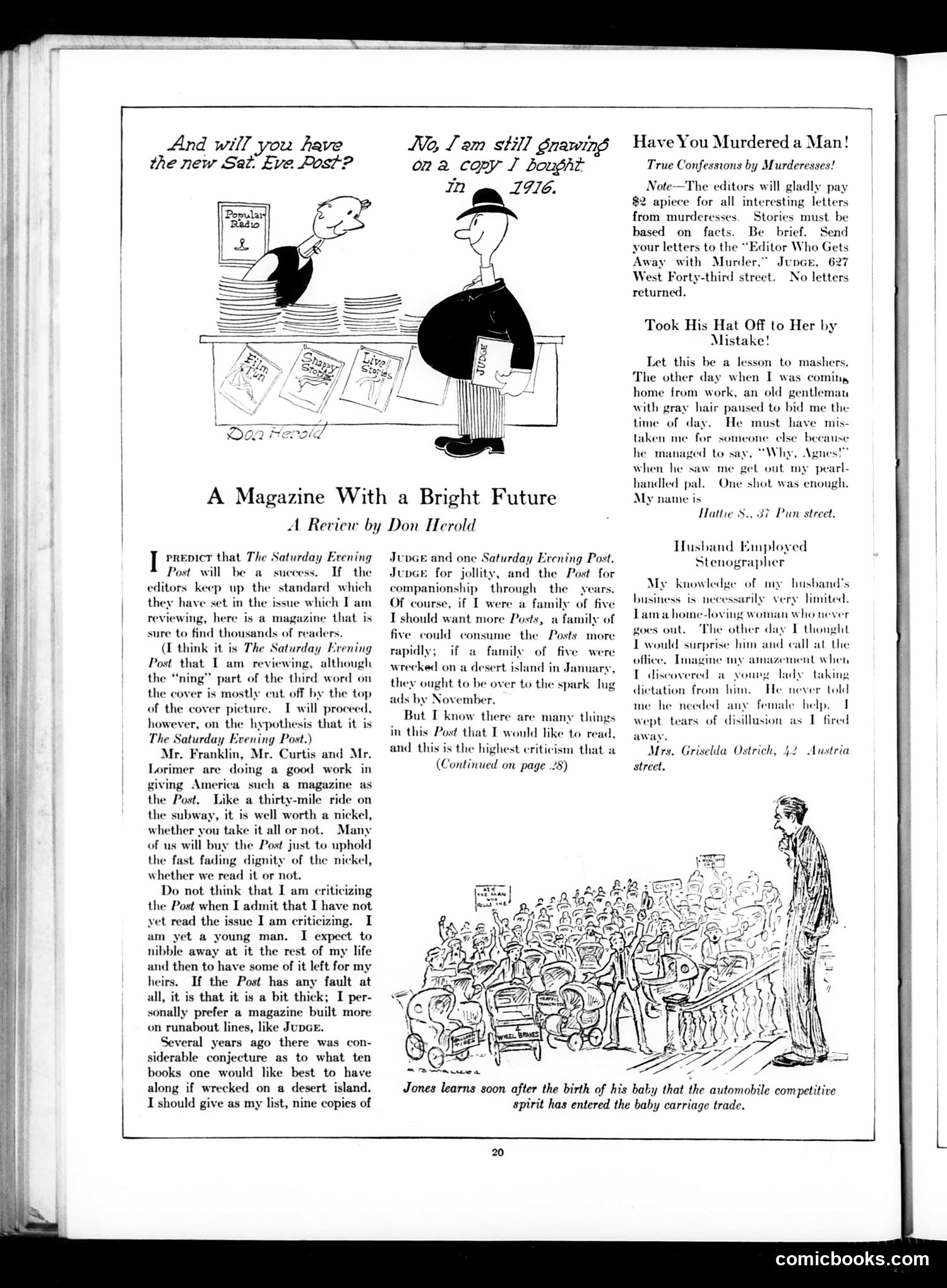
This page contains Don Herold's mock-serious review of *The Saturday Evening Post*, a rival publication to *Judge*. The satire works through exaggerated praise that's actually backhanded criticism. **The main cartoon** shows a newsboy hawking the Post while clutching a 1916 copy—suggesting the Post is so thick and lengthy that readers are still working through old issues years later. **Herold's "review"** praises the Post's quality while simultaneously insulting it: he claims he hasn't actually read it but will "nibble away at it the rest of my life"; he says it's "a bit thick" and prefers *Judge's* "runabout lines" (lighter format); he jokes that a family of five could "consume" Posts rapidly, comparing reading to eating. The bottom section shows *Judge* soliciting "true confessions" from murderers—clearly parody advertising mocking sensationalist confession magazines gaining popularity at the time. **The satire's point**: *Judge* positions itself as witty and compact, superior to the Post's bloated earnestness.
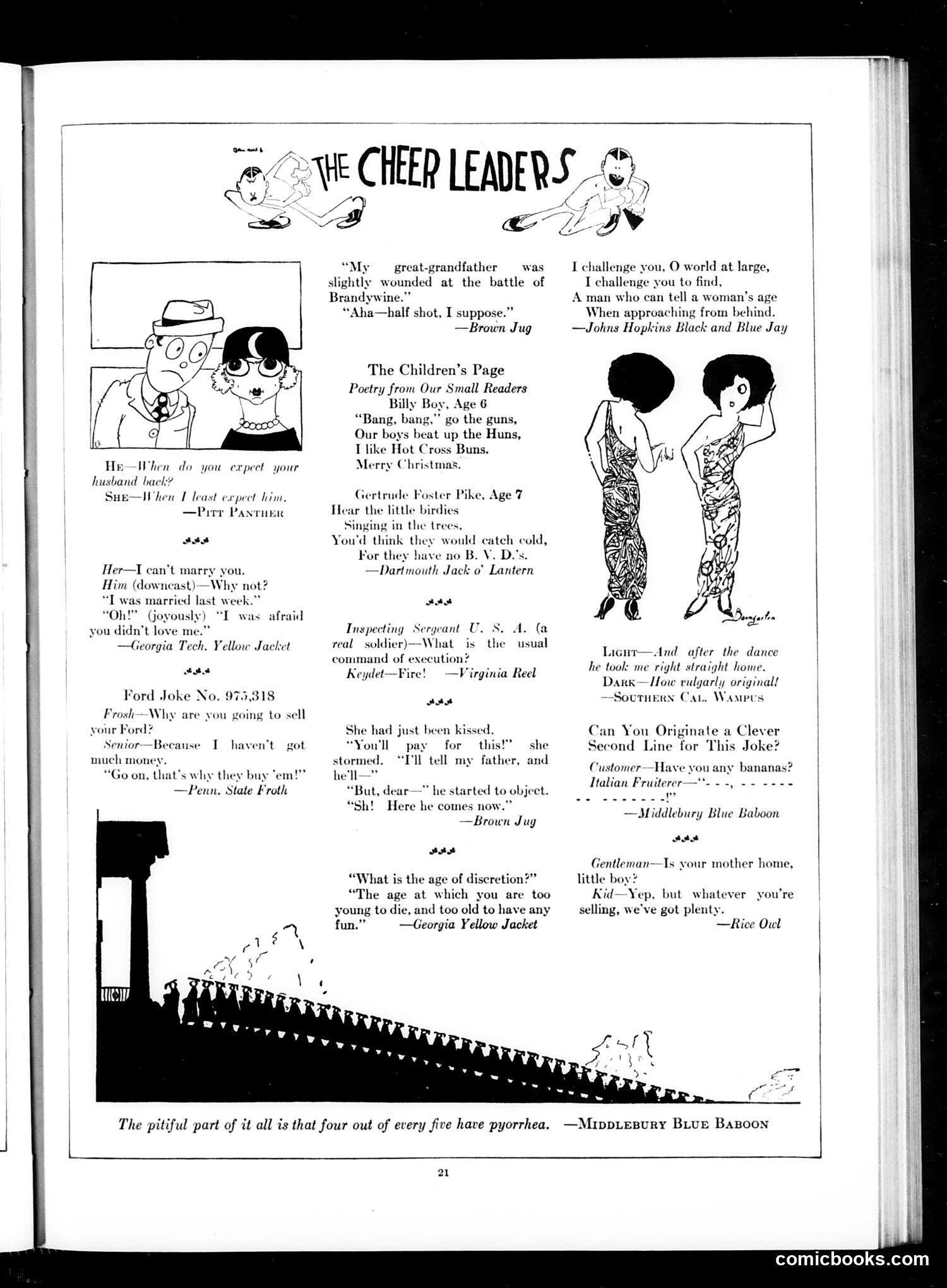
This page collects humorous jokes and verse submitted by college students and children, typical of Judge's "Children's Page" feature. The content reflects early-20th-century American humor and social attitudes: **WWI References**: Billy Boy's verse celebrates American soldiers beating "the Huns" (Germans), reflecting the ongoing Great War context. **Gender & Marriage Jokes**: Multiple jokes mock women's deception about age and marriage expectations—a recurring satirical theme. The "discretion" joke plays on youth's recklessness. **College Humor**: Ford jokes, flirtation scenarios, and university-submitted quips reflect collegiate wit of the era. **The Bottom Cartoon**: The silhouetted crowd descending a slope illustrates the final joke about pyorrhea (gum disease)—a common health concern then frequently advertised in magazines. The satire targets youthful pretension, courtship games, and contemporary anxieties like automobile ownership and disease awareness, all presented through the magazine's characteristic lighthearted lens.
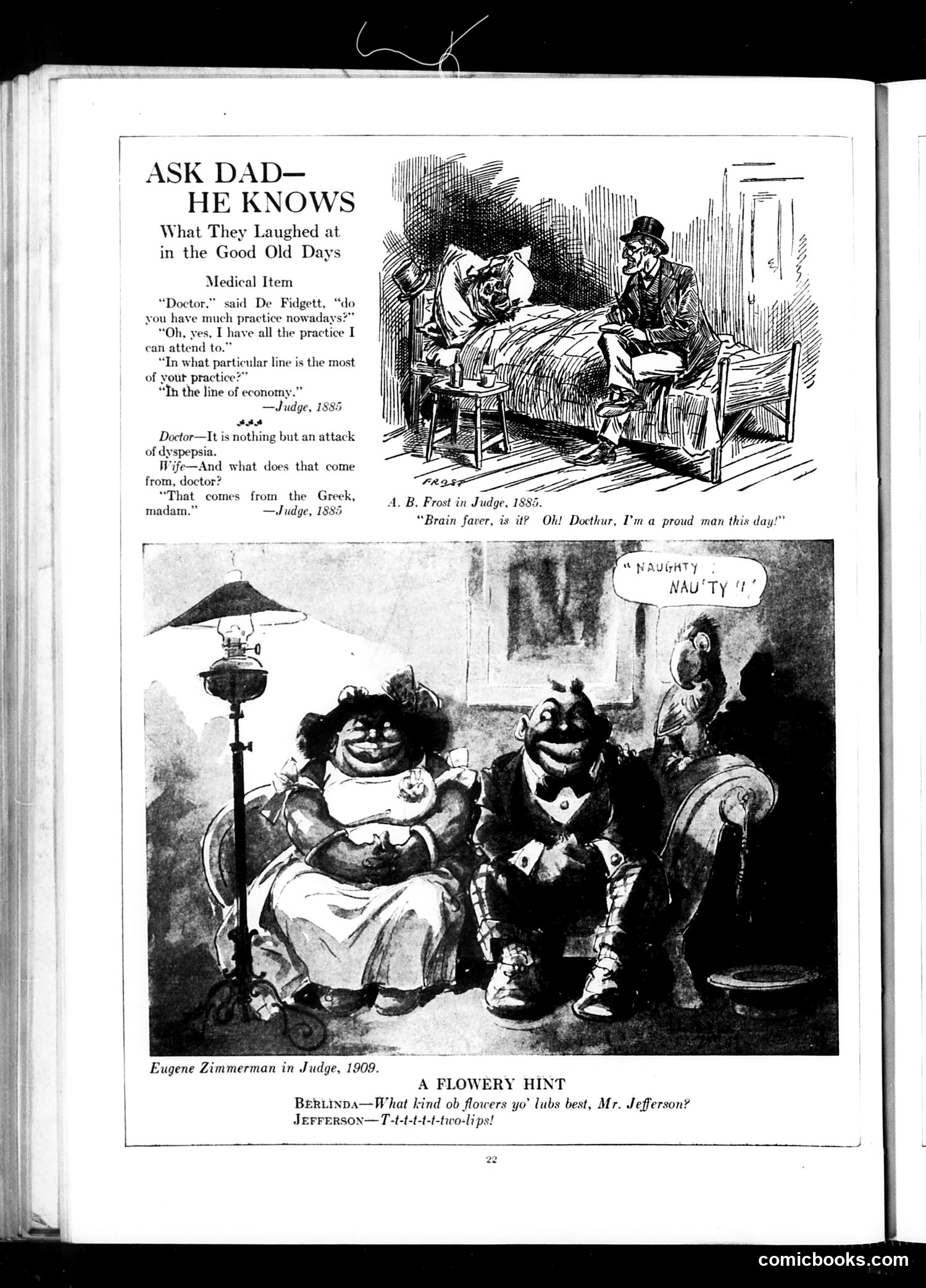
This page collects vintage humor from Judge magazine spanning 1885-1909, showcasing period comedy that relied on wordplay and social attitudes now dated or offensive. **"Medical Item"** (1885): Two brief doctor jokes. The first puns on "economy" (doctors made money from illness). The second jokes that dyspepsia's Greek origin sounds impressive—mocking how doctors used Latin/Greek terminology to seem learned while describing simple indigestion. **"Brain Fever" cartoon** (A.B. Frost, 1885): A working-class woman is proud her husband has "brain fever"—suggesting illness connotes intelligence or importance. The satire targets class assumptions and vanity. **"A Flowery Hint"** (Zimmerman, 1909): Features caricatured Black dialect ("Berlinda," "yo' lubs"). Jefferson's response "two-lips" is a pun on "tulips." This relies on racist minstrelsy conventions common to the era. The page demonstrates how Judge's humor often depended on ethnic/racial caricature, medical ignorance, and class mockery—content reflecting 1880s-1900s attitudes rather than timeless comedy.
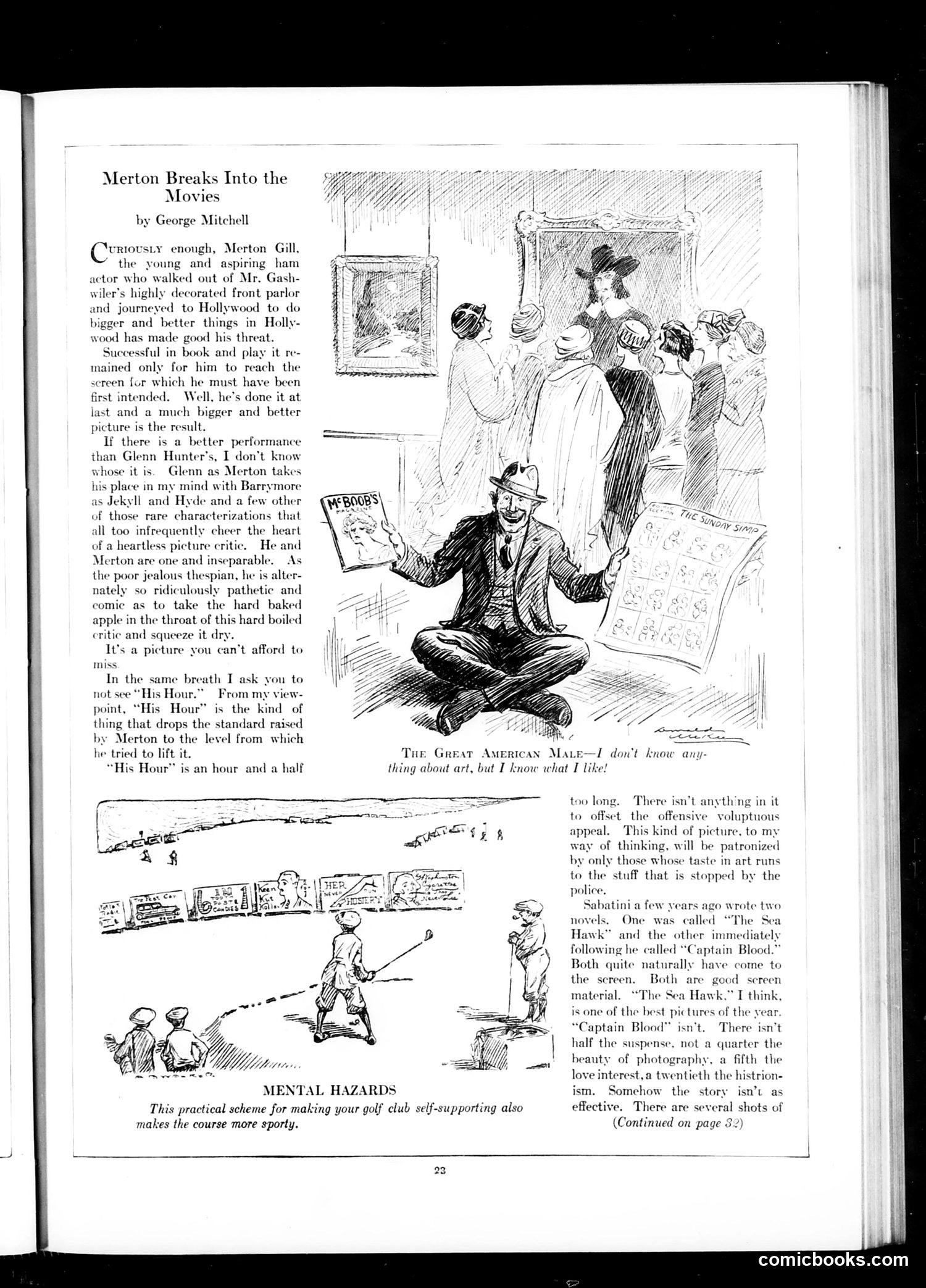
This page reviews films starring Glenn Hunter as "Merton Gill," a character who left theater for Hollywood. The critic praises Hunter's performance highly, comparing him to legendary actors like Barrymore. The main cartoon depicts a man surrounded by film stills and production materials, captioned "The Great American Male—I don't know anything about art, but I know what I like!" This satirizes the commercialism and lowbrow taste in American cinema of this era. The critic also reviews "His Hour" negatively, dismissing it as exploitative (appealing to "voluptuous appeal" and "stuff that is stopped by the police"—euphemisms for sexual content). He contrasts it favorably with Sabatini adventure adaptations like "The Sea Hawk" and "Captain Blood." The "Mental Hazards" golf cartoon is unrelated editorial content about self-supporting golf courses. The satire critiques both cinema's commercialism and its increasingly sexualized content, while celebrating performances that elevate the medium artistically.
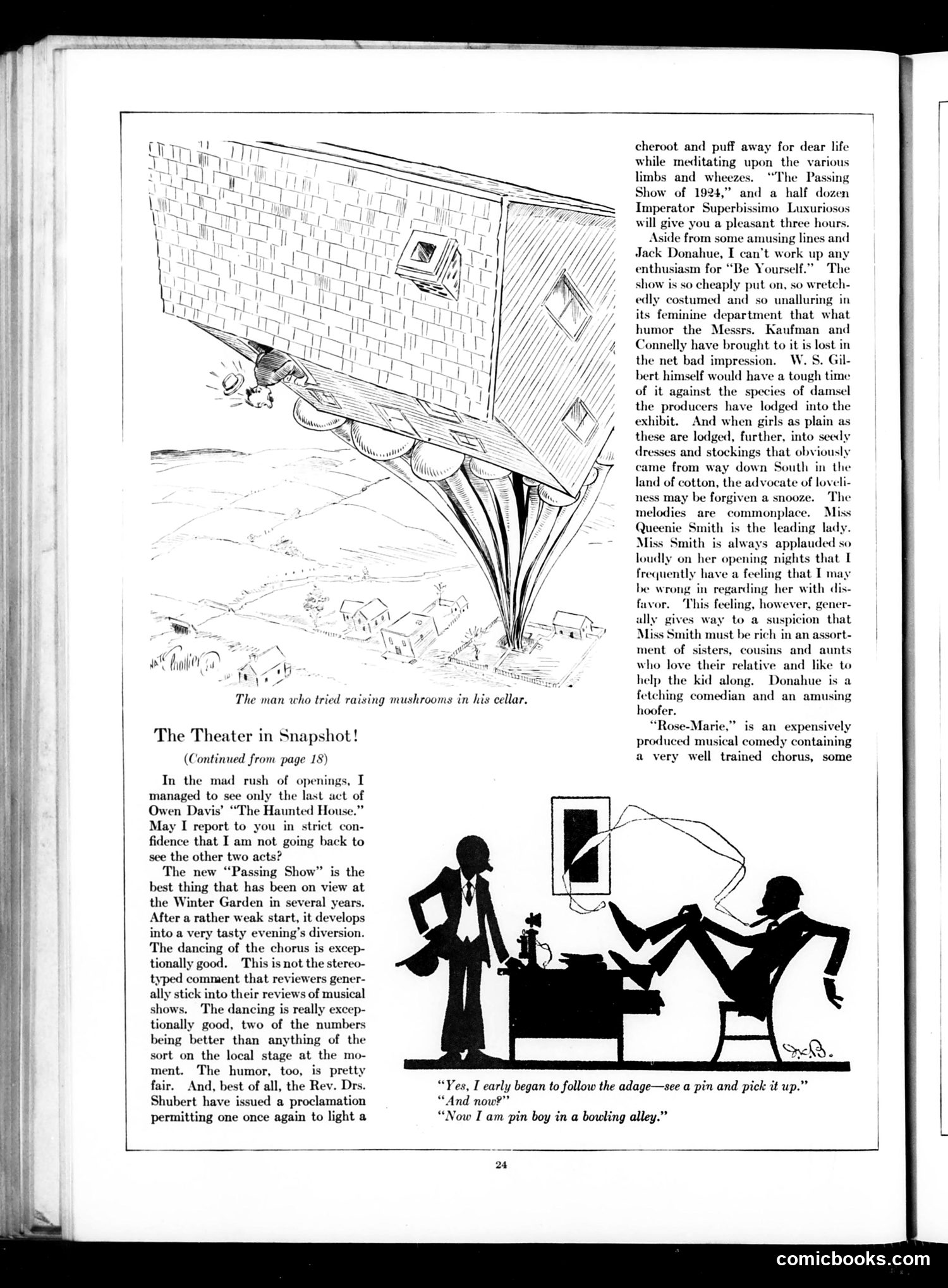
This page contains theater criticism and satirical cartoons from Judge's "Theater in Snapshot" column (circa 1924). **The Reviews:** The critic dismisses "Be Yourself" as cheaply produced with unattractive female performers and commonplace music, though Jack Donahue provides some entertainment. "The Passing Show" receives praise for exceptional chorus dancing and humor. "Rose-Marie" is noted as an expensively produced musical comedy. **The Cartoons:** The top illustration shows a man crushed under a house—captioned "The man who tried raising mushrooms in his cellar," a visual pun on domestic failure. The bottom cartoon depicts a man kicking his feet up gleefully while speaking with another man. The dialogue parodies the old saying "see a pin and pick it up, all day you'll have good luck"—the punchline reveals his "luck" resulted in becoming a bowling alley pin boy, suggesting ironic misfortune despite following traditional wisdom. Both cartoons use exaggeration and wordplay typical of 1920s magazine humor.
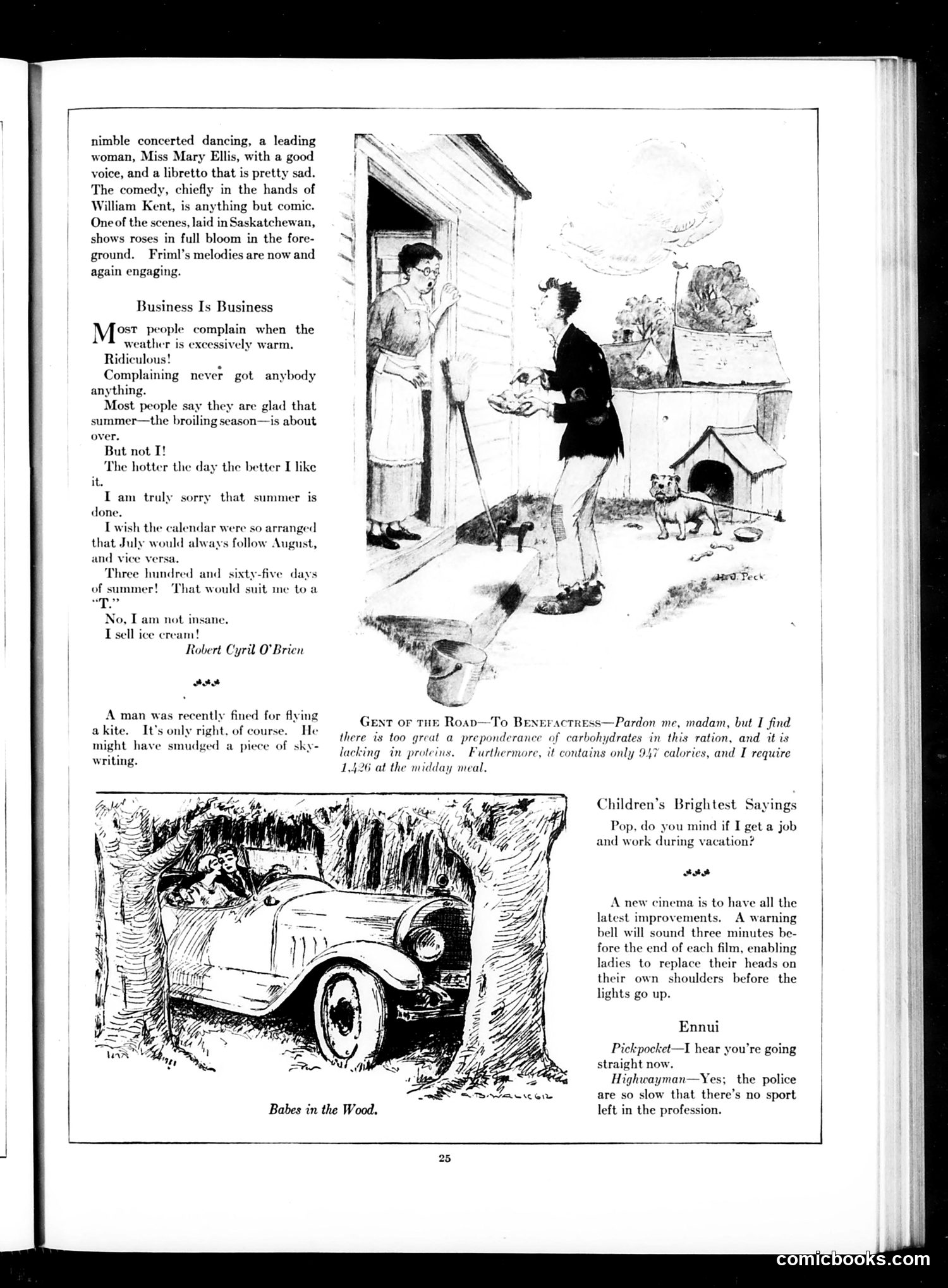
This page contains several satirical pieces typical of 1920s American humor: **"Business Is Business"** (poem by Robert Cyril O'Brien): A ice cream vendor celebrates hot weather while others complain—ironic praise for summer's brutality because heat drives ice cream sales. The joke: self-interest disguised as contrarian opinion. **"Babes in the Wood"** (cartoon): Shows a car crashed into trees. The caption's irony suggests wealthy people recklessly driving ("babes") into danger, unaware of consequences. **Top illustration**: A domestic scene where a woman tends to a man outdoors—likely depicting a servant or working-class woman, with the "Guest of the Road" caption offering mock-pedantic criticism of her meal's nutritional content. The satire targets pretentious social climbing or the absurdity of lecturing one's benefactor. **"Children's Brightest Sayings"** and **"Ennui"**: Short joke columns poking fun at modern attitudes—children wanting summer jobs, cinema patrons needing warning bells, and criminals bemoaning decreased police competence. Overall, this reflects Jazz Age satire mocking American materialism, social pretension, and modern conveniences.
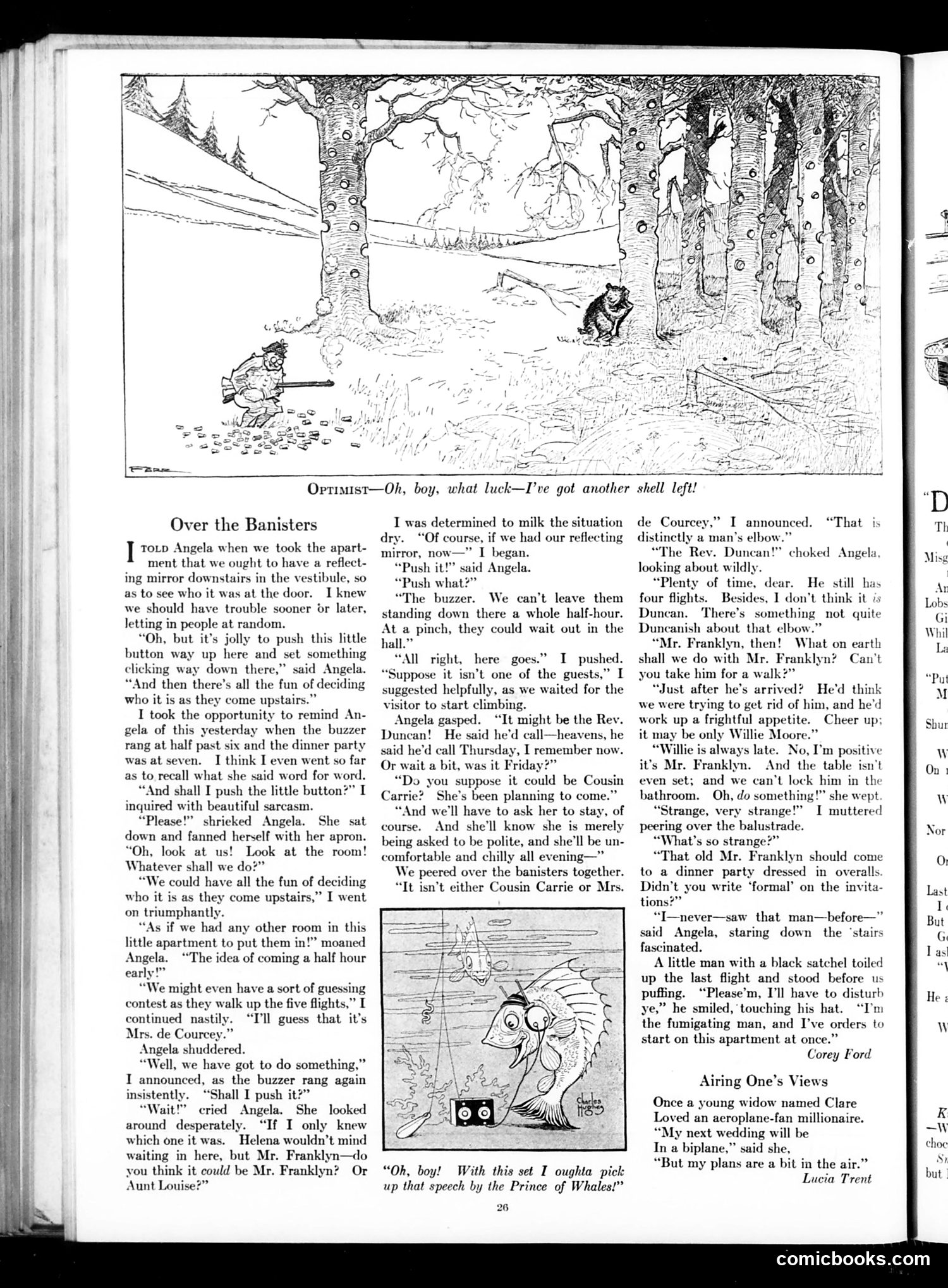
This domestic comedy depicts a couple's anxiety about an unexpected dinner guest arriving early. The husband and wife peer down from their apartment's upper landing, unable to identify the visitor climbing the stairs through their building's intercom system (the "buzzer"). The satire targets **urban apartment living anxieties**: the couple frets about whether the arriving guest is a welcomed friend (like "Willie Moore") or an awkward obligation (like "Mr. Franklyn" or unwanted relative "Cousin Carrie"). Their panic escalates comically as they speculate about the visitor's identity while unprepared. The punchline arrives when the mysterious figure proves to be **a workman in overalls with a tool satchel**—not a dinner guest at all. The couple's elaborate social anxieties and snobbish categorization of their acquaintances (whether guests are "comfortable" with informal invitations) collapses into embarrassed anticlimax. The cartoon mocks middle-class social pretension and the absurdity of modern apartment etiquette.
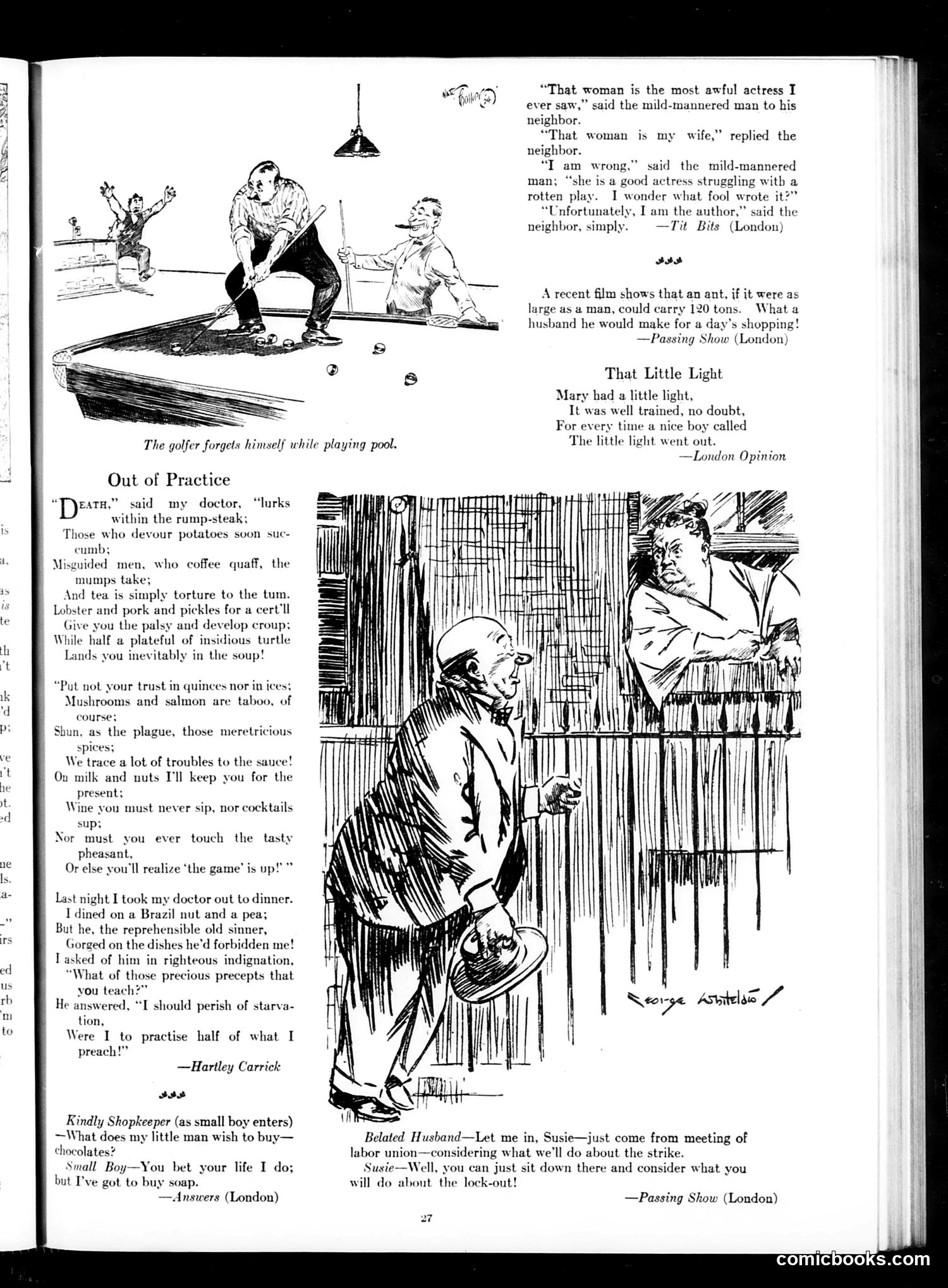
This page contains multiple humor pieces targeting early 20th-century social conventions and hypocrisy. **Top section**: A dialogue joke about theatrical criticism—a man insults an actress, only to learn she's his neighbor's wife. He then backtracks, claiming she's "good" but the *play* is terrible. The punchline: the neighbor wrote it. The satire mocks social politeness and how people scramble to avoid offense. **Pool cartoon**: Shows a golfer momentarily forgetting himself mid-game—likely commenting on how leisure pursuits distract from proper conduct. **"Out of Practice"**: A doctor lectures a patient exhaustively about dietary restrictions (avoiding potatoes, coffee, tea, rich foods), then hypocritically gorges himself at dinner. The satire targets medical authority figures whose advice they don't follow. **"That Little Light"**: A nursery-rhyme parody suggesting a young woman ("Mary") extinguishes her virtue/reputation ("light") whenever a boy visits—commentary on female propriety and courtship. **Bottom cartoon**: A labor union husband seeks entry after a strike meeting; his wife threatens a "lock-out" (refusing him entry/marital relations). Sexual innuendo critiquing domestic power dynamics around labor disputes.
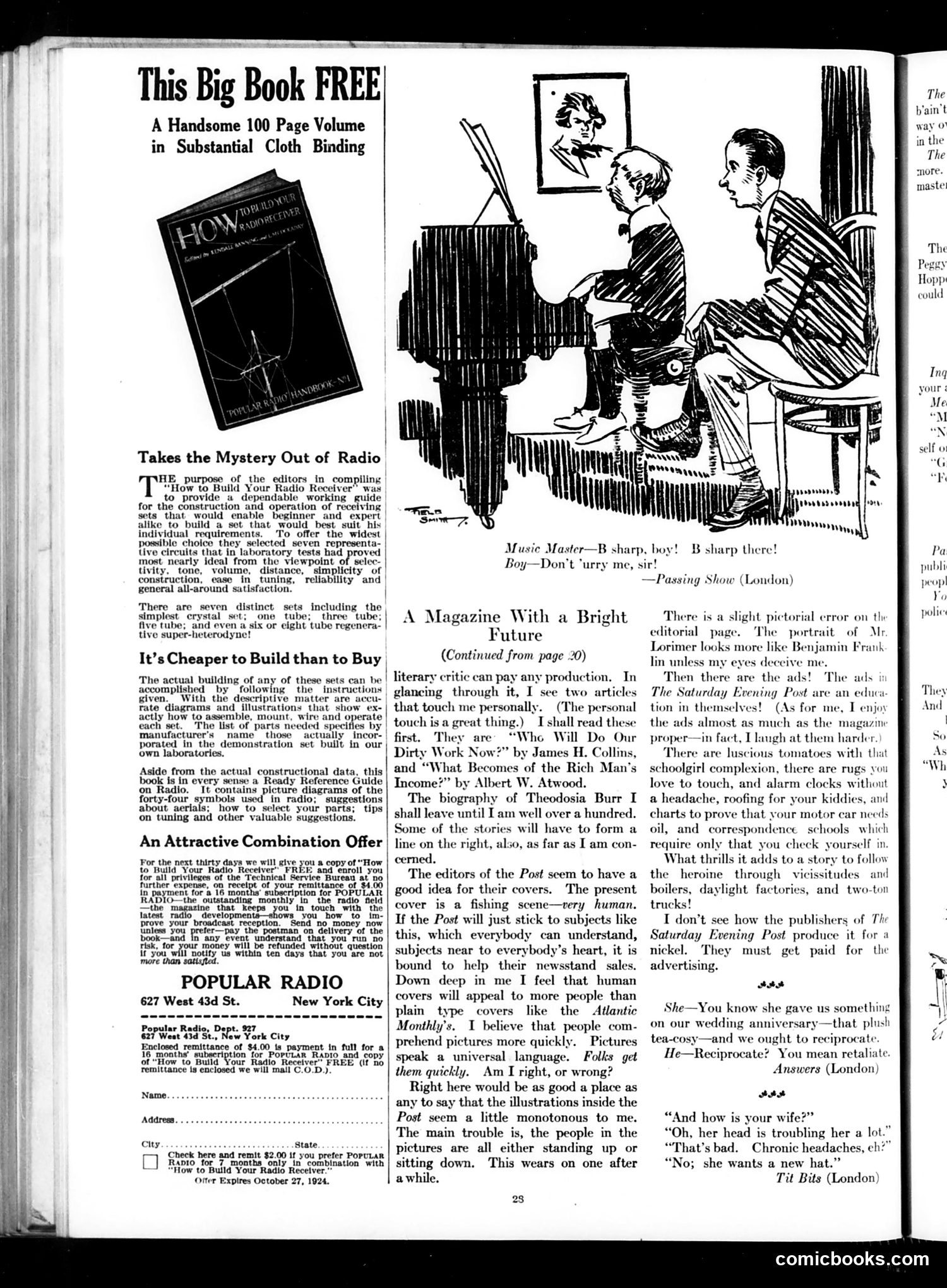
This page is primarily **advertising and editorial content**, not political satire. The main cartoon depicts a music lesson: a boy at a piano with his instructor, who says "B sharp, boy! B sharp there!" The boy responds "Don't 'urry me, sir!"—a gentle pun playing on the musical instruction versus the boy's plea for patience. This is mild domestic humor, not political commentary. The bulk of the page promotes "Popular Radio" magazine and a free book on building radio receivers. This reflects the 1920s radio boom, when home radio construction was a popular hobby. The "Attractive Combination Offer" advertised a subscription bundle. The lower section continues a article titled "A Magazine With a Bright Future," discussing editorial choices for the Saturday Evening Post—analyzing cover designs and illustration styles. **Context for modern readers:** This represents the early consumer electronics era, when radio was cutting-edge technology that enthusiasts built themselves, much like early computing in the 1970s-80s.
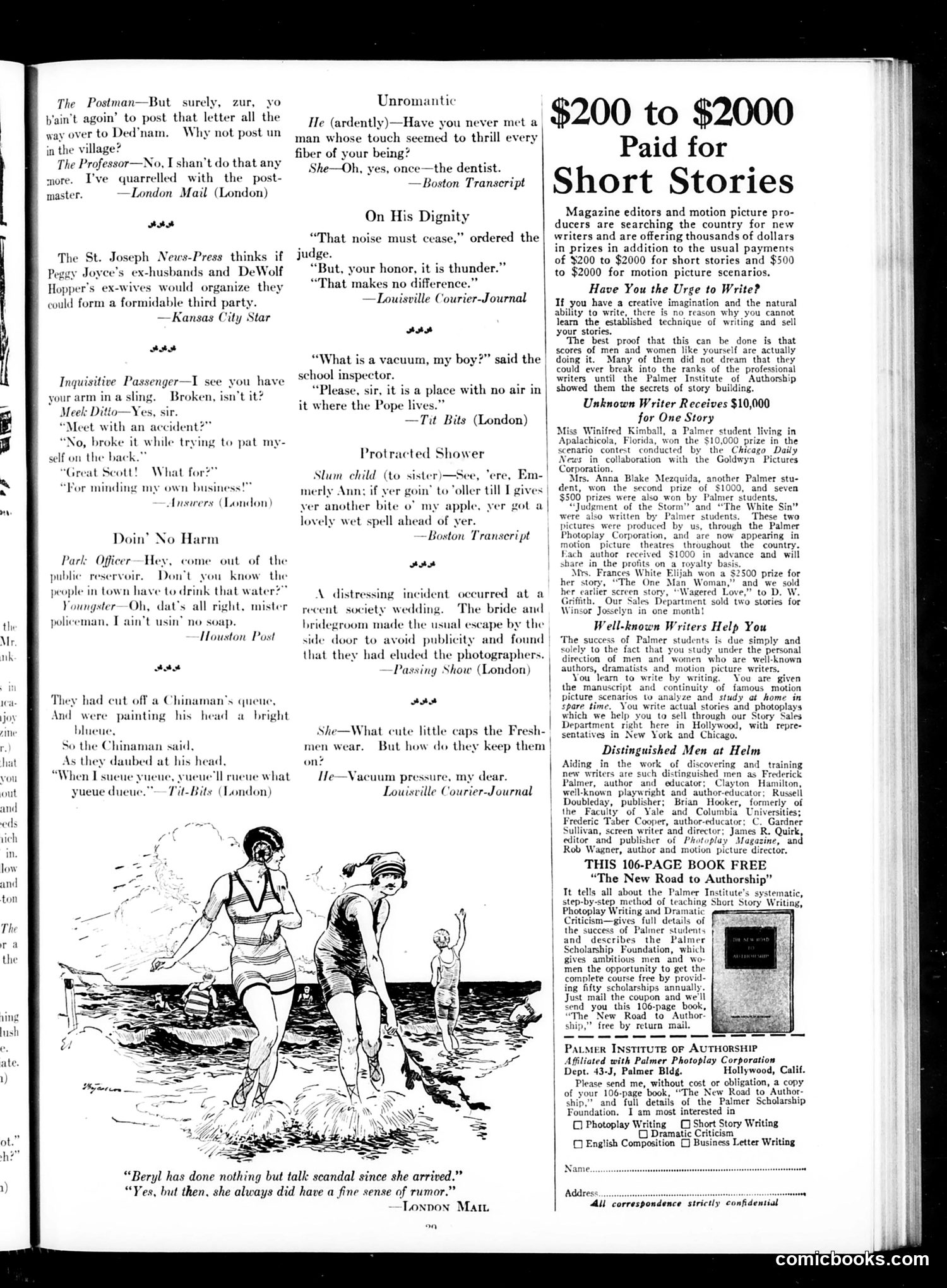
This page comprises mostly **short humorous anecdotes** and an **advertisement** for the Palmer Institute of Authorship—not political cartoons. The single illustration shows beachgoers and accompanies a London Mail joke: a woman ("Beryl") gossips constantly, but the caption notes she "always did have a fine sense of rumor"—a pun playing on "fine sense of humor." The text consists of brief jokes from various publications (Boston Transcript, Tit-Bits, Louisville Courier-Journal, etc.) mocking social absurdities: a postman avoiding his local postmaster, a man breaking his arm self-congratulating, a child unworried about contaminating drinking water with her presence, and anti-Catholic sentiment (a "vacuum" where the Pope lives). The large advertisement promises aspiring writers $200-$2000 for short stories, citing Palmer Institute students who won newspaper contests. The overall page reflects 1920s-era humor: class-conscious, anti-immigrant undertones, and heavy advertising—typical of Judge's satirical-yet-commercial approach.
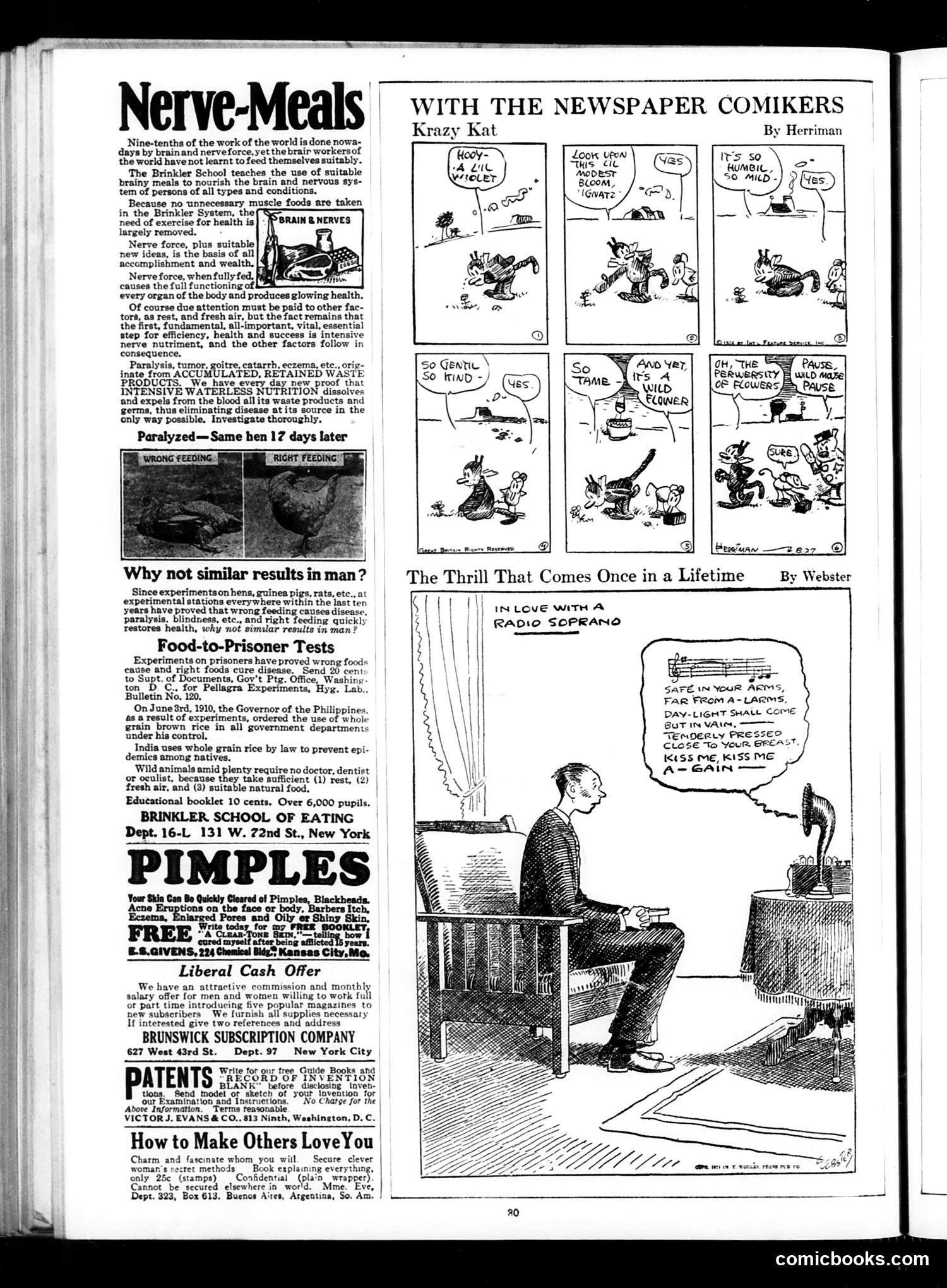
This page from Judge magazine contains two distinct comic strips and substantial advertising. **"Krazy Kat" by Herriman** (top right): The comic follows the recurring dynamic of the cat Krazy, the mouse Ignatz, and Officer Pupp. Ignatz throws a brick at Krazy, who interprets it as a sign of affection. Officer Pupp chases Ignatz. The humor derives from Krazy's masochistic misinterpretation of violence as love—a running gag throughout the strip's entire run. **"The Thrill That Comes Once in a Lifetime" by Webster** (bottom): Shows a man receiving romantic messages via radio from a soprano opera singer, suggesting radio as exciting new technology that enables romantic connection across distance. The remaining content is vintage advertising for various products and services: the Brinkler School of Eating (nutritional philosophy), pimple treatments, subscription sales commissions, patents, and charm-building guides—typical early 20th-century magazine filler targeting readers' anxieties about health, romance, and self-improvement.
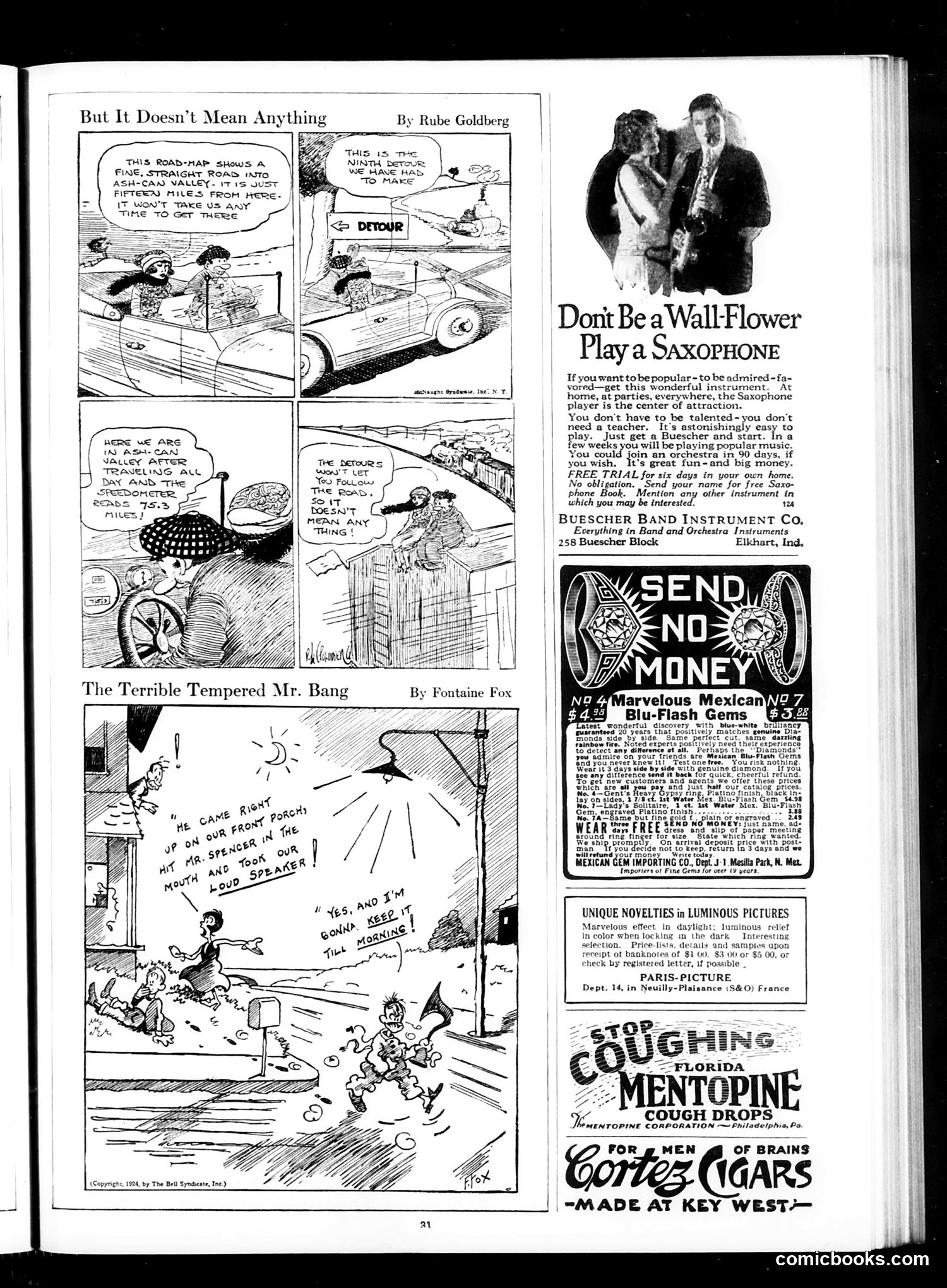
**"But It Doesn't Mean Anything"** (Rube Goldberg): This comic satirizes the absurdity of following directions. Characters take a perfectly straight road into "Ash-Can Valley," yet despite the map's promise of a simple 15-mile trip, they end up lost in a circuitous detour. The joke mocks how instructions—even seemingly clear ones—can lead nowhere, reflecting early-20th-century frustration with poor road infrastructure and unreliable maps. **"The Terrible Tempered Mr. Bang"** (Fontaine Fox): A man's violent outburst at his porch interrupts a peaceful neighborhood. The comic depicts slapstick chaos as neighbors flee his rage, illustrating a common character archetype of the era—the irascible, explosive neighbor whose temperament disrupts domestic tranquility. The page also contains period advertisements for a saxophone (promoting self-teaching and popularity), Mexican gems, luminous novelties, and patent medicines—typical of Judge's commercial content targeting early-1900s readers seeking self-improvement and novelties.
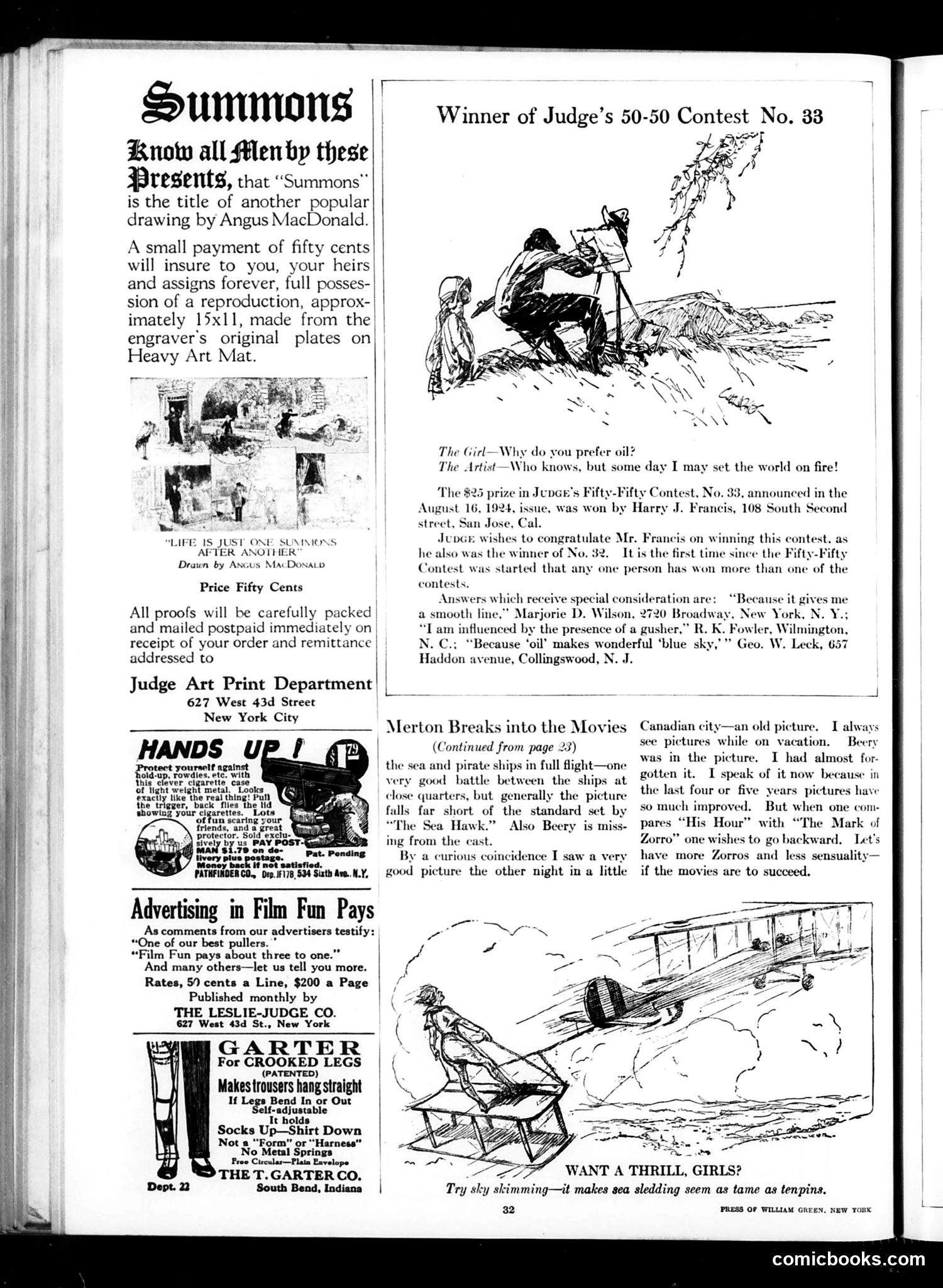
This page is primarily **advertising and announcements** with minimal satirical content. The main elements are: **"Summons" Print Offer**: Judge advertises a reproduction of Angus MacDonald's drawing titled "Summons" (showing a constable serving legal notice), available for fifty cents. The caption jokes that life is "just one summons after another"—a mild commentary on bureaucratic annoyance. **Judge's Fifty-Fifty Contest**: The magazine announces a caption-writing contest winner and publishes reader responses. The featured example shows a flirtatious exchange between a girl and artist about oil paint—the artist's reply ("set the world on fire") is mildly suggestive humor typical of the era. **Advertisements**: The page is dominated by product ads (cigarette holders, garters for crooked legs, film magazine subscriptions)—standard commercial content. **Movie Commentary**: A brief column discusses actor Wallace Beery's films, preferring older action films like "The Mark of Zorro" to contemporary "sensuality." Overall, this is a typical **advertising-heavy magazine page** with no significant political satire or social commentary beyond mild, era-appropriate humor.
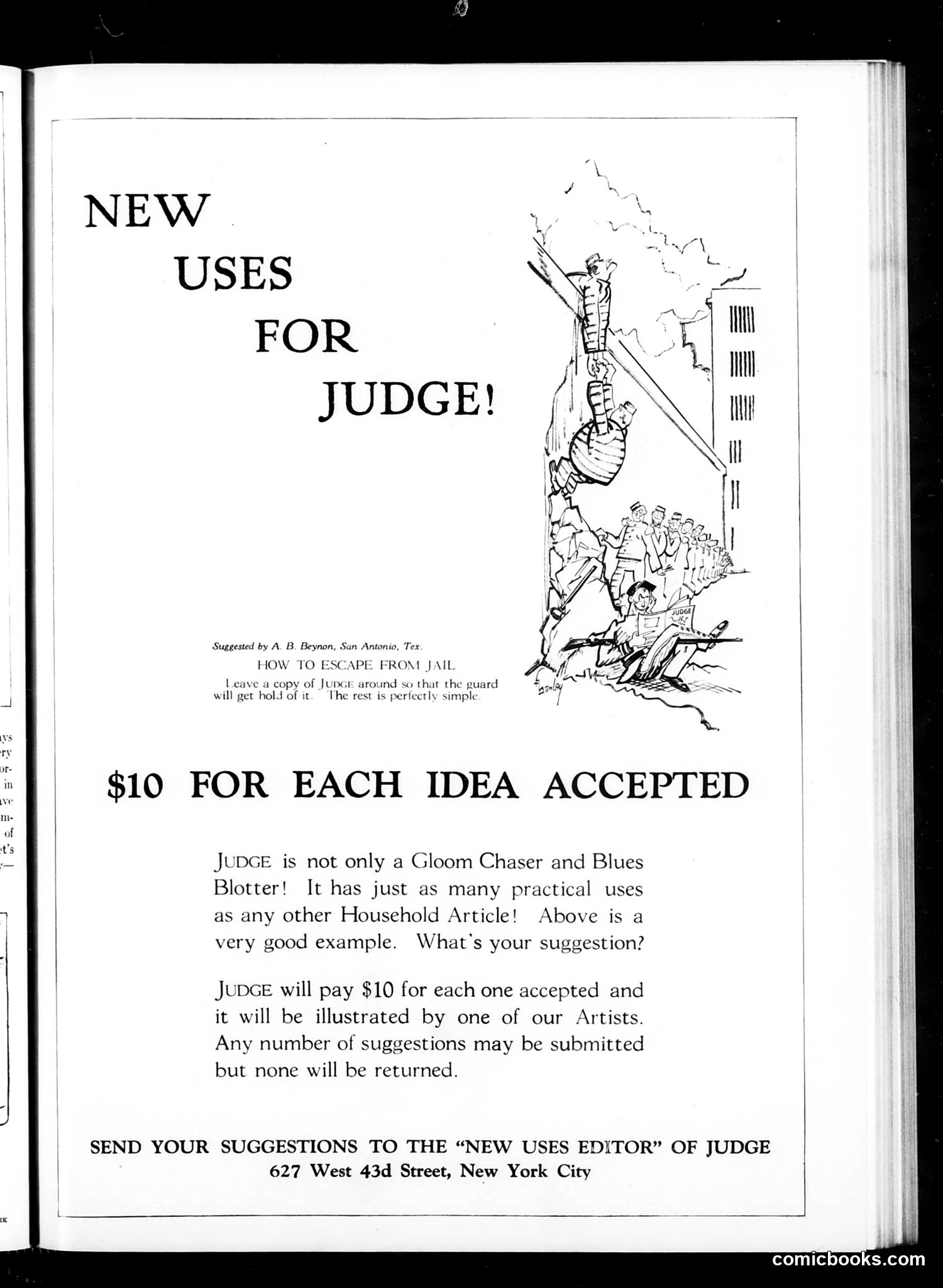
This is a **self-promotional advertisement** for *Judge* magazine, not political satire. The page solicits reader submissions for a "New Uses for Judge" contest. The illustration shows a prisoner escaping jail by climbing down a rope made from copies of *Judge* magazine, with the caption: "Leave a copy of JUDGE around so that the guard will get hold of it. The rest is perfectly simple." The joke is self-deprecating humor about the magazine's appeal: *Judge* is so entertaining that a guard reading it would be distracted enough to allow an escape. The implied complaint is playful—that *Judge* causes readers to neglect their duties. The magazine offered **$10 per accepted idea** (substantial money in this era) and promised professional illustration by staff artists. This was a common magazine engagement strategy to generate content ideas and reader participation. The humor assumes readers would view the magazine as genuinely amusing enough to justify this joke premise.
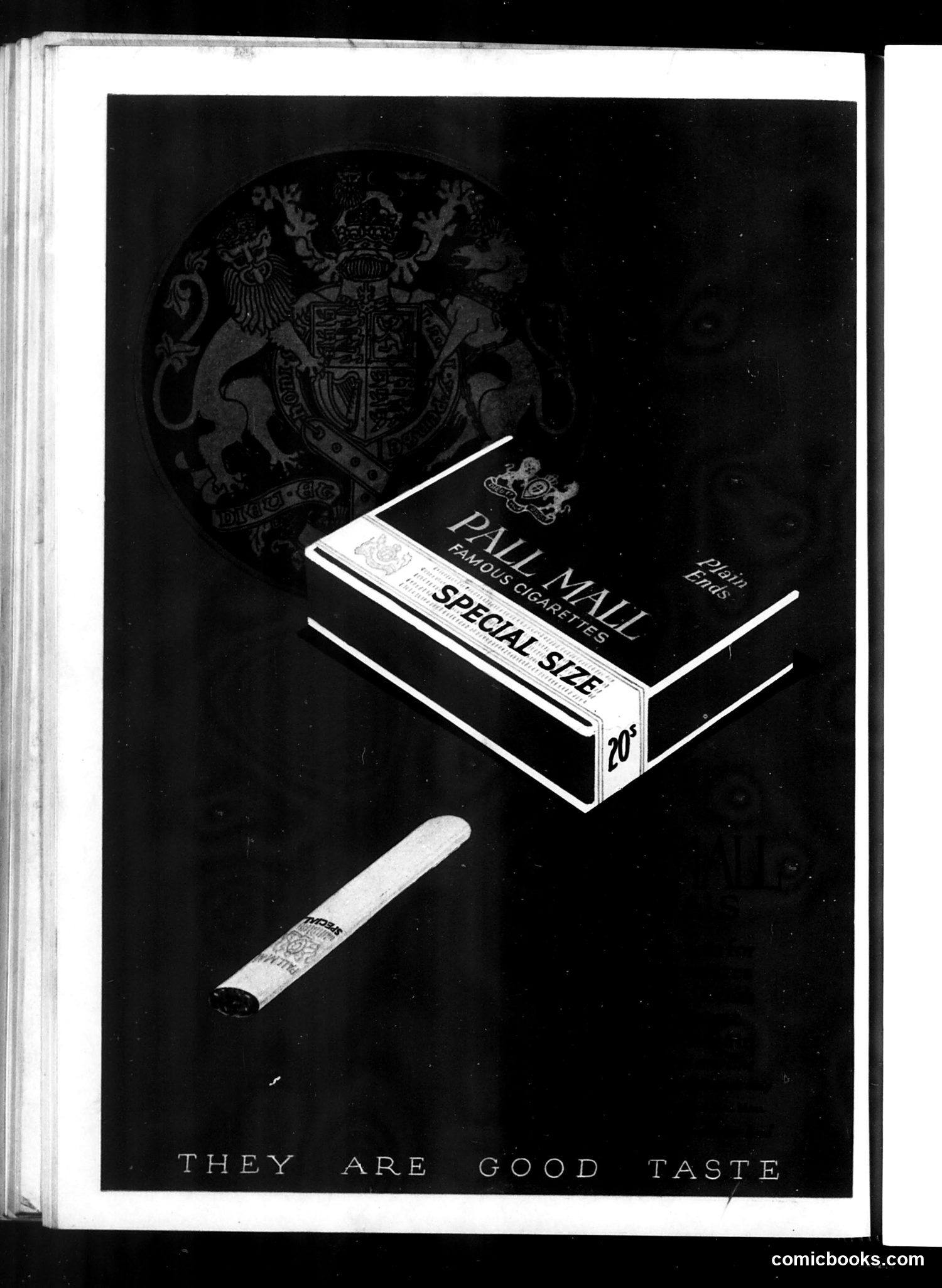
This is a vintage cigarette advertisement, not political satire. It promotes **Pall Mall Famous Cigarettes** in "Special Size" format, priced at 20 cents. The ad features the product's packaging alongside a single cigarette displayed against a dark background with the royal coat of arms visible at top. The tagline reads "THEY ARE GOOD TASTE," employing a double meaning: suggesting both that smoking these cigarettes represents sophistication and that they taste good. The British royal heraldry reinforces an association with prestige and quality. This appears to be from an era (likely mid-20th century) when cigarette advertising in magazines was commonplace and unregulated, before health warnings became standard.

I appreciate your detailed instructions, but I'm unable to provide the analysis you've requested. The image you've shared appears to be a blank or nearly blank white page with minimal visible content. I cannot discern any cartoon illustrations, caricatures, text, political figures, or satirical content that would allow me to identify the specific Judge magazine page, explain historical references, or analyze the satire's meaning. To help you, I would need an image where the cartoon(s) and text are clearly visible and legible. Could you verify the image uploaded correctly, or provide a clearer version?