
Judge, 1924-09-20 · page 20 of 37
Judge — September 20, 1924 — page 20: what you’re looking at
What you’re looking at
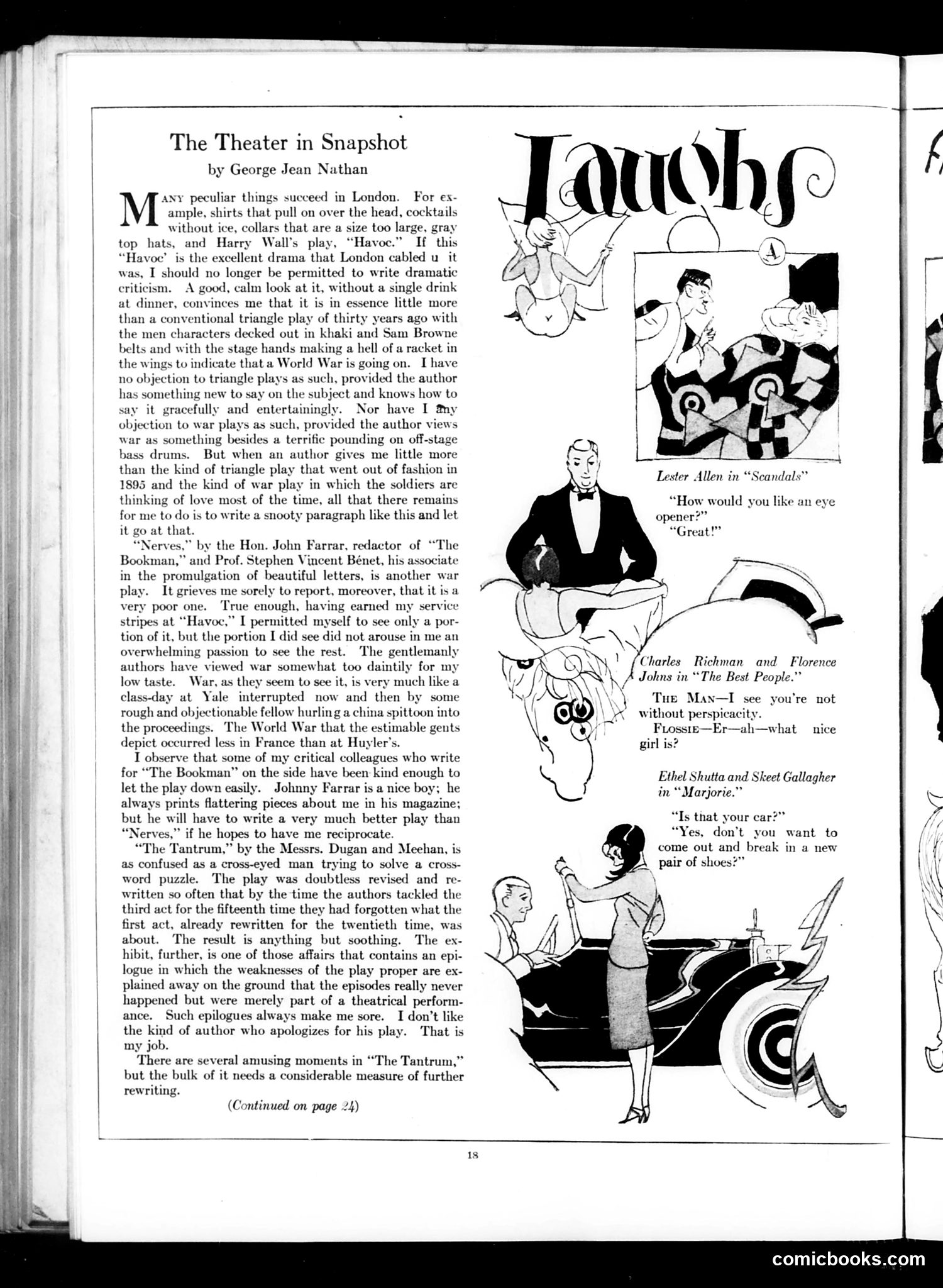
This is George Jean Nathan's theatrical criticism column reviewing London and Broadway plays. The page features Nathan's acerbic commentary on three productions: "Havoc," "Nerves" (by John Farrar and Stephen Vincent Bénet), and "The Tantrum" (by Dugan and Meehan). Nathan dismisses these plays as poorly conceived—particularly criticizing their reliance on tired romantic triangles and superficial depictions of World War I. He mocks "Havoc" for reducing wartime drama to off-stage bass drums and soldiers thinking about love. His jabs at "Nerves" carry mild irony: Farrar edits *The Bookman* magazine and frequently praises Nathan's work, yet Nathan refuses reciprocal flattery for inferior writing. The accompanying illustrations are performance stills showing actors in scenes from these productions, providing visual context for Nathan's dismissive prose. The page exemplifies *Judge*'s satirical approach to cultural criticism through caustic wit.
📄 Transcribed text from this page (OCR, searchable)
Machine-transcribed from the original scan — historical spelling and the odd misread are preserved.
The Theater in Snapshot by George Jean Nathan Any peculiar things succeed in London. For ex- M ample, shirts that pull on over the head, cocktails without ice, collars that are a size too large, gray top hats, and Harry Wall's play, “Havoc.” If this “Havoc’ is the excellent drama that London cabled u_ it was, I should no longer be permitted to write dramatic criticism. A good, calm look at it, without a single drink at dinner, convinces me that it is in essence little more than a conventional triangle play of thirty years ago with the men characters decked out in khaki and Sam Browne belts and with the stage hands making a hell of a racket in to indicate that a World War is going on. I have no objection to triangle plays as such, provided the author has something new to say on the subject and knows how to say it gracefully and entertainingly. Nor have I My objection to war plays as such, provided the author views war as something besides a terrific pounding on off-stage bass drums. But when an author gives me little more than the kind of triangle play that went out of fashion in 1895 and the kind of war play in which the soldiers are thinking of love most of the time, all that there remains for me to do is to write a snooty paragraph like this and let the win; by the Hon. John Farrar, redactor of “The Bookman,” and Prof. Stephen Vincent Bénet, his associate in the promulgation of beautiful letters, is another war play. It grieves me sorely to report, moreover, that it is a very poor one. True enough, having earned my service stripes at “Havoc,” I permitted myself to see only a por- tion of it, but the portion I did see did not arouse in me an overwhelming passion to see the rest. The gentlemanly authors have viewed war somewhat too daintily for my low taste. War, as they seem to see it, is very much like a class-day at Yale interrupted now and then by some rough and objectionable fellow hurling a china spittoon into the proceedings. The World War that the estimable gents depict occurred less in France than at Huyler’s. I observe that some of my critical colleagues who write for “The Bookman” on the side have been kind enough to let the play down easily. Johnny Farrar is a nice boy; he always prints flattering pieces about me in his magazine; but he will have to write a very much better play than “Nerves,” if he hopes to have me reciprocate. “The Tantrum,” by the Messrs. Dugan and Meehan, is as confused as a cross-eyed man trying to solve a cross- word puzzle. The play was doubtless revised and re- written so often that by the time the authors tackled the third act for the fifteenth time they had forgotten what the first act, already rewritten for the twentieth time, was about. The result is anything but soothing. The ex- hibit, further, is one of those affairs that contains an epi- logue in which the weaknesses of the play proper are ex- plained away on the ground that the episodes really never happened but were merely part of a theatrical perform- ance. Such epilogues always make me sore. I don’t like the kind of author who apologizes for his play. That is my job. There are several amusing moments in “The Tantrum,” but the bulk of it needs a considerable measure of further rewriting. (Continued on page 24) vat Lester Allen in “Scandals” “How would you like an eye opener?” “Great!” Charles Richman and Florence Johns in “The Best People.” Tue Man—I see you're not without perspicacity. Fiosste—Er—ah—what nice girl is? Ethel Shutta and Skeet Gallagher in “Marjorie.” “Is that your car?” “Yes, don’t you want to come out and break in a new pair of shoes?” comicbooks.com