
Judge, 1924-09-20 · page 17 of 37
Judge — September 20, 1924 — page 17: what you’re looking at
What you’re looking at
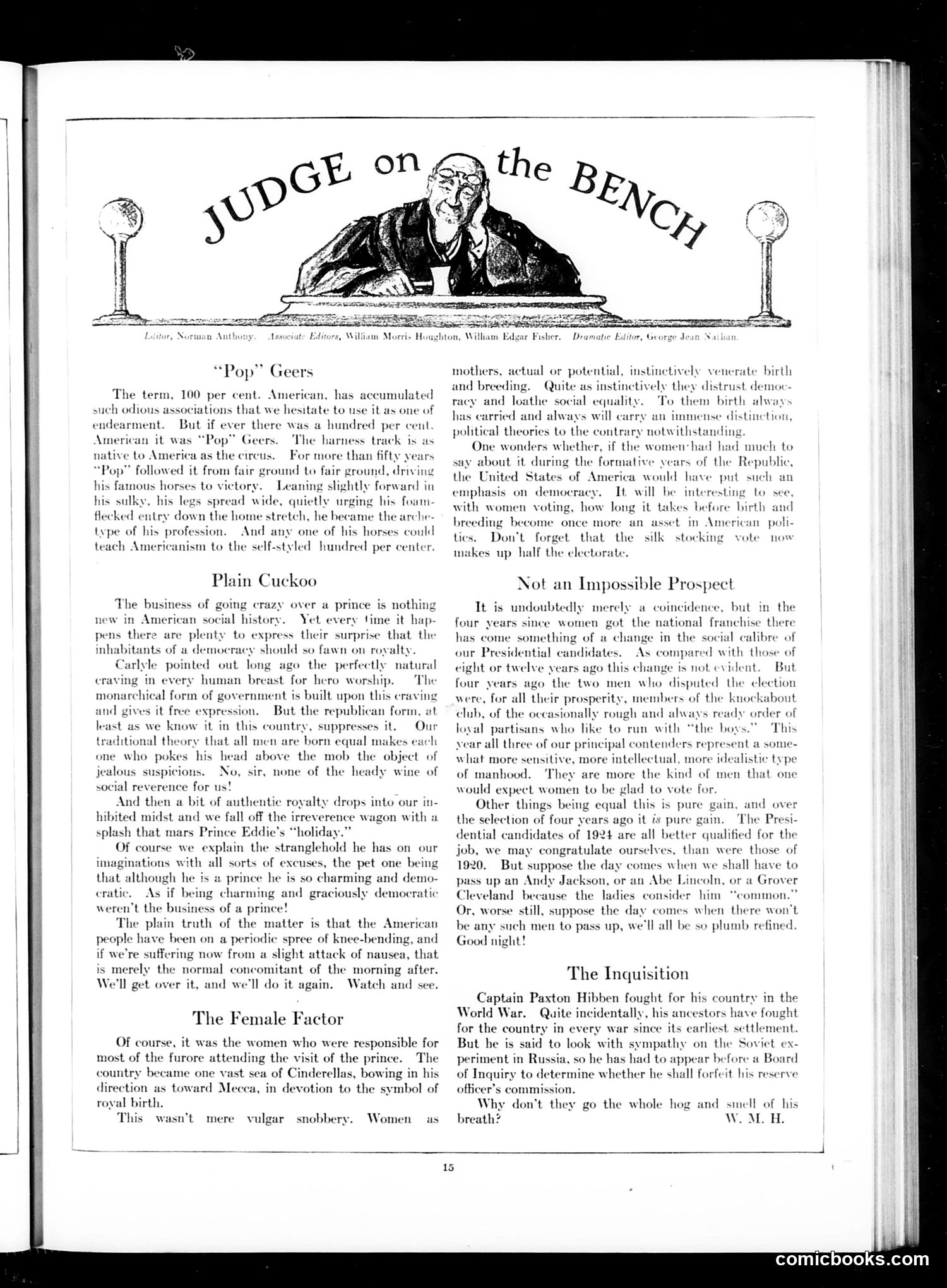
This satirical page from Judge magazine critiques American attitudes toward royalty and social hierarchy, particularly following a royal visit (likely Prince Edward's 1924 tour). **Main Points:** "Pop" Geers celebrates a genuinely American figure—a renowned harness-racing driver—as embodying authentic American values, contrasting him with artificial "100 per cent. American" nationalism. The longer pieces mock Americans' contradictory behavior: we claim democratic ideals yet obsess over visiting royalty ("Plain Cuckoo," "The Female Factor"). The satire suggests women especially crave hierarchy and "birth and breeding" despite democratic principles. **The Inquisition** briefly comments on Captain Paxton Hibben, a World War I veteran facing a Board of Inquiry, likely regarding Soviet sympathies. The overall tone: Americans *say* they believe in equality but reveal deep, suppressed desires for aristocracy whenever royalty appears. The woman's vote, newly granted, supposedly accelerates this return to valuing social status over democratic ideals.
📄 Transcribed text from this page (OCR, searchable)
Machine-transcribed from the original scan — historical spelling and the odd misread are preserved.
joughton, “Pop” Geers The term, 100 per cent. American, has accumulated such odious associations that we hesitate to use it as one of endearment. But if ever there was a hundred per cent American it wa The ha kis as native to America as the circus. For more than fifty years “Pop” followed it from fair ground to fair ground, driving his famous horses to victory. “Pop” Geers mess t Leaning slightly forward in 1 wide, quietly urging his foam- flecked entry down the home stretch, he became the arche- type of his profession. his sulky, his legs spre: And any one of his horses could teach Americanism to the self-styled hundred per center Plain Cuckoo The business of going crazy over a prince is nothing new in American social history. Yet every time it hap- pens there are plenty to express their surprise that the inhabitants of a democracy should so fawn on royalty. Carlyle pointed out long ago the perfectly natural craving in every human breast for hero worship. The monarehical form of government is built upon this craving and gives it free expression. But the republican form, at least as we know it in this country, suppresses it. Our above the mob the object of sir, none of the heady wine of traditional theory that all men are born equal mz one who pokes his head jealous suspicions. social reverence for us! And then a bit of authentic royalty drops into our in- hibited midst and we fall off the irreverence wagon with a splash that mars Prince Eddie's “holiday.” Of course we explain the stranglehold he has on our imaginations with all sorts of excuses, the pet one being that although he is a prince he is so charming and demo- cratic. As if being charming and graciously democratic weren't the business of a prince! The plain truth of the matter is that the American people have been on a periodic spree of knee-bending, and if we're suffering now from a slight attack of nausea, that is merely the normal concomitant of the morning after. We'll get over it, and we'll do it again. Watch and see. The Female Factor Of course, it was the women who were responsible for most of the furore attending the visit of the prince. The country became one vast sea of Cinderellas, bowing in his direction as toward Mecca, in devotion to the symbol of royal birth. This wasn’t mere vulgar snobbery. Women — as Wilham Edgar Fisher. mothers, actual or potential, instinctively venerate birth and breeding. Quite as instinctively they distrust democ- racy and loathe social equality. To them birth always has carried and always will carry an immense distinction, political theories to the contrary notwithstanding One wonders whether, if the women: had 1 much to say about it during the formative years of the Republic, the United States of America would have put such an emphasis on democracy. It will be interesting to see, with women voting, how long it takes before birth and breeding become once more an asset in American poli- Don't forget that the silk stocking makes up half the electorate. tics. vole now Not an Impossible Prospect It is undoubtedly merely a coincidence, but in the four years since women got the national franchise there has come something of a change in the social calibre of our Presidential candidates. As compared with those of But rs ago the two men who disputed the election were, for all their prosperity, members of the knockabout club, of the occasionally rough and always ready loyal partisans who like to run with “the | eight or twelve years ago this change is not evident four y rder of This year all three of our principal contenders represent a some- what more sensitive, more intellectual, more idealistic type of manhood. They are more the kind of men that one would expect women to be glad to vote for. Other things being equal this is pure gain, and over the selection of four years ago it is pure gain. The Presi- dential candidates of 1924 are all better qualified for the job, we may congratulate ourselves, than were those of 1920. But suppose the day comes when we shall have to pass up an Andy Jackson, or an Abe Lincoln, or a Grover Cleveland because the ladies consider him “common.” Or, worse still, suppose the day comes when there won't be any such men to pass up, we'll all be so plumb refined. Good night! The Inquisition Captain Paxton Hibben fought for his country in the World War. Quite incidentally, his ancestors have fought for the country in every war since its earliest. settlement. But he is said to look with sympathy on the Soviet ex- periment in Russia, so he has had to appear befo Board of Inquiry to determine whether he shall forfeit his reserve officer’s commission. Why don't they go the whole hog and smell of his breath? W. M. H. comicbooks.com