
A complete issue · 36 pages · 1924
Judge — August 23, 1924
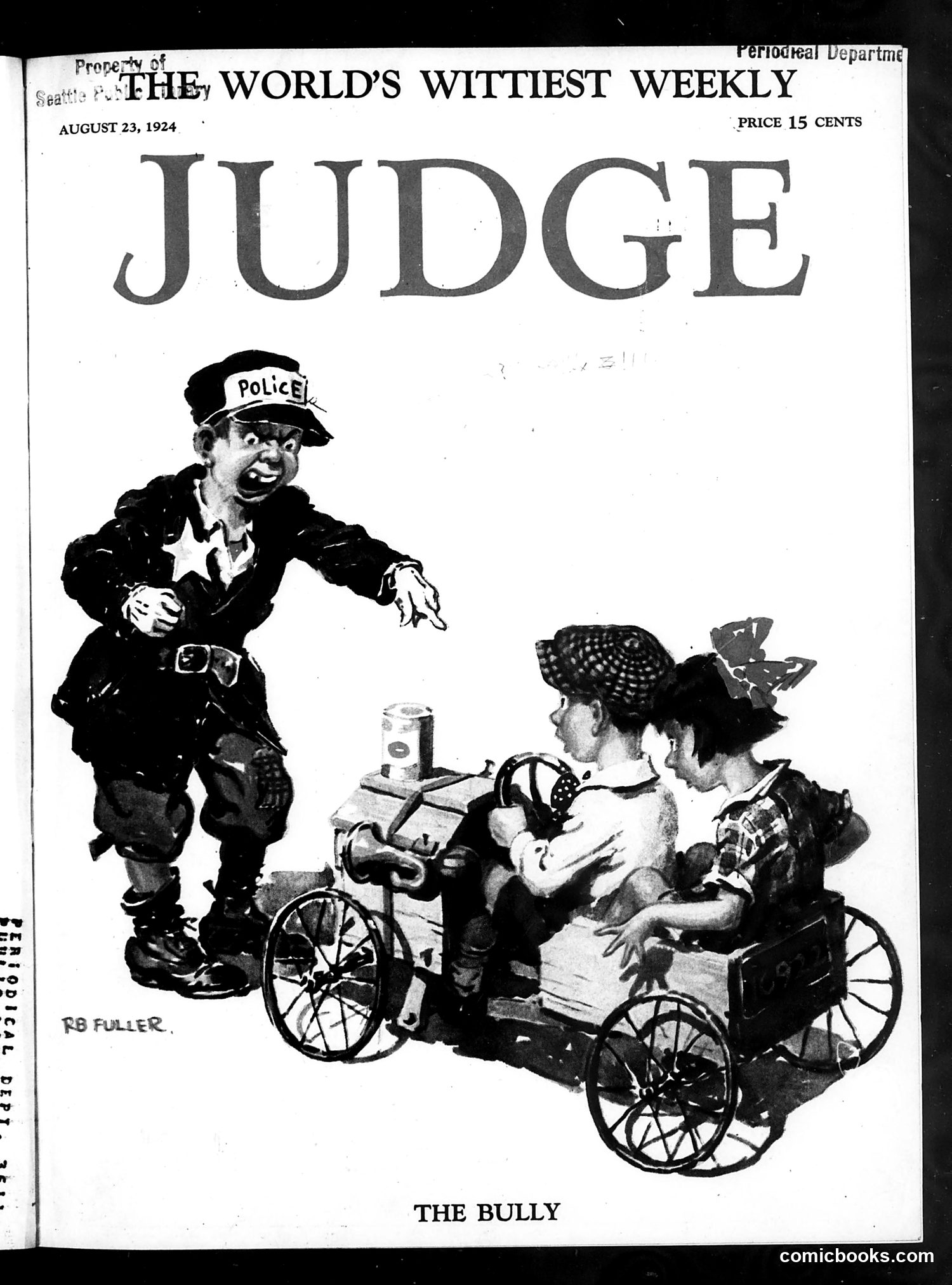
This cover cartoon titled "The Bully" depicts a police officer confronting two children on tricycles. The satire appears to criticize police abuse of authority—specifically, an officer using his power to intimidate vulnerable, powerless figures (children). The cartoon's message is straightforward: it mocks aggressive policing tactics that target those who cannot defend themselves, equating such behavior with bullying. The police officer's exaggerated facial expression and aggressive posture emphasize the absurdity of his authority being wielded against children. This likely reflects broader 1924 concerns about police conduct and corruption during Prohibition era law enforcement. The cartoon uses dark humor to critique institutional overreach and the misuse of power against the defenseless.
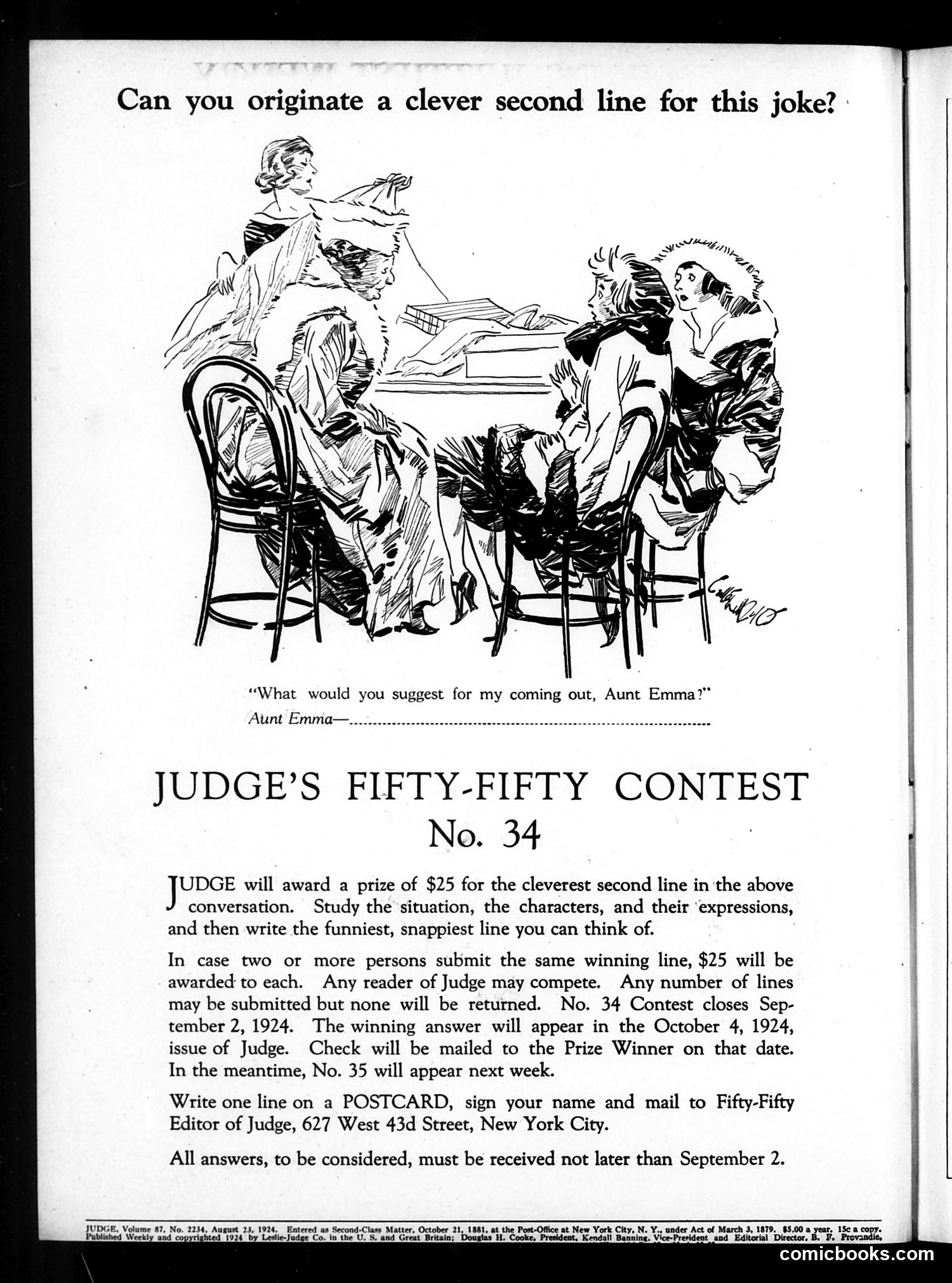
This page from Judge magazine (dated August 23, 1924) features a "Fifty-Fifty Contest" asking readers to complete a joke's punchline. The cartoon depicts a social gathering where someone asks "Aunt Emma" for advice about their "coming out"—likely referring to a debutante's formal social introduction to society, a significant ritual for upper-class young women in the 1920s. The humor relies on readers supplying a clever second line to Aunt Emma's response. Without knowing the intended answer, the joke's specific point is unclear, but it likely plays on generational differences, social conventions of the era, or double meanings around "coming out." The $25 prize ($400+ today) incentivized reader participation in what was common magazine engagement during this period.
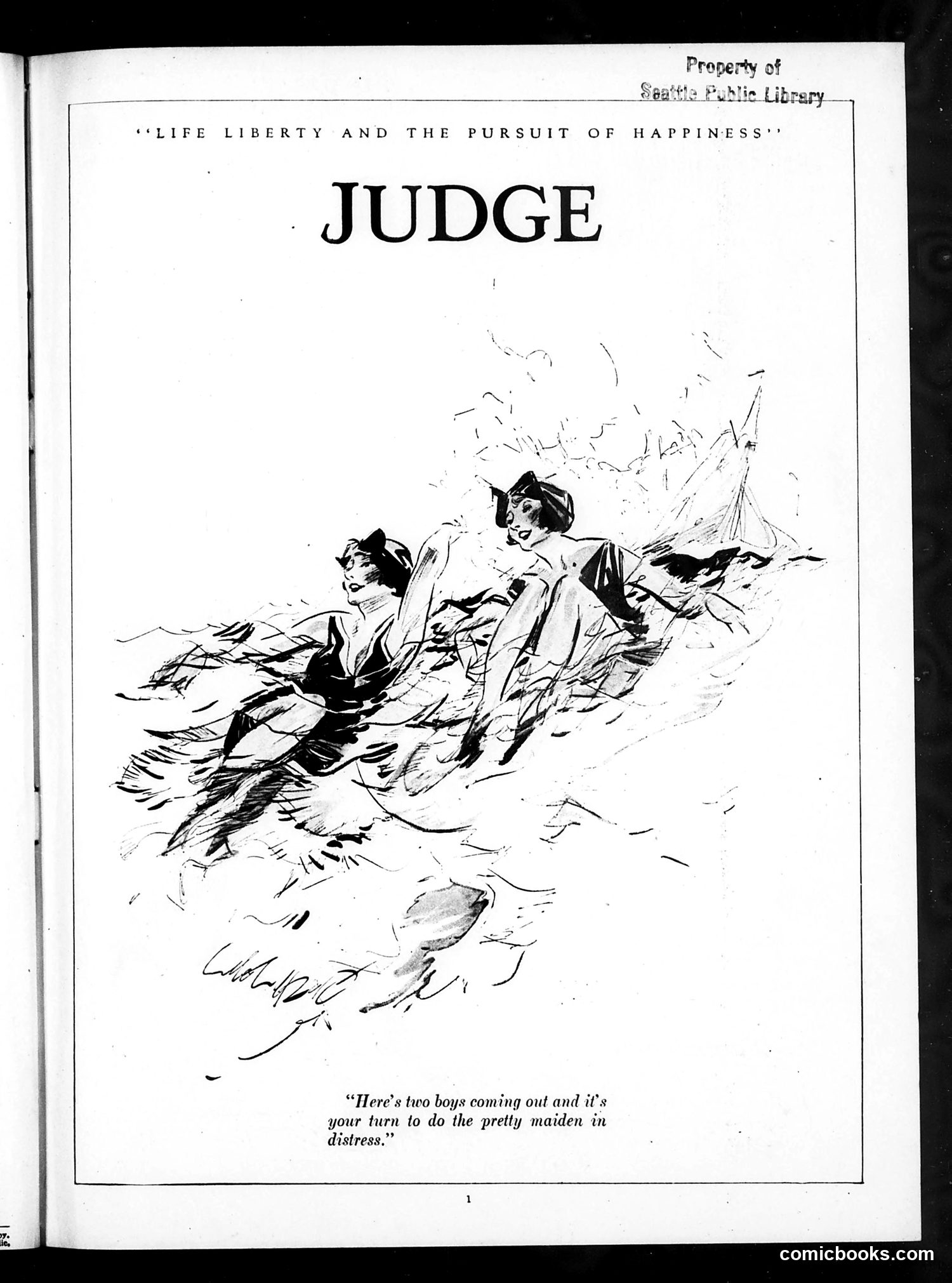
This page shows the title "JUDGE" at the top with the subtitle "'LIFE LIBERTY AND THE PURSUIT OF HAPPINESS'" — a reference to the Declaration of Independence. The illustration depicts two young boys rushing toward what appears to be a damsel in distress, with a caption reading: "Here's two boys coming out and it's your turn to do the pretty maiden in distress." This is likely a satirical jab at adventure fiction or melodrama conventions popular in early 20th-century entertainment — specifically mocking the predictable trope of damsels requiring rescue. The joke appears to comment on either the formulaic nature of such stories or, possibly, gender role expectations of the era. The specific context of Judge magazine suggests social satire rather than political commentary.
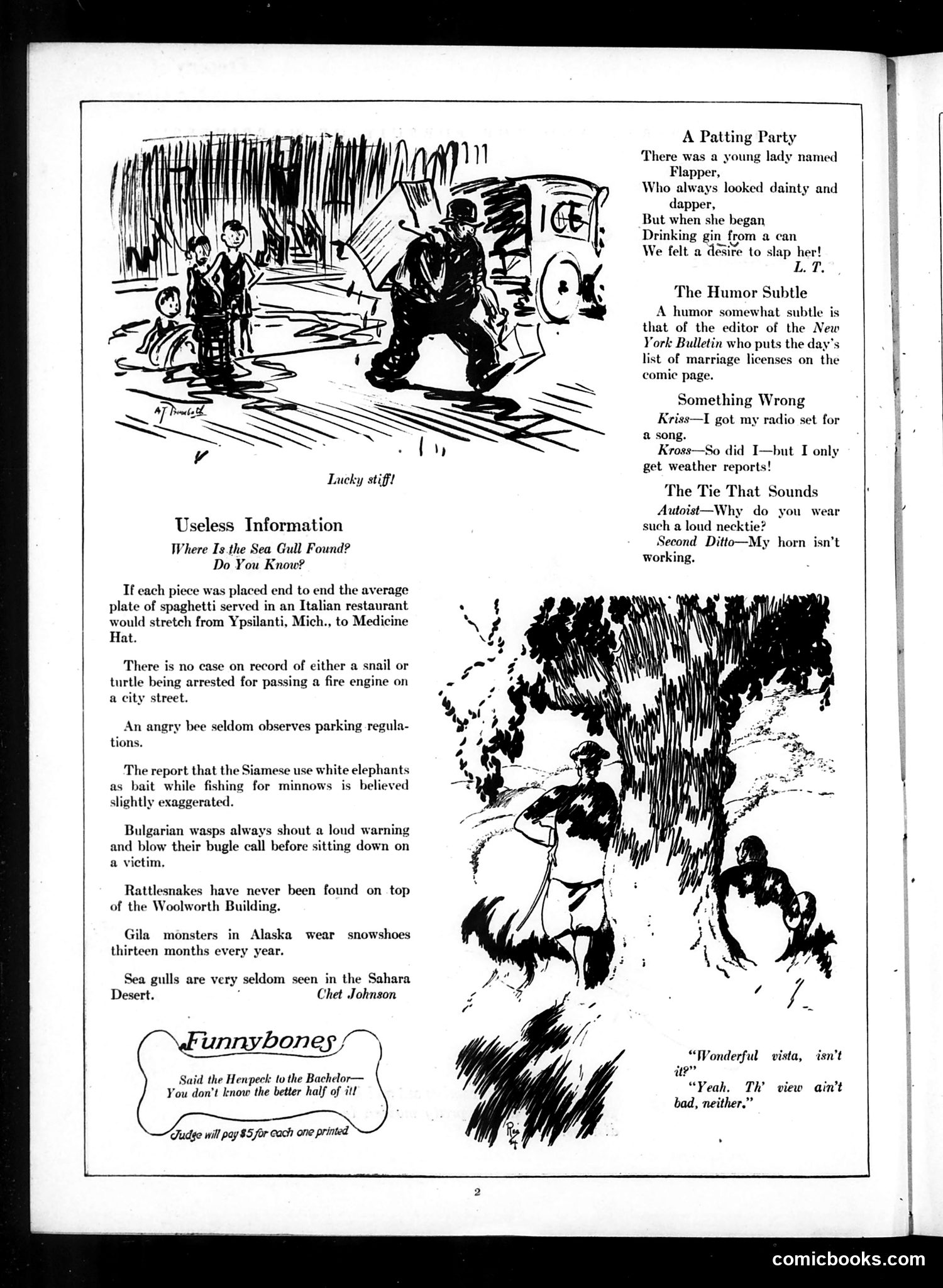
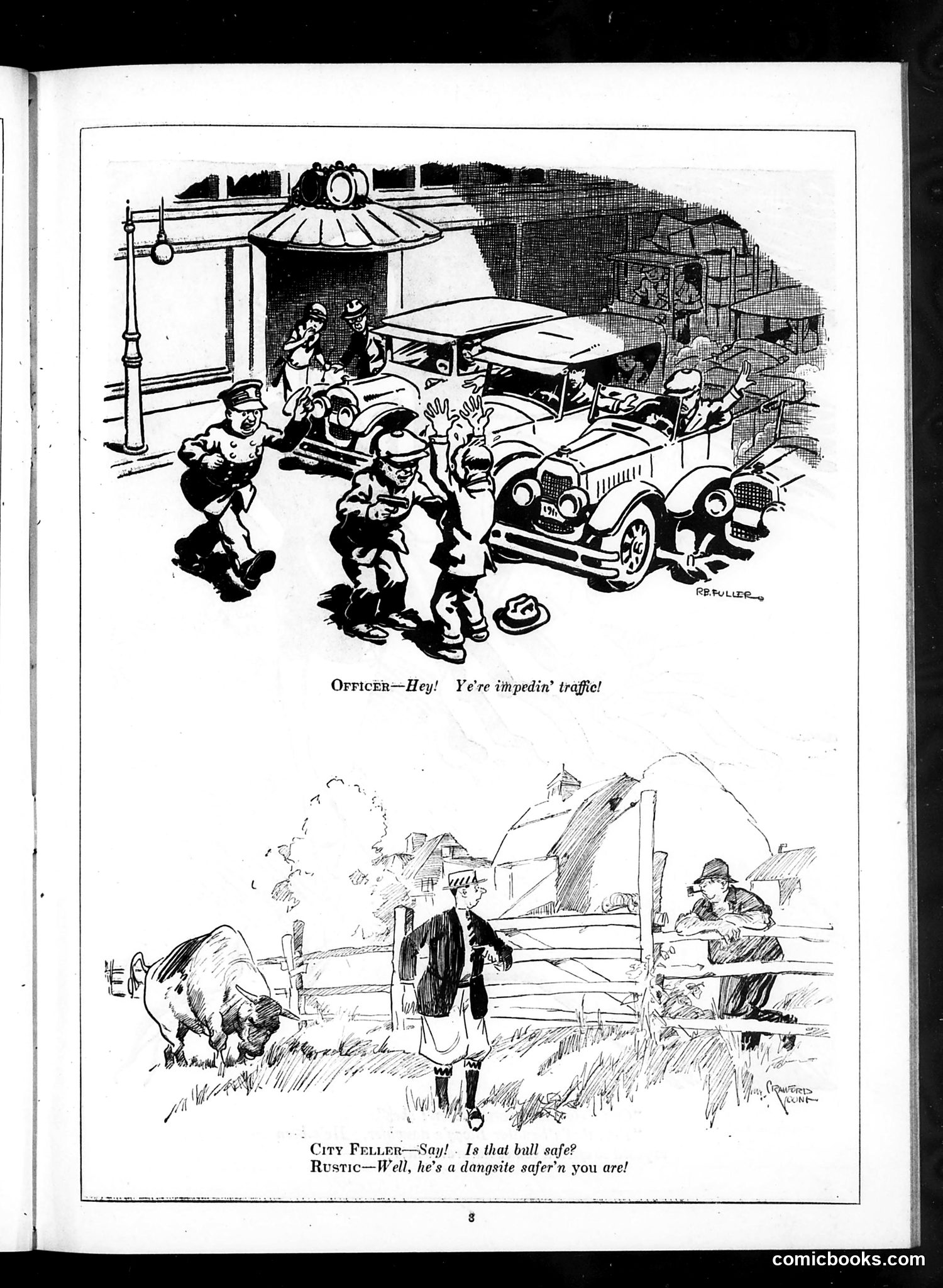
This page contains two cartoon jokes contrasting urban and rural life. **Top cartoon:** Children play in a city street amid parked cars and a street lamp. An officer tells them they're "impedin' traffic"—satire on how urban congestion has become so severe that children cannot safely play outdoors without obstructing vehicle movement. **Bottom cartoon:** A country boy asks a city visitor if a ball is "safe," implying balls are dangerous in the city. The rustic replies it's safer in the countryside—a "dangsite safer'n you are," meaning the ball faces no threat from urban hazards like traffic. Both jokes mock the contrast between modern urban congestion and traditional rural safety, suggesting cities have become dangerously crowded places where even children's play is criminalized.
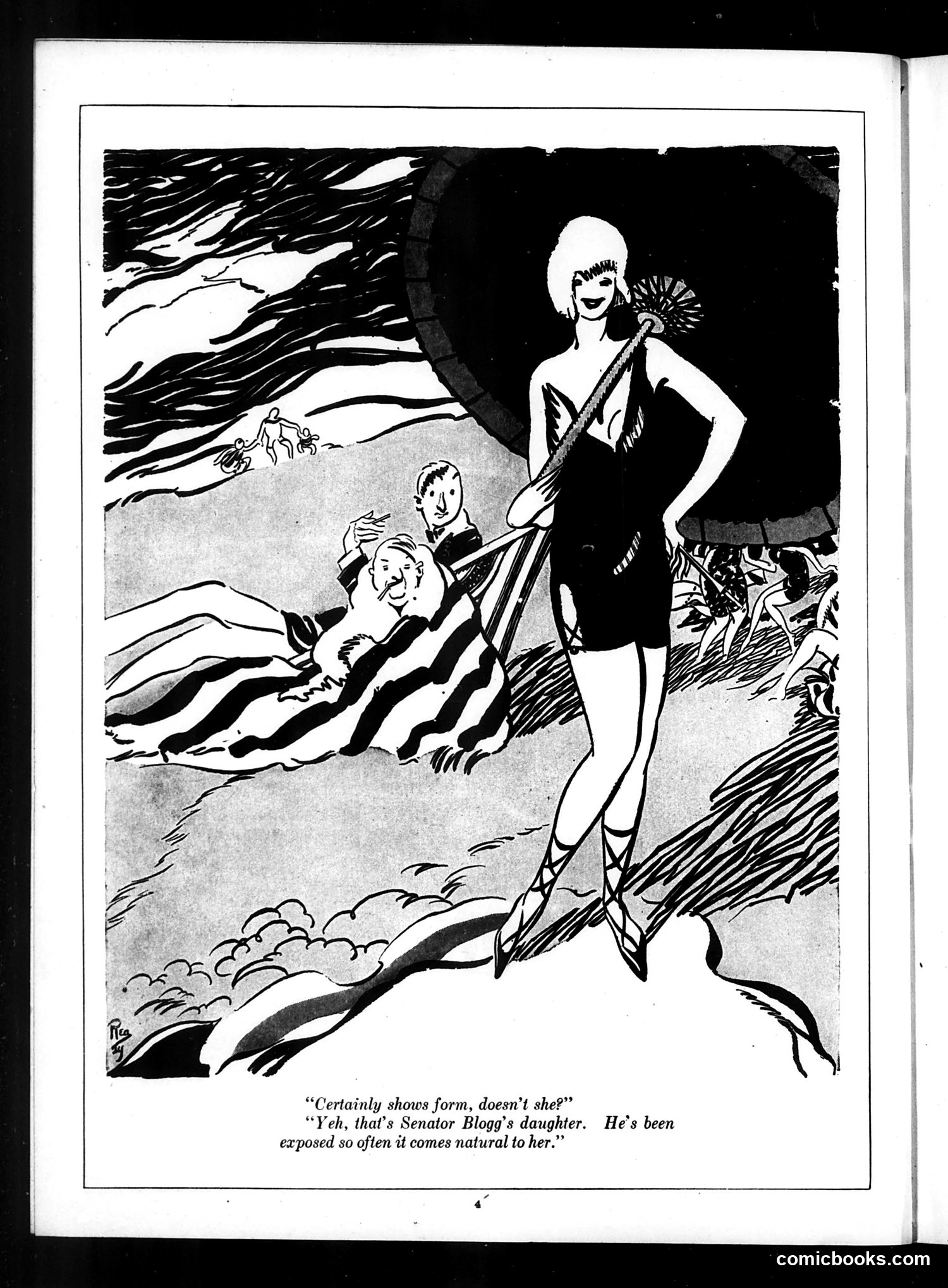
This cartoon satirizes the social prominence and behavior of a senator's daughter at a beach. The dialogue reveals the joke: the woman "certainly shows form" (displays an attractive figure in her swimsuit), and observers note she's "Senator Blogg's daughter" who has "been exposed so often it comes natural to her." The humor relies on a double entendre—"exposed" means both publicly visible (due to her father's political prominence) and wearing revealing swimwear. The cartoon mocks both the daughter's casual disregard for modesty standards of the era and implicitly critiques the senator himself, suggesting his public life has desensitized his family to propriety. This reflects early 20th-century anxieties about changing social norms, particularly around women's beach fashion and behavior.
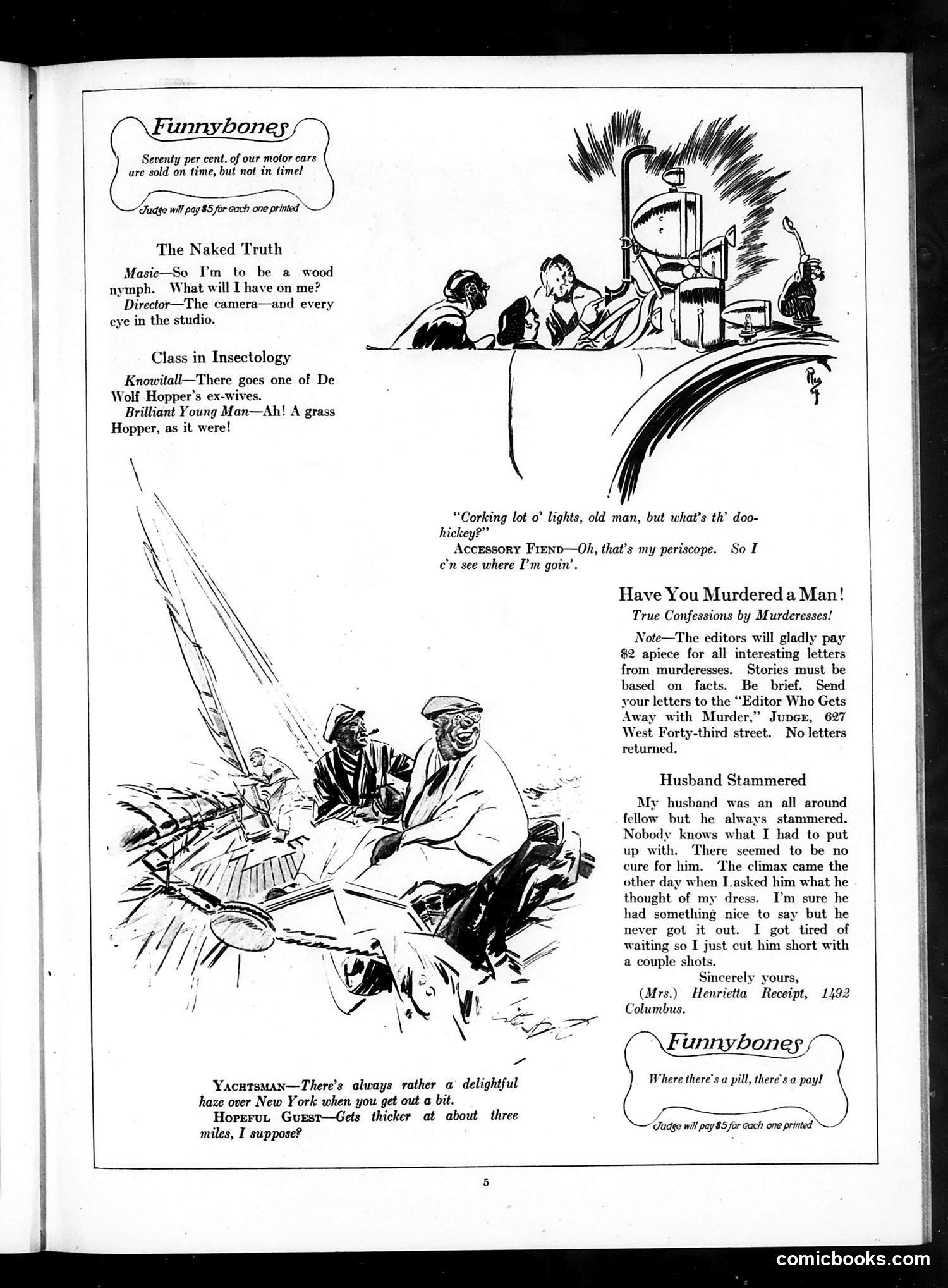
This page from *Judge* contains several brief satirical jokes typical of early 20th-century American humor: **"The Naked Truth"** mocks Hollywood filmmaking, joking that a wood nymph actress will wear only a camera—implying the director and studio crew represent the "real" exposure. **"Class in Insectology"** is a pun: De Wolf Hopper was a famous actor; his "ex-wives" are compared to "grasshoppers" (a play on his name). **"Have You Murdered a Man!"** is dark satire advertising for confessional letters from murderesses, paying $2 each. The included letter from "Mrs. Henrietta Receipt" describes killing her stammering husband out of impatience—the joke being the mundane, petty nature of her crime. **The "Funnybones"** sections are one-liner jokes about installment car buying and pills/payoffs. The overall tone reflects period attitudes: casual about automotive debt, dismissive of women in entertainment, and darkly comedic about domestic violence—none of which would be considered acceptable humor today.
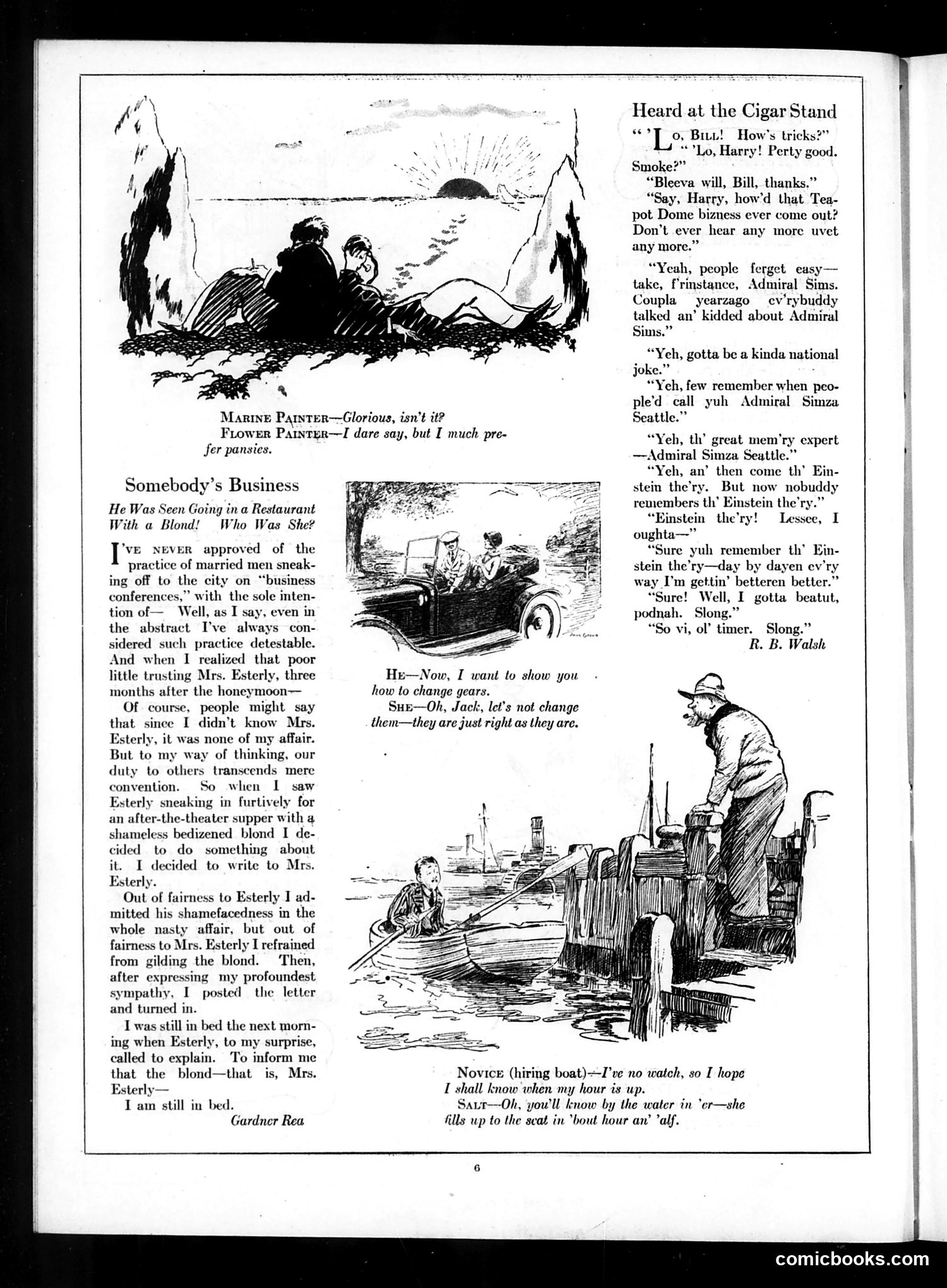
This page contains three unrelated humorous pieces typical of 1920s-era Judge magazine: **"Somebody's Business"** satirizes busybody moralism and gossip. A self-righteous narrator writes to Mrs. Esterly accusing her husband of infidelity with "a shameless bedizened blond," only to discover the "blond" was Mrs. Esterly herself—the narrator's meddling backfires comically. **"Heard at the Cigar Stand"** is a casual dialogue where working-class men discuss how public scandals fade from memory. They reference **Teapot Dome** (1920s oil-bribery scandal), **Admiral Sims** (naval figure), and **Einstein's theory** as examples of once-sensational topics now forgotten. The satire targets public amnesia regarding serious matters. **The remaining cartoons** show romantic/instructional situations with visual gags about automobiles and boating. The page reflects post-WWI American culture: gossip, fading scandal memory, and early automotive humor.
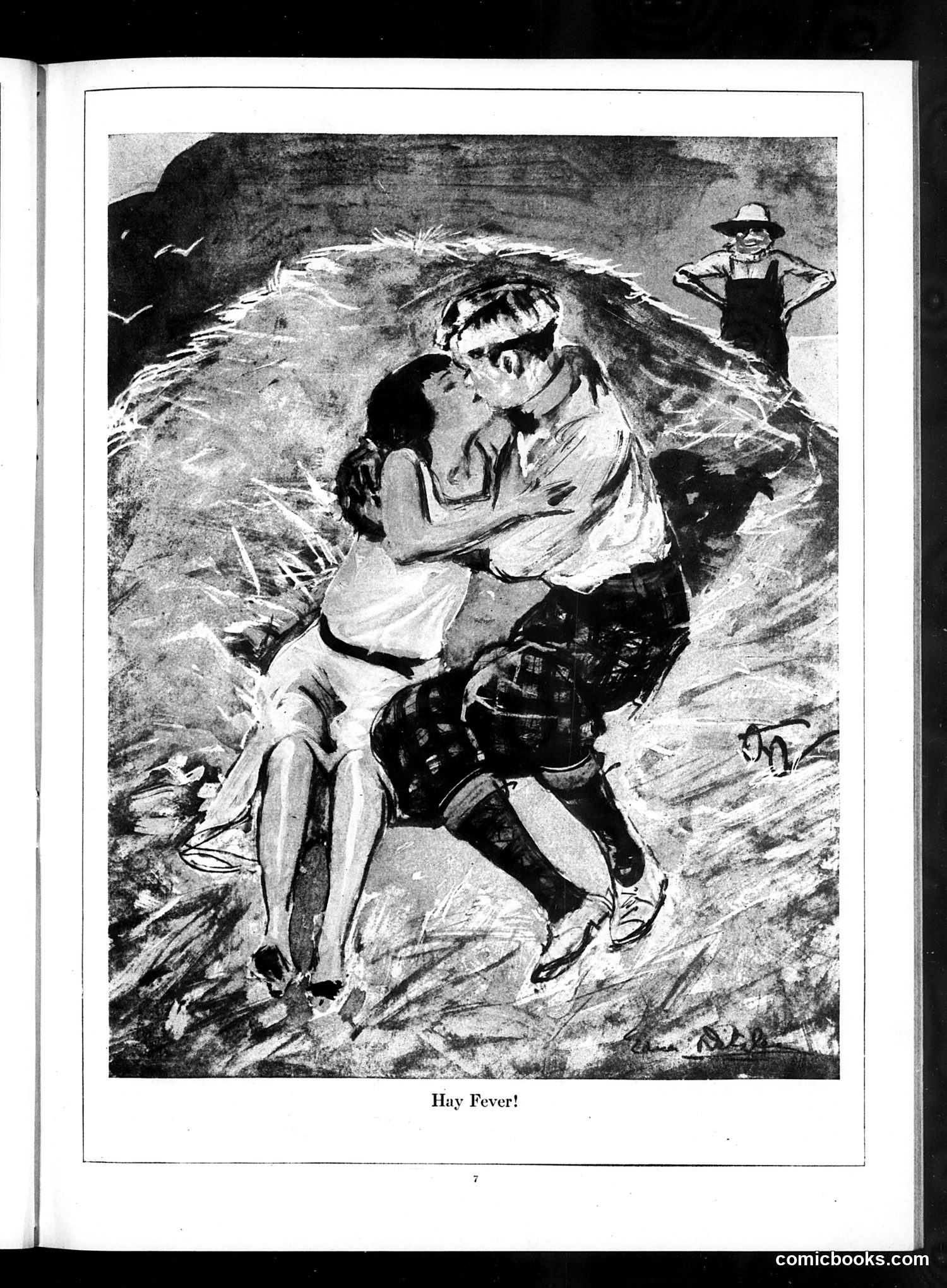
This illustration depicts a romantic couple embracing in a rural hay setting, with a farmer watching disapprovingly in the background. The title "Hay Fever!" is a pun: it plays on the medical condition (hay fever/allergies) while depicting literal fever—romantic passion—occurring in hay. The humor relies on double meaning typical of Judge magazine's style. The farmer's stern posture and surveillance suggest social disapproval of the couple's public affection or potentially illicit romantic encounter in his field. The satire may comment on rural morality, class differences, or the tension between romantic impulse and social propriety in early 20th-century America. The specific historical context of which "hay fever" season or social controversy this references remains unclear without additional publication information.
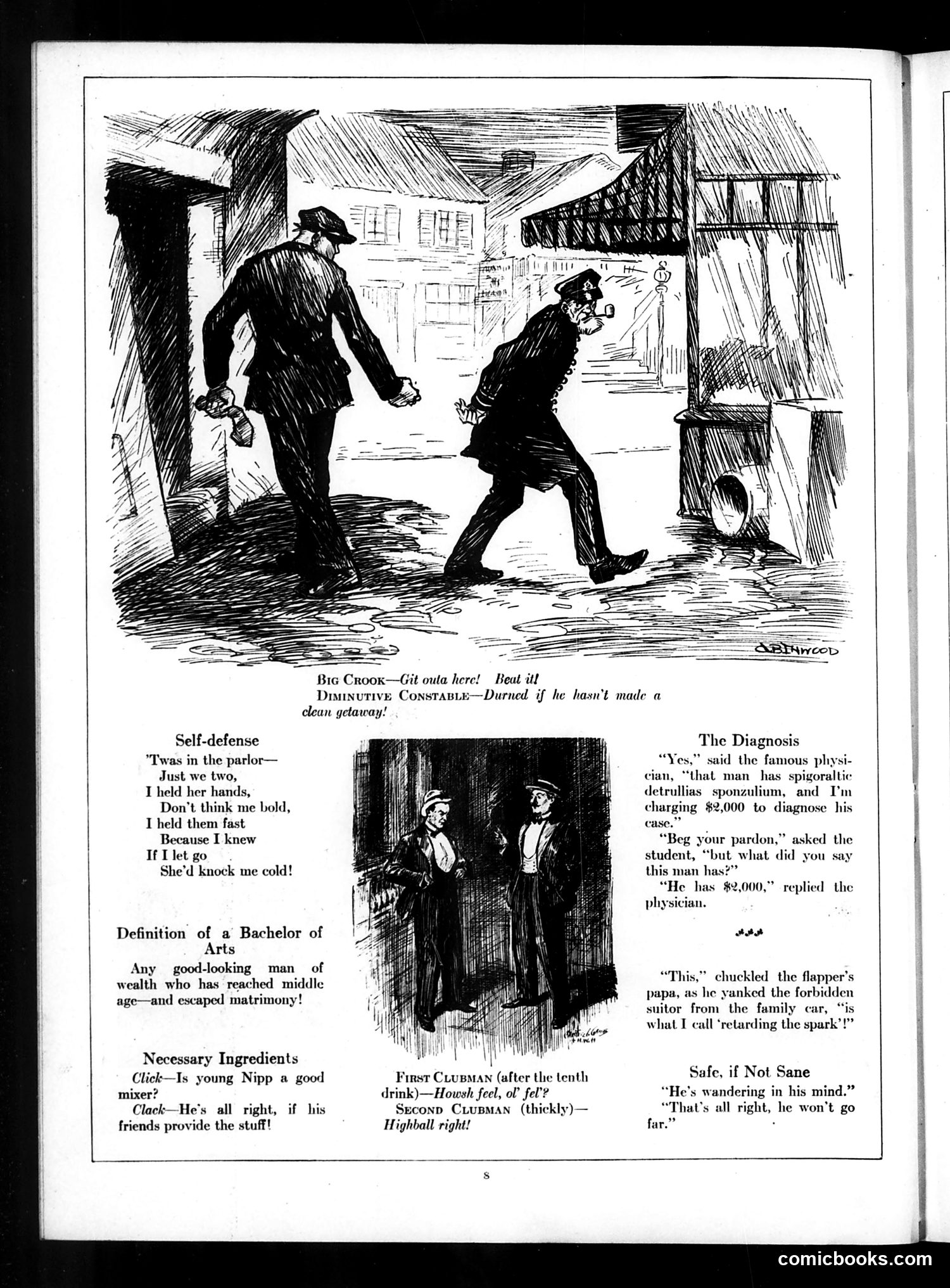
This page collects several brief humorous sketches typical of 1920s-era satirical humor: **Top cartoon**: A police officer chases a burglar through an alley—straightforward slapstick comedy about crime. **Jokes below address contemporary social anxieties:** - **"Self-defense"** mocks aggressive modern women, joking that a man must physically restrain his date or she'll hit him. - **"Bachelor of Arts" definition** satirizes wealthy men who've avoided marriage into middle age—implying this was considered unusual or shameful. - **"Necessary Ingredients"** jokes that a young man is only "good" at socializing if his friends supply alcohol (Prohibition-era commentary). - **"The Diagnosis"** mocks doctors' greed: the physician invents a fake disease name, revealing he only cares about the patient's $2,000 fee, not actual diagnosis. - **"Retarding the spark"** is a car pun: a father removes his daughter's suitor from the automobile, punning on automotive terminology. The humor reflects 1920s concerns: female assertiveness, matrimony avoidance, Prohibition, medical fraud, and parental control over courtship.
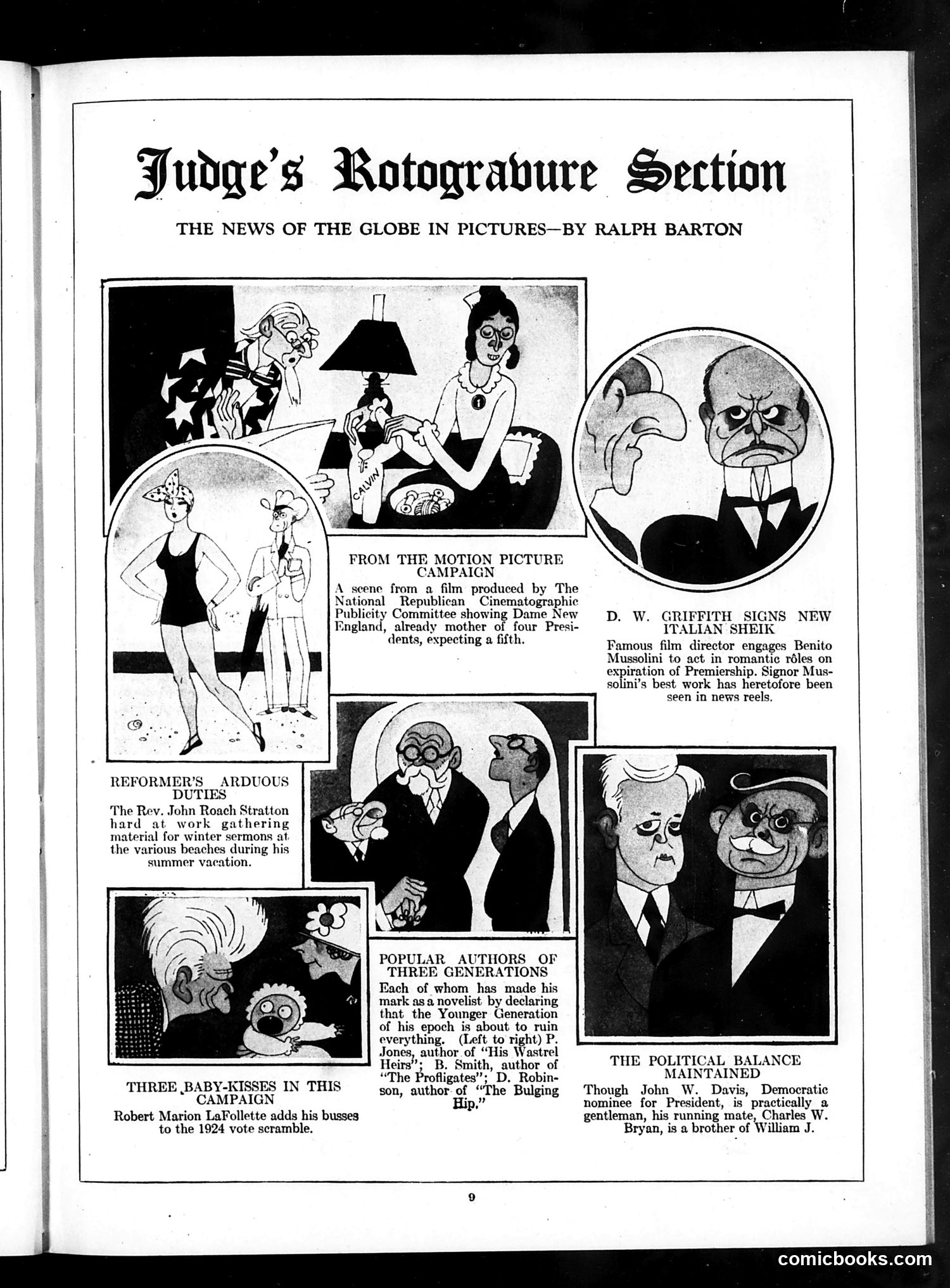
This is a satirical news-in-pictures page from Judge magazine's rotogravure section, featuring Ralph Barton's cartoons mocking 1924 political and cultural figures. **Key satires:** 1. **Rev. John Roach Stratton** – A reformer depicted cynically "gathering material" for sermons while vacationing at beaches, suggesting hypocrisy about moral crusades. 2. **Robert LaFollette** – Progressive presidential candidate shown kissing babies in the 1924 campaign, mocking standard political theatrics. 3. **D.W. Griffith/Benito Mussolini** – Joke proposing the famous film director hire Mussolini as an actor after his premiership ends, satirizing both Hollywood and fascism. 4. **Davis/Bryan ticket** – The Democratic nominees are mocked: Davis is "practically a gentleman" (faint praise), while running mate Charles Bryan is merely William Jennings Bryan's brother—suggesting weakness and nepotism. 5. **Three authors** – Novelists are ridiculed for repeatedly claiming each new generation will ruin everything, a recurring literary trope. The overall tone is irreverent commentary on 1924 American politics and celebrity.
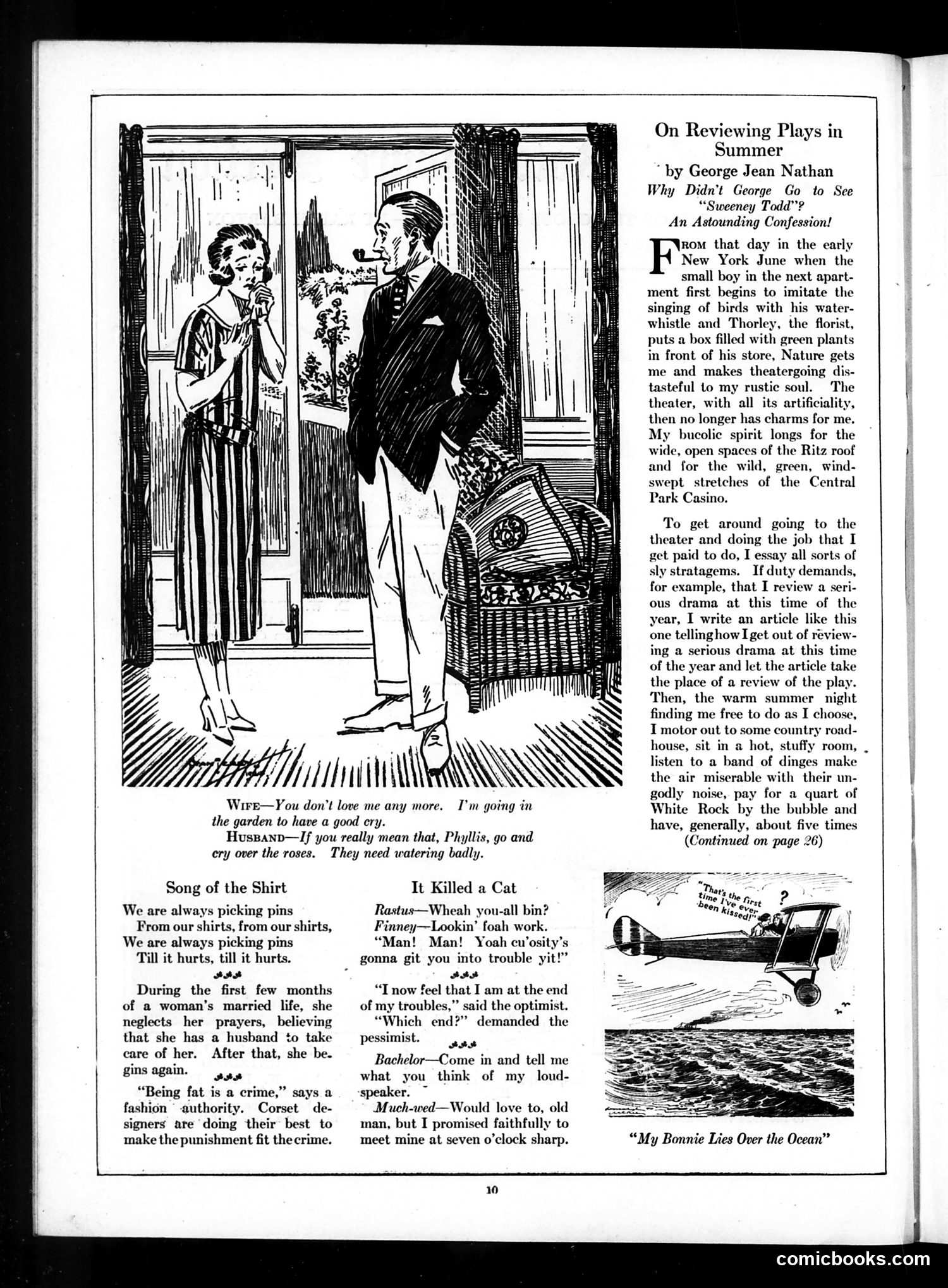
This Judge magazine page contains several discrete humor pieces: **Main Cartoon (top):** A domestic scene where a wife threatens to cry in the garden unless her husband shows affection. His callous response—suggesting she cry over the roses because they need watering—satirizes marital indifference and the husband's emotional neglect. **Short Humor Pieces:** Include jokes about married life (wives neglecting prayers once married), fashion/corsetry as punishment for being overweight, and racial dialect humor featuring Black characters ("Rastus" and "Finney") that reflect period stereotyping. **Featured Article:** George Jean Nathan's essay about avoiding theater reviews during summer, using meta-humor—he writes an article *about* avoiding his job instead of doing it. He claims nature (city summer sounds, plants) makes theater seem artificial compared to roadhouses and open spaces. The page reflects 1920s attitudes: casual marital mockery, weight-shaming, racial caricature, and the conceit that avoiding work through clever writing constitutes wit.
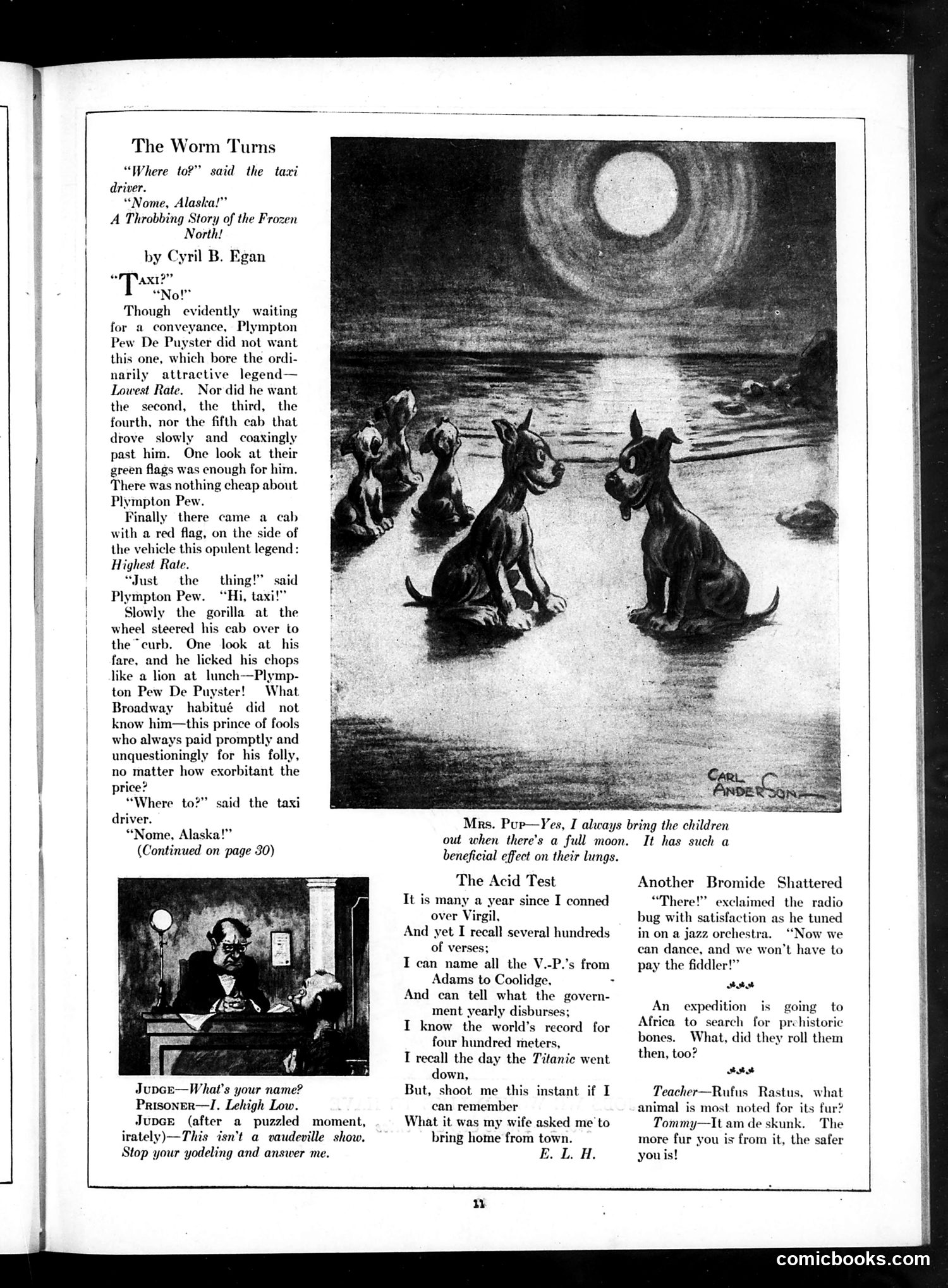
This story satirizes wealthy snob **Plympton Pew De Puyster**, a Broadway socialite known for wasteful spending. The joke: despite waiting for taxis, he refuses five "cheap" cabs with "Lowest Rate" flags, then eagerly hails a sixth displaying "Highest Rate"—choosing the most expensive option simply because it costs more. The accompanying illustration shows dogs (not humans as the gorilla taxi driver description might suggest) sitting under a full moon, complementing the sidebar humor about Mrs. Pup bringing children out for lunar air. The satire mocks conspicuous consumption and the absurd logic of the wealthy: Pew equates price with quality and status, paying premium rates as a badge of affluence rather than value. His final destination—Nome, Alaska—adds absurdist humor to his foolish extravagance. Other page content includes brief jokes and verse about memory, radio entertainment, and African expeditions.
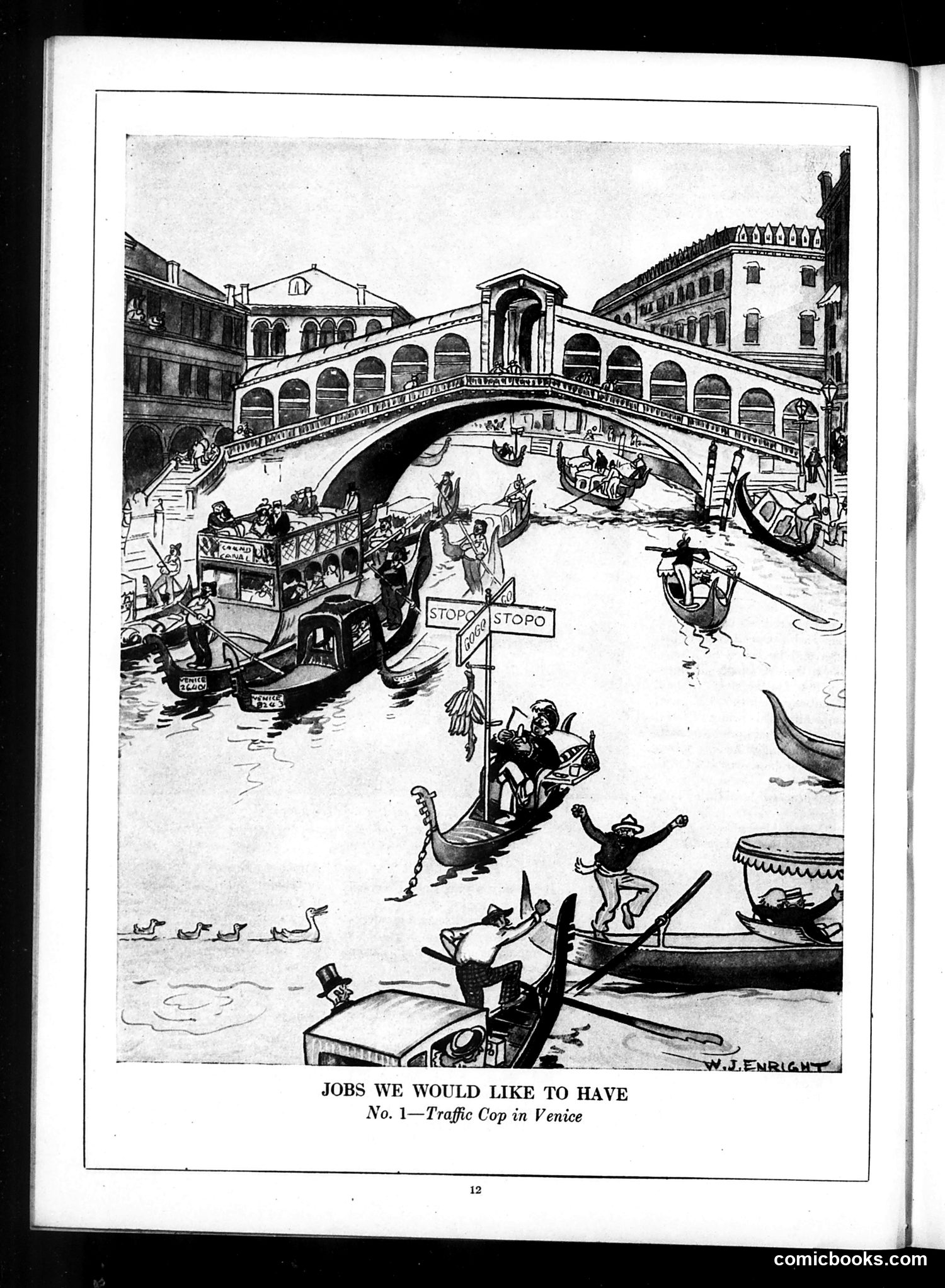
This is a humorous cartoon titled "Jobs We Would Like to Have, No. 1—Traffic Cop in Venice." The satire depicts the absurdity of applying modern traffic regulation to Venice's canal system. The cartoon shows a traffic officer attempting to direct gondola traffic with a "STOP/STOPO" sign at the Rialto Bridge. Multiple gondolas and boats create chaos in the waterway, rendering traditional traffic control meaningless. The joke mocks the impracticality of imposing modern urban infrastructure concepts onto Venice's medieval water-based transportation system. This reflects early-20th-century American attitudes about modernization and the clash between contemporary bureaucratic solutions and historical, unconventional urban layouts. The cartoonist (W.J. Enright) uses Venice as a humorous example of where American-style traffic management would fail completely.
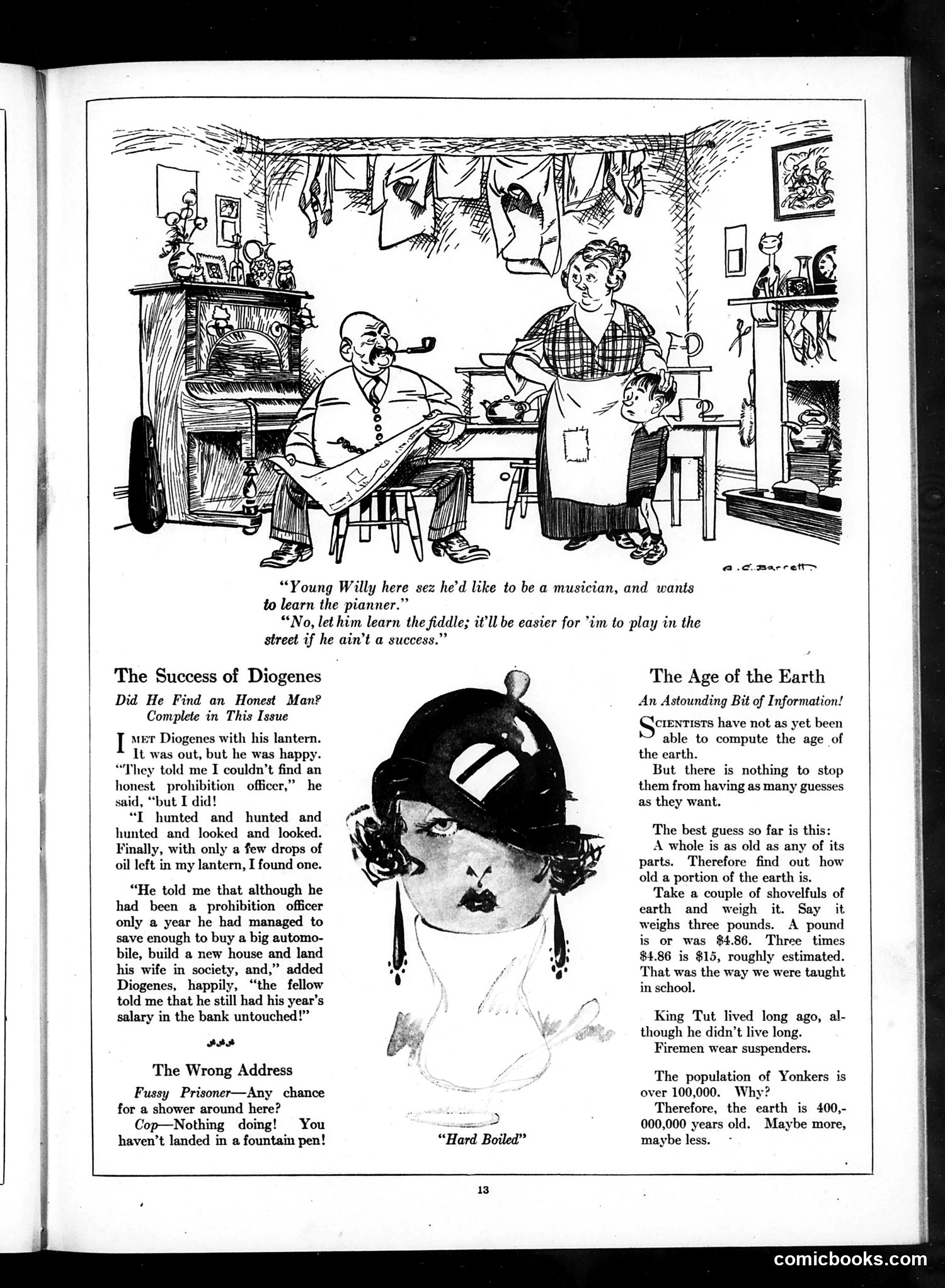
This page contains multiple satirical pieces typical of Judge's humor circa the 1920s-30s. **Top Cartoon:** A working-class family scenario where a father advises his son to learn fiddle rather than piano because if the boy fails as a musician, he can at least play on the street for money. The satire mocks poverty and limited social mobility—even parents resign themselves to their children's potential street-level survival. **"The Success of Diogenes":** References the ancient Greek philosopher who searched for an honest man with a lantern. Here, Diogenes supposedly finds an "honest prohibition officer" who, despite serving only one year, somehow afforded a new automobile, house, and elevated his wife's social status—all while claiming his original salary remains untouched in the bank. The satire attacks corruption among Prohibition enforcement officials, implying they enriched themselves through bribery or graft. **Other Brief Items:** Absurdist humor about calculating Earth's age through flawed logic; a fountain-pen joke; observations about firemen and Yonkers' population. These represent filler humor common to satirical magazines.
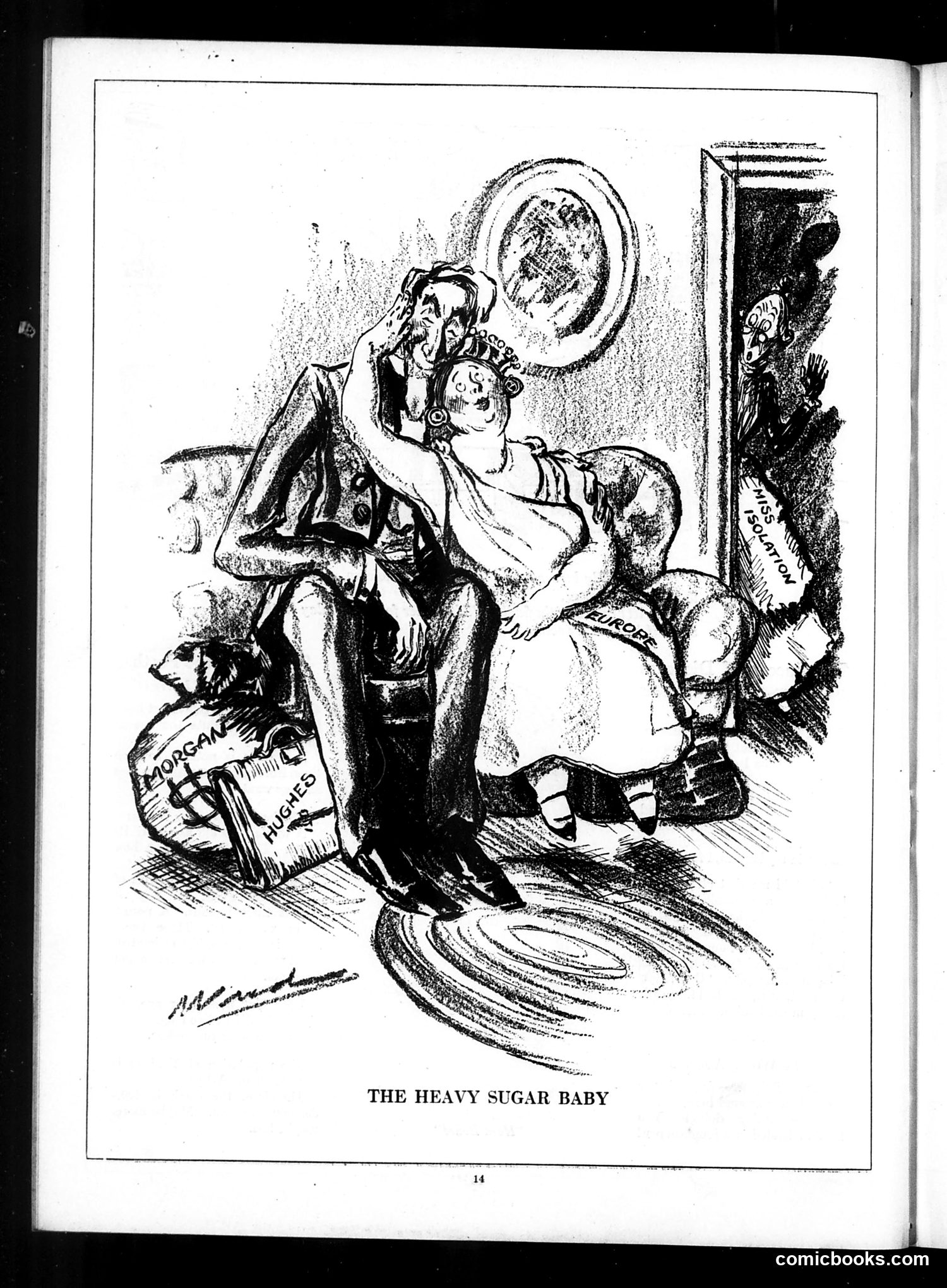
This political cartoon satirizes what appears to be a wealthy industrialist or financier (the well-dressed man in center) being manipulated or controlled by various interests represented as babies or dependents. The labeled figures visible include references to "Morgan" and "Hughes," likely J.P. Morgan and Charles Evans Hughes—prominent financial and political figures of the early 20th century. The satire suggests these powerful men are actually beholden to outside forces—treated as "sugar babies" dependent on patronage rather than independent actors. The swirling motion and chaotic composition emphasize loss of control. This reflects Progressive Era skepticism toward concentrated wealth and the invisible networks of influence among America's financial elite.
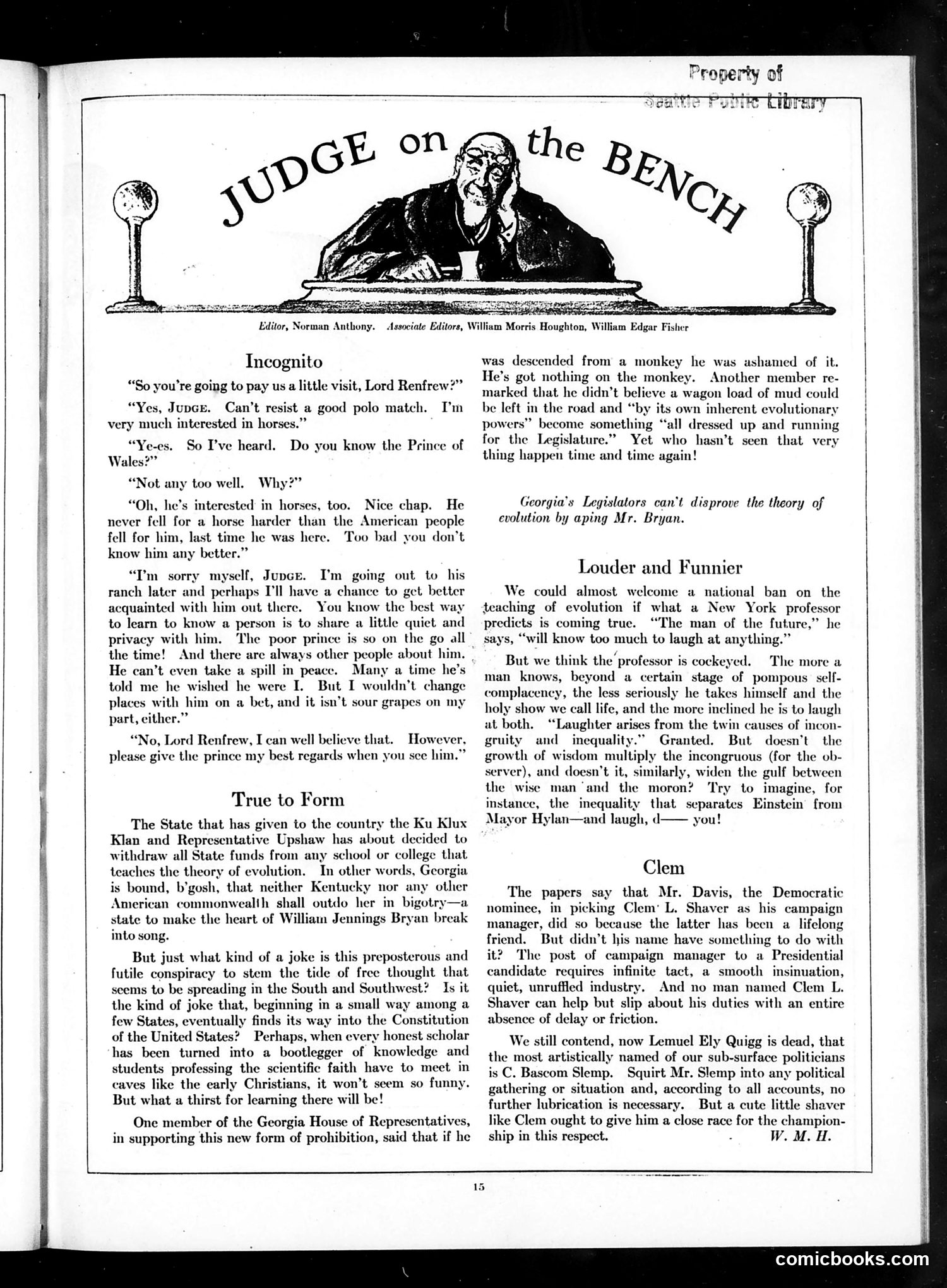
This page from Judge contains three satirical sections mocking contemporary political and social issues: **"Incognito"** - A dialogue joke about "Lord Renfrew" (likely a pseudonym for a visiting British nobleman) discussing the Prince of Wales and polo. The satire plays on American enthusiasm for visiting royalty and the irony of comparing the prince's fame to his actual equestrian interests. **"True to Form"** - Sharp criticism of Georgia's decision to defund schools teaching evolution. Judge ridicules the state's religious anti-science stance as hypocritical bigotry comparable to Prohibition, invoking William Jennings Bryan. The satire mocks a legislator who claimed descending from monkeys would shame him—turning his argument absurdly against him. **"Louder and Funnier"** - A brief column suggesting that increased human knowledge paradoxically makes the gap between the wise and foolish more ridiculous and laughable (invoking Einstein and Mayor Hylan as examples). All three pieces target anti-intellectual attitudes and religious fundamentalism prevalent in 1920s America.
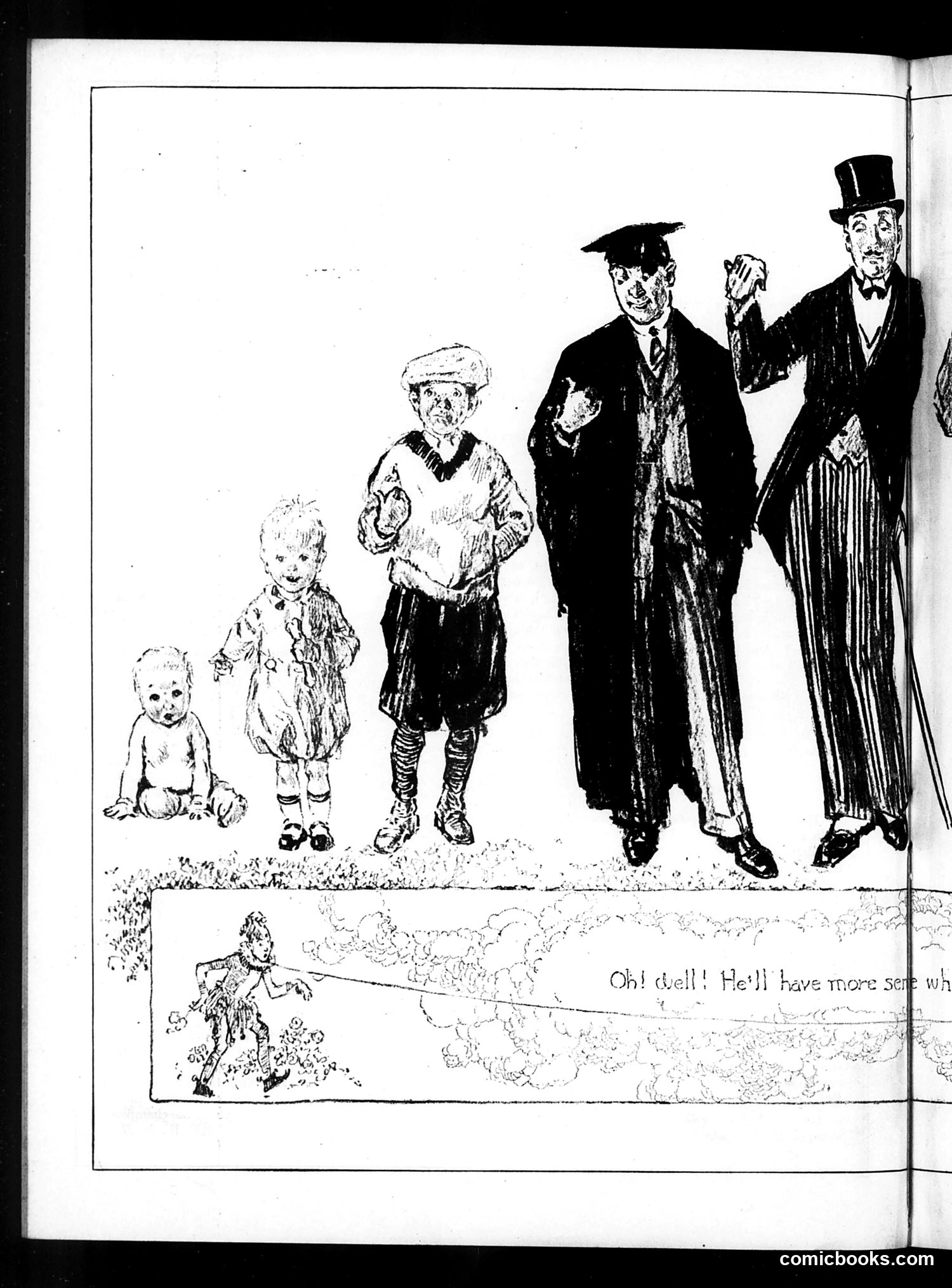
This cartoon appears to satirize wealth inequality and generational privilege. The upper panel shows five figures in ascending order of size and formal dress—from a baby to a toddler to a child to two adult gentlemen (one in academic robes, one in a top hat). The lower panel depicts a ragged child playing in dirt or poverty. The caption reads: "Oh! well! He'll have more sense wh[en]..." The satire likely critiques how wealthy, privileged children are groomed for success and respectability through education and class advantage, while poor children remain trapped in poverty and degradation. The contrast between the well-dressed, ascending figures and the impoverished child illustrates the vast social divisions of the era, suggesting that circumstance of birth—not merit—determines one's fate.
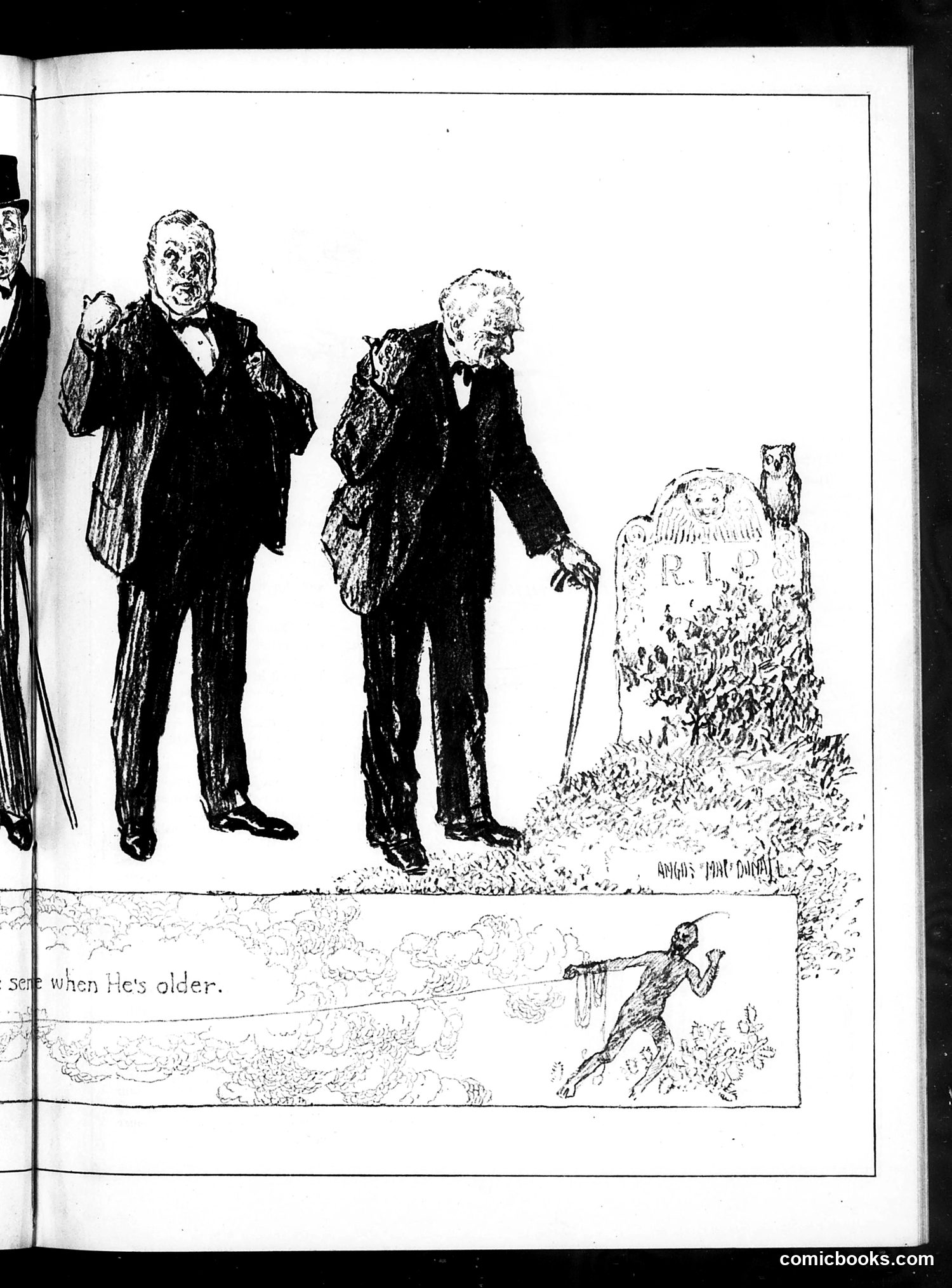
This appears to be a darkly satirical cartoon about mortality and aging. Two well-dressed older gentlemen stand beside a gravestone marked "R.I.P." with an owl perched on top. The caption reads "See when he's older," suggesting a morbid joke about what awaits one of these figures in the future. The cartoon likely comments on mortality, aging, or perhaps political/social decay using the gravestone as visual metaphor. The formal dress and refined appearance of the figures contrasts sharply with the death imagery, creating satirical commentary typical of *Judge* magazine's style. Without clearer context about which specific individuals are caricatured or what event this references, the exact political meaning remains unclear. The satire appears to concern inevitability of death or decline, possibly directed at specific public figures of the era.
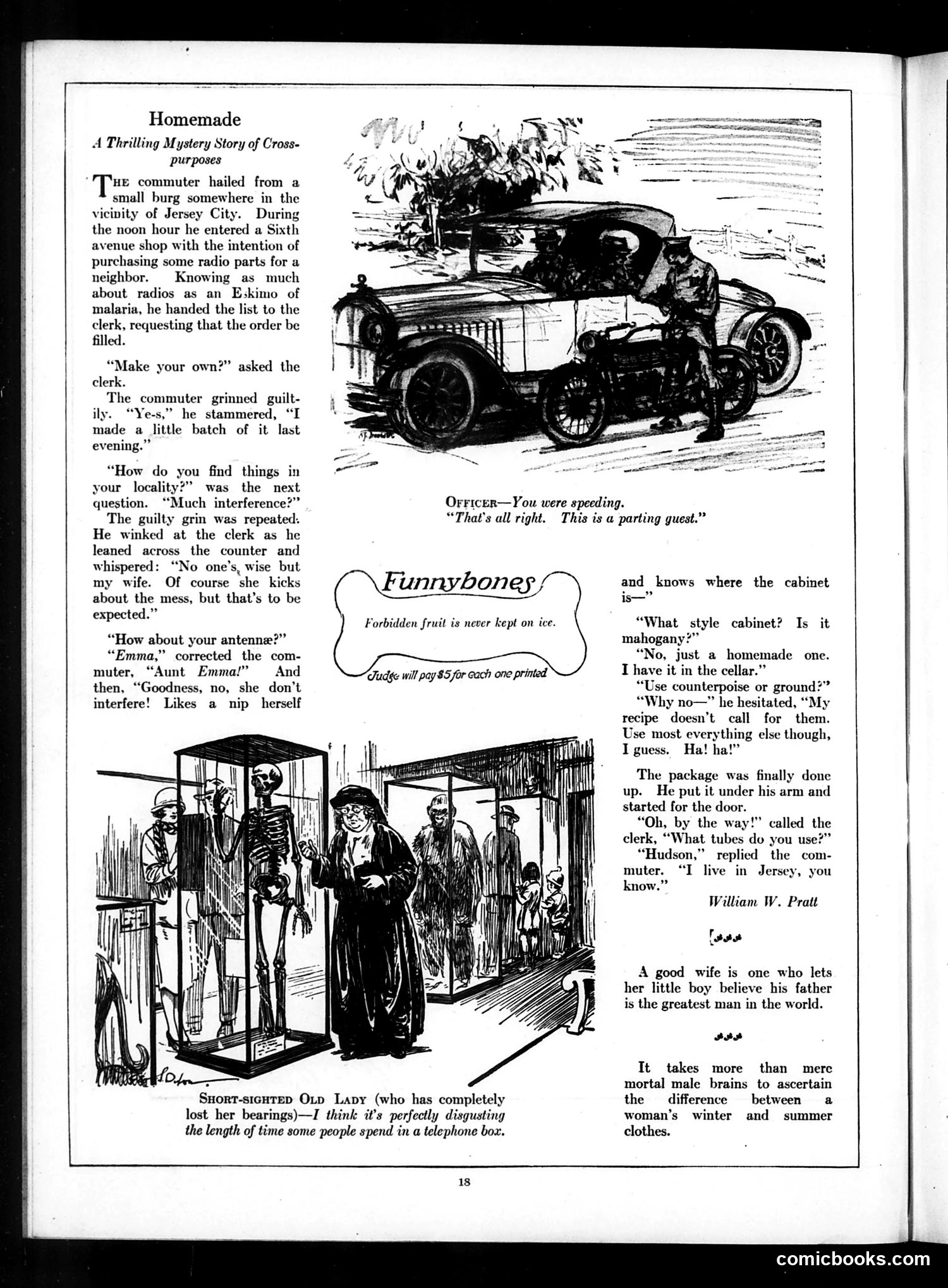
This 1920s Judge story satirizes Prohibition-era misunderstandings. A commuter enters a radio parts shop claiming to build a radio, but his guilty responses—mentioning "a batch of it last evening," his wife being the only one "wise," and a homemade "cabinet" kept in the cellar—suggest he's actually making illegal alcohol. The clerk plays along with knowing ambiguity. When asked about "tubes," the commuter answers "Hudson" (Hudson automobiles), implying he uses automobile parts, a common Prohibition-era bootlegging practice. The humor relies on double meanings: "interference," "antennae," "cabinet," and "counterpoise" reference both radios and alcohol production. The punchline about his wife "Aunt Emma" liking "a nip herself" confirms the subtext. The cartoons below mock unrelated absurdities—telephone booths and speeding—typical Judge filler humor. The satire mocks both Prohibition enforcement evasion and the commuter's clumsy deception.
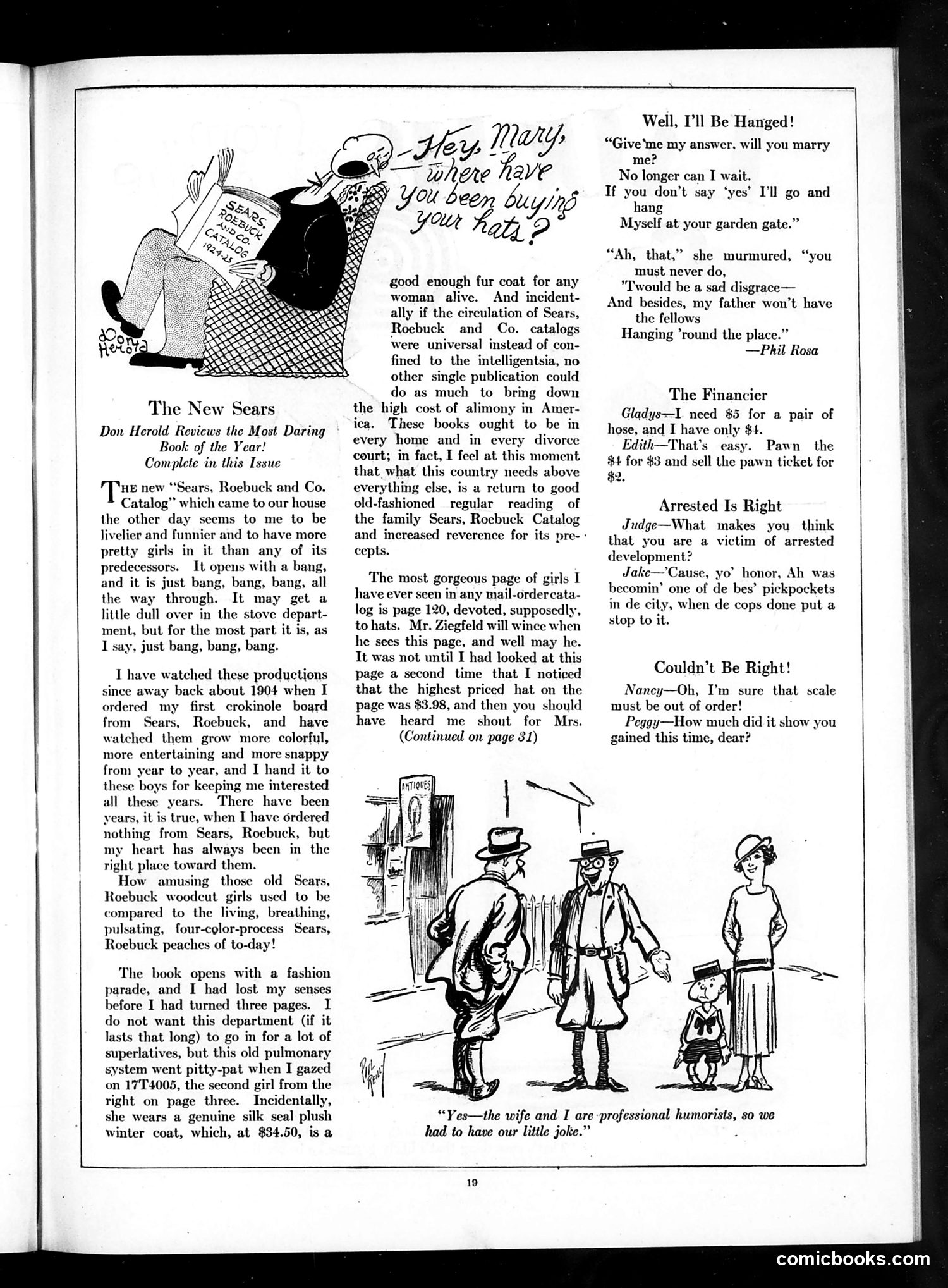
This page satirizes the Sears, Roebuck catalog as entertainment literature. Critic Don Herold humorously reviews the new catalog as "the most daring book of the year," praising its fashion photography—particularly the attractive models—over its actual merchandise value. The joke targets both the catalog's evolution into glossy marketing and American consumer culture's obsession with mail-order shopping. Herold sarcastically suggests the catalog should be in "every divorce court," implying it reduces alimony costs by making women less materialistic. He fixates on model #1774005 and notes hat prices are surprisingly affordable at $3.98, contrasting with Florenz Ziegfeld's famous chorus-girl productions. The page also includes four unrelated comic vignettes: a rejected suitor's suicide threat, financial scheming, an arrested pickpocket, and a woman denying a scale's accuracy. These are typical Judge magazine humor shorts with no apparent connection to the main article.
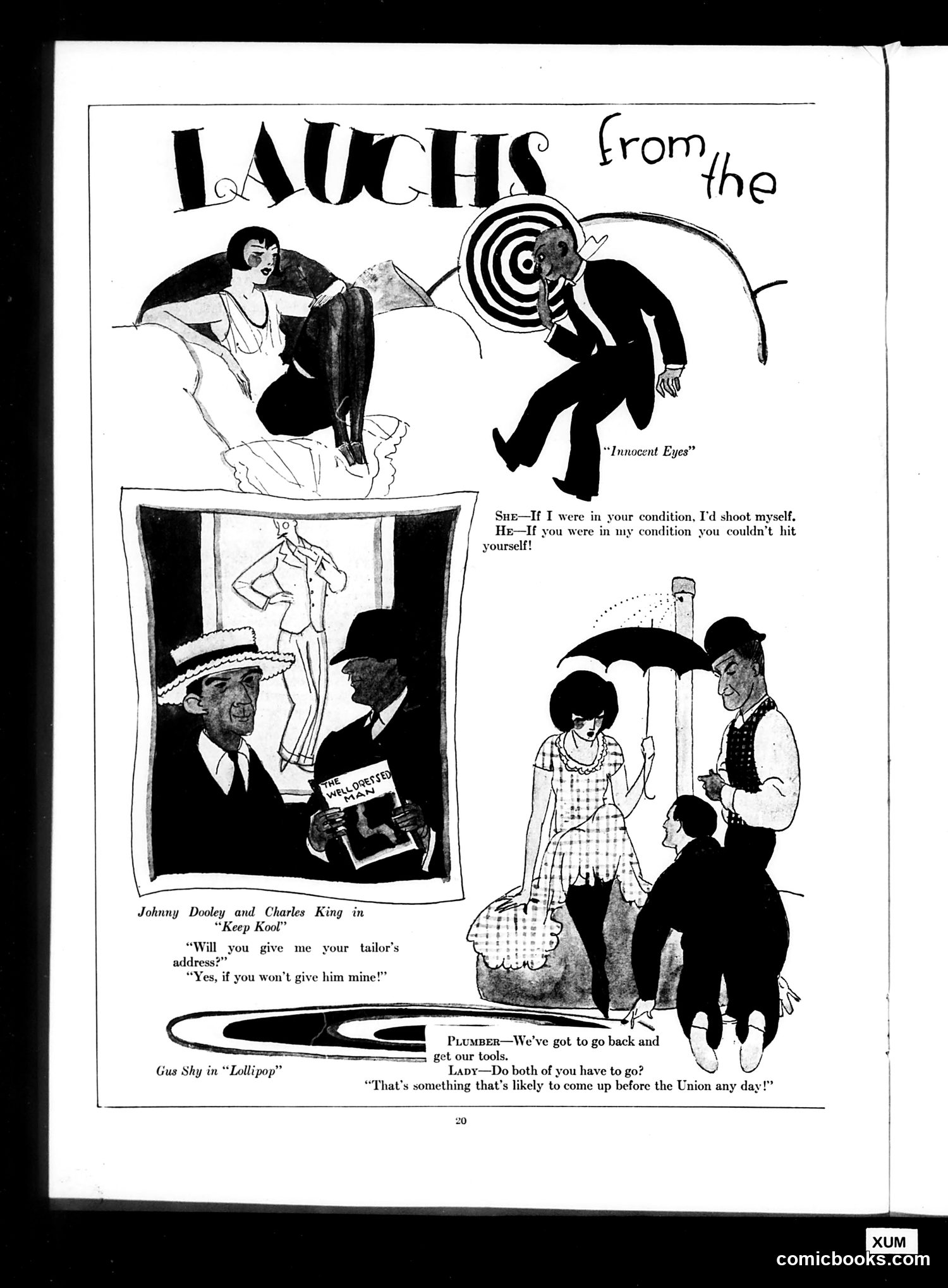
This page collects comedy sketches from contemporary theatrical productions, likely from the 1920s. The top cartoon mocks a couple's marital discord—she threatens suicide over his infidelity; he sarcastically responds she lacks the competence. The middle sketch from "Keep Kool" shows two men viewing a theatrical performance, with a joke about tailors' addresses implying infidelity. The bottom cartoon from "Lollipop" depicts a plumber and woman under an umbrella; when asked if both must leave, the man quips the question of "union" labor (whether both workers must depart) will become a major civic issue—likely satirizing contemporaneous labor disputes and unionization debates in 1920s America. These vignettes represent Judge's typical format: reprinting jokes from popular stage productions to amuse readers.
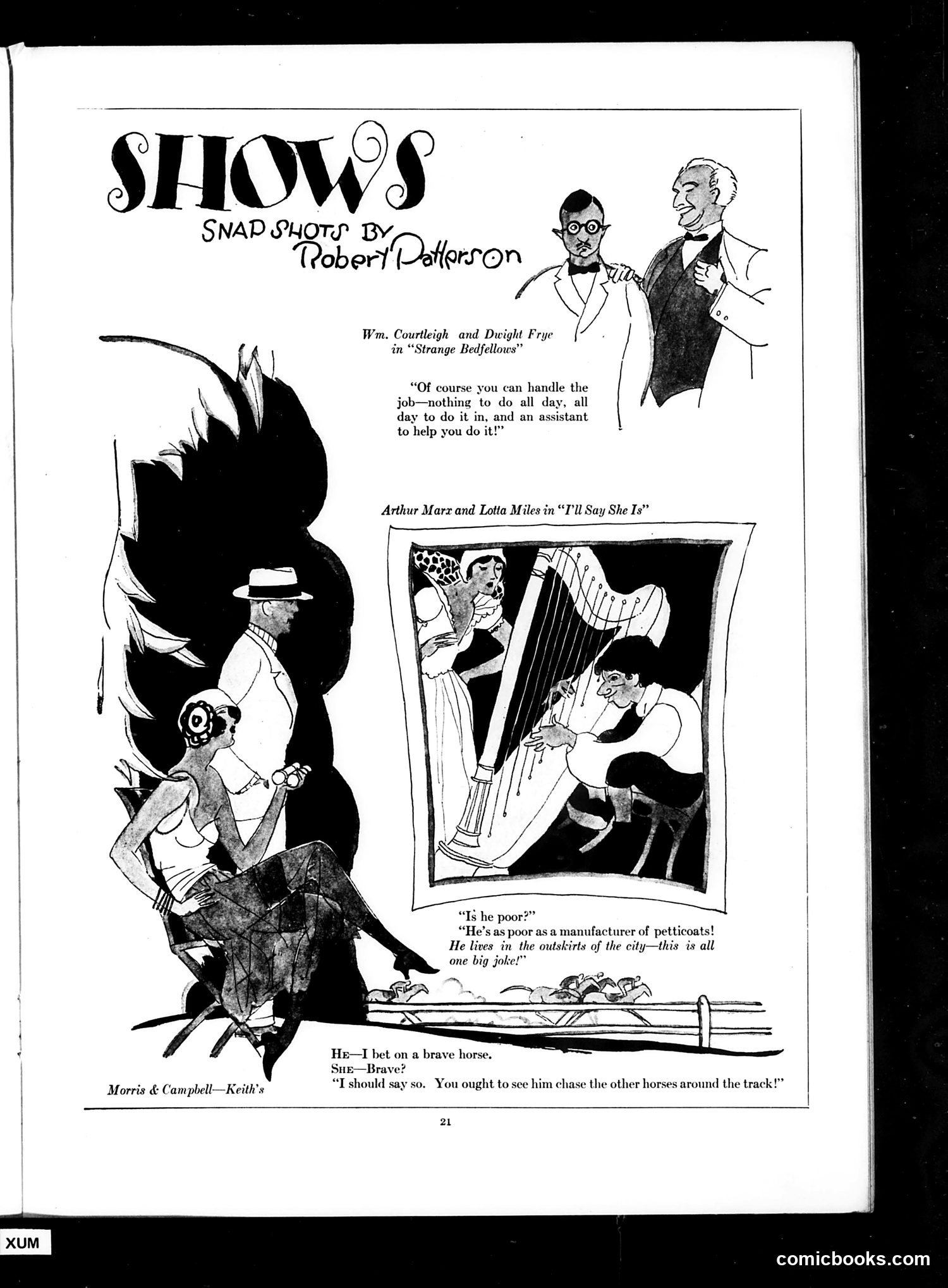
This page features theatrical humor sketches by cartoonist Robert Pallerson, depicting scenes from Broadway productions of the era. The three vignettes mock contemporary plays and their characters: 1. **"Strange Bedfellows"** features two men discussing a job offer with intentional irony—the position requires all-day work despite claiming to be effortless. 2. **"I'll Say She Is"** contains a joke about poverty, playing on the absurdity of calling a petticoat manufacturer "poor" while living on the city outskirts, suggesting ironic social commentary about middle-class pretensions. 3. **"Keith's"** (a vaudeville circuit) shows a couple joking about a horse's bravery—the humor relies on the double meaning of "brave" (courageous versus reckless), with the horse chasing others competitively. These are light entertainment pieces satirizing theatrical stereotypes and contemporary social attitudes, typical of Judge magazine's theatrical coverage from this period.
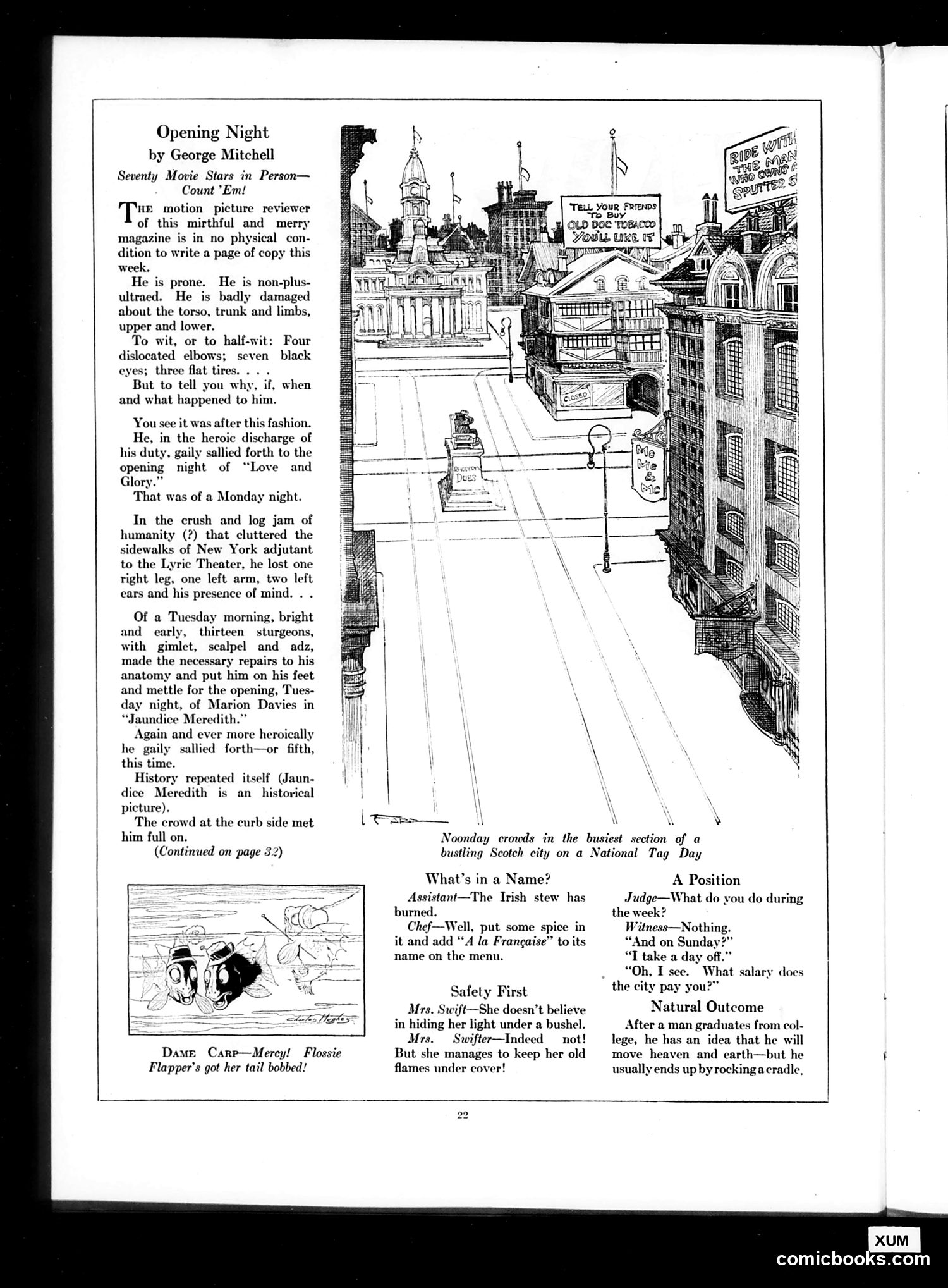
This page satirizes the chaos surrounding major film premieres in 1920s New York. The main article, by George Mitchell, humorously describes the magazine's motion picture reviewer becoming severely injured—losing limbs and gaining black eyes—while covering the opening night of a film called "Love and Glory" at the Lyric Theater. The joke escalates when he returns Monday to cover Marion Davies's "Jaundice Meredith," only to suffer the same fate again from the crushing crowds. The accompanying cartoons and jokes mock contemporary social scenarios: movie star culture, working-class courtship rituals, and changing attitudes toward women (the "flapper" haircut reference). The humor relies on slapstick exaggeration and wordplay rather than direct political commentary, typical of Judge magazine's satirical style.
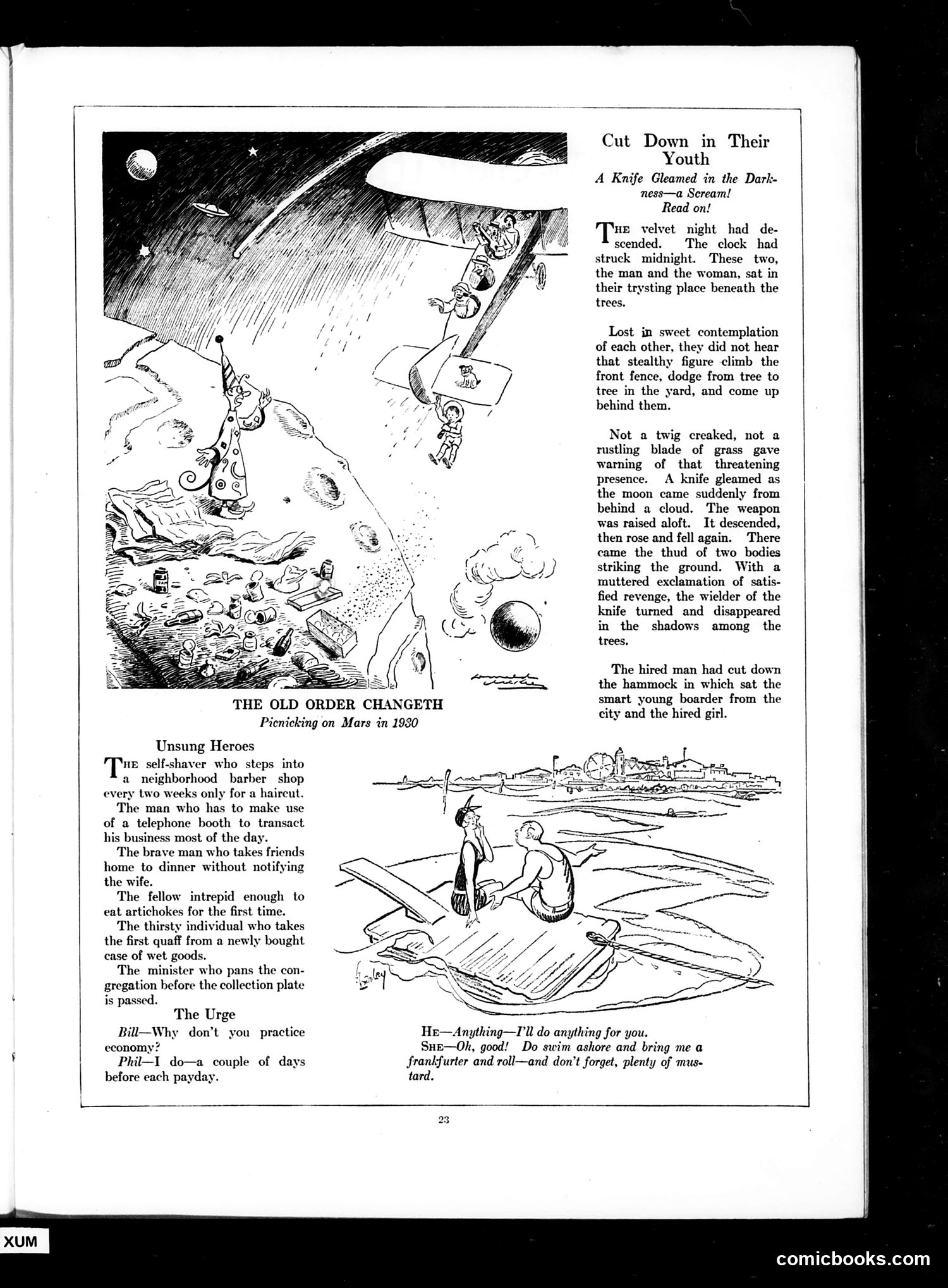
This page contains three distinct pieces of satirical humor: **"Cut Down in Their Youth"** is a mock-melodramatic story illustrated with woodcut-style art. The dramatic narrative—complete with knives gleaming in moonlight and bodies striking the ground—is revealed as a joke: a hired farmhand simply cut down the hammock where young city visitors were sitting. The satire mocks both overwrought pulp fiction and the contrast between urban sophistication and rural practicality. **"Unsung Heroes"** is a brief satirical list of ordinary people performing small acts of courage or social sacrifice—from the man who uses public phone booths to conduct business, to someone eating artichokes for the first time. The humor lies in treating trivial social inconveniences as heroic deeds. **"The Urge"** is a short joke where a man promises to do anything for a woman; she responds by asking him to swim ashore and fetch her food. The humor derives from the anticlimactic, mundane nature of her "romantic" request. Together, these pieces exemplify Judge's focus on gentle domestic and social satire targeting middle-class American life.
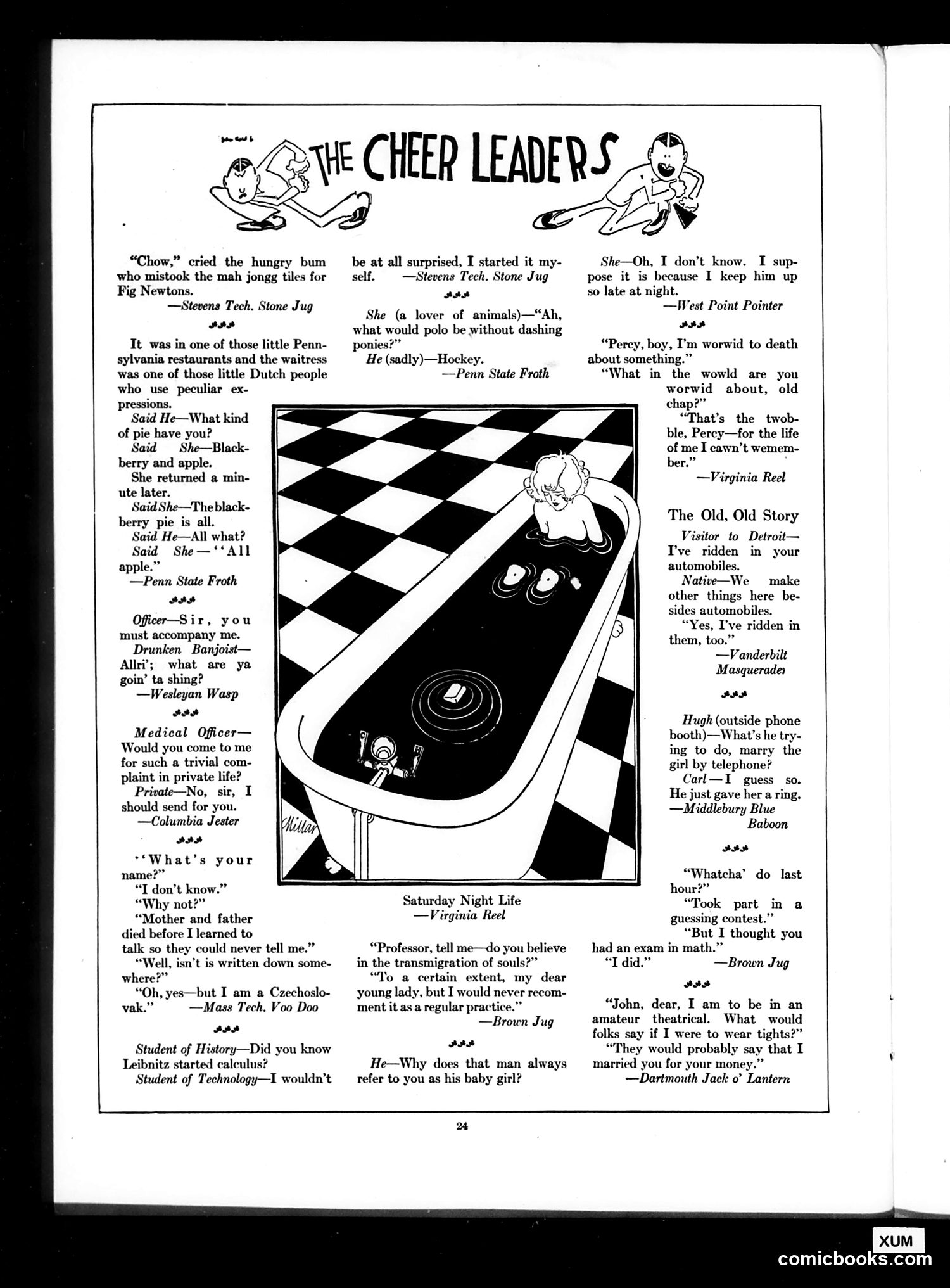
This is a collection of brief jokes and witticisms, primarily sourced from college humor magazines (Stevens Tech Stone Jug, Penn State Froth, Columbia Jester, etc.). The single illustration depicts a woman in an automobile, referencing contemporary fascination with motorcar culture. The jokes target typical early-20th-century college humor subjects: absent-minded professors, ethnic stereotypes (a Czechoslovak's bureaucratic confusion), military hierarchy, courtship mishaps, and marital dynamics. Several play on pronunciation and dialect—particularly Irish accents ("worwid" for "worried") and upper-class British affectation. One joke mocks Detroit's automotive dominance ("We make other things besides automobiles"). Another satirizes philosophical pretension. A running theme is young men's romantic incompetence—proposing via telephone, marrying for money despite women wearing "tights" (considered scandalous). The humor is lighthearted, collegiate, and assumes familiarity with period gender roles and social conventions.
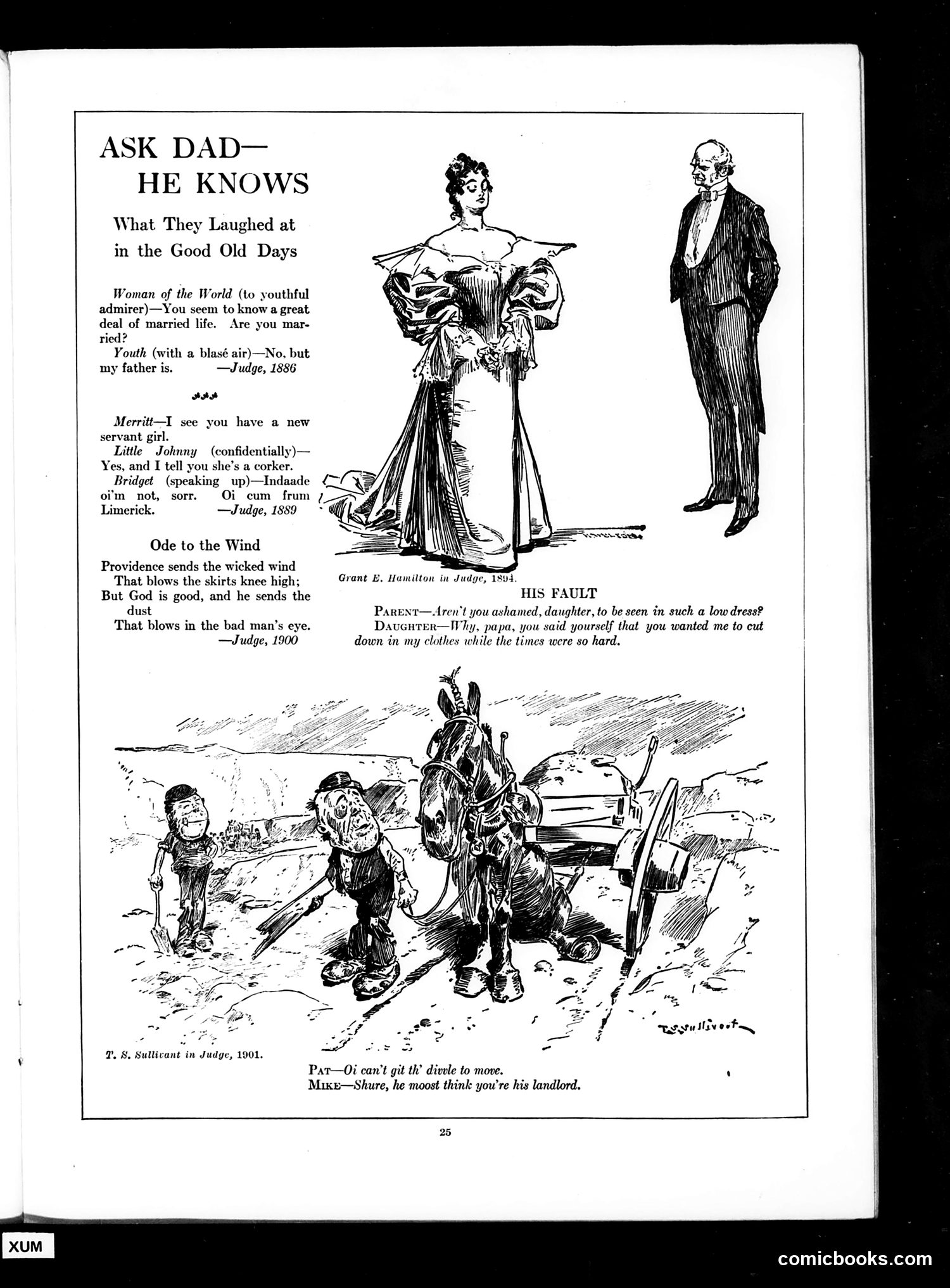
This page collects humorous anecdotes and cartoons from Judge's archives, labeled "Ask Dad—He Knows." **The jokes** rely on wordplay and social observation typical of 1880s-1900s American humor: - A youth claims knowledge of married life through his *father's* experience (1886) - A servant girl named Bridget (Irish stereotype) corrects a boy calling her a "corker" (1889) - An "Ode to the Wind" uses ironic morality—God sends dust to blind wrongdoers (1900) - A daughter takes her father's advice about economizing clothes *literally*, wearing an inappropriately low-cut dress (1894) - Two Irishmen ("Pat" and "Mike," ethnic caricatures) struggle with a stubborn mule; one suggests the other treats it like a landlord—implying Irish tenant farmers famously resisted landlords (1901) **The appeal** relies on period stereotypes (Irish servants and laborers, gender dynamics, class anxiety) and innocent double-entendres rather than complex satire. The cartoons illustrate simple misunderstandings or comeuppances.
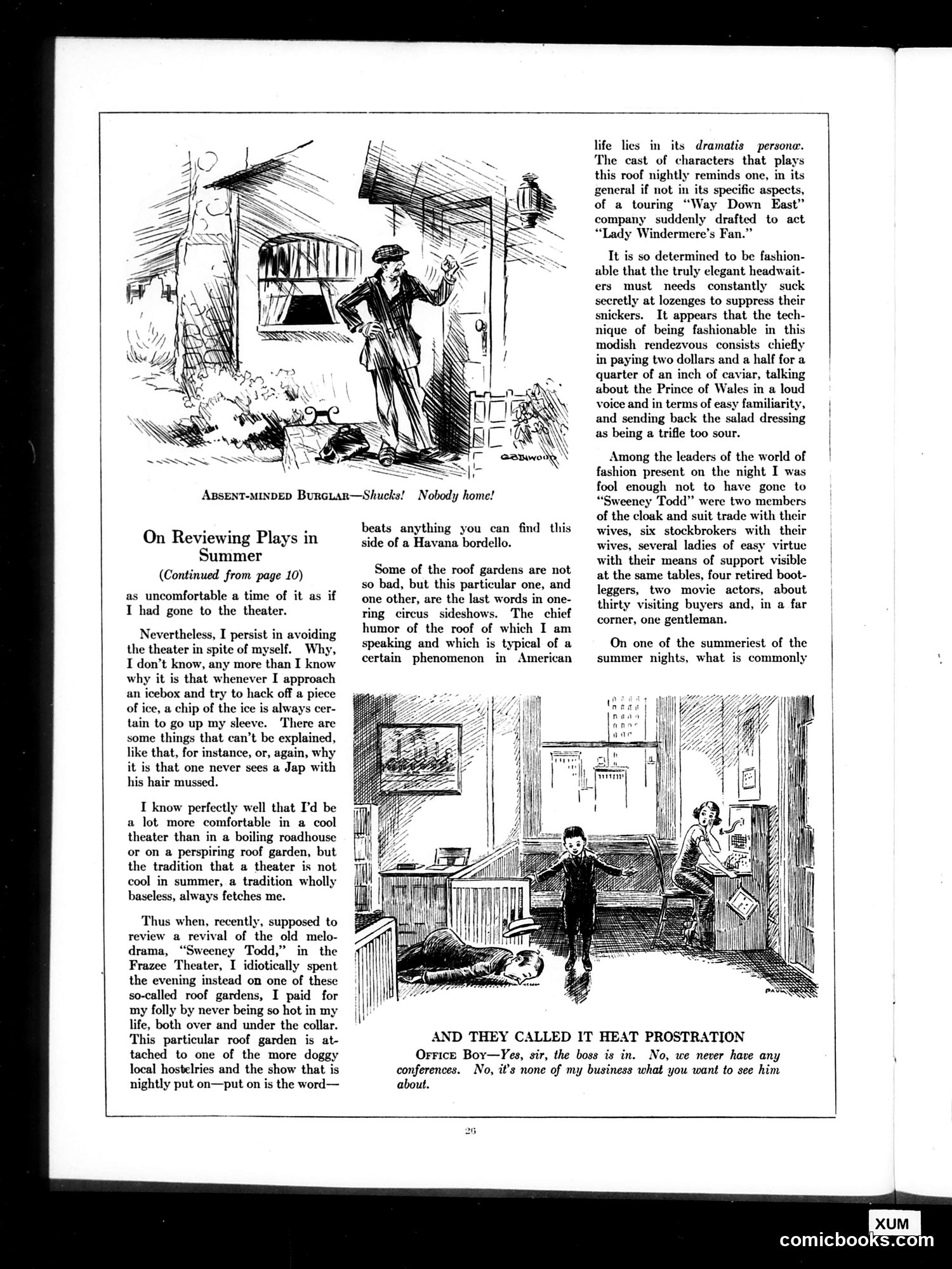
This page contains two satirical pieces mocking summer theater-going in what appears to be the 1920s-30s. **Top cartoon**: "Absent-Minded Burglar" shows a befuddled thief who's broken into a house but forgotten why—a simple visual gag about forgetfulness. **Main article**: The author criticizes both roof garden venues and the "Sweeney Todd" revival. The satire targets: - **Roof gardens as pretentious failures**: These rooftop entertainment spots attempt high fashion but attract a ridiculous mix—stockbrokers, garment workers, retired bootleggers, "ladies of easy virtue," and movie actors all pretending sophistication by discussing the Prince of Wales, eating expensive caviar, and complaining about salad dressing. - **Class pretension**: The humor lies in the collision between working-class and wealthy clientele all performing "elegance." - **Summer discomfort**: The author sarcastically defends choosing a sweltering roof garden over a cool theater simply to follow tradition. **Bottom cartoon**: "Heat Prostration" depicts an overheated office boy indifferently delivering a message—visual proof of the summer misery described above. The satire reflects 1920s-30s anxiety about class mobility and nouveau riche social climbing.
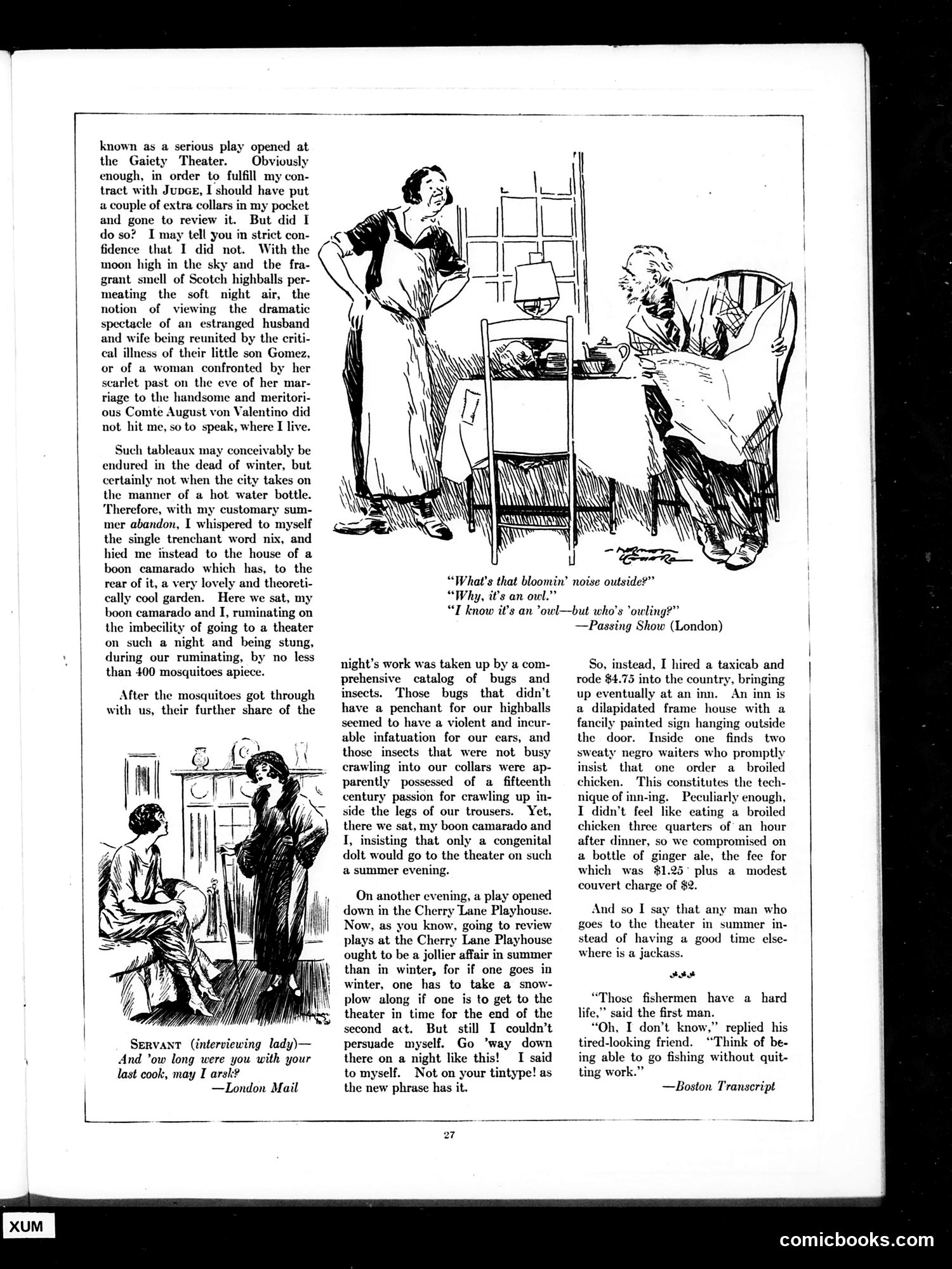
This page contains a humorous essay about avoiding theater in summer, accompanied by comic illustrations and quoted jokes. **Main Content:** The author humorously defends skipping mandatory theater reviews during hot weather, choosing instead to sit in a garden (where he's attacked by 400 mosquitoes) or hire a taxi to a country inn. He argues that anyone who goes to the theater in summer instead of enjoying outdoor activities is foolish. **The Cartoons:** Two separate comic illustrations show domestic/servant scenarios with working-class British characters using Cockney dialect ("bloomin'," "'owl"). The humor relies on wordplay and class-based observational comedy. **The Quoted Jokes:** Brief anecdotes about servants and fishermen, sourced from London and Boston publications, use simple punchlines typical of early 20th-century magazine humor. **The Satire:** The piece gently mocks the author's own obligation to attend theater reviews and celebrates summer leisure over cultural duty—reflecting Jazz Age attitudes about abandoning stuffy conventions.
This page is primarily **financial advertising** from Judge magazine, a satirical publication. The dominant content consists of investment pitches for 7% bonds and mortgage securities—products targeting middle-class savers seeking reliable income. The cartoon appears minimal or unclear in this image. The "Investment Bureau" section includes a small illustration labeled "THRIFT" showing what appears to be animals (likely a satirical reference to thrift/saving), but its specific satirical point is difficult to discern from the reproduction. The article "A Long, Strong Pull" by Theodore Williams discusses stock market behavior—cautioning against overconfidence during bull markets and advising investors to maintain discipline. This reflects early 20th-century financial journalism. **Historical context**: These ads reflect pre-Depression investment culture, when high-yield bonds were marketed as safe, and mortgage-backed securities were sold with confidence in institutional stability—assumptions that would soon prove catastrophically wrong.
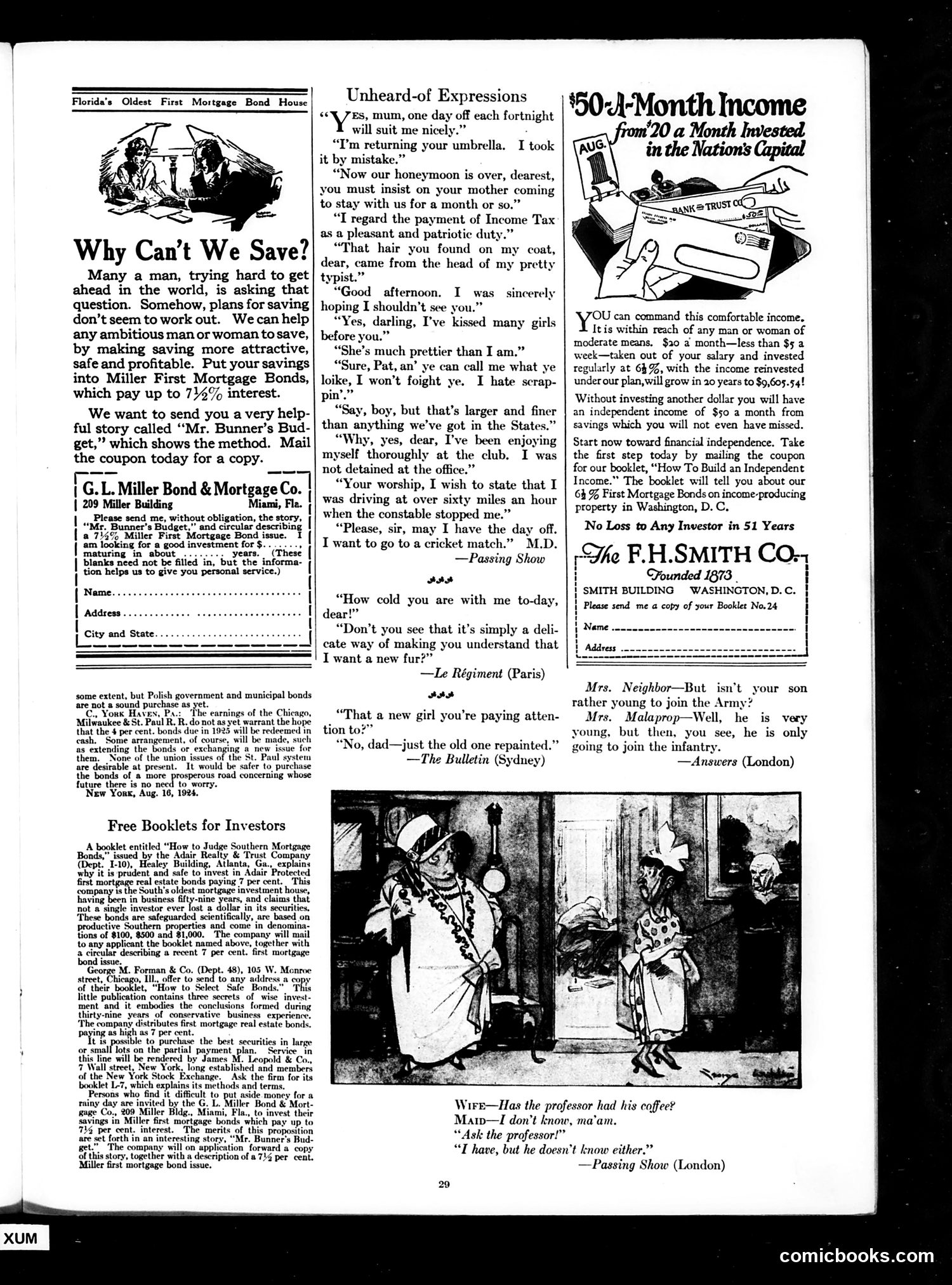
This page is primarily **advertising and financial content** with minimal satirical cartooning. The main ad features a small cartoon labeled "Why Can't We Save?" showing two figures discussing savings bonds. It's a straightforward pitch for Miller First Mortgage Bonds offering 7¼% interest—presented as a solution to Americans' savings struggles, likely reflecting post-WWI economic concerns. The "Unheard-of Expressions" section is a brief satirical segment listing absurd or paradoxical statements: offering servants days off, voluntarily returning borrowed items, inviting in-laws to stay, and willingly paying income taxes. These represent behaviors *so contrary to normal human behavior* that they're presented as impossibly humorous—satirizing penny-pinching employers, dishonest borrowers, and tax resistance. The cartoon illustration shows what appears to be a domestic or financial scene but is too small to identify specific figures or references with certainty. The page's content is primarily **investment-focused promotional material** rather than political satire.
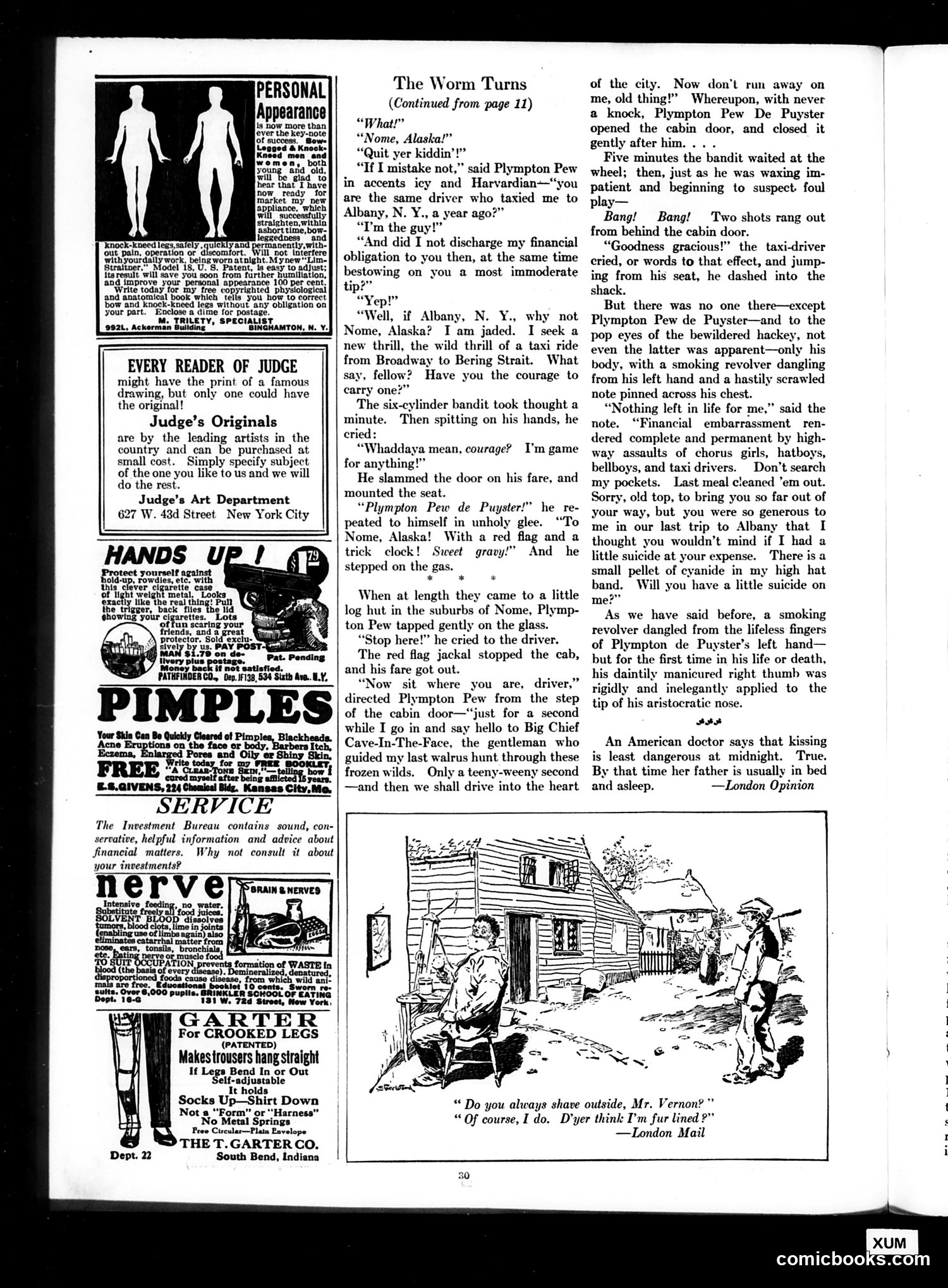
The single cartoon at the bottom depicts a rural scene with a man sitting outside a cabin while another man approaches from the direction of the house. The caption reads: "Do you always share outside, Mr. Vernon?" / "Of course, I do. D'yer think I'm fur lined?" This appears to be a simple joke about outdoor toileting or bathing practices in rural areas—the humor relying on the idea that country living involved doing personal activities outside in the open air, with the punchline playing on the phrase "fur lined" as an absurd response to why someone would choose to be outside year-round. The cartoon satirizes rural/frontier life and its lack of modern indoor conveniences, a common subject of urban humor magazines targeting city readers. The page is primarily filled with period advertisements for medical treatments, patent devices, and services rather than editorial content.
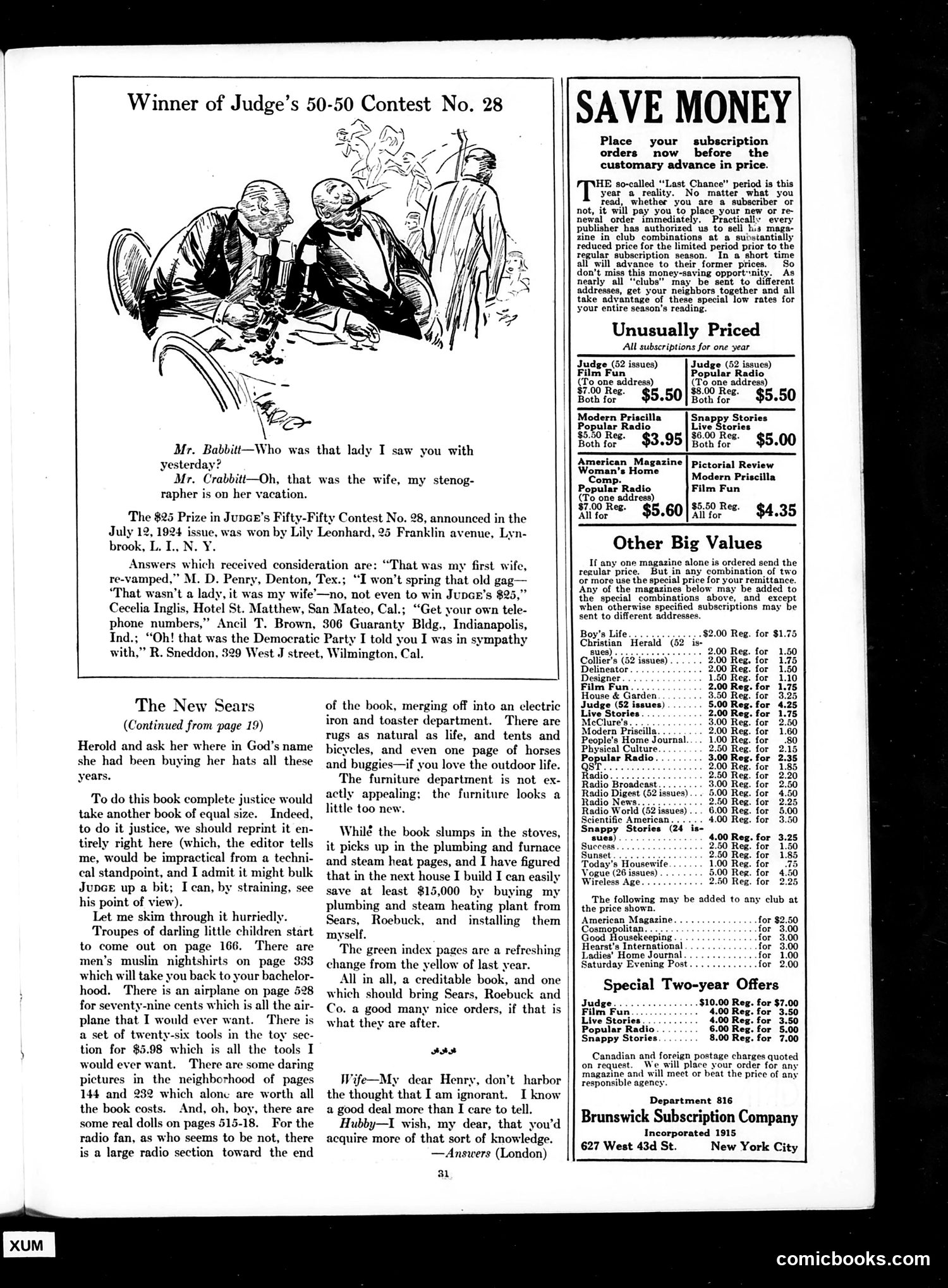
**The Main Cartoon:** The "Winner of Judge's 50-50 Contest No. 28" shows two men in conversation. Mr. Babbitt asks Mr. Crabbitt about a woman he saw with him, assuming she was an affair. Crabbitt responds it was his wife—his stenographer on vacation. The joke's punchline, from contest winner Lily Leonhard, plays on the tired marital complaint: "That wasn't a lady, it was my wife." This is a variation of the old joke format "That wasn't a lady, that was my wife." **The Satire:** The humor reflects early 20th-century attitudes about marriage—portraying wives as less attractive or refined than romantic companions. The contest format invited readers to compete with joke variations, suggesting this was a widely-recognized comedic formula of the era. **Context for Modern Readers:** This represents period humor about marital dissatisfaction that would be considered offensive today. The rest of the page contains magazine subscription advertisements and a book review of the Sears catalog.
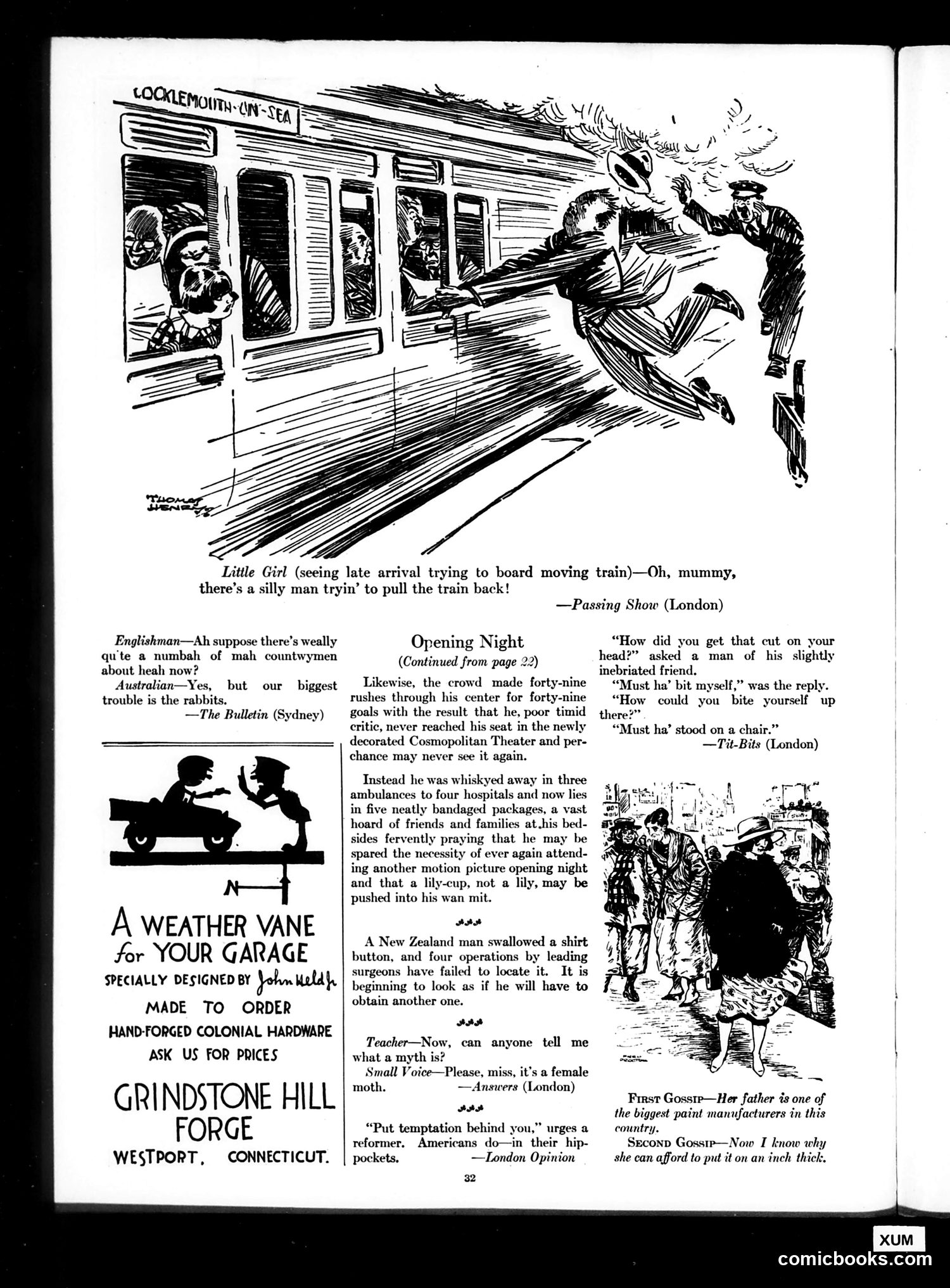
This page contains multiple humor items typical of early 20th-century satirical magazines: **Top cartoon**: A British child observes a man chasing a departing train, humorously misinterpreting his running alongside as an attempt to "pull the train back"—playing on innocent misunderstanding. **"Opening Night" piece**: Dark comedy about a theater critic mobbed by crowds at a movie premiere, injured so severely he ends up in multiple hospitals. The satire targets both rowdy opening-night crowds and dramatic entertainment industry excess. **Scattered jokes**: - A New Zealand man swallows a shirt button; surgeons can't locate it - A teacher's student defines "myth" as "female moth" - Wordplay about a drunk man biting himself and standing on a chair - A gossip joke: a woman can afford heavy makeup because her father manufactures paint The page also advertises a weather vane forge business. The humor relies on absurdist scenarios, puns, and mild social observation typical of Judge's style—accessible, lighthearted satire without heavy political content.
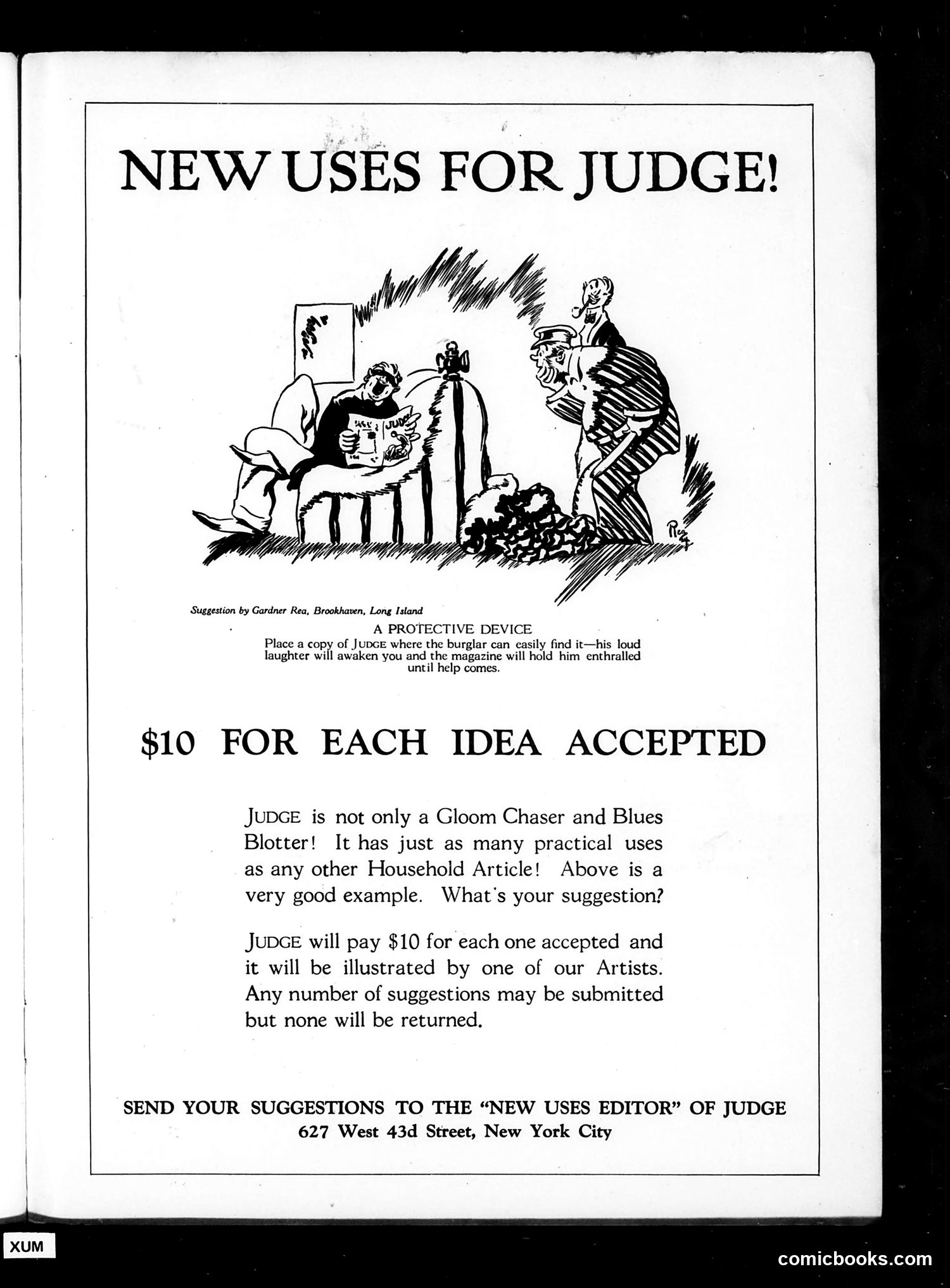
This is a **reader-submission contest page**, not political satire. Judge magazine invited readers to suggest creative, humorous uses for the magazine itself beyond its intended purpose as humor publication. The cartoon illustrates the winning example by Gardner Rea: placing Judge where a burglar would find it. The joke is that the burglar will laugh so hard reading Judge that he'll wake the homeowner, and become so entertained he'll stay reading until police arrive—making the magazine itself a home security device. The advertisement offers $10 per accepted idea (substantial money in this era), with professional illustration. This was a **promotional gimmick** encouraging reader engagement while poking fun at Judge's own comedic value. The self-aware humor suggests Judge was confident enough in its humor to joke about its (supposedly) paralyzing comic effects.
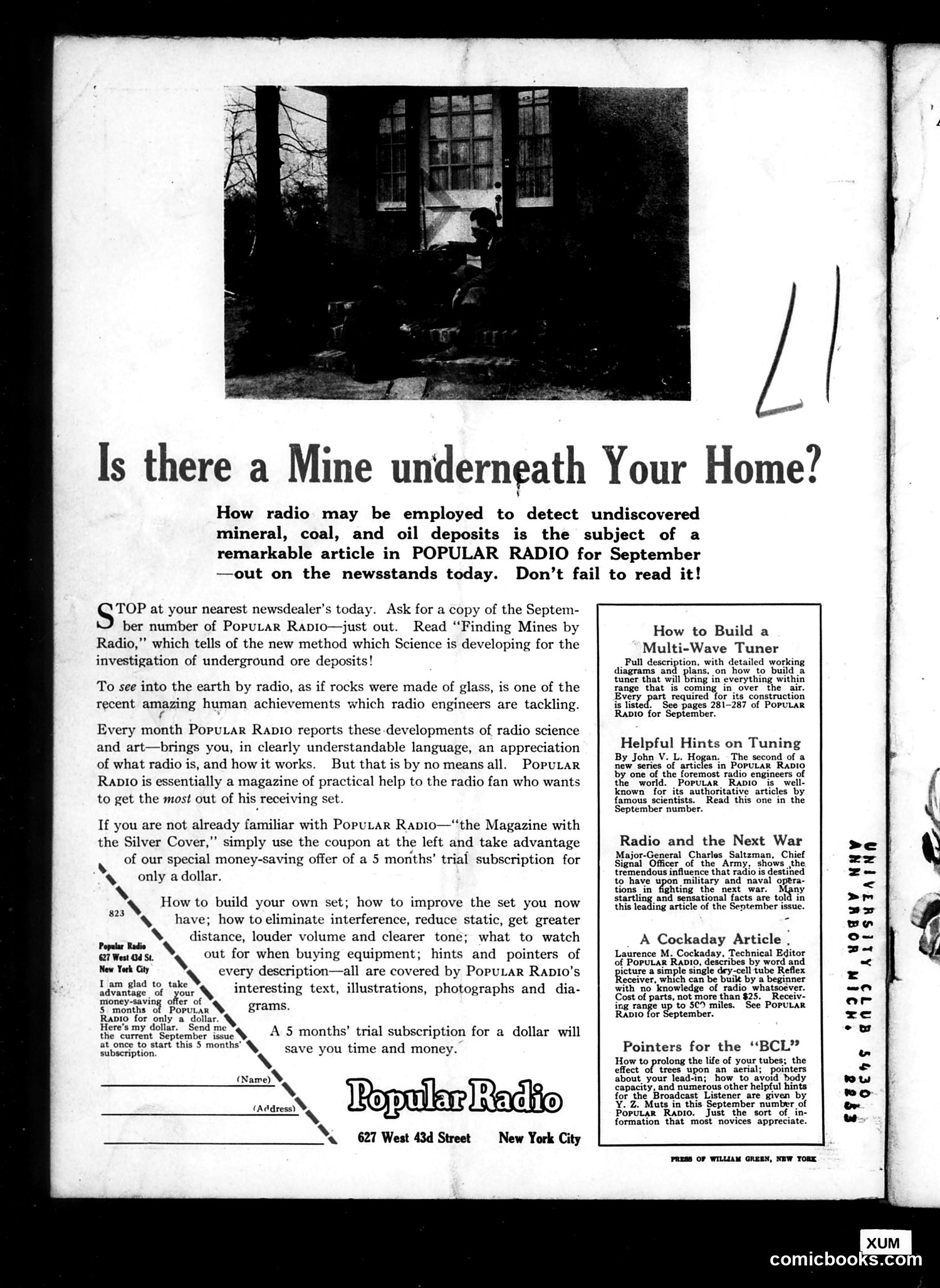
This is primarily **advertising**, not satire or political commentary. The page promotes *Popular Radio* magazine's September issue through a clickbait headline: "Is there a Mine underneath Your Home?" The headline is sensationalist marketing. The actual article discusses using radio technology to detect underground mineral, coal, and oil deposits—a genuine 1920s scientific development. The "mine under your home" framing is designed to grab readers' attention with an intriguing mystery, then redirect them to purchase the magazine. The right column lists other September articles: radio tuning guides, a piece by a U.S. Army general about radio in future warfare, beginner radio-building projects, and tips for casual radio listeners ("BCL" = Broadcast Listener). This reflects the era's enthusiasm for radio as cutting-edge technology and practical hobby. There is no political satire evident here—it's straightforward magazine promotion targeting radio enthusiasts and hobbyists.