
Judge, 1924-08-23 · page 12 of 36
Judge — August 23, 1924 — page 12: what you’re looking at
What you’re looking at
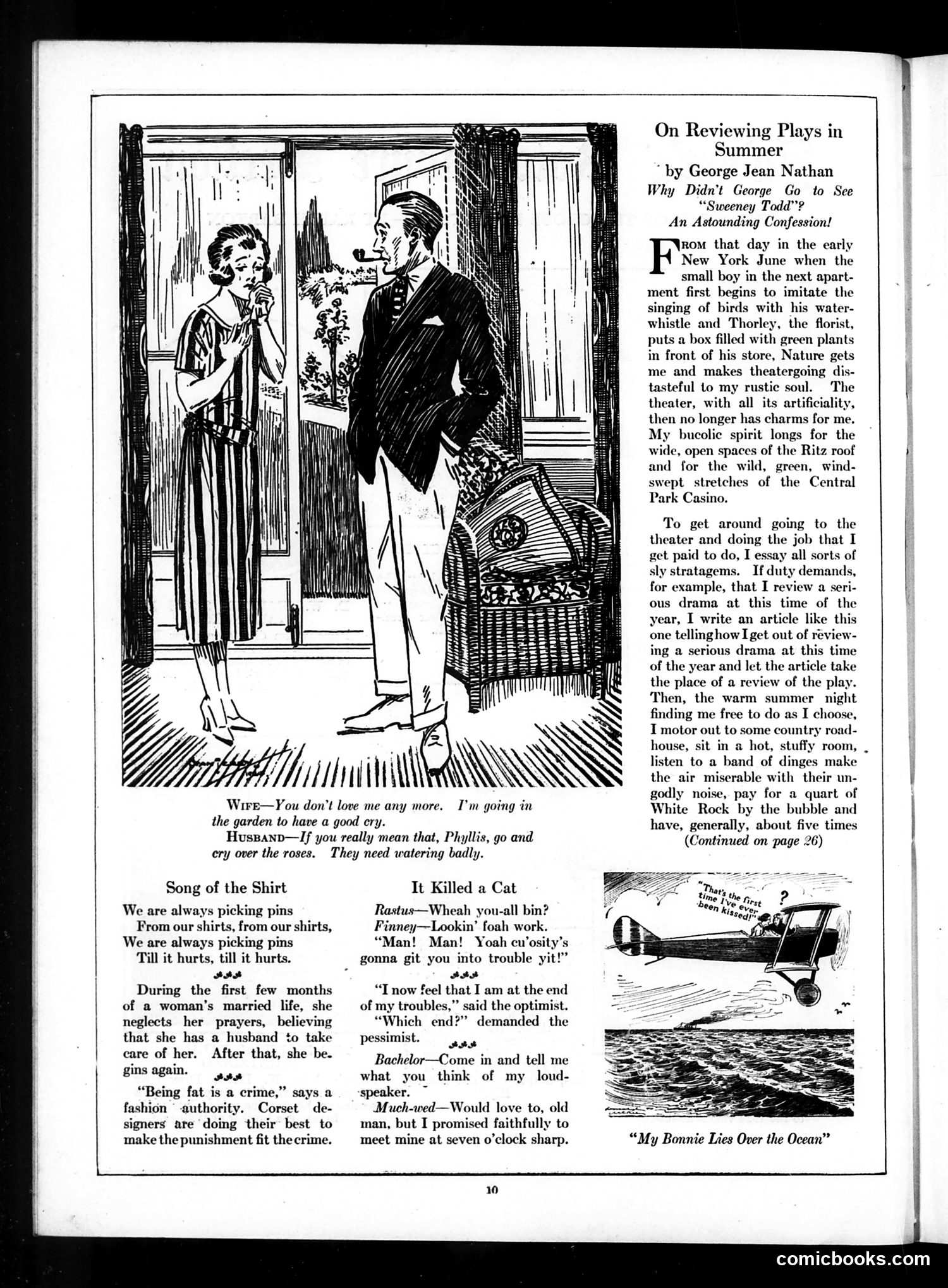
This Judge magazine page contains several discrete humor pieces: **Main Cartoon (top):** A domestic scene where a wife threatens to cry in the garden unless her husband shows affection. His callous response—suggesting she cry over the roses because they need watering—satirizes marital indifference and the husband's emotional neglect. **Short Humor Pieces:** Include jokes about married life (wives neglecting prayers once married), fashion/corsetry as punishment for being overweight, and racial dialect humor featuring Black characters ("Rastus" and "Finney") that reflect period stereotyping. **Featured Article:** George Jean Nathan's essay about avoiding theater reviews during summer, using meta-humor—he writes an article *about* avoiding his job instead of doing it. He claims nature (city summer sounds, plants) makes theater seem artificial compared to roadhouses and open spaces. The page reflects 1920s attitudes: casual marital mockery, weight-shaming, racial caricature, and the conceit that avoiding work through clever writing constitutes wit.
📄 Transcribed text from this page (OCR, searchable)
Machine-transcribed from the original scan — historical spelling and the odd misread are preserved.
yi { Mh Is ge \ \\) Ass Aeiwtlh vail pupae Mijas twas he Wire—You don’t love me any more. I’m going in the garden to have a good cry. Huszanp—If you really mean that, Phyllis, go and ery over the roses. They need watering badly. Song of the Shirt We are always picking pins From our shirts, from our shirts, We are always picking pins Till it hurts, till it hurts. tae During the first few months of a woman’s married life, she neglects her prayers, believing that she has a husband to take care of her. After that, she be. gins again. PIS “Being fat is a crime,” says a fashion authority. Corset de- signers are doing their best to make the punishment fit the crime. It Killed a Cat Rastus—Wheah you-all bin? Finney—Lookin’ foah work. “Man! Man! Yoah cu’osity’s gonna git you into trouble yit!” PIs “T now feel that I am at the end of my troubles,” said the optimist. “Which end?” demanded the pessimist. sae Bachelor—Come in and tell me what you think of my loud- ‘speaker. ~ Much-wed—Would love to, old man, but I promised faithfully to meet mine at seven o’clock sharp. On Reviewing Plays in Summer “by George Jean Nathan Why Didn’t George Go to See “Sweeney Todd’? An Astounding Confession! Rom that day in the early Fx York June when the small boy in the next apart- ment first begins to imitate the singing of birds with his water- whistle and Thorley, the florist, puts a box filled with green plants in front of his store, Nature gets me and makes theatergoing dis- tasteful to my rustic soul. The theater, with all its artificiality, then no longer has charms for me. My bucolic spirit longs for the wide, open spaces of the Ritz roof and for the wild, green, wind- swept stretches of the Central Park Casino. To get around going to the theater and doing the job that I get paid to do, I essay all sorts of sly stratagems. If duty demands, for example, that I review a seri- ous drama at this time of the year, I write an article like this one tellinghowI get out of review- ing a serious drama at this time of the year and let the article take the place of a review of the play. Then, the warm summer night finding me free to do as I choose, I motor out to some country road- house, sit in a hot, stuffy room, , listen to a band of dinges make the air miserable with their un- godly noise, pay for a quart of White Rock by the bubble and have, generally, about five times (Continued on page 26) “My Bonnie Lies Over the Ocean” comicbooks.com