
A complete issue · 37 pages · 1924
Judge — June 28, 1924
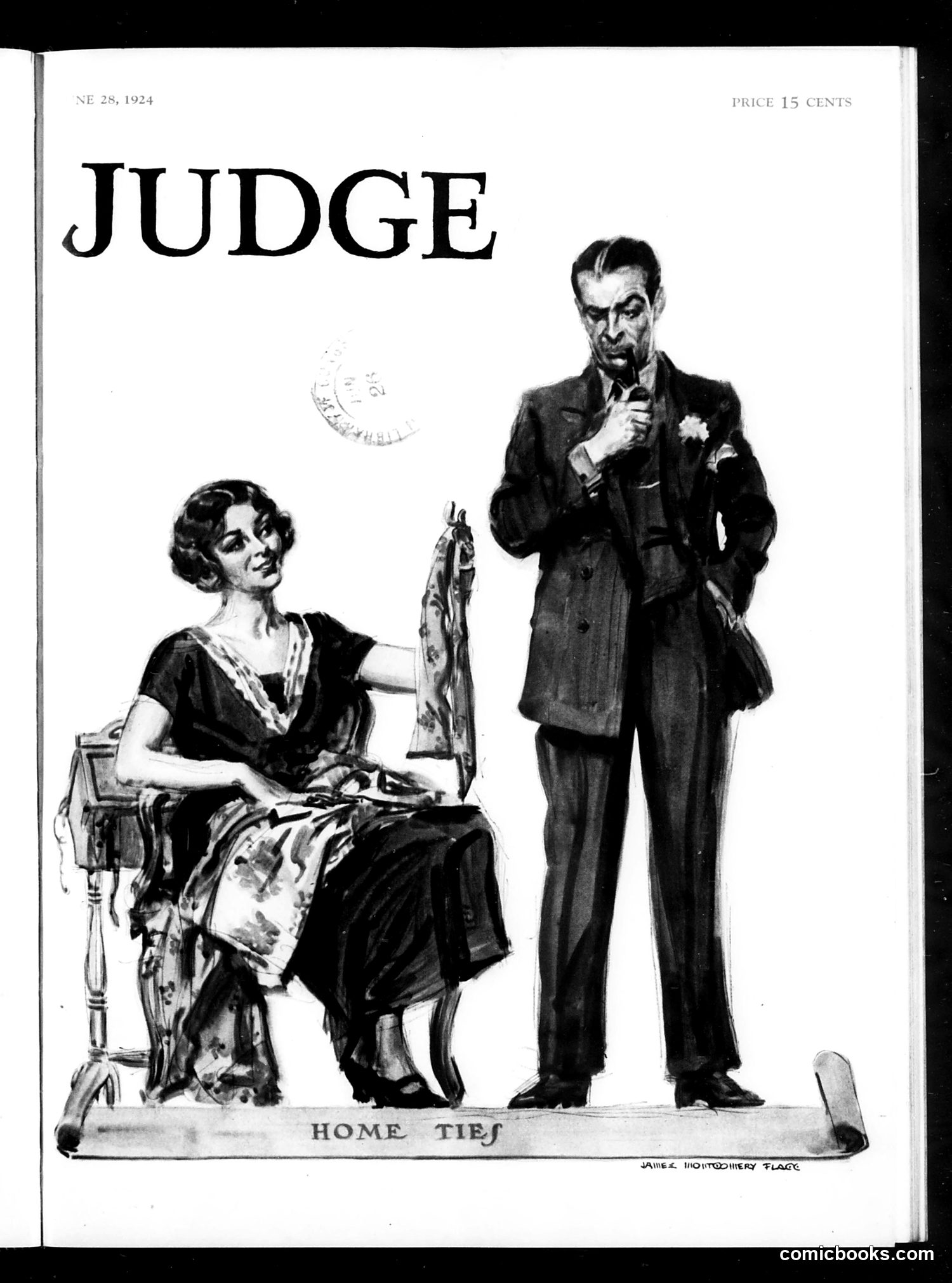
This cartoon satirizes domestic marital conflict. The illustration shows a well-dressed man and woman in what appears to be a fashionable 1920s interior. The woman sits examining fabric swatches or clothing samples while the man stands beside her, hand to chin in a contemplative or worried pose. The caption "HOME TIES" is a pun—referring both to literal neckties (domestic goods) and the metaphorical "ties" binding a marriage. The satire likely targets the tensions between spouses over household spending or domestic decisions, a common theme in 1920s humor. The woman's engagement with material goods contrasts with the man's apparent anxiety or resignation, suggesting commentary on gender roles and consumer culture in the era.
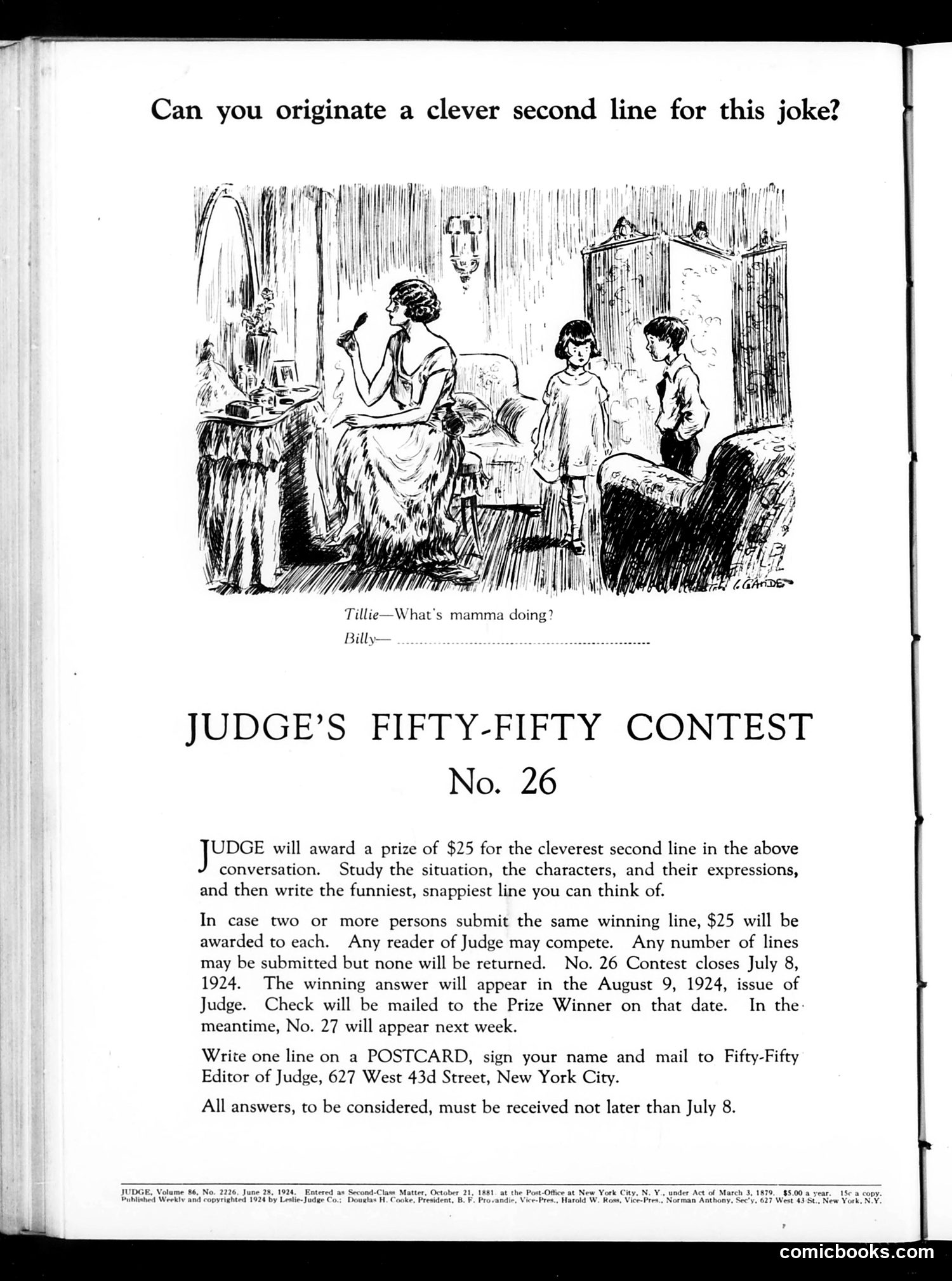
This page features a "Fifty-Fifty Contest" (No. 26) from Judge magazine, dated June 24, 1924. It's not political satire but rather a humor competition. The cartoon shows a domestic scene: a woman sits at a vanity mirror while two children ask, "What's mama doing?" The first line is provided: "Tillie—What's mama doing?" / "Billy—[blank]" Readers are invited to submit clever second-line responses for a $25 prize. The humor apparently derives from the visual ambiguity of the woman's activity—she's preparing her appearance (applying makeup or hair care), which children might humorously misinterpret. This represents Judge's interactive humor format, where readers completed jokes rather than consuming finished comedy.
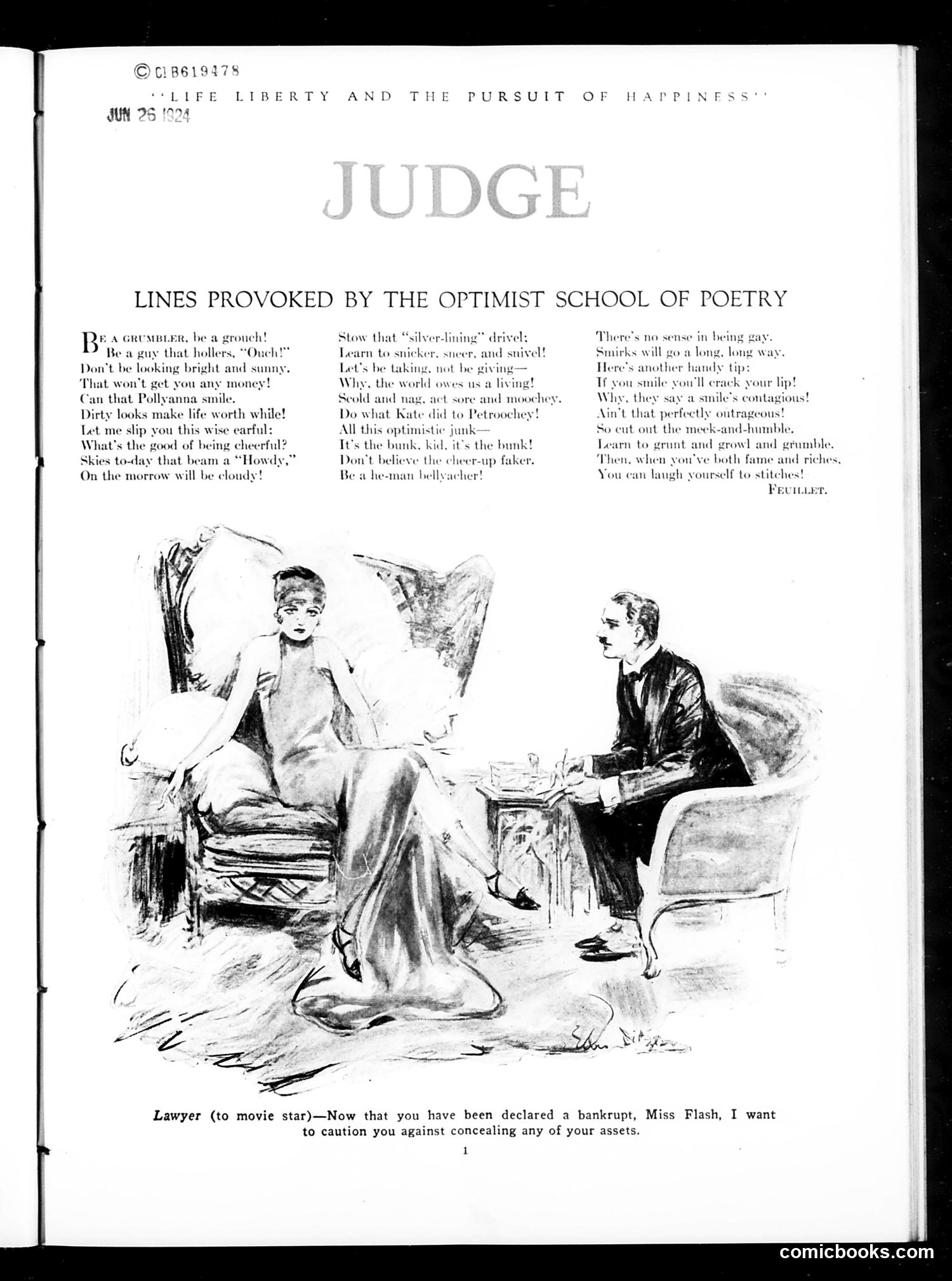
This page satirizes the **Optimist school of poetry** — a literary movement emphasizing relentless positivity. The poem mocks optimists who dismiss legitimate complaints ("Don't be looking bright and sunny") and demand cheerfulness regardless of circumstances ("Why, they say a smile's contagious!"). The cartoon below depicts a lawyer cautioning a bankrupt movie actress ("Miss Flash") against hiding assets. The satire is social rather than political: it ridicules the gap between optimistic ideology and harsh reality. While optimists preach that positive thinking solves problems, this woman faces genuine financial ruin requiring legal accountability—not cheerful platitudes. The piece critiques naive optimism as disconnected from practical life's difficulties.
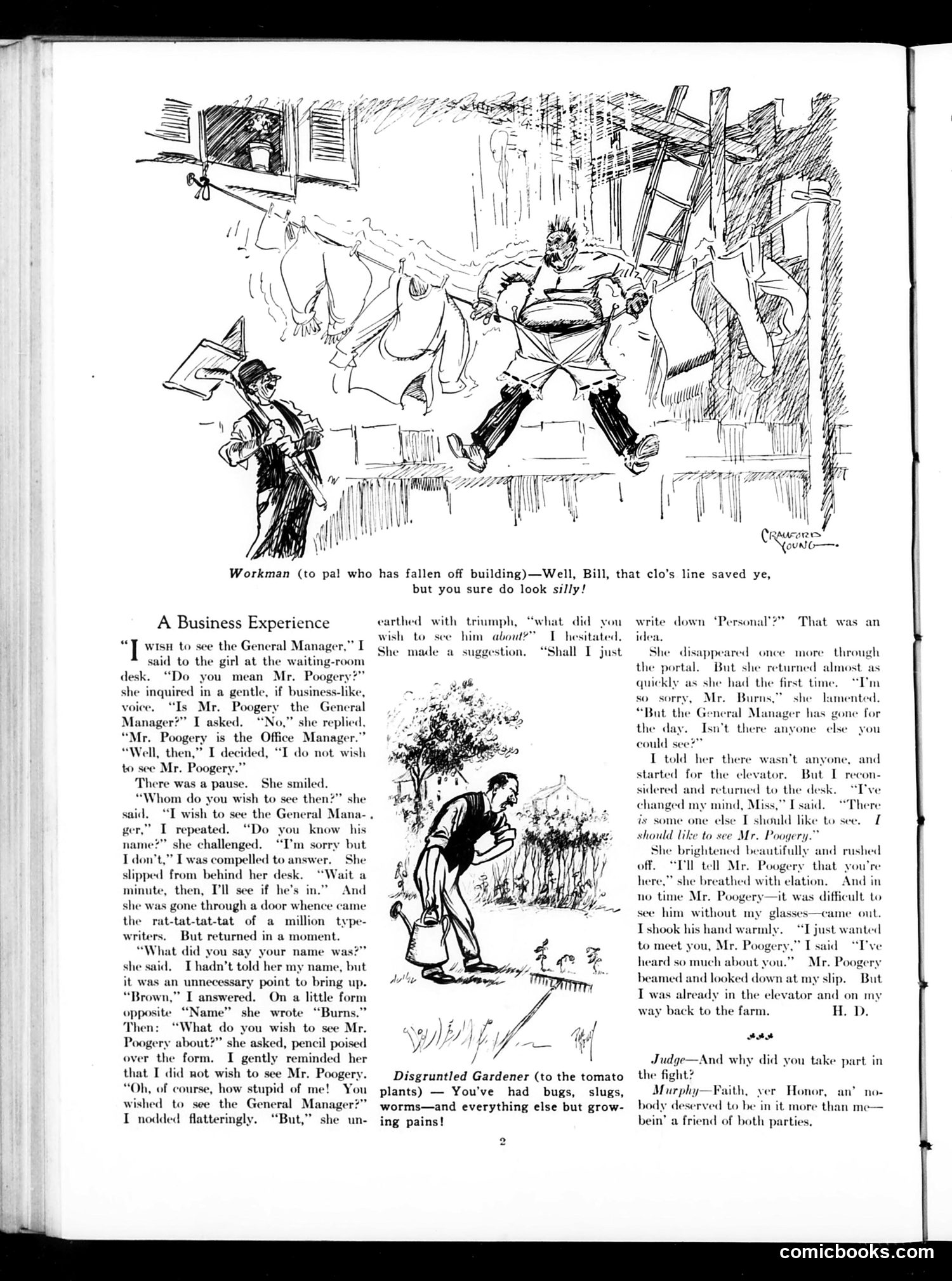
This page contains two separate humor pieces: **Top cartoon:** A workplace safety joke. A workman tells a colleague who's fallen off a building that "that clo's line saved ye, but you sure do look silly!" The humor relies on slapstick physical comedy and the absurdity of a clothesline preventing serious injury. **"A Business Experience" story:** This satirizes office hierarchies and job-seeking. A young woman seeks the General Manager but must navigate bureaucratic obstruction—being redirected through various staff members. The satire targets workplace absurdity: the difficulty accessing authority figures and the pointless intermediaries that prevent direct communication. Both pieces mock contemporary workplace dynamics (safety negligence, administrative inefficiency) through exaggerated scenarios, typical of Judge magazine's satirical approach to American social conditions.
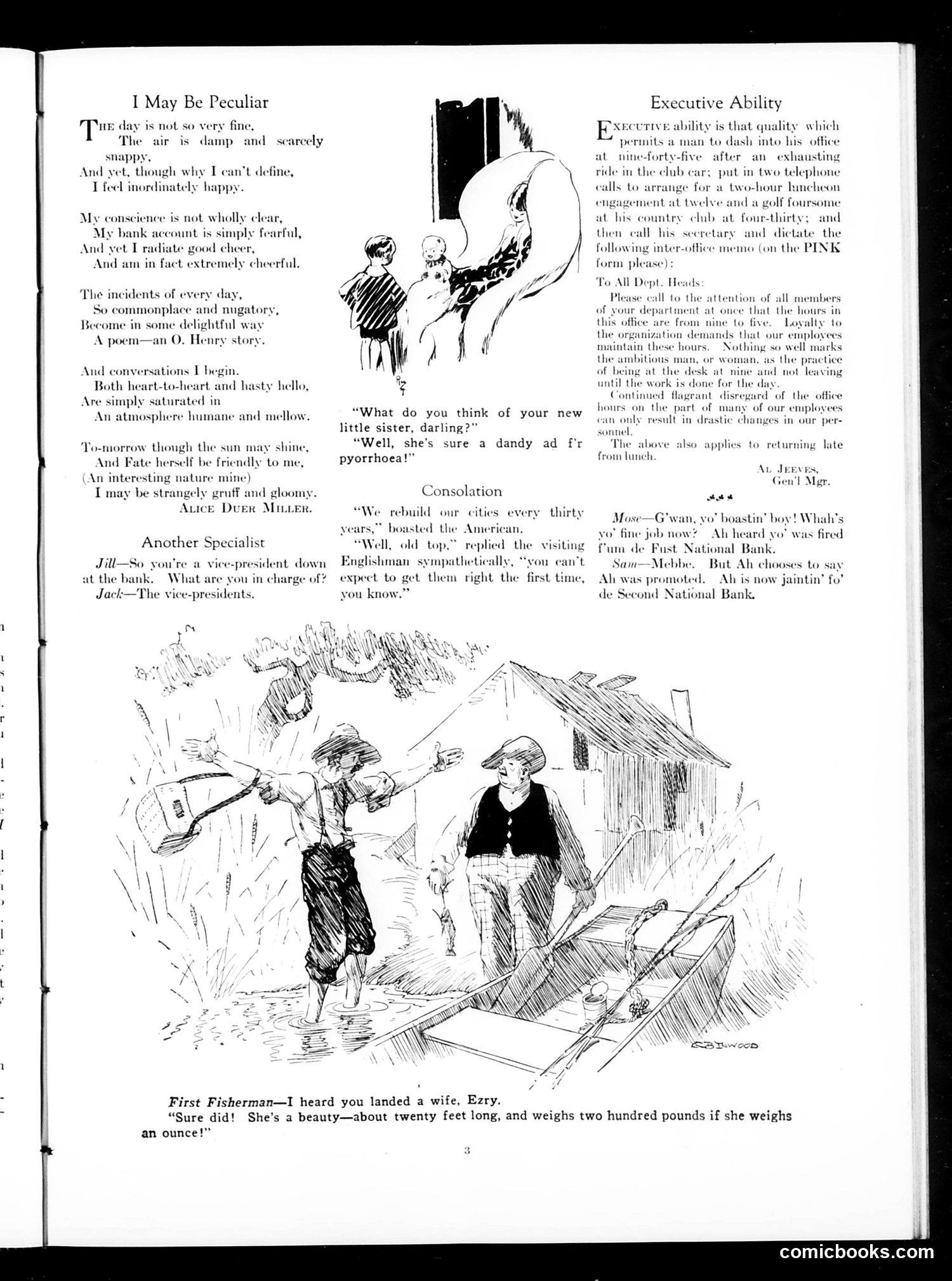
This page contains several distinct pieces of humor: **"I May Be Peculiar"** (top left): A poem by Alice Deer Miller expressing mild dissatisfaction despite cheerfulness—satirizing the tension between inner feelings and social obligation to appear content. **"Executive Ability"** (top right): Mocks corporate efficiency by describing an executive's packed schedule of leisure activities (golf, telephone calls, lunch)—satirizing how "busy" businessmen actually spend their time on personal pursuits rather than work. **"Another Specialist"** (middle): A brief joke about vice-presidents, suggesting corporate hierarchy creates redundant positions. **Bottom cartoon**: Two fishermen discuss a massive catch described as a "wife"—a crude joke playing on old tropes about wives as burdensome catches or prizes, reflecting early 20th-century misogynistic humor common in satirical magazines. The page reflects period attitudes toward work, ambition, and gender roles.
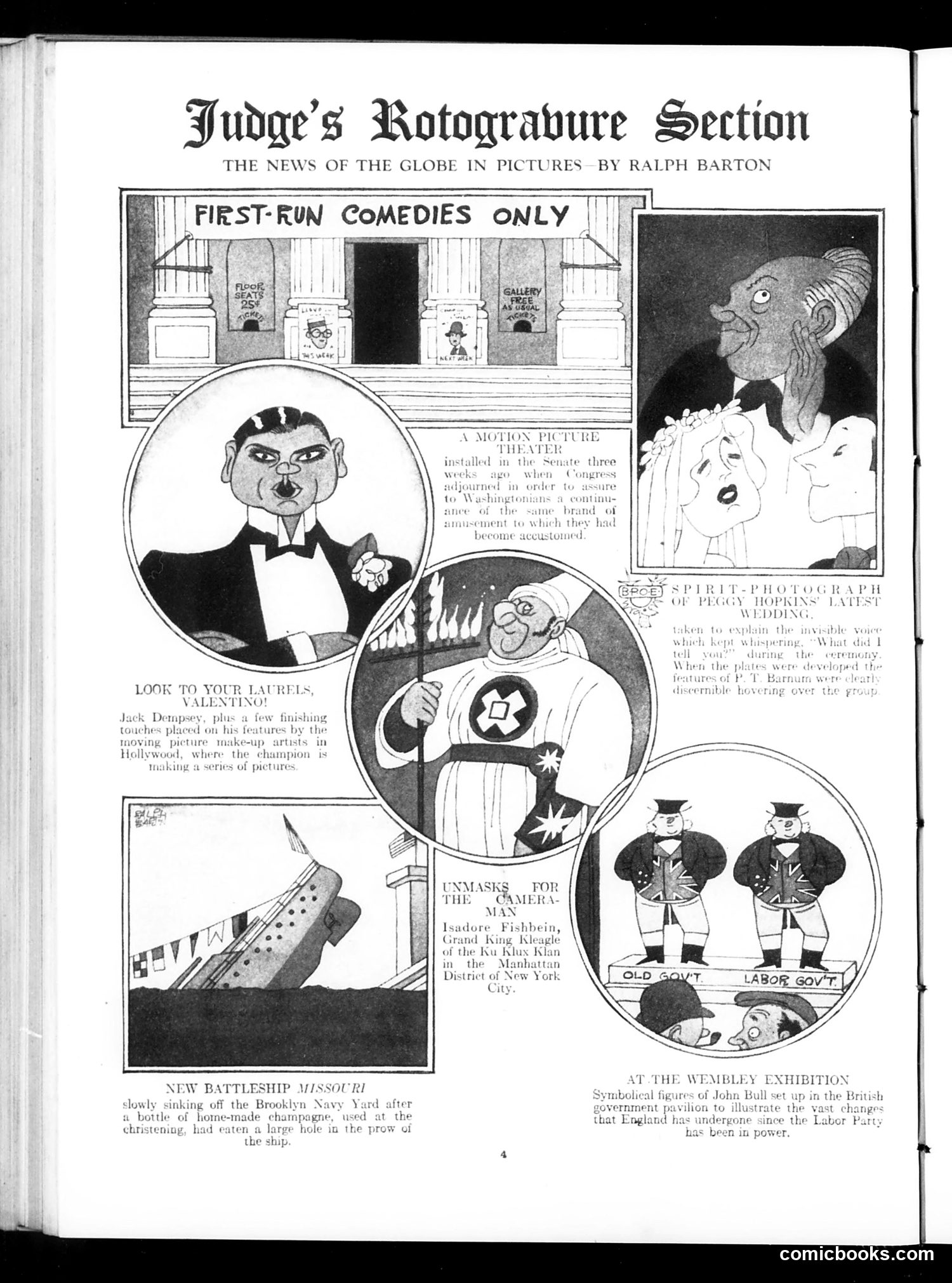
This page from Judge magazine combines entertainment industry satire with political commentary: **"First-Run Comedies Only"** showcases silent film industry content, including a reference to Jack Dempsey (boxing champion turned actor). The theater marquee satirizes Hollywood's output. **"Spirit-Photograph of Peggy Hopkins' Latest Wedding"** mocks actress Peggy Hopkins, known for multiple marriages—a common subject of 1920s satire about celebrity excess. **"New Battleship Missouri"** depicts naval military equipment, likely contemporary military commentary. **"At the Wembley Exhibition"** presents political caricatures comparing "Old Scout" and "Labor Gov't" figures, referencing Britain's Labour Party political shift. The symbolic contrast criticizes political change in post-WWI Britain. The page blends entertainment gossip with international political commentary typical of Judge's satirical approach.
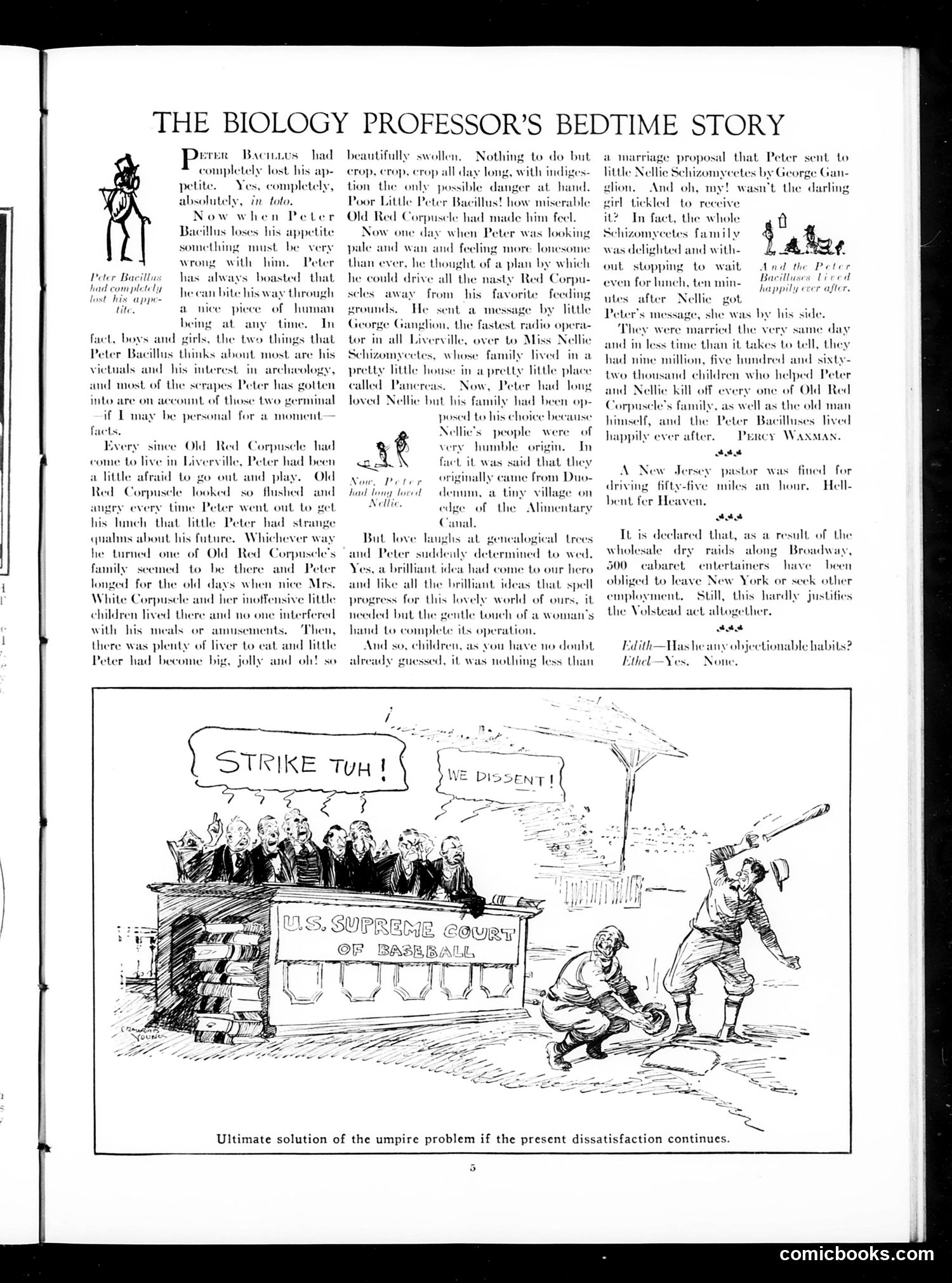
The main story is a whimsical fable about bacteria (Peter Bacillus) courting Nellie Schizomycetes, told as children's bedtime fare. It's largely a lighthearted romantic tale with biological terminology replacing human names—seemingly meant to amuse educated readers familiar with microbiology. The cartoon below addresses a contemporary issue: baseball umpire disputes. It depicts the "U.S. Supreme Court of Baseball" with judges striking while players dissent, captioned as the "ultimate solution of the umpire problem if the present dissatisfaction continues." This satirizes ongoing arguments over umpire calls and suggests that if complaints persist, the solution would be replacing human umpires with a court system—absurdist political commentary on labor/authority conflicts of the era. The page also includes minor humor items about Prohibition enforcement (the "wholesale dry raids" closing cabarets) and a joke about a speeding pastor.
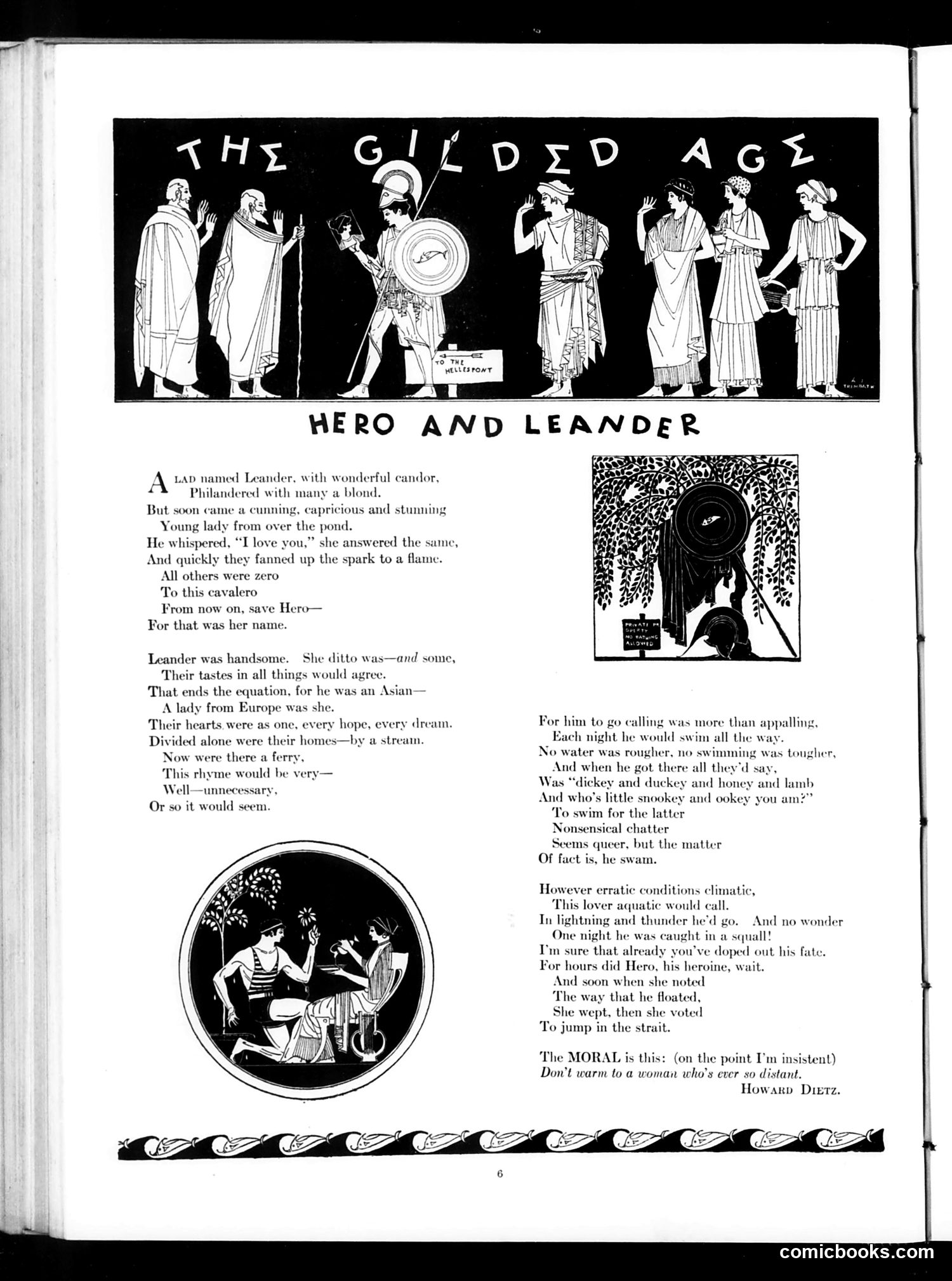
This page presents a humorous retelling of the classical myth of Hero and Leander—lovers separated by water, with tragic consequences. The satire appears to target early 20th-century romance across national/cultural boundaries. The joke operates on multiple levels: Leander, an "Asian" gentleman, repeatedly swims across a stream to court Hero, a European lady. Their courtship is undermined by absurd domesticity—when he visits, they engage in inane baby-talk ("dickey and ducky"). The tragic classical ending (he drowns; she jumps after him) becomes darkly comedic commentary on impractical long-distance romance. The moral by Howard Dietz warns men against pursuing distant women—likely a humorous jab at transatlantic courtships or cross-cultural relationships that were becoming more common but remained socially fraught. The classical frame allows safe satirization of contemporary anxieties about modern romance and cultural differences.
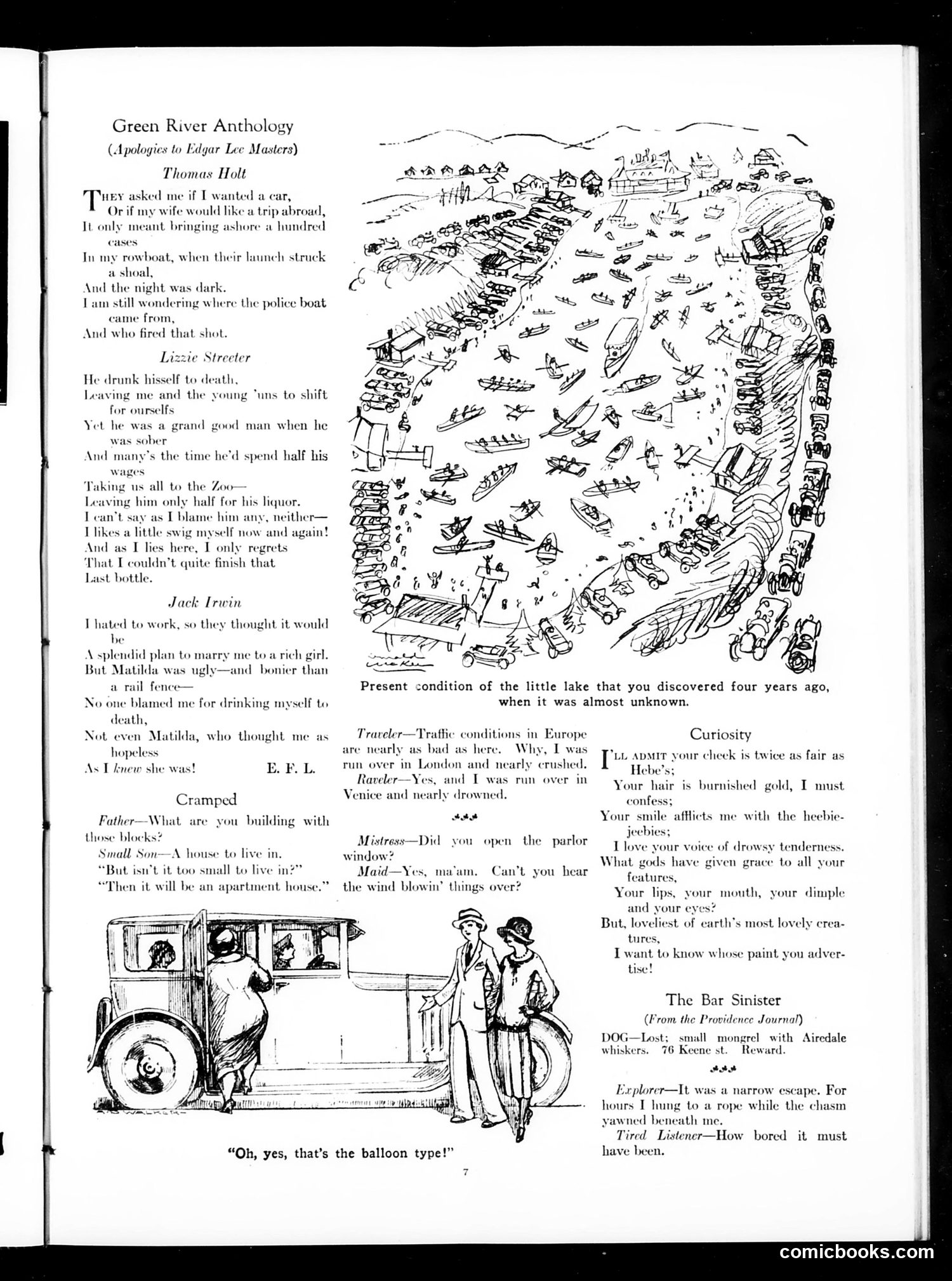
This page from Judge satirizes early 20th-century American social anxieties through multiple pieces: **"Green River Anthology"** parodies Edgar Lee Masters' *Spoon River Anthology*, replacing its poetic gravedigger narratives with mundane confessions of small-town drunks and failures—suggesting alcohol abuse and moral decay pervade ordinary life. **"Cramped"** jokes about housing shortages and cramped urban living, with a father's absurd logic that a tiny structure will become an "apartment house"—satirizing Depression-era housing problems. **The balloon-type car cartoon** pokes fun at early automobile design and marketing jargon. **"Curiosity"** mocks superficial romantic compliments layered atop commercial vanity—the lover demands to know what beauty product the woman advertises, suggesting women's appearance is merely manufactured artifice. **"The Bar Sinister"** presents a humorous lost-dog ad (a kennel club term for illegitimacy). Overall, the page reflects period concerns: urban crowding, alcoholism, crass commercialism, and skepticism toward modern romance and consumerism.
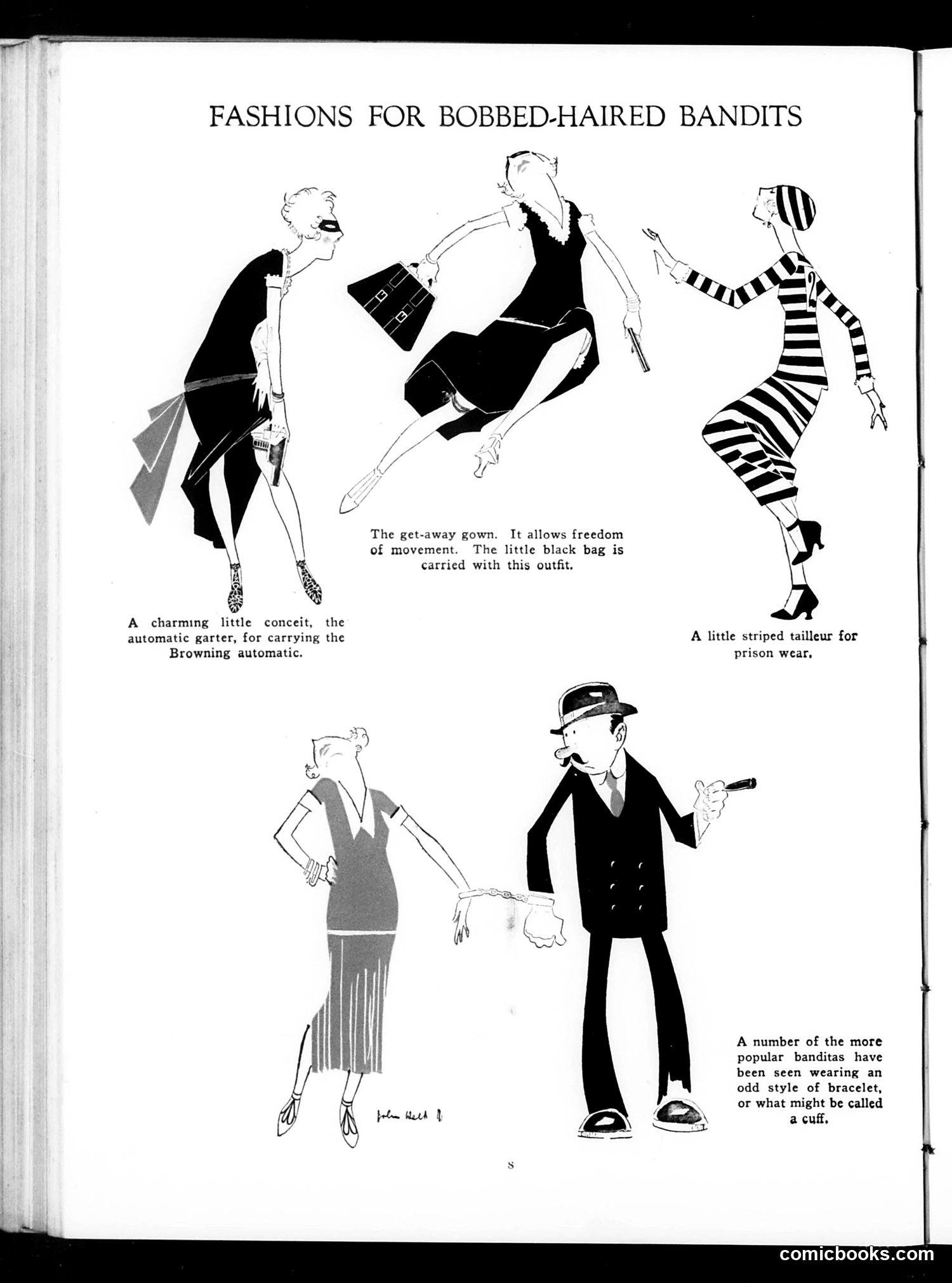
This satirical page mocks 1920s female criminals—particularly the "bobbed-haired bandit" gang that robbed stores in Brooklyn around 1924. The cartoon presents absurd "fashions" designed for criminal activities: a garter holster for carrying a Browning automatic pistol, a "get-away gown" enabling quick movement, striped clothing for "prison wear," and a "bracelet/cuff" (likely referencing handcuffs or jail shackles). The humor targets both the criminals' audacity and contemporary anxieties about modern women—the bobbed hair itself represented rebellious femininity. By treating violent crime as a fashion trend, Judge satirizes how these young female criminals captured public fascination and media attention, transforming dangerous outlaws into celebrity figures. The joke reflects 1920s moral panic over changing gender roles and youth culture.
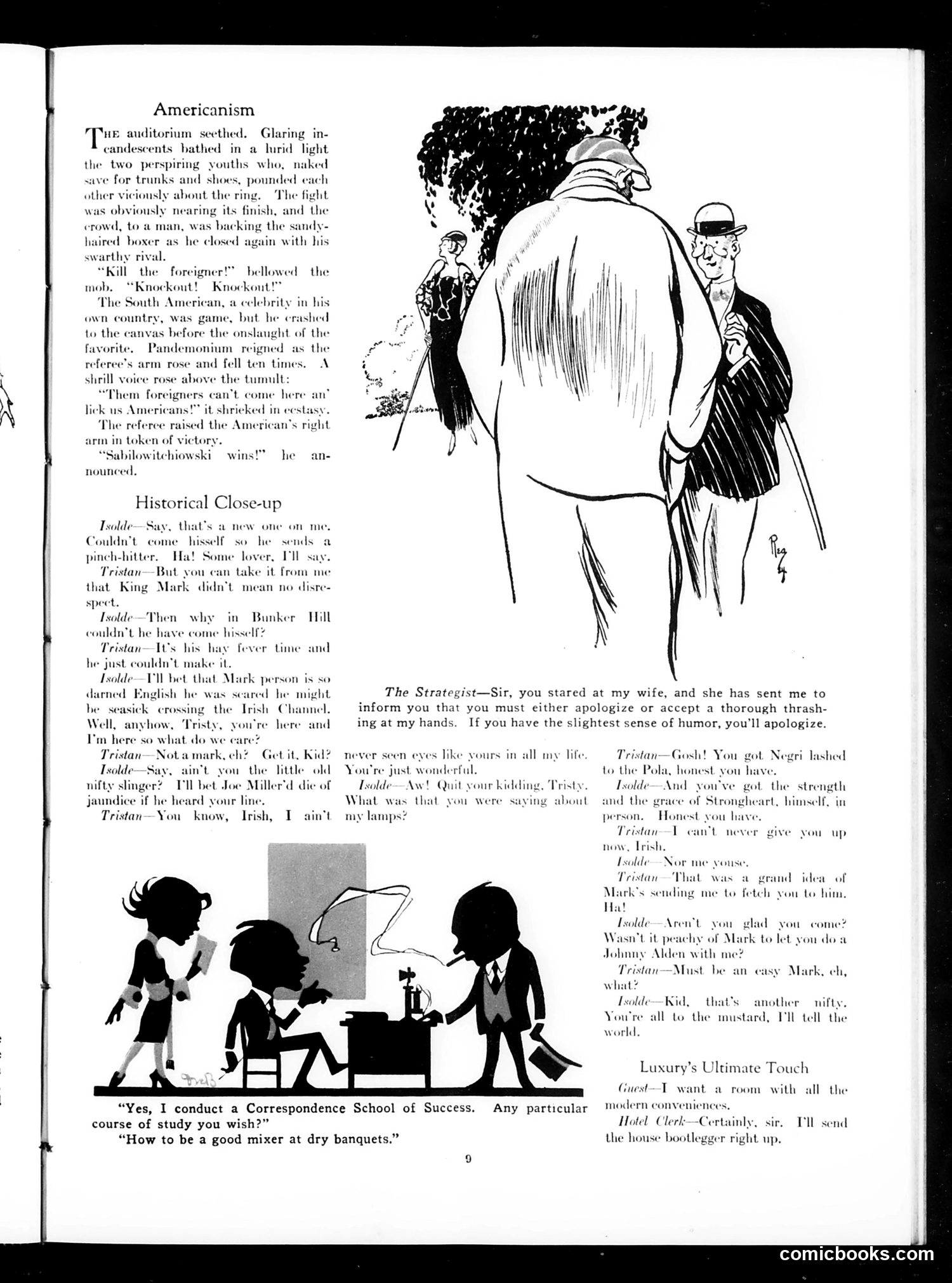
**"Americanism" (Top Section):** This cartoon satirizes jingoistic American nationalism during a boxing match. A sandy-haired American boxer defeats a South American champion, and the crowd celebrates with xenophobic fervor ("Kill the foreigner!"). The joke's irony: the referee announces the American winner as "Sabilowitchiowski"—a clearly Eastern European immigrant name—exposing the hypocrisy of "American" identity. The crowd's anti-foreigner sentiment contradicts the fact that their hero is himself an immigrant, mocking nativist attitudes. **"Historical Close-up":** This parodies the medieval legend of Tristan and Isolde with modern slang. King Mark sends Tristan to fetch Isolde; the couple joke that Mark is too seasick/cowardly to cross the Irish Channel himself. The dated slang ("nifty," "mustard") and casual infidelity humor satirize both classical literature and contemporary romance. **Bottom Cartoons:** Minor gags about correspondence schools and hotel bootleggers (Prohibition-era reference).
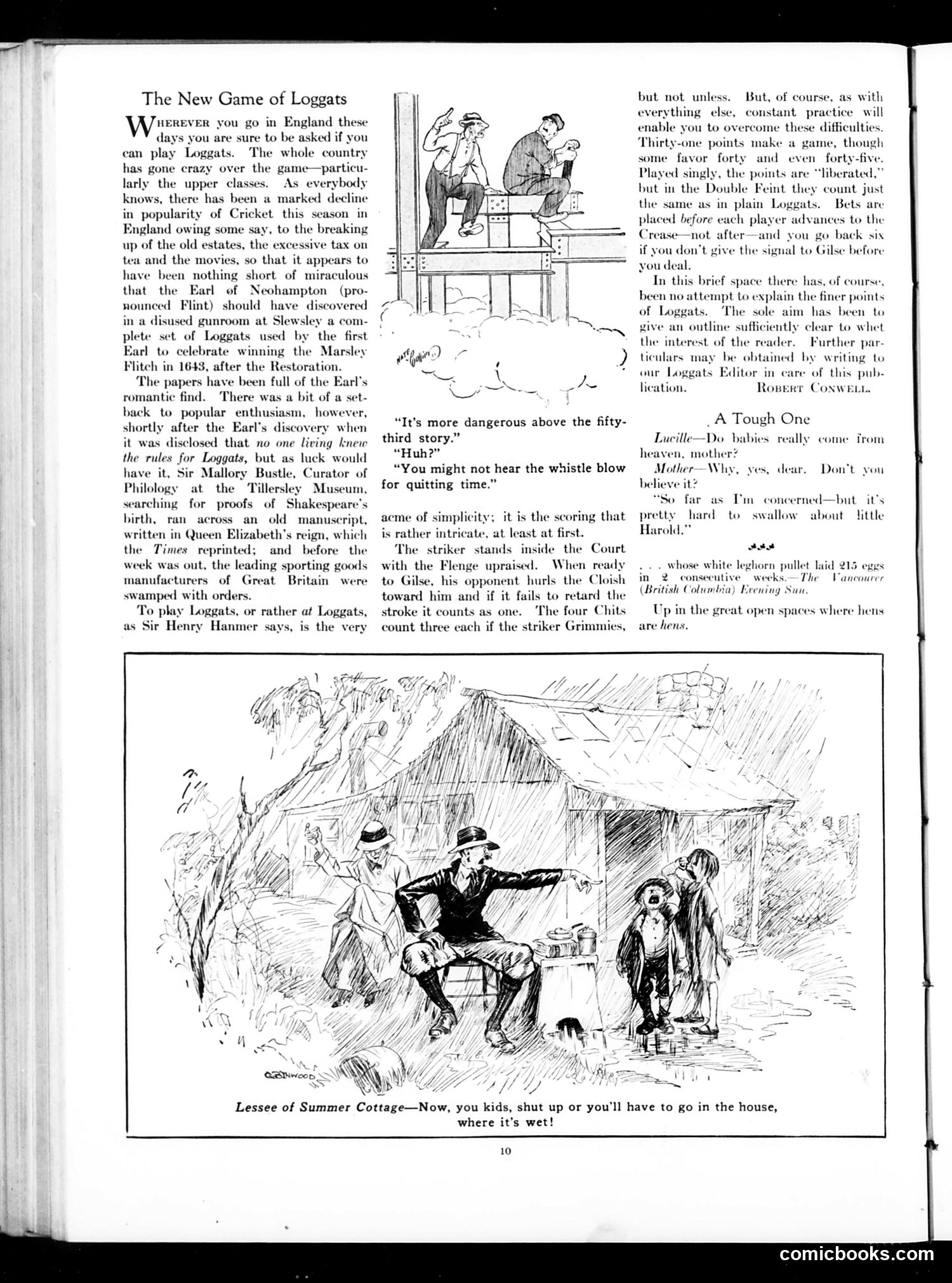
This article satirizes the British upper classes' sudden obsession with a "rediscovered" historical game called Loggats. The satire works on multiple levels: **The Setup**: An English Earl supposedly discovers ancient Loggats equipment, sparking nationwide craze—particularly among the wealthy—as cricket's popularity declines. A manuscript conveniently surfaces explaining rules. **The Joke**: The "rules" are complete nonsense. Terms like "Flenge," "Cloish," "Grimmies," and "Gilse" are fabricated. The scoring system is deliberately impenetrable. The author (Robert Conwell) admits the explanation clarifies nothing and directs readers to a fictional "Loggats Editor." **The Point**: This mocks British class pretension and the gullibility of aristocrats who eagerly adopt whatever fashionable pursuit is presented as historically prestigious. The bottom cartoon (unrelated) jokes about workplace safety. The satire suggests that upper-class enthusiasm for "discovering" old traditions is easily manufactured—they'll embrace any activity if it's packaged as elite and historical.
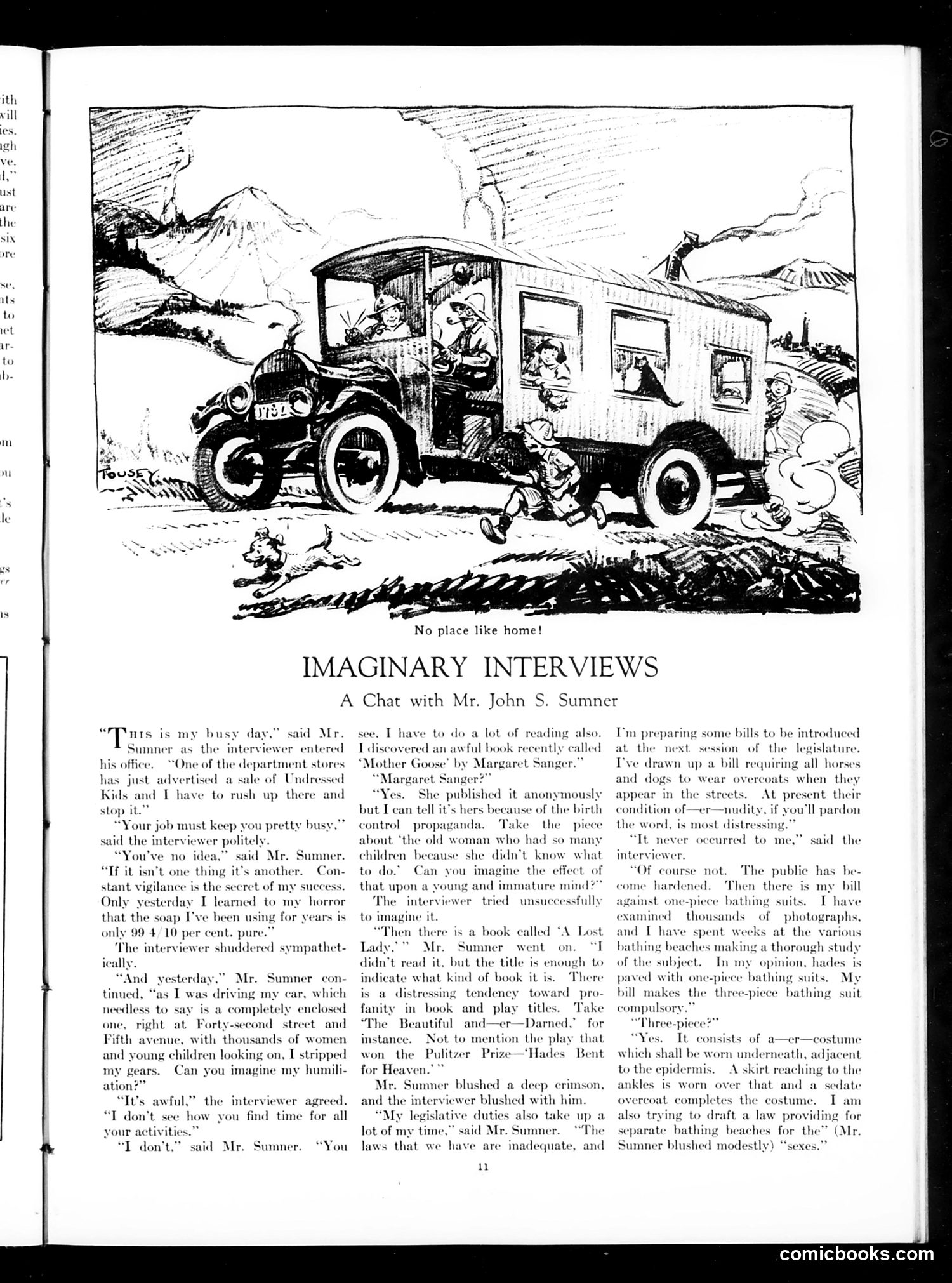
This satirical interview mocks **John S. Sumner**, head of the New York Society for the Suppression of Vice—a real historical organization that aggressively censored books and materials deemed immoral. The cartoon depicts Sumner as an absurdly prudish censor obsessed with policing minor infractions while missing serious problems. His complaints are ridiculous: a soap that's only 99.4% pure, stripped gears (implying nudity), and "Mother Goose" as birth-control propaganda because Margaret Sanger published it anonymously. The satire targets Sumner's overwrought moral crusades against literature (he genuinely opposed books like "A Lost Lady"). His proposed laws—requiring horses wear overcoats, mandating three-piece bathing suits with overjackets—escalate the absurdity to expose how excessive his real censorship efforts were. The opening cartoon shows a family vehicle labeled with the period car registration "1872," suggesting society's outdated attitudes. The joke: Sumner represents archaic, ridiculous moralism dressed as civic duty.
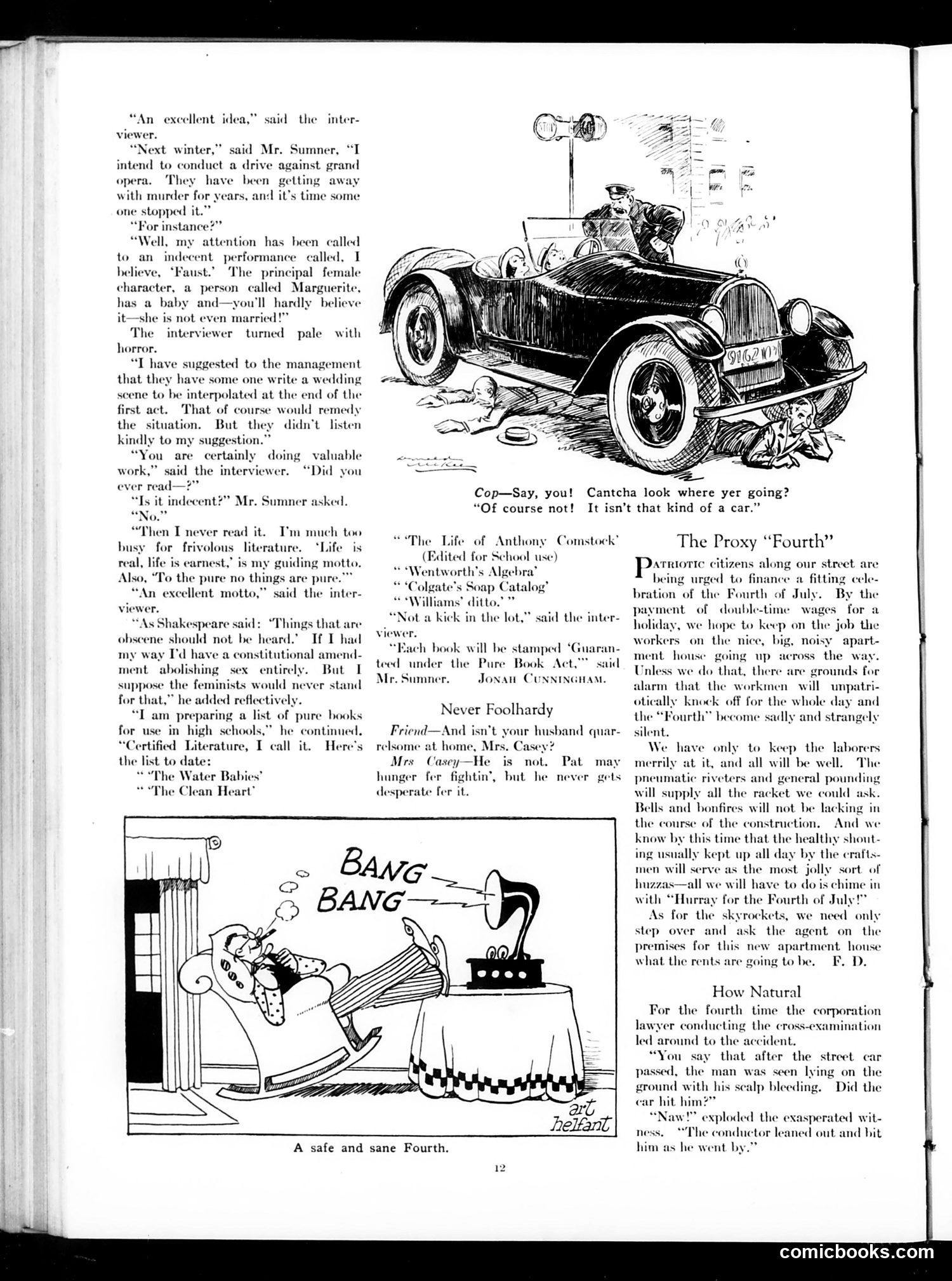
This page contains satirical commentary on censorship and social propriety circa the 1910s-20s. **Main Cartoon (Top):** A car accident scene illustrating absurdist humor about cause-and-effect. The caption's joke—that a conductor bit rather than hit a victim—mocks overly literal legal questioning. **"Never Foolhardy" Section:** A brief domestic joke about a quarrelsome husband who "never gets desperate" for fighting, playing on Irish working-class stereotypes. **"The Proxy Fourth":** Satire on wealthy citizens financing construction work (replacing Fourth of July celebrations) by paying double wages to keep laborers working rather than celebrating. The joke: industrial noise and "pneumatic riveters" replace traditional fireworks—a cynical commentary on commercialism overriding patriotism. **Left Column Interview:** Appears to reference **Anthony Comstock**, the famous censorship crusader who campaigned against "obscene" literature. The character "Mr. Sumner" advocates removing sex references from opera (*Faust*) and compiling "pure books" lists. This mocks Comstock's zealous moral policing as absurdly prudish and disconnected from reality. The page satirizes both censorship overreach and commercialism undermining American values.
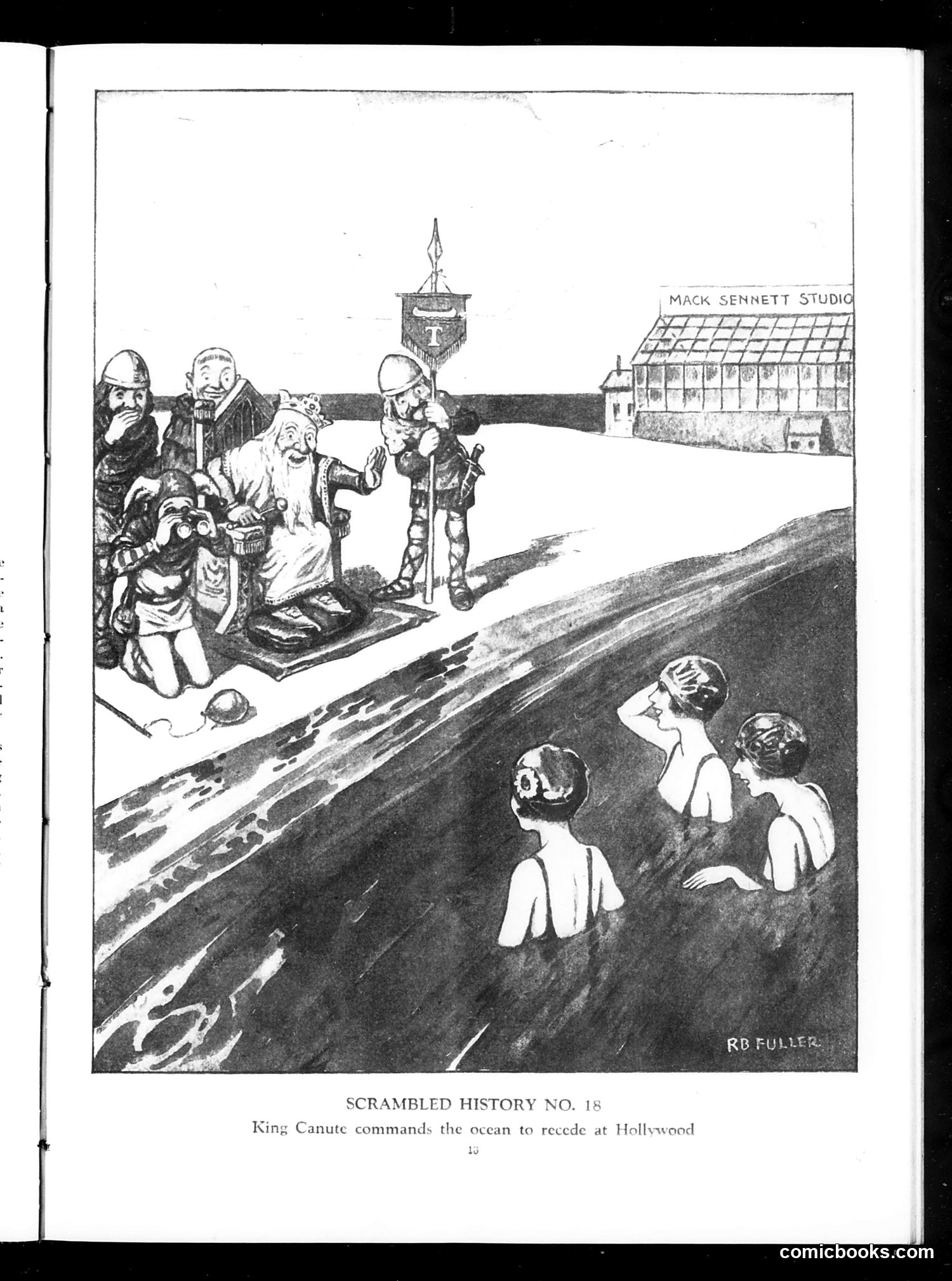
This satirical cartoon adapts the medieval legend of King Canute (who famously commanded the ocean to recede, demonstrating the limits of royal power) and relocates it to 1920s Hollywood, specifically at the Mack Sennett Studio. The joke conflates Hollywood's outsized ambitions with historical hubris: film producers and directors are portrayed as modern "kings" attempting to command nature itself for entertainment purposes. Three women in the water appear to represent actresses or performers. The uniformed figures on shore—likely representing studio executives or filmmakers—attempt to control the ocean as if directing a scene. The satire mocks Hollywood's perceived arrogance and its belief that money and power can manipulate anything, even natural forces. It's a commentary on the industry's grandiose pretensions during the silent film era's rapid expansion.
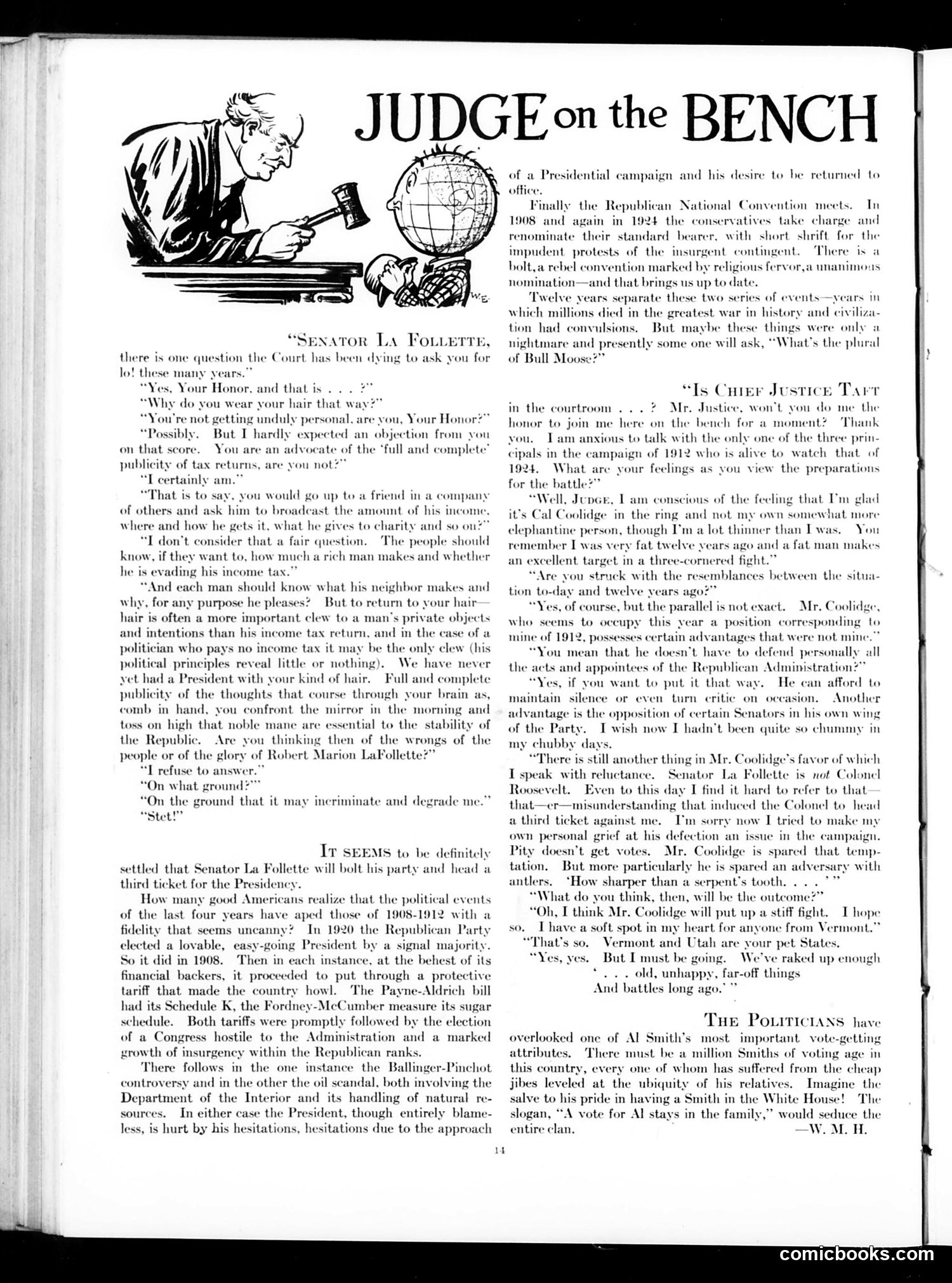
This page from *Judge* magazine contains a satirical dialogue between an unnamed judge and **Senator Robert La Follette**, the progressive Republican known for his distinctive swept-back hair. **The main cartoon's satire:** The judge interrogates La Follette about his hair styling, treating it as evidence of his character and political intentions—a mocking inversion of La Follette's famous demand for "full and complete publicity" of politicians' income and finances. By focusing absurdly on his appearance rather than policy, the cartoon ridicules La Follette's transparency demands as intrusive. **The political context:** The article discusses La Follette's impending third-party presidential run in 1924, comparing it to his 1912 "Bull Moose" split from the Republican Party. It parallels the Taft-Roosevelt split (1908-1912)—both involving tariff controversies, Interior Department scandals, and insurgent Republicans bolting their party. **The joke:** The cartoon sarcastically suggests La Follette's distinctive appearance and reformist vanity make him predictably prone to party rebellion, positioning him as a perpetual disruptor of Republican unity.
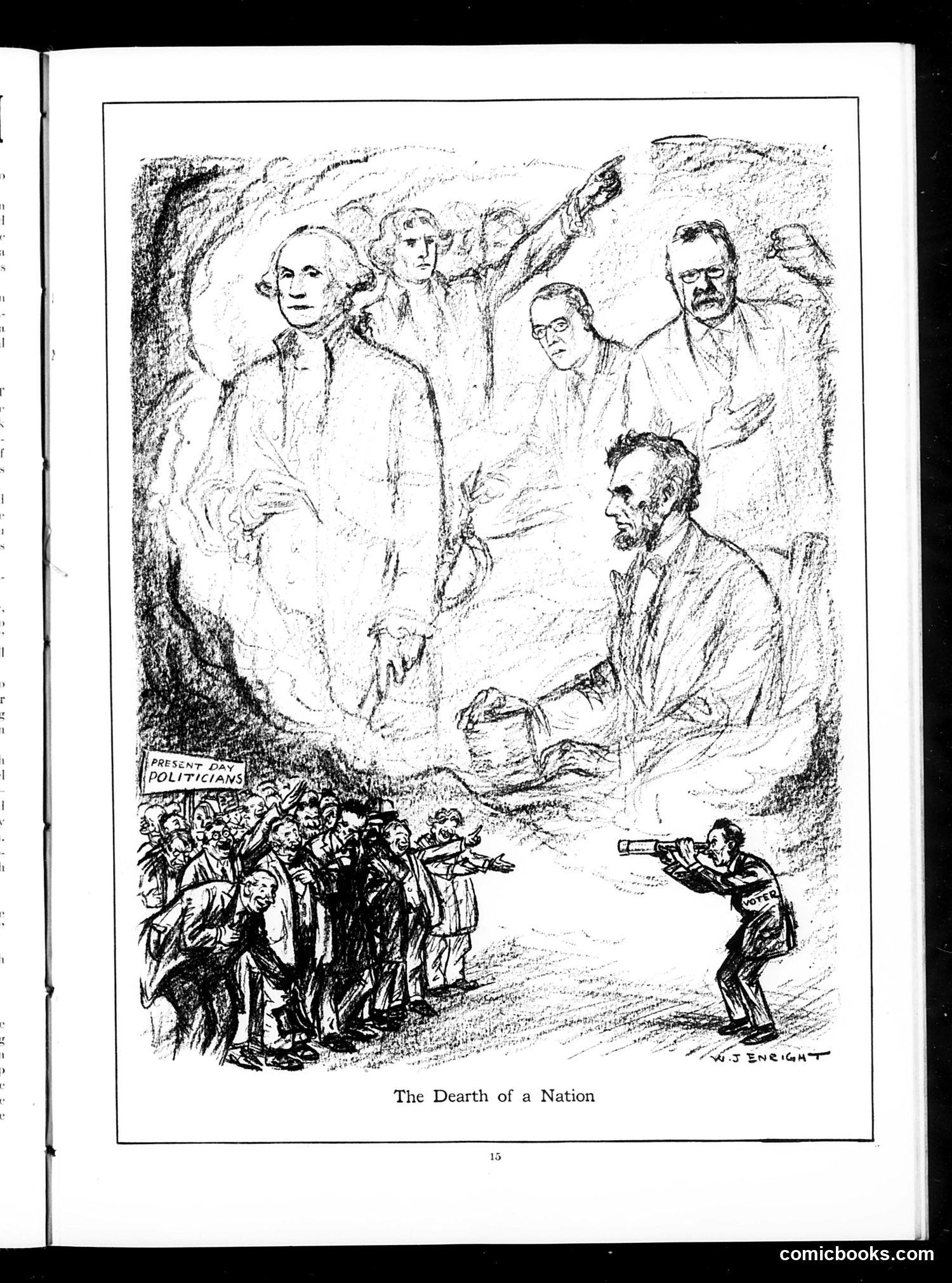
This political cartoon by W.S. Eneigh depicts a allegorical scene of national decline. Five ghostly or spectral figures hover above, appearing to represent departed leadership or ideals. Below, a crowd labeled "PRESENT DAY POLITICIANS" gestures frantically upward toward these vanished figures, while a single man on the right points accusingly at the crowd. The cartoon's title—a pun on "dearth" (scarcity) rather than "death"—suggests contemporary politicians are inadequate replacements for previous leaders or principles. The satire critiques the quality of current political leadership, implying they lack the stature or wisdom of their predecessors. Without a specific date visible, the exact historical moment remains unclear, though the style suggests early-to-mid 20th century Judge magazine publication.
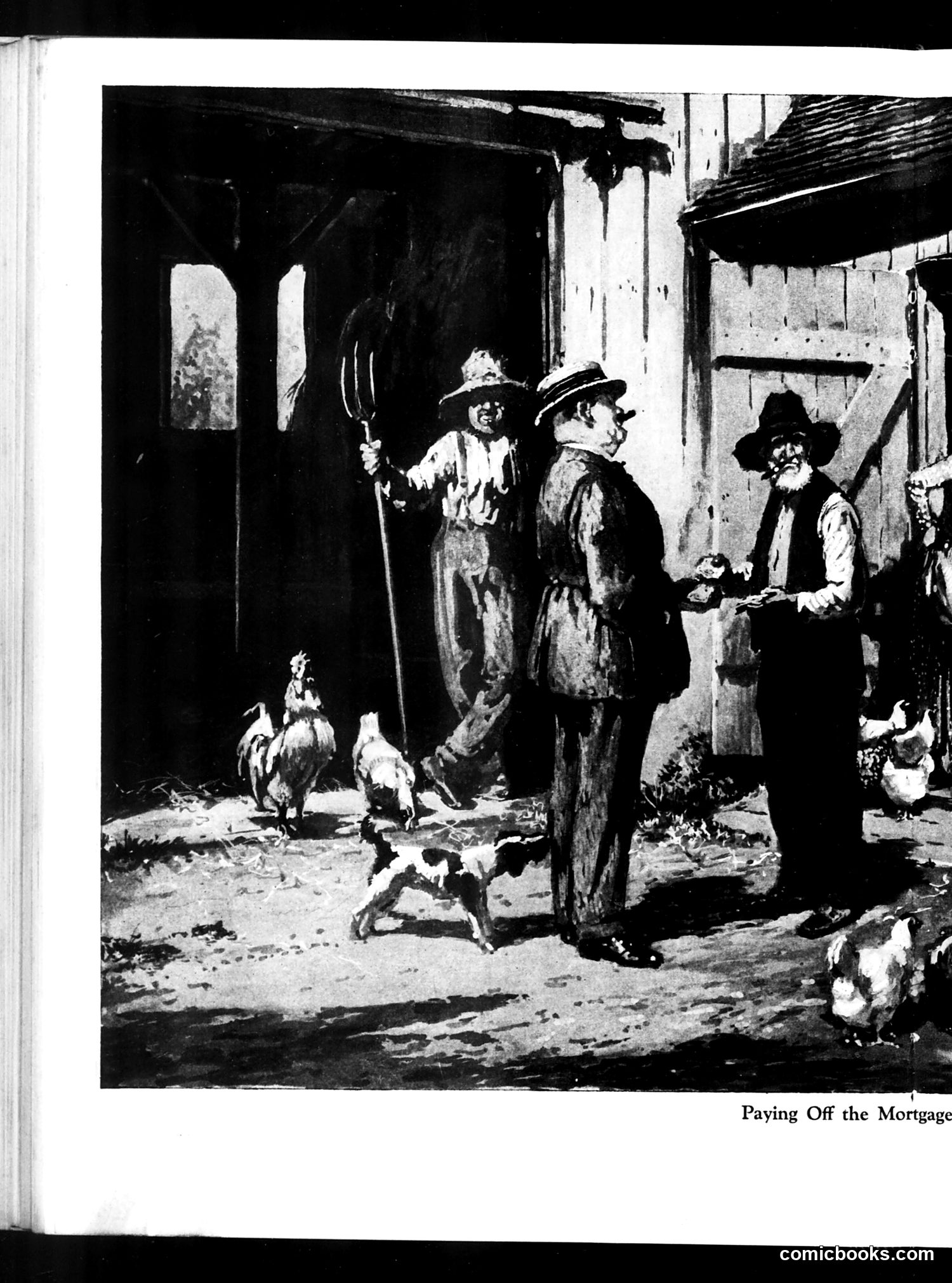
This black-and-white illustration depicts a rural farmyard scene with three men in period clothing (cowboy hats, work wear) conducting a transaction. The caption reads "Paying Off the Mortgage." The satire likely addresses agricultural financial hardship—a recurring theme in American humor during economic stress periods. The rural setting with humble farm buildings and animals suggests struggling farmers. The composition implies either: 1. Farmers celebrating debt relief, or 2. A satirical commentary on how farmers might "pay off" debts (perhaps through sale of livestock or property) Without clearer OCR text or a visible date, the specific economic crisis being referenced—whether Gilded Age agricultural depression, Populist era tensions, or another period—remains unclear. The image supports themes of rural economic struggle common to Judge magazine's social commentary.
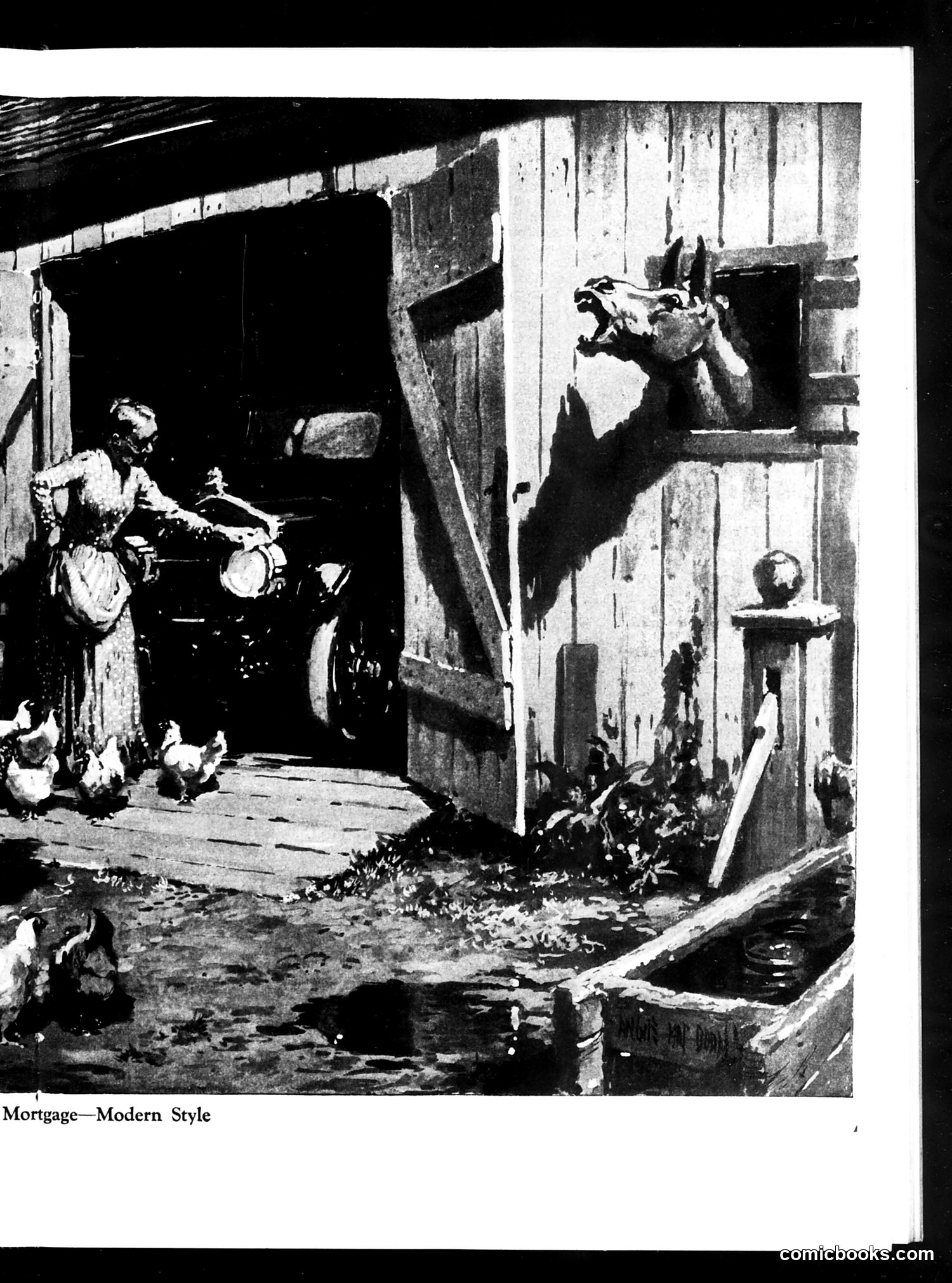
This satirical cartoon depicts a homeowner facing financial hardship. A distressed woman sits outside a modest dwelling while a menacing figure—likely representing a creditor or debt collector—looms at the window, appearing to seize property or possessions. The overgrown yard and deteriorating condition of the house suggest economic decline. The caption "Mortgage—Modern Style" suggests this comments on contemporary (to Judge magazine's publication) mortgage practices and foreclosure threats. The cartoon mocks the harsh realities of homeownership debt, portraying the creditor as predatory and threatening. This likely reflects period anxieties about housing instability, foreclosure, or aggressive debt collection practices that were satirical targets for Judge's audience.
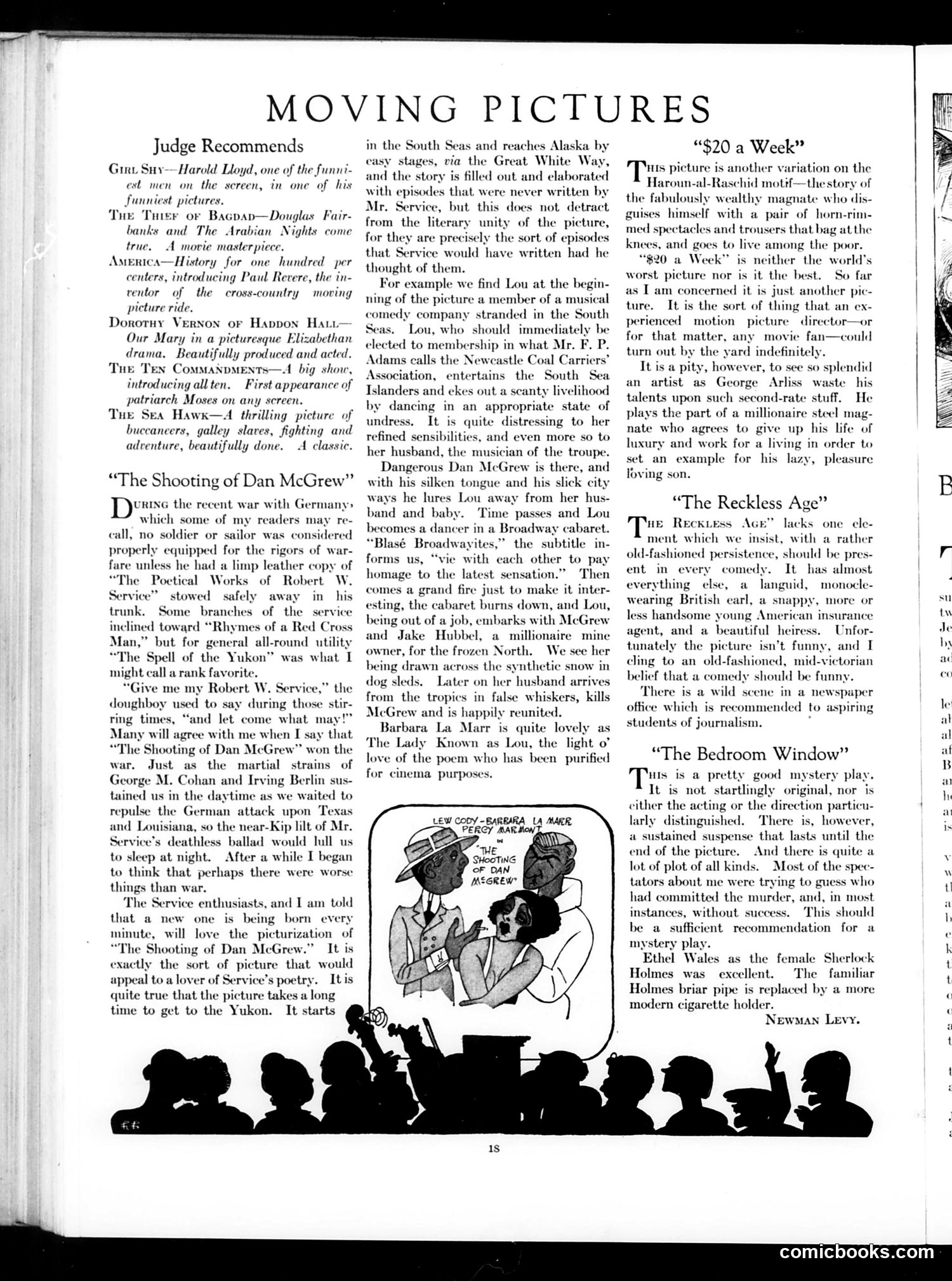
This page reviews early silent films (circa 1920s). The main cartoon depicts a scene from "The Shooting of Dan McGrew"—a film adaptation of Robert W. Service's famous Yukon poem, hugely popular with WWI soldiers. The reviewer criticizes the film for padding Service's original story with invented episodes: a South Seas musical-comedy sequence where the heroine "Lou" dances scantily-clad, a Broadway cabaret fire, and melodramatic plot additions unwritten by Service. The cartoon shows two characters (appears to be Lou and Dan McGrew) in conversation, captioned with dialogue establishing their relationship. The reviewer's complaint is essentially that while the film exploits Service's beloved poem's popularity, it cheapens the source material through sensationalism and manufactured drama—a familiar modern critique of literary adaptations prioritizing spectacle over fidelity.
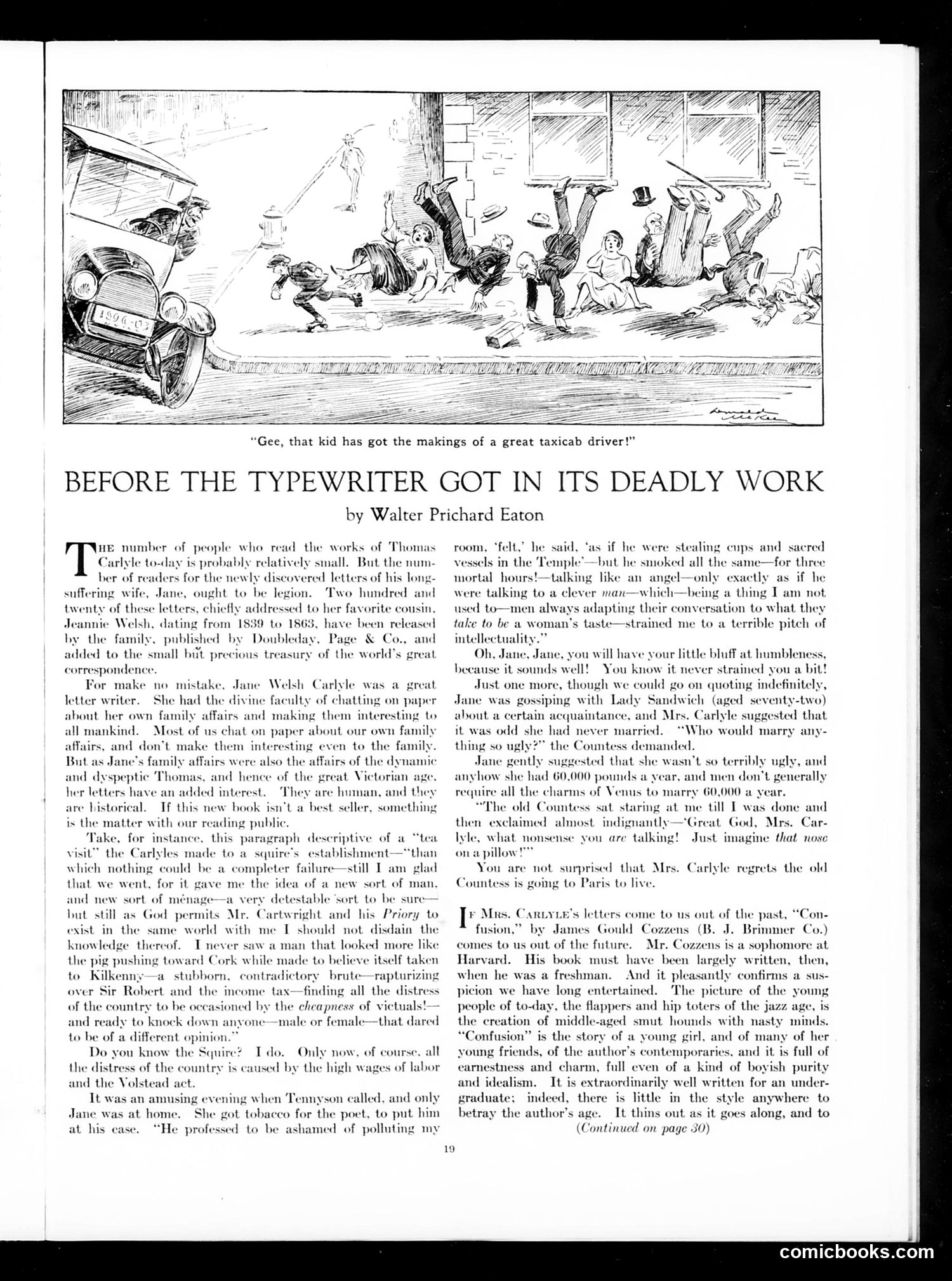
**The Cartoon:** The sketch depicts a car swerving wildly through a street, scattering pedestrians in all directions. The caption jokes that the reckless driver "has got the makings of a great taxicab driver"—satirizing early taxi drivers as notoriously dangerous and reckless. **The Article:** Walter Prichard Eaton reviews newly published letters of Jane Welsh Carlyle (wife of Victorian philosopher Thomas Carlyle), written 1839-1863. He argues these personal letters are witty, insightful social commentary worth reading. **The Satire:** Eaton contrasts Jane's clever letter-writing with modern complaints. Where people blame "cheapness of victuals" or "high wages" for the country's problems, Jane's era faced similar debates about taxicabs and labor costs. The cartoonist mocks taxi drivers as incompetent; Eaton celebrates Jane's ability to find humor in everyday social absurdities—suggesting her observations remain timelessly relevant. The implied point: serious social criticism can emerge from domestic correspondence and keen observation of human folly.
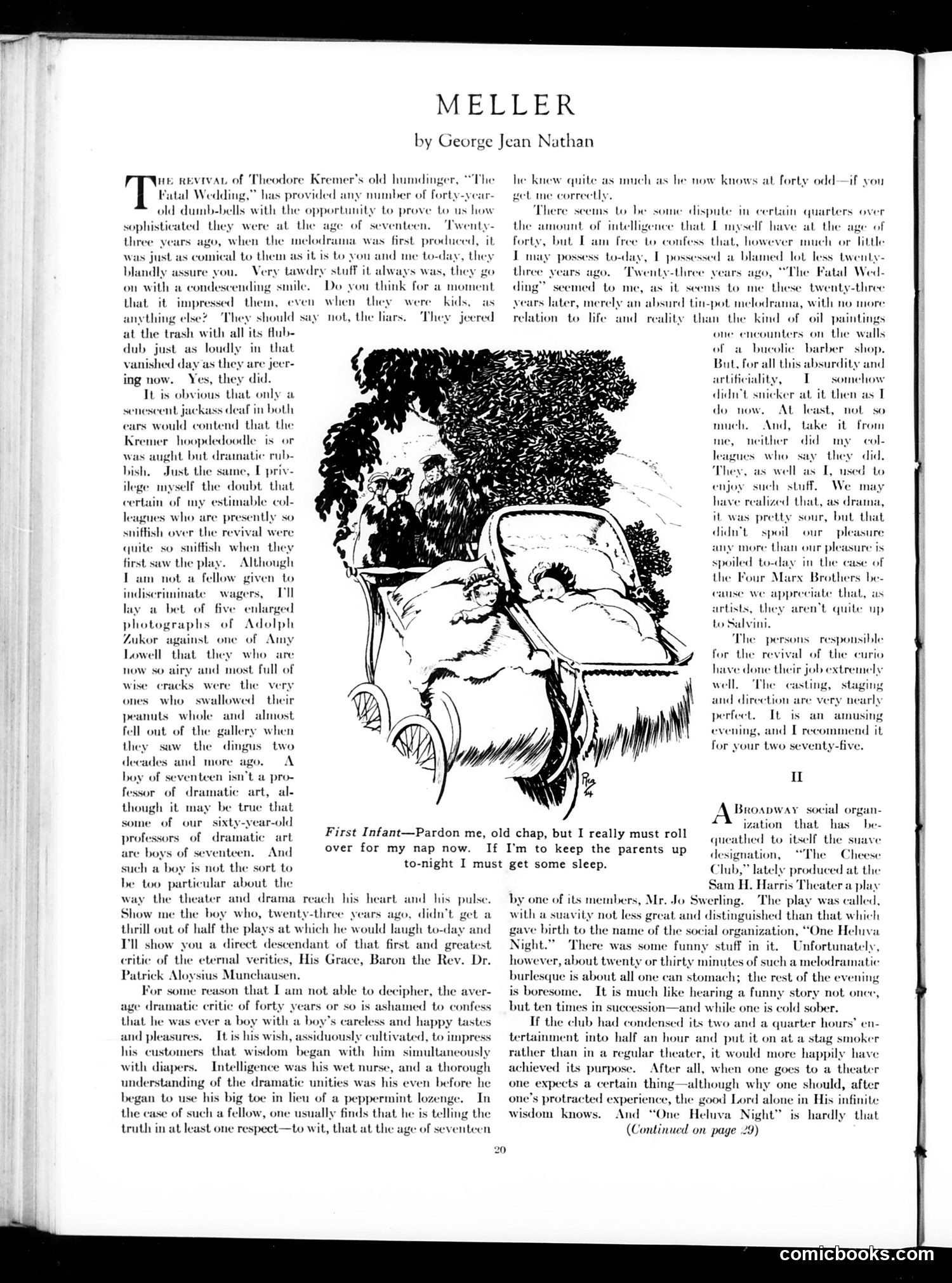
This page satirizes theater critics' hypocrisy about "The Fatal Wedding," an old melodrama being revived. Theater critic George Jean Nathan mocks older critics who now claim they were too sophisticated to enjoy such "trash" when they were young, yet clearly did enjoy it twenty-three years prior. Nathan's central joke: these forty-year-old critics are lying about their younger selves to appear intellectually superior today. He argues that enjoying melodrama as a teenager was natural and honest—pretending otherwise now is pretentious. The small cartoon shows an infant asking to nap before keeping parents awake, a crude joke about melodrama's exhausting emotionality. Nathan defends simple pleasures and calls out the affectation of critics who retroactively construct false sophistication, suggesting genuine artistic appreciation shouldn't require denying one's authentic past responses.
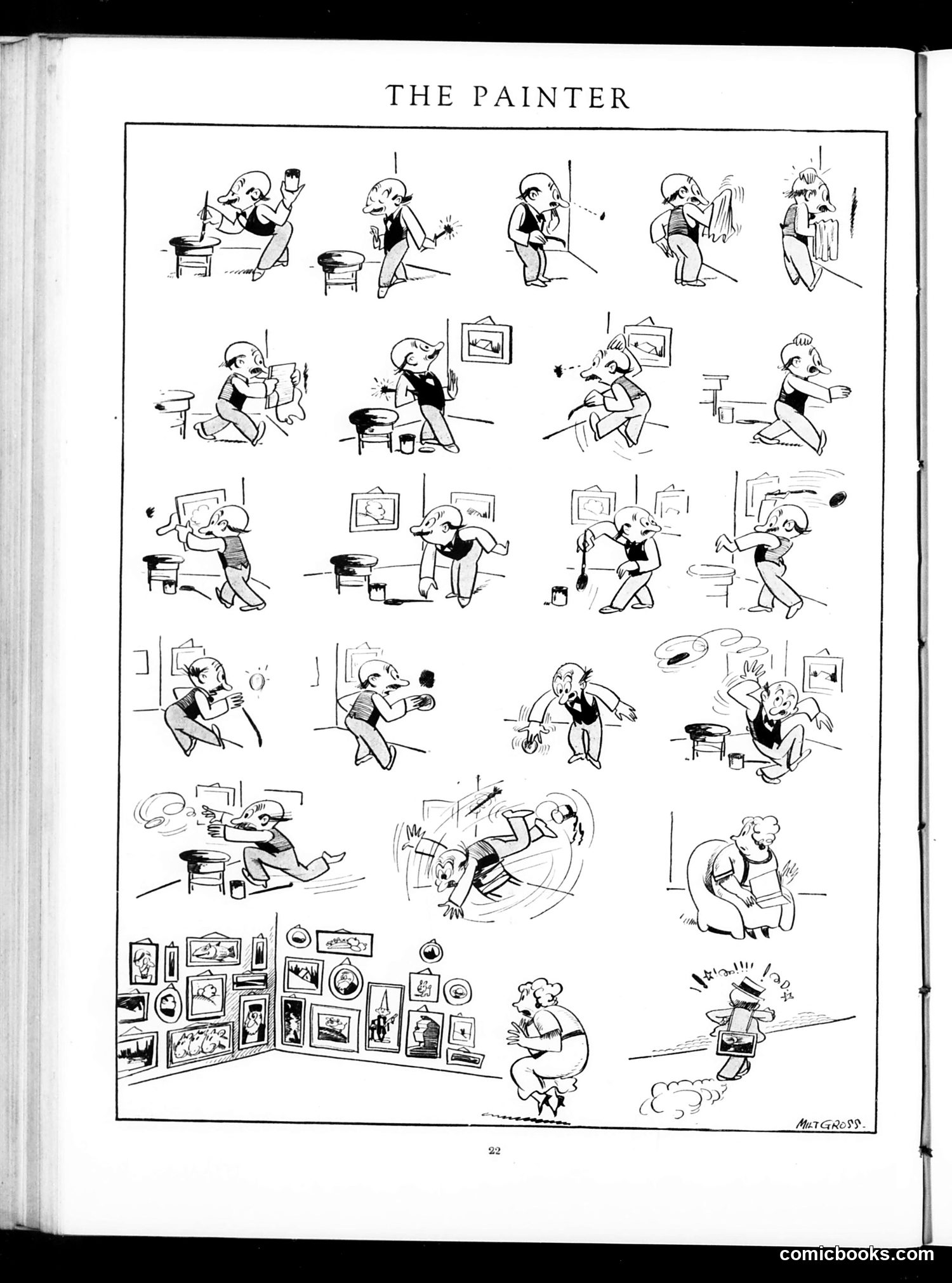
This is a wordless visual comic strip showing the misadventures of a painter at work. The sequence depicts a hapless artist struggling through various painting mishaps: spilling paint, dropping brushes, getting tangled in his work, and generally creating chaos around his studio and canvases. The satire appears to mock incompetent or struggling artists—poking fun at the stereotype of the disorganized, clumsy painter who cannot execute his craft properly. The final panels show his finished work displayed alongside other paintings, suggesting the ironic contrast between his chaotic process and the professional gallery setting. This represents typical Judge magazine humor: physical comedy and visual slapstick aimed at gently satirizing various professions and character types through exaggerated situations.
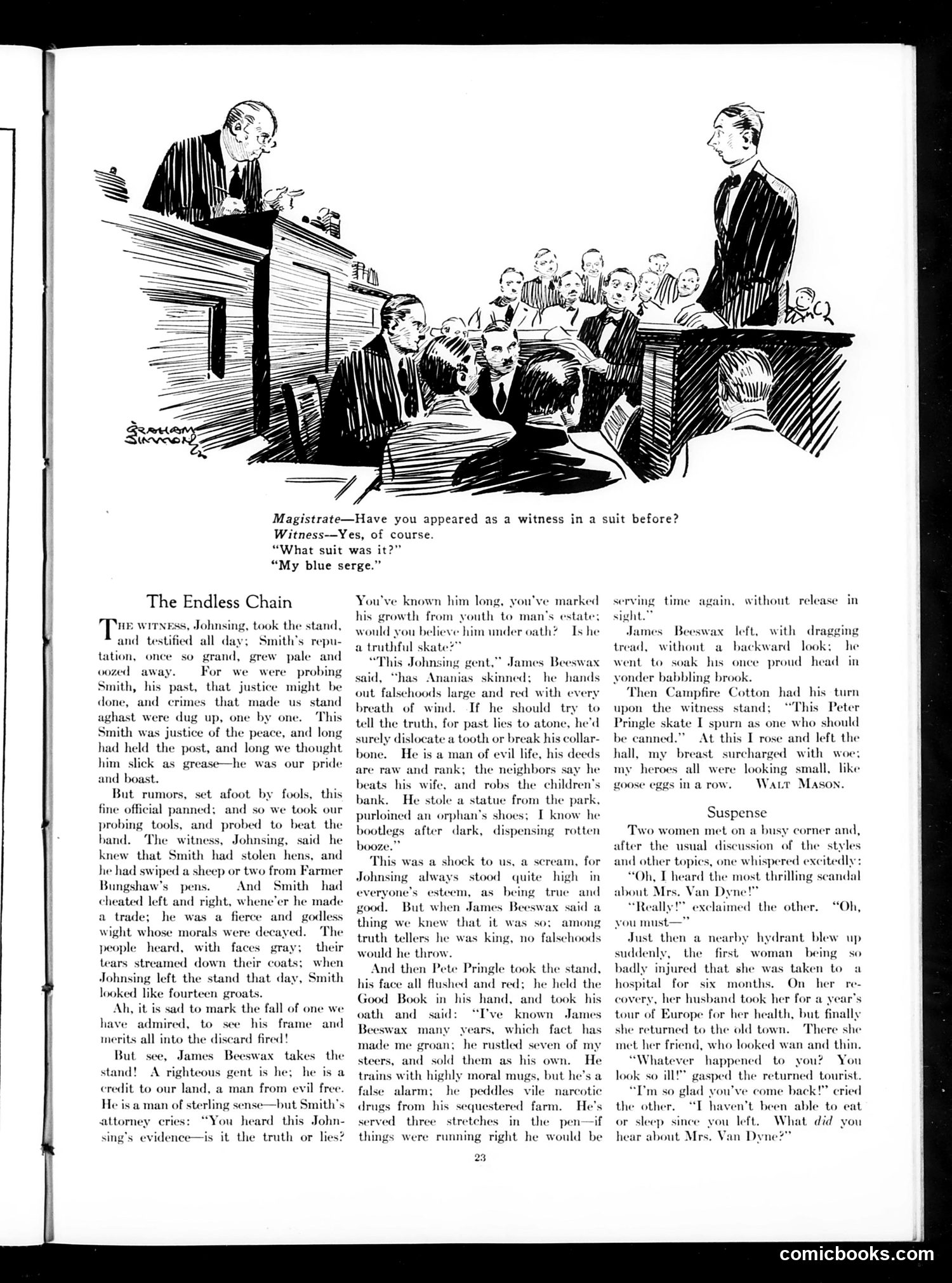
This page satirizes the corruption of character testimony and judicial integrity. A Justice of the Peace named Smith, previously respected, is exposed through witness testimony as a corrupt, immoral figure who has stolen livestock and abused his position. However, the satire's twist—"The Endless Chain"—reveals the deeper problem: each subsequent witness who testifies against Smith is himself exposed as equally dishonest or criminal. The attorney questioning them discovers that the accuser Johnsing is a liar, then that accuser Beeswax peddles drugs, then that accuser Pringle is a thief. The cartoon illustrates courtroom chaos where no one can be trusted to tell the truth. The author (Walt Mason) concludes by abandoning the courtroom in despair—if all potential witnesses are morally bankrupt, how can justice function? The satire critiques not specific figures but systemic corruption where the entire web of people involved in law enforcement and testimony are compromised.
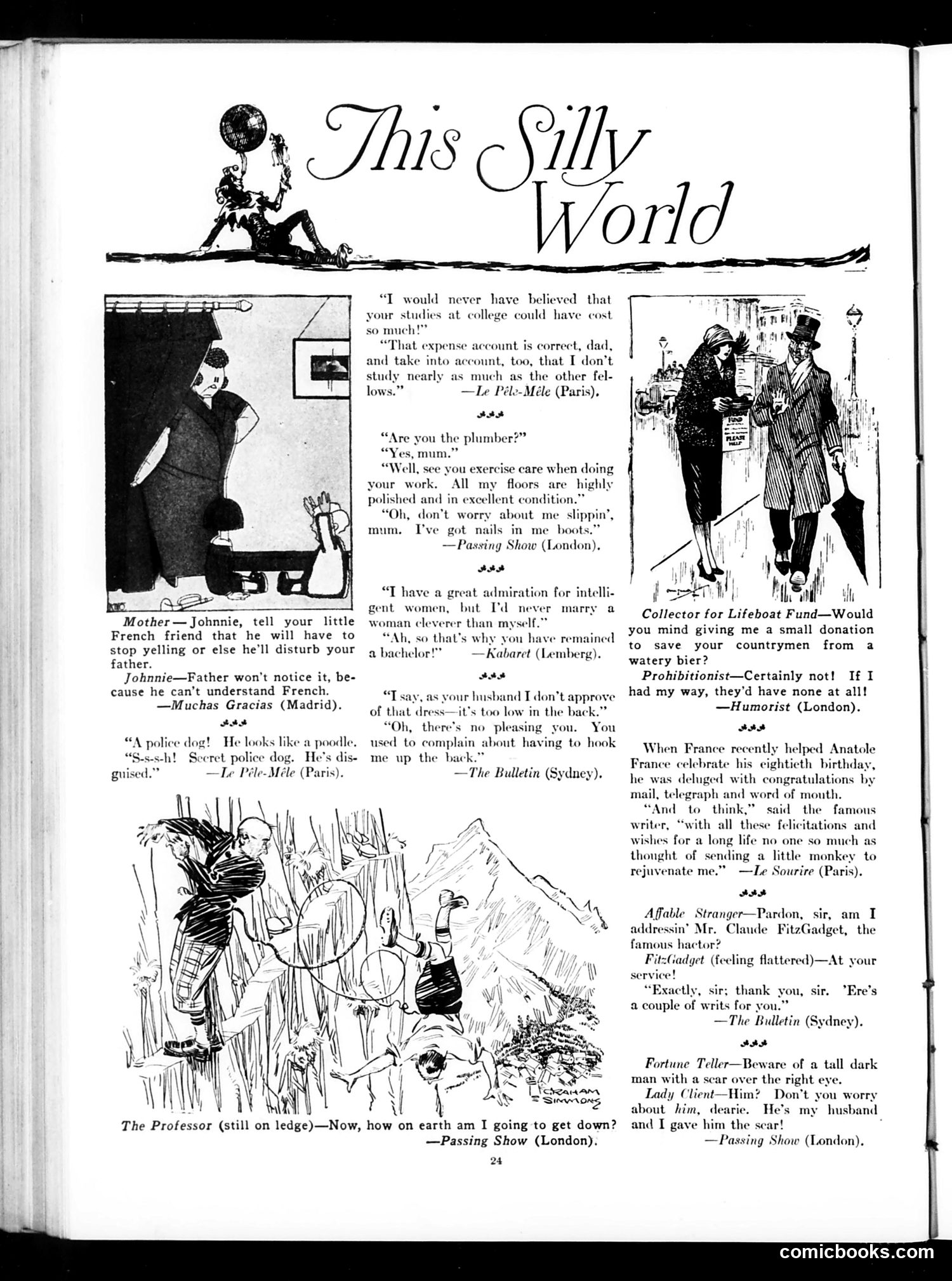
This page collects brief humorous anecdotes from international publications, a common Judge feature. The jokes rely on early 20th-century social attitudes: **Key themes:** - **Class/gender dynamics**: A plumber confidently tracking mud on polished floors; a husband controlling his wife's dress; intellectual women remaining unmarried by choice - **National stereotypes**: A French child yelling (the joke: father doesn't understand French); Madrid's "Muchas Gracias" byline - **Prohibition era**: A prohibitionist refuses donating to save drowning sailors—preferring they have no alcohol - **Wealth/education**: College expenses causing parental shock - **Literary celebrity**: Anatole France's 80th birthday celebrated with mail but no "monkey" (unclear reference, possibly slang for a gift or person) The cartoons at bottom show a professor stuck on a ledge and people struggling through tall grass. **For modern readers**: These represent genteel, cosmopolitan humor aimed at educated audiences, with casual sexism and class consciousness typical of the era.
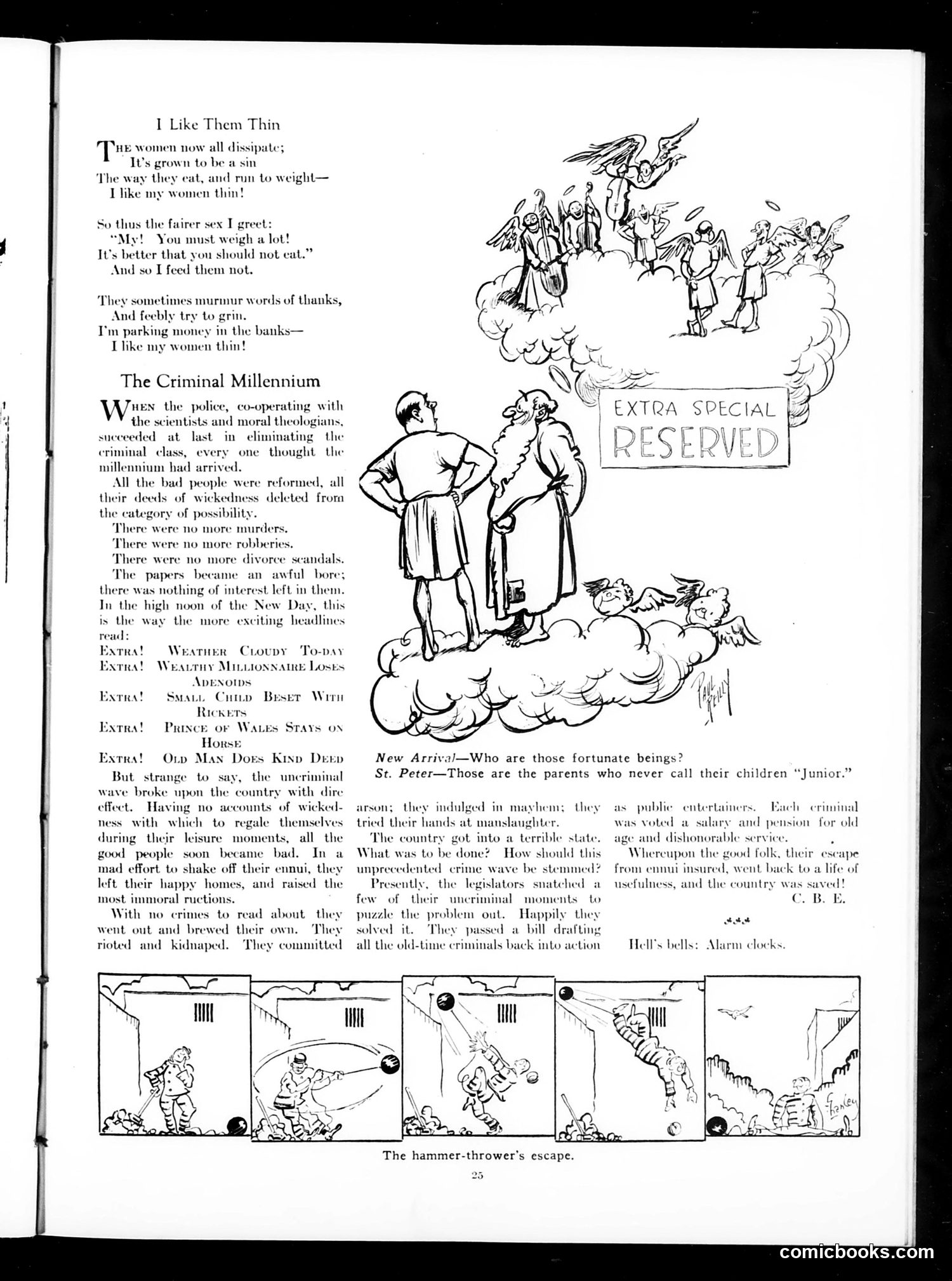
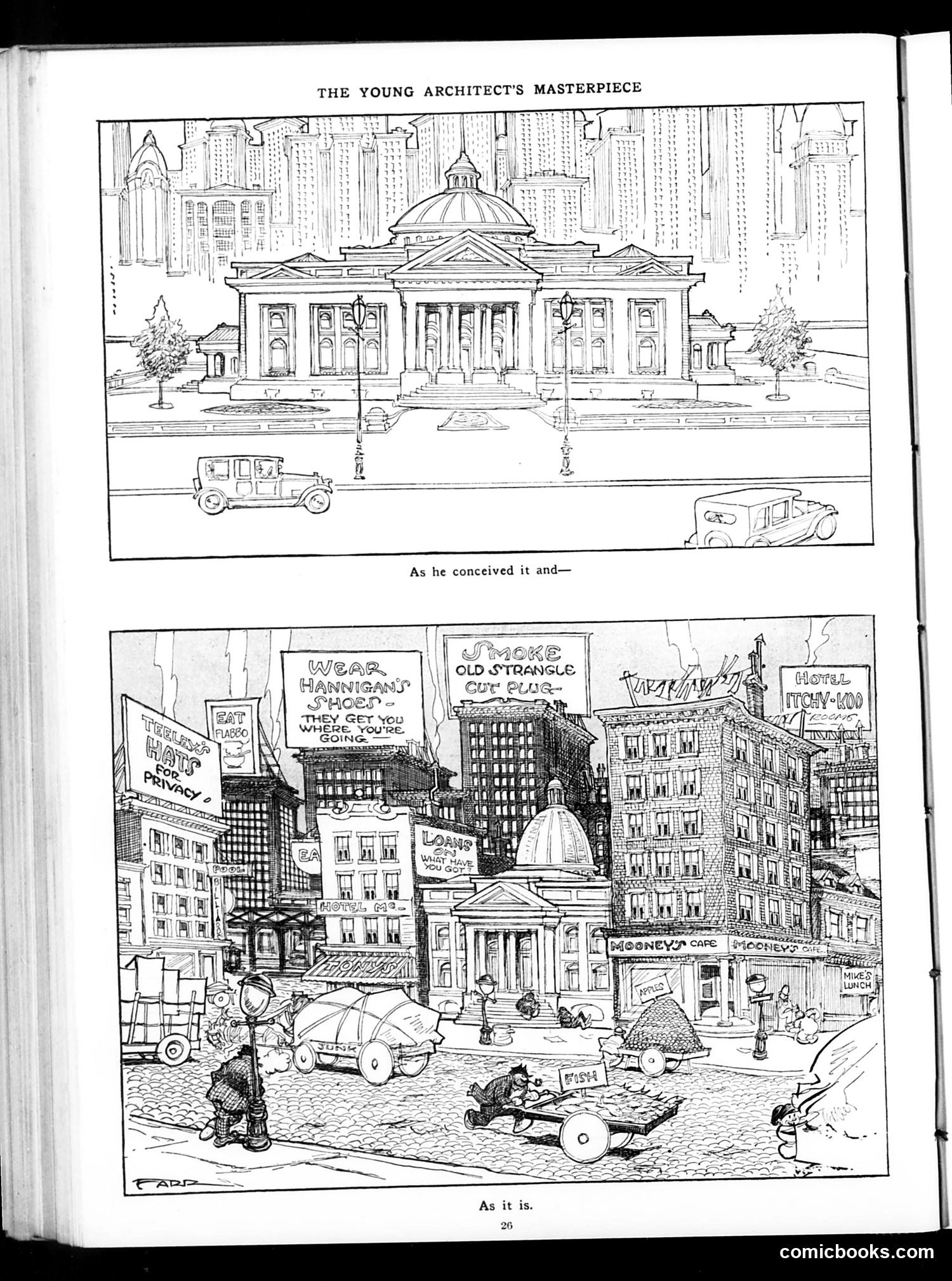
This cartoon satirizes the gap between architectural ideals and urban reality. The top panel shows an architect's pristine vision: a classical, domed civic building in a clean, orderly cityscape with modern automobiles. The bottom panel reveals the actual reality: the same building is now surrounded by crowded, shabby urban decay—cluttered storefronts (including "Hannigan's," an "Old Strangle Gut Club," and various cheap businesses), children playing in the streets with toy vehicles, and general squalor. The joke targets both the optimism of architects/planners and the messy realities of American city life in the early 20th century. It suggests that no matter how grand the architectural plan, cities inevitably become chaotic, commercialized, and unglamorous—a commentary on urban development and the contrast between aspirational design and lived experience.
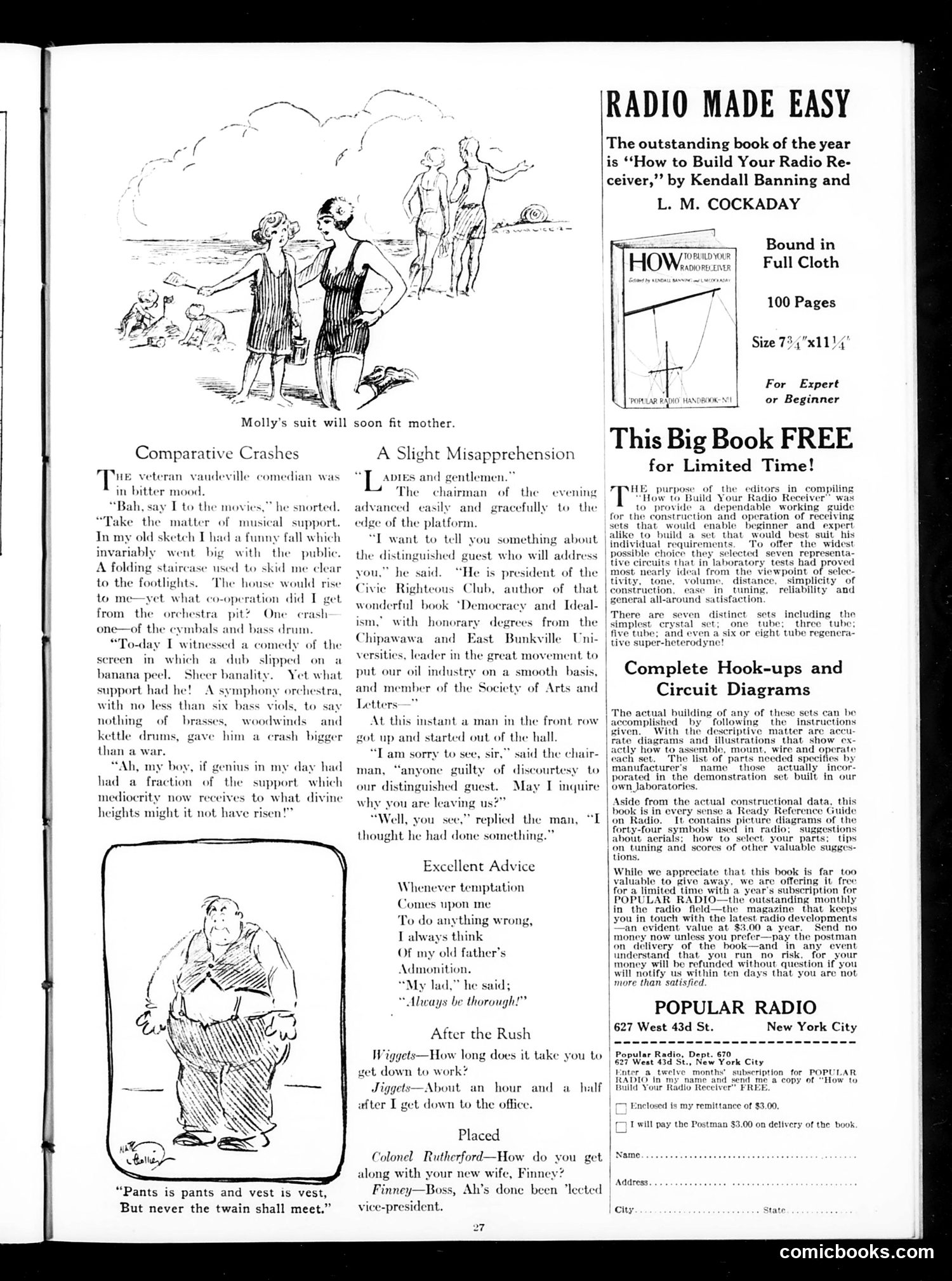
This page from *Judge* magazine contains three separate humorous pieces: **"Comparative Crashes"** (top left): A veteran vaudeville comedian complains that silent film comedies receive lavish orchestral accompaniment for mediocre physical comedy (a man slipping on a banana peel), while his skilled stage work got minimal musical support. The satire critiques how cinema was overtaking live performance in the 1920s, with studios throwing resources at inferior entertainment. **"A Slight Misapprehension"** (center): A man leaves a lecture hall after the chairman introduces a distinguished guest as president of the "Civic Righteous Club." The joke appears to be that the departing man misunderstands something about the speaker's credentials or identity. **"Excellent Advice"** and other brief jokes (right): Lightweight humor pieces about temptation and workplace behavior. The page is primarily an **advertisement** for "How to Build Your Radio Receiver," offering a free 100-page instructional book—reflecting radio's emergence as consumer technology in the 1920s.
This page is primarily **financial advertising**, not satire. It's aimed at middle-class investors seeking guidance on bonds and securities. The left side features ads from investment firms (George M. Forman & Company, James M. Leopold & Co.) promoting their services as safe, reliable ways to invest modest sums—targeting "the man who looks ahead" planning for his future. The centerpiece is an article by Theodore Williams titled "The Country Still Safe," discussing President Coolidge's new revenue act. Williams argues the tax reform, while imperfect, provides relief and won't harm the economy. He suggests business will remain stable until after the Presidential election, and recommends public utility stocks as safe investments unaffected by fiscal policy. The right side contains an "Investment Savings Plan Booklet" ad from F.H. Smith Company and an "Answers to Inquiries" column addressing readers' specific investment questions. **The overall message**: financial stability exists; ordinary people can safely invest small amounts for their futures.
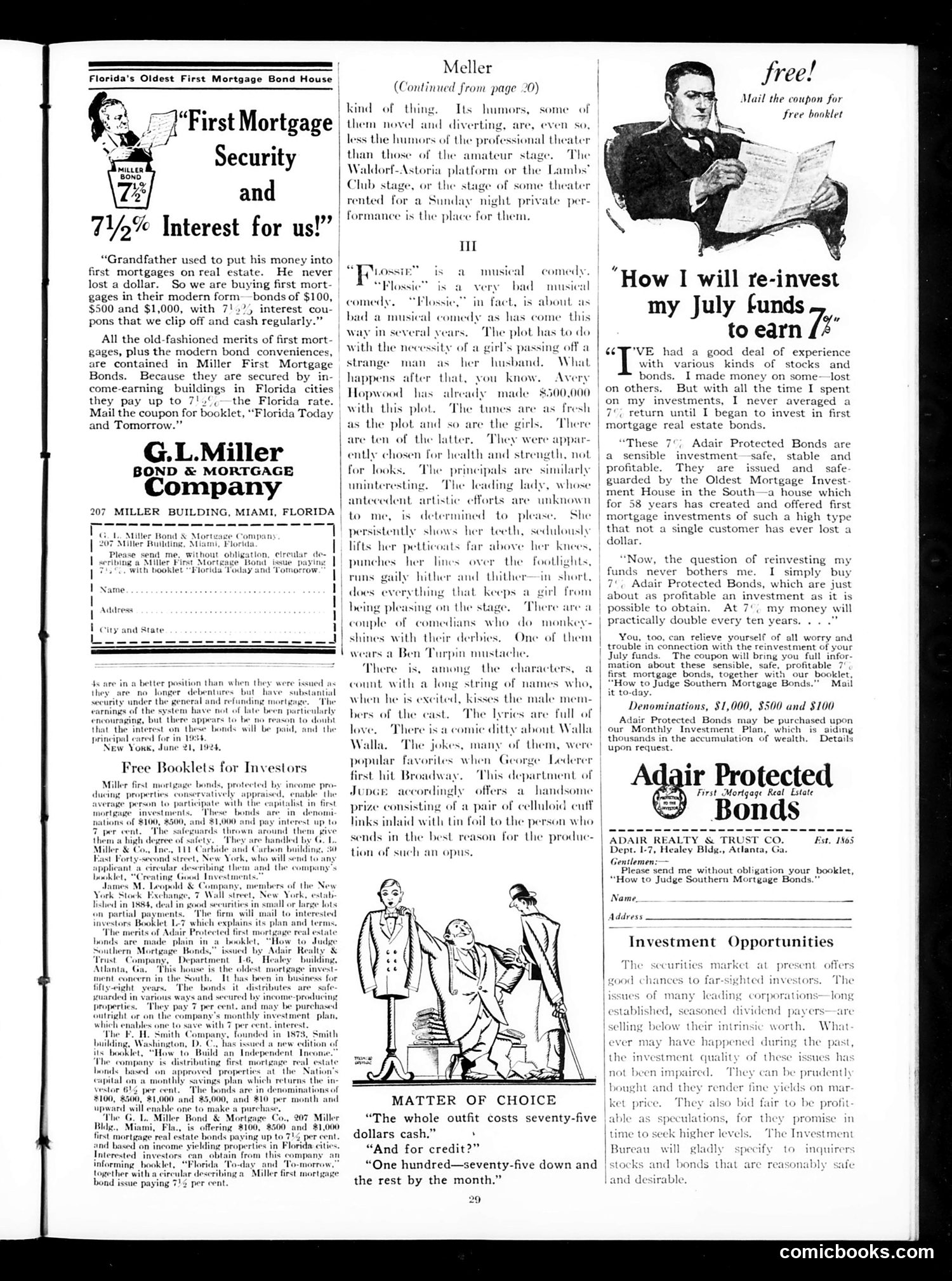
This page mixes satirical theater criticism with financial advertising—typical of Judge's format. **The Theater Critique (top right):** A critic reviews "Flossie," a mediocre musical comedy. The satire lies in describing a forgettable plot (a girl must pass off a stranger as her husband) and noting the chorus was selected for "health and strength, not looks"—poking fun at both the show's quality and the shallow casting practices of Broadway comedies. **The Advertisements:** The bulk of the page promotes first mortgage bonds at 7½% interest, marketed as safe investments backed by Florida real estate. Multiple companies (G.L. Miller, Adair Protected Bonds, etc.) compete for investor attention. **The Cartoon ("Matter of Choice"):** Shows a well-dressed couple discussing a seventy-five dollar purchase: "And for credit? One hundred—seventy-five down and the rest by the month." This satirizes consumer credit culture and inflation of prices when buying on installment. The page reflects 1920s concerns: speculative investment bubbles, consumer credit expansion, and Broadway's entertainment industry.
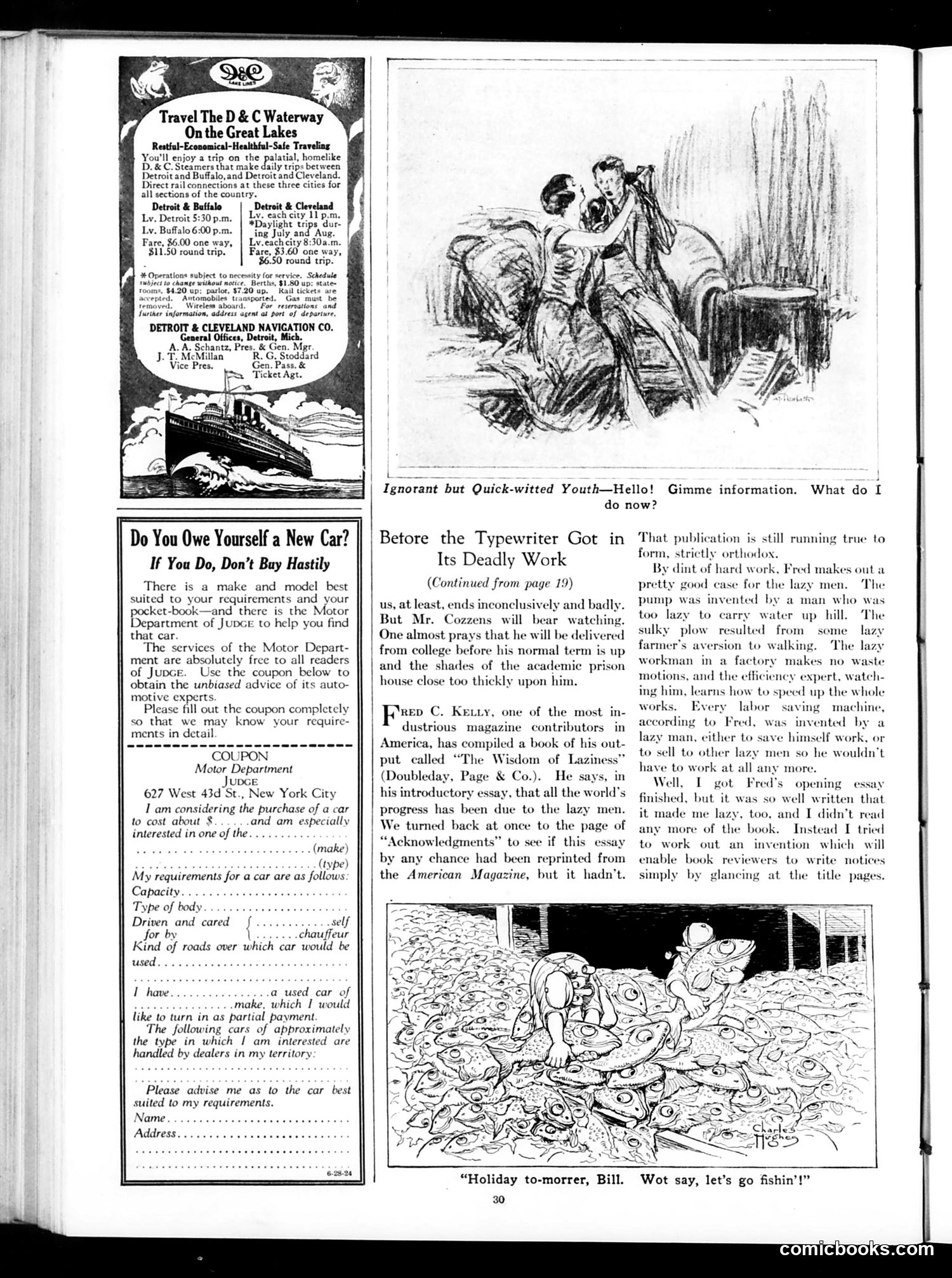
This page contains mostly **advertisements and editorial/advice columns** rather than political satire. The **top cartoon** (right side) shows two young people in an intimate moment by a willow tree—a sentimental romantic scene typical of period illustration. The caption reveals social commentary: the ignorant youth asks "what do I do now?"—satirizing youthful inexperience and naïveté about courtship. The **main article** discusses Fred C. Kelly's book "The Wisdom of Laziness," which argues that lazy men invented labor-saving devices (pumps, plows) out of unwillingness to work hard. The author jokes that Kelly's essay was so well-written it made *him* too lazy to finish reading the book. The **bottom cartoon** shows two boys planning to skip school ("Holiday to-morrer, Bill...let's go fishin'")—humor about childhood truancy. The remainder is **advertisements**: steamship travel, automobile purchase advice, and a motor department coupon. These reflect 1910s-era consumer culture and leisure industry marketing.
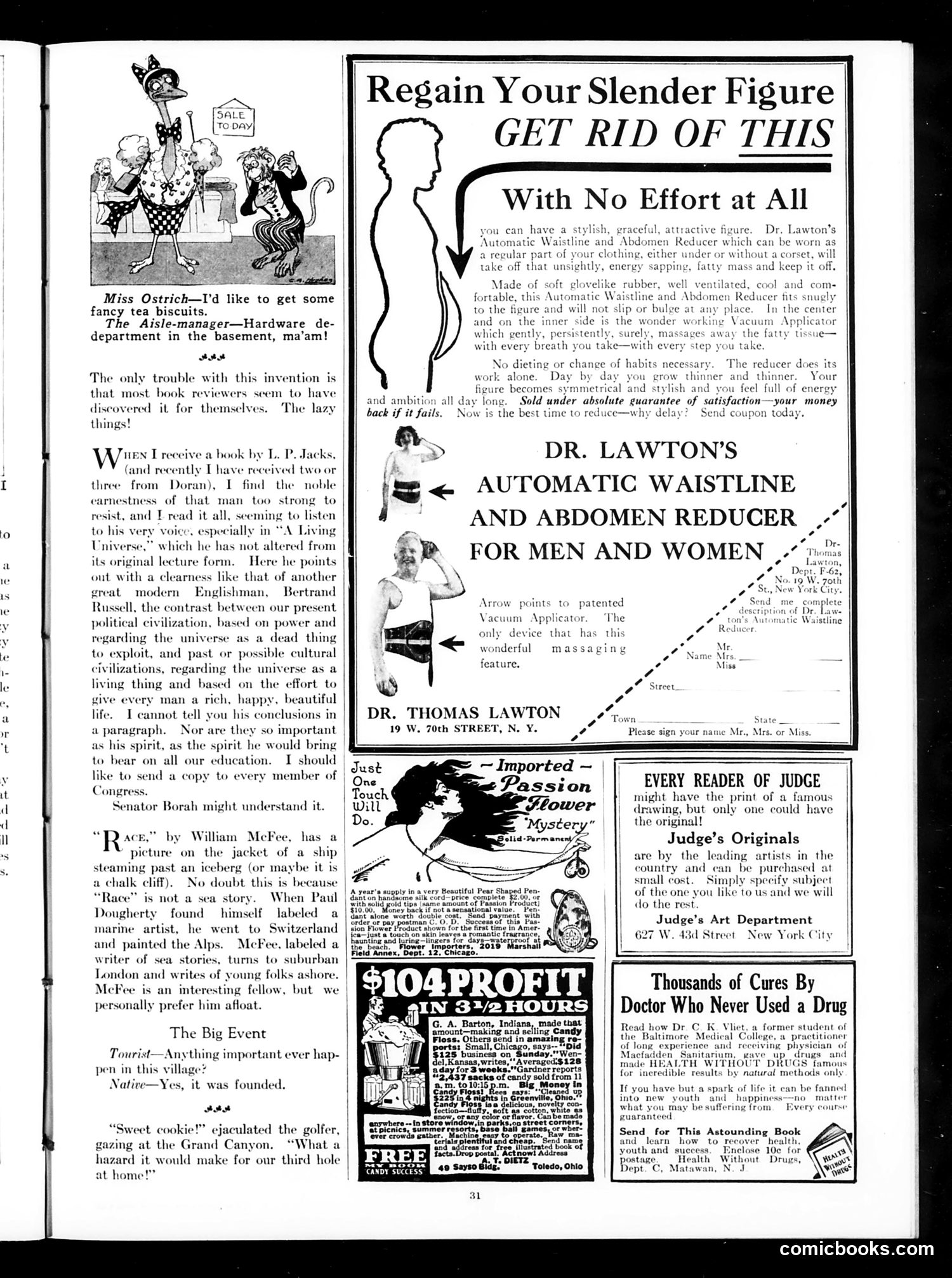
This page combines satirical commentary with period advertisements, typical of early-20th-century Judge magazine. **The Satire:** The upper left contains brief humorous anecdotes mocking everyday absurdities—a store clerk's incompetence, lazy book reviewers, and a golfer's obliviousness to natural wonders. These reflect Judge's recurring theme of poking fun at American social pretensions and foolishness. **The Advertisements:** The bulk of the page promotes dubious "miracle" products common to the era: Dr. Lawton's "Automatic Waistline and Abdomen Reducer" (an electrical belt claiming effortless weight loss), get-rich-quick schemes promising "$104 profit in 24 hours," and a book by a doctor claiming cures without medication. These ads reveal what people desperately wanted to believe about easy solutions to weight, wealth, and health problems. **The Irony:** Judge juxtaposes sophisticated literary criticism (discussing serious authors) with snake-oil marketing, subtly satirizing American consumer gullibility and the contradiction between intellectual aspiration and commercial exploitation.
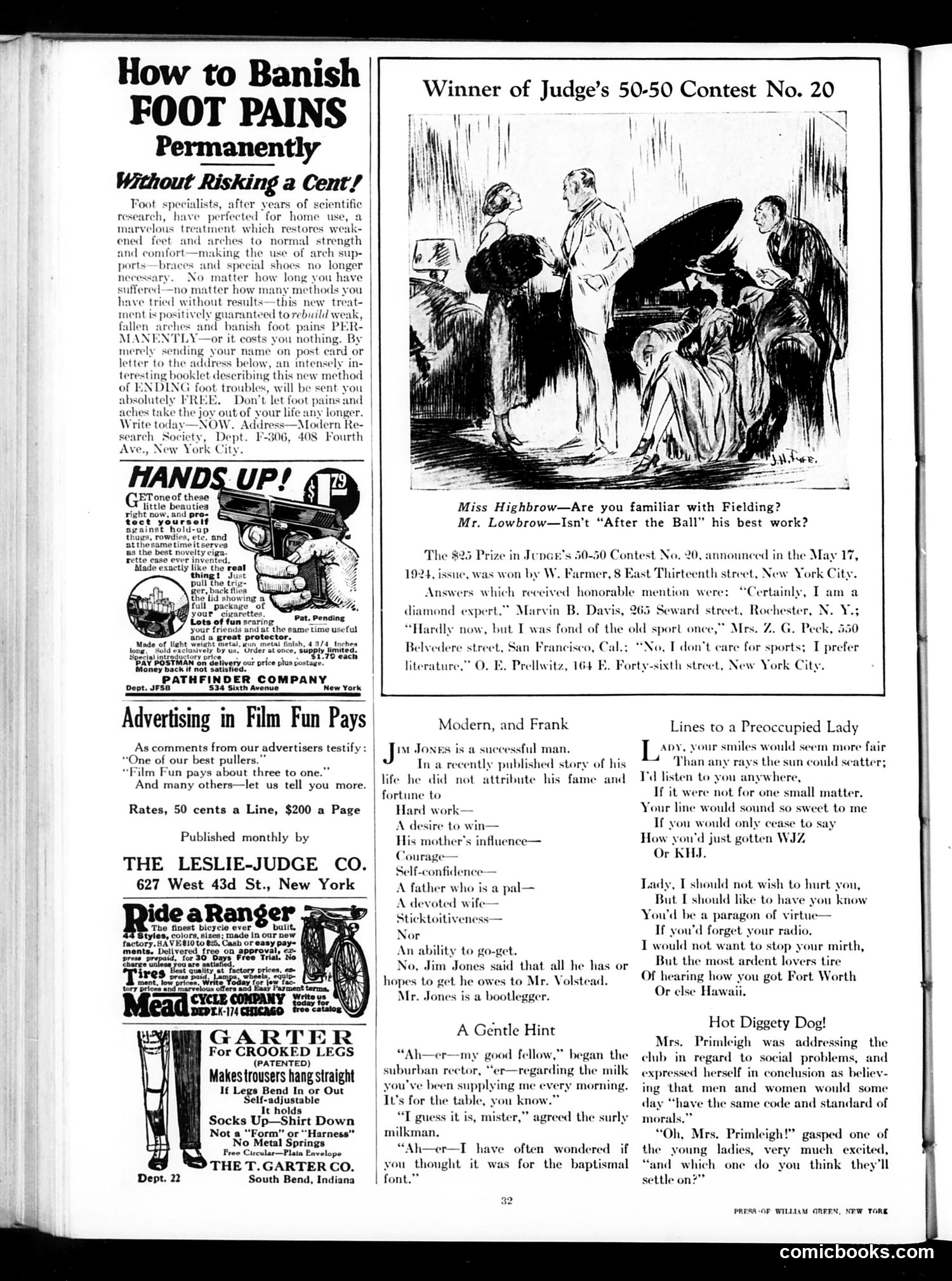
This page from Judge (circa 1924) is primarily **advertising and humor content**, not political satire. The main cartoon shows a drawing-room scene captioned "Winner of Judge's 50-50 Contest No. 20," depicting the magazine's contest results. The humor involves two exchanges: one about Henry Fielding (the 18th-century novelist)—where "Mr. Lowbrow" mistakes his work for the popular song "After the Ball"; another about a rector complaining to his milkman that he's been supplied table milk, not baptismal milk. The page is dominated by **product advertisements**—foot pain remedies, a toy gun, bicycles, leg garters, and socks. There's also a humorous piece titled "Modern, and Frank" mocking a bootlegger (Jim Jones) who credits his success entirely to "Mr. Volstead" (the Prohibition law's namesake), and lighter verse about radio call letters (WJZ, KHJ) interrupting romantic moments. The satire is gentle social humor about class pretension, Prohibition-era bootlegging, and modern radio's intrusive popularity—typical of Judge's light comedic approach.
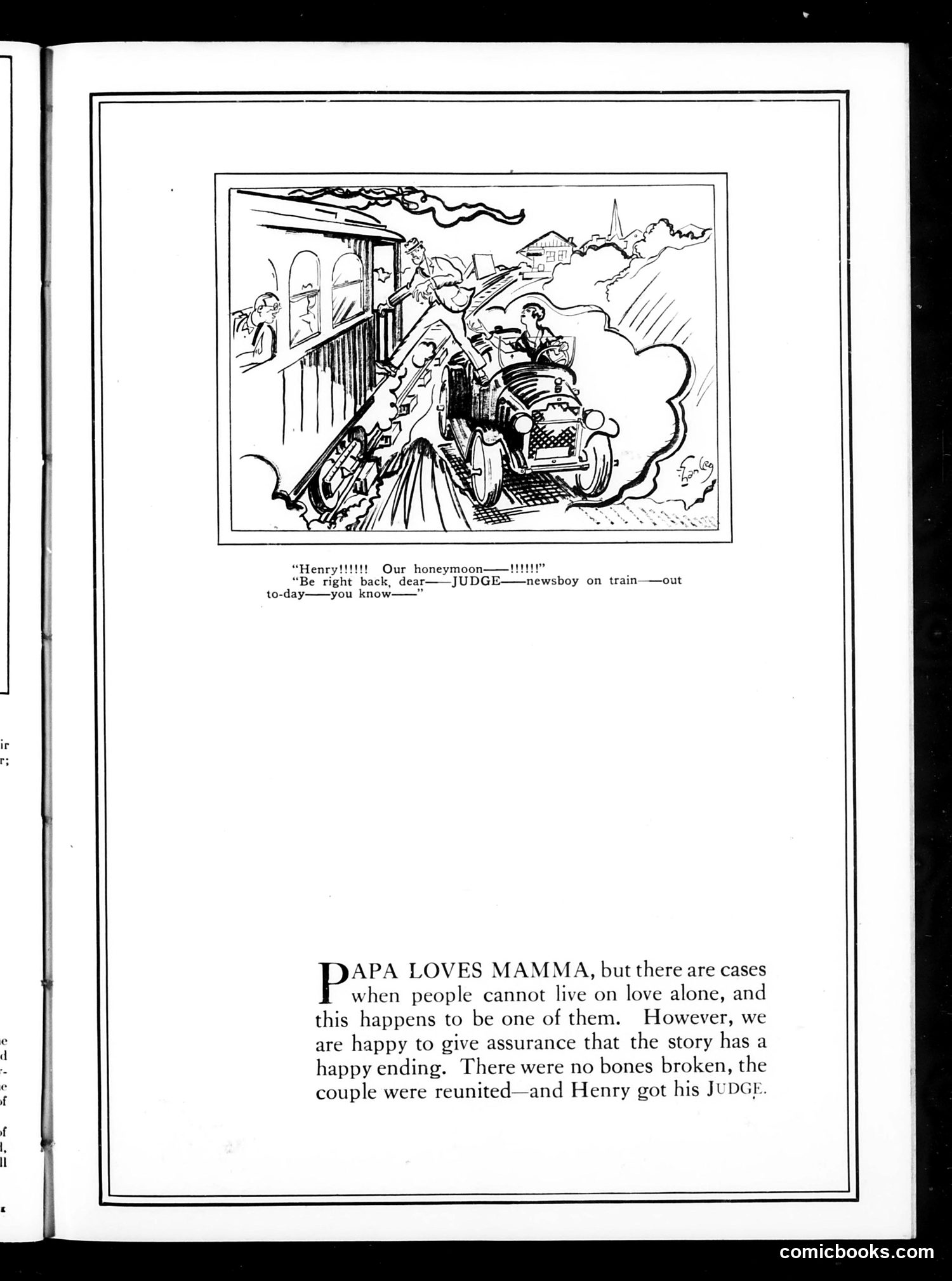
This is a humorous domestic scene satirizing the priorities of newlyweds. A woman on a train platform calls after her departing husband "Henry," who's distracted by getting the latest issue of **Judge** magazine from a newsboy—prioritizing the publication over their honeymoon departure. The joke is domestic satire: the groom's eagerness for Judge magazine supersedes romantic attention to his bride, suggesting husbands' devotion to reading matter over matrimonial duties. The accompanying text promises a "happy ending" where "Henry got his JUDGE," playing on this absurdity. This serves as **self-promotional advertising** for Judge itself, humorously suggesting the magazine is so essential that even newlyweds can't leave without it. The exaggerated punctuation and melodramatic tone are typical of Judge's satirical style.
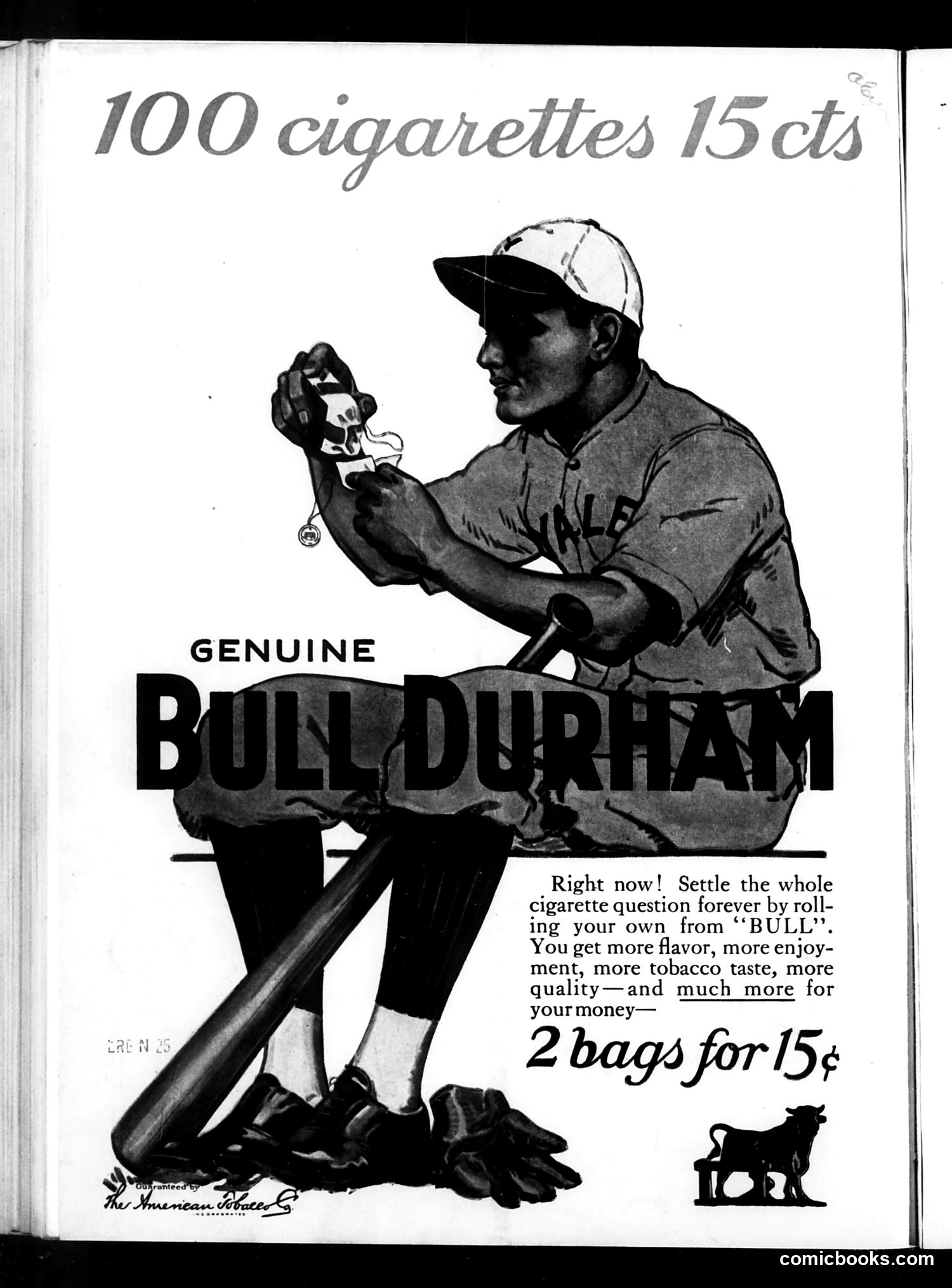
This is a cigarette advertisement, not political satire. It promotes "Bull Durham" roll-your-own tobacco, priced at 2 bags for 15 cents for 100 cigarettes. The imagery depicts a baseball player—likely chosen to appeal to male consumers—demonstrating the product's appeal through an athletic, masculine figure. The ad's pitch emphasizes economy and quality: rolling your own provides "more flavor, more enjoyment, more tobacco taste" and better value than pre-made cigarettes. The "cigarette question" reference suggests contemporary debate about manufactured versus hand-rolled cigarettes, with Bull Durham positioned as the superior, cost-effective choice. The cow logo in the corner was the brand's trademark. This reflects early 20th-century consumer marketing targeting working-class men through sports imagery and value propositions.

I cannot reliably read the OCR text from this image - it appears to show only scattered characters and symbols rather than coherent words. The image itself appears to be a mostly blank page with binding visible on the left side, characteristic of a scanned book or magazine. Without legible text or visible cartoon illustrations, I cannot identify specific figures, political references, or satirical content. This appears to be either a blank page, a title page, or a scanning error that hasn't captured the intended content clearly. To provide meaningful historical analysis, I would need a clearer image showing actual cartoon artwork or readable text from the Judge magazine page.