
Judge, 1924-06-28 · page 21 of 37
Judge — June 28, 1924 — page 21: what you’re looking at
What you’re looking at
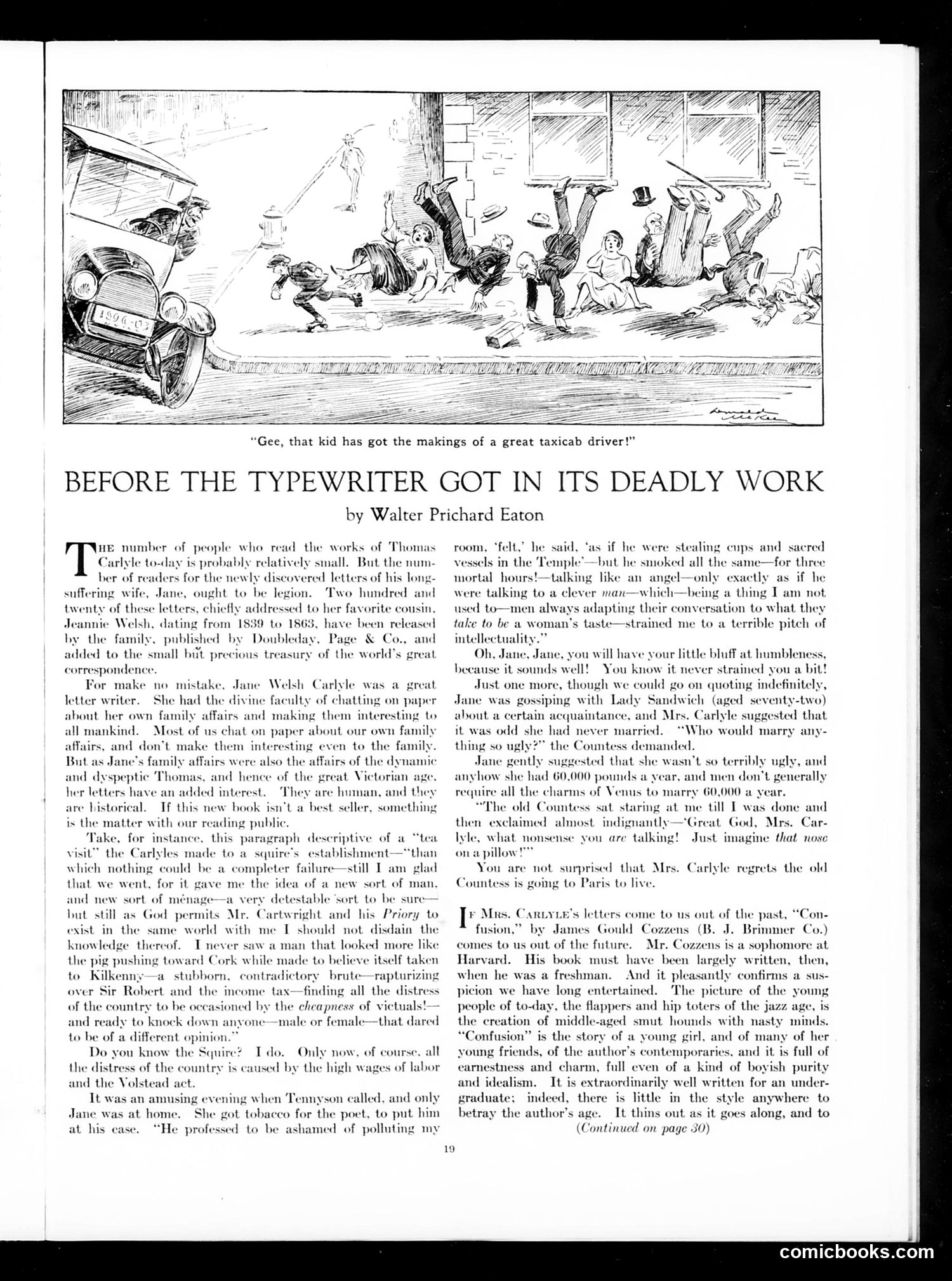
**The Cartoon:** The sketch depicts a car swerving wildly through a street, scattering pedestrians in all directions. The caption jokes that the reckless driver "has got the makings of a great taxicab driver"—satirizing early taxi drivers as notoriously dangerous and reckless. **The Article:** Walter Prichard Eaton reviews newly published letters of Jane Welsh Carlyle (wife of Victorian philosopher Thomas Carlyle), written 1839-1863. He argues these personal letters are witty, insightful social commentary worth reading. **The Satire:** Eaton contrasts Jane's clever letter-writing with modern complaints. Where people blame "cheapness of victuals" or "high wages" for the country's problems, Jane's era faced similar debates about taxicabs and labor costs. The cartoonist mocks taxi drivers as incompetent; Eaton celebrates Jane's ability to find humor in everyday social absurdities—suggesting her observations remain timelessly relevant. The implied point: serious social criticism can emerge from domestic correspondence and keen observation of human folly.
📄 Transcribed text from this page (OCR, searchable)
Machine-transcribed from the original scan — historical spelling and the odd misread are preserved.
“Gee, that kid has got the makings of a great taxicab driver BEFORE THE TYPEWRITER GOT IN ITS DEADLY WORK by Walter Prichard Eaton HE number of people who read the works of ‘Thomas le to-day is probably relatively small. But the num- Of readers for the newly discovered letters of his long- suffering wife, Jane, ought to be legion. Two hundred and twenty of these letters, chiefly addressed to her favorite cousin. Jeannie Welsh, dating from 1839 to 1863, have been re ed by the family, published by Doubleday, Page & Co., and added to the small bit precious treasury of the world’s great correspondence. For make no mistake, Jane Welsh Carlyle was a great letter writer. She had the divine faculty of chatting on paper about her own family affairs and making them interesting to all mankind. Most of us chat on paper about our own family affairs, and don’t make them interesting even to the family. But as Jane’s fami y affairs were also the affairs of the dynamic and dyspeptic ‘Thomas, and hence of the great Victorian age. her letters have an added interest. are historic They are human, and they 1. Tf this new book isn’t a best seller, something is the matter with our reading public. Tak visit” ec, for instance, this paragraph descriptive of a “tea the Carlyles made to a squire’s establishment—"than which nothing could be a completer still Tam glad that we went, for it gave me the idea of a new sort of man, and new sort of ménage—a very detestable ‘sort to be sure but still as God permits Mr. Cartwright and his Priory to exist in the same world with me [ should not disdain the knowledge thereof. T never saw a man that looked more like the pig pushing toward Cork while made to believe itself taken to Kilkenny contradictory brute—rapturiz over Sir Robert and the income tax—finding all the distress of the country to be occasioned by the cheapness of victuals! and ready to knock down to he of a different opinion Do you know the Squire? Only now, of course. all the distress of the country is caused by the high wages of labor and the Volstead act. It was an lure a stubborn, male or female—that dared yone T do. amusing evening when ‘Tennyson called, and only Jane was at home. She got tobacco for the poet, to put him at his ease. “He professed to be ashamed of polluting my room, ‘felt,’ he said, ‘as if he were stealing eups and sacred vessels in the ‘Temple’—but he smoked all the same—for three mortal hours!—talking like an angel—only exactly as if he were talking to a clever man—which—being a thing Iam not used to—men always adapting their conversation to what they take to be a woman's taste—strained me to a terrible pitch of intellectuality Oh, Jane, Jane, you will have your little bluff at humbleness, because it sounds well! You know it never strained you a bit! Just one more, though we could go on quoting indefinitely, Jane was gossiping with Lady Sandwich (aged seventy-two) about a certain acquaintance, and Mrs. Carlyle suggested that it was odd she had never married. “Who would marry any- thing so ugly?” the Countess demanded. Jane gently suggested that she wasn’t so terribly ugly, and anyhow she had 60,000 pounds a year, and men don’t generally require all the charms of Venus to marry 60,000 a year. “The old Countess sat staring at me till T was done and then exclaimed almost indignantly—Great God, Mrs. Car- Iyle, what nonsense you are talking! Just imagine that nose villow!” ou are not surprised that Mrs. Carlyle regrets the old Countess is going to Paris to live. I: Mrs. Carzy.e’s letters come fusion,” by James Gould Co: comes to us out of the future. Mr. Cozzens is a sophomore at Harvard. His book must have been largely written, then, when he was a freshman. And it pleasantly confirms a sus- picion we have long entertained. The picture of the young people of to-day, the flappers and hip toters of the jazz age, is the creation of middle-aged smut hounds with nasty minds. “Confusion” is the story of a young girl, and of many of her young friends, of the author’s contemporaries. and it is full of earnestness and charm, full even of a kind of boyish purity and idealism. It is extraordinarily well written for an under- graduate; indeed, there is little in the style anywhere to betray the author's age. It thins out as it goes along, and to (Continued on page 30) ona to us out of the past, “Con- ens (B. J. Brimmer Co.) comicbooks.com