
Judge, 1924-06-28 · page 20 of 37
Judge — June 28, 1924 — page 20: what you’re looking at
What you’re looking at
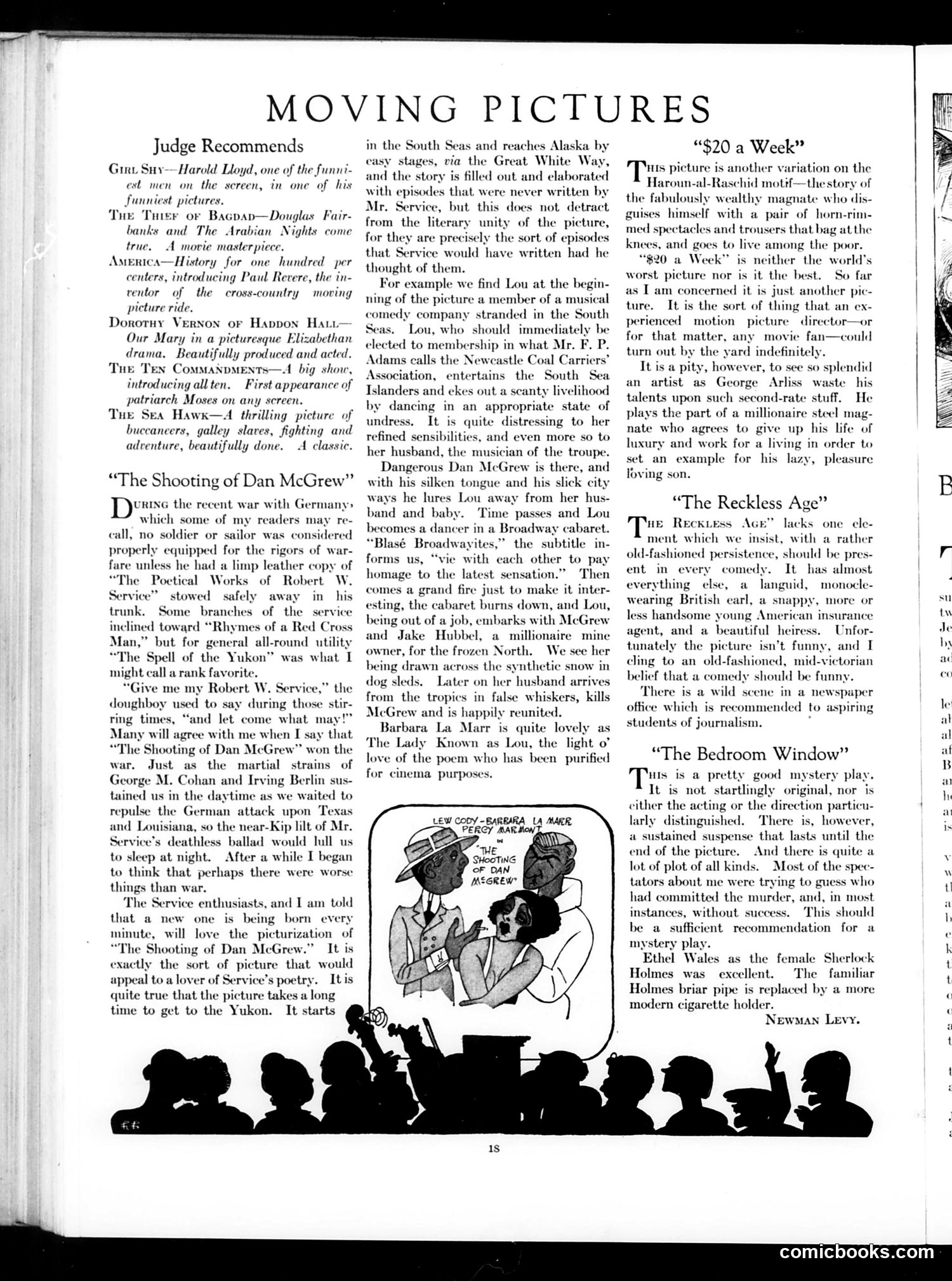
This page reviews early silent films (circa 1920s). The main cartoon depicts a scene from "The Shooting of Dan McGrew"—a film adaptation of Robert W. Service's famous Yukon poem, hugely popular with WWI soldiers. The reviewer criticizes the film for padding Service's original story with invented episodes: a South Seas musical-comedy sequence where the heroine "Lou" dances scantily-clad, a Broadway cabaret fire, and melodramatic plot additions unwritten by Service. The cartoon shows two characters (appears to be Lou and Dan McGrew) in conversation, captioned with dialogue establishing their relationship. The reviewer's complaint is essentially that while the film exploits Service's beloved poem's popularity, it cheapens the source material through sensationalism and manufactured drama—a familiar modern critique of literary adaptations prioritizing spectacle over fidelity.
📄 Transcribed text from this page (OCR, searchable)
Machine-transcribed from the original scan — historical spelling and the odd misread are preserved.
MOVING PICTURES Judge Recommends Girt Suy—Harold Lloyd, one of the funni- ext men on the sereen, in one of his funniest pictures. Tue Tuer or Bacpap—Douglas Fair- banks and The Arabian true. A movie master piec Amenica—History for one hundred per centers, introducing Paul Revere, the in- ventor of the picture rid Dororny Vernon or Happon Hat Our Mary in a picturesque Elizabethan drama. Beautifully produced and acted. Tue Ten CommaNpMENTS—A big show, introducing allten. First appearance of patriarch Moses on any screen. Tur Sea Hawx—A thrilling picture of buccaneers, galley slaves, fighting and adcenture, beautifully done. A classic. ights come cross-country — moving “The Shooting of Dan McGrew” D6 the recent war with Germany» which some of my readers may re- call, no soldier or sailor was considered properly equipped for the rigors of war- fare unless he had a limp leather copy of “The Poetical Works of Robert W. Service” stowed safely away in his trunk. Some branches of the service inclined toward “Rhymes of a Red Cross Man,” but for general all-round utility “The Spell of the Yukon” was what I might call a rank favorite. “Give me my Robert W. Service,” the doughboy used to say during those stir- ring times, “and let come what m Many will agree with me when I t “The Shooting of Dan McGrew” won the war. Just as the martial strains of George M. Cohan and Irving Berlin sus- tained us in the daytime as we waited to repulse the German attack upon Texas and Louisiana, so the near-Kip lilt of Mr. hless ballad would lull us sleep at night. After a while I began think that perhaps there were worse things than war. ‘The Service enthusiasts, and I am told that a new one is being born every minute, will love the picturization of “The Shooting of Dan McGrew.” It is exactly the sort of picture that would appeal to a lover of Service’s poetry. It is quite true that the picture takes a long time to get to the Yukon. It starts in the South Seas and reaches Alaska b asy stages, via the Great White W and the story is filled out and elaborated with episodes that were never written by Mr. Service, but this does not detract from the literary unity of the picture, for they are precisely the sort of episodes that Service would have written had he thought of them. For example we find Lou at the begin- ning of the picture a member of a musical comedy company stranded in the South Se Lou, who should immediately be elected to membership in what Mr. F. P. Adams calls the Newcastle Coal Carriers’ Association, entertains the South Sea Islanders and ekes out a scanty livelihood by dancing in an appropriate state of undress, It is quite distressing to her refined sensibilities, and even more so to her husband, the musician of the troupe. Dangerous Dan McGrew is there, and with his silken tongue and his slick city ways he lures Lou away from her hus- band and baby. Time passes and Lou becomes a dancer in a Broadway cabaret. “Blasé Broadwayite: the subtitle in- forms us, “vie with each other to pay homage to the latest sensation.” Then comes a grand fire just to make it inter- esting, the cabaret burns down, and Lou, being out of a job, embarks with McG and Jake Hubbel, a millionaire mine owner, for the frozen North. We see her being drawn across the synthetic snow in Later on her husband arrives from the tropics in false whiskers, kills McGrew and is happily reunited. Barbara La Marr is quite lovely as ‘The Lady Known as Lou, the light 0” love of the poem who has been purified for cinema purposes. Ww dog sleds. a eR tate U4 RR 1s “$20 a Week” Is picture is another v ion on the Haroun-al-Raschid motif—the story of the fabulously wealthy magnate who dis- guises himself with a pair of horn-rim- med spectacles and trousers that bag at the knees, and goes to live among the poor. 0 a Week” is neither the world’s worst picture nor is it the best. So far as I am concerned it is just another pic- ture. It is the sort of thing that an ex- perienced motion picture director—or for that matter, any movie fan—could turn out by the yard indefinitely. It is a pity, however, to see so splendid an artist as George Arliss waste his talents upon such second-rate stuff. He plays the part of a millionaire steel mag- nate who agrees to give up his life of luxury and work for a living in order to set an example for his lazy, loving son. “The Reckless Age” ne Reckiess AGE” ment which we insist, with a rather old-fashioned persistence, should be pres- ent in every comedy. It has almost ‘ything else, a languid, monocle- vearing British earl, a snappy, more or less handsome young American insurance agent, and a beautiful heiress. Unfor- tunately the picture isn’t funny, and I cling to an old-fashioned, mid-victorian belief that a comedy should be funny. pleasure lacks one ele- There is a wild scene in a ne} wspaper office which is recommended to aspiring students of journalism. “The Bedroom Window” HIs is a pretty good mystery play It is not startlingly original, cither the acting or the direction particu- larly distinguished. There is, however, a sustained suspense that lasts until the end of the picture. And there is quite a lot of plot of all kinds. Most of the spec- tators about me were trying to guess who had committed the murder, and, in most instances, without succe This should be sufficient recommendation for a stery play Ethel Wales as the female Sherlock Holmes was excellent. The familiar Holmes briar pipe is replaced by a more modern cigarette holder. Newman Levy. nor is comicbooks.com