
Judge, 1924-06-28 · page 22 of 37
Judge — June 28, 1924 — page 22: what you’re looking at
What you’re looking at
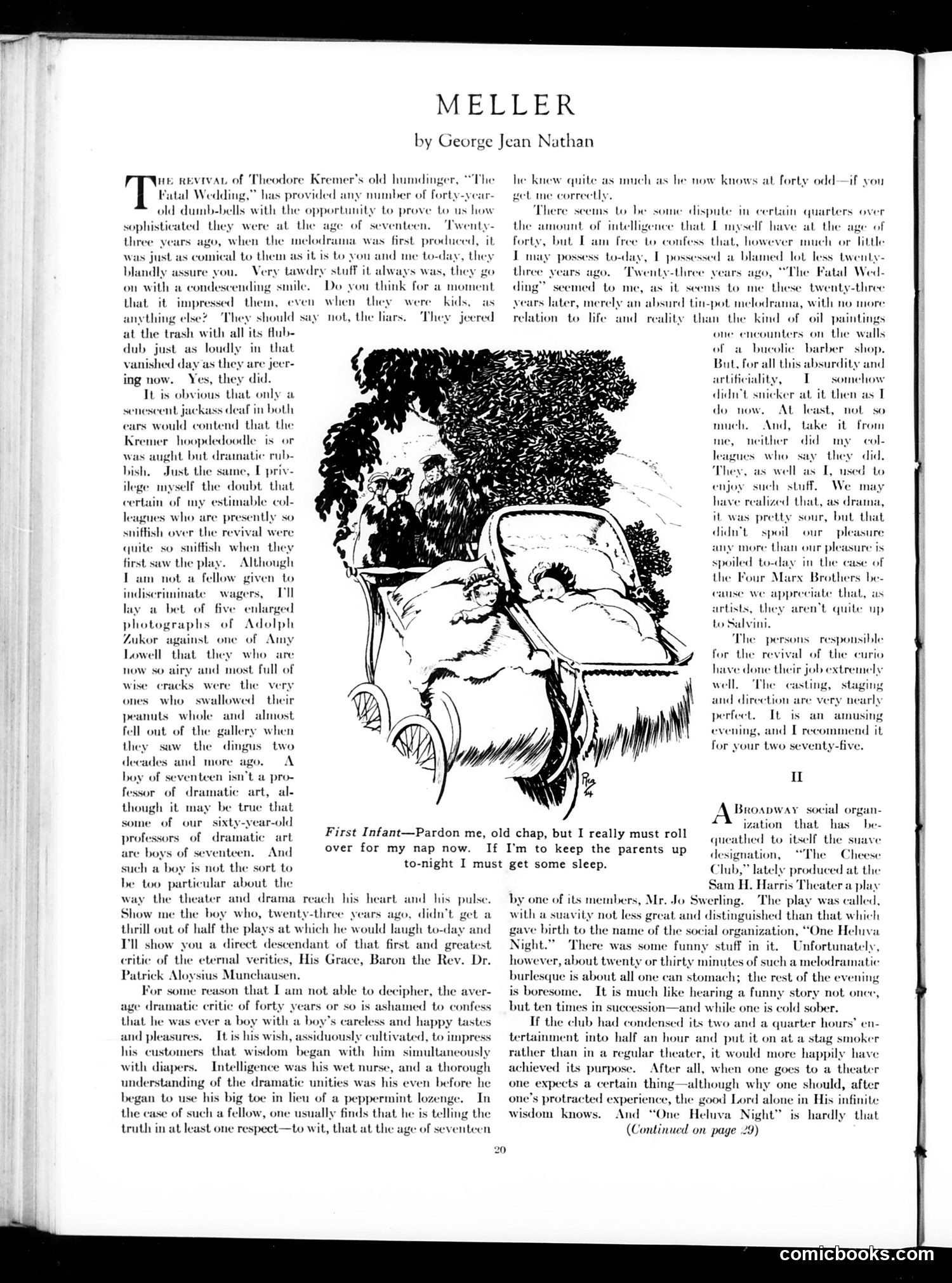
This page satirizes theater critics' hypocrisy about "The Fatal Wedding," an old melodrama being revived. Theater critic George Jean Nathan mocks older critics who now claim they were too sophisticated to enjoy such "trash" when they were young, yet clearly did enjoy it twenty-three years prior. Nathan's central joke: these forty-year-old critics are lying about their younger selves to appear intellectually superior today. He argues that enjoying melodrama as a teenager was natural and honest—pretending otherwise now is pretentious. The small cartoon shows an infant asking to nap before keeping parents awake, a crude joke about melodrama's exhausting emotionality. Nathan defends simple pleasures and calls out the affectation of critics who retroactively construct false sophistication, suggesting genuine artistic appreciation shouldn't require denying one's authentic past responses.
📄 Transcribed text from this page (OCR, searchable)
Machine-transcribed from the original scan — historical spelling and the odd misread are preserved.
MELLER by George Jean Nathan HE REVIVAL of Theodore Kremer’s old humdinger, “The | Fatal Wedding,” has provided any mumber of forty-year- old dumb-bells with the opportunity to prove to us how sophisticated they were at the age of seventeen, ‘Twenty- three years ago, when the melodrama was first produced, it Was just as comical to them as it is to you and me to-day, they Very tawdry stuff it always was, they go Do you think for a moment they kids, They jeered hlandly assure you. on with a condescending smile. Uhat it’ impressed them, even anything else? ‘They should say not, the liars. at the trash with all its fub- dub just as loudly in that vanished day as they are jeer- ing now. Yes, they did. It is obvious that only a senescent jackass deaf in both ears would contend that the Kremer hoopdedoodle is or was aught but dramatic rub- hish. Just the same, [ priv- ilege myself the doubt that certain of my estimable col- when were as leagues who are presently so sniffish over the revival were quite so sniffish when they first saw the play. Although I am not a fellow given to indiscriminate ril lay a bet of five enlarged photographs of Adolph Zukor against one of Amy Lowell that they who are now so airy and most full of cracks the very ones who swallowed their peanuts whole and almost fell out of the gallery when they the dingus two Jes and more ago. A iteen isn’t a pro- fessor of dramatic art, al- though it may be true that rold wagers, wise were saw dec hoy of sev some of our sixty- professors of dramatic art are boys of seventeen. And such a boy is not the sort to be too particular about the way the theater and drama reach his heart and his pulse. Show me the boy who, twenty-three years ago, didn’t get a thrill out of half the plays at which he would laugh to-« Tl show you a direct descendant of that first and greatest critic of the eternal verities, His Grace, Baron the Rev. Dr. Patrick Aloysius Munchausen. For some reason that I am not able to decipher, the aver- age dramatic critic of forty years or so is ashamed to confess that he was ever a boy with a boy’s careless and happy tastes over for my nap now. and pleasures. It is his wish, assiduously cultivated, to impress his customers that wisdom began with him. simultaneously with diapers. Intelligence was his wet nurse, and a thorough understanding of the dramatic unities was his even before he began to use his big toe in lieu of a peppermint lozenge. In the case of such a fellow, one usually finds that he is telling the truth in at least one respect—to wit, that at the of seventeen First Infant—Pardon me, old chap, but I really must roll If I'm to keep the parents up to-night I must get some sleep. 20 he knew quite as much as he now knows at forty odd—if you gel me correctly. There seems to be some dispute in certain quarters over the amount of intelligence that L myself have at the age of forty, but Lam free to confess that, however much or little 1m thr ding’ y possess today, I possessed a blamed lot less twent he Fatal W seemed to me, as it seems to me these twenty-three ‘Twenty-three years ago, * ‘ars ago. years later, merely an absurd tin-pot melodrama, with no more relation to. life ity Uan the kind of oil paintings one encounters on the walls andr bucolie barber shop. nd somehow of a But, for all this absurdity artificiality, — I didn’t snicker at it then as I At least, not And, take it me, neither did my leagues who say they did. They, as well as [, used to enjoy such stuff. We may ha it was pretty sour, but that didn’t any more than our p spoiled to-day in the the Four Marx Brothers be- te that, as do now. s\ so much. from col- e realized that, as drama, spoil our cause we appreci artists, Uhey aren't quite up lo Salvini. The persons responsible 1 of the curio job extremely: for the reviv have done the well. ‘The casting, staging and direction are very nearly perfect. It evening, and E recommend it for your two seventy-five. is an amusing IL Broapway social organ- ization that has queathed to itself the suave designation, “The Club,” lately produced at the Sam H. Harris Theater a play by one of its members, Mr. Jo Swerling. ‘The play was called, with a suavity not less great and distinguished than that which birth to the name of the social organization, “One Hehuva ‘There was some funny stuff in it. Unfortunately, however, about twenty or thirty minutes of such a melodramatic burlesque is about all one can stomach; the rest of the evening is boresome. It is much like hearing a funny story not once, but ten times in suecession—and while one is cold sober. If the club had condensed its two and a quarter hours’ en- tertainment into half an hour and put it on at a stag smoker rather than in a regular theater, it would more happily have achieved its purpose. After all, when one goes to a theater one expects a certain thing—although why one should, after one’s protracted experience, the good Lord alone in His infinite wisdom knows. And “One Heluva Night” is hardly that (Continued on page 29) be- Cheese comicbooks.com