
A complete issue · 37 pages · 1924
Judge — June 7, 1924
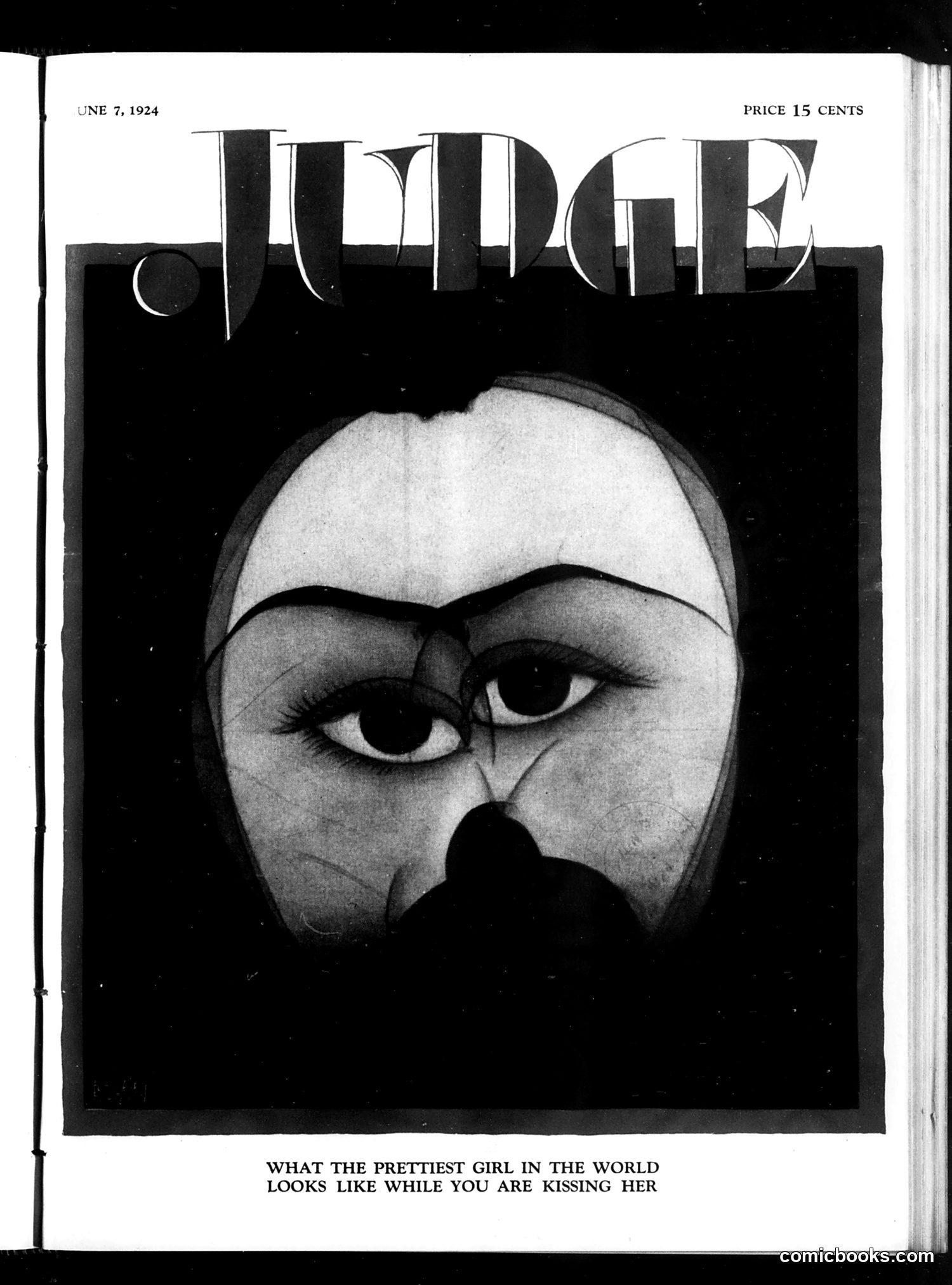
This is a humorous magazine cover playing on the physical distortion that occurs during kissing. The stylized illustration shows an exaggerated face with closed eyes and puckered lips, depicting how facial features appear compressed and contorted from the kissing person's perspective. The caption—"What the Prettiest Girl in the World Looks Like While You Are Kissing Her"—frames this as satirical commentary on romance and intimate moments. Rather than the idealized beauty referenced in the caption, the viewer sees an unflattering, almost grotesque reality. The joke targets the contrast between romantic fantasy versus physical reality, typical of 1920s humor about dating and courtship. The Art Deco-influenced typography and stark black-and-white design are characteristic of Judge's visual style during this era.
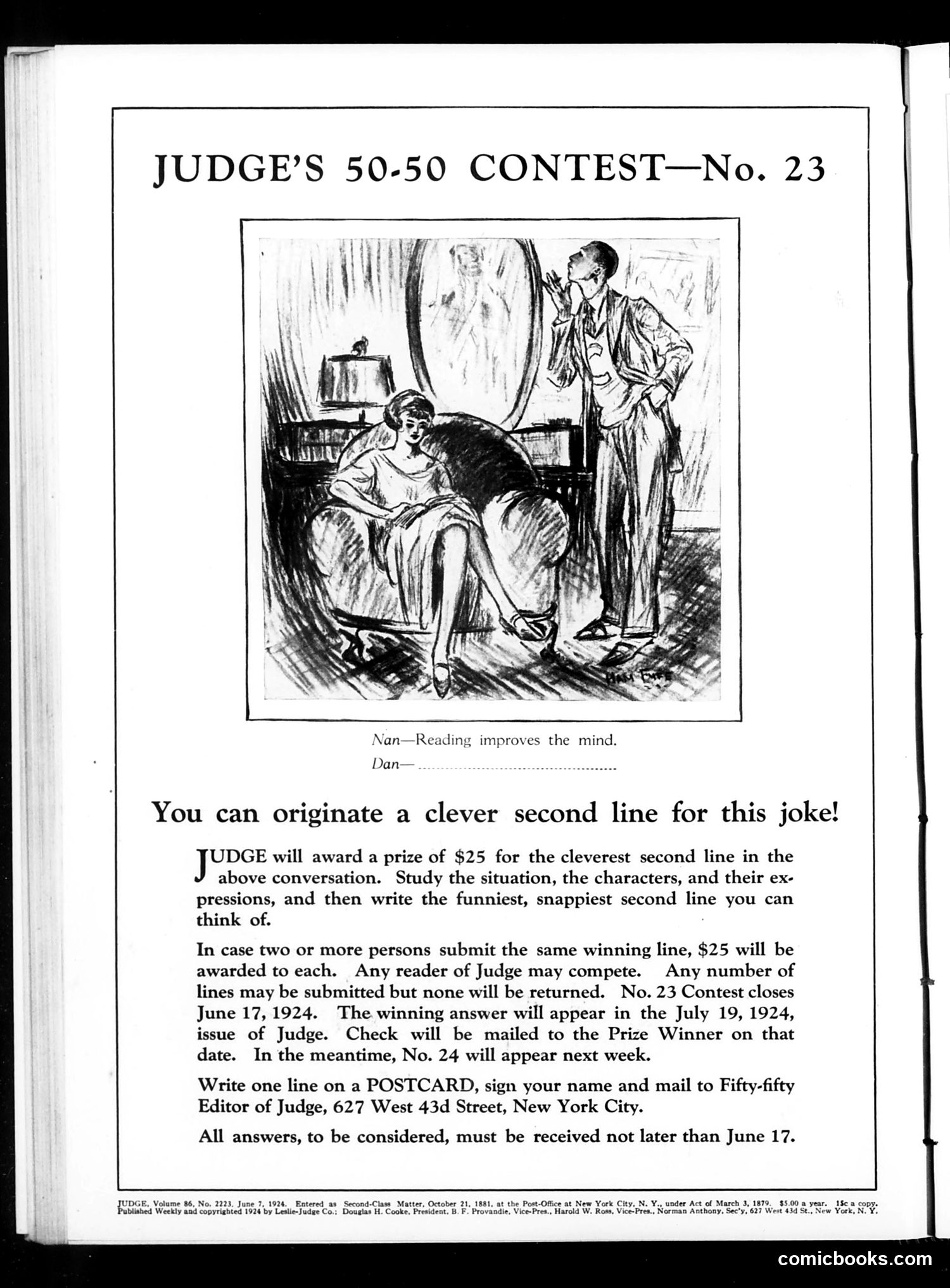
This is a **contest page**, not a political cartoon. It presents a domestic scene where a woman sits reading while a man stands nearby, with the caption: "Nan—Reading improves the mind. Dan—[blank line]" Readers are invited to complete Dan's response with a clever second line, competing for a $25 prize. The humor format suggests Dan should provide a witty or sarcastic comeback—likely poking fun at women's reading habits or intelligence in a way typical of 1920s humor. The cartoon itself makes no specific political or social reference beyond general gender dynamics of the era. This is primarily a **reader participation contest** rather than editorial satire, representing Judge's popular interactive features for engaging its audience.
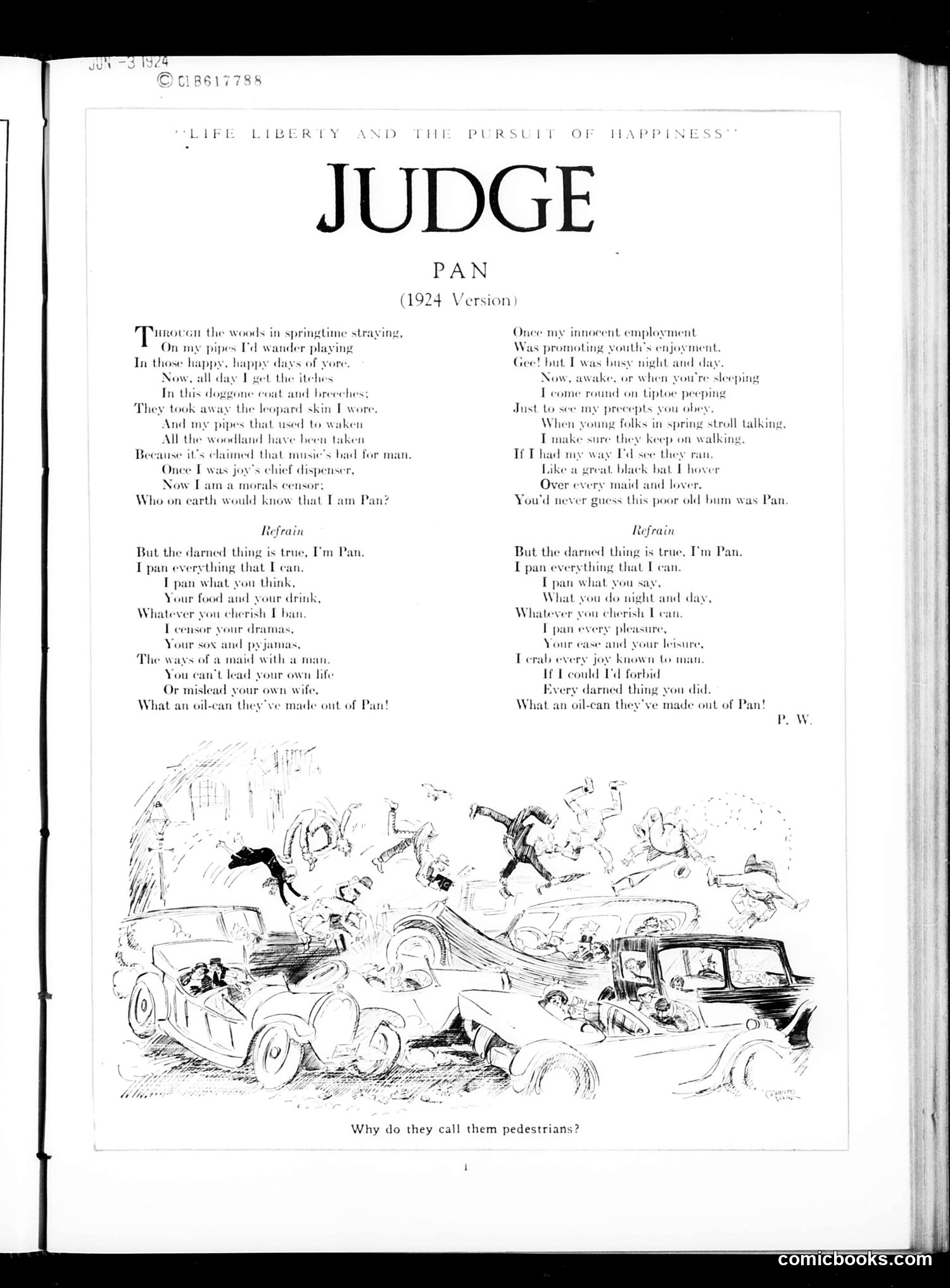
This page presents a satirical poem by P.W. about Pan, the Greek mythological figure of nature and pleasure. The poem's narrator—once a carefree Pan promoting "youth's enjoyment"—has become a "morals censor," lamenting how restrictions have ruined innocent pleasures. The accompanying illustration depicts a chaotic car crash scene, with the caption "Why do they call them pedestrians?" The satire targets 1920s moral reform movements, particularly Prohibition and conservative backlash against youth culture. Pan represents pre-regulation freedom; his transformation into a "morals censor" mocks the era's restrictive policies. The pedestrian joke likely critiques dangerous automobiles and reckless driving—suggesting that moralizing busybodies create actual hazards while policing innocent enjoyment.
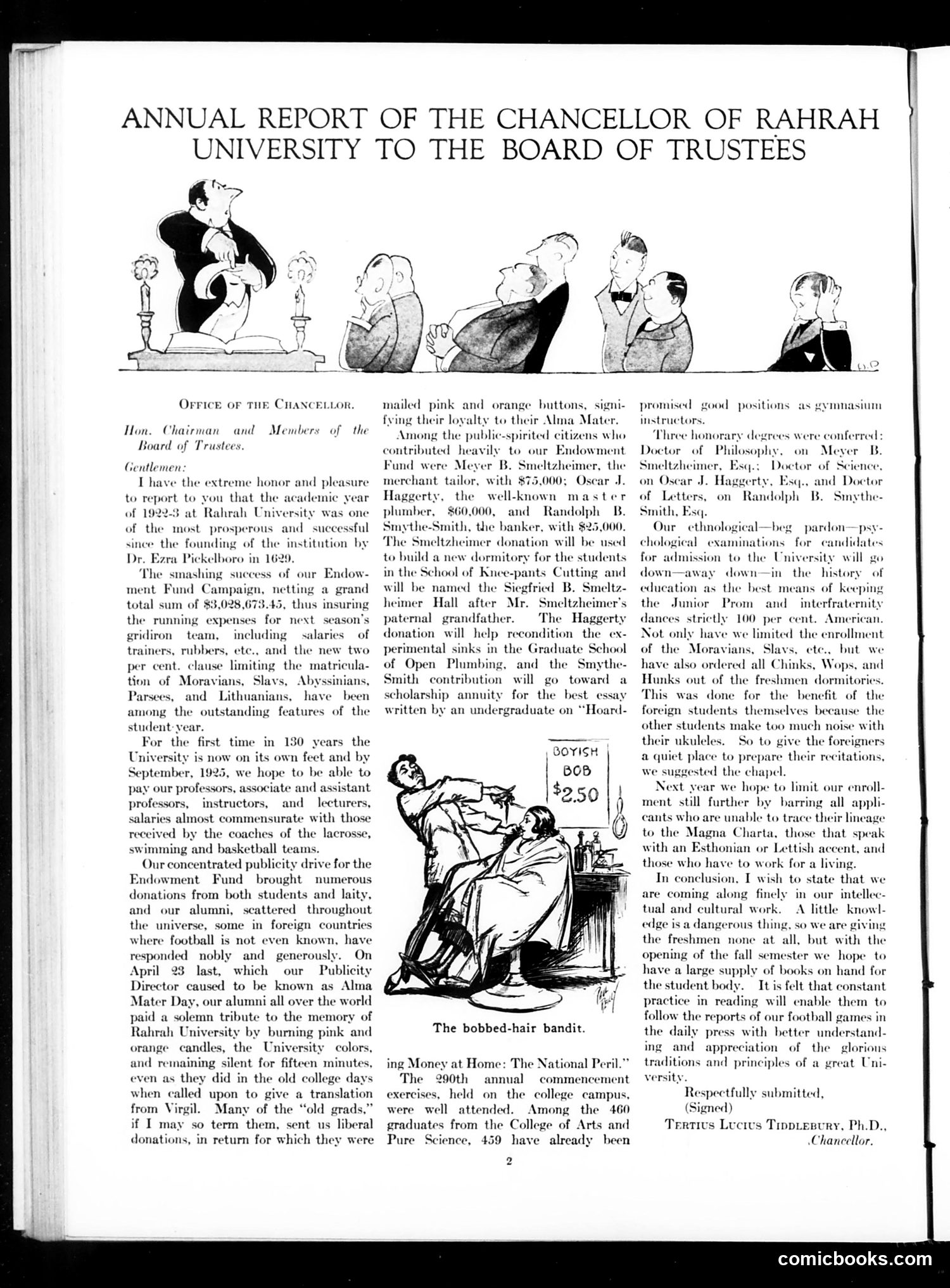
This page contains the Chancellor's formal annual report to Rahrah University's board, but includes a cartoon satirizing a contemporary crime phenomenon. The illustration shows a figure labeled "The bobbed-hair bandit" robbing what appears to be a barber or hairdresser (note the "$2.50" price sign). The "bobbed-hair bandit" references actual 1920s female criminals who adopted the fashionable short hairstyle and committed robberies. The cartoon mocks this trend, treating the fashionable bob—a symbol of modern, independent womanhood—as laughably criminal. The satire conflates bobbed hair with criminality and social disorder, reflecting conservative anxieties about women's changing roles and appearance during this era.
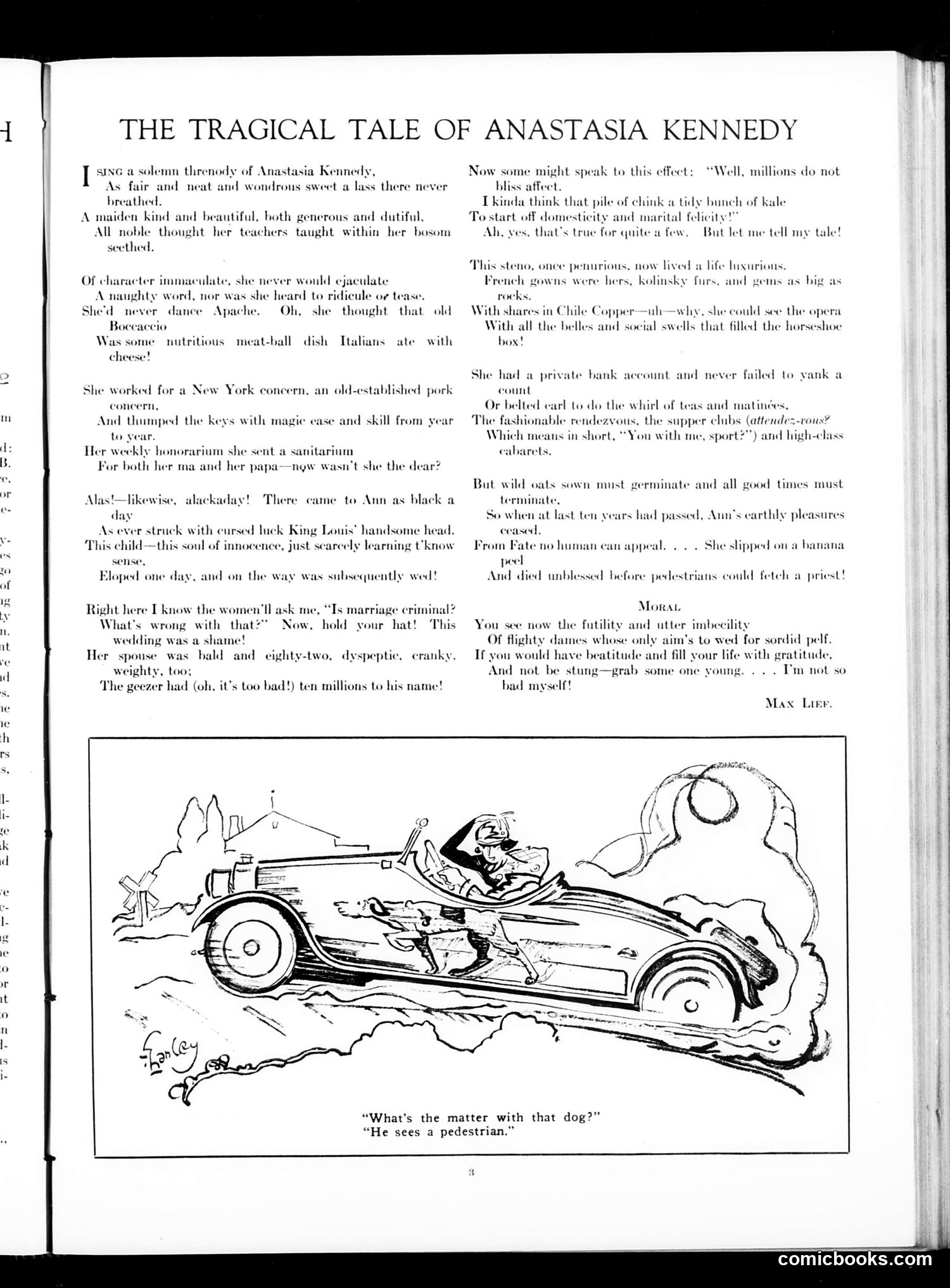
This page satirizes a wealthy socialite named Anastasia Kennedy through both poem and cartoon. The verse describes a privileged woman with inherited wealth who lived luxuriously—French gowns, opera boxes, bank accounts—but whose "wild oats sown must germinate." After ten years of pleasure, her fortunes reversed: she died "unblessed before pedestrians could fetch a priest." The accompanying cartoon shows a reckless driver in an expensive automobile hitting a pedestrian, captioned "What's the matter with that dog? He sees a pedestrian." The satire mocks both the carelessness of wealthy drivers and the moral comeuppance theme—suggesting that hedonistic excess and dangerous indifference to others' lives invite tragedy. The cartoon's dark humor emphasizes the pedestrian's helplessness before automotive peril.
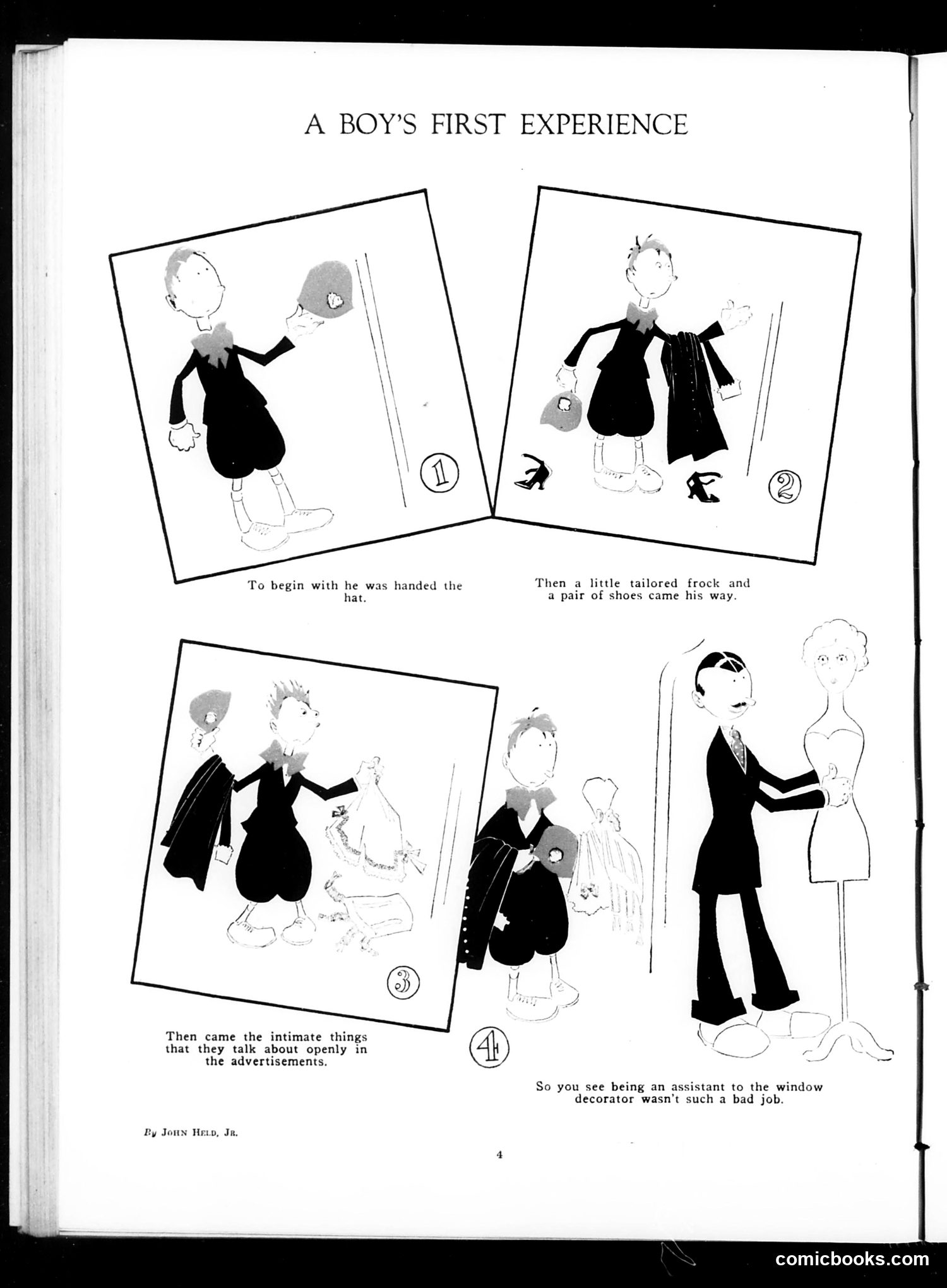
This is a humorous sequential cartoon about a young man's first job as a window dresser or shop assistant. The narrative shows: 1. He receives a hat to display 2. A tailored dress and shoes arrive 3. He arranges these items with mannequins, appearing flustered by "intimate things" discussed openly in advertisements 4. He assists a female customer at the window display The joke targets early-20th-century retail work and social attitudes: the boy is embarrassed or surprised by the casual discussion of women's clothing and fashion in commercial settings—something considered somewhat scandalous or improper at the time. The cartoon humorously depicts his awkwardness adapting to modern retail culture. Held's characteristic simple line-drawing style emphasizes the character's discomfort with this new professional environment.
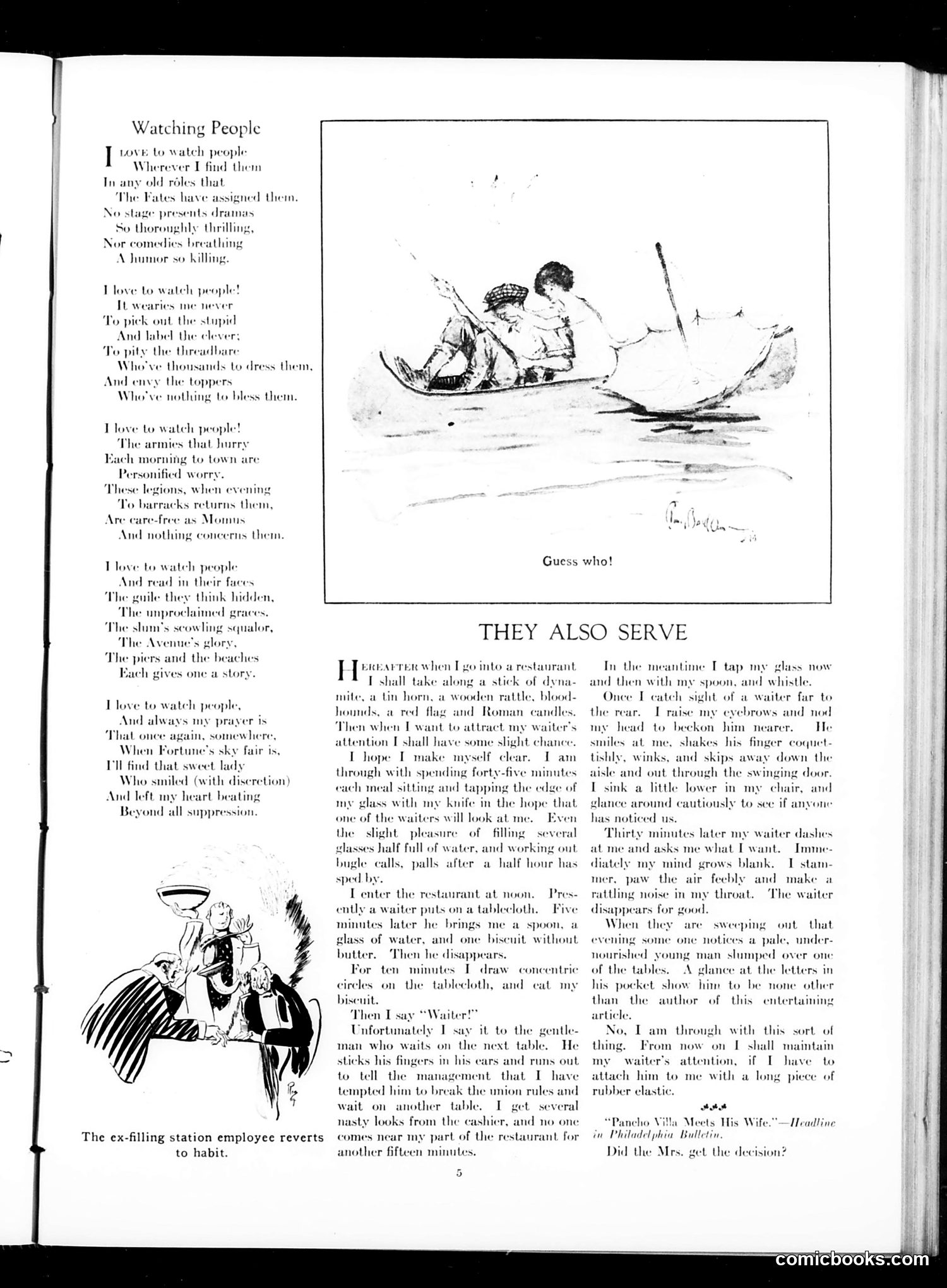
**"Watching People"** (left): A sentimental poem celebrating human observation—watching people's daily struggles, worries, and hidden qualities. It concludes with nostalgia for a lost love. This appears purely literary rather than satirical. **"They Also Serve"** (right): A humorous complaint about restaurant service. The author describes the frustrating experience of being ignored by waiters despite attempting increasingly absurd methods to get their attention (tapping glasses, whistling, raising eyebrows). The satire targets inefficient, indifferent restaurant service and union rules that apparently prevented waiters from serving patrons outside their assigned sections. The piece mocks both the author's desperation and the broken service system. **"Guess Who!"** illustration: Shows figures in a boat, seemingly a playful riddle for readers. The page reflects early 20th-century middle-class frustrations with modern urban life—romance, human nature, and service industry incompetence.
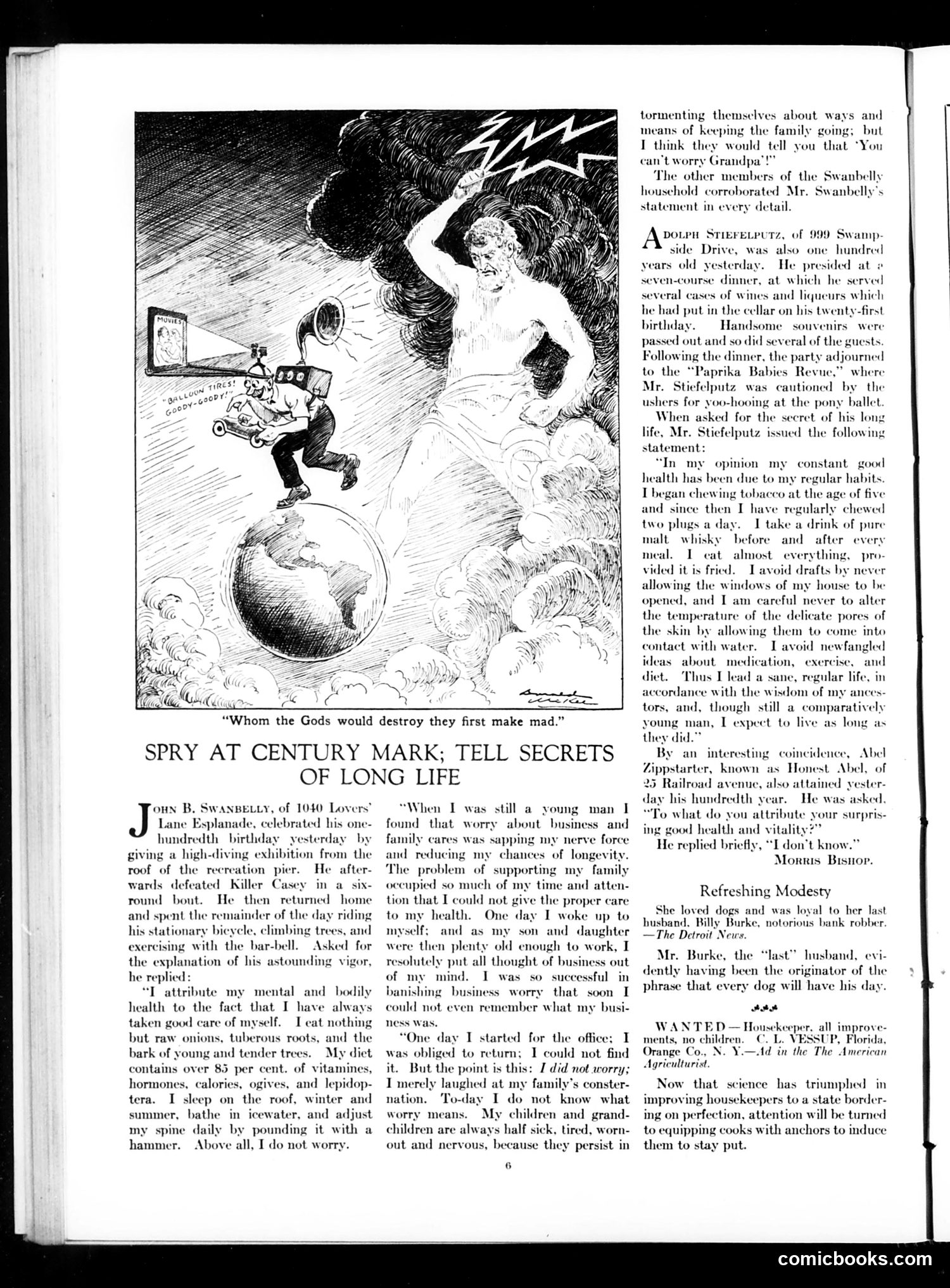
This Judge satirical piece mocks competing health fads of the early 20th century by presenting three centenarians offering wildly contradictory "secrets" to longevity. **The Satire:** John B. Swanbelly attributes his vigor to extreme asceticism: eating only raw onions and tree bark, sleeping on roofs, and crucially—*refusing to worry* by abandoning all responsibility for his family. The joke is that he achieved health through willful ignorance and abdication. Dolph Stiefelputz claims the opposite: constant drinking (wine, liqueurs, whisky), smoking since age five, and avoiding fresh air and water. His health supposedly thrives on indulgence and stagnation. A third centenarian, Honest Abel, simply replies "I don't know"—suggesting common sense trumps elaborate theories. **The Cartoon** (top) shows one character fleeing a giant woman, illustrating chaos and excess. **The Point:** Judge ridicules pseudoscientific health crazes and contradictory wellness advice of the era. Both extreme deprivation and excess claim success; therefore both are equally absurd.
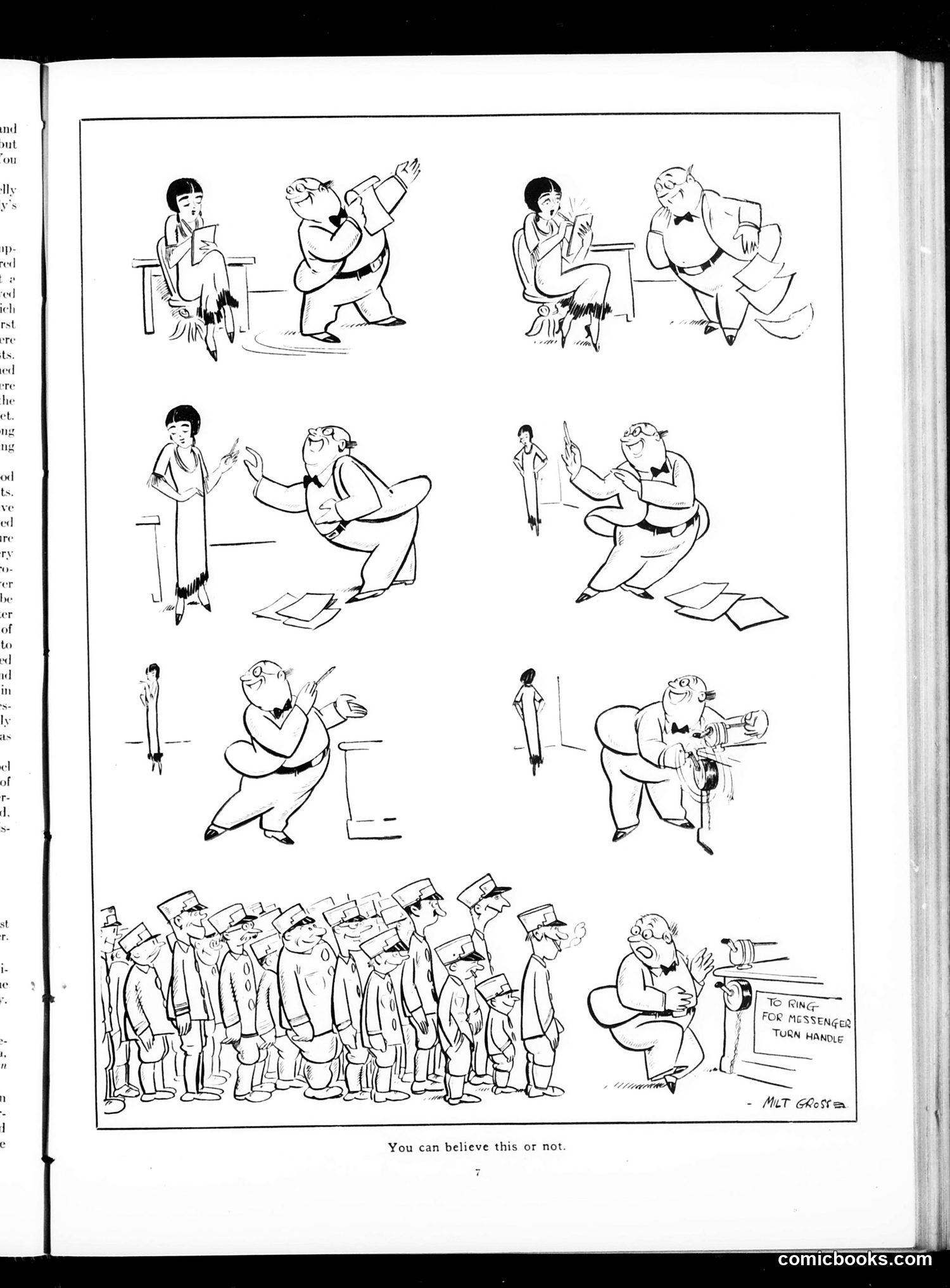
This page by Mat Gross depicts a humorous sequence about a messenger or office worker's escalating panic while delivering messages. The strip shows: 1. Initial calm interaction between a seated woman and an agitated man 2. Progressively frantic behavior as the messenger loses composure 3. Papers scattering everywhere 4. The messenger's complete breakdown 5. A final panel showing a crowd of similar-looking messengers queued to use a "turn handle" device labeled "to ring for messenger" The satire critiques office inefficiency and the comedic desperation of overworked messengers or postal workers trying to manage their duties. The identical crowd suggests interchangeability of workers and the dehumanizing nature of bureaucratic labor. The caption "You can believe this or not" invites skeptical amusement at the exaggerated premise.
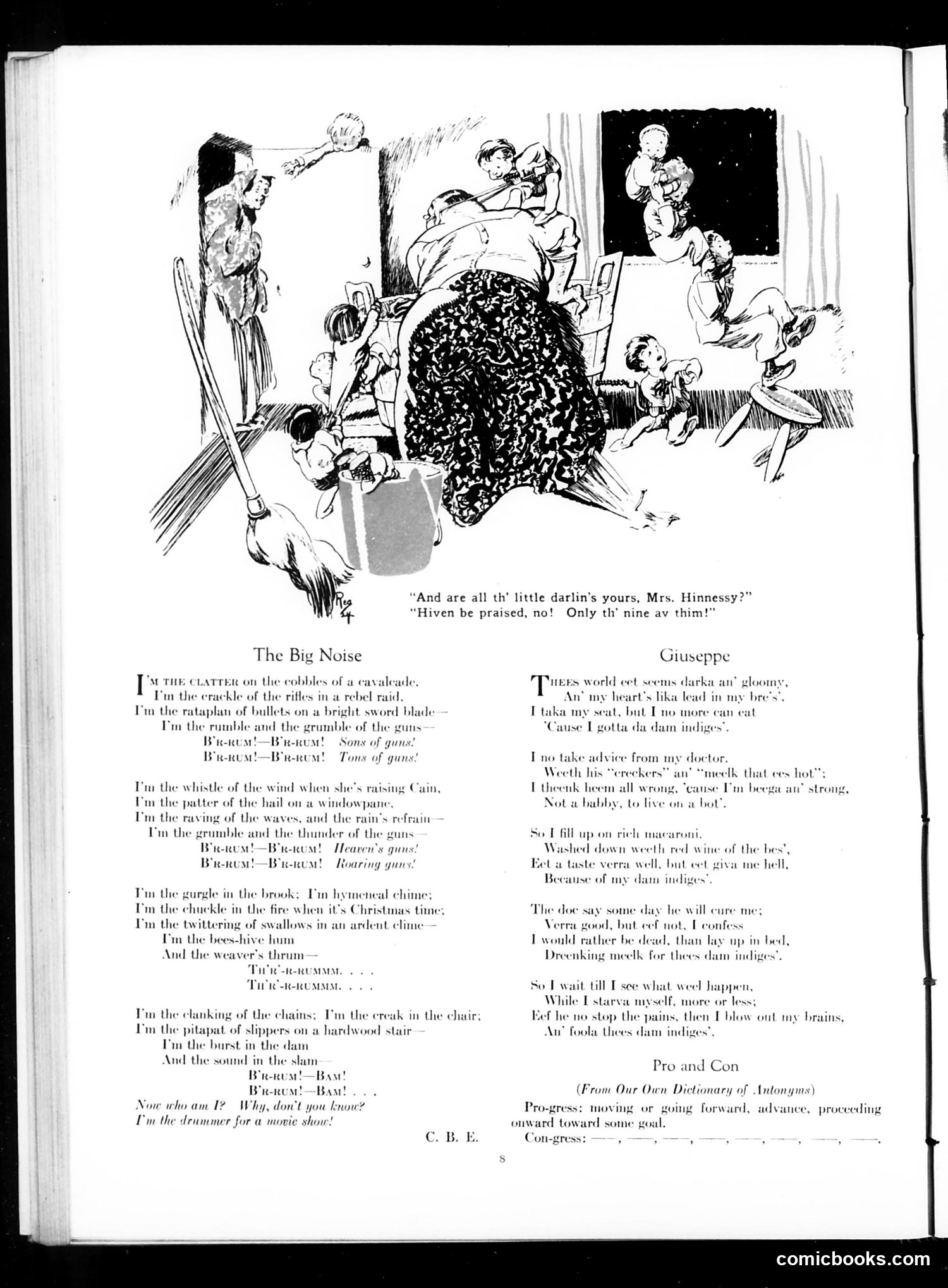
This page contains three distinct pieces from Judge magazine: **The cartoon** (top) depicts a crowded tenement scene with a woman surrounded by many children. The caption plays on Irish-American dialect humor: Mrs. Hinnessy denies all the children are hers, claiming only nine belong to her—implying the rest are neighborhood children. This reflects period stereotypes about Irish immigrants and large families, common in early 20th-century American satire. **"The Big Noise"** (left poem) is a tongue-in-cheek celebration of all manner of sounds—from warfare to domestic noises—climaxing with the reveal: the "big noise" is merely a movie theater drummer. It's light humor about cinema's growing cultural impact. **"Giuseppe"** (right poem) uses Italian-immigrant dialect to humorously describe digestive complaints caused by rich food and wine, presenting stereotypical immigrant eating habits as comedy. **"Pro and Con"** (bottom) is a wordplay joke defining "Congress" as the opposite of "progress"—political satire suggesting Congress obstructs advancement. All reflect early 20th-century American attitudes toward immigrants and emerging technologies.
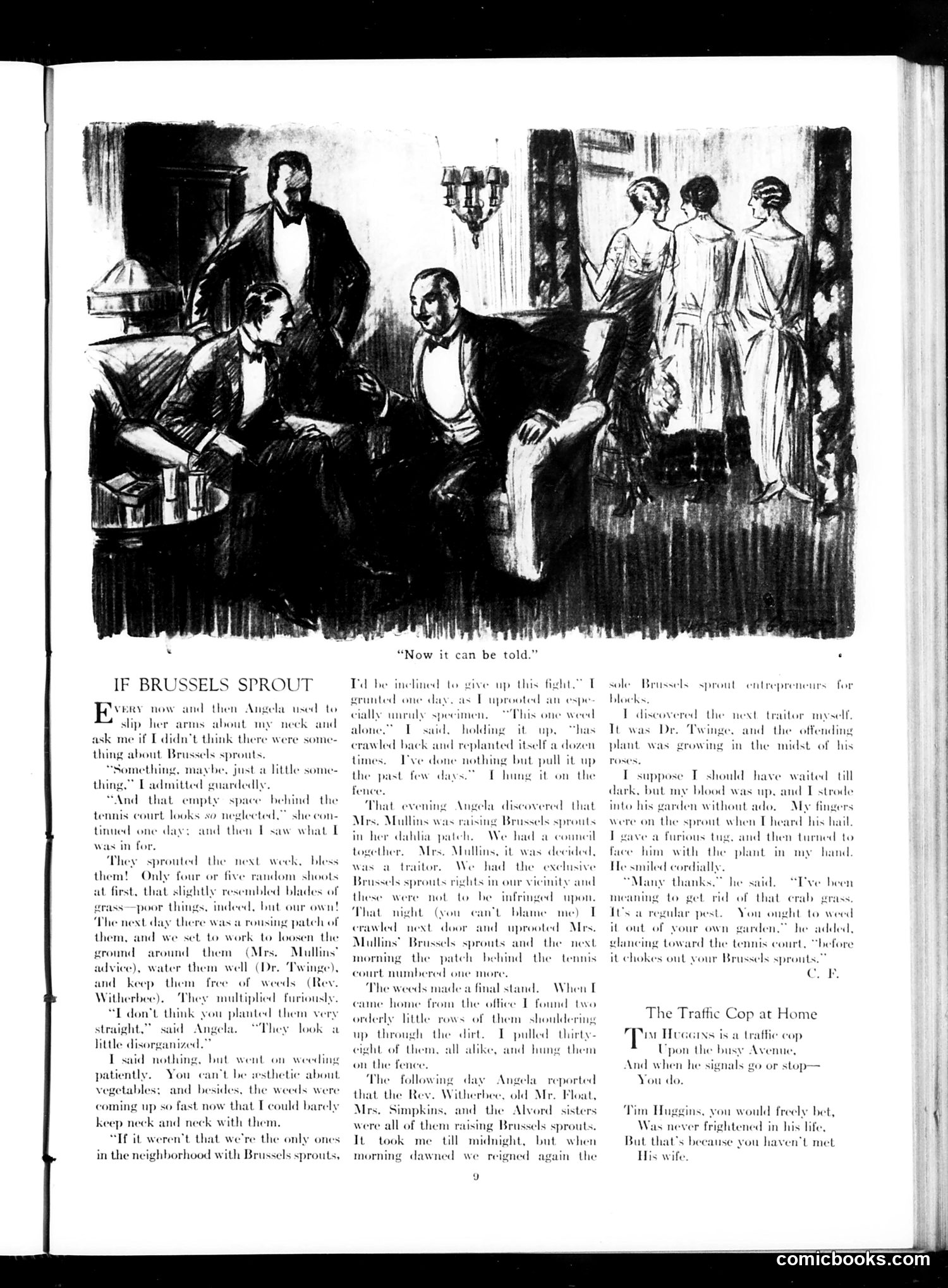
This humorous story satirizes suburban competitiveness and social one-upmanship. A narrator plants Brussels sprouts at his wife Angela's suggestion. When neighbors discover his exclusive crop, they begin planting their own—including Mrs. Mullins, Rev. Witherbee, Dr. Twinge, Mrs. Simpkins, and the Alvord sisters. Rather than enjoy his horticultural advantage, the narrator spends nights frantically uprooting neighbors' sprout plants to maintain his monopoly. Even when he discovers Dr. Twinge growing sprouts, Twinge casually reveals he was trying to *eliminate* the plant as a pest. The joke targets petty suburban rivalries and the absurdity of competitive status-seeking over trivial matters. The narrator's desperate nighttime sabotage—ultimately pointless—mocks how people exhaust themselves chasing social superiority in their neighborhoods. The final irony (that Twinge considers sprouts a nuisance) deflates the entire competitive enterprise.
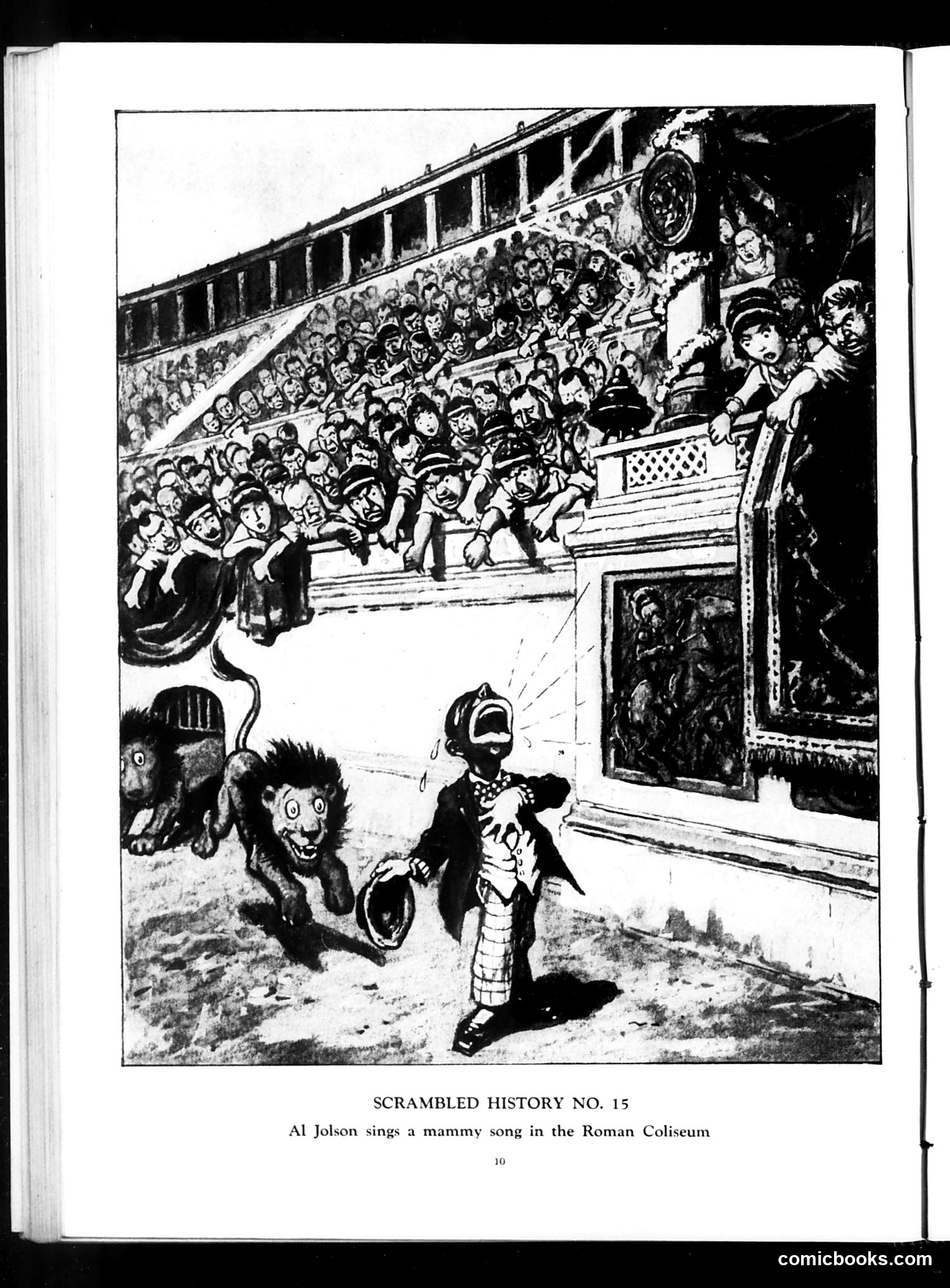
This is a humorous anachronistic cartoon from Judge magazine's "Scrambled History" series, which juxtaposed historical settings with modern figures for comedic effect. The image shows **Al Jolson**, the famous vaudeville and early film performer known for blackface minstrelsy, singing in the Roman Coliseum. Jolson was particularly renowned for his "mammy songs"—sentimental performances often performed in blackface makeup. The joke relies on absurdist humor: placing this contemporary American entertainer in ancient Rome creates an incongruity that mocks both Jolson's theatrical style and the notion of historical accuracy. The packed stadium audience and wild animals in the arena suggest the brutality of Roman spectacles, contrasting sharply with Jolson's sentimental entertainment. The satire appears to target Jolson's performance style as much as historical absurdity.
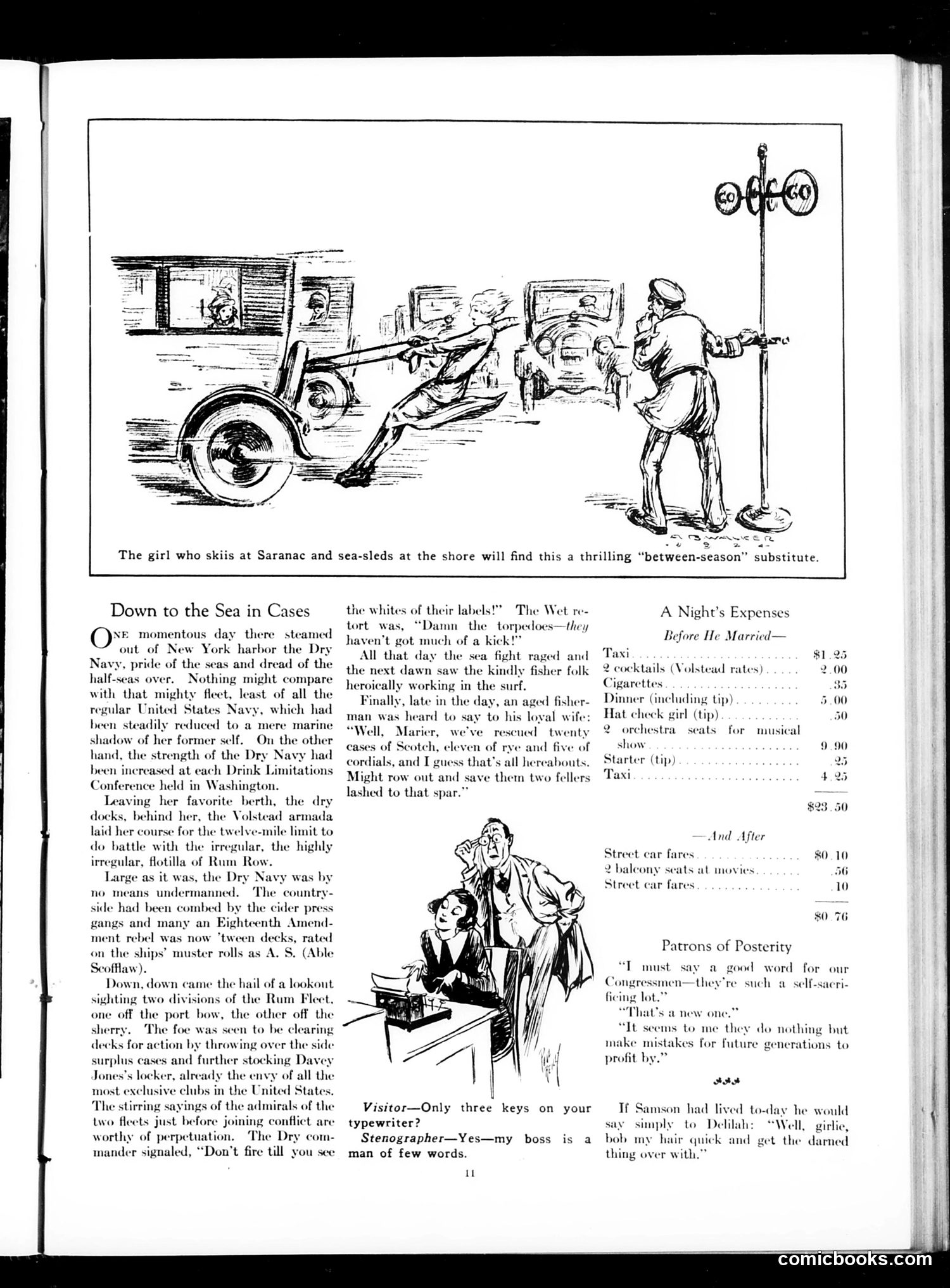
This Judge magazine page satirizes Prohibition enforcement efforts during the 1920s. The top cartoon depicts the "Dry Navy"—a humorous reference to federal agents tasked with preventing alcohol smuggling—battling "Rum Row" (smugglers operating beyond the legal twelve-mile limit). The joke compares this conflict to naval warfare, with commanders exchanging absurd orders about "labels" and "kicks." The accompanying story mocks how ineffective Prohibition enforcement was: fishermen casually recover smuggled cases of scotch and rye from the sea after battles between agents and bootleggers. Below, secondary jokes contrast pre- and post-marital spending habits, mock Congress as incompetent, and reference Samson and Delilah. The overall message: Prohibition was unenforceable and widely mocked by the public as futile government overreach. The elaborate "Dry Navy" metaphor emphasizes how absurdly the government pursued alcohol enforcement while losing the broader war against smuggling.
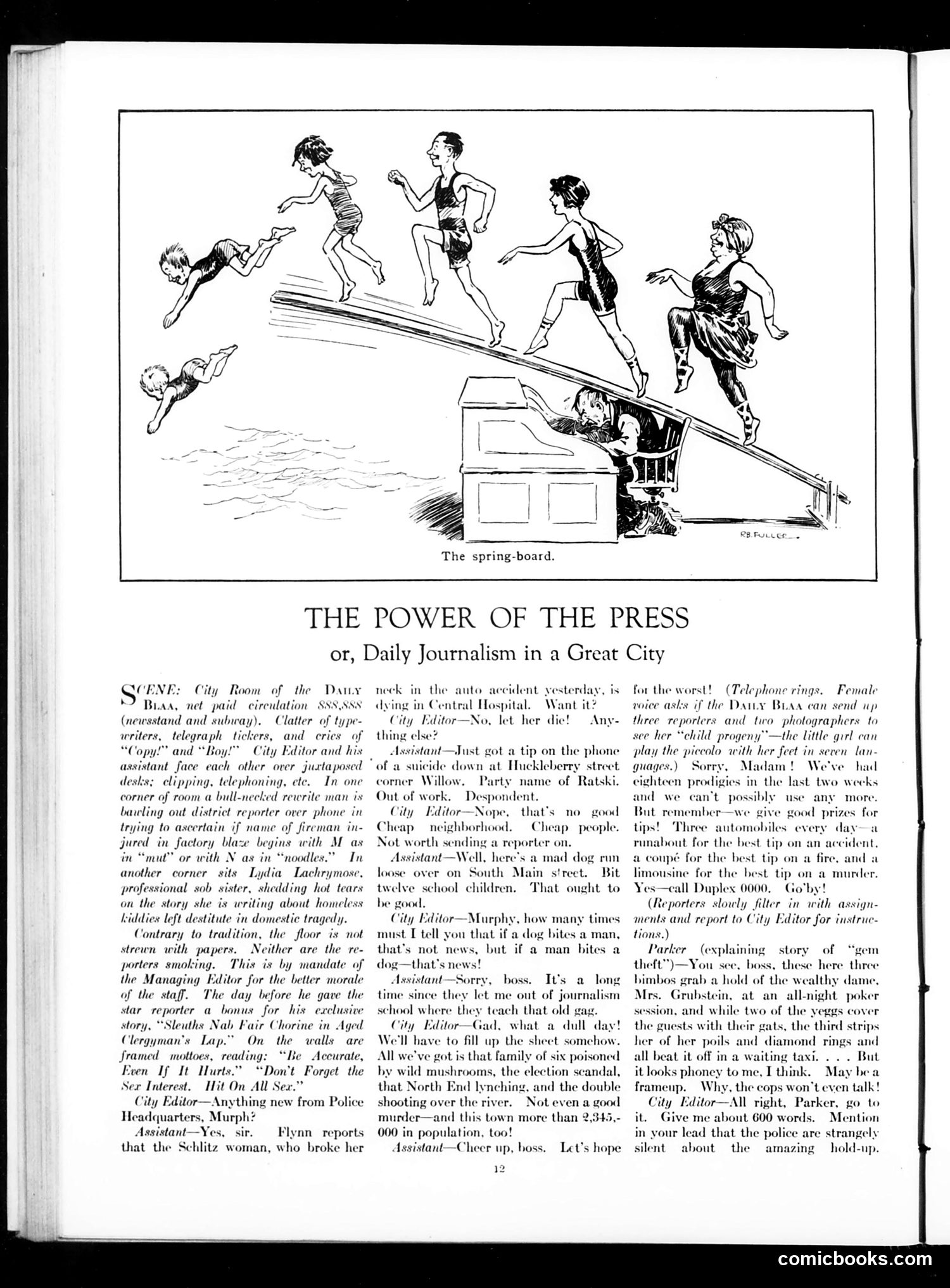
This satirical cartoon critiques the sensationalism and unethical practices of early-20th-century urban journalism. The title "The spring-board" refers to how newspapers sensationalize tragedy to boost circulation. The scene depicts a newspaper city room where editors cynically decide what stories merit coverage based not on importance or truth, but on salience value. Key satirical moments include: - The City Editor rejecting a suicide story because the victim comes from a "cheap neighborhood" with "cheap people" - Dismissing a mad dog attack as insufficiently dramatic - Complaining about lacking a "good murder" despite having lynching, poisoning, and shooting stories available - Offering financial incentives (automobiles) for reporters who secure sensational tips - Instructing a reporter to emphasize police "silence" to manufacture intrigue about a robbery The accompanying dialogue mocks journalistic priorities: a dog biting a man is not news, but a *man* biting a dog is. The cartoon shows editors valuing spectacle and circulation over accuracy or public interest.
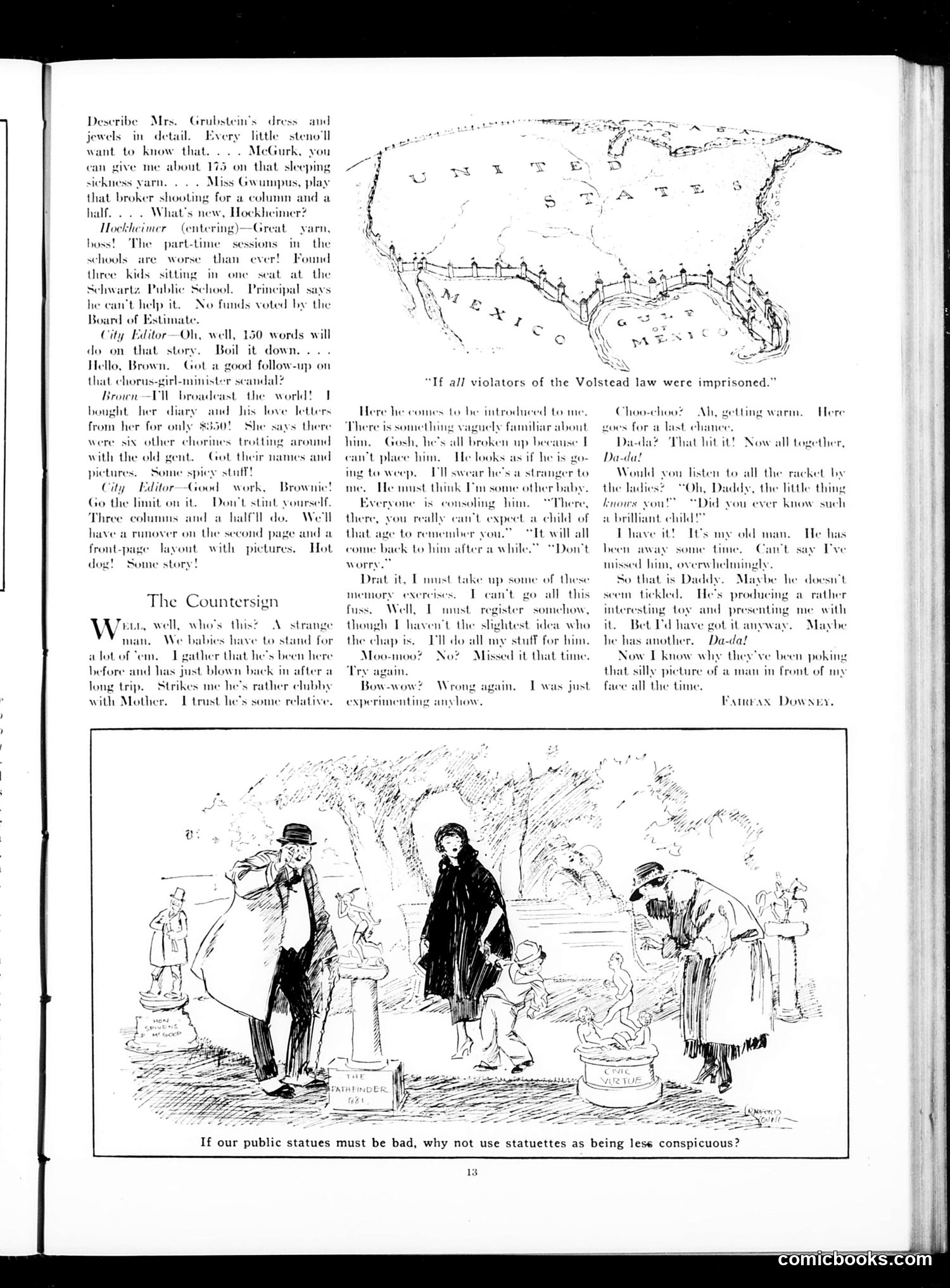
This page satirizes the **Volstead Act** (Prohibition enforcement) through a two-part joke. The top map shows the U.S. with the caption "If all violators of the Volstead law were imprisoned"—implying so many people broke Prohibition that prisons couldn't hold them all. The cartoon below depicts a child reunion scenario where an absent father returns home. The family tries to get the child to recognize "Daddy" by making animal sounds ("Moo-moo," "Bow-wow," "Choo-choo") until finally succeeding with "Da-da." **The satire**: The father has been away so long—implied to be jail time for Volstead violations—that his own child doesn't recognize him. The seemingly innocent "memory game" actually mocks how common Prohibition arrests were, making paternal absence an ordinary family problem. The joke underscores how pervasive lawbreaking and imprisonment had become under Prohibition, affecting ordinary American households.
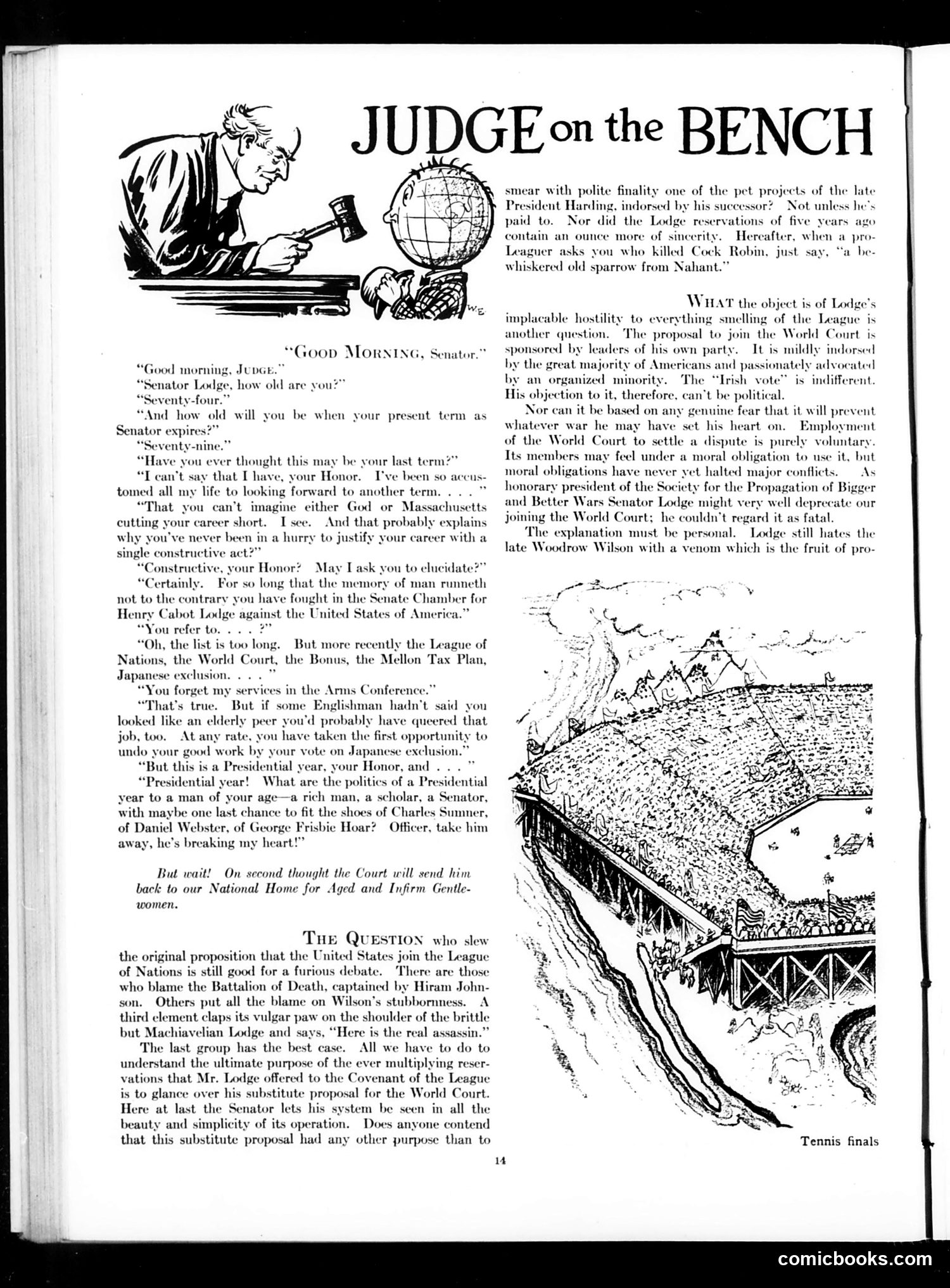
This satirical piece attacks **Senator Henry Cabot Lodge** (identifiable from context clues like "Nahant" — his Massachusetts home — and references to his Senate opposition). The "Judge" conducting the interrogation represents the magazine's editorial voice holding Lodge accountable. **The satire's targets:** Lodge's opposition to the League of Nations and World Court despite claiming to support international cooperation. Judge accuses him of using procedural "reservations" as pretexts to sabotage these institutions, particularly initiatives endorsed by Presidents Wilson and Harding. **Key points of mockery:** - Lodge's advanced age (74, near death) makes his obstruction seem petty - His claim that opposing Japan exclusion was "constructive" rings hollow - His real motive is partisan politics ("Presidential year"), not principle - The final joke: Lodge, honorary president of the "Society for the Propagation of Bigger and Better Wars," actually *wants* conflict, making his opposition to peace mechanisms transparent The cartoon presents Lodge as an elderly obstructionist prioritizing political damage over genuine international cooperation.
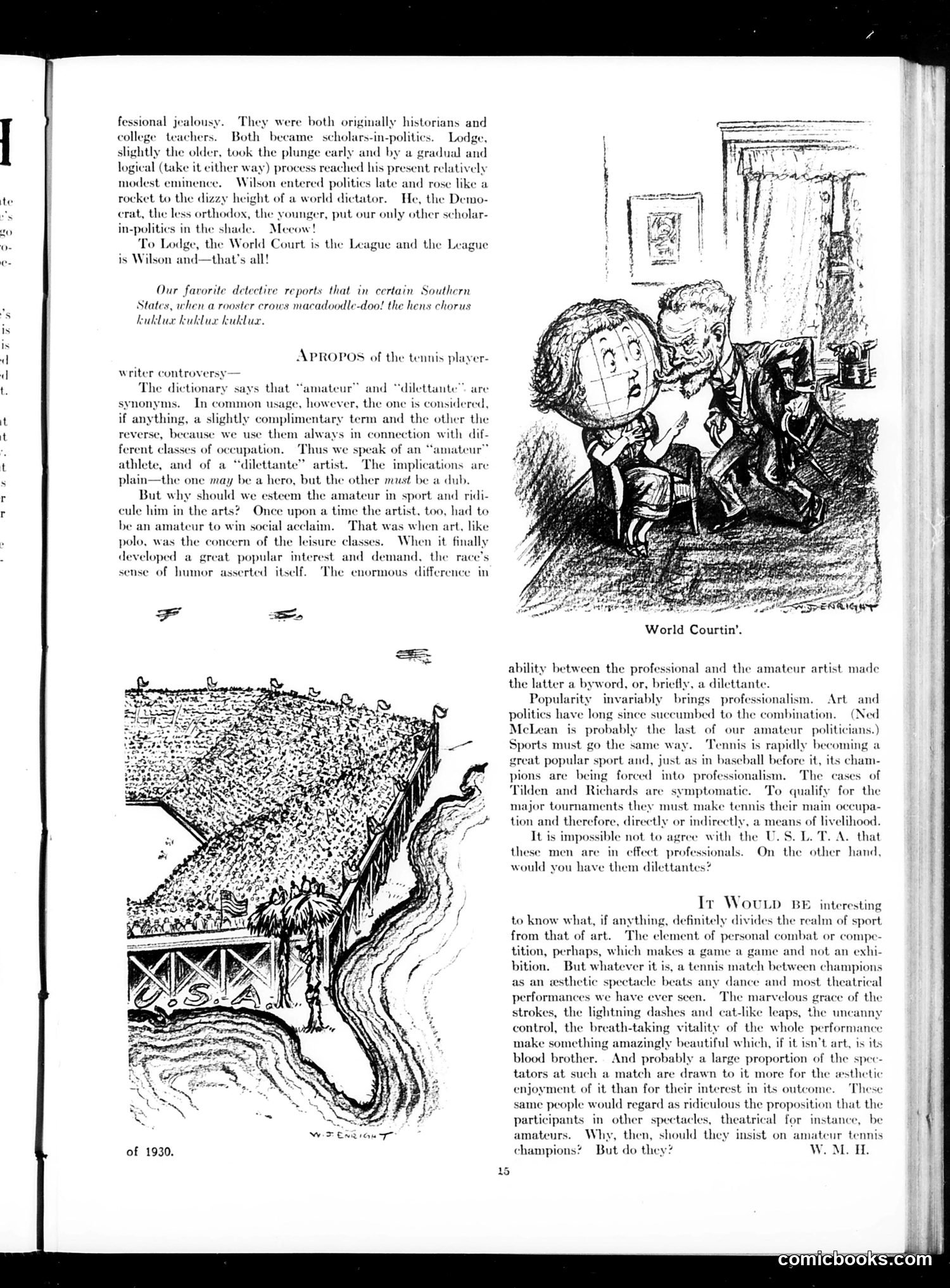
This page contains two distinct pieces of satire: **"World Courtin'" cartoon** (top right): Depicts figures in what appears to be a heated debate. The text references Senator Lodge versus President Wilson over the League of Nations and World Court. The satire mocks Lodge's obsessive conflation of these entities—to him, they're all the same thing, all Wilson's doing. This reflects 1920s Republican isolationist opposition to American international entanglement post-WWI. **Tennis amateur/professional debate** (main text): The article discusses whether tennis players like Tilden and Richards should be considered professionals despite claiming amateur status. It draws a parallel to how "amateur" artists were once respected but became dismissed as "dilettantes" once art professionalized. The satire argues sports inevitably follow this same trajectory as they gain popularity. The point: society celebrates amateur status in sports while despising it in arts—an arbitrary and hypocritical distinction that will collapse as tennis becomes a major professional sport.
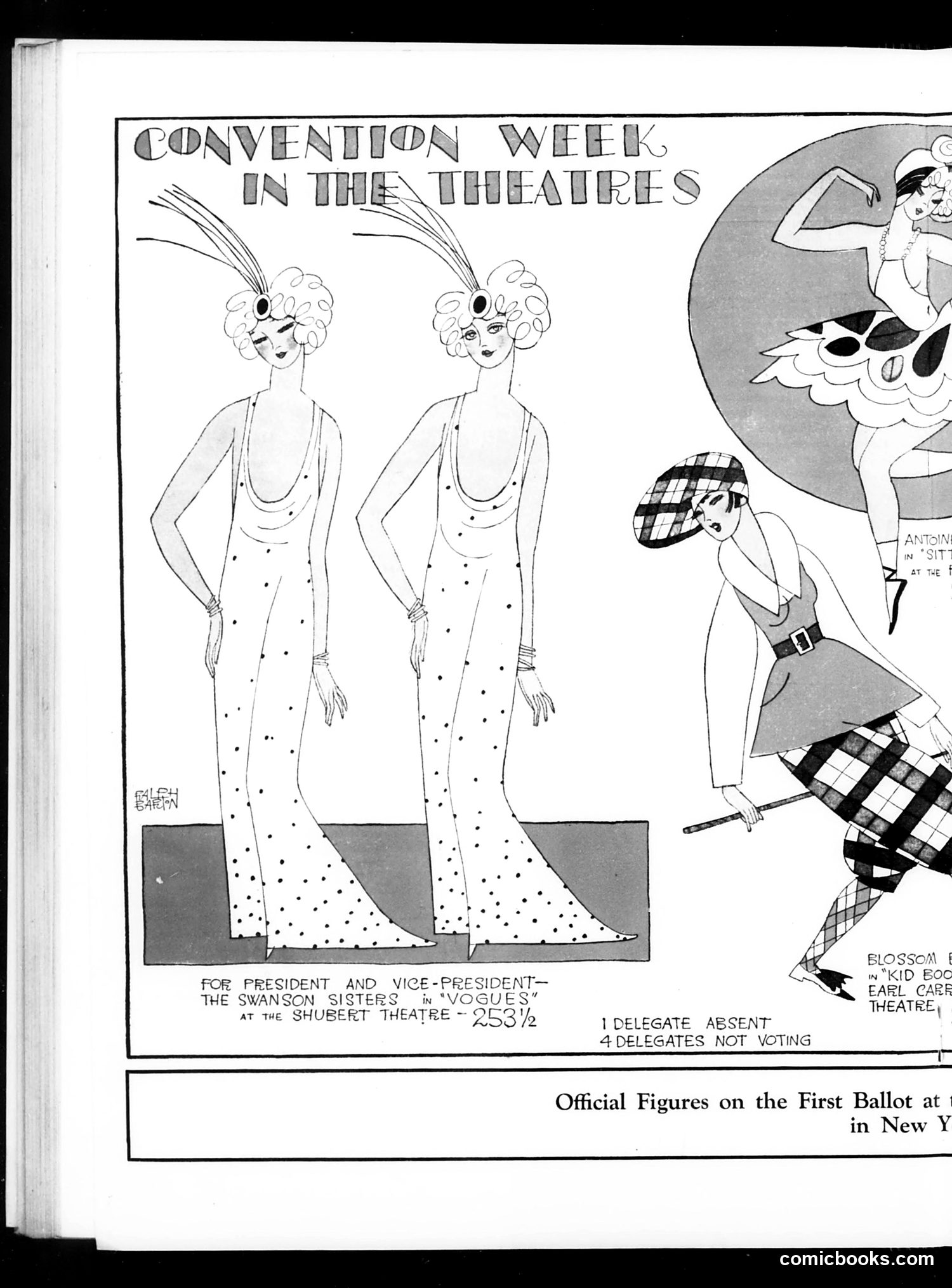
This Judge magazine page satirizes a theatrical convention by presenting it as a political one. The "Swanson Sisters" are nominated for "President and Vice-President" in a stage production of "Vogues" at the Shubert Theatre, with voting results (253½ votes) displayed like actual convention balloting. The satire conflates theatrical conventions (gatherings of performers/shows) with political party conventions, treating actresses' costumes and performances as if they were political candidates. The detailed voting notation—including "1 delegate absent" and "4 delegates not voting"—parodies the formal procedures of real political conventions. This is a lighthearted joke about the theatrical world's self-importance, presenting a fashion/vaudeville show as though it were a serious political event worthy of convention-style voting and reporting.
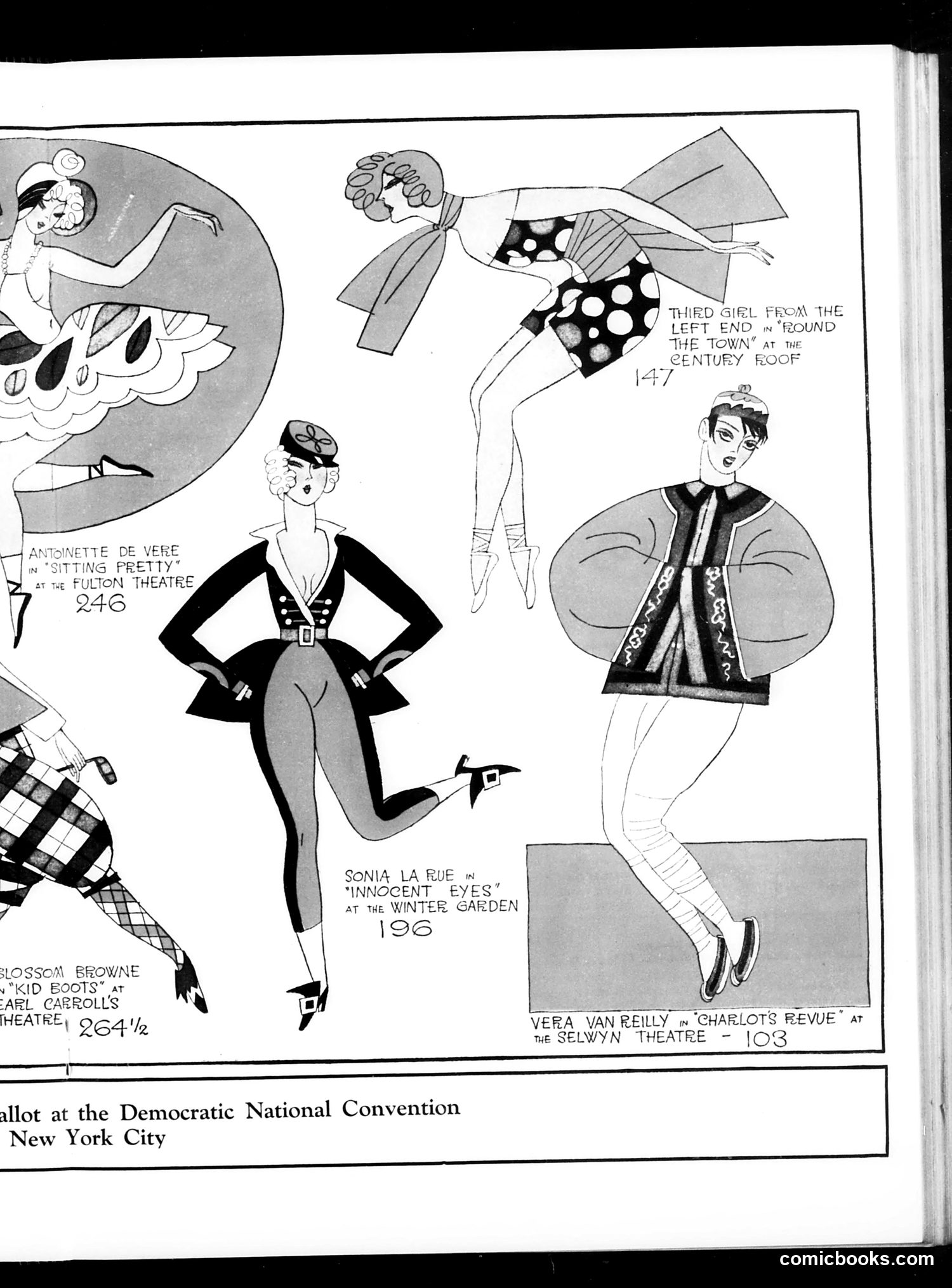
This page showcases fashionable women from 1920s Broadway shows, likely from Judge magazine's entertainment section. Each figure is labeled with the actress's name, the theatrical production she appeared in, and a reference number (possibly ticket prices or page numbers). The illustrated women display the era's flapper aesthetic: short skirts, stylized poses, and modern clothing. Named performers include Antoinette de Vere, Sonia La Rue, Blossom Browne, and Vera Van Reilly, appearing in productions at venues like the Fulton Theatre, Winter Garden, and Selwyn Theatre. The caption "allot at the Democratic National Convention New York City" appears disconnected from the fashion illustrations above, suggesting either OCR error or page layout confusion. This appears primarily as entertainment/fashion commentary rather than political satire—typical Judge content mixing society, theater, and leisure culture for its upscale readership.
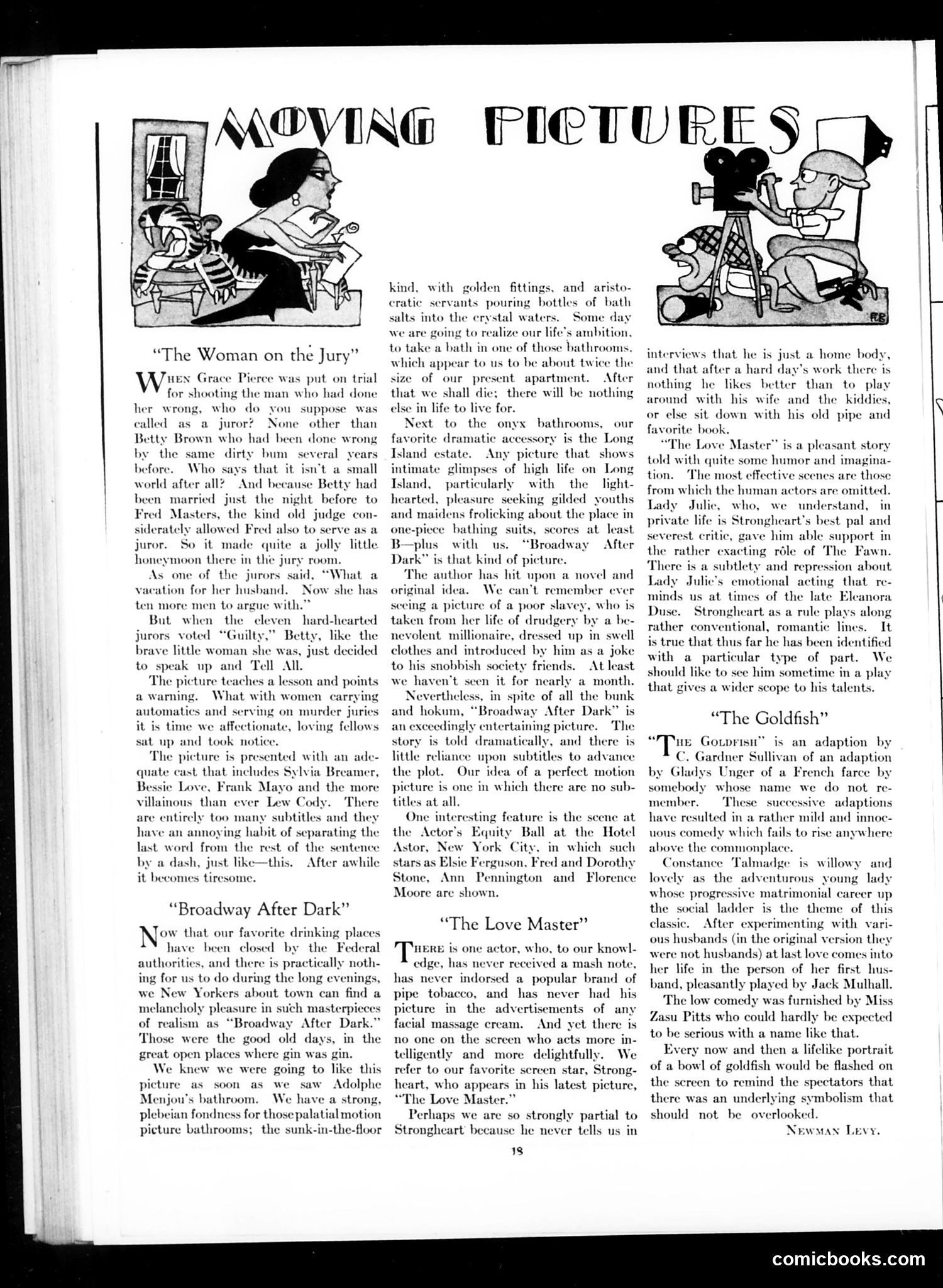
This page reviews three silent films, reflecting 1920s attitudes about women, Prohibition, and entertainment. **"The Woman on the Jury"** satirizes women's recent right to serve on juries. The plot—a woman juror who wrongly shot the defendant votes "guilty" anyway—mocks the notion that women jurors might be emotional or biased. The joke hinges on the absurd coincidence that another juror is her new husband, making the jury room a "honeymoon." **"Broadway After Dark"** celebrates luxurious bathrooms and wealthy Long Island lifestyles—escapist fantasy during Prohibition's restrictions on drinking establishments. The reviewer notes the novel plot of a poor servant girl elevated by a millionaire. **"The Love Master"** praises an unnamed male star (likely Strongheart, mentioned in text) for never seeking publicity through endorsements or fan mail—contrasting with typical celebrity behavior. The reviews showcase Judge's satirical tone while revealing period anxieties about women's expanded roles and nostalgia for pre-Prohibition pleasures.
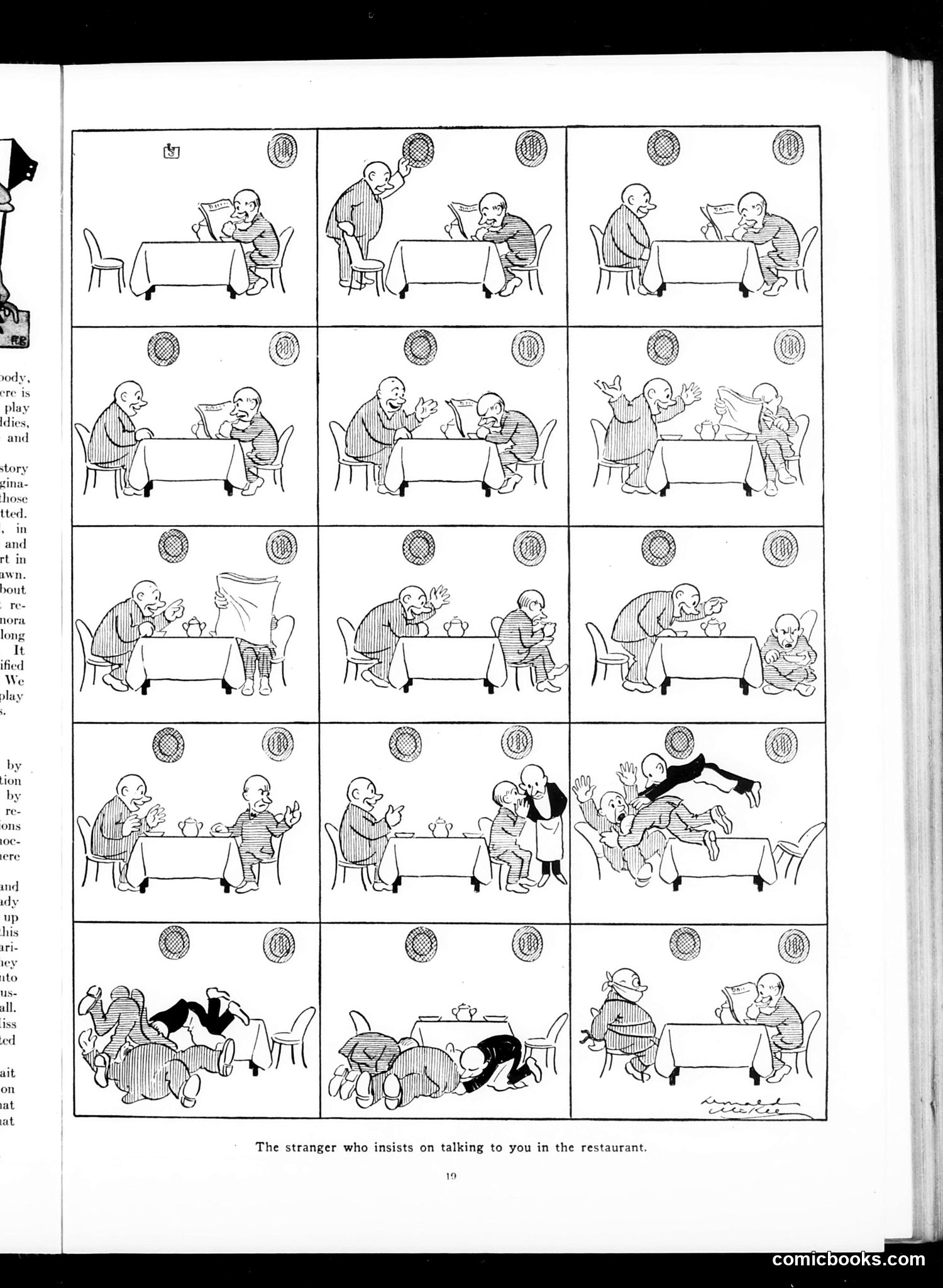
This comic strip satirizes a common social annoyance: an uninvited stranger who interrupts your meal with unwanted conversation. The twelve-panel sequence shows a progression from initial polite interaction (top panels) through escalating intrusion—the stranger gestures wildly, stands up, physically interferes with the diner's meal, and eventually creates complete chaos, culminating in overturned furniture and disorder. The humor derives from the relatable frustration of being trapped in a public space with a talkative nuisance who ignores social cues and boundaries. This appears to be observational humor about everyday social behavior rather than political satire—a type of content Judge magazine frequently published alongside political cartoons. The exaggerated physical comedy illustrates how annoying such encounters can become.
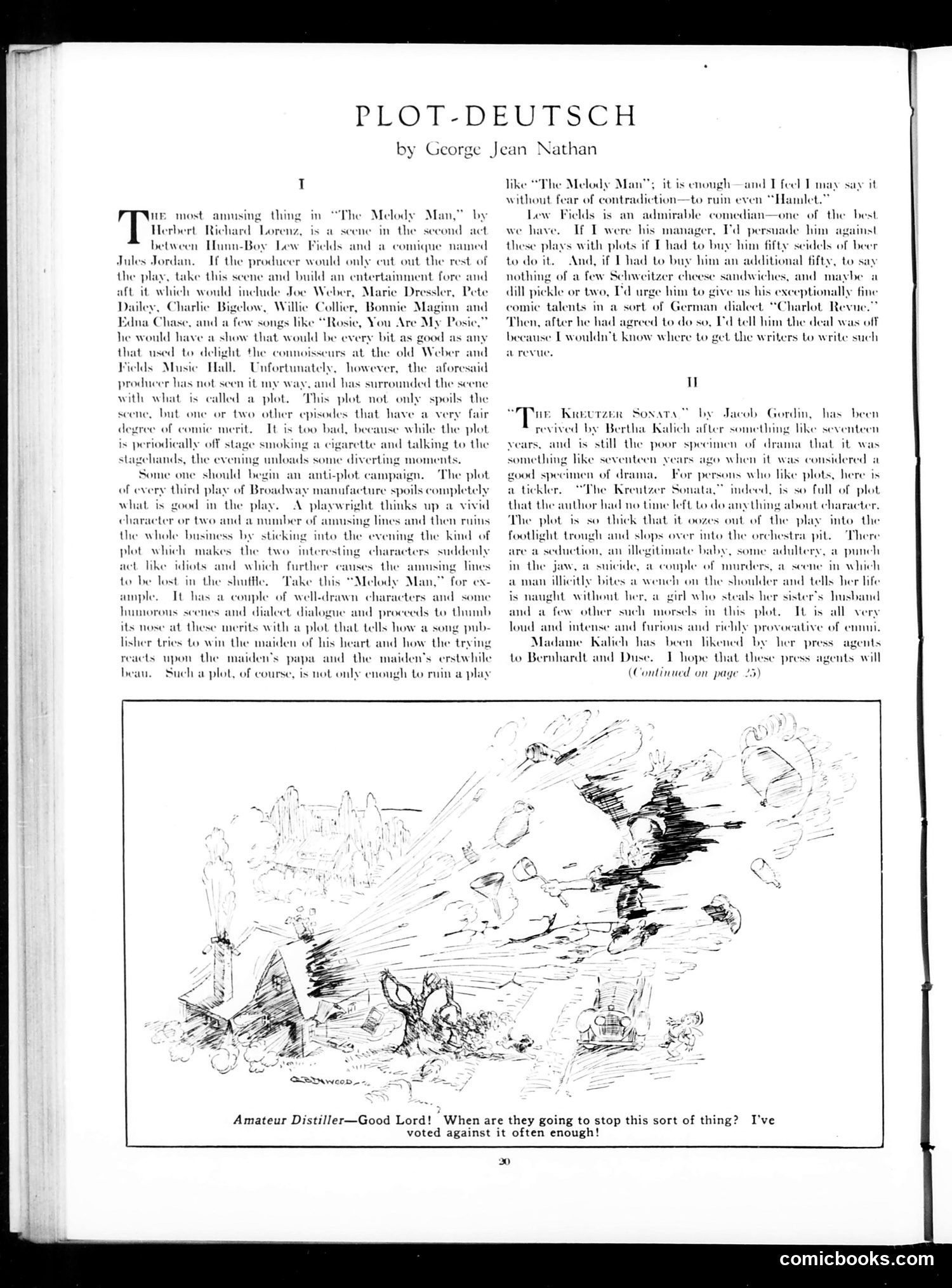
This theater critique attacks the overuse of plot in Broadway productions. Nathan reviews "The Melody Man," starring comedian Lew Fields, arguing the play's contrived romantic plot undermines genuinely funny scenes and skilled performers. He advocates for an "anti-plot campaign," suggesting Fields would be better showcased in a German-dialect revue where comic talent matters more than narrative. The second review criticizes Jacob Gordin's revival of "The Kreutzer Sonata," claiming it's so plot-heavy (featuring seductions, murders, suicides, and melodrama) that character development is nonexistent. Nathan sarcastically notes the plot literally "oozes" into the orchestra pit—an exaggeration emphasizing how excessive and poorly-constructed the story is. The cartoon's caption about an "Amateur Distiller" appears unrelated to the theater reviews above it. Nathan's underlying argument: Broadway producers prioritize formulaic plots over comedy, character, and performer talent.
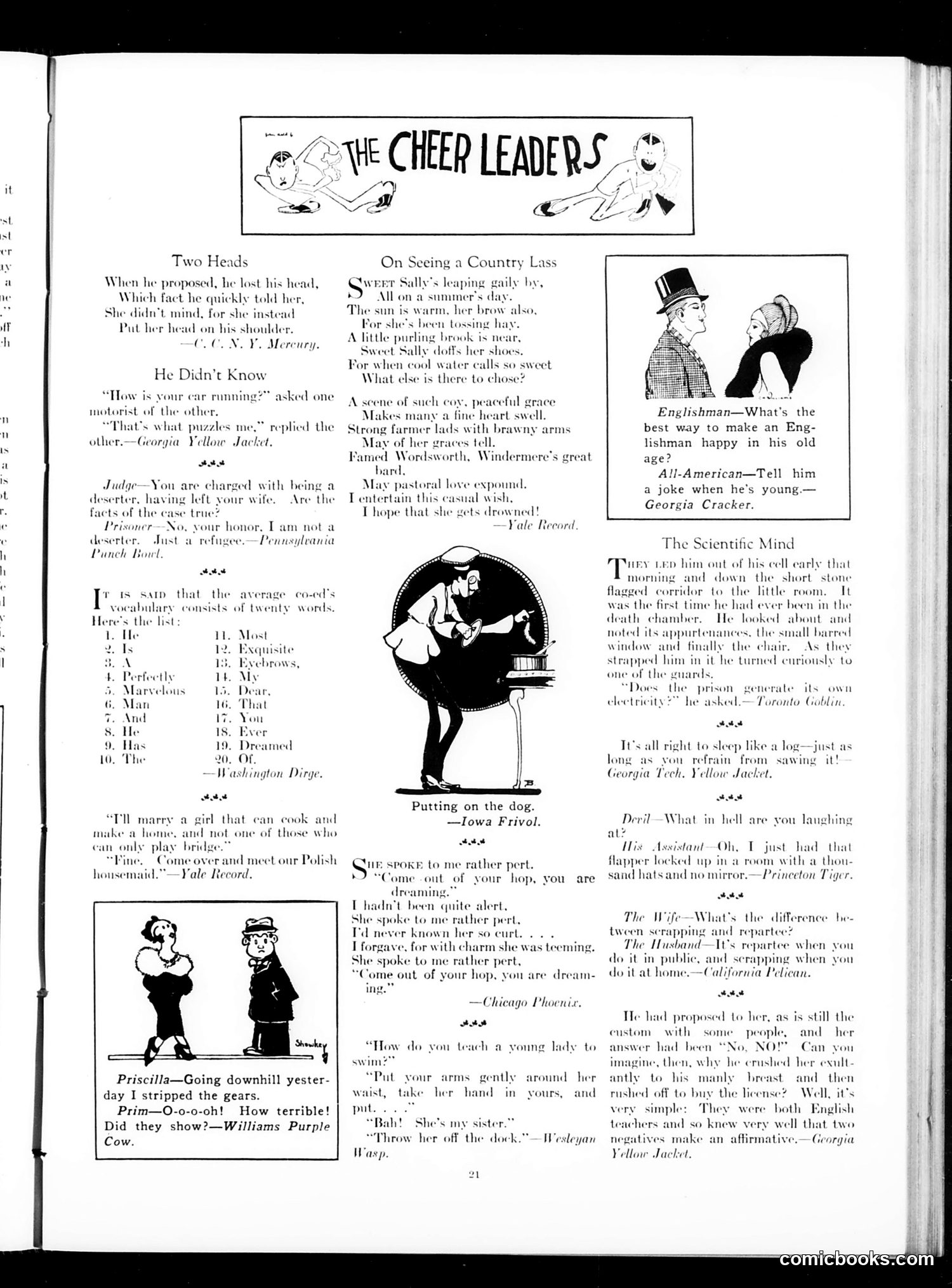
This page from *Judge* magazine compiles humor pieces and light verse typical of early 20th-century college/satirical publications. The content reflects period attitudes toward courtship, gender, and social class. **Key pieces:** The "Country Lass" poem mocks Romantic poetry (referencing Wordsworth) by having the speaker, instead of celebrating a pastoral maiden, hope she drowns—dark humor deflating sentimental literature. "Two Heads" and "He Didn't Know" are mild romantic/mechanical humor common to the era. The swimming instruction joke relies on crude physical humor and the trope of the unwilling female pupil. The "English teachers" finale plays on the double-negative logic joke—two "no" answers equaling consent—reflecting contemporary assumptions about courtship rituals and legal marriage. Overall, the page represents casual, often sexist humor typical of American college magazines from this era, mixing literary parody with domestic comedy focused on courting, marriage, and gender dynamics.
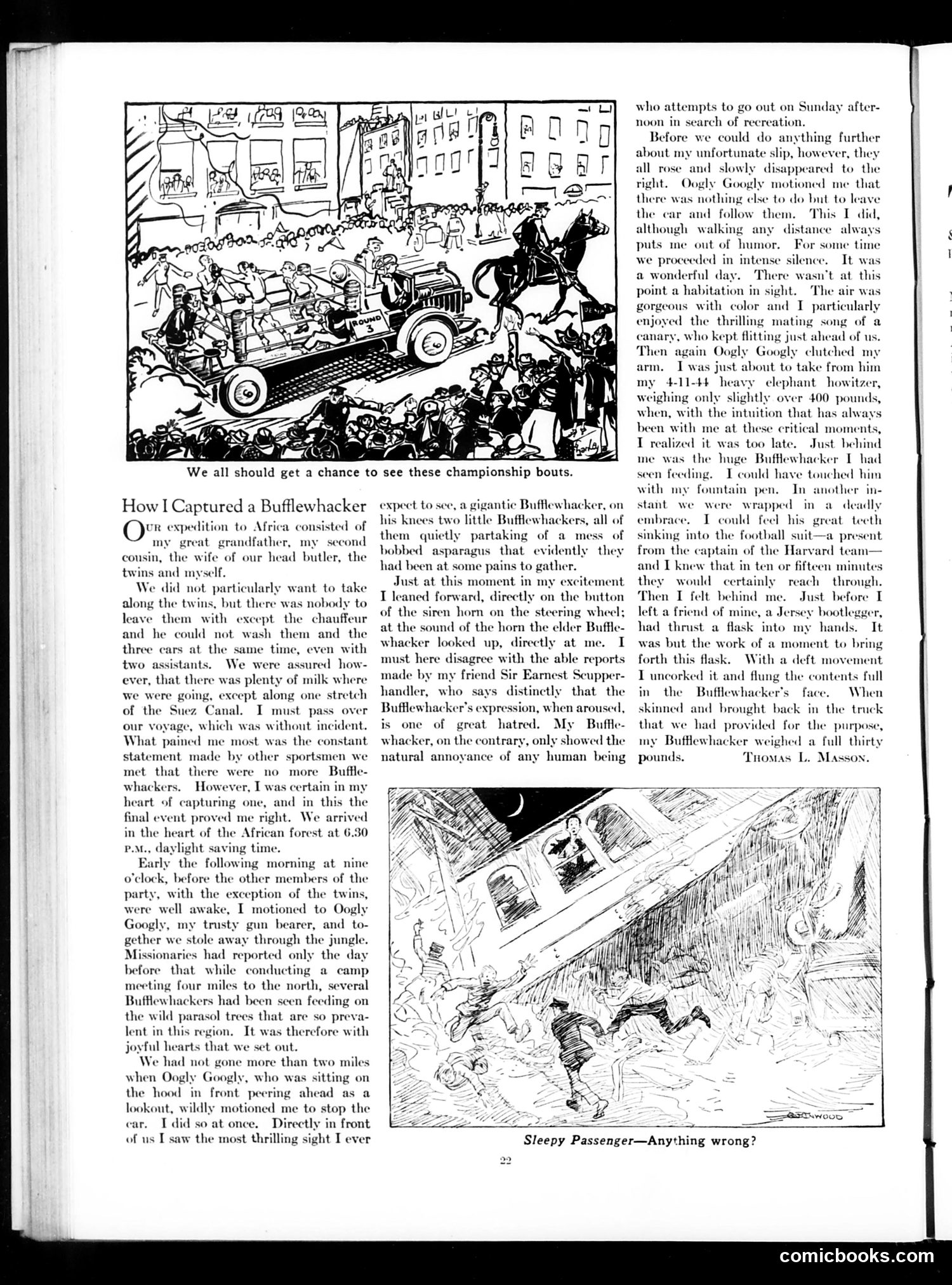
This is a humorous tall tale about an African safari, satirizing wealthy American big-game hunters and their exaggerated adventure narratives. The author claims to have captured a "Bufflewhacker"—an invented, fictional animal—presenting an absurd hunting story as factual. The satire targets several things: the pretentious leisure of the rich (bringing along twins and a chauffeur on safari), the pseudo-scientific tone of hunting memoirs, and the tendency of sportsmen to boast and contradict each other's "expertise." The humor peaks when the "thrilling" Bufflewhacker responds to the car horn not with ferocity but with "natural annoyance of any human being who attempts to go out on Sunday afternoon in search of recreation"—mocking how the narrator misreads mundane irritation as wild danger. The entire narrative is deliberately ridiculous, exposing the vanity and self-aggrandizement inherent in such adventure tales popular among Judge magazine's wealthy readership.
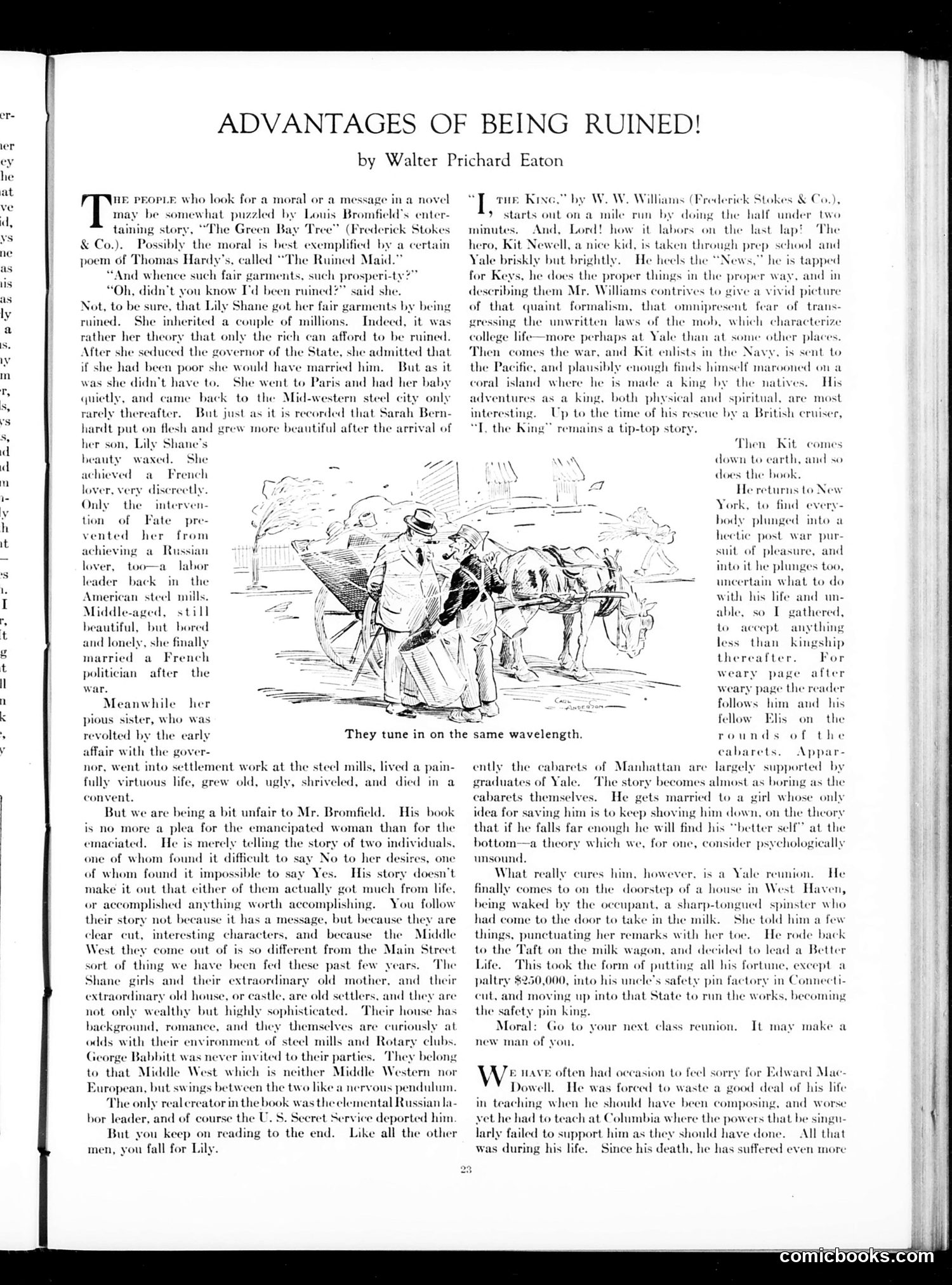
This page contains a literary review essay by Walter Prichard Eaton discussing Louis Bromfield's novel *The Green Bay Tree*. The illustration depicts characters "tuning in on the same wavelength"—a metaphor for connection. The satire concerns **class and morality in 1920s America**. Eaton reviews Bromfield's story of Lily Shane, a wealthy woman who bears an illegitimate child with a Russian labor leader (later deported by the U.S. Secret Service). The ironic "advantage" of being "ruined" (sexually compromised) is that wealth shields her from real consequences—she can afford Paris, discretion, and eventual respectability through marriage to a politician. The contrast is her pious sister, who lives virtuously among steel mill workers but grows "old, ugly, shriveled." The satire critiques how **money, not morality, determines a woman's fate**, and how the wealthy operate by different rules than working-class people. Eaton notes the book doesn't moralize; it simply shows two outcomes determined by class position, not character.
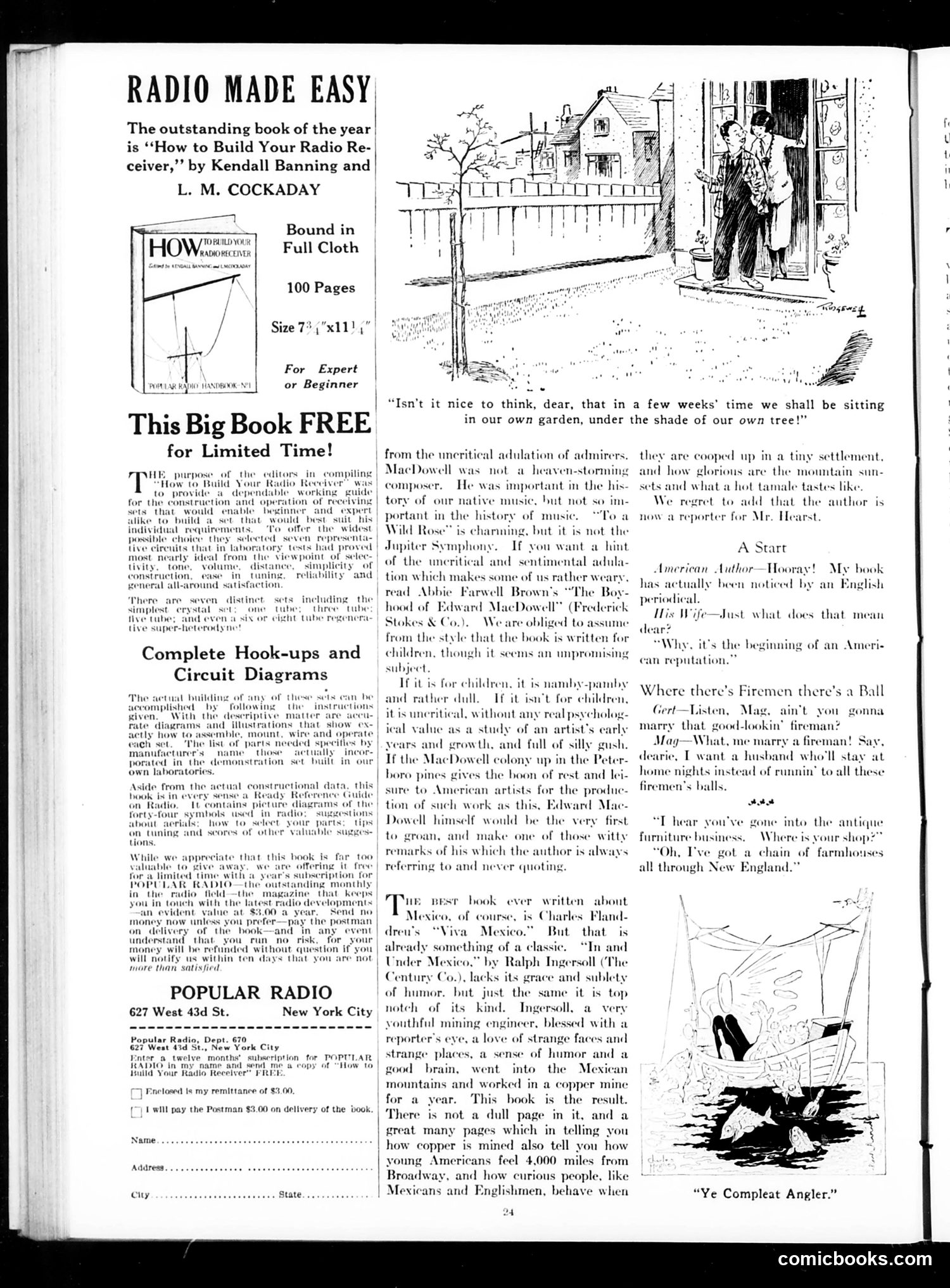
This page is primarily **advertising and book promotion**, not satire or political commentary. The main content is a free-book offer from **Popular Radio magazine** for "How to Build Your Radio Receiver" by Kendall Banning and L.M. Cockaday. The advertisement targets radio enthusiasts—both experts and beginners—during the early radio era when building one's own receiver was a popular hobbyist activity. The accompanying illustrations show: 1. A couple imagining their future leisure ("in our own garden, under the shade of our own tree")—a fantasy lifestyle enabled by radio technology 2. A fishing scene labeled "Ye Complet Angler"—likely referencing leisurely pursuits The page also contains **book reviews** of literary works about Mexico and Edward MacDowell (the composer), unrelated to the radio content. This is typical Judge magazine content mixing advertising, product promotion, and cultural commentary, with no discernible political satire on this particular page.
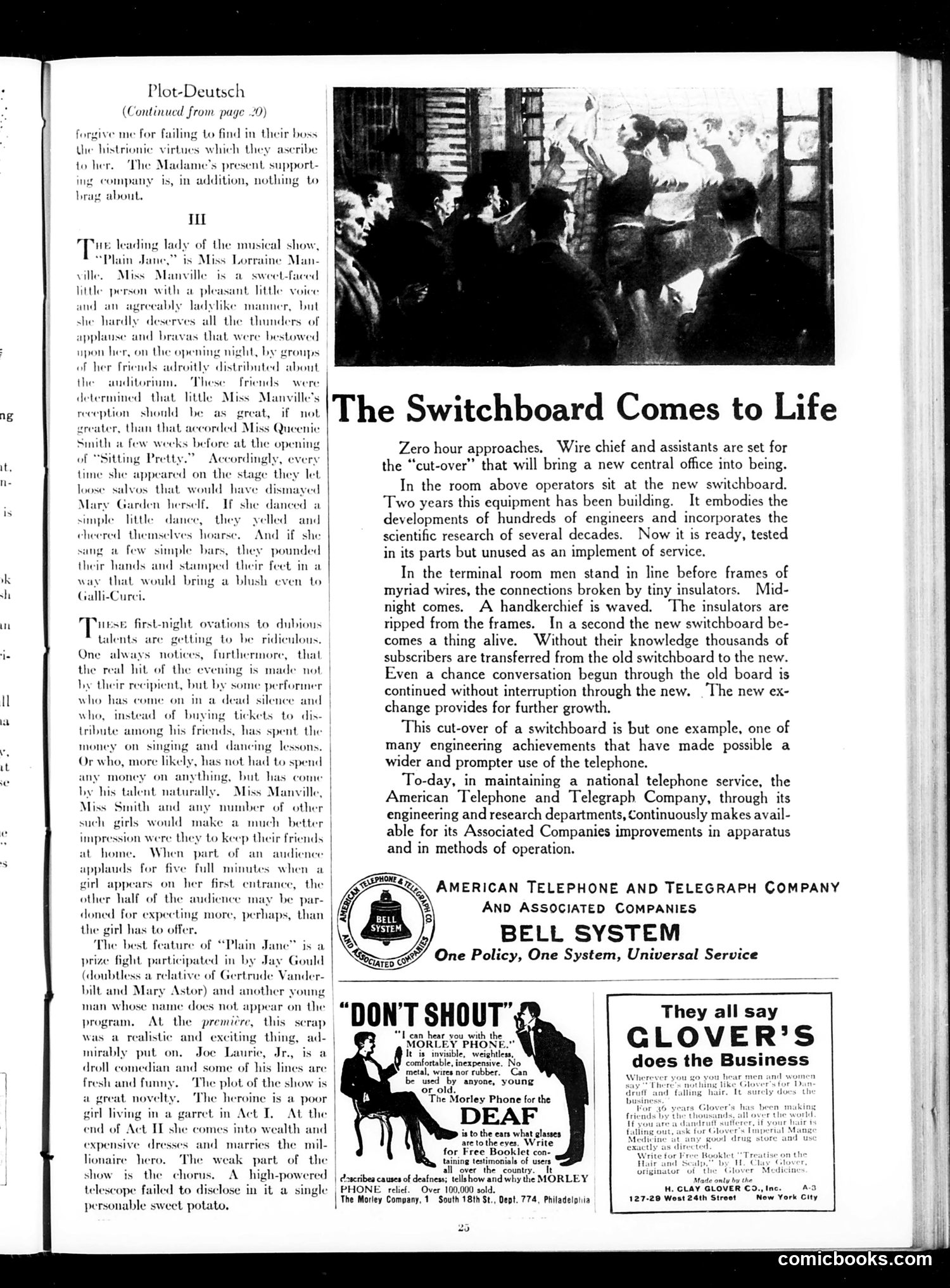
**Main Article:** A theater review of the musical "Plain Jane," criticizing first-night ovations inflated by organized cliques of friends. The critic argues that genuine talent (like Joe Laurie Jr.'s comic performance) succeeds without manufactured applause, while mediocre performers like Miss Lorraine Manville receive undeserved thunderous receptions. The satire targets social climbing and artificial enthusiasm in theatrical circles—a common early 20th-century practice where wealthy patrons would pack audiences to boost favored performers. **Advertisement:** "The Switchboard Comes to Life" promotes Bell System telephone infrastructure improvements, specifically a major switchboard upgrade transferring thousands of subscribers without service interruption—presented as a technological marvel of coordinated engineering. **Secondary Ad:** A Morley Phone advertisement for deaf users, and a Glover's cosmetics ad. The page reflects Judge's dual focus on entertainment criticism and corporate advertising.
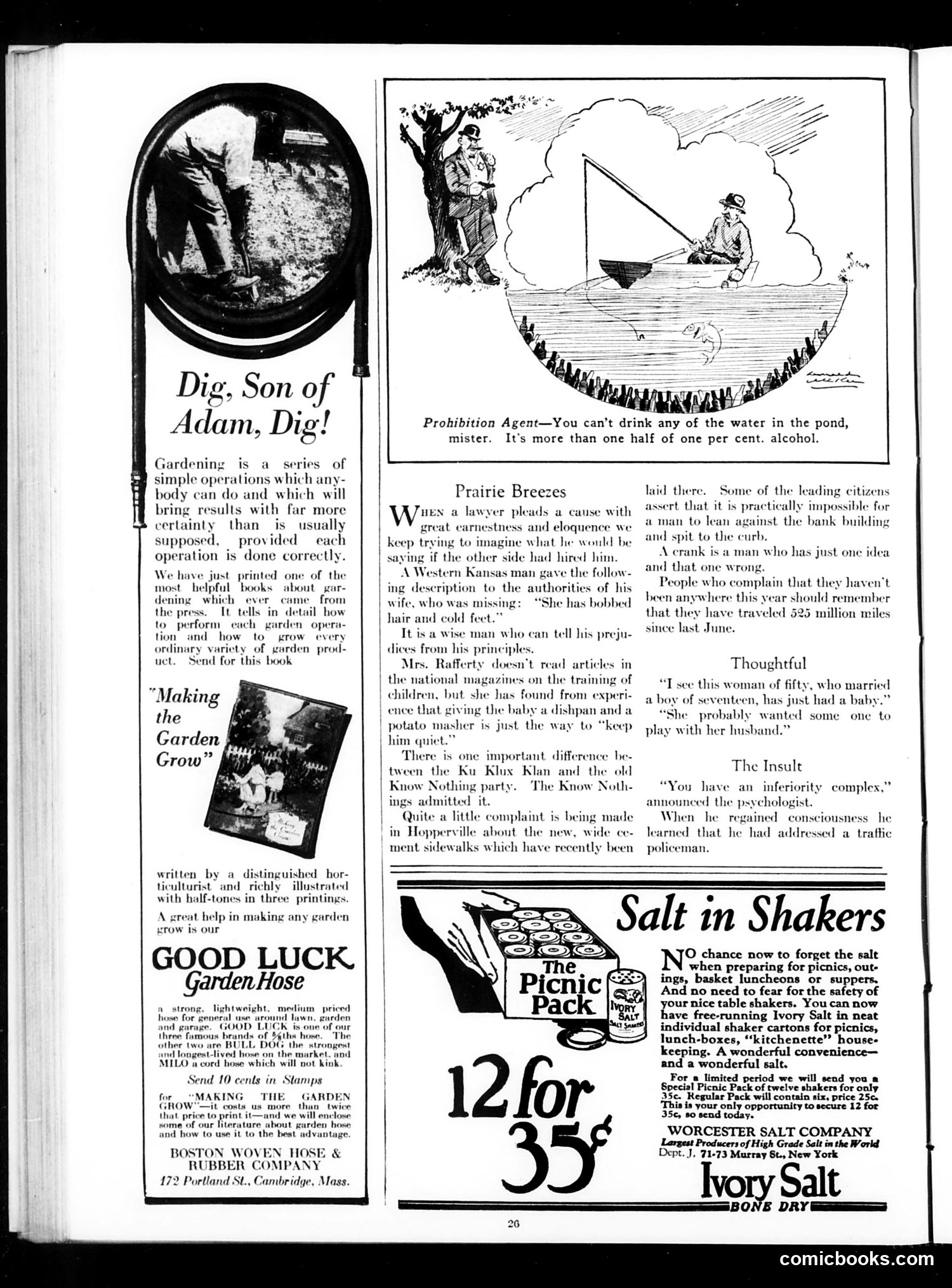
This page primarily contains **advertisements and humor columns** rather than political cartoons. The main content includes: 1. **"Prairie Breezes"** - A humor column with satirical one-liners on contemporary topics, notably including a **reference to the Ku Klux Klan**, where the author jokes that unlike the old "Know Nothing" party, the KKK doesn't admit its discriminatory nature. This suggests the piece was written when the Klan's resurgence (1920s) was a current social issue. 2. **Social commentary** in the jokes: references to women's "bobbed hair" (a 1920s controversy), Prohibition (alcohol ban), and Freudian psychology ("inferiority complex"). 3. **Advertisements** for gardening books/hoses, and salt shakers dominate the page's lower half. The humor is light, domestic satire typical of Judge's era—targeting lawyers' hypocrisy, parenting methods, and social pretensions—rather than serious political cartooning. The KKK reference is the only genuinely pointed political content.
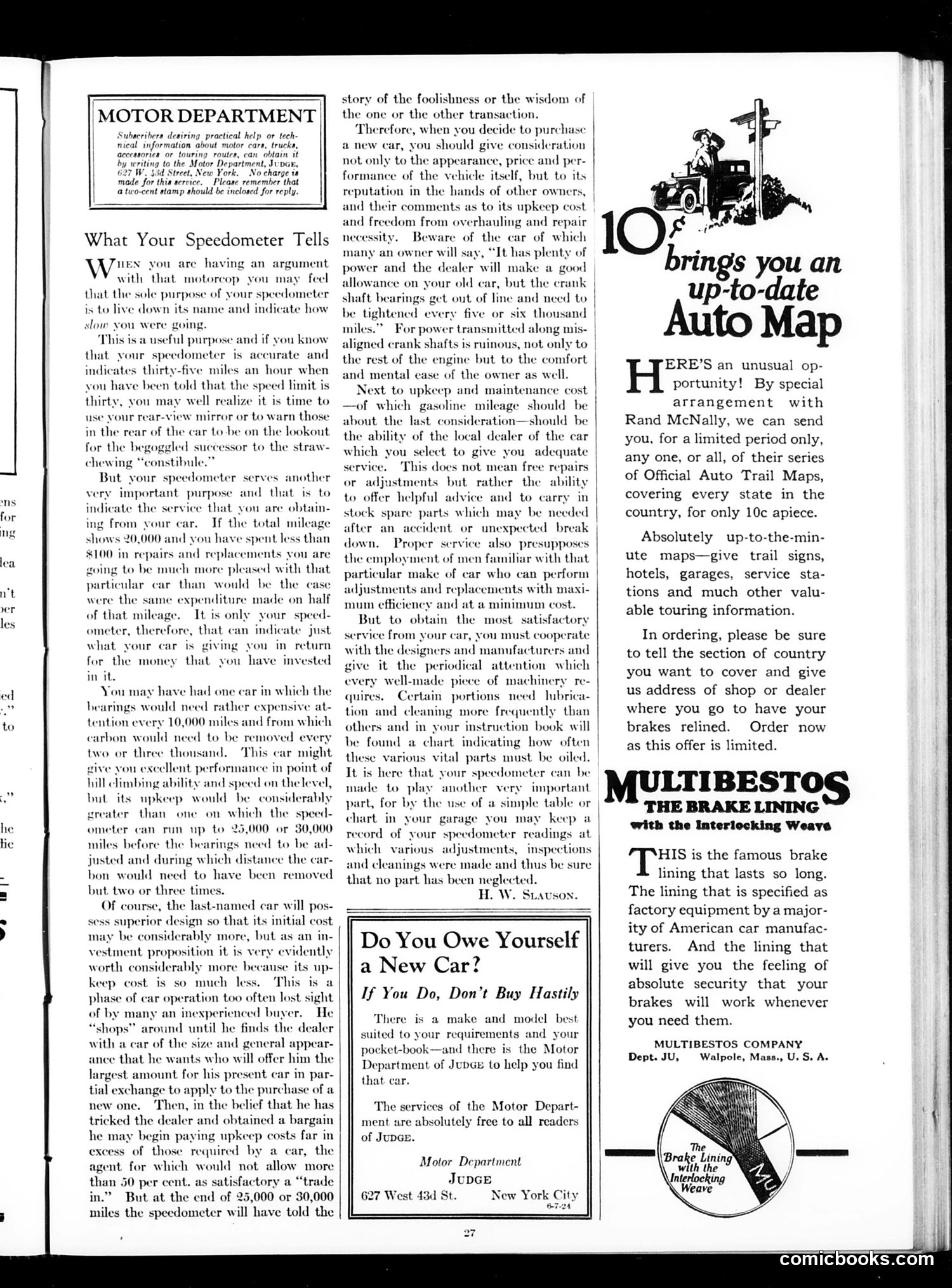
This page from Judge magazine contains **primarily automotive advice and advertisements**, not political satire. The main editorial content, "What Your Speedometer Tells" by H. W. Slauson, is practical consumer guidance advising readers to consider a car's maintenance history and long-term upkeep costs—not just initial price or appearance—when purchasing. The author argues that a cheaper car with good reliability (indicated by high mileage on the speedometer with minimal repairs) is a better investment than an expensive vehicle requiring frequent servicing. The advertisements promote an auto map service and Multibestos brake linings. There are no identifiable political figures or satirical cartoons on this page. The illustration showing a car near a cemetery cross appears decorative, accompanying the text about car selection. This is essentially a **consumer advice column**, reflecting Judge's practical service content alongside its better-known humor and satire.
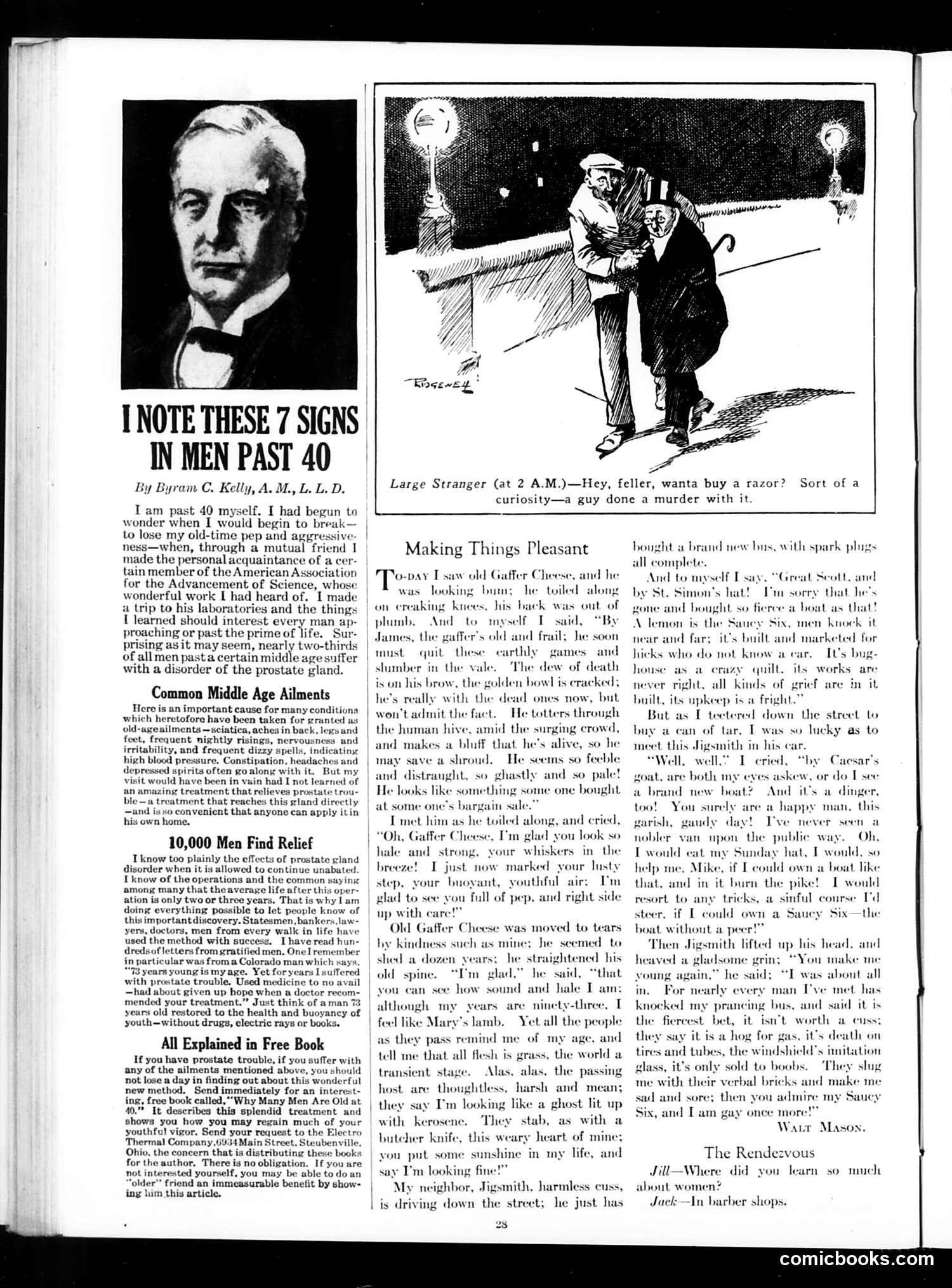
This Judge magazine page contains two distinct pieces: **Left side:** An advertisement disguised as editorial content about prostate gland disorders in middle-aged men. It promotes a mail-order "treatment" (likely ineffective) to men over 40, claiming 10,000 men found relief. This reflects early 20th-century medical advertising that exploited male anxieties about aging. **Right side cartoon:** A satirical sketch titled "Large Stranger (at 2 A.M.)" depicts a suspicious nighttime encounter where a stranger tries to sell a razor to someone, mentioning it was used in a murder. It's dark humor mocking street hustlers and shady late-night transactions. **Below:** "Making Things Pleasant" is a sentimental story-poem about a narrator encouraging an aging man (Gaffer Cheese) to stay positive despite his decline. It contrasts with the advertisement's fear-mongering by suggesting optimism helps aging men maintain vitality. The page juxtaposes commercial manipulation of male vulnerability with literary sentimentality—revealing contradictory cultural attitudes toward aging.
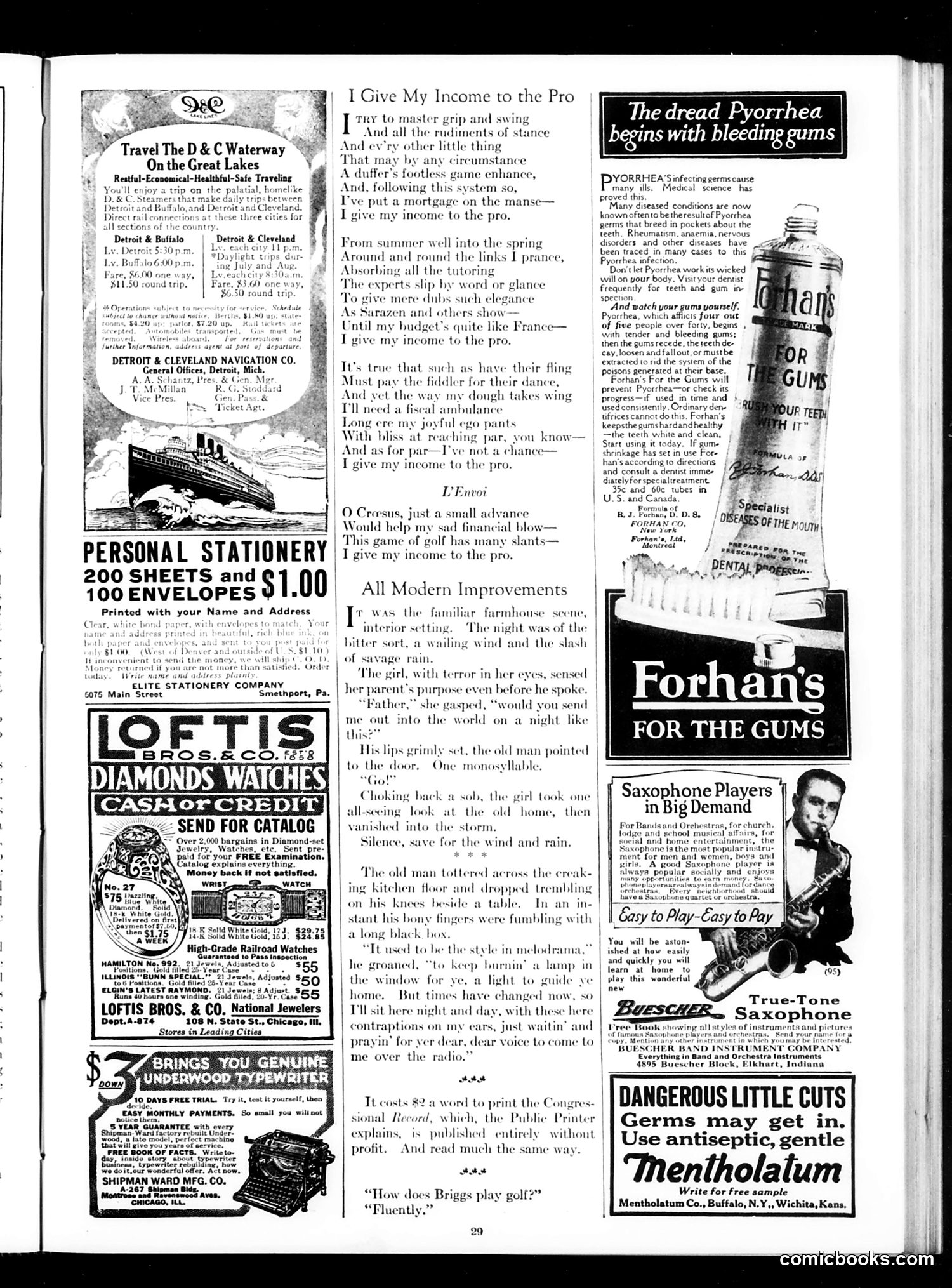
This page is primarily **advertising and light verse**, not political satire. The main text piece, "I Give My Income to the Pro," is a humorous poem about golf obsession. It satirizes wealthy golfers who waste their fortunes on expensive golf lessons and club memberships—the "pro" refers to professional golf instructors. The speaker mortgage his house ("put a mortgage on the manse") to pay for coaching, becoming financially ruined while still unable to break par. The joke targets the nouveau riche's wasteful spending on leisure pursuits and their gullibility to paid "experts." The surrounding content is period advertising: stationery, watches, jewelry, saxophones, dental products, typewriters, and steamship travel—typical 1920s-30s magazine filler. A short story excerpt about a melodramatic domestic scene appears but lacks clear satirical intent. The page reflects early 20th-century consumer culture and masculine pursuits like golf, but contains no significant political commentary or caricature worthy of historical note.
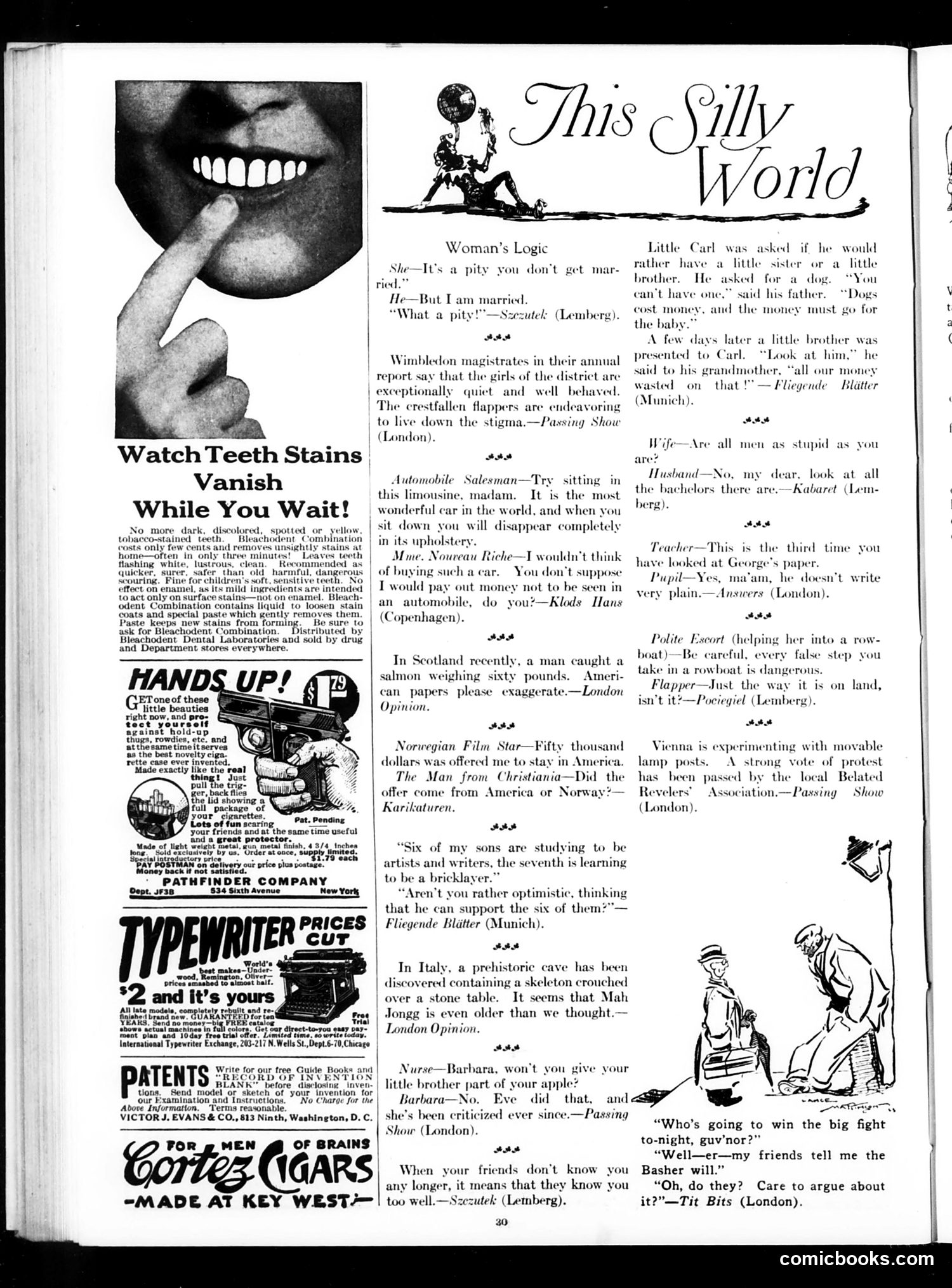
This page from *Judge* magazine contains humorous short jokes and advertisements, not political cartoons. The content consists of brief, international comic anecdotes—most sourced from European publications like *Fliegende Blätter* (Munich) and *London Opinion*—presenting everyday social observations and wordplay. The jokes target familiar targets: the illogic of romantic relationships ("Woman's Logic"), the foolishness of automobile salesmen, and generational behavior (flappers trying to escape a reputation for being "quiet and well behaved"). One joke mocks exaggerated newspaper reporting about Scottish fishing catches. Another satirizes modern crazes—mahjong is joked to be "even older than we thought." The humor is genteel and domestic rather than political, reflecting the magazine's satirical approach to middle-class social behavior and contemporary trends. The advertisements (Bleachodent toothpaste, typewriters, cigars) occupy significant space alongside the editorial content.
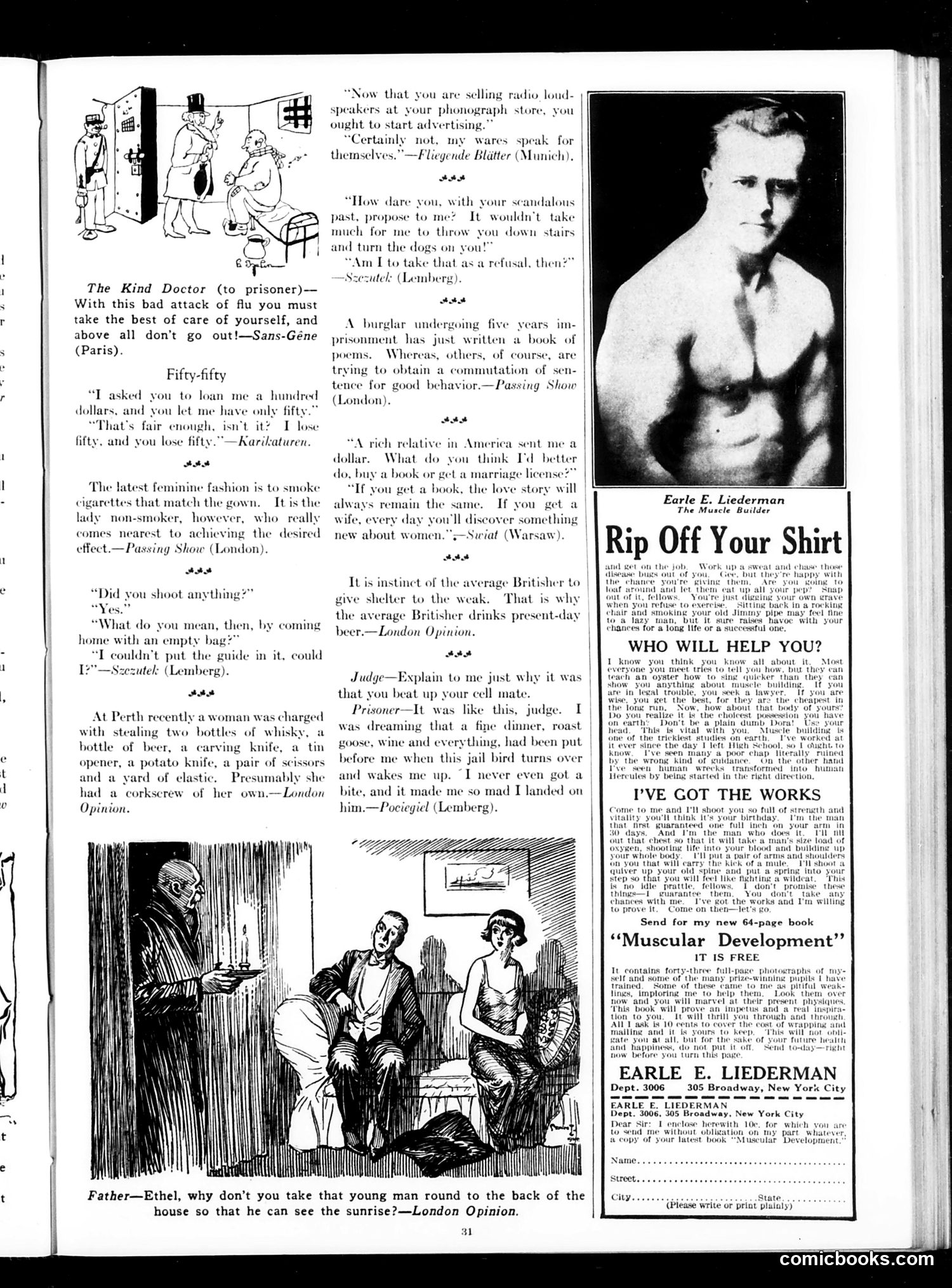
This page contains **satirical short jokes** drawn from international sources (Paris, Munich, London, Warsaw, Lemberg) rather than American political cartoons. The humor relies on wordplay and social observations typical of 1920s-era magazines: - A doctor tells a flu patient not to go out; the prisoner jokes he already can't - A woman steals household items including a corkscrew, implying she's a habitual thief - A hunter returns with an empty bag because he "couldn't fit the guide in it" (dark humor about accidentally shooting someone) - A man proposes to a woman with a scandalous past; she threatens violence, then asks if that's a "no" - A burglar writes poetry to get sentence commutation - Commentary on gender and consumer behavior (women smoking matching cigarettes, marriage vs. books) The page also features a **Earle E. Liederman advertisement** for bodybuilding courses—typical of the era's mail-order self-improvement marketing—depicting a muscular man and promising a free book on "Muscular Development." The cartoons reflect pre-WWII European sensibilities about crime, courtship, and social propriety.
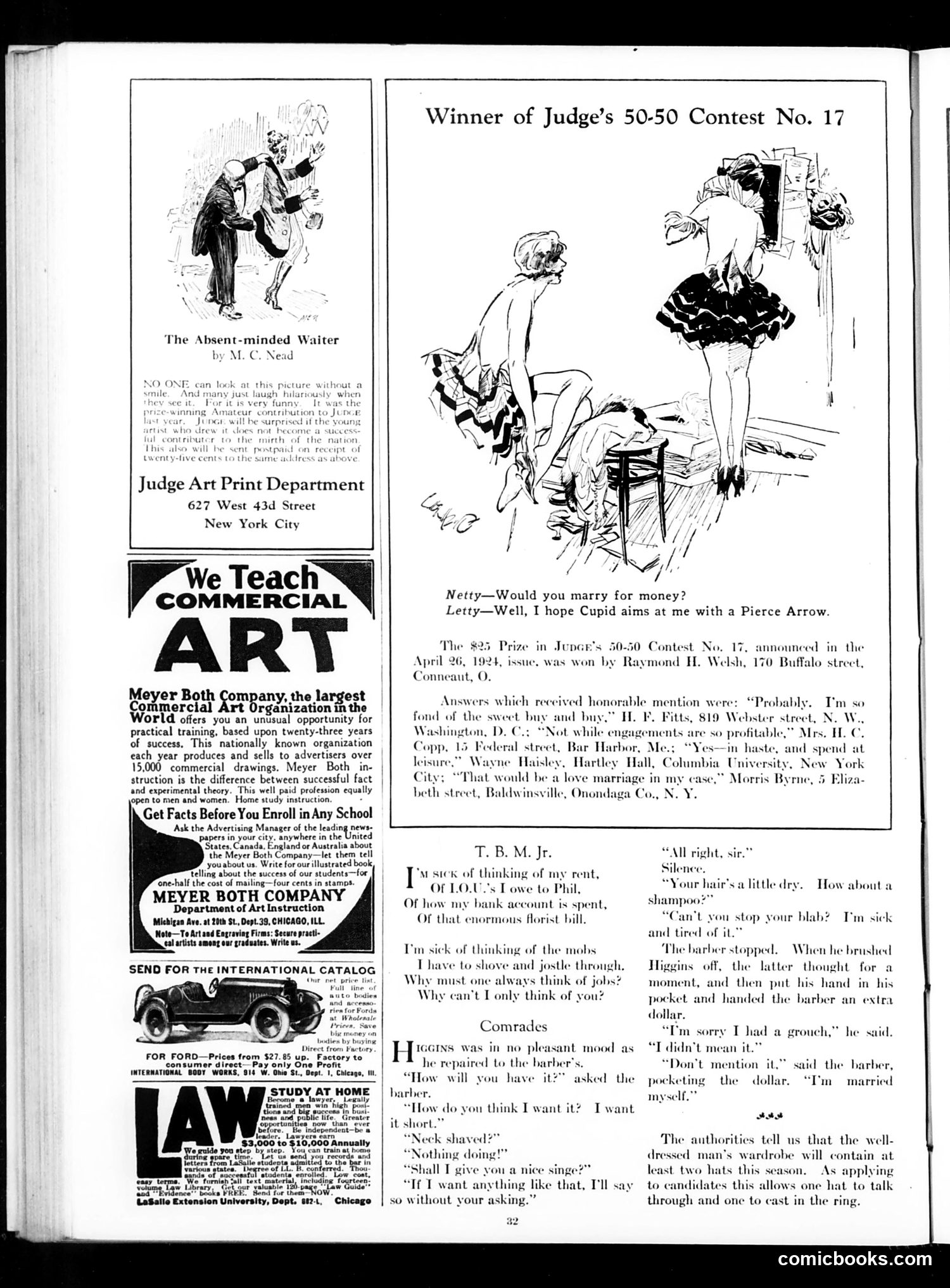
This page mixes humor content with advertising. The main cartoon "The Absent-minded Waiter" (left) depicts a server's mishap—likely spilling or mishandling something—with the caption emphasizing comedic obliviousness. The winning cartoon for Judge's 50-50 Contest No. 17 shows two women discussing marriage: one asks if the other would marry for money; the response jokes that she hopes "Cupid aims at me with a Pierce Arrow"—a luxury car brand. The humor plays on materialism: she's equating romantic love with wealth/status symbols. The page also includes two short humorous pieces: "T.B.M. Jr." laments urban living costs and romantic longing, while "Comrades" depicts a barber-customer exchange where a grouchy customer eventually reconciles by tipping extra. The remainder is advertising for commercial art training, Ford automobiles, and law school correspondence courses—typical Judge magazine filler designed to fund the publication.
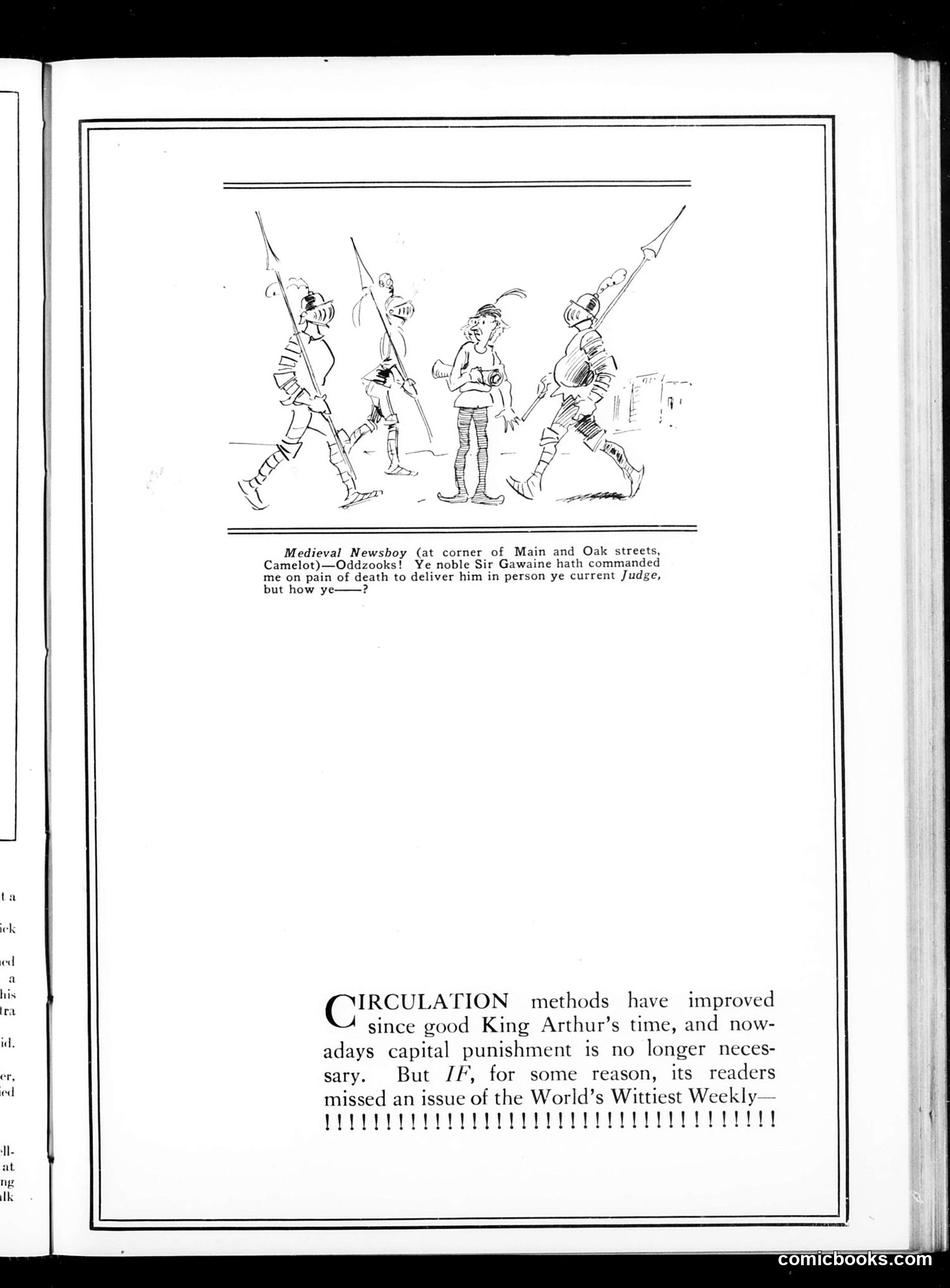
This satirical cartoon depicts a medieval newsboy at a street corner in Camelot, confronted with an impossible task: Sir Gawaine has ordered him under pain of death to deliver the current issue of **Judge magazine** to him in person—a humorous anachronism placing a 19th-century American humor publication in King Arthur's legend. The joke operates on multiple levels: it's self-promotional advertising for Judge (calling itself "the World's Wittiest Weekly"), while satirizing circulation problems. The accompanying text jokes that modern circulation methods have improved since medieval times, making capital punishment unnecessary—**except** if readers miss an issue of Judge, implying the magazine is so essential that failure to receive it should be a death-worthy offense. The four armed knights gesturing frantically visualize the desperate impossibility of the newsboy's medieval predicament, emphasizing the comic absurdity of trying to distribute a modern magazine in a historical setting.
This is a full-page advertisement for *Film Fun*, a movie magazine. The ad uses playful, colloquial language ("Lotsa information") to appeal to casual readers interested in cinema. The pitch emphasizes entertainment value: humor, photographs, and movie information. The ad's rhetorical strategy—"Are you reading the best movie magazine or are you missing"—creates competitive tension, implying *Film Fun* is superior to competitors. At 20 cents per copy, it targets a mass audience. The July issue announcement suggests this ad appeared in a June issue of *Judge* magazine, using one publication to cross-promote another. The tone reflects 1920s-30s advertising style: informal, direct, and emphasizing visual content alongside text—reflecting the era's growing film industry and magazine culture.

I can see this appears to be a blank or nearly blank page from Judge magazine, with only minimal content visible - primarily what looks like a binding edge on the left side and some faint marks. The page contains no clearly legible text, cartoon illustrations, or advertisements that I can reliably read or interpret. Without being able to see substantive content, images, captions, or readable text on this particular page, I cannot accurately identify figures, explain satirical references, or convey the intended meaning to a modern reader. This may be a title page, a blank separator page, or a page where the image quality or scanning has rendered the content illegible. To provide accurate historical context, I would need a page with clearly visible cartoon artwork or readable text.