
Judge, 1924-06-07 · page 17 of 37
Judge — June 7, 1924 — page 17: what you’re looking at
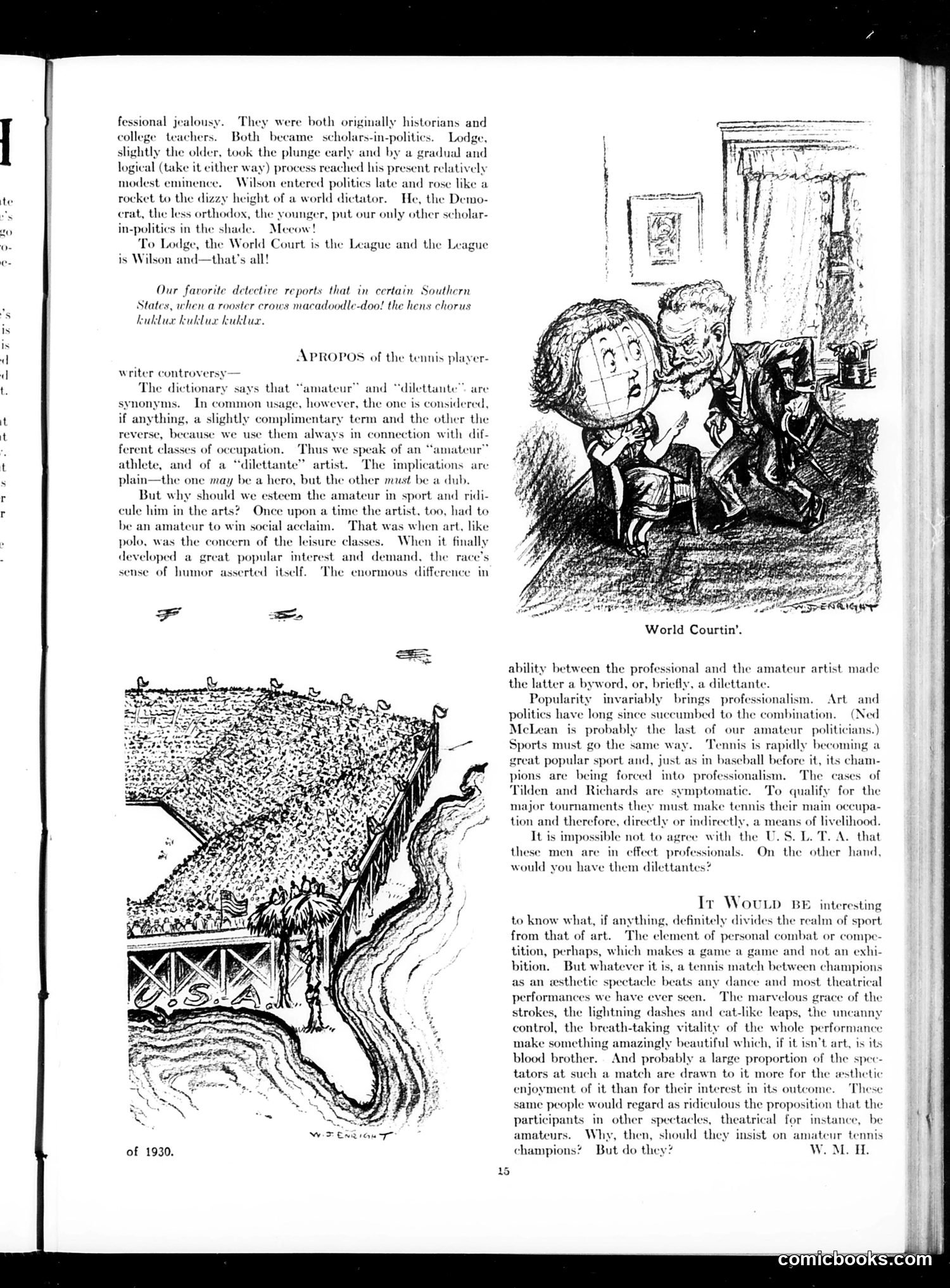
What you’re looking at
This page contains two distinct pieces of satire: **"World Courtin'" cartoon** (top right): Depicts figures in what appears to be a heated debate. The text references Senator Lodge versus President Wilson over the League of Nations and World Court. The satire mocks Lodge's obsessive conflation of these entities—to him, they're all the same thing, all Wilson's doing. This reflects 1920s Republican isolationist opposition to American international entanglement post-WWI. **Tennis amateur/professional debate** (main text): The article discusses whether tennis players like Tilden and Richards should be considered professionals despite claiming amateur status. It draws a parallel to how "amateur" artists were once respected but became dismissed as "dilettantes" once art professionalized. The satire argues sports inevitably follow this same trajectory as they gain popularity. The point: society celebrates amateur status in sports while despising it in arts—an arbitrary and hypocritical distinction that will collapse as tennis becomes a major professional sport.
📄 Transcribed text from this page (OCR, searchable)
Machine-transcribed from the original scan — historical spelling and the odd misread are preserved.
fessional j They were both originally historians and lege Both became scholars-in-politics. Lodge, itly the older, took the plunge early and by a gradual and logical (take it either way) process reached his present relatively modest eminence. Wilson entered politics late and rose like a rocket to the dizzy height of a world dictator. He, the Demo- crat, the less orthodox, the younger, put our only other scholar- in-politics in the shade. Mecow! To Lodge, the World Court is the League and the League is Wilson and—that’s all! lousy. teachers. sli Our favorite detective reports that in certain Southern States, when a rooster crows macadoodle-doo! the hens chorus Kullu kuklue kukluc. APROPOS of the tennis player- writer controversy — The dictionary says that “amateur” and “dilettant synonyms. In common usage, however, the one is considered, if anything, a slightly complimentary term and the other the reverse, because we use them always in connection with dif- ferent classes of occupation. Thus we speak of an “ athlete, and of a “dilettante” artist. The implications are plain—the one may be a hero, but the other must be a dub. But why should we esteem the amateur in sport and ridi- cule him in the arts? Once upon a time the artist, too, had to be an amateur to win social acclaim. That was when art, like polo, was the concern of the | When it finally developed a great popular inte and, the race's sense of humor asserted itself. The enormous difference in mateur” sure classes and dev of 1930. 1S EAE RRIGQne World Courtin’. ability between the professional and the amateur artist made the latter a byword, or, briefly, a dilettante. Popularity invariably brings professionalism. Art and politics have long since succumbed to the combination. (Ned McLean is probably the last of our amateur politicians.) Sports must go the same way. ‘Tennis is rapidly becoming a great popular sport and, just as in baseball before it, its cham- pions are being forced into professionali Tilden and Richards are symptomatic. sm. The cases of To qualify for the major tournaments they must make tennis their main occupa- tion and therefore, directly or indirectly, a means of livelihood. It is impossible not to agree with the U.S. L.T. A. that these men are in cffect professionals. On the other hand, would you have them dilettantes? Ir WoULp BE interesting to know what, if anything, definitely divides the realm of sport from that of art. tition, perhaps, which makes a game a game and not an exhi- bition. But whatever it is, a tennis match between champions as an aesthetic spectacle beats any dance and most theatrical performances we have ever The marvelous grace of the strokes, the lightning dashes and cat-like leaps, the uncanny control, the breath-taking vitality of the whole performance make something amazingly beautiful which, if it isn’t art, is its blood brother. And probably a large proportion of the spec- tators at such a match are drawn to it more for the etic enjoyment of it than for their interest in its outcome. These same people would regard as ridiculous the proposition that the participants in other spectacles, theatrical for instance, be amateurs. Why, then, should they insist on amateur tennis champions? But do they? W. M. The element of personal combat or compe- pen.